Introduction
The quantification of habitability is an open and active area of research. Currently, three schools can be distinguished: the astrobiological focuses on the most basic premises for abiogenesis (origin of life)-biogenesis (life evolution) to occur anywhere in the universe, the biogeochemical pays more attention at biogeochemical cycles and the availability of physical magnitudes such as energy or power, while the ecological (biological) is more concerned with the interactions between species in the ecosystem (Shock and Holland, Reference Shock and Holland2007; Cardenas, Reference Cardenas2017). These approaches could be seen as complementary, but actually, not much effort is done to enhance feedbacks, although some attempts are underway (Shock and Holland, Reference Shock and Holland2007; Cardenas, Reference Cardenas2017).
One issue currently argued is the problem of spatial-temporal scales. However, Quantitative Habitability Theory (QHT), born inside the astrobiological community, is scalable in space and time. In this paper, we use tools of QHT to devise a new version of our Aquatic Primary Habitability (APH) index (Cardenas et al., Reference Cardenas, Pérez-Díaz, Martínez-Frias and Martín-González2014; Cardenas, Reference Cardenas2017) to apply for the first time to freshwater ecosystems under perturbations of their optical quality. Then we embed the index in an ecological model of trophic levels, a phytoplankton–zooplankton dynamics which we modified from Ferrero et al. (Reference Ferrero, Eory, Ferreyra, Schloss, Zagarese, Vernet and Momo2006). This traces a clear connection from the astrobiological to the ecological schools of quantitative habitability, showing that ecosystem spatial and temporal scales can be addressed from the starting point of QHT.
Thus, we present a new methodology to model the dynamics of freshwater ecosystems after perturbations of their optical quality. Although the main objective is to outline the methodology rather than realism, initial steps for parameterization and application are directed towards the Riñihue lake which belongs to Araucanian Lakes District in South-central Chile (Thomasson, Reference Thomasson1963). In the case of Chile, this methodology is relevant because in the country there is insufficient data to evaluate the state of water resources, mainly in lake systems. The existing monitoring network only considers 14 of the 375 lakes with larger areas of 3 km2 (MMA 2014), so exists little understanding and information on continental aquatic ecosystems. Of course, the proposed methodology is applicable to lacustrine systems elsewhere in the planet, as it is based on general theoretical foundations.
Materials and methods
The main postulate of QHT is that habitability indexes HI can be devised as a product of n functions f i({x j}), which are dependent on sets {x j} of the main environmental variables influencing life (Mendez, Reference Mendez2010):
 $$\hbox{HI} = \prod\limits_{i = 1}^n {\,f_i} \{ x_j\}, $$
where n is positive integer number. For the sake of interpretation, habitability indexes are usually normalized in the range {0–1}, where 0 means a dead environment and 1 is the optimum for life. Another crucial aspect of QHT is that a correctly devised habitability index can be used to estimate the net primary productivity NPP of a given ecosystem through:
 $$\hbox{NPP} = \hbox{HI} \times \hbox{NP}\hbox{P}_{\max}, $$
where NPPmax is the maximum possible net primary productivity. In this work, we use the general formalism for devising habitability indexes described in Cardenas et al. (Reference Cardenas, Pérez-Díaz, Martínez-Frias and Martín-González2014; Reference Cardenas2017), which concludes that a primary aquatic habitability index for a photosynthetically dominated ecosystem in principle can be formulated as:
 $$\hbox{APH} = f\,(L)f\,(N)f\,(T),$$
where f(L), f(N) and f(T) are functions of light, nutrients and temperature, respectively. All these functions can be normalized to be in the range {0 − 1}. In Cardenas et al. (Reference Cardenas, Pérez-Díaz, Martínez-Frias and Martín-González2014; Reference Cardenas2017) two particular versions of this index were devised and applied. However, those versions were applied to oceanic and coastal environments. In this work, we apply APH for the first time to freshwater ecosystems, specifically lakes and thus we propose another particular version of this index.
Results and discussion
The third version of APHIII considers the function of limiting nutrient f(N) as a classical Michaelis–Menten kinetics:
 $$f\,(N) = \displaystyle{{v_{\max} [N]} \over {K_{1/2} + [N]}},$$
with v max being the maximum speed of (phytoplankton) nutrient uptake, K 1/2 the half-saturation constant and [N] the concentration of limiting nutrient. The function of temperature f(T) is (Volk, Reference Volk1987):
 $$f\,(T) = 1 - \left( {\displaystyle{{T_{{\rm opt}} - T} \over {T_{{\rm opt}} - 273}}} \right)^2,$$
where T opt is the optimum temperature for (photosynthetic) aquatic primary producers and T is the temperature.
The most complex part of APHIII is the radiational one. We propose a function of light f(L) which treats photosynthetically active radiation (PAR) as in the E model for photosynthesis (Fritz et al., Reference Fritz, Neale, Davis and Pelloquin2008) and UV radiation as in Ferrero et al. (Reference Ferrero, Eory, Ferreyra, Schloss, Zagarese, Vernet and Momo2006), but extending it through the water column using Lambert–Beer's law of Optics:
 $$f\,(L) = \displaystyle{{1 - \exp [ - E_{{\rm PAR}}(z)/E_s]} \over {1 + (E_{{\rm UV}}(z))/(B)}},$$
where E PAR(z) stands for PAR irradiance at depth z, E S is a parameter measuring the efficiency of the species in the use of PAR, E UV(z) is the irradiance of ultraviolet radiation and B is a parameter measuring the UV inhibition of photosynthesis.
The spectral irradiances down the water column can be calculated using the Lambert–Beer's law of Optics:
 $$E({\rm \lambda}, z) = E({\rm \lambda}, 0^ - )\exp [ - K({\rm \lambda} )z].$$
In the above equation, K(λ) is the wavelength-dependent attenuation coefficient. The spectral irradiances just below the surface are found substracting the reflected light from the spectral irradiances just above:
 $$E({\rm \lambda}, 0^ - ) = [1 - R]E({\rm \lambda}, 0^ + ),$$
where R is the reflection coefficient of the water surface, which can be found using the Fresnel formulae applied to the interface air–water. Its value of R depends on solar zenital angle, roughly varying between 0.02 and 0.11. The irradiances at depth z for UV and PAR bands can be found summing the spectral irradiances:
 $$E_i(z) = \sum\limits_\lambda {E({\rm \lambda}, z)} \Delta {\rm \lambda}, $$
where subscript i represents UV or PAR and Δλ is the interval for which E(λ, z) stands.
Normalization of the APH III
For APHIII to be in the range {0–1}, in this work each of its component functions is normalized. For each function, this is usually done dividing by the function evaluated at some situation considered optimum, unless other considerations prevail.
For f(T) normalization is not necessary, as it already takes the maximum value f(T) = 1 for T = T opt and the minimum f(T) = 0 for T = 273 and T = 2T opt – 273. Outside the range T = {273-(2T opt–273)}, f(T) takes unphysical negative values which are discarded.
For f(N), we took into consideration that it asymptotically tends to v max, which is the optimum, so the normalized function yields:
 $$f\,(N) = \displaystyle{{v_{\max} [N]/K_{1/2} + [N]} \over {\nu _{\max}}} = \displaystyle{{[N]} \over {K_{1/2} + [N]}}$$
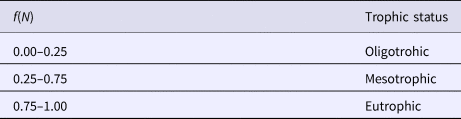
Now, for practical purposes, we propose a trophic classification according to the range of values of the function of nutrients f(N) (Table 1).
Trophic classification according to the function of limiting nutrient f(N)

Above equation goes from 0 (for [N] = 0) to 1 (for [N] = ∞). The average real value of f(N) for above mentioned Riñihue lake could be calculated from available data for the time period 1987–2015 (Campos et al., Reference Campos, Steffen, Aguero, Parra and Zúñiga1987; Campos et al., Reference Campos, Hamilton, Villalobos, Imberger and Javam2001; Woelfl et al., Reference Woelfl, Villalobos and Parra2003), but as we intend to focus on the radiational side in this modelling, we just set f(N) = 0,2; which from the mathematical point of view means K 1/2 = 4[N]. Real calculation of f(N) would result in a small correction of this value, which would not affect the conclusions of this paper.
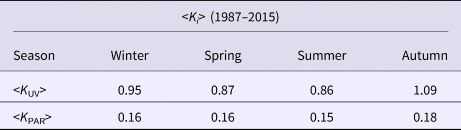
The normalization of the radiational function f(L) is much more complicated. We consider as optimum the time interval with the smallest average attenuation coefficient <K PAR> of the PAR, assuming this implies a greater photosynthetic potential. For the Riñihue lake, selecting a seasonal timescale and using measurements for the time period 1987–2015, results can be seen in Table 2:
Average light attenuation coefficient for Riñihue lake in the time series 1987–2015

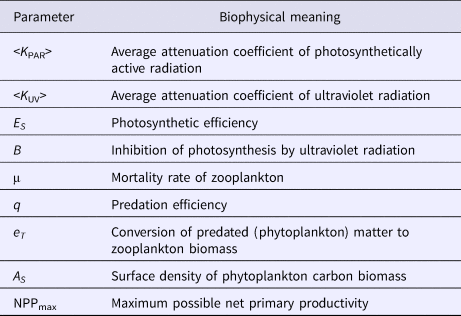
Parameters of the biophysical parameter space

Then summer turns out to be the optimum from the radiational point of view for Riñihue lake. To be consistent with that physical situation, we then took the <K UV> corresponding to this season. Despite the higher UV, we assume this is the situation with greater photosynthetic potential, as was shown in papers by some of us for open ocean and coastal ecosystems (Rodríguez-López et al., Reference Rodríguez-López, Cardenas and Avila-Alonso2014; Avila-Alonso et al., Reference Avila-Alonso, Cardenas, Rodríguez-López and Álvarez-Salgueiro2016). The selected depth to evaluate Lambert Beer's law is calculated from formulae resulting from the traditional definition of maximum photic depth z ph (Montecino, Reference Montecino1991) with the empirical formula relating Secchi depth z S with <K PAR>:
 $$z_{\,ph} = \displaystyle{{4.6} \over {\langle K_{{\rm PAR}}\rangle}} $$
 $$z_s = \displaystyle{2 \over {\langle K_{{\rm PAR}}\rangle}} $$
Combining above two formulae:
 $$z_{\,ph} = 2.3z_S$$
We then chose the intermediate photic zone depth:
 $$z = \displaystyle{{z_{\,ph}} \over 2} = 1.15z_S$$
Then the average <APHIII> can be estimated as:
 $$\langle \hbox{AP}\hbox{H}_{{\rm III}}\rangle = \langle f\,(L)\rangle \langle f\,(N)\rangle \langle f\,(T)\rangle $$
The phytoplankton–zooplankton dynamics
We follow the dynamics of algae modifying the model in Ferrero et al. (Reference Ferrero, Eory, Ferreyra, Schloss, Zagarese, Vernet and Momo2006), neglecting circulation. This is applicable to stratified lakes. We additionally propose a more comprehensive way of estimating biological primary productivity. This is done by introducing average net primary production <NPP> in the photic zone estimating it using an averaged version of equation (1):
 $$\langle \hbox{NPP}\rangle = \langle \hbox{AP}\hbox{H}_{{\rm III}}\rangle \hbox{NP}\hbox{P}_{\max} $$
Then the dynamics phytoplankton–zooplankton is described by:
 $$\displaystyle{{dA} \over {dt}} = A\left[ {\displaystyle{{\langle \hbox{NPP}\rangle} \over {A_S}} - qH} \right],$$
 $$\displaystyle{{dH} \over {dt}} = H[e_TqA - {\rm \mu} ],$$
where A and H are biomass (volumetric) densities of phytoplankton and zooplankton, respectively; μ is the mortality rate of zooplankton, q is predation efficiency, while e T is the transformation efficiency, i.e., conversion efficiency of predated (phytoplankton) matter to zooplankton biomass. For the sake of dimensional homogeneity, it was introduced the (surface) density of phytoplankton carbon biomass A S.
The biophysical parameter space
From the above equations it turns out that the model depends on the biophysical parameter space:
 $$p = \{ \langle K_{{\rm PAR}}\rangle, \langle K_{{\rm UV}}\rangle, E_S,B,{\rm \mu}, q,e_T,A_S,\hbox{NP}\hbox{P}_{\max} \}. $$
It can be split in optical, bio-optical and biological parameter subspaces:
 $$p_{{\rm opt}} = \{ \langle K_{{\rm PAR}}\rangle, \langle K_{{\rm UV}}\rangle \} $$
 $$p_{{\rm bio} - {\rm opt}} = \{ E_S,B\} $$
 $$p_{\rm bio} = \{ {\rm \mu}, q,e_T,A_S,\hbox{NP}\hbox{P}_{\max} \} $$
For the sake of clarity, below we include Table 3 with the biphysical meaning of each parameter of equation (19).
Perturbations of the optical quality mean to perturb the optical parameter space, that is, to vary the parameters <K PAR> and <K UV>, which would act as control parameters in the dynamical systems analysis of the system of differential equations (17) and (18). For it, the critical points are:
 $$\lpar {A_1^{\ast}, H_1^{\ast}} \rpar = (0,0),$$
 $$\lpar {A_2^{\ast}, H_2^{\ast}} \rpar = \left( {\displaystyle{{\rm \mu} \over {qe_T}},\displaystyle{{\langle \hbox{NPP}\rangle} \over {qA_S}}} \right),$$
which are consistent with those found in Ferrero et al. (Reference Ferrero, Eory, Ferreyra, Schloss, Zagarese, Vernet and Momo2006), after neglecting circulation and introducing our model for net primary productivity. As in the previous reference, we focus on the second (non-trivial) point. The eigenvalues of the Jacobian matrix are:
 $$\lambda _{1,2} = \pm i\sqrt {\displaystyle{{{\rm \mu} \langle \hbox{NPP}\rangle} \over {A_S}}} $$
The two eigenvalues are a conjugated pair, which implies the presence of oscillations of the biomass densities of phytoplankton and zooplankton, looking like a classical Lotka Volterra dynamics. However, the detailed stability analysis of this model goes beyond the aims of the present paper and shall be presented in a forthcoming one, which will also include vertical mixing to extend potential applications to non-stratified lakes with active vertical mixing and thus a highly variable PAR and UV doses for plankton.
Conclusions
We outlined a methodology to investigate how robust freshwater ecosystems are to perturbations of their optical quality. It incorporates ideas from the astrobiological school to model habitability, specifically QHT to devise habitability indexes and then embed the proposed index in an ecological model of trophic levels. The above mentioned habitability index is a new version of our APH index, devised by some of us and formerly applied to saltwater ecosystems (both ocean and coastal), now directed to freshwater ecosystems (lakes). All this shows the applicability of QHT to spatial-temporal scales typical in ecological studies, showing a useful bridge between Astrobiology and Ecology.
In a forthcoming publication some refinements of this methodology will be presented and its applications to case studies.
Acknowledgements
Lien Rodríguez and Lisdelys González acknowledge CONICYT (Chile) for PhD grants. Roberto Urrutia and Oscar Parra acknowledge CRHIAM /CONICYT/FONDAP/15130015. Osmel Martin acknowledges Universidad Central ‘Marta Abreu’ de Las Villas (UCLV) for financial support. Rolando Cardenas acknowledge both UCLV and the University of Concepción (Chile) for financial support.