1. Introduction
This study investigated whether and how pre-adolescent girls style-shift in Multicultural London English (MLE), a variety of English that is relatively new and potentially still changing. We looked at the extent to which five 11-year-old girls in a homework club in East London, where MLE is spoken, changed their pronunciations in different speech contexts. The results showed that the girls did indeed change their pronunciations in the different contexts (i.e. they style-shifted), and that the patterns of style-shifting varied between both the individual participants and the three vowels which were examined.
1.1 What is style-shifting?
Style-shifting is the phenomenon of speakers changing how they speak according to the social context in which they are talking. We all style-shift – ‘there are no single style speakers’ (Labov, Reference Labov1972b: 112) – to a greater or lesser extent, depending on the speech registers we are competent in using. Labov's (Reference Labov1972a) foundational work on style explained these shifts as a consequence of attention paid to speech: in more formal contexts, when the speaker is more conscious of how they are speaking, their speech is more standard; whereas in less formal situations, when the speaker is less self-conscious, it is claimed that their speech reverts to its natural state – known as that speaker's vernacular. More recent work has added greater nuance to our understanding of style-shifting, moving away from the notion of a single informal-formal speech style continuum. It has been shown that speakers’ style-shifting can be motivated by whom they are talking to (Rickford & McNair–Knox, Reference Rickford, McNair–Knox, Biber and Finegan1994); their intended audience (e.g. Bell, Reference Bell, Eckert and Rickford2001); or the persona they wish to project (e.g. Podevsa, Reference Podesva2007). Research on multidialectal speakers has further highlighted that speakers show personal agency in commanding a repertoire of speech styles (Sharma, Reference Sharma2011, Reference Sharma2018; Sharma & Rampton, Reference Sharma and Rampton2015).
Further research has shown that children style-shift too. For example, Lanza (Reference Lanza1992) found that a bilingual two-year-old adopted a monolingual mode with one parent, and codeswitched with the other, in a way that mirrored how each parent spoke to her. Smith, Durham and Richards (Reference Smith, Durham and Richards2013) found that caregivers of children aged between two years ten months and four years two months used higher rates of dialectal features when engaging in less formal activities such as routine and play, and lower rates of dialectal features when engaging in teaching and discipline, thus copying the style-shifting behaviour of their caregivers. It has also been shown that 11-year-old school boys in Edinburgh used the vernacular variants of (t) and (ing) the most when playing with their friends in the playground, less in a one-to-one interview with an adult, and less still when reading aloud (Reid, Reference Reid and Trudgill1978). Relatedly, Eckert suggests that it is at around this age – pre-adolescence – that girls begin engaging in ‘the production of style’ (Reference Eckert, Warner, Ahlers, Bilmes, Oliver, Wertheim and Chen1996: 3), both linguistically and in other domains, which is relevant to our own study investigating pre-adolescent girls.
However, all of the above studies have focussed on stable language varieties and stable sociolinguistic variables, such as (ing) (Hazen, Reference Hazen and Brown2005). Less is known about children's style-shifting when language change is still in progress, which is the focus of the current study. Moreover, with the exception of Lanza (Reference Lanza1992), the above studies looked at children growing up in monolingual, monodialectal environments.
The current study is an important departure from this trend, in that the children who are the focus of this research were growing up in a highly diverse, multilingual environment in London, acquiring a language variety, MLE, which is thought to still be undergoing change (Cheshire et al., Reference Cheshire, Kerswill, Fox and Torgersen2011). Indeed, London is one of the most linguistically diverse cities in the UK and perhaps the world. Around 20% of people report a main language other than English, compared to 9% nationally (Census Information Scheme, 2013). In highly multilingual areas of inner London, such as Hackney, where the data for this study were collected, the majority of children grow up immersed in numerous dialects and languages, and in cases where English is not spoken in the home, English is acquired from peers upon school entry (Cheshire et al., Reference Cheshire, Kerswill, Fox and Torgersen2011). Meanwhile, the Cockney speakers who used to inhabit these traditionally monolingual working-class areas of inner London are currently moving out of the city to rural Essex. This means that MLE is replacing Cockney as the English vernacular variety of East London (Cheshire et al., Reference Cheshire, Kerswill, Fox and Torgersen2011; Fox, Reference Fox2015).
Cheshire et al. describe MLE as a ‘repertoire of features’ (Reference Cheshire, Kerswill, Fox and Torgersen2011: 154), where there is a considerable amount of dialectal variation between speakers; and at the same time, these authors suggest that MLE has the status of the ‘unmarked Labovian “vernacular”’ for some speakers (Reference Cheshire, Kerswill, Fox and Torgersen2011: 153), i.e. their default way of speaking. Yet, we cannot know what a speaker's default way of speaking is if the data only comes from one speech context, such as an interview, which is how the data for Cheshire et al. (Reference Cheshire, Kerswill, Fox and Torgersen2011) were collected. The current study investigates how this ‘repertoire of features’ is implemented in style-shifting in a particular group of pre-adolescent girls in Hackney, with data collected in diverse contexts from the classroom to the playground.
1.1 Diphthong changes in MLE
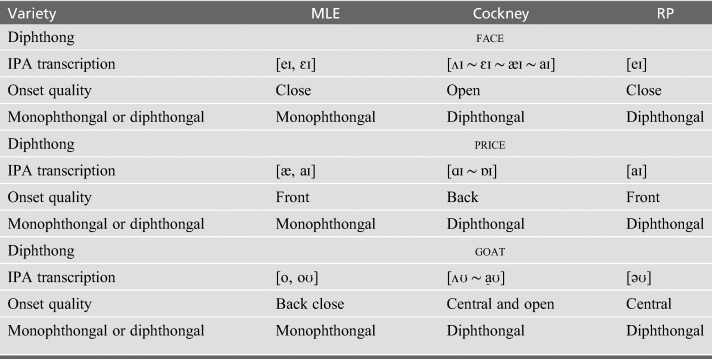
Diphthongs were the linguistic variables chosen for the current study because they are supposed to be the most salient features of MLE (Kerswill. Torgersen & Fox, Reference Kerswill, Torgersen and Fox2008; Cheshire et al., Reference Cheshire, Kerswill, Fox and Torgersen2011). A diphthong is a vowel that shows a change in vowel quality over time between its start and finish. For many speakers of English, the vowels in words such as face, price, choice are diphthongs, whereas the vowels in words such as trap, start, kit, dress do not show a change in vowel quality, and are known as monophthongs. The first vocalic element in a diphthong (e.g. the [e] in the face diphthong) is often referred to as the onset, and the second vocalic element is often referred to as the offset (e.g. the [ɪ] in the face diphthong). The differences between MLE, Cockney and Received Pronunciation (RP) diphthongs are summarized in Table 1 – Cockney being the variety of English that would, until recently, have been the most commonly spoken in Hackney. In MLE, the diphthongs face and price have onsets that are more similar to the RP ones than to the Cockney ones. The onset of the goat diphthong is similar to neither the RP nor the Cockney diphthong, and is more back. This means that MLE shows a goat change that is different from the rest of the southeast of England, which shows fronting of the offset of goat, known as goat-fronting (Kerswill & Williams, Reference Kerswill and Williams2000). Moreover, in MLE, these diphthongs are also becoming more monophthongal – i.e. they are actually losing their offsets.
Summary of differences between face, price and goat in MLE, Cockney and RP.
(MLE values from Fox (Reference Fox2015); Cockney values from Mott (Reference Mott2012); RP values from Roach (Reference Roach2004).)

1.2 Predictions/hypotheses
Cheshire et al. (Reference Cheshire, Kerswill, Fox and Torgersen2011) have claimed that for some young people, MLE is their unmarked vernacular; however, as their study only elicited interview speech, we followed up on this claim by recording our participants in different speech contexts, following a design similar to that of Reid (Reference Reid and Trudgill1978). The children made self-recordings in the playground; they were recorded in an interview with an adult (white, female, SSBE-speaking, the first author of this paper) interviewer, with one of their friends present; and within the interview, each child also read a wordlist. Hereafter, these recording contexts will be described as playground, interview, and wordlist speech.
We predicted that the children's speech would shift towards MLE in the self-recordings, when they were playing with their friends, compared to the interview and wordlist speech (cf. Rickford & McNair–Knox, Reference Rickford, McNair–Knox, Biber and Finegan1994; Podesva, Reference Podesva2007). In the methodology of variationist sociolinguistics, wordlist speech is also predicted to show more conservative pronunciations compared to interview speech (Labov, Reference Labov1972a). However, we were not sure whether during the interview and wordlist speech, they would produce more RP-like or more Cockney-like diphthongs. As we conducted an acoustic analysis of the vowels, predictions are also given with reference to formant frequencies, i.e. first formant (F1) and second formant (F2).
A more MLE-like pronunciation of each vowel is described as:
Face
a) The onset is close (low F1)
b) The vowel is monophthongal (20% and 80% measurements are similar)
price
a) The onset is front (high F2)
b) The vowel is monophthongal (20% and 80% measurements are similar)
Goat
a) The onset is back (low F2)
b) The vowel is monophthongal (20% and 80% measurements are similar)
2. Methodology
2.1 Field site & participants
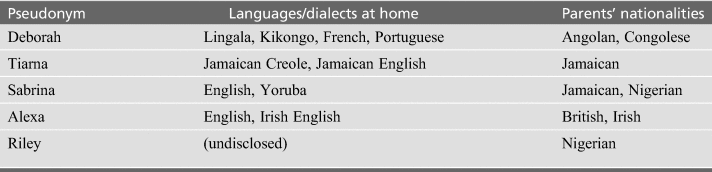
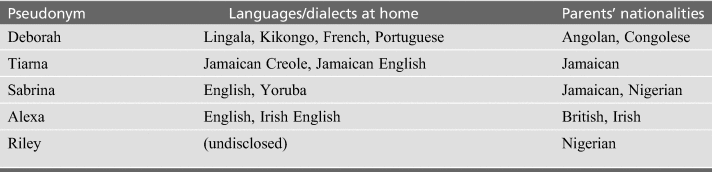
The site chosen for fieldwork was a primary school in the London borough of Hackney. The location was chosen for the sake of comparability with the existing literature on MLE (Cheshire et al., Reference Cheshire, Kerswill, Fox and Torgersen2011). The participants were five 11-year-old girls who were in their final year of primary school (Year 6). Information about the participants’ language background and parents’ nationalities is summarized in Table 2. Even though Riley's exact language and dialect use at home was undisclosed, it is known that all of the girls were multilingual and / or multidialectal at home.
Information on participants
2.2 Recordings & acoustic analysis
Recordings took place in the school in May–June 2016. These were carried out with the permission of the school and with the approval of QMUL Research Ethics Committee.
As described above, the children were recorded (1) in a sociolinguistic interview with a friend present; (2) reading a wordlist at the end of the interview; and (3) in the playground. The wordlist was the same as that used by Cheshire et al. (Reference Cheshire, Kerswill, Fox and Torgersen2011). For the interviews and wordlist, participants were recorded on a Marantz solid-state recorder, with an Audio–Technica lavalier microphone (sample rate 44,100 Hz, Bit-rate 16). The playground recordings were carried out using an H2n Zoom portable recorder, but, otherwise, the recording procedure was the same. Approximately five minutes of speech per situation per participant was extracted for the analysis (see token numbers in the Appendix). The recordings were transcribed and then analysed acoustically in Praat (Boersma & Weenink, Reference Boersma and Weenink2016), which is a software tool used for speech analysis. Measurements of F1 and F2 were taken at 20% and 80% duration points in the vowel token, to represent the onset and offset (Di Paolo, Yaeger-Dror & Wassink, Reference Di Paolo, Yaeger–Dror, Wassink, Di Paolo and Yaeger–Dror2011) and see if the diphthong was actually monophthongal.
3. Results
3.1 FACE
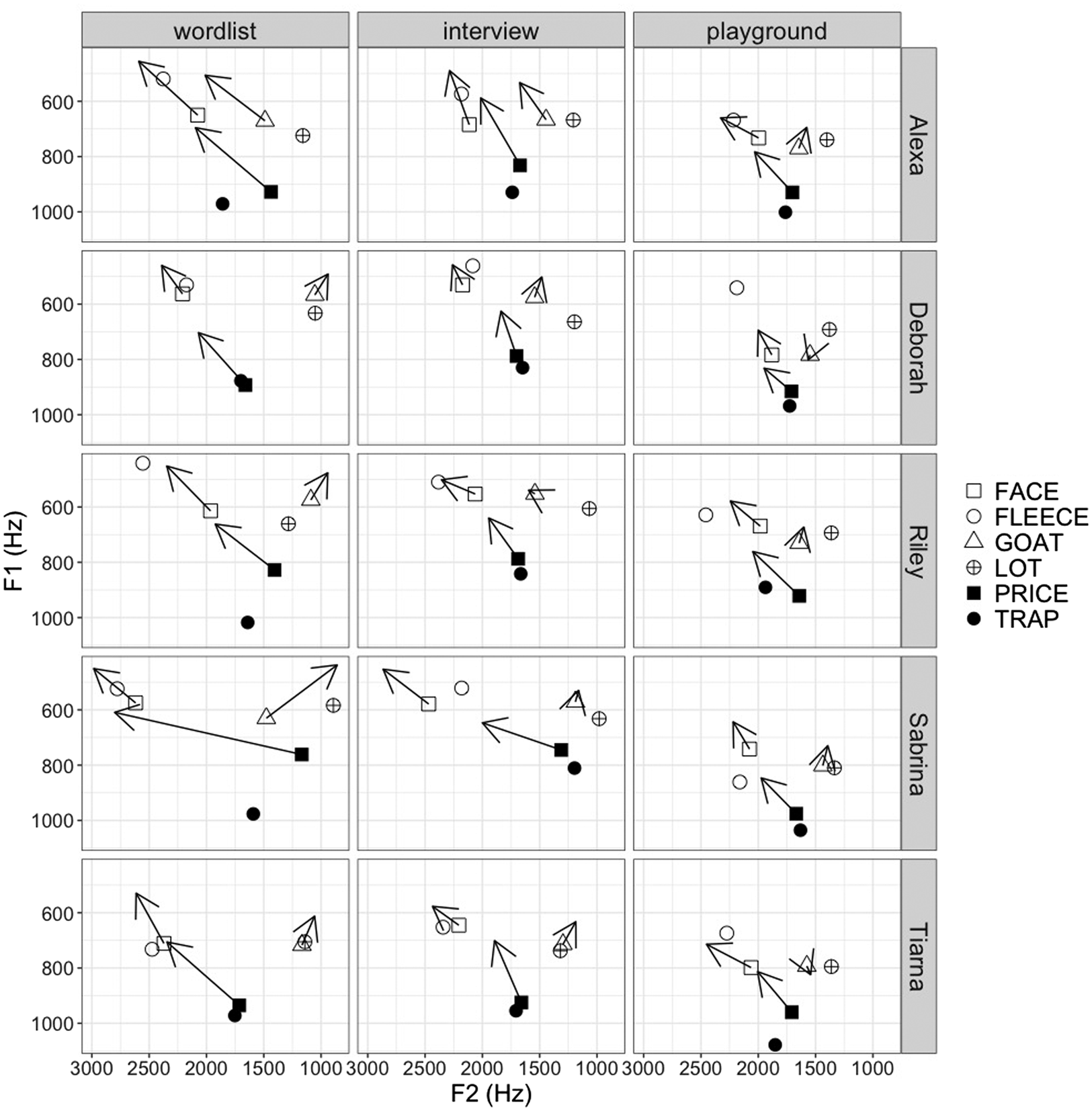
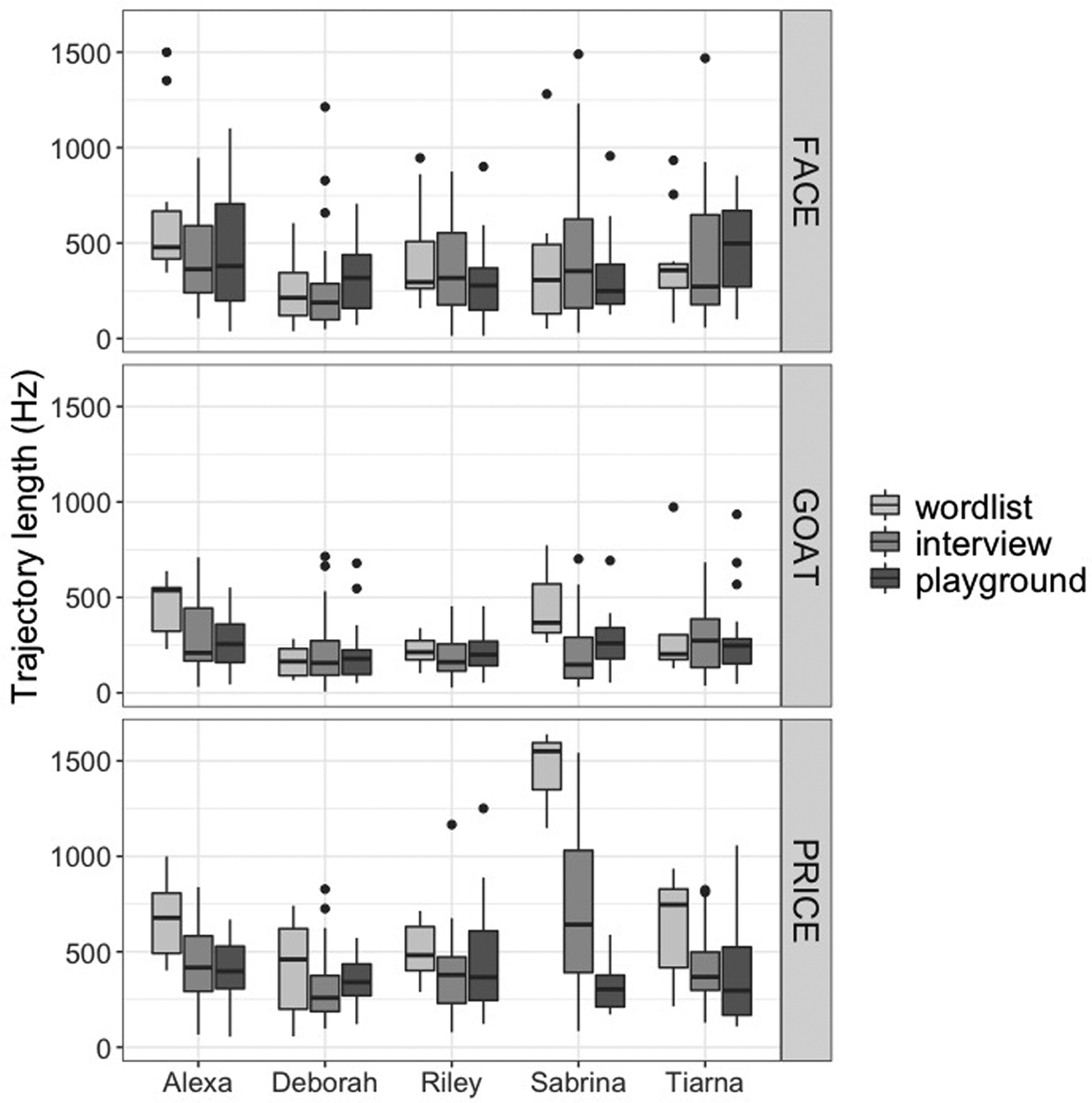
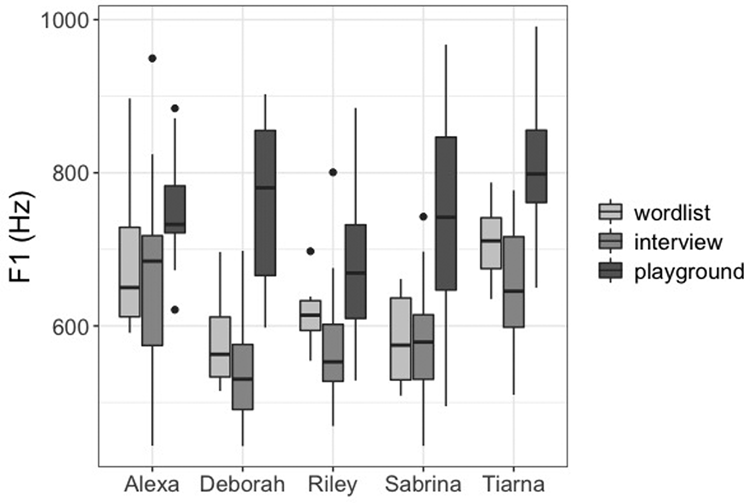
It was predicted that the girls would favour a more close and monophthongal pronunciation of face in playground speech (revealing more MLE-like speech) compared to interview and wordlist speech. Actually, the opposite was true: all of the participants favoured a more open pronunciation of face in playground speech, compared to interview and wordlist speech. This can be seen in Figure 3, which shows how for every participant, the onset of face tended to be most open (i.e. have the highest F1 frequency) in playground speech compared to wordlist and interview speech. Similarly, face was not more monophthongal in any one situation compared to the others. This can be seen in Figure 2: each participant has some outliers, i.e. extremely diphthongal tokens, but generally there is little difference in the pronunciation of face between situations, and it tends to be quite monophthongal across the board. Therefore, with regard to the F1 values, style-shifting was indeed observed, although not in the direction we predicted; and with regard to monophthongization, there was little style-shifting as this occurred in all settings.
Vowel plots showing median F1 and F2 for each participant (rows) and situation (columns). Points represent the 20% time point of the diphthong, or the midpoint of monophthongs; the 80% time point of diphthongs is shown as an arrow

Variation in how diphthongal or monophthongal the girls’ productions were. Higher values = more diphthongal; lower values = more monophthongal

FACE F1 variation

3.2 PRICE
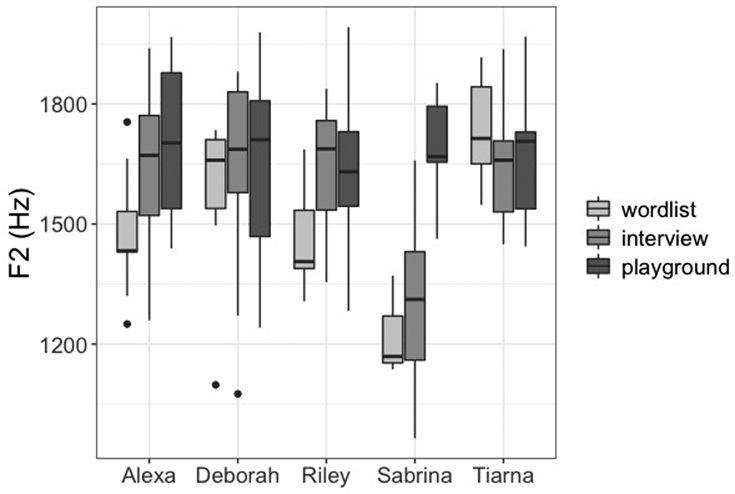
It was predicted that the participants would favour a more front (i.e. higher F2) and monophthongal realization of price in playground speech, and a more back (i.e. lower F2) and diphthongal realization in wordlist and interview speech. As expected, Alexa, Sabrina and Riley all showed a back realization of price in wordlist speech, and Alexa and Sabrina tended to have a more front realization of price in playground speech (see Figure 4). However, Deborah and Tiarna did not show any substantial differences in the onset of price across situations. Across the participants, price tended to be most monophthongal in playground speech, as we had expected (Figure 2). This is exemplified to the greatest degree by Sabrina, but also to a lesser extent by Alexa, Tiarna and Riley. This means that, while some participants showed style-shifting as expected with respect to the onset of price, this was not consistent across participants.
PRICE F2 variation

3.3 GOAT
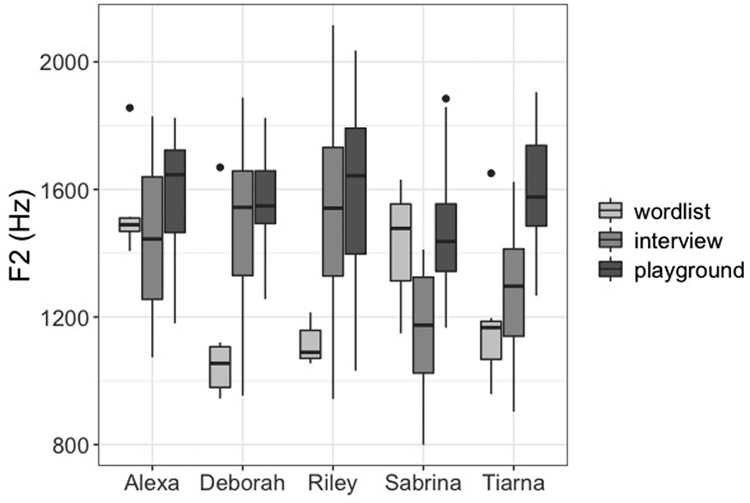
For goat, we predicted that the onset would be back (lower F2) and monophthongal in playground speech, i.e. more MLE-like, compared to interview and wordlist speech. However, contrary to our predictions, three of the participants (Deborah, Tiarna and Riley) favoured a back realization of goat in wordlist speech, compared to the other two situations (Figure 5). Alexa and Sabrina did not show this trend. Furthermore, Alexa and Sabrina showed a more diphthongal realization of goat in wordlist speech compared to the other two situations, as we had predicted; but Deborah, Tiarna and Riley did not vary how monophthongal/diphthongal their goat pronunciation was between situations. This means that Deborah, Tiarna and Riley tended to favour a back monophthongal pronunciation of goat in wordlist speech, and a central-front monophthongal realization of goat in interview and playground speech. Therefore, all participants showed style-shifting in their pronunciations of goat, but in different ways.
goat F2 variation

4. Discussion
For all three variables, style-shifting occurred, confirming that the pre-adolescent girls we investigated did indeed alter their diphthong pronunciations between situations. However, while the style-shifting for price happened largely in the way we had predicted, for face, style-shifting occurred in the opposite direction to what had been predicted, and, for goat, different speakers style-shifted in different ways.
For face, while it was predicted that the girls would favour the MLE variant in playground speech, compared to wordlist and interview speech, the opposite was the case. Why should this be so? One explanation is that these girls favoured a more open face onset in their speech among friends, suggesting that there is a new, incoming variant – something like [ɛ(ɪ)]. Alternatively, it may have been the nature of the acoustic analysis that produced these results: when speakers raise their voices, as these girls often did in a loud playground setting, this can affect the F1 measurement such that the whole vowel space becomes more open (Huber et al., Reference Huber, Stathopoulos, Curione, Ash and Johnson1999). Looking at Figure 1, this would seem to be a more likely explanation: for each girl, in her playground speech it is not just the face vowel that appears more open, but price and goat too. Nonetheless, for all participants, face appeared relatively monophthongal regardless of situation (Figure 2). This could indicate that the MLE-related change of monophthongization has come to completion and is no longer sensitive to style-shifting. It could also substantiate Cheshire et al.'s claim that MLE is the ‘unmarked Labovian “vernacular”’ (Reference Cheshire, Kerswill, Fox and Torgersen2011: 153), as the MLE monophthongal variant was found in all elicitation contexts. Notably, however, the friend remained present during the wordlist recording, and this may have created a more informal setting than traditional wordlist recordings, in which often only the investigator is present.
For price, style-shifting was found, but manifested in slightly different ways between participants. Some girls changed their price vowel between situations in the manner expected, either having a more front onset in playground speech, or a relatively backed onset in wordlist speech (Figure 4). However, other girls did not alter the onset of their price vowel between situations, but had a relatively front price vowel across the board. At the same time, as we predicted, all participants showed a more diphthongal pronunciation of price in wordlist speech, and all but Deborah tended to have the most monophthongal pronunciation of price in playground speech (Figure 2). This means that, on the whole, the girls were shifting their pronunciation of price towards the MLE variant in playground speech, as predicted, while Deborah used the MLE variant regardless of situation. This is interesting because Deborah was also assessed by the first author to have had a more confident personality in comparison to her peers. If adopting MLE diphthongs is a way for these girls to sound more like teenagers and less like children, it could be that Deborah was a ‘stylistic icon’ (Eckert, Reference Eckert, Warner, Ahlers, Bilmes, Oliver, Wertheim and Chen1996); she used the most innovative pronunciations, even when addressing adults, while her peers varied between more conservative and more innovative pronunciations.
The results for goat were unexpected, showing that several participants favoured an MLE-like – i.e. backed and monophthongal – pronunciation of goat in wordlist speech, and a fronted (but still monophthongal) goat vowel in interview and playground speech. The difference was clearly audible, with participants using a backed [o:] variant in wordlist speech, and a central or fronted monophthongal variant in spontaneous speech – something like [ɵː] (cf. Haddican et al., Reference Haddican, Foulkes, Hughes and Richards2013). This is not the first study to find that speakers use the non-standard variant more in wordlist speech than in spontaneous speech. Gafter (Reference Gafter2016), finding that Misrahi Israeli speakers increased their use of the stigmatized variant [ʔ] in wordlist speech, suggested that, for some speakers, the wordlist can be a site for identity performance within the context of the sociolinguistic interview and this could have been enhanced through the presence of a friend during the wordlist recording. At the same time, we know that in varieties of English where fronting of goose is taking place, fronting of goat is also likely to occur (Labov, Reference Labov1994). It may be that goat-fronting is actually an even newer change in this community than goat-backing, and that the girls are favouring an innovative, fronted variant in playground speech. Regardless of which explanation we choose, the results indicate that the girls command a repertoire of goat variants, and that sociophonetic variation in goat is deployed according to speech context.
To summarize, our results showed that these 11-year-old girls implemented MLE phonetic features in style-shifting, such that they drew from a repertoire of variants dependent on the situation they found themselves in. Moreover, style-shifting affected the various vowels differently – this is perhaps to be expected in a situation where not only does each speaker have a different multilingual background, but where the language variety itself – MLE – has been described as a variable repertoire of features, and is likely still undergoing change. For face, we found that pronunciations were most MLE-like in word-list and interview speech, perhaps suggesting that MLE had indeed become the default choice for these girls, even in relatively formal situations; for price, MLE-like productions were most frequent in playground speech, meaning that this variable shows situational style-shifting as expected; while goat potentially shows multiple competing variants.
Our findings point to the value of (a) analyzing speech data from different situations (Rickford, Reference Rickford2014), (b) investigating pre-adolescent style-shifting, and (c) investigating style-shifting in a situation of language change. In one respect, our analysis only reveals the tip of the iceberg: this is not just because we only present three speech contexts – when in daily lives, these girls are also talking with teachers, parents, siblings and other friends across a wider age range – but for reasons of brevity we presented only their average vowel measurements from each speech situation in this manuscript. When examining the raw data, the girls most likely show phonetic variation within their interactions, as well as style-shifting between situations (cf. Eckert, Reference Eckert, Warner, Ahlers, Bilmes, Oliver, Wertheim and Chen1996; Sharma & Rampton, Reference Sharma and Rampton2015; Sharma, Reference Sharma and Rampton2018). Nevertheless, our data show that the preadolescent girls we examined appear to style-shift in a relatively new variety of English that is most likely still undergoing change.
Appendix: Token numbers

 ROSIE OXBURY is a PhD student in Linguistics at Queen Mary University of London, where she is a member of the Phonetics and Acquisition Labs. She decided to pursue Linguistics at a postgraduate level after completing her BA in English Language and Literature at the University of Oxford then teaching English as a Foreign Language abroad. Her PhD project investigates the use of Multicultural London English by adolescents and children in West London. Her research interests include: variationist sociolinguistics; the sociophonetics of diphthongs; children's acquisition of sociolinguistic competence; and discourse-pragmatic variation and change. Email: r.f.oxbury@qmul.ac.uk
 ESTHER DE LEEUW is Reader in Experimental Linguistics and Phonetics at Queen Mary University of London where she is Director of the Phonetics Lab. Her research concerns the production, processing, representation, and development of speech sounds in the context of multilingualism and language contact, the cognitive organization of dual phonological systems, and the phonetic and phonological interactions which occur during first language attrition and second language acquisition. Her additional research interests include the sociophonetics of multilinguals and the study of regional and individual variation according to multi-level acoustic and articulatory approaches. She is Associate Editor of the journal Second Language Research and has authored or co-authored more than 30 papers in scientific journals and volumes, including the editing of numerous international journal special issues.