Introduction
‘I don't even know what gender is’. This was Milena Vilanova's first thought when she arrived in post-conflict East Timor to work on sexual and gender based violence (SGBV).Footnote 3 Similarly, before the international non-governmental organisations (INGOs) arrived, Manuela PereiraFootnote 4 ‘believed that domestic violence was “normal” since it was “happening to everyone”’.Footnote 5 If Milena Vilanova didn't know what gender was, we assume she soon learned with the arrival of the INGOs; we can also assume that Manuela Pereira learned that domestic violence was not ‘normal’ – even if regularly normalised – given the gender training she went on to receive. As a global initiative which has rapidly ‘captured the attention of policy makers’,Footnote 6 gender mainstreaming has become extremely popular. In the wide range of attempts to mainstream gender, whether in post-conflict zones such as East Timor or through international institutions like the EU and the UN, the concept of gender is evidently crucial; indeed essential. Yet, fundamental questions about the nature and work of gender and how gender might be effectively mainstreamed remain inadequately answered. Though the difficulties in satisfactorily implementing gender mainstreaming have been rigorously rehearsed in the literature,Footnote 7 the connections between the concept of gender, the inadequacies of gender mainstreaming and feminist theory have been paid less attention. It is this set of connections that I focus on in this article.
These opening comments invite consideration of an important set of issues which might initially be encapsulated in Robyn Wiegman's claim that there is a ‘critical incomprehension’ around feminism.Footnote 8 This incomprehension surfaces in varying sites including within the broader field of feminist International Relations theory,Footnote 9 but also in relation to gender mainstreaming more specifically. This incomprehension might be understood as coalescing around confusions and disagreements about the power and work of gender, and the power and work of feminism. How much work does gender really do? How does gender do its work?Footnote 10 What can we do about gender? And how far has feminist theory been able to shed light on these questions and indeed helped to operationalise the desired outcomes? In this article I am particularly interested in the connections between the work of feminism/feminists and gender mainstreaming legislation. In this context one might claim feminists have been extremely successful given the vast array of laws and policies relating to gender equality and gender mainstreaming which have become embedded in a wide range of national and international institutions. This feminist triumph might be further demonstrated by the increasing numbers of ‘gender experts’ deployed by these institutions to help implement gender mainstreaming successfully. For Harvard Law Professor Janet Halley, the success of feminism has been so profound that in her view, ‘feminists walk the halls of power’.Footnote 11 Yet despite this success and forceful presence, Janet Halley suggests that we should consider ‘taking a break’ from feminism. Why should feminists, perhaps particularly feminist IR scholars as well as those keen to make gender mainstreaming work properly across the globe take any notice of Halley's call?
In this article I engage Halley's provocative intellectual and political call to ‘take a break from feminism’ to shed light on some of the complexities and contradictions which permeate the relationship between gender, gender mainstreaming and feminist theory and, more broadly, the critical incomprehension around feminism introduced above. One of the reasons Halley suggests we ‘take a break’,Footnote 12 is because feminism is unhelpfully tethered to a subordination model which insists on, or works with a distinction between m and f (m/f). Different feminists deploy this distinction differently; some see men and women, some man/woman, some masculine/feminine, some masculinity/femininity and some male/female (or a combination of some or all of these). Second, feminism implies or works with a theory of, or sense of subordination in which f is subordinate to m (m>f). And third, the normative turn for Halley, feminism opposes the subordination of f and as such ‘carries a brief for f’ (+f). Her claim it is not that feminism might not move away from these commitments; rather that it does not.Footnote 13
Let me comment straight away on Halley's presentation of feminism as ostensibly singular – an ‘it’. When writing about or speaking about ‘feminism’, and when a suggestion is made ‘about feminism’ (as an ‘it’), particularly one as potentially divisive as Halley's, attention will quickly be drawn to the plurality of feminism. That there are different manifestations of feminism is clearly true, yet in the context of gender mainstreaming, the sense is that the generic institutionalisation of feminism renders its complexities and multiplicities into a semblance of singularity and, crucially, one bearing the heavy footprints of the subordination model briefly introduced above. Though there have been increasing demands for gender mainstreaming to not ‘only’ be about women (and to include men), and indeed to not ‘simply’ be about men and women (which arguably equals gender), but to work with the complexities of transnational diversity and intersectionality,Footnote 14 there is still an overwhelming sense that in practice, gender mainstreaming still favours (or is ‘about’) women and, moreover, continues to marginalise men and the workings of masculinity.Footnote 15 Given this, one might ask if one of the reasons for the on-going critical incomprehension around feminism – which can manifest as a form of intellectual refusal – relates to an apparent gender bias within feminism.Footnote 16 How could such an exclusionary theory of gender feasibly translate into successful gender mainstreaming? There is another important complexity to note at this juncture which arguably also fuels critical incomprehension around feminism, particularly in relation to its contemporary theoretical utility,Footnote 17 namely, if performative and discursive understandings of genderFootnote 18 have become the obligatory starting point for contemporary feminist analysis;Footnote 19 taking this seriously would render the possibility of gender mainstreaming an absurdity. It would be as if gender were not already mainstreamed; or indeed that there really was a possibility of mainstreaming only ‘good’ versions of gender.
This series of issues and questions are extremely important to investigate given the confirmation of the enduring persistence and reinvention of gender despite legislation and associated robust rhetorical and political commitments to eradicating unacceptable gender differentiation.Footnote 20 Like a cancerous growth in the body(politic) of justice and democracy, the identification, isolation and removal of gender has been delineated as necessary; both morally and in line with competent and just governance practices. A variety of tools, tactics and techniques have been gathered together over many decades most recognisably under the political and epistemological banner of feminism,Footnote 21 with the explicit aim of removing the obdurate vestiges of outdated gendered ideas and practices. At the forefront of feminist success in policy,Footnote 22 gender mainstreaming has emerged as a significant outcome of this burgeoning corpus of scholarly, activist and governmental work. We should make no mistake, gender mainstreaming has radical possibilities,Footnote 23 or at least its proponents (usually) have radical intentions in regard to change. The generic demand is nothing short of the wholesale transformation of the institutions and processes of government in regard to gender,Footnote 24 with the intention that this impacts on, works with, and changes the wider society and polity. There is a remarkable revolutionaryFootnote 25 aspect to gender mainstreamingFootnote 26 as expectations of transformatory changeFootnote 27 and a ‘paradigm shift’Footnote 28 are both implicit and explicit. Consequently we perhaps should not be surprised that there is resistance to gender mainstreaming; although resistance seems to not be quite right, as has already been indicated a more commonplace evaluation is that successful implementation is difficult to achieve.Footnote 29 But can we (yet) imagine the seismic changes that a revolutionary and paradigmatic shift in gender practices would actually produce? What would this look like?Footnote 30 We are surely not living it? I do not want to dismiss too quickly the idea of resistance in favour of the more commonplace analysis of inadequate, stalled, or ‘as yet’ incomplete implementation as the stumbling blocks to the success of gender mainstreaming. Therefore it is one to which I will return.
To address the questions and issues I have introduced, this article will proceed in four main sections. First, given the concept of gender is evidently crucial to the theory and practice of gender mainstreaming, I want to spend some time re-visiting the feminist discovery of and production of this now familiar and possibly overly comfortable concept.Footnote 31 This re-visitation is necessary in order to delve deeper into and make more sense of the complexities that permeate the practices of gender mainstreaming particularly in relation to contemporary feminist theory. In the second section I elaborate on the idea of the widespread cultural and political diffusion of feminism through a discussion of Janet Halley's work. Halley's work is important to engage not least because the literature she uses has a very firm place in the international lexicon of feminism – intellectually, institutionally, practically and pedagogically. That this might say something about the hegemony of the US is perhaps not a moot point.Footnote 32 Moreover, Halley's provocative position in regard to feminism can be used to shed light on some of the incomprehensions around contemporary feminism that introduced above. Halley's political and intellectual invitation to ‘take a break from feminism’ is partially a response to the problems she judges have been produced through feminismFootnote 33 – or at least as she presents governance feminism – and given the political, practical, intellectual and symbolic connections between feminism and gender mainstreaming,Footnote 34 her invitation is one worthy of investigation.
Section three will move to look briefly at the example of the United Kingdom's Gender Equality Duty LegislationFootnote 35 as this is an interesting and contemporary attempt to more adequately mainstream gender in the context of UK (and thus heavily EU influenced) legislation. I look at how the Duty understands and uses gender through an analysis of some of the language and imagery in the Duty and related documentation. This example will also be used to discuss some of the claims about the diffusion of feminism that Halley makes. In the fourth section I return to consider the series of questions and issues under discussion in this article partially by thinking a little more deeply about the connections between feminist (theory) and gender (practice). This discussion may offer insights about contemporary feminism both in general and in the context of debates about gender mainstreaming as well as in the broader field of International Relations. Should Halley's invitation to ‘take a break’ be taken up? In conclusion, Halley's authoritative invitation is read through the prism of Angela McRobbie's recent discussion of post-feminism.Footnote 36 My ultimate suggestion is that we might think of Halley's call, as well as the robust rhetorical popularity of gender mainstreaming, as potential examples of post-feminist practices; an idea I largely leave with readers for further reflection. But first, as the concept, idea and practice of gender is a crucial aspect of feminist theory and practice as well as being the central currency of gender mainstreaming, it is to gender I want to now turn.
What is this thing called gender?
I don't even know what gender is.Footnote 37
For gender mainstreaming to become genuinely transformative and retain feminist aspirations, an understanding of the processes leading to gender inequality is crucial.Footnote 38
In Ridley Scott's film G.I. Jane, there's a scene in which the central female character Jordan O'Neil (played by Demi Moore) complains to her boyfriend that though they are the same age and entered the Navy at the same time, ‘he was the one with the stripes’. His reply was that ‘I just got lucky’. Though the film's feminist credentials have been consistently contested,Footnote 39 I think his answer articulates, at least for a moment, the problem for which feminists introduced gender as a solution. Or a feminist reading of that line is that he did not simply ‘get lucky’, but rather that his ascribed gender accounted for his better career success, at least in comparison to hers. It is so interesting when seemingly fleeting references to the social construction of gender crop up in popular culture and every-day life. Though we might imagine the film's director, Ridley Scott, was making a (feminist?) point, the possibility that such a comment might be unreflectively received (even if simultaneously ‘getting it’)Footnote 40 by a viewing audience is strong. In making this comment my aim is not to patronise the viewing public but rather to suggest that gestures toward the socially constituted character of gender are replete in the everyday. Indeed there is something of popular industry with global reachFootnote 41 which constantly gestures toward and reminds us about the social construction of gender. How did something so intentionally radical become so widespread and part of our everyday sense? That feminists intended radical results would be generated through the deployment of gender as a political, epistemological and methodological tool is, I think, not in doubt.Footnote 42 Have radical understandings of gender really permeated that deeply? If they have – what accounts for the persistence of gendered inequities?
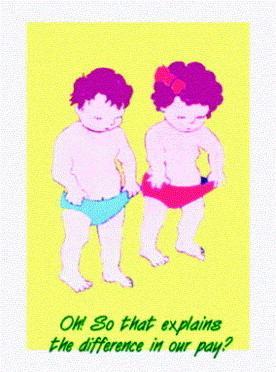
Leeds postcard.

Poster in a Rwandan Girl's School.

Consider these two images. They im(mediately) tell the story of the now very familiar narrative of the relationship between gender and sexual difference. The first is produced by the energetic Leeds Postcards groupFootnote 43 with the caption: ‘Oh! So that explains the difference in our pay?’ (The child on the left is wearing blue; the child on the right is wearing dark pink). The second is a photograph taken in a girl's school in RwandaFootnote 44 which has the (we assume girl child, on the right wearing pink) commenting to the (we assume boy child on the left wearing blue), ‘so that's why you have more opportunities’. There are clearly different inflections in these images; one being the focus on ‘pay’ in the Leeds postcardFootnote 45 as opposed to ‘opportunities’ in the image from the Rwandan school. Yet the predominant message in both is one that illustrates the profound impact of the discovery of the cultural character of gender; and it is the message that lies at the heart of gender mainstreaming philosophy. Though the story is well known, or perhaps because it is so well known, I want to step a little more slowly through some of the moves from sex to ‘gender’ which have perhaps become blurred in the swiftness of the mediated sense these images, and other like them, invoke.
Males and females are physically different; this is most obviously recognised at the level of what high-school biology text-books generally refer to as ‘primary sexual characteristics’ notably genitalia, which we (are given to) assume is what the children in the images above are ‘seeing’, or indeed ‘not seeing’ in their underpants.Footnote 46 These differences, along with chromosomal differences and so-called ‘secondary sexual characteristics’ have historically been used to justify or naturalise the differential treatment of, and differential expectations of men and women. The truism of these kinds of physical sexual differences is not one that feminists have generally wanted to deny; though liberal feminists have been more likely to emphasise the irrelevance of these physical differences in relation to women's intellectual and other rationalistic capacities suggestive of the idea that men and women are interchangeable,Footnote 47 or at least of equal worth – something surely insisted on in the cartoon images heading up this section. Radical feminists, on the other hand, have tended toward valorising women's specific forms of (traditionally disparaged) embodiment.Footnote 48 But that these apparently incontrovertible physical differences along with the reproductive and familial/societal roles they were assumed to engenderFootnote 49 facilitated calculably unfair treatment has been the central political and intellectual focus of a great deal of feminist activity and enquiry. There has been an ongoing, cyclical, slow and sometimes/often faltering articulation of these enquiries – and here I mean to invoke the centuries of interrupted activities (literary, academic, grass-roots, solipsistic, philosophical, cultural, personal, international, local, revolutionary) that people, most often women, have been embroiled in to try and make sense of (and change) women's (gendered) disadvantage. Mary Wollstonecraft's Vindication of the Rights of Woman Footnote 50 first published in 1792 and regarded as an early feminist classic by many contemporary scholars, gives a sense of the temporal framing and conceptual, linguistic and emotive struggle to make sense of woman/women: ‘It is time to effect a revolution in female manners, time to restore them to their lost dignity. It is time to separate unchangeable morals from local manners.’Footnote 51 Though in Vindication, Wollstonecraft held women partially if not largely responsible for their feeble and subordinate condition, feminist interpretations of her treatise since have regularly suggested that this work was an early articulation of the social construction of gender.Footnote 52
A major outcome of all these enquiries about women and ‘feminine manners’ was the exposé of gender as a central motor in society which offered explanations for women's specific unequal (in the main) position vis-à-vis men. And, to remind us, these ‘realties’ were simply, if devastatingly unfair,Footnote 53 a pathological remnant of earlier mistaken or misogynist knowledge which has remained to wreak much damage; often fatal damage. ‘Feminine’ behaviours deemed natural and rigorously codified as such through a variety of ‘sciences’, including psychology, psychoanalysis, biology, medical science and sociology throughout the 20th century,Footnote 54 were discovered to be culturally manufactured and nurtured. Consequent to this discovery, femininity was targeted as the key pathology;Footnote 55 as Wollstonecraft had imagined, femininity was merely or largely learned.Footnote 56
In the 20th century there was an analytic explosion of work illustrating how gender is learned and reproduced, and it is clear that ‘feminist theory has been immensely productive in making these [gendered] realties visible’.Footnote 57 Gender became understood to refer to the socio-cultural aspects of being a man or woman – as the cartoon images depict – though the sense clearly retained through the cartoon imagery is that sex (bodily sex) remains in the realm of the natural and biological. But a crucial further move in this journey of discovery about gender was that it was seen to be amenable to change; ‘oppressive gender arrangements, being the product of past choices, could be abolished by fresh choices.’Footnote 58 The immensely radical separation of gender from sex – radical because so many everyday practices and people's everyday lives had previously relied on this connection as inevitable, normal, necessary and functional – and the simultaneous belief in the possibility of change, have both seemingly become deeply entrenched in mainstream everyday thinking and practice.
It is indeed remarkable how relatively quickly the term gender and the associated understandings of social change and the possibilities of effective individual and institutional agency have gained a comfortable place in the lexicon of social/political science and within policy making circles, particularly in the realm of governance feminism and gender mainstreaming.Footnote 59 However, my suggestion is that the slide from (radical?) theory to (mainstream) practice is deeply misleading. The ubiquitous explanatory brevity which captures and explains genderFootnote 60 functions to conceal the residual and robust epistemological and ontological practices which work to retain attachments to gender; if in metamorphosing and resisted forms. This concealment does a great deal of work in constituting gender as an overly comfortable term facilitating the (re)production of gender as an increasingly ineffective concept at least in regard to the radical intentions feminists hoped and work(ed) for. Simultaneously concealed and confined is the political link with feminism; or alternatively said, the political character of the term gender itself is muffled. To unpack the theoretical/practical nuances and implications of my comments I move to clarify why Janet Halley suggests we should take a break from feminism despite its apparent success especially in contemporary governance practices.
What is this thing called feminism?
By positing themselves as experts on women, sexuality, motherhood, and so on, feminists walk the halls of power.Footnote 61
Gender mainstreaming in effect replaces feminism.Footnote 62
In an interview with Harriet Harman, the UK's Minister for Women and Equality, she was asked how concerned she was that her proposals for new equality legislation would be construed as putting forward a feminist agenda.Footnote 63 Harman's initial response was, ‘as if there was something wrong with that!’ moving on to claim that her proposed equality measures were best understood in the generic context of social justice.Footnote 64 Given her robust commitment to equality and seemingly comfortable association with feminism, Harman conceivably qualifies as one example of the (many?) feminists that Janet Halley claims ‘walk the halls of power’,Footnote 65 perhaps giving some credence to Halley's generic thesis about the healthy presence of feminists in the political arena. Has feminism – and feminists – been so successful? To consider this let me move to explain and discuss Halley's claims.
Far from being passé, a common popular perception of feminism, Halley claims feminism occupies a central role in contemporary national and international governance practices. This centrality has been facilitated by the diffusion of feminist knowledge deep into the logics and practices of national and international public institutions, perhaps particularly, but certainly not exclusively, in western(ised) countries. By way of illustration Halley suggests that what might have been seen as ‘feminist justice projects’ in the 1970s have now moved from ‘the streets’ and into the state, for example in family law, employment, education and health care institutions, all of which are regulated by policies which control sexual conduct and equality practices.Footnote 66 From this basis, Halley offers convincing arguments that feminism has been and is currently a highly productive social force.
To support her view, we might consider that the rhetoric of gender equality is now commonplace in the international arena especially given the increasing attention paid to the gendered character of international politics and practices. In a relatively short time (since the 1980s/90s) the idea of gender equality has caught the attention of policy makers and simultaneously evolved as an international norm.Footnote 67 In the EU, gender mainstreaming has become the primary tool for advancing gender equality in Europe.Footnote 68 The high incidence of rape and sexual violence in war and conflict zones and violence against women generally, has clearly moved high up on the United Nation's agenda. Preceded by CEDAWFootnote 69 and DEVAWFootnote 70 the United Nation's Security Council's Resolution 1325 has an explicit remit to eradicate violence against women. The latter has been hailed as a major breakthrough in international law in regard to gender violenceFootnote 71 and is proffered as an excellent example of the impact of feminist work in regard to gender. Most recently UNSCR 1820 has been adopted by the Security Council which stresses the need to prevent all forms of violence against civilians but particularly violence perpetrated against women and girls during and in the wake of armed conflict.Footnote 72 That the United Nations has accepted that the violent effects of gender are wholly unacceptable and, moreover, that it is unequivocally necessary to challenge and change this egregious situation seems a true mark of feminist success. Even the Vatican has not been immune to feminist knowledge about gender as Halley illustrates:
Its Congregation for the Doctrine of the Faith, presided over by Joseph Cardinal Ratzinger (since installed as Pope Benedict XV1), has issued an important dogmatic letter specifically to refute feminism, complete with a concentrated attack on the ideas that biological sex and cultural gender are distinct and independently variable […] that is to say, the current pope has devoted a substantial portion of his time to refuting feminism.Footnote 73
In her invocation of the Pope engaging with feminist arguments, Halley is not necessarily suggesting that Vatican scholars pore over what academics (and/or activists) might consider feminist texts, though they might and certainly did at the Fourth World Conference on Women in Beijing.Footnote 74 Rather she includes this to demonstrate how deeply the feminist conceptual separation of ‘biological sex’ from ‘cultural gender’ has infiltrated, how it has become something of a conventional idea, especially in the context of gender mainstreaming in an international setting.Footnote 75 Although Halley focuses mostly on what she calls ‘American feminism’, the use of her work is appropriate given the story she narrates about the development of feminist theory and the apparent permeation of feminist ideas about gender into mainstream practices in a wider context for several reasons. The first is that the archive of feminist work she uses is one that most Western feminist scholarsFootnote 76 would recognise as a central part of a feminist theoretical lexicon which has consequently, if problematically, become globally entrenched; pedagogically, intellectually and institutionally.Footnote 77 As she puts it, ‘American feminism, particularly through feminist legal theory has become ‘internationalized’.Footnote 78 Additionally, her diagnosis of feminism is one that contemporary scholars of International Relations might find informative in the context of recent discussions about feminism within the discipline.Footnote 79 A third reason is that Halley's arguments and conclusions can help us to think through some of the conundrums around feminism, gender and gender mainstreaming under discussion in this article.
Halley is unequivocal in her judgement about the impact and reach of feminism particularly in everyday governance practices; though she is clearly ambivalent about this success. As she puts it, ‘let me say, loud and clear, that governance feminism has been in manifold ways, a good thing […] feminisms’ bringing to the fore of the dire realities that affect women, that put them at a bargaining disadvantage across the board, ‘in sexual life, economic life and elsewhere’Footnote 80 has been profoundly important. But Halley expresses uneasiness with feminist behaviours, theoretical and practical, in the wake of this success. Feminists, she claims, disingenuously proclaim powerlessness in the midst of power. In this latter claim she is making several different points; one is that women are not (always) as badly off as feminists continue to insist. Moreover, men's gendered suffering continues to be ignored or marginalised through governance feminism, not to mention the gendered harms done to less traditionally gender-identified people. Further, feminism is not the weak, beleaguered and ineffectual force that feminists tend to regularly imply. Feminism is powerful; and any force as powerful as feminism ‘must find itself occasionally looking down at its own bloody hands.’Footnote 81 This is a provocative statement, perhaps especially as it invokes the idea (and reality) of violence – feminist violence. Whose blood has been spilt – either metaphorically or literally? What kinds of insidious damage is Halley suggesting feminism has caused? I will return to these questions subsequently; at this point I want to continue looking more closely at Halley's arguments.
Halley's book is a veritable and critical tour de force interrogating the wide range of feminist scholarship over the last few decades. Despite the plethora of feminist approaches and a regular insistence in feminist literatures that there are feminism(s), Halley insists there are a set of things which ultimately defines something – a thought project, a political project, or a normative projectFootnote 82 – as singularly, identifiably feminist. The desire for a concise definition of feminism is particularly pertinent in the context of feminist International Relations scholarship where there is a persistent demand for confined definitions of feminism.Footnote 83 Halley's own definition of feminism emerges from the way feminism becomes enacted through governance practice. Also, it is a reaction to the tendency for feminists to outlaw the theoretical incongruities or departures that she claims contemporary feminists impose on renegade feminists. Halley infers that feminists have struggled hard to prevent these renegades – the ‘prodigal sons and daughters’ – who have ‘wandered off to do other things’ from ‘Taking a Break’.Footnote 84 Part of the reason for feminists not wanting ‘renegades’ to jump ship according to Halley, is related to the concern that feminism is beleaguered. This is an inaccurate reading or interpretation, at least for Halley, given her view that governance feminism has been extremely successful. In sum, despite the range of feminism, Halley insists that governance feminism, which is arguably the most recognisable and acceptable internationalised form of feminism, is persistently reduced to the formula (m/f), (m>f), (+f) – a model which also relies on what Halley calls ‘Sex 1’ referring to the bodily differences between men and women. Why and how does all this matter for Halley?
To answer this we can return to the issue of feminist violence. Through their work as gender experts and in their commitment to carry forward gender policies, feminists egregiously fail to acknowledge the power they wield and, more dangerously and damagingly, consciously disregard the distributional and the violent consequences of these policies. Halley chides feminists for ignoring the costs and benefits to stakeholder groups other than women. She offers the example of pregnancy claiming that feminist commitments suggest pregnant employees should ‘experience no downturn in compensation, promotion, seniority […] and the like’.Footnote 85 Her inference is that feminists imagine (hope?) that their work on gender would eliminate the costs incurred by pregnancy. On the contrary, Halley argues that the costs are merely shifted, but an allegiance to feminism implies that this should not be an issue of concern. This is one of the ways in which Halley argues feminists cannot see injury to men; her insinuation being that men (or at least some men) will inevitably suffer from the shifting of the costs of ensuring pregnant workers do not suffer in any way (in relation to pay and promotion, etc). Taking the contemporary neoliberal capitalist model of the workplace as a given, Halley has a point, if a contentious and arguably anti-feminist one. Though the latter is the salient point for Halley as it illustrates why it matters to her; there is a cost to feminist success, and this cost will go somewhere, but ‘bringing them back is seen as unfeminist’.Footnote 86 Thus feminism perpetrates violence through its practices and unswerving commitment to the subordination model Halley outlines. Moreover feminists refuse to acknowledge this and further refuse to countenance any feminism(s) which departs from this model; provocative indeed.
I want to move to pursue her arguments in a different direction by looking at a recent legislative attempt to more effectively mainstream gender namely the UK's Gender Equality Duty Legislation (known as the Duty). Given the impact of the EU on UK legislation, and given the Duty illustrates many of the complexities around gender mainstreaming under discussion in this article, it is a useful site to analyse.
Let's get rid of gender!
30 years after the introduction of the Sex Discrimination Act there is still discrimination. The Gender Equality Duty will bring about real change in the culture of organizations as the onus will be on organizations to promote equality, rather than on individuals to highlight discrimination.Footnote 87
We need to transform our workplaces, our services and our communities. Or we all face the consequences of the unfinished revolution. The good news is we can change all this.Footnote 88
The recent introduction of the United Kingdom's Gender Equality Duty LegislationFootnote 89 has been warmly embraced as a virile addition to the equality legislative arsenal.Footnote 90 It is one of latest in a long line of attempts to mainstream gender in order to eliminate gender's worst or most ‘negative’Footnote 91 effects. Acknowledging that gender inequities are deep-rooted despite over 30 years of sex equality legislation, the Duty promises a different approach to tackling gender discrimination. It places the onus on employers to prove they are promoting equality which together with the aim of making ‘gender equality central to the way that public authorities work’Footnote 92 implies the introduction of a radical set of practices to obliterate gender discrimination. As discussed earlier, placing gender at the heart of public policy making and institutional planning and organisation has been the holy grail of much feminist work, activist and scholarly, for decades. Given this, we might consider the Duty as representing a resounding success for feminism. Feminist knowledge has now seemingly become a central part of everyday institutional and public life. Perhaps feminists really do ‘walk the halls of power’ as Halley asserts, notably in the guise of the gender experts and entrepreneursFootnote 93 required to carry forward gender policies in national and international institutions. Let's look at how the Duty understands and presents the problems caused by gender.
The Duty comfortably asserts that gender(ed) discrimination still exists in unacceptable ways in the United Kingdom; a stark illustration of this occurs in the area of paid employment. For example the Duty states there is a 17 per cent pay gap between the hourly earnings of women who work full-time compared to men who work full-time; women who work part-time earn 38 per cent less than men who work full time, hour for hour.Footnote 94 Moreover, discrimination against pregnant employeesFootnote 95 is claimed to still be widespread (recall Halley's discussion about pregnancy above); while at the other end of the life-span spectrum pensions remain designed for a traditional male career path with the result that mothers/carers lose out. In order to change these problems attributed to social enactments of gender, the Duty's remit coalesces around three main aims: (a) to eliminate unlawful discrimination; (b) to eliminate (sexual) harassment and (c) to promote equal opportunities.Footnote 96 Here is a section from the Duty which gives a better sense of its rhetoric and main aims.
The duty is intended to address the fact that, despite 30 years of individual legal rights to sex equality, there is still widespread discrimination. The duty is intended to improve this situation, both for men and for women, for boys and for girls. Gender roles and relationships structure men's and women's lives. Women are frequently disadvantaged by policies and practices that do not recognise their greater caring responsibilities, the different pattern of their working lives, their more limited access to resources and their greater vulnerability to domestic violence and sexual assault. Men are also disadvantaged by workplace cultures that do not support their family or childcare responsibilities, by family services that assume they have little or no role in parenting, or by health services which do not recognise their different needs. Both sexes suffer from stereotyping of their roles and needs. The duty should help the public sector, and those working with it, to identify and respond to stereotyping, sex discrimination and sexism, resulting in improvements for all.Footnote 97
I want to think about the Duty's aims through the prism of Janet Halley's portrayal of feminism (m/f), (m>f), (+f). My discussion here will include reference to the Gender AgendaFootnote 98 which forms a visually robust part of the documentation relating to the Duty. The Agenda uses a variety of pop art images, presumably with the aim of attracting and encouraging people to engage issues around gender equality, especially perhaps young(er) people who, the implication is, are less easily convinced of the realities of such inequalities. To this end the Agenda's web site offers a series of colourful invitations, for example to ‘send an e-card’, or to take an ‘equality MOT’.Footnote 99 This is how the narrative in the Agenda commences.
The way we live has transformed dramatically in the last 30 years. The roles of men and women have changed in a fast-paced social revolution but life around us has not caught up. This revolution is unfinished and that hurts all of us.Footnote 100
The reference to time is intriguing; when was and what was the fast-paced social revolution that the Agenda makes reference to? Why have we not caught up with it? What parts of (whose?) lives have not ‘caught up’? How far do we need to travel to finish the ‘unfinished revolution’? What vehicle(s) will effectively transport us to this putatively gender-free landscape (gender mainstreaming legislation presumably)? And what is the ‘hurt’ that affects ‘us all’? The implication is that the swathes of legislation passed in the 1970s as a consequence of social and cultural shifts occurring in the previous decade have not been properly successful. Though no explicit reference is made to feminism, one might safely assume that the demands of women's groups in all their manifestations for, minimally, equal rights for women, and indeed the influence of the growing body of feminist scholarship can be assumed to have been a major part of the fast-paced social revolution indicated.Footnote 101 Given this, I think we can credibly argue that the Duty and the Agenda are, albeit partially, implicitly and tangentially, invoking feminist revolutionary aspirations specifically in regard to need for the evisceration of (bad) gender.
In the context of contemporary corporate, consumerist and neoliberal Western(ised) societies the use of the language of revolution is fascinatingFootnote 102 especially given the revolutionary aspirations typical of earlier renditions of feminism have largely dissipated, at least publically in Western societies.Footnote 103 But it is evidently clear that the Duty, particularly through the excitable language of the Agenda, has taken up the challenge of finally completing (part of) the feminist revolution. Perhaps it is worth momentarily recalling what was actually called for by feminist revolutionaries by reference to an explicit case ‘for feminist revolution’ made in Shulamith Firestones' The Dialectic of Sex.Footnote 104 The first line of this classic book is, ‘sex class is so deep as to be invisible’.Footnote 105 This captured well the workings of gender, though the feminist discovery of gender discussed in the first section of this article presumably began to render ‘sex class’ finally visible and thus ‘capturable’ and amenable to change. Yet it is the case that Firestone's feminist revolution in regard to ‘sex class’ was strictly targeted at ending the oppression of women, as such ‘m and f’ are deployed as clear categories in Firestone's work, and primarily hierarchically experienced ones (‘m>f’). Moreover, there was an explicit intention to alter this situation in favour of women (‘carrying a brief for f’: +f). Are there credible connections between the agenda of the Duty and the feminist revolutionary aims?
The Duty has a ten year plan to ‘complete the revolution’.Footnote 106 In that time the changes required include: (a) the gender pay gap for full and part-time work will be eliminated in the time to benefit the current generation of working women; (b) having children does not mean financial inequality for women, (c) becoming a carer does not lead to financial inequality, (d) public services that are free of gender stereotypes so women and men and girls and boys can fulfil their potential; and that services are accessible in places and times that meet the needs of the diversity of potential users. To achieve this, old-fashioned gender practices and expectations need to be discarded. The Duty and the Agenda present very clear examples of these anachronistic practices making much comfortable use of the sociological concepts and practices of stereotyping and social roles. For example, the Duty suggests it is no longer the case that men are ‘bread-winners’ or that women are ‘stay-at-home mums’. These examples suggest that the Duty and the Agenda make robust attempts to make gender mean more, or other than, women, specifically through the explicit inclusion of other gendered people, namely men (and boys) and transgender people. As such the over-commitment to ‘f’ to the detriment of ‘m’ and the project to be solely dedicated to ‘carrying a brief for f’ seems to have dissipated in this legislation. To think about this further I will move to focus on one of the pop-art images from the Agenda's web site.
Part of the Agenda's remit is to convince the public that gender is important and has effects, and in this endeavour a range of arresting images are deployed. The series of images that litter the web site materials depict very particular views of the structure of modern society (presumably the one that has caught up with the fast paced revolution) showing relatively young people, some seemingly not (quite) white (presumably a nod toward racial awareness) but most in recognisably hetero-normative poses/relationships, if slightly skewed to make a specific point. Take a look at this example:
One of the pop-art images advertising the ‘Gender Agenda’ on the Internet.

The ‘thought-bubble’ accompanying the picture reads, ‘Doctor! I … I thought I'd never see you again!’ The caption underneath reads, ‘With most public services open 9–5 only, he'd almost given up hope of making an appointment …’ There is a nice, if relatively undemandingFootnote 107 play on still typical (we are led to presume) assumptions about gender here; the doctor turns out to be the woman in the picture, which we might not automatically assume despite the stethoscope. The ‘serious’ message is that men find it harder to get an appointment with the doctor given their conventional gendered work commitments (even if an arguably more significant risk to men's health is their gendered reluctance to visit the doctor).Footnote 108 However, given the attention to men's characteristic gendered behaviours and practices, one might conclude that the Agenda's use and understanding of gender is intended to be a fully inclusive one and that gender no longer presents as a synonym or cover for women in the context of gender mainstreaming legislation of this ilk. The arguably undemocratic focus on women typical of feminisms associated with the 1970sFootnote 109 has perhaps finally come of age, once again invoking faith in the positive properties of ‘time’,Footnote 110 with the full recognition that men are gendered too. Masculinity has come to be perceived to be as pathological as femininity as men also suffer as a consequence of gender. Does this help to satisfy the Agenda's demand to ‘complete the unfinished revolution’ and at the same time render Halley's arguably dismissive typology of feminism redundant? To pursue this thought I want to consider how the Duty and Agenda deal with gender invoked through the figure of the transgender person.
The clear aim of the Duty and the Agenda is to remove discrimination associated with culturally constituted identities; specifically gendered identities. Though the Agenda claims there are special problems relating to transgenderFootnote 111 the stated aim is that transgender people are to be treated with the same respect and dignity as ‘other men and women’.Footnote 112 But the page devoted to transgender people in the Agenda is the only one which does not have an accompanying pop art image;Footnote 113 one wonders why not. This may seem trivial to note, yet what might this image look like if there was one? Deciding on an appropriate image for this page clearly emerges as problematic given the simultaneously implicit and explicit but crucially profound weight the Agenda places on knowing what gender is, which is patently evidenced through the knowledge the Agenda appears to have or relies upon in order to help us easily recognise gender. Readers/viewers are assumed to have no problem recognising men and women in the pop-art images; indeed it is extremely important that we do recognise men and women in order that we comprehend our conventional gendered mistakes about them. Recognising our gender(ed) mistakes suggest that the lessons we have learned about gender as described in section one truly appear to have become solidly embedded in every-day common sense; though one might ponder to what real effect given the on-going egregious harms of gender.
To emphasise the implications of these comments in the context of the overall discussion in this article, let us consider the advice given in the documentation in regard to how best to deal with transgender people in a professional setting to ensure they are treated with (equal) respect and dignity. A potential problem noted in the pursuance of this goal is the issue of what pronoun might be appropriate to use when referring to a transgender person, either in person, or in writing, or to third parties. The advice given is this:
If it is not possible to ask the person which pronoun he or she prefers, use the pronoun that is consistent with the person's appearance and gender expression. For example, if the person wears a dress and uses the name “Susan”, feminine pronouns are appropriate.Footnote 114
This begs a serious question – what if a male to female transsexual person knows herself to be a lesbian and calls herself Nicky or Sam and prefers to wear her hair short and wears comfortable clothes which are perhaps less likely to be recognised as ‘feminine’? What pronoun is appropriate to use in this circumstance?
It is stated that those who are meant to benefit from the Duty include men, women, boys, girls and transgender people, though the latter are clearly understood to be either men or women – at least eventually.Footnote 115 The difficulties that the Duty and the Agenda face in regard to depicting transgender people indicates that there is no space – conceptually, physically, practically, visually – for more or other than two genders – m and f. The inclusion of men and boys does not get rid of this binary dead-end, quite the opposite; much less a transcendence of gender which might arguably be implied by transgender practice. The Duty and the Agenda understand gender to be ultimately about m/f, moreover one might also argue that the primary (gender) pathology (re)emerges as femininity, even though there is some sense that men suffer from expectations related to masculinity. An overriding impression one gets when reading the documentation is that women are primarily underpaid and over-worked mothers/carers who are also persistently in need of protection from predatory (male) sexual harassers.
One assumes there is mostly a desire to treat all people with respect and dignity – my comments here are not about undermining this aim and the hopefully genuine attempts to carry this out. The discussion here is rather in the service of shedding some light on the series of questions this article raises about feminism, gender and gender mainstreaming. The understanding of what counts as appropriate treatment for transgender people in the context of equality legislation, illustrated here through the Duty and the Agenda, illustrates the persistent reproduction of gender through its identification as an always heteronormative binary. In this sense the use of gender as both the theoretical lever and empirical evidence to get rid of gender while at the same time remaining deeply indebted to gender to do this, is both paradoxical and intriguing. What was provided as a solution to the invidious invisibilities of sex class, has subsequently, if not simultaneously, becomes the problem which reproduces its own kind. Does this suggest Halley is right and it is time to take a break (from feminism)? Let me move to the concluding section in which I will attempt to draw together and address the conundrums and puzzles I have raised in this article.
Conclusion: time to take a break?
Contestation does not amount to revolution […] in the paid workforce, equal opportunity may be the official policy but new forms of gender segregation constantly appear.Footnote 116
Gender mainstreaming is a strategy addressing a future which is not yet upon us.Footnote 117
Reflecting on gender mainstreaming is useful to help grapple with the puzzles which permeate its practice and theoretical architecture and also to help clarify critical incomprehensions around feminism particularly in the context of the possibilities of effectively and constructively changing gendered practices and lives. The achievement of radical change in gendered practices and lives, not a tinkering or tailoring,Footnote 118 has surely been one of the main aims of feminism. The aim was (is) to eliminate gender, not to produce new nicer stereotypes or better ways to ‘do’ or ‘be’ (a) gender – but a ‘gender-free world’.Footnote 119 Let me move to explain further.
There are intimate connections between gender mainstreaming and feminism both through the former's wholehearted reliance on gender and via feminism's responsibility for gender. Though one might dispute the feminist ownership of gender that I infer throughout this article, I think it is reasonable to make this connection. Many of the feminist discussions about gender mainstreaming focus on the difficulties of implementation, often with a view to figuring out how to achieve a more successful enactment of gender mainstreaming requirements. This has not been the focus of this article; rather I wanted to investigate what the debates about gender mainstreaming and the associated complexities around gender tell us about contemporary feminism, particularly in its internationalised forms. This is important for the following reasons: first, to shed light on the on-going critical incomprehensions around feminism which occurs generally as well as within the discipline of International Relations, the latter sometimes materialising as something of an intellectual refusal of feminism. Specifically, my focus has been on gender mainstreaming through an engagement with Halley's invitation to discard feminism. My overall discussion invites analysis of the on-going reliance on the ability of theory to do something about practice which continues to inspire, motivate, animate and prejudice both feminism and gender mainstreaming.
As indicated, many of the debates about gender mainstreaming focus on implementation; embedded in the competing views about the difficulties of implementation is an implicit view of the relationship between theory and practice.Footnote 120 On the one hand the acceptance of the logics and possibilities of gender-change through mainstreaming have been hugely welcomed and much ink has been spilled suggesting how gender mainstreaming might be better executed. Given its international remit, facilitating its successful implementation in culturally differentiated societies and institutions across the globe is predictably going to be tricky; perhaps something of an understatement given the global variety of gender regimes. However others argue that the language and concepts used in gender mainstreaming literatures (both academic and policy) dramatically fail to appreciate or grasp just how gender works and in particular that rather than being a form of extricable variable, gender is discursively insinuated in the philosophies and practices of organisations, personal, local and global.
Each of these approaches have some sense or understanding of how gender works and how institutions might move toward achieving gender equality; or indeed how and why they fail to. But how do institutions think gender works? Where do gender experts imagine gender is located? What techniques do gender entrepreneurs and practitioners believe have the capacity to really achieve transformatory gender change? And, most significantly, where does all this ‘gender knowledge/knowledge about gender’ come from? Working with the idea that much gender knowledge comes from feminism, the journey is likely to be nebulous and indirect. Nevertheless, it has seemingly become very easy to know gender, to know what it is and where it is located and to comfortably address Milena Vilanova's lack of knowledge about gender exhibited in the comment that opened this article – ‘I don't even know what gender is’. I suggest we might be more curious about what changes or transforms from the feminist production of knowledge about/of gender to its (re)production in mainstream practices. Christine Booth and Cinnamon Bennett argue that the entrepreneurs, experts and deliverers of gender knowledge and mainstreaming policies do understand that gender works at the level of structure(s), yet this appreciation stops short at accepting the ‘patriarchal’ dimension and thus preventing a fully adequate understanding that women are ‘oppressed’ and not merely erroneously disadvantaged.Footnote 121 In a similar vein, Joan Eveline and Carol Baachi argue for a ‘return of the political to the concept of gender’,Footnote 122 in order to breathe life back into the revolutionary aspirations intended by feminists. Further, Elisabeth Prugl claims that what is missing from discussions about gender mainstreaming are ‘theorizations of operations of power’, moreover suggesting that governments and international organisations have ‘distorted feminist goals in the process of implementation and have co-opted feminist rhetoric for their own agenda’.Footnote 123
I think Halley would disagree with Booth and Bennett given the governance feminists she claims ‘walk the halls of power’ includes both those who espouse liberal as well as vigorously structural understandings of the workings of gender.Footnote 124 There are clearly organisational obstacles to the more robust versions of structural feminism that Booth and Bennett infer, yet Halley would presumably argue that these radically inspired feminists have been more successful than we generally believe. Eveline & Baachi and Elisabeth Prugl all argue for some form of retrospective (re)injection of politics/power into our understandings of how gender both works and is resisted. There is, I agree, an under-appreciation of how power works and how gender works in the context of gender mainstreaming but one of the emergent conclusions consequent to the plethora of discussions about gender mainstreaming is the idea ‘policy makers and femocrats’ hold an ‘unreflective interpretation’ of gender mainstreaming.Footnote 125 Or more specifically and tellingly, there is a gap between the ‘sophisticated theoretical work on gender and empirical gender research’.Footnote 126 The crux of the argument here, and inferred by Eveline & Baachi and Elisabeth Prugl, is that gender mainstreaming suffers from a disconnect with its feminist theoretical groundings; concomitantly there is temporal mismatch between feminist theory and gender mainstreaming practices. This disjuncture has three aspects; the first relates to the suturing of gender to heteronormativity, the second to the performative reproduction of gender and the third connects to the temporal confusions around the relationship between ‘theory and practice’.
In its pursuance of social justice, gender mainstreaming has not adequately moved beyond the male-female dichotomy and consequently regularly ignores interfaces between race, sex, gender, nationality, ethnicity, sexuality and power.Footnote 127 It is most evidently the case that there remains a focus on the male-female dichotomy and indeed one that favours women; though a forceful proponent of gender mainstreaming might argue that this is still the point. But if we are minded to accept that performatively deploying gender to get rid of gender simply inflicts (more) harm to people of all genders, perhaps a more crucial question to ask is how far can we hold feminism responsible for the harms that re-assertions of gender inflict especially through institutional sites?
Janet Halley accuses feminists of having blood on their hands, partially because of a refusal to acknowledge the harm done, as she puts it, to stakeholders other than women. Her argument is based on the belief that feminists have successfully and powerfully injected knowledge about gender into national and international policies and practices. In the light of this success, perhaps Halley is right to insist that feminists need to acknowledge their power and the ‘will to power’.Footnote 128 Perhaps she is also right to suggest that feminists inflict harm; though I think it is not simply acknowledgement of this that Halley requires. Confessing to conceptual violence, which has resulted, as it always does, in harm to real people, is not enough – we need to take a break.
Angela McRobbie's recent diagnosis of contemporary internationalised feminism is intellectually and politically very different to Janet Halley's and as such I want to make reference to it, if briefly here, as I think it provides a compelling counter-point. Though feminism may be perceived to have had a major impact given the easy deployment of the term gender and the ubiquitous national and international acceptance that (bad) gender requires annihilation, alongside the increasing number of gender experts in the corridors of power, I think we need to ask alternative questions about feminism. Contra to Halley, McRobbie's view is that the institutionalised success of feminism has incrementally, inevitably and devastatingly drained feminism of its radical potential and politics. The feminism that has trickled through to the ‘halls of power’, arguably the feminism that Halley describes, is, for McRobbie not really feminism. Let me briefly re-visit the example of gender mainstreaming to flesh out the implications of McRobbie's intervention.
Angela McRobbie's view is that elements of feminism have been deeply incorporated into political and institutional life. Her sense of incorporation is not quite the same as Prugl's as McRobbie is not implying either a conscious or unconscious usurpation and watering down of feminist aims; rather her conclusion is that feminism has become ‘undone’.Footnote 129 In the journey(s) – from/to thought/concept/passion – to/from institutionalisation feminism has undergone a governance ‘make-over’ and as a consequence feminism has become palatable for contemporary use – explaining its mainstream acceptance. This new postfeminism or ‘faux- feminism’ as she names it, deploys the language of ‘empowerment’ and ‘choice’ and promises freedom through education, employment as well as through participation in consumer culture and civil society. In this sense feminism, she implies, has become normalised, something Halley might agree with. Yet, as McRobbie asserts, women's subordination and experience of inequality remains unequivocal and substantial.Footnote 130 Interestingly, McRobbie uses the example of gender mainstreaming as a possible exception to her view that feminism has been ‘undone’. Echoing Halley's view that feminism has moved from the ‘justice projects of the street’ into national and international institutions, gender mainstreaming is proffered as potential evidence of the successful transition of feminist revolutionary and regularly rowdy demands into politically productive effects delivered by polished professionals. However McRobbie is ultimately sceptical of the claim that gender mainstreaming is a good example, or even an example at all of feminist success; rather she argues that gender mainstreaming has replaced feminism.Footnote 131 The result is the production of a respectable version of feminism, a ‘faux-feminism’ made appealing for local and global governance, simply another technocratic-managerial strategy to optimise gender specific human resources in the service of profit; but not a simple or easily detectable absorption of feminism, rather a new patriarchal ownership of feminism.
One might come to the conclusion that Janet Halley's diagnosis of feminism is not necessarily inaccurate per se, and as such her arguments deserve attention. Moreover, her suggestion is to ‘take a break’, not to totally abandon feminism. The inference is that feminists need to take time out – to ‘flicker in and out’ – so they (we) can see things better, not be so blinded by (feminist) commitments. Though feminist commitments to m/f, m>f and +f she identifies has some credibility, her analysis is inflected by something akin to an assumption that feminism is statically produced and practiced. Or that there is a discernible direction (from) theory (to) practice, rather than the more amorphous route ‘from’ practice ‘to’ theory gestured toward in McRobbie's analysis. But there is an attraction to Halley's diagnosis which is not directly related to the intellectual logic she deploys and this attraction might fruitfully be considered through the prism of McRobbie's perception of contemporary postfeminism.
McRobbie's focus on post-feminism exposes a raw nerve affecting the contemporary politics of feminism, most specifically in western-influenced institutions. Though the mainstream, in all its varied forms, has always been wary of feminism, of late scepticism toward feminism has emerged in significant ways from critically inspired analysts – Halley is one example of this. Simultaneously the mainstream has perhaps become less wary of feminism, a reaction potentially explicable if we think of post-feminism as still a kind of feminism but one saturated with anti-feminist sentiment;Footnote 132 this is what McRobbie implies in her claim that gender mainstreaming has replaced feminism. This contemporary disturbing paradox permeating feminism perhaps goes some way toward beginning to shed dark light on the persistence of gendered harms in the midst of feminist ‘success’.
In my opening comments I gestured toward the importance of retaining an intellectual interest in the idea of resistance in the context of debates about the inadequate implementation of gender mainstreaming. In a conventional political sense, resistance is usually understood to be extremely important. We do, however, conventionally rely on being able to see what to resist, or to access it in tangible ways, or to know how to resist (even if we believe there to be enormous obstacles), or to have the agency to resist, however minimal or constrained. Yet an intangible resistance to, or refusal of feminism and to the profound changes that feminism implies, is something that I think McRobbie's analysis of post-feminism detects. This might suggest that we should take up Halley's invitation to ‘take a break from feminism’, given feminism, at least those kinds of feminisms McRobbie suggest become institutionally eviscerated, really cannot deliver on the radical potential promised. Yet it might simultaneously suggest that this is precisely not the time to take a break from feminism given we cannot yet imagine the seismic changes that a revolutionary and paradigmatic shift in gender might actually produce.