Introduction
Dementia is a chronic, progressive disease syndrome affecting cognition and the activities of daily living. Virtually everybody with dementia experiences some type of neuropsychiatric symptoms (NPS) during the course of the disease (Steinberg et al., Reference Steinberg2008). NPS have a profound impact on the well-being of the person with dementia and they are associated with earlier institutionalization (Yaffe et al., Reference Yaffe2002), an increased burden on the caregiver and increased cost of care (Herrmann et al., Reference Herrmann2006).
Even though cognitive symptoms in dementia have received most attention, we have over the past 10–15 years seen several initiatives to highlight the importance of neuropsychiatric symptoms in dementia. These symptoms are also termed behavioral and psychological symptoms of dementia (BPSD) or non-cognitive symptoms in dementia. By introducing one term or concept that seeks to encompass diverse symptoms, such as apathy vs disinhibition or depression vs euphoria, one might erroneously create the impression that these symptoms have common etiological factors and hence common treatment options.
NPS are highly prevalent in nursing-home settings. Most treatment recommendations advise that non-pharmacological strategies should be the first line of treatment. However, NPS in nursing homes are often treated with psychotropic drugs, in spite of their uncertain effect and potentially serious side effects (Schneider et al., Reference Schneider, Dagerman and Insel2006).
Different types of NPS co-occur and one symptom may remit as another symptom starts. To improve the understanding of NPS and to guide treatment decisions clusters of symptoms or subsyndromes have been identified. The European Alzheimer's Disease Consortium has proposed grouping NPS into agitation, affective symptoms, psychosis and apathy (Aalten et al., Reference Aalten2007). As the etiology of NPS is multifaceted, there is reason to believe that factors such as the degree of dementia, the type of dementia, and residential status may impact on the grouping of symptoms. Consequently, it is important to use similar instruments in various populations, both in cross-sectional and longitudinal studies to explore the robustness of subsyndromes of NPS.
The Neuropsychiatric Inventory (NPI) is a well-established rating scale for the assessment of neuropsychiatric symptoms in dementia (Cummings et al., Reference Cummings, Mega, Gray, Rosenberg-Thompson, Carusi and Gornbein1994). With minor adjustments to the original inventory a nursing-home version (NPI-NH) has been developed. It has been translated into several languages and tested for validity and reliability. The NPI has been applied in clinical trials and epidemiological studies. It has been subjected to principal component analysis or corresponding methods (to identify subsyndromes or clusters of NPS) in various studies allowing for comparison across different sample types, such as outpatients (Aalten et al., Reference Aalten2007), hospital patients (Lange et al., Reference Lange, Hopp and Kang2004), mixed outpatients and nursing-home patients (Hollingworth et al., Reference Hollingworth2006) and nursing-home patients only. Recently, the stability of NPI clusters across dementia stages and with regard to psychotropic drug use was explored in a large sample of nursing-home patients with dementia (Zuidema et al., Reference Zuidema, de Jonghe, Verhey and Koopmans2007).
Few studies have investigated NPS clusters exclusively in nursing-home samples and to our knowledge no study has explored the stability of NPS clusters over time. The object of the present study was to investigate the stability of the putative subsyndromes that underlie NPS (as measured by the NPI-NH) in a cohort of Norwegian nursing-home patients over three assessments during a 31-month follow-up period.
Methods
Study design
This study is a cohort-study of Norwegian nursing-home patients with baseline assessments in 2004/2005. In Norway approximately 40,000 people live in nursing homes. Of these, 80% have dementia (Selbaek et al., Reference Selbaek, Kirkevold and Engedal2007). Each municipality has at least one nursing home. Municipalities from four Norwegian counties were included in the study. Patients from 26 nursing homes in 19 municipalities were recruited for the study (Selbaek et al., Reference Selbaek, Kirkevold and Engedal2007). The baseline sample was representative of the entire nursing-home population in the four counties in terms of distribution between small, medium and large municipalities, as well as rural and urban areas. All nursing-home patients with a minimum stay of 14 days were considered eligible for the study. The cohort was examined three times over a 31-month period. The mean observation time from the first assessment (A1) to the second assessment (A2) was 354 days (SD 17) and from A1 to the third assessment (A3) it was 936 days (SD 39).
Subjects
In all, 1,165 patients were approached. Two patients or their next of kin declined to participate, leaving 1,163 patients for inclusion. Of these, 932 patients had dementia at baseline, signified by a score of one or more on the Clinical Dementia Rating scale (CDR) (Hughes et al., Reference Hughes, Berg, Danziger, Coben and Martin1982). Of the patients with dementia at baseline, 35 did not have dementia at follow-up (CDR < 1) and were excluded from the analysis, leaving 897 patients. The present analysis is based on data from the patients with dementia.
Patients with more than 20% of items on the NPI-NH missing at any one assessment were excluded from the analysis. At baseline, two patients were excluded because of missing values on the NPI-NH, leaving 895 patients for analysis – Sample 1 (S1). Of these, 592 patients completed the second assessment – Sample 2 (S2) – and 278 patients completed the third assessment – Sample 3 (S3). Attrition occurred because of death (589 patients), moving to another level of care (21 patients) and protocol violation (7 patients). Hence, we had three samples. Sample 1 (S1) assessed once (S1A1), Sample 2 (S2) assessed twice (S2A1 and S2 A2) and Sample 3 (S3) assessed three times (S3A1, S3A2 and S3A3).
Procedure and assessment scales
Data collection was carried out by 16 registered nurses with wide experience of working in old- age psychiatry. They used a standardized set of assessment scales. They received training of two days, one day and four hours prior to first, second and third assessment, respectively. The same group of assessors did all three assessments. The assessors could contact and were supervised by the project leader (first author) during the assessment periods.
Dementia was assessed by means of the CDR. This is a six-item instrument assessing the level of dementia. The total score is calculated based on an algorithm giving precedence to memory. Scores of 0, 0.5, 1, 2 and 3 denote no dementia, questionable dementia, mild dementia, moderate dementia and severe dementia, respectively. The reliability of the Norwegian version of the CDR has proved to be excellent (Selbaek et al., Reference Selbaek, Kirkevold and Engedal2007). Two previous Norwegian studies have shown that the CDR is a valid substitute for a dementia investigation among nursing-home patients (Engedal and Haugen, Reference Engedal and Haugen1993; Nygaard and Ruths, Reference Nygaard and Ruths2003).
The NPI was used for the assessment of NPS. It assesses the frequency and severity of 12 psychiatric or behavioral symptoms. An item score is generated by multiplying frequency by severity (0–12). By summing these item scores a sum score ranging from 0 to 144 is produced.
The Norwegian version of the NPI has proved to be valid and reliable (Selbaek et al., Reference Selbaek, Kirkevold, Sommer and Engedal2008). In line with previous studies, a score of four or more on an individual item was defined as a clinically significant NPI symptom (Ballard et al., Reference Ballard2001; Zuidema et al., Reference Zuidema, de Jonghe, Verhey and Koopmans2007). The level of functioning was classified according to the Physical Self-Maintenance scale, a six-item scale with each item rated 1 to 5, where higher scores denote more severe functional impairment (Lawton, Reference Lawton1988). Physical health was rated using the General Medical Health Rating scale (Lyketsos et al., Reference Lyketsos1997).
Demographic data and regular medication lists were collected from the patients’ records. Psychotropic drugs were grouped according to the Anatomical Therapeutic Chemical (ATC) index (WHO Collaborating Centre for Drug Statistics Methodology, 2007).
Ethical considerations
Information about the study was given to the participants. If the patient had reduced capacity to give consent, a family member was informed about the study. Explicit consent was not required for inclusion in the study, but the patients or their next of kin were informed that they could refuse participation at any stage of the study. The procedure was approved by the Regional Ethics Committee, the Data Inspectorate, and the Directorate for Health and Social Affairs.
Data analysis
Data were analyzed using the Statistical Program for Social Sciences (SPSS) version 17.0. Description of the data was done by mean and standard deviation (SD) or median and interquartile range (IQR), as well as frequency analysis for categorical variables. Differences between groups were analyzed with independent sample t-tests (normally distributed data) or Mann-Whitney U-tests (skewed data). Differences in proportions were analyzed with the χ2 test. Longitudinal changes in CDR sum of boxes and NPI-NH sum score were analyzed with the Wilcoxon signed rank test as the data were not normally distributed. Changes in psychotropic drug use and changes in proportions of patients with clinically significant NPI symptoms were analyzed with the McNemar test for paired proportions.
To explore the pattern of subsyndromes of NPS, we conducted an exploratory factor analysis, more specifically a principal component analysis. In accordance with previous publications, we have used the term “factor” to denote the components extracted. Factors were extracted based on inspection of the scree-plot and the Kaiser criterion (eigenvalues of factors > 1). Items with factor loadings equal to or higher than 0.4 were considered to be relevant. Initially, all samples were explored using both orthogonal (varimax) and oblique (direct oblimin) rotation. Several of the models showed that the factors were correlated. This concurs with assumptions made on theoretical grounds. Consequently, an oblique rotation was applied. The criteria used to indicate the appropriateness of factor analysis were a significant Bartlett's test of sphericity and a Kayser-Meyer-Olkin measure of sampling adequacy (KMO) ≥ 0.7. In addition, the sample sizes in association with the magnitude of factor loadings were taken into account when the models were interpreted.
Results
Characteristics of patients
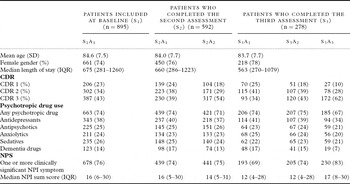
The mean age of the 895 patients at baseline was 84.6 years (SD 7.5), the median length of stay was 675 days (IQR 281–1260), and 74% of the patients were women. Forty-three percent of the patients had severe dementia (CDR = 3), and psychotropic drugs were prescribed to 74% of all patients. Table 1 shows characteristics of Sample 1 (S1), Sample 2 (S2) and Sample 3 (S3).
Demographic data, level of dementia, NPS and psychotropic drug use at first (A1), second (A2) and third (A3) assessment

CDR = Clinical Dementia Rating; NPS = neuropsychiatric symptoms; NPI = Neuropsychiatric Inventory; IQR = inter-quartile range
In S2 the CDR sum of boxes was higher at A2 (median = 15, IQR 11–18) than at A1 (median = 13, IQR 10–16) (Z = ˗9.143, p < 0.001, Wilcoxon signed rank test). A larger proportion of patients used dementia drugs at A1 than at A2 (p < 0.001, McNemar test). In S3 the CDR sum of boxes was higher at A3 (median = 16, IQR 12–18) than at A1 (median = 13, IQR 10–16) (Z = ˗9.072, p < 0.001, Wilcoxon signed rank test). The NPI total score was higher at A3 than at A1 (Z = ˗3.198, p = 0.001, Wilcoxon signed rank test). A larger proportion of the patients exhibited one clinically significant NPI symptom at A3 compared to A1 (p < 0.001, McNemar Test). There was a decrease from A1 to A3 in the use of psychotropic drugs (p = 0.01, McNemar test), antidepressants (p = 0.01, McNemar test) and dementia drugs (p < 0.001, McNemar test).
A comparison of baseline measures between patients who completed A3 and those who left the study prior to A3 showed that the patients who completed A3 were younger (mean age 83.7 years (SD 7.7) vs 85.0 years (7.3), p = 0.02, indep samples t-test), had less severe dementia (CDR median sum of boxes 13 (IQR 10–16) vs 14 (IQR 11–17, p < 0.001, Mann-Whitney U-test), better physical health (proportion with bad or very bad physical health 38.4% vs 58.5%, p<0.001, χ2-test), a higher level of functioning (mean score 16.8 (SD 5.4) vs 19.7 (SD 5.0), p < 0.001, indep samples t-test) and less severe neuropsychiatric symptoms (NPI total median score 12 (IQR 4–28) vs 17 (7–32), p = 0.004, Mann-Whitney U-test). Among those who completed A3 compared with those who left the study prior to A3 a larger proportion were female (78% vs 72%, p = 0.04, χ2-test). There was no difference in terms of length of stay.
Neuropsychiatric symptoms
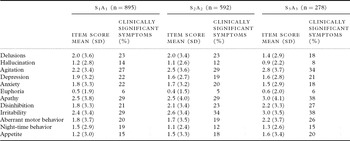
The individual item score and the proportion of patients with clinically significant symptoms at baseline and each follow-up are presented in Table 2. At all three assessments the most common clinically significant symptoms were agitation, irritability and apathy.
Scores on individual NPI items (frequency × severity) and proportion of patients with clinically significant symptoms (item score ≥ 4) at the first, second and third assessments

Principal component analysis (PCA)
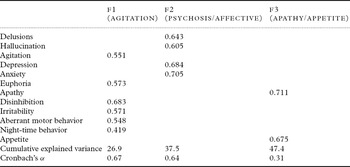
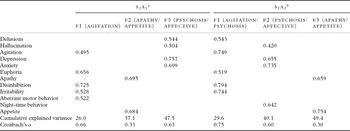
PCAs of S1, S2 and S3 are presented in Tables 3–5. For all of the models the Bartlett's test for sphericity was significant (p < 0.001) and the KMO ≥ 0.7.
Principal component analysis of the NPI-NH (F × S): Sample 1, first (S1A1) assessment1

1 KMO 0.78
Only factor loadings >0.40 are presented.
Principal component analysis of the NPI-NH (F × S): Sample 2, first (S2A1) and second (S2A2) assessments

aKMO 0.76, bKMO 0.82 Only factor loadings > 0.40 are presented
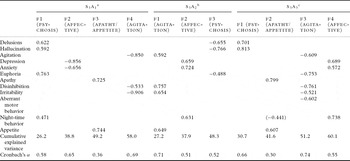
Principal component analysis of the NPI-NH (F × S)– Sample 3, first (S3A1), second (S3A2) and third (S3A3) assessment

aKMO 0.70, bKMO 0.76, cKMO 0.78
Only factor loadings > 0.40 are presented. Factor loadings in parentheses imply that an item loads on more than one factor, with the lowest loading in parentheses.
Sample 1 (S1)
PCA of S1 (Table 3) gave a three-factor solution explaining 47% of common variance. Factor 1 (agitation) included agitation, euphoria, disinhibition, irritability, aberrant motor behavior and night-time behavior. Factor 2 comprised delusions, hallucinations, depression and anxiety and was termed “psychosis/affective”. Factor 3 (apathy/appetite) consisted of apathy and appetite.
Sample 2 (S2)
PCA of S2 (Table 4) yielded three factors both at A1 and A2, explaining 48% and 50% of the common variance, respectively. At A1, factor 1 (agitaton) included agitation, euphoria, disinhibition, irritability, and aberrant motor behavior. Factor 2 (apathy/appetite) encompassed apathy and appetite. Factor 3 (psychosis/affective) comprised delusions, hallucinations, depression and anxiety. At A2, factor 1 (agitation/psychosis) comprised delusions, agitation, euphoria, disinhibition and irritability. Factor 2 (psychosis/affective) consisted of hallucinations, depression, anxiety and night-time behavior. Factor 3 (apathy/appetite) included apathy and appetite.
Sample 3 (S3)
PCA of S3 (Table 5) gave four factors at A1 and A3, explaining 58, and 60% of the common variance, respectively. At A2 three factors appeared, explaining 48% of the common variance. The factors psychosis, agitation, affective and apathy/appetite emerged on the first and third assessments. Apathy did not load on any factor at A2.
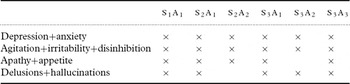
The symptoms most commonly appearing in the same factor were depression and anxiety (six times), agitation, disinhibition and irritability (six times), appetite and apathy (five times) and delusions and hallucinations (five times) (Table 6).
Individual symptoms appearing in the same factor at various assessments

Discussion
We present the results from the first study investigating the longitudinal stability of neuropsychiatric subsyndromes in nursing-home patients with dementia, as measured by the NPI. Based on a large nursing-home cohort, two (partly overlapping) samples have been defined, one with a 12-month follow-up period (S2), the other with a 31-month follow-up period (S3).
In both samples the factor structure is relatively stable during the follow-up period. However, there are some differences between the two samples. This may be due to the fact that those who dropped out prior to A3 differed from those who completed A3 in that they had more severe dementia, a lower level of functioning, worse physical health and more severe neuropsychiatric symptoms at baseline. Most of them dropped out of the sample because they died.
Agitation, psychosis, affective symptoms and apathy/appetite disorder seem to be the most stable factors. The most stable co-occurring symptoms in one and the same factor were depression and anxiety (affective), agitation, irritability and disinhibition (agitation), delusions and hallucinations (psychosis), and apathy and appetite disorder. However, affective symptoms are grouped with psychosis in three of the six solutions, and agitation is grouped with psychosis in one of the solutions. In the sample with the longest follow-up period (S3), the factor structure is stable across all three assessments, apart from the fact that apathy does not load on any factor at A2. It should be noted that the factor apathy/appetite in all analyses had a low Cronbach's α, indicating that these two symptoms actually do not correlate well with each other. The validity of this factor is thus questionable.
The largest study on NPI subsyndromes including outpatients with dementia from several European countries found a four-factor solution that was relatively consistent across dementia subtypes, gender and age (Aalten et al., Reference Aalten2008). The factors were termed hyperactivity, psychosis, mood and apathy, which is similar to the factors found in our study. Factor analysis of a large sample of Dutch nursing-home patients produced four- or five-factor solutions across various levels of dementia with factors referred to as agitation/aggression, depression, psychosis, psychomotor agitation and apathy (Zuidema et al., Reference Zuidema, de Jonghe, Verhey and Koopmans2007). Another large study including both nursing-home patients and outpatients with Alzheimer's disease (AD), applying a slightly different methodology, found four factors, termed behavioral dyscontrol, psychosis, mood and agitation (Hollingworth et al., Reference Hollingworth2006). These results are in line with the findings in our study, apart from the fact that the study by Hollingworth et al. found that apathy and depression belonged to the same subsyndrome. However, in the group with moderately severe to severe stages of dementia (Global Deterioration Scale 5–7), depression and apathy loaded on different factors.
A number of other studies have identified psychosis (hallucinations/delusions) as a distinct subsyndrome (Aalten et al., Reference Aalten2003; Lange et al., Reference Lange, Hopp and Kang2004; Mirakhur et al., Reference Mirakhur, Craig, Hart, McLlroy and Passmore2004; Colombo et al., Reference Colombo, Vitali, Cairati, Vaccaro, Andreoni and Guaita2007; Spalletta et al., Reference Spalletta2010). Another study including outpatients with AD found that agitation and psychosis were grouped together (Frisoni et al., Reference Frisoni1999). Affective symptoms (depression and anxiety) have constituted one factor in some studies (Dechamps et al., Reference Dechamps, Jutand, Onifade, Richard-Harston and Bourdel-Marchasson2008; Aalten et al., Reference Aalten2003; Spalletta et al., Reference Spalletta2010), but have been grouped with psychosis (Fuh et al., Reference Fuh, Liu, Mega, Wang and Cummings2001) or agitation (Mirakhur et al., Reference Mirakhur, Craig, Hart, McLlroy and Passmore2004; Borroni et al., Reference Borroni2006) in other studies.
The relationship between apathy and affective symptoms deserves particular attention. Several studies have reported that apathy and depression are grouped in the same factor (Frisoni et al., Reference Frisoni1999; Aalten et al., Reference Aalten2003; Lange et al., Reference Lange, Hopp and Kang2004; Hollingworth et al., Reference Hollingworth2006). Our finding that apathy does not belong in the same underlying factor as depression corroborates findings from two large studies of outpatients (Aalten et al., Reference Aalten2008; Spalletta et al., Reference Spalletta2010) and three studies of nursing-home patients (Zuidema et al., Reference Zuidema, de Jonghe, Verhey and Koopmans2007; Colombo et al., Reference Colombo, Vitali, Cairati, Vaccaro, Andreoni and Guaita2007; Dechamps et al., Reference Dechamps, Jutand, Onifade, Richard-Harston and Bourdel-Marchasson2008). It seems plausible that these findings reflect a late-stage dementia phenomenon as apathy increases with the progression of dementia, whereas depression seems to be equally prevalent across dementia stages or more prevalent in the earlier phases of the disease (Verkaik et al., Reference Verkaik, Nuyen, Schellevis and Francke2007). However, the mean MMSE of the studies by Aalten et al. (Reference Aalten2008) and Spalletta et al. (Reference Spalletta2010) were 17.6 and 18.3, respectively, indicating that these findings also apply at moderate stages of dementia. This is supported by results from Zuidema et al. (Reference Zuidema, de Jonghe, Verhey and Koopmans2007), which demonstrate that apathy and eating disorders constitute one factor at GDS stages 4/5. Another study, which included elderly without dementia living in residential facilities, demonstrated that apathy and depression cluster into distinct subsyndromes (Cravello et al., Reference Cravello, Palmer, de, Caltagirone and Spalletta2011). Furthermore, a large population study showed that apathy is associated with cognitive impairment even among elderly people adjudged to have normal cognition (Onyike et al., Reference Onyike2007). These findings suggest that the identification of apathy as a distinct subsyndrome may have clinical importance even at pre-dementia stages. All these studies as well as our own indicate that apathy is a different phenomenon from depression.
Differentiating between depression and apathy may be complicated in clinical practice. However, this distinction is important in terms of identifying etiological factors and choosing among treatment options. With the progression of dementia the phenotypes of depression and apathy are influenced by a number of factors, such as neuropathological changes or environmental factors associated with increasing care needs. Longitudinal studies, with careful assessment of depression and apathy, that take these factors into account are needed. There is a need for better understanding of the phenotypes of depression and apathy to interpret the results of previous intervention studies and to plan future studies.
Limitations
There are some limitations to this study that warrant consideration. The diagnosis of dementia was not established using diagnostic criteria. We have used the CDR to identify persons with dementia and to establish the stage of dementia. Ideally, one might think that this should have included an interview with the patient, but previous studies have shown that CDR staging based solely on an informant interview is a valid substitute (Nygaard and Ruths, Reference Nygaard and Ruths2003). We do not have information on dementia subtypes. It might be that the factor structure differs between different types of dementia, but the largest study on factor structure of the NPI showed that the factor structure was not dependent on the subtype of dementia (Aalten et al., Reference Aalten2008).
We have not interviewed or examined the patients directly but relied on nursing staff for information in order to complete the assessment scales. However, direct interviews with the patients might have failed to give reliable information because of the severe cognitive impairment of a large proportion of the nursing-home patients. Furthermore, all the actual respondents were registered nurses who had close and daily contact with the patients. The Norwegian versions of the NPI and the CDR have been shown to give reliable results (Selbaek et al., Reference Selbaek, Kirkevold and Engedal2007; Reference Selbaek, Kirkevold, Sommer and Engedal2008).
Finally, some methodological issues need to be addressed. Factors, or components, may be viewed as merely theoretical constructs with uncertain clinical relevance. Exploratory factor analysis does not allow for generalization unless different samples result in similar factor structures. However, the widespread use of the NPI makes it possible to compare different samples in diverse clinical settings and this and other studies have shown that some recognizable patterns exist.
The products of individual items of the NPI do not give a continuous scale. This may render the solutions less stable. However, most previous studies have used the same methodology and, furthermore, a study using a method treating the products of the NPI as ordinal variables has produced similar factor structures (Hollingworth et al., Reference Hollingworth2006).
The major strengths of this study are its large and representative sample, the structured data collection done by registered nurses working in old age psychiatry who had taken courses on the use of assessment scales prior to each collection of the data, and, finally, the use of established assessment scales allowing for comparison with a number of other studies in this field.
Conclusion
The factor structure of the NPI is stable across a 31-month follow-up period in a large cohort of nursing-home patients. In line with previous research, we have identified three factors that may be referred to as psychosis, affective symptoms, agitation/aggression and also a distinct symptom, apathy, which is not part of the factor “affective symptoms”. Our findings lend support to the differentiation between apathy and affective symptoms as separate subsyndromes. The identification of stable neuropsychiatric subsyndromes may be important both for understanding etiological factors and for the planning and evaluation of treatment.
Conflict of interest
None.
Description of authors' roles
Geir Selbæk designed and conducted the study, and prepared the paper. Knut Engedal took part in planning the study and preparing the manuscript.
Acknowledgment
The study was funded by an unrestricted grant from Innlandet Hospital Trust, Norway.