INTRODUCTION
Clonorchiasis, caused by Clonorchis sinensis, is a key foodborne zoonosis, found in most provinces in China, Korea, Laos and Vietnam, with over 35 million people estimated to be infected (Rim, Reference Rim1986; Kaewkes, Reference Kaewkes2003; Lun et al. Reference Lun, Gasser, Lai, Li, Zhu, Yu and Fang2005; Lim et al. Reference Lim, Ju, Franceschi, Oh, Kong, Hwang, Park, Cho, Sohn, Kim, Yoo, Hong and Shin2006; Kim et al. Reference Kim, Cho, Huh, Kong, Sohn, Hwang, Chai, Lee, Park, Oh and Lee2009; Fürst et al. Reference Fürst, Keiser and Utzinger2012). Co-infection with HIV patients has been reported in China with possible serious consequences (Tian et al. Reference Tian, Chen, Wang, Cheng, Steinmann, Wang, Cai, Yin, Guo, Zhou and Zhou2012). Heavy and chronic infection with this parasite usually leads to various hepatobiliary diseases (Rim, Reference Rim1986; Liu and Chen, Reference Liu and Chen1998; Fürst et al. Reference Fürst, Keiser and Utzinger2012), and has been recognized as a carcinogen by the International Agency for Research on Cancer (IARC, 2012).
The complete life cycle of C. sinensis requires three different types of hosts, the first intermediate host, freshwater snails, the second intermediate host, freshwater fish and the definitive host which can include humans and carnivorous animals (Lun et al. Reference Lun, Gasser, Lai, Li, Zhu, Yu and Fang2005; Lin et al. Reference Lin, Tang, Zhou, Song, Huang, Chen, Chen, Zhang, Zhu and Zhou2011). Removing exposure to a raw freshwater fish diet is the most effective way to block the infection with C. sinensis as well as other foodborne parasites. Thus, the most sensible way to prevent clonorchiasis is by food safety control.
A lot of research has been focused on the infection rate caused through sales of freshwater fish in markets (Deng et al. Reference Deng, Liu, Zeng, Huang, Chen, Guo, Chen, Shen, Li, Ma and Chen2003; Lun et al. Reference Lun, Gasser, Lai, Li, Zhu, Yu and Fang2005; Xu et al. Reference Xu, Zhou, Wu, Tao, Li, Le, Hua, Chen and Wang2007). Routine diagnosis of C. sinensis mainly relies on finding the presence of the pathogen. The traditional method for detecting the metacercariae by light microscopy, following fish tissue digestion with pepsin, is time consuming and labour intensive. Distinguishing parasites by morphology in snails is extremely difficult and sometimes impossible. Furthermore, it can easily lead to misdiagnosis and is difficult for dealing with large numbers of samples. Some PCR methods have been developed to detect genomic DNA of this parasite with apparent improved sensitivity and specificity (Müller et al. Reference Müller, Schmidt and Mehlhorn2007; Parvathi et al. Reference Parvathi, Karunasagar, Sanath Kumar, Kenchanna Prakasha, Lu, Xu, Hu and Feng2007), free of the complex detection process requiring detailed morphological knowledge. However, due to the low sensitivity of the Taq polymerase in the presence of a high ratio of host to parasite DNA molecules in the samples, PCR detection of infection is reduced. Furthermore, random selection of the samples from the large body size of most freshwater fish in the markets, such as the grass carp (Ctenopharyngoden idellus), decreases the chances of sampling the parasite from the infected fish. Thus PCR assay may not always be an ideal method for the detection of this parasite from the second intermediate hosts due to obtaining a high probability of false negatives.
To overcome these problems, the present study was focused on the diagnosis from freshwater snails (detection of sporocysts, rediae and cercariae) collected from fish ponds in endemic regions of C. sinensis. Using this approach, 100% of the snail could be used for the DNA extraction thus removing the possibility of false negatives due to biased tissue sampling. In this study we wish to investigate whether loop-mediated isothermal amplification (LAMP) can be developed for the detection of C. sinensis. The LAMP reaction is carried out by a Bst DNA polymerase with high strand displacement activity and six primers that recognize a total of eight distinct sequences on the target DNA. It can amplify a few copies of the target DNA fragment by a magnitude of 109 in less than 1 h at isothermal conditions ranging from 60 to 65 °C (Notomi et al. Reference Notomi, Okayama, Masubuchi, Yonekawa, Wananabe, Amino and Hase2000; Mori et al. Reference Mori, Nagamine, Tomita and Notomi2001; Nagamine et al. Reference Nagamine, Hase and Notomi2002). Therefore, this method could potentially achieve a very high specificity of C. sinensis detection in a short time and without the use of expensive equipment, which is usually a limitation in field surveys using PCR. A simple sensitive detection system like this could be used as an early warning system of infection in ponds. A positive snail would indicate that the fish from the same pond are at a high risk of the infection with this parasite. This would enable a food safety warning to be issued for C. sinensis-infected ponds and a risk assessment of food supplies could then be conducted.
MATERIALS AND METHODS
DNA samples
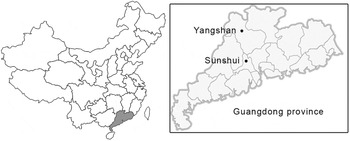
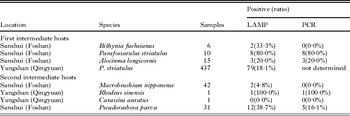
Eleven freshwater snails (Parafossarulus striatulus), which were experimentally infected with C. sinensis, were obtained from the Parasitology Institute, Zhongshan School of Medicine, Sun Yat-Sen University. Eighteen non-infected snails were obtained from the Centre for Disease Control and Prevention of Guangdong Province (GDCDC). All these 29 samples were further checked by microscopy before they were used as positive samples and negative controls respectively. A total of 468 freshwater snails, 42 shrimps and 33 freshwater fish were collected from endemic areas of clonorchiasis, Yangshan (112.65′E/24.48′N) and Sanshui (112.89′E/23.18′N) of Guangdong province (Table 1 and Fig. 1). Genomic DNA was extracted from each sample as previously described (Lai et al. Reference Lai, Wang, Chen, Cai, Wu, Zhu and Lun2008). Genomic DNA of Fasciola gigantica, Fasciola hepatica, Schistosoma japonicum and Opisthorchis viverrini were used as controls.
Map of sampling sites in China.

Origins of field samples used in this study, including snails, shrimps and fish, and their test results by both LAMP and PCR methods

LAMP and PCR methods
The C. sinensis internal transcribed spacer 2 (ITS2) gene (GenBank accession number AF217099) was chosen as the target for designing the LAMP primers, as it provides a relatively conserved nucleic acid fragment of 242 bp. Four of six primers were designed using Primer Explorer V4 software (http://primerexplorer.jp/e/, Table 2). LAMP primers F3 and B3 were also used as PCR primers (Suppl. Fig. 1S – in Online version only).
Primers used for LAMP and PCR

The LAMP reaction was performed in a final volume of 25 μL which contained 1×LAMP reaction buffer [10 mm Tris-HCl (pH 8·8), 5 mm KCl, 5 mm (NH4)2SO4, 4 mm MgSO4, 0·1% Tween 20 and 0·4 m betaine (Sigma-Aldrich, USA)], 8 units of the Bst DNA polymerase (NEB, UK), 100 ng of test DNA, and primers of 40 pmol (FIP and BIP), 20 pmol (LF and LB) and 5 pmol (F3 and B3), respectively. The mixture was incubated at 60 °C in a water bath for 60 min. The LAMP amplicons were examined on a 2% agarose gel and were visualized after staining with ethidium bromide. Alternatively, positive samples would turn green, if 4×SYBR Green I (Invitrogen, USA) was added after the reaction.
The PCR was performed in a thermocycler as previously described (Lai et al. Reference Lai, Wang, Chen, Cai, Wu, Zhu and Lun2008) with 10 pmol of F3 and B3 primers. The PCR reaction started by a initial step at 94 °C for 5 min, followed by 35 cycles at 94 °C for 30 s, 55 °C for 30 s and 72 °C for 1 min, with a final extension step at 72 °C for 10 min. Finally, the PCR products were analysed by electrophoresis and recorded following staining with ethidium bromide.
Evaluation of LAMP and PCR for C. sinensis detection
The specificity of LAMP was examined using host DNA and that of other trematodes (F. gigantica, F. hepatica, S. japonicum and O. viverrini). PCR and LAMP assays were tested by using DNA extracted from the known negative/positive samples and the field samples. Furthermore, the sensitivity of both methods was tested using a serial dilution (10−1–10−7) of C. sinensis DNA template.
RESULTS
Optimizing LAMP assay conditions for C. sinensis detection
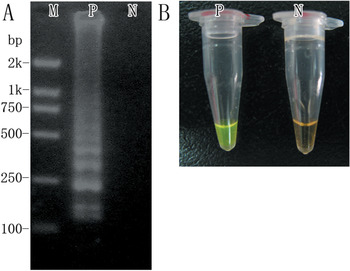
Positive amplification using LAMP was detected by both agarose gel electrophoresis and visual inspection. As shown in Fig. 2A, a positive target DNA sequence was amplified at 60 °C and produced a ladder-like pattern on the gel. The positive reaction was also indicated clearly by the green colour produced by the intercalating dye SYBR Green I shown in Fig. 2B.
Agarose gel electrophoresis and visual inspection of LAMP products. (A) LAMP products were resolved in agarose gel; (B) After adding SYBR Green I®, fluorescence could be visible by either the naked eye or under ultraviolet light. M, DNA marker; P, positive sample; N, negative sample.

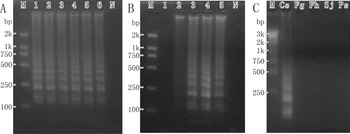
The LAMP reaction conditions were optimized by testing various temperatures and reaction times. As shown in Fig. 3A, clear patterns were obtained at 60–65 °C and the amplicons could be detected initially at 30 min and reached a peak at 60 min (Fig. 3B). Based on these results, further LAMP tests were all carried out at 60 °C for 1 h.
The LAMP reaction under various conditions. (A) LAMP reactions were tested in temperature gradients. Lanes 1–6: 60, 61, 62, 63, 64 and 65 °C, respectively; (B) LAMP incubations were all done at 60 °C but in various lengths of time. Lanes 1–5: 15, 30, 45, 60 and 75 min, respectively; (C) Specificity of LAMP for Clonorchis sinensis detection. M, DNA marker; Cs, C. sinensis, Fg, Fasciola gigantica; Fh, F. hepatica; Sj, Schistosoma japonicum; Ps, Parafossarulus striatulus.

Evaluation of LAMP and PCR for C. sinensis detection
To test the specificity of LAMP for C. sinensis detection, DNA samples were extracted from the common first intermediate hosts of C. sinensis, the freshwater snails including Bithynia fuchsianus, Alocinma longicornis and P. striatulus, the second intermediate hosts of this parasite including C. idellus, Carassius auratus, Rhodeus sinensi and Macrobrachium nipponense, and the samples of three other trematodes (F. gigantica, F. hepatica, S. japonicum and O. viverrini). The results showed that there was no cross-reaction among either host species or different species of trematodes tested by either the LAMP assay or the PCR method in all species tested (Fig. 3C, Suppl. Fig. 2S – in Online version only and data not shown).
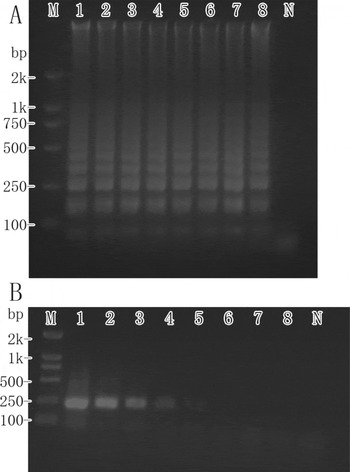
The sensitivity of the LAMP technique was also tested and compared with the PCR tests by progressively diluting the concentration of C. sinensis DNA (100 ng–10 fg) templates. As shown in Fig. 4A, LAMP was able to detect as few as 10 fg of DNA sample, which approximately corresponds to 0·0002 C. sinensis per snail (as judged by the size of the snail and cercaria), whereas PCR could only amplify C. sinensis DNA at amounts of 10 pg or higher (Fig. 4B). Therefore, the detection sensitivity of LAMP was at least 1000-fold higher than the PCR (0·2–2 C. sinensis per snail).
Sensitivities of LAMP and conventional PCR detection methods for C. sinensis. Detection reactions conducted using 10-fold serial dilutions of the C. sinensis genomic DNA by either LAMP (A) or PCR (B), lanes 1–8: 100 ng, 10 ng, 1 ng, 100 pg, 10 pg, 1 pg, 100 fg and 10 fg respectively. M: DNA marker.

The LAMP approach was able to detect all positive samples of snails (P. striatulus) which were experimentally infected (n=11), while the PCR method showed two of them as negative. Both methods show all 18 non-infected samples as negative. The agreement with the control samples, as measured by the Kappa Statistic, was ‘perfect’ (1·0; 95% CI: 1·0–1·0) for the LAMP procedure and ‘very good’ (0·85; 95% CI: 0·65–1·0) for the PCR procedure.
Application of LAMP and PCR for field sample detection
In total, 106 field samples including snails, fish and shrimps were tested by both the LAMP and PCR methods (Table 1). Two of 42 samples of M. nipponense were positive by LAMP, but negative by PCR. Thirteen of 33 samples of fish were positive by LAMP, while only 6 of them were positive by PCR.
From 2007 to 2011, 31 snails were collected from fish ponds in Sanshui (112.89′E/23.18′N) and 437 from the upstream of the fish ponds in Yangshan (112.65′E/24.48′N) in Guangdong province which are highly endemic regions of C. sinensis (see Fig. 1 and Table 1). Results indicated that the high infection rate of B. fuchsianus, P. striatulus and A. longicornis from Sanshui, 2/6, 8/10 and 3/15, respectively by LAMP. PCR amplification could obtain the same results for P. striatulus and A. longicornis, but was unable to detect any positives from B. fuchsianus. Comparison of the LAMP and PCR techniques on field samples where both techniques were used had high consistency, as judged by the Kappa Statistic (0·69; 95% CI: 0·53–0·86), with the LAMP technique consistently detecting at a higher sensitivity level. In all 437 snails of P. striatulus, collected from Yangshan, the LAMP results showed 79 (79/437) positives indicating a high prevalence in the region (18·1%; 95% CI: 14·7–22·0) which was consistent with the results from a recent epidemiological survey (Lun et al. Reference Lun, Gasser, Lai, Li, Zhu, Yu and Fang2005).
DISCUSSION
A number of previous studies have indicated that the first or second internal transcribed spacers (ITS1, ITS2) of nuclear ribosomal DNA (rDNA) provide accurate genetic markers for the identification of many parasites (Cox et al. Reference Cox, Tilley, McOdimba, Fyfe, Hide and Welburn2005, Reference Cox, Tosas, Tilley, Picozzi, Coleman, Hide and Welburn2010; Zhu et al. Reference Zhu, D'Amelio, Gasser, Yang, Paggi and He2007; Lin et al. Reference Lin, Ai, Zou, Verweij, Jiang and Li2008; Sato et al. Reference Sato, Thaenkham, Dekumyoy and Waikagul2009; Ai et al. Reference Ai, Dong, Zhang, Elsheikha, Mahmmod and Lin2010; Chen et al. Reference Chen, Tong, Zhang, Lou, Kong, Lv, Zhuo, Wen and Lu2011; Tang et al. Reference Tang, Lan, Wen, Zhang, Desquesnes, Yang, Hide and Lun2012). In our study, ITS2 was used as a genetic marker to establish both PCR and LAMP assays for the specific diagnosis of C. sinensis infection in both first and second intermediate hosts. The use of primers designed from the repetitive ITS2 regions can hugely increase the sensitivity of the method. In addition, the other most important step that we made in this study was to develop a LAMP method to detect parasites within the first intermediate host of C. sinensis. This technique was used to provide evidence to indicate the presence of infection with this parasite in the region. Importantly, large numbers of parasites were found in infected snails and all snail tissues were able to be used for extraction of genomic DNA for amplification. Our results showed that these molecular methods are specific and did not show cross-reaction with the trematodes tested: F. gigantica, F. hepatica, S. japonica and O. viverrini. Opisthorchis is a sister genus of Clonorchis, and the species in the genus Opisthorchis are widely distributed in some countries in Southeast Asia such as Thailand, Lao, Vietnam and Malaysia. Our primers are located at the highly divergent regions of the ITS2 gene, thus enabling it to distinguish C. sinensis from O. viverrini. The LAMP method produced sensitive, accurate and rapid results and is sufficient for field detection of C. sinensis in the first intermediate hosts. Although the LAMP method is not suitable for amplicon sequencing, we are able to confirm the correct products by sequencing of PCR products amplified by the same primers B3 and F3. Thus, we are confident that all our LAMP positive results were obtained from C. sinensis infections.
The infection of C. sinensis can be quite low in hosts and can create problems with detection. In cases of low parasite load, where low concentrations of template DNA is expected, the sensitivity of the detection method is extremely essential. The detection limit of the LAMP system established here is around 10 fg DNA, at least 1000 times more sensitive than the PCR detection. LAMP also passed the positive/negative test with a 100% score, while the PCR method missed 2 of all 11 positive samples. When we applied both approaches to field samples, higher positive rates (26·41%, 28/106) were detected by LAMP than by PCR (16·04%, 17/106). This suggests that PCR is underestimating the number of cases by 10·3%. According to our findings, PCR detection could detect 0·2–2 cercariae in a snail, and we are quite confident that these PCR-negative but LAMP-positive samples are actually examples of cases, with parasite intensities too low to be detected by the PCR method.
For a prevalence survey, the diagnosis provides a confident estimation of current infection, but lacks data for risk assessment of new infection and re-infection. The maintenance of an endemic environment with clonorchiasis requires the complete life cycle of the parasite including the first, the second and final hosts. For a comprehensible epidemiological survey and for prevention of the disease, in addition to detection of parasites in patient feces, we need to screen intermediate hosts and, in particular, freshwater fish. However, due to the low parasite load commonly found in market fish and their vast body size in most cases, such diagnoses are labour consuming, low throughput and, from a practical point of view, unrealistic. It is known that there are more than 132 different species of freshwater fish that can serve as the second hosts for C. sinensis in China (Lun et al. Reference Lun, Gasser, Lai, Li, Zhu, Yu and Fang2005). A complete monitoring of all possible hosts in markets is rather difficult. In contrast, the freshwater snails, which can be the first intermediate hosts for C. sinensis, are restricted to merely 10 species in endemic regions in this country (Lun et al. Reference Lun, Gasser, Lai, Li, Zhu, Yu and Fang2005; Fang, Reference Fang2007) and all are of a small size at around 5–10 mm. Thus, the definition of endemic regions and risks of transmission could be more easily identified by surveying the small snails than by surveying other hosts. Additionally and importantly, DNA extraction can be done from the whole snail, due to its small size, thus avoiding the sampling bias and likely generation of false negatives associated with sampling the larger fish body mass. Furthermore, the parasite in the snail undergoes asexual reproduction, during which around 1000 cercariae could be generated from each ingested egg in the snail. Therefore, the snail host is an ideal target for food safety control in the fish industry in the endemic regions infested with this parasite.
Few studies have been carried out on the freshwater snails. In China, P. striatulus, B. fuchsianus and A. longicornis are considered the most important snails for the transmission of this parasite. In Guangdong province, based on the data from 2003 to 2009, the prevalence of C. sinensis in the snails from Shaoguan, Jiangmen and Foshan cities was estimated from 0·30–3·70% in both P. striatulus and A. longicornis. However, the infection rates were dramatically different among different endemic regions. For instance the highest rate, with 27·50% (of 109 examined snails), was reported in A. longicornis from a village near Qingyuan city (Li et al. Reference Li, Lin, Huang, Zhou, Ou, Luo, Tan and Chen2005; Huang et al. Reference Huang, Zhong, Chi, Liu, Zhang, Deng and Huang2006; Zou et al. Reference Zou, Chen, He, Luo, Pan and Cui2008; Zhang et al. Reference Zhang, Pei, Zhang, Lin, Huang, Wang, Cen, Lu and Chao2010). In our study, 18·1% of the 437 snails of P. striatulus collected from Qingyuan region were positive, which suggests the current situation of clonorchiasis is still one of high risk. We noted that an unexpectedly high infection rate was found in the samples collected from Sanshui, Foshan. However, we consider that the reason behind this result is not related to the specificity of the primers we used as fragments could not be amplified from the genomic DNA of O. viverrini, one of the most closely related species to C. sinensis. After consideration of possible reasons, we suggest that it might be caused by the limited number of samples collected from these fish ponds in which fish were demonstrated to be highly infected with C. sinensis. These molecular findings demonstrate that the prevalence of C. sinensis in this endemic region is still at a high level, and thus still poses a high risk of infection. This is consistent with the results from the latest national survey in China published in 2005 (CONSIHPD, 2005). In fact, it has been reported that the increase in C. sinensis prevalence is more dramatic (over 200%) in endemic areas where eating raw freshwater fish meat is considered as part of a new popular culture (Lun et al. Reference Lun, Gasser, Lai, Li, Zhu, Yu and Fang2005; Chen et al. Reference Chen, Zhou and Xu2012). As mentioned above, control of fish infection with C. sinensis in fish ponds, through monitoring the first intermediate host, the freshwater snail, is an efficient way to validate infection-free status of fish from these ponds. Using this approach, a guaranteed food safety system could be established which is able to eliminate the risk of infection or re-infection of humans and other mammalian hosts.
CONCLUSIONS
The LAMP assay developed in the present study allows the rapid and sensitive detection of C. sinensis in hosts, particularly in freshwater snails. Furthermore, this LAMP assay provides a crucial tool which has the potential to underpin epidemiological studies, by means of rapid, accurate and location-unlimited detection, to enable control and inspection of infected snails in at-risk areas. The impact of the development of this LAMP assay will facilitate clinical and epidemiological investigations and indirectly promote the effective control of human clonorchiasis.
ACKNOWLEDGEMENTS
We thank Dr Yue-Yu Fang of the CDC of Guangdong Province who kindly provided the C. sinensis-free snail P. striatulus, Prof Wanchai Maleewong, Khon Kaen University, Thailand, who kindly provided O. viverrini and Dr Xin-Quan Zhu of Lanzhou Veterinary Medical Research Institute, Lanzhou, China who provided genomic DNA of F. gigantica, F. hepatica and S. japonicum.
FINANCIAL SUPPORT
This work was supported by a grant from National Basic Research Program (973 project, no. 2010CB530000).
SUPPLEMENTARY MATERIAL
To view supplementary material for this article, please visit http://dx.doi.org/10.1017/S0031182013000498.