Implications
The nutritive potential and anti-nutritional profiles of seed materials of a promising under-utilized legume, velvet bean (VB), was revealed. The results on the effects of certain simple and cost-effective processing methods on the nutritional and anti-nutritional properties of VB allowed the selection of appropriate treatment for the utilization of VB as an alternative source of dietary protein. Furthermore, the major findings of the present investigation regarding the suitable level of inclusion of VB meal in the poultry feed as an alternative protein ingredient are very much useful for the poultry industry. The recommendation of incorporation of VB meal as an alternative protein ingredient in poultry feed would meet the increasing demands for dietary protein in the poultry sector. Moreover, the utilization of such suitably processed non-conventional legume grains could reduce the over-dependence on conventional legume proteins, which in turn decreases the feed production cost and ultimately improves the growth of the livestock industry in many developing countries.
Introduction
Soybean meal (SBM) and fish meal are currently playing a key role as a protein ingredient in the feedstuff of poultry birds (Ukachukwu and Szabo, Reference Ukachukwu and Szabo2003). However, the production and supply of such conventional protein sources are not sufficient to meet the increasing requirements of the expanding and fast-growing poultry industry, which resulted in an inappropriate increase in the price of poultry feed and ultimately affected the growth of the poultry industry (Ukachukwu, Reference Ukachukwu2007). To meet the protein demands in the poultry sector, the recent research trends are being focused toward finding out an alternative/additional and economic source of protein ingredient. In this connection, certain promising under-utilized legume grains have received more attention and research efforts are underway on the possibilities of utilization of such wild legume grains as an alternative source of protein in poultry feed (Bourne, Reference Bourne1997).
Among the various under-utilized legumes, the seed materials of velvet bean (VB) (Mucuna pruriens (L.) DC. var. utilis (Wall. ex Wight) Baker ex Burck) merit a wider use as an alternative protein source in many tropical countries (Pugalenthi et al., Reference Pugalenthi, Vadivel and Siddhuraju2005). This wild legume is distributed in the Southern and Southeast Asian regions, and in some parts it is cultivated as a green manure/cover crop. In India, VB seeds are traditionally consumed by certain ethnic groups, particularly the Northeastern tribes and Kanikkar tribes in Kerala and Dravidian tribes in Tamil Nadu (Vadivel and Pugalenthi, Reference Vadivel and Pugalenthi2008).
The seed materials of VB contained higher levels of proteins (25.4% to 29.6%), starch (31.2% to 39.5%), desirable amino acids, fatty acids and mineral composition with good nutritional properties (Siddhuraju and Becker, Reference Siddhuraju and Becker2003; Pugalenthi et al., Reference Pugalenthi, Vadivel and Siddhuraju2005; Vadivel and Janardhanan, Reference Vadivel and Janardhanan2005). But although the raw VB seeds constitute a rich source of protein and other nutrients, its utilization as food/feed remains poor mainly due to the presence of certain anti-nutritional compounds (Pugalenthi et al., Reference Pugalenthi, Vadivel and Siddhuraju2005; Vadivel and Pugalenthi, Reference Vadivel and Pugalenthi2008). Earlier research reports have indicated that the inclusion of raw VB seeds as a protein ingredient in poultry feed reduces the growth rate of broiler chicks (Del Carmen et al., Reference Del Carmen, Gernat, Myhrman and Carew1999) and also decreases egg production in laying hens (Harms et al., Reference Harms, Simpson and Waldroup1961). Siddhuraju and Becker (Reference Siddhuraju and Becker2003) have also reported that the incorporation of raw VB seeds in fish feed exhibits poor growth performance and feed utilization of fishes.
Even though few reports are available on the nutritional and anti-nutritional properties of VB seeds, the information regarding a suitable processing method to detoxify VB seeds as well as its utilization as a protein ingredient in poultry feed was very meager. Hence, this study was carried out with the following objectives: (i) to select a more effective and viable processing technique, which would cause a maximum level of reduction/removal of various anti-nutritional compounds in VB seeds. (ii) Analysis of the effect of inclusion of suitably processed velvet bean meal (VBM) in poultry feed on the growth performance of broiler birds in order to determine the optimal level of inclusion of VBM as an alternative protein ingredient in the commercial-type broiler diet.
Material and methods
Collection of seed sample
The seed materials of VB (black colured seed coat) were collected from Valanadu, Tiruvananthapuram (Dt), Kerala, India. After removing the immature and damaged seeds, the mature seeds were dried in open sunlight for 2 days and stored in plastic containers.
Experiment 1
Processing methods
The whole seeds of VB were randomly divided into seven batches and the first batch of seeds was stored as such without any treatment and considered as raw seeds. The second batch of seeds was soaked in distilled water for 4 h at room temperature (28°C ± 2°C) in a bean to water ratio of 1 : 10 (w/v). The third batch of seeds was soaked in 0.2% NaHCO3 solution (pH 8.6) for 4 h in a bean to alkaline solution ratio of 1 : 10 (w/v). The fourth batch of seeds was soaked in distilled water for 4 h and then cooked at 90°C to 95°C for 1 h. The fifth batch of seeds was soaked in 0.2% NaHCO3 solution for 4 h and then cooked for 1 h. The sixth batch of seeds was soaked in distilled water for 4 h and then autoclaved at 15 lb pressure (121°C) for 30 min. The seventh batch of seeds was soaked in 0.2% NaHCO3 solution for 4 h and then autoclaved for 30 min. After each treatment, all the processed seed samples were rinsed with distilled water, separately, and then dried at 55°C for 6 h in a hot air oven. Then, all the processed as well as raw seeds of VB were powdered in a Willey Mill to 60-mesh size and used for further analysis.
Proximate composition
The proximate composition of moisture, crude protein (CP), ether extract, crude fiber and ash content of raw and differentially processed VB seeds was determined by the following AOAC (Association of Official Analytical Chemists, 1990) method. The CP content was analyzed using the micro-Kjeldahl method (AOAC method ID: 984.13), whereas the Soxhlet extraction method was used to quantify the amount of ether extract (AOAC method ID: 920.30). The nitrogen free extractives (NFE) and gross energy were calculated according to the method of Siddhuraju et al. (Reference Siddhuraju, Vijayakumari and Janardhanan1995).
Anti-nutritional compounds
Anti-nutritional compounds such as the tannin content of raw and differentially processed VB seed samples were analyzed according to the method described by Vijayakumari et al. (Reference Vijayakumari, Pugalenthi and Vadivel2007). L-Dopa (L-3,4-Dihydroxy-phenylalanine), a non-protein toxic amino acid, was quantified by the following Brain (Reference Brain1976) method, whereas the phytic acid content was determined according to Vijayakumari et al. (Reference Vijayakumari, Pugalenthi and Vadivel2007) method. The level of oligosaccharides was analyzed by following the method described by Pugalenthi et al. (Reference Pugalenthi, Siddhuraju and Vadivel2006), whereas the hemagglutinating activity was measured according to Makkar et al. (Reference Makkar, Becker, Abel and Pawelzik1997) method. The trypsin inhibitor and α-amylase inhibitor activities were analyzed by following the methodologies described by Vadivel and Pugalenthi (Reference Vadivel and Pugalenthi2008).
Experiment 2
Preparation of the poultry diet
From the results of experiment 1, we came to know that among the different processing methods used, soaking in sodium bicarbonate solution + autoclaving was more effective in reducing the maximum levels of various anti-nutritional compounds in VB seeds. Hence, we have used VBM (VB seeds subjected to soaking in sodium bicarbonate solution + autoclaving), since it possesses a good nutritive profile and a negligible amount of anti-nutritional compounds.
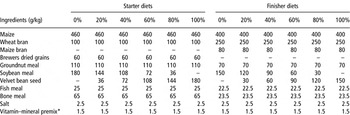
The composition of the starter and finisher phase broiler diets is given in Table 1. VBM was included in the 36, 72, 108, 144 and 180 g/kg diet and the 30, 60, 90, 120 and 150 g/kg diet in the starter and finisher phase diets, respectively. The abovementioned levels of addition of VBM correspond to the inclusion of VB protein at the 20%, 40%, 60%, 80% and 100% levels in the poultry diet by replacing the SBM. All the diets were adjusted for the isonitrogenous and isocaloric levels at both the starter (23% CP, 32.97 MJ/kg dry matter (DM) energy) and finisher phases (18.5% CP, 13.39 MJ/kg DM energy). The feed samples were analyzed for proximate composition according to the method of AOAC (1990).
Composition of starter and finisher phase poultry feed containing different levels of velvet bean meal as an alternative protein source

*Vitamin–mineral premix provided per kg of diet: vitamin A: 100 μg, cholecalciferol: 25 μg, vitamin E: 100 μg, vitamin K3: 2 mg, riboflavin: 5 mg, niacin: 35 mg, d-calcium pantothenate: 10 mg, folic acid: 0.75 mg, vitamin B12: 12 mg; choline chloride: 250 mg, biotin: 22 mg, pyridoxin: 18 mg, thiamin: 15 mg, manganese: 70 mg, iron: 30 mg, zinc: 50 mg, copper: 10 mg, iodine: 1.5 mg, cobalt: 0.15 mg, selenium: 10 mg.
Experimental birds
A total number of 120 1-day-old commercial-type male broiler birds (Gallus domesticus) were purchased from Shanthi Poultry Farm, Coimbatore, TN, India. These birds were maintained at Karpagam University Animal House (approved by the Animals Ethics Committee, Government of India) and fed a common proprietary feed (Hindustan Lever Ltd, Bangalore, India) initially during the period of the first 7 days. Then the 7-day-old birds with an initial body weight (BW) of 82 to 94 g were randomly allocated to six dietary treatments with four cages per treatment and five birds per cage (size 60 × 90 cm). The experimental period consists of two phases, namely the starter phase (1 to 21 days) and finisher phase (22 to 42 days). The 7-day-old birds were fed with the starter phase experimental diets from days 1 to 21 and the same birds were subjected to finisher phase dietary treatments from days 22 to 42. Throughout the entire experiment, feed and water were given ad libitum.
Analysis of growth performance
The weight of the feed given, feed leftover and BW of the birds were recorded weekly and then the feed intake (FI) was determined by subtracting the leftover feed from the total feed offered. The FI, body weight gain (BWG) and feed conversion ratio (FCR) were calculated according to the method of Del Carmen et al. (Reference Del Carmen, Gernat, Myhrman and Carew1999), whereas the protein efficiency ratio (PER) was determined by the following Iyayi and Taiwo (Reference Iyayi and Taiwo2003) method.
Statistical analysis
The statistical analysis was carried out by using SPSS for Windows (SPSS Inc., version 11.0, Chicago, IL, USA). Values were expressed as the mean (s.e.m.). Means between the dietary treatment groups were compared by using one-way ANOVA and Dunnett’s post-hoc test. Two-tailed P-values <0.05 were considered statistically significant.
Results
Experiment 1
Proximate composition
The raw VB seeds were found to contain appreciable levels of CP (263.2 g/kg DM), ether extract (79.60 g/kg DM), crude fiber (95.80 g/kg DM), ash (38.40 g/kg DM), NFE (523 g/kg DM) and gross energy (67.49 MJ/kg DM; Table 2). All the processing methods attempted in this study were found to significantly (P < 0.05) reduce the nutritional profiles. However, the VB seeds processed by soaking in sodium bicarbonate solution + autoclaving treatment exhibited similar levels of CP and gross energy when compared to raw VB seeds.
Proximate composition of raw and differentially processed velvet bean seedsFootnote 1,Footnote 2

DM = dry matter.
1 Values are mean (s.e.m.) of three separate determinations (n = 3).
2 Values in the same row with different alphabet superscript are significantly different (P < 0.05).
Anti-nutritional compounds
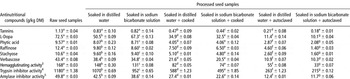
The raw seed samples of VB contained various nutritionally undesirable anti-nutritional substances such as tannins (1.13 g/kg DM), L-Dopa (72.5 g/kg DM), phytic acid (9.57 g/kg DM), oligosaccharides such as raffinose (12.4 g/kg DM), stachyose (10.6 g/kg DM) and verbascose (43.4 g/kg DM), hemagglutinating activity (168 HU/kg DM), trypsin inhibitor activity (1180 TIU/kg DM) and α-amylase inhibitor activity (49.8 AIU/kg DM; Table 3). Among the various treatments used in this study, soaking in sodium bicarbonate solution + autoclaving caused a significantly maximum level of reduction/removal of anti-nutritional compounds. A significant level of reduction of tannins (84%), L-Dopa (86%), phytic acid (78%), raffinose (88%), stachyose (85%), verbascose (76%), hemagglutinating activity (82%), trypsin inhibitor activity (82%) and α-amylase inhibitor activity (77%) was noticed in VB seeds during soaking in sodium bicarbonate solution + autoclaving treatment.
Effect of certain simple and cost-effective processing methods on the levels of various anti-nutritional compounds of velvet bean seedsFootnote 1,Footnote 2

DM = dry matter.
1 Values are s.e.m. of three separate determinations (n = 3).
2 Values in the same row with different alphabet superscript are significantly different (P < 0.05).
3 Values expressed in HU/kg seed flour.
4 Values expressed in TUI/kg seed flour.
5 Values expressed in AUI/kg seed flour.
Experiment 2
Growth performance of poultry birds in the starter phase
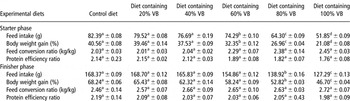
The FI and BWG levels of broiler birds were found to be similar up to the inclusion level of 40% VBM in the poultry feed without any significant difference (P < 0.05; 76.69 g and 37.53%, respectively) when compared to the control group (82.39 g and 40.56%, respectively; Table 4). But, an above 40% level of incorporation of VBM resulted in a reduction of the FI and BWG levels of broiler birds at significant levels. However, when considering FCR and PER, there is no significant level of difference between the control group and dietary treatment groups fed with diets containing different levels of VBM.
Growth performance of broiler birds fed with diet containing different levels of velvet bean mealFootnote 1,Footnote 2

VB = velvet beana.
1 Values are s.e.m. of three separate determinations (n = 3).
2 Values in the same row with different alphabet superscript are significantly different (P < 0.05).
Growth performance of poultry birds in the finisher phase
Inclusion of VBM up to the 60% level as an alternative protein source in the poultry feed did not affect the FI level of broiler birds (154.86 g) when compared to the control group (168.37 g; Table 4). However, the BWG level was significantly decreased at the 60% VBM inclusion level in experimental birds when compared to the control group. Hence, 40% level of inclusion of VBM is considered to be optimal in achieving better levels of FI and BWG in broiler birds. Nevertheless, the FCR and PER values of dietary treatment groups were similar to that of the control group without any significant difference.
Discussion
Experiment 1
Proximate composition
The CP and ether extract content of raw VB seeds (263.2 and 79.6 g/kg DM; Table 2) were found to be higher when compared to an earlier report on certain common legume grains such as Pisum sativum (219 and 23.4 g/kg DM); Phaseolus vulgaris (209 and 24.9 g/kg DM); Cicer arietinum (185 and 36.9 g/kg DM) and Lens culinaris (206 and 21.5 g/kg DM; Almeida-Costa et al., Reference Almeida-Costa, Queiroz-Monici, Machado-Reis and Costa de Oliveira2006). The high protein content of VB seeds has nutritional significance, since moderate intake of these grains will greatly increase the total dietary protein intake. Hence, its utilization as an alternative protein ingredient in poultry feed will reduce over-dependence on conventional protein supplements, notably soybean and other common legumes. Nevertheless, the notable ether extract content of this wild legume does not qualify it as an oil-rich legume, especially when compared to groundnut and soybean, which have a fat content of 25.3% and 19.5%, respectively (Pugalenthi et al., Reference Pugalenthi, Vadivel and Siddhuraju2005).
Anti-nutritional compounds
The level of various anti-nutritional substances in VB seeds was presented in Table 3. Tannins can reduce the digestibility of proteins, carbohydrates and minerals, lower the activity of digestive enzymes and also cause damage to mucosa of the digestive tract. Oxidation products of L-Dopa conjugate with SH compounds (cysteine) of proteins and form a protein bound 5-S-cysteinyldopa cross-link, leading to polymerization of proteins and resulting in a lowering of protein digestibility. Phytic acid was reported to bind with nutritionally important divalent cations, such as Ca2+, Na2+, Mg2+, etc. It lowers the bioavailability of minerals and also forms complexes with proteins and starch and inhibits their enzymatic digestion. The oligosaccharides (raffinose, stachyose and verbascose) have been identified as one of the important contributors to flatulence effect in monogastric animals. Lectins not only have the ability to bind with carbohydrate moieties of blood erythrocytes and cause them to agglutinate, but also they bind with intestinal mucosal cells and interfere with the absorption of nutrients. The trypsin inhibitors form an irreversible complex with trypsin enzyme and cause poor protein digestibility. The α-amylase inhibitor binds with α-amylase enzyme and thereby inhibits the digestibility of legume starch (Pugalenthi et al., Reference Pugalenthi, Vadivel and Siddhuraju2005).
When considering the effects of various simple and cost-effective treatments on the levels of anti-nutritional compounds in VB seeds, soaking in sodium bicarbonate solution + autoclaving was more effective in reducing the maximum levels of various anti-nutritional compounds at significant levels (Table 3). This is in consonance with an earlier report on Vigna aconitifolia and V. sinensis (Vijayakumari et al., Reference Vijayakumari, Siddhuraju, Pugalenthi and Janardhanan1998), Bauhinia purpurea (Vijayakumari et al., Reference Vijayakumari, Pugalenthi and Vadivel2007) and Phaseolus vulgaris (Shimelis and Rakshit, Reference Shimelis and Rakshit2007). Such substantial levels of loss of anti-nutritional compounds during this treatment might be due to the leaching out of anti-nutrients into the soaking medium not only because of the increased permeability of the seed coat caused by the alkaline soaking solution but also because of the subsequent degradation by heat under pressure.
Experiment 2
Growth performance of broiler birds in the starter phase
The growth performance of starter phase broiler birds fed with experimental diets containing different levels of VBM was given in Table 4. There was no significant level (P < 0.05) of difference in the FI levels of broiler birds fed with experimental diets containing up to 40% of VBM when compared to the control group. The FI levels demonstrated that the consumption of an experimental diet was not affected at significant levels due to the inclusion of VBM up to the 40% level, but thereafter a drastic reduction of FI was noticed. Similarly, the BWG level of broiler birds was not affected up to the 40% level of inclusion of VBM as a protein source. The BWG levels of the chickens fed with diets containing 20% and 40% VBM were found to be similar to that of control diet without any significant (P < 0.05) difference.
Nevertheless, if only FCR and PER values were considered, SBM could be replaced up to 100% level with VBM, which raises the inclusion level of VBM up to 180 g/kg diet. However, the results of this study indicate that VBM can possibly be included only up to the 40% level without having any adverse effects on the FI and BWG levels of broiler birds in the starter phase. Similarly, the earlier reports have shown that the Mucuna pruriens seeds can be included at the 10% level (Del Carmen et al., Reference Del Carmen, Gernat, Myhrman and Carew1999); M. cochinchinensis at the 19% level (Ukachukwu, Reference Ukachukwu2007); Lupinus albus at 23% (Brenes et al., Reference Brenes, Marquardt, Guenter and Viveros2002) and Phaseolus lunatus at 25% (Ologhobo et al., Reference Ologhobo, Apata, Oyejide and Akinpelu1993) in the starter phase commercial broiler rations.
Inclusion of 40% level of VBM in poultry feed without any adverse effects on the growth performance of the starter phase broiler birds was found to be comparable to an earlier report on Mucuna pruriens var. cochinchinensis at 30% (Ukachukwu and Szabo, Reference Ukachukwu and Szabo2003); Canavalia ensiformis at 30% (Apata, Reference Apata1999); Vicia sativa at 60% (Farran et al., Reference Farran, Dakessian, Darwish, Uwayjian, Dbouk, Sleiman and Ashkarian2001) and Cajanus cajan at the 40% (Udedibie and Mba, Reference Udedibie and Mba1994) and 50% levels (Amaefule and Obioha, Reference Amaefule and Obioha1998).
Growth performance of broiler birds in the finisher phase
The FI levels of broiler birds fed with diets containing VBM up to the 60% level as an alternative protein source appear to be similar to those of control diets without any significant difference (P < 0.05). Nevertheless, a significant level of difference was noticed among the chickens fed with diets containing VBM beyond the 60% level with respect to FI at the finisher phase. Furthermore, regarding BWG, there was a drastic reduction above the 40% level of inclusion of VBM in poultry feed, when compared to control. It is interesting to notice that in birds fed with an experimental diet containing 20% VBM, the FI and BWG levels were slightly higher than that of control, which denote the palatability of VBM. When considering FCR and PER, VBM can be included even up to the 100% level in the finisher phase poultry diets. However, since there was a significant level of decrease on the BWG after the 40% inclusion level, VBM could be recommended as an alternative source of protein ingredient only up to the 40% level without any adverse effects on the growth performance of the finisher phase broiler birds.
The optimum inclusion level of VBM (40%) in the finisher phase broiler diets of this study was found to be higher when compared to a previous report on the inclusion of 6% to 10% of Mucuna pruriens (Emenalom and Udedibie, Reference Emenalom and Udedibie1998; Del Carmen et al., Reference Del Carmen, Gernat, Myhrman and Carew1999; Iyayi and Taiwo, Reference Iyayi and Taiwo2003), 10% of Canavalia ensiformis (Mendez et al., Reference Mendez, Vasgas and Michelangeli1998) and 15% of Lupinus albus (Brenes et al., Reference Brenes, Marquardt, Guenter and Viveros2002). Moreover, the suitable VBM inclusion level (40%) of the present investigation was found to be comparable with that of an earlier report on an under-utilized legume, M. pruriens var. cochinchinensis at 30% (Ukachukwu and Szabo, Reference Ukachukwu and Szabo2003), M. cochinchinensis at 38% (Ukachukwu, Reference Ukachukwu2007) and Vicia sativa at the 60% level (Farran et al., Reference Farran, Dakessian, Darwish, Uwayjian, Dbouk, Sleiman and Ashkarian2001) as well as the common legume, Cajanus cajan at the 50% level (Amaefule and Obioha, Reference Amaefule and Obioha1998).
Conclusions
The results of this study revealed that the seed materials of VB constitute a rich source of protein and other nutrients. Although various anti-nutritional compounds were present in the raw VB seeds, soaking in sodium bicarbonate solution + autoclaving treatment was more effective in reducing their maximum levels. Inclusion of VBM, subjected to soaking in sodium bicarbonate solution + autoclaving treatment, in the poultry feed as a protein ingredient up to the 40% level exhibited better growth performance of both the starter and finisher phase broiler birds. Hence, after conducting a large-scale trial and extensive toxicological evaluation, recommendation of such non-conventional legume grains as an alternative and cost-effective source of proteins will meet the increasing requirements of dietary protein in the poultry industry and could also reduce their over-dependence on conventional protein sources. Furthermore, the incorporation of VBM in poultry feed would reduce the feed production cost and ultimately improve the growth of the livestock sector in many developing countries, including India.
Acknowledgments
One of the authors (VV) is grateful to the Council for Scientific and Industrial Research (CSIR), New Delhi, India for the award of a Senior Research Fellowship (SRF; Sanction no. 8/355 (0003)/2008-EMR-I dt. 20.03.2008) and the authors are thankful to the University Grants Commission (UGC), New Delhi for financial support of a Major Research Project (Sanction no. F. 35-37/2008 (SR) dt. 19.03.2009) and also the Management and Administrative authorities of Karpagam University, Coimbatore, TN, India for their encouragement and constant support.