Introduction
Nematodes of the family Syngamidae Leiper, 1912 are parasites of the respiratory, excretory and digestive systems of birds and mammals and their body cavities. At present, the Syngamidae is subdivided into three subfamilies (the Stephanurinae, Syngaminae and Archeostrongylinae), with avian parasites representing exclusively the Syngaminae Baylis and Daubney, 1926 (three genera: Boydinema, Cyathostoma and Syngamus) (Lichtenfels, Reference Lichtenfels, Anderson, Chabaud and Willmott1980). One of the major diagnostic characters differentiating between the three genera is the copulatory bursa structure: dorsal rays in males of the genera Syngamus and Boydinema are similar in length to exterodorsal rays, while the copulatory bursa dorsal ray in Cyathostoma is longer than the exterodorsal rays. As proposed by Lichtenfels (Reference Lichtenfels, Anderson, Chabaud and Willmott1980), the genus Cyathostoma is at present subdivided into two subgenera: Cyathostoma (Cyathostoma) (Blanchard, 1849), in which the copulatory bursa dorsal ray reaches beyond the end of the bursa to form a thorn-like projection and spicules measure 0.08–0.4 mm, and Cyathostoma (Hovorkonema) Turemuratov, 1963, in which the dorsal ray does not extend beyond the end of the bursa and spicules measure 0.45–0.8 mm.
So far, the following six valid Cyathostoma species have been well documented in Europe as occurring in birds representing different orders (Ciconiformes, Anseriformes, Falconiformes, Gruiformes, Charadriiformes, Strigiformes): Cyathostoma (Hovorkonema) americana (Chapin, 1925); Cyathostoma (Hovorkonema) bronchialis (Mühling, 1925); Cyathostoma (Hovorkonema) tadornae Chatin, 1874; Cyathostoma (Hovorkonema) variegatum (Creplin, 1849); Cyathostoma (Cyathostoma) lari Blanchard, 1849; and Cyathostoma (Cyathostoma) trifurcatum (Hovorka et Macko, 1959) (Ryzhikov, Reference Ryzhikov1949; Baruš & Tenora, Reference Baruš and Tenora1972; Bakke, Reference Bakke1975; Baruš et al., Reference Baruš, Sergeeva, Sonin, Ryzhikov, Rysavy and Ryzhikov1978; Okulewicz, Reference Okulewicz1984; Simpson & Harris, Reference Simpson and Harris1992; Borgsteede & Okulewicz, Reference Borgsteede and Okulewicz2001; Krone et al., Reference Krone, Friedrich and Honisch2007). Cyathostoma (Cyathostoma) microspiculum is a parasite of cormorants (Ph. carbo, Ph. pygmeus), reported mainly from Asia: Kazakhstan (Panova, Reference Panova and Isaïchikov1927), Tajikistan (Dubinina & Serkova, Reference Dubinina and Serkova1951; Borgarenko, Reference Borgarenko1990), Israel (Lengy, Reference Lengy1969), Uzbekistan (Turemuratov, Reference Turemuratov and Osmanov1976) and Azerbaijan (Vaidova, Reference Vaidova1978). Baruš et al. (Reference Baruš, Sergeeva, Sonin, Ryzhikov, Rysavy and Ryzhikov1978) also reported the presence of C. microspiculum in pelicans (P. onocrotalus) but did not give any details about this finding. The records concerning the nematodes from south-eastern and central Europe (Dagestan, Moldova and Germany; Baruš et al., Reference Baruš, Sergeeva, Sonin, Ryzhikov, Rysavy and Ryzhikov1978; Oßmann, Reference Oßmann2008; database in www.faunaeur.org) are poorly documented. Cyathostoma microspiculum was originally described by Skrjabin (Reference Skrjabin1915) as Syngamus microspiculum from specimens found in the cormorant Ph. carbo in the River Talas valley (at the border of today's Kazakhstan and Kirgizstan). Having reanalysed the preserved specimens described by Skrjabin, Ryzhikov (Reference Ryzhikov1949) transferred the species to his subgenus Syngamus (Ornithogamus) Ryzhikov, 1948. Neither Skrjabin nor Ryzhikov reported males as possessing the characteristic elongated dorsal ray, typical of the genus Cyathostoma. The character was first observed in the species by Turemuratov (1963, cf. Lengy, Reference Lengy1969) in the nematodes collected from cormorants (Ph. carbo, Ph. pygmeus) from the Aral Sea shores. Turemuratov transferred Syngamus microspiculum to the genus Cyathostoma to form a new combination Cyathostoma microspiculum (Skrjabin, Reference Skrjabin1915) Turemuratov, 1963. Analysis of materials collected from Phalacrocorax sp. in Israel led Lengy (Reference Lengy1969) to state that the specific structure of the copulatory bursa is too important a character to have been overlooked by Skrjabin and Ryzhikov; he suggested that Turemuratov described a de facto new species Syngamus (Cyathostoma) turemuratovi Lengy, Reference Lengy1969. So far, data on the morphology, biometry and ecology of the parasite are still greatly insufficient.
Since the mid-1980s, the whole of Europe has been witnessing a constant increase in the abundance of the great cormorant (Phalacrocorax carbo), populations of its continental subspecies Phalacrocorax carbo sinensis (Troilliet, Reference Troilliet1999; Bregnballe et al., Reference Bregnballe, Engström, Knifel, van Eerden, van Rijn, Kieckebusch and Eskilden2003) showing a particularly spectacular increase in size. However, in spite of large-scale, multidisciplinary studies on various aspects of the ecology of Ph. carbo (Carss, Reference Carss2003), knowledge concerning the nematode fauna of the cormorant and its ecology is insufficient (Moravec et al., Reference Moravec, Našincová and Scholz1988, Reference Moravec, Scholz and Našincová1994; Okulewicz, Reference Okulewicz1989; Moravec, Reference Moravec1990; Żuchowska, Reference Żuchowska2000; Frantová, Reference Frantová2001; Dezfuli et al., Reference Dezfuli, Volponi, Beltrami and Poulin2002; Kanarek & Rolbiecki, Reference Kanarek and Rolbiecki2006a, Reference Kanarek and Rolbieckib).
The present work was aimed at providing a detailed documentation of C. microspiculum records in the great cormorant in north-eastern Poland and at analysing effects of various ecological factors on parameters of the infection of Ph. carbo with this parasite.
Materials and methods
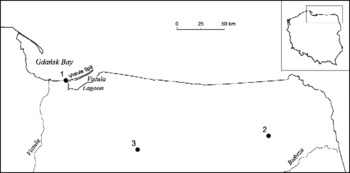
In 2001–2005, a total of 491 individuals of the great cormorant [Phalacrocorax carbo sinensis (Blumenbach, 1798)] were subjected to comprehensive parasitological examination. The birds, of different ages (209 chicks, 202 adults, and 80 immature individuals; see table 1), originated from locations in north-eastern Poland: the largest Polish breeding colony at Kąty Rybackie on the Vistula Spit (54°21′N, 19°14′E) and the Vistula Lagoon, as well as from the Masurian Lake District [the breeding colony on Lake Wulpińskie (53°42′N, 20°22′E) and Lake Selment Wielki (53°47′N, 22°31′E) (fig. 1)]. The cormorants from the Vistula Spit breeding colony feed virtually exclusively in the Vistula Lagoon and Gulf of Gdańsk (Bzoma et al., Reference Bzoma, Goc, Brylski, Stempniewicz and Iliszko2003), i.e. areas adjacent to the colony's location. Those areas are estuarine and brackish: the salinity in the Vistula Lagoon ranges from about 0.5 to 5–6 PSU (Practical Salinity Units) (Łazarienko & Majewski, Reference Łazarienko and Majewski1975), while the Gulf of Gdańsk salinity is up to 8 PSU (Majewski,Reference Majewski1990). In contrast, lakes Wulpińskie and Selment Wielki are typical inland freshwater areas. The Vistula Spit and the Vistula Lagoon yielded a total of 290 cormorants to be examined (144 chicks, 38 immature individuals and 108 adults), while a total of 201 birds were obtained from the Masurian Lake District (65 chicks, 42 immature individuals and 94 adults).
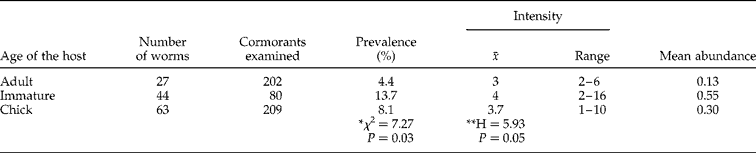
Parasitology indices of C. microspiculum in cormorants in different age categories. Significant differences: * χ2 test; ** Kruskal–Wallis test.

Map of the sampling stations: 1, breeding colony at Kąty Rybackie on the Vistula Spit and the Vistula Lagoon; 2, Lake Selment Wielki; 3, breeding colony on Lake Wulpińskie.

The birds to be examined were collected with permission of the Local Ethics Commission for Research Involving Animals at the Medical University of Gdańsk (decision no. 27/03). Cormorants able to fly were shot in the Vistula Lagoon and Lake Selment Wielki during the pre-breeding season (March–April; 125 adults and 24 immature birds) and in late summer (July–August; 77 adults and 56 immature birds) after the breeding season had ended. Chicks were picked out from nests in breeding colonies on the Vistula Spit and Lake Wulpińskie during the breeding season (May–June). Once the birds were killed, they were transported to the laboratory and immediately dissected for a complete helminthological examination, or were frozen ( − 20°C) and kept frozen until examination. Sex was determined exclusively in adults and immature individuals; gonad underdevelopment precluded sexing of the chicks. A total of 117 females and 165 males were examined. The live nematodes found were washed in physiological salt solution, fixed in hot 4% formaldehyde and preserved in 70% ethanol; nematodes collected from frozen cormorants were carefully cleaned of mucus and blood, fixed directly in 70% ethanol and cleared in glycerine. Drawings were made with aid of a camera lucida. Prevalence, mean intensity and mean abundance of infections were calculated as described by Bush et al. (Reference Bush, Lafferty, Lotz and Shostak1997). χ2 or Fisher exact tests for prevalence analyses were used; for mean intensity, the data were not normally distributed even after transformation and only non-parametric (Kruskal–Wallis or Mann–Whitney) tests were used (Zar, Reference Zar1996).
Voucher specimens have been deposited in the collection of the Museum of Zoology, Polish Academy of Sciences, Coll. No. MIZ 60577–60588.
Cyathostoma (Cyathostoma) microspiculum (Skrjabin, Reference Skrjabin1915)
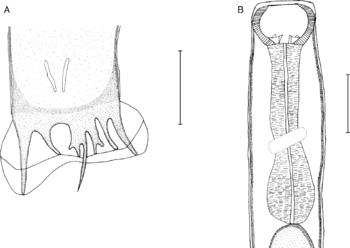
Description. Nematodes of intermediate to large size; live individuals blood-red, brown-white after fixation. Cuticle smooth, translucent; loops of uterus and testes well visible. Females and males usually at permanent copulation, although uncoupled females were found sporadically as well. The pairs decoupled when treated with hot fixative. Excretory pore poorly visible, situated on the level of characteristic broadening of oesophagus. Buccal capsule without collar (some individuals showed poorly differentiated collar), hexagonal, with six strongly chitinized teeth on the bottom (fig. 2).
Cyathostoma (Cyathostoma) microspiculum (Skrjabin, Reference Skrjabin1915): A, copulatory bursa in dorsal view; B, buccal capsule of male in dorsal view. Scale bars = 0.15 mm.

Male (n = 21; all dimensions in millimetres with mean in parentheses). Total length 3.17–7.46 (5.17); maximum width 0.20–0.45 (0.34). Oesophagus 0.55–0.79 (0.68) long and 0.13–0.20 (0.17) wide. Buccal capsule 0.13–0.20 (0.16) wide and 0.11–0.18 (0.15) deep. Copulatory bursa structure: dorsal ray wide at the base and, approximately at mid-length, divided into two asymmetrical lobes, one bi- and the other tripartite. Lobes of the first short, one reaching to the end of the copulatory bursa. One of the rays of the tripartite lobe much longer than the rest and reaches beyond the end of copulatory bursa to form a characteristic thorn-like extension (fig. 2). All the exterodorsal rays similar in length, reaching only to the end of the copulatory bursa. Both spicules equal in length: 0.071–0.079 (0.076). Gubernaculum absent.
Female (n = 21). Total length 10.22–24.30 (18.53); width 0.33–0.92 (0.75). Oesophagus 0.62–0.91 (0.78) long and 0.14–0.28 (0.21) wide. Buccal capsule 0.13–0.26 (0.20) wide and 0.15–0.22 (0.19) deep. Vulva located in the anterior third of body length; vulva–anterior end distance 3.51–6.38 (4.95). Posterior end spiked; anus–tail tip distance 0.48–0.64 (0.55). Eggs elliptical, 0.061–0.073 (0.068) × 0.036–0.043 (0.039), with one operculum.
Synonyms. Syngamus microspiculum Skrjabin, Reference Skrjabin1915; Syngamus (Ornithogamus) microspiculum (Skrjabin, Reference Skrjabin1915) Ryzhikov, Reference Ryzhikov1949; Syngamus hexadontus Chin, Reference Chin1950; Syngamus (Cyathostoma) turemuratovi Lengy, Reference Lengy1969.
Host. Phalacrocorax carbo sinensis (Blumenbach, 1798).
Locality. Breeding colony at Kąty Rybackie on the Vistula Spit (54°21′N, 19°14′E) and Vistula Lagoon; Selment Wielki Lake (53°47′N, 22°31′E), north-eastern Poland (fig. 1).
Site. Trachea.
Distribution parameters
Tracheae of 37 birds yielded 134 individuals of Cyathostoma microspiculum (Skrjabin, Reference Skrjabin1915). Prevalence, mean intensity and intensity range were 7.5%, 3.6 and 1–16, respectively. Although C. microspiculum was present in all the cormorant age categories, the heaviest infection was observed in the immature individuals, followed by chicks and adults; the differences in the prevalence and mean intensity between the age categories were significant (table 1).
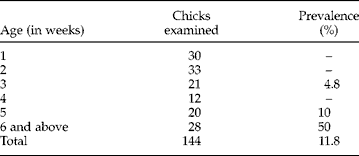
Parasitology indices of C. microspiculum in cormorants from the Vistula Spit and Vistula Lagoon (prevalence 8.9%; mean intensity 3.6; intensity range 1–10; mean abundance 0.31) showed higher prevalence and mean abundance compared with the birds from the Masurian Lake District (5.5%; 4; 2–16; 0.24); however, the differences were non-significant (prevalence: Fisher exact test, P = 0.1; mean intensity: Mann–Whitney test, P = 0.9). As for the chicks, the nematode was found exclusively in the Vistula Spit breeding colony: singular individuals of C. microspiculum were first observed in 3-week-old chicks; the oldest chicks ready to leave the nest (older than 6 weeks) showed 50% prevalence (table 2). No significant sex-dependent differences in the infection parameters were found (prevalence: Fisher exact test, P = 0.6; mean intensity Mann–Whitney test, P = 0.7), but females showed higher C. microspiculum infection parameters (7.5%; 4.5; 2–16; 0.35) than males (6.1%; 2.8; 2–4; 0.17). The nematode prevalence, mean intensity and mean abundance were higher in cormorants collected in late summer (8.3%; 4; 2–16; 0.33), than in cormorants collected during the pre-breeding season (5.4%; 3.1; 2–6; 0.17), but these differences were also non-significant (prevalence: Fisher exact test, P = 0.4; mean intensity: Mann–Whitney test, P = 0.5).
Prevalence of C. microspiculum in chicks from the breeding colony located on the Vistula Spit.

Discussion
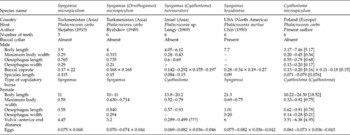
Morphology of the C. microspiculum individuals examined did not basically deviate from the description published by Lengy (Reference Lengy1969). The biometric variability range was wider than that reported by Skrjabin (Reference Skrjabin1915), Ryzhikov (Reference Ryzhikov1949) and Lengy (Reference Lengy1969). Primarily, however, the spicule length was shorter (0.071–0.079 mm) (table 3); the spicule length also proved surprisingly stable, with a narrow range of variability. The small vulvar distance from the anterior body end (table 3) as given in Lengy's published description is most probably a printing error, whereby the decimal point was moved by one decimal place: ‘vulvar distance from anterior end 0.289–0.499 [sic] (in first or second quarter of body)’ (Lengy, Reference Lengy1969). The remaining differences observed resulted most probably from a different method of fixation of the nematodes collected and a higher number of specimens measured. The most likely explanation of differences in the copulatory bursa structure, observed by the authors mentioned (Skrjabin, Reference Skrjabin1915, Ryzhikov, Reference Ryzhikov1949; Lengy, 1969), would be that both Skrjabin and Ryzhikov described the same males, whose copulatory bursae were most probably damaged. Some C. microspiculum individuals examined in this work showed damaged copulatory bursae with dorsal rays lacking distal parts in the section extending beyond the end of the bursa, which could have resulted in an erroneous identification (e.g. as Syngamus trachea, cf. Kanarek & Rokicki, Reference Kanarek and Rokicki2005). The distal fragment of the dorsal ray is very delicate, extremely susceptible to damage; however, damage was found exclusively in those nematodes collected from the cormorants frozen after collection. No damaged copulatory bursa was ever observed in the nematodes treated with hot fixative when live.
Comparison of selected biometrical and morphological characteristics of Cyathostoma (C.) microspiculum; measurements in millimetres.

In my opinion, Syngamus hexadontus Chin, Reference Chin1950, described from the cormorant Phalacrocorax auritus from North America, is an older synonym of C. microspiculum. The similarity of virtually all morphological and biometric characters between S. hexadontus and C. microspiculum and the very close affinity of the hosts (the genus Phalacrocorax) may be taken as supporting the synonymy. The only distinguishing characters include the poorly developed cuticular collar of the buccal capsule in S. hexadontus and a different structure of the copulatory bursa (table 3), in the original description typical of the genus Syngamus (Chin, Reference Chin1950). As already mentioned, the differences could have resulted from different methods of fixation and damaged copulatory bursae in the nematode specimens collected.
Previous records of C. microspiculum had been restricted to south-western Asia, south-eastern and central Europe. However, the highly probable identity of S. hexadontus with C. microspiculum may evidence a much wider geographic distribution of the species, the range of which covers also North America. Rare records of C. microspiculum are most likely caused by the rarity of the nematode in natural populations of its definitive hosts, the cormorants. In Azerbaijan, Vaidova (Reference Vaidova1978) found the nematode in 2 out of the 115 great cormorants (Ph. carbo) (1.7%) she examined, and in 1 out of the 137 pygmy cormorants (Ph. pygmeus) (0.73%). In Uzbekistan, Turemuratov (Reference Turemuratov and Osmanov1976) found C. microspiculum in 5.1% of the Ph. carbo and in 7.6% of the Ph. pygmeus individuals examined; in Germany 12 out of 96 great cormorants were infected (12.5%) (Oßmann, Reference Oßmann2008). The prevalence of the nematode in the cormorants in northern Poland was 7.5%; it was thus much higher than that reported by Vaidova (Reference Vaidova1978) and close to that found by Turemuratov (Reference Turemuratov and Osmanov1976), but lower than that recorded by Oßmann (Reference Oßmann2008). It should, however, be mentioned that nematodes of the genus Cyathostoma usually show low prevalence in avian populations. For example, Borgsteede & Okulewicz (Reference Borgsteede and Okulewicz2001) recorded Cyathostoma americana in 6 out of the 126 birds of prey they examined in The Netherlands; similarly, Lavoie et al. (Reference Lavoie, Mikaelian, Sterner, Villeneuve, Fitzgerald, McLaughin, Lair and Martineau1999) reported the presence of Cyathostoma spp. in 14 out of the 394 birds of prey they examined in Canada, while Furmaga (Reference Furmaga1957) observed the nematode in 5 out of the 618 birds of prey in south-eastern Poland. Against that backdrop, the prevalence of Cyathostoma lari in the Norwegian population of the seagull Larus canus was unusually high (79 out of the 269 individuals proved infested, i.e. 29.4% prevalence) (Bakke, Reference Bakke1975).
The higher C. microspiculum infection parameters found in the cormorants from the Vistula Spit and Vistula Lagoon, and particularly the presence of the parasite in the chicks from the Vistula Spit colony – coupled with the absence of the nematode in the chicks of the Lake Wulpińskie colony – may be related to the C. microspiculum life cycle being associated with the marine environment. A distinct habitat dependence in the occurrence of the nematode in chicks, as well as the low degree of infection of the adults, the chicks of which are heavily infested, may be taken as ruling out a possibility of direct transmission of C. microspiculum from parents to chicks, e.g. during feeding. The life cycle of C. microspiculum has not been followed in the laboratory. Life cycles of other Cyathostoma species followed in laboratory cultures (C. lari, C. bronchialis) are usually regarded as simple, but the nematodes are considered capable of using terrestrial invertebrates (earthworms and insects) as their paratenic or intermediate hosts (Pemberton, Reference Pemberton1959; Threlfall, Reference Threlfall1965; Vasiliev & Denev, Reference Vasiliev and Denev1972; Fernando et al., Reference Fernando, Hoover and Ogungabe1973; Ryzhikov, Reference Ryzhikov1980). The cormorant, a typical ichthyophage, feeds exclusively on fish; terrestrial invertebrates are not usually a part of its diet. Most probably, the first intermediate or paratenic hosts of C. microspiculum are brackish-water ostracods or other aquatic arthropods, while fish are the hosts of the invasive forms of the parasite.
The highest parameters of the C. microspiculum infection recorded in the immature cormorants and chicks result most likely from deficient function of the immunological system in the young birds, and hence their higher susceptibility to parasitic invasions (e.g. Wakelin & Apanius, Reference Wakelin, Apanius, Clayton and Moore1997). Some role may be also played by higher food consumption by young cormorants, related to their higher energy demand during growth. However, the cause of the age-dependent difference in the helminth infection parameters in the cormorant (Ph. carbo) requires further, interdisciplinary research.
Acknowledgements
The study was partly supported by the Polish State Committee for Scientific Research grant No. 2PO4C 070 27.