Introduction
We often think of the Roman presence in western Europe as primarily located on plains, along main rivers, and in coastal areas, a society developing its way of life in cities and villae. Other kinds of landscapes were, however, also of interest to the Romans, such as upland regions and marshland areas, whose resources complemented the main agricultural or livestock production. The processes of occupation in some of these areas, such as the Alps or Pyrenees, reflect the capabilities and interests of the Roman provincial administration and army in exploiting these resources from the second to the first century bc.
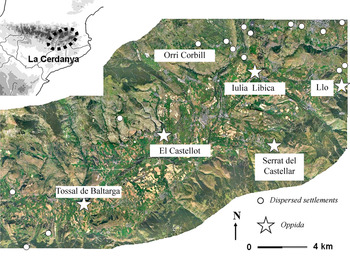
Archaeological investigations carried out in the eastern Pyrenees, in particular the Cerdanya region (Figure 1), have identified a Roman presence in these highland areas (at 1200–2100 m asl) that is earlier and more intensive than previously assumed. This presence is documented by specific artefacts, including seal-rings. Roman seal-rings are often found in urban spaces and are scarcer in rural contexts, even more so in supposedly marginal mountainous areas (Olesti, Reference Olesti2019, Reference Olesti2021). This article deals with Roman seal-rings found in the eastern Pyrenees dating to the second–first century bc, including one exemplar of outstanding quality. The study of these objects, their function, and their historical interest allows us to revisit the question of the Roman presence in the Pyrenees and the occupants’ complex relationship with local communities. To set the seal-rings in context, we must, however, first give an overview of the site of Tossal de Baltarga.
The Cerdanya region with the main archaeological sites cited in the text.

Tossal de Baltarga
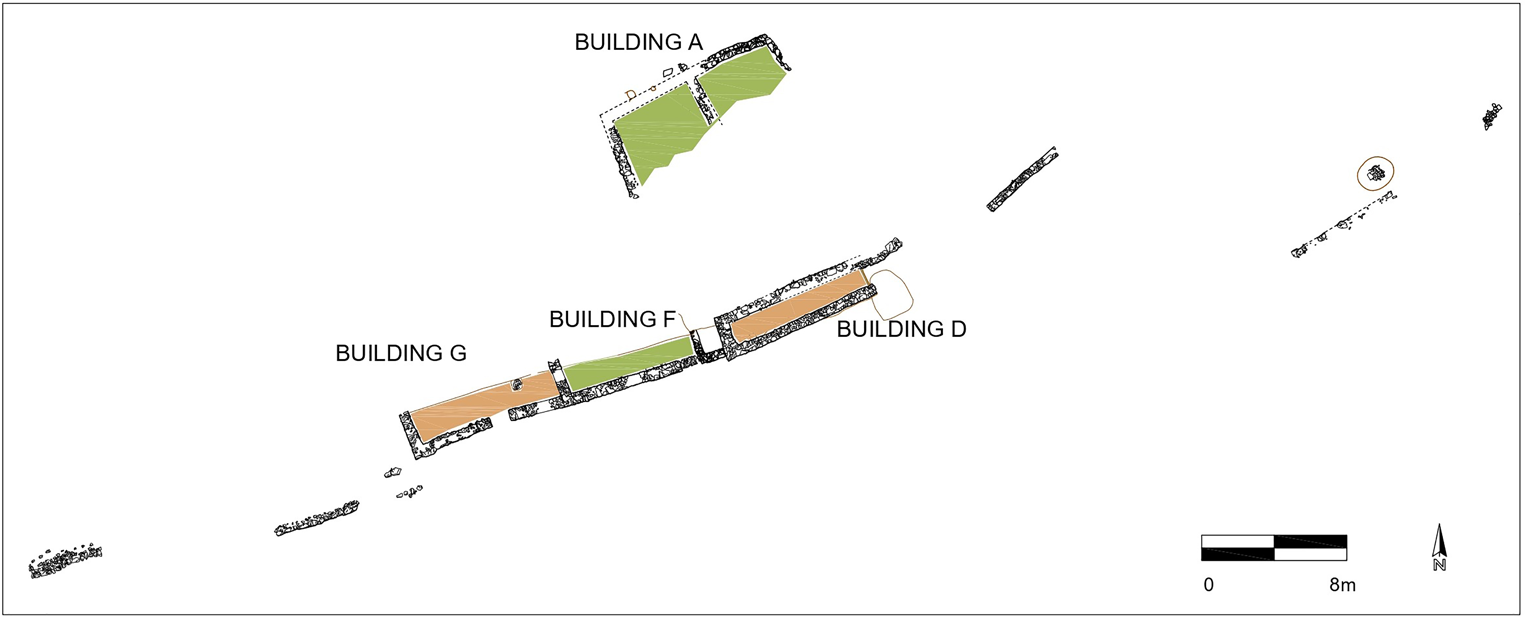
Tossal de Baltarga (Bellver de Cerdanya, province of Lleida in Catalonia) was excavated from 2011 onwards. So far, eight seasons of excavations have taken place, detailed in reports and other publications (Morera, Reference Morera2017; Morera et al., Reference Morera, Olesti, Oller, Pera and Vidal2016, Reference Morera2017; Oller et al., Reference Oller, Morera, Olesti and Mercadal2018a, Reference Oller, Morera, Olesti and Mercadal2018b). It is situated on the top of a hill that strategically blocks off the valley, allowing control over access to the Cerdanya region from its southern slope and, from its northern slope, the River Segre, one of the main ancient communication axes in this area. A small settlement was established there, consisting of three chronological phases: Late Bronze to the Early Iron Age, Iberian period (fourth–third century bc), and a Roman Republican phase (second–first century bc). We shall mainly concentrate on the latter phase, when fortified structures were built, including a watchtower. This allows us to determine the site's strategic character and suggest its function as a turris, as defined for the north-eastern Iberian Peninsula by Moret (Reference Moret, Mayoral and Celestino2010: 11–17) and Noguera et al. (Reference Noguera, Principal, Ñaco, Cadiou and Navarro2014: 33). In the Iberian period, a set of scattered and partly unconnected, poorly preserved structures (Figure 2) define several grouped buildings adapted to the slope, without showing any signs of urban planning and without a perimeter wall. So far, four houses have been identified: Buildings A, D, F, and G. The latter three were burnt down and violently destroyed around 200 bc, as attested by a cup from the Rosas workshop and by radiocarbon dating between 230 and 200 bc (Beta-458585: UE 3157) from Building D. For the other buildings, further fragments of Rosas pottery and two coins (a drachma from Ampurias and a Gallic imitation of an Ampurias drachma) place the destruction of these structures in the same context, in the last quarter of the third century bc. Tossal de Baltarga's proximity to the oppidum of El Castellot de Bolvir, and the fact that the two settlements are within line of sight, suggest that Tossal de Baltarga was a small settlement dependent on El Castellot.
The Iberian phase at Tossal de Baltarga.

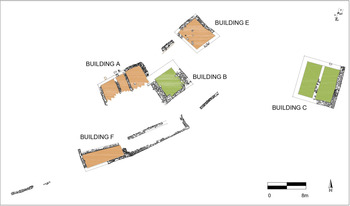
After its complete destruction at the end of the third century bc, possibly connected to the beginning of the Second Punic War and the Punic and Roman intervention in the Pyrenees, the settlement was largely rebuilt during the Republican period, at some point during the second half of the second century bc. This is the main period of interest here since the rings at the heart of this study belong to this phase of the Roman presence. Despite transformations, the size and features of the settlement remained the same: a small nucleus of several scattered buildings hugging the slope, without regular urban planning and without a walled enclosure (Figure 3). The material culture (75 per cent of the pottery is handmade) suggests continuity, at least in part, of the pre-Roman occupation. In this phase, however, a square watchtower became the central element of the site, around which the rest of buildings were structured. This indicates that, during the Republican period, Tossal de Baltarga continued to function as a strategic point for territorial control. So far, seven buildings have been documented in excavation, alongside other structures. These buildings can be divided into three groups: those presumably linked to domestic use (Buildings A and E), those of indeterminate function (Buildings C, D, F, and G) and the tower (Building B).
The Republican phase at Tossal de Baltarga.

The structures linked to domestic use (Buildings A and E) have a simple structure, but they also contain evidence for production and manufacturing activities. As for Building C, it consists of two rectangular areas of unknown function, about 7.2 m in length. Although little stratigraphy remained, the excavation of its walls’ foundation trenches yielded a hobnail from a caliga, which is significant for establishing a link with the military presence at the site. Several other caliga hobnails have also been recovered from other contexts at the site and in metal detector surveys.
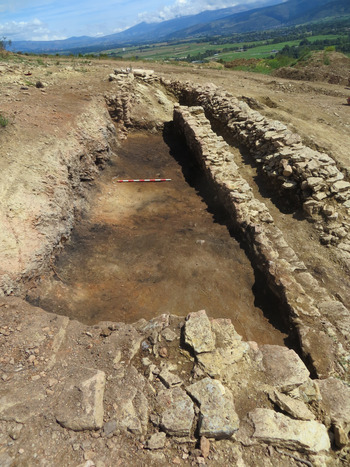
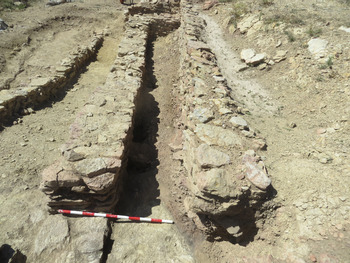
Building D (Figure 4) was rebuilt with a set of new walls extending its original (Iberian) area with a strong but crude closing wall. Its interior was levelled to create a flat surface that probably served as the base for an upper structure or circulation space. Building F (Figure 5), located to the west of Building D, was also rebuilt. There, a southern wall that connects with the closing wall of Building D was erected, together with a northern wall embedded in a cut in the bedrock. To the west, another wall created a wide rectangular space, that would have been accessed from the east. It is here that the ring with intaglio BTB'17-3176-1 was found, in the abandonment levels that covered the southern wall of Building F. The fact that it appeared in these latest levels suggests an association with the final moments in the life of the building, between 50 and 30 bc. The find could link this space with the residence of a military figure of a certain rank, although the scarcity of available data does not allow us to go beyond hypothesizing. Indeed, hardly any stratigraphy has survived in the structures recorded at Tossal de Baltarga. Except at specific points, archaeological layers have suffered from erosion almost everywhere, directly affecting the precise contextual attribution of the seal-rings found in areas related to buildings.
The remains of Building D during excavation. View from the west.

View of Building F from the east. The walls on the left and right of the image belong to the Republican structure, while the wall in the middle is related to the Iberian phase. The ring BTB’17 3176-1 was found among the abandonment levels covering the southern (left) wall.

In the upper area between Buildings D and F, another ring was found: a bronze ring with glass gem (BTB'17-3001-21). It was recovered during prospection with a metal detector and, since no clear archaeological context is available, dating has to rely solely on the ring's typology.
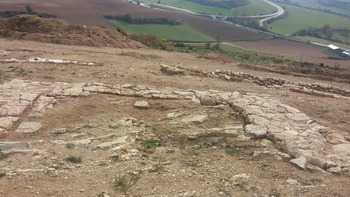
Finally, Building B (Figure 6) gives sense and cohesion to the entire settlement during the Republican phase. Located in the central part of the site, it consists of a square structure with an internal width of 4.45 m, which has been interpreted as a tower. Access was at the southern side, through a door with a threshold 2.95 m wide (the equivalent of a Roman unit of measurement known as a pertica). The rear of the tower is badly preserved since the walls overlapped with the rock of the hill. The stratigraphy associated with this tower is unfortunately poor, with limited depth and hardly any associated material. Nonetheless, just below the door, at a superficial level, a third ring (BTB'13-3058-1) was identified: it is an iron signet ring still retaining its gold foil made with an amalgam of gold and silver (Morera et al., Reference Morera, Oller, Olesti and Viladevall2017: 108). Despite being recovered from the lower levels associated with the tower, the ring is likely to belong to the last use layers of the building, which were probably eroded and displaced over time.
The tower or Building B from the north. The ring BTB'13-3058-1 was recovered just below the southern wall of the tower, in the superficial levels below its door.

The Seal-Rings
Three seal-rings have been found so far at the site of Tossal de Baltarga. Their characteristics, and consideration of the context of their production, use, and abandonment are presented below.
Iron ring with intaglio: Achilles and Penthesilea
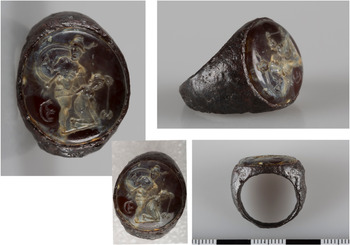
This ring, BTB'17-3176-1 (Figure 7), was found at Tossal de Baltarga in 2017 in layer 3176, a brownish non-compacted soil covering the Republican structures of Building F on the southern edge of the site, built around the mid-second century bc and abandoned around 50–30 bc.
Ring BTB’17 3176-1 (images: Ramon Maroto).

The ring consists of an iron hoop whose vertical shoulders are slightly inclined towards the top. The inside of the hoop is flat and circular. Heavy incrustation has been removed and corrosion stabilized. The ring is 21 mm high (with gem; 20 mm without), 21.4 mm wide, 16.5 mm deep, and its interior diameter is 12.1 mm. Set in this ring is an intact, polished intaglio, inserted from above. It is oval, with a subconvex front, and a border bevelled to the front straight edge. The dimensions of the intaglio are 17 × 15.5 mm and its weight is 8 g.
The ring is dated to c. 100–50 bc by reference to exemplars cited in Guiraud (Reference Guiraud1988: 78, type Ib; Reference Guiraud1989: 180), Micheli (Reference Micheli2012: 19, type III fig. 6; gold rings on pp. 37, 40, 42, 46, 56, 59, 63, dated to 150–75 bc) and an iron ring with glass gem from Manching (Platz-Horster, Reference Platz-Horster2018: 25 no. 2, dated to 100–50 bc).
The intaglio depicts Achilles and Penthesilea. Achilles, with armour, sword, and helmet, lunges to his left behind the Amazon queen, who is on her knees. Achilles looks back, protecting her with a round shield on his right arm. With his left hand, he holds the fatally wounded woman below her left arm as a double axe slips from her raised hand. Her pelta-shaped (crescent-shaped) shield is floating in the background beside Achilles’ right leg, behind which Penthesilea's right arm vanishes. She wears a high-girded chiton whose overlap around the hips ends in little pointed tails; on her thighs, the garment is layered in parallel oblique folds, leaving her lower legs free. Her inclined head is framed by tiny round locks, with her hair fastened in a knot at the neck. There is a short line indicating the ground, under Achilles’ right foot and under Penthesilea's knees and foot. Her lower part and Achilles’ left legs are not engraved. The vivid design of both bodies—finely detailed faces, joints, and clothing, engraved with a fine round rod—contrasts with the linear elements, like the folds of the dress and the pteryges (strips making a skirt attached to the armour). The composition, with Achilles's undulating helmet crest and abrupt turn, as well as the double axe slipping from Penthesilea's open hand, enhances the drama between the two protagonists.
The Thracian Penthesilea was an ally of the Trojans. Achilles killed her during battle, then gave her corpse to the Trojans for burial (contrary to custom, allegedly because he had fallen in love with her; for the different versions of the story and its representation, see Kossatz-Deißmann, Reference Kossatz-Deißman, Ackerman, Gislert and Kahil1981: 161–63). This motif appears quite often in glyptic art, where it may be roughly separated into two groups. In the first, both figures are dressed, Achilles in full armour rescuing the slain Penthesilea (‘Berge-Gruppe’). In the second, both figures are naked (apart from a short cloak on their backs) and Achilles, wearing a helmet, supports the falling Penthesilea by her arms (‘Stütz-Gruppe’). The first group is best illustrated by an Etruscan banded agate scarab, now in London (Walters, Reference Walters1926: 77, pl. 11, 634; Zazoff, Reference Zazoff1968: 46–48, pl. 156, 48, dated to after 450 bc, Reference Zazoff1983, 223, no. 41, pl. 57.6; Horster, Reference Horster1970: 10–12, pl. II, 1–2; Krauskopf, Reference Krauskopf1995: 26, 51, 74, 96, no. 329, II, fig. 6; Russenberger, Reference Russenberger2015: 141, fig. 66). The intaglio from Baltarga falls into the first group, and is very similar to another good example: a brown convex glass gem from Ensérune (Hérault; for composition, dresses, and attributes, see Guiraud, Reference Guiraud1988: 137, no. 440, pl. 29.47, fig. 16, dated c. 50 bc, Reference Guiraud and Avisseau Broustet1997: 38, no. 17, figs 4–5; Toso, Reference Toso2007: 26–28, nos 37 and 282, pl. II, fig. 6; Russenberger, Reference Russenberger2015: 141, fig. 66). The second group, in which Penthesilea is often characterized by her Phrygian cap, is exemplified by a flat carnelian from London (Walters, Reference Walters1926: 112, pl. 14.964; Martini, Reference Martini1971: 71, 81, 84, 125, 140, no. 101, pl. 20.5, dated to 225–200 bc), a flat banded glass gem from Berlin (Furtwängler, Reference Furtwängler1896: 48, pl. 9.617–61; Zwierlein-Diehl, Reference Zwierlein-Diehl1979: 41, pl. 16.670, dated 50–0 bc), or brownish-grey sard from Hannover (Schlüter & Platz-Horster, Reference Schlüter and Platz-Horster1975: 86, pl. 49.333, dated 60–30 bc; Russenberger, Reference Russenberger2015: 141, fig. 67). Whereas the first (and presumably earlier) group accentuates the point of conflict in the tragic encounter through the detailed depiction of armour and clothing, the second group seems to emphasize its erotic nature, through the nudity of the protagonists supporting and embracing each other. This version remains a firm favourite in glyptic art until the end of the Roman Empire (e.g. on a red jasper from Dambach: Weiβ, Reference Weiß2007: 203, no. 264; Platz-Horster, Reference Platz-Horster2018: 52, no. 32).
Besides these two versions (both widespread in the tradition of Etruscan-Italic glyptic art), a third type appeared during the Hellenistic era, apparently originating in the Eastern Mediterranean. It is represented by a clear, biconvex amethyst intaglio (15 × 11 × 6 mm) from the grave of a wealthy male in Ancona (Necropoli del Cardeto, grave 45), dated c. 140–120 bc (Micheli, Reference Micheli2008: 9–21, fig. 5, Reference Micheli2012: 45–46). In this exemplar, Achilles, naked except for his helmet, looks back while holding Penthesilea by both her arms. She wears a chiton and Phrygian cap. Achilles’ spear is behind him and the Amazon's shield (pelta) lies before her. The design follows the formula of the ‘rescue group’ outlined above, but the composition takes on a new dynamic, with the hero's right foreleg set in the centre and his foot placed on a second ground line, giving the composition a sense of depth. This version appears in several convex glass gems (e.g. Furtwängler, Reference Furtwängler1896: 139, pl. 26, 3111; Schmidt, Reference Schmidt1970: 125, pl. 136, 1346), as well as a series of clay stamps from convex seals at Delos (Hatzi-Vallianou, Reference Hatzi-Vallianou, Boussac and Invernizzi1996: 206–10, type A, figs 1–2, pl. 42; Micheli, Reference Micheli2008: 13, fig. 2). This version of the ‘rescue group’, where Achilles holds both arms of the fallen Amazon, varies; for example, in a convex carnelian from Vienna, dated c. 50 bc, Achilles’ action is mirrored as he pulls out his sword (Zwierlein-Diehl, Reference Zwierlein-Diehl1973: 104, pl. 48, 279), while in a glass gem from Vienna, Achilles is depicted with his legs side-on and with a cloak (Zwierlein-Diehl, Reference Zwierlein-Diehl1979: 41, pl. 16, 669). It is only the third group, represented by the Ancona amethyst (dated by context and presumably imported from the East), that corresponds with the well-known Hellenistic statuary group, which most probably originated in Asia Minor. Its appearance, therefore, cannot be dated later than c. 140–120 bc (see Berger, Reference Berger, Rohde-Liegle, Cahn and Ackermann1967, 61–75, Reference Berger1999: 113–143; Grassinger, Reference Grassinger and Bol1999: 323–30, pls. 90–93; Vorster, Reference Vorster2004: 107–10, no. 57, pls. 73–75; Micheli, Reference Micheli2008: 11, fig. 1; Gensheimer & Welch, Reference Gensheimer and Welch2013; Russenberger, Reference Russenberger2015: group VI, 384–420; see also Kossatz-Deißmann, Reference Kossatz-Deißman, Ackerman, Gislert and Kahil1981: 161; Devambez & Kauffmann-Samaras, Reference Devambez, Kauffmann-Samaras, Ackerman, Gislert and Kahil1981: 597–601; Raepsaet, Reference Raepsaet1985; Berger Reference Berger, Ackerman, Gislert and Kahil1994: 296–305).
Bronze ring with glass gem
The ring BTB'17-3001-21 (Figure 8) was recovered in 2017 in a systematic metal detector survey conducted at Tossal de Baltarga. It was found in a surface level above Building D, located on the southern edge of the site, beside and to the east of Building F, in a circulation area between the buildings.
Ring BTB’17 3001-21 (images: Ramon Maroto).

The bronze finger ring, dating to the early first century bc, has protruding shoulders, the inside of the hoop is flat, and its lower part is missing. It is 16.8 mm high (with gem; 15.9 mm without), 17 mm wide, 8.7 mm deep, and its interior diameter is 16.7 mm. A glass gem (8.3 mm high, 7 mm wide, weighing 2 g) was inserted into this ring, from the top; it is violet, transparent, vesicular, its surface scarred and cracked in three parts. Oblong in shape, the gem's front is highly convex. An inlaid gold foil gives the gem a yellowish hue; a small bronze frame secures the gem and foil in the setting. During restoration of the heavily corroded finger ring, a black mass was discovered between the frame and the inlay, presumably bitumen used as an adhesive.
The glass gem (in poor condition, with cracks, bubbles, and sinter) is tentatively interpreted as depicting a standing club with a globe to its left. This would fit the highly convex form of the glass gem and the shape of the ring. The club and globe symbolize peace and wealth as do other motifs, such as cornucopia, rudder, caduceus, palm branch etc., which also feature in glyptic art (see convex glass gems in Munich: Schmidt, Reference Schmidt1970: 225, nos 2124–26, pl. 184; flat carnelian dated to the first century bc in Hanover: Schlüter & Platz-Horster, Reference Schlüter and Platz-Horster1975: 150, pl. 93, 724; flat carnelian from the Bergau Collection in Nürnberg: Weiß, Reference Weiß1996: 152, no. 426). As for the ring form, it corresponds to Guiraud's type Ic (Reference Guiraud1988: 78, Reference Guiraud1989: 179–80, figs 9–10) or Micheli's type VIb (Reference Micheli2012: 19, fig. 6; iron rings on pp. 36, 39, 43–44, 47, dated c. 150–50 bc; Platz-Horster, Reference Platz-Horster2012: 43–44, figs 7–8, Reference Platz-Horster2018: 12, no. 27, fig. 1; also found at the fort of Waddon Hill, Dorset: Henig, Reference Henig1974: no. 406). For the gold foil under the glass gem, parallels exist among the iron rings from Oberaden (pre-8 bc) and Haltern (pre-ad 9) (Hofter, Reference Hofter1988: 599, nos 444, 447, and 449; Trier Reference Trier1989: 130–31, figs 121–22, 129).
Iron ring with gold foil
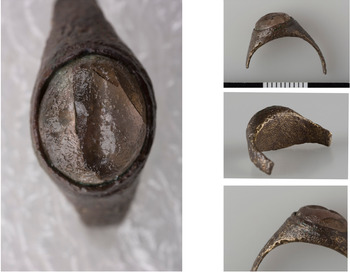
This ring, BTB'13-3058-1 (Figure 9), appeared in a superficial level at Tossal de Baltarga, just below Building B (the tower), and is probably related to material eroded from the inside of this building. It is likely to belong to the final use of this Republican structure in the first century bc.
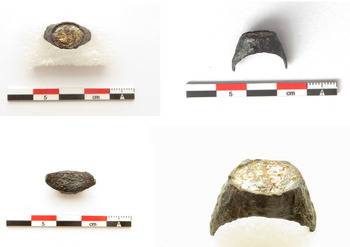
Ring BTB’13 3058-1.

The find is a fragment of an iron finger ring, dated to 100–50 bc, with highly protruding shoulders; the inside of the hoop is flat, and its lower part is missing. The ring is 12.5 mm high, 18.1 mm wide, 9.3 mm deep, with an inner diameter of 16.1 mm, weighing 4 g. The flat cavity of the head of the ring still preserves a crinkled gold foil, most probably the inlay for a missing glass gem whose colour it was meant to highlight (as above; for the ring form, see Guiraud, Reference Guiraud1989: 179, fig. 9, type Ib; Platz-Horster, Reference Platz-Horster2018: 13, fig. 1).
The Material Culture at Republican Tossal de Baltarga
Artefacts such as the rings, caliga hobnails, and numerous coins, recovered alongside pottery such as sherds of Greco-Italic amphorae, indicate a military context for Tossal de Baltarga during the Republican phase (Carreras et al., Reference Carreras, Menéndez, Pera and Rodrigo2017). The many coins found at the site and in surrounding areas are especially important. A systematic metal detector survey recovered several Ibero-Roman coins on the hill from mints such as Untikesken, Iltirkesken, Seteisken, Ilturo, Kese, and Arse, as well as three drachmas from Ampurias, two Gallic imitations of Ampuritan drachmas, and one drachma fraction from Rhode, preliminarily dated to between the fourth and second centuries bc. Previous coins found on the hill by local—and unauthorized—metal detector enthusiasts belong to mints such as Oskumkem, Lauro, Baitolo, Iesso, Kelse, and Bolskan (Campo & Mercadal, Reference Campo, Mercadal and Arévalo2009). Coins found in archaeological contexts include two coins in Building F (an Ampuritan drachma and a Gallic imitation of an Ampurias drachma) and, next to Building D, a silver Gallic imitation of an Ampuritan drachma dated to the middle of the third century bc (Villaronga, Reference Villaronga2000, group 4-2-4 of imitations, pl. 53; Villaronga & Benages, Reference Villaronga and Benages2011: 243). Within a radius of three kilometres from the site, another nine coins have been recovered, all imitations of Ampuritan drachmas. Significantly, almost all the coins in the region that fall between the fourth and the second century bc are concentrated around the site (Campo & Mercadal, Reference Campo, Mercadal and Arévalo2009).
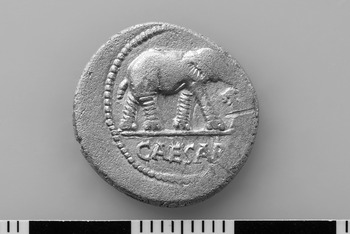
In terms of Roman coinage, the finds made by local amateurs include a Roman denarius dated 120 bc with the legend M Tulli (RRC 280/1; Crawford, Reference Crawford1974 cited as RRC hereafter), a Roman as of 46–45 bc with the legend Cn Mag imp (RRC 471/1), and another denarius dated 43 bc of Petillius Capitolinus (RRC 487/2). The metal detector survey also recovered a silver denarius of Caesar dating to 49–48 bc (RRC 433/1; see Figure 10), and another such coin was found on the hill by local researchers. In the surrounding area, local amateurs also found a Helvetian quinarius with the legend NINNO/MAUC (BN 9349, Muret-Chabouillet, Reference Muret and Chabouillet1889) dated to 80–50 bc, an exceptional indicator of foreign troops in the Roman army (see Campo & Mercadal, Reference Campo, Mercadal and Arévalo2009; Ferrer et al., Reference Ferrer, Velaza and Olesti2018). This date can be related to a time when the hill was abandoned during the period of civil unrest in the second half of the first century bc and supports the idea of a link between Tossal de Baltarga and the military.
Reverse of a silver denarius of Caesar dated in 49–48 bc found at Tossal de Baltarga (image: Ramon Maroto).

We consider that Tossal de Baltarga maintained its primary function as a strategic point in the control of the territory in the Republican phase, as evidenced by the rebuilding of the settlement, with a watchtower as its main element, surrounded by several dispersed buildings linked to domestic and production activities. This suggests the presence of a small military garrison, attested by the various militaria recovered, alongside the Iberian population. This garrison, or praesidium, would be especially important during periods of conflict in the eastern Pyrenees, such as the conquest of southern Gaul, the Sertorian War, or the Civil Wars between Caesar and Pompey. The garrison would have commanders in charge, whose presence (and perhaps that of their relatives) could explain materials such as the rings presented here.
The Roman Military Presence in the Pyrenees in the Second and First Centuries bc
The presence of three seal-rings at Tossal de Baltarga must be connected to the Roman occupation of the region, as the rings were made by skilled craftsmen using gold foil and, especially for the Achilles ring, the techniques and cost of the objects make it unlikely that they were produced, or even used, by the Iberian community. At Tossal de Baltarga, there is no evidence to link this luxury imported item to a member of the local elite, given the lack of wealthy imports in the region before the Roman occupation, or identifiable aristocratic buildings or objects at the site or in the region. Imported goods in the Cerdanya region during the second and first centuries bc are indeed modest, rare, and in most cases connected to the logistics of the Roman army.
In the last fifteen years, archaeological excavations have convincingly identified the presence of the Roman army in north-eastern Hispania (present-day Catalonia) during the second and first centuries bc (Noguera et al., Reference Noguera, Principal, Ñaco, Cadiou and Navarro2014; Olesti & Mercadal, Reference Olesti and Mercadal2017). In general terms, a significant part of the Roman army in north-eastern Hispania seems to have settled in a number of key Iberian settlements (some of them oppida, others just roadside sites); these establishments included garrisons (praesidia), that controlled the most important roads, territories, and resources. These patterns of control were not only deployed in the coastal zones, as expected, but also inland, including the Pyrenees. During the second century bc, the key role of the Pyrenean passes in the conquest of southern Gaul is well known, with the possibility that the territory of the local tribe of the Cerretanii acted as a logistical base for military operations (Morera, Reference Morera2017; Olesti & Mercadal, Reference Olesti and Mercadal2017). The Cerretanii are mentioned in ancient literary sources referring to Iberian culture, their anthroponyms and writing are known, and their settlement pattern was similar to that of other Iberian tribes, albeit adapted to an upland context. There are two periods in which the Pyrenean passes saw military activity during the first century bc: the Sertorian War and the Civil War (Morera et al., Reference Morera, Olesti, Oller, Pera and Vidal2016). In both cases, the pass on the Narbo-Ilerda axis was key, and the fortifications and conflict throughout this region are mentioned by ancient writers, such as Plutarch (Sertorius 7), Caesar (Bellum Civile. 1.37; Bellum Gallicum 3.20.1), and Orosius (Historiae Adversus Paganos 5.23.4). The process of integration of the Cerdanya region into the Roman Empire was completed in 39 bc, with the commander Domitius Calvinus’ suppression of a major uprising by the Cerretanii (Dio Cassius 48.7; Velleius Paterculus 2.79.3). Subsequently, most pre-Roman settlements were abandoned, and Roman territorial structures were implemented under Augustus. In the case of Cerdanya, this is clear in the creation of the municipium of Iulia Libica, the central settlement in the region during the early imperial period, and the abandonment of sites such as El Castellot or Tossal de Baltarga.
It is not always easy to identify the presence of the Roman army on these sites, given that the material culture and some of the structures are, logically, remarkably similar to those found at Iberian sites. However, in some cases the outposts have been identified thanks to the presence of Roman militaria, the use of Roman measurements and models in the buildings, and the introduction of new techniques (such as tegulae, opus signinum, or advanced metallurgy). Such elements have been used to justify the presence of the Roman army (and local auxilia) at these sites, even when walls or defensive structures are absent (Noguera et al., Reference Noguera, Principal, Ñaco, Cadiou and Navarro2014; Padrós & Ruiz de Arbulo, Reference Padrós and Ruiz de Arbulo2015; Morera et al., Reference Morera, Olesti, Oller, Pera and Vidal2016, Reference Morera, Oller, Olesti and Viladevall2017). However, little attention has been paid to some important objects related to writing, sealing, and the listing of resources that frequently appear at sites occupied by the Roman army, the local Iberian communities, or both. As noted above, one such object, the seal-ring (signaculum or anulus signatories, i.e. a signet ring), is attested in three exemplars at Tossal de Baltarga.
From the middle of the second century bc, a Roman presence is evident at several sites in Cerdanya, such as the hillfort of El Castellot, Tossal de Baltarga, Llívia (the main centre of the Cerretanii, later developed as Iulia Libica), and Serrat del Castellar. Archaeological interventions at this latter site have recently yielded three seal-rings—two iron, one bronze. This small oppidum, later castellum, was occupied from the fourth to the first century bc and shows signs of at least two episodes of violent destruction, one linked to the end of the Iberian phase and the second related to the Republican phase. The site of El Castellot de Bolvir, an Iberian oppidum of the Cerretanii is particularly interesting: founded during the fourth century bc, its modest size (0.6 ha) suggests a secondary position in the territory of the Cerretanii. From the mid-second century bc, it underwent major transformations: a new gate, protected by two towers, was built, and several buildings followed a Roman measurement system (decempeda) and layout. The storage of grain in silos was one of the functions of the new site, alongside a complex metallurgy workshop that shows evidence of the use of iron, copper, lead, cinnabar, silver, and gold, possibly linked to the presence of alluvial gold in the region (Morera et al., Reference Morera, Olesti, Oller, Pera and Vidal2016, Reference Morera, Oller, Olesti and Viladevall2017). This technology, along with the presence of other objects, a latrunculus (gaming piece), a tintinnabulum (bell or chime), a fire-lighter, and a simpulum (ladle), would indicate that a Roman garrison occupied the oppidum. Nevertheless, eighty-five per cent of the pottery is handmade (a similar proportion to that at Baltarga), suggesting a large Iberian population. Some writing implements were also found at the site: an iron seal-ring (badly preserved, with no gem or gilded surface) and an iron double wax-spatula. Given that El Castellot is only ten kilometres distant from Tossal de Baltarga, the concentration of Roman seal-rings in this zone is remarkable and it is significant that this area is linked to one of the major roads crossing the Pyrenees.
The Seal-Rings as an Indicator of Roman Presence
A recent study (Olesti, Reference Olesti2021) has shown the link between seal-rings (especially iron exemplars) and the Late Republican Roman army in Hispania, as attested by the presence of such rings, both personal and official, in the belongings of members of the Roman army at the battlefield of Baecula (twelve iron rings were found there, four being seal-rings: see Bellón et al., Reference Bellón, Rueda, Lechuga and Moreno2016) and the destruction levels of Valentia. As seal-rings are instruments used for writing and recording, they can be linked to the needs of the army and the provincial administration in managing military logistics and the exploitation of local resources (Olesti, Reference Olesti2019). All these functions fit the archaeological and historical context of Tossal de Baltarga.
There are several mentions in the literary sources describing the Roman presence in Hispania (second–first century bc) of the use of seal-rings and tablets. This is the case of T. Sempronius Gracchus, a quaestor in Mancinus’ army in Numantia (137 bc), who recovered his official written accounts stolen by the Numantines (Plutarch Tiberius Gracchus 6), or of the praetor L. Piso, who broke his anulus aureus (gold ring) at Cordoba while carrying out military exercises and employed an aurifex (goldsmith) in the city's forum to replace it (Cicero, In Verrem 2.4.56). In these examples the context is essentially military, but this is not always the case. The use of seal-rings and tablets is also documented in other provinces during the same period. For example, in the East, this habit had a long tradition: Cicero advised his brother Quintus to use his anulus as a part of himself while governor of Asia in 60 bc (Epistulae ad Quintum Fratrem 1.1.13).
In the Roman army, rings were also a form of identification, usually of officials and commanders. After combat, the dead—and mutilated—body of a Roman official could still be recognized by his ring. In 216 bc, during the Second Punic War, Mago brought to the Carthaginian senate a huge haul of gold rings obtained by Hannibal on the battlefield. Mago indicates that they were worn only by the Roman equites, and mainly by the primores (Livy, 23.12). In another episode, in 148 bc during the Third Punic War, Manilius disobeys Scipio and suffers a major defeat against the Punic army. Scipio asks Hasdrubal to allow the burial of the tribunes, and the latter searches among the corpses: ‘recognizing them by their signet rings, for the military tribunes wore gold rings while common soldiers had only iron ones, he buried them’ (Appian, Punic Wars 15.104). According to early imperial sources (such as Pliny, Natural History 33.5), Roman commanders generally used iron rings, gold rings being later, but as Appian or Livy report, gold was also used early on.
Many of these rings also functioned as seals during military operations. Again in 148 bc in Africa, Appian (Punic Wars 108) mentions a letter sent by Scipio to an ally, Phameas, authenticated only by his seal. The text confirms that seals, probably impressed with a seal-ring, were used in military correspondence, not only by the Roman army, but also by allies. In the absence of a signature, the seal offers images, signs, or symbols that made it possible to identify their origin, like the seal-rings documented at Baltarga.
In Hispania, the case of Sertorius is also significant: on the night of his murder, he was accompanied by two scribes, Versius and Maecenas (Sallust, Historiae 3. 79), which illustrates the importance of their role in Sertorius’ military administration, and probably also civilian life.
Not all documents connected to the Romans were necessarily military. There are some clear examples of the role of tablets, letters, and seals in civic and economic affairs. There is no such information in ancient sources referring to Hispania, but there are some episodes from nearby Gallia Narbonensis. In particular, Cicero's speeches contain evidence of writing in the first century bc, with reference to debts recorded on tabulae (e.g. Pro Fonteio 2.3 or 5.11). Debts, loans, records, trade transactions, etc., were the kind of actions that needed writing and sealing instruments to function effectively. This habit was so widespread in the Roman world that it was also employed in private life, as Cicero (Ad Familiares 16.26) mentions, recalling that his mother even sealed empty wine-jars.
We believe that the seal-rings of Baltarga, El Castellot, and Serrat del Castellar most likely belong to a military context. The Iberian character of the sites and relatively sparse evidence of trade and economic activities suggest that the owners of the seal-rings were Roman officers. The owner of the Achilles intaglio might even have been a commander, perhaps a tribunus. Nevertheless, the other two seal-rings with gold foil are also significant. The presence of such a surface beneath the gem to reflect light and increase the gem's brilliance is well known in literary sources (Pliny, Natural History 33.6.23), suggesting that their owners were aware of the styles of the period. Nevertheless, the use of heroic depictions on engraved gems was also common among soldiers in the Roman army (Henig, Reference Henig1970).
Why three rings of this type are present at Tossal de Baltarga, and three more in nearby Serrat del Castellar, warrants consideration. Again, the scarcity of the evidence only allows us to offer a hypothesis. Since the rings could be related to military officers, the loss of three such items in the same context (including fine pieces like the Achilles intaglio) could be connected to some kind of military event that affected the settlement. All were discovered in the late phases of the Republican buildings and, even if in two cases the stratigraphic context is poor, the quality of the pieces makes it unlikely that they were discarded while the site was still functional. It is more likely that they were lost when the site was abandoned. Taking into account the discovery of the coins of Caesar, Pompey, and Petillius, this event must be seen in the context of the Roman Civil War of 49–45 bc, or slightly later. Indeed, the literary sources quote several military movements of Caesar and of Pompey's sons in this part of the Pyrenees. These could have affected the key area of Cerdanya and some of its most important settlements, such as Tossal de Baltarga, El Castellot, and Serrat del Castellar. The abandonment of El Castellot, supported by the discovery of an as of Sextus Pompeius (45–44 bc; RRC 471/1), is dated to this period.
As mentioned, there are other archaeological examples of Roman military seal-rings lost in battlefield contexts. At the Baecula battlefield (206 bc), several iron seal-rings were found alongside other significant Roman militaria, including armour, hobnails, coins, fire-lighters, etc., making it possible to follow the evolution of the battle on the ground (Bellón et al., Reference Bellón, Rueda, Lechuga and Moreno2016). More striking is the case of Valentia, where the massacre of some of the Roman commanders (tortured and killed in the forum) is documented and a severed hand still had an iron seal-ring on its finger (Olesti, Reference Olesti2019).
We therefore suggest that the loss of the seal-rings is linked to the abandonment of Tossal de Baltarga, caused by the military campaigns in the territory of the Cerretanii during the mid- or later first century bc. Although no evidence of violent destruction at the settlement has been encountered so far, its key role as a major outpost in the area could suggest that the garrison was rapidly withdrawn. In this scenario, the seal-rings could have been lost or left behind, and the settlement abandoned as part of a major reconfiguration of the territory after the suppression of the last uprising of the Cerretanii in 39 bc. The finds of silver and bronze coins (most now in private collections) also point to a dramatic event. The earlier case of Baecula is especially remarkable for explaining this process, as the rings found there were separated from the bodies, as is also the case in Tossal de Baltarga. In Baecula, the loss of the rings can be understood in the context of war and perhaps this was also the case at Baltarga. The rings could conceivably also have been acquired as part of a previous war loot, during the military events that took place in the area at the time.
The well-known predilection for Trojan War subjects in engraved gemstones towards the middle of the first century bc and the possible identification of Roman generals, such as Pompey or Octavian, with Achilles is significant. Even if we cannot be certain about the relation between the Achilles seal-ring from Baltarga and a military officer linked to generals such as Pompey or Octavian, it is tempting to place the loss of the ring in the second half of first century bc, when, as we have seen, several military events related to armies led by Pompey and Octavian directly affected this Pyrenean region (for Pompey and Achilles, see Golyzniak, Reference Golyzniak2020: 106–09; for Octavian, see Golyzniak, Reference Golyzniak2020: 157–59).
Conclusion
The occupation of Tossal de Baltarga between the mid-second century bc and the third quarter of the first century bc coincides with a period of great dynamism and military conflict in the north-eastern Iberian Peninsula. The presence of militaria at the site, and especially of three seal-rings, must relate to this military presence. Baltarga and Castellot were key points in the Roman system of occupation, focused on a strategic road that crosses the Pyrenees.
This network of stationes and garrisons (praesidia) had a double function. On the one hand, it guaranteed the control and submission of the conquered area (and its proximity to the main Iberian oppida and insertion in the road network would be especially useful). On the other hand, it served as logistical support for the military that also facilitated the exploitation of the territory's natural and human resources. Without direct or indirect military support, it would be difficult to understand the existence of mechanisms that drained local resources. The army and its logistical infrastructure were the arteries through which provincial goods would circulate, guaranteeing both their own supply and export of booty and riches to Italy. The seal-rings offer a good indication of the military's presence and its recording and controlling activities.
Acknowledgements
We would like to dedicate this work to the memory of our co-author, Gertrud Platz-Horster, who passed away while this study was being prepared.