To connect word forms with meanings a child must first recognize particular segmental sequences and their accentual patterns as familiar. This is needed to permit the association of a form with the relevant situation, event, object, or person—in other words, to begin to learn words in the full sense. This study was designed to answer two questions in relation to this critical first step in word learning. At what age do infants begin to recognize word forms? In what ways, if at all, does a bilingual community affect word recognition in infants primarily exposed, in the home, to the minority language (“monolingual” exposure) or to both languages to a similar extent (“bilingual” exposure)?
When do infants begin to recognize word forms? In a series of cross-linguistic studies it has been established that groups of infants respond with longer attention to untrained familiar than to phonotactically matched rare words by 11 months in both French (Hallé & Boysson-Bardies, 1994) and British English (Vihman, Nakai, DePaolis, & Hallé, 2004), although at 9 months they do not yet show the effect (Vihman et al., 2004). In contrast, Welsh infants show the word familiarity effect only at 12 months (Vihman & DePaolis, 1999). Figure 1 shows the length of head turns to familiar versus unfamiliar words as reported in our earlier studies of English and Welsh monolingual children.

The head turn results for monolingual English and Welsh infants according to Vihman and DePaolis (1999); N = 12 in each group. *Significance at the .05 level.
Here we report the results of experiments designed to establish the age of onset of word form recognition in infants raised in the bilingual community of North Wales, based on larger numbers of children (over 20 in each age group vs. 12 in the earlier studies: cf. Vihman & DePaolis, 1999; Vihman et al., 2004) and on stimuli better controlled for cross-linguistic comparison. We undertook systematic cross-sectional testing of both monolingual English- and Welsh-learning infants (ages 9, 10, 11, and 12 months) and bilingual English–Welsh learners, at 11 months only. Our primary goal was to test our earlier finding of a delay in word form recognition for Welsh infants and to determine whether the response of 11-month-old bilingually raised infants would resemble that of either English- or Welsh-learning infants. An innovative aspect of this study is that it made use of two experimental paradigms in parallel, namely, the head turn (HT), a behavioral method, and event-related potentials (ERPs), a procedure that involves recording of brain responses from the surface of the infant's scalp. Note that our experiments included no specific word training or familiarization.
METHOD
Participants
A total of 128 monolingual English-learning infants, 79 monolingual Welsh-learning infants, and 28 English–Welsh bilingual infants were tested on the two procedures (age range = 9–12 months); because bilingually raised infant participants were recruited in relatively smaller numbers, we tested them only at 11 months, when word form recognition is most consistently found. Families were recruited primarily through advertisements in local newspapers and were paid for participation. All families completed a Communicative Development Inventory (CDI) in the appropriate language(s), using versions adapted for British English by Hamilton, Plunkett, and Schafer (2001) and for Welsh by Margaret Bell. Based on the CDI reports, we considered children to be bilingual if the number of words they were reported to know in English fell between 20 and 80% of the total words known in both languages (cf. Pearson, Fernández, & Oller, 1993, for a comparable procedure for establishing language dominance).
Stimuli
New stimuli were developed for both the English and the Welsh experiments, with the goal of arriving at a selection of familiar words well matched for relative frequency of use in the two languages, based on CDIs returned for infants participating in our previous studies. In the present experiment the number of stimuli increased from 12 (repeated across six trials in Vihman et al., 2004) to 33 words of each type (familiar and rare), with 11 stimuli in each of three lists, repeated once each, for a total of six trials. We increased the number of stimuli because of the requirements of the ERP procedure for larger numbers of stimuli (and a minimum of repetition) and our desire to use all of the words in both procedures. English words selected for use as familiar stimuli were reported as recognized, on average, by 36.5% (SD = 19.1) of 158 infants aged 9–12 months, based on English families returning CDIs for previous studies in our lab. Welsh words selected for use as familiar stimuli were reported as recognized, on average, by 34.1% (SD = 9.3) of 113 Welsh infants in the same age range, based on Welsh families returning CDIs. There was no significant difference in frequency between the words in the English and Welsh lists, t (64) = 0.644, p > .1.
All stimuli were disyllabic words with the dominant “trochaic” or strong–weak accent pattern typical of both languages (although, as noted below, the phonetic manifestation of this accent pattern is quite different in the two languages). An attempt was also made to match the range of semantic categories represented in the stimuli across the two languages, based on the CDI. Examples of word stimuli used for English, in order of relative frequency of parental report, are familiar—nappy, thank you, bottle, apple, and naughty (from the CDI word categories “clothes,” “games and routines,” “household objects,” “food and drink,” and “adjectives,” respectively), with phonotactically similar rare words: Eiffel, courtly, nettle, wacky, and juncture. Corresponding examples for Welsh are familiar—tedi (teddy), gwely (bed), gorffen (finishing), bisged (biscuit), and ceffyl (horse) (“toys,” “furniture and rooms,” “action words,” “food and drink,” and “animals”), with phonotactically similar rare words: trosi (translate), icon (icon), gwifrad (wiring), berw (boiling), and capoc (kapok). Testing consonants and vowels separately, we ascertained that the familiar word stimuli did not differ significantly from the rare word stimuli in either language with regard to frequency of occurrence of the component phonemes in input speech (based on Mines, Hanson, & Shoup, 1978, for English and on transcripts of mothers' speech in 30-min recordings for Welsh).
All of the words were recorded by three different female speakers for each language, although in HT each child heard only one. This made it possible to present the stimuli in two blocks in the ERPs, one with each of two voices; the third voice was used for HT, with counterbalancing to ensure that no child heard any voice more than once in the two procedures and that all three voices were used in both procedures. For the bilingual infants, a new list including 30 of the 33 familiar words used in HT and 57 additional rare words of similar phonotactic structure (to make up a total of 90, resulting in a 1:3 ratio) was recorded for use in the ERPs by a single balanced bilingual speaker of English and Welsh. Acoustic analysis showed that there were no significant differences in loudness, pitch, or duration between familiar and rare words in any of the recorded lists.
Procedure: HT
The HT procedure followed the recommendations of Kemler Nelson et al. (1995). The child sat on a caregiver's lap in a three-sided booth inside a sound-proof room. Loudspeakers were mounted on the wall on either side. Speech stimuli of one type (either familiar or rare) were presented through one loudspeaker at each trial. The infant's total listening time to each stimulus type was recorded by the experimenter pressing a button for as long as the infant maintained an HT in the direction of the loudspeaker from which the stimulus was playing. Both experimenter and caregiver wore headphones playing scrambled versions of the stimuli, which effectively mask the actual stimuli delivered to the infant. The word lists were presented on a rotating basis, with 11 words of either type (familiar or rare) used in each trial, in a single voice. Side of presentation was also rotated, and the order of list presentation was predetermined using a Latin square design, counterbalanced across children, as was presentation of familiar versus rare as the first list. For bilingual infants we ran the HT procedure twice, once for each language, with a short snack and play break between procedures. Order of presentation of the two languages was counterbalanced across infants.
Procedure: ERPs
For the ERPs, the stimuli were presented one at a time in a pseudorandomized fashion and the timing of delivery was determined by the experimenter, observing the infant from an adjacent room to pause the presentation of stimuli whenever the infant became unsettled. For the monolingual infants, the 66 words (familiar and rare randomly mixed) were presented in each of two blocks, for a total of 132 trials. For the bilingual infants, we used an oddball stimulus presentation structure, with 25% familiar and 75% rare words, departing from the 50–50 stimulus presentation format used in a previous study in our laboratory (Thierry, Vihman, & Roberts, 2003). This choice of an oddball paradigm in bilingual infants was made to reduce the number of trials needed in each language, given the goal of testing infants in their two languages. Stimuli from the two languages were presented in separate blocks and the order of presentation counterbalanced across participants.
Recording and analysis: ERPs
Scalp voltages were recorded from 11 silver/silver chloride electrodes referenced to the left mastoid. Impedances were kept below 14 kΩ. The middle frontal polar electrode was the ground. Electrodes were located at left and right frontal sites (F3, F4); left, middle, and right central sites (C3, Cz, C4); left and right parietal occipital sites (PO3, PO4); and over the right mastoid. Signals were continuously digitized at 1 kHz, filtered online bandpass between 0.1 and 100 Hz and refiltered offline band pass between 1 Hz (12 dB/octave) and 30 Hz (48 dB/octave) using a zero phase shift digital filter. Major motor/eye artifacts were visually discarded. Signals were then rereferenced to the left and right mastoid channels and cut into 1,100 ms epochs starting 100 ms before stimulus onset. Remaining artifacts were rejected automatically when voltage amplitude exceeded ±100 μV. Data from 16 infants who had more than 30 artifact-free trials in each condition were baseline corrected in reference to the prestimulus activity and averaged in each experimental condition. Peak detection was performed automatically in the following search intervals. The first positive peak (P1) was searched between 100 and 200 ms, the first negative peak (N2) was searched between 180 and 310 ms, the second positive peak (P3) was searched between 270 and 360 ms, and the second negative peak (N4) was searched between 320 and 480. Note that P1, N2, P3, and N4 are descriptive labels that do not imply a relationship between these peaks and well-established theoretical components such as the P300 and the N400. Peak amplitudes and latencies were then analyzed over seven electrodes using a 2 (Familiarity) × 2 (Language) × 7 (Electrode) repeated-measures analysis of variance (ANOVA).
Results for HT experiments
English
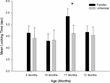
Data from the 101 English-learning infants (25, 27, 23, and 26 9-, 10-, 11-, and 12-month olds, respectively) who completed the test successfully were included in the final analysis.1
We included in the final analysis only (a) trials with looking times greater than 1 s and (b) infants who responded on approximately equal numbers of trials to familiar and to unfamiliar word lists. This screening of the data enabled us to reduce the error variance.

The head turn results for monolingual English 9- to 12-month-old infants. *Significance at the .05 level.
This 11-month effect is robust, as we have found it repeatedly in experiments using different stimuli (Bywater, 2004; Vihman et al., 2004). Note, however, that the use of three different voices in the HT procedure in the present study meant that different infants were exposed to slightly different versions of the stimuli, which may have led to greater variability in the familiarity effects across infants. That is, the multiple voices contributed an additional source of “noise” in our findings. Furthermore, we found that the effect size at 11 months was smaller than in our previous studies, most likely because of the fact that more words, including words known by fewer infants, were presented. It is interesting that, after its robust appearance at 11 months, the familiarity effect was no longer seen at 12 months, suggesting that exposure to word forms alone no longer holds infants' attention once word meanings have begun to be learned more generally (see the decrease in mean looking time to the two lists here at 12 compared to 11 months).
Welsh
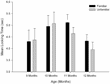
Altogether, 74 Welsh-learning infants (14, 12, 27, and 21 9-, 10-, 11-, and 12-month-olds, respectively) completed the test successfully and were included in the final analysis. The difference in mean looking times to familiar and unfamiliar word lists failed to reach statistical significance: 9 months, t (13) = .156, p = .44; 10 months, t (11) = .210, p = .105; 11 months, t (26) = 1. 339, p = .096; 12 months, t (20) = 1.533, p = .071. Thus, we found no significant effect of familiarity in any age group (Figure 3), although the effect does appear to be emergent at 11 and 12 months as mean looking times to familiar words were marginally longer in those age groups.

The head turn results for monolingual Welsh 9- to 12-month-old infants.
Welsh–English bilingual infants
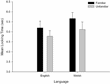
For the 20 bilingual infants who provided usable data we found significantly longer looks to English familiar than to unfamiliar words, t (19) = 1.876, p = .038. The parallel difference in Welsh approached statistical significance, t (19) = 1.661, p = .057. Mean looking times to familiar and unfamiliar word lists for the infants reared in bilingual homes are presented in Figure 4.

The head turn results for 11-month-old Welsh-English bilingual infants.
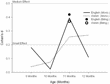
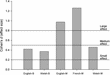
To gain a better understanding of these results in our three groups of infants we examined the standardized difference in looking times using Cohen's d (i.e., measure of effect size). Following Cohen (1988), a standardized difference value of .2 is considered a small effect size, .5 a medium effect size, and .8 a large effect size. Inspection of the effect sizes confirmed that, at 11 months, the familiarity effect is somewhat larger for the monolingual English learning infants in comparison to the other monolingual age groups from either English or Welsh environments (Figure 5).

The head turn effect sizes for monolingual and bilingual infants.
The bilingual infants also had comparable effect sizes to the monolingual English infants at 11 months; however, we need to keep in mind differences in the methodology used to assess word recognition between these two groups. On the one hand, the bilingual infants were all tested on the same voice, whereas the monolinguals were tested on three different voices, as noted above. On the other hand, because of the use of 33 different words, presented twice each to the bilinguals, this test was more difficult than were previous tests with monolinguals, which presented only 12 words, reordered so that each word was potentially heard six times. Nevertheless, to evaluate word recognition in bilingual infants it is perhaps more appropriate to examine their performance with respect to studies that used only a single voice. Figure 6 displays the bilingual results from this study together with the results of previous HT studies with monolingual infants (Hallé & Boysson-Bardies, 1994; Vihman & DePaolis, 1999; Vihman et al., 2004), all using the single-voice methodology (as did the bilingual study), but with just 12 words. Here we see that the familiarity effect for the English–Welsh bilinguals is comparable to that of the Welsh monolinguals tested using a single voice for all participants. It is apparent that both of these groups of infants show a weaker preference for familiar words, in terms of effect sizes, in comparison with the English and French monolinguals, who are growing up in a predominantly English or French environment, respectively.

Comparisons of the effect sizes at 11 months with single voice methodology. B, bilingual; M, monolingual. English-M, French-M, and Welsh-M results are according to Vihman et al. (2004), Hallé and Boysson-Bardies (1994), and Vihman and DePaolis (1999), respectively.
To summarize the findings of the HT experiments, monolingual English infants responded with significantly longer looks to familiar words at 11 months but Welsh infants did not. Welsh infants showed the effect only at 12 months, when tested with only 12 words; on the more difficult test they show only a tendency to look longer at familiar words. Effect sizes for 11-month-old bilingual infants are far smaller than for monolingual English and French infants tested with a single voice (but recall that the monolinguals also heard fewer words as stimuli, repeated more often).
Results for experiments using ERPs
English
ERPs allow us to look in some detail at the time course of word recognition. Thierry et al. (2003), testing monolingual English-learning infants at 11 months, found a significant difference between the response to familiar versus rare words within 250 ms (N2 peak)—time enough to hear only the onset consonant(s) and possibly the first vowel. Thierry et al. (2003) interpreted this N2 modulation as a mismatch negativity (MMN; see Näätänen, 2001, for a review). The MMN is a modulation of ERPs typically observed between 100 and 250 ms and elicited by stimuli of low local probability presented within a stream of stimuli of high local probability, that is, in an “oddball” context (Näätänen, Paavilainen, Alho, Reinikainen, & Sams, 1989). The MMN is considered automatic, and requires no involvement of conscious attention. It is thought to index spontaneous evaluation of perceptual cues in the environment by the auditory system. Thierry et al. (2003) interpreted the N2 modulation as an MMN because only a subset of the word stimuli selected as familiar by the experimenters was likely to be familiar to a given child, and stimuli from the familiar condition would thus have been of low local probability whereas rare words would have been of high local probability.
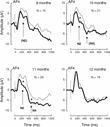
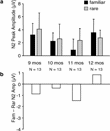
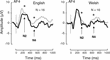
Figure 7 shows the ERPs for electrode F4 (right anterior frontal), the site of the largest response across all groups, for English at all four ages. The findings here replicate Thierry et al. (2003), in that a significant main effect of familiarity on N2 mean peak amplitudes was found at 11 months. We used N2 as a descriptive label for the negative peak with a latency of approximately 200 ms that, as in Thierry et al. (2003), was significantly more negative for familiar than rare words in 11-month-old monolingual English infants. It is of interest that an N2 main effect of familiarity was also found at 10 months and a significant N2 amplitude difference (restricted to electrode AF4, hence not a main effect) was found at 9 months.

Event-related potentials elicited by familiar (black wave) and rare (gray wave) English words at electrode AF4. *Significant main effects of familiarity on mean peak amplitudes over the five frontocentral electrodes.
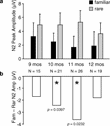
In Figure 8 the N2 effect can be seen to increase steadily in size from 9 to 11 months (see Figure 8b, where the difference between familiar and rare words reaches its maximum at 11 months). The N2 effect then disappears entirely at 12 months. As in Thierry et al. (2003), we interpret the N2 effect as an MMN-like event, showing automatic orientation of the auditory system to (low-probability) recognizable stimuli presented among (high-probability) unknown stimuli. We make that interpretation despite the fact that the stimuli, for the monolingual infants, were evenly divided between familiar and rare, on the grounds that, for any given infant at 11 months, only a small proportion of the words are likely to be familiar, with the effect that a few familiar words (in effect, oddball familiar-word stimuli for the infant) are detected against a background of many unknown words.

The first negative peak (N2) familiarity effects in English infants.
The progressive emergence of the familiarity effect shows that implicit word recognition commences well before 11 months. At 9 months the effect is restricted to the anterior region of the scalp, but at 10 and 11 months it spreads broadly, which suggests wider involvement of underlying cortical networks. It is of interest that the N2 effect was accompanied by a developing N4 modulation, which was characterized by a significant main effect at 11 months but which then, like the N2, disappeared at 12 months (see Figure 7). Furthermore, the size of the familiarity effect in the N2 range was significantly correlated with that in the N4 range (r = .69, p<.001), across all age groups. We interpret the emergence of the N4 modulation at 11 months as reflecting increased infant familiarity with the later part of the word, a kind of pervasive N2 modulation.
It is surprising that at 12 months the N2 and N4 disappear together. However, it is highly unlikely that words that sound familiar to one group of English 11-month-olds are insufficiently familiar to another group of English 12-month-olds to evoke a response. On the contrary, in the framework of the MMN-based oddball interpretation that we give for the N2–N4 complex seen at 11 months, we speculate that by 12 months, with an increase in lexical knowledge, the probability of occurrence of familiar and rare words, actually presented in equal numbers, has come to be roughly equal for the infants, effectively eliminating the oddball effect.
Welsh
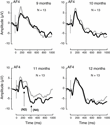
For Welsh, the pattern of results seen in the ERPs was again consistent with the HT results (Figure 9). No main effect of familiarity was evident at any age. At 11 months, however, we did see signs of the familiarity effect in the form of a localized N2 amplitude difference at electrode AF4 (p <.05, uncorrected) and a difference in the N4 range at electrodes AF4 and Cz (both p <.05, uncorrected). Our failure to find a main effect of word familiarity in Welsh infants at any age in either HT or ERPs suggests that the differentiation between familiar and rare is less efficient in Welsh than in English infants.

Event-related potentials elicited by familiar (black wave) and rare (gray wave) Welsh words at electrode AF4. There were no significant main effects of familiarity on mean peak amplitudes over the five frontocentral electrodes.
Close examination of the N2 amplitude pattern at electrode AF4 shows that the N2 amplitudes elicited by rare words tend to closely follow the pattern of those elicited by familiar words (see Figure 10a), in contrast with what we find for English (Figure 8a). Automatic orientation of attention may thus be elicited in Welsh by rare as well as by familiar words. The lack of a main effect of familiarity could then be seen as reflecting not a failure of familiar words to elicit a response in the Welsh infants but rather a more balanced attentional response to familiar and rare words alike.

The first negative peak (N2) familiarity effects in Welsh infants.
English–Welsh bilingual infants
Sixteen bilingual infants were successfully tested on the ERPs. Here—again in keeping with the HT results—we found a significant N2 modulation for both English and Welsh (main effect of familiarity: p < .004; Figure 11). We also found a main effect of familiarity in the N4 time window (p < .002). There was, however, no main effect of language on the amplitude of the N2 and N4 peaks and no interaction between familiarity and language. In addition, both the N2 and N4 peaked later in Welsh than in English, as indicated by a main effect of language on N2 and N4 latencies (both p<.0001).

Event-related potential results for 11-month-old Welsh–English bilingual infants. *Significant main effects of familiarity on mean peak amplitudes over the five frontocentral electrodes.
We can summarize the ERP findings as follows. In English, we see a significant broad N2 modulation already at 10 months. By 12 months enough words are known to eliminate the MMN in English. In Welsh, we see the emergence of the N4 at 11 months and we find that the N4 is stronger than the N2, whereas in English the N2 is stronger than the N4. In bilinguals, both N2 and N4 effects are significant in both languages by 11 months. These familiarity effects do not differ between languages or interact with languages but peak latency is significantly delayed in Welsh compared to English.
DISCUSSION
We have presented the findings of our studies of infant word form recognition using two experimental procedures in parallel. For the English-learning infants, we replicated the earlier HT finding of the emergence of word form recognition at 11 months, using an experimental design that proved more difficult for the infants than that used in previous word form recognition studies (33 words of each type repeated once instead of 12 words repeated six times). We also found the first generalized neurophysiological sign of word form recognition at 10 months in English, even though the first behavioral response can be detected only at 11 months. In addition, we showed that by 12 months the familiarity effect vanishes in English, probably for one reason in HT (a lack of interest in decontextualized words) and another in ERPs (balanced proportion of familiar and rare words cancelling the oddball effect underlying the MMN). In the case of the Welsh-learning infants, we failed to see clear familiarity effects in either procedure, although a tendency toward a familiarity effect was seen in HT at 11 and 12 months and localized signs of N2 and N4 modulations were also found within the expected time window. Finally, we reported results from Welsh–English bilingual infants, showing an effect of familiarity in both languages, in both procedures. In the discussion below, we address our two main unanticipated findings, both of which concern the status of infants from bilingual and minority-language homes, namely, the absence of a familiarity effect in infants addressed only in Welsh in the home and the unique pattern of ERP familiarity effects in infants addressed in both English and Welsh.
Minority language learning in a bilingual community
Our findings were unambiguous, in that the Welsh-learning infants differed from the English-learning infants in both procedures; they failed to show a significant generalized familiarity effect in either case. This replicates our earlier findings, but leaves open the question as to what underlies the contrast in response to familiar words between English (and French, based on the findings of Hallé & Boysson-Bardies, 1994) versus Welsh.
The absence of a familiarity effect in Welsh infants can be interpreted in a number of ways. First, although Welsh, like English, is considered to be primarily trochaic (strong–weak accentual pattern), the accent in Welsh is manifested differently: the vowel of the first (accented) syllable is short, the medial consonant is lengthened, and the vowel of the final syllable is also long (Vihman, Nakai, & DePaolis, 2006). Thus, the second part of a word is more salient than the first—the reverse of English, in which stress has the effect of lengthening the first syllable as well as adding both intensity and pitch change, making the first part of a word more salient. The accented syllable has been shown to be critical for word form recognition: a change to the onset consonant of the first (stressed) syllable blocks recognition in 11-month-olds in English but not in French, with its iambic (weak–strong) accentual patterning, whereas the reverse is true of the medial consonant in a disyllable (Vihman et al., 2004). Welsh infants could be expected to rely more on later parts of a word, as French children do, and their early word patterns reflect this, as both French and Welsh infants commonly omit initial consonants, whereas English infants rarely do: cf. French chapeau (hat)/∫apo/, produced as [apo], and lapin (rabbit)/lap[ecir ]/, va pas (doesn't go, doesn't fit)/vapa/, both produced as [apa]; Welsh bwni (bunny)/buni/, produced as [h

ni], fyna (there)/vjna/, produced as [λnæ], and moron (carrot)/m

r
n/, produced as [/awan] (Vihman & Kunnari, 2006). Because ERPs are time locked to word onset, ERP modulations discriminating familiar from rare words can be expected to be offset in Welsh and the relative increase in amplitude of the N2/N4 complex to be delayed.
Second, Welsh, like the other Celtic languages, has several mutation processes, by which the initial consonant of a word changes under certain grammatical conditions (e.g., feminine cath [cat] becomes gath when preceded by the definite article y, whereas masculine car [car] undergoes no change). Depending on grammatical gender and other syntactic factors, then, Welsh initial consonants are subject to change and so serve as relatively less reliable lexical cues than English initial consonants.
Third and finally, consider the sociolinguistic situation in North Wales: Welsh speakers are almost universally fluent in English, whereas English native speakers in the same community seldom speak Welsh. How might this translate into the differences in onset of word recognition that we have identified? Recall the difference in the patterning of rare word responses in the two languages. In English, N2 amplitudes for rare words tended to be large and stable at 9, 10, and 11 months, whereas N2 amplitudes for familiar words tended to become more negative over the same period. This pattern of response is consistent with our interpretation of the N2 modulation as an MMN-like response: we interpret the amplitude of the N2 as indexing the extent of attentional resources automatically captured by each stimulus type. In the case of Welsh, however, N2 amplitudes elicited by rare words closely followed the general pattern elicited by familiar words, as if rare words attracted almost as much attention as familiar words. This observation highlights fundamental differences in the way rare words are processed in the two languages.
It is possible that the difference is related to the imbalance in use of the two languages in the community of North Wales. Despite the fact that the two counties of Anglesey and Gwynedd, from which our participants were drawn, boast the largest proportion of Welsh speakers anywhere in the world,2
In the 2001 census 76% of adults in Gwynedd and 70% in Anglesey reported an ability to read, write, speak, or understand Welsh. However, all of these adults are also fluent in English, which is the dominant language for many of them.
The familiarity effect in bilinguals
Is the bilingual infant more sensitive to the onset consonant in Welsh words because of experience with the onset consonant in English words, supported by all the acoustic properties of heavy stress? Might the strong bilingual N4 response to English at 11 months be related to the same infants' N4 response to Welsh, based on the complementary importance of the second syllable-onset consonant in Welsh, which is lengthened under accent? The characteristics of the monolingual responses to both English and Welsh can be seen in the bilinguals. It is notable that bilingual 11-month-olds show a pattern that falls in between those observed in the monolinguals. Furthermore, there seems to be no cost of bilingual exposure for the online processing of English: the N2 peaks at roughly the same time in both bilinguals and monolinguals. However, it is not possible to comment on the relative time course for the online processing of Welsh in the case of monolingual versus bilingual exposure, because we found no significant familiarity effect in the monolingually exposed Welsh infants. It appears that developing familiarity with the phonotactic structure and accentual pattern of both English and Welsh supports word form recognition in each of the languages, because the overt HT response is obtained for both English and Welsh in bilinguals, whereas 11-month-old Welsh infants fail to show that response.
It must be kept in mind, however, that the paradigm used in the bilingual study involved a “true” oddball paradigm because the familiar/rare ratio in the words presented as stimuli was 1:3. Because there were only 25% familiar words in total, the familiar condition was more likely to elicit not only an MMN-like response but also a P300-like response, that is, the response obtained in adults when they are consciously aware of the occurrence of a low probability event. Some authors have speculated that the P300 may be inverted in infants and peak later (i.e., between 400 and 700 ms; see Thierry, 2005). Therefore, the significant N4 effect that we obtained might have been facilitated by a paradigm more likely to induce a P3 modulation. Such a hypothesis depends on making the assumption that infants were “overtly conscious” of the low local probability of familiar words in the experiment.
The N2 and N4 peak latency difference between English and Welsh in bilingual infants suggests that English recognition effects are characterized by a faster neural processing time course. This effect very likely relates to the prosodic and morphophonological characteristics of Welsh that we mentioned with regard to the ERPs obtained from Welsh monolinguals: the accentual pattern lends less salience to the word–initial consonant than does English and the pervasive mutation system greatly lessens the cue validity of that consonant.
CONCLUSION
In conclusion, we found that word learning in a bilingual community is subtly different, depending on the language(s) spoken to the child. For the dominant language, the time course appears to be the same as in a monolingual setting (e.g., French in France). For monolinguals exposed directly only to the minority language, we see a delay and a difference in the attentional response. Rare or unknown words held infant attention in a way that did not obtain for children learning the dominant language of the community, perhaps because these infants are “flooded” with unknown words, and have thus learned not readily to dismiss them.
We thank Satsuki Nakai for designing the HT study and preparing the stimuli; Dilys Hughes for serving as our balanced bilingual speaker; and Kat Barker, Naomi Craig, and Fran Garrad-Cole, as well as our undergraduate students (Aimée Butler, Ruth Dyson, Charlotte Harrington, Vicky Hudson, Jenny Hughes, Alaina Turnbull, Athena Trigenis, and Sarah Williams) for recruiting participants and running the infant experiments. We are grateful to the ESRC for funding this study.