Acute rheumatic fever is a chronic, inflammatory, and systemic disease that develops after group A beta-hemolytic streptococcus (GABHS) infection. Its incidence is 8 to 51 per 100,000 people worldwide. Rheumatic heart disease, the long-term consequence of acute rheumatic fever, still remains a major health problem in developing countries. It is estimated that at least 15 million people worldwide are affected by rheumatic heart disease. Reference Carapetis, Steer, Mulholland and Weber1,Reference Gewitz, Baltimore and Tani2 The diagnosis of acute rheumatic fever is based on the Jones criteria. The American Heart Association had first set it in 1944 and periodically updated the criteria. The last update was made in 2015, and important changes were made in the diagnostic criteria. Reference Gewitz, Baltimore and Tani2,Reference Dajani, Ayoub and Bierman3
The disease mainly affects the joints, heart, skin, and central nervous system. Antibodies are formed against the breakdown products and antigens of GABHS in susceptible individuals with pharyngitis due to GABHS. These antibodies cross-react with host tissues (heart, brain, joint, skin) due to their antigenic mimicry. This cross-reaction leads to the production of cytokines. Antibodies binding to the endothelial valve surface cause injury and infiltration of inflammatory cells and the continuation of T cell and macrophage infiltration by stimulating vascular adhesion molecules. As a result, binding of these cross-reactive antibodies to the endothelial surface causes the subendothelial structure and proteins to be exposed, further injury and valve scarring. Reference Guilherme, Kalil and Cunningham4–Reference Galvin, Hemric, Ward and Cunningham6
After the first attack of rheumatic carditis, neovascularisation as a result of scarring of the valve leads to the continuation of the disease. The recurrence of rheumatic attacks increases the scar formation on the valves. Reference Guilherme, Dulphy and Douay7,Reference Cunningham, Antone, Smart, Liu and Kosanke8
Currently, we do not have a marker to show whether one has had acute rheumatic fever in the past. On the other hand, the criteria of World Heart Federation (WHF) and 2020 Australian guideline are guiding in evaluating whether incidentally detected aortic and/or mitral regurgitations are due to rheumatic heart disease. Reference Reméanyi, Wilson and Steer9,Reference Ralph, Noonan, Wade and Currie10
Endocan, also called endothelial cell-specific molecule-1 (ESM-1), is a soluble dermatan sulfate proteoglycan of extracellular matrix secreted by vascular endothelial cells. It is among the extracellular matrix components involved in vasculopathy and fibrosis. Therefore, it is considered as a new tissue and blood-based biomarker reflecting endothelial activation and dysfunction. Its expression is strongly regulated by vascular endothelial growth factor. Reference Roudnicky, Poyet and Wild11
In this study, it was aimed to examine the serum endocan levels in patients with rheumatic aortic regurgitation and to investigate whether it has a value in differentiating it from aortic regurgitation due to bicuspid aortic valve.
Material and method
Study population
Blood samples were taken for the study from patients with rheumatic aortic insufficiency (Group 1) who had a previous first attack acute rheumatic fever and followed up in the paediatric cardiology clinic, and from patients with newly diagnosed borderline or definite rheumatic aortic insufficiency (without previous diagnosis of acute rheumatic fever) (Group 2). In addition, children with bicuspid aortic valve with concomitant aortic regurgitation (Group 3) and healthy children of similar age who applied to our outpatient clinic during the study (Group 4) were included in the control groups.
The current Jones criteria were followed when diagnosing first episode of acute rheumatic fever. Reference Gewitz, Baltimore and Tani2,Reference Dajani, Ayoub and Bierman3 The criteria recommended by the WHF were used when deciding on the rheumatic aetiology in patients with incidentally diagnosed aortic and/or mitral regurgitation. Reference Reméanyi, Wilson and Steer9
Blood samples
Blood samples taken from the patient and control groups were placed in the biochemistry tube. After keeping the biochemistry tube in an upright position for 10–20 minutes for coagulation, it was centrifuged at +4°C for 10 minutes at 4500 rpm. The serum samples obtained were placed in a deep freezer at −80°C and kept there until the day the endocan Elisa test would be analysed.
Analyte assay techniques
The collected serum samples were studied using a “Human Endocan ELISA Kit” (BT LAB, Cat. No.E3160Hu, China) according to the manufacturer’s instructions. Detection range of this kit is 5–2000 ng/L. The sensitivity of this assay is 2.56 ng/mL. Interassay coefficient of variance and the intraassay coefficient of variance is given as <10% and <8% for endocan measurement by the kit manufacturer, respectively.
Statistical analysis
Data analysis was performed on SPSS 20.0 for Windows software (SPSS Inc., Chicago, IL, USA). The normality distribution of the data was examined. Since the data did not show a normal distribution, the mean values between the groups were separately compared with the Mann–Whitney U test. Ages between the groups were compared with the ANOVA test. Gender frequencies between the groups were compared with the chi-square test. A p < 0.05 was considered statistically significant.
Results
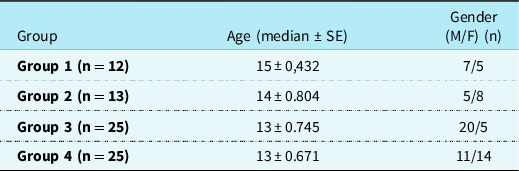
The demographic characteristics of the patients included in the groups are given in Table 1.
Demographic characteristics of the groups

F: Female, M: Male, SE: Standart error.
There was no significant difference between the groups in terms of median ages (p = 0.291), but the gender distribution showed a significant difference (p = 0.03).
Four (33.3%) of the children in Group 1 had isolated aortic regurgitation, while eight (66.6%) had concomitant mitral regurgitation. However, aortic regurgitation was the predominant valve involvement. Seven of these patients had first-degree and five had second-degree aortic regurgitation. It was accompanied by first-degree mitral regurgitation in six patients and second-degree mitral regurgitation in two patients. In these patients the median time between the first diagnosis and blood sampling was 1.96 years.
The median time between the first diagnosis and blood sampling in Group 2 was 0.8 years. Two of Group 2 patients had definite and remaining had borderline rheumatic heart disease. In all patients the acute phase reactants were negative. All had first degree aortic regurgitation. It was accompanied by first degree mitral regurgitation in one patient and second degree in one patient.
Also in cases in Group 3 the acute phase reactants were negative. All had first degree aortic regurgiation. The associated pathologies were as following; mild aortic stenosis = 12, small atrial septal defect = 2 and small ventricular septal defects = 1
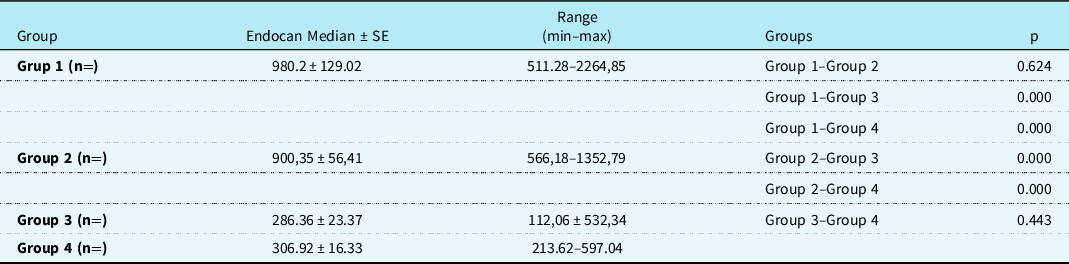
Median endocan levels and statistical comparisons are given in Table 2.
Median endocan levels and comparisons in groups

max: Maximum, min: Minimum, SE: Standart error.
Discussion
Acute rheumatic fever still continues to be an important health problem, especially in developing countries. Rheumatic heart diseases are the most important result of acute rheumatic fever and cause significant morbidity and mortality in advancing ages. The Global Burden of Disease study more recently estimated that there are 33 million prevalent cases of rheumatic heart disease, causing more than 9 million Disability-Adjusted Life Years lost and 275,000 deaths each year. Reference Vos, Barber and Bell12
Chronic secondary prophylaxis is recommended in patients with acute rheumatic fever who develop carditis, and this is the most important tool in the prevention of acute rheumatic fever recurrences. It is known that the appropriate and regular application of secondary prophylaxis reduces the recurrences of acute rheumatic fever. About 2/3 of patients with rheumatic carditis are aware of the situation and apply to the physician. The remainder constitutes the highest risk group for rheumatic heart disease. Because they will be deprived of prophylaxis. Reference Gewitz, Baltimore and Tani2,Reference Dajani, Ayoub and Bierman3
The last update regarding the Jones criteria used in the diagnosis of acute rheumatic fever was made by the AHA in 2015. Reference Gewitz, Baltimore and Tani2 The WHF published a guideline in 2012 to be used in the diagnosis of rheumatic heart diseases. Recommendations regarding echocardiographic findings that provide criteria for distinguishing pathological rheumatic heart disease from physiological changes are presented in this guideline. In the presence of certain echocardiographic findings in patients who apply to cardiology clinics for any reason and are found to have mitral and/or aortic regurgitation, they recommend that these patients be considered to have had Acute rheumatic fever and that secondary prophylaxis should be given. Reference Reméanyi, Wilson and Steer9 The Australian guideline published by Ralph et al Reference Ralph, Noonan, Wade and Currie10 in 2020 is also presented further details on the use of echocardiograms.
Mitral and/or aortic regurgitation are the most common lesions caused by valvulitis leading to chronic rheumatic heart disease. Reference Guilherme, Ramasawmy and Kalil13 Clinically, the rate of mitral valve involvement in rheumatic heart disease is between 90–95%, and about 20–25% of these are associated with aortic valve involvement. Isolated aortic valve involvement has been reported in less than 5–8% of cases. Reference Markowitz, Markowitz and Gordis14,Reference Persellin15
Valvulitis is among the life-threatening complications and it causes fibrosis of the heart valves, which results in damage of heart valve and cause heart failure or death of the patient. Reference Liu, Lu, Sun, Zheng and Zhang16
The pathogenesis of acute rheumatic fever and rheumatic heart disease is complex, and both environmental and genetic factors contribute to the aetiology. Occurrence of disease in only a small subset of children with untreated GABHS throat infection, furthermore, progress of only one-third of affected children to the development of rheumatic heart disease suggest that host genetic factors are also involved. Reference Guilherme, Ramasawmy and Kalil13 Two phases have been described in the pathological process of acute rheumatic fever. The first stage of the disease, that is seen in the first 2-3 weeks, is called as the exudative-degenerative phase. It is characterized by interstitial edema, T-cell, B-cell, and macrophage infiltration, fragmentation of collagen tissue, and scattering fibrinoid deposition. The second phase, called the proliferative or granulomatous phase, lasts for months or even years. Typical Aschoff nodules are seen. Reference Saphir17 Macroscopically, the heart is edematous, loose, and the cavities are enlarged. Mitral and aortic valves are initially edematous. In the acute period, elongation or even rupture of the mitral anterior leaflet chordae, annular dilatation, impaired coaptation, prolapse and regurgitation are seen. Reference Câmara, Neubauer, Câmara and Lopes18,Reference Kamblock, N’Guyen and Pagis19 During the healing period, increase in vascularity and thickening of the valve with the emergence of granulation tissue occur, and eventually fibrosis develops.
It has been reported that anti-carbohydrate B, an antispotreptoccal antibody, remains elevated for longer than other antibodies in patients with a previous history of rheumatic carditis. Thus, it has been reported that these antibodies can be used to recognize rheumatic valve diseases. Reference Shulman, Ayoub, Victorica, Gessner, Tamer and Hernandez20–Reference Dudding and Ayoub22 However, studies on the subject are few and do not provide a clear result. Today, there is a need for a test that can help in determination of whether an incidental aortic and/or mitral regurgitation is due to rheumatic heart disease or not.
Severe or permanent tissue damage cannot be repaired by parenchymal regeneration alone, as it causes damage to both parenchymal cells and the stroma framework. In this case, the repair is provided by the replacement of the parenchyma cells that cannot be regenerated by the connective tissue (fibrosis). Fibrosis in the early stage is formed in the granulation tissue consisting of loose extracellular matrix and new vessel roof at the repair site. The process has four components; 1) Angiogenesis, 2) Fibroblast migration and proliferation to the injury site, 3) Extracellular matrix deposition, 4) Fibrous tissue maturation and reorganisation. Reference Oakes, Kumar, Abbas and Aster23 Angiogenesis is defined as the process by which new vessels are formed by branching from the existing vascular network. The formation of new capillaries is important not only for normal growth and development, but also for the progression of angiogenesis-related diseases. Angiogenesis involves a complex interaction between different cells, soluble factors, and extracellular matrix components. Reference Carmeliet24,Reference Conway, Collen and Carmeliet25 Angiogenesis is the critical event in injury recovery. Various factors stimulate angiogenesis, but the most important are basic fibroblast growth factor and vascular endothelial growth factor. Both are secreted by various stromal cells and basic fibroblast growth factor bind proteoglycans to the basement membrane. A more comprehensive understanding of the molecules that regulate angiogenesis may be valuable for early diagnosis and targeting of therapy. Reference Oakes, Kumar, Abbas and Aster23
Stimulation and regulation of fibroblasts are regulated by growth factors. Many of the growth factors that regulate fibroblast proliferation also stimulate extracellular matrix synthesis. The extracellular matrix is a locally made dynamic, permanently outlined macromolecular complex that makes up a significant portion of every tissue. There are three basic extracellular matrix components: Fibrous structural proteins (collagen, elastin) forming resistance; lubricating aqueous gels and matrix elements (proteoglycans and hyaluronan); and adhesive glycoproteins (fibronectin, laminin, integrins, etc.) that bind cells together. The repair begins within 24 hours after the tissue injury and continues with the appearance of a special type of tissue called granulation tissue within 3–5 days. The granulation tissue then transforms into fibrous tissue composed largely of inactive spindle-shaped fibroblasts, dense collagen, elastic tissue fragments, and other extracellular matrix components by the progressive increase of the extracellular matrix. Reference Mitchell, Kumar, Abbas and Aster26
Endocan is a novel soluble dermatan sulfate proteoglycan secreted by cultured endothelial cells. Reference Sarrazin, Adam and Lyon27 It plays a role in the regulation of cellular activities such as adhesion, migration, and proliferation. Reference Lee, Choi and Bae28,Reference Gerszten, Garcia-Zepeda and Lim29 Endocan is upregulated by proangiogenic molecules as well as proinflammatory cytokines. Among many mediators, it is secreted by vascular endothelial cells in response to different stimuli such as tumor necrosis factor-α and vascular endothelial growth factor. Reference Balta, Mikhailidis, Demirkol, Ozturk, Celik and Iyisoy30
Endocan participates in molecular interactions underlying various biological processes such as cell adhesion, proliferation, as well as neovascularization and endothelial cell activation in response to proangiogenic signals. Reference Sarrazin, Adam and Lyon27,Reference Lee, Choi and Bae28,Reference Balta, Mikhailidis, Demirkol, Ozturk, Celik and Iyisoy30–Reference Abu El-Asrar, Nawaz and De Hertogh33
Serum levels of endocan are within normal limits in cases with functional endothelial tissue, while increased serum levels of endocan have been reported in patients with endothelial damage and neovascularization. Reference Icli, Cure and Cure34 Due to the fibrotic changes that may develop after neovascularisation, new blood endothelial biomarkers may be important alternatives for diagnosing endothelial dysfunction, especially in the early stages of diseases. Reference Wang, Yang, Luo, Wang and Jing35 Activation of endothelial cells and inflammation increases endocan secretion, which in turn feeds vascular inflammation. Therefore, it has been suggested that endocan can be used as a biomarker of endothelial dysfunction and pathological angiogenesis. Reference Sarrazin, Adam and Lyon27,Reference Balta, Mikhailidis, Demirkol, Ozturk, Celik and Iyisoy30,Reference Oktar, Guney and Eren31,
It has been reported that endocan may have diagnostic or prognostic value in many clinical problems. Reference Sarrazin, Adam and Lyon27,Reference Kali and Rathan Shetty36 Because endocan can interact with bioactive proteins, it has been identified in tumours as a marker of proliferation, neovascularisation, Reference Strasser, Kaminker and Tessier-Lavigne37,Reference Del Toro, Prahst and Mathivet38, and endothelial cell activation Reference Abid, Yi, Yano, Shih and Aird39,Reference Grigoriu, Depontieu and Scherpereel40 in response to proangiogenic signals. It is expressed at higher levels in endothelial cells during proliferation compared to non-proliferating cells. Reference Abid, Yi, Yano, Shih and Aird39
It has also been shown to elicit epithelial cell proliferation in vitro by interacting with growth factors such as hepatocyte growth factor/scattering factor via the dermatan sulfate chain. Reference Béchard, Gentina and Delehedde41 In a study investigating serum endocan concentration in relation to different stages of liver diseases, it was shown that endocan levels were higher in advanced fibrosis than in the control group. Reference Klisic, Kavaric and Abenavoli42
It has been stated that endocan is a potential biomarker for microvascular manifestations and complications in patients with systemic sclerosis. Reference Bălănescu, Lădaru, Bălănescu, Voiosu, Băicuş and Dan43 Proteoglycans have been shown to increase the activity of dermal fibroblasts to overexpress pro-fibrotic proteins. Thus, endocan, which acts as a circulating proteoglycan, also contributes to fibrosis in systemic sclerosis. Reference Lo, Mandraffino and Rodríguez-Carrio44,Reference Liakouli, Cipriani and Di Benedetto45 In chronic kidney disease, risk factors include progressive glomerular scarring and interstitial fibrosis. In renal hypodysplasia, which is one of the causes of chronic kidney disease, serum endocan levels were found to be significantly higher than in the control group. Reference Cayci, Aydin and Aygar46
It is known that rheumatic heart disease causes typical chronic fibrotic changes in the heart valves. This study, which was conducted to answer the question of whether endocan, a marker of fibrosis, can distinguish these patients from patients with non-rheumatic aortic regurgitation, is the first study on the subject and points to promising results in this regard.
In our study, the median endocan level was found to be significantly higher in children with chronic rheumatic aortic regurgitation after a previous acute rheumatic fever (Group 1) and in children with aortic regurgitation evaluated as incidental rheumatic valve disease (Group 2) than in children with aortic regurgitation due to bicuspid aortic valve (Group 3) and normal healthy children (Group 4). It is also important that a long time has passed after the first attack in patients with rheumatic valve disease (Group 1). Our findings suggest that upregulation of endocan expression in rheumatic heart disease may be a reflection of angiogenesis-related endothelial cell activation and subsequent fibrosis.
Conclusions
Our results indicate that serum endocan level can be used to differentiate rheumatic aortic regurgitation from non-rheumatic aortic regurgitation. It is thought that important results can be reached by investigating the subject in other rheumatic heart disease patients with mitral valve involvement. Also the diagnostic value of this marker should be confirmed in long-term, prospective studies with larger samples. In this way, the answer to the question “How long the serum endocan level remains high after the first attack of acute rheumatic fever?” can be found.
Study limitations
The most important limitation is the low number of patients in Group 1 and Group 2. However, the fact that the frequency of aortic regurgitation is already low in patients with rheumatic carditis, and that a significant part of it improves during follow-up, are the causes of small number of such patients.
Acknowledgements
None.
Financial support
This research received no specific grant from any funding agency, commercial, or not-for-profit sectors.
Conflicts of interest
The authors declared no potential conflicts of interest with respect to the research, authorship, and/or publication of this article.
Ethical standards
Ethics committee approval was received for this study from the ethical committee of Ataturk University Faculty of Medicine.