INTRODUCTION
One afternoon in 2004, a small man with white hair walked into the main room of Nepal's National Association for the Deaf and Hard of Hearing in Kathmandu. This Deaf-run institution, which served as one of the primary sites for my research on DeafFootnote 1 social networks in Nepal, coordinates eight regional Deaf Associations in their shared mission to promote Nepali Sign Language (NSL) and Deaf rights. I was startled to see this man as, for reasons discussed below, Nepal's Deaf associations are rarely frequented by anyone over the age of forty-five. Indeed, the association members with whom I had been spending the afternoon greeted him with excitement, drew my attention to his age by signing, “He's an elderly Deaf man!”, and suggested that I record his life story.
They explained that this man, named Madhu,Footnote 2 communicated primarily by means of idiosyncratic gestures, referred to in the literature as homesigns. Homesigns are systems of gestural communication that emerge “only in situations where there is not sufficient language stimulation in an individual's environment to permit typical language development” (Morford Reference Morford1996:165). These systems have language-like structure but vary in complexity (Morford Reference Morford1996; Kegl Reference Kegl, Morgan and Woll2002; Goldin-Meadow Reference Goldin-Meadow2003). Homesigners’ abilities to acquire a sign language later in life likewise vary, according to factors such as their age at first exposure to language and the complexity of their homesign system (Newport Reference Newport1990). Because Madhu was not exposed to sign language until he was over seventy years old, my companions noted that he had been too old to acquire NSL. Therefore, a young woman named Laxmi was recruited to interview him since, based on their past interactions, she had some familiarity with his communicative code.
Though the conversation I recorded was bracketed by establishing and concluding dialogues hesitantly conducted in Madhu's gestural system, I was surprised to see that the remainder of the interview appeared to be a seamless series of questions and answers in NSL. Upon reviewing the videotape, however, I realized that each of Madhu's turns in that code consisted of the repetition of the last sign in Laxmi's previous NSL utterance. I subsequently learned that while Madhu was indeed unable to produce NSL independently, persons whose individual competence in NSL is compromised by prior linguistic isolation often take advantage of the interactional scaffolding provided by their interlocutors to produce NSL through copying (or mirroring). This article contextualizes the factors underlying such events while exploring their consequences for both homesigners like Madhu and for Deafness as an emerging social category in Nepal.
Since the 1980s, members of Nepal's Deaf associations have promoted an ethnolinguistic model of Deafness, in which Deaf status hinges on competence in NSL rather than on the inability to hear. This model of Deafness is increasingly international in scope (Erting, Johnson, Smith, & Snider Reference Erting, Johnson, Smith and Snider1994; Monaghan, Schmaling, Nakamura, & Turner Reference Monaghan, Schmaling, Nakamura and Turner2003), exported to emerging Deaf social networks world-wide by prominent Deaf cultural centers such as Gallaudet University in the United States, the World Federation of the Deaf, and Deaf Associations in Scandinavian countries where sign languages receive strong state support (Bagga-Gupta & Domfors Reference Bagga-Gupta, Domfors, Monaghan, Schmaling, Nakamura and Turner2003; Monaghan Reference Monaghan, Monaghan, Schmaling, Nakamura and Turner2003:85; Senghas Reference Senghas, Monaghan, Schmaling, Nakamura and Turner2003). Proponents of this view often follow Woodward (Reference Woodward1972) in writing the English word deaf in lowercase to indicate the inability to hear and reserving Deaf, written with a capital D, to indicate identification as a member of an ethnolinguistic category (using the mixed case, d/Deaf, to refer to groups or situations in which both framings of d/Deafness are relevant). Members of Nepal's Deaf Associations have mapped the deaf/Deaf distinction onto the Nepali terms latto (a pejorative term meaning dumb in the literal and figurative senses) and bahiro (a more neutral term for nonhearing persons).
However, as LeMaster & Monaghan (Reference LeMaster, Monaghan and Duranti2004) have noted, it cannot be assumed that the meanings and consequences of treating Deafness and sign language as mutually constitutive will be the same across social and cultural contexts.Footnote 3 Rather, this perspective both shapes and is reshaped by ambient local language ideologies, the “ubiquitous set of diverse beliefs” whether implicit or explicit, that are “used by speakers of all types as models for constructing linguistic evaluations and engaging in communicative activity” (Kroskrity Reference Kroskrity and Duranti2004:497). In social contexts where ideological conceptions of language use highlight individual competencies, homesigners like Madhu would not be seen as possessing the linguistic competence necessary for Deaf social identity. However, in this article I draw on long-term participant observation in Nepali d/Deaf social networks during a series of six visits between 1997 and 2006 to argue that Nepali conceptions of socially distributed personhood contribute to a local focus on the social, rather than individual, dimensions of semiosis. As a result, the recognition of NSL competency in this context can depend less on individual cognitive ability than on social collaboration. This ideological perspective allows persons with a wide range of individual linguistic competencies to achieve bahiro status.
By analyzing the ideological and interactional processes through which homesigners are incorporated into an emerging bahiro social life, this article fills an important gap in the literature. Homesigners have been largely ignored by Deaf studies, which focuses disproportionately on families in which d/Deafness is hereditary and Deaf social (re)production occurs in a manner analogous to hearing social (re)production. Much work on homesigners has been conducted by linguists and cognitive psychologists who have studied homesign systems for what they may tell us about a language acquisition instinct, framed as an individual cognitive capacity (e.g. Senghas & Coppola Reference Senghas and Coppola2001; Goldin-Meadows Reference Goldin-Meadow2003). As a result, both the effects of homesigners on linguistic and social diversity in signing networks and the effects of social context on homesigners are underexamined and undertheorized.
This bias is not restricted to studies of the d/Deaf. As Goodwin (Reference Goodwin2004:151) has noted, in much linguistic and social theory actors are assumed to be the “prototypical competent speaker, fully endowed with all abilities required to engage in the processes under study,” an assumption that reaffirms “the basic Western prejudice toward locating theoretically interesting linguistic, cultural, and moral phenomena within a framework that has the cognitive life of the individual as its primary focus.” In attending to the role of homesigners in an emerging Deaf social network, and detailing the social constitution of their communicative (in)competencies, this article contributes to scholarly efforts to provide a corrective for this focus.
THE SOCIAL CONTEXT OF D/DEAFNESS IN NEPAL
The meanings of an ethnolinguistic model of Deafness in Nepal are influenced by other local models of d/Deafness with which it coexists and competes. In this section, after discussing the prevalence and causes of deafness in the country, I outline three major models through which the condition is interpreted and briefly situate them in historical and social context.
There is a high incidence of hearing loss in Nepal, the most common cause of which is otitis media, an infection of the middle ear, and its sequelae (Little, Bridges, Gurugain, Friedman, Prasad, & Weir Reference Little, Bridges, Guragain, Friedman, Prasad and Weir1993; Shrestha, Baral, & Neil Reference Shrestha, Baral and Neil2001; Maharjan, Bhandari, Singh, & Mishra Reference Maharjan, Bhandari, Singh and Mishra2006).Footnote 4 The 1990–1991 survey of deafness and ear disease in the country, conducted by the Britain Nepal Otology Service and the Tribhuvan University Teaching Hospital, found that out of a sample population over the age of five, 16.6% of Nepalis had significant loss of hearing while 1.7% were profoundly deaf (Little et al. Reference Little, Bridges, Guragain, Friedman, Prasad and Weir1993). Joshi (Reference Joshi1991), a Deaf Nepali leader, argues that the number of profoundly deaf is actually higher, at 3%. If Nepal's total population, as described by the National Planning Commission in 2002, is 23,151,423, these estimates suggest that the number of profoundly deaf in Nepal ranges between 393,574 and 694,542. Devkota (Reference Devkota2003), another Deaf Nepali leader, notes these numbers may have increased in recent years, due to the ten-year (1996–2006) Maoist insurrection that disrupted already marginal access to health services.
A religious model of d/Deafness
Little and colleagues note that 60% of the cases of hearing loss found in the 1990–1991 survey were false negatives. That is, people (or family members speaking for them) reported that they could hear, though testing later showed that they were in fact deaf (Little et al. Reference Little, Bridges, Guragain, Friedman, Prasad and Weir1993). A significant factor that motivates this underreporting is the stigma associated with d/Deafness in Nepal, where the condition is commonly interpreted as the result of the affected person's bad karma (the results of misdeeds in a previous life) (Joshi Reference Joshi1991; Acharya Reference Acharya, Hoffmann and Chemjong1997; Taylor Reference Taylor1997; Prasad Reference Prasad2003; Hoffmann Reference Hoffmann2008).Footnote 5 An important consequence of this view is the ritual pollution associated with d/Deafness. In accordance with the porous nature of personhood in many South Asian contexts (Marriott Reference Marriott and Kapferer1976), the pollution and shame that can be associated with d/Deafness does not apply only to the d/Deaf family member. Rather, it can be shared through regular physical and social contact, a “notion based on a complex physical theory of the flow of person-defining substances” (Parrish Reference Parrish, Mines and Lamb2002:179). For example, the hearing principal of Kathmandu's Naxal School for the Deaf recalls that when she first began to work with the d/Deaf, she was chastized and even shunned by some friends and family members who were concerned that the d/Deaf students’ pollution might affect her (and by proxy, them). Indeed, though this is by no means universal, in many cases d/Deaf Nepalis can be abused, neglected, or disowned by their birth families and surrounding communities because of this concern. Alternatively, many families work to hide the fact of a child's d/Deafness, a practice that can compound the effects of their linguistic and social isolation (Taylor Reference Taylor1997; Hoffmann Reference Hoffmann2008).
A biomedical model of deafness
However, since Nepal opened its borders to international aid programs in the 1950s, a range of governmental and nongovernmental organizations (NGOs) have established programs devoted to the prevention, diagnosis, and treatment of deafness in Nepal. These groups, including the Peace Corps, the Britain Nepal Otology Service, the Swedish Organization of Persons with Disabilities International Development Cooperation Association (SHIA), and Nepal's Welfare Society for the Hearing Impaired (WSHI), also worked to promote the belief that deafness has a biomedical basis not implicated in the workings of karma.Footnote 6
While this perspective frames deaf persons in a positive light, it still constructs deafness as an undesirable condition, an illness to be cured. In cases in which medical intervention or the application of hearing aids is not successful in effecting a cure, organizations serving the deaf typically attempt to mitigate the resulting disability through oralist procedures (including speech therapy and lip reading). The goal of such an approach is to help deaf persons function analogously to, or ideally pass as, hearing persons in order to “cure” their deafness socially if not physically. Most of the schools for the d/Deaf established in Nepal since 1966 adopted this model, promoting lip reading and speech therapy while strictly discouraging the use of manual communication (Acharya Reference Acharya, Hoffmann and Chemjong1997; Sharma Reference Sharma2003).Footnote 7 However, in a process similar to that described in other cross-societal contexts,Footnote 8 NSL emerged from the intensive communicative interactions of the first several cohorts of students in the d/Deaf schools (Acharya Reference Acharya, Hoffmann and Chemjong1997; Sharma Reference Sharma2003).Footnote 9
An ethnolinguistic model of Deafness
The students enrolled in the d/Deaf schools mentioned above often gathered together in local tea shops or on street corners after school hours, in order to enjoy socializing through sign language without constraint. Over time, and with the encouragement of Deaf tourists from abroad, these relationships coalesced into more formal social and physical spaces for d/Deaf social life outside the schools. The Kathmandu Association for the Deaf was founded in 1980 (though was not recognized by Nepal's government until ten years later). In 1995 the Nepal National Federation of Deaf and Hard of Hearing (NFDH) was founded in Kathmandu as an umbrella organization to organize what had become eight regional Deaf associations.Footnote 10 Unlike the Deaf schools, which are largely directed and run by hearing persons, Deaf Nepalis lead the Deaf associations.
Nepal's Deaf associations are socially, financially, and ideologically connected to national and international Deaf clubs and associations. They have received funding from the National Association of the Hearing Impaired in Denmark (LBH), the Danish Hard of Hearing Federation, the Swedish Association of the Deaf, the Norwegian Association of the Deaf, and Britain's Deaf Way, among others. Deaf representatives from these institutions have frequently visited Nepal to assist with local projects, such as the production of NSL dictionaries and the establishment of a center to train d/Deaf girls in tailoring skills, while representatives from the Nepali Deaf Associations occasionally visit Scandinavian and British associations to observe their activities. In 1996 the NFDH became a member of the World Federation of Deaf (WFD) and since sends representatives to the WFD meetings where Deaf people from around the world gather.
Internationally, Deaf associations influenced and are influenced by an ethnolinguistic model of Deafness, which rejects the biomedical framing of deafness as an inherent disability. In this perspective, Deaf status hinges on competency in a sign language, though ideological conceptions of what constitutes this competency vary (Erting et al. Reference Erting, Johnson, Smith and Snider1994). In the globally influential Deaf culture in the United States only native signers can claim Deaf ethnicity (Johnson & Erting Reference Johnson, Erting and Lucas1989; LeMaster & Monaghan Reference LeMaster, Monaghan and Duranti2004:147), despite the fact that less than 5% of d/Deaf children are born to d/Deaf parents (Mitchell & Karchmer Reference Mitchell and Karchmer2004). While some scholars and Deaf rights activists argue that this narrow categorization inappropriately privileges those aspects of Deaf social reproduction that parallel “normal” hearing social reproduction, this perspective reflects the significant effects on language acquisition of late exposure to language, a phenomenon discussed in the next section.
HOMESIGNERS, LATE-LEARNERS, AND LANGUAGE ACQUISITION
The critical period for language-acquisition theory, first proposed by Lennenberg (Reference Lenneberg1967), suggests that humans must be exposed to language before puberty in order for the language-acquisition mechanism to be triggered. Though this concept has been controversial,Footnote 11 research on d/Deaf persons who were not exposed to an accessible language from birth indeed shows that “with increasing ages of exposure there is a decline in average proficiency, beginning as early as ages 4–6 and continuing until proficiency plateaus for adult learners” (Johnson & Newport Reference Johnson, Erting and Newport1989; Mayberry & Fischer Reference Mayberry and Fischer1989; Emmorey & Corina Reference Emmorey and Corina1990; Newport Reference Newport1990; Emmorey Reference Emmorey1991; Mayberry & Eichen Reference Mayberry and Eichen1991; Newport, Bavelier, & Neville Reference Newport, Bavelier, Neville and Dupoux2001:483).
This work provides evidence for a critical period but shows “more gradual offsets and more complex interactions between maturation and experiential factors” than earlier proposals suggested (Newport et al. Reference Newport, Bavelier, Neville and Dupoux2001:482). In particular, it appears that strong stimuli can lead to learning even at an age when the critical period is beginning to close and perhaps even extend its length, while weaker stimuli allow for learning only at the peak of the acquisition period (Newport et al. Reference Newport, Bavelier, Neville and Dupoux2001:494). Thus while some scholars (e.g. Goldin-Meadow Reference Goldin-Meadow2003) see a critical period as offering support for the Chomskian view that language acquisition is primarily a-social and innate, Newport and colleagues (Reference Newport, Bavelier, Neville and Dupoux2001) note that the phenomenon also highlights the role of communicative interaction in the acquisition process.
Though many deaf children do not have access to the strongest and most important stimulus, exposure to language, it is important to note that in most cases they are not in a communicative void. Such persons are often termed homesigners because they draw on the “weaker” but accessible aspects of hearing speakers’ communicative ecologies, such as gesture and facial expression, to construct homesign systems. While these codes are impoverished in comparison with those that have developed in a broader social and temporal milieu, they vary in complexity; some have language-like qualities including “systematicity across string(s) of gestures and systematicity across sublexical units” (Goldin-Meadow Reference Goldin-Meadow and Lust1987, Reference Goldin-Meadow2003; Morford Reference Morford1996:170).
While research suggests that homesigners exposed to a sign language later in life are generally unable to achieve native proficiency, the degree to which they are able to acquire language is affected by both age at first exposure and the structure of their particular homesign system (de Villiers, Bibeau, Ramos, & Gatty Reference de Villiers, Bibeau, Ramos and Gatty1993; Morford, Singleton, & Goldin-Meadow Reference Morford, Singleton, Goldin-Meadow, Emmorey and Reilly1995). Homesigners who are exposed to a sign language from school going age through adolescence are often termed late-learners. It appears that late-learners acquire vocabulary and semantic processing with native-like fluency (Newport Reference Newport1990:484) though such persons often have difficulty controlling the complex combinatorial morphological structures and spatial grammatical structures of sign languages (Johnson & Newport Reference Johnson, Erting and Newport1989; Newport Reference Newport1990). As mentioned above, these constraints can, in some Deaf social networks, prevent a former linguistic isolate from claiming full Deaf ethnicity.
Homesigners in Nepal
While the percentage of d/Deaf Nepalis born to hearing parents is not known, it is most likely at least as high as the 90–97% cited for the United States. This is because, as mentioned above, deafness in Nepal is due more frequently to disease, iodine deficiency, or accident than to genetics. As it is rare for hearing Nepali parents to be familiar with any sign language, those children who are profoundly and prelingually deafened are not exposed to an accessible language in their home environment. Rather, exposure to language typically occurs at school-going age at the earliest.
However, there is no assurance that a given d/Deaf child will enter school. The 1980 Report of the Sample Survey of Disabled Persons in Nepal showed that out of the above cited 393,574 to 694,542 d/Deaf Nepalis, only 609 had been enrolled in school (Prasad Reference Prasad2003:39). While the number of d/Deaf students has certainly increased during the last thirty years, Devkota (Reference Devkota2003) estimated in Reference Devkota2003 that only 1% of d/Deaf children had received any schooling. In addition, because d/Deaf schools in the country are few and did not exist at all before 1966, most d/Deaf students have been enrolled in schools for the hearing, where provisions are rarely made to give such students access to the spoken and written discourse. Only those comparatively few students who entered the d/Deaf schools after NSL began to emerge were exposed to an accessible language at a young age.
Consequently, many members of Nepal's bahiro social networks are late-learners and show similar constraints to those described for late-learners in the United States. For example, Deaf Nepalis who acquired NSL early in life produce morphologically productive combinatorial signs—combining, for instance, the morphemes for TWO, YEAR, and PAST to produce a single sign meaning TWO-YEARS-AGO. Many late-learners cannot perform a single sign in this fashion, but produce each morpheme independently, one after the other.Footnote 12
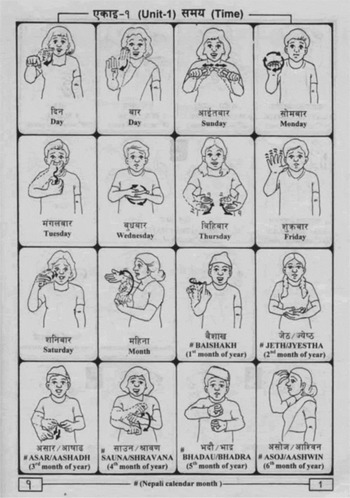
However, while such constraints could endanger a late-learner's Deaf status in the United States, those aspects of signed grammar that are affected by late-learners’ prior isolation are not of ideological focus in the locally salient definition of NSL. While there is a great deal of diversity in signing practice in Nepal, most Deaf Nepalis consider communicative practice NSL if it draws on the corpus of lexical items collected in the NSL dictionaries produced by the NFDH in cooperation with The Danish National Association of the Hearing Impaired (LBH) and Britain's Deaf Way (Hoffmann-Dilloway Reference Hoffmann-Dilloway2008).Footnote 13 Like other sign languages, NSL does not have a widely used written form; the NSL dictionaries thus consist of pictorial representations of individual lexical items that are linked to glosses in Nepali, the national language of Nepal, and English.Footnote 14 The fact that there is no ready means to represent and objectify the grammatical structures of NSL signing practices in print encourages the exclusive focus on lexical items in both the dictionaries and local ideologies about of the nature of the language.Footnote 15 Because late-learners are able to produce these lexical items, their bahiro status is unproblematic.
However, many Nepali homesigners do not encounter an accessible language until adulthood (in my study, at ages ranging from nineteen to around seventy years old), if ever. In addition, many Nepali homesigners do not have willing partners in creating homesign systems due to the stigma associated with deafness. Those homesigners who experienced extreme linguistic and social isolation of long duration are often constrained in their ability to independently produce even the lexical items of NSL. This inability does not resolve itself with exposure over time; I have observed homesigners who appear to be “frozen” into their idiosyncratic gestural system despite daily interaction in the Deaf associations over a period of ten years.
COPYING AND MIRRORING IN NEPAL'S DEAF ASSOCIATIONS
While the adult homesigners in my study represent more extreme cases of linguistic and social isolation than appears in the literature concerning d/Deafness in the United States, Senghas (Reference Senghas, Monaghan, Schmaling, Nakamura and Turner2003:270) also describes nonhearing persons who “do not seem capable of acquiring language, even after long exposure” in Nicaragua. He notes that signers in Nicaragua's Deaf social networks, who have adopted an ethnolinguistic model of Deafness through contact with many of the same international Deaf institutions that work in Nepal, refer to such homesigners with a sign that glosses as NO-SABE (or know-nothing), a term similar to the Nepali latto.Footnote 16 However, as the rest of this article shows, this is not the only possible way in which an ethnolinguistic model of Deafness can affect the status of homesigners.
An excerpt from the Nepali Sign Language dictionary, published by the Kathmandu Association of the Deaf; art by Mr. Pratigya Shakya.

Members of Nepal's Deaf associations regularly send young Deaf men and women into rural areas to recruit nonhearing persons into bahiro social life. While an important goal of these efforts is to expose d/Deaf children to NSL at an early age, older d/Deaf persons are also included in outreach efforts. As a result, eighteen of the roughly sixty persons I worked with in Nepal's Deaf associations were homesigners with impaired abilities to acquire NSL. Though around ten of these persons have difficulty with or are unable to produce the NSL signs independently, they frequently copy or mirror their interlocutor's signs. When I say mirroring, I mean that some homesigners replicate the signs in reverse, like a reflection in a mirror. While my research on this phenomenon is still in progress, length and degree of linguistic isolation appears to be predictive of whether a homesigner will copy or mirror. The more extreme the isolation, the more likely it is that a person will mirror rather than copy.
Copying or mirroring has the greatest impact on a homesigner's status when it occurs in the context of two important Deaf association speech events: formal NSL classes run by the Deaf associations and the narratives that members tell each other about the events that led them to join the Deaf associations.Footnote 17 Below I provide two examples of such interactions, recorded between October 2004 and May 2005 in The National Association for the Deaf and Hard of Hearing in Kathmandu and in an NSL classroom in Pharphing, a small town on the rim of the Kathmandu Valley.
Nepali Sign Language classes
In addition to having created the dictionaries codifying the lexical items that constitute NSL in popular understanding, the Deaf associations hold classes to disseminate and reinforce the standard signs. Students in these classes include recruits who were deafened later in life and who are acquiring NSL as a second language, homesigners who have encountered Deaf social networks when they were too old to enter the d/Deaf schools, fluent signers who wish to better align their signing practice with the standard norms, and hearing students who plan to become interpreters or teachers, or who have Deaf family members.
Below I describe a class held in 2004 in Pharphing, which represents the structure of these classes across the Deaf associations. The class was held in the mid-morning, after most Nepalis have had a light breakfast but before the day's first substantive meal at 10 a.m. Four Deaf adults—two of whom were prelingually deafened homesigners who had not encountered an accessible language until early adulthood and two young hearing participants—were in attendance at the lesson. All of the participants lived with their families in or around Pharphing. The instructor, Birendra, was a member of one of the first cohorts of Deaf students to be exposed to the emerging NSL at a young age, and a high-ranking Deaf association leader.
When the class began, Birendra turned to a list of verbs he had written in Nepali on the blackboard and, pointing to each, modeled its NSL translation.Footnote 18 His introduction of these signs did not include any instruction concerning their deployment in context, though in practice NSL signers modify verbs to reflect, for example, person, aspect, or tense.Footnote 19 This pedagogical focus, which is in accordance with the ideological model of NSL described above, is consistent with all other NSL classes I have observed since 1997. Students acquire these grammatical aspects of NSL not through formal instruction but through social interaction.
After the teacher's recitation to the class, the students were individually called to the board to perform each sign from memory. Jeevan, a bahiro man who was post-lingually deafened, took the first turn, which is detailed in (1). The first column below provides an English translation, while the second provides an English gloss of the signed communication, in all capitals.
(1)

Jeevan was expected to produce the signs without prompting, with the sign form supplied by Birendra only if he hesitated too long or produced it incorrectly. With the exception of the two homesigners, all the other students performed the task in the same fashion. The procedure shifted when the homesigners were called to the board, as illustrated by the turn taken by Usha, a homesigner first exposed to language in her early twenties.
(2)
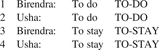
Rather than expecting Usha to produce the forms independently, Birendra only required that she produce each sign correctly by directly copying as he modeled each.Footnote 20 The other homesigner in attendance that day likewise copied as he was led through the recitation by Birendra. This was not because the homesigners were new to the class. This arrangement had only been reached once it became clear that they were in fact unable to acquire the signs.
This method of incorporating homesigners in the language lessons was common across the five Deaf associations in which I have observed NSL classes. In addition, while most students discontinue their participation after having mastered the standard signs, many homesigners participate in the NSL classes continually, never acquiring the ability to produce the standard forms independently but performing them in concert with their teachers several times a week. Their continued participation in these lessons suggests that the classes serve not only to teach the standard forms that constitute NSL to those who can acquire them but also to provide a forum in which such homesigners can publicly perform them with the teachers’ support.
Emplacement stories
Because most Deaf children are born to hearing parents, Deaf culture has been characterized as a recruitment, or convert, culture, which one must typically join rather than be born into (Bechter Reference Bechter and Bauman2008). Those who enter bahiro social networks in Nepal often talk about the arc that brought them there, and through that narrative firmly locate themselves within a milieu defined by an ethnolinguistic model of Deafness; most of the life stories I have recorded detail the experience of having first suffered the shame of being defined as ritually polluted, the relief and frustration associated with being viewed as disabled in the biomedical model, and the joy at having discovered the more satisfying ethnolinguistic model (Hoffmann Reference Hoffmann2008). Following Narayan (Reference Narayan, Mines and Lamb2002:425), I call such narratives “emplacement” stories, as their telling is part of an emplacement process, both a strategy of coming to belong somewhere and a discursive “orientation of the self within multiple frameworks of meaning.”
Homesigners tell these stories as well, often using their homesign systems. However, because the thrust of these stories is generally to emplace the teller in a bahiro social life and identity, and because such status is increasingly defined by the use of NSL, these stories are most successfully told using the standard NSL signs. In this respect, following Garrett (Reference Garrett2005:328), they might be called code-specific genres: “normative, relatively stable, often metapragmatically salient types of utterance, or modes of discourse, that conventionally call for use of a particular code.”
To provide an example of the manner in which some homesigners who are unable to produce these signs independently collaborate with fluent signers to tell their emplacement stories using NSL, I return to the conversation between Laxmi and Madhu with which this article opened. Laxmi, who was chosen to interview Madhu because she had some familiarity with his homesign system, is a respected NSL teacher seen as highly competent in the language.Footnote 21 Before their collaborative emplacement story began, Laxmi told me what she already knew about Madhu's background. She said that he lived at the Pashupatinath temple, the most important Hindu temple complex in Nepal. To make a living he set out from the temple grounds each day carrying mud from the riverbed on a leaf. He would then offer to put tikka on the heads of passersby—in other words, to smear a bit of the mud on their forehead with the third finger of his right hand.Footnote 22 This passes blessings to the recipients, who were then expected to offer him a small financial reward (the act of giving the money also allows the recipient to accrue merit and so is beneficial to both parties). About two years prior to this meeting, in the course of his perambulations of the city, he had encountered a young bahiro woman who encouraged him to include the Deaf associations on his route. The associations have since become daily stops, where he puts tikka on all those present, receives some money, and then stops to socialize.
Laxmi then confirmed Madhu's given name by inspecting the identification card he wore around his neck (such cards are frequently worn by d/Deaf people in Nepal who do not read or write). She next estimated his age by extrapolating from his recollection, conveyed through homesign, that he was six years old when the last major earthquake struck Kathmandu, in 1934. Because this conversation occurred in 2004, Laxmi determined that he was seventy-six years old. She then inquired about his relatives, most of whom, he reported, were now deceased. The transcript below opens as she begins to inquire about his relationship with a younger brother he had mentioned. She asks about their medium of communication and, upon being told that they no longer meet or talk, shifts the time frame to their mutual childhoods, to investigate how they communicated then (Madhu had been born deaf). She concludes that the brothers had employed homesigns.
The transcript of the interaction follows the same conventions of those that appeared above. The second column, with English glosses of the signed communication (in all capitals), clearly reveals Madhu's appropriation of Laxmi's signs. While it is only possible to positively identify mirroring in a sign that involves a difference in orientation, hand shape, or movement on one side of the signing space (a perfectly symmetrical sign looks the same whether in is copied or mirrored), Madhu mirrors rather than copies all asymmetrical signs. In both the translation and the gloss, underlined sections indicate points at which Madhu has appropriated Laxmi's signs and sections in italics indicate that the sign is a mirror image of the standard form.
(3)

The members of the NFDH and my subsequent observations confirm that Madhu does not independently produce standard NSL signs, excepting those that are bivalent with his homesign system, such as the movements of the head or hand indicating “yes” or “no” (which are common in hearing persons’ communicative repertoires as well). Despite this, he uses standard NSL signs in each of the utterances in the transcript above. Other than the aforementioned bivalent signs, the standard forms are all appropriations of signs in Laxmi's immediately prior utterances. The reader will note that, in line 15 Laxmi reverses the orientation of her sign; consequently Madhu's mirrored response takes on the correct standard form.
DISCUSSION AND CONCLUSION: COMPETENCE AND PERSONHOOD IN IDEOLOGICAL CONTEXT
Though the degree to which the homesigners described above understand the NSL they produce is unclear, their copying and mirroring involves more than a phatic response to their interlocutors. To successfully engage in both the NSL classes and the telling of collaborative emplacement stories, homesigners must be capable of pragmatic alignment with locally significant speech events and able to make use of “the sequential practices that sit at the center of the organization of talk-in-interaction” (Goodwin Reference Goodwin2004:166). For example, participants in the NSL classes must copy or mirror signs at the appropriate moments and refrain at other times. In Madhu's case, in order for his mirrored signs to function as negative or affirmative answers to Laxmi's questions, he must be attuned to conversational timing and deploy prosodic features appropriately by, in his responses, omitting the raised brows that mark Laxmi's utterances as questions.
However, contextually appropriate copying or mirroring cannot rely on the pragmatic abilities of homesigners alone, but inherently requires the cooperation of their interlocutors. Birendra must allow the continued participation of homesigners in his class and be willing to lead them through the correct sign forms. Laxmi must phrase her questions such that they can be successfully responded to by repeating their last sign. Because Madhu mirrors rather than copies asymmetrical signs, even this does not consistently allow him to produce formally correct NSL signs until, consciously or unconsciously, Laxmi reverses the orientation of her sign so that his mirrored appropriation is formally correct. Some homesigners are more likely than others to find cooperative partners for such interactions. Madhu attracts this support because of his age, in a Nepali cultural context in which it is important to honor elders and a Deaf cultural context in which the elderly are rare and exciting. I have recorded other interactions in which fluent signers, unwilling to share signs, position their bodies so that homesigners with less social capital are unable to copy them. These exclusions highlight the fundamentally collaborative nature of homesigners’ appropriation of signs.
From many of the ideological orientations that inform linguistic and social theory, the necessity of this collaboration would undermine the attribution of competency to those homesigners who share their interlocutors’ signs. For example, scholars taking a Chomskian (Reference Chomsky1965) approach to the study of language typically treat competence as the individual speaker's underlying knowledge of linguistic structure. Similarly, while copied and, to a lesser extent, mirrored signs formally resemble the standard lexical items taken to constitute NSL in Deaf social networks, from a Peircean semiotic standpoint they are not instantiations of these signs. Rather, they would most likely be considered sinsigns—“signs that are an occurring event” made signs only by the accidents of their existence (Parmentier Reference Parmentier1994:23). In contrast, the same form as produced by a signer who has acquired NSL would be considered a legisign, a sign whose physical instantiation is a token of a conventionalized type. That is, because the homesigner produces the form in response to the movements of an interlocutor rather than in reference to individual knowledge of the conventional sign, from a semiotician's perspective it is fundamentally different from a linguistic symbol;Footnote 23 within this framework, signs are classified in part according to semiotic competencies located in precisely the kind of individual cognitive processes that have been compromised or obscured by homesigners’ linguistic isolation.
Sociolinguists and anthropologists, by contrast, have reframed the concept of competence from one concerned with an a-social, individual language instinct to one that is re-embedded in the social context of its use. Most notably, Hymes (Reference Hymes, Pride and Holmes1972) coined the term communicative competence to label a conception of competence in which the “formal aspects of language … are encompassed by the functional aspects of language” (Mehan Reference Mehan1980:132). Because communicative competence includes the pragmatic skills required for the successful use of language in a given social and historical context, there can be no external objective measurement of competency, as the required skills and means of displaying them change over time and are contested within and across contexts. Scholars taking this perspective therefore attend to a wide range of interactive, structural, and ideological phenomena in exploring local understandings of competence.
This broader perspective allows scholars to attend to, rather than erase, competencies that differ from a Chomskian ideal. For example, in a case that resonates with that described here, Goodwin (Reference Goodwin2004) has conducted research with Americans rendered aphasic after suffering a stroke. He details the manner in which a stroke victim is able to draw on a variety of resources, including the other participants in a conversation, to authoritatively construct narratives. To use Goffman's (Reference Goffman1981) terms, Chil, an aphasic man Goodwin describes, may not animate an utterance but can be considered its principle. Depending on the dynamics of a particular interaction, he can also be considered its author if the animator repeatedly checks for confirmation to see if the words chosen are those Chil had in mind, taking the time to stop and supply alternative words and phrases until Chil indicates that he is satisfied. The distribution of participant roles in conversations including aphasics thus demonstrates that “parties with very different resources and abilities are nonetheless able to use language, including grammatical structures that are beyond their capacities as individuals to create” (Goodwin Reference Goodwin2004:154).
The interactive processes Goodwin describes affect and are affected by ambient language ideologies. In particular, the attribution of competence to the aphasics by their families in Goodwin's case relies on what Hill (Reference Hill2008) calls a linguistic ideology of personalism. This is the idea that “the most important part of linguistic meaning comes from the beliefs and intentions of the speaker … personalism insists that each individual has an invisible interior self which is the site of beliefs and intentions and emotional states … and that the task of interlocutors is to retrieve meaning by assessing those states” (Hill Reference Hill2008:88–89). It is this underlying belief that allows Chil to be seen by his family as a “competent speaker who cannot speak” (Goodwin Reference Goodwin2004), as his family members continually checked for signs that the utterances they voiced for Chil represented his communicative intent. Thus, while Goodwin's work with aphasics provides an important view of the socially embedded nature of communicative competence, the processes he describes are dependent on the same ideological focus that has informed the Chomskian and Peircian conceptions of linguistic and semiotic competence: individual cognitive processes and personal intentionality.
When homesigners copy or mirror signs, however, the cognitive processes and the individual intentionality underlying their production of the linguistic forms can be unclear or inaccessible, a fact exacerbated by the inherently cooperative nature of the interactions as described above. Consequently, from a personalist perspective about the constitution of competence, copying or mirroring would likely not be taken as evidence of competent use of NSL. However, ideologies about the nature of personhood vary widely across contexts (Senghas Reference Senghas, Monaghan, Schmaling, Nakamura and Turner2003) and the dominance of language ideologies stressing individual intentionality is not universal. For example, in some ethnographic contexts attempts to uncover the intentions of other speakers is strongly dispreferred or the right or obligation to do so is distributed only across certain social configurations (Ochs & Schieffelin Reference Ochs, Schieffelin, Shweder and LeVine1984). In other cases the effects of utterances, including the social relationships they create or reinforce, are given ideological precedence (Rosaldo Reference Rosaldo1982; Duranti Reference Duranti1994). In yet other cases, the production of linguistic meaning independent of the intention of the speaker is idealized (Du Bois Reference Du Bois, Irvine and Hill1993).
Similarly, Nepal, where the individual is not as salient a category as in many Western contexts, is an environment that fosters a focus on the social, rather than individual, dimensions of semiosis. As Marriott (Reference Marriott and Kapferer1976) has suggested, the South Asian person is in many cases seen as “dividual” rather than individual, that is, persons are not seen as bounded units but as permeable and transformable through interactions with others. Marriott (Reference Marriott and Kapferer1976:109) suggests in fact that “what goes on between actors are the same connected processes of mixing and separation that go on within actors” (italics in original). Practices and beliefs regarding commensality, ritual pollution (e.g. Cameron Reference Cameron1998), and the relationship between land and personhood (e.g. Daniel Reference Daniel1987) are the most well-known illustrations of this perspective. However, just as the notion of the dividual person can contribute to the stigma surrounding the d/Deaf by suggesting that their ritual impurity can be shared with interlocutors, it also expands the inclusiveness of the ethnolinguistic model of Deafness in Nepal by contributing to local forms of communicative competency that hinge less on individual cognitive ability than on social collaboration.Footnote 24
Consequently, unlike the case described by Goodwin, the collaborative construction of competence in Nepal's Deaf social networks does not require that conversational partners work to uncover and voice the (presumed) intended utterances of other participants. Rather, the blurred line of individual authorship and intentionality that occurs in cases of collaborative copying and mirroring does not undermine the attribution of competency to homesigners, but supports it; by sharing their signs, NSL teachers and other persons seen as competent signers are also able to share that competence. Thus, homesigners who, like Madhu and Usha, find communicative collaborators willing to share their signs are considered bahiro despite their individual linguistic constraints. An analysis of the interactional and ideological processes by which this is achieved expands our understanding of variation in ideological conceptions of the nature of language, competence, and personhood across social contexts, along with the consequences of that variation for both social actors and social networks.