Subjective vitality was defined by Ryan and Frederick (Reference Ryan and Frederick1997) as “one’s conscious experience of possessing energy and aliveness” (p. 530), and has been considered as an indicator of eudaimonic well-being (Ryan & Deci, Reference Ryan and Deci2001) and a clinically relevant outcome measure of positive psychological well-being (Rouse et al., Reference Rouse, Veldhuijzen Van Zanten, Ntoumanis, Metsios, Yu, Kitas and Duda2015). Subjective Vitality Scale (SVS), composed by seven-item, was designed to measure this construct, what from a phenomenological point of view reflects the degree to which a person is fully functioning and psychological well.
In previous research, psychometric tests on the scores obtained from the SVS have provided substantial evidence of a unidimensional factor structure, internal reliability and validity for the English version of the scale (e.g., Bostic, Rubio, & Hood, Reference Bostic, Rubio and Hood2000; Ryan & Frederick, Reference Ryan and Frederick1997). Bostic et al. (Reference Bostic, Rubio and Hood2000) indicated that eliminating item 2 (“I don’t feel very energetic”), negatively worded, improved the scale’s effectiveness. So they removed this item from the scale retaining only the six positive worded items.
The SVS measuring perception of vitality has been widely used with different populations including university students, adult smokers and rheumatoid arthritis patients, and across different cultural context as United States, France, Britain, Portugal, Arabic, among others (e.g., Bostic et al., Reference Bostic, Rubio and Hood2000; Fayad & Kazarian, Reference Fayad and Kazarian2013; Moutão, Alves, & Cid, Reference Moutão, Alves and Cid2013; Rouse et al., Reference Rouse, Veldhuijzen Van Zanten, Ntoumanis, Metsios, Yu, Kitas and Duda2015; Ryan & Frederick, Reference Ryan and Frederick1997; Salama-Younes, Reference Salama-Younes2011; Taylor & Lonsdale, Reference Taylor and Lonsdale2010), demonstrating good internal reliability and validity.
Given that subjective vitality reflects personal feelings of possessing available energy by the self (Ryan & Frederick, Reference Ryan and Frederick1997), individuals that exercise are expected (and desirable) to perceive fully functioning and psychological well. Subjective vitality has been considered particularly salient in the sport domain to assess eudaimonic wellbeing and therefore during the last decades the SVS has been used extensively in the field of sport, tapping the degree to which athletes feel physically and mentally vigorous and alert. In the sport domain, the SVS has also demonstrated good internal reliability and validity (e.g., Adie, Duda, & Ntoumanis, Reference Adie, Duda and Ntoumanis2012; Álvarez, Balaguer, Castillo, & Duda, Reference Álvarez, Balaguer, Castillo and Duda2012; Balaguer et al., Reference Balaguer, González, Fabra, Castillo, Mercé and Duda2012; Gagné, Reference Gagné2003).
Research has also demonstrated that level of vitality is impacted by the sport experience, and that fluctuates during practice (Gagné, Reference Gagné2003). Given that comparisons among times are meaningful only when different levels of invariance across time have been empirically shown, multi-group confirmatory factor analyses will be performed with athletes to test invariance across time. Factorial invariance analyses would provide an indication of whether or not statistically significant differences based on scale scores would reflect real differences across time groups in the underlying latent variable measured by the SVS.
Early research within the general population demonstrated that subjective vitality is positively related to other indicators of well-being such as global self-esteem and satisfaction with life (e.g., Papaioannou et al., Reference Papaioannou, Appleton, Torregrosa, Jowett, Bosselut, González and Zourbanos2013; Ryan & Frederick, Reference Ryan and Frederick1997; Uysal, Satici, Satici, & Akin, Reference Uysal, Satici, Satici and Akin2014). Life satisfaction (global judgments of one’s life) is a construct of subjective well-being (Diener, Emmons, Larsen, & Griffin, Reference Diener, Emmons, Larsen and Griffin1985) and is considered as an indicator of hedonic well-being. Additionally, global self-esteem, an overall feeling of self-worth as a person (Harter, Reference Harter2012), is also considered an indicator of psychological well-being. Overall, studies in the sport and physical activity context indicated that there is a high correlation between life satisfaction and subjective vitality, suggesting that those who experience a high level of life satisfaction possess energy, enthusiasm and aliveness (López-Walle, Balaguer, Castillo, & Tristán, Reference López-Walle, Balaguer, Castillo and Tristán2012; Moutão et al., Reference Moutão, Alves and Cid2013; Salama-Younes, Reference Salama-Younes2011; Uysal et al., Reference Uysal, Satici, Satici and Akin2014). Recent finding in youth sport indicated that subjective vitality and global self-esteem are strongly and positively correlated (Papaioannou et al., Reference Papaioannou, Appleton, Torregrosa, Jowett, Bosselut, González and Zourbanos2013). On the contrary, studies in general population including the sport domain have indicated that the subjective feeling of vitality is negative related with indicators of ill-being, such as depression, negative affect and the emotional and physical exhaustion component of athlete burnout (Adie et al., Reference Adie, Duda and Ntoumanis2012, Balaguer et al., Reference Balaguer, González, Fabra, Castillo, Mercé and Duda2012; Mack et al., Reference Mack, Wilson, Oster, Kowalski, Crocker and Sylvester2011). According to that, we would expect that subjective vitality will show significant and positive relations with life satisfaction and negative relationship with perception of loss of emotional and physical energy (emotional and physical exhaustion). A high correlation between subjective vitality and these two indicators of well – ill being would provide evidence of validity based on relationships with other variables.
As far as the authors are aware, the translation and psychometric properties of a Spanish version of the scale are yet to be established (preliminary analyses were presented by the authors in the 13th FEPSAC European Congress, 2011). Therefore the aim of the present study was threefold: (1) to translate the SVS 7-items into Spanish to examine the factor structure and reliability of SVS scores, (2) to test its invariance across time, and (3) to provide evidence of validity based on relationships with other variables.
From a practical perspective, the development of a Spanish version of the SVS will provide the Spanish-speaking research community with a strong instrument for measuring the degree to which people feel physically and mentally vigorous and alert. From a theoretical perspective, it will contribute to the construct validation and cross-national generalizability of the instrument. Moreover, testing measurement invariance of the SVS across time will provide further support for the use of the scale in testing changes in subjective vitality across time, and the meaningful comparison of the observed scores. Indeed, test translation and adaptation is a major concern in psychometric research (Muñiz, Elosua, & Hambleton, Reference Muñiz, Elosua and Hambleton2013) that will facilitate cross-cultural comparative research and should help in understanding diverse cultural variations.
Method
Participants and procedure
Study 1. Responses to the SVS were obtained from 790 adolescent students (392 male and 398 female) ranging in age between 11 and 18 years old (M = 14.8; SD = 1.75).
Study 2. 130 adolescents engaged in an individual or team sport (65 boys and 65 girls) aged 11 to 15 at baseline (M = 13.1; SD = 1.51) completed the questionnaire on two occasions over the course of one season (at the beginning and in the middle of the season; time 1 and time 2 were separated by 5 months). We obtained a response rate of 60.5%, and the dropout rate was 14.6%.
Study 3. 197 vocational dancers (33 male, 164 female) aged between 12 and 33 (M = 18.65, SD = 3.73) enrolled in full-time training in dance conservatories volunteered for the study.
Ethical approval for the study was provided by the university ethics review committee. The present research was conducted in accordance with international ethical guidelines that are consistent with American Psychological Association. Convenience sampling was used in the selection of the participants, so data from different projects were included in this study. All participants and their parents provided informed consent before data collection and confidentiality was ensured. The questionnaires were responded anonymously and voluntarily, and were completed by the players during a 10-minute interval, either before or after practice, in a place made available for this purpose. Neither the coach nor the sports director of the club were present at any time during questionnaire administration. Players were encouraged to answer honestly and ask the investigator present if they had any questions. In Study 2, the Time 1 questionnaire was administered approximately two months into the season and Time 2 was completed five months into the season.
The source English version of the SVS was translated to Spanish following the back-translation procedure widely described in the literature (e.g., Hambleton & Kanjee, Reference Hambleton and Kanjee1995).
Instruments
Spanish translation of the Subjective Vitality Scale (the Individual Difference Level Version) a 7-item questionnaire designed by Ryan and Frederick (Reference Ryan and Frederick1997) was used to measure the subjective experience of being full of energy and alive. The instruction in the questionnaire was “Please respond to each of the following statements by indicating the degree to which in general the statement is true for you”. Responses are endorsed using a 7-point Likert scale (1 = not at all true; 7 = very true).
Three additional variables were also assessed to provide evidence of the validity of the inferences based on SVS scores estimating its relationship with external criteria: Life satisfaction and global self-esteem in Study 1, and life satisfaction and emotional and physical exhaustion in Study 3.
The Spanish version (Atienza, Pons, Balaguer, & García-Merita, Reference Atienza, Pons, Balaguer and García-Merita2000) of the Satisfaction with Life Scale (Diener et al., Reference Diener, Emmons, Larsen and Griffin1985) was used to assess the respondents’ degree of satisfaction with their life. Participants were asked to indicate the extent to which each of the five items corresponds to what they experience with their life. Sample items include: “The conditions of my life are excellent” and “If I could live my life over, I would change almost nothing“. Athletes were asked to respond on a 7-point Likert scale (1 = totally disagree; 7 = totally agree). The reliability of this scale scores has been supported in several studies (e.g., Atienza et al., Reference Atienza, Pons, Balaguer and García-Merita2000; Diener et al., Reference Diener, Emmons, Larsen and Griffin1985; Diener, Inglehart, & Tay, Reference Diener, Inglehart and Tay2013). The results of the one-factor CFA indicated that factorial structure of the scale was replicated in Study 1 sample (RMSEA = .05, SRMR = .03, CFI = .99, NNFI = .99) and Study 3 sample (RMSEA = .05, SRMR = .02, CFI = .99, NNFI = .99). The Cronbach alpha coefficient of the scale was .84 in Study 1 and .86 in Study 3.
A five-item global Self-esteem measure was obtained from the Spanish version (Pastor, Balaguer, Atienza, & García-Merita, Reference Pastor, Balaguer, Atienza and García-Merita2001) of the Harter’s Self-Perception Profile for Adolescents (Harter, Reference Harter1988). The adolescent is first asked to decide which kind of teenagers he or she is most like, those described on the left or those described on the right, in each statement. Having made this decision, the adolescent next decides whether the description on the side he/she chose is “Really True for Me” or “Sort of True for Me”. Each item was scored on a 4-point scale from 1 to 4, where 1 indicated lowest level of self-esteem, and 4 reflected the highest level of self-esteem. Sample items include: “some teenagers are often disappointed with themselves but other teenagers are pretty pleased with themselves” and “Some teenagers are very happy being the way they are but other teenagers often wish they were different”. The reliability of this scale scores has been supported in several studies (e.g., Harter, Reference Harter1988; McDavid, McDonough, & Smith, Reference McDavid, McDonough and Smith2015; Pastor et al., Reference Pastor, Balaguer, Atienza and García-Merita2001).The results of the one-factor CFA indicated that the factorial structures of the scale was replicated in Study 1 sample (RMSEA = .06, SRMR = .03, CFI = .98, NNFI = .95). The Cronbach alpha coefficient of the scale was .78.
Players’ perception of energy loss was assessed using the 5-item emotional and physical exhaustion subscale from the Athlete Burnout Questionnaire (Raedeke & Smith, Reference Raedeke and Smith2001). Players responded to items including “I feel physically worn out from sport” and “I am exhausted by the mental and physical demands of sport” on a 5-point Likert scale (1 = almost never; 5 = almost always). The reliability of this scale scores has been supported in a number of studies involving athletes (Balaguer et al., Reference Balaguer, González, Fabra, Castillo, Mercé and Duda2012; Castillo, González, Fabra, Mercé, & Balaguer, Reference Castillo, González, Fabra, Mercé and Balaguer2012; Lemyre, Treasure, & Roberts, Reference Lemyre, Treasure and Roberts2006) and dancers (Balaguer, Castillo, Duda, Quested, & Morales, Reference Balaguer, Castillo, Duda, Quested and Morales2011; Quested & Duda, Reference Quested and Duda2009).The results of the one-factor CFA indicated that the factorial structures of the scale was replicated in Study 3 sample (RMSEA = .06, SRMR = .05, CFI = .98, NNFI = .97). The Cronbach alpha coefficient of the scale was .84.
Data analysis
To calculate the descriptive statistics and the homogeneity indexes (corrected item-total correlations) obtained by the items the IBM SPSS Statistics [v. 20] software was used.
Reliability and evidences of validity based on internal structure and based on relationships with other variables
The examination of the scale’s psychometric properties included reliability (α in all samples, and test-retest in Study 2 sample) and validity evidence based on the internal structure (factorial analysis). SVS items were subjected to EFA and CFA using SPSS 20 and LISREL 8.8 respectively, to test whether the unidimensional structure proposed by Ryan and Frederick (Reference Ryan and Frederick1997) adequately fit data collected from Spanish athletes.
In Studies 1 and 2, factorial structure was tested through EFA using unweighted least squares as the extraction method and applying an oblique rotation criterion (Sass & Schmitt, Reference Sass and Schmitt2010). Moreover, in Study 1, evidence of validity based on relationship with other variables was investigated through inspection of the correlations between subjective vitality and two indicators of well-being (satisfaction with life and global self-esteem).
In Study 3, CFA were carried out to cross-validate the factorial structure tested in studies 1 and 2. Considering the ordinal nature of the items, weighted least squares was used to estimate model parameters, and the polychoric correlation matrix and the asymptotic covariance matrix were used as input for the analyses. We considered the root mean square error of approximation (RMSEA), the non-normed fit index (NNFI), and the comparative fit index (CFI) to evaluate goodness of fit as well an evaluation of parameter estimates. For the NNFI and CFI values above .90 and RMSEA values below .08 are considered reasonable model fit, although stringent recommendations suggest values close to .95 and .05 respectively. Nevertheless, RMSEA tend to overreject true-population model at small sample size (Hu & Bentler, Reference Hu and Bentler1999). Moreover, in Study 3, evidence of validity based on relationship with other variables was investigated through inspection of the correlations between subjective vitality and an indicator of well-being (satisfaction with life) and ill-being (emotional and physical exhaustion).
Measurement invariance
In Study 2, a sequential model testing approach was employed via multi-sample CFA to examine whether the SVS displayed invariance across time (repeated measures). Prior to any invariance analysis, CFAs were applied to each group-time separately (models M0a and M0b; see Table 3). Then, a baseline model testing the structural invariance was established. Afterwards, increasingly constrained models were specified to examine the equality of measurement (i.e., invariance of factor loadings and intercepts across time (Time 1 and Time 2) groups. The invariance of uniquenesses was not considered as error invariance is not expected in longitudinal measurement invariance testing (see Coertjens, Donche, De Maeyer, Vanthournout, & Van Petegem, Reference Coertjens, Donche, De Maeyer, Vanthournout and Van Petegem2012). In all the models, for identification purposes and to establish the scale of measurement, one measured variable for the SVS dimension was selected to be a reference indicator, and its factor loading was fixed to be 1. In order to test invariance hypotheses using CFA, the covariance and the asymptotic covariance matrices, and the vector of means were used as input for the analysis. With the aim of assessing the fit for the models, differences not larger than .01 between NNFI and CFI values are considered as indication of negligible practical differences (Cheung & Rensvold, Reference Cheung and Rensvold2002). Chen (Reference Chen2007) suggests that when the RMSEA increases by less than .015, one can also claim support for the more constrained (parsimonious) model.
Results
Preliminary reliability and exploratory factor analysis (Study 1 and Study 2)
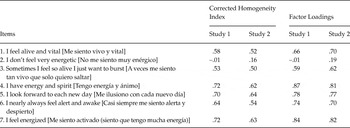
Preliminary items homogeneity (corrected item-total correlations) and scale scores reliability analyses were carried out (see Table 1) using the seven items proposed by Ryan and Frederick (Reference Ryan and Frederick1997). Item 2 (“I don’t feel very energetic”) showed poor values for both study 1 and study 2 (time 1) samples. Furthermore, the deletion of item-2 resulted in an increment of the Cronbach’s alpha coefficient for both samples (study 1 from .79 to .87 and study 2 from .76 to .82). Interestingly, this was the one negatively worded item. When running preliminary exploratory factor analyses, all the items had high factor loadings (i.e., loadings > .61) except item 2 that showed a very poor factor loading value (i.e., loading < .20). Taking into account these results, item 2 was deleted and further analyses were run with a reduced version of the scale (six items). The results obtained in Study 1 and Study 2 showed a one-factor solution that accounted for 55.7% and 56% of common variance respectively.
Items homogeneity and factor loadings from exploratory factor analysis for Subjective Vitality Scale

Note: For Study 1, n = 790. For Study 2 (time 1), n = 130. The deletion of item 2 resulted in an increment of the Cronbach’s alpha coefficient for both samples.
Descriptive statistics and reliability (all the studies)
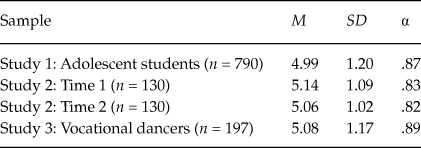
The descriptive statistics and Cronbach’s alpha coefficient of the six-item version SVS for all the groups are presented in Table 2. Participants exhibited high mean scores for subjective vitality (i.e., above the midpoint). The estimates of internal consistency SVS scale were adequate in all the samples of the study ranging between .82 and .89. The test-retest reliability (time 1 and time 2) in Study 2 sample was .44 (p < .01).
Descriptive and reliability analysis of the Subjective Vitality Scale (SVS) in all samples

Note: In all samples, SVS is composed by six items. Range = 1–7.
Measurement invariance (Study 2)
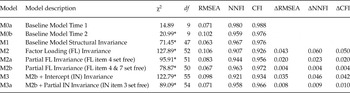
Different nested models were tested to analyze the factorial invariance across time. The CFA results revealed that the proposed factorial structure was acceptable for each group (time 1 and time 2). As can be seen in Table 3, the results provided a good fit to the data in the two time-groups considered separately (Models M0a and M0b), except for the RMSEA value in M0b that was over the cut-off criteria. Nevertheless, we should consider that in our study sample size was small (n = 130). For these models, all parameter estimates were statistically significant (p < .01).
Goodness of Fit Indices for Tested Invariance Models over Time (n = 130)

Note: df = degrees of freedom; RMSEA = root mean square error of approximation; NNFI = non-normed fit index; CFI = comparative fit index. All the Δ index comparisons are made with respect to the baseline model (M1). * = p < .01.
With regard to the multi-sample baseline model (Model 1), in which no equality constraints were imposed, results showed that the fit was acceptable for the time invariance (see Table 3) model. Thus, it could be concluded that the same unidimensional factor model was able to fit the data from each group. Consequently, Model 1 was used as the baseline against which all remaining models were compared in the process of determining evidence of measurement invariance.
Model 2 (M2) tested the hypothesis that all factor loadings are invariant across time. The practical fit indices showed that this model has a reasonable fit (see Table 3), except for RMSEA value (also small sample size must be considered). However, the incremental fit indexes indicated that the total invariance factor loading hypothesis might not be tenable. Items with higher modification indexes for factor loading parameter were set free in a sequence of nested models. Factor loadings of item 4 (“I have energy and spirit”) and item 7 (“I feel energized”) were detected as non-invariant across time (see Model M2a and M2b in Table 3).
Model 3 (M3) tested partial factor loadings invariance and total intercept invariance hypothesis. That is, that all item intercept were invariant across time, and that all factor loading, except for the FL of items 4 and 7, were invariant across time (see Table 3). The practical fit indices showed that this model has a reasonable fit (see Table 3). However, the incremental fit indexes indicated that this hypothesis might not be tenable. We looked for the item with the highest modification index for the intercept parameter. Intercept of item 3 (“Sometimes I feel so alive I just want to burst”) was detected as non-invariant across time (see Model M3a in Table 3).
Measurement invariance analysis indicated that not all the item parameters were invariant across time; concretely items 3, 4 and 7 were detected to show differential item functioning (DIF) across time. The practical significance of the DIF detected across time was tested. The mean score on the SVS, with and without removing items 3, 4 and 7 was computed for each time group and compared across groups using the standardized mean difference. The difference on d provides an index of the practical significance of the DIF detected. The DIF is considered trivial when the d value is lower than .20 (Chan, Reference Chan2000). In the present study, the d difference was .021.
Evidences of validity (Study 1 and Study 3)
In Study 1, Subjective Vitality was positively correlated with life satisfaction (r xy = .43, p < .01) and with global self-esteem (r xy = .36, p < .01). Additionally, in an independent sample (Study 3), Subjective Vitality was positively correlated with life satisfaction (r xy = .51, p < .01) and negatively correlated with physical and emotional exhaustion (r xy = –.40, p < .01). Furthermore, in Study 3, the proposed unifactorial structure adequately fitted the data for the 6-item SVS version (χ2(9) = 25.18, p < .01; RMSEA = .050 (90% CI = .00, .080); NNFI = .993; CFI = .996). Factor loadings ranged from .62 to .92 (all were statistically significant, p <. 01). Measurement errors ranged from .16 to .61 (all were statistically significant, p < .01).
Discussion
The aim of the present work was to translate into Spanish and examine the psychometric properties of a positive indicator of mental health and well-being, the Spanish version of the Subjective Vitality Scale (SVS) in three studies with samples of adolescent students, adolescent athletes and dancers. Overall, and in accordance with Bostic et al. (Reference Bostic, Rubio and Hood2000) the SVS composed by six items instead of seven (item 2 that was negatively worded was deleted), exhibited good psychometric properties in all the Spanish samples.
In line with previous research in different cultural contexts as Britain, United States, France, Portugal, and Arabic among others (e.g., Bostic et al., Reference Bostic, Rubio and Hood2000; Fayad & Kazarian, Reference Fayad and Kazarian2013; Moutão et al., Reference Moutão, Alves and Cid2013; Ryan & Frederick, Reference Ryan and Frederick1997; Salama-Younes, Reference Salama-Younes2011; Taylor & Lonsdale, Reference Taylor and Lonsdale2010), results of the CFA provided support for the hypothesized unidimensional structure.
The multisample CFA supported the configural invariance of the scale, providing evidence of the replicability of the SVS factor structure across time. Total factor loadings and total intercept invariance were not supported. Three items, item 4 (“I have energy and spirit”), item 7 (“I feel energized”), and item 3 (“Sometimes I feel so alive I just want to burst”) were detected as showing Differential Item Functioning (DIF). Nonetheless, the practical significance of the DIF detected was trivial (d value lower than .20). Thus, it was concluded that no important differences were found on the item parameters across time, suggesting that youth players responded in a similar fashion independent on the data collection time. These findings indicated that the SVS is a valid scale to assess subjective vitality and allows for unbiased comparison of average scores across time.
Consistent with previous research in the context of sport (e.g., Adie et al., Reference Adie, Duda and Ntoumanis2012; Mack et al., Reference Mack, Wilson, Oster, Kowalski, Crocker and Sylvester2011) and in other contexts (e.g., Ryan & Frederick, Reference Ryan and Frederick1997; Uysal et al., Reference Uysal, Satici, Satici and Akin2014), this study also provides validity evidence of the inferences based on SVS scores as it confirms a high and positive relationship between subjective vitality and life satisfaction, as well as between subjective vitality and global self-esteem, and a high and negative relationship with emotional and physical exhaustion. Therefore, if participants feel full of energy and alive, they are also more likely to perceive that they are satisfied with their life, perceive higher self-esteem and are less likely to perceive loss of emotional and physical energy.
These findings provide evidence of validity of the inferences based on SVS scores estimating relationships with other variables (well and ill-being indicators) in the different contexts such as academic, sport and dance. In these contexts, this instrument can be used as a positive well-being outcome with the confidence that assess whether students, athletes and dancers are fully functioning and psychological well.
Our findings have a number of theoretical and practical implications. First, results have substantive importance for well-being studies, as they provide evidence for the cross-cultural validation of the SVS, a questionnaire designed to assess the subjective experience of being full of energy and alive (Ryan & Frederick, Reference Ryan and Frederick1997). Second, this study strengthens the utility of the SVS in academic, sport and dancer research and applied settings in Spanish-speaking countries. An additional advantage is that the SVS is freely available to use without payment and no need to request permission.
Despite strengths in the present research in the construct validation approach, some shortcomings should be noted. First, sample size in study 2 was not large, but we should notice that it is difficult to follow up a sample in different time points. Second, our results support the appropriateness of the SVS for Spanish adolescents, athletes and dancers. Further research is needed in different Spanish settings and groups (such as other population groups) in order to contribute to the growing body of knowledge about SVS validation.
In summary, results from multi-sample analyses supported the invariance of SVS factor structure across time, indicating that the scale allows for unbiased comparison of average scores across time groups. The present study supported the reliability of the Spanish SVS scores and the validity of inferences made on the basis of the Spanish SVS scores with adolescents, athletes and dancers as well as over time. The results of the study provide further evidence that the Subjective Vitality Scale is a unidimensional construct. Researchers in the academic, sport and dancer domains may employ this freely available and brief scale with the confidence that it is a valid and reliable measure of positive health and psychological well-being. Thus, this study provides with an instrument that can contribute to the advancement of research on Health Psychology in Spanish speaking contexts.