Coronavirus disease 2019 (COVID-19) is an unprecedented event in modern history. The pandemic has impacted the majority of the world to some extent, resulting in a slew of social and economic costs. Pandemics are predicted to become more common in the coming years. Reference Marani, Katul and Pan1,2 As a result, minimizing pandemic vulnerability while increasing pandemic adaptive capacity is critical. Reference Connolly, Ali and Keil3,Reference Sharifi and Khavarian-Garmsir4
Numerous sensitivity factors have been linked to the spread of the pandemic. Demographic factors such as population density, age distribution, sex, and urbanization are correlated with COVID-19 cases and deaths. Reference Velasco, Tseng and Chang5–Reference Sarkar8 Second, meteorological and environmental factors such as average temperature, outdoor environment, particulate matter, environmental zones and wind speed are associated with COVID-19 cases and deaths. Reference Sharif and Dey6,Reference Aabed and Lashin9–Reference Sarkar and Khan11 Third, underlying health factors such as diabetes, obesity and nutritional status have been identified as key contributors of COVID-19 related morbidity and mortality. Reference Yu, Rohli and Yang12–Reference Baik14 Fourth, studies recognize ethnicity, socio-economic inequality, poverty and disposable income as significant factors of COVID-19 cases and deaths. Reference Tian, Zhang and Hu10,Reference Yaylali13,Reference Rocha, Atun and Massuda15 Fifth, travel patterns and international connectivity are related to virus spread and infections. Reference Christidis and Christodoulou16–Reference Brannen, Alhammad and Branum18 Finally, studies point to the (in)capacity of health systems to cope with pandemic crisis—essentially an indicator of governance effectiveness and adaptive capacity. Reference Rocha, Atun and Massuda15,Reference Babu, Khetrapal and John19,Reference Brannen, McDonnell and Schmitt20
Vulnerability quantification is a necessary condition for proactive response. Measuring Asian vulnerability to COVID-19 is important given it continues to report the highest numbers of new infections in the world. India, the second largest Asian country in terms of population concentration, is leading in the number of new infections and deaths. 21 This has far-reaching implications for neighboring South Asian countries and beyond. Asia is primarily composed of developing economies and the pandemic has slowed the region’s continuous economic growth, affecting millions of people. The majority of available literature on COVID-19 vulnerability is either country- or global-specific. For example, the Social Vulnerability Index (SVI) in the United States considers socioeconomic status, household composition and disability, minority status and language, and housing type and transportation for measuring vulnerable groups during public health emergencies. 22 Similarly, vulnerability to COVID-19 pandemic in India reflects on 5 socio-economic domains: Socioeconomic, demographic, housing and hygiene, epidemiological, and health system. Reference Acharya and Porwal23 To date, there has been no study that measures Asian countries’ vulnerability to COVID-19 pandemic using a natural disaster, which is an external stressor, framework.
The objective of this research is to measure vulnerability of Asian countries to the COVID-19 pandemic. The Intergovernmental Panel on Climate Change (IPCC) 2007 framework for quantifying vulnerability to natural hazards can be applied to the COVID-19 pandemic. Vulnerability is comprised of 3 components: exposure, sensitivity, and adaptive capacity. We used principal component analysis (PCA) to identify the major factors affecting sensitivity and adaptive capacity to estimate vulnerability. Exposure refers to an external stress, such as COVID-19, whereas sensitivity and adaptive capacity are measures of susceptibility and coping capacity to the external stress, respectively. Reference Sharma and Ravindranath24 Our research does not consider risk of COVID-19 transmission as a component of vulnerability (see Bjørnstad et al. Reference Bjørnstad, Shea and Krzywinski25 ). Subsequently, this research is based on the reported COVID-19 cases and deaths, which is different from the Susceptible-Exposed-Infectious-Removed (SEIRS) model that considers factors such as loss of immunity, birth, and death in COVID-19 transmission dynamics. Reference Bjørnstad, Shea and Krzywinski26
Methods
Study Area
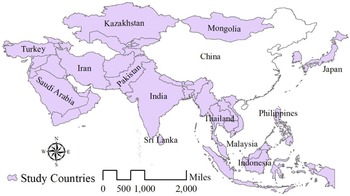
Forty-three of 46 Asian countries were selected for the study (Figure 1). Due to the scarcity of data, this study excluded China and its territorial geographic areas (Hong Kong and Taiwan), North Korea, and Palestine.
Countries included in the study.

Analytical Method
We have used vulnerability to natural disasters as an analytical framework for this study, where vulnerability is defined as the function of exposure, sensitivity, and adaptive capacity (Equation 1). Reference Brooks27–Reference Wilhelmi and Hayden30 According to the IPCC’s 2007 report, vulnerability is the result of the interaction of exposure, sensitivity, and adaptive capacity. According to the IPCC’s fourth assessment report (AR4), vulnerability to climate change is defined as “the degree to which a system is susceptible to and incapable of coping with adverse effects of climate change, including climate variability and extremes. Vulnerability is a function of the type, magnitude, and rate of climate change and variation to which a system is exposed, as well as its sensitivity and adaptive capacity”. 31 While IPCC does not define exposure, it is understood as an external stressor that contributes to vulnerability. Reference Jurgilevich, Räsänen and Groundstroem32 Vulnerability is thus viewed as the first-order impact caused by the exposure due to the system’s sensitivity, which is moderated by its adaptive capacity. Reference Sharma and Ravindranath24
 $${Vulnerability = Exposure + Sensitivity - Adaptive \;Capacity}$$
COVID-19 exposure, sensitivity, and adaptive capacity are determined by several independent variables (Table 1). Exposure is quantified by the number of cases per million population. Sensitivity and adaptive capacity variables are classified in such a way that their values increase with increasing sensitivity or adaptive capacity. For instance, a high prevalence of diabetes increases morbidity and mortality when associated with COVID-19. Reference Yu, Rohli and Yang12,Reference Morshed and Sarkar33 In this study, COVID-19-related deaths per million population are used as a proxy for a country’s pandemic vulnerability.
Exposure, sensitivity, adaptive capacity, and vulnerability factors

The definition of vulnerable people can change dynamically in a COVID-19 scenario. Globally, the economic cost of the pandemic is estimated to be staggering at US $10 trillion between 2020 and 2021. 34 Vulnerable people include not only the elderly and those with chronic illnesses and comorbidities, but also those who may struggle financially, mentally, or physically as a result of the onset of COVID. 35 However, this study’s vulnerability estimation is limited to exposure, 8 sensitivity, and 7 adaptive capacity variables.
Multicollinearity refers to a linear correlation between a large number or all of the independent variables in a dataset, which makes estimating the relationship between each independent and dependent variable difficult. Reference Islam, Talukdar and Mahato36 Multicollinearity occurs when 1 independent variable shifts in response to a change in another independent variable. As a result, a high degree of multicollinearity among the independent variables may influence the results and their interpretation. Principal component analysis (PCA) is a widely used multivariate analysis technique that breaks down multiple correlated variables into several uncorrelated components. Reference Mahmoudi, Heydari and Qasem37 We used PCA to eliminate multicollinearity in data.
Varimax rotation was used to calculate the factor loadings of sensitivity and adaptive capacity, which have an inverse relationship with the factor score. The Kaiser-Meyer-Olkin (KMO) and Bartlett’s Test of Sphericity were used to determine the sampling adequacy for principal component analysis. Reference Williams, Onsman and Brown38 A statistically significant principal component analysis requires a minimum KMO value of 0.50. Significant factors are those that satisfy the Kaiser Eigenvalue criterion (>1) and account for a greater than one-third of the variance in the data. The normalized exposure, sensitivity, and adaptive capacity variables were used to calculate vulnerability to COVID-19. Equation 2 is used to normalize the data.
 $$x^{\!\!\!'} = \frac{x-\text{Min}(x)}{Max(x) - Min(x)}$$
Where,
 $x^{\!\!\!'}$
= normalized data of a country;
x = data of a country;
Min(x) = the minimum value among the countries;
Max(x) = the maximum value among the countries.
To normalize India’s exposure, for example, the number of cases per million population was calculated for each of the study countries. Similarly, the maximum number of cases per million (Bahrain) and minimum number of cases per million (Yemen) were noted. Following that, the normalized exposure of India was calculated using the min-max normalization technique (Equation 2). The primary advantage of min-max normalization is that it produces a distribution of data between 0 and 1, with 0 and 1 representing the lowest and highest values, respectively.
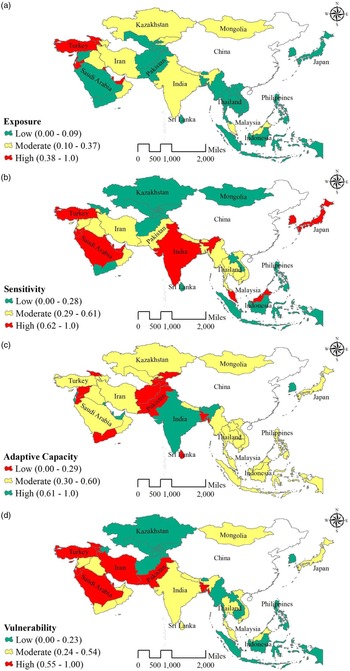
The vulnerability to COVID-19 of the respective countries is determined using Equation 1. On the basis of Jenks’ natural breaks classification method, the normalized COVID-19 vulnerability is reclassified into 3 classes. Appendix Table 1 shows the normalized values of exposure, sensitivity, adaptive capacity, and vulnerability to COVID-19 (see also Figure 2). Finally, we validated the calculated vulnerability by comparing it to the actual vulnerability (death per million population from COVID-19) by Pearson correlation.
(a) Exposure, (b) sensitivity, (c) adaptive capacity, and (d) vulnerability to COVID-19.

ArcGIS 10.5 was used to create maps of selected countries’ exposure, sensitivity, adaptive capacity, and vulnerability. IBM-SPSS 25 was used to conduct the statistical analysis.
Data
COVID-19 exposure (cases/million as of 04 August 2021), sensitivity, adaptive capacity, and vulnerability (deaths/million) data/variables were gathered from a variety of online sources. A total of 16 factors were identified following a thorough literature review. Three subgroups of variables had been defined: 1 for exposure, 8 for sensitivity, and 7 for adaptive capacity (Table 1).
Results
Principal Component Analysis
The Bartlett’s Test of Sphericity yielded a statistically significant result (P-value 0.05), indicating that the data set was suitable for factor analysis. KMO tests for sensitivity (0.519) and adaptive capacity (0.576) indicated that the variables had a high degree of informational overlap. As a result, factor analysis was a viable method for eliminating multicollinearity between independent variables. Based on the Kaiser Eigenvalue criterion and scree plots, 3 components for sensitivity and 2 components for adaptive capacity were identified.
For sensitivity, 3 components independently explained 40.91 percent, 25.67 percent, and 13.49 percent (cumulatively 80.07 percent) of the data variance of the input variables of COVID-19 sensitivity (Table 2). Three factors in component 1—percentage of urban population (0.922), obesity rates (0.883), and air connectivity (0.675)—all contributed positively and significantly to the COVID-19 sensitivity, as determined by varimax rotation (Table 3). Component 2 isolates the population aged 65 and over as the only significant positive factor (0.589). Component 3 contains 2 significant positive variables: Diabetes prevalence (0.695) and PM2.5 (0.880).
Result of component extraction of factor analysis

Factors loading of the factors

* Bold values indicate high factor loadings.
Two adaptive capacity components accounted for 42.97% and 24.48% (cumulatively 67.46%) of the variance in the input variables, respectively. Three factors in component 1—governance effectiveness index (0.851), HDI (0.872) and vaccination rate (0.850)—all contributed positively and significantly to adaptive capacity against COVID-19. Component 2 of the adaptive capacity has 2 significant factors: Life expectancy at birth (0.934) and GDP (0.664). Sensitivity and adaptive capacity were calculated for each country using the principal component analysis components.
In summary, high urbanization and obesity, along with air pollution, have the highest potential for increasing sensitivity to COVID-19. On the contrary, 4 variables—life expectancy at birth, governance effectiveness, HDI and vaccination rate—positively contribute to adaptive capacity against COVID-19 pandemic.
Exposure, Sensitivity, and Adaptive Capacity
The maps in Figure 2 depict the selected Asian countries’ exposure (a), sensitivity (b), adaptive capacity (c), and vulnerability (d). Bahrain ranks highest in terms of exposure (normalized range 0.38-1.0), followed by the Maldives, Georgia, Jordan, Israel, and Kuwait (Figure 2a). Clearly, countries with small landmasses are more exposed than countries with larger landmasses. Oman, Mongolia, Iran, Iraq, Malaysia, and Azerbaijan, to name a few, have a moderate level of exposure (normalized range, 0.10-0.37). Saudi Arabia, Sri Lanka, the Philippines, Indonesia, and Singapore, among other countries, have a low level of exposure (0-0.09).
The most sensitive countries to COVID-19 are Qatar, Bahrain, Saudi Arabia, Turkey, and the United Arab Emirates (Figure 2b). On the other hand, Singapore, Qatar, the United Arab Emirates, and Bahrain, among others, had the highest adaptive capacity (Figure 2c). According to Equation 1, 14 of the 43 countries, including Bahrain, the Maldives, Georgia, Jordan, Kuwait, and Israel, had the highest vulnerability to COVID-19 (normalized range, 0.55-1.00) (Figure 2d). Similarly, 14 countries had a medium (0.54-0.24) vulnerability to COVID-19, while the remaining countries had a low (0.23-0.00) vulnerability.
Finally, a Pearson correlation coefficient of 0.615 (at the 0.01 level of significance) between the calculated vulnerability and death per million population from COVID-19 for the selected Asian countries indicated an acceptable level of vulnerability estimation.
Discussion
Numerous studies have been conducted on the contextual and country-specific factors that contribute to COVID-19 vulnerability. International comparisons of vulnerability to the COVID-19 pandemic, on the other hand, are difficult due to a lack of data and contextual differences between countries. PCA is frequently used to study natural disaster behavior, Reference Alam and Chakraborty46 and it has the potential to identify common COVID-19 factors globally. Reference Duarte and Riveros-Perez47–Reference Viezzer and Biondi49
We considered the COVID-19 pandemic as a hazard in this study. Therefore, we have used the IPCC’s 2007 hazard framework to assess Asian countries’ vulnerability to COVID-19, incorporating 16 variables that quantify each country’s vulnerability. Using principal component analysis, a total of 5 components (3 for sensitivity and 2 for adaptive capacity) were found to be suitable for measuring vulnerability. Six variables—the percentage of the urban population, the population aged 65 and over, obesity rate, air connectivity, diabetes prevalence, and PM2.5—all contributed positively and significantly to the COVID-19 sensitivity. These findings corroborated with those of several other studies that have linked COVID-19 sensitivity to demographic factors such as urbanization and the population aged 65 and over, Reference Velasco, Tseng and Chang5–Reference Sarkar, Ekram and Das7 underlying health condition, Reference Yu, Rohli and Yang12,Reference Baik14 air connectivity, Reference Christidis and Christodoulou16 and meteorological factors such as PM2.5. Reference Aabed and Lashin9
Five factors explained COVID-19 adaptive capacity: The governance effectiveness index, the human development index (HDI), the vaccination rate, the life expectancy at birth, and the gross domestic product (GDP). Similar to the findings of Babu et al., Reference Babu, Khetrapal and John19 this research indicates that governance effectiveness is a predictor of an effective response to a pandemic. Bangladesh, for example, ranks low in adaptive capacity due to a poor track record managing the pandemic and residents’ disregard for health guidelines. 50,Reference Shammi, Bodrud-Doza and Islam51 We used GDP and HDI as indicators of countries’ socioeconomic characteristics, and a high value for these 2 variables increase adaptive capacity to COVID-19. Additionally, we demonstrated that vaccination is critical for building adaptive capacity against the COVID-19 pandemic.
The analytical framework used in conjunction with the findings of this study has implications for national and international policy responses to COVID-19. Separating exposure, sensitivity, and adaptive capacity enables a more precise assessment of a country’s preparedness for a pandemic. India, for instance, has a high sensitivity but a low vulnerability due to its high adaptive capacity. Additionally, identifying universal risk factors for vulnerability enables socioeconomic and political policy interventions such as increased vaccination in high-density and urban areas, as well as for older adults. More importantly, the vulnerability of each country can serve as a benchmark for prioritizing vaccine roll-out through the COVID-19 Vaccines Global Access (COVAX) program in the event of future pandemics.
Finally, we used Pearson correlation to validate the estimated vulnerability to COVID-19 death. Our vulnerability, as estimated, accounts for 61.5% of COVID-19 deaths, which is quite acceptable. Apart from the study’s limitations, discussed in the following section, vulnerability appears to be a dynamic concept. As a result, using death from COVID as a proxy for vulnerability is debatable. Incorporating variables relating to financial, mental, and physical consequences can undoubtedly help improve the vulnerability estimation model.
This study has several limitations. To begin, China (including Hong Kong and Taiwan), North Korea, and Palestine were not considered for measuring Asian Vulnerability. Second, the total number of confirmed cases and deaths was based on the official report that lacks data confidence. For instance, India demonstrated a high level of exposure but a low level of vulnerability. However, India’s death toll is estimated to be 4 times that of official reports. Reference Anand, Sandefur and Subramanian52 Additionally, governance, vaccinations, and even population enumeration were reported with varying degrees of accuracy across these countries. Third, the study established vulnerability to COVID-related deaths. This is problematic, however, because the vulnerable population included those who suffered financially, psychologically, or physically as a result of COVID-19’s onset. Fourth, despite the fact that COVID-19 is a respiratory illness, we do not have an explanation for death from cardio-vascular diseases with a high yet negative factor loading for sensitivity (see Table 3). Additionally, this research ignores several well-documented COVID-19 sensitivity factors, such as population density. Reference Velasco, Tseng and Chang5 Fifth, we disregarded the severity of COVID-19 infection and made no distinction between asymptomatic, mild, and severe cases. Finally, this study excluded spatiotemporal analysis and relied exclusively on cross-sectional data rather than panel data.
Conclusions
COVID-19 is a global concern at the moment, and pandemics are expected to occur more frequently in the future. Assessing vulnerability to pandemics is a prerequisite for adaptive future planning in the event of a pandemic. We assessed Asian countries’ vulnerability to COVID-19 using the IPCC’s 2007 natural disaster framework and a set of universal indicators. COVID-19 vulnerability was determined by 1 component for exposure, 3 components for sensitivity, and 2 components for adaptive capacity. When death per million population was used as a proxy for vulnerability, our estimate was 61.5% accurate.
The findings of this study have policy implications for pandemic preparedness, including vaccine roll-out and response measures. Additionally, the analytical framework used in this study is applicable to other infectious and transmissible diseases, such as tuberculosis and dengue fever. Apart from data limitations, the study makes no attempt to account for spatiotemporal variation in COVID-19 vulnerability. However, the methodology used in this study leaves ample room for data manipulation, addition, and replication to improve the estimation of COVID-19 vulnerability.
Supplementary material
To view supplementary material for this article, please visit https://doi.org/10.1017/dmp.2022.139
Acknowledgments
We are indebted to the Editors of this journal and anonymous reviewers for their insightful comments and suggestions on earlier drafts of this manuscript.
Conflicts of interest
The authors declare that they are unaware of any competing financial interests or personal relationships that might appear to have influenced the work reported in this study.
Ethical standards
The authors declare that no ethical approval is required. Our institute does not require ethical approval for this type of study.