Introduction
The theory of evolution by natural selection (Darwin Reference Darwin1859) pictures how biodiversity (Wilson Reference Wilson1992) has cumulated. Fossil records and similarity among biological macromolecules are rationalized by projecting back in time from the contemporary branches of life along paths that merge over and over again into common ancestors (Woese Reference Woese1998). When descending to the epoch of chemical evolution (Oparin Reference Oparin1952; Miller Reference Miller1953), devoid of genetic material and apparent mechanisms of replication, it is unclear how natural selection operates (Orgel Reference Orgel1998; Fry Reference Fry2000; Gould Reference Gould2002) on matter and yields functional structures and hierarchical organizations that are characteristics of life.
The basic question, why matter evolved from inanimate to animate, is addressed in this study using the theory of evolution by natural selection that was recently formulated in thermodynamic terms (Sharma & Annila Reference Sharma and Annila2007). In nature many phenomena follow the second law of thermodynamics, also known as the principle of increasing entropy (Alonso & Finn Reference Alonso and Finn1983). The law, as it given by Carnot, is simple: an energy difference is a motive force (Carnot 1977). For example, heat flows from hot to cold and molecules diffuse from high to low concentration. Energy also flows in chemical reactions that transform compounds to other compounds to diminish chemical potential energy differences. Eventually a stationary state without energy gradients is reached. For example, the chemical equilibrium (Gibbs 1993–Reference Gibbs1994; Atkins Reference Atkins1998) corresponds to the most probable distribution of reactants and products. In general, all processes that level potential energy gradients are referred to as natural processes (Kondepudi & Prigogine Reference Kondepudi and Prigogine1998).
According to thermodynamics, evolution in its entirety is also a natural process driven by the universal tendency to diminish differences among energy densities. Although the quest for higher entropy has for a long time been understood as the primus motor of evolution and as the emergent motive for orderly mechanisms and hierarchical organizations (Lotka Reference Lotka1925; Salthe Reference Salthe1985; Brooks & Wiley Reference Brooks and Wiley1986; Ulanowicz & Hannon Reference Ulanowicz and Hannon1987; Weber et al. Reference Weber, Depew and Smith1988; Schneider & Kay Reference Schneider and Kay1994; Chaisson Reference Chaisson1998; Swenson Reference Swenson, van de Vijver, Salthe and Delpos1998; Lorenz Reference Lorenz2002; Dewar Reference Dewar2003; Salthe Reference Salthe2004; Lineweaver Reference Lineweaver, Kleidon and Lorenz2005), it nevertheless seems that the second law has not acquired unanimous recognition as the profound principle that also governs processes that we refer to as living. The physical basis of the entropy law was recently strengthened when it was derived from probability considerations and formulated as an equation of motion (Sharma & Annila Reference Sharma and Annila2007). Now it is possible to deduce unmistakably where a system under an influx of external energy is on its way. In particular, it can be understood what is happening when external energy from the Sun couples to numerous chemical reactions that distribute matter on Earth.
The recently derived equation of evolution (Sharma & Annila Reference Sharma and Annila2007) has already been used to account for the emergence of chirality consensus and other standards of life (Jaakkola et al. Reference Jaakkola, Sharma and Annila2008b), as well as to tackle the puzzle of large amounts of non-expressed DNA in eukaryotes (Jaakkola et al. Reference Jaakkola, El-Showk and Annila2008a). Furthermore, skewed population distributions are ubiquitous characteristics of plant and animal populations in the same way as gene lengths and their cumulative curves, e.g., species–area relationships have been shown to be consequences of the second law (Grönholm & Annila Reference Grönholm and Annila2007; Würtz & Annila Reference Würtz and Annila2008). The global homeostatic characteristics that were articulated by the Gaia theory (Lovelock Reference Lovelock1988) have also been placed on the same thermodynamic foundation (Karnani & Annila Reference Karnani and Annila2008). Moreover, the ubiquitous imperative to disperse energy has been associated with the principle of least action to describe flows of energy. The flows are directed down along the steepest gradients, equivalent to the shortest paths, and flatten the manifold of energy densities (Kaila & Annila Reference Kaila and Annila2008).
In this study, evolution, on all length scales and at all times, is considered to display the ubiquitous principle of energy dispersal. The subsequent thermodynamic analysis does not bring forward essentially novel thoughts, but communicates the simple physical basis that underlies the earlier reasoning about the emergence of life, the rise of complexity and courses to hierarchical organizations. It is emphasized that the study does not aim to expose any particular locus or moment in time or precise primordial conditions from which life sprang up. In fact, thermodynamics give no special attributes to living systems but describe all matter as compounds, i.e. heterogeneous substances (Gibbs 1993–Reference Gibbs1994) at large entities. To recognize energy gradients as evolutionary forces paves the way for understanding why life emerged.
On the entropy concept
The adopted view of entropy, i.e. entropy increases when energy gradients diminish, is briefly contrasted with other notions associated with the entropy concept. The standpoint is traditional thermodynamics, because an energy gradient is understood as a motive force but the equation of motion has been obtained from the statistical probability calculation. In contrast, the informational entropy defined mathematically by Shannon (Reference Shannon1948) does not explicitly recognize probability as a physical motive (Martin Reference Martin2007). Even without explicit energetic terms it is possible to deduce mathematically, e.g., using Lagrange multipliers, the maximum entropy state, because per definition at the stationary state the energy differences, i.e. the driving forces, have vanished. However, when using informational entropy the evolutionary course itself that arrives at the stationary state remains unclear. The maximum entropy principle formulated by Jaynes (Reference Jaynes1957) builds on the abstract informational entropy but aims at finding the paths that lead to increasingly more probable states. These optimal paths are associated with the steepest ascents and are found by imposing constraints. The resulting principle of maximum entropy production for non-equilibrium stationary states (Dewar Reference Dewar2003) parallels the thinking in this study. However, the imposed constraints are not a substitute for the adopted formalism that describes mutually interdependent entities in energetic terms. The diminishing energy density differences will, without further guidance, direct the course along the shortest paths that are equivalent to the steepest descents in the energy landscape (Kaila & Annila Reference Kaila and Annila2008). Furthermore, it is important to realize that the driving forces keep changing due to the motion that, in turn, affects the forces. In other words, the trajectory of evolution is non-deterministic. The course of a system is not predetermined by the initial conditions or constraints because the system is changing irreversibly either by acquiring or loosing energy.
The adopted standpoint makes no principal distinction between the concepts of non-equilibrium and equilibrium. Typically systems that grow in their energy density are referred to as animate whereas those that shrink are regarded mostly as inanimate. However, in both cases the principle of diminishing gradients is the same. Both animate and inanimate systems aim at stationary states governed by the high-energy and low-energy surroundings, respectively. Customarily the resulting high-energy animate state is referred to as the non-equilibrium whereas the low-energy inanimate state is referred to as the equilibrium state. Here the stationary state concept is preferred for both systems to denote the state when there is an energy balance between the system and its surroundings, irrespective of whether the surroundings are high or low in energy density. It is, of course, somewhat of a subjective decision as to how one wishes to label some entities as being parts of the system and others as being parts of the surroundings. However, the choice is of no consequence when using the adopted formalism. Entropy of the system, just as entropy of its surroundings, will increase as mutual differences in energy are levelling off.
Finally, it is emphasized that the adopted standpoint does not associate high entropy with high disorder (Schrödinger Reference Schrödinger1948). Certainly many animate processes are driven to orderly functional structures to attain stationary states in their high-energy surroundings just as many inanimate processes are driven to disintegrate to disordered aggregates to attain stationary states in their low-energy surroundings. However, order or disorder is a consequence of energy dispersal, not an end in itself or a motive force.
Evolution as a probable process
The consequences of thermodynamics on the emergence of life are perhaps best exemplified by considering a primordial pool (Darwin Reference Darwin1859; Miller Reference Miller1953) that contains some basic compounds. The compounds make a chemical system by reacting with each other and coupling to an external source of energy, e.g., to high-energy radiation from the Sun. The system is an energy transduction network that disperses energy influx via chemical reactions among all compounds. Obviously the particular compounds that happen to be in the pool are very important for conceivable chemistry, but to elucidate the general driving force that propels evolution no presumptions are made about the ingredients. In other words, the important mechanistic questions of how life came about are not addressed in this study but the driving force, i.e. the cause of why life emerged is clarified.
It is perhaps a common thought but a misconception that chemical reactions would be random without any preferred direction. Reactions do take the direction of decreasing free energy, which is equivalent to increasing entropy, i.e. the basic maxim of chemical thermodynamics. This is also the natural direction taken during chemical evolution. The motion down along energy gradients can be pictured as a sequence of steps where the system moves via chemical reactions from one distribution of primordial compounds to another in the quest for attaining a stationary state in the high-energy influx. To learn about the probable direction of motion, the plausible states, i.e. distributions of compounds (entities) in numbers N j are compared by entropy (Sharma & Annila Reference Sharma and Annila2007)

where μk/RT=ln[N kexp(G k/RT)] denotes the chemical potential of substrates and μj of products. The average energy RT concept is meaningful when the system is sufficiently statistic (Kullback Reference Kullback1959). According to Eq. (1), entropy S is a logarithmic probability measure of the energy dispersal. When energy ΔQ jk from the surroundings couples to a reaction, it will add to the substrate chemical potent μk and raise it by ΔQ jk to turn the energy flow from the excited substrate potential μk+ΔQ jkdownhill towards the product potential μj and power the endoergic reaction (μk+ΔQ jk>μj). Without the external energy the flow would be from μj to μk, thus in the opposite exergonic direction but also then downhill. The thermal excess of energy produced by the reaction is ultimately dissipated from the system to the cold space. Alternatively, reactions may be powered by an influx of high-μ matter (e.g., food) that is consumed in coupled exoergic reactions to drive endoergic reactions. The resulting low-μ matter excess (e.g., excrement) is discarded from the system. Thus the thermodynamic formula (Eq. (1)) speaks about mundane matters in terms of physical chemistry. The value of the general expression of entropy is that it serves to describe concisely diverse energy transduction systems at various levels of hierarchy. For a particular system detailed knowledge of the constituents, e.g., concentrations N j, Gibbs free energy G j, influx ΔQ jk and possible jk-reactions, can be given to calculate entropy using Eq. (1).
The fitness criterion
The primordial pool contains at any given moment a distribution of compounds. A reaction that turns N k to N j (or vice versa) will alter the distribution. The resulting distribution can be compared with the initial one in Eq. (1) to deduce whether the particular reaction changed the distribution to a more probable one. Thus, for any given initial state, it can deduced where the chemical system is most likely to be on its way via chemical reactions. To infer the probable course of evolution the time derivative of Eq. (1) gives the second law of thermodynamics as an equation of motion (Sharma & Annila Reference Sharma and Annila2007)

where the velocity of a reaction is v j=dN j/dt. The notation is concise but it includes numerous chemical reactions that eventually result in biological functions. The potential energy difference that drives the reaction is also known as free energy, exergy or affinity (Kondepudi & Prigogine Reference Kondepudi and Prigogine1998) A j=∑μk+ΔQ jk−μj. Importantly A j also includes the energy influx. When A j>0, there is free energy to increase the concentration (or population) N j of molecular (or plant and animal) species j. When A j<0, then N j is too high in relation to the other ingredients N k of the system. Then the population N j is bound to decrease one way or another. As long as there are energy density differences among the constituents of the system or energy density differences with respect to the surroundings, the system will evolve to decrease free energy, i.e. to increase entropy via diverse processes.
Obviously, the mere thermodynamic driving force does not result in evolution but it also takes mechanisms to conduct energy. Eq. (2) contains the vital kinetics that are understood by many models of chemical evolution to be important for life to emerge (Kacser Reference Kacser1960; Eigen & Schuster Reference Eigen and Schuster1979; Peacocke Reference Peacocke1996). The kinetic rates (Sharma & Annila Reference Sharma and Annila2007)

are proportional to the thermodynamic driving forces to satisfy the balance equation. In other words, energy and momentum are conserved in the reactions (Kaila & Annila Reference Kaila and Annila2008). The coefficient r j>0 depends on the mechanisms that yield N j. According to the self-similar thermodynamic description each mechanism is a system in itself. For example, an enzyme is a catalytic mechanism that has resulted from a folding process preceded by a chemical synthesis, both evolutionary courses in themselves. The coefficient is a constant as long as the mechanism is stationary, i.e. not evolving itself further. When Eq. (3) is inserted into Eq. (2), it is indeed apparent from the quadratic form that dS/dt⩾0. The familiar approximations of the kinetic equation (Eq. (3)) are the mass-action law (Waage & Guldberg Reference Waage and Guldberg1864) and logistic equations (Verhulst Reference Verhulst1845) that picture concentrations N j as motive forces and muddle energetics in variable reaction rates. As a result of using these approximate models that do not spell out free energy as the driving force, kinetics and thermodynamics appear inconsistent with each other. Consequently, thermodynamics seem insufficient for outlining evolutionary courses and various kinetic scenarios acquire additional emphasis (Pross Reference Pross2003, Reference Pross2005).
The thermodynamic value of an energy transduction mechanism is only in its ability to attain and maintain high-entropy states by energy conduction. The thermodynamic theory is unarmed to say specifically which mechanisms might appear but once some have emerged, their contribution to the reduction of free energy is evaluated according to Eq. (2). Under the energy influx from the surroundings the rate of reactions r j in Eq. (3) are very important because the high-entropy non-equilibrium concentration compounds and populations of species are constantly replenished by dissipative regeneration. Even a small advantage will accumulate rapidly as an increased flow directs to increase further the population of the superior transduction mechanism. This is also known as the constructal law (Bejan Reference Bejan1997).
When some novel compounds happened to appear in the primordial system due to random variation in chemical syntheses, some of them may have possessed some elementary catalytic activity. Even slightly higher rates of r j provided by the emerging catalytic activity were very important to attain more probable non-equilibrium states. They allowed the energy difference between the chemical system and its high-energy surroundings to diminish faster (e.g., due to the sunlight). The dS/dt rate criterion will naturally select faster and faster mechanisms as well as those mechanisms that recruit more and more matter and energy from the surroundings to the natural process. Therefore, any primordial energy transduction mechanism that was just slightly faster than its predecessor gained ground. The primitive chemical evolution took the direction of dS/dt>0, just as the sophisticated evolution does today. Indeed, contemporary catalysed reactions contribute to entropy by rapidly producing diverse entities that then interact with each other within their lifetimes, i.e. they act as catalysts themselves.
According to the thermodynamics of open systems, every entity, simple or sophisticated, is considered as a catalyst to increase entropy, i.e. to diminish free energy. Catalysis calls for structures. Therefore the spontaneous rise of structural diversity is inevitably biased towards functional complexity to attain and maintain high-entropy states. This quest to level differences in energy by transduction underlies the notion that evolution is progress. Once all differences in energy densities (∑μk−ΔQ jk+μj) have been abolished, the system has reached a stationary state S max and evolution dS/dt=0 has come to its end. At this maximum-entropy stationary state, entities keep interacting with each other but there are no net flows of energy among them and no net fluxes from the surroundings to the system or vice versa. Frequent mutual interactions maintain the most probable state by quickly abolishing emerging potential differences. The system is stable against internal fluctuations according to the Lyapunov stability criterion (Kondepudi & Prigogine Reference Kondepudi and Prigogine1998; Strogatz Reference Strogatz2000), however, when there are changes in the surrounding densities-in-energy, the system has no choice but to adapt to them, i.e. to move by abolishing the newly appeared gradients.
Steps towards life
The primordial pool, the simple chemical system having some abiotic substances in equilibrium numbers N 1, began to evolve when a reaction pathway that coupled external energy opened up and products N j>1 began to form. Then the high-surrounding potential began to drain into the system as substrates transformed to products. This raised the overall chemical potential of the system towards that of the high-energy radiation. Free energy kept diminishing and entropy continued to increase when reactions yielded more and more products from the substrates. During the natural process the initial equilibrium state was lifted up from equilibrium to the non-equilibrium state by the energy influx. Nevertheless, it is important to keep in mind that all flows of energy were downward and still are from high-energy sources to the repositories lower in energy. According to thermodynamics, evolution from the equilibrium to the non-equilibrium was a likely sequence of events, not a miraculous singular event. It is the coupling of external energy that made the evolutionary course probable.
The reasoning that the probable course is governed by conditions is in agreement with Le Chatelier's principle, i.e. the conditions determine the stationary state of a reaction. When the external energy coupled to the reactions, the conditions were in favour of the non-equilibrium stationary state over the equilibrium state. Conversely, when the external energy was reduced (e.g., during night or winter), the non-equilibrium state became improbable. Then the system took a course towards the equilibrium, e.g., by consuming established stocks and even disintegrating prior mechanisms of energy transduction during a prolonged starvation.
Remarkably, Eq. (1) has not been known explicitly until recently. Importantly, it shows that the non-equilibrium state, supported by the external energy, has higher entropy than the equilibrium state. Thus all systems attempt to move towards a more probable state by coupling to sources of external energy. The attempt is successful when there are abundant and versatile ingredients to capture the energy influx. To this end carbon chemistry by its impressive number of combinatorial choices was and still is the treasure trove. It allowed numerous mechanisms to emerge, e.g., due to a random variation in the flows, and to increase energy transduction further by channelling more external energy into the system and dispersing it further within the system. Thus the second law of thermodynamics provides the intrinsic bias for the emergence of functional structures to conduct energy. The primordial systems, even without genetic material and mechanisms of replication, were subject to evolutionary forces, i.e. directional energy gradients. In the quest to level differences in energy the primordial energy transduction networks expanded and eventually integrated in the global energy transduction system. Thus, it is accurate to say that there is not only life on Earth but the planet is living (Lovelock Reference Lovelock1988; Karnani & Annila Reference Karnani and Annila2008).
The thermodynamic formalism is self-similar. It is applicable to diverse levels of hierarchy including complex biological systems that are results of chemical reactions. Thus the thermodynamic description not only outlines the primordial course of chemical evolution but also reveals the characteristics of contemporary processes as well. The question of why life emerged and the question of what life is are thus tied together. The natural process that accumulated early functional chemical compounds is the one and the same that today involves complex entities (species). The scale is different and the mechanisms are versatile and more effective but the principle is the same.
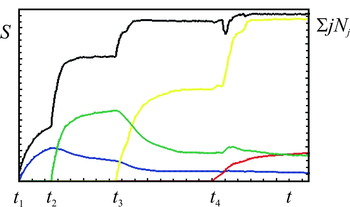
All organisms assemble via numerous chemical reactions. The increase in numbers is, in the case of complex entities, referred to as proliferation (Fig. 1). According to Eq. (2), entropy also increases when different kinds of products appear until the stationary state is attained. In the case of complex entities this process is usually referred to as differentiation, which gives rise to biodiversity. In the case of a single organism the process is called developmental differentiation, which results in maturity (Prigogine & Wiame Reference Prigogine and Wiame1946), i.e. the stable maximum entropy state. Eq. (2) reveals that entropy increases further when more external energy couples to the reactions. This process corresponds to an energy intake, e.g., by photo- and chemosynthesis. Entropy will also increase when the system acquires more matter. It has of course been known for a long time that entropy of a larger system is higher than that for a smaller, but otherwise similar, system. When the energy intake involves complex entities it is usually referred to as metabolism that powers natural processes such as growth and expansion.
Evolution of a chemical system obtained from a simulation. The simulation was programmed as steps of random syntheses in a for-loop. External energy couples to steps of assembly N 1+N j−1↔N j according to Eq. (3) and energy dissipates in dissipative degradations N j↔jN 1. Initially, the system contains only basic constituents in numbers N 1. At the time t=t 1 a synthesis pathway opens up. Entropy S increases rapidly (black) when matter flows from N 1 to new compounds (j>1) in increasing numbers ∑jN j (blue). The growth curve is representative for non-catalysed reactions. At time t=t 2 a second, but a faster (4x) pathway opens up (green). New kinds of products quickly prompt the system but soon the system is accumulating them more gradually as energy in the new products becomes comparable to the original but diminishing substrate compounds. The system prompts again when a third pathway punctuates open at time t=t 3 yielding catalytic products (yellow), having higher activity with j. Later the evolution settles to a new stasis. The form of an autocatalytic growth curve depends on the specific mechanisms. At time t=t 4 a fourth pathway opens up (red), yielding products that are capable of slowly recruiting more matter (N 1) from outside and maintaining it in the system. As a result the new pathway, even though it is slow, is gaining ground in the overall entropy production. With the help of the newest pathway the previously emerged fast catalytic pathway will also have more matter to yield even better catalysts to attain higher states of entropy, whereas the relative contribution of older slower pathways continues to diminish, eventually facing extinction.

The aforementioned processes from the elementary level of chemical compounds to complex biological entities at higher and higher levels of hierarchical organization are strikingly similar to those that we recognize as the basic biological processes. Yet they were exposed simply by considering probabilities of states accessible for an open system undergoing chemical reactions (Sharma & Annila Reference Sharma and Annila2007). Thus it is concluded that life is a natural process. It is a consequence of increasing entropy, the quest to diminish free energy with no demarcation between inanimate and animate. According to thermodynamics there was no striking moment or no single specific locus for life to originate, but the natural process has been advancing by a long sequence of steps via numerous mechanisms so far reaching a specific meaning – life.
The outlined course of evolution is understood by thermodynamics as a probable scenario. This statement may be interpreted erroneously to imply that life should exist everywhere but apparently does not. Considering the cosmic background spectrum where the appropriate energy range for the processes referred to as biological spans only a minute band, life is undoubtedly rare but not unnatural. The probability is not an abstract concept but inherently associated with energy (also in the form of matter) as is obvious when S in Eq. (1) is multiplied by T to give the overall kinetic energy within the system (Kaila & Annila Reference Kaila and Annila2008). Free energy drives evolution so that kinetic energy balances potential energy and the energy in radiation. Probabilities are not invariants but keep changing. When there is little energy or when there are no mechanisms to couple to external energy or few ingredients to make energy transduction machinery, evolution will not advance very far. The very same laws of thermodynamics that worked in the primordial world are still working today. For example, when a biological system is deprived of energy, e.g., an animal is deprived of food, its existence becomes improbable. Thermodynamics is common sense.
The equation of evolution
Considering the explanatory power of thermodynamics, it is perhaps surprising that the probable course of evolution cannot be solved and predicted in detail. The fundamental reason is exposed by rewriting Eq. (2) for the probability using the definition S=RlnP

The equation of motion cannot be solved analytically (Sharma & Annila Reference Sharma and Annila2007) because the driving forces L keep changing with changing flows. The non-conserved system, summarized by the probablity P, is changing because its energy content is either increasing or decreasing. Chemical reactions are endo- or exoergic, i.e. it is imposible for the system to change its state without acquiring or loosing a quantum. In other words, there are no invariants of motion, which is the fundamental reason for the unpredictable courses of evolution. New mechanisms accessing new potentials are in turn transformed into new mechanisms that redirect the flows of energy and so on. Even small perturbations in the initial conditions affect the overall course and evolution is by definition chaotic (Strogatz Reference Strogatz2000).
Despite evolution being non-deterministic its main characteristics are revealed by the equation of motion. Notably when new means appear to conduct energy from plentiful potentials, the probablity will increase rapidly. Then evolution punctuates because suddenly there is much to draw from and thus, according to Eq. (3), the rate dN j/dt is fast. When the supplies narrow, the process slows down. Finally, when the net resources have become exhausted, the system settles to a stasis. This characteristic course of punctuations and stases (Eldredge & Gould Reference Eldredge, Gould and Schopf1972) covers both complex animate and simple inanimate systems (Bak Reference Bak1996) (Fig. 1). For the large global ecosystem the evolutionary course has taken eons whereas a simple and small system will quickly settle to a stasis.
The maximum-entropy steady-state distributions of energy transduction mechanisms, e.g., populations N j of species that result from natural processes, are characteristically skewed (Grönholm & Annila Reference Grönholm and Annila2007; Jaakkola et al. Reference Jaakkola, El-Showk and Annila2008a; Würtz & Annila Reference Würtz and Annila2008). The distribution contains relatively few of the most expensive mechanisms at the top of the energy transduction chain, i.e. food chain. They are thermodynamically expensive hence rare but highly effective in energy transduction. The numerous mechanisms at the intermediate levels are not particularly expensive but altogether conduct most of the energy. The most inexpensive entities do not have many mechanisms and thus they will not contribute much to the overall energy transduction either.
The propagator L in Eq. (4) denotes the energy landscape by tangential vectors that keep changing as energy flows (Kaila & Annila Reference Kaila and Annila2008). A coordinate on the manifold of energy densities is distinguished from another coordinate by energy, thereby expressing the concept of identity in terms of energy. Therefore evolution as an energy transduction process can be viewed as an energy landscape in a flatting motion. The thermodynamic analysis reveals that the manifold is not preset, i.e. deterministic. It is non-Euclidian because the ‘distances’ in free energy are directional (thus not proper distances) and because the ‘distance’ between two energy densities will change when a third density of energy comes within interaction range (thus the triangle inequality need not be satisfied).
Discussion
To understand the origins and evolutions of complex systems, thermodynamics calls our attention to not discarding the principle of decreasing free energy, which is equivalent to the principle of increasing entropy. Often the universal thermodynamic principle and the natural selection in the theory of evolution are viewed as opposing forces. This is a misconception. The driving force due to external energy has remained obscure because the equation for the rate of entropy increase (Eq. (2)) has been deduced but not derived from the first principle probability calculation (Sharma & Annila Reference Sharma and Annila2007). Furthermore, when the entropy concept was formulated by statistical physics, free energy was not recognized as the evolutionary force because it is absent at the equilibrium that was determined mathematically using Lagrange multipliers rather than following the course directed by fading forces. Consequently, the concepts of entropy and order have become mixed with each other. Owing to the confusion it has become the norm to say that living systems would export entropy to maintain their internal high degree of order. The objective is not to maintain order but to employ orderly energy transduction machinery to diminish energy gradients. The vital orderly mechanisms of energy transduction are not low in entropy, i.e. improbable, when being parts of an external energy-powered system. It is emphasized that entropy increases when differences in energy diminish, whereas disorder, or more precisely decoherence, increases during isergonic processes due to the stochastic exchange of quanta. Indeed the pedagogical cliché of equating entropy with disorder is unnecessarily confusing and ultimately wrong (Sagan Reference Sagan, Beretta, Ghoniem and Hatsopoulos2007). The common misconception that entropy of a living system could possibly decrease at the expense of entropy increasing in its surroundings does in fact violate the conservation of energy. It is possible, although statistically unlikely, that entropy of a system and its surroundings would both decrease. This means that energy would transiently flow upwards from a low to a high density. Thus the second law of thermodynamics and the theory of evolution by natural selection are not opposing but one and the same imperative. There is no demarcation line between animate and inanimate.
Natural selection by the rate of entropy increases among alternative ways, i.e. mechanisms to conduct energy are the self-consistent and universal criterion of fitness. In the primordial world any mechanism, irrespective of how simple or elementary, did move towards more probable states. Primordial catalysts, perhaps yielding only minute rate enhancements, could just have been the compounds themselves. Later, when other, faster, ways opened up they were employed to reach states that were even higher in entropy. Thus evolution is tinkering (Jacob Reference Jacob1977), and there might be only very few clues left to track down specific chemical reactions that began to increase the energy content of matter on Earth by coupling to high-energy flux from Sun. Nevertheless, the emergence of systems with increasingly higher degrees of standards such as chirality in biological macromolecules and common genetic code can be recognized as signposts of evolution. We see nothing of these slow changes in progress, until the hand of time has marked the long lapses of ages (Darwin Reference Darwin1859).
When a system cannot access more matter or energy, the rates of energy transduction may still continue to improve to reach higher states of entropy. The rates of entropy increase are relative to one another. When ingredients are intrinsically difficult to recruit to the natural process, even a slow process is better than nothing. The dS/dt rate is a blind but highly functional criterion. Over the eons rates have improved over and over again to result in, e.g., efficient cellular metabolism and an ecosystem food web. Today catalysed kinetics is so ubiquitously characteristic of life that it is easily regarded as a profound cause rather than being a consequence of the principle of increasing entropy by decreasing gradients in energy. The dS/dt rate criterion guarantees that only those among the diverse entities that are capable of contributing to entropy are maintained in the system, i.e. will survive. The rate of entropy increase as the selection criterion resolves the circular argument: fitness marks survival – survival means fitness. Natural selection by the entropy increase rate may at first appear merely as a conceptual abstraction or an oversimplification of reality. Indeed it may be difficult to recognize the increase of entropy, equivalent to the decrease of free energy, as the common motive among many and intricate contemporary mechanisms of life. However, intricacies and complexities are in the machinery, not to be confused with the universal objective.
The principle of increasing entropy explains why matter organizes in functional structures and hierarchies. The order and complexity in biological systems has no value as such. Mechanisms and structures are warranted only by their energy transduction, i.e. the ability to attain and maintain high-entropy states. A system cannot become larger than the one where its entities still reach to interact with each other. For example, molecules that are results of endoergic external energy powered reactions, are bound to break down and thus they may take part only in the reactions that they will reach within their lifetimes. Further entropy increase may take place when systems themselves become entities of a large system at a higher hierarchical level with a larger range of interactions. For example, molecules are entities of systems known as cells that are entities of organisms and so on. The principle dS>0 is also the universal condition of integration. An organization will form when entropy increases more than can be achieved by entities, as systems interact with their surroundings independently. Some organisms, e.g., yeast, exemplify the thermodynamic principle by switching between uni- and multicellular modes of organization depending on surrounding supplies (the potential energy gradients). Thus a hierarchical organization is just a mechanism among many others to conduct energy.
According to thermodynamics, mechanisms are consequences of the natural process, not conditions for life to emerge. There is no requirement for an autocatalytic self-replicating molecule being assembled by a fortuitous event and being susceptible to mutations for natural selection to operate on it. This is in agreement with the notion ‘metabolism first’, but without the incentive to discover a specific, vital mechanism. There is no problem in evolution taking its direction. It is always down along the energy gradients. The role of heredity and information is not overlooked by thermodynamic formalism either. It is incorporated in the evolutionary processes as mechanisms. The physical view of information gives understanding, e.g., to its dispersal in genomes.
The unifying view of thermodynamics captures courses and distributions of matter with no demarcation line between living beings and inanimate objects. Stochastic processes act on all matter and put it in motion towards increasing entropy. The result is evolution, i.e. a series of steps from one state to another to lower potential energy differences. Earth, our home, is in between the huge potential energy difference due to the hot Sun and the cold space. Biota emerged integrated in processes of the atmosphere and geosphere to diminish the energy differences by transduction. The theory of evolution by natural selection formulated in thermodynamics roots biology via chemistry to physics to widen contemporary discourse on the fundamentals of evolution and the emergence of life.
Acknowledgments
We thank Christian Donner, Sedeer El-Showk, Mikael Fortelius, Carl Gahmberg, Salla Jaakkola, Kari Keinänen, Liisa Laakkonen, Martti Louhivuori, Kaj Stenberg, Mårten Wikström and Peter Würtz for enlightening discussions and valuable comments.