INTRODUCTION
The environmental envelope of a species is the set of environmental conditions within which the species can persist. These environmental ranges can determine the potential geographical range of a species with boundaries where the environmental requirements of the species are no longer met (Walker & Cocks, Reference Walker and Cocks1991). For marine crustaceans temperature and salinity are two important elements of a species' environmental envelope that together can be used to predict its range (Summerson et al., Reference Summerson, Darbyshire and Lawrence2007). This is of particular use with the prediction of the potential range expansion of introduced species (Kaustuv et al., Reference Kaustuv, Jablonski and Valentine2001; Peterson & Vieglais, Reference Peterson and Vieglais2001; Herborg et al., Reference Herborg, O'Hara and Therriault2009; Ba et al., Reference Ba, Hou, Platvoet, Zhu and Li2010; Oliveira et al., Reference Oliveira, Hamilton and Jacobi2010; Sorte et al., Reference Sorte, Williams and Carlton2010).
The predicted global temperature rise may shift geographical boundaries of a species and open new environments to the possibility of invasive species successfully establishing new populations (Aronson et al., Reference Aronson, Thatje, Clarke, Peck, Blake, Wilga and Seibel2007). An increase in temperature may also result in environments currently at a suboptimal level for invasive marine crustacean populations becoming more suitable. This could result in increased growth and development of individuals and potentially lead to higher reproductive output, more surviving offspring as they spend less time in the vulnerable planktonic stages, and considerable population growth (Van den Brink et al., Reference Van den Brink, McLay, Hosie and Dunnington2011).
The most successful invasive species have a wide range of environmental tolerances (Zerebecki & Sorte, Reference Zerebecki and Sorte2011). While crustaceans are known to adapt to different temperature regimes (Truchot, Reference Truchot1973; Burggren & McMahon, Reference Burggren and McMahon1981; Anger, Reference Anger1991; Cuculescu et al., Reference Cuculescu, Hyde and Bowler1995), invasive species populations will establish and grow most rapidly and successfully in environments with the optimal temperature range for their growth and reproduction.
The effect of temperature on brood incubation and larval development in crabs is well documented (Leffler, Reference Leffler1972; Wear, Reference Wear1974; Anger, Reference Anger1991; Nagaraj, Reference Nagaraj1993; Wiess et al., Reference Wiess, Thatje, Heilmayer, Anger, Brey and Keller2009; Van den Brink et al., Reference Van den Brink, McLay, Hosie and Dunnington2011). Higher temperatures increase physiological processes and therefore decrease the duration of embryonic and larval development (Leffler, Reference Leffler1972). With increasing environmental temperatures, individuals would therefore be expected to mature earlier than they would in colder temperatures, until temperatures become too high resulting in mortality caused by developmental disruption.
Hemigrapsus takanoi (Asakura & Watanabe, Reference Asakura and Watanabe2005) was first reported in the Oosterschelde, The Netherlands by Nijland (Reference Nijland2000) as H. penicillatus (de Haan, 1835). Hemigrapsus takanoi was probably introduced into Europe via ballast water or hull fouling, and spread to the Oosterschelde with the transport of the Pacific oyster Crassostrea gigas (Thunberg 1793) from France (Nijland, Reference Nijland2000; Nijland & Beekman, Reference Nijland and Beekman2000; Faasse et al., Reference Faasse, Nijland, D'Udekem D'Acoz and Duivenvoorde2002). The introduction of H. takanoi presented the ecosystem with a new competitor for the native crabs, particularly the European green crab Carcinus maenas (Linnaeus 1758), itself an exceptionally successful invader elsewhere (Cohen et al., Reference Cohen, Carlton and Fountain1995; Grosholz & Ruiz, Reference Grosholz and Ruiz1995; Jensen et al., Reference Jensen, McDonald and Armstrong2002; Thresher et al., Reference Thresher, Proctor, Ruiz, Gurney, MacKinnon, Walton, Rodriguez and Bax2003), and a predator of various commercially important species including mussels (Dauvin et al., Reference Dauvin, Tous Rius and Ruellet2009).
In an investigation of the life history of H. takanoi from the Oosterschelde, the effect of temperature on the net reproductive rate (R0) of the embryonic stage of H. takanoi was studied. Net reproductive rate estimates the number of females expected to reach reproductive age by considering the number of offspring per female and the mortality rate at each stage of development. While the R0 is dependent on growth, mortality and reproduction, here we consider only reproduction and the effect of temperature thereon. By looking specifically at the time it takes for females to lay eggs, and the incubation time of eggs carried by females we test the hypothesis that with an increase in temperature, the speed of reproduction will increase significantly. In combination with growth and mortality, an increased reproductive rate may lead to an increase in the R0 for H. takanoi which may result in population growth and increased success and distributional range as an invasive species.
MATERIALS AND METHODS
Mature female Hemigrapsus takanoi were collected from the intertidal zone at Sas van Goes, in the Oosterschelde estuary in early May 2011. Mature females were identified by broad abdomens that cover the entire ventral side of the body as described in McLay & van den Brink (Reference McLay and Van den Brink2009) for Halicarcinus cookii (Filhol, 1885). The crabs were brought to the laboratory where each was measured and labelled with a commercial bee tag, each tag bearing a different number. A total of 81 female crabs were collected and divided equally into three 60 × 40 cm tanks (27 crabs in each) containing unfiltered Oosterschelde seawater. The crabs ranged from 12.26 mm to 20.84 mm in carapace width. One tank was kept at a constant temperature of 12°C (the current long term mean temperature of the Oosterschelde at Goes) and one at 18°C (the current long term maximum temperature of the Oosterschelde at Goes—both temperatures according to http://www.sea-temperature.com/water/goes/411: accessed 6 July 2011) and one at 24°C (the rounded maximum temperature of the Oosterschelde at Marollegat in 2010 according to the Dutch meteorological website of Rijkswaterstaat http://www.hmcz.nl/: accessed 13 July 2011) The temperature of the water in the tanks was measured daily to monitor the temperature variations. The mean temperatures of the water in the three tanks were 12.4°C (±1), 18.5°C (±0.4) and 24.03°C (±1.1) (these will be referred to as 12, 18 and 24°C respectively).
An air bubbler in each tank provided oxygen and the salinity of the water was kept consistent with the water from the Oosterschelde (33–35‰). Crabs were given a sandy substrate with rocks for shelter and were fed crushed local mussels (Mytilus edulis) once a week. Three males were kept in each tank to guarantee a sperm supply. If females died during the experiment they were immediately replaced with a new female bearing a new number.
Females were monitored over a complete brood cycle to determine the duration of brood development at each temperature. Once a female laid a brood, a sample of around 10 embryos was removed and photographed so that the stages of development could be determined. Females were monitored daily so that the duration of each brood stage could be accurately recorded. The mean development time for each brood stage at each temperature was compared using a one-way analysis of variance and with a power trend line (Van den Brink et al., Reference Van den Brink, McLay, Hosie and Dunnington2011). The interbrood interval (time from hatching of the first brood to first appearance of the next) was measured to determine whether gonad development occurred simultaneously with brood development or whether it occurred sequentially with brood development.
Field surveys in different locations in the Oosterschelde were conducted weekly from 10 April 2011 to 20 June 2011 to determine whether and how many crabs were carrying eggs. For one hour the same two people haphazardly collected as many crabs as possible. This usually entailed one lifting a rock while the other collected crabs. During these surveys crabs found with eggs were recorded along with the stage of brood development. From this it was possible to identify the beginning of the egg-laying season in the wild. Surveys beyond 20 June were unfortunately not feasible, so only data for the beginning of the breeding season are presented; however, anecdotal and personal observations indicate that a high proportion of ovigerous crabs were found again in August.
RESULTS
Of the 27 crabs, nine crabs laid eggs in the 12°C tank; 18 crabs laid eggs in the 18°C tank; and 21 crabs laid eggs in the 24°C tank. The time it took before eggs were laid varied between temperatures and individuals, but there was no relationship between the size of the crab and the time it took to lay eggs. In the 12°C tank crabs took an average of 31.6 ±15 days to lay eggs (N = 9), in the 18°C tank they took an average of 10.7 ± 8 days (N = 18) and in the 24°C tank they took an average of 7.6 ±5 days to lay eggs (N = 21). Some females lost part or all of their broods before the broods fully developed. As these eggs were fertilized (indicated by the length of time they were carried and that there were signs of development), the loss of eggs is attributed to the artificial environment rather than lack of fertilization.
Mating was observed in the 18 and 24°C tanks on two separate occasions. During the experiment mortality was similar in all temperatures; six crabs died in the 12°C tank, eight died in the 18°C tank and nine died in the 24°C tank.
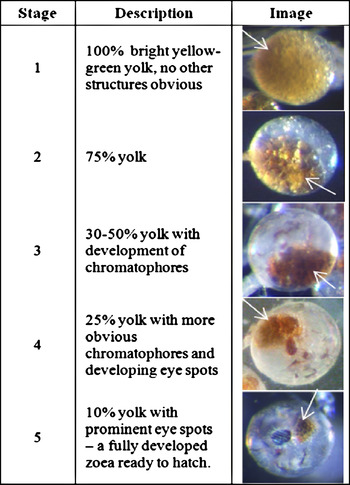
Five stages of brood development were identified visually by the amount of yolk present and the observable level of development of the eyespot of the larvae inside (Figure 1). Stage 1 was completely filled with orange yolk and no other decipherable structures (100% yolk). Stage 2 was identified when the yolk was pulled from the outside membrane leaving a translucent space (70% yolk). At stage 3, small chromatophores are visible (generally > 30‰). Stage 4 had obvious chromatophores and the beginning of an eyespot (25% yolk). By stage 5 the fully developed larva is visible with a complete eyespot (10% yolk).
Description and illustration of the five stages of egg development in Hemigrapsus takanoi. Arrows indicate the egg yolk.

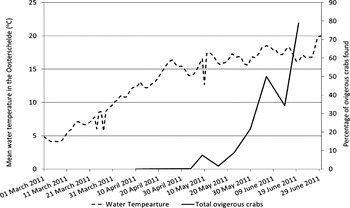
In the field survey the number of ovigerous females of H. takanoi increased rapidly at the end of May (Figures 2 & 4). A total of 1543 adult, female crabs were surveyed ranging each week from 56–352 crabs. The first ovigerous crab was found on 4 May and was carrying stage 1 eggs. Comparing these results to the mean water temperatures in the Oosterschelde, it appears that broods were not laid until the water temperature had been about 15°C for almost 20 days (Figure 2).
The percentage of females that were ovigerous found in the field between 10 April and 20 June (right y-axis) and the water temperature taken at Marollegat in the Oosterschelde between 1 March and 30 Jun 2011 (left y-axis: data provided by the Rijkswaterstaat: Hydro Meteo Centrum; http://www.hmcz.nl/).

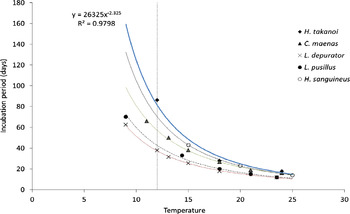
Mean incubation time (days) at different temperatures from the current study for Hemigrapsus takanoi compared with data from Wear (Reference Wear1974) for Carcinus maenas, Liocarcinus depurator (as Macropipus depurator) and Liocarcinus pusillus and from Fukui (Reference Fukui1988) for Hemigrapsus sanguineus. The equation shown is for H. takanoi.

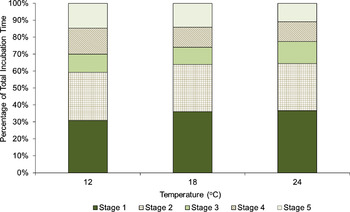
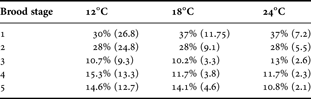
Each brood stage as a percentage of the entire brood cycle for Hemigrapsus takanoi at different temperatures.

Brood cycle
The incubation period in the experimental crabs differed significantly between the different treatment temperatures (F2,26:3202.946, P < 0.001). Incubation was shortest at 24°C, lasting a mean of 17.6 days (±3 days). At 18°C incubation lasted a mean of 27.9 days (±3 days). At 12°C there was a mean incubation period of 86.2 days (±3 days) (Figure 1).
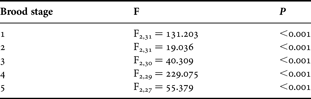
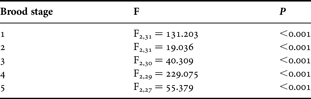
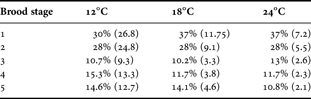
There were significant differences in incubation period at different temperatures for all brood stages (Table 1). The mean percentage of total incubation time for each stage was relatively similar between temperatures (Table 2; Figure 4).
Results of the one-way analysis of variance for the duration of each brood stage at different temperatures for Hemigrapsus takanoi.
The proportion of total embryonic development time for Hemigrapsus takanoi at different water temperatures. Numbers in parentheses are the average number of days.
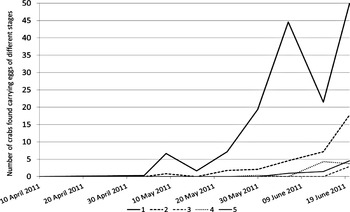
During the field survey at the beginning of the breeding season females carrying stage 1 broods were always most numerous, even with a sharp decline in numbers found on 14 June (Figure 5). Females carrying stage 2 broods were the second most numerous at all times. Females carrying stages 4 and 5 were the next most numerous, generally found in similar numbers, while females carrying stage 3 broods were the rarest.
The percentage of female Hemigrapsus takanoi found carrying eggs of different stages between 10 April and 20 June 2011.

Interbrood interval
In the experiment five females (19%) were observed to lay a second brood in the 24°C tank, and only two (7%) laid a second brood in the 18°C tank, while none produced a second brood in the 12°C tank. The interbrood interval in the 24°C tank lasted an average of five days, while in the 18°C tank both observed interbrood intervals lasted six days. The second broods were not monitored until hatching, but the data suggest similar development time as the first brood.
Following the hatching of the first brood ecdysis occurred in eight females in the 24°C tank after an average of 22 days while in the 18°C tank ecdysis occurred in four females after an average of 34.5 days. The average moult increment was 12.61% but sample sizes were too small to discern any effect of temperature on moult increment.
Two crabs in the 24°C tank moulted following the second brood after 21 and 19 days. During the three month experiment, no second moult was observed, and no brood was laid after ecydsis at any temperature.
DISCUSSION
Water temperature had an obvious effect on both the time to lay eggs and the duration of brood development in Hemigrapsus takanoi. At 12°C females took three times longer to lay eggs (almost 32 days) than at 18°C (11 days) and five times longer than at 24°C (8 days). The total incubation time at 12°C (86 days) was also almost three times longer than at 18°C (28 days) and almost five times longer than at 24°C (18 days). The longer delay in laying eggs in the 12°C tank may have been a result of temperature shock after the crabs were removed from the field where temperatures were warmer (ranging between 14 and 16°C at the time of collection), and placed in cooler water in the laboratory. This difference in time to lay eggs and decrease in incubation time with increased temperature is due to an increase in the speed of metabolic processes with increased temperature (Leffler, Reference Leffler1972). These results are comparable to the similar species Hemigrapsus sanguineus (Fukui, Reference Fukui1988) (Figure 3). Obviously a controlled temperature and consistent immersion is not the same as the natural environment, which fluctuates in temperature and tidal heights, however it does provide a basis for comparison of the effect of different temperatures on the R0 for the embryonic life stage of this species.
Comparing the brood development time in H. takanoi with those of other crab species present in the Oosterschelde, Carcinus maenas, Liocarcinus depurator (Linnaeus, 1758) and Liocarcinus pusillus (Leach, 1816) (as Macropipus) (see Wear (Reference Wear1974) and for H. sanguineus (De Haan, 1835) see Fukui, (Reference Fukui1988)) showed that H. takanoi and H. sanguineus had similar incubation periods at different temperatures, but at temperatures below 20°C the incubation periods were particularly longer than the other three species (Figure 3). The incubation period at 12°C for H. takanoi was considerably longer than the extrapolated incubation period of the other species at 86.2 days compared to 70 days for H. sanguineus, 57 days for C. maenas, 37 days for L. depurator and 43 days for L. pusillus.
Each of the five stages of brood development also decreased in duration with increased temperature, but remained similar in terms of proportion of total development time at all temperatures, suggesting that the duration of each stage of development was affected by temperature in the same way. This is consistent with the effect of temperature on the five brood stages of three hymenosomatid species: Halicarcinus cookii, H. varius (Dana, 1851) and H. innominatus Richardson, 1949 (see Van den Brink et al., Reference Van den Brink, McLay, Hosie and Dunnington2011).
The length of each stage of brood development is somewhat comparable to the number of crabs found carrying each brood stage in the field at the beginning of the breeding season. Stage 1 was always the longest in duration and females carrying stage 1 broods were most commonly found. Likewise stage 2 was the next longest stage at all temperatures and was also the second most commonly found in the field. Stages 3, 4 and 5 differed in their proportion of total incubation period with different temperatures, and were found in similar numbers in the field. Although stage 3 was the rarest found in the field, in the laboratory it was the shortest brood stage only in the 12°C tank.
In the field survey crabs were not found carrying eggs until the water temperature had risen to about 15°C for almost 20 days. This temperature of about 15°C may therefore be a trigger for the seasonal ovary development after which eggs are laid and the reproductive season begins. This is also supported by the much smaller number of crabs (nine, 33%) to have laid eggs in the 12°C tank compared to the 18°C (18, 66%) and 24°C tank (21, 77%). As the water temperature in the Oosterschelde had reached 15°C almost 20 days prior to collection, the nine that laid eggs in the 12°C tank may have already begun ovary development while still in the field.
In 2010 the water in the Oosterschelde reached temperatures above 15°C from late April to mid-October; approximately five and a half months according to the data from Rijkswaterstaat. If 15°C is the temperature at which H. takanoi can successfully reproduce, the current breeding period of H. takanoi in the Oosterschelde is therefore likely to be about five months long; from May to September. This is consistent with the breeding season of the similar species, H. sanguineus whose breeding season covers the same months (Pillay & Ono, Reference Pillay and Ono1978; McDermott, Reference McDermott1991, Reference McDermott1998; Epifanio et al., Reference Epifanio, Dittel, Park, Schwalm and Fouts1998; Dauvin et al., Reference Dauvin, Tous Rius and Ruellet2009).
A rise in average water temperatures may result in the reproductive season of H. takanoi beginning earlier in the year and lasting longer than it currently does. McDermott (Reference McDermott1998) found that the breeding period of H. sanguineus along the Atlantic coast of the United States is shorter in the northern (cooler) parts of its range than in the southern (warmer) parts where temperatures increase earlier and decrease later in the year. Fukui (Reference Fukui1988) reported that the water temperature in Tanabe Bay, Wakayama Prefecture, Japan, which is almost always above the proposed breeding trigger of 15°C, allows the breeding season to continue between February and November for both H. sanguineus and H. penicillatus (Fukui, Reference Fukui1988).
In the 24°C tank, five females (19%) laid a second brood compared to two (7%) in the 18°C tank and none in the 12°C tank, showing that at higher temperatures crabs are more likely to produce a second brood prior to ecdysis, but that even at 24°C the majority of crabs did not lay a second brood. Whether this surprisingly small proportion of second broods is due to insufficient sperm supply, captivity, temperature or something else cannot be answered in the current study and requires further investigation. Nevertheless, it appears that at higher temperatures not only do broods develop faster, but there is a greater chance that more broods are laid per intermoult period. Fukui (Reference Fukui1988) calculated that H. sanguineus and H. penicillatus had 5–6 broods per year in the warmer waters (15–30°C) of Tanabe Bay, Japan. In New Jersey, USA, which experiences similar water temperatures to the Oosterschelde, H. sanguenius produced ‘at least two broods per breeding season’ (McDermott, Reference McDermott1998). On the Opal Coast in France, less than 200 km from the Oosterschelde, Dauvin et al. (Reference Dauvin, Tous Rius and Ruellet2009) reported that mature H. sanguineus females could produce 3–4 broods per breeding season. Depending on size, female H. sanguineus can produce 40,000 eggs per brood (McDermott, Reference McDermott1998; Dauvin et al., Reference Dauvin, Tous Rius and Ruellet2009). Given the similarities of the species, it is reasonable to assume that in the Oosterschelde H. takanoi is similarly capable of producing four broods of 40,000 eggs each per breeding season if conditions allow.
These results are important when considering the R0 of the species, and the effect of temperature thereon. However, other factors must also be taken into account with respect to the R0 of a crab species, specifically growth and mortality. Further research would shed more light onto these aspects for H. takanoi.
Growth affects R0 in crabs because the lifecycle of crabs is divided between growth and reproduction. Hartnoll (Reference Hartnoll and Wenner1985) described how some crabs grow until a pubertal moult after which they continuously reproduce, but no longer grow (determinate growth) (e.g. Van den Brink & McLay, Reference Van den Brink and McLay2010), while others interchange growth and reproduction, producing offspring between each moult (indeterminate growth) (e.g. Berrill, Reference Berrill1982). Hemigrapsus takanoi has indeterminate growth and must stop reproducing to moult and grow. During the experiment 10 females were observed to moult (with an increase in size of about 13%) after an average of 22 days in the 24°C tank compared to four females in the 18°C tank after an average of 34.5 days, suggesting that the speed of growth increases with increased temperature. In increased water temperatures, it is possible that the crabs will also grow faster, experiencing the moult–reproduction cycle more times per year, and therefore be able to reproduce more often in a summer season and increase their R0.
Mortality is also a major influence on the R0 of a species since whether an individual survives to reproductive age, and how long an individual survives at reproductive age obviously has an effect on the number of offspring that an individual can produce during its lifetime. The planktonic stages of crustaceans are particularly vulnerable to predation and changes in environmental conditions. The longer larvae remain in the plankton, the higher chance of mortality. As temperature influences development time, larval mortality can therefore also be affected by temperature and influence the R0. Larval development of the xanthid crab, Panopeus herbstii Milne Edwards, 1834, in colder waters in spring was prolonged until the water warmed to accommodate the megalopa stage, while in the colder waters in autumn the gradually cooling water temperatures would not favour newly hatched larvae and mortality in the late zoeal and megalopa stages would be extremely high (Costlow et al., Reference Costlow, Bookhout and Monroe1962). Similarly, mortality of Zoea 1 stages of Cyrtograpsus altimanus Rathbun, 1914 and C. angulatus Dana, 1851 was significantly lower at 20°C than at 15°C (Moresino & Helbling, Reference Moresino and Helbling2010).
Mortality of juvenile and adult crabs can also be influenced by temperature. Leffler (Reference Leffler1972) found that mortality in juvenile blue crabs, Calinectes sapidus Rathbun, 1896, was directly proportional to temperatures between 13°C and 34°C and was very high during ecdysis at elevated temperatures. Leffler (Reference Leffler1972) suggested that this is due to the elevated metabolic rate increasing O2 consumption in higher temperatures where O2 is more limited. Mortality during ecdysis is especially high because O2 consumption increases greatly during moulting, even doubling in Pachygrapsus crassipes Randall, 1839, compared to normal rates (Roberts, Reference Roberts1957). Death usually results from asphyxiation, because the respiratory surfaces do not function properly during the moult (Passano, Reference Passano and Waterman1960). The effect of temperature on the metabolic rate and mortality of Hemigrapsus takanoi at different life stages requires further investigation before conclusions about its effect can be made.
The results suggest that the current temperature regime of the Oosterschelde is perhaps slightly below the optimal range of the R0 for H. takanoi. An increase in water temperature may shift the temperature regime closer to the optimal range for H. takanoi and result in increased R0 and consequently increased population growth. Furthermore, if temperatures rise, locations where H. takanoi breeding is currently inhibited due to low temperatures may eventually become more vulnerable to an invasion and establishment of the species. The current distribution of H. takanoi on the Atlantic coast of Europe is not precisely known, but according to Dauvin (Reference Dauvin2010) the species has been reported from the northern coast of Spain to the southern coasts of Denmark. In his study Dauvin (Reference Dauvin2010) presented the distribution of H. takanoi as that of H. pencillatus, most likely because the two were not known as separate species until 2005 (Asakura & Watanabe, Reference Asakura and Watanabe2005), and recent research has suggested that only H. takanoi is present in Western Europe (Asakura & Watanabe, Reference Asakura and Watanabe2005; Yamasaki et al., Reference Yamasaki, Doi, Mingkid, Yokota, Strüssmann and Watanabe2011). Assuming that this distribution is limited by temperature and if global temperatures rise, H. takanoi may spread to the northern coasts of Denmark and southern coasts of Norway and Sweden and perhaps even further north.
ACKNOWLEDGEMENTS
We thank IMARES for providing the means to conduct the experiment. We also thank Martine van den Heuvel-Greve, Bart van den Heuvel and Mare and Nanne van den Heuvel for their help collecting crabs for the pilot stage of the experiment, and a special thanks to Jonathon Hutchens for his ‘motivational encouragement’ and help in the laboratory during weekends and holidays.