We evaluated the agreement of the 2009 National Healthcare Safety Network definition of catheter-associated urinary tract infections with concurrent alternate sources of fever, finding it high, and clinical catheter-associated urinary tract infections, finding it low. This suggests poor definition specificity and lack of utility of including fever in the definition.
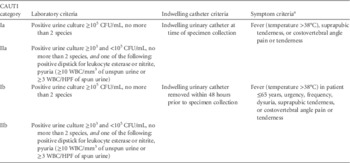
Surveillance for catheter-associated urinary tract infection (CAUTI) is performed using standard criteria from the Centers for Disease Control and Prevention’s National Healthcare Safety Network (NHSN). Criteria were refined in 2009 to discontinue asymptomatic bacteriuria as an infection type and consider only symptomatic and bacteremic cases, and to include lower colony counts in the presence of a positive urinalysis (Table 1). 1 Although laboratory criteria were further revised in 2015, there was no change in symptom assessment. 2 Notably, if laboratory and catheter criteria are met, fever can define CAUTI, and fever may not be attributed to another condition even if another source of fever is found. Although the emphasis on symptomatic cases is well intended, it is unclear whether it improved the performance of the definition because CAUTI in hospitalized patients is rarely symptomatic and is challenging to diagnose.Reference Tambyah and Maki 3 , Reference Hooton, Bradley and Cardenas 4
Summary of NHSN 2009 Surveillance Criteria for Symptomatic CAUTI

NOTE. Adapted from Centers for Disease Control and Prevention/ National Healthcare Safety Network (NHSN) Surveillance Definition of Healthcare-Associated Infection and Criteria for Specific Types of Infections in the Acute Care Setting, March 1, 2010 1 ; table does not include criteria for patients <1 year of age or asymptomatic bacteremic urinary tract infection. CAUTI, catheter-associated urinary tract infection; CFU, colony-forming units; HPF, high-power field; WBC, white blood cells.
a Symptom not attributed to another source except fever, which cannot be attributed to another source.
The objective of this study was to assess the performance of the 2009 NHSN surveillance definition in detecting CAUTI. We suspected poor definition specificity—that is, a large proportion of false-positive cases. In the absence of a gold standard for CAUTI, we evaluated this by measuring the agreement of NHSN-defined CAUTI with (1) clinical diagnosis of CAUTI and (2) alternate sources of fever. We hypothesized that the agreement between NHSN-defined CAUTI and alternate sources of fever would be higher than the agreement between NHSN-defined CAUTI and clinical CAUTI.
Methods
We conducted a cross-sectional study at University of Maryland Medical Center, a 757-bed urban tertiary care academic hospital, using data collected during development and validation of an automated algorithm for routine CAUTI surveillance. The study was determined not human subjects research by the University of Maryland institutional review board.
We queried the hospital’s relational database containing administrative, clinical, and laboratory data for inpatients with positive urine cultures (obtained ≥48 h after admission) and indwelling urinary catheter, from August 1 through September 30, 2010. Patients meeting NHSN urinary catheter and laboratory criteria for CAUTI (Table 1)—that is, those with catheter-associated asymptomatic bacteriuria, constituted the study sample.
Medical charts were then reviewed for (1) signs and symptoms of NHSN-defined CAUTI, (2) clinical CAUTI—that is, patient given a diagnosis of and treated for UTI, and (3) alternate sources of fever—that is, infection at a site other than the urinary tract or a noninfectious cause of fever, all within 72 h (before or after) of the index urine culture. Determination of an alternate source of fever was made on the basis of provider-documented diagnoses, including infectious diseases consultations. Noninfectious conditions—for example, central fever, were included if documented as suspected causes of fever. Multiple conditions in the same patient were counted separately.
We measured the agreement of NHSN-defined CAUTI with clinical CAUTI, and with alternate sources of fever, using Cohen’s κ statistic. We also evaluated the association of both NHSN-defined CAUTI and clinical CAUTI with alternate sources of fever using multivariable logistic regression. Organism (bacteria or yeast), pyuria (≤10, 11–25, or >25 white blood cells per high-power field), and colony count (< or ≥ 100,000 colony-forming units per mL) were included as covariates.
Results
From August 1 through September 30, 2010, we identified 642 patients with positive urine cultures more than 48 h after admission, of whom 130 (20%) had catheter-associated bacteriuria meeting NHSN urinary catheter and laboratory criteria. Of these, 85 (65%) fulfilled the NHSN CAUTI surveillance definition. All 85 case patients had fever; other signs or symptoms were noted in only 2 cases. Clinical diagnosis of CAUTI occurred in 69 (53%) of the 130 cases.
Of 85 NHSN-defined CAUTI, 43 (51%) did not receive clinical CAUTI diagnoses, whereas of the 69 clinical CAUTI cases, 27 (39%) were not captured by NHSN criteria. Alternate sources of fever were found in 59 (45%) of 130 cases of catheter-associated bacteriuria, in 46 (54%) of 85 NHSN-defined CAUTI, and in 21 (30%) of 69 clinical CAUTI cases. These alternate sources of fever (in decreasing order of number of cases) were respiratory tract infection (22), soft-tissue infection (11), bloodstream infection (with organism other than in urine culture) (6), Clostridium difficile infection (5), central fever (4), musculoskeletal infection (3), deep venous thrombosis (3), intra-abdominal infection (2), endocarditis (2), central nervous system infection (2), ischemic bowel (2), abdominal hematoma (1), and acute necrotizing pancreatitis (1).
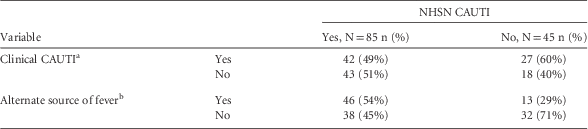
There was 46% agreement between NHSN-defined CAUTI and clinical CAUTI (κ, −0.10 [95% CI, −0.26 to −0.07]). The agreement between NHSN-defined CAUTI and alternate sources of fever was higher (61%) (κ, 0.23 [95% CI, 0.08–0.38]) (Table 2).
Agreement of NHSN-Defined CAUTI With Clinically Diagnosed CAUTI and Alternate Sources of Fever Among Patients With Catheter-Associated Bacteriuria

NOTE. CAUTI, catheter-associated urinary tract infection; NHSN, National Healthcare Safety Network.
a Agreement between NHSN-defined CAUTI and clinical CAUTI: (42+18)/130=46%.
b Agreement between NHSN-CAUTI and alternate sources of fever: (46+32)/129=61%. Information on alternate source of fever could not be obtained for one patient.
In multivariable analysis, after controlling for pyuria and colony count, presence of an alternate source of fever (odds ratio [OR], 3.8 [95% CI, 1.5–9.2]) and organism other than yeast (2.8 [1.1–7.1]) were independently associated with NHSN-defined CAUTI. Factors associated with clinical CAUTI were absence of an alternate source of fever (OR, 3.1 [95% CI, 1.1–8.6]), organism other than yeast (9.3 [3.1–28.5]), pyuria (>25 vs <10 white blood cells per high-power field) (4.0 [1.3–11.8]), and colony count (≥100,000 colony-forming units per mL vs <100,000 colony-forming units per mL) (3.1 [1.1–9.3]).
Discussion
In the absence of a gold standard for CAUTI, we used a novel method to demonstrate the poor specificity of the NHSN CAUTI surveillance definition: finding a strong association of NHSN-CAUTI with the presence of alternate sources of fever.
NHSN criteria state that signs and symptoms should be attributed to CAUTI if there is no other cause for those symptoms. 2 However, this “attribution” does not apply to fever. Bacteriuria develops at an average rate of 5% per day of indwelling catheter,Reference Garibaldi, Burke, Dickman and CB 5 such that urine cultures performed for fever from any cause have a high pretest probability of being positive and counted as CAUTI. Similar to our study, Al-Qas Hanna et alReference Al-Qas Hanna, Sambirska, Iyer, Szpunar and Fakih 6 found a strong association of systemic inflammatory response syndrome and NHSN-defined CAUTI. They also showed that increase in fever prevalence from other causes would increase the number of NHSN-defined CAUTIs.
The agreement between NHSN-defined and clinical CAUTI was low in our study, consistent with previous findings.Reference Al-Qas Hanna, Sambirska, Iyer, Szpunar and Fakih 6 , Reference Meddings, Reichert and McMahon 7 Although the 2 definitions 2 , Reference Hooton, Bradley and Cardenas 4 have different purposes, this disparity could lead to questioning of the validity of CAUTI data used to drive and evaluate prevention initiatives. However, clinical definitions for CAUTI are also imperfect, and overtreatment of catheter-associated bacteriuria is well described.Reference Trautner, Cope, Cevallos, Cadle, Darouiche and Musher 8 In the present study, alternate sources of fever were found in a third of clinical CAUTI cases, suggesting they were also not true infections.
Other limitations are that this study was conducted at a single center and was based on the 2009 CAUTI definition even though changes were made to the definition in 2015. 2 However, there was no change between 2009 and 2015 in how symptoms are assessed. 1 , 2
The following are additional considerations for CAUTI surveillance. First, emphasize urinary catheter utilization because duration of catheterization is the strongest risk factor for CAUTI and is associated with other adverse outcomes.Reference Saint, Lipsky, Baker, McDonald and Ossenkop 9 , Reference Saint, Lipsky and Goold 10 Second, include all catheter-associated bacteriuria—experts have argued that this measure represents a justifiable benchmark for prevention efforts because it predisposes to CAUTI, is associated with antibiotic-resistant bacteria, and leads to unnecessary antimicrobial use.Reference Hooton, Bradley and Cardenas 4 This could also allow electronic data capture and save time spent in manual surveillance. Lastly, if symptoms are to be included, consider attributing fever to CAUTI only if no other source is found. Future studies should focus on automated and objective ways of accounting for these concurrent sources of fever to allow further refinement of CAUTI surveillance.
Acknowledgments
Financial support. None reported.
Potential conflicts of interest. All authors report no conflicts of interest relevant to this article.