INTRODUCTION
The behaviour of fruit-eating animals has important consequences for the evolution of plants with zoochorous modes of seed dispersal (Wheelwright Reference WHEELWRIGHT1991). Factors such as diet or stage of breeding cycle, which have been reported as having significant effects on animal movements, will influence where the seeds land and therefore the reproductive success of the plants being dispersed (Fogden Reference FOGDEN1972, Hoppes Reference HOPPES1987, Karubian & Duraes Reference KARUBIAN and DURAES2009, Levey Reference LEVEY1987, Wheelwright Reference WHEELWRIGHT1991). Movement patterns can also provide valuable information about the distribution of resources available to an animal or similarly, movement patterns may be predictable from the spatial distribution of resources (Murray Reference MURRAY1988, Westcott & Graham Reference WESTCOTT and GRAHAM2000).
In the wet tropics, approximately 70% of plant species have zoochorous modes of seed dispersal (Au et al. Reference AU, CORLETT and HAU2006, Corlett Reference CORLETT1998, Herrera Reference HERRERA, Herrera and Pellmyr2002) and birds typically comprise a large majority of these animal dispersers (Corlett Reference CORLETT1998, Kitamura et al. Reference KITAMURA, YUMOTO, POONSWAD, CHUALUA and PLONGMAI2004). In tropical East Asian forests, it is estimated that 85% of fleshy-fruited plant species are eaten and seeds dispersed by birds (Corlett Reference CORLETT2009); similarly in neotropical forests birds are dispersers for approximately 75% of tree species (Wenny & Levy Reference WENNY and LEVY1998). However, we typically know relatively little about the individual movement patterns of tropical frugivorous birds in relation to available fruit resources.
In tropical East Asia, based on current phylogenies, bulbuls (family Pycnonotidae) are represented by 55 species, accounting for 2% of the region's avifauna and are thought to be particularly important seed dispersers (Corlett Reference CORLETT2009). However, while bulbuls are abundant and have a significant impact on patterns of seed dispersal in the entire region, there are almost no data focusing on the movement patterns of this group as key dispersers within forested habitats.
The objective of this study was to investigate the movement patterns of a forest-interior bulbul during the course of a year in relation to variation in fruit resources. We describe movement patterns in relation to fruit availability and dispersion within home ranges of the puff-throated bulbul (Alophoixus pallidus Swinhoe).We chose this species because it is widely distributed in the Asian region (Robson Reference ROBSON2000) and abundant, at least, locally in the study site, Khao Yai National Park, Thailand (Gale et al. Reference GALE, ROUND, PIERCE, NIMNUAN, PATTANAVIBOOL and BROCKELMAN2009). We predicted that: (1) total feeding range would decrease with increasing availability and aggregation of fruit resources, (2) average distances moved between fruit foraging locations would decrease with increasing availability and increasing aggregation of fruit resources, and (3) time spent foraging on individual trees would decrease with increasing availability and increasing aggregation of fruit resources.
METHODS
Study site
The study was conducted on the 30-ha Mo-singto Long-Term Biodiversity Research Plot (101°22’E, 14°26′N), Khao Yai National Park (KYNP; 2168 km2), Thailand. The average temperature ranges from 17 °C in December and January to 28 °C in April and May. The average annual rainfall is 2554 mm, most of which falls between May and October; the dry season occurs from November to February (c. 7% of days with rain) (Khao Yai Project, unpubl. data).
The plot comprises a series of ridges and valleys with an altitudinal range of 730–860 m asl. The vegetation is mostly old-growth evergreen forest, dominated by fleshy-fruited trees with a small area of secondary forest at the north edge of the plot (Brockelman Reference BROCKELMAN and Poonswad1998). The plot is laid out on a 20 × 20-m grid. All trees with diameter at breast height (dbh) ≥ 1 cm have been identified, labelled with unique identification numbers, and mapped in a GIS with a precision of at least ± 1 m (Brockelman Reference BROCKELMAN and Poonswad1998).
Study species
The range of the puff-throated bulbul (Alophoixus pallidus Swinhoe) includes Cambodia, China, Laos, Myanmar, Thailand and Vietnam. It is a common resident of evergreen forest of northern and north-eastern Thailand (Lekagul & Round Reference LEKAGUL and ROUND1991) and is the most abundant bird species on the study plot (Gale et al. Reference GALE, ROUND, PIERCE, NIMNUAN, PATTANAVIBOOL and BROCKELMAN2009). In KYNP, it has also been identified as the most common avian consumer of fruit (Kitamura et al. Reference KITAMURA, YUMOTO, POONSWAD, CHUALUA, PLONGMAI, MARUHASHI and NOMA2002). It lives in pairs or in groups of three to seven birds, defending a territory and foraging together (Pierce et al. Reference PIERCE, TOKUE, POBPRASERT and ROUND2004, Sankamethawee et al. Reference SANKAMETHAWEE, GALE and HARDESTY2009). Based on a study of faecal samples as well as direct observations of fruiting trees (Sankamethawee et al. in press), it consumes a wide variety of fruits (> 100 species). Alophoixus pallidus forages in the lower to middle canopy with an average foraging height of 9.4 m (range = 1–15 m) within an average home range of approximately 2.2 ha (Tanasarnpaiboon, unpubl. data). It ranges primarily in the forest interior, foraging rarely in non-forest habitat (Chaikuad, unpubl. data). It occasionally joins mixed-species bird flocks feeding on insects (McClure Reference MCCLURE1974, Nimnuan et al. Reference NIMNUAN, ROUND and GALE2004). Approximately 30 groups occupy the study area, such that all groups are surrounded by neighbours. Of these, 10 groups occupying the core of the Mo-singto plot were chosen for this intensive study.
Colour-ringing was initiated in January 2003 as part of a long-term study on the Mo-singto plot such that at the time of this work nearly all the members of the 10 focal groups could be individually identified. Unique combinations of two to three colour rings and one numbered aluminium ring from the Royal Thai Forest Department (currently the Department of National Parks, Wildlife and Plant Conservation) allowed for individual identification. Faecal samples were collected during the course of ringing to at least partly determine food types consumed by A. pallidus during the study period.
Plant phenology
We collected phenology data once per month on both trees and lianas, which we knew were part of the puff-throated bulbul diet based upon faecal samples and direct observations conducted on the plot (Sankamethawee et al., in press). The exact location and dbh of each individual tree was obtained from the Mo-singto tree database referred to above. Monthly surveys were conducted in each territory of the 10 focal groups on three parallel 100 × 20-m belt-transects separated from one another by 20 m. Within the transects we monitored a total of 280 randomly selected individuals from 20 species (14 trees per species) of potential food trees with dbh ≥ 10 cm (range = 10–116 cm). For lianas we selected 226 stems from 14 species (~16 stems per species) with a dbh ≥ 1 cm (range = 1–44 cm). We counted and measured the basal area of all liana stems present in each transect. Percentage of fruit presence in the crown was recorded based upon a five-point score where 0 = no fruit, 1 = 1–25%, 2 = 26–50%, 3 = 51–75% and 4 = > 76% (Ragusa-Netto Reference RAGUSA-NETTO2002).
Fruit productivity
Monthly fruit productivity for both fruiting trees and lianas were estimated following Savini et al. (Reference SAVINI, BOESCH and RICHARD2008):

Where Dk is the density of species k in the area, Bk is the mean basal area of species k in the area, Pkm is the percentage of observed trees of species (k) that produce ripe fruit in a given month (m), Wk is the mass of fruit for species k (Kitamura et al. Reference KITAMURA, YUMOTO, POONSWAD, CHUALUA, PLONGMAI, MARUHASHI and NOMA2002) and Nk the amount of fruit in the crown in 1 m3 of species k. The number of fruits available in 1 m3 of the crown was estimated visually and grouped into categories of abundance using the following group midpoints: 10, 20, 50, 100, 300, 500 or 1000 fruits. There were several limitations to measuring liana crown volume and counting fruit per twig/branch to estimate fruit productivity, thus liana fruit productivity in this study was estimated by the same method as fruiting trees even though the relationship between stem diameter and crown size (or fruit crop size) could not be clearly defined. Productivity of lianas followed the same methods as for fruiting trees where the basal area for lianas was estimated from the stem dbh. The diameter measurement point followed Gerwing et al. (Reference GERWING, SCHNITZER, BURNHAM, BONGERS, CHAVE, DEWALT, EWANGO, FOSTER, KENFACK, MARTINEZ-RAMOS, PARREN, PARTHASARATHY, PEREZ-SALICRUP, PUTZ and THOMAS2006) in which all stems that emerge more than 130 cm from the main root were measured.
Dispersion of fruiting trees and lianas
In order to estimate fruiting tree and liana dispersion, the belt transects were divided into 20 × 20-m sections. Dispersion of fruiting trees and lianas was calculated within the transect grid using the ratio of the variance to the mean of the monthly number of trees in fruit in the transect grids: the coefficient of dispersion (CD) following Chapman et al. (Reference CHAPMAN, CHAPMAN, WRANGHAM, HUNT, GEBO and GARDNER1992) and Chapman et al. (Reference CHAPMAN, WRANGHAM and CHAPMAN1995). When the CD > 1 fruiting trees are considered to be clumped; CD < 1 indicates fruiting trees are widely dispersed and when CD = 1 fruiting trees are randomly dispersed.
Movement patterns
Four of the ten focal groups of birds were randomly selected to be followed on a particular day. Their locations and feeding activities were recorded by following a focal animal from each group for a total of 4 h mo−1. The 4 h were divided into 2-h observation periods conducted every 2 wk. The observations were conducted during May 2007 to April 2008, with the exception of September when no data were collected. The observations started when at least one individual in a group was found in their home range. The timing of the observations was started and finished within one of four time intervals: early morning (06h30–09h00), late morning (09h00–12h00), early afternoon (12h00–15h00) and late afternoon (15h00–18h00). Group composition was also recorded. When the birds were followed, tree numbers were used to precisely reference their locations and their true movement distances by georeferencing to the plot grid. The grid was corrected for topography.
When the bulbuls were feeding on a fruiting tree during the observation period, the first record was started when the first fruit was fed upon until they left the tree or stopped feeding. The numbers of fruit fed upon were also recorded based only on clearly visible events. The frequency of feeding events on insects was also recorded.
Data analysis
Bulbul home ranges were drawn based on the locations of colour-ringed birds, which were observed as part of the long-term study from 2003–2008. The areas were drawn using the 95% Minimum Convex Polygon (MCP) command in ArcView 3.2a (Boitani & Fuller Reference BOITANI and FULLER2000). Each home range was calculated from at least 470 observation points per group; group members nearly always forage together. The observed travel routes were mapped in a GIS (Animal Movement extension of ArcView). The association of fruit availability with movement patterns (feeding range, distance moved), and time spent feeding were examined using Spearman rank correlation coefficients for both independent groups as well as averaged data from all 10 bulbul groups combined. We also examined differences in distances moved and time spent on fruiting trees between seasons, breeding (February–August) and non-breeding (September–January) by using t-tests based on monthly averages from individual groups as well as all 10 groups combined. The area of the monthly range of movements was estimated based on 95% MCPs. The statistical analysis was conducted using R version 2.8.1.
RESULTS
Fruit availability
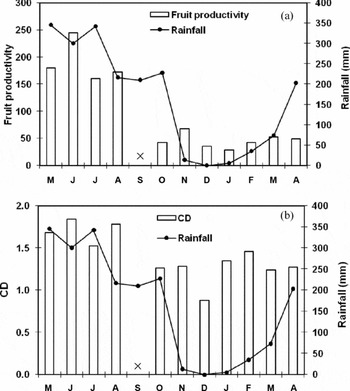
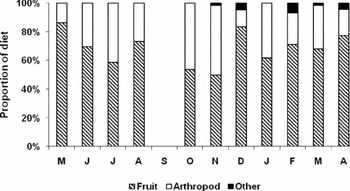
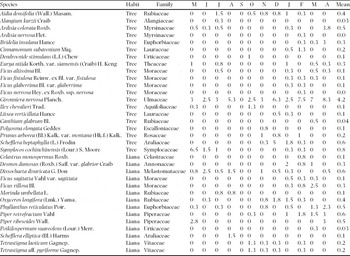
During the 1-y study period, 280 fruiting trees from 20 species and 125 fruiting lianas from 14 species were monitored. There were clear seasonal fluctuations in fruit availability based on monthly averages of the 10 groups of A. pallidus combined. Overall, June had the highest fruit productivity (FP = 245) and the highest coefficient of dispersion (CD = 1.84) indicating greater clumping. Fruit productivity was lowest in January (FP = 29) and most widely dispersed in December (CD = 0.88). The average fruit availability had two distinct periods during our study, with fruit being relatively more abundant from May to August 2007 during the wet season, followed by a notable decline and another period of little change between October 2007 and April 2008 through the dry season (Figure 1). On average, fruit of most species were available for 12 wk, however, one tree species Gironniera nervosa (Ulmaceae) and one liana species Dissochaeta divaricata (Melastomataceae) were available year round. Furthermore, Gironniera nervosa was fed upon by the bulbuls every month (Appendix 1). Alophoixus pallidus ate more fruit than other items. However during October and November after the end of the wet season, the proportion of non-fruit (primarily arthropods and nectar/flower parts) was nearly equal to that of fruit (Figure 2).
Relationship between total rainfall by month and fruit productivity (a) and the coefficient of dispersion (CD) (b). Fruits refer only to species fed upon by Alophoixus pallidus. Data collected from 10 A. pallidus groups on the Mo-singto Plot, KhaoYai National Park, Thailand during May 2007 to April 2008 (‘x’ indicates no data were collected during September 2007).

The proportion of different food types (fruit, arthropod, other (typically nectar or small lizards)) taken by Alophoixus pallidus. Number of feeding observations during this study from May 2007 to April 2008 were 58, 53, 92, 30, 0, 95, 132, 103, 128, 104, 122 and 136 respectively with no data collected during September 2007.

Overall, there was a significant positive correlation between monthly fruit productivity and the monthly coefficient of dispersion (rs = 0.74, P = 0.009) using data for all 10 groups combined, such that when fruit abundance was low, fruiting trees/lianas were more spatially dispersed than during the periods of higher fruit productivity. Monthly rainfall was also significantly and positively correlated with monthly fruit productivity and coefficient of dispersion (rs = 0.72, P = 0.012; rs = 0.68, P = 0.021, respectively).
Feeding range in relation to resource
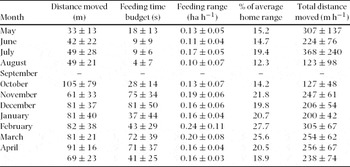
The average percentage of the home range covered during the monthly 4-h observation periods changed notably through the year. February was the month with the largest range while August was the month with the smallest range (Table 1). For only one group was there a significant correlation between monthly range of movement and the coefficient of dispersion (rs = −0.74, P = 0.009), but six of the remaining nine had trends in the same direction although the overall correlation was not significant (rs = −0.47, P = 0.14). There was no significant correlation between fruit productivity and the monthly range of movement for any of the different bulbul groups alone or combined (rs = −0.33, P = 0.32) nor were there any consistent trends (rs was < 0 for 4 of the 10 groups). There was no correlation between the median distance moved between fruiting trees and median feeding range per unit time (rs = 0.60, P = 0.18) nor any correlation between median time spent on a fruiting tree and ranging area (rs = 0.47, P = 0.14). There was also no correlation between median total distance moved and median feeding range per unit time (rs = 0.47, P = 0.15).
Distance (mean ± SD) moved between fruiting trees (m), feeding time on a fruiting tree (s), feeding range (ha h−1), percentage of average home range covered and total distance moved (m h−1) by puff-throated bulbuls during 4 h mo−1 of observation for 10 bulbul family groups.

Distances moved between fruiting trees in relation to available fruit resources
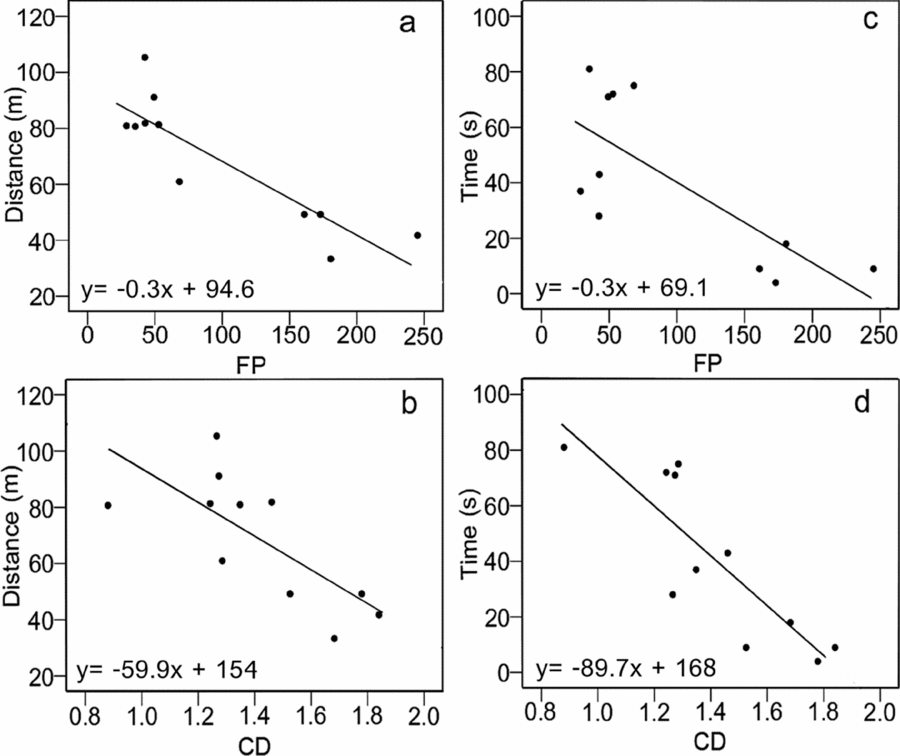
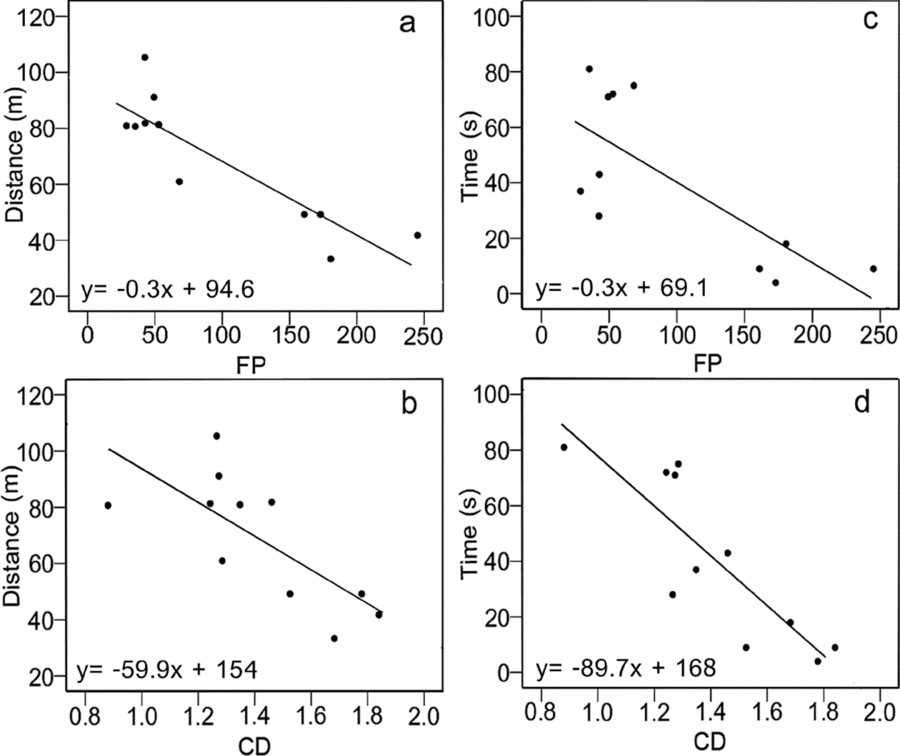
Distances moved between fruiting trees also varied notably by month. October was the month with the longest distances moved between fruiting trees and May distances were shortest (Table 1). For only one out of the 10 groups was there a significant correlation between distance moved between fruit trees and fruit productivity (rs = −0.80, P = 0.003) and there was no trend for the remaining nine groups (rs was < 0 for five of the 10 groups). However, when the data were pooled, distance moved between fruiting trees and fruit productivity were negatively correlated (rs = −0.76, P = 0.006) (Figure 3). For distance moved between fruiting trees in relation to the coefficient of dispersion, eight groups out of 10 had trends in the same direction. Furthermore, when data from all 10 bulbul groups were pooled monthly, there was also a clear and significant negative correlation between distances moved between fruiting trees and coefficient of dispersion (rs = −0.64, P = 0.01) (Figure 3). Bulbuls moved further between subsequent feeding trees when food was scarce, and when it was more dispersed. The average (± SD) total distance travelled by puff-throated bulbul per observation period ranged from 123 ± 98 m h−1 (August) to 368 ± 240 m h−1 (July), with an average total distance of 238 ± 74 m h−1 for the study period (Table 1). There was no significant correlation between total distance moved and fruit productivity (rs = 0.30, P = 0.37) or the coefficient of dispersion (rs = 0.12, P = 0.71) using all groups combined. There was also no correlation between the median total distance moved and median distance moved between fruiting trees (rs = 0.37, P = 0.26) or median total distance moved and median time spent on a fruiting tree (rs = 0.11, P = 0.75) also based on all groups combined.
Relationship between the average distances moved by Alophoixus pallidus between fruiting trees and fruit productivity (FP) (rs = −0.76, P = 0.007) (a), and coefficient of dispersion of fruiting trees/lianas (CD) (rs = −0.64, P = 0.04) (b). Relationship between the average time spent in a fruiting tree (s) and total FP (rs = −0.52, P = 0.09) (c) and CD (rs = −0.72, P = 0.01) (d). The 11 points represent monthly average distances and times derived from 10 A. pallidus groups during 11 mo of observations. Lines of best fit were shown for illustration.
Foraging time in relation to fruit resources
There was large variation in the time a particular group foraged on a fruiting tree ranging from 1 to 219 s. The average time spent on a fruiting tree also varied throughout the study period. August was the month in which the puff-throated bulbul spent the shortest time on the fruiting trees after which time spent increased to December, which was the month with the longest time spent on fruiting trees (Table 1). Two of the 10 focal groups had significant negative correlations between foraging time on a fruiting tree and fruit productivity (rs = −0.80, P = 0.003 and rs = 0.79, P = 0.003); six of the remaining eight groups also had trends in the same direction, although correlations were not significant. The data from all groups combined also indicated that there was a negative correlation between time spent on fruiting trees and fruit productivity (rs = −0.58, P = 0.05). Two of the 10 groups had significant negative correlations between foraging time on a fruiting tree and the coefficient of dispersion (rs = −0.81, P = 0.002 and rs = −0.76, P = 0.006). Again six of the remaining eight groups also had trends in the same direction. The pooled data also demonstrated that time spent was also significantly negatively correlated with the coefficient of dispersion (rs = −0.83, P = 0.001) (Figure 3). There was a significant positive correlation between the median time spent on a particular fruiting tree and the median distance moved between fruiting trees also based on the pooled data (rs = 0.70, P = 0.016).
Examination of the mean distance, feeding range and foraging time in relation to season, found no significant differences between the breeding and the non-breeding season (t-test: tdistance = −0.88, df = 9, P = 0.40; trange = 0.80, df = 9, P = 0.44; ttime = −0.43, df = 9, P = 0.68, respectively).
DISCUSSION
There was clear seasonal fluctuation in fruit productivity on the plot, which appeared to be correlated with rainfall. Trees tended to produce more fruits in the wet season relative to the dry season. A large drop in fruit productivity was detected between August and October at the end of the wet season. This reduction was primarily attributed to the general cycle of plants known to comprise the diet of A. pallidus and the rapid disappearance of fruits from a large number of Symplocos cochinchinensis (Symplocaceae) trees, a species which is known to vary considerably in productivity among years (Brockelman et al. in press). These changes were significantly correlated with both the time birds spent on, and how far they travelled between, fruiting trees.
Effect of fruit resources on feeding range
The total range of these territorial A. pallidus groups did not appear to be related to fruit productivity or the dispersion of fruit resources. This and previous work suggested that bulbul territory size fluctuates little with the exception of temporary increases for groups with fledged young (Tanasarnpaiboon, unpubl. data). This contrasts with studies of other tropical birds (Holbrook & Smith Reference HOLBROOK and SMITH2000, Tremblay et al. Reference TREMBLAY, THOMAS, BLONDEL, PERRET and LAMBRECHTS2005), which report changes in feeding ranges or home ranges associated with food availability, although all of these species were non-territorial. As most tropical frugivorous birds examined to date appear to be non-territorial (Stutchbury & Morton Reference STUTCHBURY and MORTON2001), the differences observed here may be due to our study species having small (~2.2 ha) territories resulting in the frequent re-use of the same fruiting trees within short periods of time. Thus, while during certain months of lower fruit availability cumulative foraging distances travelled per unit time were relatively high, the total foraging area remained relatively small.
Distances moved between fruit foraging locations
Alophoixus pallidus groups moved longer distances between fruiting trees when fruit abundance was lower and fruit dispersion higher as demonstrated in other studies (Holbrook & Smith Reference HOLBROOK and SMITH2000, Korine et al. Reference KORINE, KALKO and HERRE2000). As observed in studies in tropical Central America, there was a significant negative correlation between dispersion of fruiting trees/lianas and foraging distance, whereby birds flew shorter distances as fruit resources became more aggregated (Korine et al. Reference KORINE, KALKO and HERRE2000, Tremblay et al. Reference TREMBLAY, THOMAS, BLONDEL, PERRET and LAMBRECHTS2005).
Mean distances moved between feeding locations of A. pallidus (69 m) appeared to be roughly similar to three species of frugivorous bird of somewhat smaller body size (20–33 g vs 37 g for A. pallidus) studied in neotropical forests (57 m) (Murray Reference MURRAY1988). The only other movement data available near our study area were for the much larger great hornbill (Buceros bicornis) (2150–4000 g) which had long average daily movements of approximately 7600 m (Poonswad & Tsuji Reference POONSWAD and TSUJI1994). In general however, broad interspecific differences in distances moved are likely to be related to body size (Westcott & Graham Reference WESTCOTT and GRAHAM2000) and to some extent predation risk (Oppel & Mack Reference OPPEL and MACK2010). Murray (Reference MURRAY1988) also noted that movement patterns of frugivorous birds in his neotropical study area also shifted with changes in the dispersion of fruiting trees as we found in our study, however Murray (Reference MURRAY1988) did not explicitly map fruit resources.
There was no correlation between either fruit availability or dispersion of fruiting trees/lianas with the total distance moved per unit time. This contradicts findings reported in Costa Rican rain forest where frugivorous birds used a different tactic, moving into different habitat when the resources in the primary forest declined (Levey Reference LEVEY1988). Alophoixus pallidus is territorial year round; groups travel around their home range for reasons other than foraging, particularly territorial defence which is likely a significant determinant of total movement per unit time (Schoener Reference SCHOENER1968).
Foraging time in relation to resources
Alophoixus pallidus tended to feed longer in a particular fruiting tree when fruit was in lower abundance and more widely dispersed as observed in other systems (Morales & Carlo Reference MORALES and CARLO2006). Spending more time in a given fruit tree or resource may maximize energy gain before moving to the next fruiting tree although there appears to be a trade-off with predation risk (Oppel & Mack Reference OPPEL and MACK2010). Even if a resource has low availability but the cost of leaving is higher, foragers will tend to stay with the same resource longer (Stephens & Krebs Reference STEPHENS and KREBS1986). Although few data on mean residence times in fruiting trees for other bulbuls exist, A. pallidus spent relatively less time on a particular fruiting tree when compared with other bulbuls, 41 s (this study) vs 150 s (Weir & Corlett Reference WEIR and CORLETT2006), or other passerines in the region (60–600 s) (Oppel & Mack Reference OPPEL and MACK2010). While this may also be partly a function of crop size and other factors such as predation pressure (Oppel & Mack Reference OPPEL and MACK2010, Weir & Corlett Reference WEIR and CORLETT2006), it is possible that some of the difference in time spent feeding reflects the abundance and distribution of resources between closed-canopy forest and open grassland with scattered trees of Weir & Corlett (Reference WEIR and CORLETT2006). Mean visiting times to fruiting trees of frugivorous birds from neotropical montane forest also suggest notably longer visitations (420–720 s) (Murray Reference MURRAY1988) compared even with the longest recorded visiting time of A. pallidus (219 s). Again, differences in movement patterns are likely the result of multiple factors (Murray Reference MURRAY1988, Oppel & Mack Reference OPPEL and MACK2010, Weir & Corlett Reference WEIR and CORLETT2006, Westcott & Graham Reference WESTCOTT and GRAHAM2000) and it is currently unknown which of the various factors are responsible for such regional differences.
Although A. pallidus is unusual in that it is a cooperative breeder, and as such may have somewhat different foraging patterns than non-cooperative breeders, this study provides an initial quantitative assessment of the movement patterns of a forest-dwelling bulbul indicating that: (1) its movement patterns are highly correlated with food availability and (2) this bulbul and probably many other similarly sized frugivores from tropical Asia and other regions move longer distances with longer residence times in fruiting trees when fruit availability is low and widely dispersed even taking into account baseline differences in distances travelled or residence times. Such trends also strongly suggest that models of seed disperser behaviour need to account for the dynamics of fruit availability.
ACKNOWLEDGEMENTS
We would like to thank the National Parks, Wildlife and Plant Conservation Department and Khao Yai National Park for providing permission to conduct this study. Thanks also to A. Koenig for valuable comments on this paper. We thank W. Sankamethawee, N. Sukumal, J. Khunwongsa, S. Dhanasanpaiboon, D. Ngoprasert, M. Pliosungnoen, A. J. Pierce, and the Conservation Ecology Program students who provided invaluable assistance in the implementation of this study. Also thanks to David Reed for advice on the statistical analysis. The study was funded by the Thai Biodiversity Research and Training Program (BRT T_350009).
The top five fruit species consumed mo−1 by puff-throated bulbul during the study period (n observations h−1). Zero indicates that no consumption of the particular species was observed.