


1 Introduction
Although research into infixation has a long tradition (Ultan Reference Ultan and Seiler1975, Moravcsik Reference Moravcsik1977), there is still some debate as to the exact range of locations in which infixes can occur. While some locations, such as ‘following the first consonant’ or ‘following the first vowel’, have been firmly established (Yu Reference Yu2003, Reference Yu2007), recent discussion regarding the lack of unambiguous cases demonstrating infixation after the first syllable has cast some doubt on the credibility of infixation in this location (Samuels Reference Samuels2010). I will argue that evidence from Yeri, an endangered Torricelli language spoken in Papua New Guinea, supports the existence of infixation after the first syllable and its inclusion in a typology of infixation sites and phonological pivots.
Given the controversial nature of infixation after the first syllable, I discuss the current typology of infixation sites and previously considered evidence for this particular infixation site in §2. I then turn to the Yeri data, presenting in §3 background information on Yeri, tests for syllabic structure and an overview of relevant verbal morphology. §4 provides evidence that Yeri imperfective and additive morphemes are best analysed with an infixal analysis rather than a bipartite stem analysis, demonstrating that the morphemes (i) occur within another morpheme, (ii) occur at a phonologically predictable location, specifically after the first syllable of the verb stem, and (iii) do not occur at a morpheme boundary. §5 demonstrates that Yeri imperfective and additive morphemes cannot be analysed as infixation at the boundary of a metrical foot, a common alternative analysis to infixation at a syllable boundary, and §6 concludes.
2 A typology of infixation sites
Since infixes are defined as occurring within another morpheme, it is necessary to determine at what position within this morpheme an infix occurs. Linguists have referred to this location by a variety of names, including anchor point or pivot (Yu Reference Yu2003, Reference Yu2007), attachment point (Samuels Reference Samuels2010), t-juncture (Frampton Reference Frampton2009) and insertion point (Helmbrecht & Lehmann Reference Helmbrecht, Lehmann, Harrison, Rood and Dwyer2008). Following Haspelmath & Sims (Reference Haspelmath and Sims2002), I will use the more theory-neutral label ‘infixation site’ to refer to this position. In this section, I briefly consider some of the typological studies regarding attested variation in infixation sites, before discussing Yu's predictive theory of infix location. I then consider the evidence presented in the literature for infixation after the first syllable and discuss some confounding issues regarding these examples.
2.1 Attested infixation sites
The possible range of infix locations has been a topic of great interest, with several linguists attempting to provide lists of attested infixation sites (Ultan Reference Ultan and Seiler1975, Moravcsik Reference Moravcsik, Booij, Lehmann and Mugdan2000, Yu Reference Yu2003, Reference Yu2007, Samuels Reference Samuels2010). Ultan (Reference Ultan and Seiler1975), for example, provides the list of attested infixation sites presented in (1). Note that he includes ‘after the initial syllable’ as a possible infixation site, as does Moravcsik (Reference Moravcsik1977, Reference Moravcsik, Booij, Lehmann and Mugdan2000).
-
(1)

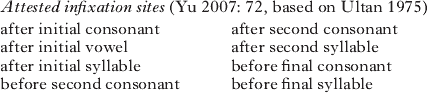
However, Ultan notes one important complication in his survey involving this particular infixation site. He writes: ‘The environment ‘following the first syllable’ as described in various sources is somewhat misleading. In all examples cited, this is equivalent to ‘following the first vowel’' (Ultan Reference Ultan and Seiler1975: 165). While there are in fact numerous examples in his survey illustrating infixation after the first vowel, there were no unambiguous examples illustrating infixation after the first syllable. Since Moravscik based her conclusions on the data in Ultan's study, neither Ultan nor Moravscik provides clear examples of infixation after the first syllable.
2.2 A predictive theory of infixation sites
Yu (Reference Yu2003, Reference Yu2007) conducted a typological study looking at 154 infixation patterns from 111 languages in 26 different phyla. Based on data from his survey, he argues for a theoretical approach to infixation which involves affix-subcategorisation frames for phonological units. He refers to these phonological units as pivots, and presents a predictive theory of the locations in which infixation can occur. He argues that there is an inductive bias in morphological learning towards phonological subcategorisation frames based on psycholinguistically or perceptually salient phonological units. He captures this notion in the Salient Pivot Hypothesis, which states that ‘phonological pivots must be salient at the psycholinguistic and/or phonetic level’ (Yu Reference Yu2007: 68).
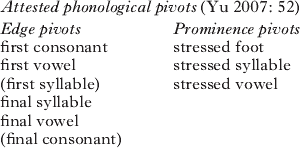
On the basis of the Salient Pivot Hypothesis, Yu predicts two types of pivots: edge pivots and prominence pivots. Edge pivots are those phonological units determined with respect to the edge of a stem, while prominence pivots are those phonological units determined with respect to a stressed unit. He points out that the list of well-attested pivots in his survey is a subset of those pivots which are predicted by the Salient Pivot Hypothesis. Although his theory predicts the existence of a first-syllable pivot and a last-consonant pivot, he was unable to find conclusive evidence demonstrating the existence of these pivots. The list of pivots predicted by Yu is given in (2). The pivots listed in parentheses are predicted by his theory, but have yet to be clearly established, due to a lack of conclusive examples.
-
(2)
2.3 Previous evidence for infixation after the first syllable
Although Yu ultimately concludes that the data found in his survey is insufficient to clearly establish the existence of a first-syllable pivot, his work provides the most recent attempt to identify examples which clearly demonstrate the existence of this infixation site. He considers three potential cases, Mandarin, Koasati and Cantonese. Two of these potential cases of infixation, Mandarin /li/ (Chao Reference Chao1968) and Koasati /ho/ (Kimball Reference Kimball1991), involve morphemes which only occur with a very limited set of stems. As such, Yu ultimately rejects these examples, due to the restrictedness of the pattern.
The third potential case he considers comes from Cantonese, and involves two types of infixation. The first type, shown in (3), involves the word /kwɐi/ ‘ghost’, which ‘may appear inside certain monomorphemic disyllabic adjectives to signify intensification’ (Yu Reference Yu2007: 134).
-
(3)

The second pattern involves the appearance of interrogatives /mɐtkwɐi/ or /mɛ/ ‘what’ inside words to indicate speaker uncertainty, as in (4).
-
(4)
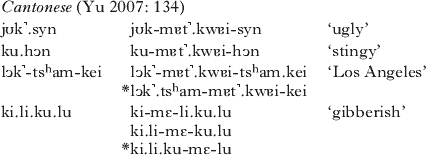
However, Yu (Reference Yu2003, Reference Yu2007) and Samuels (Reference Samuels2010) draw attention to a possible alternative analysis, involving infixation at the boundary of a metrical foot, a better-established pivot. Cantonese metrical feet are typically monosyllabic (Wong et al. Reference Wong, Chan, Beckman and Jun2005), which is consistent with the occurrence of an infix after the first syllable. Furthermore, variation occurs in some quadrisyllabic words (e.g. /kilikulu/ in (4)), suggesting that perhaps the infix is placed with respect to the first prosodic constituent, either a foot or a syllable. Given this, Samuels (Reference Samuels2010) endorses an analysis involving infixation at the boundary of a metrical foot, while Yu (Reference Yu2007: 133–135) considers the example suggestive, but ultimately insufficient to establish a first-syllable pivot conclusively. Given the lack of unambiguous evidence for the existence this site, I turn now to the Yeri data.
3 Yeri preliminaries
Yeri is a severely endangered Papuan language spoken in Sandaun Province, Papua New Guinea, about 40 km south-south-east of Aitape. The language is spoken in a single village, labelled ‘Yapunda’ on most maps, and is classified as a member of the Torricelli phylum (Laycock Reference Laycock1968, Wurm Reference Wurm and Moseley2007, Lewis et al. Reference Lewis, Simons and Fennig2014).Footnote 1 All data is from my own fieldwork. The only literature previously published on the language is Laycock (Reference Laycock1968), which includes a ten-word vocabulary list.
3.1 Syllabic structure
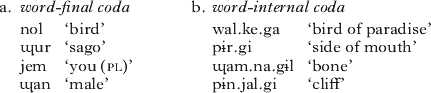
Given the topic of this paper, it is useful to note the tests for syllabic structure in Yeri. These generally involve either phonotactic constraints or the distribution of allophones. While Yeri contrasts /p t k b d g s m n ŋ l r j w ɰ/ in onset position, the only coda consonants are /l r m n/, exemplified in (5). In particular, verb roots have only liquid codas.Footnote 2
-
(5)
Yeri also permits certain sequences of onset clusters, most notably obstruents followed by liquids or glides.Footnote 3 Other sequences of consonants trigger the insertion of the epenthetic vowel [ɨ] (e.g. /plokwa/ [plokwa] ‘mud’, but /m-nania/ [mɨnania] ‘I go into’). Additionally, several tautosyllabic vowel sequences are permissible, including /ai ei oi ui io ia ua au ou/.
Allophonic evidence for syllabic structure is available for several phonemes. Specifically, the vowel /a/ is pronounced as [ɛ] when it is followed by an /l/ in coda position (e.g. /pala/ ‘branch’, /pala-l/ [pa.lɛl] ‘branches’), while /i/ is pronounced as [ɨ] in closed syllables (e.g. /lapaki/ ‘tong’, /lapaki-lgal/ [la.pa.kɨl.gɛl] ‘tongs’). Some consonants also provide allophonic evidence for syllabic structure. Voiced plosives are always prenasalised following vowels (e.g. /abor/ [a.mbor] ‘finish’). However, voiced plosives which do not follow vowels are not prenasalised (e.g. /alba/ [ɛl.ba] ‘touch’).
3.2 Verbal structure
In addition to tests for syllabic structure, an overview of basic verbal structure is necessary. (6) gives the relevant verbal template.
-
(6)

Subject prefixes precede 1st or 2nd person object prefixes, and 3rd person objects are typically indicated by suffixes.Footnote 4 Within the verb stem, realis and irrealis mood are signalled by the vowel quality of the first vowel in the verb stem. The /o/ of /gorwedi/ ‘follow’ signals realis mood, while irrealis mood would be indicated by a /ɨ/ in this position (i.e. /gɨrwedi/).
There are two additional morphemes which occur within the verb stem: (i) an imperfective /m/ morpheme and (ii) an additive /p/ morpheme, often translated as ‘also’. Both morphemes are productive, occurring with almost all verbs, and are located after the first syllable of the verb stem. The next section is devoted to providing evidence that these morphemes should be analysed as infixes, and that Yeri imperfective and additive morphemes provide evidence of the existence of infixation after the first syllable.
4 Yeri infixes occur after the first syllable of the verb stem
4.1 Defining infixation
Before examining Yeri imperfective and additive morphemes in detail, it will be useful to first identify exactly what defines a morpheme as being an infix. In his seminal article on infixation, Ultan (Reference Ultan and Seiler1975: 159) defines an infix as ‘a continuous morph (or morpheme) which is inserted into another morph thus turning the latter into a discontinuous morph’. More recently, Moravcsik (Reference Moravcsik, Booij, Lehmann and Mugdan2000: 545) has proposed a somewhat looser definition, whereby an infix can be considered ‘an affix which is positioned inside the base such that the preceding and following portions are not meaningful by themselves’. Yu (Reference Yu2007: 10) defines an infix along the same lines as Moravcsik. He writes: ‘an affix [is] infixing if it appears as a segmentally distinct entity between two strings that form a meaningful unit when combined but do not themselves exist as meaningful parts’.
Helmbrecht & Lehmann (Reference Helmbrecht, Lehmann, Harrison, Rood and Dwyer2008) point out that the above notions correspond to slightly different notions of infix, with Ultan's definition specifying that an infix must occur within a morph, while Moravcsik's definition allows for the possibility that the base may be composed of two ‘submorphemic’ components, components which may appear in other contexts without a stable meaning. Helmbrecht & Lehmann (Reference Helmbrecht, Lehmann, Harrison, Rood and Dwyer2008: 282) propose that the notion of ‘infix’ be more restrictive, defining an infix as ‘a simple [continuous] affix that is inserted into a root’. For morphemes which occur within a stem at an internal morphological boundary, they suggest the term ‘interfix’.
The distinction Helmbrecht & Lehmann make between ‘infix’ and ‘interfix’ can be viewed as roughly corresponding to the distinction between an infixal analysis and a bipartite stem analysis as described in Bickel & Nichols (Reference Bickel, Nichols and Shopen2007: 199), who state: ‘infixation places formatives into a phonologically or prosodically defined environment’.Footnote 5 This is in opposition to a bipartite stem analysis, which would assume that the location is determined morphologically, as described in their definition of a bipartite stem:
A bipartite stem is a stem where only part, but not the whole, is the target of morphological rules (affixation, reduplication, mutation, particle hosting, etc.), and the location of the boundary between the two parts is morphologically defined, i.e. neither semantically (e.g. by scope as in the juxtaposition of independently inflected stems) nor phonologically (e.g. by syllable structure as with infixation) (Bickel & Nichols Reference Bickel, Nichols and Shopen2007: 199).
For my purposes, it is enough to demonstrate that the Yeri imperfective and additive morphemes should be classified as ‘infixes’ under the definitions proposed by Moravcsik, Yu and Bickel & Nichols.Footnote 6 To do this, I provide evidence for the following statements: (i) the imperfective and additive morphemes occur within another morpheme, (ii) the location of the imperfective and additive morphemes is phonologically predictable and (iii) the imperfective and additive morphemes are not positioned at a morpheme boundary. For simplicity, I focus on demonstrating the infixal status of the imperfective morpheme. Since the imperfective morpheme and the additive morpheme occur in the same position, it is possible to then extend any conclusions regarding the status of the imperfective morpheme to the additive morpheme.
4.2 The imperfective morpheme occurs within another morpheme
There is clear evidence that the imperfective morpheme occurs within another morpheme, specifically the verb stem. Examples like (7) establish that verb stems such as /altou/ ‘cover’ and /nania/ ‘go in’ occur as continuous morphs in the language. Furthermore, there is no evidence for a bipartite stem analysis of these roots.Footnote 7
-
(7)
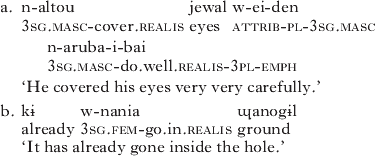
When these verbs occur in the imperfective, the imperfective morpheme occurs within the verb stem, as in (8). Infixes are enclosed by < >.
-
(8)
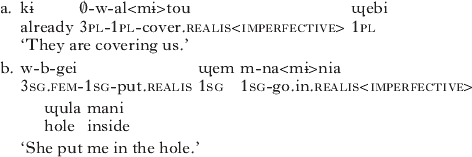
4.3 The location is phonologically predictable
In this section, I present a brief description of the allomorphy and morphophonological processes involved in Yeri imperfective and additive marking, and argue that a unified analysis is possible, pinpointing a single location which is phonologically predictable. The two morphemes display a range of allomorphy, summarised in (9).
-
(9)

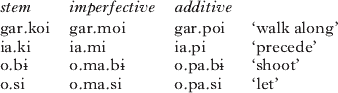
Both /-C-/ and /-Ca-/ allomorphs are much less frequent than the /-Ce-/ allomorph and must be lexically specified. Note that many verbs which select a /-C-/ allomorph show deletion of an immediately following /k/. Examples of verbs which select for these allomorphs are provided in (10).
-
(10)
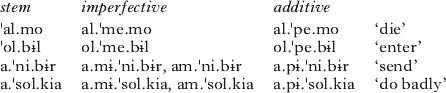
It is worth noting that the vowel /e/ in Yeri frequently undergoes vowel reduction or deletion when it occurs in unstressed or closed syllables. For this reason, the /-Ce-/ allomorph is often pronounced as [-Cɨ-] (with the reduced vowel [ɨ]) or as [-C-] (with complete deletion of /e/), where deletion does not result in a prohibited syllabic structure.Footnote 8 For example, nasals are acceptable codas, but obstruents are not. As such, the /e/ in the imperfective morpheme is frequently reduced or deleted, as in [o.mɨ.ˈni.ga] or [om.ˈni.ga] ‘singing’, while the /e/ in the additive morpheme is reduced rather than deleted as in [o.pɨ.ˈni.ga] ‘also sing’. Examples of the /-Ce-/ allomorph with disyllabic and trisyllabic verbs are given in (11).
-
(11)
Finally, when imperfective and additive morphemes occur with the few monosyllabic verbs in Yeri, the morphemes immediately follow the first and only syllable of the verb stem.Footnote 9 For example, /or/ ‘sleep’ has an imperfective form /or.me/ and an additive form /or.pe/.
In summary, all imperfective and additive allomorphs can be described as targeting a single phonological position: after the first syllable of the verb stem. This location is particularly clear from verbs which are trisyllabic and which have a first-syllable coda, as in /altobɨ/ ‘force’ (imperfective /al.mɨ.to.bɨ/) or /dalkoki/ ‘look for’ (imperfective /dal.mo.ki/) As such, there appears to be strong evidence that the location of the imperfective and additive morphemes is phonologically predictable.
4.4 The imperfective morpheme is not at a morpheme boundary
Neither the portion of the verb stem which precedes the imperfective morpheme nor the portion of the verb stem which follows has any meaning on its own. Consider the verb /dogɨr/ ‘to carry in a bilum (a string bag)’. Its imperfective form is /domegɨr/. Yeri speakers do not recognise a meaning when only /do/ or /gɨr/ is provided. It is only when /do/ and /gɨr/ occur together as /dogɨr/ that speakers understand them as having a meaning. As such, it is not possible to analyse /dogɨr/ as decomposable into two individual morphemes, with the imperfective morpheme occurring at the morphological boundary between them. The same is the case for almost all of the approximately 330 verbs in my current lexicon.Footnote 10
Despite this, it could be argued that because the /o/ in /dogɨr/ indicates realis mood, the imperfective morpheme is located with respect to this morpheme boundary. However, about one-quarter of the verbs I have collected involve first-syllable codas. In these verbs, the imperfective morpheme does not occur immediately following the realis vowel. For example, the imperfective form of /almo/ in (11) is /al.me.mo/, indicating that the location of the morpheme is phonologically conditioned (i.e. after the first syllable), rather than morphologically conditioned (i.e. after the realis vowel). Additional examples where the imperfective morpheme can only be described as occurring after the first syllable (and not after the realis or irrealis vowel) are presented in (12).
-
(12)
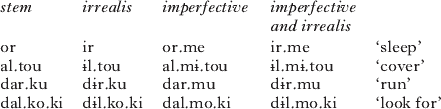
It could be argued that for those verbs which do not have a first-syllable coda, like /a.lia/ ‘drop’, the location of the imperfective morpheme is in fact morphologically conditioned, and the morphemes occur after the realis or irrealis vowel (e.g. imperfective realis /a.mɨ.lia/; imperfective irrealis /ɨ.mɨ.lia/). However, this would then require an arbitrary distinction between verbs with first-syllable codas, where morpheme positioning would be phonologically conditioned, and verbs without first-syllable codas, where morpheme positioning would be described as morphologically conditioned. Given that imperfective morpheme positioning can be generalised as occurring after the first syllable of the verb stem for all verbs, it is unclear what would be gained by analysing verbs without first-syllable codas separately from those where initial syllable codas occur.
4.5 Summary
I have provided evidence that the Yeri imperfective morpheme and, by extension, the Yeri additive morpheme (i) occur within another morpheme, (ii) occur in a phonologically predictable location and (iii) are not positioned at a morpheme boundary. Given this, the Yeri imperfective and additive morphemes can be classified as infixes under the definitions proposed by Moravcsik and Yu, as well as by Bickel & Nichols. Furthermore, Yeri imperfective and additive infixes target a single infixation site: after the first syllable of the verb stem.
5 Is infixation after the first syllable the best analysis?
Although Ultan (Reference Ultan and Seiler1975), Moravcsik (Reference Moravcsik, Booij, Lehmann and Mugdan2000) and Yu (Reference Yu2003, Reference Yu2007) all expect to find infixation after the first syllable, ‘empirical data supporting this prediction is famously difficult to find’ (Samuels Reference Samuels2010: 135). This is due to the acceptability of alternative analyses for all of the potential examples considered in the literature, especially those involving well-established infixation sites, e.g. after the first vowel or at the boundary of a metrical foot.
Given the frequent occurrence of Yeri imperfective and additive morphemes following closed first syllables, an analysis of infixation after the first vowel is easily ruled out. However, it is worth demonstrating the unacceptability of an analysis involving infixation at the boundary of a metrical foot.
The best evidence for Yeri metrical structure comes from stress, which is typically realised as greater duration of the stressed syllable. Regular stress in Yeri is penultimate, with secondary stress on alternate syllables preceding the penultimate syllable (e.g. /ˈno.gɨl/ ‘village’, /ɰar.ˈkro.kɨ/ ‘chicken’, /ˌmo.ni.ˈke.ta/ ‘water snake’). As such, the Yeri stress system seems best analysed as involving a syllabic trochee, where feet are disyllabic and are stressed on the first syllable.
An analysis positioning the infixes with respect to a metrical foot would therefore predict that these infixes should occur at the boundary of a disyllabic trochaic foot. For trisyllabic verbs such as /asolkia/ in (11), this account can correctly predict the location of the infix. The verb would be footed as /a(ˈsolkia)/, and the imperfective infix would be inserted at the left boundary of the foot (i.e. /a.mɨ.sol.kia/).
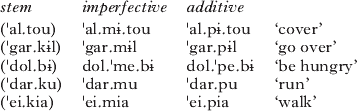
However, complications in a metrical foot analysis arise when we consider monosyllabic verbs. The monosyllabic verb /or/ in (12) would be footed as /(ˈor)/. However, unlike the trisyllabic verbs, where the imperfective morpheme must be inserted at the left boundary of the foot, the imperfective morpheme must be inserted at the right edge of the foot to give the correct form (i.e. /ˈor.me/).
The problems of a metrical foot analysis are even more clearly demonstrated by disyllabic verbs in Yeri. Since Yeri stress involves disyllabic trochaic feet, disyllabic verbs consist of a single foot. A metrical foot analysis would predict that the imperfective and additive morphemes should either precede or follow the entire verb stem. As shown in (13), this is incorrect. An analysis involving metrical feet is therefore unable to account for the position of the imperfective and additive morphemes in disyllabic verbs. Rather, the location is best described as after the first syllable of the verb stem.
-
(13)
Given that the primary goal of this article is to demonstrate the existence of infixation after the first syllable and the need for its inclusion in a typology of infixation sites and phonological pivots, I refrain here from a full formal analysis of Yeri infixation. Instead I note only that this appears to be best analysed as a case of phonological subcategorisation, whereby an infix is aligned with a phonological unit (Inkelas Reference Inkelas1990, McCarthy & Prince Reference McCarthy and Prince1996, Paster Reference Paster2006, Yu Reference Yu2007). It should also be pointed out that an adequate analysis of Yeri infixation must also be able to account for why verbs with first-syllable codas like /al.mo/ have an infixed form /al.me.mo/, rather than /a.mel.mo/. In other words, there is a correspondence between the first syllable of the infixed verb stem and the first syllable of the non-infixed verb stem. A formal analysis of Yeri infixes must account for this behaviour, perhaps by reference to an output–output correspondence relation (Benua Reference Benua1997), as suggested by a referee.
6 Conclusion
Considering the productivity of the Yeri imperfective and additive morphemes and their predictable location based on a phonological environment within the verb stem, it seems necessary to classify the morphemes as infixes. Furthermore, common alternative analyses involving infixation after the first vowel or infixation at the boundary of a metrical foot are unable to account for the pattern found in Yeri infixation. As such, an analysis involving an infixation site of ‘after the first syllable’ appears necessary to account for the Yeri data. For this reason, Yeri provides evidence that such an infixation site does in fact exist. In addition, the Yeri data demonstrates the need to include the first syllable in a typology of phonological pivots, as predicted by Yu's Salient Pivot Hypothesis.


