In the early hours of November 1, 1755, the pious population of Lisbon was attending the celebrations of All Saints Day when a powerful earthquake violently shook the western and southern parts of the country. The earthquake was centered southwest of the Algarve region (about 300 km away from the Portuguese capital), and it was felt in a wide area, from southern Spain and northern Africa, to France, Italy, and Britain.Footnote 2 The earthquake hit in three distinct jolts that started at 9:30 am and lasted for about nine minutes, being one of the most violent and longest earthquakes on record, with an estimated intensity of 8.7 on the Richter scale. Many of the survivors fled to the streets in panic only to be swallowed by a giant wave that swept the harbor a few minutes later.Footnote 3 Effects from the tsunami were felt all across the Atlantic Ocean, from Western Europe to the Americas. In Lisbon, the final blow came when the debris in many of the buildings was ignited by the remains of candles and by looters, giving rise to an intense fire that lasted for five days and destroyed most of the Portuguese capital. When all was done, one of the largest and richest European cities was almost completely destroyed.
In the eyes of the contemporaries, the destruction was of apocalyptic proportions, sparking a vigorous debate in Europe on the causes of the earthquake in the years that followed, in which many of the most influential thinkers of the European Enlightenment intervened, like Rousseau, Voltaire, and Kant. Russell Dynes argues that the 1755 Lisbon earthquake can be characterized as the first “modern” disaster, due to the unprecedented coordinated state emergency response and because it was a turning point for a more scientific explanation of natural hazards.Footnote 4
In spite of its magnitude and repercussions, the existing literature has tended to downplay the role of the disaster for Portugal's economic woes and subsequent reforms in the late eighteenth century. Estimates of the earthquake are mostly sketchy and rely to a certain extent on anecdotal data. Using new archival and existing data, this article tries to remedy this lacuna in the literature by estimating the economic impact of the 1755 earthquake. The article proceeds as follows. Section 2 examines the main direct effects of the disaster, providing new estimates of casualties, of the total GDP loss, and of the impact on prices and wages. Section 3 analyzes the long-term impact of the disaster, focusing on the institutional changes that followed the tragedy. This section argues that the 1755 Lisbon earthquake provided an opportunity to reform the economy. The long-term performance of the Portuguese economy benefited accordingly, and the situation of economic semi-dependency vis-à-vis Britain was reduced. All in all, the conclusions of this article suggest that some natural hazards might have long-term economic effects, corroborating the findings of recent works by Mark Skidmore and Hideki Toya and by Kerry Odell and Marc Weidenmier.Footnote 5
THE DIRECT EFFECTS
I begin by estimating the direct effects of the earthquake, including the casualties and the impact on GDP. I also examine its impact on prices at the regional level, using new data on builders' wages.
Impact on Population
Estimates of the death and casualty tolls of the 1755 earthquake vary tremendously, ranging from 10,000 to almost 100,000 in Lisbon alone. The widely divergent figures are partly due to the lack of reliable estimates of the Portuguese population before 1755.Footnote 6 The problem is compounded by the government's decision (taken because of fears of plague and disease) to dispose of the corpses swiftly, by burying them in mass graves or throwing them into the open sea. Many people also changed parishes after the earthquake.
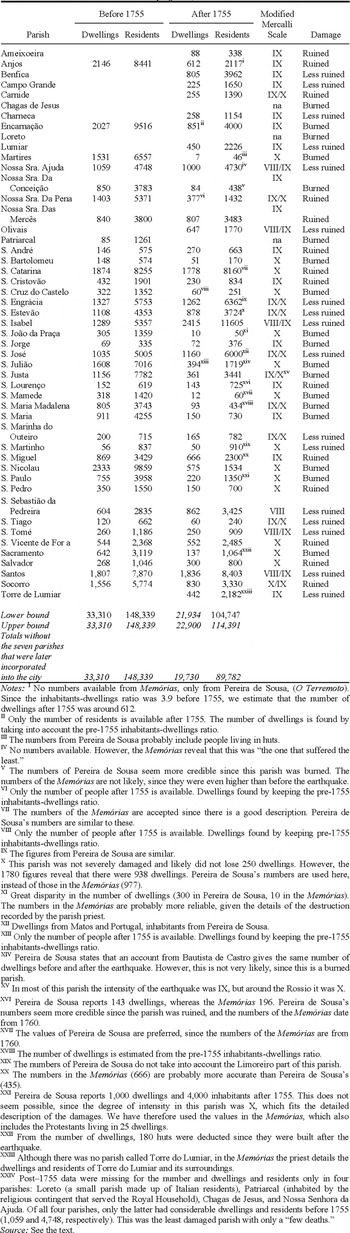
The uncertainty surrounding the casualty toll obscures any estimate of the earthquake's human impact and the damages it caused. In order to get a better picture of the casualty toll, we have created new estimates of the population and the number of dwellings by combining several sources and by correcting some of the existing estimates. The sources used were the 1758 “Parish Memories” (Memórias Paroquiais), as well as the works of Alfredo de Matos and Fernando Portugal and Pereira de Sousa.Footnote 7 These sources were combined to produce Table 1, which shows the number of dwellings and residents before and after 1755 in all Lisbon parishes plus seven others that were later incorporated into
EARTHQUAKE DAMAGE BY PARISH: (freguesia)

Notes:
I No numbers available from Memórias, only from Pereira de Sousa, (O Terremoto). Since the inhabitants-dwellings ratio was 3.9 before 1755, we estimate that the number of dwellings after 1755 was around 612.
II Only the number of residents is available after 1755. The number of dwellings is found by taking into account the pre-1755 inhabitants-dwellings ratio.
III The numbers from Pereira de Sousa probably include people living in huts.
IV No numbers available. However, the Memórias reveal that this was “the one that suffered the least.”
V The numbers of Pereira de Sousa seem more credible since this parish was burned. The numbers of the Memórias are not likely, since they were even higher than before the earthquake.
VI Only the number of people after 1755 is available. Dwellings found by keeping the pre-1755 inhabitants-dwellings ratio.
VII The numbers of the Memórias are accepted since there is a good description. Pereira de Sousa's numbers are similar to these.
VIII Only the number of people after 1755 is available. Dwellings found by keeping pre-1755 inhabitants-dwellings ratio.
IX The figures from Pereira de Sousa are similar.
X This parish was not severely damaged and likely did not lose 250 dwellings. However, the 1780 figures reveal that there were 938 dwellings. Pereira de Sousa's numbers are used here, instead of those in the Memórias (977).
XI Great disparity in the number of dwellings (300 in Pereira de Sousa, 10 in the Memórias). The numbers in the Memórias are probably more reliable, given the details of the destruction recorded by the parish priest.
XII Dwellings from Matos and Portugal, inhabitants from Pereira de Sousa.
XIII Only the number of people after 1755 is available. Dwellings found by keeping the pre-1755 inhabitants-dwellings ratio.
XIV Pereira de Sousa states that an account from Bautista de Castro gives the same number of dwellings before and after the earthquake. However, this is not very likely, since this is a burned parish.
XV In most of this parish the intensity of the earthquake was IX, but around the Rossio it was X.
XVI Pereira de Sousa reports 143 dwellings, whereas the Memórias 196. Pereira de Sousa's numbers seem more credible since the parish was ruined, and the numbers of the Memórias date from 1760.
XVII The values of Pereira de Sousa are preferred, since the numbers of the Memórias are from 1760.
XVIII The number of dwellings is estimated from the pre-1755 inhabitants-dwellings ratio.
XIX The numbers of Pereira de Sousa do not take into account the Limoreiro part of this parish.
XX The numbers in the Memórias (666) are probably more accurate than Pereira de Sousa's (435).
XXI Pereira de Sousa reports 1,000 dwellings and 4,000 inhabitants after 1755. This does not seem possible, since the degree of intensity in this parish was X, which fits the detailed description of the damages. We have therefore used the values in the Memórias, which also includes the Protestants living in 25 dwellings.
XXII From the number of dwellings, 180 huts were deducted since they were built after the earthquake.
XXIII Although there was no parish called Torre do Lumiar, in the Memórias the priest details the dwellings and residents of Torre do Lumiar and its surroundings.
XXIV Post–1755 data were missing for the number and dwellings and residents only in four parishes: Loreto (a small parish made up of Italian residents), Patriarcal (inhabited by the religious contingent that served the Royal Household), Chagas de Jesus, and Nossa Senhora da Ajuda. Of all four parishes, only the latter had considerable dwellings and residents before 1755 (1,059 and 4,748, respectively). This was the least damaged parish with only a “few deaths.”
Source:
See the text.
the city.Footnote 8 The latter were included to see whether or not there was an exodus from the city after the disaster and to control for population losses. The last two columns of Table 1 present the degree of intensity in the Modified Mercalli Scale (MMS) and the damage sustained as estimated by Pereira de Sousa.Footnote 9 The last three rows show upper bound and lower bound estimates of the total number of residents and dwellings before and after the earthquake. In order to account for possible population movements to the outskirts of the city (which were reported to have happened), these estimates include the totals from the seven parishes in the surrounding areas of Lisbon. Finally, the last row of Table 1 presents the estimated total of residents and dwellings without these seven parishes.
From table 1, it is apparent that the number of dwellings before 1755 was above 33,000 (which is consistent with the estimates of José Vicente Serrão), whereas, after 1755, the number of dwellings in the 38 parishes fell to about 20,000. This loss of about 13,000 houses is similar to that reported by José A. França. According to a 1758 account by Moreira de Mendonça, two-thirds of the city was rendered uninhabitable. Thus, besides the 13,000 destroyed, an additional 10,000 dwellings also sustained substantial damage.Footnote 10Table 1 also shows a more accurate account of the human losses of the disaster. I should emphasize that the total number of residents does not include children less than 7 years old, since the source from the parishes excludes children who did not yet receive the sacraments (rol de confessados). Thus, the 148,339 residents of Lisbon in Table 1 for 1755 correspond to a true total of about 160,000 to 200,000 inhabitants in all.Footnote 11 After the earthquake, the number of residents falls to 114,391 in our upper-bound estimate and to 104,747 in our lower estimate. If I do not consider the seven parishes that were incorporated later, the number of residents is as low as 89,782. What is most striking about the human losses is that even if we assume that, say, 15,000 to 20,000 people left Lisbon altogether, there would be still more than 15,000 people dead without the children. Knowing that the children were around one-fifth of the casualties suggests that the number of deaths in Lisbon alone was between 20,000 and 30,000.Footnote 12
Besides Lisbon, there were many other towns and villages that were greatly affected by both the earthquake and the tsunami, such as the harbor towns of Cascais (514 deaths), Setúbal (more than 1,000 deaths), and Peniche (more than 50 people engulfed by the sea).Footnote 13 In the Algarve, the closest region to the epicenter of the earthquake, the devastation was even greater. There are several reports stating that Albufeira, Faro, Lagos, Alvor, Quarteira, and Portimão were almost totally destroyed by the tsunami and the earthquake, which in many places in the Algarve reached X and XI in the Medvedev-Sponheuer-Kárnik scale. Between 1,000 and 2,000 people died in the Algarve alone. The regions of the Alentejo, Ribatejo, and the Lisbon outskirts also reported hundreds of deaths.Footnote 14 All in all, the total death toll outside Lisbon is likely to have been between 1,500 and 3,000.
In Spain, the number of deaths was much lower. There were 1,214 deaths reported, although the number was likely considerably higher.Footnote 15 In contrast to Portugal, most Spanish deaths were tsunami-related. Information about the impact on Morocco is sparser and contaminated by another earthquake that affected the region in late November 1755. Some authors estimate that the Lisbon earthquake and the resulting tsunami might have killed about 10,000 people, and destroyed the cities of Fez and Tanger. All in all, the 1755 earthquake and the resulting tsunami and fires caused between 35,000 and 45,000 deaths in Portugal, Spain, and Morocco.
IMPACT ON GDP
The impact on GDP is harder to assess, since often the estimated losses are either not credible or exaggerated. In Lisbon alone, the losses were dramatic. Not only did two-thirds of the city become uninhabitable, but also virtually all biggest buildings were destroyed: 86 percent of its 40 churches and of its 75 convents and monasteries were ruined. This destruction took place in one of the richest and opulent cities of eighteenth-century Europe, which was the main recipient of the huge gold and diamond inflows from Brazil.Footnote 16 In light of these immense riches, it is not surprising that the reports of the losses were catastrophic.
An anonymous French witness of the disaster estimates the following losses (all values in livres): 12,000 houses lost and 5,000 severely damaged; 32 parochial churches; 60 small private churches; 22 men monasteries; 21 women convents; 53 palaces; nine public buildings with an estimated value of 20 million; furniture lost, 1,200 million; interiors of churches (sacred vases, ornaments, furniture, statutes, etc.), 32 million; diamonds and jewelry lost, 80 million; and the losses incurred by foreigners at 260 million (of which the English lost 160 million). According to this account, around 1,500 million livres tornois (more than 266,000 contos) were lost to the disaster.Footnote 17 Another anonymous source estimates the overall losses at about 120,000 contos, although no detailed amounts are presented.Footnote 18 One of the most popular works in the 1750s assessed the losses as follows: 12,000 dwellings, each valued at 960,000 reis (0.96 contos); the Terreiro do Paço area, 4,000 contos; money lost, 4,000 contos; gold, silver, diamonds, libraries, and furniture valued at 210,000 contos; and losses sustained by foreigners, 38,400 contos (of which the British lost more than 25,600 contos).Footnote 19 More recent estimates decrease the losses, although the values are still very considerable. Carlos Estorninho uses British consular sources to estimate a total loss of about 86,000 contos, of which more than 40 percent belonged to foreigners. José Luís Cardoso combines the estimates from the contemporary accounts with trade data for 1755 to get an estimate of between 100 and 150,000 contos.Footnote 20 Since the estimates for Portuguese GDP in the 1750s are between 150,000 contos and 200,000 contos, the total direct losses vary between 43–57 percent, 75 percent, 115–153 percent, and 133–178 percent of Portuguese GDP.Footnote 21
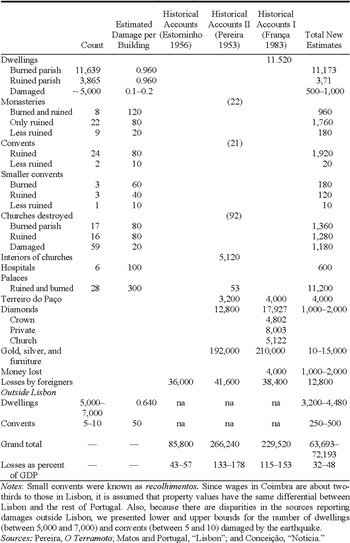
In the face of such wide estimates and since other losses were not taken into account for these calculations (e.g., the palaces and the churches), new estimates were found by using different sources. The losses of dwellings were calculated from Table 1. Based on archival work from records of houses demolished in the city center, an average dwelling was established at 0.96 contos.Footnote 22 In addition, although the wealth of the churches and convents varied dramatically, an average value for convents and churches was estimated from the reports of the losses in the Memórias Paroquiais and in Pereira de Sousa's classic work.Footnote 23 On average, monasteries were assumed to be worth 300,000 cruzados (120 contos), convents 200,000 cruzados, hospitals 250,000 cruzados, and churches 200,000 cruzados. These estimates (which were adjusted for the degree of damage sustained) seem consistent with the losses to church interiors and buildings reported by Ângelo Pereira of about 5,000 contos.Footnote 24 Palaces also varied tremendously in their value, but were estimated at 300 contos each. The total losses in the Terreiro do Paço include the Royal Palace, the Patriarchal, a brand new sumptuous opera house, the Customs House, a new stone quay, and several storage buildings. Contemporaries' accounts estimated that the losses for the Terreiro do Paço came to 4,000 contos.Footnote 25
Some of the greatest damages, according to contemporaries, were diamonds, gold, silver, furniture, and foreigners' goods. We have therefore given special attention to such goods. For diamonds, one of the few reliable contemporary sources (the priest Manuel Portal) argued that just in the earthquake- and tsunami-ravaged India House there were “11 to 12 million [cruzados] in diamonds,” equivalent to 1,920 contos. If these estimates were correct, 1.5 percent of the Portuguese GDP was lost just with the diamonds at the India House. Even more dramatic, other contemporary accounts claim that the total losses in diamonds alone were about 18,000 contos, equivalent to 10–15 percent of Portuguese GDP.Footnote 26 Given the lack of reliable statistics for the period, the only feasible way to check these numbers is to compare them with existing figures for the extraction and sale of diamonds. Diamonds were discovered in Brazil in the 1720s, in 1734 a formal diamond region (the Tijuco) was created, and, from 1740 onwards, the Portuguese government granted monopoly rights for its exploitation based on a series of contracts. From 1740 to 1755, the total value of diamonds extracted amounts to 6,447 contos.Footnote 27 Even if we allow for smuggling, it is likely that only a small part of this would end up in Portugal. From the total value extracted, we should subtract the diamonds sold in Europe, which amounted to 857 contos. Assuming that the quantity of diamonds from non-Brazilian sources was not significant, the total value of the diamonds did not exceed 5,000 contos, which is substantially lower than the claims of the contemporaries of the earthquake. Even the figures for the India House are certainly overestimates, since the total extracted value for 1754/55 is only about 1,000 contos, of which more than 800 contos were sold to European traders. All in all, even if we assume that the Royal Household, the church, and other individuals lost a great part of their diamonds in the disaster, it is very unlikely that these losses totaled more than one- or two-fifths (1,000 to 2,000 contos) of the total value of the diamonds that existed in Portugal.
Although we do not have reliable figures for the losses of gold, silver, and furniture by private individuals, as it happened with diamonds, it is extremely unlikely that the estimates by the contemporaries of the disaster are credible. In fact, there were many reports of robberies during this period, and it is likely that most of the gold and silver just changed hands. Therefore, and since many of these losses are already accounted for in the damages done to palaces and religious buildings, they are estimated to amount to between 10,000 and 15,000 contos. The same reasoning applies to the money lost. It is usually assumed by the historical accounts that the losses included those of the mint of about 2 million cruzados worth of bullion. However, it is known that the mint escaped from the earthquake, the fire, and the mob, due to the prompt intervention of some dedicated soldiers. The Pombal government also acted swiftly to protect it by ordering guards to be placed in the royal treasuries on November 3, 1755. Rita Martins de Sousa's work on the Portuguese money supply reveals that, in spite of the large fire, there was only a small amount of recoinage (0.09 contos in 1755, and 40 contos in 1756).Footnote 28 All in all, it is likely that the bulk of the money lost mostly changed hands or was overestimated, and hence a value between 1,000 and 2,000 contos seems reasonable.
Similarly, the amount lost by foreigners is also greatly exaggerated. Although the losses were high, they were not as catastrophic as the initial reports from the British merchants indicated. In January 1756 British Consul Edward Hay reported that “the loss our trade has sustained is very great, but I am very far from thinking it total.”Footnote 29 Many of the ships and some storage buildings owned by foreigners in Lisbon were not destroyed by the disaster, and according to Hay, the British losses were mostly cargoes and gold in the Customs House and warehouses near the Tagus River, whereas much of the money lost was recovered by the merchants. Charles R. Boxer argues that the main financial losses sustained by the British merchants were the “unavoidable repudiation of their debts by many Lisbon shopkeepers, who were completely ruined by the earthquake. But this local trade was not the most profitable part of the British investment.”Footnote 30 Even Hay contends that most of the debts could still be recovered, especially those owed by merchants involved in the Brazilian trade. Obviously, unrecoverable debts should not be included in the final calculations of the earthquake aggregate losses, since the British losses were Portuguese gains. From the accounts by Boxer and Estorninho, it is likely that the losses sustained by the foreign community in Lisbon was about a third of what is reported in some of the historical accounts, or only 12,800 contos.
Finally, the number of dwellings and convents lost outside Lisbon is also included in the estimated losses. Table 2 summarizes the new estimates. The direct damage done by the 1755 earthquake comes to between 32 and 48 percent of the Portuguese GDP, a considerable amount and one that reflects the opulence and the riches of eighteenth-century Lisbon. The figure gives credence to the idea that the losses of the disaster were substantial, although not as catastrophic as many contemporary reports and existing estimates would lead one to believe.Footnote 31 An alternative calculation is to measure the impact of the losses by using estimates for income derived from the capital stock. If we assume, as Cardoso, that the capital-output ratio was around 4 percent, then the disaster caused a loss equivalent to 8–12 percent of the Portuguese capital stock.Footnote 32 A loss that is in the same order of magnitude to the loss of Brazil a few decades later.Footnote 33
PRICES
One major consequence of the 1755 earthquake was a dramatic change in prices, both at the national and regional level. In general, the change in prices was only transitory, but substantial volatility persisted for some time. This was especially true for staples, such as wheat, in regions such as Lisbon and the Algarve.Footnote 34 In Lisbon, the rise in staple prices surpassed even other more inflationary periods in the eighteenth century, such as the 1760s and the 1730s (Figure 1).
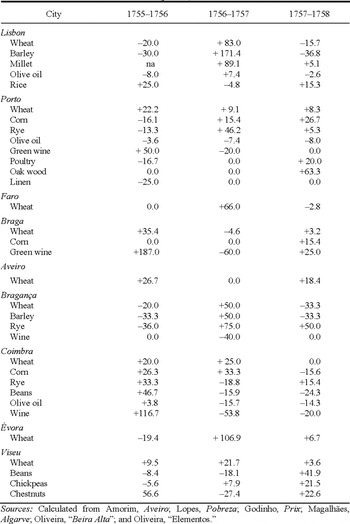
However, the rise in prices was not restricted to Lisbon. Table 3 summarizes these price changes in other cities and towns. In the first year after the earthquake, price controls imposed by the government seem to have had an effect, at least in the areas most affected by the earthquake. In fact, in Lisbon, the price of wheat and barley decreased, probably because of the price controls, which were most effective in the perimeter around the city. In contrast, in cities and towns such as Porto, Coimbra, and Aveiro, wheat prices increased by more than 20 percent, whereas in more remote areas like Bragança and Évora wheat prices declined. In general, the prices of other cereals declined between 1755 and 1756. In contrast, in the second year after the earthquake, the price ceilings were no longer effective, and cereal prices increased substantially in most markets. In Lisbon, this is particularly noticeable, since the price of wheat rose by 83 percent, barley by 171 percent,
LOSSES FROM THE EARTHQUAKE, FIRE, AND TSUNAMI (in contos)

Notes:
Small convents were known as recolhimentos. Since wages in Coimbra are about two-thirds to those in Lisbon, it is assumed that property values have the same differential between Lisbon and the rest of Portugal. Also, because there are disparities in the sources reporting damages outside Lisbon, we presented lower and upper bounds for the number of dwellings (between 5,000 and 7,000) and convents (between 5 and 10) damaged by the earthquake.
Sources:
Pereira, O Terramoto; Matos and Portugal, “Lisbon”; and Conceição, “Noticia.”
and millet by 89 percent. In all other regions, wheat prices rose substantially, as did the prices of other cereals. By the third year after the earthquake, cereal prices started to decline with respect to their previous levels. The amplitude of the price changes then subsided. The only exception was wood, whose price increased dramatically after the initial clean up of debris was completed in the center of Lisbon.
ANNUAL PRICE CHANGES IN LISBON, 1728–1800: (percent)

Prices of other construction materials also rose substantially after the disaster. The archives of the Lisbon Inquisition show that there was a dramatic increase in the price of whitewash. Between 1740 and 1755 the average price of whitewash was 1250 reis per moio, whereas between 1756 and 1757 it increased to 1950 reis per moio, a 55 percent increase relative to its pre-earthquake level. Aware of the shortage of this building material, on November 3, 1756 the Pombal government
ANNUAL PRICE CHANGES BY CITY, 1755–1758 (percent)

Sources:
Calculated from Amorim, Aveiro; Lopes, Pobreza; Godinho, Prix; Magalhães, Algarve; Oliveira, “Beira Alta”; and Oliveira, “Elementos.”
gave William Stephens a license to run a whitewash factory, with a grant of a privileged position in exchange for a promise to sell at a reasonable price. Boosted by the rise in supply, the price of whitewash fell, and by early 1758 it had returned to its pre-earthquake level of around 1250 reis per moio. Throughout the 1760s, the average price of whitewash oscillated between 1200 and 1500 reis per moio.
All in all, the earthquake had a substantial, albeit transitory, effect on prices of staples and construction materials, especially in the most affected regions.
WAGES
The earthquake also had a significant, albeit temporary, effect on wages, boosting the wage premium for construction workers. In the early days after the disaster, several accounts report an acute shortage of stonemasons and, especially, carpenters. The letters of the Pope's representative in Lisbon suggest that for several months there was a dire need for carpenters, and that it was difficult to find someone willing or able to work even to build a hut for the royal family to live in. The wages of construction workers rose sharply in the immediate days after the disaster. In Lisbon, in the decades prior to the earthquake, nominal wages for carpenters and masons were stable at 300 reis per day, while masters earned a daily wage of 350 reis. After the earthquake, there was a huge increase in demand for builders' services as more than 9,000 wooden huts were built around Lisbon. Not surprisingly, there were reports that: “In the first days [after the tragedy], one could not find a mason or a carpenter but soon enough there were double the number that existed before, since all wanted to learn such a job, mainly that of carpenter, and even if he were paid at 400 and 500 reis per day they could not be found.” Footnote 35 In spite of these anecdotal accounts, there is no consistent evidence about how wages behaved after the earthquake. Since we have no published wages for the period before 1766, original data had to be collected from archival sources. Although the earthquake destroyed many documents, there are still data sources available. For Lisbon, wages were gathered from both the archives of the Royal Household (Casa Real) and the Lisbon Inquisition. After 1766 the archival data were combined with the existing data from the Misericórdia de Lisbon collected by Nuno Madureira.Footnote 36 All series were consistent with each other, and they were consolidated to create a series of wages for construction workers (Figure 2).
WAGES FOR CONSTRUCTION WORKERS IN LISBON, 1722–1800: (reis per day)
In Lisbon, we have strong evidence of the impact that the earthquake had on the daily wages of the workers associated with the reconstruction, especially builders and carpenters. In the archives of the Inquisition, there are hundreds of weekly records of reconstruction orders and work from November 15, 1755 onwards. From those records, we can see that, initially, wages did not change, since carpenters and builders continued to earn 300 reis per day, whereas laborers were paid 200 reis. In April 1756 the shortage of laborers temporarily boosted their wage to 240 reis a day, but by November it had fallen back to 200 reis. By contrast, the wages of skilled workers did not rise initially, remaining at 300 reis for both carpenters and builders until the first weeks of June 1756. By June of 1756, however, the wages of these skilled workers started to increase. By the second week of June, carpenters were earning 330 reis, and from the third week onwards 350 reis. Wages keep climbing and by August several carpenters and stonemasons were already making 400 reis per day, which is more than what masters earned before the earthquake Wages between 350 and 400 reis became the norm for skilled construction workers until about the mid 1760s, but unskilled laborers' wages remained at 200 reis per day.Footnote 37
Using a price index assembled by Nuno Valério, I have also calculated real wages.Footnote 38 They improved briefly in the years following the disaster, but declined afterwards (Figure 3).
In regions less affected by the earthquake than Lisbon, wages did not show the same pattern of temporary increase after 1755. In Coimbra, 200 km north of Lisbon, wages for regular construction workers remained almost unaltered. Evidence from the archives of the University of Coimbra and the Misericórdia of Coimbra (an institution of welfare support) shows that there was only a small increase in nominal wages for master carpenters in 1756 and 1757. The wages of regular carpenters and stonemasons were unaffected, and, by 1758 wages were back to their previous levels (Figure 4).
INDIRECT EFFECTS AND LONG-TERM IMPACT
Although economic theory tends to characterize natural disasters as exogenous shocks that temporarily disrupt an economy, recent studies have shown that natural hazards can have long-term effects on economic performance. For instance, Skidmore and Toya use a sample of 89 countries for the 1960–1990 period and find that impact of natural hazards on economic growth varies by type of disaster. They argue that climate-related disasters tend to have a positive effect on growth, whereas geologic disasters have either a negative or insignificant impact. In turn, Odell and Weidenmier argue that the 1906 San Francisco earthquake had a substantial impact on financial markets, contributing to permanent changes in the institutional structure of the United States.Footnote 39 The 1755 Lisbon earthquake also seems to have had a considerable long-term impact, which significantly affected the long-run performance of the Portuguese economy.
REAL WAGES FOR CONSTRUCTION WORKERS IN LISBON, 1722–1800
It is generally agreed that the earthquake had a long-lasting political effect, as it increased the power of Sebastião José de Carvalho e Melo, better known as the Marquis of Pombal, who became the dominating figure in Portuguese politics until the death of the king, D. José I, in 1777. The mythology surrounding Pombal portrays him as an enlightened dictator who rescued Portugal from the asphyxiating influence of the church, the rent-seeking nobility, and economic dependency on Britain. In reality, Pombal was a controversial figure who defies simple characterization.Footnote 40 The earthquake was in any case the defining moment in his political life. In fact, as Nuno Monteiro and José Súbtil have amassed recently argued, it is very likely that without the political capital amassed during the recovery and relief efforts, Pombal would have lacked the political support necessary for the reforms he undertook during his 27 years in power.Footnote 41 In particular, it would have been impossible for him to persecute the Jesuits and to reduce the church's influence, and his nationalistic commercial and import-substituting policies would have been virtually impossible. In order to understand the prestige and power he acquired after the earthquake, we need to analyze his response to the 1755 disaster.
CONSTRUCTION WORKERS’ WAGES IN COIMBRA, 1687–1782: (in reis)
THE IMMEDIATE RESPONSE AND RECONSTRUCTION
The unparallel disaster in 1755 demanded a totally different response, which included measures to maintain public order and prevent looting, as well as efforts to prevent plagues, disease, and starvation. The most impressive feature of Pombal's response was the speed and the degree of centralization that he attained. From the outset, Pombal assumed a prominent position in the relief effort. Of the three secretaries of state in the government, Pombal was the only one able or willing to face the dimension of the tragedy. Caught by the surprise and magnitude of the tragedy, neither the king (who fled to the countryside) nor the other secretaries of state were capable or willing to act. In contrast, Pombal seized the opportunity by traveling around the devastated capital and organizing the relief effort from his carriage.Footnote 42 As Cardoso emphasizes, his most important immediate policy measures included disposing of corpses, removing rubble, repealing duties on foodstuffs, distributing food, imposing price and rent controls, establishing temporary hospitals for the sick and injured, preventing looting, improving water sanitation, reestablishing religious services, and helping to rebuild and repopulate the city.Footnote 43 In Lisbon, the reconstruction efforts focused mainly in the city center. Before 1755 Lisbon was a medieval town with small and disorganized streets. Since the city center was almost completely destroyed by the earthquake, Pombal and several military architects regarded this as an opportunity to redesign the city and to transform it into a modern metropolis, and also to make it less vulnerable to earthquake damage. All temporary rebuilding was forbidden until all the debris was cleared from the land and until the plans for rebuilding were finished. To speed up the reconstruction, prefabrication was promoted, and there were incentives to standardize the quality of work materials and the façades of buildings.Footnote 44 A new construction technique (the gaiola) was introduced to increase the elasticity of houses, and the new streets were made straight and wide enough to reduce potential earthquake damage. With ample funds from both the private sector and public institutions, reconstruction in the city center was relatively swift, starting at the end of the 1750s and ending in the 1780s.Footnote 45 However, in other parts of the city and in the less populous parishes, rebuilding was often painfully slow. There were about 340 decrees, proclamations, regulations, and laws (decretos, alvarás, portarias, and editais) concerning reconstruction work from 1755 to 1838.Footnote 46 In spite of the casualties and the initial exodus from the city, the population of Lisbon recovered and by 1780 the number of dwellings in the same territory of the old 38 Lisbon parishes had surpassed that of 1755. The recovery was faster in the parishes that had suffered less damage and slower in the devastated parishes. Reconstruction was considerably slower outside Lisbon. In Setúbal, ravaged by the tsunami and also devastated by a fire that followed the earthquake, the city center was also rebuilt quickly, but some neighborhoods were still not restored by the mid-nineteenth century. In Faro, close to the epicenter, many buildings destroyed in 1755 were still in ruins in the first decades of the twentieth century.Footnote 47 Thus, in spite of a prompt and decisive immediate response in the most populous parts of Lisbon, the reconstruction rates differed widely in other places.
THE LONG-TERM IMPACT ON ECONOMIC POLICY
Although the earthquake had a substantial, albeit short-lived, influence on the main macroeconomic variables, the long-lasting legacy of the earthquake was a deterioration of the public finances and of the external trade balance, providing both a stimulus and an excuse for an agenda of economic reforms and institutional change introduced by the Pombal-led reformist group that seized power after the disaster. As argued before, the prestige Pombal gained won him an unprecedented political capital in the Portuguese court, which he used in order to implement a series of policies designed not only to enhance the centralization of the (absolutist) state, but also to reduce the dependency vis-à-vis Portugal's main trading partner, Britain. In many ways, the earthquake was not directly responsible for these developments. After all, Pombal had already pondered many of these policies and reforms when he was an ambassador in London in the 1740s.Footnote 48 However, until the earthquake, Pombal did not have the power to implement these reforms.Footnote 49 Thus, the 1755 earthquake was at least indirectly responsible for a change of course in the direction of economic policy.
Public Finances
In terms of public finances, the tremendous losses caused by the earthquake and the large reconstruction effort (of buildings, roads, infrastructures, and so forth) seriously aggravated the financial situation of the state.Footnote 50 To make things worse, after decades in which the seemingly unending supplies of Brazilian gold fuelled public expenditures and the construction of sumptuous monuments and churches, in the 1760s the gold remittances started to plunge, adding strain on the public finances. According to Álvaro F. Silva, the sources of the financial crisis were mostly related to the reduction in the colonial revenues (especially gold and tobacco), external threats (most notably the Seven Years War), and the 1755 earthquake.Footnote 51 The earthquake harmed the state's finances, and both the reports of the Papal Nuncio in Lisbon as well as those of other contemporaries suggest that the public finances were in dire straits in the years following the disaster.Footnote 52 Although we do not have detailed accounts of the state of the public finances in Portugal before 1762, because these documents seem to have been destroyed by the earthquake, we can still observe the finances of the Royal Household for this period.Footnote 53Figure 5 presents the Royal Household's expenditures and revenues obtained from archival work for the 1742–1757 period.Footnote 54
Figure 5 suggests that, in the immediate years after the earthquake, crown revenues declined substantially, causing the Royal Household to cut down expenditures. The public finances fell into such a deplorable state that in 1762, the Portuguese government had to ask Britain for a substantial loan (which Britain declined to make) in order to face a military threat from Spain.Footnote 55 In 1762, the first year for which we have reliable figures for the government's finances, Fernando Tomás estimates that governmental revenues and expenditures were clearly below average, although revenues did increase thereafter due to the military threat from Spain and improved tax collection.Footnote 56
TOTAL EXPENDITURES AND REVENUES OF THE ROYAL HOUSEHOLD: (thousand reis)
The burden of the reconstruction effort was born not just by the state, but by the church and by private individuals as well. Shortly after the earthquake, merchants donated 4 percent of all their transactions to the reconstruction of the capital, and Pombal ordered the newly formed Junta do Comércio (an association of businessmen which aimed to supervise all commercial and industrial activities) to take charge of the operations concerning the collection and disposal of the funds the merchants offered. Between 1762 and 1776, the revenues of the 4 percent donation came to roughly 5,000 contos for the whole period. For the same period, colonial donations to the reconstruction of the capital (mostly from Rio de Janeiro) added up to 2,720 contos.Footnote 57 The Junta do Comércio had vast powers to regulate commercial activity in Portugal, and all the merchants (national or foreign) were subject to its dictates. In one of its first regulations, the Junta introduced an extraordinary 4 percent duty on all imports for the reconstruction of Lisbon. British traders asked for a dispensation, arguing that the 1654 Treaty between Britain and Portugal limited taxes on British products to a 23 percent ad valorem duty and did not allow for any additional levies.Footnote 58 Pombal denied the request, creating the first strains in Anglo-Portuguese relations.
International Trade and the Decline of the British Trade
The earthquake had also substantial short- and medium-term consequences for the Portuguese trade balance. In the short run, there was a substantial increase in the volume of imports both from Portugal's main trading partner (Britain) as well as from other countries, and a considerable decline in exports (Figure 6). After 1755 Portugal's imports included not only aid-related items, but also commodities needed for the reconstruction, especially wood and iron. According to H. E. S. Fisher, there was a clear change in the pattern of imports from Britain after the earthquake.Footnote 59 Textiles imports dropped sharply from an average of about £1 million in the 1750s to £709,000 in 1761–1765 and about £460,000 in 1766–1770. During this period, the only imports from Britain that rose in value were wrought iron wares. The jump in imports needed for reconstruction led the Portuguese trade deficit to grow substantially, and gold left Portugal for its main trading partners, especially Britain.Footnote 60
In order to sustain the reconstruction effort and to reduce the rate of the gold outflow (Figures 7A and 7B), Portugal was forced to redirect its imports, from Britain to countries that exported wood and iron, such as Sweden and Russia. This redirection of trade is confirmed by a prominent British merchant, who among other factors, attributed the decline in trade with Portugal to “the very considerable sums … annually paid since the earthquake to Russia, Denmark, Sweden, and Holland for timber and iron to rebuild the city [which] had a great effect
TRADE BETWEEN PORTUGAL AND BRITAIN, 1699–1780: (’000 £)
upon the sale of our goods by drawing off … money.”Footnote 61 Although bilateral trade statistics are not complete for the period, this increase in imports from other countries is confirmed by Preceptor Hildebrand, who showed that not only was Portugal the second largest importer of iron from Sweden, but also that these imports increased steadily during the 1755–1785 period, rising from an average 2,400 tons per annum in the late 1750s to about 5,250 tons per year in the mid 1780s.Footnote 62 Although after 1785 bar iron imports declined somewhat, they remained large until the start of the Napoleonic wars.
TOTAL GOLD SUPPLY: (in contos)
EXPORTS OF GOLDP: (in contos)
In sum, the relief and reconstruction efforts widened the trade deficit, boosted gold outflows, and shifted the pattern of imports. Imports from Britain loomed large in the immediate aftermath of the disaster, but declined in importance during reconstruction. Consequently, Portugal's dependency on Britain diminished considerably.
OPPORTUNITIES FOR REFORM
Tighter state finances and the burgeoning trade deficit gave Pombal the perfect excuse to implement a mercantilist policy that promoted the import substitution of manufactured products and state-sponsored industrial development.Footnote 63 The goal of the mercantilist policy was to reduce Portugal's dependence on foreign manufactured goods, which was seen as the main cause of the massive gold exports to Portugal's main trading partners. Britain was the main target here.Footnote 64 Although a nationalist at heart, Pombal did not want to completely antagonize Britain, since he was well aware that Portugal's independence from Spain required a trade and military alliance with Britain. Nevertheless, by imposing a 4 percent duty on all imports (including the British), by granting monopoly rights to Portuguese nationals in the Brazilian trade, and by protecting national industries from foreign competition, Pombal's policies cut British trade by more than 40 percent in the 1760s and even more thereafter. British merchants blamed the policies for their difficulties, although the redirection of Portuguese trade also played a part.Footnote 65 However, Pombal argued that these policies were necessary for the economic survival of Portugal because the earthquake had ruined the state and the economy. Consequently, the policies remained in place, notwithstanding the British protests.
Although the main package of policies of industrial promotion was implemented after 1770, the first measures appeared in 1757 with the reform of the state-sponsored Lisbon silk factory. In the following 20 years, until the death of the king and Pombal's subsequent dismissal from his post, the government sponsored industrial development by investing directly with its own funds or by using new and existing taxes. For instance, the 4 percent donation from merchants to the reconstruction of Lisbon and the similar 4 percent duties imposed on imports were both used by Pombal for industrial development. In addition, the government also granted monopolies to industrialists chosen by the Junta do Comércio to promote import substitution. From 1755 until 1769, 15 new industries or “factories” were established (including sugar refining, ceramics, paper, textiles, cotton, and linen), and 56 others were introduced from 1770 to 1777. After Pombal left government in 1777, the policy was maintained, and 238 new factories were established from 1778 until 1788.Footnote 66
The second set of reforms implemented by the Pombal government focused on the reorganization the state. Before 1755 the revenues of the central government were collected by a plethora of organisms and institutions, including the Conselho da Fazenda (responsible for the crown revenues), the Conselho Ultramarino (collector of the tax revenues from the colonies), the Junta do Tabaco (which controlled the tobacco revenues), as well as several political and economic courts, mostly attached to the military orders.Footnote 67 These institutions had additional layers of bureaucrats, including provadores and contadores (monitors and tax inspectors), corregedores (in charge of important taxes like sisas and other local government's functions), almotacés (responsible for all matters related to food items), customs officials (who dealt with the internal and external trade), and many other central and local government officials. This multiplication of institutions and individuals bred inefficiency in revenue collection, fomented the waste of resources, and kept the crown from forming an accurate picture of its own revenues and expenditures.Footnote 68 The earthquake not only struck a lethal blow to this chaotic situation, but also totally destroyed the main branch of the treasury, the Casa dos Contos. The loss of the Casa dos Contos and the financial difficulties were contributing factors to the biggest reorganization of the state finances in the modern era.Footnote 69
The movement towards centralization began with a law (alvará) of November 13, 1756, which established the primacy of the state vis-à-vis the rest of the society. On December 16 the statutes of the Junta do Comércio were approved and, in December 1761, another law created the Royal Treasury (Erário Régio), the institution around which all royal financial services were now centralized. The Royal Treasury was under the direct supervision of Pombal, who also became its first inspector general. According to Kenneth Maxwell, the creation of a centralized treasury was likely inspired by the British model and became “the key element in Pombal's overall effort of rationalization and centralization,” in which the jurisdiction of all fiscal matters were centralized and all crown's income was concentrated and recorded.Footnote 70 The centralization of the operations not only dramatically improved efficiency, but also allowed for the introduction of new taxes, including the décima in 1762, one of the most “modern” taxes in Europe.Footnote 71 Other European countries were centralizing their administrations too, and it is likely that Portugal would have eventually gone through the same trend, even without the earthquake. But Pombal's reformist group accelerated the process.
All in all, the sweeping institutional changes that enabled a revitalization of the Portuguese economy in the second half of eighteenth century had multiple sources, including the large trade imbalances, the rise to power to the Pombal-led reformist group, as well as earthquake-related financial difficulties. Other factors, such as reduced international competition from the exports of the British colonies, also contributed to the positive economic performance of the period.Footnote 72 Nevertheless, as Jorge Pedreira and Súbtil emphasize, the post–1755 reforms were instrumental in improving the performance of the Portuguese economy, although they were not enough to break the traditional structures of the ancién régime.Footnote 73 The final blow to the latter only occurred after the French invasions and, chiefly, after the 1820 Liberal Revolution.
CONCLUDING REMARKS
By combining new archival and existing data, this article is the first thorough study of the economic impact of the 1755 earthquake.Footnote 74 This article presents new estimates for casualties and damages of the Lisbon 1755 earthquake. The direct cost of the 1755 earthquake is estimated to have been between 32 and 48 percent of the Portuguese GDP. Prices and wages rose after 1756 and remained fairly volatile in the years afterwards, and the reconstruction effort led to a rise in the wage premium for skilled construction workers. The earthquake also led to the adoption of mercantilist policies aimed at improving the trade deficit and public finances. All in all, in spite of a terrible casualty toll and significant wealth losses, in the long run the 1755 earthquake may have even been beneficial to the Portuguese economy. The disaster was an exogenous shock, which provided an opportunity to reform the economy. The long-term economic performance benefited accordingly, and the situation of economic semi-dependence on Britain was reduced.