INTRODUCTION
This paper explores political attitudes and voting behavior among evangelicals, arguably one of the most decisive voting blocs in the 2016 election. The paper explores the link between evangelical identity and political attitudes across racial groups, and concentrates in particular on the key drivers of white evangelicals' political attitudes. I identify critical differences between White and non-White evangelicals' in terms of attitudes about vote choice, party identification, and various political issues. As such, we must further question the conventional wisdom that Evangelical religious identity and Republican party identification go hand-in-hand (see Claassen Reference Claassen2015 for a review of this literature). Political conservatism is much more consistent and deeper among White evangelicals than among Black, Latinx, and Asian American evangelicals. The reason for these racial divides within the evangelical community has to do with the degree to which White evangelicals feel that they face discrimination vis-a-vis outgroups and how closely these feelings are associated with a conservative political agenda. I describe this sense of persecution, particularly relative to groups themselves marginalized by race and religion, among some White evangelicals as a sense of “in-group embattlement.”
Prior to the election of Republican Donald Trump, many political commentators expected the 2016 election results to signal the receding power of White evangelicals in U.S. politics. In the spring of 2015, Chris Kromm anticipated the group's diminishing role in U.S. elections in American Prospect (Kromm Reference Kromm2015). He observed that “after a period of growth in numbers and political influence in the 1980s and 1990s, white fundamentalist Christians have seen the size of their congregations dwindle, eroding their political clout as well… .” The Executive Director of the Public Religion Research Institute, Robert Jones (Reference Jones2014), made a similar claim in The Atlantic:
In recent years, for example, the Southern Baptist Convention, the largest evangelical denomination in the country, has reported steady declines in membership and new baptisms. Since 2007, the number of white evangelical Protestants nationwide has slipped from 22% in 2007 to 18% today … A look at generational differences demonstrates that this is only the beginnings of a major shift away from a robust white evangelical presence and influence in the country. While white evangelical Protestants constitute roughly three in ten (29%) seniors (age 65 and older), they account for only one in ten (10%) members of the Millennial generation (age 18–29).
But, to the surprise of many observers, the 2016 election was not the death knell of White evangelicals in American politics. Instead, it signaled the unprecedented consolidation and triumph of White evangelical power in the electoral arena. The results of that election, in which Republican Donald Trump emerged victorious even after making claims of sexual assault, disparaging Mexican Americans, and failing to demonstrate deep connections to Christian faith communities were shocking to many.
Trump won a greater share of White evangelical voters than any Republican nominee in the previous four election cycles, despite his public record of un-Christian behavior (see, for instance, Pieper and Henderson Reference Peiper and Henderson2017). And even in the face of evidence of their overall demographic decline over the past decade by Jones (Reference Jones2016) and others, White evangelicals have maintained a steady presence in the electorate at 26% since 2008 (this proportion represents even a slight increase since 2004, when White evangelicals made-up 23% of all voters) (Smith and Martínez Reference Smith and Jessica2016). In fact, White evangelicals largely drove the decisive “White vote” for Trump in 2016. Exit polls (CNN 2016) show a majority (57%) of White voters supported Trump, but it is worth noting that if we remove evangelicals from the equation, analysis of exit poll data shows that a substantial majority of (non-evangelical) Whites supported Hillary Clinton (59%) (author's calculation). In contrast, a very small proportion of White evangelicals (16%) supported Clinton in 2016.
In “post-game” analyses, along with attention to rural voters (Leonard Reference Leonard2017), Rustbelt voters (Brownstein Reference Brownstein2016), and disaffected White men (Draut Reference Draut2016), pundits pondered over the White evangelical vote in particular. Representing more than one in every four voters and with 81% supporting the Republican candidate in 2016 (up from a very solid 78% in 2012 and 74% in 2008), there is no doubt that White evangelicals are among the most powerful voting blocs in U.S. politics today.
This paper takes as its starting point two questions. First, to what extent does being a White matter when it comes to political attitudes among evangelicals? And second, how is a demographic change affecting White evangelicals’ political orientations? My argument is that rather than embracing demographic change as a source of new growth and revitalization, many White evangelicals express a sense of anxiety about racial and religious change, and this perception matters greatly for their political attitudes.
RISING EVANGELICAL POWER, RISING NUMBERS OF IMMIGRANTS
While these questions may be especially relevant to the outcome of the 2016 election and Donald Trump's core constituency (White evangelical voters), they also arise from two long-standing trends that serve to situate this study. Many scholars of religion and politics observe that at the end of the 1960s, attitudes about race and sex were changing sharply and these transformations “triggered a return to evangelical Protestantism in American political life that hit a high-water mark in the first decade of the 21st Century” (Campbell and Putnam Reference Campbell and Putnam2012, 24; Putnam and Campbell Reference Putnam and Campbell2012). As anxieties were stoked about Black civil rights and the counterculture movements of the 1960s (Alexander Reference Alexander2012), evangelicals strengthened their ties to the Republican Party (Olson Reference Olson2012, 105; see also Layman Reference Layman2001). Study after study shows a strong association between evangelical identity and conservative political attitudes (Smidt Reference Smidt1987). Jelen and Chandler (Reference Jelen and Chandler1996) posit that evangelicals’ conservative political attitudes result in part from messages from elites, such as national leaders, religious media, and pastors. Based on much of the literature on religion and politics, evangelical identity is strongly associated with political attitudes due to shared theological beliefs, cultural commitments, and religious messages (Smith et al. Reference Smith, Michael, Sally, Paul and David1998; Wilcox and Robinson Reference Wilcox and Robinson2010). Although some evangelicals align with the political left, scholars of religion and politics observe that the majority are conservative and there is no doubt that they “constitute a key GOP voting bloc in both national and local politics” (cf. Fowler et al. Reference Fowler, Hertzke, Olson and Den Dulk2010, 35).Footnote 1
Within the same timeframe in which evangelicals gained prominence as a core, virtually unshakable voting bloc in American politics, a remarkable demographic transformation of the U.S. population has taken place. In 1965, Congress passed a new Immigration and Naturalization Act (also known as the Hart-Celler Act). This law replaced the provisions of the 1924 Immigrant and Nationality Acts which had established quotas for each sending nation and strongly favored immigrants from Northern Europe (cf. Card Reference Card2005; Masuoka and Junn Reference Masuoka and Junn2013) and reinforced earlier restrictions on Asian migration (cf. Junn Reference Junn2007). The 1965 Immigration and Naturalization Act ushered in a new era of mass migration to the United States, based on skills and family-reunification. Due to a confluence of domestic and foreign policy political developments (cf. FitzGerald, Cook-Martin, and García Reference FitzGerald, Cook-Martin and García2014), the Act provided a catalyst for migration from Asia and Latin America. By 2000, 32% of adult immigrants were born in Mexico, 16% in Central America or the Caribbean, and 27% in Asia, while those from Europe made up less than 20% of all adult immigrants (Card Reference Card2005, 301). Since then, the Asian population in the United States has grown the fastest, followed closely by Latinos (Holland Reference Holland2016), as a result of both migration and births. Migration has changed the face of the United States. According to the Pew Research Center, in 1960 fully 85% of Americans identified as “White (non-Hispanic),” a proportion that declined to 63% in 2011. In 1960, just 4% of Americans identified as Hispanic/Latino and less than 1% identified as Asian. By 2011, 17% of Americans identified as Hispanic/Latino and 5% identified as Asian.
These two post-1965 trends, (1) the rise of evangelicals as a potent political force within the GOP and (2) massive demographic change driven by international migration, have been studied in parallel, resulting in a large body of work on both topics. However, they have rarely been studied in relation to one another.Footnote 2 By examining evangelical identity, post-1965 immigrants, and political attitudes in the pages that follow, I bring two separate political trends and areas of study together.
This paper is based upon analysis of the 2016 Collaborative Multiracial Post-Election Survey (Barreto Reference Barreto, Lorrie, Edward and Janelle2017; Barreto et al. Reference Barreto2017; Barreto et al. Reference Barreto, Frasure-Yokley, Vargas and Wong2018). The 2016 CMPS includes more than 10,000 respondents, including (self-identified) 1,032 “Whites”; 3,102 “Black/African Americans”; 3,003 Latinx (“Latino/a”/“Hispanic”) and 3,006 “Asian”/“Asian Americans.” The survey was conducted via a “random to web” method such that emails were selected randomly from a registered voter and commercial vending lists and individuals associated with those emails were contacted and invited to participate in an online survey. Note that approximately 40% of the individuals on registered voter lists provided an email address.Footnote 3 Invitations and surveys were provided in a bilingual format (English, Spanish, Chinese, Korean, and Vietnamese). The response rate was 9.9%.
While the CMPS is not a truly representative sample, the full data are weighted within each racial group to match the adult population in the 2015 Census ACS 1-year data file for age, gender, education, nativity, ancestry, and voter registration status. A post-stratification raking algorithm was used to balance each category within ±1% of the ACS estimates. Barreto et al. (Reference Barreto, Frasure-Yokley, Vargas and Wong2018) provide a comparison and more in-depth description of the strengths and limitations of the CMPS compared with other surveys.
There are some important limitations to the CMPS survey data. One of the main questions in the survey utilized here is, “Do you consider yourself an evangelical or born-again Christian?” This question fails to capture the nuances of religious identity and may even exclude some individuals of interest. Many who adhere to the key tenants of evangelical faith may not self-identify as “evangelical” and those who do may be different systematically from those who do not. The question does not capture variation within the evangelical umbrella, such as distinctions between those who identify as renewalist and those who distance from movements (Guzman-Garcia Reference Guzman-Garcia2017; Pew Research Center 2006). Further, the CMPS represents a single snapshot of public opinion in the immediate aftermath of the 2016 presidential election cycle. Perhaps the most important limitation of the survey is a systematic bias in who opts to take an online survey as well. However, if we assume that this bias is relatively consistent across racial groups, the CMPS allows us to examine relative differences and similarities across groups, even as we must recognize that it will not allow for the kind of general population estimates associated with a true random sample of the population. Such a sample of Asian Americans and Latinx would be cost and time prohibitive.
Despite its limitations, the CMPS survey is quite useful because it provides systematic data on key questions related to the project. One major benefit of the survey for the current study is that it includes questions about respondents’ nativity, religious affiliation, political orientations, attitudes toward social issues, and political participation. Further, it represents perhaps the best contemporary multiracial, multilingual survey available that includes large enough numbers of Latinos, Asians, Blacks, and Whites to allow for meaningful statistical comparisons across both racial and religious groups. Finally, the CMPS allows for limited (not comprehensive) disaggregation of the Asian American and Latino samples (Chinese, Vietnamese, Korean, Filipino, Mexican, Puerto Rican, Cuban, and Central American).
GROUP PROFILES: RACE AND RELIGION
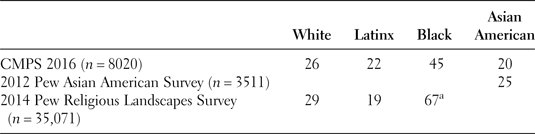
Before delving into a more thorough analysis, it is instructive to review some basic descriptive statistics related to religion and socioeconomic status across the major racial categories included in the current analysis. As expected based on past research, born-again identity is most prevalent among Black Americans. Nearly half of this group describe themselves as born-again Christians. Whites also demonstrate relatively high rates of evangelical or born-again identity (about one out of every four respondents). At the same time, fully 22% of Latinx in the CMPS sample identify as born-again. Similarly, although Asian Americans are one of the most diverse groups in terms of religious affiliation, 20% also describe themselves as born-again Christians (Table 1).
Born-again and Evangelical Identity by Race (Identifies as “born-again” or “evangelical”)

a Includes those who identify as “evangelical” and “Historically black” church.
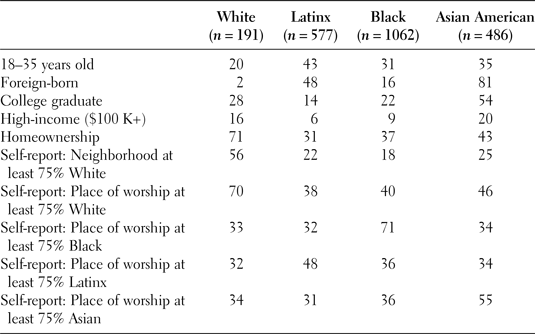
Turning to Table 2, which presents demographic comparisons among those who identify as born-again or evangelical, one observes that despite their common religious affiliation, White, Black, Latino, and Asian American evangelicals differ in terms of key socioeconomic characteristics and religious behavior. For example, Asian American born-again Christians are more likely to report graduating from college than any other group. There is also a substantial income gap between Asian Americans and other groups. Approximately 20% of evangelical Asian Americans claim that their annual household income consists of $100,000 or more, compared with 16% of Whites and less than 10% of Latinx or Black evangelicals. As one would expect, more Asian American (81%) and Latino (48%) evangelicals indicate that they are foreign born compared with either White (2%) or Black (16%) evangelicals.
Born-again identity and demographic characteristics in the Collaborative Multi-racial Post-Election Survey

Source: Barreto et al. Reference Barreto2017; Data are weighted.
Despite prominent distinctions in socioeconomic status, born-again survey respondents appear relatively similar in terms of religious commitment, regardless of racial identity. At least 50% of Latino, Asian American, White, and Black evangelicals who took part in the 2016 Collaborative Multiracial Political Survey say that they attend religious services “almost every” or “at least every” week. To compare, less than 25% of mainline Christians or Catholics attend services as often. Higher attendance at religious services across all racial groups is consistent with other shared evangelical characteristics. Data from the General Social Survey and the Pew Forum on Religious Life suggest that regardless of racial background, evangelicals are more likely than those affiliated with other religious traditions to believe that the Bible is the ultimate word of God, to believe their religion is the “one true faith,” to pray, and to say living a religious life is very important to them (Pew Research Center 2014; Putnam and Campbell Reference Putnam and Campbell2012). At the same time, with regard to many of these religious beliefs and behaviors, there is within group variation—evangelical Asian Americans, Blacks, and Latinos indicate more religious commitment than their White counterparts (cf. Greeley and Hout Reference Greeley and Hout2008; Lugo and Pond Reference Lugo and Allison2007; Pew Research Center 2012; 2014).Footnote 4
POLITICAL ATTITUDES: WHITE AND NON-WHITE EVANGELICALS
A range of political attitude questions was included in the CMPS survey. Respondents were also asked about partisanship, support for candidates in the 2016 presidential race, and ideology. It is common for reporters and academic researchers who study “the evangelical vote” to focus on allegiance to the Republican Party, issues of abortion, and same-sex marriage (Brooks and Manza Reference Brooks and Manza1997; Hankins Reference Hankins2009; Hillygus and Shields Reference Hillygus and Shields2005; Lewis and de Bernardo Reference Lewis and de Bernardo2010; Olson et al. Reference Olson, Wendy and James2006; Sherkat, De Vries, and Creek Reference Sherkat, De Vries and Creek2010; Wilcox and Robinson Reference Wilcox and Robinson2010). Similar attitudes are also considered here. In addition, policy-related items that fall outside of the traditional evangelical agenda are included, having to do with whether immigrants are bad for the economy, taxing the wealthiest, climate change, aid to the poor, whether the United States should apologize for slavery, and whether respondents support or oppose the Black Lives Matter Movement.Footnote 5
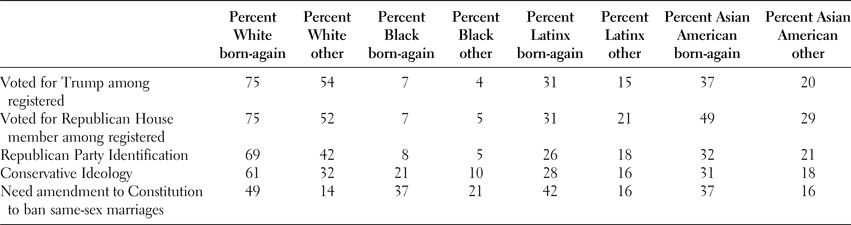
Table 3 details the bivariate associations between born-again identity and items associated with the “traditional” evangelical political agenda, such as Republican party identification, support for Republican candidates, ideology, and belief that there should be a constitutional ban on same-sex marriage, among Whites, Latinos, Asian Americans, and Blacks who took part in the CMPS. Two distinct patterns emerge. First, within each racial category, if one compares those who identify as born-again with those who do not identify as born-again, those who identify as born-again express greater levels of Republican identification, were more likely to have voted for Republicans at the state level and in the presidential race, identify as conservative in terms of ideology, and to support a ban on same-sex marriage. For example, about 30% of Latinos who identify as born-again claim to have voted for Republican President Donald Trump, but only 15% of non-born-again Latinos say they voted for him. Similarly, nearly half of born-again Asian Americans claim to have supported a Republican as their member of Congress versus 29% of non-born-again Asian Americans. Among Latinos, Asian Americans, and Whites, there are dramatic differences between born-again and non-born-again identifiers across all of the items in Table 3. The differences among Blacks are much less stark, though Blacks who identify as born-again are more likely to identify as “conservative” and to support a ban on same-sex marriage compared with their non-born-again counterparts.
Born-again identifiers more conservative than non-Born-Again identifiers across racial groups, but White born-again identifiers are much more conservative than non-Whites

Source: Barreto et al. Reference Barreto2017; Data are weighted.
In almost every case, Black Americans, born-again or not, tend to be less conservative than their Latino, White, and Asian American counterparts. However, when it comes to same-sex marriage, Asian Americans exhibit similar (relatively low) rates of opposition to same-sex marriage, particularly among those who identify as born-again. This is a bit surprising given the visible role of Chinese and Korean American Christian pastors in contesting marriage equality (Kim Reference Kim2010, 128). Still, for the most part, the data in Table 3 mesh well with speculation by scholars and journalists that Latinos and Asian Americans may represent a rich source of potential growth for the Republican Party and potential coalition partners with similarly oriented White evangelicals and frequent worshippers.
These data also reveal, also, though, that variations remain between White born-again Christians and non-White born-again Christians—even on traditional evangelical consensus issues such as voting for Republican candidates, conservative ideology, and party identification. For example, in terms of Republican party identification, about 8 percentage points separate Latino evangelicals and Latinos who do not identify as evangelicals (Table 3, row 3). A much larger spread, about 40 percentage points, separate Republican identifiers among Latino evangelicals (26% Republican) from White evangelicals (69% Republican). Similarly, one observes that while a larger proportion of Asian Americans who identify as born-again voted for Trump compared with non-born-again Asian Americans (37% versus 20%), the difference in Trump-support between born-again Asian Americans and born-again Whites is much more dramatic (37% versus 75%). At the same time, same-sex marriage continues to be more of a consensus policy issue across race within the evangelical community. Note that a robust minority of evangelicals across all groups support a ban on same-sex marriage. On this “hot button” social issue, there is more convergence across race than between racial groups among those who identify as born-again.
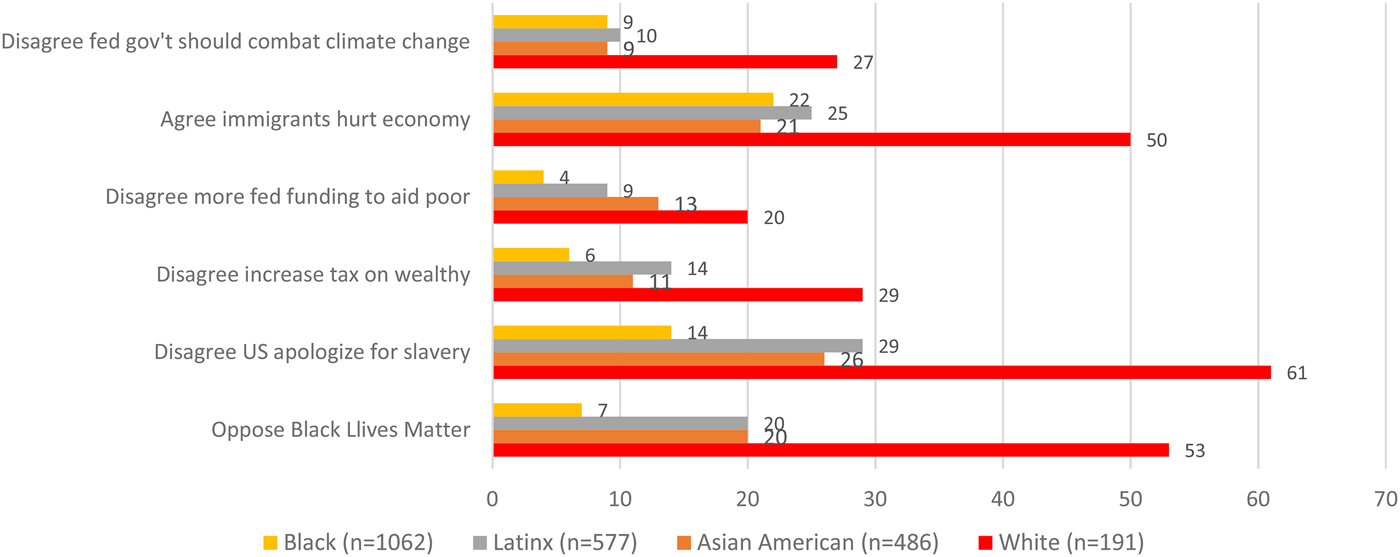
Turning to a broader range of policy issues (Figure 1) one observes that variations between White and non-White evangelicals persist. Figure 1 shows that on issues ranging from opposing government intervention to combat climate change to opposition to the Black Lives Matter movement, White evangelicals are almost always at least twice as likely to take a conservative position compared with their Asian American, Latinx, or Black evangelical counterparts. The gaps are least dramatic when it comes to opposing more government funding to aid the poor. On that policy issue, 20% of White evangelicals claim to want to decrease government spending on the poor, compared with 13% of Asian Americans, 9% of Latinx and 4% of Black evangelicals. On most other issues, the percentage point gaps between Whites and non-Whites are even larger. White evangelicals have long been one of the most conservative groups on immigration policy. In this case, the question was on whether respondents believed that “immigrants are bad for the economy” in the respondent's state. Fully half of all White evangelicals agreed with this statement. Not surprisingly, given that a majority of Asian Americans are foreign-born and that Latinos continue to make up the largest groups of immigrants in the United States, fewer than one out of every four Asian American and Latinx evangelicals agree. Notably, and also consistent with past research, Black evangelicals are also much more reluctant than their White counterparts to assess the role of immigrants negatively. But it is also true that on issues that might not hit as close to home, such as climate change and taxing the rich, White evangelicals are far more conservative than other evangelicals. And we also see that these gaps between White and non-White evangelicals persist in terms of issues that have to do with race explicitly. For instance, while Asian American and Latinx born-again respondents are twice as likely as Black born-again respondents to disagree that the U.S. Congress should apologize for slavery and to oppose the Black Lives Matter movement, White born-again respondents are four and seven times more likely to take the same conservative positions on each of these policies, respectively.
Policy positions among born-again identifiers by race. Source: Barreto et al. Reference Barreto2017; Data are weighted.
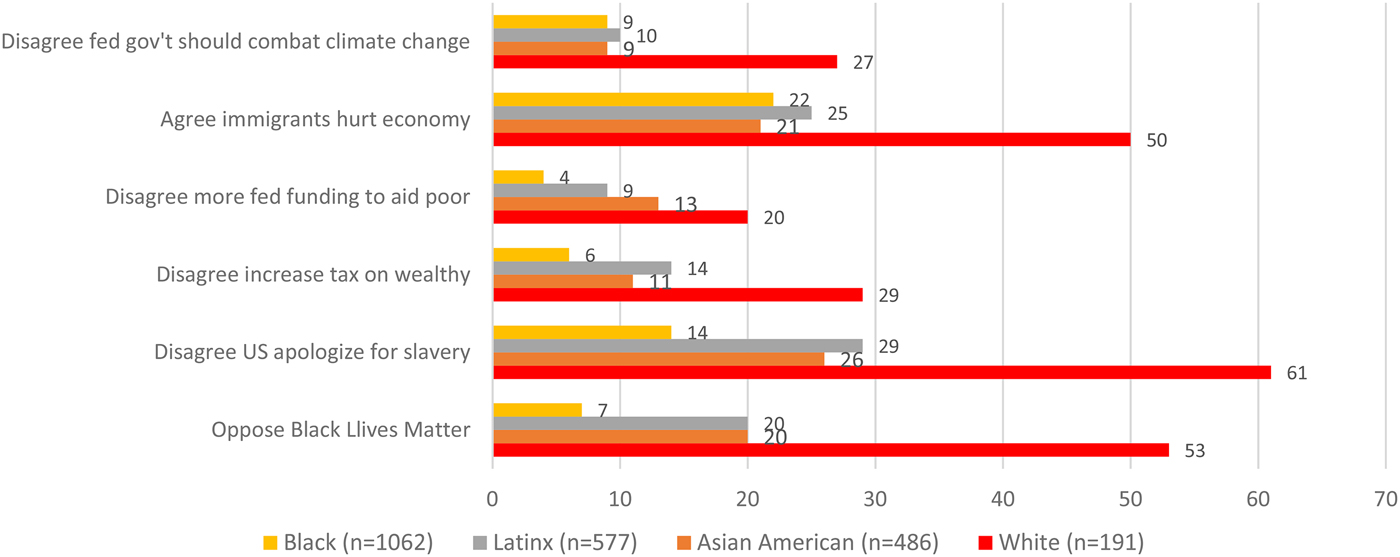
These basic comparisons hint that while evangelical religious affiliation certainly shapes the political orientation of Latin and Asian Americans, the effects of race may be equally important or even more powerful. However, before drawing any conclusions about how being White or not might matter for evangelical political attitudes, it is important to ask whether these differences are driven by race or other co-varying influences, such as party identification, socio-economic status, immigrant status, or general attitudes toward the role of government.
DIFFERENCES BETWEEN WHITE AND NON-WHITE EVANGELICALS PERSIST
Further analysis shows that even after taking into account Republican party identification, socioeconomic status, and whether or not one is an immigrant, White evangelicals are, in fact, more conservative on a range of political issues compared with Asian American, Black, and Latinx evangelicals.
I conducted three different analyses, first pooling the White and Black born-again respondents, then pooling White and Latinx born-again respondents, then pooling White and Asian American born-again respondents.
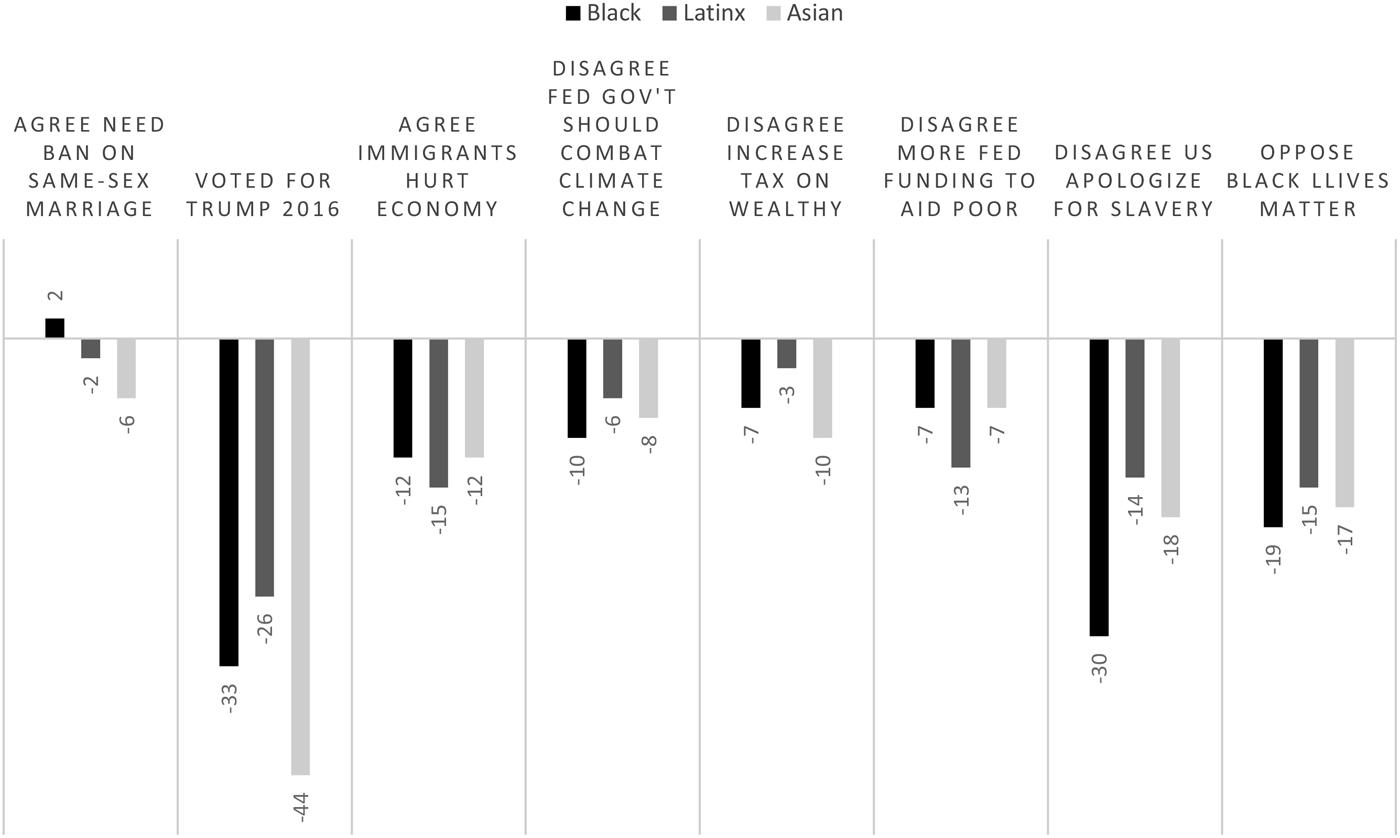
The dependent variables were the policy attitudes highlighted in Table 1. Each of these eight policy questions was analyzed separately for each pooled sample (“White-Black,” “White-Latinx,” “White-Asian American”). The control variables included party identification, income, education, age, sex, and nativity. (Note that similar results obtain when frequency of religious attendance is also included in the models). The key independent variable, racial identity, was captured by dummy variables for “Latinx,” “Asian American,” and “Black,” with “White” constituting the excluded category in every model.Footnote 6 Ordered logit and logit regression models were employed to better isolate the effects of racial identity from the control variables. I calculated predicted probabilities associated with taking the conservative position on each policy, and for each racial group, compared with Whites. For ease of interpretation, I show the difference between the predicted probabilities of taking the conservative position (1) if the respondent is White versus (2) either Black, Latinx, or Asian American. Each bar in the table below shows that calculation (e.g., predicted probability of taking a conservative position on the issue if Black minus predicted the probability of taking the conservative position on issue if White). Negative numbers indicate that the predicted probability of taking the conservative position on an issue is larger among Whites than the non-White group with which it is being compared.
The results displayed in Figure 2 show that even when one takes into account the effects of partisanship, socioeconomic status, and other potential intervening variables, race is still an important predictor of policy attitudes among those who identify as born-again. It should be noted that the differences between Whites and other groups are not statistically significant in the analysis of same-sex marriage attitudes. In addition, the differences were not statistically significant when comparing Latinx and White respondents on the climate item or between Asian Americans and Whites on “aid to poor” item. But, across all other issues and comparisons, White evangelicals are more likely to take a conservative position on every one of the issues examined, all else being equal.
Black, Latinx and Asian American born-again respondents less conservative on issues than White born-again respondents even after taking into account partisanship and socioeconomic influences (bars represent percentage point difference in predicted probabilities between White and non-White born-again respondents). Source: Barreto et al. Reference Barreto2017; Data are weighted; Note: Figure based on ordered logit and logit models that include party identification (Republican), age, education, income, female, and foreign-born status; Black/Non-Hispanic White analysis = 1253 (Trump vote among voters only n = 880); Latinx/Non-Hispanic White Analysis n = 768 (Trump vote among voters only n = 491); Asian/Non-Hispanic White Analysis n = 677 (Trump vote among voters only n = 380)’ Differences between groups on same-sex marriage item not significant; Differences between Latinx and non-Hispanic White respondents on climate item and difference between Asian and White on aid to poor item p < .10; on tax item not significant; All other differences significant at p < .05.

Some might ask if the differences between Whites and non-Whites are driven by forces beyond socioeconomic status or partisanship, such as general conservatism, feelings of economic precarity, or region (such as living in the South). But even when I include variables to capture these potential influences, such as beliefs that the federal government can “never” do anything right (a measure of general political conservatism), feelings that the economic conditions in the country are “getting a lot worse” (a measure of economic insecurity), and a variable for whether respondents reside in the Southern U.S., the same substantive results obtain.
I also want to emphasize that the patterns I describe above do not obtain only with the 2016 CMPS. I found similar patterns using a telephone survey of registered voters (the 2008 Collaborative Multiracial Political Survey) and with a 2012 dataset that includes White, Black, Latino, and Asian American respondents (but that was focused on Asian Americans in particular, hence the title the 2012 National Asian American Survey) (Wong Reference Wong2015; see also Wong Reference Wong2014). Analysis of specific Asian American and Latinx national origin groups results in very similar findings as well (Wong, Reference Wongin press).
EXPLAINING GROUP DIFFERENCES: THE ROLE OF IN-GROUP EMBATTLEMENT
Political attitudes vary with race. To a large extent, evangelical political attitudes depend on whether one is White or non-White. What drives these differences between White and non-White evangelicals? Though there are important exceptions, more than any other group in America, White evangelicals express a deep anxiety about potential threats to the traditional boundaries of their national community. This anxiety manifests in a kind of nostalgia for a period in American history when Black and non-White immigrants were considered outside the bounds or peripheral to the American national community, or what Robert P. Jones has vividly described as “White Christian America” (Bean Reference Bean2014; Jones Reference Jones2016). When asked their views about the United States as a Christian nation, fully 59% believe that the United States used to be a Christian nation, but is no longer (Jones et al. Reference Jones, Cox, Dionne, Galston, Cooper and Lienesch2016, 18). This proportion has increased over time. In 2012, 48% of White evangelicals expressed the same view. At the same time, White evangelicals are the religious group most likely to believe that “the American way of life needs protection.” Further, nearly 80% of White evangelicals contend that “discrimination against Christians is now as big a problem as discrimination against other groups in America.” This statistic is striking even compared with other White Christian groups. Just about 55% of White mainline Protestants and White Catholics believe that discrimination against Christians rivals discrimination against other groups.
In addition, while strong majorities of Latino Catholics (64%) and Black Protestants (69%) believe that “American culture and way of life” have mostly improved since the 1950s, a majority of White evangelicals say the opposite. They believe that since that time American culture and way of life have worsened. This nostalgia is accompanied by deep unease about racial equality and demographic change. According to Jones et al. Reference Jones, Cox, Dionne, Galston, Cooper and Lienesch2016, White evangelicals (68%) are much more likely than Whites as a whole (57%) to believe that “today discrimination against whites has become as big a problem as discrimination against blacks and other minorities”.
Political Scientists Christopher Parker and Matt Barreto (Reference Parker and Barreto2014, 35) suggest that there is a flip-side to this nostalgic mind-set—fear that newcomers and new attitudes will erode the dominant culture in the United States. In their thorough treatment of the attitudes of Americans who express support for the Tea Party, for example, the authors argue that support for the group's agenda is likely rooted in anxiety over progressive forces that ‘threaten to steal ‘their’ country.” Tea Party support is tied to supporters’ beliefs that their vision of America is threatened by liberal organizations and leadership. Similarly, sociologist Algernon Austin (Reference Austin2015), who studied Americans who express the most distainand antipathy toward Barack Obama, contends that the rise of the so-called “Obama-Haters” cannot be explained by party identification or ideological conservatism alone. Rather, the most important correlates of intense hatred toward Obama were not only anti-Black attitudes, but negative attitudes toward a host of “multicultural elements” in U.S. society, including Muslims and immigrants.
Data from the 2016 CMPS align with these trends.
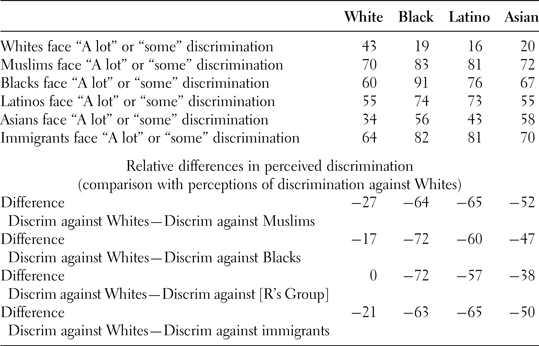
The top half of Table 4 shows that when assessing levels of discrimination faced by different groups in society, White evangelicals report higher levels of discrimination toward Whites compared with the degree to which non-White evangelicals assess discrimination against Whites. For example, 43% of White evangelicals believe that Whites face “a lot” or “some” discrimination compared with 19% of Black, 16% of Latinx, and 20% of Asian American evangelicals who believe that Whites face “a lot” or “some” discrimination. And, in contrast, when it comes to assessing levels of discrimination against various “outgroups” in society, White evangelicals are less likely than non-White evangelicals to believe these groups face discrimination. The proportion of White evangelicals who rate the levels of discrimination faced by other racial groups, “immigrants” and “Muslims” as “a lot” or “some” is consistently lower than the proportion of Black and Latinx evangelicals who rate discrimination faced by those groups as “a lot” or “high.” Asian American evangelicals are more moderate in their assessments of group discrimination, but still more likely to claim that out-groups face discrimination than their White counterparts. Of course, it is critical to acknowledge here that these outgroups are not mutually exclusive. One can be “Muslim” and “Black” or “White” and an “immigrant.”
Perceptions of discrimination faced by different groups among Born-Again identifiers

Source: Barreto et al. Reference Barreto2017; Data are weighted.
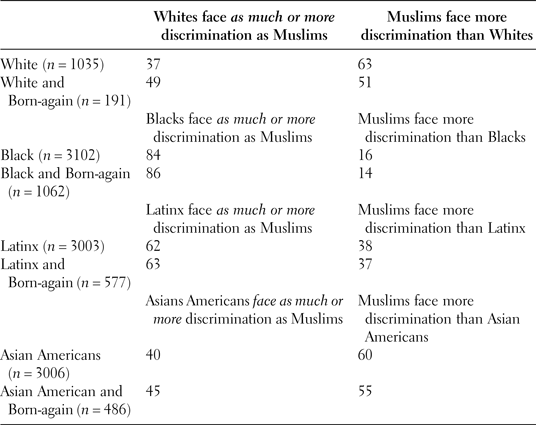
Turning to the bottom half of Table 4, we see the distinct ways in which White and non-White evangelicals assess the relative difference in discrimination faced by Whites versus different outgroups. These results show that White evangelicals consistently perceive levels of discrimination between Whites and the outgroups presented as less different in relative terms than do other groups. The bottom half of Table 4 attempts to measure what I call “perceived in-group embattlement” among Whites evangelicals in the CMPS study. This key measure is a variable that captures the extent to which respondents believe that their own racial group faces discrimination compared with the extent to which “Muslims” (a group that includes a small minority of adherents across all of the four racial groups that comprise the focus of this study) face discrimination. If a respondent believes their own group to faces as or more discrimination as “Muslims,” I argue that the respondent is expressing perceptions of in-group anxiety or “embattlement.”
Less than 1% of the U.S. population identifies as “Muslim” and Muslims are at least twice as likely to report being the victim of religiously-motivated hate crimes as members of any Christian religious group in the country (Green Reference Green2017). Still, it is important to note that while about 66% of Americans as a whole believe that Muslims face more discrimination than Christians, these sentiments are reversed among White Evangelicals. In a 2013 Public Religion Research Institute Survey, nearly 60% of all White Evangelicals claim that Christians face more discrimination than Muslims. This sense of embattlement can be extended beyond religious in-groups.
For the analysis presented in Table 5, I created a measure of perceived in-group embattlement for each of the four racial groups, with “Muslim” used as a proxy for outgroup. Again, these categories are not mutually exclusive (a member of any racial group could identify as “Muslim” and vice-versa). However, since Muslims constitute a minority of all of the aggregate racial groups here, “Muslims” serves as a very rough proxy for a potential outgroup. The “in-group” is the respondent's own self-identified racial group. My question is to what extent is this sense of perceived in-group embattlement associated with political attitudes?
Perceptions that Respondent's Racial Group Faces the Same or More Discrimination compared with Muslims (“In-group Embattlement”)

Source: Barreto et al. Reference Barreto2017; Data are weighted; Measures are constructed from the following item.
How much discrimination is there in the United States today against each of the following groups? [Rotated] [Whites/Blacks/Asian Americans/Immigrants/Latinos/Gays and lesbians/Muslims/ (Asian American and Latino respondents only) respondent's national origin group].
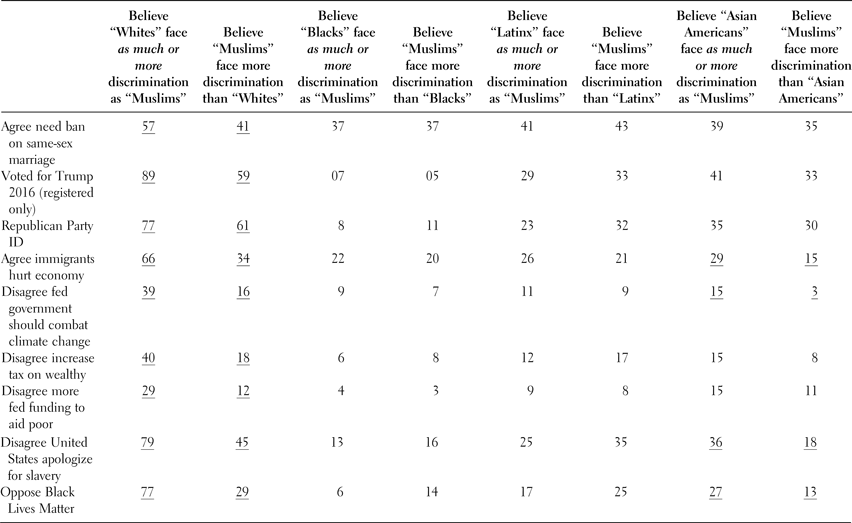
The results are clear. The analysis in Table 6 shows cross-tabulations across racial groups and policy attitudes, distinguishing (1) those who believe that their group faces the same or more discrimination as Muslims from (2) those who believe that Muslims face more discrimination than their group. From Table 5, we know that the proportion of the former is greater among White evangelicals (49%) compared with Whites who are not evangelical (37%). The analysis in Table 6 includes “born-again” identifiers only. For the White evangelical sample, believing that Whites face the same level or more discrimination as Muslims is associated powerfully with taking the most conservative position on every political issue examined, from voting for Trump to opposing government intervention on climate change to taxing the rich. All of those associations are statistically significant (p < .05). For Latinx and Black evangelicals, perceived in-group embattlement is not associated with taking any conservative position. Political attitudes between (1) those who believe that their group faces the same or more discrimination as Muslims are not very different from (2) those who believe that Muslims face more discrimination. Among Asian Americans, perceived in-group embattlement is lower than among Whites, and less consistently associated with conservative attitudes on policies. However, Asian American evangelicals who exhibit a sense of in-group embattlement are more conservative than those who do not exhibit that sense in terms of their beliefs about immigrants hurting the economy, climate change, disagreement that the U.S. government should apologize for slavery, and opposition to the Black Lives Matter movement.
Sense of in-group embattlement associated with more conservative attitudes among White Evangelicals, less important among other groups

Source: Barreto et al. Reference Barreto2017; Data are weighted; “_” indicates p < .05.
In multivariate analyses, the role of perceived in-group embattlement persists, even when controlling for party identification and other potentially intervening variables. And, even when I include variables to capture the potential influences of generalized conservatism, such as beliefs that the federal government can “never” do anything right, feelings that the economic conditions in the country are “getting a lot worse” (a measure of economic insecurity), and a variable for whether respondents reside in the Southern U.S., the same substantive results obtain.
CONCLUSION
The 2016 presidential election and the critical role that White evangelicals played in Donald Trump's victory provided a powerful reminder that demography is not destiny in American politics (Ramírez Reference Ramírez2013). In the aggregate, White evangelicals appear to be supporting a political agenda against the tide of demographic change and unique from non-White evangelicals in the United States. This study provides strong evidence that the important association between evangelical identity and a politically conservative agenda is strongest for Whites and much less consistent among non-Whites. As a result of centering race, we see that there is much more research and theoretical work to be done around the relationship between religion and politics.
Another key take-away from this study is that rather than shifting their agenda in response to potential new religious recruits from Asian American and Latinx communities, many White evangelicals express a sense of in-group embattlement over newcomers and demographic change. The research presented here argues that major political distinctions exist between Whites and non-Whites who share the same religious identification, and that this is due in part to the influence of perceptions of in-group embattlement on White evangelicals’ political attitudes, but not Latinx, Asian American or Black evangelicals’ attitudes. Despite their dramatic growth, the political opinions of Asian American, Latinx, and Black evangelicals have not influenced the overall evangelical policy agenda in a dramatic way. Asian American and Latino evangelicals may be growing in terms of population, but their political power is limited by their geographic concentration, ideological profile, lower-levels of political participation, and organizational capacity and coordination. In this respect, the experience of Asian American and Latino evangelicals mirrors that of Asian Americans and Latinos in the broader U.S. political arena and allows for a closer look at how the future of U.S. politics is likely to evolve—change will surely take place, but it will be slow and contested.
Acknowledgments
I would like to thank the journal editors and anonymous reviewers for their comments and suggestions. I would also like to thank the Russell Sage Foundation and the University of Maryland's Office of Undergraduate Studies for their generous support of this research. Portions of this paper are adapted from my book, Immigrants, Evangelicals and Politics in a Era of Demographic Change (Russell Sage Foundation, in press). I would also like to thank Dr. Christopher Towler for his substantive suggestions as well as how to address them by sharpening the analysis and improving the models.