Implications
Endosperm is a most important part in corn and wheat, which may affect metabolic energy supply for ruminants during degradation, especially under low-quality forage diets. With the increasing ratio of wheat in the concentrate substrate, total volatile fatty acids supply increased, but microbial protein (MCP) concentration decreased, indicating that starch–protein matrix and starch granules in the endosperm of the corn and wheat grain mixture played an important role in regulating rumen fermentation and N utilization, and it should be considered in dietary formulas under low-quality forage in the future.
Introduction
Forage is an important source of energy for ruminants (Kendall et al., Reference Kendall, Leonardi, Hoffman and Combs2009; Zhu et al., Reference Zhu, Fu, Wang, Wang, Ye, Wu and Liu2013a). However, high-quality forage is limited in China, where the importation of forage, such as alfalfa hay, is increasing annually (Feng et al., Reference Feng, Li, Bai and Wan2006). As a result, the shortage of forage has been a bottleneck for the dairy industry. On the other hand, approximately 200 million metric tons of corn stover and similar amounts of rice straw are produced annually (Pang et al., Reference Pang, Liu, Li, Wang and Yuan2008). These resources have not been utilized efficiently because of the compositional characteristics such as high fiber content, low protein level and low energy density (Li et al., Reference Li, Xu, Liu, Fang and Wang2014). Many studies have been conducted to improve the utilization of low-quality crop byproducts (Zhu et al., Reference Zhu, Tang, Sun, Liu, Wu, Yuan and Zhang2013b, Zhou et al., Reference Zhou, Zhang, Zhao, Zhang, Zhu, Bu and Wang2015). Wang et al. (Reference Wang, Mao, Yang, Wu, Wang, Li, Shen and Liu2014) found that a higher content of easily fermented carbohydrates and rumen undegraded protein (RUP) contributed to higher metabolizable protein in diets based on alfalfa than in diets based on corn stover or rice straw. Sufficient energy is critical for ruminal MCP synthesis, with corn stover as the forage source (Zhu et al., Reference Zhu, Fu, Wang, Wang, Ye, Wu and Liu2013a), and the addition of corn starch in low-quality forage increased MCP yields (Zhu et al., Reference Zhu, Tang, Sun, Liu, Wu, Yuan and Zhang2013b).
Corn and wheat are common sources of non-fiber carbohydrates (NFC). Endosperm is the most important part in grain seeds, and ruminal degradation of the starch in endosperm accounts for more than 70% of the energy supply for ruminants. Corn with a greater fraction of vitreous endosperm exhibited lower starch degradation (Ngonyamo-Majee et al., Reference Ngonyamo-Majee, Shaver, Coors, Sapienza and Lauer2008), and starch degradability in corn kernel increased after ensiling (Stéfan, 2005), possibly due to the breakage of starch–protein matrix that changed its structure. Our previous study found that ruminal degradability and energy availability are much greater in steam-flaked corn due to the alteration of carbohydrate biopolymers (Xu et al., Reference Xu, Liu and Yu2017) and the destruction of the endosperm structure. The difference in molecular structure was significantly associated with carbohydrate fractionation that determines carbohydrate biodegradation (Xu et al., Reference Xu, Liu and Yu2017). On the other hand, wheat grain exhibited completely different endosperm structures with corn, resulting in more effectively degradable starch (Offner et al., Reference Offner, Bach and Sauvant2003). Thus, the endosperm structure may be a key factor for manipulating the energy supply during rumen fermentation.
Steam flaking is a time- and energy-consuming process linked to the increased cost of feed. It is more profitable to supply wheat grain to low-quality forage to maintain metabolizable energy. However, wheat grain, with its loosened starch granule distribution in kernel (Swan et al., Reference Swan, Bowman, Martin and Giroux2006), is degraded much faster than corn (Huntington, Reference Huntington1997) and influences forage utilization. Until now, few studies have been conducted to investigate how the endosperm structure influences low-quality forage utilization. Thus, the objectives of the current study were to investigate how different endosperm physical structures in wheat and corn influence rumen fermentation and ruminal N utilization with rice straw as forage.
Materials and methods
Experimental design
Commercial corn (Zea mays L.) and wheat (Triticum aestivum L.) were used as the grain sources with different rumen degradation rate, and rice straw was used as the forage source. Corn and wheat were grown in Shandong Province, China. Rice straw were obtained from Jinhua, Zhejiang province, China. All samples were harvested in 2015. In the first experiment, we detected the in vitro fermentation characteristics of corn and wheat samples. In the second experiment, different ratios of wheat and corn were mixed to create a series of endosperm structures. A 3×4 factorial design involving two factors, the ratio of concentrate to forage (C:F at 35:65, 50:50 and 65:35) and the ratio of wheat to corn (W:C at 20:80, 40:60, 60:40 and 80:20) was conducted to investigate effect of endosperm structure on rumen fermentation under rice straw substrates. In vitro gas testing was conducted to determine the gas production (GP) characteristics, and final fermentation fluids after 24 h of incubation were used to determine fermentation parameters and N utilization.
Nutritional values of feed materials
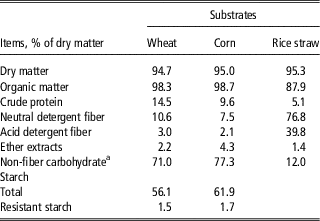
Wheat, corn and rice straw were obtained from a local dairy farm. All substrates were dried in a forced-oven at 65°C for 48 h, ground through a 1-mm screen Wiley mill (Tecator 1093; 114 Tecator AB, Höganäs, Sweden), and then stored at 4°C until further analysis. According to AOAC procedure (AOAC, 2005), the samples were analyzed for dry matter (DM, 105 °C), crude protein (CP, # 988.05), ether extract (EE, # 922.06), ash (# 942.05), and acid detergent fiber (ADF, # 973.18). The neutral detergent fiber (NDF) was analyzed using a method by Van Soest et al. (Van Soest et al., Reference Van Soest, Robertson and Lewis1991) with no added sodium sulfite or amylase. The chemical compositions of the individual substrates are listed in Table 1.
Chemical composition of individual substrates

a Non-fiber carbohydrate=100 – % neutral detergent fiber − % crude protein − % ether extract − % ash.
Microscopic analyses
A scanning electron microscope (SEM) was applied to measure the surface of the cracked wheat and corn endosperm at an accelerating voltage of 15 kV. No difference was observed between morphology of ground and cracked starch granules, but the cracked ones showed a better and intact structures of endosperm, thus cracked wheat and corn were applied to detect SEM. According to Jha et al. (Reference Jha, Woyengo, Li, Bedford, Vasanthan and Zijlstra2015), a confocal laser scanning microscope (CLSM) equipped with a 20×objective lens was applied to detect the phosphorus-associated protein matrix after double-staining by 8-amino-1,3,6-pyrenetrisulfonic acid (Blennow et al., Reference Blennow, Hansen, Schulz, Jørgensen, Donald and Sanderson2003) (APTS, Molecular Probes, A 7222, Sigma- Aldrich) and Pro-Q Diamond (Glaring et al., Reference Glaring, Koch and Blennow2006). The starch granules and protein were stained green and red by a double-staining process.
Time-course in vitro fermentation
Rumen fluid was collected from three donor Hu-sheep (1.5 years old, body weight of 35±5 kg) housed at the experimental farm located at the animal facility (Zijingang Campus of Zhejiang University). The sheep were fed twice daily at 8:30 am and 4:00 pm with 400 g of concentrate and Chinese wild rye grass hay ad libitum. Rumen fluid was collected 1 h before the morning feeding and strained through 4 layers of gauze into pre-warmed flasks. All processes were anaerobic. Five ml of rumen fluid was injected into a 120 ml bottle containing 45 ml of buffered medium and 500 mg of substrate with 0.45-mm size at 39°C (Theodorou et al., Reference Theodorou, Williams, Dhanoa, McAllan and France1994). The buffered medium supplied 14.8 mg/ml nitrogen (N) for rumen fermentation and bacteria activity. A semi-automated Reading Pressure Technique system (Mauricio et al., Reference Mauricio, Mould, Dhanoa, Owen, Channa and Theodorou1999) was used to determine the gas production (GP) parameters. Three replicates in two runs were conducted for each treatment.
The GP was recorded after 3, 6, 9, 12 and 24 h of inoculation. After 24 h of fermentation, all bottles were placed into ice water to stop the fermentation process. The pH was measured by a pH meter (Mettler Toledo FE20). Triplicates of mixed liquor were sampled to measure volatile fatty acids (VFA), including acetate, propionate, and butyrate, ammonia nitrogen (NH3-N) and MCP. The VFA content was analyzed by gas chromatography (GC-8A; Shimadzu Corp., Kyoto, Japan). The MCP yield was estimated according to Makkar et al. (Reference Makkar, Sharma, Dawra and Negi1982). The NH3-N content was assessed by a spectrometer (Model 721) using colorimetry. The in vitro dry matter digestibility (IVDMD) was measured using the nylon bag (10×20 cm; 50-μm pore size; Ankom Technology Corp., Macedon, NY, USA) technique. The efficiency of N utilization (ENU) was estimated by the equation: ENU (%)=bacteria N (g) / available N (g)×100, where available N was calculated as the substrate N plus N infused through buffered medium minus undegraded N (Offner et al., Reference Offner, Bach and Sauvant2003).
Statistical analysis
All of the data (pH, GP, IVDMD, VFA, NH3-N, MCP, and ENU) were analyzed using PROC MIXED in SAS (SAS version 8.0, Cary, NC, USA), with the C:F and W:C ratios as the main effects. Orthogonal polynomial contrasts were used to examine the responses (linear and quadratic) to the C:F and W:C ratios. The model for data analysis was as follows:
 $$Y_{{ijkl}} {\equals}\mu {\plus}\,T_{i} {\plus}\,R_{j} {\plus}\,TR_{{ij}} {\plus}F_{k} {\plus}\,e_{{ijkl}} $$
where Y ijkl is the dependent variable, μ is the overall mean, T i is the effect of C:F, R j is the effect of W:C, TR ij is the interaction effect of C:F and W:C, F k is the random effect of fermentation run with five incubation bottles, and e ijkl is the error term.
Probability values of P<0.05 were used to define statistical significance, and the values P<0.10 and P>0.05 were accepted as statistical trends.
Results
Physical structure of corn and wheat endosperm
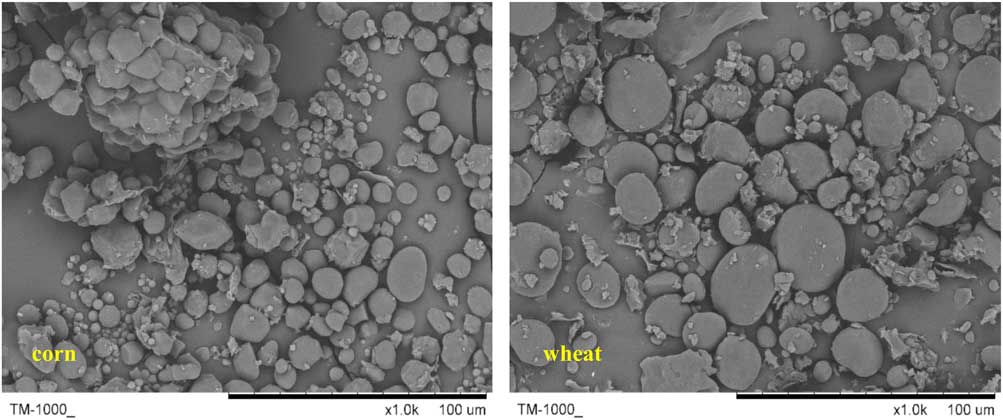
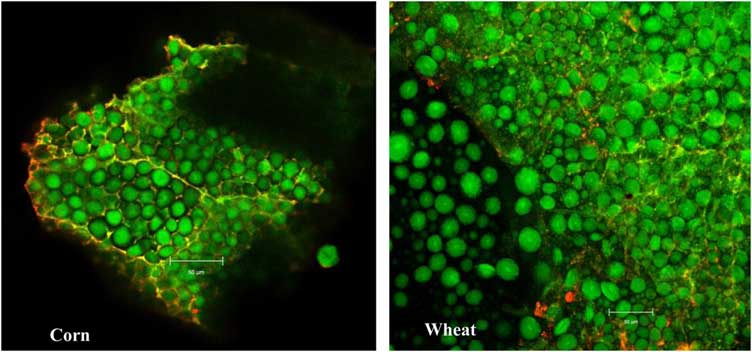
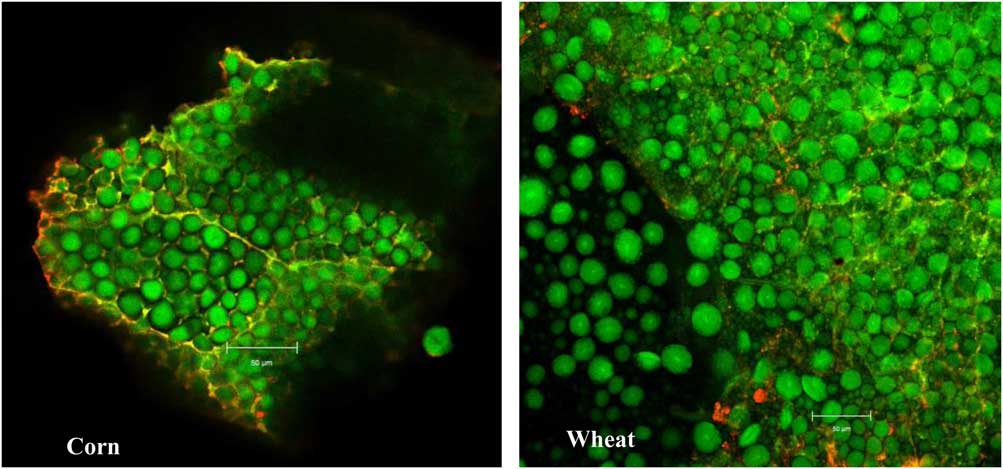
The microscopic examinations of the wheat and corn endosperm are shown in Figures 1 and 2. The SEM images indicated that the starch granules in corn endosperm are much more homogeneous while the starch granules in wheat can be divided into large- and small-granule types (Figure 1). The large granule in wheat is much larger than the starch granule in corn. The morphology of the corn starch granule was a sphere, but the wheat starch granule was irregular. Most of the starch granules in wheat were released from the endosperm after grinding, but apparent agglomerates were observed in corn. Wheat endosperm has more fragments associated with fibers, protein and fatty acids. The CLSM images show the phosphorous-associated protein matrix in Figure 2. The starch granules in the corn endosperm were encompassed by phosphorus-associated components more tightly than the wheat endosperm, and many granules in the wheat endosperm were scattered randomly.
Scanning electron microscopic images (1000×) of corn and wheat.

Confocal laser scanning microscopic images (20×) of corn and wheat staining with 8-aminopyrene- 1,3,6-trisulfonic acid (APTS) and Phosphate Pro-Q.
In vitro fermentation parameters of raw materials
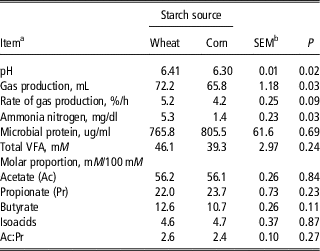
The results of the in vitro rumen fermentation variables of the individual substrates are listed in Table 2. Some differences in pH values existed between the wheat and corn, but all of the pH values were within normal range. Wheat grain had higher values for GP (P=0.03), rate of GP (P=0.09) and NH3-N concentration (P=0.03) than did the corn group; however, there was no difference (P>0.05) in MCP and VFA concentration (total, acetate, propionate, butyrate and isoacids) between the corn and wheat groups.
In vitro gas production and rumen fermentation parameters for the individual substrates

a VFA, volatile fatty acids.
b SEM, standard error of mean.
Rumen fermentation variables for rice straw-based diets
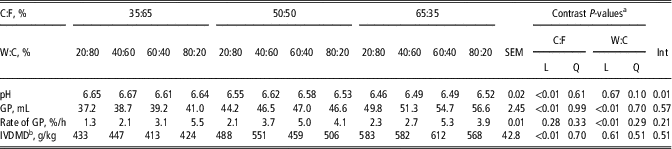
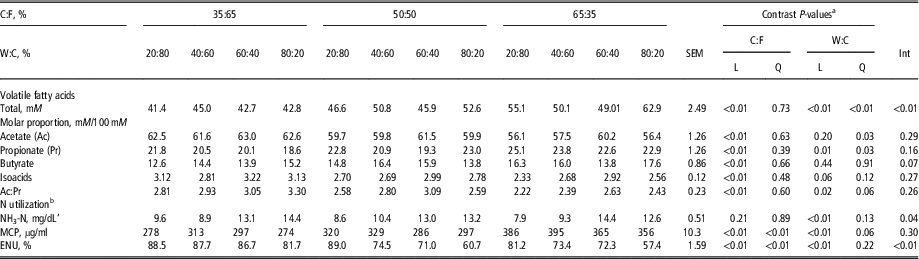
The in vitro gas production and rumen fermentation parameters for different C:F ratios and W:C ratios with rice straw as the forage source are listed in Table 3 and Table 4, respectively. Differences existed in the pH values (P=0.01); however, all of the pH values were within normal limits. The GP increased linearly (P<0.01) with increasing C:F and W:C ratios, and the IVDMD increased linearly with increasing C:F (P<0.01). The rate of gas production increased linearly (P<0.01) as the wheat component increased. As for the rumen fermentation parameters, all of the variables except for the NH3-N value showed a significant difference (P<0.01) among the varying C:F ratios. With an increasing ratio of W:C, total VFA increased (linear, P<0.01). The ratio of W:C had a significant effect on the molar proportion of acetate (quadratic, P=0.03), propionate (linear, P=0.01) and acetate-to-propionate ratio (linear, P=0.02). The NH3-N increased linearly with the wheat ratio (P<0.01); however, MCP (linear, P<0.01) and ENU (linear, P <0.01) decreased. The effects of the interaction between the C:F ratio and W:C ratio were detected in the total VFA (P<0.01), NH3-N (P=0.04) and ENU (P<0.01).
In vitro gas production (GP) kinetics for different ratios of concentrate to forage (C:F) and of wheat to corn (W:C) with rice straw as forage

a L, linear; Q, Quadratic, Int, Interaction between the C:F ratio and W:C ratio.
b IVDMD, In vitro dry matter degradability, as measured using nylon bag technique.
In vitro rumen fermentation parameters for different ratios of concentrate to forage (C:F) and of wheat to corn (W:C) with rice straw as forage

a L, linear; Q, Quadratic; Int, Interaction between the C:F ratio and W:C ratio.
b N, nitrogen; NH3-N, ammonia N; MCP, microbial protein yield; ENU, efficiency of N utilization, expressed as ratio of bacterial N (g) to available N (g), in which available N was calculated as [dietary N intake+N infused through artificial saliva- undegraded N] (Bach and Stern, Reference Bach and Stern1999).
Discussion
With the increasing ratio of wheat in the substrate, rate and extent of GP and IVDMD was enhanced, which was in agreement with Liu et al. (Reference Liu, Pu, Xie, Wang and Liu2015). The smaller starch granules in corn may be hydrolyzed faster (Li et al., Reference Li, Xu, Liu, Fang and Wang2014) due to easier diffusion process of enzymes into starch granules. However, the improved fermentation parameters with increasing wheat ratio could be attributed to lower crystallinity (Lewandowicz et al., Reference Lewandowicz, Jankowski and Fornal2000) of wheat starch granules, on the other hand, the starch–protein matrix in the endosperm is also a major inhibitor of the diffusion of enzymes, thus the looser starch–protein linkage in wheat endosperm contributed to the greater gas production and IVDMD. Wheat had a higher CP content than corn; thus the N supply was relatively higher with increasing wheat ratios. The increased GP and total VFA in the higher wheat substrate indicated relatively more available energy supply for rumen microbes. However, the MCP concentration, which is determined by the energy supply and N availability, did not increase linearly as expected but rather decreased quadratically. The MCP concentration reached a maximum value when the wheat-to-corn ratio was at 40:60, indicating that this ratio of corn to wheat may be suitable for the utilization of rice straw. The concentration of NH3-N increased linearly with increasing ratios of wheat, and all the NH3-N concentration were over 50 mg/L in the current study, indicating that the ammonia content did not limit microbial growth (Satter, et al., Reference Satter and Slyter1974). Therefore, the decreased MCP synthesis and ENU indicated that MCP synthesis in the rumen was energy-dependent rather than N-dependent in the current study.
The ratio of acetate to propionate responded quadratically with the increasing wheat ratios. Thus, the metabolic characteristics of fiber-digesting bacteria became dominant when the wheat ratio increased to 40 and 60%. Iso-acids mainly arise from the catabolism of amino acids (Zhu et al., Reference Zhu, Tang, Sun, Liu, Wu, Yuan and Zhang2013b). The increased iso-acids in the present study may indicate that more amino acids were degraded into ammonia in the higher wheat substrate. Bach et al. (Reference Bach, Calsamiglia and Stern2005) revealed that ammonia N accumulation in the rumen is a result of the preferential use of peptides or amino acids by the microbes. Theoretically, the most efficient method of N utilization is bacteria directly utilizing the amino acids from the protein degraded in the rumen to synthesize MCP. An unmatched supply of energy and N may lead to low ENU and low MCP yield. The synchronized degradation of carbohydrate and protein has been proposed as a method to increase ruminal MCP synthesis and improve the efficiency of N usage and animal performance (Cole and Todd, Reference Cole and Todd2008). Thus, ENU may be regulated by the starch degradation rate, which was associated with the endosperm structure, through a synchronous supply of available energy for MCP synthesis. The decreased ENU in the substrate with relatively high-starch degradation may be attributed to the quick accumulation of VFA, which inhibits the degradation of the structural carbohydrate (Ngonyamo-Majee et al., Reference Ngonyamo-Majee, Shaver, Coors, Sapienza and Lauer2008), leading to less use of ammonia to synthesize MCP (Russell et al., Reference Russell, O’Connor, Fox, Soest and Sniffen1992).
Berthiaume et al. (Reference Berthiaume, Benchaar, Chaves, Tremblay, Castonguay, Bertrand, Bélanger, Michaud, Lafrenière and Mcallister2010) noted that an increasing level of non-structural carbohydrates in alfalfa enhances microbial N synthesis in the rumen. The linearly increasing MCP and total VFA following the increasing C:F ratio may be attributed to the enhanced bacterial attachment and increased ruminal pool size of solid-attached bacteria. However, the ENU decreased with an increasing C: F ratio. Because the efficiency of microbial synthesis is not always associated with dietary CP (Zhu et al., Reference Zhu, Fu, Wang, Wang, Ye, Wu and Liu2013a), high-forage substrates may contribute to improved N utilization. The lower acetate-to-propionate ratio following the reduced forage ratio suggested lower fiber degradation in high-concentrate substrates.
The effect of the interaction between the C:F and W:C ratios on ENU and total VFA was identified. The ENU in the substrate with high C:F and low W:C was similar to that observed with low C:F and high W:C, indicating that both energy density and endosperm structure play important roles in ENU. Therefore, regulating the physical structure of the endosperm may be an efficient way to regulate N utilization in dairy feed.
Conclusion
In conclusion, endosperm structure of corn and wheat was totally different. The MCP yield and ENU were reduced with an increasing ratio of wheat, and total VFA concentrations were higher in the diets with higher ratio of wheat. It is inferred that different endosperm structure in corn and wheat could influence rumen fermentation and N utilization based on low-quality forage diets.
Acknowledgements
The authors acknowledge the funding support by the China Agriculture Research System (No. CARS-36).
Declaration of interest
The authors declare they have no competing interests.
Ethics statement
Animal use in the current study was approved by Animal Care Committee of Zhejiang University. And rumen fluid was collected by well-trained staff in accordance with the strictly standard operation process.
Software and data repository resources
None of the data were deposited in an official repository.