INTRODUCTION
The New Caledonian archipelago is composed of a main island, sited on the Norfolk Ridge, and several smaller island groups differing in their geological origin. The Loyalty Islands, a hundred kilometres to the east of the main chain, are coral and limestone islands built over ancient collapsed volcanoes on the verge of the Vanuatu Trench. The marine biota of the Loyalty Ridge has been studied by several French expeditions: ‘BIOGEOCAL’ (1987, 310–2370 m), ‘MUSORSTOM 6’ (1989, 21–1400 m), ‘VOLSMAR’ (1989, 195–550 m), ‘BERYX 2’ (1991, 650–850 m), ‘BATHUS 3’ (1993, 607–925 m), ‘TERRASSES’ (2008, 610–990 m) and the recent ‘EXBODI’ (2011, 216–1130 m). Ng & Richer de Forges (Reference Ng, Richer de Forges, Payri and Richer de Forges2007) listed the Brachyura collected from New Caledonia. The rich calappid biota of New Caledonia and the adjoining Vanuatu archipelago and Solomon Islands had been described in a series of papers (Galil, Reference Galil and Crosnier1993, Reference Galil and Crosnier1997, Reference Galil2007; Crosnier, Reference Crosnier1997; Galil & Ng, Reference Galil, Ng, Castro, Davie, Ng and Richer de Forges2010).
This report documents the occurrence of Calappa karenae Ng & Lai, Reference Ng and Lai2012 off the Pétrie Reef, Loyalty Ridge, and indicates that the species is not restricted to central Micronesia.
MATERIALS AND METHODS
The ‘EXBODI’ research cruise aboard RV ‘Alis’, which took place between 2 and 28 September 2011, sampled 172 stations at depths between 250 and 1150 m, on the Loyalty Ridge and the southern slope of the south province of New Caledonia. A standard French beam trawl, 4 m wide, 0.35 m high was used, with conic sac of fine mesh (15, 12 mm) and double-layered cod-end. The trawl was generally deployed at 2.5–4.5 knots and towed at a ground speed of 1.5 knots.
RESULTS
One male specimen, carapace length (CL) 87.9 mm, maximum carapace width (MCW) 161.7 mm, was collected during the ‘EXBODI Expedition’ off Pétrie Reef, Station CP3927, 18°36′S 164°20′E, 381 m, 26 September 2011. The specimen is deposited in the Muséum National d'Histoire Naturelle, Paris (No. IU-2011-6570).
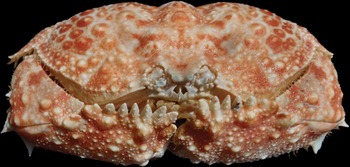
Colour photographs taken by L. Corbari of the freshly landed specimen (Figure 1) exhibit its striking colour pattern. The carapace and chelipeds are covered with irregular patches of pale salmon; the large papular tubercles anteriorly on the carapace resemble inflamed pustules with yellow apex ringed with red. Upper external surface of chela salmon coloured, dentate crest, tubercles and proximal ram-like denticle pale; inner surface of chela with reticulation of red dots; tips of dactyl and pollex dark brown. The colours agree with those described for the type (Ng & Lai, Reference Ng and Lai2012).
Calappa karenae Ng & Lai Reference Ng and Lai2012, adult male, 87.9 mm, Pétrie Reef, New Caledonia (original photograph by L. Corbari, edited by O. Rittner).

DISCUSSION
Calappa karenae has been recently described by Ng & Lai (Reference Ng and Lai2012) from two male specimens (CL 95.9, 95.0, MCW 180.4, 197.0 mm) (USNM 1150290-1) collected on 10 April 1986, off Haputo, Guam, in crab-trap, at depth of 183 m, by E. Smith and L. Eldredge. Calappa karenae is characterized by extensive clypeiform expansions bearing subogive teeth, carapace anteriorly bearing large papular tubercles, smaller granules, some coalescing into short striae, posteriorly, cheliped merus quadrilobate, anterior margin of basal antennal article bidentate with additional denticle at base of peduncle and second male pleopod with subdistal denticulate flange and digitate tip. At first glance the pronounced and distinctively-coloured dorsal tubercules, looking like inflamed pustules, bring to mind the similarly patterned Calappa japonica Ortmann, 1892, C. exanthematosa Alcock & Anderson, 1894, and C. africana Lai & Ng, Reference Lai and Ng2006. All three are relatively large and stout species, but they lack the extensive clypeiform expansions of C. karenae (Lai & Ng, Reference Lai and Ng2006; Ng et al., Reference Ng, Lai, Ghotbeddin and Safaie2011). The members of the Calappa lophos species group, C. lophos (Herbst, 1782), C. guerini Brito-Capello, 1871, C. quadrimaculata Takeda & Shikatani, 1990 and C. acutispina Lai, Chan & Ng, Reference Lai, Chan and Ng2006, possess well developed clypeiform expansions, but are easily distinguished by, among other characteristics, their colour patterns (Lai et al., 2006). Calappa sebastieni Galil, Reference Galil and Crosnier1997 also possesses wide clypeiform expansions, and its second male pleopod is similar to that of C. karenae, but its carapace is not as wide, it lacks the large papular tubercles, and differs in the shape of rostrum, basal antennal article, and sculpture of chela (see Galil, Reference Galil and Crosnier1997).
Extensive collections since the 1980s of deep sea marine biota from New Caledonia and nearby Vanuatu and Solomon archipelagoes had not collected any specimens of C. karenae. But its presence off Pétrie Reef, lying in considerable isolation to the north-west of the Loyalty Ridge, indicates that this species, although apparently very rare, is widely distributed—nearly 4000 km away from its initial record off Guam, and more than twice as deep as the original record. It is quite possible that C. karenae may occur in rarely sampled habitats on other Micronesian and Melanesian islands.
ACKNOWLEDGEMENTS
The ‘EXBODI’ cruise, headed by Drs Sarah Samadi and Laure Corbari, was operated by Muséum National d'Histoire Naturelle (MNHN) and Institut de Recherche pour le Développement (IRD) as part of the research program ‘Tropical Deep Sea Benthos’, PI Philippe Bouchet. We also thank Laure Corbari, Paula Martin-Lefevre, Anoushka Sato and Rachid Kebir, MNHN, Département Systématique & Evolution and Département Milieux et Peuplements Aquatiques, Paris, France, Oz Rittner, the Steinhardt National Collections of Natural History, Tel Aviv University, Israel, and the anonymous referees.