


1. INTRODUCTION
1.1. Social media: a platform for sociolinguistic inquiry
Social media opened up new horizons in sociolinguistic investigations by providing researchers with publicly available, primarily informal written data that often encompasses geographical and other social information about a wide variety of speakers. As studies in the current special issue demonstrate, social media data is ideal for observing how oral patterns translate into short texts online, especially when it comes to nasal vowel shift, phonological variation transcribed as geminates, and identity construction via phrase final devoicing. Furthermore, Twitter is capable of capturing diachronic change in the lexicon. In this article, social media will be used to explore lexical variation: particularly, the implantation of official new French translations mot-dièse and mot-clic that are meant to replace the English word hashtag. Hashtag is considered the emblematic word of Twitter, as users signal topics in their messages by including the symbol # in front of a word, e.g. #sociolinguistics. Similarly to other contributions in this issue, such as variation in Québécois informal written language, this article focuses on characteristics of lexical variation in urban areas in France and Québec, male and female speakers, and users with various degrees of social media influence.
The use, control and consumption of new media in the age of French social media has led to both top-down and bottom-up approaches to new word creations (Blackwood, Reference Blackwood2013). Language planning bodies demonstrate strong intentions to control the lexicon and intervene whenever they deem necessary, but in a democratic fashion, speakers are now invited to participate in the dialogue. As opposed to the Académie française (Estival & Pennycook, Reference Estival and Pennycook2011), online users do not have authority to influence the decision making, but they vote – so to speak – with their word choices online. Moreover, even on websites such as Wikipedia, which is not supervised by language planning institutions, the prescribed norm is preferred and implemented – thus, users voluntarily comply with prescription. On the other hand, social media sites like Facebook and Twitter, where users participate in lexical and grammatical innovation from a bottom-up approach, might deviate considerably from the norm. This consists not only of unconventional spellings, but the use of lexical items borrowed from foreign languages or registers. Therefore, top-down influence is not expected to be successful in social media environments, where spontaneous innovations rule.
Previous scholarship on geographical variation on Twitter shows that the evolution of spelling and the role of prestigious language varieties can be tracked through time via tweets (Escalante, Reference Escalante2015; Gonçalves & Sánchez, Reference Gonçalves and Sánchez2016; Gray etal., Reference Gray, Reagan, Dodds and Danforth2018). Using information embedded in the tweets, the authors are able to draw dialectal maps that considerably correspond to previously established dialectal borders, and they confirm that lexical innovation originates from large urban areas (Grieve etal., Reference Grieve, Nini and Guo2018; Huang etal., Reference Huang, Guo, Kasakoff and Grieve2016). Geographical variation also includes variation with respect to style, register and social characteristics across space. Non-standard forms are more prevalent when users address their peers. However, when tweets target a wider audience, variables are more likely to comply with the standard written language, which confirms that users are conscious of their audience selection and the meaning of the lexical variables they opt for (Eisenstein, Reference Eisenstein2015; Pavalanathan & Eisenstein, Reference Pavalanathan and Eisenstein2015; Wikström, Reference Wikström2016). Comparably to traditional sociolinguistic inquiries, previous studies confirm the existence of gender-based linguistic variation on Twitter and highlight the importance of including gender in the analysis (Bamman etal., Reference Bamman, Eisenstein and Schnoebelen2014; Morikawa, Reference Morikawa2019).
Cultural and linguistic practices on French Twitter have interested scholars since its launch in 2006, with some examining certain prescriptive tendencies. For instance, the semantic analysis of a large corpus of tweets related to the 2015 Paris attacks revealed that event-related content (e.g. discussing what happened in the attacks) was retweeted more than support-related content (e.g. expressing comfort to the victims) (Cvetojevic & Hochmair, Reference Cvetojevic and Hochmair2018). Tweets with hashtags were retweeted more often than tweets with only keywords, probably due to the searchability and trackability of hashtags, which is not the case of keywords. Furthermore, tweets with pictures published by journalists had a higher number of retweets, proving that professionals with strong ties to the media have established trustworthiness in their follower network. Indeed, journalists in France use social media to gather information, monitor current events, and inform the public. However, instead of incentivizing individual journalists, French news organizations opt for collective representation on social media: brands will have more of a role on Twitter, rather than individual journalists like in the United States (Powers & Vera-Zambrano, Reference Powers and Vera-Zambrano2018).
Other scholars focused on forms in addition to semantics. Following the same 2015 attacks, creative uses of the hashtag starting with #JeSuis resulted in a large variety of new expressions: e.g. #JeSuisBruxelles, #JeSuisPanama, #JeSuisRéfugié. This implies that after the original form, #JeSuisCharlie, alignment and solidarity with victims of other tragedies were further extended to various causes (De Cock & Pizarro Pedraza, Reference De Cock and Pizarro Pedraza2018). This hashtag itself goes through lexicalization, where it can occur in constructions not conforming to the prescribed norm. Moreover, it is used to mock the original intention of the #JeSuisCharlie hashtag and to create new affiliations. #JeSuisCirconflexe and #JeSuisOignon are examples of this, included in tweets discussing recent implementation of the 1993 orthographic reforms in France (Drackley, Reference Drackley2019). In the latter case, the top-down reforms faced bottom-up rejections: users defended old prescribed norms instead of the newly prescribed ones. Thus, it would seem that language users express more prescriptive attitudes than the language planning institutions, when in fact they are merely rejecting the ones prescribed to them. This might signal the perception of failed top-down intervention in social media. In the following section, I put this observation to the test.
1.2. Official new terms: intervention on linguistic practices
Protectionism towards language typically arises in reaction to perceived foreign influence that manifests through an influx of lexical borrowings. Contact-induced change is a result of cultural influence, rather than direct imposition of a language through conquest or other types of disruptive social change. In cases of this cultural influence, a donor language contributes lexical borrowings to a recipient language. The most frequent types of borrowings are nouns (Saugera, Reference Saugera2017), especially for borrowings of new concepts by specific user groups (Haspelmath, Reference Haspelmath, Stolz, Bakker and Palomo2008). Despite the perception that English is extensively mixed with French, leading to the creation of the portmanteau Frenglish or franglais, the type of language contact leading to cultural borrowings cannot be considered imposition (Thomason & Kaufman, Reference Thomason and Kaufman1991). They are not imposed by non-native speakers, but rather by user groups or prestigious communities that introduce innovations. Deeper structure of the grammar is not affected, although certain derivational affixes like -ing are borrowed and used productively in new word formations in French (Walter, Reference Walter and Wright2000).
The most frequently mentioned social motivations for lexical borrowings are need and prestige (Hock, Reference Hock1991; Weinreich, Reference Weinreich2011; Winford, Reference Winford2003). Since the onset of the industrial era when England – rather than France – assumed economic and political influence in the Western world, English has become the most prolific donor language for French. It also emerged as the source of technological innovations and, hence, the source of cultural borrowings for most standard European languages. In the twentieth century, semantic fields of the incoming lexical borrowings are associated with rising globalization and its emblem: the American economy (Amit, Reference Amit2013). The boom in technological innovations in computer science, information technology, the entertainment industry and telecommunication in the twentieth and twenty-first centuries led to an increased need to name new concepts in English, which are in turn borrowed in French. The fast pace of the diffusion of innovations that needed new terminologies prompted quick state response in French, where prescriptivism has a long tradition (Caron & Kibbee, Reference Caron, Kibbee and Fresco2016).
Linguistic prescriptivism is a form of language ideology that aims to suppress variation by defining what elements of the language ought to be included and excluded from use (Langer & Nesse, Reference Langer, Nesse, Hernández Campoy and Conde Silvestre2012). Lexical purism represents its archetypal form (Thomas, Reference Thomas1991), targeting elements of foreign, regional or sociolectal origins. Purism is an ideology and not a reality (Milroy & Milroy, Reference Milroy and Milroy2012): norms alternate from one speaker or social group to the other; meanwhile, the constant change in formal and informal spoken norms permanently creates tension with the written norm (Lodge, Reference Lodge1991). Contrarily to purism, prescriptivism is not inherently conservative, its norms can change (Walsh, Reference Walsh2016), taking form in revisions of dictionaries, grammar books, language policies and laws.
In order to achieve a desired form free of anglicisms, language planning has been outlined in France with the creation of terminological commissions since 1972 (Calvet, Reference Calvet2017). Today, the Commission d’enrichissement de la langue française (CELF, ‘Commission for the Enrichment of the French Language’) selectively targets borrowings from the prestige language (Weinstein, Reference Weinstein1989): in the CELF’s official French terminology, 99% of the more than 8000 published terms are translations of English borrowings. In Québec, the Office québécois de la langue française (OQLF, ‘Québec Board of the French Language’) has implemented similar protective measures against English lexical borrowings, and it regularly makes recommendations on linguistic practices. Proposed official terminology is collected in the Grand dictionnaire terminologique. In each case, institutions examine if creating a neologism is necessary, if the new term is transparent (i.e. it is directly associated with the notion it covers), and if it complies with the morphological and syntactic rules of French (Candel, Reference Candel, van Ostade and Percy2017). In general, definitions of new terms have to be concise in order to help non-specialists better understand the complex realities that the specialized terminology designates.
1.3. Research questions
This article investigates the effect of prescriptivism on French Twitter with a focus on the English variant hashtag, an emblematic term on this social media platform, and the officially prescribed variants mot-dièse in France and mot-clic in Québec. Twitter users produce valuable corpora of texts embedded with social information. Social variables for this study include the urban population size where the tweet was posted, the gender of the user, and their social media influence. By examining the diffusion of recommended terminology, I seek to answer the following research questions:
1. What is the effect of prescription on the use of prescribed terminology over time on social media that is considered a more informal register?
2. What is the relationship between urban population size and the probability of use of the prescribed terminology? Can we observe a geographic diffusion on social media that mirrors what is expected for face-to-face linguistic change?
3. How do user demographic characteristics like gender and social media influence condition the use of prescribed terminology on social media?
Previous studies also shed light on gaps in the scholarship. French social media is relatively understudied compared to the English social media landscape, and the few studies which exist focus only on political science or reaction to given historic events. The effects of prescriptivism on lexical variation have remained underexplored. Based on the existing scholarship, however, it could be hypothesized that if prescription affects the probability of use of the prescribed terminology, the probability increases over time, where non-standard forms like Anglicisms are expected to be more probable in large urban areas. If prescribed terminology is observed, then lexical innovation starts in populous cities, and it is diffused from larger to smaller urban areas. And finally, users with a high social influence score are presumed to be more likely to use the prescribed terminology, if prescribed terminology is observed, given that they respect the use of standard forms due to their large audience. At the same time, variation is expected between male and female users.
2. CORPUS AND METHODOLOGY
2.1. Corpus
The aim of this article is to investigate how the lexical implantation of prescribed terminology is influenced by sociolinguistic characteristics on social media, studied by measuring variation between all lexical items (representing the same lexical concept) over a period of time (Quirion, Reference Quirion2003, Reference Quirion2011). The target of this research is the concept of hashtag, where hashtag is the English borrowed variant, whereas mot-dièse and mot-clic are French prescribed variants in France and Québec, respectively. They have been selected given their crucial role on Twitter: the # symbol is used to link a wide variety of tweets to a given topic, which helps the user align with certain trends and create searchable hyperlinks. In French, the use of the unassimilated English loanword is widespread: even French Wikipedia, previously observed to follow prescribed norms, uses le hashtag primarily, only noting the existence of other acceptable forms.
In January 2013, the CELF published an officially recommended term, mot-dièse, which translates as “word-pound key” or “hash word.” Mot-dièse satisfies the guidelines of the CELF because it clearly refers to a word used with the hash symbol visually (#) and is a calque of hashtag. Therefore, it can be expected to be successfully adapted by the users. The definition published in the Journal officiel also clarifies the plural form, “Pluriel : mots-dièse” (Commission générale de terminologie et de néologie, 2013), which in fact indicates that dièse acts not as a noun, but as an adjective, given its invariable plural form. This might indicate that in fact, mot-dièse could be translated as ‘sharp word’, as in a sharp note in music. Similarly, mot-clic, or “click word” in English, also satisfies the requirements of transparency of reference, and it respects the morphological rules of French. The OQLF recommended this term in 2011, two years ahead of its French sister institution.
French language tweets were collected through the online database Crimson Hexagon (CH), a platform that gathers texts from a variety of social media sources (Breese, Reference Breese2016). CH defines the geographical locations of tweets by either precise geotags (an option embedded on Twitter), or by a complex algorithm that accounts for time zone, language, the user’s Twitter network, and so forth. The less certain the algorithm is, the less likely it will assign a location to tweets: 90% of the posts on CH are tagged for country, 70% for regions and 50% for cities. The dataset contains 63 distinct urban areas from France and 21 from Québec. Correlation between population size as a numeric value and the use of the prescribed variants were examined by transforming raw population to logarithm base 10 to make smaller differences at the beginning of a range weigh more than larger differences toward the end (Zumel etal., Reference Zumel, Mount, Howard and Thomas2020). For example, a difference in population of a few thousand residents moving from cities with 20,000 to 30,000 people might be more meaningful than the same thousands from 90,000 to 100,000 people. This data transformation allows the model to better estimate the correlation between the input and output variables, especially when the population size is skewed: there are considerably more tweets originating in Paris or Montreal than in smaller cities.
In order to account for the presence of the variables before their prescription times in 2011 and 2013, tweets were extracted from January 2010. December 2016 represents the final point in time, which allows for approximately three years after the recommendation of mot-dièse. This is a sufficient time frame to reveal implantation patterns (Zsombok, Reference Zsombok2021), in particular in a fast paced setting such as Twitter.
Another social factor is the user’s gender: in this case, gender refers to the binary division of sex categories, namely female and male. This information was provided by the database, and it was determined by the users themselves based on their bio. On top of gender and geographical location, this research accounts for a speaker’s influence that can be measured by the ratio of their posts, followers and followings (users they follow). Previous scholarship argued that influential users, or simply influentials, have a large amount of posts and followers, but their followings are relatively sparse. Broadcasters have many posts and followers, but at the same time they follow many people which in fact weakens their influence. Moreover, users outside these categories can be considered the crowd (González-Bailón etal., Reference González-Bailón, Borge-Holthoefer and Moreno2013; Zhang etal., Reference Zhang, Zhao and Xu2016). Thus, the formula below was applied to calculate the social influence of a user:
 $$influence = {\log _{10}}\left( {\frac{{\;number\;of\;followers+1\;}}{{{\;number\;of\;followings+1}}}}*\left( {\;number\;of\;posts+1} \right) \right)\;$$
2.2. Method
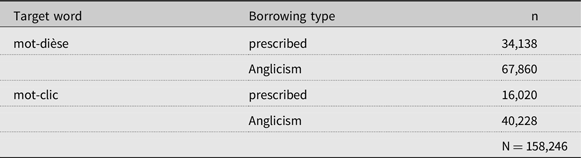
Due to limited access to downloadable tweets from the database, the analysis was carried out on a sample (Table 1). Generalized additive models (GAM) were used with the mgcv package in R (Wood, Reference Wood2017) to examine the probability of use of the prescribed variants on Twitter. Using a linear model to analyse the effect of prescriptivism over time would presume that the probability of use of the prescribed variant displays a unidirectional, monotonic increase. This sort of linearity cannot, however, be expected based on the raw frequency of the counts of each target word. Hence, GAM has the advantage to account for any non-linearity over time, while allows for linearity if there is no evidence of non-linearity. The logit probability of prescription is binomial, and it is modeled through the prescribed variants measured against the English term over seven calendar years, influence score and urban population size with an added main effect of gender. The influence score smooth also contains a by variable of gender adding an individual smooth for each factor level. Only the influence score smooth is added to the gender by variable because they are expected to interact since gender and influence score are dependent of the individual users, as opposed to gender with time or urban population size that are not. The model also includes gender as a main effect due to it being a by variable for influence score smooth.
Frequency counts of the sample data indicates that the prescribed variants in France and Québec were outnumbered by the English lexical borrowing

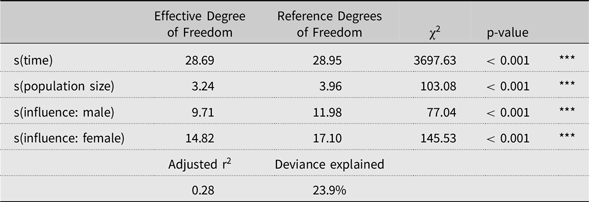
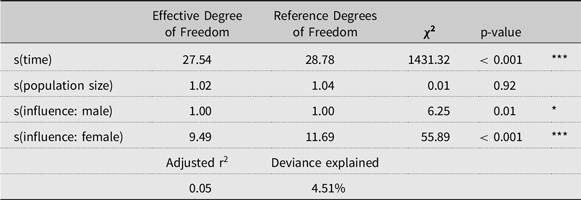
Diagnostics of the parametric coefficients and approximate significance of smooth terms of the generalized additive models are shown in the Appendix tables. The estimated degrees of freedom (Tables 3 and 5) indicate more linear (closer to 1) relationship between the dependent variable and the urban population size smooth for both mot-dièse (edf = 3.24) and mot-clic (edf = 1.02). A definite linear relationship for male influentials is present in the case of mot-clic (edf = 1), while similar, but somewhat non-linear tendencies characterize mot-dièse (edf = 9.71). Time and influence by female speakers show a rather non-linear pattern. While relatively low, deviance explained and the adjusted r2 measures suggest a good model for the data, especially when considering such noisy data. In general, GAM results are better interpreted through the visualizations of probabilities of use patterns over time, which is showcased in the following sections.
3. RESULTS
Presentation of the results will follow the order of the research questions. First, the interaction between the estimated probability of use of the prescribed terminology over time will be analysed. Afterwards, the geographical variation will be examined, including the possible differences between small and large urban areas, and taking into account the initial diffusion of mot-dièse in France and mot-clic in Québec. Finally, variation in influence score and gender will be discussed. Gender will be part of the analysis throughout the whole section, even if visualizations will demonstrate independent behaviour exclusively for the influence score, as explained in the previous section.
3.1. Implantation over time
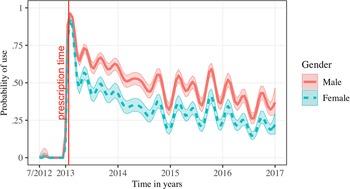
Although data from Crimson Hexagon between January 2010 and December 2016 were accessible, mot-dièse occurred for the first time in July 2012 in France. The model captures a low initial usage in 2012, followed by a considerable uptake in early 2013 at prescription time (Figure 1). This time also marks the highest value for the prescribed term at a 0.96 probability for male and 0.92 probability for female users. The probability of use consistently decreases after this burst in usage, going below 0.50 probability for female users within the first year, and within the second year for male users. At the end of 2016, the model estimates a probability of 0.37 for male and 0.22 for female users. The two genders in the corpus show different tendencies throughout the four years: male users are significantly more probable to use mot-dièse than female users. This difference is particularly noticeable until the end of 2014, while it starts to close in by the end of 2016, as demonstrated by the confidence interval bands.
Estimated probability of use for mot-dièse in France over time. The initial uptake at prescription is followed by a consistent decrease in estimated probability of use. Male users are significantly more probable to employ the prescribed term than female users.

The first occurrences of mot-dièse in the corpus are shown in (1) and (2), tweeted on the same day in July 2012. These examples demonstrate that the prescribed term had been in public discourse even before its prescription six months later. Moreover, they suggest negative attitudes towards the officially recommended term. It is likely that someone working on the official recommendation procedure shared information with the public months before the word was published in the Journal officiel. For mot-dièse, the CELF did not use an already available term (e.g. mot-clic in Québec had been available since 2011), but rather prescribed a neologism. The first tweet recognizing prescription in (3) not only refers to the original English term hashtag, but also the Québécois term mot-clic. Moreover, by using the #jorf hashtag, they clearly react to the publication in the Journal officiel.
(1) On ne dit pas “hastag”, mais “ mot-dièse ”…
(2) (par contre “ mot dièse ” pour hashtag c’est juste pas possible… o_O #tweetprecedent)
(3) RT @[username] #jorf le “ mot-dièse ” en français de France remplace le “hashtag” ou “mot-clic” en français du Québec
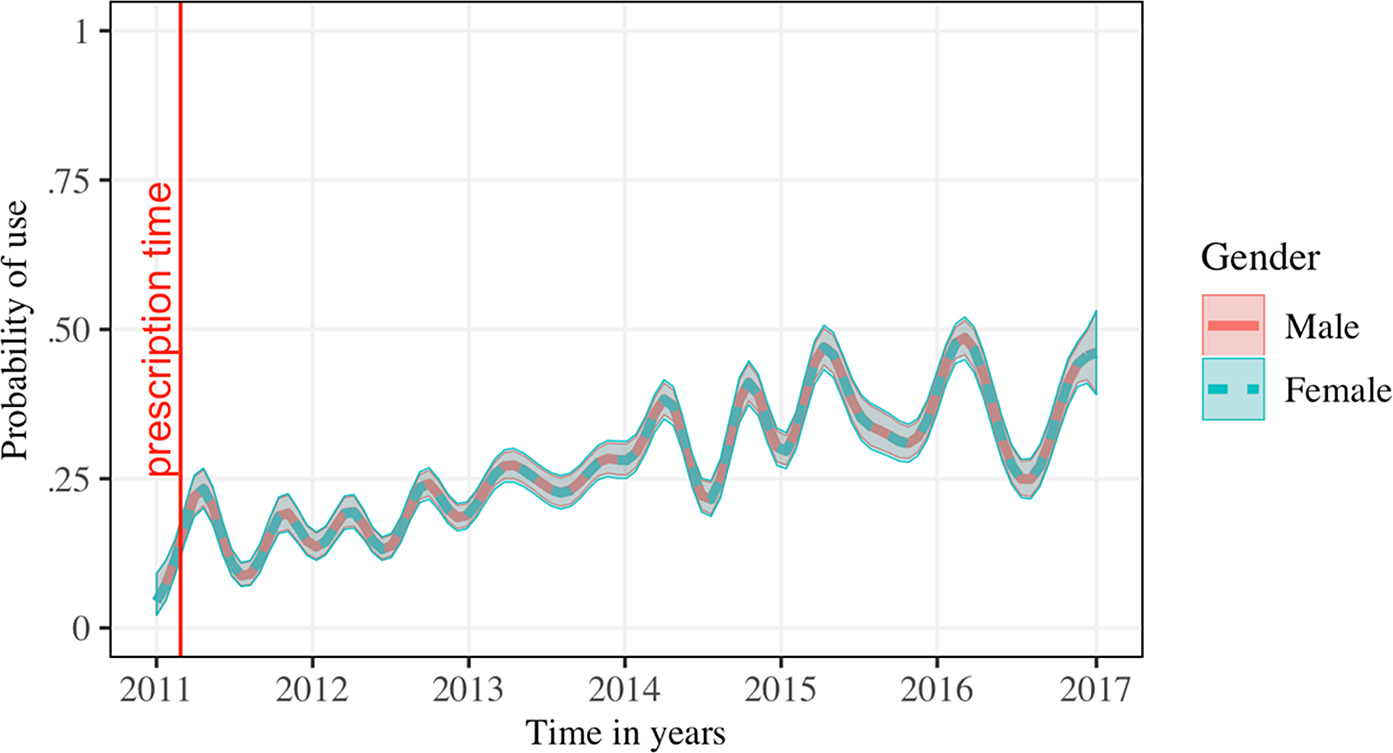
The case of mot-dièse revealed that the Québécism mot-clic had already entered public discourse in France by the time of prescription. Mot-clic was officially recommended in January 2011 in Québec by the OQLF, two years before mot-dièse in France. Figure 2 shows the estimated probability of use of mot-clic over time. At the beginning of 2011, the term has a 0.04 probability, which increases steadily in the next few years. The model estimates a more wiggly pattern between 2014 and 2017, but the probability recovers after each drop. The estimated probability never exceeds 0.50 during the seven calendar years: the highest value occurs in early 2016 with a 0.48 probability. Interestingly, overlapping lines indicate no significant difference between male and female users in Québec, which makes mot-clic unique when compared to other variables.
-
(4) Le terme français recommandé par l’OLF pour hashtag: “ mot-clic ”. Pas sûr que les tweeteux vont l’adopter.
-
(5) @[username] Ne dites pas mot-dièse , dites mot-clic .
-
(6) En France, on voudrait franciser les hashtags par mots-dièse . Ici, on utilise mots-clic . Vous préférez lequel?
-
(7) .@[username] Si on utilise Twitter pour un cours: déterminer à l’avance un mot-clic / hashtag , ex: #SOI3812 (sigle du cours) #cpass_ms
Estimated probability of use for mot-clic in Québec over time. The probability of use steadily increases from 0.04 probability in early 2011 to 0.46 probability by 2017. There is no apparent significant difference in gender.

Just as in the case of mot-dièse in France, the first tweet in (4) with mot-clic in the corpus reacts to the term’s prescription. It is noteworthy that the author expresses concerns about mot-clic’s adaptation by the speakers. For the occasion of mot-dièse’s publication in the Journal officiel, the discussion about that variable’s usage spread over to the Québécois Twittersphere. (5) indicates a suggestion for users not to use the French prescribed term, but rather the Québécois one. (6) demonstrates that the user is conscious about their affiliation with the Québécism by using “en France” for mot-dièse, and “ici” for mot-clic. At the same time, by saying “on utilise”, they admit that the term is in usage as of early 2013. (7) exemplifies that it is possible for the prescribed term to appear in the same sentence with the English borrowing: in this tweet, hashtag serves as an explanation for mot-clic.
3.2. Urban population size and diffusion
The following part will seek answers about geographical variation among urban population size, as well as between France and Québec when it comes to the diffusion of the recommended terminology. The population of each urban area were used as a continuous value from small to large cities. As a reminder, the raw population size was transformed to a logarithm base 10 value, which will help us better examine the significance of smaller differences in population size. On each visualization, the x-axis will bear annotations on where populations fell on the logarithm base 10 scale.
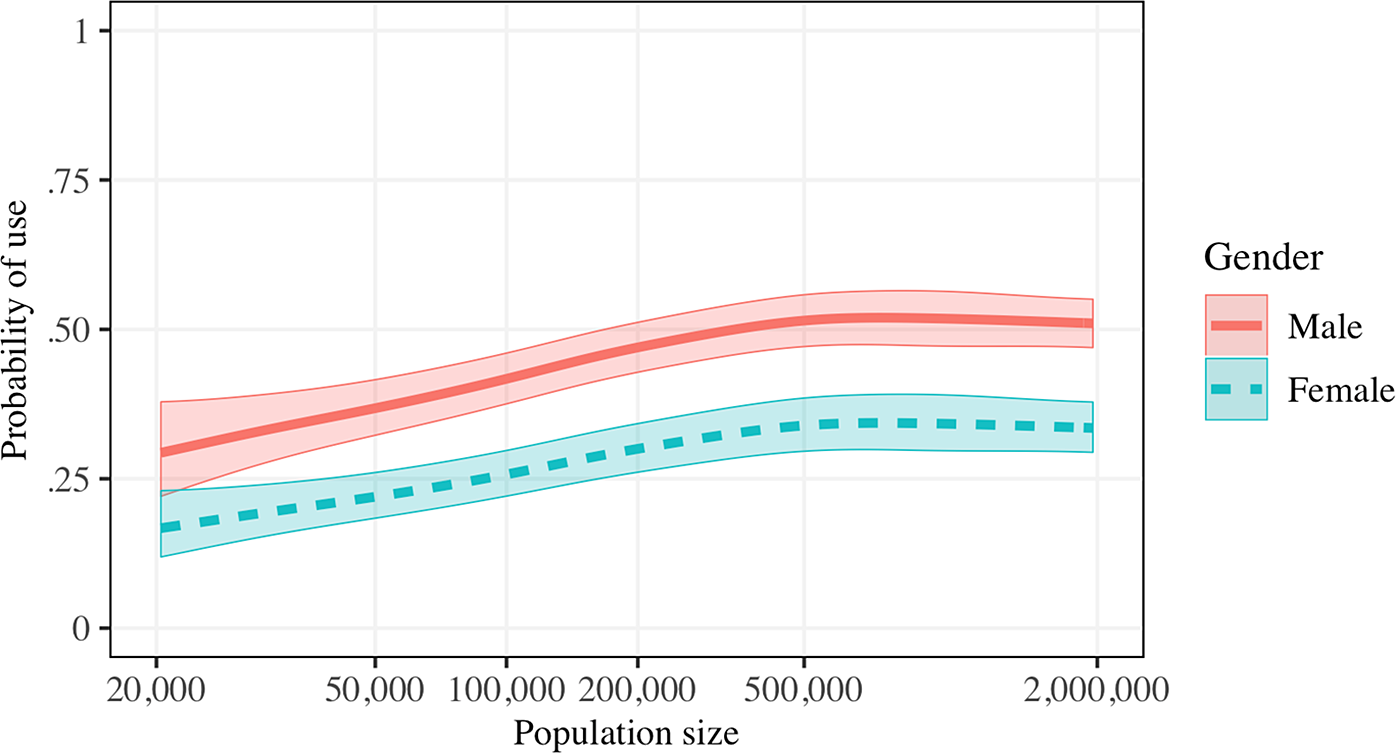
As seen before, mot-dièse’s probability of use declined after its prescription in 2013. Figure 3 displays the estimated probability of use of this prescribed term over city population size. It is clear at first glance that the estimated probability is higher in large cities, rather than in smaller ones. In less populous urban areas, the model estimates a 0.29 probability for male and a 0.17 probability for female users. The estimated probability consistently increases with the city population size between 20,000 and 500,000. Afterwards, it remains similar to the probability with Paris, which is 0.51 for male and 0.33 for female users. Another distinctive pattern in the estimated probability of mot-dièse over population size is the difference between male and female users, which is statistically significant even in the smallest cities. The confidence interval bands never overlap. While male users have a probability of use over 0.50 starting in cities with at least 500,000 people, the probability for female users remains far below the 0.50 mark.
Estimated probability of use for mot-dièse over city population size. Small urban areas show considerably lower probability of use at 0.29 for male and 0.17 for female users than large urban areas at 0.51 for male and 0.33 for female users.

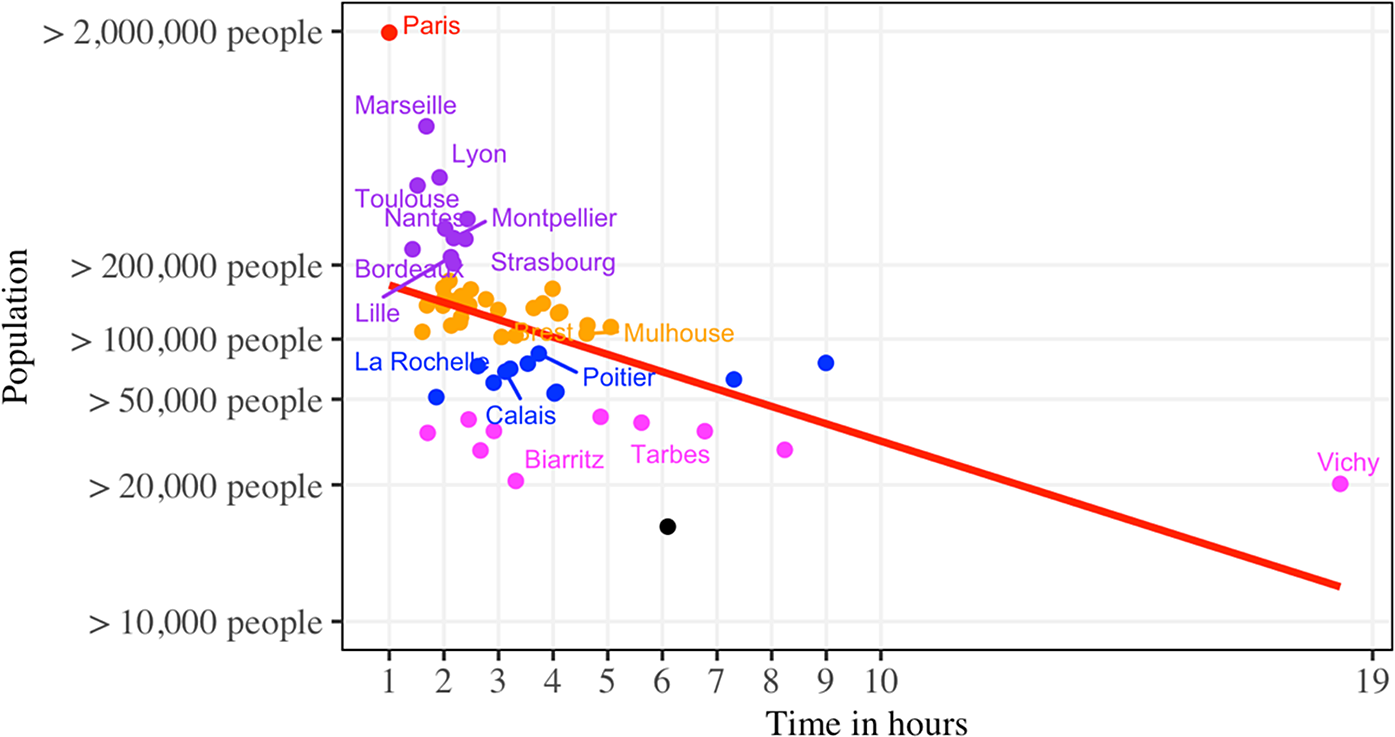
The data allow us to examine patterns for lexical diffusion. Figure 4 presents the diffusion of this prescribed word in France within the first three hours or more on 23 January 2013. Each point on the graphics represents the first occurrence of mot-dièse in the given city. The visualization shows that within the first hour, mot-dièse was used in Paris, the source of diffusion, and spread over the most populous French cities: Lyon, Marseille, Toulouse and Bordeaux. It also suggests that users in smaller cities surrounding these populous urban areas also employed the term. From one to two hours, mot-dièse continued to spread further in large urban areas, like Strasbourg, Lille, Nantes and Montpellier, as well as in adjacent less populous cities. Additionally, the first smaller cities where mot-dièse diffused are as follows: Agen in the Nouvelle-Aquitaine region, Saint-Brieuc in Brittany and Arras in Hauts-de-France. Agen is in between Bordeaux and Toulouse, Saint-Brieuc is situated close to Rennes and Nantes, and Arras is nearby Lille, which could explain the early adaption of the prescribed term. From two to three hours demonstrates the lack of big cities: only places with fewer than 200,000 inhabitants are present. Among them, the larger urban areas include Nancy in Grand-Est, Le Havre and Caen in Normandy, and Brest in Brittany, while smaller ones are Calais in Hauts-de-France, Poitiers in Nouvelle-Aquitaine and Béziers in Occitanie. The smallest city is Biarritz in the French Basque country. Mot-dièse was diffused from three hours or more to cities with 100,000 to 200,000 people like Mulhouse, Amiens, Besançon and Orléans, or cities with 50,000 to 100,000 people like Cherbourg and Troyes. This is the time slot with the highest number of smallest cities. Figure 4 thus visualizes that the smaller the city population size is, the more time mot-dièse needs to diffuse there.
Diffusion of mot-dièse in the relation of population and time. Red line shows negative correlation, which indicates that the smaller the city population is, the more time it needs for mot-dièse to spread there.

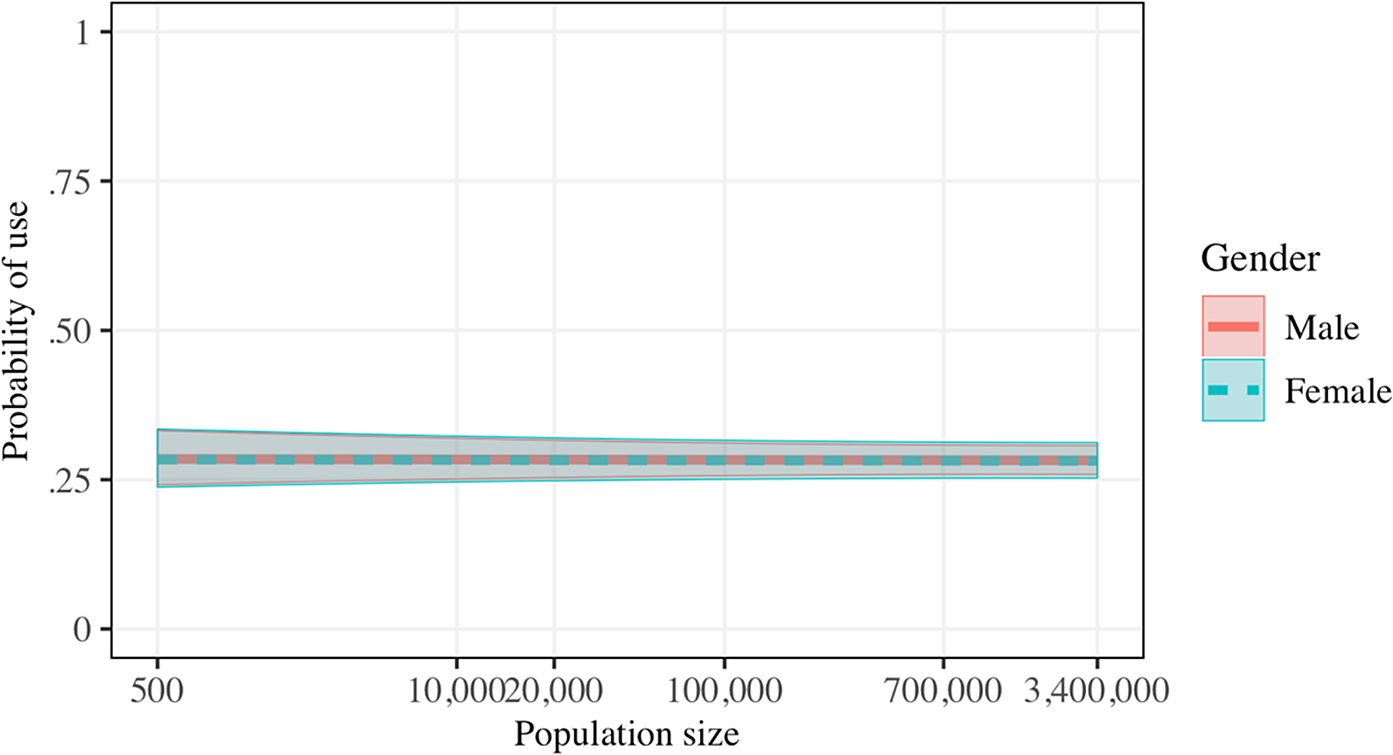
The analysis of the estimated probability of use for mot-clic over city population size in Québec reveals interesting differences when compared with the other prescribed variable in France. Figure 5 illustrates that the effect of population size smooth on the estimated probability is linear. The model estimates the probability at 0.28 in the smallest urban areas for both male and female users, which remains identical in the largest urban areas too. Confidence interval bands overlap for every city size, which further supports the lack of variation between male and female users. This finding aligns with the results of the estimated probability of use of mot-clic over time in Québec, as gender did not indicate significant difference.
Estimated probability of use for mot-clic over city population size in Québec. City population size does not affect the estimated probability of use of mot-clic. There is no difference between male and female users.

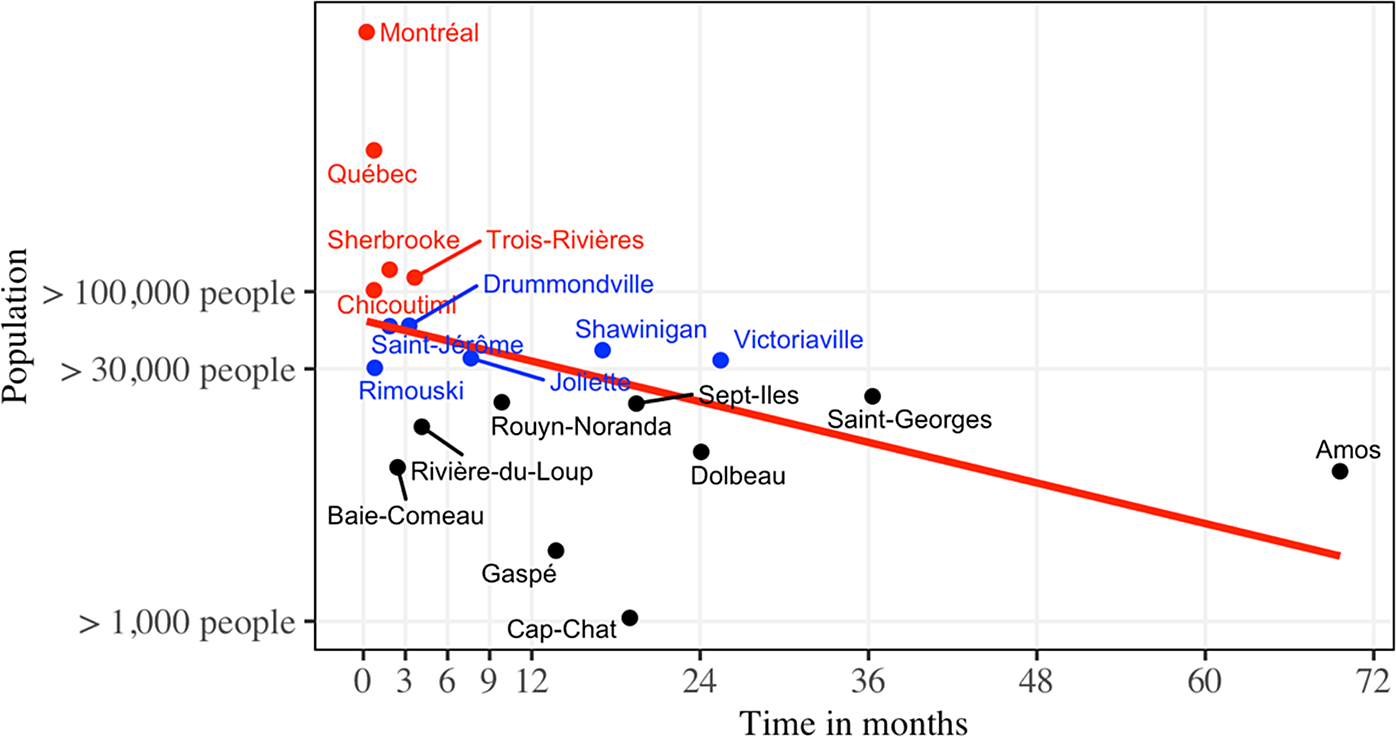
Figure 6 maps the visualization of diffusion of mot-clic in Québec in 2011 and later. The different categories in time evidence a much slower diffusion of the prescribed term, which happens in the matter of a month, compared to mot-dièse’s rapid spread within hours in France. In the first map on the left in Figure 6, mot-clic is diffused within one month in the largest urban areas, including Montreal, Québec City and Chicoutimi-Jonquière. The only medium size city in this time period is Rimouski on the Saint Lawrence River. This follows a similar pattern as in France: the lexical innovation appears first in the most populous cities in the region. In particular, mot-clic was found for the first time in the data in Montreal, followed two weeks later on the same day by Québec City and Chicoutimi-Jonquière. The second wave of diffusion occurs from one to three months with a large city, Sherbrooke and a medium size city nearby, Saint-Jérôme. It is likely that the occurrence in Sherbrooke affected the one in Saint-Jérôme, as they happened on the same day in March 2011. A small city, Baie-Comeau is the first small urban area where mot-clic appeared in the corpus. The third time slot represents the diffusion of the prescribed term from three to 12 months, including the large city of Trois-Rivières and medium city centres in its surroundings, as well as two small areas Rivière-du-Loup and Rouyn-Noranda on the western and eastern peripheries of the map. Finally, urban areas where mot-clic diffused only after a year or more do not have any large cities among them. The highest number of small urban areas are displayed here, including remote towns like Amos, Cap-Chat and Sept-Îles. The two medium size cities, Shawinigan and Victoriaville, are situated near Trois-Rivières. Thus, the diffusion of mot-clic in Québec follows a pattern similar to the one observed in France, where it starts in the largest urban areas, and spreads towards their surroundings in a wave-like movement, to finally arrive in small areas. Figure 6 illustrates the relation between population size and time in the diffusion of the prescribed term. It suggests a negative correlation, not surprisingly, which means that the smaller the city population is, the more time mot-clic needs to diffuse there. This corroborates a previous correlation between these factors in the diffusion of mot-dièse in France. This leads us to conclude that Québec and France follow the same pattern when it comes to lexical diffusion, but in Québec, the spread needs considerably more time.
Diffusion of mot-clic in Québec in the relation of population and time. The red line shows negative correlation, which indicates that the smaller the city population is, the more time it needs for mot-clic to spread there.

3.3. Social media influence and gender
The third part of the discussion of the results will seek to answer the third research question, notably on the social influence score and the individual pattern between male and female users. As established in the methodology section, the influence score of each tweet’s user was determined by the ratio of followers, followings and posts, transformed later to logarithm base 10. On each visualization of this section, the x-axis will display the influence score on a scale from -2 to 10.
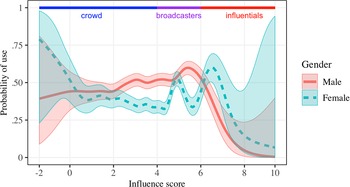
Figure 7 shows the estimated probability of the use of mot-dièse over the influence score. There are slow increasing tendencies for male users from the crowd starting at a 0.39 probability and reaching 0.60 by score 5 of the broadcasters. For influentials however, this probability heavily decreases, and it drops to a 0.0 probability for users with the highest influence scores. The pattern for female users suggests somewhat different tendencies with more wiggly movement in the influence categories. For female accounts with the lowest influence score, the probability of use is estimated at 0.79, which strongly declines afterwards. After stabilizing around 0.30, the probability varies between 0.30 and 0.50 for the broadcasters and weak influentials. Nonetheless, the model estimates a drop in probability to 0.07 for female influentials, which is comparable to tendencies for male users. The overlapping wide confidence interval bands indicate a less trustworthy significant difference between male and female users for the higher and lower end of the influence score; however, this discrepancy prevails for the crowd and the broadcasters.
Estimated probability of use for mot-dièse over influence score. The estimated probability increases for male users in the crowd and among broadcasters, while the opposite is observed for female users. For influentials, there is a considerable decrease for both genders.

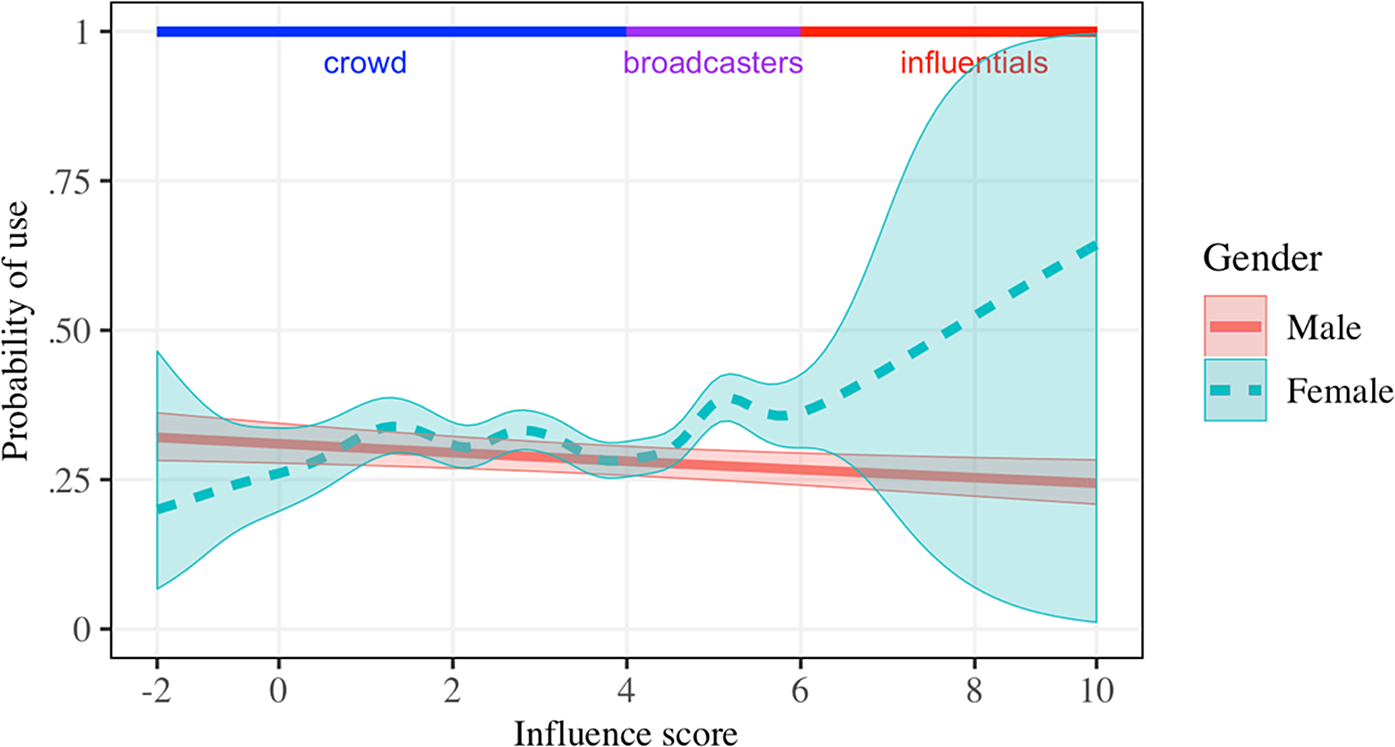
Tendencies in the probability of use of mot-clic are considerably different in Québec than those for mot-dièse in France (Figure 8). The model estimates linearity for male users, notably a negative correlation: the probability decreases as the user influence score increases. For accounts with the lowest influence score, the probability is at 0.32, while for those with the highest influence score, it is at 0.24. The difference between these two groups is not substantial, but it is visible. With regard to female users, the model estimates increasing tendencies with a non-linear relationship between the estimated probability of use and the influence score. For the least influential accounts in the crowd, the probability is at 0.20, and it varies afterwards between 0.25 and 0.35 for most of the crowd. For broadcasters, the probability reaches 0.38, and continues to rise for the influentials. At the highest end of the influence score scale, the probability of use of mot-clic for female users is at 0.64, which is considerably higher than for male users.
Estimated probability of use for mot-clic over influence score. The estimated probability shows non-linear tendencies for female users with an increasing pattern, especially for influentials. The effect of influence score on the probability of use for male users is linear, and shows negative correlation.

4. CONCLUSION
In conclusion, the analysis of the effect of prescription on the estimated probability of use of the prescribed terminology in the Twitter corpus shed light on valuable information. The first research question sought to answer the effect of time on the probability of use. It was hypothesized that in case prescription affects the estimated probability of use, we would see an increase over time. The results suggest various patterns among the variables: overall, the probability of use rises for mot-clic, while as for mot-dièse, the probability decreases considerably after an initial burst. In France, when top-down intervention on language use becomes the centre of media attention, it is often met with criticism by the public, e.g. the grammatical gender of covid, or the government’s stance on inclusive writing. On the one hand, French speakers display internal purism: they are concerned about the quality of the language, rather than lexical borrowings. On the other hand, Québécois speakers, given the substantially different linguistic landscape they live in, demonstrate more external purism: they worry about the influence English lexical items have on French (Walsh, Reference Walsh2016). These tendencies could explain why mot-clic, although slowly, was on the rise between 2010 and 2016 in Québec, compared to the decline of mot-dièse in France.
The second question tackled geographical variation, and it was hypothesized that non-standard forms like Anglicisms would be expected to be more probable in large urban areas. The analysis demonstrated a higher probability in large urban areas for mot-dièse rather than smaller ones. Interestingly, mot-clic did not indicate discrepancies in probability of use for population size. For the second research question, patterns of lexical diffusion were also explored, and based on the hypothesis one would assume lexical innovation to start in populous cities and to diffuse from larger to smaller urban areas. Mapping the spread of these two terms corroborated the hypothesis, as both of their sources were in the most populous cities, Paris and Montreal, respectively. The words then diffused to large urban areas and nearby cities, to reach the smallest towns last. The lexical diffusion showed correlation between population size and time of first occurrence of the prescribed word, suggesting that the smaller the city population is, the later the innovation spreads there. While France and Québec converged in this matter, they diverged about time: due to the burst in initial use of mot-dièse, the diffusion took place in a couple of hours in France; whereas it took over a year for mot-clic to diffuse to small towns in Québec. As reflected in early tweets in France, the media reported about the prescription of mot-dièse, which resulted in considerable buzz online. This certainly contributed to the quick response from Twitter users. By contrast, the Québécois Twittersphere lacked such hype and thus, mot-clic’s diffusion took place in a rather organic, slow-paced manner over time.
The third research question aimed at the effect of social characteristics like gender and social media influence on the estimated probability of use of the prescribed terminology. Based on previous scholarship, variation between male and female users was hypothesized, as well as higher probability of use for influentials. Mot-dièse showed declining trends in probability for influentials, while for mot-clic in Québec, influentials presented diverging tendencies depending on gender: a decrease for male and an uptake for female users. Moreover, gender points to significant differences with male users having a higher probability of use for mot-dièse, but female users for mot-clic. It is possible that these findings reflect the two different purist objectives within the two French-speaking communities. Traditionally, male speakers are characterized as more conservative speakers; therefore, they are expected to follow prescribed norms in France to keep their language internally pure. Meanwhile, female speakers, commonly associated with innovation, align more with external purism against English: in this case, they opt for mot-clic to ensure the survival of French in Québec.
This article thus explored the effect of prescription by focusing on a lexical concept assumed to be frequent and representative of social media. The results confirmed the hypothesis about geographical and gender variation, but discrepancies still remained regarding the effect of prescription on the uptake of the variables. Neologisms proposed by the terminological commissions indeed enrich the lexicon, as they provide speakers with new varieties of expressions, but they are not, and cannot be reasonably expected to replace English lexical borrowings in the age of social media where American English is a dominant language. Some institutions are flexible, open to input from the public, from the industry, encouraging bottom-up involvement in lexical innovation. At the same time, the public lacks authority to impose prescription, while the Académie française and the Office québécois de la langue française are omnipresent in the process of official lexical innovation.
Competing interests
The author declares none.
Appendix
Summary of the parametric coefficients in the GAM for mot-dièse

Significance codes: 0 ‘***’ 0.001 ‘**’ 0.01 ‘*’ 0.05 ‘.’ 0.1 ‘ ‘ 1
Approximate significance of smooth terms in the GAM for mot-dièse

Significance codes: 0 ‘***’ 0.001 ‘**’ 0.01 ‘*’ 0.05 ‘.’ 0.1 ‘ ‘ 1
Summary of the parametric coefficients in the GAM for mot-clic

Significance codes: 0 ‘***’ 0.001 ‘**’ 0.01 ‘*’ 0.05 ‘.’ 0.1 ‘ ‘ 1
Approximate significance of smooth terms in the GAM for mot-clic

Significance codes: 0 ‘***’ 0.001 ‘**’ 0.01 ‘*’ 0.05 ‘.’ 0.1 ‘ ‘ 1