
 n−



1. Introduction
In this paper, we are interested in the intersection of closed curves on translation surfaces, and especially those made with (semi-)regular polygons. We aim to study the maximal possible number of intersections for two closed curves of given lengths. This is done by considering the so-called algebraic interaction strength which is defined for a surface
 $X$
with a (say, Riemannian possibly with singularities) metric
 $g$
as
 \begin{equation*} \mbox{KVol}(X,g) \,:\!=\, \mbox{Vol}(X) \cdot \sup _{\alpha ,\beta } \frac {\mbox{Int}(\alpha ,\beta )}{l(\alpha )l(\beta )} \end{equation*}
where the supremum is taken over pairs of closed curves on
 $X$
, and
 $\mbox{Int}(\alpha ,\beta )$
represents the algebraic intersection of the closed curves
 $\alpha$
and
 $\beta$
. This quantity has seen a recent surge of interest, whether it be for flat surfaces [Reference Boulanger3–Reference Boulanger and Pasquinelli6, Reference Cheboui, Kessi and Massart8, Reference Cheboui, Kessi and Massart9], hyperbolic surfacesFootnote
1
[Reference Jiang and Pan11, Reference Torkaman17] or in general [Reference Massart and Muetzel14]. In particular,
 $\mbox{KVol}(X,g)$
is notoriously difficult to compute explicitly for a given surface
 $(X,g)$
and, with the purpose of finding examples, Cheboui-Kessi-Massart [Reference Cheboui, Kessi and Massart8, Reference Cheboui, Kessi and Massart9] initiated the study of KVol on translation surfaces. In [Reference Boulanger, Lanneau and Massart5], the author, E. Lanneau and D. Massart compute KVol on the double regular
 $n$
-gon (
 $n$
odd) and its Teichmüller disk. Then, in [Reference Boulanger4], we compute KVol on the Teichmüller disks of the regular
 $n$
-gon
 $X_n$
for
 $n \equiv 0\!\mod 4$
, but we only provide non-sharp estimates in the case
 $n \equiv 2 \!\mod 4$
. Namely,
Theorem 1.0.1. [Reference Boulanger4, Theorems 1.2 and 1.6] For
 $n \geq 8$
even, we have
 \begin{equation*} \mbox{KVol}(X_n) \leq \frac {n}{4 \tan \left (\frac {\pi }{n}\right )}, \end{equation*}
and the bound is sharp if and only if
 $n \equiv 0 \!\mod 4$
.
This is due to the fact that the regular
 $n$
-gon for
 $n \equiv 2 \!\mod 4$
(and
 $n \geq 10$
) is a translation surface with two distinct singularities, and the sides of the regular
 $n$
-gon are not closed curves; contrary to the case
 $n \equiv 0 \!\mod 4$
for which sides are closed curves and pairs of sides intersecting at the singularity achieve the maximum in the definition of KVol. In this paper, we compute the exact value of KVol on the regular
 $n$
-gon for
 $n \equiv 2 \!\mod 4$
, thus finishing the study of KVol in regular polygons. An interesting (and new) feature of this family of surfaces is that KVol is not achieved by (closed) saddle connections, but rather unions of non-closed saddle connections with different directions. Namely,
Theorem 1.0.2.
Let
 $n \geq 10$
,
 $n \equiv 2 \!\mod 4$
. For every pair of closed curves
 $\gamma , \delta$
on the regular
 $n$
-gon
 $X_n$
, we have
 \begin{equation} \frac {{Int}(\gamma ,\delta )}{l(\gamma )l(\delta )} \leq \frac {1}{2 l_0^2} \end{equation}
where
 $l_0$
is the side length of the
 $n$
-gon.
Further, equality is achieved if and only if
 $\gamma$
and
 $\delta$
are both made of two sides of the
 $n$
-gon and intersect at both singularities with the same sign.
And in particular,
Corollary 1.0.3.
For
 $n \geq 10$
with
 $n \equiv 2 \!\mod 4$
, we have
 \begin{equation*} {KVol}(X_n) = \frac {n}{8 \tan \left (\frac {\pi }{n}\right )}. \end{equation*}
The proof of Theorem1.0.2 relies on a subdivision method similar to the one used in [Reference Boulanger4] for the case
 $n \equiv 0 \!\mod 4$
. Namely, given a closed geodesic
 $\alpha$
which is made of saddle connections, we will cut
 $\alpha$
every time it crosses a side of the regular
 $n$
-gon, and we will group the obtained segments in order to control both the length of each group of segments and the (non-singular) intersections with other groups of segments obtained from the decomposition of a second closed geodesic
 $\beta$
. We will build upon the intersection count done in [Reference Boulanger4] while refining both the length and intersections estimates. This will be obtained with a careful partition into sequences of segments as well as distinguishing several types of saddle connections.
In fact, our method extends to another family of surfaces, the Bouw–Möller surfaces. These surfaces, made from semi-regular polygons, were discovered by Bouw and Möller [Reference Bouw and Möller7] in an algebraic setting and were described geometrically by Hooper [Reference Hooper10]. Given two integers
 $m,n \geq 2$
with
 $(m,n) \neq (2,2)$
, there is an associated Bouw–Möller surface made of a chain of
 $m$
semi-regular polygons, each of which has
 $2n$
sides (apart from two of them, which have
 $n$
sides). The algebraic interaction strength of these surfaces has been studied by the author and Pasquinelli in [Reference Boulanger and Pasquinelli6] where
 $\mbox{KVol}(S_{m,n})$
is computed for coprime
 $m,n$
. Still, we were unable to compute the interaction strength for non-coprime entries. This paper provides the exact value of
 $\mbox{KVol}(S_{m,n})$
for a large family of Bouw–Möller surfaces with non-coprime entries. Namely,
Theorem 1.0.4.
Let
 $m, n \geq 8$
such that
 $\gcd (m,n) \neq 1$
. Then, for any pair of closed curves
 $\gamma ,\delta$
on
 $S_{m,n}$
, we have
 \begin{equation*} \frac {{Int}(\gamma ,\delta )}{l(\gamma )l(\delta )} \leq \frac {1}{2l_0^2} \end{equation*}
where
 $l_0 = \sin \left (\frac {\pi }{m} \right )$
is the length of the smallest sides in the standard polygonal decomposition of
 $S_{m,n}$
.
Further, when
 $\gcd (m,n) \neq n$
, the equality is achieved by a pair of closed curves
 $\gamma ,\delta$
which are both made of two sides of length
 $l_0$
and which intersect twice.
The assumption
 $m, n \geq 8$
is mostly there for simplicity. In fact, the same result should hold for any
 $m,n$
non-coprime, but the adequate length estimates are more difficult to obtain for small values of
 $m$
and
 $n$
, and there are more cases to consider. Furthermore, Theorem1.0.4 also holds for
 $m = 2$
and
 $n \geq 10$
(and in fact, the assumption
 $n \geq 8$
is sufficient): in this case, the proof can be directly adapted from the
 $4m+2$
-gon case, as we are still dealing only with regular polygons.
Finally, the equality case is not achieved when
 $\gcd (m,n) = n$
. This is because the construction of the corresponding closed curves
 $\gamma$
and
 $\delta$
fail in this case. In fact, we conjecture
Conjecture 1.0.5.
Let
 $m,n \geq 3$
with
 $(m,n) \neq (3,3)$
such that
 $m$
is a multiple of
 $n$
(equivalently
 $gcd(m,n) = n$
). Then for any pair of closed curves
 $(\gamma , \delta )$
on
 $S_{m,n}$
, we have
 \begin{equation} \frac {{Int}(\gamma , \delta )}{l(\gamma )l(\delta )} \leq \frac {1}{4l_0^2} \end{equation}
where
 $l_0 = \sin \left (\frac {\pi }{m} \right )$
is the length of the smallest sides in the standard polygonal decomposition of
 $S_{m,n}$
. Further, equality is achieved for two closed curves
 $\gamma , \delta$
both made of two sides of length
 $l_0$
, and which intersect once.
Remark 1.0.6.
When
 $(m,n)=(3,3)$
, the resulting Bouw–Möller surface has genus one and is isometric to the equilateral torus which has a hexagonal lattice. In this case,
 $l_0$
equals half the systole and for any pair of closed curves
 $\gamma ,\delta$
on
 $S_{3,3}$
, we have
 \begin{equation} \frac {{Int}(\gamma , \delta )}{l(\gamma )l(\delta )} \leq \frac {1}{2\sqrt {3}l_0^2} \end{equation}
and, as discussed in [ Reference Massart and Muetzel14 ], the inequality is optimal.
1.1. History and motivations
The study of the quantity KVol goes back to [Reference Massart12], although the name interaction strength is much more recent as it comes from [Reference Torkaman17], where a similar quantity is studied (namely, the algebraic intersection is replaced by the geometric intersection). The original motivation for the study of
 $\mbox{KVol}(X)$
lies in its relation with norms defined in the homology
 $H_1(X,{\mathbb{R}})$
of the surface
 $X$
, and for which
 $\mbox{KVol}(X)$
can be alternatively seen as the best comparison constant between the (equivalent)
 $L^2$
norm and the stable norm (up to a normalisation, see [Reference Massart and Muetzel14] for definitions and for a precise statement), or the maximal symplectic area of a parallelogram inscribed in the unit ball of the stable norm.
As a consequence, the study of the interaction strength not only allows to get an estimate on the maximal possible (algebraic) intersection of two closed curves, but it also gives information on these two norms, and especially on the stable norm (which is still mysterious, see e.g., [Reference Babenko and Balacheff1, Reference Balacheff and Massart2, Reference Massart12, Reference Massart13, Reference Montealegre15]). Then, one of the first questions one can ask concerns its explicit computation on a given surface. This first question turned out to be far from trivial, and this is the reason why Cheboui, Kessi and Massart [Reference Cheboui, Kessi and Massart8, Reference Cheboui, Kessi and Massart9] initiated the study of KVol on translation surfaces, and more specifically on some square-tiled (or arithmetic) translation surfaces. Even in this case, the computation of KVol is not straightforward, and for example we do not even know the infimum value of KVol on translation surfaces of genus two with a single singularity (this is expected to be two, see [Reference Cheboui, Kessi and Massart9]).
In [Reference Boulanger4–Reference Boulanger and Pasquinelli6], E. Lanneau, D. Massart, I. Pasquinelli and the author develop a method to provide an upper bound on KVol for a large class of (half-)translation surfaces which are made out of convex polygons having obtuse angles, the estimate being sharp on Bouw–Möller surfaces with one singularity [Reference Boulanger and Pasquinelli6] and on regular
 $n$
-gons for
 $n \equiv 0 \!\mod 4$
, see [Reference Boulanger4]. This estimate also allows to compute KVol on some examples of translation surfaces with several distinct singularities, for example, the covers of a regular
 $n$
-gon for odd
 $n \geq 5$
presented in Figure 1. However, the estimate of [Reference Boulanger and Pasquinelli6, Theorem 1.3] can only be sharp for translation surfaces where the value of KVol is achieved by closed saddle connections, and it also requires that sides of the same polygon are not identified together. In particular, it never allows to compute KVol on translation surfaces of genus two with two distinct singularities, as for singularities of angle
 $4\pi$
, the fact that there is a closed saddle connection and that the surface has a polygonal decomposition made of polygons with only obtuse or right angles (as in [Reference Boulanger and Pasquinelli6]) imply a self-identification on the sides of a polygon. Our computation of KVol on the regular decagon thus provides the first example of computation on a translation surface with two singularities of angle
 $4\pi$
, and we also show that KVol is not achieved by closed saddle connections but rather unions of two (non-closed) saddle connections in distinct directions.Footnote
2
A triple cover of the double regular pentagon with three singularities (of angle
 $6\pi$
) and for which the algebraic interaction strength can be computed from [Reference Boulanger and Pasquinelli6] and is
 $\frac {15}{4\tan (\frac {\pi }{5})}$
. The same picture can be extended to any number of singularities.

1.2. Questions and conjectures
In light of Theorem1.0.2, one could wonder as it is studied in [Reference Boulanger4–Reference Boulanger and Pasquinelli6] how KVol behaves not only on the regular
 $n$
-gon but also on its
 $SL_2({\mathbb{R}})-$
orbit. However, the main argument to compute of KVol in the orbit of the surfaces considered in [Reference Boulanger, Lanneau and Massart5] and [Reference Boulanger4] relies on the fact that the surfaces have a single singularity, and hence the supremum in the definition of KVol can be considered as a supremum over saddle connections, which is not the case on the regular
 $n$
-gon for
 $n \equiv 2 \!\mod 4$
, or for Bouw–Möller surfaces with non-coprime parameters. In fact, even the simpler question of the computation of KVol on the staircase model of the regular
 $n$
-gon is still open for
 $n \equiv 2 \!\mod 4$
, and it is not clear whether a subdivision method as in the present paper would help.
In another direction, one should notice that for the regular
 $n$
-gon, the supremum in the definition of KVol is actually a maximum. This is consistent with Remark 1.6 of [Reference Boulanger, Lanneau and Massart5], where a rough argument is given to support that KVol should be a maximum for Veech surfaces of genus at least two.
1.3. Algebraic versus geometric intersection
We conclude this introduction with a remark on the nature of the intersection used here. As we have seen, a motivation for considering the algebraic intersection comes from the relations with norms in homology, but one may similarly wonder what happens for the geometric interaction strength which is defined as its algebraic counterpart but replacing the algebraic intersection with the geometric intersection, see [Reference Torkaman17]. These two quantities are not the same in general, even for translation surfaces: for example, the surfaces
 $L(n,n)$
considered in [Reference Cheboui, Kessi and Massart9] have algebraic interaction strength going to two as
 $n$
goes to infinity, while it is easily shown that their geometric interaction strength go to infinity with
 $n$
. Another significative difference is that the algebraic intersection is defined at the homology level, whereas the geometric intersection is defined at the free homotopy level, and in particular if one can assume the curves to be simple when studying the algebraic interaction strength, this is not the case anymore for the geometric interaction strength.
However, several of the methods used to study one of them also gives information on the other. This is, for example, the case of all the subdivision methods used in [Reference Boulanger4–Reference Boulanger and Pasquinelli6] and in the present paper, whose estimates on intersections rely on a count of the number of intersection points for saddle connections, assuming that, in the worst case, all the signs are the same. As a consequence, all the results of these papers can be extended to the geometric interaction strength, and in particular the algebraic and geometric interaction strength coincide on regular polygons ([Reference Boulanger4] and the present paper) and on all the examples of Bouw–Möller surfaces
 $S_{m,n}$
for which
 $\mbox{KVol}$
is known ([Reference Boulanger, Lanneau and Massart5, Reference Boulanger and Pasquinelli6] and the present paper).
Outline
We first recall in Section 2 useful background on translation surfaces, as well as the decomposition of a saddle connection into sandwiched and non-sandwiched segments from [Reference Boulanger4, Reference Boulanger, Lanneau and Massart5]. Then, Section 3 is devoted to the proof of Theorem1.0.2: in Section 3.2, we study the length of saddle connections depending on the number of segments in their sandwiched/non-sandwiched decomposition and on four types of saddle connections. In Section 3.3, we study the non-singular intersections of pairs of saddle connections depending on their type and the number of segments, and we finally use both estimates to prove Theorem1.0.2 in Section 3.4. Finally, Section 4 is devoted to the study of Bouw–Möller surfaces and the proof of Theorem1.0.4.
2. Preliminaries on the regular
 $\boldsymbol{n}-$
gon

In this section, we recall useful background on the regular
 $n$
-gon translation surface, and we describe the decomposition of a saddle connection into sandwiched and non-sandwiched segments, following [Reference Boulanger4]. Then, we provide a general strategy for the proof of Theorems1.0.2 and 1.0.4.
2.1. The regular
$\boldsymbol{n}$
-gon translation surface

A translation surface
 $(X,\omega )$
is a real compact genus
 $g$
surface
 $X$
with an atlas
 $\omega$
such that all transition functions are translations except on a finite set of singularities
 $\Sigma$
, along with a distinguished direction. In fact, it can also be seen as a surface obtained from a finite collection of polygons embedded in
 $\mathbb{C}$
by identifying pairs of parallel opposite sides by translation. The resulting surface has a flat metric and a finite number of conical singularities or cone points.
For
 $n \geq 4$
even, one can construct a translation surface by identifying the opposite sides of a regular
 $n$
-gon. The resulting surface has a well-defined atlas of charts to
 ${\mathbb{R}}^2$
where the transition functions are translations, except, for
 $n \geq 8$
, at the vertices, which are then singularities. One can check that if
 $n \equiv 0 \!\mod 4$
then all vertices are identified to the same point, whereas if
 $n \equiv 2 \!\mod 4$
the vertices split into two classes, and the resulting surface has two distinct singularities.
As a consequence of the definition, geodesics on translation surfaces are piecewise straight line segments, and they can only change direction at a singularity. A saddle connection is a geodesic segment between two cone points with no singularities in its interior, and such geodesics play a central role in the study of translation surfaces: every closed curve is freely homotopic (hence homologous) to the union of saddle connections. More, every free homotopy class has a representative element of minimal length which is the union of saddle connections. The reason for this is that a non-singular closed geodesic determines a flat cylinder of freely homotopic trajectories, as in Figure 2, and the boundary of the cylinder is made of saddle connections. For example, the regular
 $4m+2$
-gon is decomposed into
 $m$
cylinders in the direction of every side, as in Figure 2.
As a consequence of the above, when studying the interaction strength on translation surfaces, one can restrict to closed curves made of saddle connections. In fact, if one studies the algebraic interaction strength, a convexity argument shows that one can further restrict to the curves that are simple (see [Reference Massart12]). Although this is not necessary for our argument, it will simplify the exposition to restrict as a first step to closed curves passing at most once through each singularity of the surface.
The decomposition into three horizontal cylinders on the
 $14$
-gon. On the right, the unfolding of the smallest cylinder
 $C_1$
. The closed geodesic
 $\alpha$
is homologous to the union of two saddle connections.

2.2. Algebraic intersection in translation surfaces
Given two oriented closed curves
 $\alpha , \beta$
on a smooth surface, which we assume to be in transverse position, the algebraic intersection
 $\mbox{Int}(\alpha ,\beta )$
is defined as the sum of signs at each intersection point, where the sign at an intersection point
 $P$
is set to
 $+1$
if turning counter-clockwise around the point
 $P$
, one sees
 $\alpha$
going away from
 $P$
, then
 $\beta$
going away from
 $P$
, then
 $\alpha$
again, going towards
 $P$
and then
 $\beta$
going towards
 $P$
, as shown in Figure 3. In the specific case of translation surfaces, given a plane template (at the regular
 $n$
-gon for even
 $n$
), the sign of intersections is easily computed outside the singularities, but in order to compute the sign at singularities one has to look at identifications and construct a neighbourhood of the singularity which makes clear the cyclic order of the curves. In the case of the regular
 $n$
-gon, if we label the sides of the regular
 $n$
-gon
 $1,2, \ldots , \frac {n}{2}$
in cyclic clockwise order, then one can check that the cyclic counter-clockwise order of the sides we see around each singularity is the natural (cyclic) order on
 $\{1,2, \ldots , \frac {n}{2}\}$
, as shown in Figure 4 for the decagon. In particular, if we choose
 $\gamma$
(resp.
 $\delta$
) to be the union of the two sides of label
 $s_1$
and
 $s_2$
(resp.
 $t_1$
and
 $t_2$
) with
 $1 \leq s_1 \lt t_1 \lt s_2 \lt t_2 \leq \frac {n}{2}$
(orienting consistently the sides so that
 $\gamma$
and
 $\delta$
have a well-defined orientation), then
 $\gamma$
and
 $\delta$
intersect at both singularities with the same sign, and
 $|\mbox{Int}(\gamma ,\delta )| = 2$
. From Theorem1.0.2, these are pairs of curves
 $\gamma$
and
 $\delta$
achieving KVol.
Remark 2.2.1. For these pairs of closed curves, the geometric intersection is also two. More generally, the geometric intersection and the algebraic intersection coincide when all the intersection points have the same sign. As already said in the introduction, our proof of Theorem 1.0.2 will rely on a count on intersection points for saddle connections, assuming that, in the worst cases, all intersections have the same signs Footnote 3 . Hence, Theorem 1.0.2 also holds when the algebraic intersection is replaced with the geometric intersection, with the same equality cases.
The sign of a transverse intersection.

The cyclic order of the sides at the singularities. The segments
 $\gamma = 1 \cup 3$
and
 $\delta = 2 \cup 5$
intersect twice.

2.3. Sectors, transition diagrams and subdivisions
We now explain how to subdivide saddle connections into smaller sandwiched and non-sandwiched segments in order to be able to control both their length and the number of intersections, as done in [Reference Boulanger4, Reference Boulanger, Lanneau and Massart5]. The main goal of this paper is to go one step further in the study of this decomposition in order to improve the length estimates and therefore deal with the case where there are two singularities.
Let
 $\alpha$
be a saddle connection which we assume is neither a side nor a diagonal of the
 $n$
-gon. We let
 $\theta _{\alpha } \in (0, \pi )$
be the angle between the direction of
 $\alpha$
and the horizontal (which is set as the direction of a side), and we partition
 $(0,\pi )$
into
 $n$
sub-intervals
 $\Sigma _{i} = (\frac {i \pi }{n}, \frac {(i+1)\pi }{n})$
for
 $i \in \{0, \cdots , n-1\}$
.
Definition 2.3.1.
We will say that
 $\alpha$
has sector
 $\Sigma _i$
if
 $\theta _\alpha \in \Sigma _i$
.
As used in [Reference Boulanger4, Reference Smillie and Ulcigrai16], the sector determines a possible transition diagram of the cutting sequence of sides crossed by
 $\alpha$
. More precisely, the transition diagram associated with the sector
 $\Sigma _i$
is the graph whose vertices corresponds to the sides of the regular
 $n$
-gon (up to identification) and where there is an edge from the sides of label
 $A$
to the sides of label
 $B$
if there is a segment going from a side of label
 $A$
to a side of label
 $B$
whose direction belong to
 $\Sigma _i$
. In particular, if we label the sides of the regular
 $n$
-gon by numbers
 $1, 2, \ldots , n/2$
(there are only
 $n/2$
sides up to identification), then one can check that the transition diagram corresponding to the sector
 $\Sigma _i$
has the form:
 \begin{equation*} \sigma _i(1) \leftrightharpoons \sigma _i(2) \leftrightharpoons \sigma _i(3) \cdots \leftrightharpoons \sigma _i(n/2) \ \circlearrowright \end{equation*}
where
 $\sigma _i \in \mathfrak{S}_{n/2}$
is a permutation (as shown in Figure 5).
Notation 2.3.2.
We will write
 $\sigma _{\alpha }$
to refer to the permutation
 $\sigma _i$
associated with the sector
 $\Sigma _i$
corresponding to
 $\alpha$
.
The permutation
 $\sigma _0$
associated with the transition diagram in sector
 $\Sigma _0$
for
 $n=10$
.

Now, let us subdivide
 $\alpha$
into shorter segments by cutting it every time it crosses a side of the regular
 $n$
-gon. In order to obtain length estimates, one can consider two types of segments: the adjacent segments which go from the interior of a side of the regular
 $n$
-gon to the interior of an adjacent side of the
 $n$
-gon, and the other segments, referred to as non-adjacent segments. One of the main ideas of [Reference Boulanger, Lanneau and Massart5], and then [Reference Boulanger4], is to notice that non-adjacent segments have length at least
 $l_0$
, the side length of the regular
 $n$
-gon, and that, although we cannot control the length of adjacent segments separately, the total length of two consecutive adjacent segments is always greater than
 $l_0$
. More, adjacent segments correspond to segments for which one of the endpoints lies on a side of label
 $\sigma _\alpha (1)$
, and as a consequence they always come in pairs: grouping adjacent segments in pairs, we obtain a so-called sandwiched segment, whereas the other segments (i.e., the non-adjacent segments) are referred to as non-sandwiched segments.
Remark 2.3.3. This idea was later generalised in [ Reference Boulanger and Pasquinelli6 ] under general hypotheses on polygons and identifications. In this general context, adjacent segments do not always come in pairs and one has to be very careful in order to obtain intersection estimates. For example, this behaviour appears for Bouw–Möller surfaces considered in Section 4 .
Another way to define the decomposition is to first remark that the side
 $\sigma _i(1)$
can only be preceded and followed by a single side,
 $\sigma _i(2)$
, adjacent to
 $\sigma _i(1)$
. For this reason, we refer to
 $\sigma _i(1)$
as the sandwiched side in the sector
 $\Sigma _i$
, whereas the other sides will be referred to as non-sandwiched in the sector
 $\Sigma _i$
. Now, given a saddle connection
 $\alpha$
which is neither a side nor a diagonal, we subdivide
 $\alpha$
into smaller (non-closed) segments by cutting
 $\alpha$
every time it crosses a non-sandwiched side (in the sector corresponding to
 $\alpha$
). This determines a decomposition
 $\alpha = \alpha _1 \cup \cdots \cup \alpha _k$
, where
 $k \geq 2$
and each segment is either:
-
• A non-sandwiched segment which goes from a side of the
$n$
-gon to another non-adjacent side of the
$n$
-gon. -
• A sandwiched segment which goes from the interior of a side of label
$\sigma _i(2)$
to the interior of the other side of label
$\sigma _i(2)$
and intersects a side of label
$\sigma _i(1)$
. -
• An initial or terminal segment
$\alpha _1$
or
$\alpha _k$
. These segments will be considered as non-sandwiched segments.


By convention, if
 $\alpha$
is a side or a diagonal, we will say that the decomposition of
 $\alpha$
is
 $\alpha = \alpha _1$
, made of a single segment.
Notation 2.3.4.
We will denote by
 $n_{\alpha }$
the number of segments in the above decomposition of
 $\alpha$
.
2.4. Length and intersection estimates
As already hinted, the main reason for considering this specific decomposition of a saddle connection is twofold: first, the construction ensures that every segment of the decomposition has length at least
 $l_0=1$
, the side length of the regular
 $n$
-
gon (which we will assume to be 1). This means in particular that the total length of a saddle connection
 $\alpha$
is at least
 $n_\alpha$
. Second, it is easily seen that two non-sandwiched segments can only intersect once, and in fact one can control the number of intersections in terms of the total number of segments, as done in [Reference Boulanger4, Section 3.3]. For this, one should distinguish the following class of saddle connections:
Definition 2.4.1.
The saddle connections which are strictly contained inside a big cylinder are the longest diagonals and the saddle connections
 $\alpha$
for which the only sides appearing in the cutting sequence of
 $\alpha$
are
 $\sigma _\alpha (n/2-1)$
and
 $\sigma _\alpha (n/2)$
, and the endpoints of
 $\alpha$
are the common endpoints of sides with label
 $\sigma _\alpha (n/2-1)$
and
 $\sigma _\alpha (n/2)$
.
See an example on the right of Figure 6. With this definition, we have the following intersection estimates:
Proposition 2.4.2. [Reference Boulanger4, Section 3.3] Given two saddle connections
 $\alpha$
and
 $\beta$
on the regular
 $n$
-gon (
 $n \geq 8$
even), the number
 $|\alpha \cap \beta |$
of non-singular intersections between
 $\alpha$
and
 $\beta$
satisfies
 \begin{equation*} |\alpha \cap \beta | \leq n_{\alpha } n_{\beta } \end{equation*}
unless one of
 $\alpha$
or
 $\beta$
(say
 $\alpha$
) is strictly contained inside a big cylinder, and in this case we have
 \begin{equation*} |\alpha \cap \beta | \leq n_{\alpha }(n_{\beta } + q_{\beta }) \end{equation*}
where
 $q_{\beta }$
is the number of sandwiched segments of
 $\beta$
.
The second estimate of Proposition 2.4.2 comes directly from the fact that each non-sandwiched segment of
 $\alpha$
can only intersect once a non-sandwiched segment and twice a sandwiched segment. The first estimate requires more work.
2.5. General strategy
The main idea of [Reference Boulanger4] in the proof of the Theorem1.0.1 is to use the above bounds to obtain
 \begin{equation*} \frac {\mbox{Int}(\alpha , \beta )}{l(\alpha )l(\beta )} \lessapprox \frac {n_\alpha n_\beta }{\ n_\alpha n_\beta } = 1, \end{equation*}
although in reality there are two issues to deal with:
-
• Since the intersection estimate
$|\alpha \cap \beta | \leq n_{\alpha } n_{\beta }$
fails for saddle connections which are strictly contained inside a big cylinder, these saddle connections have to be considered separately, and their length estimates have to be improved; -
• the intersection estimate does not take into account the singular intersections. Here again, a small margin is required in the length estimates, for saddle connections which are not sides, to compensate for a possible singular intersection.

In the present paper, and both for the proofs of Theorems1.0.2 and 1.0.4, the general idea is similar: we roughly want to show that in general the length of a saddle connection
 $\alpha$
is at least
 $l(\alpha ) \geq \sqrt 2 n_\alpha$
, which, using the same intersection estimate,Footnote
4
would give
 \begin{equation*} \frac {\mbox{Int}(\alpha , \beta )}{l(\alpha )l(\beta )} \lessapprox \frac {n_\alpha n_\beta }{\sqrt {2} n_\alpha \sqrt {2} n_\beta } = \frac {1}{2}. \end{equation*}
Here again, the above two issues have to be dealt with,Footnote
5
but there is actually a third issue coming from the fact that saddle connections may not be closed: here
 $\alpha$
and
 $\beta$
have to be considered as unions of possibly several saddle connections. Although we will work separately with saddle connections in a first step, a large part of the argument will be devoted to analyse what happens for specific unions of saddle connections.
3. Proof of Theorem1.0.2
3.1. Outline
In order to overcome the three above issues, we will distinguish four types of saddle connections and provide specific length and intersection estimates in each of the cases. These are the following:
-
1. sides,
-
2. the saddle connection
$\Delta$
in the left of Figure 6, starting from the bottom left vertex of the regular
$n$
-gon with direction
$\left (2+\cos \left (\frac {2\pi }{n}\right ),\sin \left (\frac {2\pi }{n}\right )\right )$
, and its symmetric images by the action of the dihedral group. -
3. the saddle connections which are strictly contained inside the big cylinder associated with their sector.
-
4. all other saddle connections.



Remark 3.1.1. Saddle connections of type (1), (2) and (3) are always non-closed, whereas saddle connections of type (4) can either be closed or non-closed.
On the left, a saddle connection of type (2). Any saddle connection of type (2) can be obtained from
 $\Delta$
by a symmetry or a rotation. On the right, a saddle connection of type (3), that is staying strictly inside the big cylinder associated with its diagram. Its endpoints
 $A$
and
 $A'$
are opposite vertices of the decagon, hence representing different singularities.

With the above distinction into types, we show
Proposition 3.1.2 (Length estimates). Let
 $\alpha$
be a saddle connection on the regular
 $n$
-gon, where
 $n \geq 10$
, is even. We assume that
 $l_0=1$
, that is, the
 $n$
-gon has unit side. Then, according to the type of
 $\alpha$
as above, we have
-
1.
$l(\alpha ) = 1$
, -
2.
$l(\alpha ) = \sqrt {5 + 4 \cos \left (\frac {2\pi }{n} \right )} \gt 2 \sqrt {2}$
. -
3.
$l(\alpha ) \geq 2 \sqrt {2} n_{\alpha } + \varepsilon _1,$
where
$\varepsilon _1 \,:\!=\, \sqrt {5} + 1 -2\sqrt {2} = 0.407\ldots$
, and with equality if and only if
$n_{\alpha } = 1$
and
$n = 4m+2 = 10$
, that is,
$\alpha$
is a long diagonal of the decagon.
-
4. In all the other cases, we have
\begin{equation*} l(\alpha ) \geq \eta _0 n_{\alpha } + \varepsilon _0 \end{equation*}
where
$\eta _0 \,:\!= 2/(2{+}\sqrt {5}{-}2\sqrt {2}) = 2/(1+\varepsilon _1) = 1.420\ldots$
and
$\varepsilon _0 \,:\!=\, 2 \cos \left (\frac {\pi }{10}\right )-\eta _0 = 0.481\ldots$
, and with equality if and only if
$\alpha$
is a short diagonal of the decagon.





We provide a proof of this Proposition in Section 3.2. The constants
 $\varepsilon _1, \eta _0$
and
 $\varepsilon _0$
may seem intriguing at first sight, but the additional length will help us compensate for the possible additional singular intersections. There is actually a slight margin in the choice of constants, and the key relations that we will need are
-
•
$\eta _0 \geq \sqrt {2}$
; -
•
$(1+\varepsilon _1 )\eta _0 \geq 2$
(here, it is
$2$
by definition); -
•
$1+\varepsilon _0 \geq \sqrt {2}$
; -
• and
$3\sqrt {2}\varepsilon _0 + \varepsilon _0^2 \geq 2$
.


Remark 3.1.3.
The length estimate
 $l(\alpha ) \geq \eta _0 n_\alpha + \varepsilon _0$
does not hold for the saddle connection
 $\Delta$
(and therefore, any saddle connection of type (2)). This is the main reason why these saddle connections have to be considered separately.
Concerning the intersections, we show in Section 3.3:
Proposition 3.1.4 (Intersection estimates). Given two saddle connections
 $\alpha$
and
 $\beta$
on the
 $(4m+2)$
-gon, the following (symmetric) table gives an upper bound on the number
 $|\alpha \cap \beta |$
of non-singular intersection points between
 $\alpha$
and
 $\beta$
in terms of
 $n_{\alpha }, n_{\beta }$
.

Finally, in Section 3.4, we use Propositions 3.1.2 and 3.1.4 to analyse all possible cases of pairs of closed curves which are made of one closed saddle connection or two non-closed saddle connections.
3.2. Study of the lengths
We now prove Proposition 3.1.2. Since case (1) is trivial and case (2) is a direct computation, it remains to study cases (3) and (4).
Case (3)
Let us first assume that
 $\alpha$
is a saddle connection strictly contained inside a big cylinder. We start with the following lemma, whose proof is left to the reader.
Lemma 3.2.1 (Diagonals of the decagon). Let
 $\varphi _{10} = 2 \cos \left (\frac {\pi }{10}\right )$
. The lengths of the diagonals of a regular, unit-sided decagon are given by, in increasing order
 $\varphi _{10}, \varphi _{10}^2-1$
,
 $\varphi _{10}^3 - 2 \varphi _{10}$
and
 $\varphi _{10}^4 - 3 \varphi _{10}^2 + 1$
.
Further
 \begin{equation*} \varphi _{10}^4 - 3 \varphi _{10}^2 + 1 = \sqrt {5}+1 = 2 \sqrt {2} + \varepsilon _1. \end{equation*}
We can now estimate the length of saddle connections of type (3):
Lemma 3.2.2.
Assume that
 $\alpha$
is a saddle connection of type (3). Then
 \begin{equation} l(\alpha ) \geq 2\sqrt {2} n_{\alpha } + \varepsilon _1 \end{equation}
with equality if and only if
 $\alpha$
is a long diagonal of the decagon.
The unfolding of the saddle connections staying inside the big cylinder with
 $n_{\alpha } \leq 3$
(and for
 $n = 10$
). Here,
 $L_{10} = \sqrt {5} +1 = 2\sqrt {2} + \varepsilon _1$
is the length of the longest diagonal of the unit-sided regular decagon.

Proof. Given a saddle connection
 $\alpha$
of type (3), we unfold
 $\alpha$
to obtain a chain of
 $n$
-gons in which
 $\alpha$
is now a straight line, as in Figure 7. We will assume as in the figure that the direction of the cylinder is vertical, and
 $\alpha$
starts from the bottom singularity
 $X$
. Notice that, by definition,
 $\alpha$
must end at the top singularity
 $\bigcirc$
. In particular, the length of
 $\alpha$
can be estimated as follows:
-
• The first segment accounts for a vertical length equal to the length of the longest diagonal
$L_n$
of the regular
$n$
-gon, and we have
\begin{equation*} L_n \geq L_{10} = 2\sqrt {2} + \varepsilon _1\end{equation*}
-
• Each additional segment accounts for an additional vertical length equal to the length
$L_n$
of the longest diagonal minus
$\sin \left (\frac {\pi }{n}\right )$
. Further,
\begin{equation*} L_n - \sin \left (\frac {\pi }{n}\right ) \geq L_{10} - \sin \left (\frac {\pi }{10}\right ) = 2.927\ldots \gt 2\sqrt {2}. \end{equation*}


In particular, the vertical length of
 $\alpha$
is at least
 $2 \sqrt {2} n_{\alpha } + \varepsilon _1$
, and therefore the same holds for the total length of
 $\alpha$
. This proves Lemma 3.2.2.
Case (4)
We now consider a saddle connection
 $\alpha$
of type (4). We recall that we want to show
 $l(\alpha ) \geq \eta _0 n_\alpha + \varepsilon _0$
, with equality if and only if
 $\alpha$
is a short diagonal and
 $n=10$
. The main idea is to distinguish short and long segments in the decomposition of
 $\alpha$
. More precisely, one should notice that:
Lemma 3.2.3.
If
 $\alpha _i$
is a non-sandwiched segment whose endpoints lie on sides of label
 $\sigma _\alpha (j)$
for
 $j \geq 3$
, then
 $l(\alpha _i) \geq 2 \cos \left (\frac {\pi }{n}\right )$
, with equality if and only if
 $\alpha = \alpha _i$
is a short diagonal of the decagon.
On the left, a segment whose endpoints on sides of label
 $\sigma _0(i)$
for
 $i \geq 3$
. This segment is longer than the short dashed diagonals. On the right, a maximal trip through the short horizontal cylinder. Here, the first segment
 $\alpha _{i_0}$
is a long segment, whereas the last segment
 $\alpha _{i_0+p-1}$
(
 $p=5$
) is the terminal segment and goes to the vertex
 $A'$
.

See the left part of Figure 8. In particular, such segments have length at least
 $ 2 \cos \left (\frac {\pi }{10}\right ) = \eta _0+ \varepsilon _0$
. Such segments will therefore be referred to as long non-adjacent segments, while the other segments will be called short segments and are either sandwiched segments or non-sandwiched segments with an endpoint on the side
 $\sigma _\alpha (2)$
. Geometrically speaking, the short segments are those contained in a short cylinder in the direction of the side
 $\sigma _{\alpha }(1)$
, see the right of Figure 8 in the case where
 $\Sigma _\alpha = \Sigma _0$
. This comes from the fact that the sides of label
 $\sigma _\alpha (1)$
are adjacent to both a side of label
 $\sigma _\alpha (2)$
and
 $\sigma _\alpha (3)$
. In particular, although on their own short segments may have length as close as
 $l_0$
as possible, it turns out that considering a maximal trip through a short cylinder (in the direction of
 $\sigma _\alpha (1)$
) yields suitable length estimates:
Definition 3.2.4.
A maximal trip through a short cylinder is a sequence of segments
 $\alpha _{i_0}, \ldots , \alpha _{i_0+p-1}$
of
 $\alpha$
such that:
-
• The segments
$\alpha _{i_0 + 1}, \ldots , \alpha _{i_0 + p-2}$
are either sandwiched segments or non-sandwiched segments with an endpoint on the side
$\sigma _\alpha (2)$
; -
• The segments
$\alpha _{i_0}$
and
$\alpha _{i_0+p-1}$
are either initial (resp. terminal) segments or have their endpoints on sides of label
$\sigma _\alpha (3)$
and
$\sigma _\alpha (4)$
.


In particular, the segments
 $\alpha _{i_0}$
and
 $\alpha _{i_0 + p-1}$
may be long non-adjacent segments. However, we will count them with the sequence of short segments as this will help us to obtain suitable length estimates for a maximal trip through the short cylinder. Let us point out that maximal trips through small cylinders cannot overlap, since the first (resp. last) segment is either initial (resp. terminal) or has an endpoint in the interior of a side of label
 $\sigma _\alpha (4)$
, which means that the preceding (resp. following) segment is also a long segment. With this definition, we have
Lemma 3.2.5.
A maximal trip through the short horizontal cylinder
 $\alpha _{i_0} \cup \cdots \cup \alpha _{i_0+p-1}$
made of
 $p$
segments, and among them
 $q$
sandwiched segments, has length at least
 \begin{equation} \sqrt {\left (p+(p-1)\cos \left (\frac {2\pi }{n}\right )\right )^2 + \left ((q+1) \sin \left (\frac {2\pi }{n}\right )\right )^2} \end{equation}
Further, if either
 $i_0 \neq 1$
or
 $i_0 + p-1 \neq k$
(i.e.,
 $\alpha$
is not reduced to
 $\alpha _{i_0} \cup \cdots \cup \alpha _{i_0+p-1}$
), we can slightly improve the estimate to:
 \begin{equation} l(\alpha ) \geq \sqrt {\left (p+p\cos \left (\frac {2\pi }{n}\right )\right )^2 + \left ((q+1) \sin \left (\frac {2\pi }{n}\right )\right )^2} \end{equation}
Example of unfolding of a maximal trip in the shortest horizontal cylinder (here the saddle connection
 $\alpha$
starts at
 $A$
and ends at
 $A'$
and is completely contained in the short horizontal cylinder). Each segment (sandwiched or non-sandwiched) accounts for a horizontal length at least
 $1 + \cos (\frac {\pi }{5})$
, except the last one which may account for only
 $1$
. Further, the vertical length is at least
 $\sin (\frac {\pi }{5})$
, and each sandwiched segment accounts for an additional vertical length of
 $\sin (\frac {\pi }{5})$
.

Proof. Let
 $\alpha$
be a saddle connection whose direction lies in
 $\Sigma _0$
, and let
 $\alpha _{i_0} \cup \cdots \cup \alpha _{i_0+p-1}$
be a maximal trip through the short horizontal cylinder made of
 $p$
segments, and among them
 $q$
sandwiched segments. In order to estimate its length, we proceed similarly to case (3) by unfolding the trajectory, as in Figure 9. Now, we provide a lower bound on the length of
 $\alpha _{i_0} \cup \cdots \cup \alpha _{i_0+p-1}$
using a segment-by-segment estimate. More precisely, the horizontal (resp. vertical) length of each segment
 $\alpha _j$
is counted from the next singularity on the right (resp. above) the left endpoint
 $\alpha _j^-$
of the segment
 $\alpha _j$
up to the next singularity on the right (resp. above) the right endpoint
 $\alpha _j^+$
of
 $\alpha _j$
, except for the last segment which we will count up to the last singularity (unless it ends to a singularity). The reason for this count is that then we only have to estimate distances between singularities. In particular, we obtain the following estimates:
-
• Since
$\theta _\alpha \in \Sigma _0$
, the initial endpoint
$\alpha _{i_0}^-$
of the first segment of the sequence
$\alpha _{i_0}$
is either the singularity
$A$
or it lies on the segment
$CB$
(possibly on
$B$
), as shown in Figure 10 and the top-left of Figure 11. In particular, if
$\alpha _{i_0}^- = A$
then the segment
$\alpha _{i_0}$
accounts for a horizontal length
$1+\cos \left (\frac {2\pi }{n}\right )$
, and otherwise it accounts for a horizontal length of at least
$1 + 2\cos \left (\frac {2\pi }{n}\right )$
. Further, this segment also accounts for a vertical length of
$\sin \left (\frac {2\pi }{n}\right )$
. -
• Next, an additional non-sandwiched segment accounts for a horizontal length
$1+\cos \left (\frac {2\pi }{n}\right )$
, while it does not add any vertical length, see the bottom-left of Figure 11. -
• An additional sandwiched segment adds a horizontal length
$1+\cos \left (\frac {2\pi }{n}\right )$
but also adds a vertical length of
$\sin \left (\frac {2\pi }{n}\right )$
, see the top-right of Figure 11. -
• Finally, the right endpoint
$\alpha _{i_0+p-1}^+$
of the last segment could be either
$A'$
or lie on the segment
$B'C'$
(possibly on
$B'$
). In the first case, we count the length up to
$A'$
, which adds a horizontal length
$1$
(and no vertical length), whereas in the second case we count the length up to
$B'$
, and
$\alpha _{i_0+p-1}$
accounts for a horizontal length
$1+\cos \left (\frac {2\pi }{n}\right )$
(and no vertical length). See the bottom-right of Figure 11.


The short horizontal cylinder and the two possible combinatorics for the first segment
 $\alpha _{i_0}$
of a maximal trip through the short horizontal cylinder for a saddle connection
 $\alpha$
in sector
 $\Sigma _0$
:
 $\alpha _{i_0}$
can either start at
 $A$
, or on the segment
 $BC$
– possibly at
 $B$
).

Virtual length of segments intersecting the short horizontal cylinder. Top-left: the two cases for the first segment of a maximal trip through the horizontal cylinder; top-right: a sandwiched segment; bottom-left: an intermediate non-sandwiched segment; bottom-right: the last segment of a maximal trip.

As a conclusion, adding up the `virtual’ length of each segment, we obtain the following estimate on the length:
 \begin{equation*} l(\alpha _{i_0} \cup \cdots \cup \alpha _{i_0+p-1}) \geq \sqrt {\left (p+(p-1)\cos \left (\frac {2\pi }{n}\right )\right )^2 + \left ((q+1) \sin \left (\frac {2\pi }{n}\right )\right )^2} \end{equation*}
which is the bound of Equation (5). In fact, we obtain slightly more information as from the above discussion this lower bound can be an equality (if and) only if
 $\alpha _{i_0}^- = A$
and
 $\alpha _{i_0+p-1} = A'$
, that is,
 $\alpha = \alpha _{i_0} \cup \cdots \cup \alpha _{i_0+p-1}$
is a saddle connection staying inside the short horizontal cylinder with endpoints on
 $A$
and
 $A'$
. If this is not the case, we have a slightly better inequality as we can add
 $\cos \left (\frac {2\pi }{n}\right )$
to the length estimate of either the first or the last segment, giving the bound of Equation (6):
 \begin{equation*} l(\alpha _{i_0} \cup \cdots \cup \alpha _{i_0+p-1}) \geq \sqrt {\left (p+p\cos \left (\frac {2\pi }{n}\right )\right )^2 + \left ((q+1) \sin \left (\frac {2\pi }{n}\right )\right )^2} \end{equation*}
This concludes the proof of Lemma 3.2.5.
We can now deduce the bound
 $l(\alpha ) \geq \eta _0 n_\alpha + \varepsilon _0$
from Lemmas 3.2.3 and 3.2.5. Let
 $\alpha$
be a saddle connection on the regular
 $n$
-gon which is neither a side nor a saddle connection of type (2). Then the length of
 $\alpha$
is the sum of the lengths of its maximal trips through small cylinders (which cannot overlap) with the length of the remaining long segments. Since long segments already have length at least
 $\eta _0 + \varepsilon _0$
, it suffices to check that a maximal trip through a short cylinder made of
 $p$
segments has length at least
 $\eta _0 p+ \varepsilon _0$
.
-
• If
$p \geq 4$
, it suffices to consider the horizontal length to obtain the required inequality. With (5), we havewhere the last inequality comes from the fact that
\begin{align*} l(\alpha ) &\geq \sqrt {\left (p+(p-1)\cos \left (\frac {2\pi }{n}\right )\right )^2 + \left ((q+1) \sin \left (\frac {2\pi }{n}\right )\right )^2}\\ &\geq p+(p-1)\cos \left (\frac {2\pi }{n}\right ) \\ &\geq p+(p-1)\cos \left (\frac {\pi }{5}\right ) \\ &\geq \eta _0 p + \left(1+\cos \left (\frac {\pi }{5}\right )-\eta _0\right)p - \cos \left (\frac {\pi }{5}\right )\\ &\gt \eta _0p + \varepsilon _0 \end{align*}
$p \geq 4$
and:
\begin{equation*} 4\left(1+\cos \left (\frac {\pi }{5}\right )-\eta _0\right) - \cos \left (\frac {\pi }{5}\right ) = 0.743 \ldots \gt \varepsilon _0 \end{equation*}
-
• If
$p = 3$
and
$q=1$
, then we have from (5):
\begin{align*} l(\alpha ) &\geq \sqrt {\left (3+2\cos \left (\frac {2\pi }{n}\right )\right )^2 + 2\sin \left (\frac {2\pi }{n}\right )^2}\\ & \geq \sqrt {13+12\cos \left (\frac {2\pi }{n}\right )}\\[4pt] & \geq \sqrt {13+12\cos \left (\frac {\pi }{5}\right )}\\[4pt] & \geq 4.765\\[4pt] & \gt 3\eta _0 + \varepsilon _0 \qquad (= 4.743 \ldots ) \end{align*}
-
• If
$p=3$
and
$q=0$
, then we should notice that the first and the last segment of the maximal sequence lie either both on top of the
$n$
-gon or both on the bottom part of the
$n$
-gon, and in particular
$\alpha$
cannot both start at
$A$
and end at
$A'$
, and therefore we can use Equation (6). In particular:
\begin{align*} l(\alpha ) &\geq \sqrt {\left (3+3\cos \left (\frac {2\pi }{n}\right )\right )^2 + \sin \left (\frac {2\pi }{n}\right )^2}\\[4pt] & \geq \sqrt {10+18\cos \left (\frac {2\pi }{n}\right )+8\cos \left (\frac {2\pi }{n}\right )^2}\\[4pt] & \geq \sqrt {10+18\cos \left (\frac {\pi }{5}\right )+8\cos \left (\frac {\pi }{5}\right )^2}\\[4pt] & \geq 5.451\\[4pt] & \gt 3\eta _0 + \varepsilon _0 \end{align*}
-
• If
$p = 2$
, then if
$\alpha$
starts at
$A$
and ends at
$A'$
, we have
$\alpha = \Delta$
. Otherwise,Footnote
6
we can use (6) to obtain
\begin{align*} l(\alpha ) &\geq \sqrt {\left (2+2\cos \left (\frac {2\pi }{n}\right )\right )^2 + \sin \left (\frac {2\pi }{n}\right )^2}\\[4pt] & \geq \sqrt {5+8\cos \left (\frac {2\pi }{n}\right )+3\cos \left (\frac {2\pi }{n}\right )^2}\\[4pt] & \geq \sqrt {5+8\cos \left (\frac {\pi }{5}\right )+3\cos \left (\frac {\pi }{5}\right )^2}\\[4pt] & \geq 3.663\\[4pt] & \gt 2\eta _0 + \varepsilon _0 \qquad (= 3.322 \ldots ) \end{align*}
-
• Finally, if
$p=1$
, since sides are excluded that means
$\alpha$
is a diagonal, and its length is least
$\varphi _{10}= \eta _0 + \varepsilon _0$
, with equality for short diagonals of the decagon.


This completes the proof of Proposition 3.1.2.
3.3. Study of the intersections
We now prove Proposition 3.1.4 giving the number of non-singular intersection points between two saddle connections
 $\alpha$
and
 $\beta$
depending on their type. Which we recall here for convenience:

For this, let us first notice that the cases (2/2), (3/2) and (3/3) directly come from the fact that two non-sandwiched segments can only intersect once. Also, cases (3/4) and (4/4) are a consequence of Proposition 2.4.2. Further,
-
(1/1) Distinct sides do not intersect, and by definition
$|\alpha \cap \alpha | = 0$
. -
(2/1) The saddle connection
$\Delta$
can only intersect one side on their interior. -
(3/1) Since a saddle connection of type 3 does not contain sandwiched segments, the intersection of such a saddle connection with the interior of a given side is at most the number of times the saddle connection is cut into pieces in the subdivision, that is,
$n_\alpha - 1$
. -
(4/1) Similarly, intersection between a saddle connection
$\alpha$
of type 4 and the interior of a side can only occur either on subdivision points if the side is not
$\sigma _\alpha (1)$
, giving at most
$n_{\alpha }-1$
intersections, or on the interior of sandwiched segments if the considered side is
$\sigma _\alpha (1)$
, in which case there are at most
$n_{\alpha }-2$
intersections (recall that the first and last segments of
$\alpha$
are never sandwiched). -
(2/4) Up to symmetry we can assume that
$\alpha = \Delta$
. Now, a given segment of a saddle connection,
$\beta$
can only intersect twice
$\Delta$
on its interior (whether it be sandwiched or non-sandwiched), and in particular:However,
\begin{equation*} |\Delta \cap \beta | \leq 2 n_{\beta } \end{equation*}
-
− The only segments that can intersect (in its interior) both segments of
$\Delta$
are those with endpoints on the sides of label
$\sigma _{\Delta }(1) = \sigma _0(1)$
and
$\sigma _{\Delta }(2) = \sigma _0(2)$
and sandwiched segments. -
− Further, if the initial (resp. terminal) segment of
$\beta$
does not have its singular endpoint among the common vertices
$A, A'$
of sides with label
$\sigma _0(1)$
and
$\sigma _0(2)$
, and its non-singular endpoint either on
$\sigma _0(2)$
or
$\sigma _0(1)$
, then the initial (resp. terminal) segment of
$\beta$
intersects
$\Delta$
at most once.
Since the only saddle connections satisfying both conditions are saddle connections of type 3, we conclude that if
$\beta$
has type 4, then
\begin{equation*} |\Delta \cap \beta | \leq 2 n_{\beta }-1 \end{equation*}
-


3.4. Conclusion: Analysing the cases
In this section, we finally prove Theorem1.0.2. We consider two closed curves
 $\gamma$
and
 $\delta$
which are made of either one or two saddle connections. Recall that we want to show
 \begin{equation*} \frac {\mbox{Int}(\gamma ,\delta )}{l(\gamma )l(\delta )} \lt \frac {1}{2} \end{equation*}
or equivalently
 \begin{equation*} \mbox{Int}(\gamma ,\delta ) \lt \frac {1}{2} l(\gamma )l(\delta ) \end{equation*}
with equality if and only if
 $\gamma$
and
 $\delta$
are both made of two sides, and they intersect twice (thus, at both singularities with the same sign).
Remark 3.4.1.
In fact we will prove the slightly stronger result that for two closed curves
 $\gamma = \cup _i^k \gamma _i$
and
 $\delta = \cup _j^l \delta _j$
made of respectively
 $k$
and
 $l$
saddle connections, with
 $k,l \in \{ 1,2\}$
and under the condition that it passes at most once through each singularity, we have
 \begin{equation*} \frac {\left (\sum _{i,j} |\gamma _i \cap \delta _j|\right ) + s_{\gamma , \delta }}{l(\gamma ) l(\delta )} \leq \frac {1}{2} \end{equation*}
where
 $s_{\gamma , \delta } \in \{0, 1,2\}$
is the number of singularities contained in both
 $\gamma$
and
 $\delta$
. In particular, a subdivision argument shows that the same result holds for any value of
 $k$
and
 $l$
without the assumption on the curves passing at most once through each singularity. This slightly stronger version allows to extend the result of Theorem
1.0.2
to the case where the algebraic intersection is replaced by the geometric intersection.
We subdivide the study into two main cases:
-
(I) At least one saddle connection is a side.
-
(II) None of the saddle connections are sides.
I - One of the saddle connections is a side
Up to a permutation, we can assume that
 $\gamma = \gamma _1 \cup \gamma _2$
and
 $\gamma _1$
is a side. This first case is actually the longer, and we will need to subdivide it into several sub-cases according to the type of
 $\gamma _2$
.
-
(a)
$\gamma _2$
is also a side, -
(b)
$\gamma _2$
has type (2), -
(c)
$\gamma _2$
has type (3), -
(d)
$\gamma _2$
has type (4).


(a) If
 $\gamma _2$
is also a side,
then we can assume that
 $\gamma _1$
and
 $\gamma _2$
are not adjacent sides, as otherwise
 $\gamma$
would be homologous to a short diagonal, and therefore
 $\gamma$
would not minimise the length in its homology class. In particular, any saddle connection
 $\beta$
decomposed into
 $n_{\beta }$
segments will intersect (outside the singularities) the union of
 $\gamma _1 \cup \gamma _2$
at most
 $n_{\beta }-1$
times. This is because the intersections can only occur when
 $\beta$
crosses a side, and this side either subdivide two segments or is in the interior of a sandwiched segment. Furthermore, in the case of a sandwiched segment, since
 $\gamma _1$
and
 $\gamma _2$
are not adjacent, a sandwiched segment can only intersect one of these sides (or, more precisely, if it intersects one of the
 $\gamma _i$
,
 $i \in \{ 1,2\}$
on its interior, its extremities do not lie on the other side
 $\gamma _{3-i}$
). Using this argument, we easily obtain the following upper bound:
Lemma 3.4.2.
Assume
 $\gamma _1$
and
 $\gamma _2$
are two non-adjacent sides of the regular
 $n$
-gon. For any saddle connection
 $\beta$
, we have
 \begin{equation*} \frac {|\gamma _1\cap \beta |+ |\gamma _2\cap \beta |+ 1}{l(\gamma _1 \cup \gamma _2)l(\beta )} \leq \frac {1}{2}, \end{equation*}
and equality can only occur if
 $\beta$
is a side.
Proof of Lemma 3.4.2.
-
• If
$\beta$
is a side, then
$|\gamma _1 \cap \beta | = |\gamma _2 \cap \beta | = 0$
and
$l(\gamma _1) = l(\gamma _2) = l(\beta ) = 1$
. -
• If
$\beta$
has type 2, 3 or type 4, then
$|\gamma _1 \cap \beta | + |\gamma _2 \cap \beta | \leq n_{\beta }-1$
by the above argument,
$l(\gamma _1 \cup \gamma _2) = 2$
, and
$l(\beta ) \gt n_\beta$
, so that
\begin{equation*} \frac {|\gamma _1\cap \beta |+ |\gamma _2\cap \beta |+ 1}{l(\gamma _1 \cup \gamma _2)l(\beta )} \lt \frac {n_\beta }{2 n_\beta } = \frac {1}{2}. \end{equation*}




As a consequence of Lemma 3.4.2, if the second curve
 $\delta$
is made of a single saddle connection (i.e.,
 $\delta = \beta$
, which is thus not a side since sides are not closed), then there is at most one singular intersection between
 $\gamma$
and
 $\delta$
and therefore
 $\mbox{Int}(\gamma , \delta ) \leq |\gamma _1\cap \beta |+ |\gamma _2\cap \beta |+ 1$
, and Lemma 3.4.2 directly yields
 \begin{equation*} \frac {\mbox{Int}(\gamma ,\delta )}{l(\gamma )l(\delta )} \lt \frac {1}{2}. \end{equation*}
Now, if
 $\delta = \delta _1 \cup \delta _2$
is made of two (non-closed) saddle connections, then
 \begin{align*} \mbox{Int}(\gamma , \delta ) &\leq |\gamma _1\cap \delta _1|+ |\gamma _2\cap \delta _1|+ |\gamma _1\cap \delta _2|+ |\gamma _2\cap \delta _2| + 2 \\ & \leq (|\gamma _1\cap \delta _1|+ |\gamma _2\cap \delta _1|+1)+ (|\gamma _1\cap \delta _2|+ |\gamma _2\cap \delta _2| + 1) \\ & \leq \frac {1}{2} l(\gamma _1 \cup \gamma _2) l(\delta _1) + \frac {1}{2} l(\gamma _1 \cup \gamma _2) l(\delta _2)\\ & \leq \frac {1}{2} l(\gamma ) l(\delta ) \end{align*}
with equality if and only if
 $\delta = \delta _1 \cup \delta _2$
is made of two sides, and
 $\gamma$
and
 $\delta$
intersect at both singularities with the same sign.
(b) If
 $\gamma _2$
has type (2),
then we can assume that
 $\gamma _1 \neq \sigma _{\gamma _2}(1)$
; otherwise,
 $\gamma _1$
and
 $\gamma _2$
would share a common endpoint on the regular
 $n$
-gon and we could find a shorter curve in the same homology class.
Now, if
 $\beta$
is a side, then
 $|\gamma _1 \cap \beta |+|\gamma _2 \cap \beta | \leq 1$
by Proposition 3.1.4 and we have
 \begin{equation*} \frac {|\gamma _1\cap \beta |+ |\gamma _2\cap \beta |}{l(\gamma _1 \cup \gamma _2)l(\beta )} \leq \frac {1}{2\sqrt {2} + 1} \lt \frac {1}{2}. \end{equation*}
Now, we show that in all the other cases, we have
Lemma 3.4.3.
Assume
 $\gamma = \gamma _1 \cup \gamma _2$
where
 $\gamma _2$
has type (2) and
 $\gamma _1$
is a side distinct from
 $\sigma _{\gamma _2}(1)$
. Assume the saddle connection
 $\beta$
is not a side, and define
 $s_{\beta } \,:\!=\, 1$
if
 $\beta$
is closed and
 $s_{\beta } \,:\!=\,2$
otherwise (the number
 $s_{\beta }$
is an upper bound on the number of singular intersections between
 $\gamma$
and
 $\delta$
). Then, we have
 \begin{equation*} \frac {|\gamma _1\cap \beta |+ |\gamma _2\cap \beta | + s_{\beta }}{l(\gamma _1 \cup \gamma _2)l(\beta )} \lt \frac {1}{2}. \end{equation*}
As a consequence, since we already dealt in (a) with the case where one of the curves was made of two sides, we can assume that the curve
 $\delta$
is not made of two sides so that at least one saddle connection of
 $\delta$
is in case (2), (3) or (4). This allows to compensate for the possible singular intersections (at most
 $s_{\beta }$
) and obtain
 \begin{equation*} \frac {\mbox{Int}(\gamma ,\delta )}{l(\gamma )l(\delta )} \lt \frac {1}{2} \end{equation*}
as required.
Proof of Lemma
3.4.3. We deal with three cases according to the type of
 $\beta$
.
-
• If
$\beta$
has type 2, then we deduce from Proposition 3.1.4 that
$|\gamma _1 \cap \beta | + |\gamma _2 \cap \beta | \leq 3$
and henceas required (here
\begin{equation*} \frac {|\gamma _1 \cap \beta | + |\gamma _2 \cap \beta | + 2}{l(\gamma _1 \cup \gamma _2) l(\beta )} \leq \frac {5}{(1 + 2\sqrt {2})2\sqrt {2}} \lt \frac {1}{2} \end{equation*}
$s_{\beta } = 2$
).
-
• If
$\beta$
has type 3, then we deduce from Proposition 3.1.4 that
$|\gamma _1 \cap \beta | + |\gamma _2 \cap \beta | \leq 3 n_{\beta } - 1$
and we deduce from Proposition 3.1.2 that
$l(\beta ) \gt 2\sqrt 2 n_\beta$
. Therefore,as required (here
\begin{equation*} \frac {|\gamma _1 \cap \beta | + |\gamma _2 \cap \beta | + 2}{l(\gamma _1 \cup \gamma _2) l(\beta )} \leq \frac {3 n_\beta +1}{(1 + 2\sqrt {2})2\sqrt {2} n_{\beta }} \leq \frac {3 n_\beta +1}{(2\sqrt {2}+8) n_{\beta }} \lt \frac {1}{2} \end{equation*}
$s_{\beta } = 2$
).
-
• If
$\beta$
has type 4, then either
$\beta$
does not intersect the side
$\gamma _1$
and from Proposition 3.1.4 we haveor
\begin{equation*} |(\gamma _1 \cup \gamma _2) \cap \beta | \leq 2 n_{\beta } - 1 \end{equation*}
$\beta$
intersects the side
$\gamma _1$
. In the latter case, we obtain from the assumption
$\gamma _1 \neq \sigma _{\gamma _2}(1)$
and the proof of (2/4), Proposition 3.1.4 that given two consecutive segments
$\beta _{j}$
and
$\beta _{j+1}$
that share an endpoint on the interior of
$\gamma _1$
, only one of them can intersect
$\gamma _2$
twice. In particular, we lose an intersection with
$\gamma _2$
while gaining one with
$\gamma _1$
. Hence, we also haveIn particular, using that
\begin{equation*} |(\gamma _1 \cup \gamma _2) \cap \beta | \leq 2 n_{\beta } - 1 \end{equation*}
$l(\beta ) \geq \eta _0 n_\beta + \varepsilon _0$
, we haveNow since
\begin{equation*} \frac {|\gamma _1 \cap \beta | + |\gamma _2 \cap \beta | + 2}{l(\gamma _1 \cup \gamma _2) l(\beta )} \leq \frac {2 n_{\beta } + 1}{(1 + 2\sqrt {2})(\eta _0 n_\beta + \varepsilon _0)} \end{equation*}
$(1 + 2\sqrt {2}) \eta _0 \gt 5$
and
$(1 + 2\sqrt {2})\varepsilon _0 \gt 1$
, we havethus providing the required bound. This completes the proof of Lemma 3.4.3.
\begin{equation*} (1 + 2\sqrt {2})(\eta _0 n_\beta + \varepsilon _0) \gt 5 n_\beta + 1 \geq 4 n_\beta + 2 = 2(2n_\beta +1) \end{equation*}


(c) If
 $\gamma _2$
has type (3),
then for every saddle connection
 $\beta$
of type (2), (3) or (4), we use Propositions 3.1.2 and 3.1.4 to obtain
Lemma 3.4.4.
Assume
 $\gamma = \gamma _1 \cup \gamma _2$
, where
 $\gamma _1$
is a side and
 $\gamma _2$
has type (3). For any saddle connection
 $\beta$
, we have
 \begin{equation*} \frac {|\gamma _1 \cap \beta | + |\gamma _2 \cap \beta | + 1}{l(\gamma _1 \cup \gamma _2) l(\beta )} \lt \frac {1}{2} \end{equation*}
In particular, distinguishing the cases where
 $\delta$
is made of one or two saddle connections as in case (a), we obtain
 \begin{equation*} \frac {\mbox{Int}(\gamma ,\delta )}{l(\gamma )l(\delta )} \lt \frac {1}{2} \end{equation*}
as required.
Proof of Lemma 3.4.4. By Proposition 3.1.2, we have
 \begin{equation*}l(\gamma _1 \cup \gamma _2) \geq 1 + 2\sqrt {2}n_{\gamma _2} + \varepsilon _1 \gt 2\sqrt {2} n_{\gamma _2}\end{equation*}
and
-
1. If
$\beta$
is a side, then
$|\gamma _1 \cap \beta | = 0$
and
$|\gamma _2 \cap \beta | \leq n_{\gamma _2}-1$
by Proposition 3.1.4, and
$l(\beta ) = 1$
so thatas required.
\begin{equation*} \frac {|\gamma _1 \cap \beta | + |\gamma _2 \cap \beta | + 1}{l(\gamma _1 \cup \gamma _2) l(\beta )} \lt \frac {n_{\gamma _2}}{2 \sqrt {2} n_{\gamma _2}} \lt \frac {1}{2} \end{equation*}
-
2. If
$\beta$
has type (2), then
$|\gamma _1 \cap \beta | \leq 1$
and
$|\gamma _2 \cap \beta | \leq 2 n_{\gamma _2}$
by Proposition 3.1.4, and
$l(\beta ) \gt 2 \sqrt {2}$
by Proposition 3.1.2. Hence, we obtainwhere the last inequality come from
\begin{equation*} \frac {|\gamma _1 \cap \beta | + |\gamma _2 \cap \beta | + 1}{l(\gamma _1 \cup \gamma _2) l(\beta )} \lt \frac {2n_{\gamma _2}+2}{2\sqrt {2} n_{\gamma _2} \cdot 2\sqrt {2} } = \frac {2n_{\gamma _2}+2}{8n_{\gamma _2}} \leq \frac {1}{2} \end{equation*}
$n_{\gamma _2} \geq 1$
.
-
3. If
$\beta$
has type (3), then
$|\gamma _1 \cap \beta | \leq n_{\beta }-1$
and
$|\gamma _2 \cap \beta | \leq n_{\gamma _2} n_{\beta }$
by Proposition 3.1.4, and
$l(\beta ) \gt 2 \sqrt {2} n_\beta$
as a consequence of Proposition 3.1.2 (we are not using the additional
$\varepsilon _1$
here). Hence, we obtainagain using that
\begin{equation*} \frac {|\gamma _1 \cap \beta | + |\gamma _2 \cap \beta | + 1}{l(\gamma _1 \cup \gamma _2) l(\beta )} \lt \frac {(n_{\gamma _2} +1) n_{\beta }}{8n_{\gamma _2}n_{\beta }} \leq \frac {(n_{\gamma _2} +1) n_{\beta }}{2(2n_{\gamma _2}+2)n_{\beta }} \lt \frac {1}{2} \end{equation*}
$n_{\gamma _2} \geq 1$
.
-
4. Finally, if
$\beta$
has type (4), then
$|\gamma _1 \cap \beta | \leq n_{\beta }-1$
and
$|\gamma _2 \cap \beta | \leq 2 n_{\gamma _2}n_{\beta } - 1$
by Proposition 3.1.4. Further,
$l(\beta ) \gt \eta _0 n_{\beta }$
, so thatNotice that in this step we are really using
\begin{equation*} \frac {|\gamma _1 \cap \beta | + |\gamma _2 \cap \beta | + 1}{l(\gamma _1 \cup \gamma _2) l(\beta )} \lt \frac {(2n_{\gamma _2}+1)n_{\beta } - 1}{ (2\sqrt {2}n_{\gamma _2} + 1 + \varepsilon _1) \eta _0n_{\beta } } \end{equation*}
$\eta _0$
and not
$\sqrt {2}$
, and we are also using the additional
$1+\varepsilon _1$
length, which was not necessary in the previous cases. Indeed, the denominator satisfiesand since
\begin{equation*} (2\sqrt {2}n_{\gamma _2} + 1 + \varepsilon _1) \eta _0 n_{\beta } \geq ( 2\sqrt {2}\eta _0 \cdot n_{\gamma _2} + (1 + \varepsilon _1)\eta _0 ) n_{\beta }\end{equation*}
$2\sqrt {2}\eta _0 \gt 4$
as well as
$(1 + \varepsilon _1)\eta _0 = 2$
we obtainand therefore
\begin{equation*} (2\sqrt {2}n_{\gamma _2} + 1 + \varepsilon _1) \eta _0 n_{\beta } \gt ( 4 n_{\gamma _2} + 2 ) n_{\beta } \end{equation*}
as required.
\begin{equation*} \frac {|\gamma _1 \cap \beta | + |\gamma _2 \cap \beta | + 1}{l(\gamma _1 \cup \gamma _2) l(\beta )} \lt \frac {1}{2} \end{equation*}


(d) Finally, if
 $\gamma _2$
has type (4),
then we proceed similarly:
-
• First, if
$\delta$
is made of two saddle connections, and one of them (say,
$\delta _1$
) is a side, then we can assume that
$\delta _2$
has type 4; because we already dealt with the case where one of the saddle connections was made of two sides, or a side and a saddle connection of type 2 or 3. In particular, we have from our length and intersections estimates:and, using that
\begin{align*} \mbox{Int}(\gamma ,\delta ) & \leq |\gamma _1 \cap \delta _1| + |\gamma _1 \cap \delta _2| + |\gamma _2 \cap \delta _1| + |\gamma _2 \cap \delta _2| +2 \\ & \leq 0 + (n_{\delta _2}-1) + (n_{\gamma _2}-1) + n_{\gamma _2}n_{\delta _2} +2 \\ & = n_{\gamma _2}n_{\delta _2} + n_{\gamma _2} + n_{\delta _2}\\ & \lt (n_{\gamma _2}+1)(n_{\delta _2}+1) \end{align*}
$1+\varepsilon _0 \gt \sqrt 2$
,
\begin{equation*} l(\gamma ) = l(\gamma _1) + l(\gamma _2) \geq 1 + \sqrt {2} n_{\gamma _2} + \varepsilon _0 \gt \sqrt {2} (n_{\gamma _2} +1) \end{equation*}
so that
\begin{equation*} l(\delta ) = l(\gamma _1) + l(\gamma _2) \geq 1 + \sqrt {2} n_{\delta _2} + \varepsilon _0 \gt \sqrt {2} (n_{\delta _2} +1) \end{equation*}
as required.
\begin{equation*} \frac {\mbox{Int}(\gamma ,\delta )}{l(\gamma )l(\delta )} \lt \frac {(n_{\gamma _2}+1)(n_{\delta _2}+1)}{2 (n_{\gamma _2}+1)(n_{\delta _2}+1)}= \frac {1}{2} \end{equation*}
-
• We can now deal with the case where no sides appear in
$\delta$
. For this, we show that for every saddle connection
$\beta$
whose type is (2), (3) or (4), we have


Lemma 3.4.5.
If
 $\beta$
is not a side, then
 \begin{equation*} \frac {|\gamma _1 \cap \beta | + |\gamma _2 \cap \beta | + 1}{l(\gamma _1 \cup \gamma _2) l(\beta )} \lt \frac {1}{2} \end{equation*}
As in the previous cases, using Lemma 3.4.5 and distinguishing the cases where
 $\delta$
is made of one or two saddle connections yields the required result:
 \begin{equation*} \frac {\mbox{Int}(\gamma ,\delta )}{l(\gamma )l(\delta )} \lt \frac {1}{2}. \end{equation*}
Proof of Lemma 3.4.5. First, we have
 \begin{equation*} l(\gamma _1 \cup \gamma _2) = l(\gamma _1) + l(\gamma _2) \geq 1 + \sqrt {2} n_{\gamma _2} + \varepsilon _0 \gt \sqrt {2} (n_{\gamma _2} +1) \end{equation*}
(again using that
 $1+\varepsilon _0 \gt \sqrt {2}$
). Then,
-
• If
$\beta$
has type 2, then
$|\gamma _1 \cap \beta | \leq 1$
and
$|\gamma _2 \cap \beta |\leq 2 n_{\gamma _2}-1$
, but also
$l(\beta ) \gt 2 \sqrt {2}$
, so thatas required.
\begin{equation*} \frac {|\gamma _1 \cap \beta | + |\gamma _2 \cap \beta | + 1}{l(\gamma _1 \cup \gamma _2) l(\beta )} \lt \frac {2 n_{\gamma _2} +1}{4 (n_{\gamma _2} +1)} \lt \frac {1}{2} \end{equation*}
-
• If
$\beta$
has type 3, then
$|\gamma _1 \cap \beta | \leq n_{\beta } - 1$
and
$|\gamma _2 \cap \beta |\leq 2 n_{\gamma _2}n_{\beta }-1$
, but also
$l(\beta ) \gt 2 \sqrt {2} n_{\beta }$
, so thatas required.
\begin{equation*} \frac {|\gamma _1 \cap \beta | + |\gamma _2 \cap \beta | + 1}{l(\gamma _1 \cup \gamma _2) l(\beta )} \lt \frac {(2 n_{\gamma _2} +1)n_{\beta }-1}{4 (n_{\gamma _2} +1)n_{\beta }} \lt \frac {1}{2} \end{equation*}
-
• If
$\beta$
has type 4, then
$|\gamma _1 \cap \beta | \leq n_{\beta } - 1$
and
$|\gamma _2 \cap \beta |\leq n_{\gamma _2}n_{\beta }$
, but also
$l(\beta ) \gt \sqrt {2} n_{\beta }$
, so thatas required.
\begin{equation*} \frac {|\gamma _1 \cap \beta | + |\gamma _2 \cap \beta | + 1}{l(\gamma _1 \cup \gamma _2) l(\beta )} \lt \frac {(n_{\gamma _2} +1)n_{\beta }}{2 (n_{\gamma _2} +1)n_{\beta }} = \frac {1}{2} \end{equation*}











This concludes the case where one of the saddle connections is a side. We now deal with the case where no sides appear in neither
 $\gamma$
nor
 $\delta$
.
(II) All saddle connections have type 2, 3 or 4
This second case will be subdivided into two cases:
-
(a)
$\gamma$
and
$\delta$
are both short diagonals, -
(b)
$\gamma$
and
$\delta$
are not both short diagonals.


Case (a)
If
 $\gamma$
and
 $\delta$
are both short diagonals (which we recall are closed curves), then we have
 $\mbox{Int}(\gamma ,\delta ) \leq 1$
as
 $\gamma$
and
 $\delta$
can either intersect at a singularity, or intersect on the interior of the regular
 $n$
-gon, in which case the endpoints of
 $\gamma$
and the endpoints of
 $\delta$
do not represent the same singularity, so they do not intersect at the singularity. Further,
 $l(\gamma ) = l(\delta ) = 2 \cos \left (\frac {\pi }{n}\right )$
and hence
 \begin{equation*} \frac {\mbox{Int}(\gamma ,\delta )}{l(\gamma )l(\delta )} \leq \frac {1}{\left (2 \cos \left (\frac {\pi }{n}\right )\right )^2} \lt \frac {1}{2} \end{equation*}
as required.
Case (b)
Otherwise, we show
Lemma 3.4.6.
Assume
 $\alpha$
and
 $\beta$
are two saddle connections which are not sides, and at least one of them is not a short diagonal. Then,
 \begin{equation*} \frac {|\alpha \cap \beta | + 1}{l(\alpha ) l(\beta )} \lt \frac {1}{2}. \end{equation*}
As a consequence, if
 $\gamma = \bigcup _{i=1}^{k} \gamma _i$
and
 $\delta = \bigcup _{j=1}^{l} \delta _j$
are unions of
 $k$
(resp.
 $l$
) saddle connections (with
 $k,l \in \{1,2\}$
), we have
 \begin{equation*} \mbox{Int}(\gamma ,\delta ) \leq \left (\sum _{i,j} |\gamma _i \cap \delta _j|\right ) + s_{\gamma , \delta } \leq \sum _{i,j} \left (|\gamma _i \cap \delta _j|+1\right ) \end{equation*}
as
 $s_{\gamma , \delta } \in \{0, 1,2\}$
(defined in Remark 3.4.1) is an upper bound on the number of singular intersections. In particular, from Lemma 3.4.6, we obtain
 \begin{align*} \mbox{Int}(\gamma ,\delta ) \leq \sum _{i,j} \left (|\gamma _i \cap \delta _j|+1\right ) \leq \frac {1}{2} \left (\sum _{i,j} l(\gamma _i) l(\delta _j)\right ) = \frac {1}{2} l(\gamma ) l(\delta ) \end{align*}
as required.
We are left to prove Lemma 3.4.6.
Proof of Lemma
3.4.6. We distinguish cases according to the type of
 $\alpha$
and
 $\beta$
.
-
(2/2) In this case,
$|\alpha \cap \beta | \leq 2$
and
$l(\alpha ), l(\beta ) \geq 2 \sqrt {2}$
from Propositions 3.1.2 and 3.1.4, so that
\begin{equation*} \frac {|\alpha \cap \beta |+1}{l(\alpha ) l(\beta )} \lt \frac {3}{8} \lt \frac {1}{2}. \end{equation*}
-
(2/3) In this case,
$|\alpha \cap \beta | \leq 2 n_{\beta }$
and
$l(\alpha ) \gt 2 \sqrt {2}$
and
$l(\beta ) \gt 2\sqrt {2} n_{\beta }$
, so that
\begin{equation*} \frac {|\alpha \cap \beta |+1}{l(\alpha ) l(\beta )} \lt \frac {2 n_{\beta }+1}{8n_{\beta }} \lt \frac {1}{2}. \end{equation*}
-
(2/4) In this case,
$|\alpha \cap \beta | \leq 2 n_{\beta }-1$
and
$l(\alpha ) \gt 2 \sqrt {2}$
and
$l(\beta ) \geq \eta _0 n_\beta + \varepsilon _0 \gt \sqrt {2} n_{\beta }$
, so that
\begin{equation*} \frac {|\alpha \cap \beta |+1}{l(\alpha ) l(\beta )} \lt \frac {2 n_{\beta }}{4n_{\beta }} = \frac {1}{2}. \end{equation*}
-
(3/3) In this case,
$|\alpha \cap \beta | \leq n_{\alpha }n_{\beta }$
and
$l(\alpha ) \gt 2 \sqrt {2} n_{\alpha }$
and
$l(\beta ) \gt 2\sqrt {2} n_{\beta }$
, so that
\begin{equation*} \frac {|\alpha \cap \beta |+1}{l(\alpha ) l(\beta )} \lt \frac {n_{\alpha } n_{\beta }+1}{8 n_{\alpha }n_{\beta }} \lt \frac {1}{2}. \end{equation*}
-
(3/4) In this case,
$|\alpha \cap \beta | \leq 2 n_{\alpha }n_{\beta }-1$
and
$l(\alpha ) \gt \sqrt {2} n_{\alpha }$
and
$l(\beta ) \gt 2\sqrt {2} n_{\beta }$
, so that
\begin{equation*} \frac {|\alpha \cap \beta |+1}{l(\alpha ) l(\beta )} \lt \frac {2n_{\alpha } n_{\beta }}{4 n_{\alpha }n_{\beta }} = \frac {1}{2}. \end{equation*}
-
(4/4) In this case, we have from Propositions 3.1.2 and 3.1.4
$|\alpha \cap \beta | \leq n_{\alpha }n_{\beta }$
and
$l(\alpha ) \geq \eta _0 n_\alpha + \varepsilon _0 \gt \sqrt {2} n_{\alpha } + \varepsilon _0$
and similarly
$l(\beta ) \gt \sqrt {2} n_{\beta } + \varepsilon _0$
, so thatNow,
\begin{align*} \frac {|\alpha \cap \beta | + 1}{l(\alpha )l(\beta )} &\leq \frac {n_{\alpha } n_{\beta } + 1}{(\sqrt {2}n_{\alpha } + \varepsilon _0)(\sqrt {2}n_{\beta } + \varepsilon _0)}\\ & \leq \frac {n_{\alpha } n_{\beta } + 1}{2n_{\alpha }n_\beta + \sqrt {2} \varepsilon _0 (n_{\alpha } + n_{\beta }) + \varepsilon _0^2} \end{align*}
-
− as soon as
$n_{\alpha } + n_\beta \geq 3$
we haveand hence
\begin{equation*} \sqrt {2} \varepsilon _0 (n_{\alpha } + n_{\beta }) + \varepsilon _0^2 \geq 3\sqrt {2} \varepsilon _0+ \varepsilon _0^2 \gt 2 \end{equation*}
\begin{equation*} \frac {|\alpha \cap \beta | + 1}{l(\alpha )l(\beta )} \lt \frac {n_{\alpha } n_{\beta } + 1}{2n_\alpha n_\beta + 2} = \frac {1}{2} \end{equation*}
-
− Otherwise,
$n_\alpha + n_\beta = 2$
and then
$\alpha$
and
$\beta$
are both diagonals, and since we assumed that at least one of them is not a short diagonal (say
$\beta$
) we have
$l(\alpha ) \geq 2 \cos \left (\frac {\pi }{n}\right )$
and
$l(\beta ) \geq \left (2\cos \left (\frac {\pi }{n}\right ) \right )^2 - 1$
(which is the length of the second shortest diagonal) and henceas required.
\begin{align*} \frac {|\alpha \cap \beta | + 1}{l(\alpha )l(\beta )} &\leq \frac {2}{2\cos \left (\frac {\pi }{n}\right ) \left (\left (2\cos \left ( \frac {\pi }{n}\right )\right )^2 - 1\right )}\\ & \leq \frac {2}{2\cos \left (\frac {\pi }{n}\right ) \left (\left (2\cos \left ( \frac {\pi }{10}\right )\right )^2 - 1\right )}\lt \frac {1}{2} \end{align*}
-










This concludes the proof of Theorem1.0.2.
4. Bouw–Möller surfaces
In this section, we generalise the method developed in the previous sections to a family of Bouw–Möller surfaces, and we prove Theorem1.0.4. For any
 $m,n \geq 2$
with
 $(m,n) \neq (2,2)$
, there is an associated Bouw–Möller surface
 $S_{m,n}$
made of
 $m$
semi-regular polygons and whose geometric description is given in [Reference Hooper10, Section 4.2]. More precisely, define for
 $a,b \in {\mathbb{R}}_{\geq 0}$
and
 $n \in {\mathbb{N}}^*$
the polygon
 $P_n(a,b)$
to be the equiangular
 $2n$
-gon with sides of length alternating between
 $a$
and
 $b$
, and whose edge vectors (oriented counter-clockwise) are given by
 \begin{equation*} \mathrm{v}_i = \left \{ \begin{array}{cc} a\left (\cos \left (\frac {i\pi }{n}\right )\!, \sin \left (\frac {i\pi }{n}\right )\right ) &\quad \text{if } i \text{ is even} \\[4pt] b\left (\cos \left (\frac {i\pi }{n}\right )\!, \sin \left (\frac {i\pi }{n}\right )\right ) &\quad \text{if } i \text{ is odd} \end{array}\right . \end{equation*}
for
 $i \in \{ 0, \ldots , 2n-1 \}$
. The sides of even (resp. odd) label will be called even sides (resp. odd sides). If
 $a = 0$
or
 $b=0$
, the polygon
 $P_n(a,b)$
degenerates to a regular
 $n$
-gon. Now define the polygon
 $P(k)$
for
 $k \in \{0,\ldots , m-1 \}$
by
 \begin{equation*} P(k) = \left \{ \begin{array}{ccc} P_n\left (\sin \left (\frac {(k+1)\pi }{m}\right )\!, \sin \left (\frac {k\pi }{m}\right )\right ) & \quad \text{if } n \text{ is odd} \\[4pt] P_n\left (\sin \left (\frac {k\pi }{m}\right )\!, \sin \left (\frac {(k+1)\pi }{m}\right ) \right ) & \quad \text{if } n \text{ is even and }k \text{ is even} \\[4pt] P_n\left (\sin \left (\frac {(k+1)\pi }{m}\right )\!, \sin \left (\frac {k\pi }{m}\right )\right ) & \quad \text{if } n \text{ is even and }k \text{ is odd} \end{array}\right . \end{equation*}
Then, we form a translation surface by identifying the even sides of
 $P(k)$
, for
 $k$
odd, with the opposite sides of
 $P(k + 1)$
, and identify the odd sides of
 $P(k)$
with the opposite sides of
 $P(k-1)$
. The resulting surface, denoted
 $S_{m,n}$
, is called the Bouw–Möller surface of level
 $(m,n)$
, and it has the following properties:
Proposition 4.0.1.
[Reference Hooper10
, Proposition 24] The Bouw–Möller surface
 $S_{m,n}$
has
 $d\,:\!=\,\gcd (m,n)$
singularities.
Proposition 4.0.2.
[Reference Hooper10
, Proposition 28] The rotation by angle
 $\frac {2\pi }{n}$
on each of the polygons is an affine diffeomorphism of
 $S_{m,n}$
.
The goal of this section is to prove Theorem1.0.4, which we recall here for convenience.
Theorem 1.0.4. Let
 $m, n \geq 8$
such that
 $\gcd (m,n) \neq 1$
. Then, for any pair of closed curves
 $\gamma ,\delta$
on
 $S_{m,n}$
, we have
 \begin{equation*} \frac {\mbox{Int}(\gamma ,\delta )}{l(\gamma )l(\delta )} \leq \frac {1}{2l_0^2} \end{equation*}
where
 $l_0 = \sin \left (\frac {\pi }{m} \right )$
is the length of the smallest sides in the standard polygonal decomposition of
 $S_{m,n}$
.
Further, when
 $\gcd (m,n) \neq n$
, the equality is achieved by a pair of closed curves
 $\gamma ,\delta$
which are both made of two sides of length
 $l_0$
and which intersect twice.
We prove Theorem1.0.4 as follows. We first show in Section 4.1 that under the assumption
 $1 \lt d \lt n$
, there exist two pairs of curves, each of them made of two sides of
 $P(0)$
(resp.
 $P(m-1)$
), and intersecting twice. This will give the lower bound on KVol. Then, we prove in Section 4.2 that this lower bound is in fact sharp, using refinements of the length estimates of [Reference Boulanger and Pasquinelli6] (which hold for a much larger class of surfaces). Our length estimates are similar to those obtained for the
 $(4m+2)-$
gon in Proposition 3.1.2. Better, contrary to the proof of Theorem1.0.2 where we had to consider four different types of segments, only two are sufficient under the assumption
 $m,n \geq 8$
– sides and non-sides – and we restrict to this case for simplicity.
4.1. Intersection of pairs of sides: Lower bound
We first study the intersections of closed curves made of sides of the polygons on Bouw–Möller surfaces
 $S_{m,n}$
. Given two closed curves
 $\gamma = \gamma _1 \cup \gamma _2 \cup \cdots \cup \gamma _r$
and
 $\delta = \delta _1 \cup \cdots \cup \delta _s$
where each of the
 $\gamma _i$
and
 $\delta _j$
is the side of a polygon, we have
 $\mbox{Int}(\gamma ,\delta ) \leq \min (r,s)$
as
 $\gamma$
and
 $\delta$
can only intersect at the singularities. We show
Proposition 4.1.1.
Let
 $m \geq 2$
,
 $n \geq 4$
and
 $d \,:\!=\, gcd(m,n)$
. We consider the Bouw–Möller surface
 $S_{m,n}$
. Assume
 $d \neq 1$
, then the maximal possible ratio obtained with curves made of sides is
 $\frac {1}{2l_0^2}$
. Further, if we also assume
 $d \neq n$
, then there is a pair of two closed curves, each of them made of two sides of
 $P(0)$
and/or
 $P(m-1)$
, intersecting twice.
Proof. The first part of the statement comes from the fact that closed curves
 $\gamma$
and
 $\delta$
, respectively, made of
 $r$
and
 $s$
sides can intersect at most
 $\min (r,s)$
times. This gives
 \begin{equation*} \frac {\mbox{Int}(\gamma , \delta )}{l(\gamma ) l(\delta )} \leq \frac { \min (r,s)}{r s l_0^2} \leq \frac {1}{\max (r,s) l_0^2} \end{equation*}
In particular, if either
 $r \geq 2$
or
 $s \geq 2$
, then we obtain
 \begin{equation*} \frac {\mbox{Int}(\gamma , \delta )}{l(\gamma ) l(\delta )} \leq \frac {1}{2l_0^2} \end{equation*}
with equality if and only if
 $r = s = 2$
, and each of the sides has length exactly
 $l_0$
. If
 $r=s=1$
, this means that
 $\gamma$
and
 $\delta$
are closed saddle connections. Our assumption
 $d\neq 1$
ensures that sides of
 $P(0)$
and
 $P(m-1)$
are not closed, and therefore this case may happen only if
 $m \geq 4$
(and, in fact,
 $d=2$
), and
 $\gamma$
and
 $\delta$
have length at least
 $\sin \left (\frac {2\pi }{m} \right ) = 2\cos \left (\frac {\pi }{m}\right ) l_0$
. This gives for
 $m \geq 4$
 \begin{equation*} \frac {\mbox{Int}(\gamma , \delta )}{l(\gamma ) l(\delta )} \leq \frac {1}{4 \cos ^2 \left (\frac {\pi }{m}\right )l_0^2} \leq \frac {1}{2 l_0^2} \end{equation*}
and the inequality is strict if
 $m \geq 4$
. This proves the first part of the statement.
The two pairs of curves
 $\gamma _1 \cup \gamma _2$
and
 $\delta _1 \cup \delta _2$
intersect at both singularities
 $z_1$
and
 $z_2$
with the same sign, for Bouw–Möller surfaces with
 $1 \lt \gcd (m,n) \lt n$
.

Let us now assume
 $d \neq 1, n$
in order to prove the second part of the statement. Recall that
 $d$
is the number of singularities of the Bouw–Möller surface
 $S_{m,n}$
(Proposition 4.0.1), and that
 $S_{m,n}$
is invariant under rotation of each of the polygons by angle
 $\frac {2\pi }{n}$
(Proposition 4.0.2). In particular, the singularities of
 $S_{m,n}$
must be disposed symmetrically on the vertices of
 $P(0)$
(resp.
 $P(m-1)$
). Moreover, if we denote by
 $z_1, \ldots , z_d$
the singularities of
 $S_{m,n}$
and we label the vertices of
 $P(0)$
(resp.
 $P(m-1)$
) in cyclic (say, counter-clockwise) order while choosing the vertex
 $0$
to represent
 $z_1$
, then the vertices representing
 $z_1$
will be exactly those of label
 $dk$
for
 $k \in \{0, \ldots , \frac {n}{d}-1\}$
. Now, if say the vertex of label
 $1$
represents
 $z_2$
, then the vertices representing
 $z_2$
will be exactly those of label
 $dk+1$
(again
 $k \in \{0, \ldots , \frac {n}{d}-1\}$
). It will also be the case for
 $P(m-1)$
.
Then, let us consider the closed curve which is made of two (distinct) sides going from
 $z_1$
to
 $z_2$
in
 $P(0)$
(or, to be more precise, one, named
 $\gamma _1$
oriented from
 $z_1$
to
 $z_2$
and the other, named
 $\gamma _2$
, from
 $z_2$
to
 $z_1$
, so that the resulting curve
 $\gamma = \gamma _1 \cup \gamma _2$
is closed). This is made possible by
 $d \lt n$
, so that there are at least two sides from a vertex representing the singularity
 $z_1$
to a vertex representing the singularity
 $z_2$
in
 $P(0)$
.
Now, turn around the singularity
 $z_1$
, in the counter-clockwise order, starting at the vertex of
 $\gamma _1$
: we first reach a side
 $\tilde {\gamma _1}$
of
 $P(0)$
, which connects the singularities
 $z_1$
and
 $z_d$
(see the left part of Figure 12). For later use, we will orient this side from
 $z_d$
to
 $z_1$
. Then, we cross an angular sector in every polygon
 $P(i)$
until reaching a side
 $\delta _1$
of
 $P(m-1)$
. As
 $z_2$
comes after
 $z_1$
in the counter-clockwise order, this side connects
 $z_1$
to
 $z_2$
. (This is again because the rotation by angle
 $\frac {2\pi }{n}$
is a symmetry of the surface). We name this side
 $\delta _1$
, and again for later use, we will denote by
 $\tilde {\delta }_1$
the companion side which comes right after in the counter-clockwise order, see the right part of Figure 12. The side
 $\tilde {\delta }_1$
is a side of
 $P(m-1)$
connecting
 $z_1$
to
 $z_d$
, but which we will orient from
 $z_d$
to
 $z_1$
. Now, continue turning around
 $z_1$
until intersecting
 $\gamma _2$
, then its companion side
 $\tilde {\gamma _2}$
, and continue a bit further until reaching another side
 $\delta _2$
of
 $P(m-1)$
, which again connects
 $z_1$
to
 $z_2$
, and then its companion side
 $\tilde {\delta }_2$
. The side
 $\gamma _2$
and
 $\delta _2$
will be oriented from
 $z_2$
to
 $z_1$
, whereas
 $\tilde {\gamma _2}$
and
 $\tilde {\delta }_2$
are oriented from
 $z_1$
to
 $z_d$
, as shown in Figure 12.
Now
 $\gamma = \gamma _1 \cup \gamma _2$
and
 $\delta = \delta _1 \cup \delta _2$
, intersect at both singularities
 $z_1$
and
 $z_2$
with the same sign. This is because
-
• At the singularity
$z_1$
, the cyclic order is by construction
$\gamma _1, \delta _1, \gamma _2, \delta _2$
, that is,
$\mbox{Int}_{z_1}(\gamma ,\delta ) = + 1$
. -
• At the singularity
$z_2$
, using the symmetry by rotation of angle
$\frac {2\pi }{n}$
we obtain that
$\mbox{Int}_{z_2}(\gamma ,\delta ) = \mbox{Int}_{z_1}(\tilde {\gamma _1} \cup \tilde {\gamma _2},\tilde {\delta }_1 \cup \tilde {\delta }_2)$
, and the cyclic order at
$z_1$
between
$\tilde {\delta }$
and
$\tilde {\gamma }$
gives
$\mbox{Int}_{z_1}(\tilde {\gamma }, \tilde {\delta }) = +1$
, as we first see
$\tilde {\gamma _1}$
, then
$\tilde {\delta }_1$
,
$\tilde {\gamma _2}$
and finally
$\tilde {\delta }_2$
.


4.2. Polygonal subdivision: Upper bound
Contrary to the regular 2
 $n$
-gon, adjacent segments do not necessarily come in pairs and there could be sequences of consecutive adjacent segments containing an odd number of segments, see [Reference Boulanger and Pasquinelli6]. Still, in order to estimate the length of a saddle connection, it is convenient to group adjacent segments in pairs when it is possible, and therefore we define:
Notation 4.2.1.
Let
 $\alpha$
be a saddle connection on
 $S_{m,n}$
. We let
-
•
$p_{\alpha }$
be the number of non-adjacent segments in the polygonal decomposition of
$\alpha$
; -
•
$q_{\alpha }$
be the maximal number of (distinct) pairs of consecutive adjacent segments that can be formed with the polygonal decomposition of
$\alpha$
. -
•
$n_{\alpha } = p_{\alpha } + q_{\alpha }$
.


Remark 4.2.2.
For the regular
 $n$
-gons, the definition of
 $n_\alpha$
is consistent with Notation 2.3.4
, because sandwiched segments are pairs of adjacent segments, and in the case of the regular
 $n$
-gons adjacent segments always come in pairs. Since this is not the case anymore here, we will not use the terminology of sandwiched/non-sandwiched segments and we will work directly with that of adjacent/non-adjacent segments.
It was already noticed in [Reference Boulanger and Pasquinelli6] that the worst case for the count of intersections is when the non-adjacent segments are always separated by an odd number of adjacent segments. A saddle connection satisfying this property will be called an odd saddle connection. We have
Proposition 4.2.3.
[Reference Boulanger and Pasquinelli6
, Proposition 3.18] Let
 $m \geq 2, n \geq 3$
and
 $(m,n) \neq (2,3)$
. For any two saddle connections
 $\alpha$
and
 $\beta$
on the Bouw–Möller surface
 $S_{m,n}$
, we have
 \begin{equation*} |\alpha \cap \beta | \leq n_{\alpha } n_{\beta } \end{equation*}
and equality can occur only if both
 $\alpha$
and
 $\beta$
are odd saddle connections.
This proposition is proven under more general assumptions on the considered translation surface, but we will only use it for Bouw–Möller surfaces here.
Roughly speaking, the idea of [Reference Boulanger and Pasquinelli6] was to compensate the loss in the count of intersections for odd saddle connections by an adequate length estimate. In order to obtain the upper bound for Theorem1.0.4, we provide the following length estimate, whose proof is similar in spirit to that of Proposition 3.1.2.
Proposition 4.2.4.
Let
 $m,n \geq 8$
, and let
 $\alpha$
be a saddle connection on the Bouw–Möller surface
 $S_{m,n}$
which is not a side of
 $P(0)$
or
 $P(m-1)$
, we have
 \begin{equation} l(\alpha ) \geq \left (\sqrt {2} n_{\alpha } + (\sqrt {2} - 1)\right ) l_0. \end{equation}
Remark 4.2.5.
This proposition is stated for
 $m \geq 8$
and
 $n \geq 8$
for simplicity. For
 $3 \leq m \leq 7$
, a similar Proposition holds but there are more cases to consider and we will omit these cases for simplicity. In the case
 $n \lt 8$
, apart from the cases
 $(m,n)=(2,4)$
or
 $(3,4)$
, the same proposition should also hold up to small modifications: for example, the short diagonals of
 $P(0)$
(resp.
 $P(m-1)$
) do not satisfy
(7)
and would have to be considered separately in the whole argument, as we did with the curves of type (2) for the regular
 $n$
-gons.
Remark 4.2.6.
When
 $m=2$
, there are saddle connections similar to the type (2) saddle connections on the regular
 $n$
-gon which do not satisfy Equation
(7)
. If fact, for
 $m=2$
and
 $n \geq 10$
, the proof of Proposition 3.1.2 extends directly and shows that these saddle connections are the only additional exception up to symmetry (there is no need to consider the analogue of saddle connections of type
 $(3)$
on the double regular
 $n$
-gon). Furthermore, an analysis of the possible cases as done in Section 3.4 for the
 $(4m+2)-$
gon directly yields the conclusion of Theorem
1.0.4
for
 $m=2$
(assuming
 $n \geq 10$
is even).
We leave the proof of Proposition 4.2.4 for the final section, and we now explain how to conclude the proof of Theorem1.0.4 using Propositions 4.2.3 and 4.2.4. We start with the following preliminary result on saddle connections which are not sides of
 $P(0)$
or
 $P(m-1)$
.
Lemma 4.2.7.
Let
 $\alpha$
and
 $\beta$
be two saddle connections on
 $S_{m,n}$
(
 $m,n \geq 8$
). Assume neither
 $\alpha$
nor
 $\beta$
is a side of
 $P(0)$
or
 $P(m-1)$
. Then
-
• If
$\alpha$
and
$\beta$
are both diagonals of
$P(0)$
(resp. of
$P(m-1)$
) which intersect once outside the singularity, and such that at least one of them has length
$2 \cos \left (\frac {\pi }{n}\right ) l_0$
(i.e., is a short diagonal of
$P(0)$
or
$P(m-1)$
), then
(8)
\begin{equation} |\alpha \cap \beta | +\frac {1}{2} \lt \frac {1}{2 l_0^2} l(\alpha ) l(\beta ). \end{equation}
-
• Otherwise, we have
(9)
\begin{equation} |\alpha \cap \beta | +1 \lt \frac {1}{2 l_0^2} l(\alpha ) l(\beta ). \end{equation}


Proof. From Proposition 4.2.3, we have
 \begin{equation*} |\alpha \cap \beta | +1 \leq n_{\alpha } n_{\beta } + 1 \end{equation*}
and equality can only happen if
 $\alpha$
and
 $\beta$
are both odd saddle connections. But, since
 $\alpha$
and
 $\beta$
are assumed not to be sides of
 $P(0)$
or
 $P(m-1)$
, we also have from Proposition 4.2.4
 \begin{align*} l(\alpha ) l(\beta ) &\geq \left ( \sqrt {2} n_{\alpha } + \left (\sqrt {2}-1 \right )\right ) \cdot \left (\sqrt {2} n_{\beta } + \left (\sqrt {2}-1\right ) \right ) l_0^2\\ &\geq \left (2 n_{\alpha } n_{\beta } + \sqrt {2}(n_{\alpha } + n_{\beta })\left (\sqrt {2}-1\right ) +\left (\sqrt {2}-1\ \right )^2 \right ) l_0^2 \end{align*}
Now
-
• If
$n_\alpha + n_{\beta } \geq 4$
, then
$\sqrt {2}(n_{\alpha } + n_{\beta })\left (\sqrt {2}-1\right ) +\left (\sqrt {2}-1\ \right )^2 \gt 2$
and thereforeas required.
\begin{equation*} l(\alpha ) l(\beta ) \gt \left (2 n_{\alpha } n_{\beta } + 2 \right ) l_0^2 \geq 2 \left ( |\alpha \cap \beta | + 1 \right ) l_0^2 \end{equation*}
-
• If
$n_{\alpha } + n_{\beta } = 3$
, then one of the saddle connections is made of two segments, and therefore it is not an odd saddle connection: in particular
$|\alpha \cap \beta | \lt n_\alpha n_\beta$
and thereforeas required.
\begin{equation*} l(\alpha ) l(\beta ) \gt 2 n_{\alpha } n_{\beta } l_0^2 \geq 2 \left ( |\alpha \cap \beta | + 1 \right ) l_0^2 \end{equation*}
-
• Finally, if
$n_\alpha + n_\beta = 2$
, this means
$n_\alpha = n_\beta = 1$
and in particular
$\alpha$
and
$\beta$
are either diagonals or sides of one of the polygons defining
$S_{m,n}$
. Obviously, if
$|\alpha \cap \beta | = 0 \lt n_{\alpha } n_\beta$
, then Equation (9) holds. This happens in particular as soon as one of the saddle connections is a side of a polygon. Otherwise,
$|\alpha \cap \beta | = 1$
, and therefore
$\alpha$
and
$\beta$
are both diagonals of the same polygon
$P(i)$
. Since the diagonals of
$P(1), \ldots , P(m-2)$
all have length greater than
$2 l_0$
(because
$m,n \geq 8$
), Equation (9) is satisfied as soon as
$i \neq 0, m-1$
. However, the short diagonals of
$P(0)$
(resp.
$P(m-1)$
) have length
$2 \cos \left (\frac {\pi }{n} \right ) l_0$
which is smaller than
$2 l_0$
. In this case, we can only obtain Equation (8) using that
$2 \cos \left (\frac {\pi }{n}\right ) \gt \sqrt {3}$
. This concludes the proof of Lemma 4.2.7.


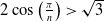
Using Lemma 4.2.7, we can prove Theorem1.0.4 in the case where none of the curves
 $\gamma$
and
 $\delta$
contain a side of one of the polygons.
Proposition 4.2.8.
Given
 $\gamma = \gamma _1 \cup \cdots \cup \gamma _k$
and
 $\delta = \delta _1 \cup \cdots \cup \delta _l$
two closed curves made of saddle connections
 $\gamma _1, \ldots , \gamma _k$
(resp.
 $\delta _1, \ldots , \delta _l)$
, and such that none of these saddle connections are sides of
 $P(0)$
or
 $P(m-1)$
, we have
 \begin{equation*} \frac {\mathrm{Int}(\gamma , \delta )}{l(\gamma ) l(\delta )} \lt \frac {1}{2l_0^2}. \end{equation*}
Proof. The decomposition of
 $\gamma$
and
 $\delta$
into saddle connections gives
 \begin{align*} \mbox{Int}(\gamma ,\delta ) &\leq \left ( \sum _{i,j} |\gamma _i \cap \delta _j| \right ) + \min (k,l) \end{align*}
where the right part of the equation is made of two terms: one counting the non-singular intersections and the other counting the singular intersections. Now,
-
• If
$\max (k,l) \geq 2$
, then
$\min (k,l) \leq \frac {kl}{2}$
and therefore
\begin{align*} \mbox{Int}(\gamma ,\delta ) &\leq \left ( \sum _{i=1}^k \sum _{j=1}^l |\gamma _i \cap \delta _j|\right ) + \frac {kl}{2}& \\ &= \sum _{i=1}^k \sum _{j=1}^l \left (|\gamma _i \cap \delta _j| +\frac {1}{2} \right ) &\\ &\lt \sum _{i=1}^k \sum _{j=1}^l \left (\frac {1}{2 l_0^2} l(\gamma _i) l(\delta _j) \right ) & \text{from (8)}\\ &= \frac {1}{2l_0^2} l(\gamma ) l(\delta )& \end{align*}
-
• Otherwise,
$k=l=1$
, which means
$\gamma$
and
$\delta$
are both closed saddle connections. If none of them is a short diagonal of
$P(0)$
or
$P(m-1)$
, the conclusion directly comes from (9). Otherwise, we can assume that
$\gamma$
is a short diagonal of
$P(0)$
. Then the fact that
$\gamma$
and
$\delta$
intersect outside the singularity and that they are both closed combined with the assumption
$\gcd (m,n) \neq 1$
gives that the endpoints of
$\gamma$
and the endpoints of
$\beta$
do not represent the same singularity of the surface (also,
$\gcd (m,n) = 2$
), and therefore there is no singular intersection. This gives
$\mbox{Int}(\gamma ,\delta ) = 1$
, and the lower bound
$l(\gamma ) l(\delta ) \geq 4 \cos ^2\left (\frac {\pi }{n}\right ) l_0^2 \gt 2 l_0^2$
on the length product gives the desired result.


We will now assume that one of the curves, say
 $\gamma$
, is made of at least one short side. We will proceed as in the study of the regular
 $(4m+2)-$
gon by grouping all the sides together. More precisely, we introduce the following
Notation 4.2.9.
-
(i) If
$\gamma$
(resp.
$\delta$
) contains at least two saddle connections which are sides of the polygons
$P(0), \ldots , P(m-1)$
, we denote by
$\mathfrak{G} = \gamma _{i_1} \cup \cdots \cup \gamma _{i_p}$
(resp.
$\mathfrak{D} = \delta _{j_1} \cup \cdots \cup \delta _{j_q}$
) the collection of sides that appear in
$\gamma$
(resp.
$\delta$
).
-
(ii) If
$\gamma$
contains a single short side
$\gamma _i$
, this side cannot be closed because we assumed
$S_{m,n}$
had at least two singularities. In particular,
$\gamma$
cannot be reduced to
$\gamma _i$
and we can choose another arbitrary saddle connection
$\gamma _{i'}$
, which is not a side. We define
$\mathfrak{G} \,:\!=\, \gamma _{i} \cup \gamma _{i'}$
. We proceed similarly for
$\delta$
if it contains a single short side.


Our assumption ensures that
 $\mathfrak{G} \neq \varnothing$
, but note that we could still have
 $\mathfrak{D} = \varnothing$
if
 $\delta$
contains no short side. Further, we will assume that none of the sides of
 $\mathfrak{G}$
(resp.
 $\mathfrak{D}$
) are adjacent, because otherwise the curve
 $\gamma$
(resp.
 $\delta$
) would not minimise the length in its homology class. We prove the following:
Lemma 4.2.10. We have
 \begin{equation} |\mathfrak{G} \cap \mathfrak{D}| + \min (\#\mathfrak{G}, \#\mathfrak{D}) \leq \frac {1}{2l_0^2} l(\mathfrak{G}) l(\mathfrak{D}) \end{equation}
and, for a saddle connection
 $\delta _j \in \delta \backslash \mathfrak{D}$
which is not in
 $\mathfrak{D}$
, we have
 \begin{equation} |\mathfrak{G} \cap \delta _j| + 1 \leq \frac {1}{2l_0^2} l(\mathfrak{G}) l(\delta _j) \end{equation}
Proof. We have to distinguish three cases according to whether
 $\mathfrak{G}$
and
 $\mathfrak{D}$
contain one side (case (ii) of Notation 4.2.9) or not (case (i)).
-
• If
$\mathfrak{G}$
and
$\mathfrak{D}$
are only made of sides, then
$|\mathfrak{G} \cap \mathfrak{D}|=0$
and
$l(\mathfrak{G}) = \#\mathfrak{G} \cdot l_0$
as well as
$l(\mathfrak{D}) = \#\mathfrak{D} \cdot l_0$
. Therefore,This gives (10). Now, given a saddle connection
\begin{align*} |\mathfrak{G} \cap \mathfrak{D}| + \min (\#\mathfrak{G}, \#\mathfrak{D}) &= \min (\#\mathfrak{G}, \#\mathfrak{D}) \\ & =\frac {\#\mathfrak{G}\cdot \#\mathfrak{D}}{\max (\#\mathfrak{G}, \#\mathfrak{D})} \\ & = \frac {l(\mathfrak{G}) l(\mathfrak{D})}{\max (\#\mathfrak{G}, \#\mathfrak{D}) l_0^2} \\ &\leq \frac {1}{2l_0^2} l(\mathfrak{G}) l(\mathfrak{D}) \end{align*}
$\delta _j$
, one can obtain (11) by noticing that when
$\mathfrak{G}$
is made only of sides, the intersections between
$\mathfrak{G}$
and
$\delta _j$
only occur between two segments in the polygonal decomposition of
$\delta _j$
. However, the assumption on the sides of
$\mathfrak{G}$
not being adjacent gives that, along a sequence of consecutive adjacent segments, an intersection with a side of
$\mathfrak{G}$
can only occur every two sides crossed. This givesand, since
\begin{equation*} |\mathfrak{G} \cap \delta _j| \leq n_{\delta _j}-1 \end{equation*}
$l(\delta _j) \geq n_{\delta _j} l_0$
, we conclude thatwhich proves (11).
\begin{equation*} |\mathfrak{G} \cap \delta _j| +1 \leq n_{\delta _j} \leq \frac {l(\mathfrak{G}) l(\delta _j)}{\# \mathfrak{G} \cdot l_0^2} \leq \frac {l(\mathfrak{G}) l(\delta _j)}{2 l_0^2}. \end{equation*}
-
• Now, assume that, say
$\mathfrak{G} = \gamma _i \cup \gamma _{i'}$
is as in case (ii) of Notation 4.2.9, whereas
$\mathfrak{D}$
is only made of sides. In this case, we get from Proposition 4.2.4
(12)Further, the above argument for the intersection implies that
\begin{equation} l(\mathfrak{G}) \geq \left ( \sqrt 2 n_{\gamma _{i'}} + (\sqrt 2 -1) + 1 \right ) l_0= \sqrt {2} l_0(n_{\gamma _{i'}}+1) \end{equation}
and then
\begin{equation*} |\mathfrak{G} \cap \mathfrak{D}| = 0 + |\gamma _{i'} \cap \mathfrak{D}| \leq n_{\gamma _{i'}} -1 \end{equation*}
Which proves (10) in this case. Further, the length estimate
\begin{align*} |\mathfrak{G} \cap \mathfrak{D}| + \min (\#\mathfrak{G}, \#\mathfrak{D}) &\leq n_{\gamma _{i'}} +1\\ &\leq \frac {l(\mathfrak{G}) l(\mathfrak{D})}{\sqrt {2} l_0 \cdot \#\mathfrak{D} \cdot l_0 }\\ & \leq \frac {l(\mathfrak{G}) l(\mathfrak{D})}{2 \sqrt 2 l_0^2} \lt \frac {l(\mathfrak{G}) l(\mathfrak{D})}{2 l_0^2} \end{align*}
$l(\delta _j) \gt \sqrt {2} n_{\delta _j}\cdot l_0$
, which holds for any
$\delta _j \in \delta \setminus \mathfrak{D}$
by Proposition 4.2.4, giveswhich is exactly (11).
\begin{align*} |\mathfrak{G} \cap \delta _j| +1 &\leq \left (n_{\delta _j}-1 \right ) + n_{\gamma _{i'}} n_{\delta _j} +1 = \left (n_{\gamma _{i'}}+1 \right ) n_{\delta _j} \\ & \lt \frac {l(\mathfrak{G}) l(\delta _j)}{ (\sqrt 2 l_0)^2} = \frac {l(\mathfrak{G}) l(\delta _j)}{2 l_0^2} \end{align*}
-
• It remains to prove (10) when both
$\mathfrak{G} = \gamma _i \cup \gamma _{i'}$
and
$\mathfrak{D} = \delta _j \cup \delta _{j'}$
are in case (ii). In this case,Then, using the fact that the (non-singular) intersections between a side
\begin{align*} |\mathfrak{G} \cap \mathfrak{D}| + \min (\#\mathfrak{G}, \#\mathfrak{D}) &= |\gamma _i \cap \delta _{j}|+|\gamma _i \cap \delta _{j'}|+|\gamma _{i'} \cap \delta _{j}| + |\gamma _{i'} \cap \delta _{j'}|+ 2. \end{align*}
$\alpha$
and another saddle connection
$\beta$
is at most
$n_{\beta }-1$
, as well as Proposition 4.2.3, we obtainThen, using (12), we obtain
\begin{align*} |\mathfrak{G} \cap \mathfrak{D}| + \min (\#\mathfrak{G}, \#\mathfrak{D}) &\leq 0+ (n_{\delta _{j'}}-1) + (n_{\gamma _{i'}}-1) + n_{\gamma _{i'}} n_{\delta _{j'}} + 2\\ & = (n_{\gamma _{i'}}+1) (n_{\delta _{j'}}+1) -1 \end{align*}
as required.
\begin{align*} |\mathfrak{G} \cap \mathfrak{D}| + \min (\#\mathfrak{G}, \#\mathfrak{D}) & \leq \frac {l(\mathfrak{G})}{\sqrt {2} l_0} \cdot \frac {l(\mathfrak{D})}{\sqrt {2}l_0} -1 \\ & \lt \frac {1}{2 l_0^2} l(\mathfrak{G}) l(\mathfrak{D}) \end{align*}


We can now finish the proof of Theorem1.0.4 in the case where the curves
 $\gamma$
and
 $\delta$
are unions of saddle connections and possibly several sides. For this, we partition
 $\gamma$
(resp.
 $\delta$
) using
 $\mathfrak{G}$
and its complement and get
 \begin{align*} \mbox{Int}(\gamma , \delta ) &\leq \left ( \sum _{i,j} |\gamma _i \cap \delta _j| \right ) + \min (k,l) \\ & = \left (|\mathfrak{G} \cap \mathfrak{D}| + \sum _{\delta _j \notin \mathfrak{D}} |\mathfrak{G} \cap \delta _j|+ \sum _{\gamma _i \notin \mathfrak{G}} |\gamma _i \cap \mathfrak{D}| + \sum _{\gamma _i \notin \mathfrak{G}} \sum _{\delta _j \notin \mathfrak{D}} |\gamma _i \cap \delta _j|\right )+ \min (k,l) \end{align*}
Now, use that
 \begin{equation*} \min (k,l) \leq \min (\#\mathfrak{G},\#\mathfrak{D}) + \max (k - \#\mathfrak{G}, l - \#\mathfrak{D}) \leq \min (\#\mathfrak{G},\#\mathfrak{D}) + (k - \#\mathfrak{G}) + (l - \#\mathfrak{D})\end{equation*}
and distribute the last two terms in the first two sums of the previous equation to obtain
 \begin{align*} \mbox{Int}(\gamma , \delta ) \leq |\mathfrak{G} \cap \mathfrak{D}| + \min (\#\mathfrak{G},\#\mathfrak{D}) + \sum _{\delta _j \notin \mathfrak{D}} (|\mathfrak{G} \cap \delta _j|+1) + \sum _{\gamma _i \notin \mathfrak{G}} \left ( |\gamma _i \cap \mathfrak{D}|+1\right ) + \sum _{\gamma _i \notin \mathfrak{G}} \sum _{\delta _j \notin \mathfrak{D}} |\gamma _i \cap \delta _j| \end{align*}
(if
 $\mathfrak{D} = \varnothing$
, one has to use
 $\min (k,l) \leq l$
and keep the
 $1$
in the first sum, because the second sum vanishes).
Then, using Equations (8), (9), (10) and (11), we obtain
 \begin{align*} \mbox{Int}(\gamma ,\delta ) &\leq \frac {1}{2l_0^2} \left (l(\mathfrak{G}) l(\mathfrak{D})+ l(\mathfrak{G}) l(\delta \backslash \mathfrak{D}) + l(\gamma \backslash \mathfrak{G}) l(\mathfrak{D}) + l(\gamma \backslash \mathfrak{G})l(\delta \backslash \mathfrak{D}) \right ) \\ &\leq \frac {1}{2l_0^2} l(\gamma ) l(\delta ), \end{align*}
as required. Therefore, it only remains to prove Proposition 4.2.4 in order to complete the proof of Theorem1.0.4. This is the purpose of the next section.
Remark 4.2.11. As in Remark 3.4.1 , one should notice that this argument proves
 \begin{equation*} \frac {\sum _{i,j} |\gamma _i \cup \delta _j| + s_{\gamma , \delta }}{l(\gamma ) l(\delta )} \leq \frac {1}{2l_0^2} \end{equation*}
when
 $\gamma$
and
 $\delta$
are closed curves which are unions of saddle connections that pass at most once through each singularity
Footnote
7
and
 $s_{\gamma , \delta }$
is the number of singularities contained in both
 $\gamma$
and
 $\delta$
. This property extends if we remove the assumption on the curves passing through each singularity at most once, proving Theorem
1.0.4
for the case where the algebraic intersection is replaced by the geometric intersection.
4.3. Proof of Proposition 4.2.4
In this final section, we analyse the polygonal decomposition of a saddle connection
 $\alpha$
into both adjacent and non-adjacent segments. While some of these segments may have length less than
 $\left (\sqrt {2} + (\sqrt {2} - 1)\right )l_0$
, we will demonstrate that grouping them together in a suitable way yields better estimates. This will be achieved by distinguishing various types of segments based on the sides to which their endpoints belong.
For simplicity, we will normalise the length of the sides of the polygons defining
 $S_{m,n}$
in order to have
 $l_0=1$
. That is, we will consider sides of length
 $\frac {\sin \left (\frac {k \pi }{m}\right )}{\sin \left (\frac {\pi }{m}\right )}$
instead of
 $\sin \left (\frac {k \pi }{m}\right )$
, for
 $1 \leq k \leq m-1$
. In particular,
-
• Every side which is not a side of
$P(0)$
or
$P(m-1)$
(or identified to such a side) has length at least
$\frac {\sin \left (\frac {2 \pi }{m}\right )}{\sin \left (\frac {\pi }{m}\right )} = 2\cos \left (\frac {\pi }{m}\right )$
which is greater than
$2\sqrt {2}-1$
because
$m \geq 8$
; -
• The length of the short diagonals of
$P(0)$
and
$P(m-1)$
is
$2\cos \left (\frac {\pi }{n}\right )$
which is greater than
$2\sqrt {2}-1$
because
$n \geq 8$
. -
• We will also need the length of the third shortest sides, that is, the length of the long sides of
$P(2)$
(resp.
$P(m-3)$
), which is given by
\begin{equation*} \frac {\sin \left (\frac {3 \pi }{m}\right )}{\sin \left (\frac {\pi }{m}\right )} = 4\cos ^2 \left (\frac {\pi }{m} \right )- 1.\end{equation*}


4.3.1. Short and long segments
From the above estimates on the length of sides and diagonals of the polygons
 $P(i)$
, we distinguish two types of segments. The following segments are long non-adjacent segments (resp. long pairs of adjacent segments), whose length is constraint to be more than
 $2 \sqrt {2} - 1$
because of their position within the polygons:
-
(a) Non-adjacent segments of
$P(i)$
for
$2 \leq i \leq m-3$
; -
(b) Pairs of adjacent segments which share an endpoint on a side of
$P(i)$
for
$2 \leq i \leq m-3$
; -
(c) Non-adjacent segments of
$P(1)$
(resp.
$P(m-2)$
) whose endpoints lie on two sides of
$P(1)$
(resp.
$P(m-2)$
) which are separated by at least a long side of
$P(1)$
; -
(d) Non-adjacent segments of
$P(0)$
(resp.
$P(m-1)$
) whose endpoints lie on two sides of
$P(0)$
(resp.
$P(m-1)$
) which are separated by at least two sides (when
$n \geq 8$
the length of a short diagonal has length greater than
$2\sqrt {2}-1$
).


These estimates come from the fact that the lengths of segments (a) to (d) are greater than the lengths of the segments connecting the endpoints of the sides of the polygon to which their endpoints belong. This argument relies on the fact that each of the polygons is convex with obtuse angles.
Then, the remaining non-adjacent segments (resp. pairs of adjacent segments) may a priori have length less than
 $2\sqrt {2}-1$
. These are as follows:
-
(e) Non-adjacent segments of
$P(1)$
(resp.
$P(m-2)$
) (when
$m \geq 3$
) whose endpoints lie on two sides located on either side of a short side of
$P(1)$
(resp.
$P(m-2)$
); -
(f) Non-adjacent segments of
$P(0)$
(resp.
$P(m-1)$
) whose endpoints lie on two sides located on either side of a short side of
$P(0)$
(resp.
$P(m-1)$
); -
(g) Pairs of adjacent segments with a segment inside
$P(0)$
(resp.
$P(m-1)$
).


Remark 4.3.1.
Single adjacent segments are left alone since they do not contribute to the count of
 $n_{\alpha }$
.
4.3.2. Grouping the segments
For every segment (resp. pair of adjacent segments) of type (e), (f) and (g), we will construct a pair (resp. a triple) with either the following or preceding segment and show that the length of the pair is at least
 $3\sqrt {2}-1 = 2\sqrt {2} + (\sqrt {2}-1)$
. We start with a definition:
Definition 4.3.2.
Let
 $\alpha _i$
be a segment of type (e) or (f). By definition, the endpoints of
 $\alpha _i$
lie on two sides of a polygon
 $P(i)$
which are located on either side of a side
 $s_0$
of
 $P(i)$
. The side
 $s_0$
will be called the supporting side of the segment
 $\alpha _i$
.
Then, we construct pairs of segments as follows:
-
• If
$\alpha _i$
is a segment of type (e), we pair
$\alpha _i$
with the segment
$\alpha _{i \pm 1}$
which is on the side of the endpoint of
$\alpha _i$
closest to its supporting side
$s_0$
. -
• Conversely, if
$\alpha _i$
is a segment of type (f), we pair
$\alpha _i$
with the segment
$\alpha _{i \pm 1}$
which is on the side of the endpoint of
$\alpha _i$
furthest to its supporting side
$s_0$
. -
• Finally, if
$\alpha _i \cup \alpha _{i+1}$
is a pair of adjacent segments of type (g), we group
$\alpha _{i} \cup \alpha _{i+1}$
with the segment
$\alpha _{i-1}$
or
$\alpha _{i+2}$
which is directly follows (or precedes) the adjacent segment of
$P(0)$
. For example, if
$\alpha _{i+1}$
belongs to
$P(0)$
, we group
$\alpha _{i} \cup \alpha _{i+1}$
with the segment
$\alpha _{i+2}$
.


With this construction, it is easily shown that:
Lemma 4.3.3.
For
 $m,n \geq 8$
, the segment paired with a segment of type (e) or (f) (resp. a pair of adjacent segments of type (g)) is a long segment. Further, the combined length of the two (resp. three) segments is greater than
 $3\sqrt {2} -1$
.
Proof. We deal with the cases separately. We first consider a segment
 $\alpha _i$
of type (e). Up to symmetry, we can assume that
 $\alpha _i$
is contained in
 $P(1)$
and has supporting side denoted
 $s_0$
, and that the paired segment is
 $\alpha _{i+1}$
. Therefore, we are in the setting of Figure 13. The direction of
 $\alpha _{i}$
lies between the the directions of the two segments
 $AB$
and
 $AC$
, and it is easily shown that the slope of
 $CE$
is greater than the slope of
 $AC$
, using that
 \begin{align*} \vec {AC}= & \left (1 + 2\cos \left (\frac {\pi }{m}\right ) \cos \left (\frac {\pi }{n}\right ),2\cos \left (\frac {\pi }{m}\right ) \sin \left (\frac {\pi }{n}\right )\right ) \\ \vec {CE}= & \bigg (2\cos \left (\frac {\pi }{m}\right ) \left ( 2\cos \left (\frac {\pi }{n}\right )+\cos \left (\frac {3\pi }{n}\right ) \right ) + \left (4\cos ^2 \left (\frac {\pi }{m}\right )-1\right )\left (1 + \cos \left (\frac {2\pi }{n}\right ) \right )\!,\\ & \left (4\cos ^2 \left (\frac {\pi }{m}\right )-1\right ) \sin \left (\frac {2\pi }{n}\right ) + 2\cos \left (\frac {\pi }{m}\right ) \sin \left (\frac {3\pi }{n}\right ) \bigg ). \end{align*}
Further, the length of
 $\alpha _i \cup \alpha _{i+1}$
is greater than the length of
 $AD$
given by
 \begin{equation*} 4 \cos \left (\frac {\pi }{m}\right ) \cos \left (\frac {\pi }{n}\right ) + 1 + \left (4\cos ^2 \left (\frac {\pi }{m}\right ) - 1 \right )\end{equation*}
which is greater than
 $3 \sqrt {2} - 1$
, as required.
We now consider a segment
 $\alpha _i$
of type (f). Up to symmetry, we can assume that
 $\alpha _i$
is contained in
 $P(0)$
and has supporting side denoted
 $s_0$
, and that the paired segment is
 $\alpha _{i+1}$
. In the setting of Figure 14,
 $\alpha _i$
has its two endpoints on the sides
 $s_3$
and
 $s_1$
, and its slope is positive. Therefore, the segment
 $\alpha _{i+1}$
which is paired with
 $\alpha _i$
is a long non-adjacent segment of
 $P(1)$
with an endpoint on the side
 $s_1$
and its other endpoint on one of the sides
 $s_0, s_2$
or
 $s_3$
. The length of
 $\alpha _i \cup \alpha _{i+1}$
is therefore greater than the length of
 $AC$
, which is by construction
 \begin{equation*} 2\cos \left (\frac {\pi }{n}\right ) + 2 \cos \left (\frac {\pi }{m}\right )\!. \end{equation*}
This is greater than
 $3 \sqrt {2} - 1$
, as required.
The study is similar in case (g), as shown in Figure 14.
A segment
 $\alpha _i$
of type (e). The segment
 $\alpha _{i+1}$
can have an endpoint
 $\alpha _{i+1}^+$
on either side
 $s_1,s_2$
or
 $s_3$
.

The segment paired with a pair of adjacent segments of type (g) is a long segment contained in
 $P(1)$
which has one endpoint on
 $s_1$
and one endpoint on either of the sides
 $s_0, s_2$
or
 $s_3$
. This is similar for the segment paired with a non-adjacent segment of type (f) whose supporting side is
 $s_0$
. The main reason this holds is because the vertices
 $A, B$
and
 $C$
are aligned (the segments
 $AB$
and
 $BC$
both make an angle
 $\frac {\pi }{n}$
with the horizontal).

Remark 4.3.4.
Contrary to the case of the
 $(4m+2)-$
gon, there is no need to consider trips through short cylinders. In fact, trips through short cylinders have to be considered if one wants to prove Proposition 4.2.4 for
 $3 \leq m \leq 7$
. This is one of the reasons we choose to assume
 $m \geq 8$
.
4.3.3. There are no overlaps
We now show that, for
 $m \geq 8$
, the pairs cannot overlap. For this, first remark that:
-
• A segment of type (e) is always grouped to a long segment of
$P(2)$
(or
$P(m-3)$
) which has at least one of its endpoints on a short segment of
$P(2)$
(or
$P(m-3)$
), namely the endpoint shared with the segment of type (e). -
• The segments of type (f) and the pairs of adjacent segments of type (g) are grouped to a long segment of
$P(1)$
(or
$P(m-2)$
).


In particular, the only possible overlaps are among
-
1. Two pairs formed by segments of type (e);
-
2. Pairs formed by segments of type (f) and/or by triples with two adjacent segments of type (g);
We deal with the two cases separately:
-
1. In the first case, we consider a pair of segments containing a segment of type (e) denoted
$\alpha _{i}$
. As in the proof of Lemma 4.3.3, we can assume up to symmetry that we are in the setting of Figure 13. Also recall from the proof of Lemma 4.3.3 that the endpoint
$\alpha _{i+1}^+$
of
$\alpha _{i+1}$
which is not shared with
$\alpha _i$
belong to either side
$s_1$
,
$s_2$
or
$s_3$
. Now,-
• If
$\alpha _{i+1}^+$
of
$\alpha _{i+1}$
is a vertex of
$P(2)$
, the segment
$\alpha _{i+1}$
is obviously only in the pair with
$\alpha _i$
. -
• If
$\alpha _{i+1}^+$
belongs to the (interior of the) side
$s_1$
, the next segment
$\alpha _{i+2}$
is either an adjacent segment of
$P(1)$
or a segment of type (e). In the first case, the adjacent segment
$\alpha _{i+2}$
is followed by another adjacent segment
$\alpha _{i+3}$
, contained in
$P(0)$
, and they form a pair of type (g). This pair is grouped with the next segment
$\alpha _{i+4}$
, and therefore there is no overlap. In the second case, considering the slope of
$\alpha _{i+2}$
we deduce that the endpoint of
$\alpha _{i+2}$
closer to its supporting side (which is also
$E$
) is the one shared with
$\alpha _{i+3}$
, and therefore the pairs formed with the two segments of type (e)
$\alpha _i$
and
$\alpha _{i+2}$
do not overlap. -
• If the endpoint
$\alpha _{i+1}^+$
belongs to
$s_2$
, the segment
$\alpha _{i+2}$
is a long segment of
$P(3)$
(or an adjacent segment which is part of a long pair of adjacent segments) and we conclude that
$\alpha _{i+1}$
only belongs to a pair with
$\alpha _i$
. -
• Finally, if the endpoint
$\alpha _{i+1}^+$
belongs to
$s_3$
, it is immediately seen from slope considerations that
$\alpha _ {i+2}$
must be a long segment of
$P(1)$
, and therefore
$\alpha _{i+1}$
only belongs to the pair with
$\alpha _{i}$
. More precisely, since the direction of
$\alpha _{i}$
(and therefore of
$\alpha _{i+2}$
) lies between the horizontal and the direction of the segment
$AC$
, as shown in Figure 13), we obtain that
$\alpha _{i+2}$
has at its second endpoint between
$C$
and
$F$
and there are at least three separating sides between its endpoints.
-
-
2. In the second case, we consider a pair containing a segment of type (f) (resp. a pair of adjacent segment of type (g) along with its paired non-adjacent segment), say contained in
$P(0)$
and
$P(1)$
, and we let
$s_0$
be the supporting side of the segment of type (f) (resp. the side of
$P(0)$
– and
$P(1)$
– which lies between the two adjacent segments, denoted
$s_0$
in the setting of Figure 14). Therefore, only three cases can occur: the long segment
$\alpha _i$
which is grouped to the segment of type (f) (resp. to the pair of adjacent segments of type (g)) can-
• have an endpoint on the side
$s_0$
, in which case the next segment
$\alpha _{i+1}$
is an adjacent segment of
$P(0)$
, followed and preceded by non-adjacent segments, and therefore it does not contribute to the count of pairs of adjacent segments and is left alone. Therefore, there is no overlap in this case; -
• have an endpoint on the side
$s_2$
(endpoints included) and in this case either there is no next segment if the endpoint is a vertex or the next segment belong to
$P(2)$
, and therefore it is not grouped to any other segment. This gives that
$\alpha _i$
does not belong to any other pair (resp. triple); -
• or have an endpoint on the side
$s_3$
(endpoints excluded), in which case the next segment is either a long segment of
$P(0)$
(because
$n \geq 6$
), and this gives that
$\alpha _i$
does not belong to any other pair (resp. group of segment). Or the next segment has type (f) with supporting side
$s_0$
. In this case, since the slope of
$\alpha$
is positive the endpoint of this segment further to
$s_0$
is the one which is not shared with
$\alpha _i$
, and therefore this segment of type (f) is not paired with
$\alpha _i$
. This shows that
$\alpha _i$
is not paired to any other segment (resp. pair of adjacent segments).
-


As a conclusion, we managed to subdivide the saddle connection
 $\alpha$
into groups of segments which have length at least
 $\sqrt {2}k + (\sqrt {2}-1)$
while they contain
 $k=1$
or
 $2$
non-adjacent segments and pairs of adjacent segments. This gives the required result.
Remark 4.3.5.
For
 $3 \leq m \leq 7$
, there are other types of short segments, and some of the pairs of segments constructed may actually overlap. In this case, one should group the overlapping pairs of segments into triples and obtain adequate length estimates. This is the second reason why we assume
 $m \geq 8$
.
Acknowledgements
This work was supported by Centro de Modelamiento Matemático (CMM) BASAL fund FB210005 for centre of excellence from ANID-Chile, as well as The ANID postdoctoral fellowship 3260102. The author thanks Rodolfo Gutiérrez–Romo, Erwan Lanneau and Daniel Massart for discussions and comments related to this paper, as well as the anonymous referee for the careful reading and helpful comments.
Competing interests
The author declares none.


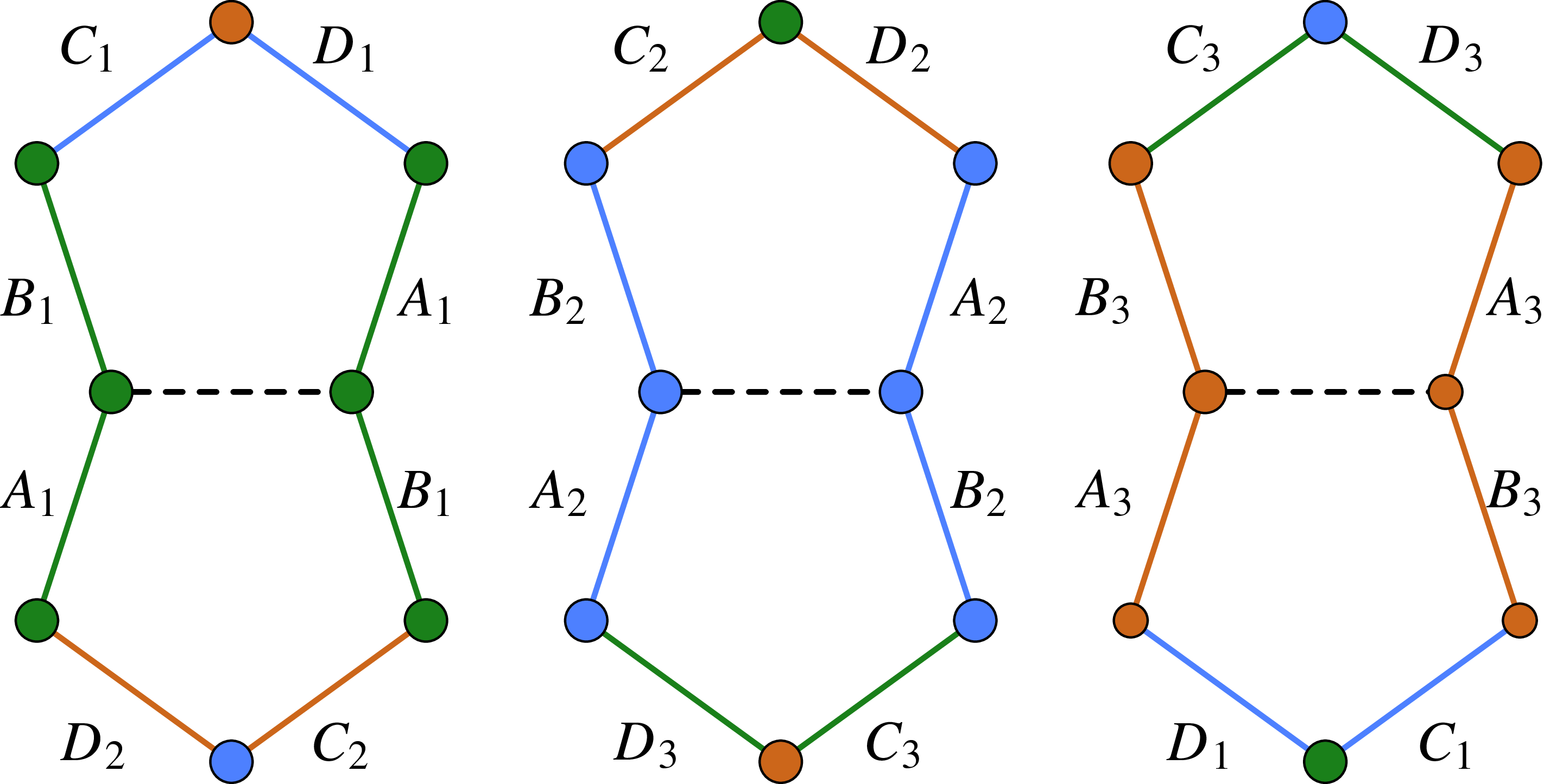
 6π
 154tan(π5)
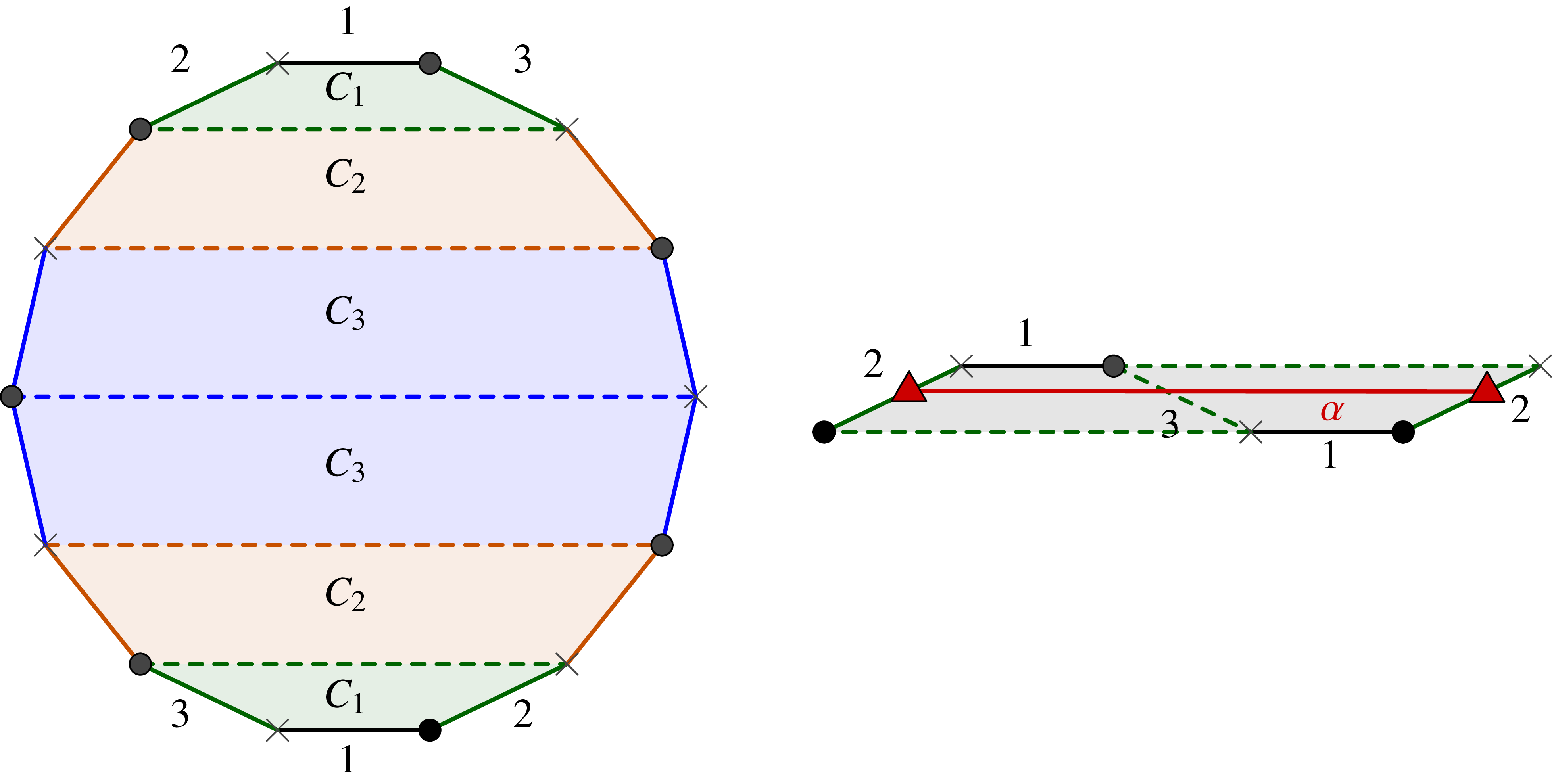
 14
 C1
 α
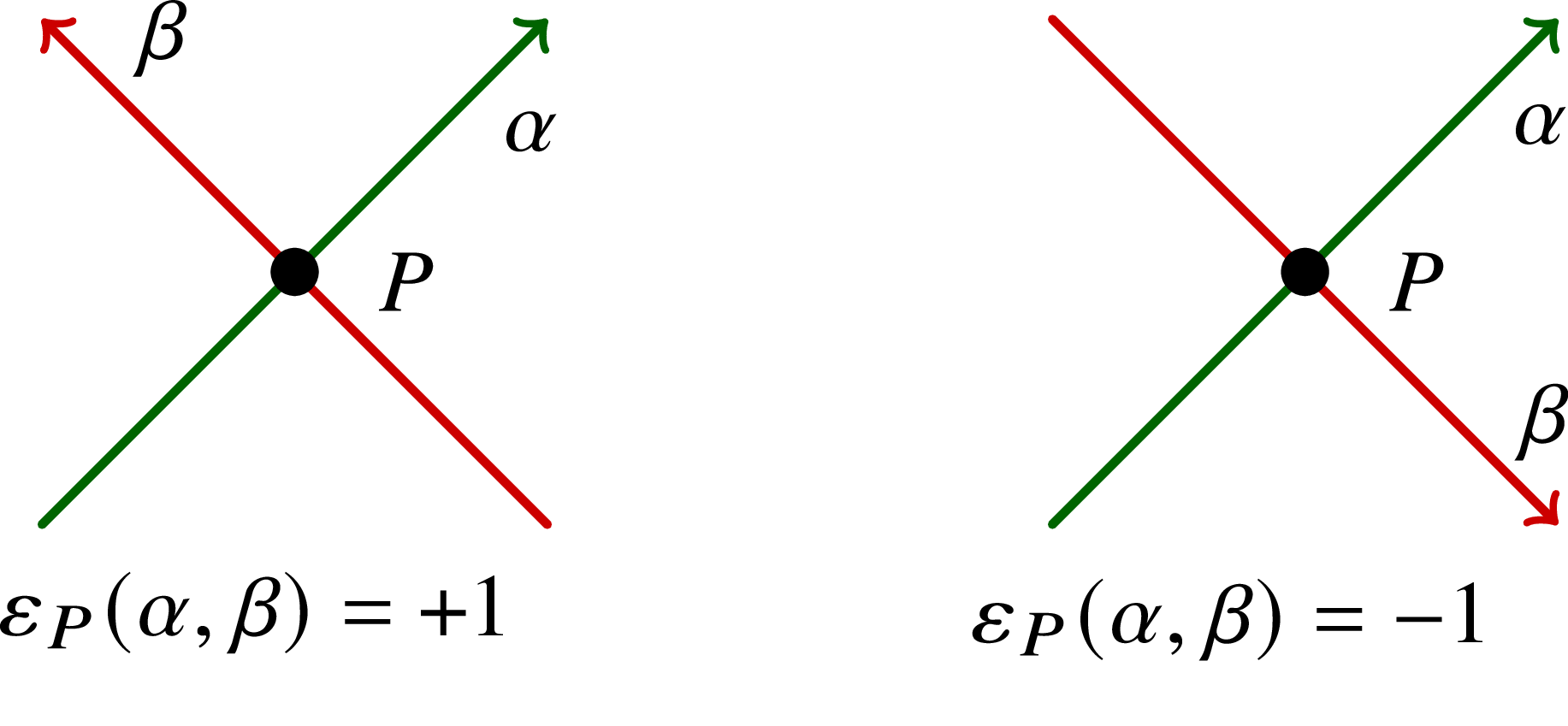
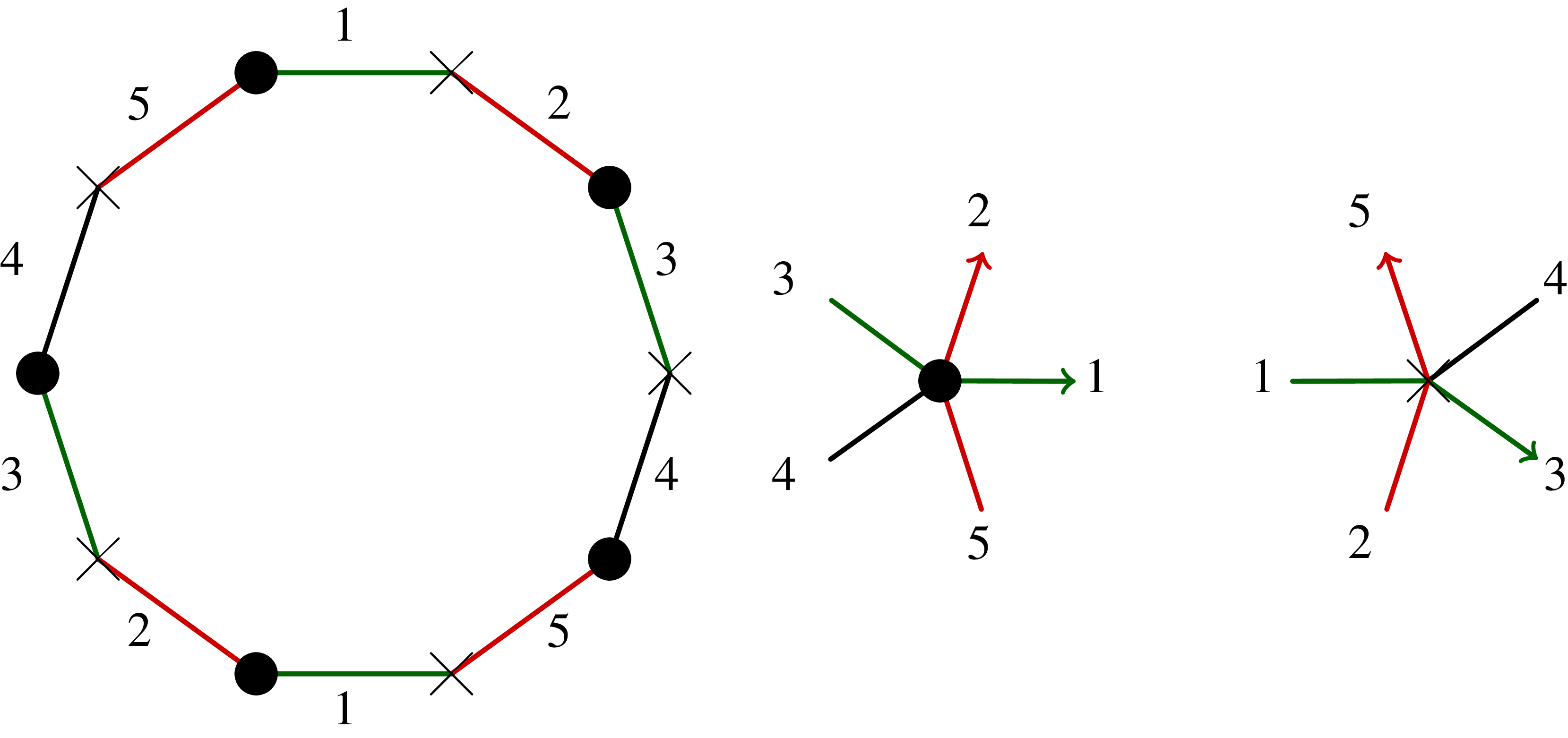
 γ=1∪3
 δ=2∪5
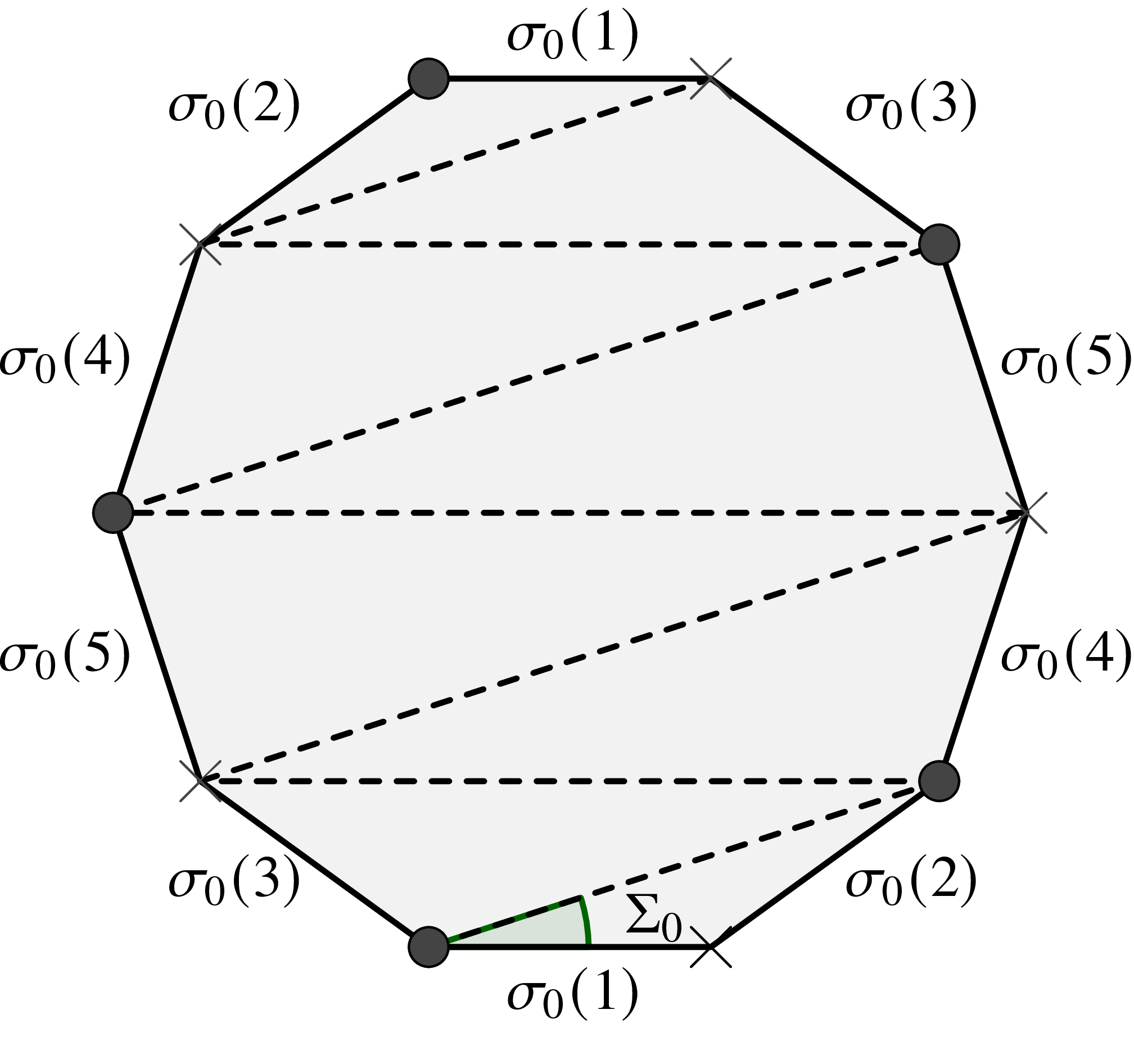
 σ0
 Σ0
 n=10

 Δ
 A
 A′

 nα≤3
 n=10
 L10=5+1=22+ε1

 σ0(i)
 i≥3
 αi0
 αi0+p−1
 p=5
 A′
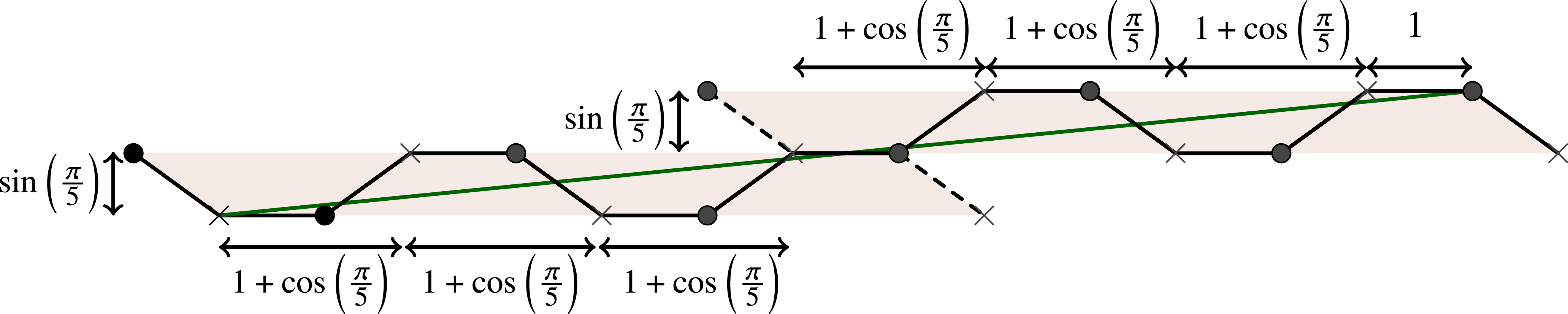
 α
 A
 A′
 1+cos(π5)
 1
 sin(π5)
 sin(π5)
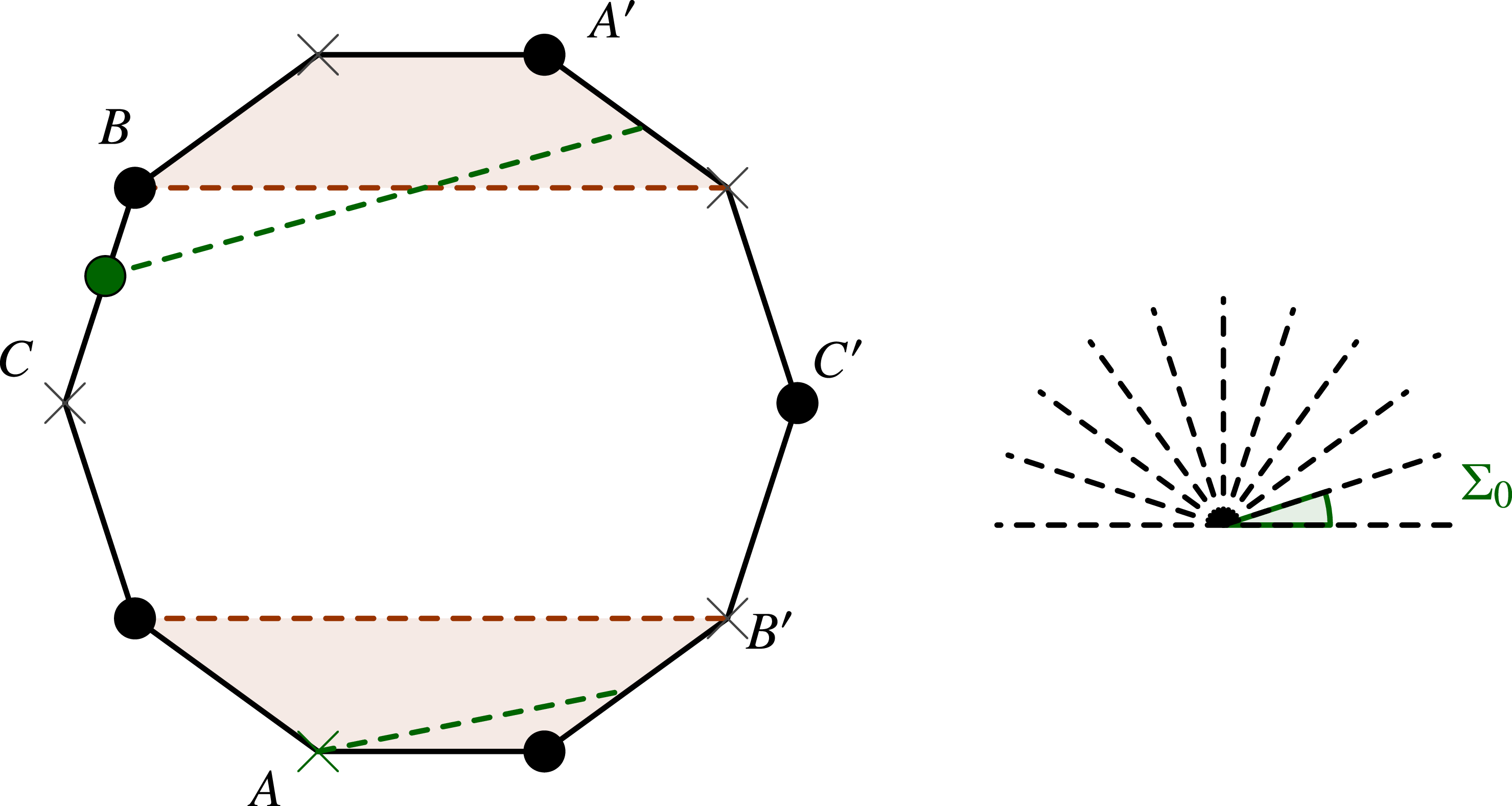
 αi0
 α
 Σ0
 αi0
 A
 BC
 B

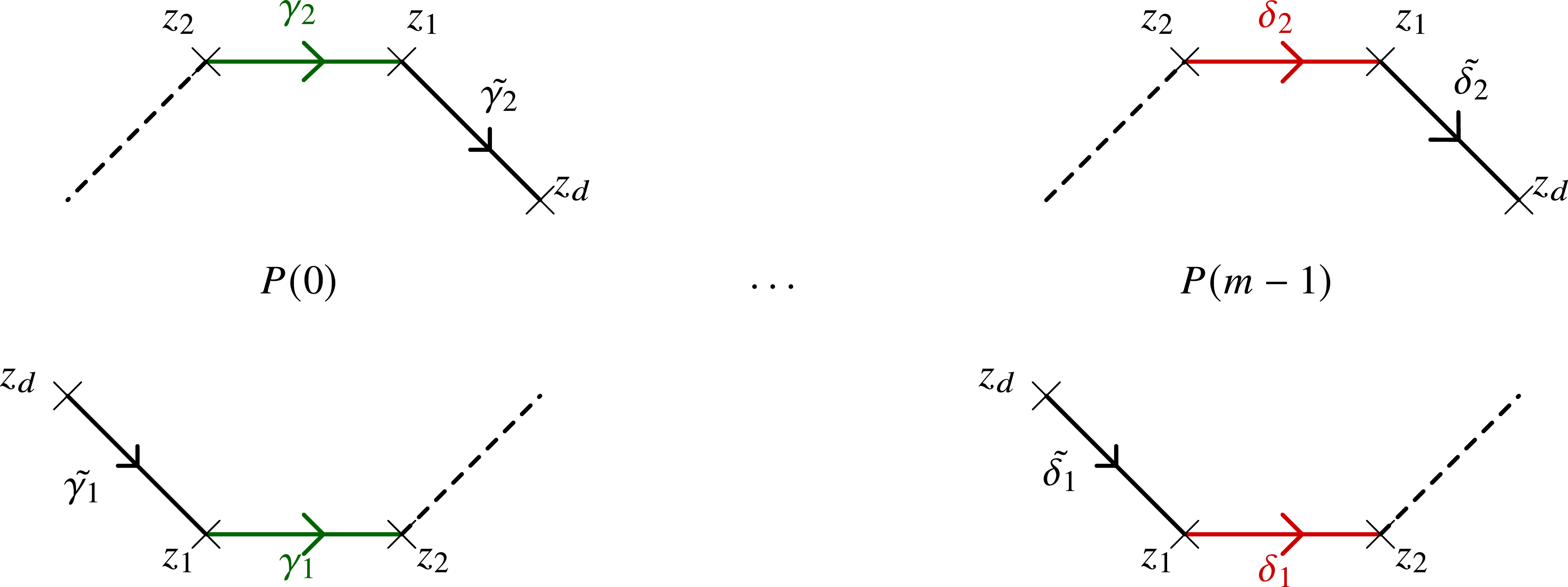
 γ1∪γ2
 δ1∪δ2
 z1
 z2
 1
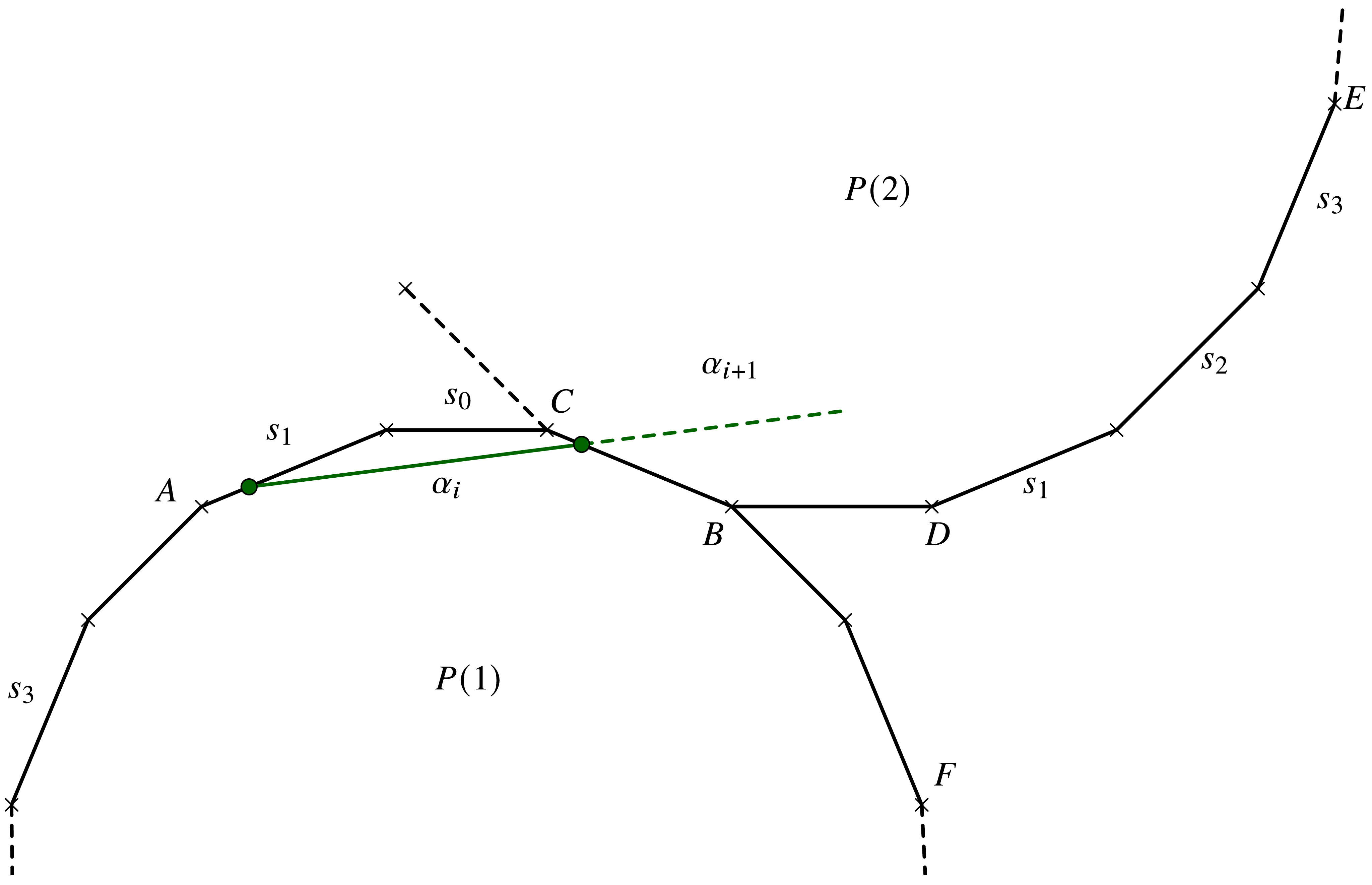
 αi
 αi+1
 αi+1+
 s1,s2
 s3
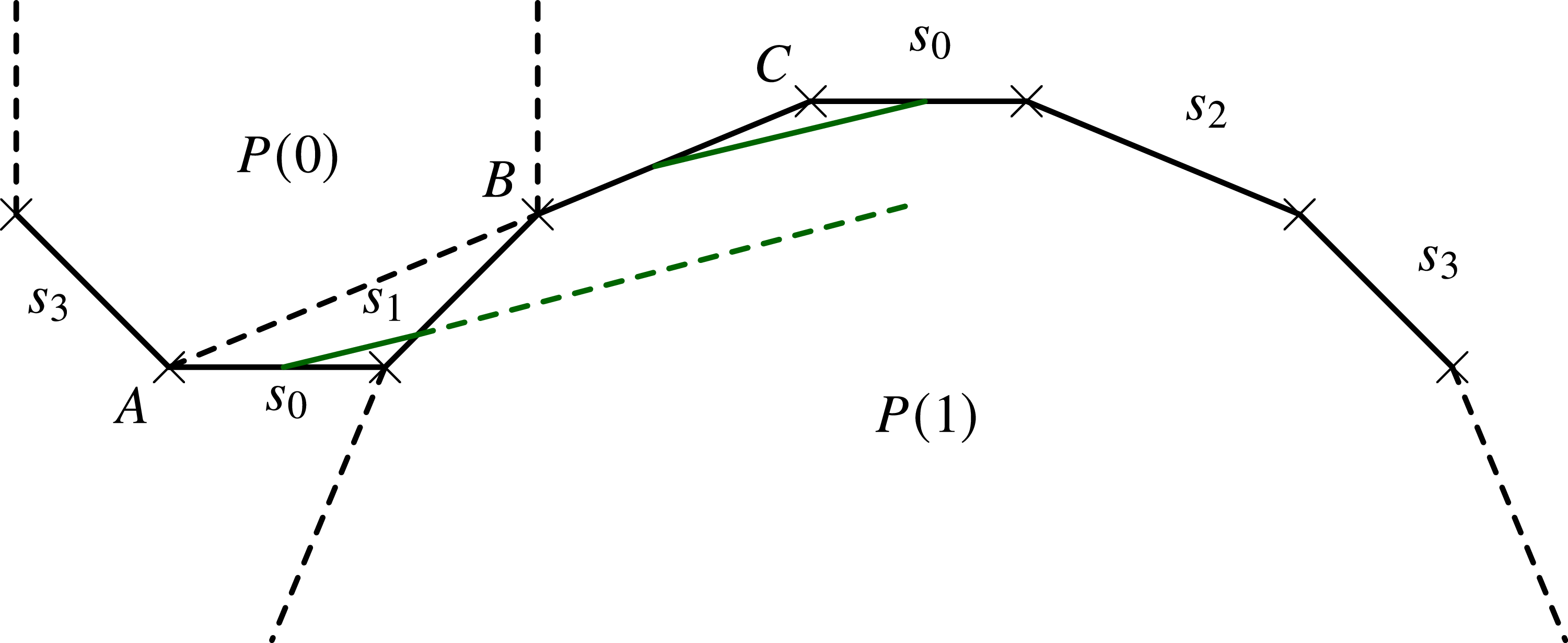
 P(1)
 s1
 s0,s2
 s3
 s0
 A,B
 C
 AB
 BC
 πn


