Introduction
Nipa (Nypa fruticans Wurmb.) belongs to the family Arecaceae, and is the only species of the genus Nypa, due to its distinctive morphological characteristics among palms (Dransfield et al., Reference Dransfield, Uhl, Asmussen, Baker, Harley and Lewis2008). Its dense stands occur in estuaries and along rivers that are regularly inundated by brackish water due to tidal action (Dowe and Tucker, Reference Dowe and Tucker1993). It tolerates salinity, and its buoyant fruits exhibit vivipary (Joshi et al., Reference Joshi, Kanagaratnam and Adhuri2006; He et al., Reference He, Zhang, Guo, Zhang, Zhou and Shi2015). These are important features of nipa being a true mangrove (Tomlinson, Reference Tomlinson2016).
The present geographic distribution of nipa encompasses most of the Indo-West Pacific (IWP) region, including Sri Lanka, India to Southeast Asia, Northern Australia and the Ryukyus, Japan (Tomlinson, Reference Tomlinson2016). It is utilized for thatch from leaves, and the sap for sugar, vinegar, alcoholic beverages and, potentially, bioethanol (Hamilton and Murphy, Reference Hamilton and Murphy1988). This palm is not yet formally domesticated, and left understudied genetically (Rasco et al., Reference Rasco, Ragas and Junio2012). Anecdotal observations showed that dense wild stands are often ignored until they become exploited economically, and impacted by urban expansion. Consequently, many local extinctions have not been documented.
Previous reports on the genetic diversity of nipa using different molecular markers showed contradicting results. For simple sequence repeats (SSRs), their potential applications to mangrove research have been fairly recent (Mukherjee et al., Reference Mukherjee, Acharya, Panda and Mohapatra2006). Lapitan and Nicolas (Reference Lapitan and Nicolas2015) observed that nipa populations attained an appropriate level of genetic variations concerning the Philippines' stands only. Hence, the current study aims to characterize SSR primers suitable for nipa across the IWP region, and to estimate genetic diversity within its distribution range. This is in preparation for future efforts on systematic conservation planning which can be customized according to local needs (McIntosh et al., Reference McIntosh, Pressey, Lloyd, Smith and Grenyer2017).
Experimental
Dried leaflet samples obtained from nipa individual in Davao City, Philippines were sent to Taiwan for DNA extraction. Good quality DNA samples were forwarded to Genomics®, New Taipei City, to construct an SSR-enriched genomic library. Sequence analysis was derived from the whole-genome sequencing of the Illumina® platform. The primer sets for SSRs were produced by Integrated DNA Technologies® (IDT), Taoyuan City, based on specific criteria: 18–24 base pairs (bp) in length; 100–280 bp product size; 55–60°C and 40–65% GC content.
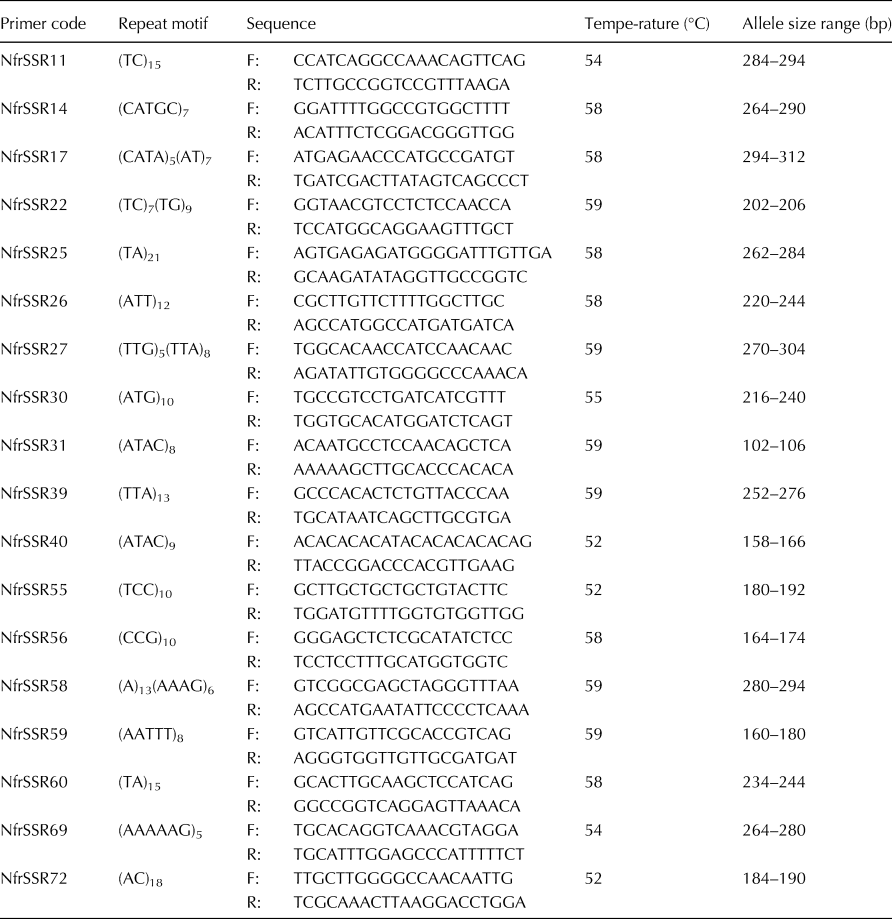
The 75 primer sets were tested for temperature gradient, followed by a primer screening through amplification using 38 random samples from IWP. A 20-μl mixture was assayed under specific polymerase chain reaction (PCR) conditions using a Multigene Optimax Thermal Cycler (Applied Biosystems, CA, USA), namely: initial denaturation at 94°C for 2 min; followed by 35 cycles of denaturation at 94°C for 45 s; primer annealing between 50 and 60°C for 45 s (see Table 1 for the optimum temperature of each primer set) and extension at 72°C for 50 s. The final extension was set to 72°C for 7 min. The PCR products were checked with 1.5% agarose gel electrophoresis.
Description of microsatellite loci of nipa (Nypa fruticans Wurmb.)

A polymorphic test was conducted in 10% polyacrylamide gel electrophoresis. Banding patterns were visualized with ethidium bromide using a digital camera. Allele scores were entered manually, as co-dominant values, to generate a data matrix for analysis in GenAlEx 6.5.
Discussion
Whole-genome sequencing detected 261,839 SSRs from 96,424 sequences (online Supplementary Table S1). Over half (52.4%) of the repeat types consisted of mononucleotides, followed by dinucleotides (22.7%) and trinucleotides (22.4%). Repeats longer than trinucleotides were extremely rare (online Supplementary Fig. S1).
SSRs are ubiquitous in the whole genome, but are considered to be non-random, as they occur at varying levels of abundance depending on the genome component. Repeat lengths vary, and are considered to be species specific. On average, estimated repeats in plants consisted of about 24% dinucleotides, and around 61–73% trinucleotides (Abdurakhmonov, Reference Abdurakhmonov and Abdurakhmonov2016). About 80% of GC-rich trinucleotides occur in exons, whereas AT-rich trinucleotides were well distributed among the genomic components (Vieira et al., Reference Vieira, Santini, Diniz and Munhoz2016). In comparison, either A or T was the most common mononucleotide found in nipa genomes. For dinucleotides, AG or CT and AT occurred frequently, whereas AAG or CTT were the predominant trinucleotides (online Supplementary Table S2).
At least 57 out of 75 SSR primer sets were successfully amplified with the sample DNA. Yet, only 18 SSR primer sets were potentially useful for nipa based on polymorphic screening (Table 1). Only one out of 38 samples did not amplify successfully.
The nipa populations in the IWP had 72% polymorphic loci (P) on the average. In particular, the southern populations in mainland southeast Asia (Peninsular Malaysia and Singapore) were 100% polymorphic, followed by the northwest (89%; Luzon Island) and southeast (89%; Mindanao Island), both in the Philippines. These populations appeared to be the most genetically diverse among the sampling sites in the region (online Supplementary Table S3).
Genetic analysis also showed that populations along the Malaysian Peninsula had the highest allele count (nearly 3), whereas stands in the Philippines had 2 alleles each. Nevertheless, the latter were less differentiated genetically based on their F values. The northern populations of mainland southeast Asia were substantially differentiated, whereas the Sri Lankan populations were clearly distinct. This effect was attributed to geographic distance, and the possible influence of the Indian Ocean circulation. However, this phenomenon requires verification.
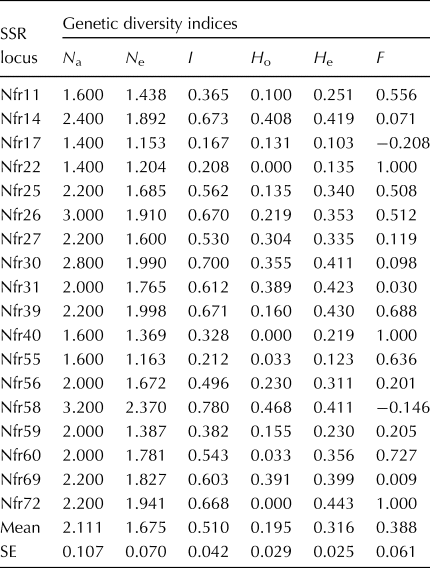
Among the polymorphic primers, Nfr58 was the most genetically diverse (Table 2 and online Supplementary Fig. S2). It obtained the highest number of alleles (N a of 3.2) and effective number of alleles (2.370). Nfr58 also had the highest heterozygosity values (H o = 0.468 and H e = 0.411), as supported by its F index, which was below zero. In contrast, Nfr72, Nfr40 and Nfr22 had +1 F values, suggesting no heterozygote was detected (H o = 0). Overall, nipa populations had considerable genetic diversity in this region.
Genetic diversity indices of microsatellite loci based on 37 samples from nipa (Nypa fruticans Wurmb.) populations in the Indo-West Pacific Region

N a, number of different alleles; N e, number of effective alleles; I, Shannon's Information Index; H o, observed heterozygosity; H e, expected heterozygosity; F, fixation index; SE, standard error.
This characterization of SSR primers resolves contradicting reports on the genetic diversity of nipa. For example, some reports suggested extremely low to no genetic variation (Jian et al., Reference Jian, Ban, Ren and Yan2010), whereas others documented genetic diversity (Lapitan and Nicolas, Reference Lapitan and Nicolas2015). The SSR markers provided preliminary insights into the past population dynamics of nipa in the IWP region, which can further address relevant questions with additional samples.
Supplementary material
The supplementary material for this article can be found at https://doi.org/10.1017/S1479262121000368
Acknowledgement
This review paper was supported by funding from the Ministry of Science and Technology, Taiwan, MOST 108-2313-B-110-001 and MOST 108-2621-B-110-003-MY3 to Y.C.C. and by partial financing (the Higher Education Sprout Project) of NSYSU.