Introduction
The Bangweulu-Mweru ecoregion is part of the Congo basin and covers the south-eastern part of the Democratic Republic of Congo (DRC) and the north-eastern part of Zambia (Thieme et al., Reference Thieme, Abell, Stiassny, Skelton, Lehner, Teugels, Dinerstein, Kamdem-Toham, Burgess and Olson2005; FEOW, 2016). It lies just north of the Zambezi–Congo watershed, but parts of the ecoregion drained into the Zambezi Basin from the late Tertiary (Moore & Larkin, Reference Moore and Larkin2001) up to the Holocene (Lévêque, Reference Lévêque1997; Key et al., Reference Key, De Wasele and Liyngu2004; Katongo et al., Reference Katongo, Koblmüller, Duftner, Mumba and Sturmbauer2007; Koblmüller et al., Reference Koblmüller, Schlieuwen, Duftner, Sefc, Katongo and Sturmbauer2008). These historical connections are also reflected in the freshwater fish fauna, which is highly similar in both basins (Van Steenberge et al., Reference Van Steenberge, Vreven and Snoeks2014). The freshwater fish fauna has the highest similarity with the Upper Congo, to which it currently drains (Van Steenberge et al., Reference Van Steenberge, Vreven and Snoeks2014). The Bangweulu-Mweru region is relatively speciose and exhibits a high degree of endemicity relative to other freshwater ecoregions (Thieme et al., Reference Thieme, Abell, Stiassny, Skelton, Lehner, Teugels, Dinerstein, Kamdem-Toham, Burgess and Olson2005). The Biological Distinctiveness Index of the ecoregion is globally outstanding and the Conservation Status Index lists it as a first priority area (Thieme et al., Reference Thieme, Abell, Stiassny, Skelton, Lehner, Teugels, Dinerstein, Kamdem-Toham, Burgess and Olson2005; FEOW, 2016). Bangwuelu-Mweru harbours 138 fish species belonging to 58 genera and 18 families (Van Steenberge et al., Reference Van Steenberge, Vreven and Snoeks2014). Within the ecoregion, the Mweru-Luapula subregion is the most diverse, harbouring 135 freshwater fish species of which 35 are endemic, with Lake Mweru and the Lower Luapula being the most speciose (Van Steenberge et al., Reference Van Steenberge, Vreven and Snoeks2014). In contrast, the Bangweulu-Chambeshi subregion is species-poor relative to Mweru-Luapula, with 93 species and a single endemic species (Van Steenberge et al., Reference Van Steenberge, Vreven and Snoeks2014).
The Cichlidae (Teleostei: Cichliformes) have the highest number of endemic species (Thieme et al., Reference Thieme, Abell, Stiassny, Skelton, Lehner, Teugels, Dinerstein, Kamdem-Toham, Burgess and Olson2005) and, after the Cyprinidae, constitute the second most speciose family (Lévêque, Reference Lévêque1997) within Bangweulu-Mweru. A typical species for the Mweru-Luapula subregion is Oreochromis mweruensis Trewavas, 1983, occurring in the Lualaba, Luvua, Lake Mweru and the Lower Luapula (Schwanck, Reference Schwanck1994). It is closely related and morphologically similar to O. macrochir (Boulenger, 1912) (Trewavas, Reference Trewavas1983; Schwanck, Reference Schwanck1994). Both species have an allopatric distribution, with O. macrochir occurring in the Upper Luapula, Lake Bangwuelu, Chambeshi, Kafue, Kalomo, Upper Zambezi, Okavango, Cunene, Buzi and Luembe rivers (Schwanck Reference Schwanck1994). In 1945, a few pairs of O. mweruensis from Mweru-Luapula were introduced in the vicinity of Lubumbashi for farming purposes (Thys van den Audenaerde, Reference Thys Van Den Audenaerde and Pullin1988). Also O. macrochir was introduced in Bangweulu-Mweru (Kipopo) (De Vos et al. Reference De Vos, Snoeks and Thys Van Den Audenaerde2001). Both species hybridize, as discovered by Thys van den Audenaerde (Reference Thys Van Den Audenaerde1964), but were classified as subspecies at the time.
Other common species in the region, such as Tilapia sparrmanii Smith, 1840 and Coptodon rendalli (Boulenger, 1857), have a wider distribution. They occur in both the Congo and Zambezi basins, and as far south as the Limpopo Basin (Skelton, Reference Skelton2001; Schwarzer et al., Reference Schwarzer, Misof, Tautz and Schliewen2009; Zengeya et al., Reference Zengeya, Booth, Bastos and Chimimba2011). The serranochromine cichlids have several representatives in Bangweulu-Mweru and are speciose throughout southern Africa (Van Steenberge et al., Reference Van Steenberge, Vreven and Snoeks2014). They also have a complex evolutionary history (Joyce et al., Reference Joyce, Lunt, Bills, Turner, Katongo, Duftner, Sturmbauer and Seehausen2005; Katongo et al., Reference Katongo, Koblmüller, Duftner, Mumba and Sturmbauer2007; Koblmüller et al., Reference Koblmüller, Schlieuwen, Duftner, Sefc, Katongo and Sturmbauer2008). The serranochromine cichlids probably migrated from the Congo Basin to palaeolake Makgadikgadi, where they experienced an explosive radiation (Joyce et al., Reference Joyce, Lunt, Bills, Turner, Katongo, Duftner, Sturmbauer and Seehausen2005). When the lake dried up, several species persisted in the southern African rivers and dispersed from there (Joyce et al., Reference Joyce, Lunt, Bills, Turner, Katongo, Duftner, Sturmbauer and Seehausen2005) into the Congo Basin (Katongo et al., Reference Katongo, Koblmüller, Duftner, Mumba and Sturmbauer2007) through a recent link between the basins (Lévêque, Reference Lévêque1997; Key et al., Reference Key, De Wasele and Liyngu2004).
In complex biogeographical situations, e.g. the dispersal of serranochromine cichlids across the Zambezi–Congo watershed, hydrology and molecular markers are used as biogeographical tools (Joyce et al., Reference Joyce, Lunt, Bills, Turner, Katongo, Duftner, Sturmbauer and Seehausen2005; Katongo et al., Reference Katongo, Koblmüller, Duftner, Mumba and Sturmbauer2007; Koblmüller et al., Reference Koblmüller, Schlieuwen, Duftner, Sefc, Katongo and Sturmbauer2008). Additionally, fossil evidence is used for studies on a larger geographical scale and on higher taxonomical levels (Murray, Reference Murray2001; Sparks & Smith, Reference Sparks and Smith2005; Friedman et al., Reference Friedman, Keck, Dornburg, Eytan, Martin, Hulsey, Wainwright and Near2013). Parasites can also function as biogeographical tools for freshwater fish biogeography (Pérez-Ponce de Léon & Choudhury, Reference Pérez-Ponce de Léon and Choudhury2005; Barson et al., Reference Barson, Přikrylová, Vanhove and Huyse2010; Pariselle et al., Reference Pariselle, Boeger, Snoeks, Bilong Bilong, Morand and Vanhove2011). Although not often used in biogeographical research, monogeneans are an ideal choice as taxonomic markers. They have limited dispersal capability because they are aquatic, strictly parasitic and have a direct life cycle, thus linking them strongly to the host species. Furthermore, monogeneans are the most host-specific of fish parasites and very host-specific in general (Whittington et al., Reference Whittington, Cribb, Hamwoord and Halliday2000; Cribb et al. Reference Cribb, Chisholm and Bray2002). Consequently, host species are often infected by a characteristic set of monogenean species, thus providing a distinguishable feature between them.
The most speciose monogenean genus on African cichlids is Cichlidogyrus Paperna, 1960 (Dactylogyridae), with over 100 valid species described. It occurs solely on the gills of African and Levantine cichlids, with the exception of C. nandidae Birgi & Lambert, 1986, C. inconsultans Birgi & Lambert, 1986 and C. amieti Birgi & Euzet, 1983 (Pariselle & Euzet, Reference Pariselle and Euzet2009). The former two are found on Polycentropsis abreviata Boulenger, 1901 (Nandidae) and the latter on representatives of Nothobranchidae. Species of Scutogyrus Pariselle & Euzet, 1995, a closely related genus, co-occur with representatives of Cichlidogyrus on the gills of African cichlids, and comprise seven described species (Pariselle & Euzet, Reference Pariselle and Euzet2009; Pariselle et al., Reference Pariselle, Bitja Nyam and Bilong Bilong2013). Representatives of both genera differ in haptor morphology. Representatives of Scutogyrus have a winged dorsal transversal bar with two very long auricles. They also have a thin oval-shaped plate associated with the ventral transverse bar (Pariselle & Euzet, Reference Pariselle and Euzet2003, Reference Pariselle and Euzet2009; Pariselle et al., Reference Pariselle, Bitja Nyam and Bilong Bilong2013). In representatives of Cichlidogyrus the plate and wings are absent and the auricles are shorter (Pariselle & Euzet, Reference Pariselle and Euzet2009). A single exception to this is an undescribed Cichlidogyrus representative from Limnochromis auritus (Boulenger, 1901) collected in the Burundese part of Lake Tanganyika; it has even longer auricles than those found on Scutogyrus representatives (Kmentová et al., Reference Kmentová, Gelnar, Koblmüller and Vanhove2016a). Phylogenetically, Scutogyrus forms a monophyletic clade within Cichlidogyrus, making the latter paraphyletic, but a formal reclassification has not been carried out (Pouyaud et al., Reference Pouyaud, Desmarais, Deveny and Pariselle2006; Wu et al., Reference Wu, Zhu, Xie and Li2007; Mendlová et al., Reference Mendlová, Pariselle, Vyskočilová and Šimková2010; Mendlová & Šimková, Reference Mendlová and Šimková2014). The host range of species of Scutogyrus was limited to mouth-brooding cichlids, specifically Oreochromini, but one recently discovered species was found on Coptodon mariae (Boulenger, 1899) (Coptodini) in Cameroon, possibly the result of a host switch (Pariselle et al., Reference Pariselle, Bitja Nyam and Bilong Bilong2013). Another genus known to infect the gills of African cichlids, Gyrodactylus Von Nordmann, 1832 (Gyrodactylidae), infects most fish orders on most continents and comprises over 450 valid species (Shinn et al., Reference Shinn, Paladini, Rubio-Godoy, Domingues, Whittington and Bron2011; Zahradníčková et al., Reference Zahradníčková, Barson, Luus-Powell and Přikrylová2016). Of these species only 17 are found on African cichlids (Zahradníčková et al., Reference Zahradníčková, Barson, Luus-Powell and Přikrylová2016). They differ substantially from representatives of Dactylogyridae, e.g. they have 16 small hooks, two large hooks with two transversal bars holding them together, and a unique life cycle that is a combination of parthenogenesis and hyperviviparity (Bakke et al., Reference Bakke, Cable and Harris2007).
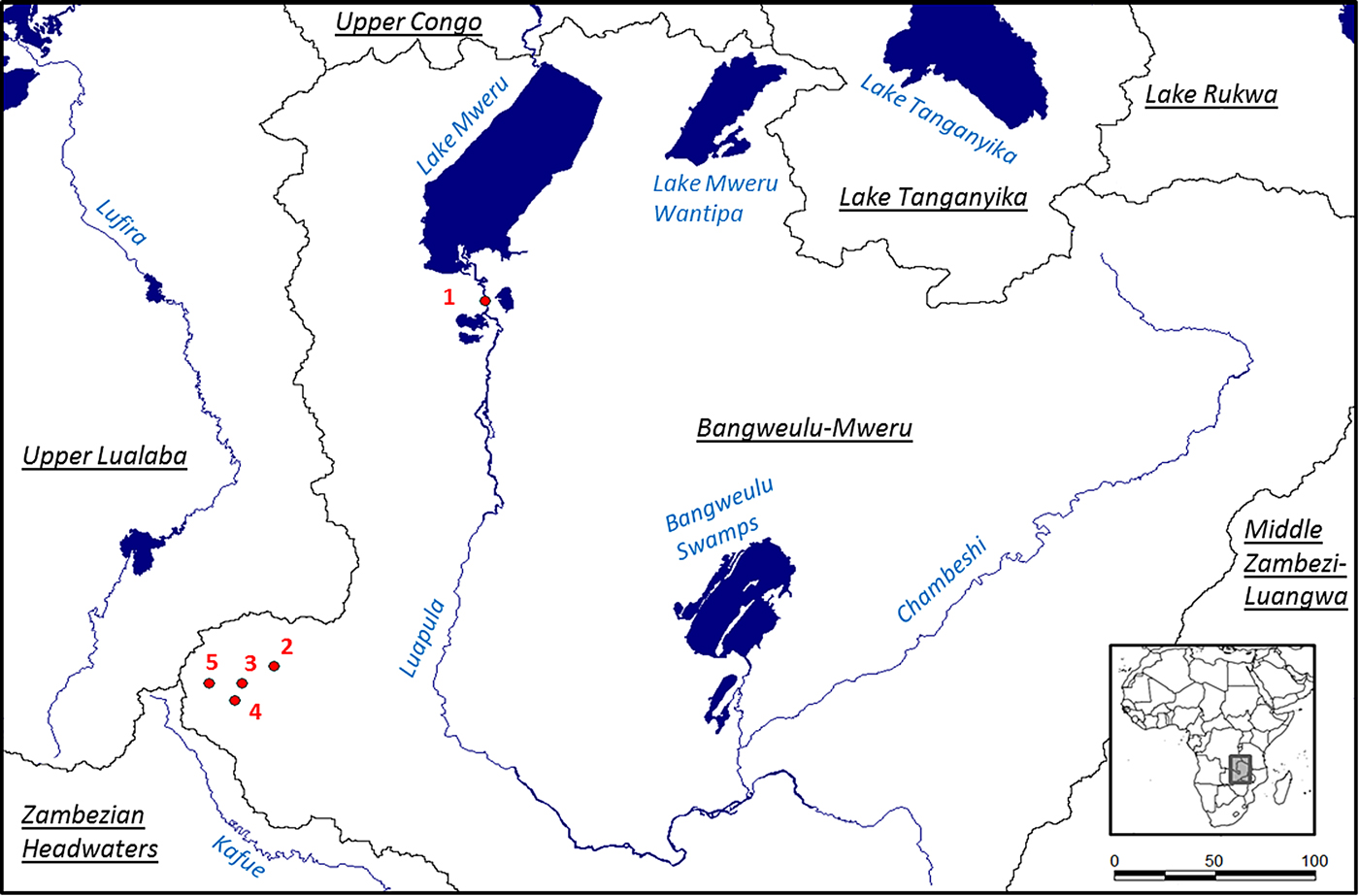
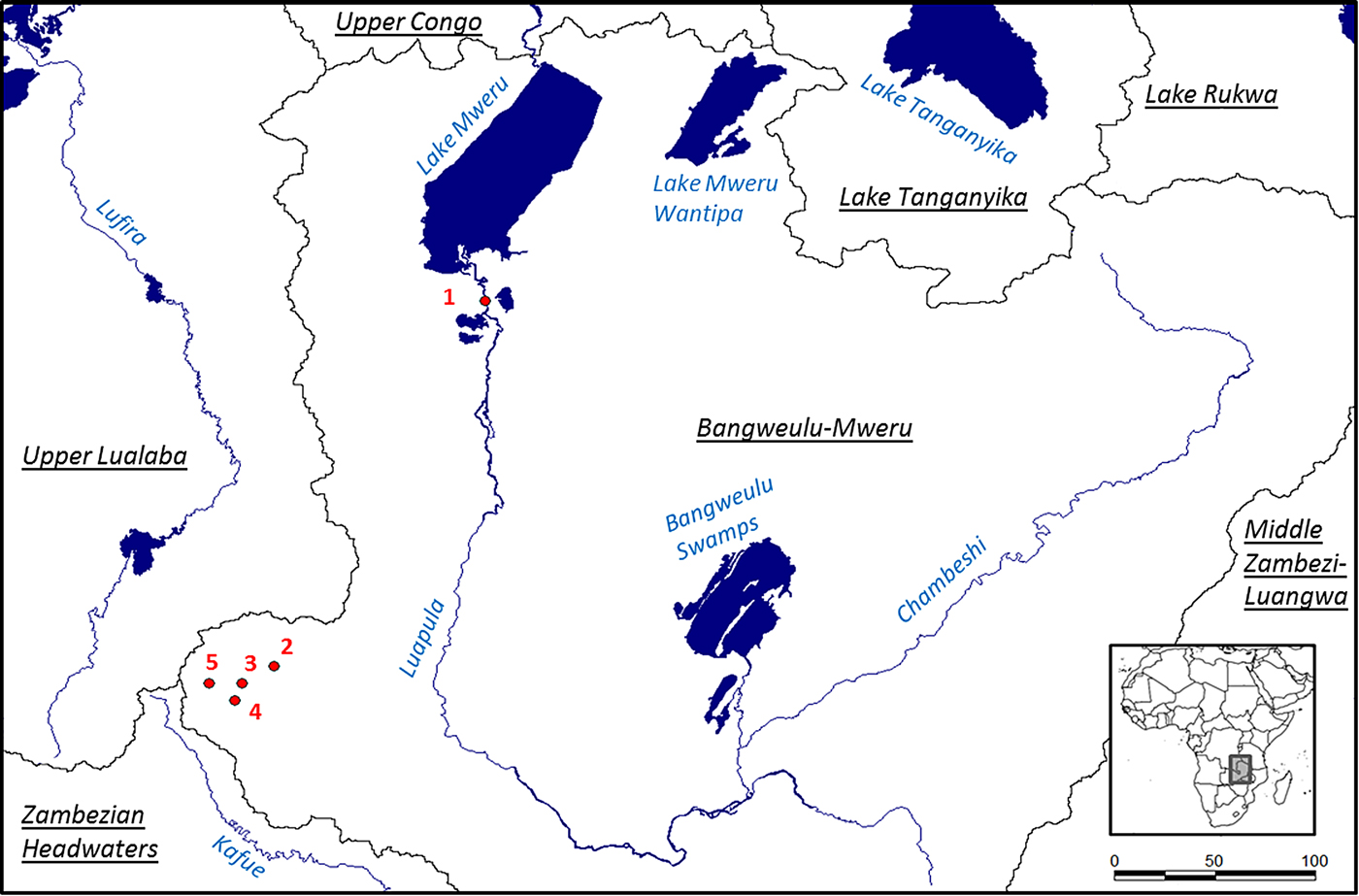
Little is known of cichlid gill monogeneans in Bangweulu-Mweru and knowledge is limited to a small-scale study in the Bangweulu wetlands, Zambia from the Bangwuelu-Chambeshi subregion (Vanhove et al., Reference Vanhove, Van Steenberge, Dessein, Volckaert, Snoeks, Huyse and Pariselle2013). In the rest of the Congo Basin, the majority of recent reports are from Lake Tanganyika (Kmentová et al., Reference Kmentová, Gelnar, Mendlová, Van Steenberge, Koblmüller and Vanhove2016b). Studies on Zambezian cichlid monogeneans are limited to Douëllou (Reference Douëllou1993) and Zahradníčková et al. (Reference Zahradníčková, Barson, Luus-Powell and Přikrylová2016). The current study serves as the first report on cichlid gill monogeneans (Platyhelminthes) from the Mweru-Luapula subregion (see fig. 1 for sample sites).
Map of Bangweulu-Mweru and neighbouring ecoregions in underlined font. Rivers and water bodies in blue font. Sampling localities in red. The inset shows the location of Bangweulu-Mweru on the African continent. Sampling localities: 1, Luapula River off Kashobwe; 2, Futuka Farm; 3, Bumaki Farm; 4, Lubumbashi Zoo; and 5, Kipopo. Scale in kilometres.
To date, over 140 African cichlid monogenean species have been described, reported from over 100 species of cichlids (Vanhove et al., Reference Vanhove, Hablützel, Pariselle, Šimková, Huyse and Raeymaekers2016). Over 1100 valid African cichlid species have been described (Froese & Pauly, Reference Froese and Pauly2015) and the species richness of monogenean gill parasites is estimated to be higher than that of cichlids. In general, it is estimated that 75,000–300,000 helminth species parasitize the approximately 45,000 vertebrate species on Earth (Poulin & Morand, Reference Poulin and Morand2004). We assume that the known African cichlid monogenean species only represent a small fraction of the diversity. Given that the Luapula-Mweru subregion has not yet been explored for cichlid monogeneans, we hypothesize that multiple new monogenean species remain to be discovered in the region. Furthermore, it is known that the ancestral character of host specificity for representatives of Cichlidogyrus/Scutogyrus is intermediate specialism (Mendlová & Šimková, Reference Mendlová and Šimková2014). Therefore, we hypothesize that within the studied parasite fauna the host range for a single species of Cichlidogyrus/Scutogyrus is limited to a single cichlid genus.
Materials and methods
Sample collection
Host fish were caught with gillnets during a field expedition in the DRC from 26 August to 11 September, 2014. They were killed with an overdose of MS222. Fish were collected from five sampling localities in the Upper Congo Basin (fig. 1), which included riverine, small lacustrine and aquaculture environments. For Cichlidogyrus zambezensis Douëllou, 1993 fresh material from the type locality and type host Serranochromis macrocephalus (Boulenger, 1899) was collected, because the original materials (holotype 138HF Tg7 and vouchers 161HF Tg30 and 162HF Tg31 from the Muséum national d'Histoire naturelle, MNHN, Paris, France) had lost their transparency and were inadequate for morphological analysis. Therefore, fresh specimens from the type locality, Lake Kariba, were used as a reference to diagnose the specimens from Bangwuelu-Mweru and were deposited in the invertebrate collection of the RMCA (MRAC).
Sample preparation and conservation
Hosts were fixed in formaldehyde and deposited in the ichthyology collection of the Royal Museum for Central Africa (Tervuren, Belgium (RMCA) under collection 2016-15-P; MRAC is the French translation and is used as the abbreviation for the collections), stored in denatured ethanol (70%). They were identified to species level by E.J. Vreven (RMCA) and U. Schliewen (Bavarian State Collection of Zoology). Before fixation of the host specimens, gills (only from the right gill chamber) were dissected in situ and stored in 100% ethanol or investigated in the field. From the gills, parasites were collected exhaustively with an entomological needle under Optika ST-30-2 (Optika, Ponteranica, Italy) and WILD M5 (Wild, Heerbrugg, Switzerland) stereomicroscopes, in the field and lab, respectively. Parasites were mounted on slides with water and fixed under a coverslip with Hoyer's medium. The coverslips were sealed with glyceel (Bates, Reference Bates1997) or D-Pex. Type material was deposited in the invertebrate collection of the RMCA (MRAC), the MNHN and the Iziko South African museum (Cape Town, South Africa; SAMC). Voucher specimens of Cichlidogyrus spp. were deposited under accession numbers 37980–38171; accession numbers of Scutogyrus spp. were 38714–38722 and those of Gyrodactylus spp., 38723–38740 in the invertebrate collection of the RMCA. Note that the authors of the new taxon are different from the authors of this paper; see article 50.1, recommendations 50A and 51E of the International Code of Zoological Nomenclature (ICZN, 1999: Article 50.1, recommendation 50A and 51E).
Microscopy and illustration
The mounted specimens were diagnosed through a Leitz Dialux 22 microscope (Leitz, Wetzlar, Germany) with differential interference contrast and measured with Auto-montage software (Imaging & Microscopy, Weinheim, Germany). Images were taken with an optical camera on a Leica DM2500 microscope with Leica Application Suite software (Leica, Wetzlar, Germany), unless noted otherwise. Specimens were measured following the method by Fannes et al. (Reference Fannes, Vanhove and Huyse2017). The total length of the animal, 23 haptoral characters, the heel, penis, accessory piece of the male copulatory organ (MCO) and the vagina were measured. Illustrations were drawn freehand using a drawing tube and finalized with GIMP V2.8 (www.gimp.org). Filaments associated with uncinuli and anchors are not represented.
Results
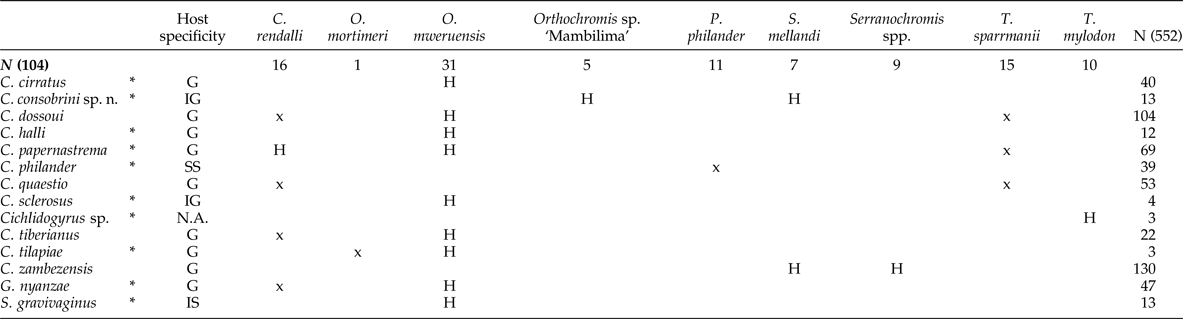
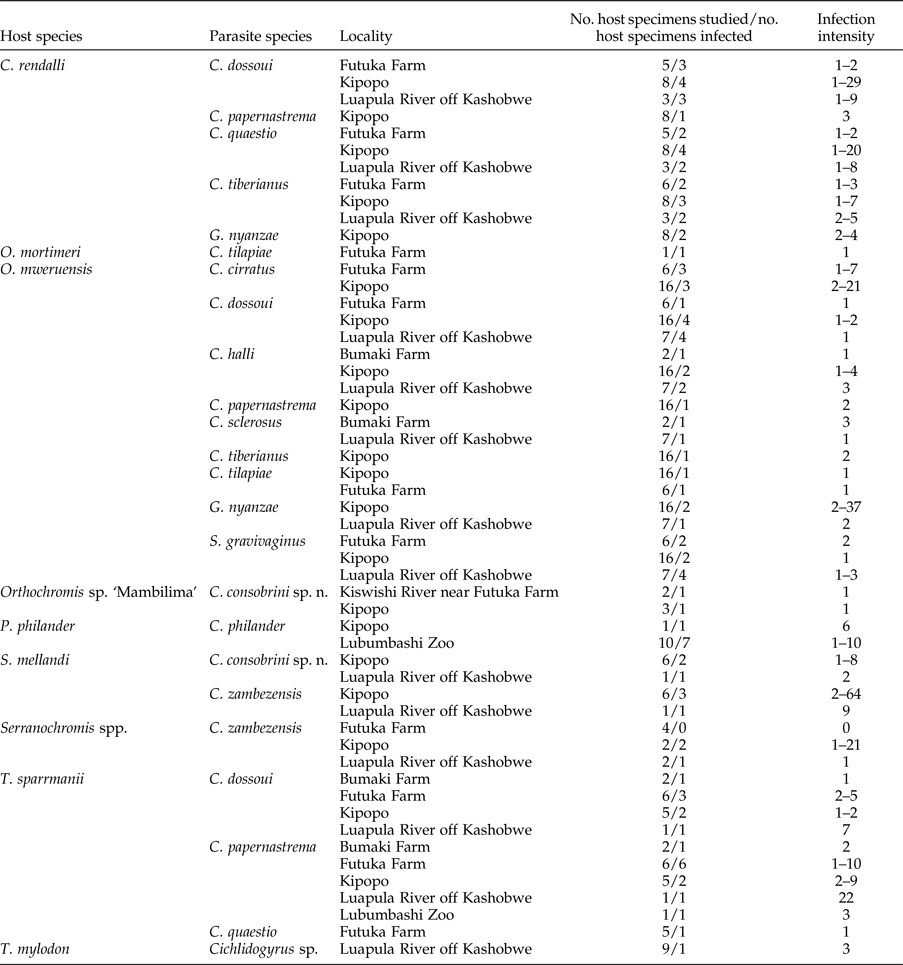
Twelve species of cichlids (104 individuals) and 14 species of Monogenea (552 individuals) were collected. Eight host species, O. mweruensis, Orthochromis sp. ‘Mambilima’ (see Schedel et al., Reference Schedel, Friel and Schlieuwen2014), Sargochromis mellandi (Boulenger, 1905), Serranochromis angusticeps (Boulenger, 1907), S. stappersi Trewavas, 1964, S. thumbergi (Castelnau, 1861) and Tylochromis mylodon Regan, 1920, received their first gill parasite screening (table 1). For ten parasite species the host range was expanded, most notably, Cichlidogyrus papernastrema Price, Peebles and Bamford 1969 which is now found on C. rendalli, O. mweruensis in addition to T. sparrmanii, making it a generalist species following the terminology of Mendlová & Šimková (Reference Mendlová and Šimková2014). Another generalist is Gyrodactylus nyanzae Paperna, 1973, which was found on C. rendalli and O. mweruensis. This parasite was previously collected from C. rendalli and Oreochromis niloticus from the Zambezi Basin (Zahradníčková et al., Reference Zahradníčková, Barson, Luus-Powell and Přikrylová2016), Zimbabwe and from Oreochromis variabilis (Boulenger, 1906) from the Ugandese part of Lake Victoria (Paperna, Reference Paperna1973). Eleven of the collected parasite species are either intermediate generalists or generalists (table 1). Regarding host species, O. mweruensis has the most diverse parasite fauna, with nine parasite species from three genera, while Pseudocrenilabrus philander (Weber, 1897) is infected by a single species, Cichlidogyrus philander Douëllou, 1993 (table 2). Our results further include one new parasite species, three new cases of intraspecific variation and three redescriptions.
Overview of the occurrence of monogenean gill parasites of the studied cichlid species in Bangweulu-Mweru. ‘x’ represents the occurrence of the species on the corresponding host, while ‘H’ represents a new host record for this parasite; ‘*’ represents the first time this parasite was found in the ecoregion. The host specificity is divided into strict specialists (SS), intermediate specialists (IS), intermediate generalists (IG) and generalists (G) (Mendlová & Šimková, Reference Mendlová and Šimková2014). N.A., not applicable. Host range data are based on Pariselle & Euzet (Reference Pariselle and Euzet2009), Vanhove et al. (Reference Vanhove, Van Steenberge, Dessein, Volckaert, Snoeks, Huyse and Pariselle2013) and supplemented with our own findings.

Number of host species studied and infected per locality in addition to the infection intensity from a certain locality.

Cichlidogyrus consobrini Jorissen, Pariselle and Vanhove sp. n.
Taxonomic summary
Type host
S. mellandi.
Additional host
Orthochromis. sp. ‘Mambilima’.
Infection site
Gills.
Type locality
Kipopo INERA aquaculture station (INERA, Institut National pour l'Etude et la Recherche Agronomiques) (11°34′S 27°21′E).
Other localities
Kiswishi River near Futuka Farm on S. mellandi and Orthochromis sp. ‘Mambilima’ (11°29′S 27°39′E); Luapula River off Kashobwe on S. mellandi (09°40′S 28°37′E) (table 2).
Material studied
Eleven specimens.
Type material
Holotype: MRAC 37980 paratypes: six in the RMCA 37980–379082, 37993, 38001–38002, two in the MNHN under HEL683 and two in the SAMC under A088908.
Symbiotype
MRAC 2016-15-P tag 2661.
Etymology
The species epithet is derived from the Latin consobrinus (cousin) and is a noun in apposition of the second declension in the plural form of the nominative. It honours ‘Neveneffecten’, a cabaret quartet with members who are all relatives and, in particular, Lieven Scheire for his efforts towards popularizing science.
Description
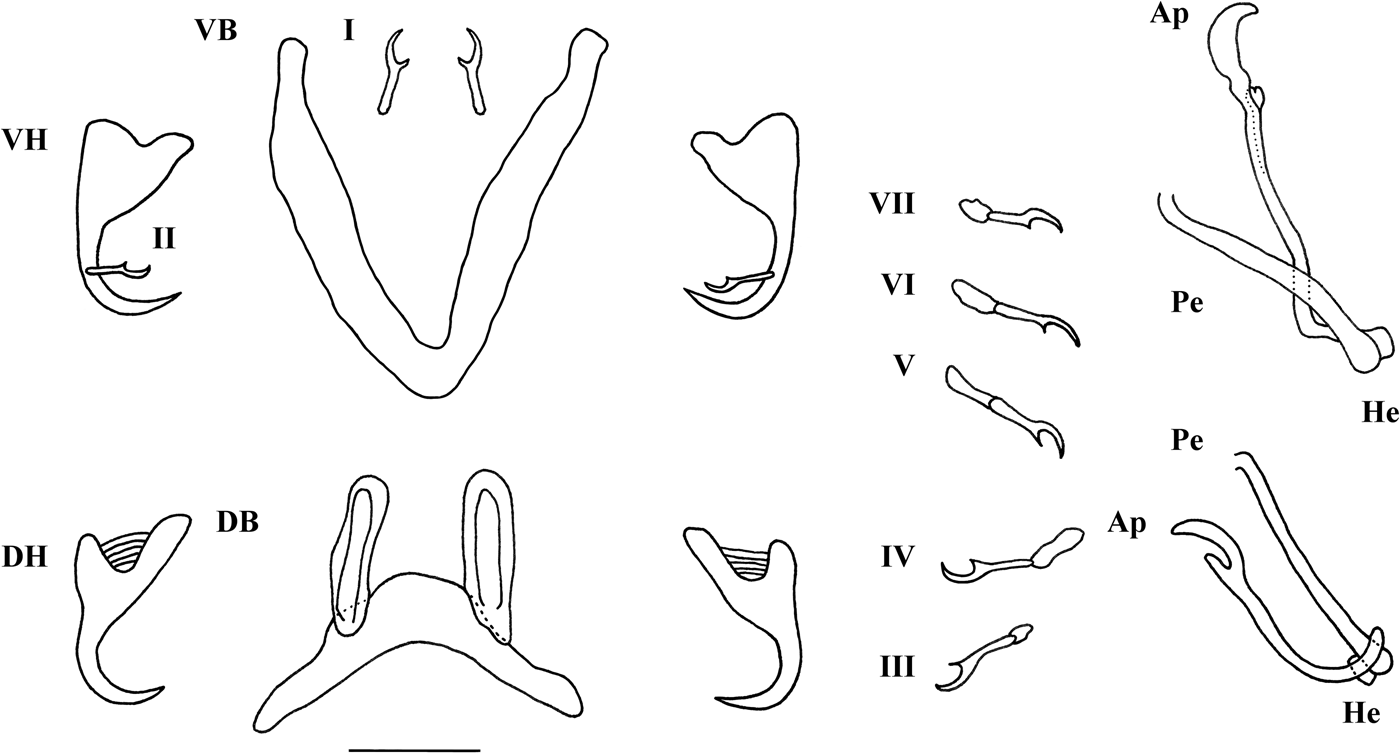
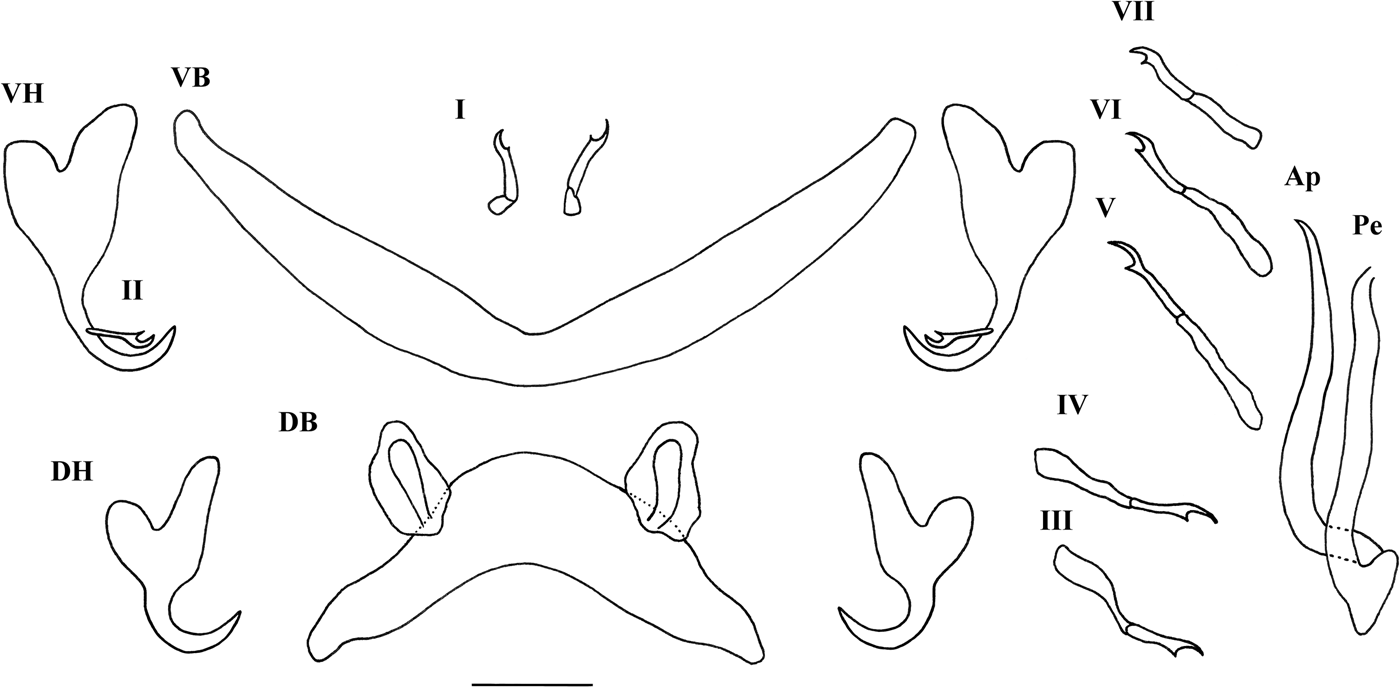
Monogenean, on average 575 μm long. The haptoral and genital hardparts are shown in figs 2 and 3a, b. Dorsal and ventral anchors small (total length: a < 40 μm) and in several specimens, fenestrated. Dorsal anchors strongly asymmetrical as the guard length is 3–4 times the shaft length. Dorsal anchors with V-shaped indentation in the base. Blade curved and short, as the distal tip does not surpass the guard laterally. Dorsal transverse bar slightly concave with developed auricles. Ventral anchors 1–5 μm larger than dorsal ones, with a more symmetrical base and a longer, more pronouncedly curved blade that surpasses the guard laterally. Indentation U-shaped. Ventral transverse bar V-shaped and simple. Uncinuli short (<1.7 times the length of uncinuli pair II sensu Pariselle & Euzet, Reference Pariselle and Euzet2009). Penis is a simple, thick-walled, slightly curved tube with a rounded basal bulb. A rectangular heel is attached to the side of the basal bulb. The accessory piece crosses the penis and is attached to it at the distal side of the basal bulb. It is a slightly curved tubular structure with, at the distal end, a broad sickle-shaped hook. At the base of this hook there is a knob-shaped structure with a groove in the middle. This structure protrudes and continues as a secondary tube within the accessory tube (figs 2, 3b).
Haptoral and genital hardparts of C. consobrini sp. n. Upper MCO drawn from the holotype from S. mellandi. Lower MCO displays the MCO from a different angle and from Orthochromis sp. ‘Mambilima’. I–VII, uncinuli; Ap, accessory piece; DB, dorsal transverse bar; DH, dorsal anchor; He, heel; Pe, penis; VB, ventral transverse bar; VH, ventral anchor. Scale bar: 20 μm.

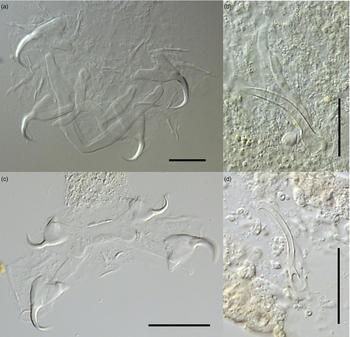
Stacked phase-contrast micrographs of C. consobrini sp. from Sargochromis mellandi, (a) haptor and (b) MCO; and of C. halli morphotype 2, (c) haptor and (d) MCO. Scale bars: (a, b) 20 μm; (c, d) 50 μm.

Remarks
The general shape of the MCO is reminiscent of C. haplochromii Paperna and Thurston, 1969. Following Vignon et al. (Reference Vignon, Pariselle and Vanhove2011), both species belong to group A in the genus, because they possess seven pairs of small uncinuli. Furthermore, in the redescription of C. haplochromii, Douëllou (Reference Douëllou1993) mentioned that the accessory piece ends in a massive hook beyond the end of the copulatory tube, as is the case in C. consobrini sp. n. However, there are differences between both species. Cichlidogyrus haplochromii is mostly known from species of Haplochromis, but has never been recorded on Sargochromis (Pariselle & Euzet, Reference Pariselle and Euzet2009). Morphologically, C. haplochromii possesses less asymmetrical and less deeply indented anchors compared to C. consobrini sp. n. and C. haplochromii lacks a heel, while C. consobrini sp. n. does possess one. Furthermore, the ventral transversal bar of C. consobrini sp. n. is twice as long and thick as that in C. haplochromii (56 vs. 27 μm), the auricles of the dorsal bar are over twice as long (22 vs. 8 μm), and the dorsal transversal bar is also a lot longer (48 vs. 26 μm) (Douëllou, Reference Douëllou1993). Based on these differences, we consider C. consobrini sp. n. to be a different species from C. haplochromii. Douëllou (Reference Douëllou1993) mentioned that C. haplochromii is probably a species complex, based on variations in the ventral transverse bar, but did not specify the variations.
Cichlidogyrus halli Price & Kirk, 1967 species complex
Taxonomic summary
Type host
Tilapia shirana (Boulenger, 1897) (now Oreochromis shiranus Boulenger, 1897).
Infection site
Gills.
Type locality
Fort Johnston, Upper Shire River, Malawi.
Other localities
Luapula River off Kashobwe (09°40′S 28°37′E) on O. mweruensis (this study); Kipopo INERA aquaculture station, (11°34′S 27°21′E) on O. mweruensis (this study) (table 2). Ouémé and Couffo, Benin on Sarotherodon melanotheron Rüppel, 1852 (Pariselle & Euzet, Reference Pariselle and Euzet2009); Lake Albert, Lake Edward, Lake George and Kajansi fish ponds, Uganda on O. niloticus (Linnaeus, 1758) (Pariselle & Euzet, Reference Pariselle and Euzet2009); Lake Victoria, Entebbe and Jinja, Uganda on O. variabilis (Boulenger, 1906) (Pariselle & Euzet, Reference Pariselle and Euzet2009); Lake Kariba, Zimbabwe on Oreochromis mortimeri (Trewavas, 1966) and S. macrocephalus (Pariselle & Euzet, Reference Pariselle and Euzet2009); Guinea and Sierra Leone on Sarotherodon occidentalis (Daget, 1962) (Pariselle & Euzet, Reference Pariselle and Euzet2009); Lake Albert, Uganda, Lake Volta and lower Volta River, Ghana on S. galilaeus (Linnaeus, 1758) (Pariselle & Euzet, Reference Pariselle and Euzet2009); Lake Albert and Lake George, Uganda (Pariselle & Euzet, Reference Pariselle and Euzet2009) and Lake Naivasha, Kenya on O. leucostictus (Trewavas, 1933) (Mogoi Rindoria et al., Reference Mogoi Rindoria, Kamau Mungai, Wamalwa Yasindi and Onjango Otachi2016); Nwanedi-Luphephe dams, Limpopo River, South-Africa on O. mossambicus (Peters, 1852) (Madanire-Moyo et al., Reference Madanire-Moyo, Luus-Powell and Olivier2012); Lake Tana, Ethiopia on O. niloticus tana (Beletew et al., Reference Beletew, Getahun and Vanhove2016); Kalemie, Lake Tanganyika, DRC on O. tanganicae (Gunther, 1894) (Muterezi Bukinga et al., Reference Muterezi Bukinga, Vanhove, Van Steenberge and Pariselle2012); Nyangara wetlands, DRC on O. niloticus (Muterezi Bukinga et al., Reference Muterezi Bukinga, Vanhove, Van Steenberge and Pariselle2012) and introduced on other continents, e.g. Perak, Malaysia on O. niloticus and Oreochromis spp. ‘red hybrid tilapia’ (Lim et al., Reference Lim, Ooi and Wong2016); Água Vermelha Reservoir, south-eastern Brazil on O. niloticus (Zago et al., Reference Zago, Franceschini, Garcia, Schalch, Gozi and da Silva2014).
Material studied
Seven specimens from Kipopo INERA aquaculture station and five specimens from the Luapula River (table 2).
Remarks
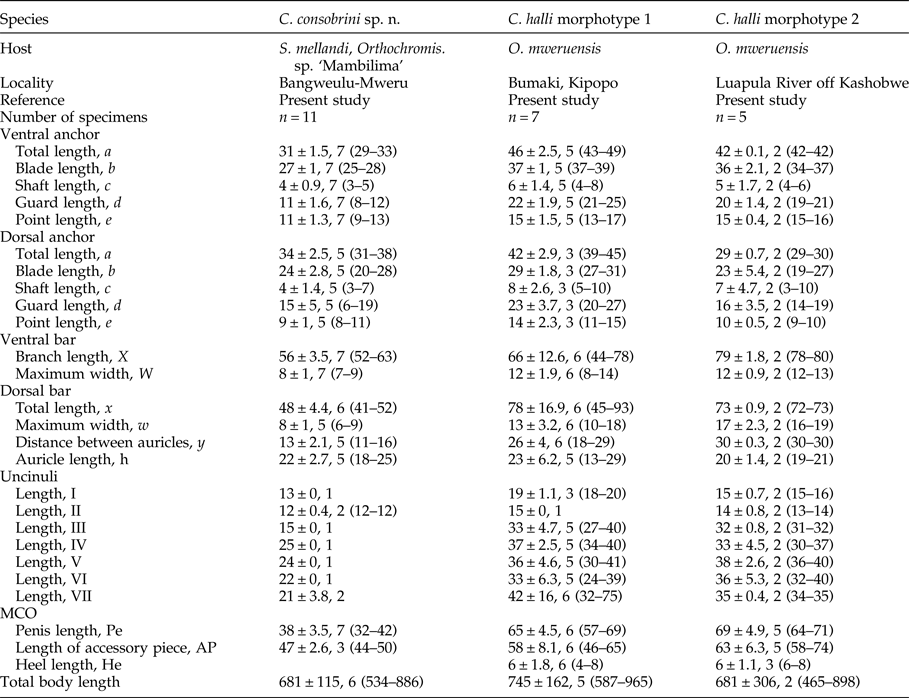
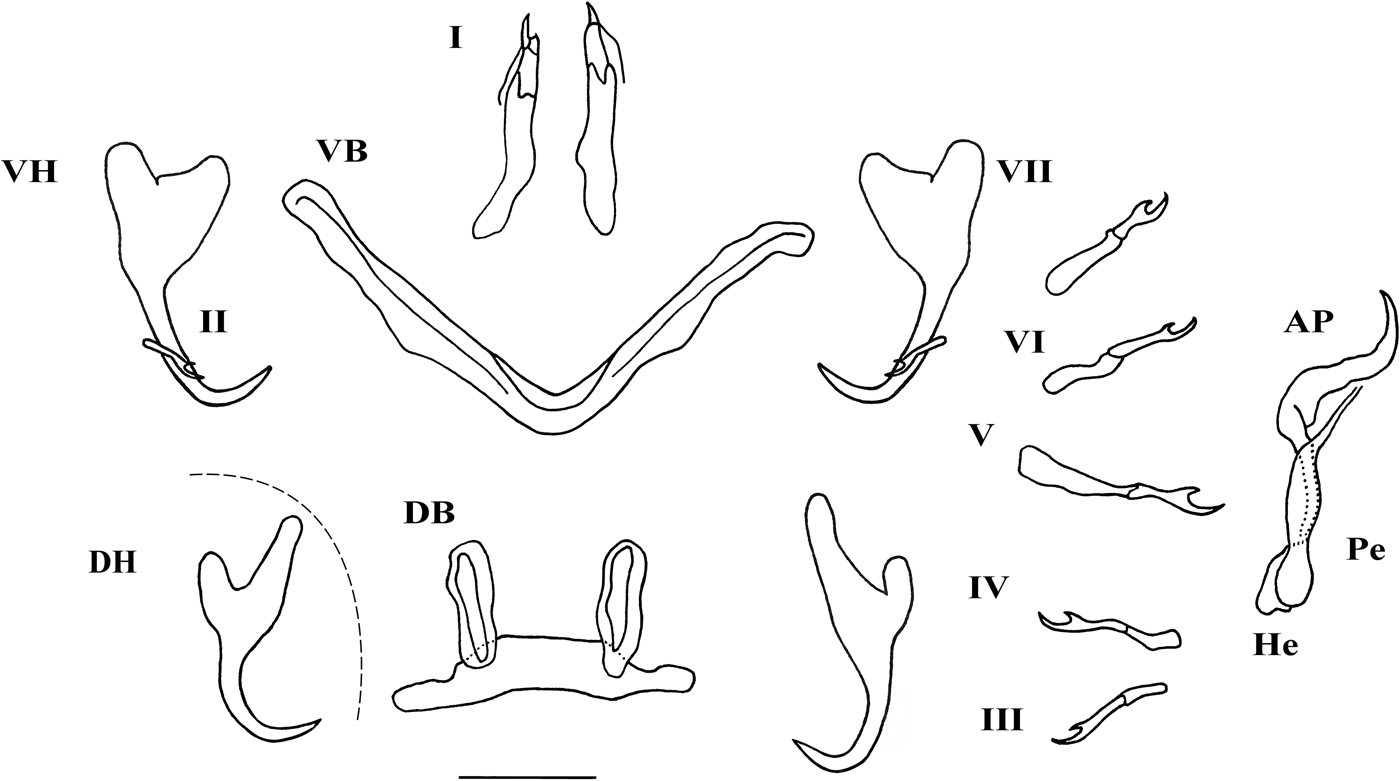
From O. mweruensis two morphotypes of C. halli were collected. The first corresponds well with the original description (Price & Kirk, Reference Price and Kirk1967) and is present in the INERA aquaculture station. Morphotype 2 was only found in the Lower Luapula River and differs in haptoral morphology compared to the other specimens. The haptoral and genital hardparts of C. halli morphotype 2 are shown in figs 3c, d and 4. The dorsal anchors are, on average, 12 μm smaller than the ventral ones, while in other representatives of C. halli both pairs of anchors are of comparable size. Furthermore, the ventral bar is much longer (79 vs. 66 μm). Finally, the uncinuli of pair I are smaller (15 vs. 19 μm; table 3). All other sclerotized elements of the specimens from the Luapula River match with the description of C. halli. We observe that C. halli is a morphologically variable species; subspecies have been defined in the past (Paperna, Reference Paperna1979), but have since been synonymized by Pariselle & Euzet (Reference Pariselle and Euzet2009). However, more work on this species complex needs to be done, with special attention paid to identifying possible cryptic species backed by genetic data. Preliminary studies have confirmed that C. halli consists of different genetic strains. However, species have not been formally delineated (Pouyaud et al., Reference Pouyaud, Desmarais, Deveny and Pariselle2006; Mendlová & Šimková, Reference Mendlová and Šimková2014). Therefore, we refrain from officially describing this morphotype as a separate species until this is supported by genetic data. Our decision is also based on the fact that no representative of Cichlidogyrus has been described based solely on morphological differences in haptoral structure, while no morphological differences are apparent on the MCOs of the two morphotypes.
Haptoral and genital hardparts of C. halli morphotype 2. I–VII, uncinuli; Ap, accessory piece; DB, dorsal transverse bar; DH, dorsal anchor; He, heel; Pe, penis; VB, ventral transverse bar; VH, ventral anchor. Scale bar: 20 μm.

Measurements of C. consobrini sp. n. and two morphotypes of C. halli. Note the size difference in dorsal anchor and ventral bar between the two morphotypes. Measurements are represented in μm as the average ± standard deviation, count and the range (in parentheses).

Cichlidogyrus papernastrema
Taxonomic summary
Type host
T. sparrmanii.
Infection site
Gills.
Type locality
Ingwauana, Natal, Republic of South Africa.
Other localities
Futuka Farm on T. sparrmanii (11°29′S 27°39′E) (this study); Luapula River off Kashobwe on T. sparrmanii (09°40′S 28°37′E) (this study); Kipopo INERA aquaculture station on C. rendalli, O. mweruensis and T. sparrmanii (11°34′S 27°21′E) (this study); Lake Kipopo on C. rendalli and T. sparrmanii (11°34′S 27°21′E) (this study); Lubumbashi Zoo on T. sparrmanii (11°39′S 27°28′E) (this study); Bumaki Farm on T. sparrmanii (11°34′S 27°30′E) (this study) (table 2).
Material studied
Seventy mounted specimens from fresh material and one holotype.
Type material
Holotype: USNM 1366817 (Parasite collection, Smithsonian Institute). Paratypes: six in personal collection of original authors.
Redescription
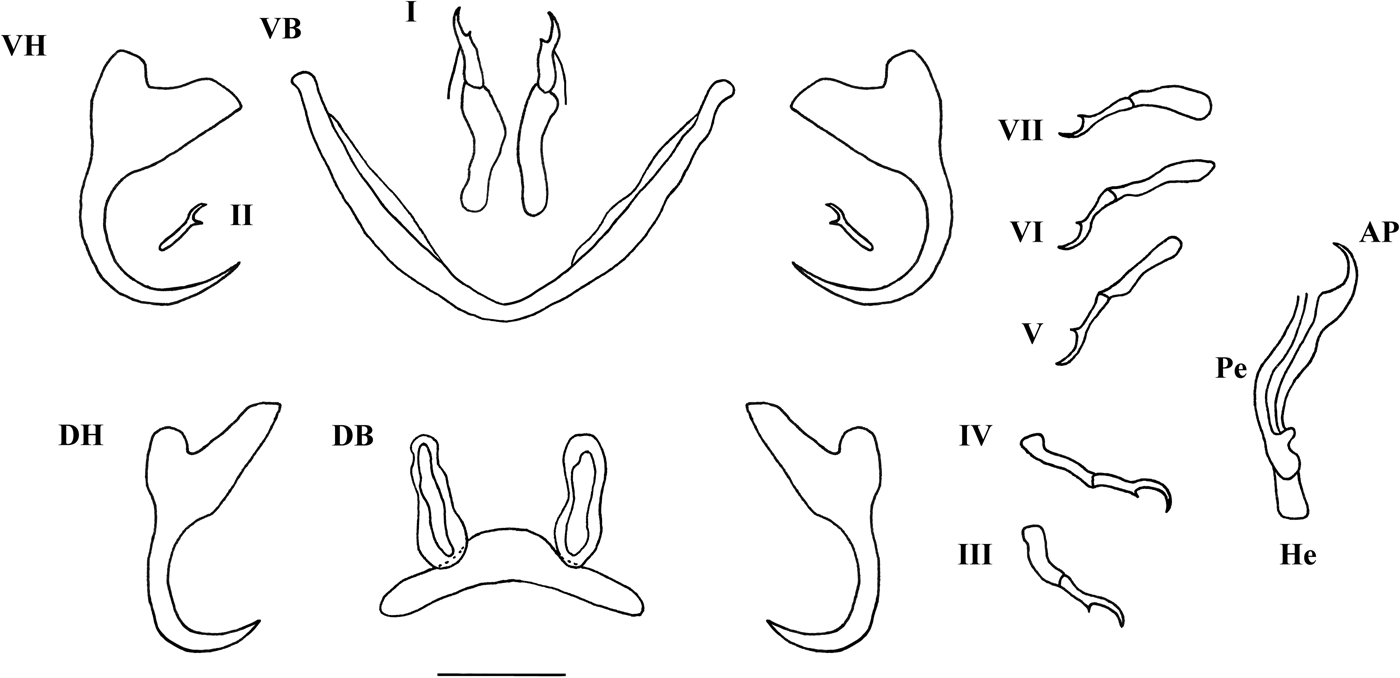
Small to medium-sized representative of Cichlidogyrus, on average 351 μm long. The haptoral and genital hardparts of C. papernastrema are shown in figs 5 and 6a, b, c. Dorsal anchors arched with a strongly asymmetrical base. Guard length approximately three times the shaft length. Indentation of the base deep, sharp and asymmetrical, with one long, curved side towards the guard and one short, straight side to the shaft. Ventral anchors about the same size as the dorsal ones, but with shallower V-shaped indentation and more symmetrical at the base: guard about twice as long as the shaft. Dorsal transverse bar with well-developed auricles. Ventral transverse bar simple, V-shaped, slightly thickened at mid-length of each arm. Uncinuli pair I elongated and thick. Uncinuli pairs III–VII short. MCO consists of a penis with a heel and an accessory piece that is longer than the penis itself. The heel is attached latero-proximally at the basal bulb, and is shaped like a bulge, sometimes also broadened. The penis narrows slightly at the distal end of the basal bulb, after which it broadens again to the same width as the basal bulb. The penis then again narrows and curves towards a sharp end. The accessory piece is attached to the distal end of the basal bulb and starts as a narrow tube under the penis. Where the penis curves, the accessory piece broadens. More distally, the accessory piece turns towards the penis and ends in a hook. The vagina is not sclerotized.
Haptoral and genital hardparts of C. papernastrema from T. sparrmanii. Left dorsal anchor drawn from a different individual. I–VII, uncinuli; AP, accessory piece; DB, dorsal transverse bar; DH, dorsal anchor; He, heel; Pe, penis; VB, ventral transverse bar; VH, ventral anchor. Scale bar: 20 μm.

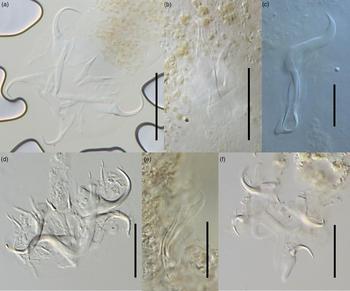
Stacked phase-contrast micrographs of (a–c) C. papernastrema from T. sparmanii: holotype, (a) haptor, (b) MCO; and from voucher MRAC 38080, (c) MCO. (d–e) C. quaestio from C. rendalli: (d) haptor and (e) MCO; and (f) Cichlidogyrus sp. from T. mylodon: (f) haptor. Scale bars: (a, d and f) 50 μm; (b, c and e) 20 μm.

Remarks
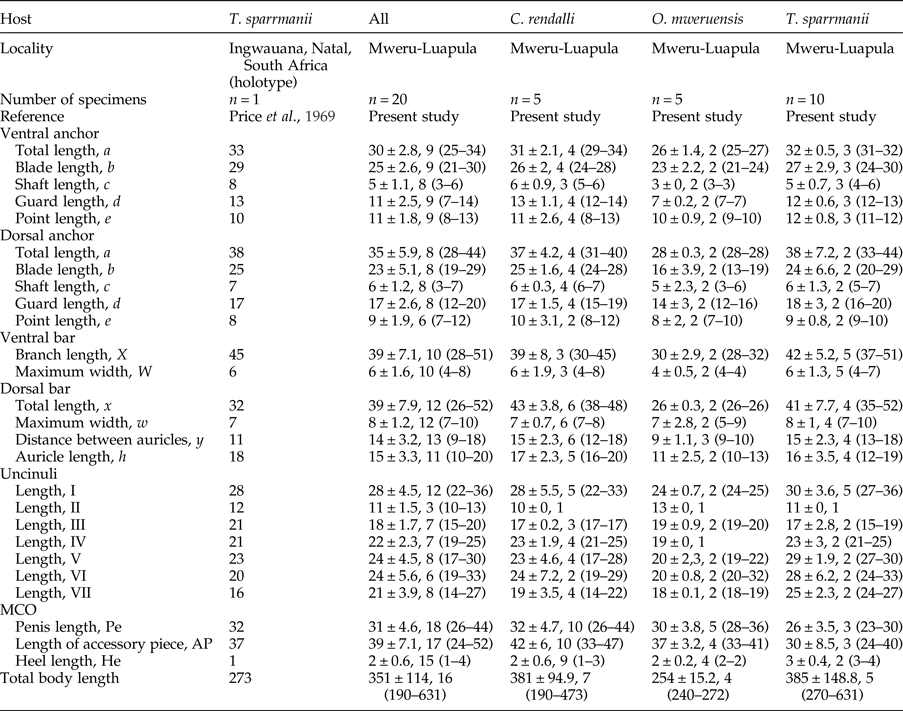
Since the original description of C. papernastrema in 1969, there have been no new records of this parasite. The newly collected specimens differed in some parts from the holotype (Price et al., Reference Price, Peebles and Bamford1969). The accessory piece does not connect to the basal bulb in the holotype, while all collected specimens do have this connection. Probably, the accessory piece was detached from the basal bulb due to the flattening of the holotype during mounting. In turn, this has moved the accessory piece and flattened the penis, giving it a broader appearance. Secondly, in the original description the presence of a heel was not mentioned. Detailed examination of the holotype did, however, reveal the presence of such a heel. The placement of the heel on the basal bulb was consistent among specimens and also on the holotype. This heel is connected to a proximally closed basal bulb, which is depicted as open on the proximal side in the figures of the original description. Because the morphology, measurements (table 4) and host species of our collected specimens coincide with those of the holotype, we consider them conspecific. Among recent specimens a slight variation in measurements between individuals from different host species was observed. Specimens from O. mweruensis were consistently smaller in total length, size of anchors and bars, while one specimen from C. rendalli was much larger than all other collected specimens in total length, size of anchors and bars. Possibly, this is intraspecific variation influenced by host species. The only further difference we noticed was that the shaft of the ventral anchors is slightly shorter in our collected specimens than in the holotype (table 4).
Measurements of C. papernastrema (in μm). Measurements are represented as the average ± standard deviation, count and the range (in parentheses).

Cichlidogyrus quaestio Douëllou, 1993
Taxonomic summary
Type host
Tilapia rendalli Boulenger, 1897 (now C. rendalli (Boulenger, 1897)).
Additional hosts
Sargochromis codringtonii (Boulenger, 1908), S. macrocephalus, T. sparrmanii.
Infection site
Gills.
Type locality
Lake Kariba, Zimbabwe.
Other localities
Lake Kipopo on C. rendalli (11°34′S 27°21′E); Kipopo, INERA aquaculture station on C. rendalli (11°34′S 27°21′E) (this study); Futuka Farm on C. rendalli and T. sparrmanii (11°29′S 27°39′E) (this study); Luapula River off Kashobwe on C. rendalli (09°40′S 28°37′E) (this study) (table 2); and Fiwili settlement, Bangweulu Wetlands, Zambia from C. rendalli and T. sparrmanii (Vanhove et al., Reference Vanhove, Van Steenberge, Dessein, Volckaert, Snoeks, Huyse and Pariselle2013).
Material studied
One hundred and eight specimens.
Type material
Holotype: MNHN 137 HF.
Redescription
Small dactylogyridean monogenean, on average 300 μm long. The haptoral and genital hardparts of C. quaestio are shown in figs 6d, e and 7. Dorsal and ventral anchors of similar size. Ventral anchors on average 4 μm shorter than dorsal ones. Dorsal anchors asymmetrical with a guard length four to five times the shaft length and a V-shaped indentation at the base. Blade curved, but subtly interrupted by an angle in the middle. Dorsal transverse bar simple, slightly concave with well-developed auricles. Ventral anchors more symmetrical, with a shallower V-shaped indentation and broader base than the dorsal anchors. Blade crescent-shaped and with longer point than the blade of the dorsal anchors. Ventral transverse bar V-shaped. Arms thickest at mid-length and thinnest where both arms meet. Distal end of each arm rounded and slightly thickened. At one-third from the distal end a flattened rim is present. Uncinuli pair I, long; III–VII, short (sensu Pariselle & Euzet, Reference Pariselle and Euzet2003, 2009). Penis thin, tubular, slightly curved. The basal bulb is oval in shape but has an indentation opposite to where the penis continues. At the distal part of the basal bulb an elongated rectangular heel is present. The accessory piece connects to the basal bulb, is thin and longer than the penis. At four-fifths of its length, the accessory piece abruptly broadens and forms a hook as a tip. Vagina not sclerotized.
Haptoral and genital hardparts of C. quaestio from C. rendalli. I–VII, uncinuli; AP, accessory piece; DB, dorsal transverse bar; DH, dorsal anchor; He, heel; Pe, penis; VB, ventral transverse bar; VH, ventral anchor. Scale bar: 20 μm.

Remarks
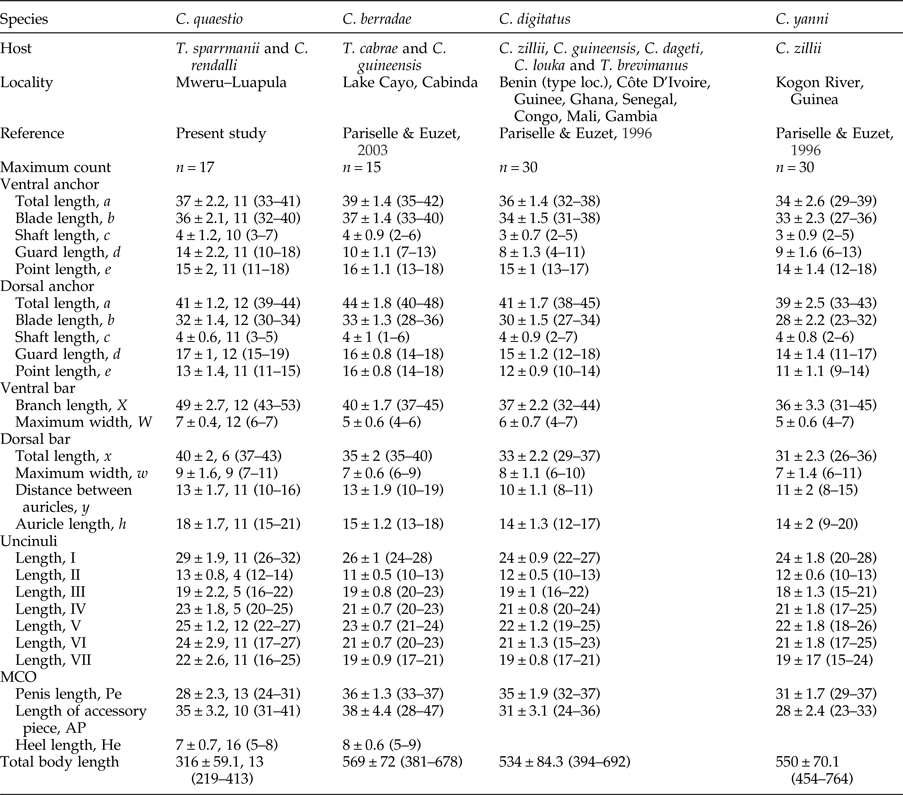
Because uncinuli pair I are long and pairs III–VII short (sensu Pariselle & Euzet, Reference Pariselle and Euzet2003, Reference Pariselle and Euzet2009) C. quaestio belongs to group B within the genus (sensu Vignon et al., Reference Vignon, Pariselle and Vanhove2011). Within this group Cichlidogyrus berradae Pariselle & Euzet 2003, Cichlidogyrus digitatus Dossou 1982, C. quaestio and Cichlidogyrus yanni Pariselle & Euzet 1996 have multiple features in common. First, all species occur predominantly on species of Coptodon Gervais 1853, but not exclusively, since C. berradae can occur on Pelmatolapia cabrae (Boulenger, 1899) and C. digitatus on ‘Tilapia’ brevimanus Boulenger, 1911 as well (Pariselle & Euzet, Reference Pariselle and Euzet2009; host taxonomy taken from Dunz & Schliewen, Reference Dunz and Schliewen2012, representatives of Tilapia belonging to Gobiocichlini are under revision and mentioned within quotation marks). Second, in all these species the guard and shaft of the dorsal anchors are asymmetrical. Furthermore, the curvature of the dorsal blade is interrupted by an angle, while the ventral anchors are more symmetrical and have a continuous crescent-shaped blade. The dorsal transverse bar is concave and quite thick. The MCOs all have an elongated heel, a slender and simple tubular penis and an accessory piece that is a bit longer than the penis and ends in a long hook. The ventral and dorsal bar, the auricles and uncinuli I of C. quaestio are larger than those of C. berradae, C. digitatus and C. yanni, while the penis is shorter (table 5). Furthermore, among these four species, C. quaestio is the only species that has a straight and rectangular heel. Also, the accessory piece of C. quaestio is more slender and the accessory tip is unique because the base of the hook is broadened and gradually narrows in a longer curve than the others. Lastly, the basal bulb of C. quaestio is unique in its morphology in that it has an oval-shaped indentation.
Measurements of C. quaestio, C. berradae, C. digitatus and C. yanni. Measurements are represented in μm as the average ± standard deviation, count and the range (in parentheses).

The differences from the original description (Douëllou, Reference Douëllou1993) are predominantly found on the MCO. First, in the original drawing the attachment of the accessory piece with the basal bulb was not represented and the basal bulb lacked the indentation. Furthermore, the heel is shorter and more rounded in the original description. Lastly, the primary shafts of uncinuli pair I are not as broad as represented in the original drawing.
Cichlidogyrus papernastrema and C. quaestio co-occur on C. rendalli and T. sparrmanii and can be hard to distinguish, since both have long uncinuli pair I, short uncinuli pairs III–VII and an MCO in which the accessory piece is longer than the penis. However, the primary shaft (sensu Pariselle & Euzet, Reference Pariselle and Euzet2003) of uncinuli pair I is thicker and larger in C. quaestio than in C. papernastrema. Furthermore, the shape of the basal bulb of C. quaestio is sufficiently characteristic to differentiate it from C. papernastrema. The basal bulb of C. papernastrema lacks the indentation that is present in the basal bulb of C. quaestio. Also, the position of the heel is different, as in C. quaestio it is at the distal end of the basal bulb and in C. papernastrema it is located more laterally. Lastly, the blades of the ventral anchors in C. quaestio are more pronounced and have a longer crescent-shaped point than do those of C. papernastrema.
Cichlidogyrus zambezensis Douëllou, 1993
Taxonomic summary
Type host
S. macrocephalus.
Additional hosts
O. mortimeri, Serranochromis robustus jallae (Günther, 1864); S. mellandi; S. stappersi; S. thumbergi; S. angusticeps.
Infection site
Gills.
Type locality
Lake Kariba, Zimbabwe.
Other localities
Lake Kipopo on S. macrocephalus (11°34′S 27°21′E) (this study); Kipopo, INERA aquaculture station on S. mellandi and S. thumbergi (11°34′S 27°21′E) (this study); Futuka Farm on S. mellandi (11°29′S 27°39′E) (this study); Kiswishi River near Futuka on S. mellandi (11°29′S 27°39′E) (this study); Luapula River off Kashobwe on S. mellandi, S. angusticeps, S. macrocephalus and S. stappersi (09°40′S 28°37′E) (this study) (table 2); Fiwili settlement, Bangweulu Wetlands, Zambia from S. robustus jallae (Vanhove et al., Reference Vanhove, Van Steenberge, Dessein, Volckaert, Snoeks, Huyse and Pariselle2013).
Material studied
Ninety-two fresh specimens from Bangweulu-Mweru, 1 holotype and 42 vouchers from Lake Kariba (MNHN 138HF,161HF, 162HF), 5 vouchers of a 2010 expedition in Bangweulu Wetlands, Zambia (MT.37714) and 32 freshly collected specimens from Lake Kariba.
Type material
Holotype: MNHN 138 HF.
Redescription
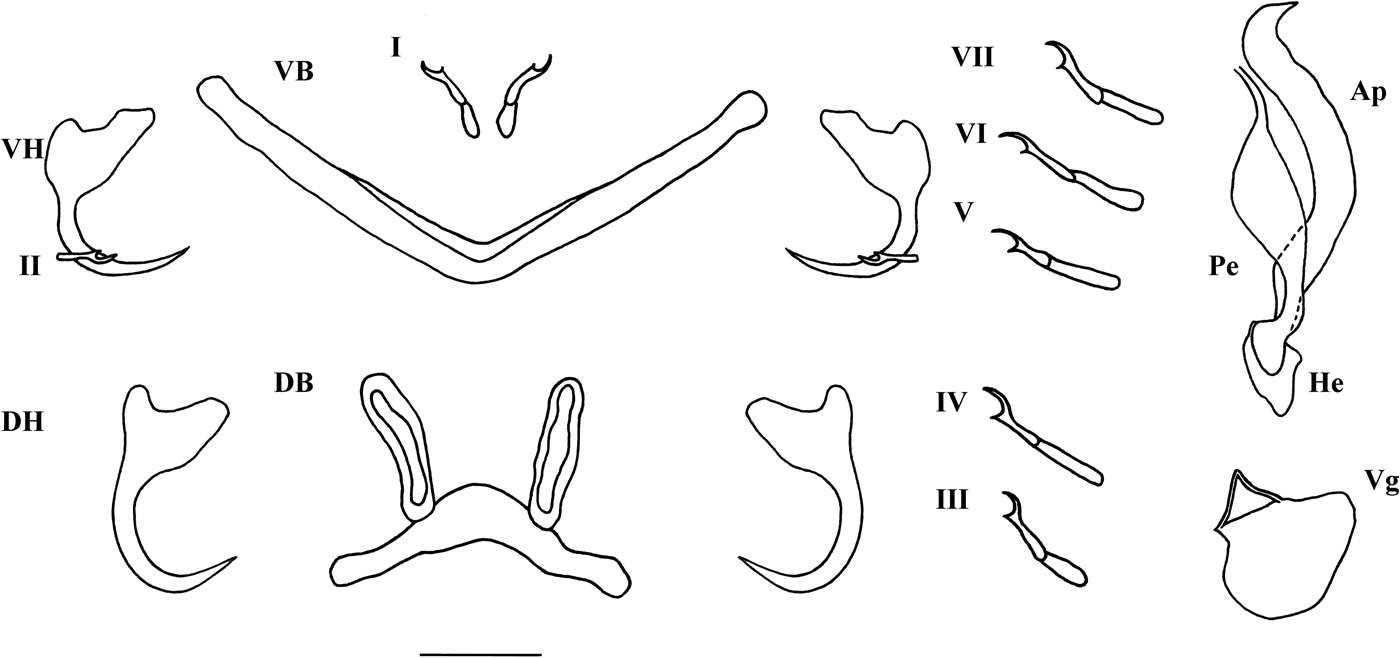
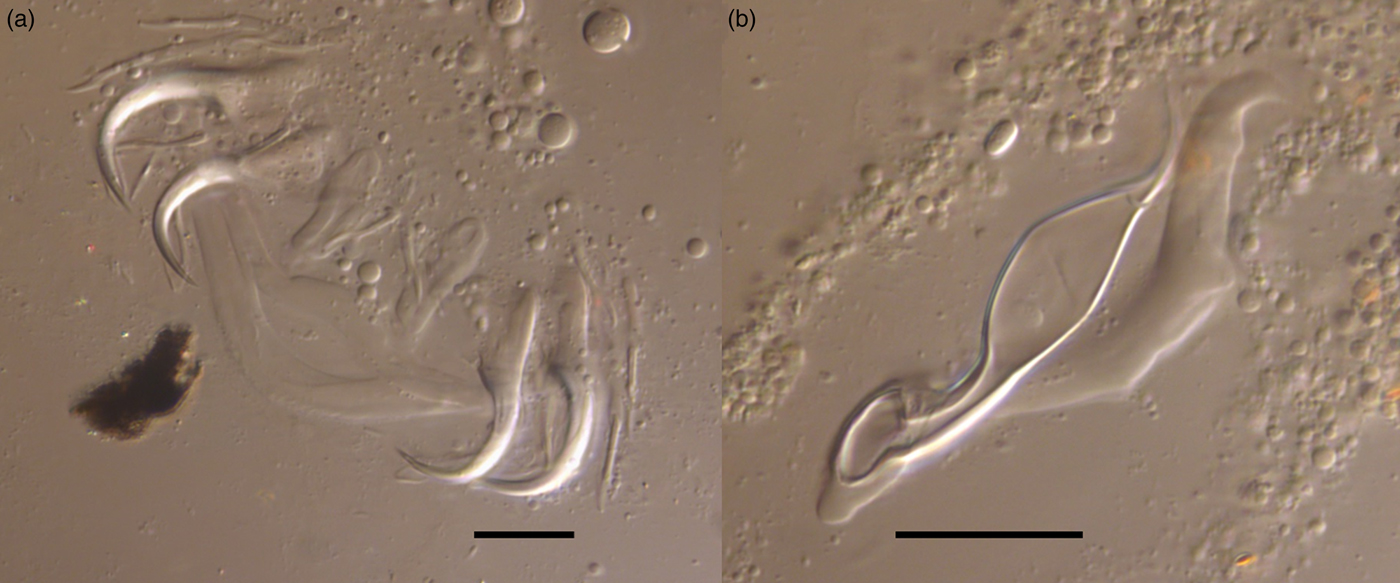
Monogenean between 300 and 600 μm long. The haptoral and genital hardparts of C. zambezensis are shown in figs 8 and 9. Ventral anchors have a more slender root than dorsal ones, with a slightly asymmetrical indentation. Blade continuous. Dorsal anchors strongly asymmetrical with a guard two to four times the length of the shaft. Blade bent more than the ventral anchors’ blade. Dorsal transverse bar bent with long auricles. Ventral transverse bar simple, V-shaped with an extension at one-third of the distance from where both arms meet. Uncinuli pairs I–VII short (sensu Pariselle & Euzet, Reference Pariselle and Euzet2003, Reference Pariselle and Euzet2009). The MCO consists of a thick-walled penis with a well-developed swollen portion, a small basal bulb and a narrow S-shaped distal end. A heel engulfs the basal bulb and is irregular in shape, broad and short. The accessory piece is often larger than the penis and is a curved tubular structure with a finger-like extension at the distal end. Proximally the accessory piece crosses the penis, after which it connects to the basal bulb. The sclerotized vagina is small, thick-walled, triangular and funnel shaped.
Haptoral and genital hardparts of C. zambezensis from S. thumbergi. I–VII, uncinuli; Ap, accessory piece; DB, dorsal transverse bar; DH, dorsal anchor; He, heel; Pe, penis; VB, ventral transverse bar; VH, ventral anchor; Vg, vagina. Scale bar: 20 μm.

Stacked phase-contrast micrographs of C. zambezensis from S. thumbergi: (a) haptor, (b) MCO. Scale bars: 20 μm.

Remarks
Douëllou described this species in 1993 from S. macrocephalus and O. mortimeri in Lake Kariba. Additional specimens from S. robustus jallae were collected from Fiwili settlement, Bangweulu Wetlands, Zambia in 2010 (Vanhove et al., Reference Vanhove, Van Steenberge, Dessein, Volckaert, Snoeks, Huyse and Pariselle2013). Both articles report morphological variation, which was considered to be intraspecific by the authors, and a possible broad geographical and host range. However, freshly collected specimens from Bangweulu-Mweru and from the type locality, Lake Kariba, differed from the original drawing and measurements.
The major difference from the original drawing is that, in all but a single specimen (from Lake Kariba), the swollen portion of the penis is much larger than originally drawn. Furthermore, Douëllou (1993) stated that C. papernastrema and C. zambezensis are the only representatives of Cichlidogyrus with an accessory piece that is not connected to the basal bulb. However (see remarks on C. papernastrema above), we have observed this connection in both species. In some specimens, the accessory piece appears to be segregated from the basal bulb but in others it is clearly continuous. Furthermore, in specimens where the accessory piece is split off, a very thin connection between the piece and the bulb is still visible, and also a part of the basal bulb points towards the distal end of the accessory piece. The accessory piece is connected to the basal bulb and does not articulate with the penis as stated in Douëllou (Reference Douëllou1993). Also, uncinuli I appear with a slightly longer shaft than originally drawn; the ventral anchors are a bit more slender and the dorsal anchors do not always have such a pronouncedly asymmetrical guard as on the original drawing.
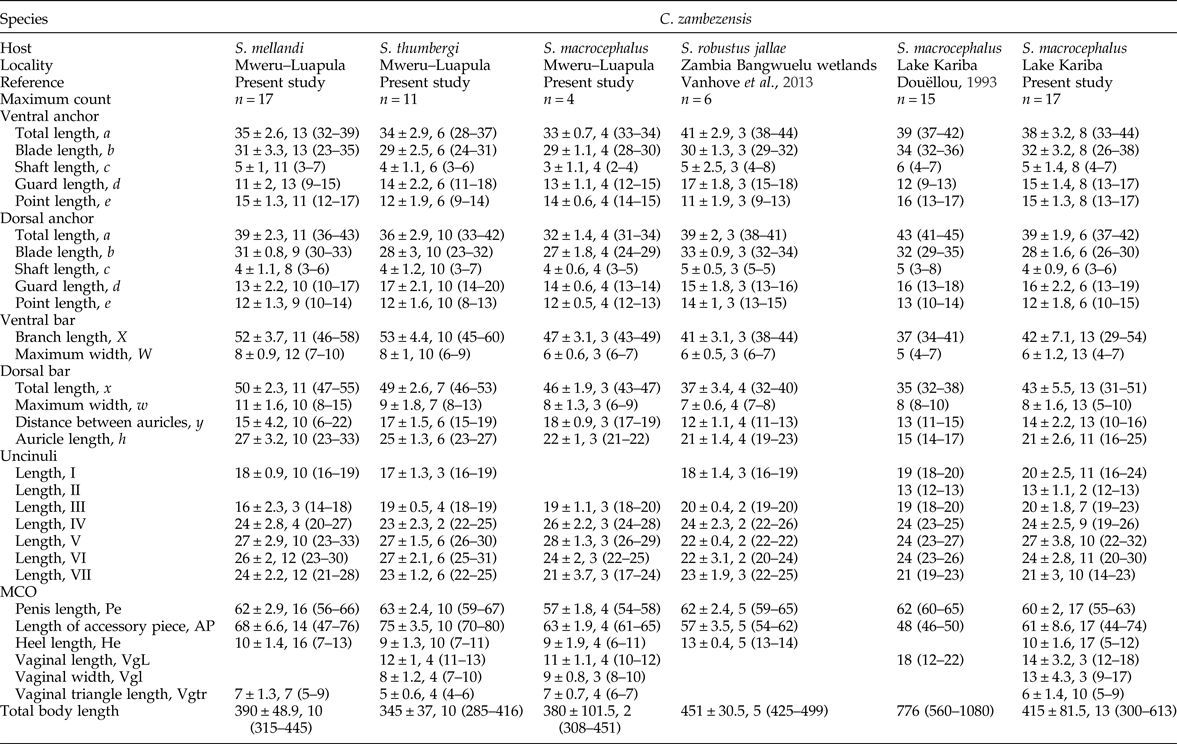
A few differences in measurements between the freshly collected specimens from Bangweulu-Mweru and Lake Kariba were observed. First, both the ventral and dorsal transverse bars, as well as the auricles, are larger in specimens from Bangweulu-Mweru. The accessory piece is smaller in specimens from Lake Kariba (table 6). These differences between the two localities can be explained by stochastic effects, geographical variation or host adaptation. However, the measurements of these specimens from S. macrocephalus from both regions correspond with each other, which may point to differences in the size of sclerotized elements due to adaptation to the host.
Measurements of C. zambezensis from four Serranochromis species and S. mellandi. Measurements are represented in μm as the average ± standard deviation, count and the range (in brackets).

Lastly, C. zambezensis is a species similar in morphology to all congeners typically infecting representatives of Haplochromini: it has a simple MCO, short uncinuli, an asymmetry between dorsal and ventral anchors and well-developed but normal-sized auricles (Pouyaud et al., Reference Pouyaud, Desmarais, Deveny and Pariselle2006; Gillardin et al., Reference Gillardin, Vanhove, Pariselle, Huyse and Volckaert2012; Muterezi Bukinga et al., Reference Muterezi Bukinga, Vanhove, Van Steenberge and Pariselle2012). Other haplochromine-infecting species are, for example, Cichlidogyrus gillardinae Muterezi Bukinga, Vanhove, Van Steenberge and Pariselle, 2012, C. irenae Gillardin, Vanhove, Pariselle, Huyse and Volckaert, 2012 and C. karibae Douëllou, 1993; the latter two also have a swollen penis. However, C. zambezensis is the only species in this group with a sclerotized vagina, and thus is distinct from the others.
Cichlidogyrus sp.
Taxonomic summary
Host
T. mylodon.
Infection site
Gills.
Locality
Luapula River off Kashobwe (09°40′S 28°37′E).
Material studied
Three mounted specimens.
Remarks
From T. mylodon, three parasites were collected with a haptoral morphology (fig. 6f) that corresponds with species of Cichlidogyrus infecting representatives of Tylochromis (see Pariselle et al., Reference Pariselle, Bitja Nyom and Bilong Bilong2014). The ventral transverse bar is simple and V-shaped while the dorsal transverse bar has reduced auricles, similar to Cichlidogyrus berrebii Pariselle & Euzet 1994. Furthermore uncinuli pairs III–VII are short. Because species of Cichlidogyrus from T. mylodon have not been studied yet, it is possible that the specimens found here belong to an undescribed species. However, this cannot be assessed with the material available. Because the MCO was not visible in any of the three specimens, they could not be identified to species level.
Discussion
Diversity
During our study, 14 monogenean species were recovered from a total of 12 host species. The cichlid species with the highest monogenean species richness was O. mweruensis; nine species of monogeneans were found. Representatives of Oreochromis tend to have a high number of monogenean species on their gills, e.g. O. niloticus and O. mortimeri with seven and eight species, respectively (Douëllou, Reference Douëllou1993; Pariselle & Euzet, Reference Pariselle and Euzet2009). Several representatives of Cichlidogyrus and all but one species of Scutogyrus infect multiple species of Oreochromis and Sarotherodon exclusively (Pariselle & Euzet, Reference Pariselle and Euzet2009), which are two closely related mouth-brooding cichlid genera, belonging to Oreochromini (Schwarzer et al., Reference Schwarzer, Misof, Tautz and Schliewen2009; Dunz & Schlieuwen, 2012). Hence, one might refer to a monogenean gill fauna typical of Oreochromini. In our study, the parasite fauna of O. mweruensis was comprised of typical parasite species of Oreochromini, such as C. sclerosus Paperna & Thurston, 1969, C. cirratus Paperna, 1964, C. tilapiae Paperna, 1960, C. halli and S. gravivaginus (Paperna & Thurston, 1969). Other typical species are all representatives of Scutogyrus, except for S. vanhovei Pariselle, Bitja Nyom & Bilong Bilong, 2013. In addition, the generalist C. papernastrema was also found on O. mweruensis. In contrast to the diverse gill parasite fauna of O. mweruensis, the gills of the four representatives of Serranochromis were infected by a single monogenean species, C. zambezensis. One of these representatives, S. macrocephalus is known to host five parasite species in Lake Kariba, all of which are also found in the Mweru-Luapula area. These are C. dossoui, C. quaestio, C. zambezensis, C. sclerosus and C. halli, the latter two of which occur only occasionally on representatives of Serranochromis (Douëllou, Reference Douëllou1993). However, in Bangwuelu-Mweru only C. zambezensis was found to infect this fish (Vanhove et al., Reference Vanhove, Van Steenberge, Dessein, Volckaert, Snoeks, Huyse and Pariselle2013; present study). This is likely the result of sampling bias. For C. rendalli and T. sparrmanii the same gill parasite fauna was observed in both Mweru-Luapula and Bangwuelu-Chambeshi (Vanhove et al., Reference Vanhove, Van Steenberge, Dessein, Volckaert, Snoeks, Huyse and Pariselle2013). The only difference was that C. tiberianus was not found on T. sparrmanii in the Mweru-Luapula area. However, we suspect that C. tiberianus does occur here on T. sparrmanii, but was not found due to sampling bias. Furthermore, no species of Gyrodactylus were found on representatives of Serranochromis, which corresponds with the results from Zahradníčková et al. (Reference Zahradníčková, Barson, Luus-Powell and Přikrylová2016). In our study, G. nyanzae was the only representative of Gyrodactylus on C. rendalli, while in the study of Zahradníčková et al. (Reference Zahradníčková, Barson, Luus-Powell and Přikrylová2016) the fauna of C. rendalli was dominated by G. chitandiri Zahradníčková, Barson, Luus-Powell & Přikrylová, 2016. The Bangweulu-Mweru region is situated in-between the other known localities where G. nyanzae occurs. It possibly has a continuous distribution from central to southern Africa, living on C. rendalli and representatives of Oreochromis within this range.
Of the 14 parasite species, C. consobrini sp. n. was described; one new morphotype of C. halli was characterized and three cases of intraspecific morphological variation were discussed. Furthermore, one Cichlidogyrus species living on the gills of T. mylodon was not identified to species level due to the insufficient quality of the collected specimens; it possibly represented an undescribed species, as this host species has not been sampled for parasites before. All other recorded species were already known. This study reported a relatively low number of new species for a sampling of an almost unexplored ecoregion. Most of the parasites found have already been described from Lake Kariba, Zambezi Basin (Douëllou, Reference Douëllou1993). This outcome reflects the hydrological history of the ecoregion, with frequent connections between the Congo and Zambezi rivers (Lévêque, Reference Lévêque1997; Moore & Larkin, Reference Moore and Larkin2001; Key et al., Reference Key, De Wasele and Liyngu2004; Katongo et al., Reference Katongo, Koblmüller, Duftner, Mumba and Sturmbauer2007; Koblmüller et al., Reference Koblmüller, Schlieuwen, Duftner, Sefc, Katongo and Sturmbauer2008). However, more sampling in the Lower Luapula River and Lake Mweru would be interesting, since more endemic cichlid species are present there (Van Steenberge et al., Reference Van Steenberge, Vreven and Snoeks2014) and have not been screened previously for parasites. Additionally, investigation in the Bangwuelu-Mweru ecoregion may be useful to determine to what extent the parasite fauna is a reflection of the distribution of its hosts.
Host specificity and biogeography
The parasites found in Bangweulu-Mweru range from strict specialists to generalists (following Mendlová & Šimková, Reference Mendlová and Šimková2014) (table 1). Only one strict specialist, C. philander, was found in this study; occurring on P. philander (Pariselle & Euzet, Reference Pariselle and Euzet2009). A species for which the reported host range was remarkedly increased is C. papernastrema, which was previously known as a strict specialist, but is now found to be a generalist. This illustrates how understudied some of these parasite species are. However, in general, the host range of these parasite species in Bangweulu-Mweru was found to be narrower compared with Lake Kariba. This trend is most distinct for parasites from O. mortimeri and S. macrocephalus. In Lake Kariba, these hosts are both infected by C. dossoui, C. halli, C. sclerosus and C. zambezensis (Douëllou, Reference Douëllou1993). All four parasite species also occur in Bangweulu-Mweru but none were found on representatives of both Oreochromis and Serranochromis. Cichlidogyrus dossoui and C. tiberianus typically infect representatives of Coptodon, but are also found on other host genera. Cichlidogyrus halli and C. zambezensis are typical of, respectively, representatives of Oreochromis and Serranochromis. Although Lake Kariba is highly similar to Bangwuelu-Mweru in parasite and host fauna, the two systems are hydrographically and ecologically very different. Lake Kariba is a man-made lake, created as a result of the construction of a hydroelectric dam. This dam transformed the previously riverine environment into a lake system, thereby impacting the ethology/ecology of host species. Such a transition creates an environment where new host–parasite encounters can occur (Combes, Reference Combes1990). In other words, the transition from a river to a lake system may favour a broader host range for parasites and a higher tendency for host switching through more or new encounters between host species. In Lake Ossa, Cameroon, a broader host range for several parasites was also observed following host switching. Scutogyrus vanhovei Pariselle, Bitja Nyom & Bilong Bilong, 2013 occurs on Coptodon mariae (Boulenger, 1899) instead of on a mouth-brooding host (Pariselle & Euzet, Reference Pariselle and Euzet2009). Also, Quadriacanthus euzeti Nack, Pariselle & Bilong Bilong, 2015 occurs in Lake Ossa on Papyrocranus afer (Günther, 1868) (Osteoglossiformes) instead of on a host belonging to the Siluriformes (Pariselle et al., Reference Pariselle, Bitja Nyam and Bilong Bilong2013; Nack et al., Reference Nack, Bitja Nyom, Pariselle and Bilong Bilong2015). Other noteworthy examples of host switching within Cichlidogyrus are C. amieti, C. nandidae and C. inconsultans from small forest streams in South Cameroon, as these species infect non-cichlids (Pariselle & Euzet, Reference Pariselle and Euzet2009; Messu Mandeng et al., Reference Messu Mandeng, Bilong Bilong, Pariselle, Vanhove, Bitja Nyom and Agnèse2015). The extended host range in South Cameroon is probably the result of a host switch away from cichlids (Messu Mandeng et al., Reference Messu Mandeng, Bilong Bilong, Pariselle, Vanhove, Bitja Nyom and Agnèse2015). The pattern observed in the Mweru-Luapula subregion is that the fauna is determined by the host taxon up to the level of host genus in most cases, because the parasite species found behave as intermediate specialists to intermediate generalists. However, our results may demonstrate that the host range of a parasite species may differ between regions. For example C. zambezensis is a generalist in Lake Kariba because it occurs on the distantly related hosts O. mortimeri and S. macrocephalus (Douëllou, Reference Douëllou1993), but in Bangweulu-Mweru it is limited to Serranochromis spp., thus being an intermediate specialist in this location. Cichlidogyrus zambezensis was not found on the local O. mweruensis in Mweru-Luapula, of which a sufficient number of hosts were investigated. We propose that there is a geographic pattern to host specificity (Krasnov et al., Reference Krasnov, Mouillot, Shenbrot, Khoklova and Poulin2004; Korallo-Vinarskaya et al., Reference Korallo-Vinarskaya, Krasnov, Vinarski, Shenbrot, Mouillot and Poulin2009) and host–parasite dynamics (Valois & Poulin, Reference Valois and Poulin2015) in species of Cichlidogyrus/Scutogyrus, which implies that distribution and host specificity are not only taxon-bound but also determined by ecology and geography. However, a formal statistical analysis is in order to investigate this further. A thorough parasitological screening of Luapula-Mweru and other regions with a highly similar cichlid species composition (Upper Zambezi, Upper Congo, Lualaba River and the Bangwuelu-Chambeshi subregion) (Van Steenberge et al., Reference Van Steenberge, Vreven and Snoeks2014) has not yet been done; and would be of great interest in further unravelling a geographic pattern to host specificity and host–parasite dynamics. Also, this would help to answer the question posed in Vanhove et al. (Reference Vanhove, Van Steenberge, Dessein, Volckaert, Snoeks, Huyse and Pariselle2013) as to whether the biogeographical pattern of species of Cichlidogyrus/Scutogyrus mirrors the host biogeography, or whether parasite assemblages are basin-specific.
Acknowledgements
Moise Katumbi Chapwe is cordially thanked for his kind hospitality and support. Also E. Abwe, B. Katemo Manda and C. Mukwene Mulele are cordially thanked for their help with the fish sampling, and W. Fannes, M. Kasongo Ilunga Kayaba and C. Kalombo Kabalika for their effort in parasite preparation. M. Barson, T. Dube and the technical team at the University of Zimbabwe Lake Kariba Research Station are thanked for delivering fresh gills of S. macrocephalus from Lake Kariba, Zimbabwe; J.-L. Justine (MNHN) and A.J. Phillips (Smithsonian) for the loan of type material; I. Přikrylová for sharing her expertise on Gyrodactylus; M. Van Steenberge for his valuable input regarding this ecoregion and its ichthyofauna; A. Henrard for his help with stacking images; G. Cael for his help with constructing fig. 1; and two anonymous referees for their valuable comments.
Financial support
This research was supported by the Belgian Federal Science Policy Office (BRAIN-be Pioneer Project BR/132/PI/TILAPIA), the University Development Cooperation of the Flemish Interuniversity Council (VLIR-UOS, South Initiative Renforcement des capacités locales pour une meilleure évaluation biologique des impacts miniers au Katanga (RDC) sur les poissons et leurs milieux aquatiques, ZRDC2014MP084) and the Mbisa Congo project, a framework agreement project of the RMCA with the Belgian Development Cooperation. M.P.M.V. was supported by a travel grant from the Research Foundation – Flanders (FWO-Vlaanderen) and Czech Science Foundation project no. P505/12/G112 (ECIP).
Conflict of interest
None.