Implications
Feather pecking is a worldwide problem in laying hens. Most feather damage occurs through severe feather pecking (SFP). Therefore, research on feather pecking has been focused on this criterion. It has been speculated recently that there exists a sub-population among feather peckers that show extremely high levels of SFP (EFP). The current study provides statistical evidence of the existence of these EFP in lines selected for high (HFP) or low feather pecking (LFP) and their F2 cross. Research on the phenotypic and genetic characteristics of these birds will be a key issue of successful selection against damaging behavior.
Introduction
Feather pecking and cannibalism is a widespread behavioral problem in commercial and non-commercial laying hens. Feather pecking is expressed in different forms: gentle pecking and vigorous or SFP (Savory, Reference Savory1995; Rodenburg et al., Reference Rodenburg, Van Krimpen, De Jong, De Haas, Kops, Riedstra, Nordquist, Wagenaar, Bestman and Nicol2013). SFP can lead to feather damage. Victims of SFP suffer from poor feather cover and consequently from increased heat loss under low ambient temperatures. Birds with poor feather cover compensate heat loss through increased feed intake and feed conversion rate is worsened. SFP is a risk factor for cannibalism, an important welfare issue. Damage caused by feather pecking and cannibalism is attenuated through treatments such as trimming and IR treatment (Carruthers et al., Reference Carruthers, Gabrush, Schwean-Lardner, Knezacek, Classen and Bennett2012; McKeegan and Philbey, Reference McKeegan and Philbey2012). Such beak treatment, however, is a welfare problem on its own. Several European countries, that is Germany, the Netherlands and the United Kingdom, are considering a ban on beak trimming in the near future. This will lead to increased damage caused by feather pecking and cannibalism in commercial poultry production. Despite intensive research on feather pecking during the last decades, the problem has not been solved.
A large variation exists in the expression of SFP between and within breeds of laying hens (Kjaer et al., Reference Kjaer and Vestergaard2001; Rodenburg et al., Reference Rodenburg, de Haas, Nielsen and Buitenhuis2003; Nicol et al., Reference Nicol, Bestman, Gilani, De Haas, De Jong, Lambton, Wagenaar, Weelks and Rodenburg2013). There is growing evidence suggesting that the existence of sub-groups of individual birds with an extreme expression of SFP (EFP). First suggestions on EFP were reported by Hoffmeyer (Reference Hoffmeyer1969) in pheasants. She called these birds ‘feather pecking specialists,’ repeatedly delivering pecks at the feathers of their group mates. Wechsler et al. (Reference Wechsler, Huber-Eicher and Nash1998) found that the distribution of feather pecking deviated from a Poisson distribution, indicating an unsteady probability of the occurrence of feather pecking between groups. The authors defined ‘high rate peckers’ using a criterion with more than twice the pecking rate of the group mean.
Labouriau et al. (Reference Labouriau, Kjaer, Abreu, Hedegaard and Buitenhuis2009) reported on ‘super-peckers’ in a line selected for HFP. Frequency of SFP departed from a continuous distribution. The authors identified a mixture of Poisson distributions with non-peckers, low-peckers and high-peckers. HFP birds clearly differed from other birds in their gene transcription profile. Mean number of bouts per bird (bpb) and proportion of HFP birds increased with increasing selection generations.
Daigle et al. (Reference Daigle, Rodenburg, Bolhuis, Swanson and Siegford2015) studied feather pecking in a White Shaver line. Mean percentage of birds that were observed delivering SFP was 61.9. However, only 5% of these birds were identified as ‘consistent’ feather peckers delivering SFP in at least three of the five observation periods over a total observation time of 180 min. EFP, though representing a small share of the total population, may play an important role in initiating outbreaks of feather pecking in large flocks.
It was the aim of the current study to re-analyze data on SFP of lines selected for HFP and LFP and their F2 cross so as to uncover hidden sub-populations of EFP. We hypothesized that there exists a sub-population of EFP in the HFP line and the F2 cross. EFP may have been eliminated through selection in the LFP line.
This study was approved by the Ethical Commission for Animal Welfare of the State Government of Baden-Württemberg, Germany.
Material and methods
Experimental design and data collection
Laying hens of White Leghorn lines selected for HFP and LFP activity of seven generations (generations 5 to 11, from 2007 to 2014; no selection was carried out in 2012) and the F2 cross of both lines were used for the present analysis. The procedure of selection from generations 0 to 5 has been described in detail by Kjaer et al. (Reference Kjaer and Vestergaard2001) and Buitenhuis and Kjaer (Reference Buitenhuis and Kjaer2008), and from later generations by Boegelein et al. (Reference Boegelein, Hurtado, Kjaer, Grashorn, Bennewitz and Bessei2014) and Grams et al. (Reference Grams, Boegelein, Grashorn, Bessei and Bennewitz2015a). Establishment of the F2 cross has been reported by Bennewitz et al. (Reference Bennewitz, Boegelein, Stratz, Rodehutscord, Piepho, Kjaer and Bessei2014). Briefly, selection started in 1995 at the Danish Institute of Animal Sciences, Foulum, Denmark using a White Leghorn line of the Scandinavian selection and crossbreeding experiment (Liljedahl et al., Reference Liljedahl, Kolstad, Sørensen and Maijala1979). The selection criterion was the number of bpb of SFP delivered. A bout was defined as pecks in a continuous series directed at the same chicken at the same body part. Observations were made in adult laying hens (26 to 38 weeks of age) kept in deep litter pens in groups of 20 using video recording. After five generations of selection, fertilized eggs of the lines were transferred to the research station Unterer Lindenhof of the University of Hohenheim, Eningen u.A., Germany. HFP and LFP chicks were raised separately in deep litter pens from day old to 18 weeks of age. Thereafter, groups of 40 to 45 birds with equal numbers of HFP and LFP were established and housed in one-tier deep litter pens of 16 m2 surface. Stocking density varied between 2.5 and 2.8 birds/m2. Wood shavings were used as litter throughout the experiment. Depending on the number of birds available three to five pens were used. One-third of the floor space was litter and two-thirds was covered with white plastic slats. For better identification of the birds, the litter area was closed during observations. A period of 14 h of artificial light was given through incandescent light from 0300 to 1700 h, providing a basic light intensity of 25 lux. In addition, there was natural light through transparent plastic material at the upper part of the side walls of the pens. Depending on natural light, light intensity varied from 25 to 2500 lux. Hens were fed a conventional layer diet containing 16.2% of CP, 11.4 MJ metabolizable energy, 4% of Ca and 0.6% of total phosphorous. The diet was formulated to meet the requirement of all vitamins, minerals and amino acids according to GfE (1999) recommendations. Numbered tags (6×16 cm, width×length) of elastic plastic material were fixed on the back of each hen. The identification number of the hens was written on the tags with black ink. Bpb of severe feather pecks were recorded through direct observation in 20-min sessions. In the following, all data on bpb are given as the sum of bpb over the complete observation session. The observation procedure has been established in earlier studies on feather pecking and was used throughout the selection experiment. Observers were given detailed instructions on how to differentiate gentle feather pecking, SFP and aggressive pecking. All pens were observed simultaneously. After each session, observers moved to the next pen in a rotational order so that all pens were observed by all observers at the same day. This procedure was repeated on 3 consecutive days. Birds showing the highest and the lowest breeding values were selected for the next generation of HFP and LFP, respectively. Family structure throughout the selection experiment has been reported in detail by Grams et al. (Reference Grams, Boegelein, Grashorn, Bessei and Bennewitz2015a). From the 10th generation an F2 cross was produced. Five males and 10 females of each line were reciprocally mated to generate 10 F1 families. One male of each of the 10 families was mated with eight females of the other families to produce the F2 generation. A total of 937 F2 offspring were produced in four consecutive hatches. The same protocol was used for rearing and behavioral observations as in the selection lines.
Statistical analysis
The observed number of bpb was assumed to follow a mixture of two Poisson distributions. The likelihood can be written as
 $$L\left( {\pi ,\lambda _{1} ,\lambda _{2} {\!}\mid {\!}k} \right)\,{\equals}\,\pi {{\lambda _{1}^{k} } \over {k!\,}}{\rm exp}\left({\!}{{\minus}\lambda _{1} } \right){\plus}\left( {1{\minus}\pi } \right){{\lambda _{2}^{k} } \over {k!\,}}{\rm exp}\left({\!}{{\minus}\lambda _{2} } \right)$$
where k is the observed number of bpb, π the proportion of EFPs in the population, λ 1 the expected number of bpb for the EFPs and λ 2 the expected number of bpb for the other animals.
We used the NLMIXED procedure of SAS to fit this model by maximum likelihood. To ensure that
 $$0\,\lt\,\hat{\pi }\,\lt\,1$$
and to facilitate convergence of the algorithm maximizing the likelihood, the proportion π was parameterized by a logistic function as
 $$\pi \,{\equals}\,{{{\rm exp}\left( {\eta _{3} } \right)} \over {1{\plus}{\rm exp}\left( {\eta _{3} } \right)}}$$
where η 3 is the logit of π.
For a joint analysis across generations, we introduced random effects for λ 1 and λ 2 on the log scale, meaning that we modeled the Poisson parameters for the ith generation as log(λ 1i )=η 1+u 1i and log(λ 2i )=η 2+u 2i . For the proportion of EFP, the random effect was introduced on the logit scale as log it(π 1)=η 3+u i3 . A trivariate normal distribution was fitted for (u 1i , u 2i , u 3i ) assuming an unstructured variance–covariance matrix. The model was fitted using adaptive Gaussian quadrature as implemented in the NLMIXED procedure of SAS. z-Statistics were used to test differences between HFP and LFP for the proportion of EFP and the difference of means of EFP and remaining birds within generation and across all generations. Differences of means between EFP and remaining birds within lines and generation were also tested by z-statistics. z-Values>1.96 were considered as significant (P<0.05). Frequency distribution of observed bpb of HFP and LFP were plotted for visual evaluation. The fit of the Poisson mixture is shown for bpb of the F2 cross in a distribution plot.
Results
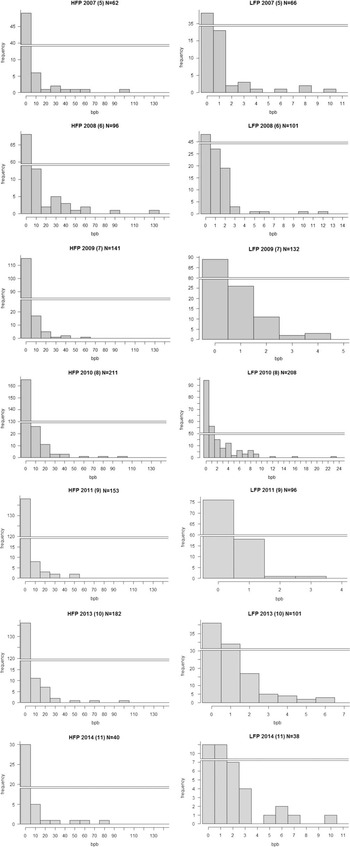
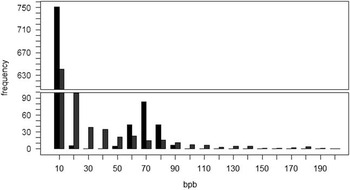
Total number of birds over all generations was 885 in HFP and 742 in LFP. Within generation the number of birds varied from 40 to 211 in HFP and from 38 to 208 in LFP. In the F2 cross total number of observed birds was 937. Distributions of bpb of SFP for HFP and LFP from generations 5 to 11 and the F2 cross are shown in Figures 1 and 2, respectively. Visual examination of the distribution plots revealed that HFP and LFP differed mainly in the range of bpb. In HFP, bpb varied between 0 and >100. In LFP, the range of bpb was about 10 times lower. The general pattern of the distributions, however, was similar in HFP, LFP and the F2 cross. Visual examination did not clearly show the existence of sub-populations. Statistical analysis, however, using a two-component mixture of Poisson distributions revealed sub-populations of EFP birds in all generations studied as well as in the F2 cross. When bpb of the F2 cross were fitted to the mixed Poisson distribution using proportions of EFP of 0.19 and 0.81 for the remaining birds, and 65.73 for the mean of EFP (λ
1) and 4.56 for the remaining birds (λ
2), distribution of EFP was clearly shown as a distinct sub-group (Figure 2). The means of EFP birds and remaining birds were significantly different within HFP and LFP and generation, with one exception (LFP, generation 9). Averaged estimated proportion
 $$\hat{\pi }$$
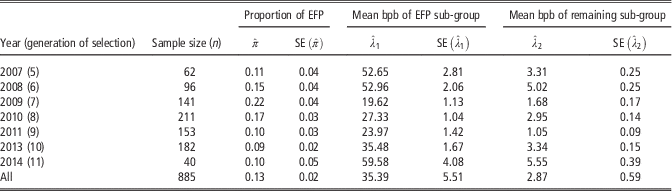
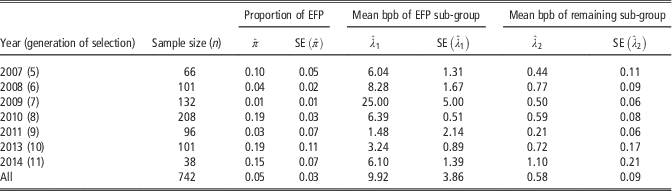
of EFP birds within generation varied from 0.09 to 0.21 in the HFP and from 0.01 to 0.19 in the LFP (Tables 1 and 2). Over all generations, the proportion of EFP birds was 0.13 in HFP and 0.05 in LFP. Within generation, the proportion of EFP birds differed only in two out of seven generations. The difference was significant for the means over all generations. Estimated means
 $$\hat{\lambda }_{1} $$
of bpb were in the range of 19.62 to 59.58 in HFP. In LFP, the estimated means (λ
2) varied between 1.48 and 8.27 in six of the seven generations. Only in generation 7 the estimated mean of bpb was considerably higher (25). Over all generations, the estimated means of bpb of EFP were 35.39 in HFP and 9.92 in LFP. Averaged estimated mean bpb of remaining sub-groups (
 $$\hat{\lambda }_{2} $$
) within generations varied between 1.05 and 5.55 in the HFP and 0.21 and 1.10 in the LFP, respectively. Over all generations, the averaged estimated mean of bpb in the remaining sub-group was 0.58 for both HFP and LFP. Difference between lines was significant for all means of EFP birds and remaining birds within generation and over all generations, with one exception (EFP, generation 7) (results of statistical tests are given in Supplementary Material S1).
Frequency distributions of bouts per bird (bpb) of severe feather pecking of lines selected for high and low feather pecking (HFP and LFP) from 2007 to 2014 (selection generations 5 to 11). The individual figures are shown on different scales for clarity.

Frequency distribution of bouts per bird (bpb) observed (gray bars) and fitted to a mixture of two Poisson distributions (black bars) of an F2 cross of lines selected for high and low feather pecking.

Parameter estimates for two-component mixture of Poisson distributions fitted to number of bouts per bird (bpb) of severe feather pecking in the high feather pecking line within selection generations 5 to 11 and across all generations

Proportion and SE of extremely high feather peckers (EFP) and means (SE) of bpb for EFP and remaining sub-groups.
Parameter estimates for two-component mixture of Poisson distributions fitted to number of bouts per bird (bpb) of severe feather pecking in the low feather pecking line within selection generations 5 to 11 and across all generations

Proportion and SE of extremely high feather peckers (EFP) and means (SE) of bpb for EFP and remaining sub-groups.
In the F2 birds (n=937), the proportion of EFP birds was 0.19 (SE 0.01). Mean bpb of EFP sub-group was 65.73 (SE 0.67) and 4.56 (SE 0.08) of the remaining sub-group.
Discussion
It is generally acknowledged that gentle feather pecking, SFP and aggressive pecking are different in their appearance and motivation (Savory, Reference Savory1995; Rodenburg et al., Reference Rodenburg, Van Krimpen, De Jong, De Haas, Kops, Riedstra, Nordquist, Wagenaar, Bestman and Nicol2013). Information on the existence of sub-groups of SFP is rare. Hoffmeyer described ‘feather pecking specialists’ which differed from their group mates by repeated feather pecks. Wechsler et al. (Reference Wechsler, Huber-Eicher and Nash1998) reported ‘high rate peckers’ which delivered twice as much severe feather pecks than their group mates. The distribution of SFP observed by Labouriau et al. (Reference Labouriau, Kjaer, Abreu, Hedegaard and Buitenhuis2009) exhibited a clear gap in between the major part of the birds and a suggested EFP sub-group. In the distributions of bpb of the current study (Figures 1 and 2) sub-groups of EFP were not clearly visible. Only the statistical analysis, fitting a mixture of two Poisson distributions by maximum likelihood, provided evidence for sub-groups of EFP in the HFP and LFP selection lines (Tables 1 and 2) and their F2 cross (Figure 2).
The development of SFP in the lines used in the present experiment over all 11 generations has been reported by Grams et al. (Reference Grams, Boegelein, Grashorn, Bessei and Bennewitz2015a). Response of selection was asymmetric. In HFP there was an increase of SFP during the first four generations (Kjaer et al., Reference Kjaer and Vestergaard2001). But there was a high fluctuation of means and no consistent trend thereafter. Similar results have been reported by Muir (Reference Muir1996). Selection for beak-inflicted injuries increased during the first four generations and showed a plateau thereafter. Selection for low SFP in the first generations was less successful as compared with selection for HFP. Missing a significant response to selection for low bpb of SFP could be attributed to the fact that phenotypic variation was low (Kjaer et al., Reference Kjaer and Vestergaard2001) and that identification of true non-feather peckers within LFP would require a substantial increase in duration of observation. With the results of Grams et al. (Reference Grams, Boegelein, Grashorn, Bessei and Bennewitz2015a) in mind we did not expect a change in proportion and means of bpb of SFP over the generations 5 to 11. But we expected a clear difference in the proportion and means of bpb between HFP and LFP. However, the difference between HFP and LFP in the proportion of EFP birds was small and only significant in two out of seven generations (results of statistical tests are given in Supplementary Material S1). Over all generations, the z-value exceeded the level of significance only marginally (2.06 v. 1.96). Differences between HFP and LFP were mainly expressed by the means of bpb of both EFP and remaining sub-groups. All but one mean (remaining, generation 9) of bpb of SFP differed significantly between lines. This shows that selection for HFP raised the level of SFP not only in EFP birds but also in the remaining sub-group. Similar observation was made by Labouriau et al. (Reference Labouriau, Kjaer, Abreu, Hedegaard and Buitenhuis2009). Selection for HFP increased the mean bpb of SFP even if the EFP birds were excluded from the calculation. In contrast to our expectation, EFP sub-groups appeared in LFP over all generations. There is no information on the behavioral or physiological differences in SFP between the birds of the two sub-groups. According to our observation the motoric pattern of SFP looks similar in birds which differ in their frequency of SFP. It cannot be ruled out, however, that more detailed behavioral studies would reveal differences between sub-groups. It may also be speculated that the basic behavior is the same in EFP birds and the remaining sub-group, but EFP birds may be more sensitive to specific enhancing physiological or environmental factors. Monoamines (van Hierden et al., Reference van Hierden, Korte, Ruesink, van Reenen, Engel, Korte-Bouws, Koolhaas and Blokhuis2002; Kops, Reference Kops2014), glucocorticoids (Kjaer and Guémené, Reference Kjaer, Sørensen and Su2009) and high light intensity (Kjaer and Vestergaard, Reference Kjaer and Guémené1999) have been reported to influence SFP. The occurrence of EFP birds may also be the result of the co-occurrence of SFP with other facilitating behaviors. Chickens from an HFP line were found to have significantly higher locomotor activity compared with chickens from an LFP (Kjaer, Reference Kjaer2009; Lutz et al., Reference Lutz, Kjaer, Iffland, Bessei and Bennewitz2016). Other behaviors, such as those involved in aggression (Bessei et al., Reference Bessei, Bauhaus and Boegelein2013; Bennewitz et al., Reference Bennewitz, Boegelein, Stratz, Rodehutscord, Piepho, Kjaer and Bessei2014), exploration (de Haas et al., Reference de Haas, Nielsen, Buitenhuis and Rodenburg2010; Brunberg et al., Reference Brunberg, Jensen, Isaksson and Keeling2011) and fear (Rodenburg et al., 2010; Boegelein et al., Reference Boegelein, Hurtado, Kjaer, Grashorn, Bennewitz and Bessei2014, Grams et al., Reference Grams, Wellmann, Preuß, Grashorn, Kjaer, Bessei and Bennewitz2015b) have been reported to be associated with feather pecking and may have a complementary effect on this behavior.
EFP birds may play an important role in the development of feather pecking in commercial layer flocks. They may not only cause feather damage by pecking of group mates but also through stimulation of SFP in group mates (Zeltner et al., Reference Zeltner, Klein and Huber-Eicher2000; McAdie and Keeling, Reference McAdie and Keeling2002). Hence, even a small proportion of EFP birds in a population may cause serious problems under practical production conditions. As damaging pecking is considered a precursor of cannibalism, EFP may also increase mortality.
Conclusions
There exist sub-groups of EFP birds in lines selected for HFP and LFP and their F2 cross. This supports earlier assumptions that SFP in layer flocks is not a homogenous behavior. It is assumed that the expression of EFP is based on sensitivity toward reinforcing physiological, environmental or behavioral factors. Even if the proportion of EFP birds is low in commercial flocks, they may cause severe feather damage and mortality through cannibalism in large groups. Sub-groups of EFP birds should be given more attention in future studies on feather pecking.
Acknowledgment
The authors acknowledge the financial support of the German Research Foundation, project numbers BE 747/14-1 and BE 3703/8-1.
Supplementary Material
To view supplementary material for this article, please visit http://dx.doi.org/10.1017/S1751731116001579