Implications
Our results agree with past research conducted in the United States, with birds raised on reused litter in multiple flocks. Our commercial study showed that the acidifying effect of aluminum sulfate (alum) caused a slight drop in pH, the lower pH values reducing ammonia volatilization from the litter, with the corresponding positive effects on poultry house environment and poultry health. In fact, ammonia concentrations and ammonia emissions from 37 to 42 days of age were substantially reduced by the alum treatment. For these reasons, litter amendment with alum, even at low rates, could be recommended as a management practice to reduce the pollution potential of European broiler facilities during a single flock cycle.
Introduction
Worldwide environmental concerns linked to intensive poultry production are increasing. The major environmental problems caused by poultry production are related with manure. The composition and quality of animal waste products, as well as manure management practices, are critical factors for determining emissions of potentially pollutant elements (Oenema et al., Reference Oenema, Oudendag and Velthof2007). Currently, the EU countries are increasingly focusing on extensive and restrictive environmental policies (Directive 2010/75/EU concerning Industrial Emissions, formerly known as Integrated Pollution Prevention and Control Directive – IPPC). The challenge is to provide technologies and environmentally suitable ways to handle animal wastes while generating valuable products following the concept of the best available techniques.
Poultry manure and litter are well known as excellent sources of N fertilizers, as well as of other major plant nutrients. Poultry litter is a mixture of manure, waste feed, feathers and bedding material, usually wood shavings or sawdust. The application of poultry litter to the land can be a good source of nutrients for growing crops. From an agricultural point of view, poultry litter is characterized by a high level of organic matter, macronutrients and micronutrients, as well as by the formation and release of volatile compounds, such as NH3 (López-Mosquera et al., Reference López-Mosquera, Cabaleiro, Sainz, López-Fabal and Carral2008).
Some environmental concerns about the storage and land application of poultry manure stem from the high levels of pollutant gases associated with atmospheric emissions from poultry houses, and the contamination of soil and water resources by nitrogen, phosphorus or heavy metals (Edwards and Daniel, Reference Edwards and Daniel1992; Moore et al., Reference Moore, Daniel, Gilmour, Shreve, Edwards and Wood1998 and Reference Moore, Daniel and Edwards2000). For instance, total ammonia emissions from poultry manure in EU-27 were estimated to be 430 kt in 2000 (Oenema et al., Reference Oenema, Oudendag and Velthof2007). The agricultural sector is the largest source of ammonia emissions into the atmosphere, where it is responsible for 80% to 90% of the total (European Monitoring and Evaluation Programme, 2005).
Gaseous NH3 can adversely affect bird performance and welfare, as well as workers’ health, and it is recommended that its concentration within the poultry house should not exceed 20 ppm (EU Council Directive 2007/43/EC). Ammonia emission into the atmosphere contributes to soil acidification and increased nitrogen deposition in ecosystems. An accurate assessment of NH3 volatilization from poultry litter is important to reduce air and water pollution, and to improve the quality of any manure used as fertilizer. Moreover, the unsuitable management of land applications of litter can lead to the oversupply of some nutrients, such as phosphorus. The overapplication of phosphorus can result in phosphorus entering surface waters, even though P is less mobile than N. Most of the runoff P is soluble phosphorus (Edwards and Daniel, Reference Edwards and Daniel1993), which is the form most available for algal growth. Most research has focused on reducing P loss because low levels of available phosphorus are usually the limiting factor for the eutrophication of surface waters (Sharpley et al., Reference Sharpley, Foy and Withers2000).
Owing to the above-mentioned problems, alternative methods are necessary to reduce the environmental impact of broiler rearing, and among these, different manure and litter handling methods are being explored (European Integrated Pollution and Prevention Control Bureau, 2003). In the United States, one of the main methods used to improve the indoor air quality of poultry houses and, indirectly, to enhance the fertilizing value of poultry litter is the use of chemical additives (Ndegwa et al., Reference Ndegwa, Hristov, Arogo and Sheffield2008). Currently, the most effective products seem to be those that react chemically to lower the pH of the litter, usually metal salts. Therefore, acidifying amendments of poultry litters has been suggested as a management practice to help reduce the potential environmental effect in multiple flock cycles (Ritz et al., Reference Ritz, Fairchild and Lacy2004). The most common ‘on-farm’ technique has been the use of aluminum sulfate, which is commonly known as alum. Aluminum sulfate [Al2(SO4)3], as an amendment for poultry litter, acidifies the litter to convert the volatile NH3 to NH4-N, which is not volatile. There have been several studies about the use of alum and its benefits: alum reduces NH3 emissions from poultry houses and decreases the loss of P and trace metals in runoff from litter-amended soils (Moore et al., Reference Moore, Daniel and Edwards2000; Moore and Edwards, Reference Moore and Edwards2007). Most research has been conducted in the United States, where standard industry practice is to reuse litter for 1, 2 or even more years of production (Sims and Luka-McCafferty, Reference Sims and Luka-McCafferty2002). After each flock cycle, caked or crusted litter is usually removed (the uppermost 2 to 5 cm of wet litter). However, almost no data are available under farm conditions in Europe, where litter is renewed between flock cycles. In addition, the quality and quantity of bedding materials can vary greatly from one region to another (Tasistro et al., Reference Tasistro, Ritz and Kissel2007).
The aim of this work was to evaluate the effect of a litter acidifier (aluminum sulfate, alum) on litter composition and characteristics, the solubility of some elements in the litter and NH3 emission into the atmosphere during a single flock-rearing period in commercial houses located in southeast Spain.
Material and methods
General procedures and treatments
The study was carried out in a broiler farm located in southeast Spain (38°28′N, 1°19′W) during the winter of 2007 (from the end of November 2007 until mid-January 2008), under commercial conditions and with an average daily minimum and maximum outdoor temperatures of 3.3°C and 14.0°C, respectively. This commercial farm had four poultry houses, each with a capacity of 20 000 broilers (size = 14 × 160 m, or 2240 m2). The litter was removed at the beginning of the study from all the houses, and broilers were placed on clean wood shavings of ∼10 cm depth. Before filling, two out of four poultry houses, alum was applied at a rate of 0.25 kg/m2 to the wood shavings, resulting in a final alum concentration in the litter of ∼2.5% alum by weight. The other two poultry houses were used as control.
The experiment was conducted from 1 to 42 days of age during a single flock-rearing period. Each bird had a floor area of ∼0.1 m2. One-day-old Ross 308 broilers (50/50) were obtained from a single hatchery, and all were subjected to the same vaccination program. The poultry houses were gradually filled to capacity over 3 days. Mortality was checked and recorded daily. Water and commercial mash diets were available ad libitum throughout the experiment. Each poultry house had four feeder lines and five drinker lines. Diets, based on cereals and soybean meal, were provided in a 4-stage feeding program consisting of crumbled starter diet (0 to 10 days of age) and pelleted grower (11 to 21 days),finisher (22 to 35 days) and withdrawal (36 to 42 days) diets.
Commercial facilities had automatically controlled light and temperature conditions. The ventilation system of each poultry house consisted of five large fans (127 cm (50″) diameter) and three small fans (two fans of 76 cm (30″) diameter, and the other one of 60 cm (24″) diameter) located in the end walls of each house, and automatically adjusted according to the inside–outside temperature. Temperature was also controlled by four propane heaters and an evaporative cooling system in the sidewall of the house. The temperature was gradually reduced from 32°C during the first 5 days to 20°C on day 42. The lighting cycle was 24 h per day from days 1 to 3, 18 h/day from days 4 to 38 and 23 h/day from days 39 to 42.
Litter sampling and chemical analyses
The litter was sampled every 3 to 5 days from each poultry house. To sample the litter in each house, they were divided transversely into two halves, taking two litter samples per house. Subsamples from each half of the house were obtained from the full depth of the litter, from 10 random locations (avoiding areas around feeders and drinkers) using a 17 × 12 cm rigid plastic box in a zigzag pattern. Subsequently, the random litter samples were thoroughly mixed in a plastic bag, and 250 g was weighed and delivered for further processing in the laboratory. A fraction of each sample was immediately dried at 80°C for 48 h, whereas the rest of the sample was ground to pass through a 2-mm sieve, and frozen at −20°C until further analysis.
The total N content of the litter was analyzed by the Kjeldahl method (Association of Official Analytical Chemist, 1990), and the pH and electrical conductivity (EC) were determined with a 1 : 2 litter-to-water extract ratio as described by Peters et al. (Reference Peters, Combs, Hoskins, Jarman, Kovar, Watson, Wolf and Wolf2003). Ammonium-nitrogen (NH4-N) in the litter was determined by steam distillation after extracting with 2 M KCl for 1 h (Mulvaney, Reference Mulvaney1996). Total P, Cu and Zn contents were determined by dry ashing 2 g of fresh material in a muffle furnace at 550°C for 3.5 h. The litter ashes were dissolved in 50 ml of 0.6N HNO3. Total P content was determined by colorimetry (Unicam, Helios Gamma, Cambridge, UK), and total Cu and Zn contents were measured by atomic absorption spectrophotometry (Unicam, Solaar M Series, Cambridge, UK). Water-soluble (WS) P, Cu and Zn were extracted by shaking fresh samples with water (1 : 10 litter to water extract ratio) for 1 h, followed by centrifugation and filtration through a 0.45-μm filter (Sims and Luka-McCafferty, Reference Sims and Luka-McCafferty2002). The P, Cu and Zn contents were determined by inductively coupled plasma atomic emission spectroscopy (Perkin Elmer, Optima 2000 DV, Norwalk, CT, USA).
Ammonia concentrations and ammonia emissions
Ammonia emissions from the poultry houses were continuously monitored during the last part of the experiment when the animals were 37 to 42 days old. To estimate ammonia emission rates from the facilities, it was necessary to measure both the ventilation rate and gas concentration. The ventilation rate was indirectly determined by the tracer gas method, based on carbon dioxide mass balance method (Commission Internationale du Génie Rural (CIGR), 2002). The ventilation rate (VF, m3/h) was calculated using the following equation:

The airflow rate was defined as the ratio of the production of CO2 (C, m3/h) to the difference in CO2 between inside and outside air concentrations (ΔC, ppm). The production of CO2 was estimated by considering different factors such as temperature and number and live weight of animals (CIGR, 2002). Gas concentrations (CO2 and NH3) were continuously monitored by X-am® 7000 Dräger multigas detector (Dräger, Lübeck, Germany). The detectors, one detector per house, were placed at random locations (1 m above the floor) and always within close proximity to the ventilation system's exhaust outlet. Using IR technology, the carbon dioxide sensor could detect CO2 in the range of 0 to 50 000 ppm, with a resolution of 100 ppm (Dräger Sensor® Smart IR CO2, Lübeck, Germany), whereas the catalytic ammonia sensor could measure NH3 in the range of 0 to 200 ppm, with a resolution of 1 ppm (Dräger Sensor® XS NH3, Lübeck, Germany). Both sensors were calibrated at the beginning of the study by the suppliers. Data (gas concentrations) were recorded continuously throughout this period, and the 10-min averages were stored by a data logging system for later analysis.
Statistical analysis
Litter data were analyzed by one-way analysis of covariance using STATGRAPHICS Plus 5.1 (Manugistics Inc., Rockville, MD, USA). The model included the fixed effects of treatment (control and alum-treated) and sampling time as categorical variable and a linear covariate, respectively. The heterogeneity of slope coefficients between treatments was also investigated. First, the regression slopes were compared (Model 1) and if they were not significantly different, a common slope was used and the intercepts compared (Model 2).
Model 1

Model 2

where μ is the overall mean, αi is the difference between the mean of each level i (ith level) of the categorical variable and the overall mean and βi is the slope of the regression of Y on level i (ith level) of the categorical variable.
To compare the two above-mentioned models, the F ratio was calculated using the following equation:

where SSModel 2 and SSModel 1 are the residual sums of squares from both analyses and dfModel 2 and dfModel 1 are the residual degrees of freedom. This ratio follows an F distribution with dfModel 2−dfModel 1 degrees of freedom in the numerator and dfModel 1 degrees of freedom in the denominator (Lazic, Reference Lazic2008). When the F ratio test was not significant, the simplest model was performed.
Regarding ammonia concentrations and emissions, daily treatment means were compared using Students’ t-test for unpaired data, and with the level of significance set at P < 0.05.
Results and discussion
Litter composition and characteristics
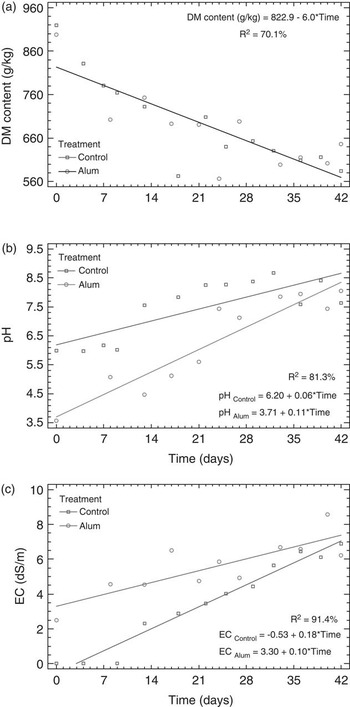
The dry matter (DM) content, pH and EC of the alum-treated litter and control, both analyzed as a function of time, are shown in Figure 1. For the DM content, the regression slopes did not significantly differ between treatments (P > 0.05), and one slope fitted both litters (Figure 1a). At the beginning of the study, the DM content ranged from 898 to 920 g/kg for the fresh litter materials. The DM content then decreased linearly at a rate of 6.0 g/kg per day (R 2 = 0.70), with an average value close to 600 g/kg at the end of the experiment. The contrasts between both treatments (alum-treated v. control) for the average DM contents during the study did not show significant differences (P > 0.05). However, the DM content of the litters amended with alum was numerically higher than that of the control at 42 days of age (584 v. 646 g/kg for control and alum, respectively). These results agree with Sims and Luka-McCafferty (Reference Sims and Luka-McCafferty2002), who found litters to be slightly drier as a result of alum addition. Controlling litter moisture is the most important step for avoiding ammonia problems, as it has been reported that wet litter can lead to high ammonia levels in broiler housing (Elliott and Collins, Reference Elliott and Collins1982). According to Carr et al. (Reference Carr, Wheaton and Douglas1990), it is desirable to maintain litter moisture levels below 30% to reduce the ammonia concentration. Recently, under laboratory-controlled conditions, Liu et al. (Reference Liu, Wang, Beasley and Oviedo2007) showed that the total ammoniac nitrogen content in the litter increased with the addition of water, potentially increasing ammonia emission.
Evolution of dry matter content (DM), pH and electrical conductivity (EC) for the control and alum-treated litters.

The pH of the two treatments evolved differently (P < 0.01; R 2=0.81), and two regression equations were calculated: pHAlum (units) = 3.71 + 0.11 × sampling time (days) and pHControl = 6.20 + 0.06 × sampling time, respectively (Figure 1b). The alum treatment significantly reduced the pH level of the litter (P < 0.001), with an average difference of 1.32 ± 0.24 units. The pH of the untreated litter had a narrower range, from 5.9 at 0 days to 8.0 at 42 days, at which time no significant differences between the treatments were found (P > 0.05). The pH fluctuation pattern observed in the present study is similar to that described by Moore et al. (Reference Moore, Daniel and Edwards2000), where alum lowered the litter pH during the first 4 weeks, at least. The time course of pH reduction is related to the rate of alum applied. As the litter was renewed at the beginning of the study, our application rate of alum was lower than that reported in the United States by Guo and Song (Reference Guo and Song2009). As expected, alum resulted in a more acidic litter as it provided a source of hydrogen ions (H+), with 6 moles of protons per mole of alum. This acidic litter, in turn, was related with lower ammonia volatilization (Moore et al., Reference Moore, Daniel, Edwards and Miller1995 and Reference Moore, Daniel, Edwards and Miller1996). The pH of the litter increased with the amount of manure produced. At pH above 8, a large percentage of the inorganic nitrogen is in ammonia form, thus increasing the NH3 to NH4 + ratio.
EC was also affected by treatment and time (P < 0.01). Litter EC increased linearly with bird age in both groups (R 2 = 0.91), and the regression slopes were of 0.10 and 0.18 dS/m per day for alum-treated and control litters, respectively (Figure 1c). On average, the alum-treated litter showed a higher EC than the control litter (5.54 v. 3.63 dS/m). The results obtained for EC in this study were in line with those of previous studies (Moore et al., Reference Moore, Daniel and Edwards2000; Choi and Moore, Reference Choi and Moore2008), the salts associated with the increased conductivity presumably being ammonium sulfate, calcium sulfate and potassium sulfate.
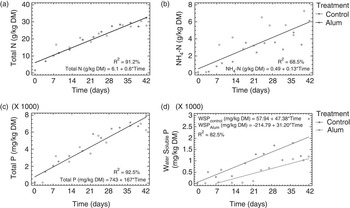
Total N, NH4 +-N, total P and WS P contents from alum-treated and untreated litter are illustrated in Figure 2 as a function of time. Total N and P contents showed no differences between treatments (P > 0.05), but the relationships between these parameters and sampling time were significant (P < 0.001), and a common slope could be fitted for both treatments (Figures 2a and c). The total N and P contents in the litter increased with time at a rate of 0.6 g/kg DM per day (R 2 = 0.91) and 167 mg/kg DM per day (R 2 = 0.93), respectively. At 42 days of age, total N and P contents for alum-treated litters were not statistically different from the control values, both being close to 30 and 7 g/kg DM, respectively.
Evolution of total N, NH4 +-N, and total and water-soluble (WS)P content for the control and alum-treated litters. DM = dry matter; WS = water soluble.

Regarding the NH4 +-N content, the regression coefficient of the sampling time was positive (0.13 g/kg DM per day) and was an important variable affecting NH4 +-N content (R 2 = 0.69; Figure 2b). In addition, the alum-treated litter had a higher NH4 +-N value than the untreated litter, with an average difference of 0.16 ± 0.07% (on a DM basis). The NH4 +-N concentration of the litters amended with alum was numerically equivalent to the control at 42 days of age. When the content was expressed over total N, the NH4 +-N content for the alum-treated litter ranged from 14.3% to 23.1%.
Past studies have shown alum-treated litters to have a slightly higher N concentration than the controls (Moore et al., Reference Moore, Daniel and Edwards2000; Moore and Edwards, Reference Moore and Edwards2005; Choi and Moore, Reference Choi and Moore2008). The increase in total N content is explained by acidification of the litter, which, in turn, converts NH3 to NH4 +, and thus reduces gaseous losses of N (Moore et al., Reference Moore, Daniel, Edwards and Miller1995 and Reference Moore, Daniel, Edwards and Miller1996). This was supported by the increase in the NH4 +-N content of alum-treated litters compared with the control litters (Sims and Luka-McCafferty, Reference Sims and Luka-McCafferty2002). According to these authors, the NH4 +-N content increased by 0.22% when alum was used. These results are in part in agreement with those of our study, although the higher NH4 +-N content was not linked to a significant difference in the N content of the alum-treated litter.
As shown in Figure 2d, evolution of the WS P content was dependent on time and litter treatment (P < 0.01; R 2=0.83). Two regression equations were fitted, whose slopes represented 31.2 and 47.4 mg/kg DM per day for alum-treated and control litters, respectively. In addition, on average, the alum-treated litter showed a lower WS P content than the control litter (444 v. 1059 mg/kg). At 42 days of age, the WS P contents of alum-treated and control litters were 1191 and 2848 mg/kg, respectively.
The results showed that the P content of the alum-treated litter was, on average, associated with a significant reduction in the WS P content. These lower litter WS P concentrations are consistent with the findings of several reports (Smith et al., Reference Smith, Moore, Miles, Haggard and Daniel2004; Do et al., Reference Do, Choi and Nahm2005) even when different measuring methods were used (Sims and Luka-McCafferty, Reference Sims and Luka-McCafferty2002), although the action mechanism of alum with regard to reducing P solubility is unclear (Moore et al., Reference Moore, Daniel and Edwards2000). This reduction could be caused by the precipitation of soluble compounds of Al-P or the sorption of WS P by amorphous Al hydroxides that are formed when Al3+ is dissolved from the alum hydrolyzed in the alkaline litters (Guo and Song, Reference Guo and Song2009).
When the WS P content was expressed over total P content, the alum-treated litter produced a significantly lower percentage than the control litter (16.76% v. 27.8% for alum-treated litter and control, respectively). At 42 days of age, the ratio of WS P to total P was about 40% lower in the alum-treated litter with respect to the control. Both runoff and leaching losses of P following land application of poultry litter are largely determined by the WS content of P in the waste (Guo and Song, Reference Guo and Song2009), this being one of the biggest problems facing the poultry industry. This reduction of the WS P content of the alum-treated litter has been described previously in multi-flock broiler litter in laboratory (Moore and Miller, Reference Moore and Miller1994) and commercial conditions (Sims and Luka-McCafferty, Reference Sims and Luka-McCafferty2002; Miles et al., Reference Miles, Moore, Smith, Rice, Stilborn, Rowe, Lott, Branton and Simmons2003; Do et al., Reference Do, Choi and Nahm2005). Our study showed that litter amendment with alum could be considered as a key tool for reducing runoff and leaching losses of soluble nutrients, reducing potential pollution in farm conditions in Europe, where the litter is renewed between flocks.
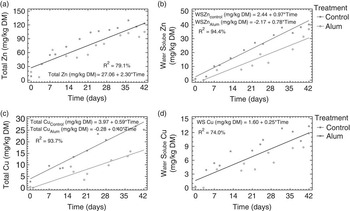
The effect of time and of alum addition on total and WS contents of some trace elements (Zn and Cu) is presented in Figure 3. As broilers aged from 1 to 42 days, there was a gradual increase in the total and WS contents of Zn and Cu (P < 0.001). On average, lower total Zn and Cu levels were found in the alum-treated litters than in the untreated litters (−19.8 ± 8.8 and −8.8 ± 2.2 mg/kg DM, respectively). In addition, WS Zn or Cu contents were also affected by treating the litter with alum (P < 0.01). The average content of WS Zn throughout the period was 14.6 and 23.3 mg/kg DM for the alum-treated and control litters, respectively. Regarding the average content of WS Cu, the alum-treated litter also showed a lower concentration than the control (5.3 and 8.4 mg/kg DM, respectively). However, there were no statistical differences found for any of these parameters at 42 days of age (P > 0.05).
Evolution of total and water-soluble contents of Zn and Cu for the control and alum-treated litters. DM = dry matter; WS = water soluble.

Sims and Luka-McCafferty (Reference Sims and Luka-McCafferty2002) observed slight decreases in total Zn and Cu contents in alum-treated litters, which could be the result of a dilution effect because of the addition of amendment to the litters (Moore et al., Reference Moore, Daniel and Edwards2000). These authors also found lower WS Zn and Cu contents in alum-treated litters than in control litters. All these reductions could also result from their sorption by the amorphous Al hydroxides formed when the alum reacted with the litters.
It should be noted that the list of pollutants that must be reported by intensive poultry rearing installations, according to the sector-specific sub-lists of pollutants reported in the Guidance Document for the European pollutant emission register implementation (2000), include emissions to water of Zn and Cu (EU Commission Decision 2000/479/EC).
Ammonia concentrations and ammonia emissions
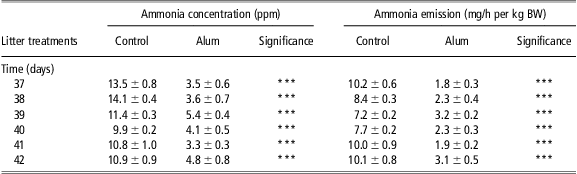
Ammonia concentrations were found to be significantly lower in the alum-treated houses compared with the controls (Table 1). When the animals were from 37 to 42 days old, alum noticeably reduced in-house ammonia concentrations (P < 0.001). The NH3 concentration from the alum-treated litter was 3.5 ppm at 37 days of age and 4.8 ppm at 42 days of age, which was similar to that reported by Do et al. (Reference Do, Choi and Nahm2005) for a multi-flock litter. However, the NH3 concentration from the untreated litter reached up to 14.1 ppm at 38 days of age, although this is still below the threshold values. According to the EU Council Directive 2007/43/EC on animal welfare for broilers, the concentration of ammonia must not exceed 20 ppm measured at the level of the chickens’ heads. Atmospheric NH3 in poultry houses has been linked to decreased bird performance and immunity, and to a higher susceptibility to respiratory infections (Carlile, Reference Carlile1984; Miles et al., Reference Miles, Branton and Lott2004).
Ammonia concentration and emission from 37 to 42 days for the control and alum-treated litters

***P < 0.001.
Means estimated from 144 data per treatment and day. Data collected every 10 min.
In addition, the limits regarding ammonia exposure aimed at protecting workers’ health should be taken into account. The indicative occupational exposure limit values for ammonia, under European Directive 2000/39/EC, are 20 ppm for an 8-h workday and 50 ppm for a 15-min period.
From 37 to 42 days of age, the NH3 concentration for the alum-treated litter was, on average, 62.9% lower than in the control. These reductions in NH3 levels agree with previous studies conducted under laboratory conditions (Choi and Moore, Reference Choi and Moore2008) and in commercial broiler houses (Moore and Edwards, Reference Moore and Edwards2007).
As shown in Table 1, ammonia emissions from 37 to 42 days of age were significantly reduced by the alum treatment (P < 0.001). During this period, the average NH3 emission from alum-treated litter was 2.4 mg/h per kg BW, compared with 9.0 mg/h per kg BW for the control litter, which represents a reduction of 73.3% in ammonia emission. Ammonia emission is expected to be particularly noticeable during the last week of grow-out, as Amon et al. (Reference Amon, Dobeic, Sneath, Phillips, Misselbrook and Pain1997) showed that emissions increase as animals age. Lower ammonia emissions using alum have previously been reported by Moore et al. (Reference Moore, Daniel and Edwards1999 and Reference Moore, Daniel and Edwards2000), and are presumably due to the lower pH (Moore et al., Reference Moore, Daniel, Edwards and Miller1995; Choi and Moore, Reference Choi and Moore2008).