1 Introduction
An open book decomposition of a closed connected oriented n-manifold M is a fibration
 $\pi :M\setminus B\to S^1$
, where B is a codimension-two oriented submanifold of M with a trivial normal bundle. The submanifold B is called the binding of the open book. The closure of each fibre of
 $\pi $
is called a page of the open book and each page is a codimension-one submanifold of M with boundary B. Alexander, in [Reference Alexander1], showed that every closed oriented
 $3$
-manifold admits an open book. For more details on open books, we refer to the survey [Reference Etnyre2].
Open book decomposition on odd-dimensional manifolds is an important tool in studying contact structures on manifolds. By a contact structure on a closed oriented
 $(2n+1)$
-manifold M, we mean a maximally nowhere integrable hyperplane field on
 $M.$
Giroux, in [Reference Giroux4], showed that every co-oriented contact structure on a closed oriented
 $(2n+1)$
-manifold is supported by an open book. In [Reference Thurston and Winkelnkemper11], Thurston and Winkelnkemper constructed contact structures on closed oriented
 $3$
-manifolds using open books. In [Reference Giroux4], Giroux showed that there is a one-to-one correspondence between the isotopy classes of co-oriented contact structures on a closed oriented 3-manifold M and the open book decompositions of M up to positive stabilisations. By a positive stabilisation operation on an open book of
 $ M$
, we mean a plumbing of a positive Hopf band to the page of the open book. Open book decomposition is a useful tool in studying
 $3$
-manifolds. For instance, an open book decomposition of a manifold naturally gives a Heegaard splitting of the manifold, where the Heegaard surface is the closure of the union of two pages.
Open book embeddings of closed oriented
 $3$
-manifolds into the open books of
 $S^2\times S^3$
as well as into
 $S^2 \,\tilde \times \, S^3$
with pages a
 $2$
-disc bundle over
 $S^2$
and monodromy the identity map are studied in [Reference Pancholi, Pandit and Saha9]. Results in [Reference Pancholi, Pandit and Saha9] are extended for nonorientable closed
 $3$
-manifolds in [Reference Ghanwat, Pandit and A3]. We say that a smooth manifold M with a given open book decomposition admits an open book embedding in an open book decomposition of a smooth manifold N if there exists an embedding of M in N such that, as a submanifold of N, the given open book decomposition on M is compatible with the open book decomposition of N. For the precise definition of an open book embedding, we refer to Definition 2.3. However, the existence of an open book for a closed oriented
 $3$
-manifold, such that its open book embeds in the trivial open book of the
 $5$
-sphere
 $S^5$
with pages the
 $4$
-disk
 $D^4$
and monodromy the identity map of
 $D^4$
, is not known.
In this note, we study open book embeddings of closed oriented
 $3$
-manifolds in the
 $5$
-sphere
 $S^5$
. We prove the following result.
Theorem 1.1. Let M be a closed connected oriented
 $3$
-manifold. There exists a knot K in M such that the manifold
 $M^{\prime }$
obtained from M, by performing an integer surgery, admits an open book decomposition and this open book embeds into the trivial open book of the
 $5$
-sphere
 $S^5.$
2 Preliminary
First, we recall the notions necessary for this note. All the manifolds and maps we consider are smooth.
Definition 2.1. An open book decomposition of a closed connected oriented manifold M is a pair
 $(B, \pi ),$
with the following properties.
-
(1) B is an oriented codimension-two submanifold in M with a trivial normal bundle called the binding of the open book.
-
(2)
 $ \pi : M \setminus B\rightarrow S^1$
is a locally trivial fibration such that the fibration
$\pi $
in a tubular neighbourhood of B looks like the trivial fibration of
$(B\times D^2) \setminus B\times \{0\} \to S^1$
sending
$(x,r,\theta )$
to
$\theta $
, where
$x\in B$
and
$(r,\theta )$
are polar coordinates on
$D^2$
.
-
(3) For each
$\theta \in S^1, \pi ^{-1}(\theta )$
is the interior of a compact codimension-one submanifold
$N_{\theta }\subset M$
and
$\partial N_\theta = B$
. The submanifold
$N=N_\theta $
, for any
$\theta $
, is called the page of the open book.


The fibration
 $\pi :M\setminus B\to S^1$
with fibre N is determined by N and the monodromy
 $\phi $
of the fibration up to conjugation by an orientation preserving diffeomorphism, that is, the fibre bundle
 $M\setminus B$
is canonically isomorphic to the mapping torus
 $$ \begin{align*}\mathcal{MT}(N,\phi)= N\times[0,1]/\sim,\end{align*} $$
where
 $\sim $
is the equivalence relation identifying
 $(x,1)$
with
 $(\varphi (x),0)$
. From the above definition, we can see that M is diffeomorphic to
 $$ \begin{align*}\mathcal{MT}(N, \phi) \cup_{id} B \times D^2.\end{align*} $$
Thus, an open book decomposition of
 $M $
is determined, up to diffeomorphism of
 $ M$
, by the topological type of the page N and the isotopy class of the monodromy which is an element of the mapping class group of N. The mapping class group of a manifold N with nonempty boundary is the group of isotopy classes of orientation-preserving diffeomorphisms of N which are the identity in a collar neighbourhood of the boundary.
This naturally leads to the notion called an abstract open book defined as follows.
Definition 2.2. An abstract open book associated with an n-manifold M is a pair
 $(\Sigma , \phi ),$
where
 $\Sigma $
is a compact connected oriented
 $(n-1)$
-manifold with nonempty boundary and
 $\phi $
is an orientation-preserving diffeomorphism of
 $\Sigma $
such that M is diffeomorphic to
 $$ \begin{align*}M_{(\Sigma,\phi)}=\mathcal{MT}(\Sigma, \phi) \cup_{id} \partial \Sigma \times D^2,\end{align*} $$
where
 $id$
denotes the identity map of
 $\partial \Sigma \times S^1.$
The map
 $\phi $
in the above definition is called the monodromy of the abstract open book. Note that the mapping class of
 $\phi $
determines M uniquely up to diffeomorphism. We will denote the manifold M with an abstract open book decomposition
 $(\Sigma ,\phi )$
by
 $ \mathcal {A}ob(\Sigma ,\phi )$
. One can easily see that given an abstract open book decomposition of M, we can clearly associate an open book decomposition of M with pages
 $\Sigma $
and vice versa. We will not generally distinguish between open books and abstract open books. For more details on open books, see [Reference Etnyre2].
Let us recall the notion of an open book embedding.
Definition 2.3. Let
 $M^k$
and
 $N^l$
be manifolds with open book decompositions
 $(B_1, \pi _1)$
and
 $(B_2, \pi _2)$
, respectively. We say an embedding
 $f: M \hookrightarrow N$
is an open book embedding of
 $(B_1, \pi _1)$
into
 $(B_2, \pi _2)$
if f embeds
 $B_1$
into
 $B_2$
such that
 $\pi _2\circ f=\pi _1.$
Similarly, we can also define an abstract open book embedding.
Definition 2.4. Let
 $M = \mathcal {A}ob (\Sigma _1, \phi _1)$
and
 $N = \mathcal {A}ob( \Sigma _2, \phi _2 )$
be two abstract open books. We say that there exists an abstract open book embedding of M into N if there exists a proper embedding f of
 $\Sigma _1$
into
 $\Sigma _2$
such that
 $\phi _1$
is isotopic to
 $ f^{-1} \circ \phi _2 \circ f.$
It is clear from the definition that an abstract open book embedding produces an embedding for the associated open book and vice versa.
3 Proof of Theorem 1.1
In this section, we discuss our proof of Theorem 1.1. Recall that given an embedded circle c in the interior of a surface
 $\Sigma ,$
a Dehn twist
 $d_c$
(or
 $d_c^{-1}$
) on
 $\Sigma $
along the circle c is a diffeomorphism which is the identity outside a neighbourhood of c and is a full twist on an annular neighbourhood of c. We begin by stating the following lemma, which is proved in [Reference Etnyre2].
Lemma 3.1. Let M be a closed oriented
 $3$
-manifold. Let
 $M=\mathcal Aob(\Sigma , \phi )$
. Suppose L is a knot sitting on a page
 $\Sigma $
of the open book. Then, the new manifold
 $ M^{\prime }$
obtained by
 $\pm 1$
surgery along L, with respect to the page framing, admits an open book
 $\mathcal Aob(\Sigma ,\phi \circ d_L^{\mp 1})$
with pages
 $\Sigma $
and monodromy
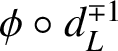 $\phi \circ d_L^{\mp 1}$
.
The following lemma will be needed in the proof of Theorem 1.1.
Lemma 3.2. Let M be a closed oriented
 $3$
-manifold. Let
 $M=\mathcal {A}ob(\Sigma , \phi )$
be an abstract open book of M. Suppose that K is a knot in M such that
 $K=\{x\}\times [0,1]/(x,1)\sim (\phi (x),0)$
in M for some interior point
 $x\in \Sigma $
. Let
 $D_x$
be an open disc neighbourhood of x in
 $ \Sigma $
such that
 $\phi |_{D_x}=id$
and let c be the curve parallel to
 $\partial D_x$
in
 $\Sigma \setminus D_x$
. Then, an integer n surgery along K gives a new manifold
 $M^{\prime }=\mathcal {A}ob(\Sigma ^{\prime },\phi ^\prime )$
with an open book decomposition having the surgery dual of K as one of the binding components, where the surface
 $\Sigma ^\prime =\Sigma \setminus D_x$
is the page and the map
 $\phi ^{\prime }=\phi |_{\Sigma ^{\prime }}\circ d_c^{-n}$
is the monodromy of the open book of
 $M^{\prime }$
.
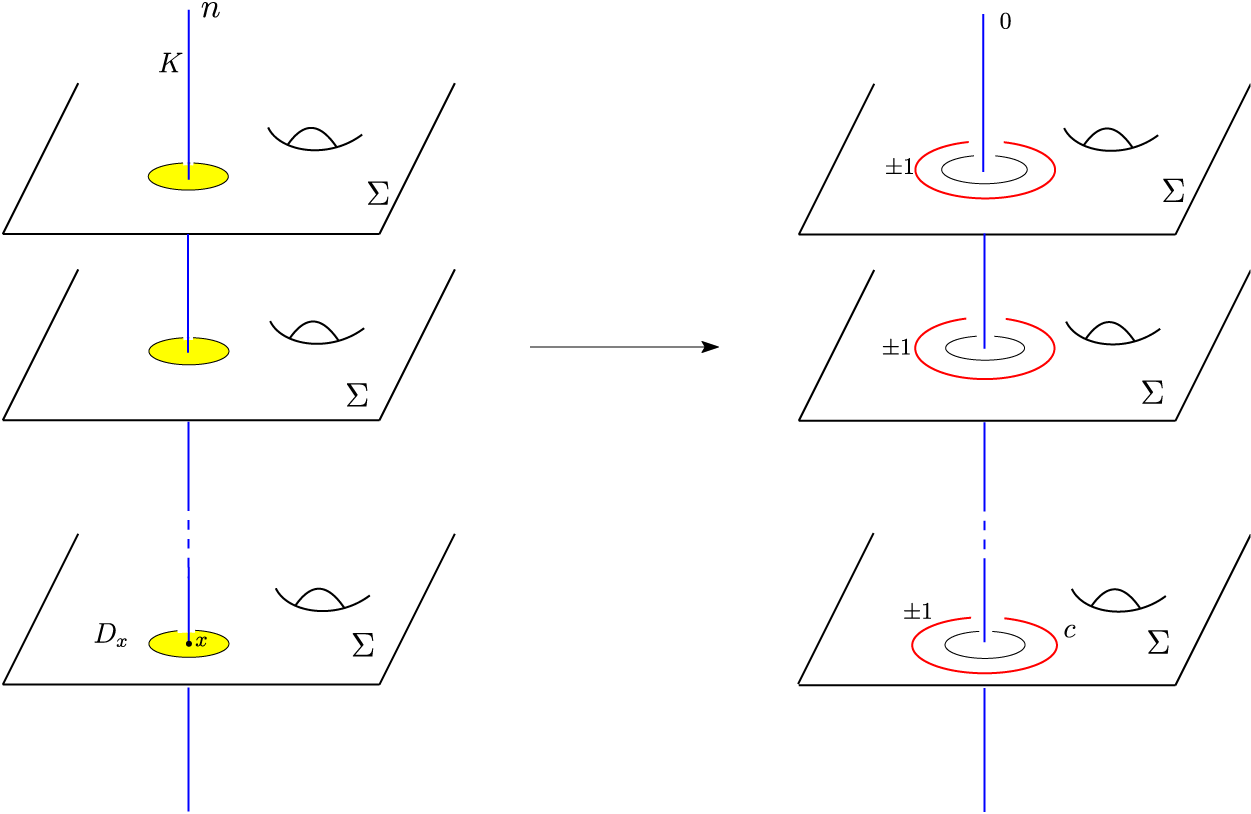
Proof. The knot K is transverse to each page of the open book
 $\mathcal Aob(\Sigma ,\phi )$
and intersects each page exactly once (see Figure 1). Suppose
 $n=0$
. Then, performing
 $0$
surgery along K is equivalent to removing
 $D_x$
from each page and filling the resulting boundary
 $\partial D_x\times S^1$
of
 $M\setminus \mathcal N(K)$
by
 $\partial D_x\times D^2$
using the identity map. Here,
 $\mathcal {N}(K)= D_x\times K$
denotes a tubular neighbourhood of K in
 $M.$
From this, one can easily see that the manifold
 $M^{\prime }$
, obtained from M by performing
 $0$
surgery along K, admits an open book with pages
 $\Sigma ^{\prime }=\Sigma \setminus D_x$
and monodromy
 $\phi ^{\prime }=\phi |_{\Sigma ^{\prime }}.$
Blowing up operations preformed on the knot K.

Suppose that n is a positive integer. From blowing up operations (see Figure 1), one can see that performing integer n surgery along K is equivalent to performing
 $-1$
surgery along n copies of a circle c parallel to
 $\partial D_x$
lying in n distinct pages of the open book
 $\mathcal {A}ob(\Sigma ,\phi )$
and performing
 $0$
surgery along K. Using Lemma 3.1, one can see that the manifold
 $M^{\prime }$
obtained from M by performing a positive integer n surgery along K admits an open book with pages
 $\Sigma ^{\prime }=\Sigma \setminus D_x$
and monodromy
 $\phi ^{\prime }=\phi |_{\Sigma ^{\prime }}\circ d_c^{-n}$
.
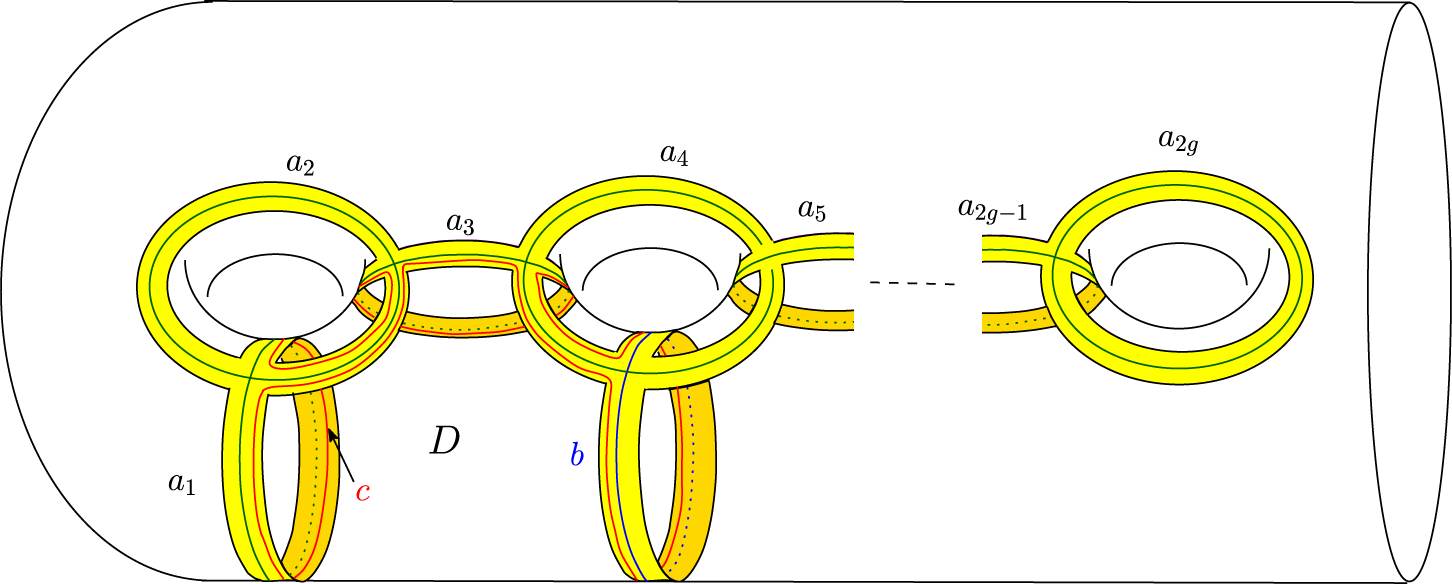
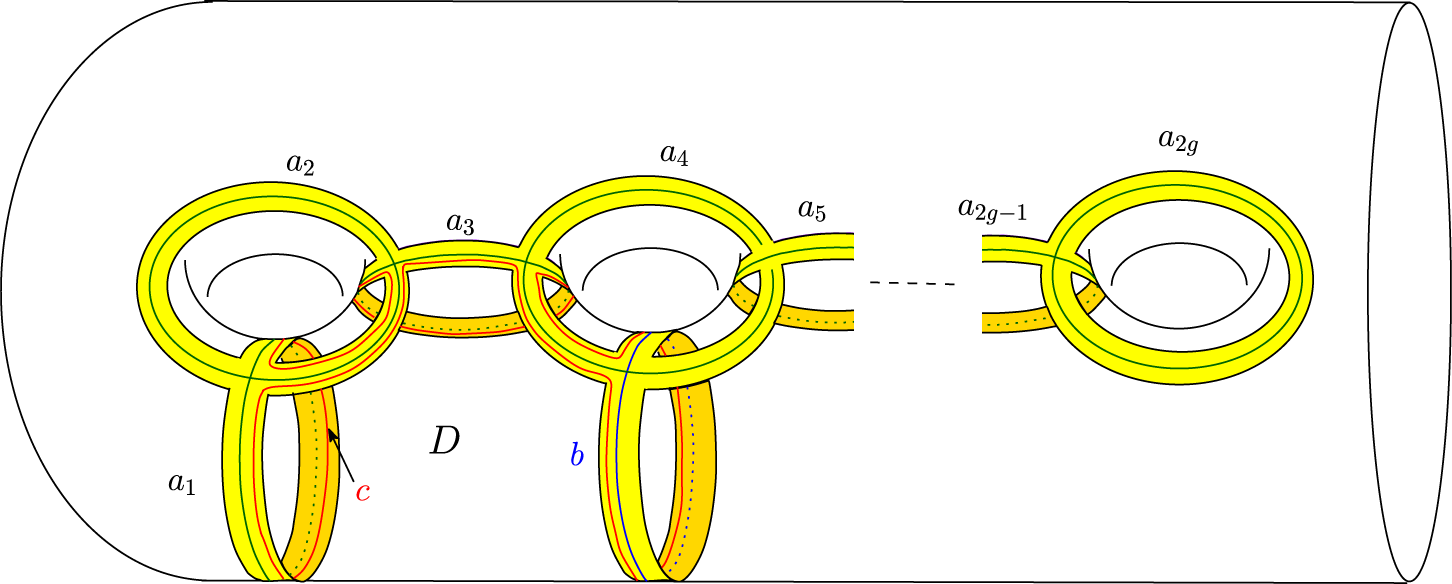
The Humphries generating curves
 $b,a_1,\ldots ,a_{2g}$
on the surface
 $\Sigma $
of genus g with connected boundary. The Dehn twist along these curves generates the mapping class group of
 $\Sigma $
. The union of the regular neighbourhoods of the Humphries generating curves is a subsurface S of
 $\Sigma $
with two boundary components. One of the boundary components of S is parallel to
 $\partial \Sigma $
and the other boundary component bounds a disc D in
 $\Sigma $
.
Similarly, when n is a negative integer, we can see that the surgered manifold
 $M^{\prime }$
admits an open book with pages
 $\Sigma ^{\prime }=\Sigma \setminus D_x$
and monodromy
 $\phi ^{\prime }=\phi |_{\Sigma ^{\prime }}\circ d_c^{n}$
.
Remark 3.3. Suppose that
 $\Sigma ^{\prime }$
has an arc
 $\alpha $
joining the boundary component
 $\partial D_x$
to some component of
 $\partial \Sigma $
such that
 $\phi $
fixes
 $\alpha $
pointwise. Then, the open book
 $\mathcal Aob(\Sigma ^{\prime }, \phi ^\prime )$
of
 $M^\prime $
, obtained from M by
 $\pm 1$
surgery along K, is just a stabilisation of
 $\mathcal Aob(\Sigma ,\phi )$
. In this case,
 $M^\prime $
is diffeomorphic to
 $M.$
Let M be a closed connected oriented
 $3$
-manifold. Recall that M admits an open book decomposition with connected binding (see [Reference Myers8]). Let
 $M=\mathcal {A}ob(\Sigma ,\phi )$
, where
 $\Sigma $
is a compact connected oriented surface with connected boundary. By considering certain stabilisations of the abstract open book of
 $\mathcal Aob(\Sigma ,\phi )$
if required, we can assume that
 $\Sigma $
has the genus
 $g\geq 3$
. The monodromy
 $\phi $
of the open book is an element in the mapping class group of
 $\Sigma $
. Humphries [Reference Humphries and Fenn6] showed that the mapping class group of a closed surface
 $\tilde \Sigma $
of genus
 $g\geq 3$
is generated by the Dehn twist along
 $2g+1$
closed curves
 $b, a_1,a_2,\ldots ,a_{2g}$
, as shown in Figure 2, where the closed surface
 $\tilde \Sigma $
is obtained from
 $\Sigma $
by gluing a disc along the boundary. We call these curves
 $b, a_1,a_2,\ldots ,a_{2g}$
in
 $\Sigma $
the Humphries generating curves and the corresponding Dehn twists the Humphries generators of the mapping class group of
 $\Sigma $
. Johnson [Reference Johnson7] showed that the
 $2g+1$
Dehn twists about
 $b,a_1,a_2,\ldots ,a_{2g}$
on
 $\Sigma $
also generate the mapping class group of
 $\Sigma $
.
Consider a regular neighbourhood of each Humphries generating curve in
 $\Sigma $
. The union S of the regular neighbourhoods of the Humphries generating curves can be considered as a surface obtained by plumbing
 $2g+1$
annuli, as shown in Figure 2. The surface S has two boundary components. One of the boundary components of S is parallel to
 $\partial \Sigma $
, that is, they bound an annulus A in
 $\Sigma $
, and the other boundary component of S bounds a disc
 $D=\Sigma \setminus (S\cup A)$
in
 $\Sigma $
, as shown in Figure 2. Note that
 $\Sigma \setminus D$
is diffeomorphic to
 $S.$
The monodromy
 $\phi $
is supported in S and hence it is the identity on the disc D.
Let
 $x\in D$
be an interior point in
 $D\subset \Sigma .$
Consider the knot
 $K=\{x\}\times [0,1]/(x,1)\sim (\phi (x),0)$
in M. As discussed in Lemma 3.2, we get an open book
 $\mathcal Aob(\Sigma ^{\prime },\phi ^\prime )$
of
 $M^\prime $
obtained by an integer n surgery along K in M. Here,
 $\Sigma ^\prime =S$
and
 $\phi ^\prime =\phi \circ d_c^{-n}$
, where c is a curve in
 $\Sigma ^\prime $
parallel to
 $\partial D.$
Now, we shall show that the open book
 $M^{\prime }=\mathcal Aob(\Sigma ^\prime ,\phi ^\prime )$
embeds into the trivial open book of
 $S^5$
. We need to recall the following notion.
Definition 3.4. A diffeomorphism
 $\phi $
of a surface F is said to be a flexible diffeomorphism, with respect to a proper embedding f of
 $\Sigma $
in a
 $4$
-manifold X, if there exists a diffeomorphism
 $\Phi $
of X isotopic to the identity map of X (also the identity near the boundary if X has nonempty boundary) such that
 $\phi $
is isotopic to
 $f^{-1} \circ \Phi \circ f$
.
One can easily observe that if a diffeomorphism
 $\phi $
of F is isotopic to a diffeomorphism
 $\psi $
of F and
 $\phi $
is flexible with respect to an embedding f of F in X, then
 $\psi $
is also flexible in X with respect to f. To prove the existence of an (abstract) open book embedding of
 $\mathcal Aob(\Sigma ^{\prime },\phi ^{\prime })$
in the trivial open book of
 $S^5$
, we need to find an embedding f of
 $\Sigma ^{\prime }$
in
 $D^4$
such that
 $\phi ^{\prime }$
is flexible in
 $D^4$
with respect to
 $f.$
As
 $\phi ^{\prime }$
is isotopic to a product of powers of Humphries generators and the Dehn twist
 $d_c$
, it is enough to construct a proper embedding f of
 $\Sigma ^{\prime }$
in
 $D^4$
such that the Humphries generators and the Dehn twist
 $d_c$
are flexible in
 $D^4$
with respect to
 $f.$
3.1 Construction of an embedding of
${\Sigma}^{\!\prime}$
in
$D^4$


A Dehn twist
 $d_\gamma $
along an embedded circle
 $\gamma $
in
 $\Sigma ^{\prime }$
is supported in an annular neighbourhood of
 $\gamma $
in
 $\Sigma ^{\prime }$
. In [Reference Hirose and Yasuhara5], it is shown that there exists a (proper) embedding of an annulus
 $A=S^1\times [0,1]$
in
 $D^4$
such that the Dehn twist along the central curve of A is flexible and hence so is each power of this Dehn twist. This follows from the fact that there exists a flow
 $\Phi _t$
on the
 $3$
-sphere
 $S^3$
associated to the open book decomposition of
 $S^3$
with pages a Hopf annulus and monodromy the Dehn twist along the central curve of the Hopf annulus such that the time
 $1$
map
 $\Phi _1$
on
 $S^3$
induces the Dehn twist along the central curve on each page of the open book of
 $S^3$
. We can choose any Hopf annulus page
 $\mathcal A$
as an embedding of the annulus A in
 $S^3=\partial D^4\times \tfrac 12\subset \partial D^4\times [0,1]$
, where
 $\partial D^4\times [0,1]$
is a collar of
 $\partial D^4$
in
 $D^4$
. Using the flow
 $\Phi _t$
, we can construct a diffeomorphism of
 $D^4$
which is isotopic to the identity and induces the Dehn twist along the central curve on the embedded Hopf annulus
 $\mathcal A$
. For more details, see [Reference Hirose and Yasuhara5, Reference Pancholi, Pandit and Saha9]. Note that
 $S^3$
admits an open book with pages a positive Hopf annulus as well as an open book with pages a negative Hopf annulus. So, we will construct a proper embedding of the surface
 $\Sigma ^{\prime }$
in
 $D^4$
such that each of the curves
 $b, a_1,\ldots ,a_{2g}$
and the boundary parallel curve c admits either a positive or a negative Hopf annulus regular neighbourhood in the embedded
 $\Sigma ^{\prime }\subset D^4$
.
Consider a collar
 $S^3\times [0,1]$
of the
 $4$
-ball
 $D^4$
with
 $\partial D^4=S^3\times 0.$
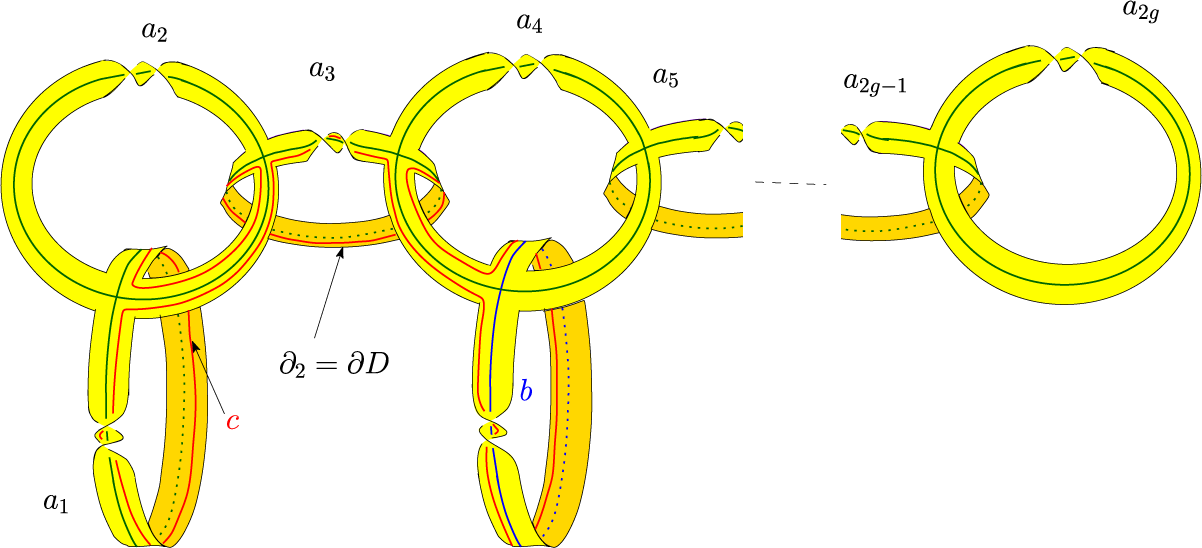
Consider an embedding
 $S_1$
of the surface
 $\Sigma ^{\prime }$
, which is obtained by plumbing
 $2g$
positive Hopf annuli
 $A_1,\ldots ,A_{2g}$
with central curves
 $a_1,a_2,\ldots ,a_{2g}$
and one negative Hopf annulus with central curve b in
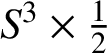 $S^3\times \tfrac 12$
, as shown in Figure 3. Recall that
 $\Sigma ^{\prime }$
has two boundary components. We denote these components by
 $\partial _1=\partial \Sigma $
and
 $\partial _2=\partial D.$
We make this embedding a proper embedding f of
 $\Sigma ^{\prime }$
by attaching cylinders
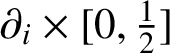 $\partial _i\times [0,\tfrac 12]$
to
 $S_1$
along
 $\partial _i$
, for
 $i=1,2$
, and smoothing out the corners to get a smooth embedding. By construction, we can see that a regular neighbourhood of each of the Humphries generating curves
 $a_1,\ldots ,a_{2g}$
in
 $f(\Sigma ^{\prime })$
is a positive Hopf annulus in
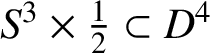 $S^3\times \tfrac 12\subset D^4$
and a regular neighbourhood of the Humphries generating curve b in
 $f(\Sigma ^{\prime })$
is a negative Hopf annulus
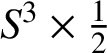 $S^3\times \tfrac 12$
. A regular neighbourhood of the curve c parallel to the boundary
 $\partial _2$
in
 $f(\Sigma ^{\prime })$
has two positive full twists and one negative full twist. Two of the twists cancel each other to get a positive Hopf annulus neighbourhood for the curve c in
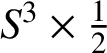 $S^3\times \tfrac 12$
(see Figure 3). From this, one can see that the Dehn twists along the curves
 $c,b,a_1,\ldots ,a_{2g}$
are flexible in
 $D^4$
with respect to the embedding f of
 $\Sigma ^{\prime }.$
For more details regarding the flexibility of the Dehn twists, see [Reference Pancholi, Pandit and Saha9]. An alternate argument for the flexibility of the Dehn twist along a simple closed curve in
 $\Sigma ^{\prime }$
admitting a Hopf annulus regular neighbourhood in
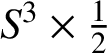 $S^3\times \tfrac 12$
is given in [Reference Pandit and A10]. For the sake of completeness, we summarise it here.
An embedding of the surface
 $\Sigma ^{\prime }=S$
in
 $S^3$
, in which each Humphries generating curve as well as the boundary parallel curve c admits a Hopf annulus regular neighbourhood in
 $S^3.$

Observe that each curve
 $\alpha \in \{c, a_1,\ldots , a_{2g}\}$
bounds a disc
 $D_\alpha $
in
 $D^4$
which intersects
 $f(\Sigma ^{\prime })$
in
 $\alpha $
and a tubular neighbourhood
 $\mathcal {N}(D_\alpha )=D^2\times D^2$
intersects
 $f(\Sigma ^{\prime })$
in a regular neighbourhood
 $\nu (\alpha )$
of
 $\alpha $
in
 $f(\Sigma ^{\prime })$
. We can choose coordinates
 $(z_1,z_2)$
on
 $\mathcal {N}(D_\alpha )$
such that
 $\nu (\alpha )=g^{-1}(1)\cap f(\Sigma ^{\prime })$
, where
 $g:\mathbb C^2\to \mathbb C$
is the map defined by
 $g(z_1,z_2)=z_1z_2$
. The monodromy of the singular fibration
 $g:\mathcal {N}(D_{\alpha })=\mathbb C^2\to \mathbb C= D^2$
with the singular point
 $(0,0)$
is the positive Dehn twist
 $d_{\alpha }$
along the curve
 $\alpha $
which lies in the regular fibre
 $g^{-1}(1)\cap \Sigma ^{\prime }=\nu (\alpha ).$
The isotopy of
 $\mathcal {N}(D_{\alpha })$
, which produces the positive Dehn twist
 $d_{\alpha }$
on
 $g^{-1}(1)\cap \Sigma ^{\prime }$
, can be extended to an isotopy
 $\Psi _s$
,
 $s\in [0,1]$
, of
 $D^4$
such that the isotopy is supported in the tubular neighbourhood
 $\mathcal {N}(D_{\alpha })$
. Then, we have
 $f^{-1}\circ \Psi _1 \circ f=d_{\alpha }$
up to isotopy. We have an isotopy of
 $D^4$
supported in the tubular neighbourhood
 $\mathcal {N}(D_{\alpha })$
of
 $D_{\alpha }$
which produces the Dehn twist
 $d_\alpha $
on
 $\Sigma ^{\prime }.$
From this, it follows that the Dehn twist
 $d_{\alpha }$
is flexible in
 $ D^4$
with respect to the embedding
 $f.$
The curve b bounds a disc
 $D_b$
in
 $D^4$
which intersects
 $f(\Sigma ^{\prime })$
in b and a tubular neighbourhood
 $\mathcal {N}(D_b)=D^2\times D^2$
intersects
 $f(\Sigma ^{\prime })$
in a regular neighbourhood
 $\nu (b)$
of b in
 $f(\Sigma ^{\prime })$
. We can choose coordinates
 $(z_1,z_2)$
on
 $\mathcal {N}(D_b)$
such that
 $\nu (b)=g^{-1}(1)\cap f(\Sigma ^{\prime })$
, where
 $g:\mathbb C^2\to \mathbb C$
is the map defined by
 $g(z_1,z_2)=z_1\bar {z}_2$
. The monodromy of the singular fibration
 $g:\mathcal {N}(D_{b})=\mathbb C^2\to \mathbb C= D^2$
with the singular point
 $(0,0)$
is the negative Dehn twist
 $d_{b}^{-1}$
along the curve b which lies in the regular fibre
 $g^{-1}(1)\cap \Sigma ^{\prime }=\nu (b).$
By arguments similar to those above, there is an isotopy of
 $D^4$
supported in the tubular neighbourhood
 $\mathcal {N}(D_{b})$
of
 $D_{b}$
which produces the Dehn twist
 $d_b^{-1}$
on
 $\Sigma ^{\prime }.$
Both
 $d_b$
and
 $d_b^{-1}$
are flexible in
 $D^4$
with respect to the embedding
 $f.$
It follows that the monodromy
 $\phi ^{\prime }$
is flexible in
 $D^4$
with respect to the embedding f of
 $\Sigma ^{\prime }$
, that is, there exists a diffeomorphism
 $\Phi $
of
 $D^4$
which is isotopic to the identity map of
 $D^4$
and
 $f^{-1}\circ \Phi \circ f$
is isotopic to
 $\phi ^{\prime }$
. This gives an abstract open book embedding of
 $M^{\prime }=\mathcal Aob(\Sigma ^{\prime },\phi ^{\prime })$
into
 $S^5=\mathcal {A}ob(D^4,\Phi ).$
This completes the proof of Theorem 1.1.