Introduction
Reproductive isolation between closely related species is thought to be one of the most important stages in the process of speciation (Howard, Reference Howard1999; Aspbury & Gabor, Reference Aspbury and Gabor2004). Among phytophagous insects, reproductive isolation often arises as a by product of heritable genetic changes in host plant preference (Berlocher & Feder, Reference Berlocher and Feder2002; Aluja & Mangan, Reference Aluja and Mangan2008), where individuals exploiting a novel host tend to find and mate with individuals exhibiting similar novel preferences rather than mating with individuals exploiting the ancestral host (Feder et al., Reference Feder, Opp, Wlazlo, Reynolds, Go and Spisak1994). Such a process, known as host-race formation, has been shown to lead to speciation through a score of examples spanning from population polymorphisms to sibling species (Dres & Mallet, Reference Dres and Mallet2002). Reproductive isolation between host races will lead to speciation as long as fitness trade-offs among races exploiting different plants strengthen such isolation (Feder & Filchak, Reference Feder and Filchak1999), in which case behavioural avoidance of interbreeding in various forms could evolve. For example, the time of day during which mating occurs is a heritable trait that prevents gene flow between species in sympatry (Aluja et al., Reference Aluja, Piñero, Jácome, Díaz-Fleischer, Sivinski, Aluja and Norrbom2000; Morrow et al., Reference Morrow, Scott, Congdon, Yeates, Frommer and Sved2000; Pike & Meats, Reference Pike and Meats2002).
Recent examples of reproductive isolation include avoidance of certain volatiles emitted by non-preferred hosts (Linn et al., Reference Linn, Feder, Nojima, Dambroski, Berlocher and Roeloefs2003), assortative mating (Vera et al., Reference Vera, Cáceres, Wornoayporn, Islam, Robinson, De la Vega, Hendrichs and Cayol2006), male alteration of sperm production (Aspbury & Gabor, Reference Aspbury and Gabor2004) and cryptic female choice (Howard, Reference Howard1999; Eberhard & Cordero, Reference Eberhard and Cordero1995). It has been postulated that understanding the origins of host-related specialization in insects is critical for understanding the genesis of biodiversity and adaptive radiation on a grand scale, as there are more phytophagous insects than any other life form on earth (Dambroski et al., Reference Dambroski, Linn, Berlocher, Forbes, Roelofs and Feder2005). In this context, assortative mating is especially relevant as it could evolve as a trade-off between local adaptation and avoidance of inbreeding depression.
The genus Anastrepha comprises >200 species of frugivorous tephritid fruit flies of neotropical origin (Norrbom et al., Reference Norrbom, Zucchi, Hernández-Ortiz, Aluja and Norrbom2000). The fraterculus species group includes at least 11 of these species. Within this group, recent scrutiny has revealed that Anastrepha fraterculus (Wiedemann), formerly thought to be a generalist species with a geographical range spanning from Argentina to Mexico, is actually a complex of at least four cryptic species (Steck, Reference Steck1991; Hernández-Ortíz et al., Reference Hernández-Ortiz, Gómez-Amaya, Sánchez, McPheron and Aluja2004 and references therein). In the A. fraterculus sibling species complex, some sibling species appear to have clearly separated geographical ranges but others do not. Sibling species also exhibit important differences in biology, notably host range (Aluja et al., Reference Aluja, Piñero, Jácome, Díaz-Fleischer, Sivinski, Aluja and Norrbom2000; Aluja & Mangan, Reference Aluja and Mangan2008), and, in some cases, exhibit distinct and consistent morphological differences (Hernández-Ortiz et al., Reference Hernández-Ortiz, Gómez-Amaya, Sánchez, McPheron and Aluja2004). Mating compatibility tests among different populations of A. fraterculus have provided evidence of prezygotic reproductive isolation among some of those populations due, in part, to asynchronies in daily patterns of sexual activity (Vera et al., Reference Vera, Cáceres, Wornoayporn, Islam, Robinson, De la Vega, Hendrichs and Cayol2006).
Anastrepha ludens (Loew), the Mexican fruit fly, is also a member of the fraterculus species group and is considered one of the most devastating pests of citrus throughout its distribution range, which encompasses southern Texas to Central America (Thomas, Reference Thomas2003; Birke et al., Reference Birke, Aluja, Greany, Bigurra, Pérez-Staples and McDonald2006). Males aggregate in lekking territories, usually but not always host-plant foliage, and release a sex pheromone (Aluja, Reference Aluja1994). Presumably, group calling amplifies the male signal and results in an average increase of females encountered by participants in leks (Höglund & Alatalo, Reference Höglund and Alatalo1995). Receptive females of this species are then attracted from a distance to lekking territories where they are thought to evaluate competing males (Sivinski et al., Reference Sivinski, Aluja, Dodson, Freidberg, Headrick, Kaneshiro, Landolt, Aluja and Norrbom2000). In the presence of a potential mate, male A. ludens perform an elaborate array of courtship displays that include acoustic signals, wing displays and body movements (Aluja et al., Reference Aluja, Piñero, Jácome, Díaz-Fleischer, Sivinski, Aluja and Norrbom2000). In some species of Anastrepha, courtship continues during copulation, where at least wing-fanning acoustic signals have been observed (Sivinski et al., Reference Sivinski, Burk and Webb1984). Copulations last ca. 60 min (Aluja et al., Reference Aluja, Piñero, Jácome, Díaz-Fleischer, Sivinski, Aluja and Norrbom2000), after which most females are inhibited from mating for approximately 12 days (M. Aluja, unpublished data).
There are important differences among A. ludens populations. For example, recently Orozco-Dávila et al. (Reference Orozco-Dávila, Hernández, Meza and Domínguez2007) showed that the hour of day, when males start to call and mate, varies among populations within Mexico. For example, wild A. ludens individuals from the state of Nayarit started to mate at 16:00 hrs while flies from Chiapas or Sinaloa did so only after 17:30 hrs. This species can be found at sea level in tropical high humidity environments (Aluja et al., Reference Aluja, Cabrera, Rios, de la Rosa, Guillen and Hendrichs1987, Reference Aluja, Rull, Sivinski, Díaz-Fleisher, Norrbom, Wharton, López and Macías-Ordoñez2003; Celedonio-Hurtado et al., Reference Celedonio-Hurtado, Aluja and Liedo1995), at elevations above 2000 m in temperate regions and in montane canyons/riparian piedmont and semi-arid environments in north-eastern Mexico (Thomas, Reference Thomas2003). Host range is also variable within its distribution. For example, A. ludens is the main pest of mangos (Mangifera indica L., Anacardiaceae) in mid elevation subtropical environments in the state of Morelos in central Mexico and in Chiapas (Aluja, Reference Aluja1993; Aluja et al., Reference Aluja, Celedonio-Hurtado, Liedo, Cabrera, Castillo, Guillén and Rios1996). Along both coastal plains of Mexico, citrus and Casimiroa edulis Llave & Lex (Rutaceae) are the main hosts and mango is only an alternate host (Aluja et al., Reference Aluja, Celedonio-Hurtado, Liedo, Cabrera, Castillo, Guillén and Rios1996). In the most important citrus growing region of Mexico (Veracruz), grapefruit (Citrus paradisi Macfadyen) and sour orange (C. aurantium L., both Rutaceae) are heavily infested (Birke et al., Reference Birke, Aluja, Greany, Bigurra, Pérez-Staples and McDonald2006). Finally, in north-eastern Mexico (Nuevo Leon, Tamaulipas), Yellow Chapote, Casimiroa greggii (S. Watson) (Rutaceae), one of A. ludens' purported ancestral hosts (the other being C. edulis), is used together with the more abundant and sympatric citrus (Thomas, Reference Thomas2003).
Individuals stemming from different A. ludens populations have to cope with differences in climatic conditions and host composition in order to persist in different environments (Thomas, Reference Thomas2003). Such populations are, therefore, subject to different selection pressures that could possibly be driving genetic divergence. It is also likely that individuals stemming from populations exploiting hosts in tropical humid environments will perform poorly in temperate or arid regions with markedly different host compositions. However, in Mexico, such environments are separated by short distances; and intermediate conditions between high and low elevations would favour inter-population gene flow and homogenization of the gene pool, particularly in light of the fact that A. ludens are able to move over considerable distances (>30 km) (Aluja, Reference Aluja1994 and references therein; Thomas & Loera-Gallardo, Reference Thomas and Loera-Gallardo1998). In order for genetic differences and differential environmental adaptation to persist among A. ludens populations, either physical barriers to movement must exist or, in areas of potential contact, some sort of isolating mechanism must evolve.
Here, we set out to explore if there is assortative mating between individuals stemming from different A. ludens populations. Adult flies originated either from populations sharing similar environments and hosts but which were separated by physical barriers and large geographical distances, or from populations differing in host use but which were separated by distances within individual-flight range. In the latter case, we studied mating preferences between populations from an isolated pristine habitat and an agricultural habitat. Simultaneously, we tested whether A. ludens adults avoid mating with their siblings. Finally, we also tested the effect of population origin and degree of genetic relatedness (sibling vs. non-sibling) on copulation duration.
Materials and methods
Biological material
Naturally infested grapefruit (C. paradisi) was collected under several trees at two geographical locations: Tapachula (N14°54′29″, W92°15′38″) in the state of Chiapas on the Pacific Coast, and central Veracruz (Tolome (N19°16′02″, W96°23′36″), San Pedro (N19°25′57″, W95°51′59″) and Martinez de la Torre (N20°03′38″, W97°03′15″)), facing the Gulf of Mexico. Infested fruit was taken to the laboratory, and pupae were recovered following methods outlined in Aluja et al. (Reference Aluja, Rull, Sivinski, Díaz-Fleisher, Norrbom, Wharton, López and Macías-Ordoñez2003). Pupae were separated in 200 ml plastic containers according to geographical origin and placed in an environmentally controlled room at 27°C, 65 RH and a 12:12 L:D cycle until adults started to emerge. At emergence, adults were sexed and transferred to 30×30×30 cm Plexiglass cages, according to sex and geographical origin, with free access to water and food (3:1 mixture of sugar and protein).
Source of siblings
To obtain siblings and non-siblings, individual pairs of the same geographical origin were enclosed in separate cages with free access to water, food and a ripe, uninfested grapefruit. Fruit was left in cages for three days and then individually placed in a 500 ml container lined with moist vermiculite to await exit of larvae. Larvae were then allowed to pupate. Because size can be a factor affecting mate choice in A. ludens (Aluja et al., in press), all pupae recovered were weighed with an electronic scale, and only those within the 10–20 mg weight range were used in the experiment. All pupae recovered from individual fruit were placed in individually labelled, 200 ml closed containers containing moist vermiculite. At eclosion, siblings of each sex were placed separately in cages with water and food. One day prior to the experiment, adults were individually marked on the back of the thorax with a distinctive dot of acrylic paint (Aluja et al., Reference Aluja, Jacome and Macias-Ordoñez2001).
Mating preferences among siblings and non-siblings from geographically distant populations
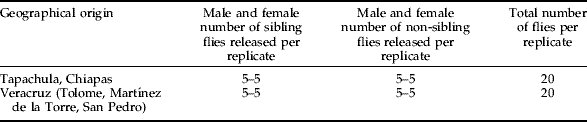
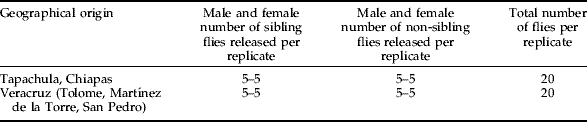
At sexual maturity (13 days after eclosing from pupae), adults were released in a 3×3×3 m field cage within an environmentally controlled room kept at 27°C, 65 RH and dim light simulating dusk light intensity. The field cage contained potted citrus trees so as to simulate the canopy of a large tree following methods outlined in Aluja et al. (Reference Aluja, Jacome and Macias-Ordoñez2001). Early in the morning, five male siblings (progeny of the same couple) and five male non-siblings of each geographical origin (Chiapas and Veracruz) were introduced into the field cage to allow individuals to get accustomed to their environment and, in the case of males, to establish courtship territories. At noon, five sibling females (siblings to the five sibling males) and five non-sibling females of each geographical origin were introduced into the field cage (table 1). A total of 20 males and 20 females were placed together in the cage for each replicate. From 16:00 hrs until the end of the last copulation, an observer recorded the identity of all mating pairs and the duration of copulations. The experiment was replicated five times.
Experimental design to test mating preferences of sibling and non-sibling A. ludens stemming from two locations separated by >2000 km.
Mating preferences of siblings and non-siblings of different geographical origins were compared by means of a Chi-square test. Copulation duration was also compared between siblings and non-siblings of similar geographical origin and between non-siblings of different and similar geographical origin by means of t-tests for independent samples using Statistica®.
Mating preferences among flies from different habitats (isolated vs. agricultural)
Mating propensity among populations stemming from an undisturbed isolated stand of native ancestral hosts, C. greggi, and an adjacent (30–50 km apart in a straight line) agricultural area, where grasslands and citrus groves covered most of the landscape, was compared. Infested C. greggi was collected in June in the ‘Cañon de Ovejas’ (isolated population) (N23°31′44″, W99°43′44″) and ‘Cruz’ (agricultural population) (N24°58′02″, W99°43′37″) sites in the state of Tamaulipas and Nuevo Leon (Mexico), respectively, and was taken to the laboratory to obtain pupae as described in Aluja et al. (Reference Aluja, Rull, Sivinski, Díaz-Fleisher, Norrbom, Wharton, López and Macías-Ordoñez2003). Pupae were reared to adulthood and placed, according to sex, in Plexiglass cages with free access to water and food. Once reaching sexual maturity, adults were marked on the back of the thorax with a distinctive dot of acrylic paint. Twenty females and 20 males of each population were then released in a field cage as described for experiment 1. Identity of mating pairs and duration of copulations were recorded. The experiment was replicated six times. The total number of copulations and mean duration of copulations per mating type combination (Oveja ♀ Oveja ♂, Cruz ♀ Oveja ♂, Oveja ♀ Cruz ♂, Cruz ♀ Cruz ♂) per replicate were compared by building a GLM with Statistica®, followed by a main effects ANOVA with male origin and female origin as factors.
Reproductive compatibility
Forty sexually mature males and 40 sexually mature females of each possible population combination (40 Oveja ♀ 40 Oveja ♂, 40 Cruz ♀ 40 Oveja ♂, 40 Oveja ♀ 40 Cruz ♂, 40 Cruz ♀ 40 Cruz ♂) were placed in Plexiglas cages and observed from 17:00 to 20:00 hrs. Mating pairs were gently removed from cages and placed in individual 3-l cylindrical containers with mesh openings and allowed to freely copulate and disengage. Males were removed from the cages the following day. Four mated females of each type were then placed in an individual 3-l cylindrical cage along with a 2.5-cm agar sphere hung from the cage top with a paper clip to recover eggs (as described in Díaz-Fleischer & Aluja (Reference Díaz-Fleischer and Aluja2003) ). The following day, 30 eggs were lined over a piece of black cloth, which in turn was placed over moist cotton, lining the bottom of a Petri dish. Petri dishes were then closed and incubated at 33°C, 85 RH for six days. After incubation, egg hatch was verified under a dissecting microscope and percent egg hatch calculated for each mating couple type. The experiment was replicated five times. Total number of eggs laid and percent egg hatch per replicate were compared among females mated to males of different origins by building a GLM with Statistica®, followed by a main effects ANOVA with male origin and female origin as factors.
Finally, mated females from each combination were re-exposed to males of their own geographical origin five days after their first copulation to determine how many females would remate.
Results
Mating preferences among siblings-non-siblings and geographically distant populations
Independent of degree of relatedness, of the 48 matings that were recorded, 27 occurred among individuals of similar geographical origin and 21 among individuals of different geographical origin (Chiapas and Veracruz, respectively) (Chi-square=1.77; P=0.18). The mean (±S.E.) duration of these copulations was 66.71±4.25 and 50.45±5.48 for pairs of similar and different geographical origin, respectively (t 46=2.3; P=0.025).
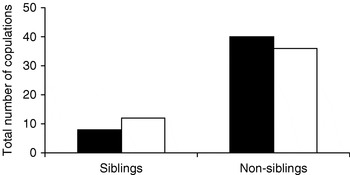
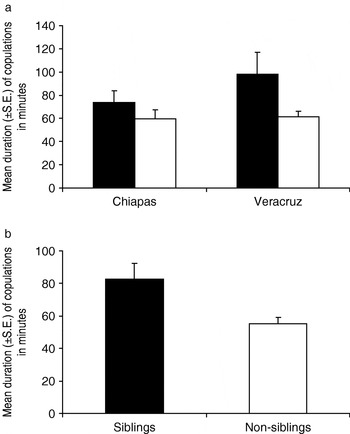
When data was dissected considering degree of relatedness and geographical origin, the following patterns emerged. Although fewer matings among siblings (8) than expected (12), and more copulations among non-siblings (40) than expected (36) were observed, a Chi-square test revealed no significant differences in mating tendency (Chi-square=1.77; P=0.182) (fig. 1). Mean (±S.E.) copulation duration of sibling and non-sibling pairs from Chiapas was not significantly different (73.6±10.25 and 59.62±7.80, respectively; t 11=1.09; P=0.29). In contrast, mean (±S.E.) copulation duration of sibling and non-sibling pairs from Veracruz was significantly different (98.33±18.55 and 61.62±4.60, respectively; t 9=2.85; P=0.018) (fig. 2a).
Total number of observed (black) vs. expected (white) matings among sibling and non-sibling Anastrepha ludens adults in a field cage (Chi-square=1.77; P=0.182) (▪, observed; □, expected).

(a) Mean duration (±S.E.) of copulations (min) among siblings (black bars) and non-siblings (white bars) from Chiapas and Veracruz (t-test for independent samples: t 11=1.09; P=0.29 and t 9=2.85; P=0.018 for Chiapas (non-significant difference) and Veracruz (significant difference), respectively). (b) Mean duration (±S.E.) of copulations (min) among siblings (black bars) and non-siblings (white bars) when flies of different geographical origins were pooled together (t-test for independent samples: t 44=2.76, P=0.008) (▪, siblings; □, non-siblings).

Viewed from a slightly different angle, copulation duration among non-siblings of similar (60.25±3.79 min) and different (50.45±5.84 min) geographical origin was statistically similar (t 38=1.40; P=0.167). Considering the latter, flies of different geographical origins were pooled together. Under such circumstances, copulation duration in the case of siblings was significantly longer (82.87±9.74 min) than in the case of non-siblings (55.35±3.52 min) (t 46=3.06; P=0.003) (fig. 2b).
Mating preferences among flies from different habitats (isolated vs. agricultural)
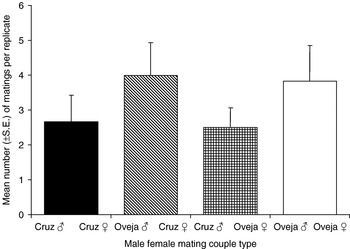
Flies stemming from different habitats (isolated and agricultural populations) mated randomly among themselves in the field cage (fig. 3). A GLM main effects ANOVA revealed no significant effect of male origin (F1,5=2.67; P=0.138) or female origin (F1,5=0.38; P=0.84) on the number of copulations among mating combination types per replicate. Furthermore, neither male origin (F1,5=0.15; P=0.92) nor female origin (F1,5=1.47; P=0.234) had an effect on the duration of copulations of flies stemming from the different habitats.
Mean number of copulations (±S.E.) between Anastrepha ludens males and females from isolated (Oveja) and agricultural (Cruz) habitats (GLM main effects ANOVA, F1,5=2.67, P=0.138 (male origin) and F1,5=0.38, P=0.84 (female origin)).

Reproductive compatibility
In laboratory cages, neither male origin nor female origin had a significant effect on the amount of eggs laid by females or in the proportion of those eggs that hatched (F1,4=0.037; P=0.85 for male origin and F1,4=0.42; P=0.84 for female origin, respectively).
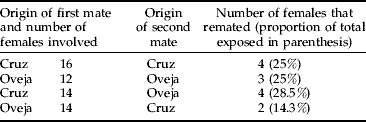
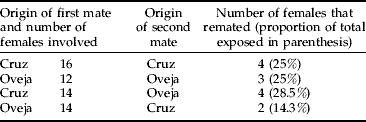
Finally, the results of the experiment in which mated females from each combination were re-exposed to males of their own original habitat five days after their first copulation to determine how many females would remate, indicated that there was no effect of male origin on female remating probability. Independent of origin (i.e. habitat type), rematings are not common in this species, at least after such a short interval after the first mating (table 2).
Proportion of rematings by Anastrepha ludens females mated with males stemming from similar or different habitats (i.e. large strand of isolated native vegetation (Oveja) vs. orchards/pastures (Cruz)) in north-eastern México. Re-exposure to males occurred five days after the females had mated for the first time.
Discussion
We failed to find evidence of assortative mating among geographically isolated populations of A. ludens exploiting the same host within Mexico. We also found no evidence for assortative mating among siblings or individuals stemming from different habitats but which were within adult flight range. Furthermore, egg hatch was similar between all possible intra- and inter-population mating combinations, failing to provide any indication of post-zygotic isolation. Importantly, however, we did find that copulation duration among siblings was significantly longer compared to non-siblings. A similar pattern was detected when comparing flies from geographically distant populations independent of degree of relatedness. This is suggestive of a sibling (mate) recognition mechanism at play during copulation.
Our results indicate that male origin did not appear to be a factor affecting female mate choice at the pre-copulatory stage in A. ludens. Similar results were reported by Vera et al. (Reference Vera, Cáceres, Wornoayporn, Islam, Robinson, De la Vega, Hendrichs and Cayol2006) with A. fraterculus stemming from two populations within Argentina (Tucumán and Concordia), by Orozco-Dávila et al. (Reference Orozco-Dávila, Hernández, Meza and Domínguez2007) with mass-reared, sterile A. ludens from Chiapas and wild flies from various other Mexican states (Nuevo León, Tamaulipas, Sinaloa, Nayarit, Michoacán and Chiapas), and by Cayol et al. (Reference Cayol, Coronado and Taher2002) working with geographically distant populations of the Mediterranean fruit fly (Ceratitis capitata (Widemann)). In all cases, random mating was the rule. We note, however, that Vera et al. (Reference Vera, Cáceres, Wornoayporn, Islam, Robinson, De la Vega, Hendrichs and Cayol2006) also report that when exposing A. fraterculus females and males stemming from populations collected in different countries (Argentina, Brazil, Peru, Colombia) mating incompatibility was indeed observed. Similarly, assortative mating between wild and laboratory-reared populations has been documented in several tephritid species of economic importance, among them A. ludens (Cayol, Reference Cayol, Aluja and Norrbom2000; Rull et al., Reference Rull, Brunel and Mendez2005; Meza-Hernández & Diaz-Fleischer, Reference Meza-Hernández and Díaz-Fleischer2006). The message to managers, particularly those working with large-scale releases of sterile males, is clear – mating incompatibility should be monitored, particularly when dealing with species exhibiting widespread distribution. In the case of A. ludens, it will be necessary to test populations from northern Mexico and Costa Rica.
Wild A. ludens females from Chiapas or Veracruz did not discriminate between sibling and non-sibling males from two geographical origins. However, once intromission occurred, they engaged in significantly longer copulations when mating with a sibling than when mating with a non-sibling male. This result suggests that females are unable to detect differences between siblings and non-siblings or between males of different geographical origin while choosing a mate (i.e. prior to mating). Further exchange of information during mating is apparently needed to allow the female to measure the quality or degree of genetic similarity of their mating partner, perhaps through copulatory courtship (Eberhard, Reference Eberhard1996; Simmons, Reference Simmons2001). Thus, mating incompatibilities may arise between siblings leading to a longer copulation.
Copulation duration in tephritids can vary according to age, strain, size of flies and host origin, but the effect of these factors varies among species (Field et al., Reference Field, Taylor and Yuval1999; Aluja et al., Reference Aluja, Jacome and Macias-Ordoñez2001; Pérez-Staples et al., Reference Pérez-Staples, Aluja, Macías-Ordóñez and Sivinski2008a). For example, Pérez-Staples et al. (Reference Pérez-Staples, Aluja, Macías-Ordóñez and Sivinski2008a), working with A. obliqua (Maquart) (placed in the fraterculus species group as is the case with A. ludens), reported that copulation duration was influenced by the interaction of host origin (males stemming form the native host Spondias mombin L. or the exotic host mango) and nutritional status (well fed vs. protein-deprived males). Other studies have either found no influence of adult diet on copulation duration (Shelly & Kennely, Reference Shelly and Kennely2002) or longer matings in males of purported better nutritional condition, such as those fed on yeast hydrolysate (Pérez-Staples et al., Reference Pérez-Staples, Prabhu and Taylor2007, Reference Pérez-Staples, Harmer, Collins and Taylor2008b). By contrast, in C. capitata, A. striata, A. ludens and A. obliqua, copulation duration is shorter when males have been fed yeast hydrolysate (Aluja et al., Reference Aluja, Jacome and Macias-Ordoñez2001; Shelly et al., Reference Shelly, Rendón, Hernandez, Salgado, Mcinnis, Villalobos and Liedo2003; Pérez-Staples & Aluja, Reference Pérez-Staples and Aluja2004).
We failed to find any indication of reproductive isolation among A. ludens populations separated by geographical barriers or stemming from different habitats (isolated and agricultural populations). However, as indicated earlier, Orozco-Dávila et al. (Reference Orozco-Dávila, Hernández, Meza and Domínguez2007) showed that the hour of day when males start to call and mate can vary among populations within Mexico. While discussing daily rhythms in male calling for 20 Anastrepha species, Aluja et al. (Reference Aluja, Piñero, Jácome, Díaz-Fleischer, Sivinski, Aluja and Norrbom2000) indicated that the daily pattern of calling rhythms was probably driven by a circadian clock and was, therefore, mostly hardwired. But the same authors also discuss the influence of environmental factors, such as temperature and light intensity, and illustrated their effect on the onset of calling by A. ludens and Toxotrypana curvicauda Gerstaecker. They also report differences in calling time in the case of A. serpentina from Chiapas and Veracruz. Since, as noted by An et al. (Reference An, Tebo, Song, Frommer and Raphael2004), small changes in circadian regulation represent a speciation mechanism, we believe that it would be important to incorporate the monitoring of daily patterns of calling rhythms in widespread, economically important species, such as A. fraterculus, A. ludens, A. obliqua, A. serpentina and A. striata, as part of the collaborative studies sponsored by international organizations, such as the International Atomic Energy Agency (IAEA) or the Food and Agricultural Organizations (FAO).
In addition to the latter, differences have been reported in pheromone composition among different A. ludens populations (Heath et al., Reference Heath, Landolt, Robacker, Dueben, Epsky, Aluja and Norrbom2000). Perhaps, reproductive isolation in this species, and in other polyphagous, lekking fruit fly species, could also arise in long distance attraction of females responding to male pheromone emission. In the case of the Apple Maggot, Rhagoletis pomonella (Walsh), the classic example of sympatric speciation, reproductive isolation arises through mutations that alter host odour recognition (Linn et al., Reference Linn, Feder, Nojima, Dambroski, Berlocher and Roeloefs2003). Both male and female apple maggots carrying mutations are attracted from a distance to novel plants where they meet and mate, and the offspring of such parents exhibits similar preferences (Feder et al., Reference Feder, Opp, Wlazlo, Reynolds, Go and Spisak1994). It would, therefore, be interesting to test the response of A. ludens females from different geographical locations and exhibiting differences in host preference to pheromones of males of different populations, particularly those stemming from areas that are far removed from each other.
Alternatively, because A. ludens is multivoltine and polyphagous, it is likely that adults had to retain the ability to move over considerable distances to find alternate hosts throughout the year (Thomas, Reference Thomas2003; Thomas & Loera-Gallardo, Reference Thomas and Loera-Gallardo1998). Such behaviour could erase fixation of mating preference alleles within populations. Future studies on the possible evolution of reproductive isolation could, therefore, focus on populations of A. ludens with no host overlap at all.
Acknowledgements
We thank Section Editor Christian Borgmeister and, particularly, two anonymous reviewers for many useful suggestions on an earlier draft that helped us improve the quality of this paper. We also thank Alberto Anzures-Dadda for his all-encompassing support during manuscript preparation and the revision process. Main financial support for this study was furnished by the Mexican Campaña Nacional contra las Moscas de la Fruta (Secretaría de Agricultura, Ganadería, Desarrollo Rural y Pesca – Instituto Interamericano de Cooperación para la Agricultura (SAGARPA-IICA), the Consejo Nacional de Ciencia y Tecnología (Project CONACyT – SEP-2004-46846), the United States Department of Agriculture (Agricultural Research Service) and the Instituto de Ecología, A.C. M.A. also acknowledges support from CONACyT through a Sabbatical Year Fellowship (Ref. 79449) and thanks Benno Graf and Jörg Samietz (Forschungsanstalt Agroscope Changins-Wädenswil ACW) for providing ideal working conditions during the final phase of the publication process of this paper.