That language input is necessary in order for acquisition to take place is undisputed, regardless of one's theoretical persuasion; however, the exact role of input in the language-acquisition process remains controversial. There is disagreement as to how much input is necessary for acquisition to take place and whether all aspects of language can be acquired from input alone (see, e.g., Valian, Reference Valian, Ritchie and Bhatia1999, for an overview). Concerning this first question, data from children exposed to two languages may prove instructive. A number of recent studies have investigated the effect of differences in amount of input on children's (rate of) acquisition of various aspects of morphosyntax and vocabulary with mixed results (Blom, Reference Blom2010; Chondrogianni & Marinis, Reference Chondrogianni and Marinis2011; Gathercole & Thomas, Reference Gathercole, Thomas, Cohen, McAlister, Rolstad and MacSwan2005, Reference Gathercole and Thomas2009; Paradis, Reference Paradis2011; Paradis, Nicoladis, Crago, & Genesee, Reference Paradis, Nicoladis, Crago and Genesee2011; Place & Hoff, Reference Place and Hoff2011). For example, with respect to the acquisition of grammatical gender, Gathercole and Thomas (Reference Gathercole, Thomas, Cohen, McAlister, Rolstad and MacSwan2005) observe a lengthy delay in bilingual English/Welsh children's acquisition of the more complex aspects of Welsh gender, which they claim is the result of reduced input to that language. There is thus evidence to suggest the bilingual acquisition of grammatical gender may be subject to input effects. However, no study to date has directly examined the effect of amount of input on the (bilingual) acquisition of grammatical gender in the two languages under investigation here, which are Dutch and Greek. The first goal of this paper is thus to contribute to this bilingual acquisition research by determining the effect of varying amounts of input in child bilinguals in their acquisition of grammatical gender in these two languages. Grammatical gender is a suitable property to examine in this context because the availability of relevant cues in the input differs in the two languages under investigation.
We use the phrase “child bilingual” as a general term referring to any child who is exposed to two languages in childhood, by which we mean up to and including the age of 10. Such a group of children is clearly heterogeneous in nature, including children exposed to two languages from birth, that is, simultaneous bilinguals, as well as those exposed to a second language (L2) at some point in early or late childhood, that is, successive bilinguals. According to some approaches to L2 acquisition (e.g., Johnson & Newport, Reference Johnson and Newport1989), some of these children fall within a purported critical period for language acquisition, whereas others may be expected to pattern similarly to L2 adults (for a review, see, e.g., Herschensohn, Reference Herschensohn2007). In a recent proposal put forward by Meisel (Reference Meisel2009), it has been claimed that age 4 constitutes the end of a critical period for the acquisition of (some aspects of) morphosyntax. The second goal of this paper is thus to explore the role of age of onset within childhood, that is, to ascertain whether there is an effect of age of onset in the linguistic development of child bilinguals in their acquisition of grammatical gender. Grammatical gender is a suitable property to examine in this context because it is in this domain that age effects are often observed (e.g., Blom, Polišenskà, & Weerman, Reference Blom, Polišenskà and Unsworth2008, on Dutch; Franceschina, Reference Franceschina2005, on Spanish; Hyltenstam, Reference Hyltenstam and Harris1992, on Swedish).
In the following section we provide a brief review of the relevant literature on input effects in bilingual acquisition, and then we turn to the role of age of onset. The relevant properties of grammatical gender in Dutch and Greek are outlined, along with a brief overview of the acquisition facts. Next, we detail the methods used to elicit production data on grammatical gender and to determine the amount of input to which children are exposed. The Dutch data and results are presented first and subsequently those for Greek. Finally, we follow up with a discussion of our research questions in light of the results. We conclude that in the (bilingual) acquisition of grammatical gender in Dutch and Greek, the amount of input to which children are exposed plays a more important role than the age at which children are first exposed to the target language.
INPUT EFFECTS IN EARLY CHILD BILINGUALISM
Children growing up bilingually have to divide their time and thus their linguistic input between two languages. They will thus by definition be exposed to quantitatively less input than their monolingual peers (Paradis & Genesee, Reference Paradis and Genesee1996). Despite often significantly less exposure, however, simultaneous bilingual (2L1) children have been observed to follow the same developmental milestones as monolingual children and do so by and large within the same time frame, at least for morphosyntax (for an overview, see Genesee & Nicoladis, Reference Genesee, Nicoladis, Hoff and McCardle2007). The relationship between input quantity and linguistic development is thus certainly not linear (Paradis & Genesee, Reference Paradis and Genesee1996).
A number of studies have examined the effect of amount of input/exposure on bilingual children's acquisition of vocabulary and grammar/morphosyntax. For example, in a large-scale study on bilingual English/Spanish children in Miami, Cobo-Lewis, Pearson, Eilers, and Umbel (Reference Cobo-Lewis, Pearson, Eilers, Umbel, Oller and Eilers2002a, Reference Cobo-Lewis, Pearson, Eilers, Umbel, Oller and Eilers2002b) observed that children who receive more language input perform better on a variety of vocabulary measures, and this holds for both the minority and majority language. Similar findings are reported for ethnic minority children in the Netherlands by Scheele, Leseman, and Mayo (Reference Scheele, Leseman and Mayo2010) and for Welsh/English bilinguals by Gathercole and Thomas (Reference Gathercole and Thomas2009).
For grammar/morphosyntax, linguistic phenomena examined include various aspects of verb form and placement (Austin, Reference Austin2009; Blom, Reference Blom2010; Paradis, Reference Paradis2010, Reference Paradis2011; Paradis et al., Reference Paradis, Nicoladis, Crago and Genesee2011), the mass/count distinction (Gathercole, Reference Gathercole, Oller and Eilers2002a), that-trace effects (Gathercole, Reference Gathercole, Oller and Eilers2002c), grammatical gender (Gathercole, Reference Gathercole, Oller and Eilers2002b; Montrul & Potowski, Reference Montrul and Potowski2007), as well as more comprehensive assessments of children's grammatical abilities (Chondrogianni & Marinis, Reference Chondrogianni and Marinis2011; Jia & Aaronson, Reference Jia and Aaronson2003; Jia & Fuse, Reference Jia and Fuse2007). For example, in a series of studies on the same set of bilingual English/Spanish children as investigated by Cobo-Lewis et al., Gathercole (Reference Gathercole, Oller and Eilers2002a, Reference Gathercole, Oller and Eilers2002b, Reference Gathercole, Oller and Eilers2002c) observed that younger bilingual children with less exposure to the target language at home and/or at school performed systematically more poorly than those with more exposure, including their monolingual peers, that is, children with (some) Spanish at home and (some) Spanish at school scored significantly higher than those without, and similar effects were observed for English. Gathercole notes, however, that by the time children reach Grade 5 (around age 10), the difference between the children with comparatively more or less target language exposure has largely disappeared, leading her to suggest that input frequency may play a greater role in the early years, that is, until children have reached a critical mass of input with respect to the relevant linguistic property (2002c, p. 247).
In a survey of family language use, De Houwer (Reference De Houwer2007) found that bilingual children typically experience few problems acquiring the majority language (although this was not measured directly), but in order to successfully acquire the minority language, it is essential that one or both parents provide input in that language in the home. An effect of parental input, that is, whether both or just one parent (in two-parent households) speaks the target language at home, was also observed by Barreña, Ezeizabarrena, and García (Reference Barreña, Ezeizabarrena, García, Pérez-Vidal, Juan-Garau and Bel2008). In a study of the early lexical and morphosyntactic development of Spanish/Basque bilingual children, they found that bilingual children with on average greater than 60% exposure to Basque at the time of testing performed similarly to monolinguals and often significantly better than bilingual children with less exposure (between 30% and 60% at time of testing). In a case study of four Italian/English simultaneous bilingual children, La Morgia (Reference La Morgia2011) showed that there is a clear association between the amount of input children are exposed to and their abilities in their weaker language, in this case Italian. Furthermore, in a study of Spanish/English bilingual toddlers, patterns in early language exposure have been linked to the development of speech-processing efficiency (Hurtado, Marchman, & Fernald, Reference Hurtado, Marchman and Fernald2008).
In contrast to some of the aforementioned studies, Goldberg, Paradis, and Crago (Reference Goldberg, Paradis and Crago2008) and Paradis (Reference Paradis2011) failed to find an effect of home language use on children's rate of acquisition of vocabulary and verbal morphology. Paradis (Reference Paradis2011) suggests that this may be an effect of the parents’ low proficiency in the L2, that is, when input at home is provided by nonproficient speakers, it has little effect on children's linguistic development (for similar results, see Chondrogianni & Marinis, Reference Chondrogianni and Marinis2011).
In a study of bilingual English/Spanish toddlers, Place and Hoff (Reference Place and Hoff2011) also found evidence of a (slightly different) proficiency effect: they observed that the proportion of exposure from native speakers of English was positively related to children's vocabulary in that language, as were other more qualitative properties of the input, such as the number of different people speaking English to the child, although neither of these findings held for Spanish. Other studies have also found an effect of more qualitative aspects of language exposure. For example, Jia and Aaronsson (Reference Jia and Aaronson2003) and Jia and Fuse (Reference Jia and Fuse2007) showed an effect of “richness” of the L2 environment, as measured by contact with native-speaker friends, reading and watching TV in the L2, and so on, on children's rate of acquisition.
In first language (L1) acquisition, the amount and type of language exposure available to children has been found to be mediated by socioeconomic status (SES), often measured in terms of maternal education (for an overview, see Hoff, Reference Hoff2006). Several of the studies mentioned above, including the Miami studies reported in Oller and Eilers (Reference Oller and Eilers2002), observed an effect of SES in bilingual acquisition. In contrast, Paradis (Reference Paradis2011) found evidence of an effect of maternal education on the acquisition of vocabulary and verbal morphology, but only when this variable was measured dichotomously rather than continuously. A positive correlation between parental education/SES and L1 and L2 outcomes was also observed by Armon-Lotem, Walters, and Gargarina (Reference Armon-Lotem, Walters and Gagarina2011) for bilingual Hebrew–German and Russian–German children.
To summarize, the amount of language exposure has been observed to affect the linguistic development of bilingual children in a variety of domains, specifically in their rate of acquisition and whether they reach monolingual norms. The exact nature of the relationship between input quantity and language acquisition in a dual language setting, for example, the extent to which it is linear and whether it holds across children, languages, and linguistic domains, largely remains unclear. This is partly due to the complex nature of this setting, which means that input quantity interacts with and is affected by numerous other factors, including input quality, parental education, SES, and age of onset. The present study focuses on input quantity and this latter variable of age of onset, to which we now turn.
AGE EFFECTS IN EARLY CHILD BILINGUALISM
Many of the studies mentioned in the preceding section focused on simultaneous bilingual children. As noted above, the linguistic development of these children by and large follows that of monolingual children, and it is generally assumed that, provided exposure to the languages in question is maintained, they will ultimately attain the same level (but see Gathercole & Thomas, Reference Gathercole and Thomas2009; Hyltenstam, Reference Hyltenstam and Harris1992; McDonald, Reference McDonald2000; Montrul, Reference Montrul2008). When it comes to successive bilinguals, children are typically found to outperform adults, which has led to the postulation of various ages as the end of a critical or sensitive period (for an overview, see Herschensohn, Reference Herschensohn2007). Most studies on the role of age of onset in L2 acquisition compare L2 children with L2 adults; more recently, however, attention has turned to exploring age effects within childhood, examining the linguistic development of early successive bilingual (ESB) children in their own right and comparing them with simultaneous bilinguals.
For example, in a study on the acquisition of various aspects of French morphosyntax, Granfeldt, Schlyter, and Kihlstedt (Reference Granfeldt, Schlyter and Kihlstedt2007) compared three groups of children: monolinguals, 2L1, and L2, where age of onset for the latter group was between 3 and 6 years and the other language for both bilingual groups was Swedish, which was also the language of the environment. They found that whereas the 2L1 children patterned similarly to the monolinguals, the L2 children produced errors typical of L2 adults. It is interesting that, in two studies on the acquisition of German word order by Turkish-speaking children, Rothweiler (Reference Rothweiler and Lleó2006) and Chilla (Reference Chilla2008) found slightly different results for children with comparable ages of onset. In a multiple case study, Chilla (Reference Chilla2008) observed that the children with an age of onset of around 6 years patterned like L2 adults, producing, for example, nonfinite verb forms in verb-second position, whereas the children with age of onset at 3 years patterned similarly to 2L1 and monolingual (L1) children, showing clear verb-form and verb-placement contingencies (Poeppel & Wexler, Reference Poeppel and Wexler1993). She argues that these results are compatible with the proposal that the interlanguage grammars of both L2 children and adults are subject to representational deficits (following Meisel, Reference Meisel1997).
Meisel (Reference Meisel2009) recently suggested that there is a critical period for some aspects of morphosyntax ending at around age 4; thus, age 4 may be seen as the dividing line between (2)L1 acquisition, on the one hand, and child L2 and adult L2 acquisition, on the other hand. Reviewing data on the acquisition of finiteness and grammatical gender from L1 German children first exposed to French between the ages of approximately 2 and 4 years, Meisel classified children as patterning with either 2L1 children or L2 adults, depending on the types of errors they make (more details to follow below); he came to the conclusion that both parameterized principles and language-specific discovery and learning principles are affected by maturational changes occurring around age 4.Footnote 1
It is interesting that age effects in early childhood have also been found to in part depend on the language combination in question. For example, while McDonald (Reference McDonald2000) observed that the early acquirers (age of onset between birth and 5 years) in her study outperformed the L2 adults, those early starters with Vietnamese as L1 (mean age of onset = 1.5 years) performed more poorly than those with L1 Spanish (mean age of onset = 2.4 years), suggesting a role for L1 transfer and/or typological similarity, even in children whose age of onset is very young. The extent of L1 transfer in early successive L2 acquisition will, however, depend on the target language properties in question, the child's level of L1 development/maintenance and L1 use in the home more generally, the age at which testing takes place, and the status of the two languages in wider society (for a review, see Kohnert, Reference Kohnert2008). Furthermore, in a study on the acquisition of irregular inflectional plural-marking morphology in L1 Russian early successive acquirers of L2 Hebrew, Schwartz, Kozminsky, and Leikin (Reference Schwartz, Kozminsky and Leikin2009) also observed the effects of reduced exposure even for children whose age of onset (when they enter Hebrew-speaking daycare) was very early, that is, shortly after birth. The amount of exposure is a factor that may also interact with age of onset in the sense that children first exposed to the L2 later are typically exposed to less input (e.g., because the majority language is not spoken at home) than those who start much earlier. Although crucial to a more complete understanding of the role of age of onset in L2 acquisition, this information is often missing.
In summary, a number of recent studies have examined the development of different types of child bilinguals as classified in terms of age of onset in more detail, the results of which suggest that there may be age effects in early child bilingualism, with children exposed to their L2 around age 6 typically producing errors that are different in type from children exposed to the L2 before or around age 3 but similar to those produced by L2 adults. In addition, it has been proposed (Meisel, Reference Meisel2009) that age 4 constitutes the critical age for some aspects of morphosyntax. Many of the aforementioned studies in this section (Chilla, Reference Chilla2008; Granfeldt et al., Reference Granfeldt, Schlyter and Kihlstedt2007; Meisel, Reference Meisel2009; Rothweiler, Reference Rothweiler and Lleó2006) typically rely on spontaneous production data and are often based on qualitative (i.e., example-based) analyses. Although such studies provide much-needed detail, especially about longitudinal development, the limited number of children included in the sample means that the results are not always generalizable to the wider bilingual child population. The present paper seeks to test the claim put forward by Meisel (Reference Meisel2009) using data on the acquisition of grammatical gender in Dutch and in Greek from a larger number of child bilinguals.
ACQUISITION OF GRAMMATICAL GENDER IN DUTCH AND GREEK
Age and input effects on gender acquisition
Before outlining the specific properties of grammatical gender in the two target languages under consideration, Dutch and Greek, let us first consider the previous literature on the effect of input quantity and age of onset on the acquisition of this particular linguistic property. Grammatical gender is often (although not always) observed to be a source of error for L2 adults (e.g., Franceschina, Reference Franceschina2005), and this has often been related to the presence/absence of a grammatical gender feature in the learners’ L1 (e.g., Sabourin, Stowe, & de Haan, Reference Sabourin, Stowe and de Haan2006). For the children in the present study, the other language is always English; English does not have a grammatical gender feature, so if this language affects the acquisition of grammatical gender in Dutch or Greek in the child bilinguals tested here, this effect should in principle be the same for all children.
The results for bilingual children, however, are mixed. Generally speaking, in their acquisition of grammatical gender, 2L1 children have been observed to make the same types of errors as monolinguals (e.g., De Houwer, Reference De Houwer1990; Müller, Reference Müller and Meisel1990), although they may experience delay, that is, slower development in one of their two languages when compared with monolingual peers (Kupisch, Müller, & Cantone, Reference Kupisch, Müller and Cantone2002), or acceleration, that is, quicker development in one of their two languages when compared with monolingual peers (e.g., Cornips & Hulk, Reference Cornips, Hulk, Lefebvre, White and Jourdan2006). In the study cited above, Meisel (Reference Meisel2009) claims that the gender marking on determiners produced by children whose age of first exposure to French is at 3;7 or later are inconsistent with the generalizations made by (2)L1 children, which are based on the formal properties of the noun. Similarly, Carroll (Reference Carroll1989) claims that after age 5, children whose L1 does not have grammatical gender are unable to acquire this feature in an L2. In contrast, Montrul, Foote, and Perpiñán (Reference Montrul, Foote and Perpiñán2008) presented data from heritage speakers of Spanish showing that despite exposure to the language from birth, these learners still often make similar errors to L2 adults. These authors suggest that this nontargetlike performance is due to variable and insufficient input, that is, due to the variety in the number of different speakers using the language at home, when the L2 is introduced to the home, and the consequences that both these factors have on the amount of available exposure in Spanish.
Gathercole (Reference Gathercole, Oller and Eilers2002b) also observed input effects in the acquisition of grammatical gender in Spanish. She found that Grade 2 children (around age 6) with the greatest amount of input at home and at school (i.e., children with Spanish-speaking parents attending bilingual schools) are better at rejecting incongruent determiner–noun (Det-N) combinations than Grade 2 children with less input, and that the children with the least input take the longest to acquire these forms. In a study of the acquisition of the grammatical gender system in Welsh, Gathercole and Thomas (Reference Gathercole, Thomas, Cohen, McAlister, Rolstad and MacSwan2005) found more targetlike production and comprehension for children with the most exposure to Welsh at home and/or at school, with exposure at home having a greater influence on results than exposure at school. Furthermore, the authors observed that the extent of such input effects in part depend on the relative complexity and/or idiosyncrasy of the particular aspect of the gender system in question, with the more complex or opaque forms requiring more input. They claim that multiple form–function pairings “appear to lend opacity and to make acquisition more difficult” (Gathercole & Thomas, Reference Gathercole, Thomas, Cohen, McAlister, Rolstad and MacSwan2005, p. 871). It is interesting that they also speculate that for the more opaque and complex structures, acquisition may be “timed off the map” in the sense that children who do not receive enough relevant input may never come to completely acquire the target language property in question. Unsworth (in press-a) tested this claim using data on the acquisition of gender from a sample of 136 simultaneous English/Dutch bilingual children aged 3 to 17. In line with Gathercole and Thomas (Reference Gathercole, Thomas, Cohen, McAlister, Rolstad and MacSwan2005, Reference Gathercole and Thomas2009), she found that total amount of exposure over the years is a significant predictor of children's ability to produce target definite determiners with neuter nouns. In addition, current amount of exposure was also a significant predictor, suggesting the importance of continuous exposure throughout the lifespan in bilingual acquisition; it is interesting, however, that the amount of exposure in the early years was not, suggesting that acquisition may not be “timed off the map” as these authors suggest.Footnote 2
Grammatical gender in Dutch and Greek
The two target languages under investigation here are Dutch and Greek. Dutch has a two-way gender system, distinguishing between common and neuter; this distinction is marked on definite and demonstrative determiners, relative pronouns, and attributive adjectives.Footnote 3 The focus of the present study is on definite determiners only. Common nouns take the definite determiner de, as in de muis, “the mouse,” whereas neuter nouns are preceded with het, as in het huis, “the house.” All plural determiner phrases (DPs) take de, and there is no gender marking on indefinite determiners; furthermore, common nouns are much more frequent than neuter nouns (Van Berkum, Reference Van Berkum1996). There are some morphological and semantic regularities, but these are limited and there are many exceptions (for an overview, see Blom, Polišenskà, & Unsworth, Reference Unsworth2008; Donaldson, Reference Donaldson1987; Haeseryn, Reference Haeseryn1997). Furthermore, many of these regularities are only relevant to abstract and/or complex nouns with which young children are unlikely to be familiar. Moreover, when it comes to acquiring grammatical gender, these are unlikely to be of any use, with the exception of diminutives that are always neuter.Footnote 4
When it comes to the acquisition of grammatical gender in Dutch, monolingual, 2L1, and L2 children overgeneralize the common determiner de with neuter nouns, producing nontarget DPs of the type *de huis “theCOMMON houseNEUTER,” but overgeneralizations in the other direction are very limited. Monolingual children make these errors until at least age 6 (Blom, Polišenskà, & Weerman, Reference Blom, Polišenskà and Weerman2008; van der Velde, Reference van der Velde2003). 2L1 and L2 children have been found to continue to make such errors beyond this age (Blom, Polišenskà, & Unsworth, Reference Blom, Polišenskà and Unsworth2008; Hulk & Cornips, Reference Hulk, Cornips, Unsworth, Parodi, Sorace and Young-Scholten2006; Unsworth, Reference Unsworth2008),Footnote 5 and various factors have been put forward to account for this observation, including the sociolinguistic context involved, as well as the quantity and quality of the input to which children are exposed (Blom & Vasic, Reference Blom and Vasic2011; Cornips & Hulk, Reference Cornips and Hulk2008; Unsworth, Reference Unsworth2008, in press-a).
Greek is a grammatical gender language with a tripartite gender distinction: masculine–feminine–neuter. This distinction is marked on definite determiners in both the singular and the plural, on indefinite articles as well as on adjectives. Gender marking on the noun follows certain phonological regularities (e.g., in the citation form, an –s ending usually marks masculine, whereas –a and –o, feminine and neuter, respectively. Greek nouns are suffixed by a syncretic form that includes gender, number, and case information (Anastasiadi-Symeonidi & Chilla-Markopoulou, Reference Anastasiadi-Symeonidi, Chilla-Markopoulou, Anastasiadi-Symeonidi and Chilla-Markopoulou2003; Ralli, Reference Ralli2002). With respect to gender marking, Mastropavlou and Tsimpli (Reference Mastropavlou and Tsimpli2011) showed that despite the possibility of some of these endings such as –os and –i occurring with more than one gender feature (e.g., –os could be masculine, feminine, or neuter, while –i could be feminine or neuter), predictive values are very high for one of these values, ranging from 0.84 to 0.98 (see also Varlokosta, Reference Varlokosta, Galani, Hicks and Tsoulas2011). The only exception is the ending –i, which is ambiguous between feminine and neuter (in spoken language only). An example is given in (1), showing gender agreement among the article, the adjective, and a (masculine) noun, ending in –os.
(1) O oreos kipos.
themasc beautifulmasc gardenmasc
“The beautiful garden”
Studies on the monolingual acquisition of Greek show that gender agreement is acquired by around ages 3 years, 6 months (3;6) to 4;0 (Tsimpli, Reference Tsimpli2003). Neuter is considered the unmarked gender and has been proposed to bear the default function (see Mastropavlou, Reference Mastropavlou2006). This proposal is supported by research that shows that neuter is the easiest to acquire by young children during the early stages of acquisition (see Stephany, Reference Stephany1995), and it is also the most overused gender in the production of L2 learners of Greek (Tsimpli, Reference Tsimpli2003; Varlokosta, Reference Varlokosta1995). Mastropavlou (Reference Mastropavlou2006) found that in the early developmental stages, young Greek children overused neuter forms inappropriately more often than older Greek children. With respect to the role of predictive values in monolingual development, the findings from Mastropavlou (Reference Mastropavlou2006) on pseudonouns suggest that for 5-year-olds high predictive values give rise to a significant increase in the number of target responses compared to performance on low predictive values; whereas for 3-year-olds, even though the tendency is the same, the difference between high and low predictive values is not significant in gender production. The implication of these findings is that morphophonological cues on the noun's suffix are used by the monolingual child but not from the earliest stage of gender production in gender agreement contexts.
Comparing the two systems, we see that Greek has systematic and largely unambiguous gender marking on all elements within the DP, but this is not the case for Dutch, where gender marking on the noun is largely absent, and on other DP elements, it is often inconsistent or ambiguous. Thus, whereas gender marking in Greek might be considered to be relatively transparent, in Dutch, it is rather opaque. In terms of syntactic analysis, we adopt a generativist approach and assume, following Carstens (Reference Carstens2000) that nouns are marked with an interpretable gender feature that checks/values the uninterpretable gender features on agreeing determiners and adjectives (Tsimpli, Reference Tsimpli2003). In both Dutch and Greek, the noun moves covertly to num, the head of the number phrase, to check the features of the adjective in a spec–head relation, and to the head of the DP, D, to check the features of the determiner in a head–head relation.
Research questions and hypotheses
Having outlined the relevant properties of gender in the two target languages, we now return to our research questions in order to make specific predictions for the learner populations under investigation here. Our first research question concerns the existence of age effects in early child bilingualism. We hypothesize that if the proposal put forward by Meisel (Reference Meisel2009) is correct, namely, that there is a critical period for some aspects of morphosyntax ending at around age 4, then the linguistic development of bilingual children whose age of first exposure is age 4 or older should be different from bilingual children whose age of first exposure is before age 4. For example, as suggested by Meisel for the acquisition of grammatical gender in French by German/French bilinguals, we would expect children with age of onset 4 years or older to produce different types of errors from children with a younger age of onset.
Our second research question asks what the effect is of varying amounts of input for the development of grammatical gender as marked on definite determiners in English/Dutch and English/Greek child bilinguals. For Dutch, the available cues for neuter gender are limited. As noted above, gender marking is restricted to certain types of determiners and pronouns only, morphological and semantic regularities are limited, and the definite determiner used with singular common nouns, de, is also used for plural nouns of both genders. Furthermore, the lexical form, het, the definite determiner used with neuter nouns, also serves other functions, for example, as a pronominal form, in impersonal constructions, with nominalized infinitives, and with predicative superlatives (Hulk & Roodenburg, Reference Hulk and Roodenburg2008). Following Gathercole and Thomas (Reference Gathercole, Thomas, Cohen, McAlister, Rolstad and MacSwan2005), this means that this form is more opaque, and consequently, it should require more input than a less opaque form for acquisition to take place. Given the lack of systematic cues, the specification of gender in Dutch, and of neuter nouns in particular, must to a certain extent occur on a word-by-word basis (e.g., Blom, Polišenskà, & Weerman, Reference Blom, Polišenskà and Unsworth2008; Unsworth, Reference Unsworth2008). If this is the case, it is expected that input quantity should affect the acquisition of grammatical gender in Dutch in the sense that a certain amount of exposure will be necessary in order to establish the target gender specification for each noun (i.e., exposure to specific items) as well as to establish how gender is realized in this language (i.e., exposure in general). This contrasts with Greek. In this language, the cues for gender are abundant and transparent: gender is consistently marked on both the noun and any agreeing DP constituents.Footnote 6 This means that the cues to the language-learning child in Greek should be abundant, and while input will clearly be necessary to establish the system, this will be restricted when compared with a language like Dutch. Thus, our second hypothesis is that input effects will be observed for English/Dutch bilingual children but only to a limited extent (if at all) in Greek. We expect amount of exposure, as measured by an extensive parental questionnaire on the children's language use and background, to have a greater effect on the acquisition of grammatical gender in Dutch than on the acquisition of grammatical gender in Greek.
METHOD
Background variables
In addition to the gender tasks described below, children were tested using standardized vocabulary tests: the Peabody Picture Vocabulary Test (PPVT-4; Dunn & Dunn, Reference Dunn and Dunn2007) or the British Picture Vocabulary Scale (Dunn, Dunn, Whetton, & Burley, Reference Dunn, Dunn, Whetton and Burley1997) for English, depending on the variety to which children were exposed; the PPVT-III-NL (Dunn, Dunn, & Schlichting, Reference Dunn, Dunn and Schlichting2005) for Dutch; and the Diagnostic Verbal IQ (DVIQ) vocabulary section test for Greek (Stavrakaki & Tsimpli, Reference Stavrakaki and Tsimpli2000). The results of these tasks are used as a general indicator of the children's relative proficiency in the two languages.
An extensive parental questionnaire on children's language use and background (partly based on V. C. M. Gathercole, personal communication; Gutiérrez-Clellen & Kreiter, Reference Gutiérrez-Clellen and Kreiter2003; Jia & Aaronson, Reference Jia and Aaronson2003; Paradis, Emmerzael, & Duncan, Reference Paradis2010) was used in order to estimate input quantity.Footnote 7 Parents were asked to indicate who spends time with the child during an average day in the week and at the weekend, how much time this is, and the amount of Dutch or Greek (as opposed to English) each person uses when addressing the child. They were also asked to indicate the amount of time spent at daycare, school, and out of school care (depending on the child's age) and about the number of hours per week spent on other activities, including reading, clubs, and sports; watching TV; using computers and the Internet; and time spent with friends. For each of these, parents were also asked the proportion of time each of the two languages is used. This was included in the analysis as the percentage of weekly language exposure in the target language.
In addition, information was also gathered concerning children's exposure patterns over time (i.e., their length of exposure). Traditionally, length of exposure in L2 acquisition studies is operationalized as the learner's chronological age (i.e., age at time of testing, minus their age of onset). Thus, for example, a child who is tested at 7 years of age and who was first exposed to the target language at 3 years of age is said to have in total 4 years’ exposure. It is clear that, given that bilingual children have to divide their language exposure time between two languages, these 4 years of exposure are quantitatively incomparable to the amount of exposure that a monolingual child will receive in the same period. Furthermore, as the results of our questionnaire demonstrate, the amount of exposure that bilingual children receive varies greatly. To give an example, the results of the calculation outlined in the previous paragraph for the 2L1 children tested in the Dutch part of this study ranged between 8% and 81% exposure to Dutch on a weekly basis.Footnote 8 In order to capture the extent of this variation when it comes to measuring language exposure over time, we have tried to develop a new measure, which we dub cumulative length of exposure (for a similar approach, see Gutiérrez-Clellen & Kreiter, Reference Gutiérrez-Clellen and Kreiter2003).
In brief, this measure works as follows (for more details, see Unsworth, Reference Unsworth2011, in press-a). Using information from the questionnaire concerning how much each parent spoke the two languages (English and Dutch/Greek) for each 1- or 2-year period in the child's life so far, alongside information about how much exposure to each language the child received at daycare and/or school during the same periods, we were able to estimate how much a child was exposed to the target language for each year in his or her life so far. Subsequently, to estimate cumulative length of exposure, the results of this calculation for each 1- or 2-year period (or part thereof) in the child's life were totaled. For example, take a 7-year-old child who was first exposed to Dutch at age 3 for approximately 25% of the time until age 4, and from then on approximately 50% of the time in each year. Her cumulative length of exposure would be 1.75 years (0.25 + 0.5 + 0.5 + 0.5) rather than the traditional 3 years.
This estimation is clearly only as good as the report data on which it is based; however, there are studies indicating that parental report is a reliable and valid means of collecting data concerning children's (language and language-related) behavior (e.g., Marchman, Martinez-Sussman, & Dale, Reference Marchman, Martinez-Sussman and Dale2004; Rodriguez et al., Reference Rodriguez, Tamis-LeMonda, Spellman, Pan, Raikes and Lugo-Gil2009) and that the child's age does not necessarily adversely affect retrospective parental report (Gilger, Reference Gilger1992; see also Paradis et al., Reference Paradis, Emmerzael and Duncan2010). We therefore hope that cumulative length of exposure, while of course still only an overall estimation, will at least provide a more precise indication of a learner's exposure to the target language over time than its traditional counterpart, and as such, will facilitate better differentiation between children and thus more accurate results.Footnote 9
Gender tasks
Children's knowledge of grammatical gender marking on definite determiners was tested using elicited production tasks, two for each language (following Blom, Polišenskà, & Weerman, Reference Blom, Polišenskà and Weerman2008, for Dutch; Mastropavlou, Reference Mastropavlou2006, for Greek). The general setup of the tasks in both languages was the same: children were presented with pictures of the nouns in question on a computer screen and first asked to name them, thereby eliciting an indefinite noun. Subsequently, they were asked a question about the same object (e.g., “Which is brown?”) or prompted to describe the position of another object relative to the object of interest (e.g., “The ball is in front of . . . (child: . . . the (yellow) robot)”), thereby eliciting a definite determiner in either a simple (Det-N) or complex (Det-Adj-N) DP. An example for simple DPs is given for Greek in Figure 1 and for complex DPs for Dutch in Figure 2. The two conditions were similar in the two languages, and each noun was elicited once in a simple DP and twice in a complex DP.
Example (simple determiner phrase) item for Greek elicited production task. [A color version of this figure can be viewed online at http://journals.cambridge.org/aps]

Example (complex determiner phrase) item from Dutch elicited production task (based on Blom et al., Reference Blom, Polišenskà and Unsworth2008). [A color version of this figure can be viewed online at http://journals.cambridge.org/aps]
The maximum number of items per gender was 18 for Greek, and for Dutch it was 21 for younger children (≤5 years at time of testing) and 27 for older children (>6 years).Footnote 10 In Greek, six different endings were used: –as and –os for masculine nouns, –a and –i for feminine nouns, and –o and –i for neuter nouns. All have high predictive values with, as noted above, the exception of –i. The items were equally distributed across each ending (i.e., three nouns per ending each elicited three times). In both languages, test items were interspersed with fillers (n = 24 for each language) that targeted other linguistic properties (verb placement and verbal morphology in Dutch, verbal morphology and object clitics in Greek) as part of a wider project; two presentation orders were used, B being the reverse of A, counterbalanced across children.
The data for both languages were analyzed similarly. Any nouns with which children were unfamiliar were excluded from analysis. For each child, the average percentage correct was calculated by dividing the number of nouns produced with the target definite determiner by the total number of nouns of the same gender produced with any definite determiner. For Greek, we calculated as correct responses those in which both the determiner and noun were both appropriately marked for each gender; in other words, any responses where the noun was marked with the incorrect suffix (n = 4 across all children) were excluded from analysis. Mixed design analyses of variance were used, with gender (common vs. neuter for Dutch, masculine vs. feminine vs. neuter for Greek) and complexity (simple DPs vs. complex DPs) as within-subjects factors and age of onset group (2L1 vs. ESBs vs. L2, see next section) as a between-subjects factor.
DUTCH DATA
Participants
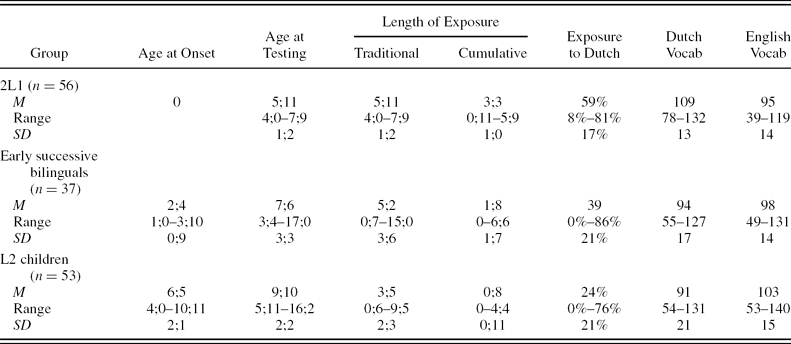
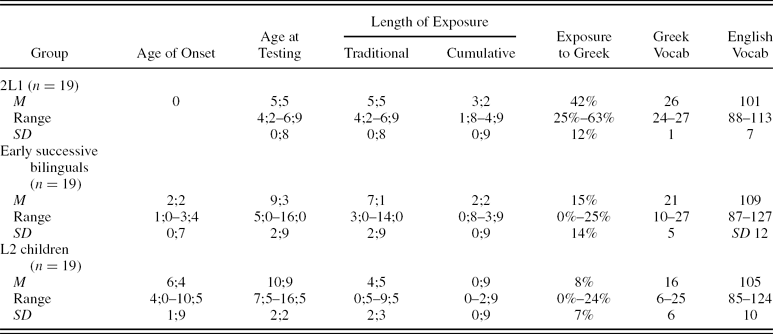
The children were divided into three groups, based on their age of onset: 2L1 children, that is, exposure to both languages from birth; L2 children, that is, exposure to Dutch between the ages of 4 and 10; and the as yet largely underresearched group of ESBs, that is, children who are exposed to English from birth and Dutch after age 1 but before age 4.Footnote 11 All children were resident in The Netherlands. Most attended Dutch-speaking primary schools, but some attended international schools, where English is the main language of instruction. Almost all the children in the 2L1 group were raised using the Grammontian principle of “one parent, one language,” although some parents reported that they also used the “other” language to varying degrees at the current time; in a handful of families (n = 7), both parents consistently used both languages at the current time. In the ESB and L2 groups, almost all parents currently still addressed the children in English most or all of the time, but in a handful of families (ESB = 7, L2 = 2), one or both parents currently addressed the child in Dutch some or most of the time, despite having used English only with the child in the early years. An overview of the biodata for the Dutch participants, as well as the two measures based on the questionnaire and the results of the vocabulary tasks, is given in Table 1. Data were also collected from 30 monolingual Dutch 4- to 6-year-olds (M = 5;9, SD = 0;11). Their average score on the PPVT-NL vocabulary task was 109 (SD = 10.3).
Overview of biodata for English/Dutch children
Note: Ages are in years;months. 2L1, bilingual first language; L2, second language.
As noted above, there is considerable variation in the amount of current exposure to Dutch both within and across groups. As might be expected, children in the L2 group, where English is the (main) home language, have considerably less exposure to Dutch than those in the other two groups.Footnote 12 This variation is also reflected in the scores for cumulative length of exposure: the difference between this and the traditional measure is greatest for the L2 children.
Group results
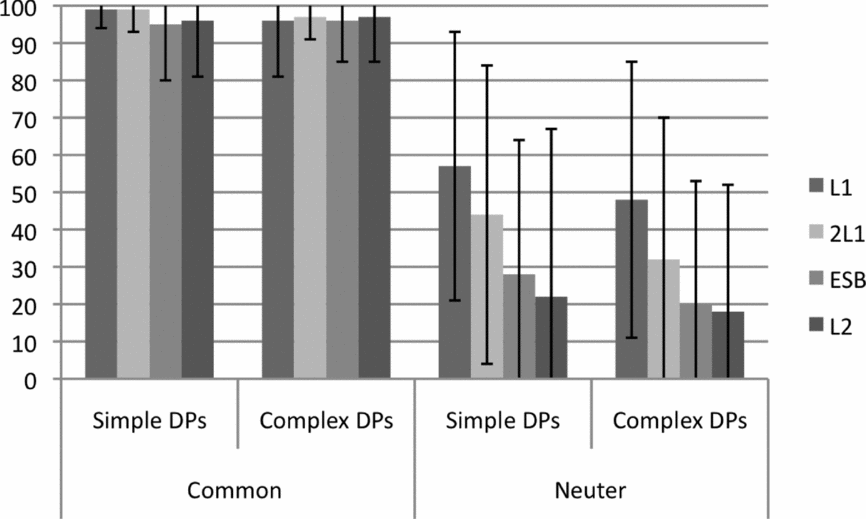
The average number of items, for simple (Det-N) and complex (Det-Adj-N) DPs together, produced with definite determiners by younger (≤5 years) children is 17.5 for common nouns and 15.6 for neuter nouns (max. 21), and by older (>6 years) children, 24.5 for common nouns, and 23.2 for neuter nouns (max. 27). The group results for both common and neuter nouns are given in Figure 3.
Dutch: Average percentage of nouns with target determiner.
There is a main effect of gender, F (1, 170) = 412.7, p < .001, η2p = 0.71; group, F (3, 170) = 8.31, p < .001, η2p = 0.13; and complexity, F (1, 170) = 38.4, p < .001, η2p = 0.18, as well as significant interactions between gender and group, F (3, 170) = 4.55, p < .01, η2p = 0.07; complexity and group, F (3, 170) = 3.17, p < .05, η2p = 0.05; and gender and complexity, F (1, 170) = 13.7, p < .001, η2p = 0.08. Overall, children are thus significantly better on common than on neuter and on simple than on complex DPs. Post hoc (Bonferroni) tests reveal significant differences on overall scores for neuter nouns between L1 and ESB children (MD = 29.5%, p < .01), and between L1 and L2 children (MD = 32.3%, p < .01), but not between any other groups. Furthermore, the difference between simple and complex neuter DPs is significant for 2L1, t (55) = 4.57, p < .001, d = 0.28, and ESB, t (35) = –2.70, p < .05, d = 0.24, children, and for the L1, t (29) = 1.93, p = .06, and L2, t (51) = 1.92, p = .06, children, this difference is approaching significance.Footnote 13
Simple bivariate correlations between the dependent and independent variables were carried out, and whenever significant correlations were observed, the independent variables were entered into a backward-elimination regression analysis for bilingual participants only (following the approach in Jia, Aaronson, & Wu, Reference Jia, Aaronson and Wu2002).Footnote 14 In the Dutch data, this was the case for all independent variables: age of onset, chronological age (i.e., age at testing), traditional length of exposure, cumulative length of exposure, percentage exposure to Dutch, and vocabulary score in Dutch (PPVT-III-NL). In the resulting model (adjusted R 2 = .56, p < .001), age of onset and traditional length of exposure were removed; cumulative length of exposure (ß = 0.45, p < .001), chronological age (ß = 0.35, p < .001), and vocabulary score (ß = 0.22, p < .01) were found to be significant predictor variables; and percentage exposure to Dutch was approaching significance (ß = 0.17, p = .07).
In order to further examine the role of age of onset and cumulative length of exposure, children from each group were matched as much as possible on the basis of this latter variable. The biodata given in Table 1 show that the three groups of bilingual children significantly differ from each other in terms of cumulative length of exposure. This is partly due to the sample and partly due to inevitable group characteristics. By definition, L2 children are not exposed to the target language during the first 4 years of life, and after this point, exposure typically only takes place outside the home; this seriously reduces the amount of input they will hear and thus their cumulative length of exposure, when compared with 2L1 children. The differences among the three groups of bilingual children in the present study are perhaps more extreme than they might be in other cases, however; this is because there are several L2 children whose only exposure to Dutch is during a weekly class at an otherwise English-speaking international school. Although a shorter (cumulative) length of exposure is in part inevitable for L2 children, in other linguistic and social settings, the differences among the various groups of bilingual children may be less pronounced (e.g., for immigrant children whose L1 exposure is restricted to the home setting only).
The relatively low values for cumulative length of exposure for the ESBs (M = 1;8) and the L2 children (M = 0;8) mean that it is virtually impossible to find 2L1 children with comparable cumulative lengths of exposure, as such children would be too young to test using the methods employed here. Therefore, we compare a subset of the ESB and L2 children only. The majority (77%) of the L2 children have had between 0 and 1 years’ cumulative exposure to Dutch. If we compare these children (n = 41) with the ESB children (n = 17) who also fall within this range, we find similar overall rates of accuracy for neuter nouns: 6.3% (SD = 12.5) for the ESB and 8.1% (SD = 18.6) for L2 children, t (56) = –0.36, p > .05.
Individual results
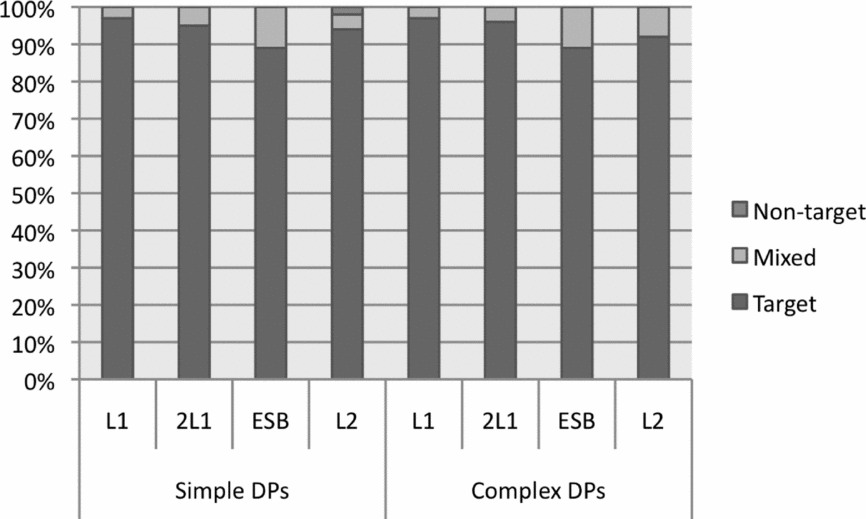
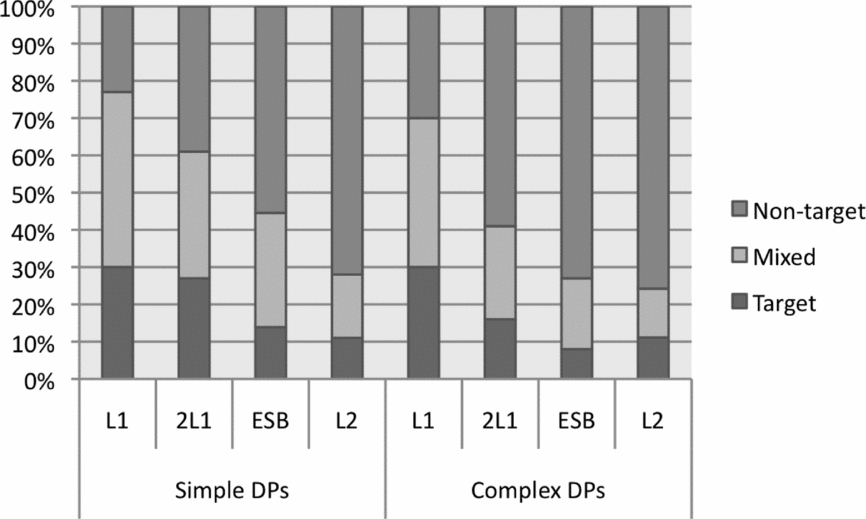
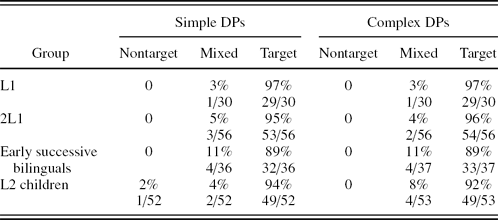
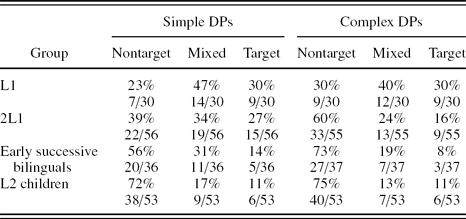
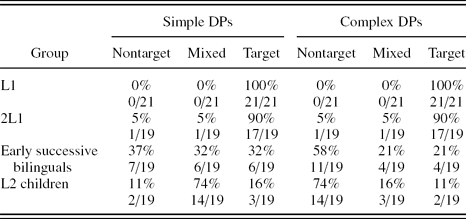
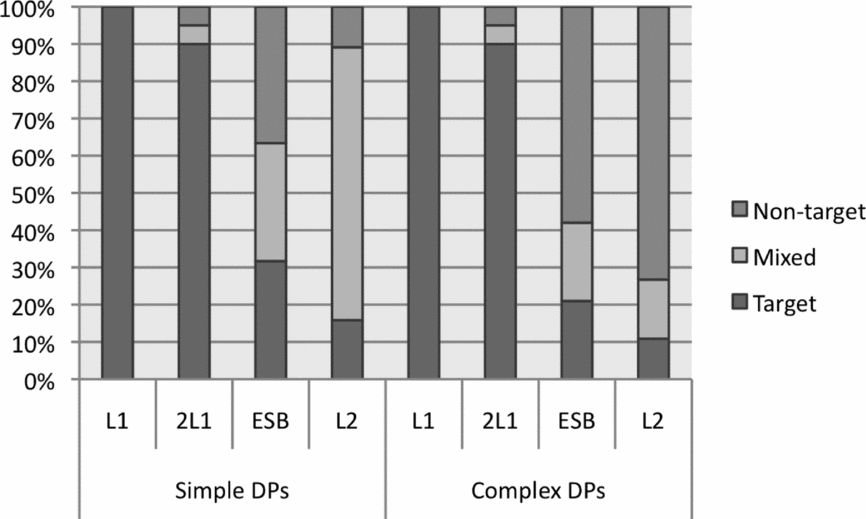
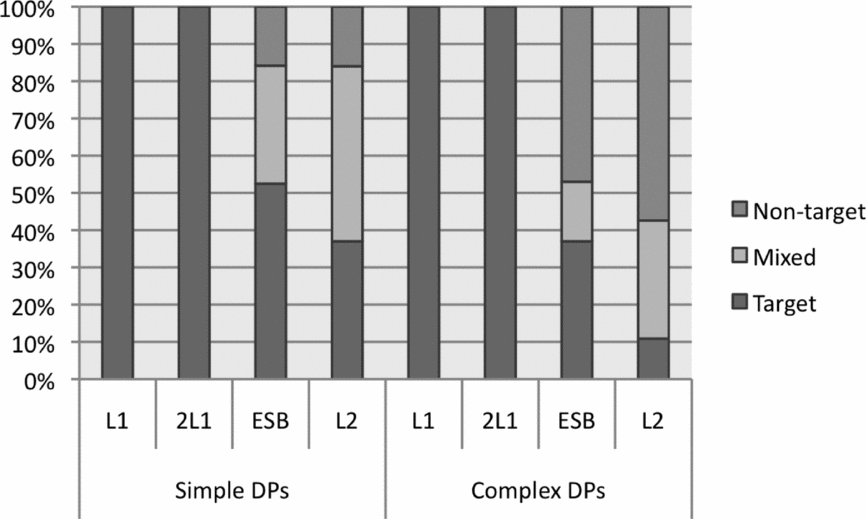
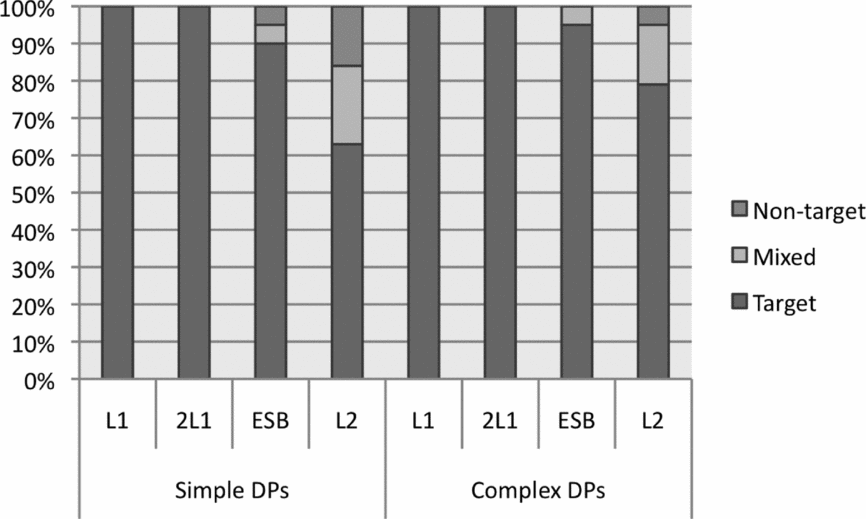
For neuter nouns, the standard deviations for all groups is rather high at just over 30%, which means that there is considerable individual variation. In order to better understand this variation, children's answers were categorized into three response patterns as follows. For simplex DPs, children with a score of 5/6 or 6/6 correct were classified as target, those with 0/6 or 1/6 correct as nontarget, and anything in between as mixed; for complex DPs, where the number of tokens is higher, 10/12, 11/12, and 12/12 were classified as target; 0/12, 1/12, and 2/12 as nontarget; and anything in between as mixed. When a child failed to produce the maximum number of tokens for a given gender, the percentage equivalent, which was the same for all three categories for both types of DP, was used (e.g., 83% or more correct counted as target). This approach was adopted to ensure that the same criteria were used for both conditions and for all children. The proportion of children in each group with each response pattern is provided for common nouns in Figure 4 and for neuter nouns in Figure 5.
Dutch: Proportion of children with each response pattern for common nouns.
Dutch: Proportion of children with each response pattern for neuter nouns.
For common nouns, the distribution of response patterns between groups is not significant for either simple ( p > .05, Fisher's exact test) or complex ( p > .05, Fisher exact test). For neuter nouns, there is a significant difference between groups in the distribution of the response patterns for both simple, χ2 (6) = 22.2, p < .001, and complex, χ2 (6) = 19.8, p < .01, DPs. The exact data are given in Table 2 and Table 3. The relative distribution of the three response patterns reflects the group results. In addition, it is interesting to observe that the proportion of children with a mixed or nontarget response pattern is virtually nonexistent for common nouns, showing that children rarely, if ever, use het with common nouns. Furthermore, when we compare individual children's response patterns for simple and complex DPs, we find that for the majority of children (n = 36), their behavior becomes less targetlike (i.e., children move from a target or mixed pattern to a nontarget pattern, or from a mixed pattern to a nontarget pattern).
Dutch: Proportion of children with each individual response pattern in simple and complex common gender DPs
Note: DP, determiner phrase; L1, first language; 2L1, bilingual first language; L2, second language.
Dutch: Proportion of children with each individual response pattern in simple and complex neuter gender DPs
Note: DP, determiner phrase; L1, first language; 2L1, bilingual first language; L2, second language.
Summary
Averaging across groups, children are worse on neuter than common nouns and on simple than complex DPs. At first sight, the between-group comparisons suggest an age effect, with L2 children producing on average fewer target definite determiners than the L1 and 2L1 children. However, closer analysis of the biodata of these children reveals a confound between age of onset and (cumulative) length of exposure. A regression analysis shows it is cumulative length of exposure, and to a lesser extent chronological age and vocabulary score, which best predict performance on neuter nouns, with percentage exposure to Dutch an almost significant predictor variable; taken together, these variables account for about half of the variance observed in the data for neuter nouns. Analyses of children's individual response patterns are in line with the group results.
GREEK DATA
Participants
The children were divided into three groups, based on their age of onset, as in Dutch. All children were resident in Athens. Several child participants attended Greek-speaking primary schools (n = 9) or preschools (n = 3), but most (n = 48) attended international schools, in which English is the main language of instruction. All the 2L1 children were raised using the “one parent, one language” strategy. At the present time, however, some parents reported that they also used the “other” language to a limited degree; and in the case of two families, one of the parents consistently used both languages. In the ESB and L2 groups, the vast majority of parents still currently addressed the children in English most or all of the time. There were, however, a (limited) number of exceptions, where Greek was also used by one of the parents at the present time. For two ESB children from the same family, one parent currently addressed the children in Greek some of the time, despite having used English only with the children in the early years; for a further five ESB children, one parent addressed the children in Greek for at least 50% of the time; and for two L2 children, the Greek-speaking guardian currently addressed the children in Greek most of the time, despite having used exclusively English until a year ago. An overview of the biodata for the Greek participants, as well as the two measures based on the questionnaire and the results of the vocabulary tasks, is given in Table 4. Data were also collected from 21 monolingual Greek children aged between 4;0 and 9;3 (M = 6;4, SD = 1;4); their average score on the DVIQ vocabulary test is 26.7 (SD = 0.6) out of a possible maximum of 27.
Overview of biodata for English/Greek children
Note: Ages are in years;months. 2L1, bilingual first language; L2, second language.
Similar to the Dutch groups, there is quite some variation in the amount of exposure to Greek both within and across groups, albeit not to quite the same extent as in the Dutch groups. Once again, it is the L2 children who have the lowest exposure scores, but scores on this variable are, for all groups, slightly lower for the English/Greek children than for the English/Dutch children (cf. Note 12). Conversely, although the English/Greek and the English/Dutch 2L1 children are comparable in terms of traditional length of exposure, the English/Greek ESB and L2 groups have had longer exposure (measured traditionally) than their English/Dutch counterparts. Nevertheless, across the two languages, the scores for cumulative length of exposure are comparable for all three bilingual groups.
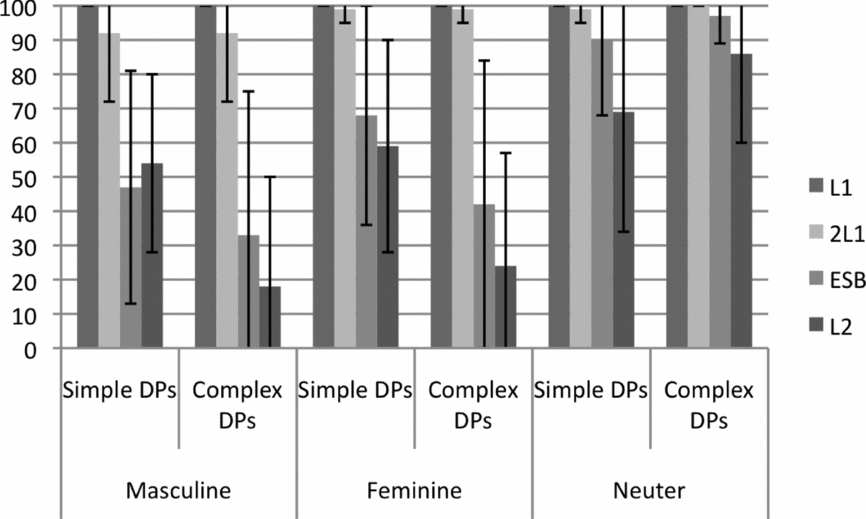
The average number of responses per child was 17.9 (max. 18). The group results for all three genders are given in Figure 6.
Greek: Average percentage of nouns with target determiner.
There is a main effect of gender, F (1.62, 119.7) = 62.3, p < .01, η2p = 0.46; group, F (3, 74) = 43.8, p < .001, η2p = 0.64; and complexity, F (1, 74) = 30.5, p < .001, η2p = 0.29, as well as significant interactions between gender and group, F (4.85, 74) = 17.3, p < .001, η2p = 0.41; complexity and group, F (3, 74) = 11.8, p < .001, η2p = 0.32; gender and complexity, F (1.5, 109.3) = 24.6, p < .001, η2p = 0.25; and a three-way interaction between gender, group, and complexity, F (4.43, 109.3) = 9.7, p < .001, η2p = 0.28.Footnote 15 Overall, children score higher on neuter than masculine and feminine nouns, and on simple than complex DPs. Post hoc (Bonferroni) tests show significant differences between L1 and ESB children for all masculine and feminine but not for neuter, and between L1 and L2 children for all genders ( p < .01 for all comparisons); the same pattern holds for the 2L1 group when compared to the other two. The ESB and L2 children do not differ from each other except in simple neuter DPs ( p = .01). Furthermore, there are no significant differences between simple and complex DPs for either L1 or 2L1 on any gender, but there is a significant difference for the ESB children on masculine, t (18) = 2.60, p < .05, d = 0.38, and feminine, t (18) = 3.10, p < .01, d = 0.68, but not for neuter nouns, t (18) = –1.42, p > .05, d = 0.38, and the same pattern is observed for the L2 children, that is, a significant difference on masculine, t (18) = 6.93, p < .001, d = 1.24, and feminine, t (18) = 5.13, p < .001, d = 1.13, but not for neuter nouns, t (18) = 1.70, p > .05.Footnote 16
The regression analysis for Greek was conducted in the same manner as for Dutch. Following a correlational analysis, the following variables were entered into a backward-elimination regression for all three genders: age of onset, age at time of testing, cumulative length of exposure, percentage of exposure to Greek, and vocabulary score in Greek (DVIQ-GR). For masculine nouns, adjusted R 2 = .41; F (2, 54) = 25.1, p < .001, the results show that percentage of exposure to Greek (ß = 0.47, p = .001) and vocabulary score (ß = 0.30, p < .05) are the only significant predictor variables. The same holds for feminine nouns, adjusted R 2 = .54; F (2, 54) = 34.1, p < .001; percentage exposure to Greek (ß = 0.49, p < .001), and vocabulary score (ß = 0.34, p < .01). For both masculine and feminine nouns, percentage of exposure to Greek has a larger beta coefficient, indicating that its effect on the children's accuracy scores is greatest. For neuter nouns, adjusted R2 = .35; F (1, 55) = 30.5, p < .001, vocabulary score (ß = 0.60, p = .001) is the only significant predictor variable.
The only possible comparative analysis based on groups matched on cumulative length of exposure is a subset of 2L1 (n = 13) and ESB children (n = 9) with an average of 2- to 4-years’ cumulative exposure to Greek. The findings show that there is a significant difference between the two groups in masculine (U = 17.5, z = –2.9, p < .01) and feminine (U = 13.0, z = –3.4, p < .01) gender but not in neuter. The 2L1 children are significantly more accurate in their production of the target determiner on masculine and feminine nouns than are the ESB children.
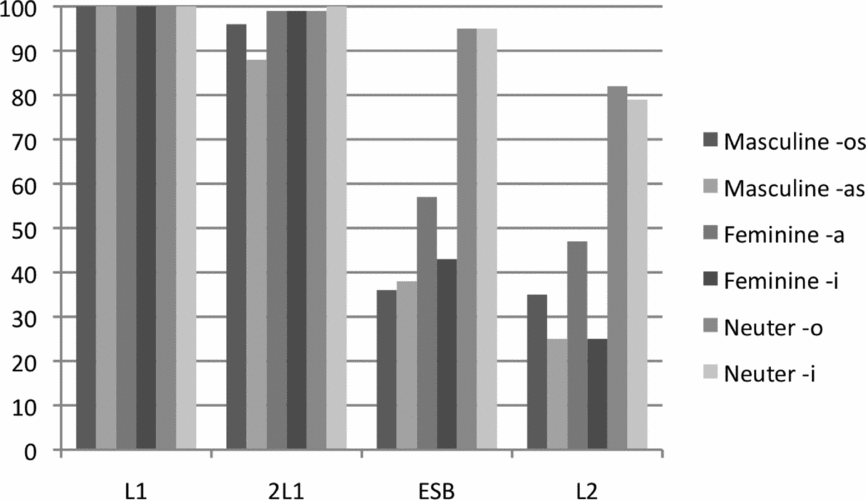
Recall that, in Greek, gender is also marked on nouns via a suffix (which additionally marks other features such as number and case). In the present study, two different suffixes were used for each gender: –os and –as for masculine, –a and –i for feminine, and –o and –i for neuter. With the exception of –i, all have high predictive values (Mastropavlou & Tsimpli, Reference Mastropavlou and Tsimpli2011). The results for each suffix are presented in Figure 7.
Greek: Average percentage of nouns with target determiner, separated by suffix.
The only significant within-group differences are for feminine (–a vs. –i) for the ESB, t (18) = 3.24, p < .01, d = 0.40, and L2 children, t (18) = 4.18, p < .001, d = 0.72, with responses on nouns ending with –i scoring significantly lower than those ending on –a.
Individual results
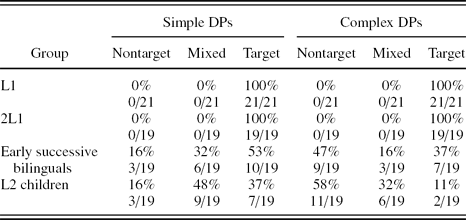
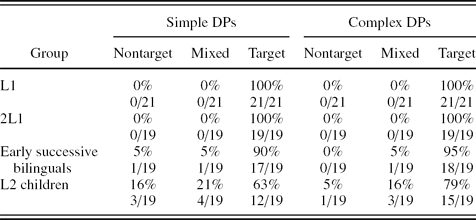
An analysis of children's individual response patterns was conducted in the same way as for Dutch. The results for simple and complex DPs are presented together in Figure 8 for masculine nouns, Figure 9 for feminine nouns, and Figure 10 for neuter nouns. The exact data are given in Table 5, Table 6, and Table 7.
Greek: Proportion of children with each individual response pattern in simple and complex masculine gender DPs
Note: DP, determiner phrase; L1, first language; 2L1, bilingual first language; L2, second language.
Greek: Proportion of children with each individual response pattern in simple and complex feminine gender DPs
Note: DP, determiner phrase; L1, first language; 2L1, bilingual first language; L2, second language.
Greek: Proportion of children with each individual response pattern in simple and complex neuter gender DPs
Note: DP, determiner phrase; L1, first language; 2L1, bilingual first language; L2, second language.
Greek: Proportion of children with each response pattern for masculine nouns.
Greek: Proportion of children with each response pattern for feminine nouns.
Greek: Proportion of children with each response pattern for neuter nouns.
The relative distribution of the individual response patterns varies significantly among groups for all genders for simple DPs ( p < .001 for masculine and feminine, p < .01 for neuter, Fisher exact test) and for complex DPs ( p < .001 for masculine and feminine, p < .05 for neuter, Fisher exact test). Once again, the individual results reflect the group results. In addition, when we examine individual children's response pattern in simple and complex DPs for masculine and feminine genders, we find that when children's patterns change, it is generally in a negative direction (n = 27), that is, children switch from target to mixed or nontarget or from mixed to nontarget (cf. three children whose response pattern becomes more targetlike).
Summary
To summarize, the L1 and 2L1 children are at ceiling in all three genders. Accuracy scores for ESB and L2 children are significantly higher on simple than complex DPs for masculine and feminine but not for neuter. Furthermore, these two groups score significantly lower than the L1 and 2L1 groups on masculine and feminine nouns, and L2 children do so on neuter nouns, too. Thus, these findings suggest that there may be an effect of age of onset, although this appears to be different for masculine and feminine versus neuter. However, a regression analysis shows that it is the exposure-related variables that account for most variance on masculine and feminine nouns, with the percentage of exposure to Greek and vocabulary score best predicting performance; together they account for about half of the variance in children's accuracy scores. For neuter nouns, vocabulary score is the only significant predictor variable, accounting for almost two-thirds of the variance in the children's accuracy scores. Analyses of children's individual response patterns are in line with the group results.
DISCUSSION
Age effects
In this paper, we presented data from English/Dutch and English/Greek bilingual children in order to investigate the role of age of onset and input quantity on the acquisition of grammatical gender as marked on definite determiners. Our first research question asked whether there was any evidence for age effects in early child bilingualism, and we hypothesized that if the proposal put forward by Meisel (Reference Meisel2009) is correct, namely, that the optimal age for the acquisition of (some aspects of) morphosyntax is before age 4, the linguistic development of children first exposed to the L2 at or after this age should be different from that of children whose age of first exposure is before 4.
When it comes to the types of errors that children make (i.e., a possible qualitative difference), the three age groups behave similarly in both languages. In Dutch, children in all three bilingual groups overgeneralize de with common nouns, rather than het with neuter nouns, and in Greek, children in all three bilingual groups overgeneralize the neuter definite determiner to with masculine and feminine nouns. Crucially, age of onset was not found to be a significant predictor for either language.
Nevertheless, there are some differences between the two languages and between certain bilingual groups that may be indicative of possible age effects. Whereas in Dutch there are no significant between-group differences for the bilinguals for neuter nouns, in Greek the 2L1 children were significantly different from both the ESB and the L2 children on masculine and on feminine nouns, and for neuter nouns, the L2 children were significantly different from both the other groups. We believe that this cross-linguistic difference can be explained by the timing of acquisition in monolingual development, and that the observed between-group differences for Greek (i.e., 2L1 vs. ESB), by the status of gender as a formal feature.
The between-group differences for Greek data may be suggestive of an age effect. However, if age were the crucial factor, although the regression analysis suggests that it is not, the relevant age should be much earlier than suggested by the results of earlier studies (Chilla, Reference Chilla2008; Granfeldt et al., Reference Granfeldt, Schlyter and Kihlstedt2007; Meisel, Reference Meisel2009; Rothweiler, Reference Rothweiler and Lleó2006), that is, somewhere between birth and around age 2, the difference between the age of onset for the 2L1 children and the average age of onset for the English/Greek ESBs.
It is possible that what is crucial here is not age per se, but the existence of another developing linguistic system. An important difference between these two groups of children, which is clearly related to age of onset, yet crucially distinct, is that when first exposed to Greek, the ESB children already have (at least) part of their L1 system in place, and as such their L2 developmental path has a potentially different starting point. In other words, whereas the 2L1 children acquiring English and Greek from birth will learn to use gender to classify nouns in Greek from the start, this may not be the case for (some of) the ESB children, who, when first exposed to Greek, already have a developing linguistic system that does not use gender as part of noun classification. This apparent difficulty in assuming gender features in the classification of nouns in the L2 lexicon, observed here even for ESB children, is consistent with the assumption that gender has a special place in the repertoire of formal features that are intrinsic on the noun's entry: Gender has a fixed value per noun (unlike case or number), and it also triggers morphological agreement in short-distance (i.e., within the DP) and long-distance (e.g., anaphoric and pronominal) dependencies. However, unlike other intrinsically specified features on nouns, such as animacy and person, the interpretability of noun gender is low (Tsimpli, Reference Tsimpli2003). This makes gender acquisition a process that cannot rely on the mapping between a semantic feature and the morphological gender value of the noun stem.
The observation that age of onset appears to play no or little role in the acquisition of gender marking on definite determiners in Dutch may be expected, given that it is typically acquired late by monolingual children. In our literature review, we noted that acquisition takes longer for Dutch than for Greek monolingual children to acquire the target system. This cross-linguistic difference is also reflected in the current results for the simultaneous bilingual children. Despite more or less comparable ages at time of testing (an average of 5;11 for the English/Greek children and 5;5 for the English/Dutch children), the 2L1 English/Greek children are at ceiling on all three genders, whereas the 2L1 English/Dutch still perform rather poorly on neuter gender (M = 36.3%). In both language samples, though, the 2L1 children do not differ significantly from the L1 children. It is interesting that an analysis of a larger sample of 2L1 English/Dutch children (Unsworth, Reference Unsworth2012) revealed that even older children (up to 17 years at time of testing) are not always at ceiling (cf. the English/Greek 5-year-olds here); the observation that first exposure at birth does not guarantee monolingual adult levels of production of het is consistent with the claim put forward in the present study that age of onset is not the primary factor driving acquisition of this particular property in bilingual children and, perhaps more generally, L2 learners’ unsuccessful acquisition of grammatical gender in Dutch (Blom, Polišenskà, & Weerman, Reference Blom, Polišenskà and Unsworth2008; Blom & Vasic, Reference Blom and Vasic2011; Cornips & Hulk, Reference Cornips and Hulk2008; Unsworth, Reference Unsworth2008).
It is possible that Meisel's (Reference Meisel2009) proposal, which claims that the optimal age for L2 acquisition is before age 4, is simply not relevant to target language properties that are acquired at or after this age. This would then raise the interesting and nontrivial question of what it means for a child to have acquired a given linguistic property and whether, for example, emergence (e.g., first productive occurrence) or mastery (e.g., 90% correct in obligatory contexts) criteria are used. If we were to take mastery as the relevant criterion, then in Dutch targetlike production of the neuter determiner het is clearly only in place well beyond age 4, but in Greek, mastery is before this age (Tsimpli, Reference Tsimpli2003). However, if we are to adopt a criterion based on emergence, this particular property can be used to test Meisel's approach in Dutch, too, because even though production of het is far from targetlike, there are 4-year-old children who (sometimes) produce het with neuter nouns. For example, in the monolingual Dutch data presented above, the six 4-year-olds produced het with neuter nouns at an average rate of 34.5% (SD = 24.6%). Their use of het is restricted to neuter nouns, suggesting they are using it to mark grammatical gender.Footnote 17
Pursuing this further from the theoretical perspective, it appears that for late-acquired properties, development presents distinct stages of (late) emergence, a rather long stage of instability and eventual mastery, while for early-acquired properties, these stages are not as clearly defined. This descriptive difference would distinguish between Greek and Dutch gender in monolingual development. In bilingual development, this difference gives rise to further implications. Greek gender, an early-acquired phenomenon, shows a contrast in the performance of the ESB children between neuter and masculine and feminine, but this does not hold for the 2L1 children who are at ceiling at the age tested here. Furthermore, the L2 children are different from the other bilingual groups on neuter. Thus, if there is an effect of age of onset for the ESB children, this appears to be relevant to the “marked” gender values and not to the default neuter. In the L2 children, this distinction between marked and default gender values is neutralized, because L2 children perform differently from the other groups of bilingual children on all three genders. It seems thus that in the (2)L1 acquisition of Greek gender, emergence, optionality (overuse of neuter), and mastery are more or less conflated in a very short period after language production begins.
Dutch gender, a late-acquired phenomenon, on the criterion of mastery at least, appears to show a contrast between common and neuter, common being acquired precociously while neuter with a long delay. What our analyses suggest, however, is that the long delay may possibly be attributed to two phases in noun production, a first stage where gender is not as yet encoded on nouns and a second one where it is (Cornips & Hulk, Reference Cornips and Hulk2008; Unsworth, Reference Unsworth2008). In this second stage, the common versus neuter distinction has emerged (i.e., children now mark nouns with het as well as de), but instability is attested, especially with respect to the neuter nouns, for over half of the children. This is in contrast to the Greek gender production, where variation between monolingual and 2L1children is not as evident as in Dutch.
To sum up, although the age of onset may be a relevant factor in the acquisition of grammatical gender in Greek, this may be due to the nature of this property of Greek in the sense that it is acquired early; however, as the contrast between neuter and masculine and feminine shows, even in Greek, if age of onset has a significant effect on bilingual children's acquisition, it is not across the board. What our data show is that accounting for (aspects of) bilingual/L2 children's language development in terms of one factor only, which in this case is the age of onset, is probably too simplistic an approach because this factor interacts with and may be conditioned by the nature of the target language property under investigation and how it is acquired by monolingual children.
Input effects
Our second research question asked whether there are input effects in early child bilingualism. We predicted that the acquisition of grammatical gender in Dutch by bilingual children would be affected by the amount of input to which children are exposed and that this in principle would also hold for grammatical gender in Greek but to a lesser extent. We determined whether there were input effects by conducting a regression analysis on the two sets of data. For Dutch, the final model (for neuter nouns only) included chronological age, vocabulary, and cumulative length of exposure as significant predictor variables, with the latter accounting for the most variance, and the percentage of exposure to Dutch approaching significance. For Greek, the percentage of exposure to Greek was a significant predictor variable for children's responses on masculine and feminine nouns, as well as vocabulary score, and for neuter nouns, vocabulary score was the only significant predictor variable. With the exception of neuter nouns in Greek, these results show that the amount of input to which children are exposed (at the present moment) is the best predictor for bilingual children's acquisition of grammatical gender in both languages, followed by vocabulary score. The adjusted R 2 values are comparable for Dutch and for Greek (.56 compared to .46 and .54), suggesting that, together, the predictor variables account for about the same amount of variance in both languages. Furthermore, examining the beta coefficients for the exposure-related variables only (i.e., cumulative length of exposure and percentage of current exposure), we find that they are comparable for Dutch (cumulative length of exposure: ß = 0.45) and for Greek (percentage exposure: ß = 0.47 for masculine and 0.49 for feminine). It thus appears that, at least when we compare the two languages in this way, the amount of input to which children are exposed does not appear to play a greater role in the acquisition of grammatical gender by English/Dutch children than by English/Greek children. This is unexpected given the differences in how gender is instantiated in the two systems (i.e., whereas gender in Greek is rather transparent, in Dutch it is much more opaque), and as such this is inconsistent with our second hypothesis. Nevertheless, the observed differences in accuracy scores for the two predictive endings for feminine nouns in Greek, –i and –a, demonstrate that bilingual children are sensitive to this transparency.
There are a couple of issues here. First, note that the input-related variables that are significant predictor variables differ between the two languages; that is, whereas the cumulative length of exposure accounts for most variance in the English/Dutch data, for the English/Greek data this is percentage of exposure. In this regard, it is informative to consider how these two variables differ and how they overlap. Cumulative length of exposure in part encompasses the percentage of exposure to Greek/Dutch in that it includes children's exposure to Greek/Dutch from birth up to and including the present moment, However, the percentage of exposure to Greek/Dutch measure is more detailed because it includes more sources of language input than home (parents) and daycare/school. In this sense, it may be that it is the amount of input over time that has a greater effect on the acquisition of gender in Dutch than the acquisition of gender in Greek (Gathercole & Thomas, Reference Gathercole and Thomas2009; Unsworth, in press-a). It is nevertheless also important to bear in mind that closer examination of the English/Greek data set reveals that percentage exposure to Greek may turn out to be a more significant predictor variable simply because of the relative range of variation for this variable for the three groups; the range of scores on percentage exposure is much more restricted for the ESB and L2 groups (0%–25% and 0%–24%, respectively), and there is virtually no overlap in values for this variable between these two groups and the 2L1 group (25% to 63%). This contrasts with the values for cumulative length of exposure where the ranges are wider and the overlap greater (2L1: 1;8–4;9 vs. ESB: 0;8–3;9 vs. L2: 0–2;9). Given that the significant between-group differences on the gender task were typically between the ESB and L2 groups and the 2L1 (and L1) group, it is perhaps not surprising that the percentage of exposure to Greek turns out to be the most significant predictor variable in the regression analysis. Such differences in variation do not hold for the Dutch data. Second, as suggested by Flege (Reference Flege, Piske and Young-Scholten2009), it is possible that large lengths of exposure effects may only be obtained for language learners with a substantial amount of native-speaker exposure. Although the percentage exposure variable in the present study does not differentiate native from nonnative input, the values for this variable suggest that input of any kind is limited for the ESB and L2 English/Greek children, and this might explain why no length of exposure effects are found.
The observation that the bilingual acquisition of grammatical gender in Dutch and Greek is subject to input effects is in line with previous literature on the acquisition of vocabulary (e.g., Cobo-Lewis, Pearson, Eilers, & Umbel, Reference Cobo-Lewis, Pearson, Eilers, Umbel, Oller and Eilers2002a; Pearson, Fernández, Lewedeg, & Oller, Reference Pearson, Fernández, Lewedeg and Oller1997), gender (e.g., Gathercole & Thomas, Reference Gathercole, Thomas, Cohen, McAlister, Rolstad and MacSwan2005; Unsworth, Reference Unsworth2008), as well as and other aspects of morphosyntax (e.g., Austin, Reference Austin2009; Barreña et al., Reference Barreña, Ezeizabarrena, García, Pérez-Vidal, Juan-Garau and Bel2008). It is worth noting that although we have discussed these effects in terms of amount of exposure, that is, in terms of input quantity, the way in which percentage of exposure to Dutch/Greek was operationalized means that this variable also incorporates qualitative aspects of the input, or what has also been dubbed “richness” of the input (Jia & Fuse, Reference Jia and Fuse2007; Paradis, Reference Paradis2011). As Paradis (Reference Paradis2011) noted, disentangling effects of input quality from input quantity is virtually impossible. A closer examination of these more qualitative aspects of language input will be the focus of future work. Finally, it is interesting to observe that the input effects in the acquisition of gender in Greek are restricted to masculine and feminine; for neuter, the only significant predictor variable is vocabulary. The lack of input effects for neuter gender may result from the status of neuter as default (see below for further discussion).
Regardless of the potential role of age of onset, in both sets of data, there is a confound between age of onset and input quantity; this is in line with Flege's (Reference Flege, Piske and Young-Scholten2009) claim that age of onset “is not a ‘simple’ variable” (p. 184) in that it is often closely associated with factors such as frequency of L1/L2 use and type of input. In the present study, input quantity was operationalized using cumulative length of exposure. When matched on this measure, Dutch-speaking ESB and L2 children patterned similarly, whereas for Greek-speaking 2L1 and ESB children, the age effect appeared to remain. It is possible that this could be due to an inconsistent exposure pattern (i.e., while these children may have had early exposure to Greek, the intensity of this exposure was not maintained over time). In other words, the intensity of their exposure differed from that of the 2L1 children in terms of consistency as well as frequency. These results are consistent with previous research on (older) L2 children (Jia & Fuse, Reference Jia and Fuse2007) and adults (Flege, Yeni-Komshian, & Liu, Reference Flege, Yeni-Komshian and Liu1999) where patterns of language exposure and use have been observed to explain L2 behavior rather than age of onset.
Irrespective of which explanation for the observed 2L1–ESB differences in the Greek data holds, in order to make a more reliable comparison among the various age groups, it would be necessary to locate ESB English/Greek children whose exposure patterns in the early years were more regular, and for both languages, it would be desirable to include L2 children with a longer cumulative length of exposure and 2L1 children who are younger at time of testing (bearing in mind the practical issue outlined above). Thus, while our attempts to match children based on cumulative length of exposure suggest that the age effects may be input effects in disguise, we acknowledge that the limited sample size must moderate our conclusion.
However, the results for cumulative length of exposure reveal an enormous amount of variation both between and within groups. Some of this variation reflects the natural variation that is part and parcel of the linguistic environment of children growing up with two languages, regardless of the exact constellation in which these two languages occur, but part of it will also be the consequence of the situation specific to certain groups. The data presented here indicate that when attempting to determine the role of age of onset in (early) L2 acquisition, and more specifically, when making claims about age of onset as the crucial variable differentiating the linguistic development of certain groups, it is vital that input quantity is also controlled for, insofar as possible. Given the extent of this variation, it seems that using the traditional way of measuring length of exposure (i.e., chronological age minus age of onset) may not be detailed enough to do this (for further discussion, see Unsworth, Reference Unsworth2011, in press-a).
Dutch and Greek compared: Similarities and differences
The present study investigates the effect of age of onset and amount of exposure/input for two different language combinations, English/Dutch and English/Greek. The motivation for doing so was to determine to what extent these two factors affect bilingual acquisition regardless of the target language in question and to ascertain in which way they might interact with language-specific properties. A number of similarities and differences were observed.
For both languages, we observed an effect of complexity, that is, for neuter gender in Dutch and masculine and feminine in Greek, children produced significantly more target responses in simple (Det-N) than in complex (Det-Adj-N) DPs. This could be a processing effect: when the distance between the determiner and the noun is increased by the addition of an intervening element, agreement between determiner and noun appears to break down for some children, making them more likely to fall back on the learner default value, de (common) for Dutch and to (neuter) for Greek. The observation that the distance between agreeing elements may affect nonnative processing is well known in the adult L2 literature (e.g., Bruhn de Garavito & White, Reference Bruhn de Garavito, White, Howell, Fish and Keith-Lucas2000; Tsimpli, Roussou, Fotiadou, & Dimitrakopoulou, Reference Tsimpli, Roussou, Fotiadou and Dimitrakopoulou2007), but little is known about processing in bilingual/L2 children. Clahsen and Felser (Reference Clahsen and Felser2006) propose that monolingual children possess qualitatively similar processing abilities to mature native speakers, but these abilities are more readily affected by working memory capacity. Assuming that bilingual children's processing capacities develop in the same way as monolinguals do, it is possible that this may be the source of the complexity effect observed in the present study. Gender-marking errors in the complex DPs may therefore reflect a learner's failure to maintain gender concord in more demanding contexts of production despite the underlying knowledge of a noun's gender specification. What remains unclear, however, is whether the observed effect of distance is a linear or structural phenomenon, that is, whether what causes problems is the number of words between the determiner and the noun or the level of embedding of the adjective relative to the noun (Keating, Reference Keating2009; Ritter, Reference Ritter and Rothstein1991).Footnote 18, Footnote 19
Note that the extent of the observed complexity effect, which is the difference between simple and complex DPs, appears to be greater for Greek than for Dutch, in that in the Greek data set, there were proportionally many more children who moved from a target to a mixed or nontarget response pattern or from a mixed to a nontarget pattern among the English/Greek bilinguals than among the English/Dutch. In Dutch, all four groups contain children whose response pattern changes in this way, but of the total of 175 children, this only amounts to 20% (n = 36). In Greek, both the L1 and 2L1 children are at ceiling and hence no changes occur, but of the total of 38 ESB and L2 children, the response pattern of 27 (i.e., 71%) changes in a negative direction. This may simply be due to the more complex overt marking of gender in Greek, where gender marking on adjectives is different for each gender (cf., Dutch where all adjectives are marked with a schwa in the definite context examined here), and this may render the processing task more complex for this language.
The tasks employed here targeted gender marking on definite determiners only, which, for Dutch at least, may be taken as an indicator of children's knowledge of gender attribution. Given that the Dutch-acquiring child has to more or less attribute gender to nouns on a word-by-word basis, this is exactly where input effects are to be expected. However, even though gender marking on determiners is generally assumed to be indicative of knowledge of gender attribution, it does involve syntactic agreement between the noun and the determiner and hence cannot be purely lexical in nature.Footnote 20 When it comes to what can certainly be classified as gender agreement (e.g., between the noun and an adjective), it is possible that the amount of input a child hears is less important. This is what Unsworth (in press-b) found for a larger group of simultaneous English/Dutch bilinguals.
One possible difference between the two languages may be the way in which gender is acquired. Given the differences in the target system, as illustrated above, it is possible that the developmental paths for the two languages may be different: whereas the acquisition of grammatical gender in Dutch in part involves lexical acquisition, the acquisition of grammatical gender in Greek appears to involve syntactic agreement from the early stages. If this is the case, one might ask why vocabulary then turns out to be a significant predictor of children's scores in all three genders in Greek as well as of neuter in Dutch. There are three potential explanations for this finding. First, the standardized vocabulary test may be more an indicator of general proficiency than of lexical knowledge per se, so we would expect this to be a significant predictor in both languages, which it is. Second, if vocabulary correlates with processing efficiency, as observed in recent work by Marchman, Fernald, and Hurtado (Reference Marchman, Fernald and Hurtado2010), and greater processing efficiency facilitates the acquisition of morphosyntax, then correlations between vocabulary and morphosyntactic agreement such as gender marking on definite determiners in Greek may be expected. Third, while the acquisition of Greek gender may involve syntactic agreement from the early stages, this does not mean that lexical acquisition does not play a role. Lexical acquisition may be involved in both Greek and Dutch, but in different ways: whereas the lexical entry can rely on the morphophonological cues for its specification in Greek, this is not the case in Dutch.
Our focus for Dutch has almost exclusively been on the results for neuter nouns. For common nouns, all three groups of bilingual children were found to perform at ceiling. It is important to note that this targetlike production of the definite determiner de may not reflect underlying targetlike knowledge of common gender, that is, as hinted at above, de may initially be used as a default value for definiteness rather than for gender (Cornips & Hulk, Reference Cornips and Hulk2008). In this sense, the targetlike performance of the bilingual children for Dutch common nouns may not be comparable with the targetlike performance of the bilingual children in Greek who categorize nouns according to gender right from the start.
Limitations
In this paper, we have attempted to compare the acquisition of grammatical gender for two different languages by comparing the same three groups of bilingual children. It should be noted, however, that the differences in numbers and the between-language variation on certain variables (e.g., current percentage of exposure), mean that this comparison cannot be as precise as we might wish. In future research, it may be worth searching for larger populations of bilingual language learners from which children can be more carefully selected and matched both within and across groups on the most important independent variables.
CONCLUSION
The data analyzed in the present paper suggest a complex interplay between the factors of input quantity and age of onset. This may hold not only for how these two factors interact in the linguistic development of bilingual children, thereby suggesting that an approach such as Meisel (Reference Meisel2009) is too global, but also for how researchers go about comparing the linguistic development of different types of bilingual children. Furthermore, investigating the acquisition of the same target language property by the same types of bilingual children in two different target languages has allowed us to pinpoint the crucial aspects of that property and examine more thoroughly how it relates to the bilingual children's background variables.
ACKNOWLEDGMENTS
This research was supported by the Netherlands Organisation for Scientific Research with an international programme award (TM-07-03, to L.C.) and with a VENI Innovational Research Incentives Scheme award (275-70-028, to S.U.). We thank two anonymous reviewers for their comments and suggestions on an earlier version as well as two further reviewers of a shorter version of this paper, which appeared in the proceedings of GALANA 4. Furthermore, we are very grateful to participating schools, teachers, parents, and children for their willingness to contribute to our research, as well as the following research assistants, for their help with data collection in The Netherlands: Marjolein Backer, Jetske Blonk, Marije Brugman, Janna Brummel, Gillian Groenen, Diane Heuvelman, Marinka van Holten, Heleen Jones, Linda van Meel, Marlous Neleman, Liv Persson, Tineke Prins, Eline Reinders, and Laura Tejedor Timomor. Visual materials for the Dutch tasks were designed by Laurence Ward.