INTRODUCTION
Terrorism sting operations—in which informants facilitate suspects’ commission of terrorism offenses, thus enabling their prosecution—have become the FBI’s signature counterterrorism technique, yielding hundreds of convictions since 9/11 (Aaronson Reference Aaronson2013). While not all of these operations involve entrapment, and some may have prevented terrorist attacks, a significant number of cases feature highly compelling entrapment claims. One quantitative study of sting operations in the thirteen years after 9/11 found that about 30 percent of all cases had numerous indicators of entrapment (Norris and Grol-Prokopczyk Reference Norris and Grol-Prokopczyk2015). Case studies of individual prosecutions have typically concluded that entrapment occurred (Sherman Reference Sherman2009; Kumar Reference Kumar2010; Said Reference Said2010; Laguardia Reference Laguardia2013; Norris Reference Norris2016; Szpunar Reference Szpunar2017), and broader qualitative analyses of terrorism stings argue that entrapment is widespread (Human Rights Watch 2014; Said Reference Said2015; Sageman Reference Sageman2016). Remarkably, such critiques have made inroads among the general public. Polls indicate that about 20 percent of the US public, and 30 percent of Muslim Americans, believe that in terrorism stings, “authorities mostly arrest people who are tricked by law enforcement and do not pose a real threat” (Pew Research Center 2017, 100).
In a few post-9/11 terrorism cases, entrapment concerns have led to short sentences, partial acquittals, and other favorable outcomes, and entrapment-related arguments—combined with other theories of defense—likely influenced the complete acquittals of three defendants (Norris forthcoming). Yet in no US case have judges or juries acquitted terrorism defendants solely on entrapment grounds (Laguardia Reference Laguardia2013).
The entrapment defense’s almost complete failure is particularly notable given the serious abuses alleged in many of these cases. For example, some defendants had no previous interest in (or plans to become involved in) terrorism, were so dysfunctional that they were not realistically capable of committing terrorism offenses, were offered enormous sums to participate in terrorism, or were repeatedly pressured despite their reluctance (Aaronson Reference Aaronson2013; Said Reference Said2015; Norris and Grol-Prokopczyk Reference Norris and Grol-Prokopczyk2015). Such facts would appear to make these cases more extreme in a number of respects than Jacobson v. United States (1992), in which the US Supreme Court found entrapment as a matter of law.
Scheingold’s observation that law is “ultimately and inevitably … shaped and altered by shifts in underlying structural forces—be they economic, political, or social” (Reference Scheingold2004, xxi) certainly applies to post-9/11 developments. Some even argue that the 9/11 attacks “turned law to Ground Zero” (Strawson Reference Strawson2004, xi), allowing “the fundamental rights underpinning the rule of law” to “be set aside in dealing with terrorist suspects,” to the extent that “the presumption of innocence gives way to the presumption of guilt” (Banakar Reference Banakar2010, 211). Similarly, the sociolegal finding that “the rule of law is replete with gaps, fissures, and failures, places where law runs up against sovereign prerogative” (Sarat and Clarke Reference Sarat and Clarke2008, 413) is illustrated by US authorities’ aggressive, and sometimes lawless, approach to terrorism (Godoy Reference Godoy2005; Hirsch Reference Hirsch2008). Indeed, in the wake of 9/11, the United States implemented a range of previously unthinkable policies, such as deporting thousands of Muslims based primarily on their religion, requiring Muslim immigrants to register with the government and submit to “voluntary interviews,” engaging in torture against terrorism suspects, and instituting a long-term program of targeted assassination through drone strikes (Chon and Arzt Reference Chon and Arzt2005; Glaser Reference Glaser2014).
Although prosecutions in federal courts have been promoted as a rights-protective alternative to military tribunals, research has found that some of these trials are deeply flawed, utilizing extreme and unnecessary carceral measures to coerce guilty pleas, relying on political speech to demonstrate criminal intent, concealing secret evidence from the defense, permitting unqualified partisans to serve as expert witnesses, and using vague material support laws to criminalize seemingly innocuous conduct (Rovner and Theoharis Reference Rovner and Theoharis2012). Given this context, it might be expected that even the strongest entrapment claims are disregarded in the face of counterterrorism’s prevailing “logic of pre-emption, in which the slightest possibility of attack could warrant any degree of preventative action” (Stampnitzky Reference Stampnitzky2013, 168). This would be consistent with the lack of accountability for other informant-related abuses in nonterrorism contexts, such as the numerous false convictions caused by informants’ perjury, the widespread toleration of ongoing criminality by informants, and the murders of vulnerable informants by the targets of botched stings (Natapoff Reference Natapoff2009; Stillman Reference Stillman2012).
The question remains, however, how exactly this process—in which the right not to be entrapped is rendered elusive for terrorism defendants—occurs in practice and what mechanisms enable these results. Traditional “gap studies” simply revealed the difference between the law on the books and the law in action and then recommended measures for bridging these gaps (Gould and Barclay Reference Gould and Barclay2012). Critics of such studies note that rather than “seeking to perfect law,” a better approach is for researchers to “help to explain why law fails” (Reference Gould and Barclay2012, 330). More specifically, McCann understands the “most unique contribution of sociolegal scholarship” to be its ability to document the “ways that people who are formally recognized as deserving rights as citizens remain relatively rightsless in varying degrees” (Reference McCann2014, 255). This study thus seeks to explain the various mechanisms preventing terrorism defendants, particularly nonwhite Muslims prosecuted in federal courts, from vindicating their rights against entrapment. This provides further evidence that the procedural rights guaranteed to all often appear to be unavailable to minority groups, as part of the racial disparities endemic to virtually all aspects of the justice system (Glaser Reference Glaser2014). Moreover, documenting these mechanisms may also provide insight into why meritorious entrapment claims fail in nonterrorism cases, which has not yet been empirically documented.
There is widespread concern that preventative models of criminal justice—which are particularly prominent in counterterrorism—tend to encourage arbitrariness and overreach, generating numerous injustices (Ashworth and Zedner Reference Ashworth and Zedner2014; Tulich Reference Tulich2018). Due to the severe rights abuses of the War on Terror, Hirsch (Reference Hirsch2008) argues that “sociolegal scholars have an opportunity, if not an obligation, to examine law’s role in this dark time” (592). She recommends that researchers focus on why “recognizable forms of accountability” appear to be missing from counterterrorism policy (602–03).
Employing both qualitative and quantitative methods, this article analyzes why and how a “recognizable form of accountability”—the federal entrapment defense—has not served its intended function of preventing “the manufacturing of crime” (Sherman v. United States 1958, 372). In doing so, it also provides insight into a larger question raised by critical legal scholarship—how it happens that the interests of the powerful, rather than the law itself, often determine legal outcomes (Tushnet Reference Tushnet2005)—by showing how this occurs in the specific area of terrorism-related entrapment claims. In short, a wide range of criminal justice actors play specific roles in disabling this key procedural protection, influenced not only by the racialized anxieties and preemptive obsession of modern counterterrorism, but also by the ordinary injustices and power differentials prevalent in the justice system.
THE ENTRAPMENT DEFENSE AND TERRORISM STING OPERATIONS
Federal courts employ a “subjective” version of the entrapment defense, which includes two elements: inducement and predisposition. Once defendants introduce evidence that government agents or informants induced defendants to commit an offense, the burden then shifts to prosecutors to prove beyond a reasonable doubt that defendants were predisposed to commit the same type of offense prior to the inducement (Marcus Reference Marcus2015).
In weaker cases, courts sometimes refuse to instruct the jury on entrapment, either because the government involvement did not constitute inducement or because no reasonable jury could find predisposition was not proven (United States v. Kabir 2015). Typically, however, outcomes hinge on the existence of predisposition, which is deemed a factual question to be determined by juries. Appellate courts have developed lists of factors to consider in determining whether a reasonable jury could have found predisposition, including such things as whether the informant first suggested the offense, whether the defendant was reluctant, whether the defendant had previous convictions for the same type of offense, and the nature of inducements offered by the informant (United States v. Hall 2010). Judges normally defer to juries’ determination of entrapment, but courts sometimes find “entrapment as a matter of law” when no reasonable jury could conclude that the defendant was predisposed (Marcus Reference Marcus2015).
An alternative to the entrapment defense, called “outrageous government conduct,” also exists in most jurisdictions. Based on the Due Process Clause, the doctrine applies only to government conduct “so grossly shocking as to violate the universal sense of justice” (United States v. Bonanno 1988, 437). However, it is so rarely used by courts—no more than a handful of cases are documented—that there is no strong rationale for including it is this study (Miller Reference Miller1996). Courts’ extreme reluctance to apply this defense is presumably due to conservative tendencies to avoid employing new doctrines, a hesitance to harshly condemn government behavior, specific case law instructing courts to seldom utilize the doctrine, and conflicting views about the appropriateness of the doctrine, given the existence of the similar defense of entrapment (United States v. Amawi 2012).
While the entrapment defense has been the subject of much doctrinal scholarship, few studies have evaluated its rate of success, and no work has empirically catalogued the reasons for its failures, even in nonterrorism cases. The “conventional wisdom” is that the defense rarely succeeds even in nonterrorism cases (Stevenson Reference Stevenson2005, 14). However, one study found that entrapment claims succeeded in one-third of cases, suggesting that the conventional wisdom may be mistaken (Valdes Reference Valdes2005). Moreover, some entrapment acquittals in nonterrorism cases have been reported in recent years, suggesting that the defense does function as intended in at least some cases. To illustrate, recent entrapment acquittals have included federal child sex stings in Georgia and Texas (Kovac Reference Kovac2018; Santillana Reference Santillana2018), a spousal murder-for-hire plot in New Hampshire state court (Cuddemi Reference Cuddemi2017), a federal government-contracts corruption case in California (BondGraham Reference BondGraham2018), and an underage prostitution sting in Minnesota state court (Busch Reference Busch2018).
Research on entrapment and terrorism has mainly focused on analyzing individual cases (Kumar Reference Kumar2010; Szpunar Reference Szpunar2017), though some studies have examined several prosecutions (Said Reference Said2015; McCulloch and Wilson Reference McCulloch and Wilson2016). Norris and Grol-Prokopczyk’s (Reference Norris and Grol-Prokopczyk2015) study of about three hundred cases found that about 30 percent of post-9/11 cases involving undercover agents or informants had numerous indications of entrapment. Additional quantitative studies have found that entrapment increased after 9/11 but not after the Oklahoma City bombing (Norris and Grol-Prokopczyk Reference Norris and Grol-Prokopczyk2018b), that black, Middle Eastern, and South Asian Muslims have been disproportionately targeted for entrapment (Norris and Grol-Prokopcyzk Reference Norris and Grol-Prokopczyk2019), and that entrapment claims in right-wing terrorism prosecutions have been less frequent and compelling than those in cases involving Muslims and left-wing activists (Norris and Grol-Prokopczyk Reference Norris and Grol-Prokopczyk2018a). Some studies have noted reasons for the entrapment defense’s failures—such as using political speech to prove predisposition (Said Reference Said2015) or manipulating juries’ fears (McCulloch and Wilson Reference McCulloch and Wilson2016)—but none have comprehensively analyzed the mechanisms generating these failures. In addition, no study has yet systematically determined how many terrorism defendants have raised entrapment claims and examined the aspects of entrapment doctrine employed to reject them. This study thus uses quantitative methods to analyze the assertion and disposition of entrapment claims and qualitative methods to catalogue the mechanisms explaining the entrapment defense’s failures.
THE EMERGENCE OF POST-9/11 ENTRAPMENT CLAIMS
In the wake of 9/11, authorities resolved to implement a new preventative approach to terrorism, in which threats would be stopped at the earliest possible point. The FBI subsequently cultivated thousands of informants to infiltrate Muslim communities and identify any terrorist plots (Aaronson Reference Aaronson2013). In many cases, however, charismatic informants befriended Muslims with no previous interest in participating in terrorism but who were capable of being manipulated (Norris and Grol-Prokopczyk Reference Norris and Grol-Prokopczyk2015). The informants were highly motivated to generate convictions to achieve their promised compensation, often money—as much as $200,000 or more—or leniency in pending cases.
The government typically claims that anyone who agrees to commit any terrorism offense under any circumstances whatsoever is dangerous because they could be recruited by real terrorists (United States v. Cromitie 2011a). Critics, however, note that many of the defendants only agreed to commit the offense after being offered large sums of money (a tactic not used by real terrorists) or were so inept that no real terrorist would conceivably try to recruit them (Aaronson Reference Aaronson2013). Theoretically, any radicalized individual could later become a lone-actor terrorist, but given the large number of people with radical beliefs and the small number of domestic terrorists, operations against those not already planning to engage in terrorism are extremely unlikely to prevent attacks (Norris Reference Norris2015).
Judge Colleen McMahon, who presided over the trial of the Newburgh Four, accused of plotting to bomb a synagogue and shoot down military planes, articulated similar thoughts about the defendant James Cromitie, whom the jury convicted despite his entrapment claim. Cromitie, who had previous drug convictions but no history of extremism, had been reluctant to participate in the terrorist plot proposed by the informant, but eventually acquiesced after he was offered $250,000 and various other rewards. Judge McMahon concluded that he was “incapable of committing an act of terrorism on his own,” that “real terrorists would not have bothered themselves with a person who was so utterly inept,” and that “only the government could have made a terrorist out of Mr. Cromitie, a man whose buffoonery is positively Shakespearian in its scope” (Dratel Reference Dratel2011, 76). Judge McMahon also “believe[d] beyond a shadow of a doubt that there would have been no crime here except the government instigated it, planned it, and brought it to fruition” (United States v. Cromitie 2013, 210).
Despite these extraordinary comments, she ruled that he had not been entrapped as a matter of law and sentenced Cromitie and his codefendants to twenty-five years, the statutory minimum. On appeal, the case was narrowly upheld by a two-to-one vote (United States v. Cromitie 2013). This provides one example of the entrapment defense failing despite the recognition of virtually all independent observers—not only academics but even the presiding judge herself—that the defendant was targeted despite posing no threat.
DATA AND METHODS
This article draws on in-depth interviews, a qualitative analysis of court decisions and other relevant documents, and a quantitative analysis of a database of post-9/11 terrorism convictions. Such mixed-method approaches have become increasingly popular among researchers focused on achieving comprehensive analyses of specific issues, using a variety of strategies to benefit from the strengths of different data sources (Brent and Kraska Reference Brent and Kraska2010).
The author conducted semi-structured phone interviews between 2015 and 2018 with thirty-seven individuals with in-depth knowledge of one or more terrorism stings. Among the interviewees were two former FBI agents, one former FBI informant, three terrorism suspects, two journalists, twenty-four attorneys, and ten experts. (The total exceeds thirty-seven because some interviewees straddled categories.) Experts included individuals who conducted independent research into one or more stings, or were insiders with personal knowledge of counterterrorism operations.
Interviewees were selected by searching for individuals known to have expertise on this subject and by contacting attorneys involved in the cases presenting the strongest entrapment claims. Twenty-two of the twenty-four attorneys were defense attorneys, one was a prosecutor, and one served in both capacities simultaneously in different jurisdictions. All of the defense attorneys worked on terrorism cases with potential entrapment claims. This study was targeted at defense attorneys because they were best positioned to provide insight into why entrapment defenses in these cases failed or were never raised.
The average interview was forty-two minutes, and interviews ranged from nine to one hundred minutes. The shorter interviews, which were necessitated by interviewees’ time constraints, were rare; 75 percent of the interviews were thirty minutes or longer. Due to the limited number of questions and some respondents’ tendency to answer questions succinctly (such as by providing a single reason explaining the defense’s failure) even the few shorter interviews could yield useful information.
Interviewees were asked generally about why entrapment claims in terrorism cases failed in court or were not raised. In addition, answers to other questions (connected to a broader project on terrorism stings) were often relevant to entrapment’s failures. Interviews were transcribed and coded for common themes, using inductive coding procedures (Gibson and Hartman Reference Gibson and Hartman2013). To supplement interview data, in-depth analyses of individual cases by journalists (gathered through Internet searches) and court materials in terrorism cases (identified through Westlaw and Google Scholar searches) were also examined.
In addition, a database employed in previous research was obtained and augmented for the purposes of this study. The original database was designed to encompass all terrorism prosecutions initiated between 9/11 and September 11, 2014 and involving undercover informants or agents before the crime was committed (Norris and Grol-Prokopczyk Reference Norris and Grol-Prokopczyk2015). Norris and Grol-Prokopczyk (Reference Norris and Grol-Prokopczyk2015) coded for the presence of twenty indicators of entrapment derived from case law and recurrent features from entrapment cases. Although they note that the indicators cannot definitely prove entrapment, they argue that each indicator represents an increased chance that entrapment occurred. Versions of this database were analyzed in several additional publications (Norris and Grol-Prokopczyk Reference Norris and Grol-Prokopczyk2018a, Reference Norris and Grol-Prokopczyk2018b, Reference Norris and Grol-Prokopczyk2019). Although it is certainly possible for a case with few indicators to represent a stronger case for entrapment than one with more indicators, a previous review was unable to identify examples (Norris and Grol-Prokopczyk Reference Norris and Grol-Prokopczyk2015).
For this project, Internet and/or Westlaw searches were performed for each of the 316 defendants in the database to determine whether they pleaded guilty or went to trial, whether they formally raised the entrapment defense, how these claims fared in court, and which aspects of entrapment doctrine courts used to reject claims. This updated database thus makes it possible to quantify the extent to which the entrapment defense failed at trial or was not raised, including in cases with the highest entrapment scores.
ACCOUNTING FOR THE FAILURES OF THE ENTRAPMENT DEFENSE
A combination of six factors together explain the almost complete failure of the entrapment defense in post-9/11 terrorism cases, even for defendants with particularly strong entrapment claims. These are analyzed in order, based on whether they principally concern the behavior of defendants, law enforcement, prosecutors, judges, or juries.
Strategic Guilty Pleas and Nonentrapment Trial Strategies
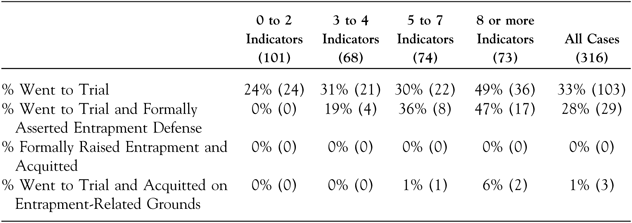
This section begins by providing descriptive statistics about defendants’ assertion of the entrapment defense in post-9/11 terrorism cases and then outlines four reasons why these defendants often decide against asserting entrapment. Table 1 presents data about the extent to which post-9/11 terrorism defendants chose to go to trial, whether they raised entrapment at trial, and whether they prevailed, organized by the number of entrapment indicators in their case.
Trials and Entrapment Claims of Terrorism Defendants in Cases Involving Undercover Agents or Informants (2001–2014) (n = 316)

Note. The number of defendants in each category is provided in parentheses.
Defendants in Table 1 were divided into four groups, each of which contains about a quarter of all defendants, based on the total number of entrapment indicators for each defendant. While there is no precise cutoff establishing when a defendant was entrapped, the highest-scoring cases are most likely to involve compelling entrapment claims, since each indicator represents an increased chance of entrapment. Previous studies used eight or more indicators as a cutoff, representing the top 23 percent of cases (Norris and Grol-Prokopczyk Reference Norris and Grol-Prokopczyk2018b, Reference Norris and Grol-Prokopczyk2019). Disaggregating results by number of indicators shows whether defendants with the strongest entrapment claims were more likely to go to trial, to assert entrapment, and to succeed in doing so.
Overall, out of 316 defendants in informant cases in the thirteen years after 9/11, 103 (33 percent) went to trial rather than plead guilty. Of those who went to trial, twenty-nine (28 percent) asserted the entrapment defense at trial. No defendants who formally raised the entrapment defense were acquitted. However, three defendants (1 percent of all cases) were fully acquitted by juries after making strong entrapment-related arguments for acquittal without formally raising the entrapment defense and making other arguments for acquittal as well, both of which likely influenced the result (Norris forthcoming). While making entrapment-type arguments despite not formally raising the defense may be somewhat common (Easton Reference Easton2014; United States v. Kabir 2015), it yielded full acquittals only for three defendants.
Defendants with eight or more entrapment indicators were the most likely to go to trial rather than plead guilty (49 percent) and the most likely to formally raise entrapment claims (47 percent). Yet even among defendants with the strongest entrapment claims, about half pleaded guilty, and over half of those who went to trial opted against raising entrapment. This provides one potential reason for the failure of the entrapment defense—it was often not raised even when it had the greatest chance of success. (Indeed, some defendants later claimed ineffective assistance of counsel because of their attorneys’ failure to litigate entrapment.)
Compared to defendants with the highest entrapment scores, defendants with five to seven indicators were somewhat less likely to go to trial or assert entrapment, while defendants with two to four indicators were even less likely to raise entrapment. Among those with zero to two indicators, the lowest percentage of defendants went to trial (24 percent), and none raised entrapment claims.
Why did even defendants with the strongest potential entrapment arguments decide against asserting the defense? First, and most obviously, many pleaded guilty in exchange for predictable sentences. One of the most powerful entrapment cases—and the database’s highest-scoring case—was that of Sami Hassoun, who lacked any terrorist ideology and was offered millions of dollars to commit an attack. Yet he pleaded guilty and was sentenced to twenty-three years. Several other defendants in highly questionable cases also pleaded guilty. These may have been rational decisions, due to the substantial trial penalties likely in these cases.
Second, some defendants strategically chose to rely on nonentrapment theories of defense at trial. Entrapment claims appear to admit guilt and may often be less persuasive than attempts to cultivate reasonable doubt about defendants’ criminal intent. As one attorney said, entrapment “involves you confessing to your guilt, and to get the jury past that you have to have a very sympathetic defendant and jury.”
To illustrate, one attorney who represented a terrorism defendant concluded that entrapment would be a “much less palatable” defense to “sell to a jury” than arguing that there was no agreement to commit terrorism. He said “we found it much more persuasive that there was really nothing there to begin with; this was a nothing case.” It was “very risky to raise entrapment,” in part because it “raised the issue of predisposition and we really did not know what evidence there was among the evidence we had.” This was especially true in that case due to the enormous volume of discovery and the attorneys’ lack of time and resources to analyze it.
Third, in cases involving several defendants, the government may induce one to plead guilty and receive a lenient sentence in exchange for testifying against others, enabling the government to preempt entrapment claims, as well as facilitating convictions. In the high-scoring Occupy Cleveland case, some defendants seemed prepared to assert entrapment before one defendant decided to plead guilty and testify against the others in specific ways that undermined their entrapment claims (United States v. Wright 2014).
The fourth reason for choosing not to assert entrapment even in the strongest cases reflects a classic sociolegal finding: Federal prosecutors, compared to local defense attorneys, are repeat players with more power, experience, expertise, and resources (Galanter Reference Galanter1974). A counterterrorism insider noted that one reason for the entrapment defense’s failure is the power imbalance between federal prosecutors and the local defense attorneys, who have “no experience, no security clearance and no background in terrorism cases.” In short, the trials are “very one-sided.” Similarly, a former FBI informant claimed that defense attorneys in these cases are “ill-equipped” to assert an entrapment defense and are “for the most part downright lazy” and unable to effectively impeach the informant. In many cases, the defense attorneys were highly skilled and had experience in terrorism trials, but other factors—such as lack of access to confidential information about the case—seem to have hamstrung their performance as counsel. Thus, several factors—trial penalties, considerations of jury perceptions, uncertainty about evidentiary issues, cooperating defendants, and an unlevel playing field between prosecutors and the defense—can combine to suppress entrapment defenses by encouraging guilty pleas or nonentrapment trial strategies.
Evidence Manipulation
Another factor in the failure of the entrapment defense is evidence manipulation by informants and law enforcement during investigations. Three illustrations are provided here: missing recordings from important interactions between informants and suspects, informants’ attempts to cultivate predisposition evidence, and more general efforts to manipulate the details of offenses to undermine entrapment claims and facilitate convictions.
First, in a suspiciously large number of cases, recordings are missing at critical times for determining whether entrapment occurred, such as conversations with the informant after meeting the defendant or immediately before the crime (Said Reference Said2015). A counterterrorism insider said “the rate of failure” of devices “at the first meeting” between the informant and suspect “is way beyond what could happen randomly.” Similarly, one expert said “there has to be something … going on to explain the enormous amount of malfunction.” As one former informant proclaimed, “We [informants] turn the recorders off and on all day long.” Yet as he noted, agents’ reactions were mild: “Remember to keep it on, OK?”
In some cases, the recordings are missing infrequently, while in others the selectivity is particularly extreme. A source close to one remarkable case said that the informant only recorded about 2 percent of his interactions with the suspect. FBI insiders (including two interviewees) have given credence to suspicions that such omissions are intended to increase the odds of conviction. Indeed, selective recording can have decisive effects on the viability of entrapment claims. Jurors in the Siraj trial reportedly thought he was entrapped, but due to the missing recordings they felt that they lacked the information needed to apply the defense (Lee Reference Lee2006). A former FBI agent noted that since informants had not “always been recording we don’t know what’s been done entirely to incite this guy,” depriving juries of information that might help them apply the entrapment defense.
Second, informants often transparently attempted to cultivate predisposition evidence by, for example, repeatedly prompting suspects to download terrorist propaganda videos. Another example is asking the defendants to swear an oath to Al Qaeda, which occurred in at least two cases. In one case, the defendants insisted on modifying the oath, so it was unclear if they were really pledging obedience at all. In another case, the defendant claimed not to have understood the informant’s garbled Arabic, and did not realize the meaning of the oath. Regardless, it seems that the oaths were introduced by informants’ handlers to ensure that there was sufficient predisposition evidence. More broadly illustrating how informant interactions are planned to create misleading evidence, a former FBI informant said, “After spending enough time with me, you become [a terrorist], I’m making you sound like it … you at least become one on the recordings.”
Another tactic to cultivate predisposition evidence, which helps show courts that the “lack of reluctance” predisposition factor applies, is for informants to tell defendants they can withdraw from the plots. On the one hand, this may seem reasonable, as a way to give the defendants a chance to change their minds and avoid prosecution. Yet it appears that in some cases informants only make such comments when defendants are already so involved with the plot and have been so consistently encouraged by informants that the informants believe the defendants are unlikely to quit. If the informant initially suggested the crime, pressured or radicalized the defendant, and offered substantial financial rewards, a late-stage offer to withdraw does not meaningfully mitigate the inappropriateness of earlier inducements. A similar principle has appeared in some nonterrorism entrapment decisions—“only those statements that indicate a state of mind untainted by the inducement are relevant to show predisposition”—though it has rarely been applied to find entrapment as a matter of law (United States v. Poehlman 2000).
In a Canadian decision finding that terrorism defendants were entrapped, the judge downplayed the significance of the “out” provided by the undercover agent, noting that “[i]t is highly unlikely that the average person would accept that once introduced to members of a terrorist group, they could disengage from this group without serious consequences” (Regina v. Nuttall 2016, 234). Indeed, there was evidence that the defendants believed they would be killed if they withdrew, which also allegedly occurred in a US case, that of Harlem Suarez. One attorney noted that in such cases, when the informant tells the suspect, “you don’t have to do this,” the informants are always “older and in a more superior position,” and they have “built up” the suspect, saying “you’re awesome” and so on. Thus, when they say “you don’t have to do this,” it is “not a real out,” due to “human nature” of wanting to impress people who are praising them. In any case, the motivation behind these “outs” is apparently to provide further predisposition evidence or undercut arguments that informants pressured them.
Third, more general efforts by law enforcement (in coordination with prosecutors) to manipulate the details of each case to maximize the chance of conviction are another form of evidence manipulation that undermines entrapment claims. In some cases, this may actually prevent entrapment abuses from happening (by ensuring that informants do not aggressively induce suspects), though it appears that such efforts are often employed to make acquittal less likely despite otherwise compelling entrapment claims. Indeed, some of the cases most widely regarded as examples of entrapment, such as the Cromitie case, feature such evidence manipulation.
According to a former FBI agent, the FBI learned their lesson from the mistrials in the Liberty City Seven case and realized they needed to “put some bells and whistles on these cases to get convictions,” such as “big weaponry.” The goal was to attain “Hollywood production value,” in which dramatic weapons or plans in the case would overwhelm a jury or judge and ensure a conviction. The ex-agent even suggested that such factors (such as impressive weaponry and plans for large-scale attacks) might “tie the US attorney’s hands,” so even if there was overwhelming evidence of entrapment, declining prosecution would be politically infeasible.
More typically, prosecutors and FBI agents work together closely from the beginning of each investigation, planning the details of the case, generally to ensure a successful conviction (with a lengthy sentence) and specifically to undermine potential entrapment arguments. Indeed, in recorded conversations between FBI agents in the Sami Osmakac case (Aaronson Reference Aaronson2015), agents said that prosecutors wanted them to encourage the suspect to pick a government target for his attack, since “[t]hat’s a better charge” than attacking a private business (Reference Aaronson2015, 60). They discussed informant actions that would “steer[ ] him more toward the government,” though “not overtly,” so he would act as agents wished but without the appearance of entrapment (30). Another reason for choosing government targets is that private targets may not affect interstate commerce, endangering their ability to prosecute the case in federal court (63).
In addition, agents arranged employment (with an informant) for the penniless and mentally ill Osmakac, so that they could get him to spend some of his earnings on weapons for an attack. Agents and prosecutors reasoned that “[h]e can part with that money”—once the informant gives the money to Osmakac “it’s his money whether we orchestrated it or not” (98). The idea was that if Osmakac was willing to spend some of his own money, that would help convince jurors that he was not manipulated into the offense. Agents were apparently worried about the appearance of entrapment—as one said, anything that could be done “to strengthen our case … and this case sucks, we should do” (35).
In their conversations, the agents clearly saw Osmakac as a blank slate. As one said, “[h]e’s an irrational guy, it’s not like us where you have an objective and do all the planning toward it. I mean, I don’t think he cares” (51). An agent described how he “[b]lathered on for five minutes and then one of us would say, is that what you meant, and is this what you’re saying? You had to pull something out of him” (20). This suggests that conversational techniques were employed to give aimless rambling the superficial appearance of concrete plans.
One expert noted that “plots are constructed very carefully by the FBI to make sure they get a conviction and that they get a really long sentence, because they can control these elements.” Illustrating how informants engineer the precise details of each offense, an ex-informant said that “in these cases,” if “you remove informants there is no case, no operation,” and “no planning,” since “informants take the initiative from the outset and develop it from A to Z. In the operation the informant is the mentor; the informant is the puppeteer.”
This continual coordination between agents and prosecutors would be predicted by structural-contextual theory, which shows that in certain high-priority areas, authorities in different agencies coordinate to generate convictions, resulting in a high number of successful prosecutions (Smith and Damphousse Reference Smith and Kelly1998). Police efforts to undermine procedural protections have been noted in other areas; one study found that police manuals instructed officers how to minimize the effects of Miranda warnings to ensure that suspects talked anyway (Weisselberg Reference Weisselberg2008).
Prosecutorial Misconduct
Prosecutorial misconduct also contributes to the failure of entrapment claims. This includes withholding critical discovery materials and may also extend to suborning perjury and knowingly relying on perjured testimony in trial arguments. Ten years into Eric McDavid’s twenty-year sentence for an “eco-terrorism” conspiracy, prosecutors acknowledged withholding thousands of pages of documents about the informant, after Freedom of Information Act requests yielded many of the missing documents (Moynihan Reference Moynihan2015). The documents contradicted the informant’s trial testimony that she did not romantically manipulate McDavid into the offense. Interviewees noted that the documents showed that she “did encourage and stoke and nurture” McDavid’s advances. In the original trial, there was “an effective defense attorney who was … totally focused on the entrapment defense, which was an incredibly close case for the jury.” Including these documents “would have reverberating effects,” since it would “tend to show that Eric was manipulated romantically by the informant and at the behest of the FBI,” who instructed the informant on “how to leverage” his romantic interest “in every way possible.” The source believed the withheld materials led to a “reasonable inference that there should be a real inquiry into the question of whether the prosecutors put this informant on the stand to lie,” which would constitute serious misconduct. Absent such misconduct—both violations of disclosure requirements under Brady v. Maryland (1963) and perhaps suborning perjury—McDavid’s entrapment defense would have had a greater chance of success.
In the Hossain/Aref case, the government withheld impeachment evidence about the informant, who was also the informant in the notorious Cromitie case (Aref Reference Aref2013). As has been documented extensively, the informant, Shahed Hussain, was a lifelong con man with a long record of fraud, who was found to have perjured himself numerous times in the Cromitie case alone (United States v. Cromitie 2011b). With the impeachment evidence, an entrapment acquittal in the Hossain/Aref case would have been more likely. Remarkably, Hussain’s negligently operated limousine company was recently responsible for one of the highest-fatality car crashes in American history, shedding further light on the character of the informants who are protected and paid by the government (Newman, Weiser, and Rashbaum Reference Newman, Weiser and Rashbaum2018).
In the Cromitie case, prosecutors seem to have knowingly used Hussain’s perjured testimony to argue their case and narrowly escaped a ruling to that effect. Yet the Second Circuit’s only rationale for ruling that they did not knowingly rely on false testimony was that it was technically possible prosecutors might have believed the informant’s statements, even though prosecutors had “no reasonable basis” for such a belief (United States v. Cromitie 2013). Prosecutors argued at trial that there was no evidence that informant Hussain offered $250,000 to the defendant to commit the attack, despite clear evidence of this offer. The only evidence against the offer was the informant’s testimony that $250,000 was a code word, which he admitted the defendant did not know. The court concluded that the government should have known that his testimony was false, but deemed the error harmless, since the jury must have realized the $250,000 offer was genuine, as the testimony suggesting otherwise was obviously false.
This is highly problematic because jurors may not have been paying attention at every moment and may have been influenced by prosecutors’ reliance on these lies in claiming that there was no evidence for the offer. If jurors had no doubt about the offer, they may have been willing to apply the entrapment defense. Notably, the $250,000 was not a minor detail in the case, but rather played a crucial causal role, since it appears that Cromitie had decided against participating in the plot and was only swayed by the offer.
In the case of Sami Hassoun, the government’s internal records revealed that the FBI believed the informant to be entrapping Hassoun. Yet this documentation was not released to the defense until after Hassoun pleaded guilty (Associated Press 2013). If the government had disclosed this material in a timely fashion, it may have influenced Hassoun to go to trial and assert entrapment.
A counterterrorism insider confirmed that part of the reason for entrapment claims’ failure is that “the FBI rarely turns over everything” to the defense. This should not be surprising. As Ninth Circuit judge Alex Kozinski has written, “[t]here is an epidemic of Brady violations abroad in the land” (United States v. Olsen 2013, 626). Due to claimed needs for secrecy, these disclosure violations may be even more common in terrorism cases. Moreover, since prosecutorial misconduct often leads to false convictions in nonterrorism cases, and yet prosecutors are virtually never punished for misconduct (Innocence Project 2011), it should be expected that such misconduct contributes to unjust results in terrorism cases as well. This underscores Shklar’s (Reference Shklar1990) observation that miscarriages of justice are not “rare occasions when a political order wholly collapses,” but rather “occur continuously within the framework of an established polity with an operative system of law, in normal times” (19).
Doctrinal Deficits
Deficits in entrapment doctrine also prevent the defense from fulfilling its intended function. This section shows that interviewees attribute entrapment’s failure to the doctrine itself and presents several examples illustrating doctrinal deficits. Next, this section presents a quantitative analysis of the disposition of all post-9/11 entrapment claims, showing how different aspects of entrapment doctrine contribute to judicial rejection of entrapment claims. Finally, this section uses these results to illustrate and extend Dolovich’s (Reference Dolovich, Dolovich and Natapoff2017) theorization of how courts undermine defendants’ rights.
Attorneys interviewed for this project were quick to point to entrapment doctrine as the reason for the defense’s failure. An attorney opined that “[e]ntrapment is just hopeless the way the law is written.” Another said that the “standard set by the courts is too difficult to meet, it’s simply that—it’s too difficult a threshold to meet.” One attorney commented that the entrapment defense “is a very difficult threshold” in part because it is “so subjective” an issue “for the jury to be evaluating,” and thus it is “easy for the jury to rationalize denying the defense.” Suggesting that entrapment is a mythical doctrine that appears on paper but never in reality, an attorney quipped, “everybody brings up entrapment,” but “do you know what entrapment’s like? Have you ever heard of a Yeti? Have you ever seen one? That’s the entrapment defense.”
In the Cromitie case, despite the judge’s exceptionally critical view of the case as quoted earlier, she held, and the Second Circuit agreed, that Cromitie was not entrapped as a matter of law, because he had an “already formed design” to engage in terrorism before he met the informant (United States v. Cromitie 2011b, 2013). However, this design amounted to no more than loose talk in his first conversations with the informant, when Cromitie said he wanted to “do something to America” and made ludicrous remarks about having wanted to perpetrate terrorism since he was seven years old (United States v. Cromitie 2011b, 4, 2013, 201). In fact, Cromitie was a pathological liar, who frequently claimed to have done incredible things that never occurred, and was apparently improvising lies to impress the informant.
Chief Judge Dennis Jacobs’s dissent in Cromitie’s appeal persuasively argues that Cromitie lacked an already formed design (United States v. Cromitie 2013). He concluded that Cromitie’s vague comments did not “amount to a design,” much less “one that was ‘already formed’” (2013, 227–28). He contended that the majority’s broad definition for already formed design “is more its converse because an idea or intent does not amount to a design” (228). He noted that their interpretation would make entrapment “untenable as a defense” and detailed how it contradicted established case law (228). He commented further that “it is not enough to infer a formed design to commit an act of terror from a sense of grievance or an impulse to lash out,” since “these disquiets are common, and in most people will never combust” (229). These arguments are consistent with research showing that the vast majority of terror sympathizers never become personally involved in terrorism (McCauley and Moskalenko Reference McCauley and Moskalenko2014).
In line with the trial court judge’s comments that Cromitie could have never been recruited, Chief Judge Jacobs noted that the agent “had to” drive the crime in every respect, “because Cromitie was comically incompetent, possibly the last candidate one would pick as the agent of a conspiracy” (United States v. Cromitie 2013, 230). Indeed, there is no record of real terrorists inexplicably fixating on some inept individual as their preferred recruit, offering continually more valuable inducements until the individual acquiesces. Such an argument might potentially be persuasive to courts or juries. Yet it would not directly address the applicable legal standard, which turns on the abstract question of predisposition rather than the more realistic question of whether the defendant would have likely committed such a crime without the informant’s influence. It is also important to note that it is technically possible even for dysfunctional individuals to perpetrate terrorist attacks. However, in this case, there was no evidence whatsoever that they had been planning terrorist activity on their own or were in danger of being recruited by real terrorists. This suggests there was no articulable policy rationale (even reasonable suspicion) for the operation.
Despite his vigorous dissent regarding Cromitie, Chief Judge Jacobs agreed that Cromitie’s codefendants were not entrapped because they “readily responded” to the inducement (2013, 230). Yet those codefendants were equally harmless, probably even more so, since they had no radical ideology at all, went along with the plot solely for the money and wanted to ensure that no one was hurt. It is virtually inconceivable that such individuals would have become involved in terrorism without a sting operation.
One attorney who analyzed numerous entrapment cases noted that the “ready response standard” was used in such a way as to apply to anyone who “didn’t withdraw,” allowing that alone to constitute predisposition. “The way it’s been interpreted is that if you don’t withdraw from the plot then it’s a ready response. So there is no entrapment defense.” While the attorney’s conclusion may be an exaggeration, it does seem that nearly any set of facts can be construed as a “ready response,” even if the sting lasted for months and the target exhibited reluctance. Indeed, researchers have long suspected that successful inducement is considered enough to show predisposition (Marx Reference Marx1988). Such problems with the “ready response” doctrine could be resolved if more courts were to adopt the Seventh Circuit’s “positional predisposition” test in United States v. Hollingsworth (1994), requiring that a person have a reasonable chance of committing such a crime on their own for them to be found predisposed (McAdams Reference McAdams2007).
Another doctrinal weakness is that courts allow juries to rely on virtually anything to conclude that someone is predisposed. In one case, a witness falsely and inappropriately testified that a wallet-sized Arabic supplication demonstrated terrorist intent. Bizarrely, the court allowed this testimony, while refusing to admit the testimony of a witness who would have argued that this pocket supplication was common in Pakistan and had no terrorism connotation. Indeed, as Judge Tashima appeared to argue, it was no more associated with terrorism than is the traditional hymn “Onward Christian Soldiers” (United States v. Hayat 2013). A source noted that in another case, that of Yassin Aref, prosecutors “threw out as much stuff as they could to confuse the jury” and try to prove his predisposition, ranging from vaguely negative things he said about the West while living abroad in the 1990s to ambiguous lines from poetry written in his diary. More generally, even though the Supreme Court in Jacobson (1992) made clear that the government must prove predisposition prior to government contact, in fact statements made by defendants far into sting operations, including political speech not directed related to committing terrorism offenses (Said Reference Said2015), are relied on for predisposition evidence.
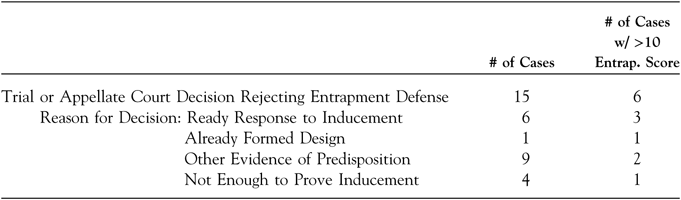
Table 2 illustrates the disposition of entrapment defenses litigated in post-9/11 terrorism cases, as determined by analyzing the relevant cases from Table 1. In fifteen cases (some of which feature several defendants each), trial or appellate judges issued decisions rejecting terrorism defendants’ entrapment claims. Of these fifteen cases, six were rejected due to defendants’ allegedly “ready response” to inducements. In nine cases, other predisposition evidence, sometimes based on considering predisposition factors from case law, was found sufficient to justify the verdict. Courts concluded in four cases that there was not enough evidence to constitute inducement, thus making the predisposition inquiry moot. (Some cases featured more than one rationale, making the total exceed fifteen.) Some of these entrapment arguments appeared weak and thus may have been appropriately rejected.
Dispositions of Entrapment Claims Litigated in Terrorism Cases (2001–2014)

Note. Cases were organized by operation rather than by individual defendant.
Analyzing the six cases with ten or more entrapment indicators in which entrapment was raised illustrates which doctrines were used to reject (what are most likely) the strongest claims. In those cases, “ready response” was the judge’s rationale in three cases, “already-formed design” was found in one case, lack of evidence for inducement was the justification in one case, and other evidence indicating predisposition was dispositive in two cases. Thus, although several aspects of entrapment doctrine were invoked to reject the strongest cases, the “ready response” category appears most prominent. Interestingly, in four cases (not included in the table), two of which had over ten indicators, defendants declined to appeal on entrapment grounds after juries rejected entrapment claims. This suggests that even some of the strongest claims were perceived as futile by defendants or attorneys.
Dolovich (Reference Dolovich, Dolovich and Natapoff2017) argues that courts tend to ignore systematic violations of constitutional rights through a three-step process. This involves, first, “underscoring the need for judicial deference to some state actor or institution,” second, “establishing a presumption of constitutionality” for government action, and, third, “announcing a substitute question that will be dispositive in most instances” (112–13). This substitute question “shift[s] the inquiry away from the governing constitutional principle and ha[s] little if anything to do with the actual lived experience or even the complaint of the individual … bringing the claim” (113).
While entrapment is not a constitutionally based defense, a very similar process occurs with entrapment. First, aside from viewing evidence in the light most favorable to the government on appeal, courts stress the need to defer to juries’ “factual” determination of predisposition. Second, initial decisions to induce suspects are presumed to be legal and are never examined in contemporary jurisprudence. This ignores powerful arguments by many experts (and enshrined in Canadian and European entrapment law) that due process violations occur when the government induces people to commit crimes without reasonable suspicion that they were already likely to commit such crimes (Roach Reference Roach2011). This lack of a reasonable suspicion requirement is remarkable given the extraordinary intrusiveness of stings, in which informants often become suspects’ best friends, exerting enormous influence on them. Third, the predisposition inquiry shifts the question away from the entrapment defense’s underlying rationale—preventing the targeting of those unlikely to commit such offenses on their own—by allowing juries to rely on nearly any fact in finding predisposition, including statements made months after informants began influencing them. Further extending Dolovich’s framework, this “substitute question” becomes considerably more removed from reality in terrorism trials, since what counts as predisposition is so much more expansive, encompassing political conversations and other material that would otherwise be inadmissible (Said Reference Said2015).
This departure from normal practice can be explained, to a large extent, by the misleading radicalization narratives that have become dominant in public policy thinking (Kundnani Reference Kundnani2012, Reference Kundnani2014). Government manuals and media depictions unrealistically portray radicalization as occurring in a conveyor belt–like manner (Akbar Reference Akbar2013). In this prevalent interpretive frame, any Muslims voicing harsh critiques of US foreign policy, expressing sympathy for political violence anywhere in the world, or even increasing religious observance are perceived as being on a predictable trajectory toward personal terrorism involvement. In fact, only a miniscule percentage of people with these characteristics ever perpetrate terrorism (Norris Reference Norris2015). Yet due to widespread belief in these flawed radicalization models, these factors—which have negligible value in predicting whether someone will engage in terrorism—are considered evidence allowing juries to conclude that prosecutors have proven defendants’ predisposition. By contrast, in nonterrorism trials, predisposition very frequently revolves around evidence of prior or ongoing involvement in the same type of crime (Marcus Reference Marcus2015).
Procedural Irregularities
The next factor involves procedural irregularities, in which questionable or highly unusual rulings appear to reflect courts’ determination to ensure the government prevails. As one counterterrorism insider said, “judges very often side with the government,” since “if you look at” how they rule on “all the motions,” the judges are “usually very prejudiced towards the government.” Indeed, “the judges think like the FBI agents” and see themselves as “protecting society against … terrorism.” Potential illustrations of this tendency include hyperbolic dicta in federal appellate decisions—such as the claim that terrorism is “the modern-day equivalent of the bubonic plague” (United States v. Mehanna 2013)—and Judge Richard Posner’s dramatic revival of the Supreme Court’s decades-old observation that the Constitution is “not a suicide pact” (Posner Reference Posner2006).
In his book Not a Suicide Pact, Judge Posner endorses “the marginal adjustments in [constitutional] rights that practical-minded judges make when the values that underlie the rights … conflict with values of equal importance, such as public safety, suddenly magnified by the onset of a national emergency” (Reference Posner2006, 1). Such ideas appear to encourage “practical-minded” judges to make “marginal adjustments” to any rights-protecting doctrine they apply in terrorism cases, and all the more so in the case of entrapment, with the unique status of a judge-made procedural protection lacking a constitutional foundation. This could explain why some judges have declined to rule that defendants are entrapped despite extreme inducements and scarce predisposition evidence, or, as in the Cromitie case, in spite of the judge’s own substantive dismissal of defendants’ dangerousness. As Said observes, courts “seem to be articulating their position on terrorism through their rejection of the entrapment defense,” such as implying that Cromitie cannot be acquitted because of the heinousness of the alleged crimes (2015, 42). Some judges have occasionally made critical remarks about government tactics in these cases, but they amount to only three judges (one trial court and two appellate). Moreover, the critical trial court judge actually ruled that the defendants were not entrapped, and the two skeptical appellate judges were unable to convince their colleagues and expressed their views in dissenting opinions.
The Aref/Hossain case has probably the most irregularities and the most disturbing ones. Mohammed Hossain was a Bangladeshi immigrant who operated a pizza restaurant and owned residential properties. From his conversations with the informant over several months, it was clear that he was opposed to terrorism and would speak against it whenever the informant raised the topic. However, when the informant offered Hossain a loan, mentioning that he was involved in procuring weapons for terrorists, Hossain accepted the offer, apparently in need of funds to repair his properties.
The informant ensnared Yassin Aref—an Iraqi Kurdish refugee who was Hossain’s imam—in the plot by having him witness the loan, a routine procedure under Islamic law. They were arrested as Aref witnessed the loan and were subsequently convicted of terrorist money laundering and sentenced to fifteen years. Hossain unsuccessfully asserted entrapment at trial, while Aref’s equally unsuccessful strategy was to argue that he was unaware of the terrorist scheme. A remarkable aspect of the case was the lack of any valid justification for targeting Hossain or Aref. There is no evidence that either were ever involved in terrorism or had even advocated terrorism. Confusion about Aref’s identity and a mistranslation of a notebook found in Iraq are two theories for why authorities targeted Aref (Aaronson Reference Aaronson2013; Downs and Manley Reference Downs and Manley2014).
One of the procedural irregularities in that case was the prosecution’s submission of several ex parte memos to the judge. Although the defense was unable to view these memos, they believe that they probably claimed that Aref was a secret terrorist agent. Presumably influenced by these memos, the judge gave an astoundingly prejudicial instruction to the jury:
There really isn’t any question in this case as to the reason Mr. Aref was targeted by the FBI …. Those reasons were good and valid reasons based on suspicions that the FBI had. Beyond that, you can’t consider any reason regarding that (Aref Reference Aref2013).
This instruction effectively endorsed the entire operation, assuring the jury that the judge had secret information justifying it. As source close to the case noted, the instructions essentially said, “I know this is a nonsense case, but we really believe he’s a terrorist, so help us out here.”
The defense argued on appeal that these instructions shifted the burden of proof to the defendant (United States v. Aref 2008). This is a plausible way to characterize them, since, as a source close to the case said, the court reversed “the burden of proof completely—he had to prove his innocence beyond a reasonable doubt, and he couldn’t do that.” Such issues may extend beyond this case, as a counterterrorism insider noted that “ex parte meetings” between prosecutors and judges occur in which prosecutors essentially said, “[t]rust us, judge, we have a reason to do this.” As he put it, “a lot of judges buy it.”
The unpublished Second Circuit opinion upholding these instructions is cursory and confusing. The opinion begins its brief treatment of the issue by stating, “Aref contends that the instruction shifted the burden of proof, as demonstrated by his acquittals on all but two substantive money laundering counts” (United States v. Aref 2008, 792). Yet if the instructions shifted the burden to the defendant, how could that possibly cause acquittals?
The court then says it disagrees with Aref’s contention about the burden of proof because “the two counts of conviction were based on the only two financial transactions following the [informant’s] final reminder that his money came from selling weapons to mujahideen” (792). This apparent nonsequitur does not address the burden of proof issue, much less the prejudicial nature of the instructions. It is also factually incorrect, as noted by one interviewee, because during recorded conversations corresponding to the counts on which Aref was actually convicted, mujahideen and weapons were not mentioned. It is extraordinary for such an unusual instruction to be upheld in this casual and brief manner.
In the same decision, the Second Circuit’s rejection of Hossain’s entrapment claim was even more underdeveloped. Incredibly for such a controversial case—even the Albany city council voted to condemn the prosecution—the court simply dismissed Hossain’s claim in one sentence, in a wholly conclusory manner, failing to mention a single fact of the case (791).
The trial court’s rejection of Hossain’s entrapment claim was also unusual and difficult to justify. While the court acknowledged that Hossain often spoke against terrorism in his conversations with the informant, the court cited highly ambiguous statements that, the court concluded, could possibly be interpreted as suggesting predisposition (United States v. Aref 2007). By any measure, these quotes are extremely weak evidence for predisposition.
An interviewee involved in the Hemant Lakhani case indicated that there was case law in his jurisdiction holding that when one government informant sells a defendant something to sell to another informant (as happened in this case), that is entrapment as a matter of law. As the source described it, the court took the unusual step of not allowing oral argument and totally ignored that precedent in its decision. It appears that the court was determined to rule against the entrapment defense, even if it meant altering standard procedures and disregarding the defendant’s core argument.
In the Hayat case, James Wedick, who served as an FBI agent for decades, was prepared to testify that Hayat likely gave a false confession. Yet Wedick’s testimony was excluded, while questionable and prejudicial testimony by prosecution witnesses was admitted. Judge Tashima of the Ninth Circuit appeared to agree with Wedick, referring to Hayat’s confession as “meandering and almost nonsensical” (United States v. Hayat 2013). A number of evidentiary rulings in the case appear biased toward the prosecution. Astonishingly, the judge allowed the informant to testify that Hayat had told him he attended a training camp but refused to allow the defense to cross-examine the informant about Hayat’s later statement that he never attended the camp (McCulloch and Wilson Reference McCulloch and Wilson2016). Yet on appeal, only Judge Tashima voted for reversal.
Similarly, one analysis of two terrorism cases found that “courts allowed expert testimony that confirmed already widespread fears about Islamic fanaticism in furtherance of the government’s prosecution,” and yet “excluded testimony intended to challenge these stereotypes in support of the defense” (Koprowski Reference Koprowski2011). Moreover, Lahav’s (Reference Lahav2003) study of archetypical political trials, such as the Chicago conspiracy trial of 1968, noted “the peculiar laxity with which the laws of evidence and … procedure are treated by the courts,” which “appear[] to lean toward the prosecution” (778, 791–92).
After the Fort Dix Six conviction, both the main conspirator (Shnewer) and the government informant (Omar) recanted, admitting that the Duka brothers knew nothing about the plot and were not involved in it at all (Hussain and Ghalayini Reference Hussain and Ghalayini2015). Apparently Shnewer had lied to the informant about the Duka brothers agreeing to participate in the plot. It is highly extraordinary and disturbing for three brothers to receive life sentences without any evidence for their participation in the conspiracy, other than the (now recanted) claims of their alleged coconspirator. Yet the court declined to order a new trial.
In one case, the prosecution was allowed to argue in closing arguments that entrapment was impossible in a terrorism case (United States v. Mohamud 2016). This is highly inappropriate, because it undermines entrapment instructions by introducing a novel theory contradicting current law. The court also allowed informants’ identities in that case to be kept secret, preventing the development of impeachment evidence.
In the Liberty City Seven case, powerful entrapment arguments led to two mistrials and complete acquittals for two defendants. During the third trial, prosecutors said they would not try the case a fourth time if there was another mistrial. In fact, the third trial very nearly ended in mistrial as well. Yet a conviction was secured by removing one juror (who was holding out for acquittal) from the case. The juror was removed for refusing to deliberate, but an attorney close to the case believed that in reality, the juror simply disagreed with the other jurors.
A number of irregularities include questionable entrapment decisions, which, beyond the doctrinal deficits outlined above, appear to reflect a determination to ensure that the government prevails. As one interviewee commented, “judges, with some important exceptions”—such as Judge McMahon from the Newburgh case—“bend over backwards to help the prosecution.” One attorney who had analyzed many entrapment cases concluded that “a lot of the decisions that come out of these courts are so contrary to precedent that they’re kind of off on their own,” almost like the Japanese internment case, since “it is so clear they’re ignoring the facts or the law in order to arrive at” their conclusions.
As an illustration, the Ninth Circuit upheld a court’s refusal to give an entrapment instruction in a terrorism case, even though, as the dissenting judge noted, to do so it had to “ignore substantial evidence on the record”: the informant “continued to encourage [the defendant] to obtain weapons … on several occasions,” and proposed the meetings that led to the defendant’s arrest (United States v. Kurt 2013). The dissenting judge commented that the ruling, which deprived the defendant of his only defense, “effectively entered a directed verdict for the government.” In another case, a former FBI agent commented that “you would have thought the case would have been thrown out because of what the informant did, but it wasn’t, and I still can’t believe the judge didn’t sit there and admonish the informant” and pressure the “government to dismiss the case, but again we all saw those buildings come down.” As he saw it, 9/11 prompted stark departures from how such issues were previously handled.
In practice, the vagueness and indeterminacy of entrapment doctrine allows judges to rule as predisposed even defendants with the strongest entrapment claims, apparently influenced by the overriding preemptive imperative of modern counterterrorism discourse. Similarly, de Lint and Kassa (Reference de Lint and Kassa2017, 170) show that attorneys in Australia “contribute to the bending of process in counter-terrorism trials away from legal principles,” in part “through accommodation to the precautionary standard.” The preemptive paradigm characterizing counterterrorism law worldwide has undermined procedural protections in a number of ways, enabling punishment based on speculation about potential risks (Lynch, McGarrity, and Williams Reference Lynch, McGarrity, Williams, McGarrity, Lynch and Williams2010). For example, as Judge Tashima of the Second Circuit noted in his dissent in United States v. Hayat, the court allowed his conviction “largely based on dire, but vague, predictions that he might commit unspecific crimes in the future” (2013, 904).
Such unprecedented prioritization of preemption may explain why Judge McMahon ruled Cromitie predisposed despite her clearly expressed belief that Cromitie posed no threat (Dratel Reference Dratel2011; United States v. Cromitie 2013, 210). Due to the “extreme precautionary dogmatism” (Jackson Reference Jackson2015, 36) animating counterterrorism, the way the entrapment defense is applied may have shifted in terrorism cases, even if entrapment case law has not significantly changed since 9/11. As one attorney remarked, terrorism cases involving Muslims “killed the entrapment thing” by letting “exceptions eat up the rule.” Yet it is ultimately unclear whether the doctrine itself, or the distorted way it is applied in terrorism cases, is responsible for entrapment’s failures. Both appear to be responsible, though one may be dominant in individual cases.
One analysis of controversial terrorism decisions noted “various alleged procedural irregularities” in one criminal prosecution and a marked “lack of care” in Judge Richard Posner’s decision on civil liability for defendants in the case (Benthall Reference Benthall2010, 4, 9). In particular, the author noted that, given Judge Posner’s “extra-professional writings” as a “spare-time political commentator,” his decision appeared motivated by a “determination on the part of the state to crack down hard on Islamic institutions, with inadequate attention to considerations of fairness” (10). More broadly, an analysis of post-9/11 terrorism trials found that they were “typically characterized by inclusion of secret evidence, excessive security to intimidate the jury, questionable governmental ‘experts,’ mistranslations and mischaracterizations of the defendant’s words, and other unfair tactics that forced defendants to defend themselves on highly un-level playing fields” (Downs and Manley Reference Downs and Manley2014, 17). Such features have led some to conclude that terrorism trials’ “veneer of due process” gives them “undeserved legitimacy,” given their departure from the “presumption of innocence” and the “beyond a reasonable doubt standard of proof,” as well as the fact that defendants are “unable to point to evidence that disproves suspicion because an imaginary crime cannot be disproved” (McCulloch and Wilson Reference McCulloch and Wilson2016, 71, 73).
As Resnik (Reference Resnik2010) notes, some actually argue that “threats of terrorism license procedural irregularities” (618). Indeed, law professors Eric Posner and Adrian Vermeule, in their expansive defense of unrestrained executive power (even torture) in the War on Terror, generalize approvingly that “[w]hen national emergencies strike, the executive acts, Congress acquiesces, and courts defer” (Reference Posner and Vermeule2007, 3). The unprecedented large-scale use of terrorism sting operations, many of which appear to constitute entrapment under current law, can be seen as an example of this phenomenon. As a former FBI informant described this controversial use of informants, “Is it working? Yes. It is unconstitutional? Yes. But that’s where we are with our democracy today—one thing that destroys the fabric of democracy, that’s terrorism, and this is how we combat it.” If the FBI, prosecutors, and judges believe a particular set of tactics is necessary, even they are inconsistent with the law, judges may tend to defer as long as the “emergency” and its associated state of exception are seen as remaining in place.
Jury Intimidation
Jury intimidation is a final factor that helps to explain the entrapment defense’s failures. This section describes jury intimidation in the Hayat case, excessive security measures allegedly aimed at influencing juries, and jurors’ overall reluctance to apply the entrapment defense in terrorism cases, given the primal fears and racialized alarmism that terrorism evokes.
First, in the Hayat case, jurors reportedly believed he was entrapped, but felt intimidated by the jury foreman. Hayat never showed inclination to become personally involved in terrorism until the informant forcefully berated him, even threatening to “force” him by his “throat” (McCulloch and Wilson Reference McCulloch and Wilson2016, 119). According to one report, only a single juror thought Hayat was capable of committing any terrorism offense. Yet the jury foreman reported feeling apprehensive about letting the government lose the case, given what people of his “background”—presumably, foreign-born Muslims—had done in the past (Waldman Reference Waldman2006, 93). This seems to indicate that jurors had difficulty assessing predisposition and in the case of doubt decided to simply defer to the government, inspired by stereotypical associations between Muslims and terrorism. That is the opposite of juries’ legal duty in such cases, which is to acquit unless predisposition is proven beyond a reasonable doubt.
Second, in several cases extreme yet unnecessary security measures, such as snipers on rooftops and guards with helmets and semi-automatic rifles, have been employed. Some see this as a form of “security theater,” as one interviewee put it, meant to intimidate the jury into thinking the defendants were dangerous and needed to be convicted (Hughes Reference Hughes2011). As one observer noted, a “bomb squad” was deployed for the arrest even though the police knew the bomb was fake, and an “18 wheeler” was ostentatiously used to block traffic (National Public Radio 2014). One report argued that “[t]he FBI made absurd displays of security to intimidate the jury” in the Cromitie case, and the judge’s granting of “the prosecution’s motion for an anonymous jury with extra security” in another case “increas[ed] the chance that the jury would be prejudiced before the trial ever started” (Downs and Manley Reference Downs and Manley2014, B-6, B-18).
An attorney recalled that in a case in which he was involved, the “security situation was overt, very visible, and gave the courthouse a sense of foreboding,” given the “military vehicles and unusual weapons and locations on tops of roofs and helmeted officers.” This “added a certain pressure situation, and you don’t know how a jury judges that.” Another attorney commented that in the Newburgh case, there was a “circus outside” the trial, with “snipers everywhere,” and even “a tank,” but there would be no such measures when jury was not there to see them. Yet he noted that he has not seen “that show trial aspect” in more recent cases, suggesting that at some point authorities realize that “it doesn’t work.” Whether certain security measures (such as large numbers of armed guards surrounding the defendant) were prejudicial to the defendant has been litigated in at least one post-9/11 terrorism case (Khadr Reference Khadr2010) and in nonterrorism cases as well (Hayes v. Ayers 2011).
A final, more general point is that the extreme fear that terrorism engenders may prevent juries from seriously considering entrapment defenses. One attorney noted that if “they exonerate the wrong person and they go on to commit a crime,” then jurors “couldn’t live with themselves.” This “emotional risk management,” which enables convictions despite compelling entrapment claims, “encapsulates why entrapment fails.” One attorney noted that of all the answers to voir dire questionnaires they received from five hundred potential jurors, the “most perfect answers we got,” were along the lines of, “I could absolutely follow the law and absolutely follow entrapment, but if I was wrong I don’t know if I could live with myself.” That is, even jurors open to the entrapment defense were extremely hesitant to apply it in a terrorism case.
Such fears are skillfully cultivated by prosecutors, who use various tactics—such as repeatedly mentioning Osama bin Laden in cases having nothing to do with him—to depict defendants as dangerous terrorists who must be convicted to prevent horrific attacks (McCulloch and Wilson Reference McCulloch and Wilson2016). Radical speech by defendants, shown to the jury as predisposition evidence, prompts jurors to see defendants as having a “jihadi heart” and “jihadi mind” (in the words of one prosecutor’s arguments to the jury) (United States v. Hayat 2013, 904) and conclude that they are terrorists from whom society must be protected. Terrorism trials in practice have the “expressive function” of making juries believe in the “irredeemable nature of a terrorist” (Said Reference Said2015, 43), or anyone with terrorist sympathies. In such a context, juries need only “view the suspected terrorist with suspicion to convict” (McCulloch and Wilson Reference McCulloch and Wilson2016, 67). Moreover, due to the discourse of radicalization, which functions as a “master signifier” representing the ultimate cause of terrorism (Kundnani Reference Kundnani2012, 3), jurors may assume that if the government provided evidence that the defendant held radical views, this alone provides sufficient reason to assume dangerousness and vote for conviction.
In the Hossain/Aref case, the trial occurred exactly on the fifth anniversary of 9/11, when footage of the attacks was being rebroadcast continually on television. According to one interviewee involved in the case, that timing, and the fact that the defendants were bearded and “foreign,” doomed the entrapment claims in their case. As a general matter, it may be that jurors have difficulty believing entrapment is possible in terrorism cases and are easily persuaded by (explicit or implied) government arguments that only people already predisposed toward terrorism could be induced. As an interviewee expressed it, “if the informant can convince you to actually shoot someone, morally the public does not want to believe that can happen” to someone not already predisposed. An expert reported that the FBI thinks that “the public in general agrees, you can’t be talked into terrorism—they have to be evil-minded” already. A source close to the Sami Hassoun case noted that the public believes “anyone willing to engage in these conversations” about terrorist attacks is “a dangerous guy” who needs to be “off the streets.” In his case, “this talk alone probably sealed his fate,” even though he was not radicalized and had never had any interest in terrorism before the informant befriended him.
The racialized nature of these fears, based on longstanding Orientalist stereotypes of Muslims as inherently irrational and violent (Jackson Reference Jackson2007), may be driving entrapment failures in jury trials and in court rulings as well (Norris and Grol-Prokopczyk Reference Norris and Grol-Prokopczyk2019). Indeed, the clearest example of an entrapment-related acquittal in a terrorism case, that of Bradley Kahle, involved a white, male, right-wing extremist, and other non-Muslims figure prominently among the small handful of partial successes of entrapment claims in terrorism cases (Norris and Grol-Prokopczyk Reference Norris and Grol-Prokopczyk2018a; Norris forthcoming). Jurors’ reference to Hayat’s “background,” as quoted above, illustrates how Muslim identity becomes a proxy for dangerousness.
In the Kahle case, the defense attorney skillfully highlighted the common ground between the defendant and the small-town Pennsylvania jury, even quoting a popular NRA slogan in an attempt to portray the defendant’s seemingly violent talk as harmless bravado. By contrast, radical views among Muslims have been widely viewed as evidence of future violence, proving predisposition and thus defeating the entrapment defense. Interestingly, Kahle’s case was missing the pro-prosecution procedural irregularities common in other trials. In fact, Kahle’s attorney was permitted to make strong entrapment-related arguments without formally raising the defense. Moreover, his attorney secured the acquittal despite his lack of related experience; this was his first federal trial. Thus, it could be that many of the reasons behind the failure of entrapment claims in cases involving Muslims do not apply to non-Muslim terrorism defendants.
DISCUSSION/CONCLUSION
In short, several mechanisms have driven the almost complete failure of the entrapment defense in post-9/11 terrorism cases, including defendants’ own strategic choices, authorities’ efforts to undermine entrapment claims, questionable court decisions, and several deficiencies in entrapment doctrine itself. Interestingly, only some of these have a direct connection to the terrorism context. These include, for example, ex parte memos, keeping the identities of informants secret, jurors’ heightened fears, the anomalous use of political opinions to prove predisposition, and excessive security precautions at trial. Due to such factors, terrorism-related entrapment claims appear to be more disadvantaged than nonterrorism entrapment claims.
Yet many of the other factors identified, such as doctrinal deficits and prosecutorial misconduct, lack any specific connection to the terrorism context and instead reflect the typical progovernment biases of the justice system, further encouraged by the exceptional deference that counterterrorism evokes. Moreover, entrapment’s failures result not simply from doctrinal distortions—such as how the “substitute question” (Dolovich Reference Dolovich, Dolovich and Natapoff2017, 113) of predisposition displaces the core concerns underlying entrapment law—but from various mechanisms, only some of which (like evidence manipulation) directly exploit doctrinal weaknesses. In effect, the “ordinary injustices” arising from the justice system’s structural weaknesses (Bach Reference Bach2010), combined with the broad executive deference and irregular procedures associated with national security matters, the preemptive obsession of counterterrorism policy, and the racialized anxieties fanned by Islamophobic discourses, result in the almost complete incapacitation of a key procedural protection against government abuses. All of this said, the lack of an empirical comparison with nonterrorism entrapment allegations is one limitation of this research. A close comparison of these cases to nonterrorism entrapment claims, which could be undertaken in future research, could more definitively establish that these terrorism-related considerations have further weakened the defense.
Previous scholarship has noted how counterterrorism policy has the general effect of increasing government powers while reducing accountability (Welch Reference Welch2007). Detailed sociolegal studies of how this occurs in practice have appeared relating to the Bush administration’s use of torture after 9/11 (Hajjar Reference Hajjar2009; Laguardia Reference Laguardia2014), violations of due process at Guantanamo (Ahmad Reference Ahmad2009), and emergency counterterrorism powers (Mehozay Reference Mehozay2012), but not regarding particular legal defenses in regular courts, such as entrapment.
Legal protections for accused terrorists can be seen as existing on a continuum. Guantanamo and military commissions are on one end, with a nearly complete absence of due process (Ahmad Reference Ahmad2009). On the other end are trials for domestic terrorists in Article III courts, where terrorism defendants, at least on paper, have all the legal rights provided to them by the Constitution, procedural statutes, and judge-made doctrines such as the federal entrapment defense. Despite the dramatically different institutional contexts, the results are in some ways uncannily similar. The use of secret evidence, for example, is a feature of both military commissions and the trials discussed in this article. More broadly, Ahmad observes that
military commissions seemingly are a mathematical proof of the central theorems of Critical Legal Studies: law transparently manufactured by, and covering for, politics; legal process intended to meet political goals; a radically indeterminate system based upon infinitely manipulable classifications; and seemingly neutral principles easily deployed by politicians in service of prevailing power structures (1728).
At some level, each of these points directly applies to terrorism stings. First, as for being manufactured by and covering for politics and meeting political goals, it is widely alleged that stings are intended to show the public that authorities are using their massive counterterrorism budget to prevent attacks (Aaronson Reference Aaronson2013; Norris Reference Norris2019b).
Second, proceedings in federal courts are not as radically indeterminate as those of military commissions, for which there was “no other option than to make up the law as it went along” (Ahmad Reference Ahmad2009, 1728). Yet the sheer number of points of discretion at which decisions favorable to the government can occur, ranging from recording decisions at the investigation stage to evidentiary rulings at trial, allow a staggering degree of manipulation, enabled above all by heightened, comprehensively calculated determination of prosecutors and police—and to some extent judges as well—to ensure convictions despite compelling entrapment claims.
Finally, while all of these points of discretion are governed by ostensibly neutral rules, the rules are flexibly implemented in service of government power. The overall result is to place judges and juries under substantial pressure to render decisions favorable to the government in terrorism cases and to pressure defendants to plead guilty rather than assert entrapment. While there is wide agreement among critically oriented scholars that at least some moderate version of the “indeterminacy thesis”—that power and inequality, not law, often determine the results of legal cases—is valid, it is less clear how this actually occurs in practice (Tushnet Reference Tushnet2005). What this study of the entrapment defense’s failure shows is that virtually all criminal justice actors—not only police, prosecutors, and judges, but also informants, jurors, and defendants themselves—play specific roles in disabling this important procedural protection, influenced by the vast power differentials at play, stereotypical constructions of terrorism, and counterterrorism’s preemptive imperative.
It may be tempting to ascribe the failure of entrapment claims to a single cause, such as jury intimidation, or perhaps the “presumption of guilt” that appears to drive both the racial disparities endemic to the justice system and the procedural injustices of terrorism trials (Banakar Reference Banakar2010). Instead, this study provides a complex, multifaceted explanation for “why law fails” (Gould and Barclay Reference Gould and Barclay2012, 330)—in other words, detailing how exactly it occurs that many individuals are left virtually “rightsless” despite the law on the books (McCann Reference McCann2014). Although all “rights talk” is “indeterminate, malleable, variable, and polyvalent,” and thus can be manipulated (McCann Reference McCann2014, 248), the right not to be entrapped—which is not even enshrined as a constitutional right and hinges on perceptions of dangerousness—may be more vulnerable to erosion by racialized anxieties. Even so, sociolegal terrorism scholarship has usually focused on individual cases, or categories of cases (such as conspiracy trials), rather than types of defenses (Margulies Reference Margulies2008). Comparative research could shed light on whether entrapment claims fare differently than other defenses in terrorism cases.
Describing accountability as “an antidote to a variety of fears,” Hirsch counsels sociolegal analysts of counterterrorism to focus on authorities’ failure to rely on traditional mechanisms of accountability (Reference Hirsch2008, 600). The entrapment defense can potentially serve as an accountability mechanism ensuring that investigations target those already likely to commit crimes, both improving the efficiency of resource allocation and protecting citizens from police misconduct. Greater accountability could be achieved in a number of ways, such as by requiring reasonable suspicion of terrorist plans before initiating stings (as in Canada and Europe), restoring pre-9/11 administrative restrictions on undercover operations, or mandating judicial preapproval of stings.
In fact, in several countries with few terrorism sting operations and stricter entrapment standards—including Canada (Regina v. Nuttall 2016, 2018), Britain (Regina v. Kearns 2010), France (Paris Court of Appeals 2014), and the Czech Republic (High Court in Prague 2018)—courts have acquitted terrorism defendants on entrapment grounds, suggesting that entrapment doctrines can function reliably as a form of accountability (Norris Reference Norris2019a). The Canadian case in particular—featuring dysfunctional and isolated Muslim converts manipulated by undercover agents—is factually similar to many US cases in which the entrapment defense failed, suggesting that the Canadian standard is more effective (Regina v. Nuttall 2016; Regina v. Nuttall 2018). Some scholars have suggested that a shift toward the “objective” entrapment defense adopted by statute in several US states, which focuses on government conduct rather than defendant predisposition, would fare better than the prevailing subjective test (Margulies Reference Margulies2008). Yet the strict threshold requirements of the Canadian and European standards may be necessary to prevent and redress abuses.
Despite the potential promise of stricter standards, even a dramatic shift in entrapment doctrine would not necessarily eliminate entrapment or ensure acquittals in appropriate cases. After all, the mechanisms contributing to the failure of entrapment claims mirror many of the problems that pervade the justice system and drive its more quotidian injustices. These claims also fail for some of the same reasons that nonentrapment defenses fail in terrorism cases, such as the tendency to interpret political speech as evidence of criminal intent (Rovner and Theoharis Reference Rovner and Theoharis2012). Perhaps only more systemic reforms, correcting the vast power imbalances between defendants and the government, could fully redress and prevent entrapment.
As Simon (Reference Simon2007) argues, the War on Terror extended the War on Crime’s longstanding orientation toward a “zero-risk environment” (16), which further entrenched the “lockdown strategy” (272) of ever-expanding criminalization and politicized punishment. A functional entrapment defense could help counterterrorism transcend its single-minded and quixotic focus on the elimination of all risks—even hypothetical or speculative ones—and accommodate a reasonable balance between individual liberties and public safety. At the same time, this could increase counterterrorism effectiveness by confining investigations to realistic threats and encouraging public cooperation through enhanced procedural legitimacy (Tyler, Schulhofer, and Huq Reference Tyler, Schulhofer and Huq2010). Yet the reinvigoration of the entrapment defense cannot take place in isolation, without challenging the fallacies of the preemptive logic underlying many counterterrorism abuses and confronting the sources of the justice system’s everyday injustices.