Introduction
Proteocephalidean tapeworms (Cestoda: Proteocephalidea) are cosmopolitan parasites of freshwater fish, reptiles and amphibians (Schmidt, Reference Schmidt1986), and have a worldwide distribution (Freze, Reference Freze1965). They constitute the most numerous group of South American cestodes and, until 2008, 109 nominal proteocephalidean species in freshwater fish were known (Rego et al., Reference Rego, Chubb and Pavanelli1999; de Chambrier, pers. comm.).
Machado et al. (Reference Machado, Pavanelli and Takemoto1994) did not find a relationship between the sex of the host and proteocephalidean parasites in Pseudoplatystoma corruscans Agassiz, 1829 and Schizodon borelli Boulenger 1900. On the other hand, Takemoto & Pavanelli (Reference Takemoto and Pavanelli2000) found that the host sex influenced the intensity of infection by Spatulifer maringaensis and Nupelia portoriquensis in Sorubim lima Bloch & Schneider 1801, and that the prevalence was correlated with the host length.
Machado et al. (Reference Machado, Almeida, Pavanelli and Takemoto2000), studying the proteocephalidean cestodes in Cichla monoculus Spix, 1831 from the Paraná River, found a positive correlation in the host length and prevalence of Proteocephalus macrophallus (Diesing, 1850) Scholz, de Chambrier, Prouza & Royero, 1996 and Proteocephalus microscopicus Woodland, 1935. Moreover, there were significant differences in the prevalence of these cestode species between male and female hosts. The sex of the host also influenced the intensity of infection by S. maringaensis and N. portoriquensis in Sorubim lima Bloch & Schneider, 1801 (Takemoto & Pavanelli, Reference Takemoto and Pavanelli2000).
Martins et al. (Reference Martins, Pereira, de Chambrier and Yamashita2009) showed that P. macrophallus Diesing, 1850 and P. microscopicus Woodland, 1935 are parasites of Cichla piquiti Kullander & Ferreira, 2006 (tucunaré) (Cichlidae), a fish from the Amazon Basin introduced into the Volta Grande Reservoir, Minas Gerais, Brazil. These authors pointed out abiotic factors, except rainfall, as possible indirect causes for parasite dissemination. As tucunaré usually eats small fish (Gomiero & Braga, Reference Gomiero and Braga2004a, Reference Gomiero and Bragab), cannibalism can be suggested as a possible explanation for the high prevalence and intensity of infection. Indeed, this situation is favoured by the exotic host in the reservoir (Martins et al., Reference Martins, Pereira, de Chambrier and Yamashita2009). According to Gomiero & Braga (Reference Gomiero and Braga2004c), who studied the fish population in the Volta Reservoir, Minas Gerais, Brazil, species of Cichla have a high frequency of immature individuals during summer and autumn (December to May).
This study aims to examine whether host sex and weight classes influence parasitism by proteocephalidean cestodes in C. piquiti Kullander & Ferreira, 2006 (sin. part. C. ocellaris ‘sensu’ Kullander & Ferreira, 2006) in the Volta Grande Reservoir, Minas Gerais, Brazil. In the studies of Martins et al. (Reference Martins, Pereira, de Chambrier and Yamashita2009), general aspects of parasitism were approached. Here, therefore, we analyse the same data from another point of view, where fish are separated by sex and weight classes.
Materials and methods
Collection and examination of fish
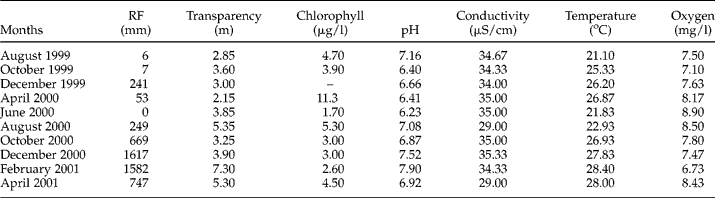
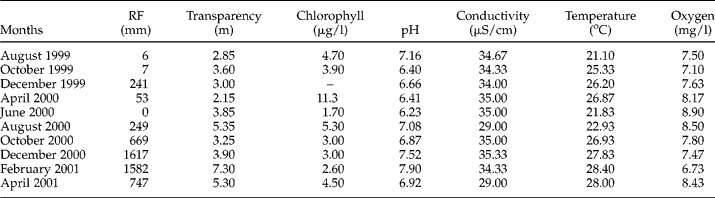
From August 1999 through to June 2001, a total of 96 tucunaré (50 males and 46 females) were captured with net and hook and brought to the laboratory to be measured and weighed prior to parasitological analysis. The collection was conducted at the hydroelectric power station of the Volta Grande Reservoir (CEMIG), Grande River, Minas Gerais, Brazil (21°46′14″S, 42°32′20″W). In each sample, water pH, electrical conductivity, dissolved oxygen, chlorophyll, transparency and temperature were measured (table 1). The rainfall during the period of collection was measured by the CEMIG Hydrology Department. It was not possible to obtain water-quality data in February 2000 and June 2001. Worms collected from the intestine were relaxed in distilled water at 4°C, fixed in AFA (alcohol–formaldehyde–acetic acid) for 24 h for later storage in 70% alcohol and identification. The prevalence of infection, mean intensity (MI) and mean abundance were calculated according to Bush et al. (Reference Bush, Lafferty, Lotz and Shostak1997).
Mean values of the rainfall (RF) and water quality measured in the Volta Grande Reservoir, Minas Gerais State, Brazil, between August 1999 and April 2001 during the collection of fish.
Data analysis
Differences between the parasitological indexes of groups (host sex and weight classes) were analysed using the Kruskal–Wallis test. When statistically different by the Kruskal–Wallis test, a non-parametric multiple-comparisons test was applied to examine all possible comparisons. A P value of less than 0.05/[k × (k − 1)/2] was considered statistically significant, with k corresponding to the number of animals in the group. When statistically different, the mean intensity (MI) and the weight classes were compared by Fisher's exact test, to determine whether there were non-random associations between two categorical variables. The Pearson correlation analysis was used to verify the significance between the values of rainfall and water quality, and the prevalence and MI of infection and mean abundance of parasites.
Results
Water quality and rainfall
No significant correlation (P>0.05) was observed between prevalence rates, intensity of infection and mean abundance and the rainfall indexes and water quality. In spite of the low transparency in April 2000 (2.1 m), no variation in electrical conductivity and water pH was observed (table 1). The months with the highest temperatures were December 2000 (27.8°C), February (28.4°C) and April 2001 (28.0°C). Dissolved oxygen did not vary more than 2.17 mg/l, while the chlorophyll analysis showed the highest value (11.30 μg/l) in April 2000. The rainfall means were high in December 1999, October 2000, December 2000 and April 2000 (table 1).
Infection levels and host body weight
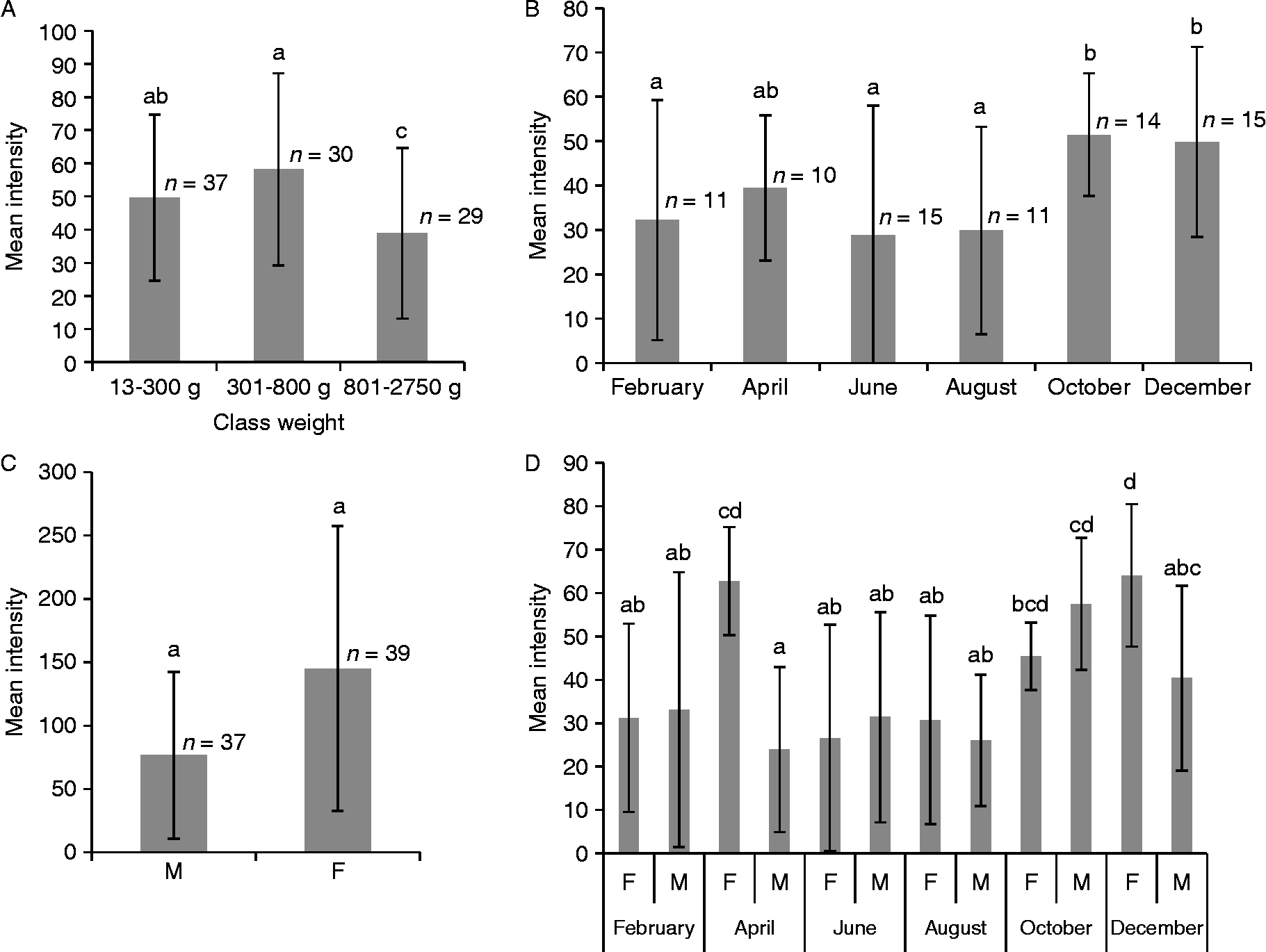
The parasites were identified as P. macrophallus and P. microscopicus. When the fish were separated by classes of weight, the mean abundance of parasites of fish weighing 301–800 g was higher than in the biggest fish (fig. 1A). The mean abundance was 64.33 in those of 13–300 g weight; 150.96 in those of 301–800 g and 47.24 in those of 801–2750 g (fig. 1A). Fish weighing between 301 and 800 g showed a high range of intensity, varying from 3 to 1031 parasites per host. Consequently, fish weighing 301–800 g were more parasitized (P < 0.05) than the largest ones (fig. 1A).
Parasitological indexes in Cichla piquiti from Volta Grande Reservoir, Minas Gerais, Brazil, infected by proteocephalidean cestodes. (A) Relationship between mean abundance and weight classes of the host. (B) Variation in the mean intensity in the months analysed. (C) Mean intensity in males (M) and females (F). (D) Monthly changes in the mean intensity in males and females. *All different lowercase letters indicate significant difference among bars (P < 0.05).
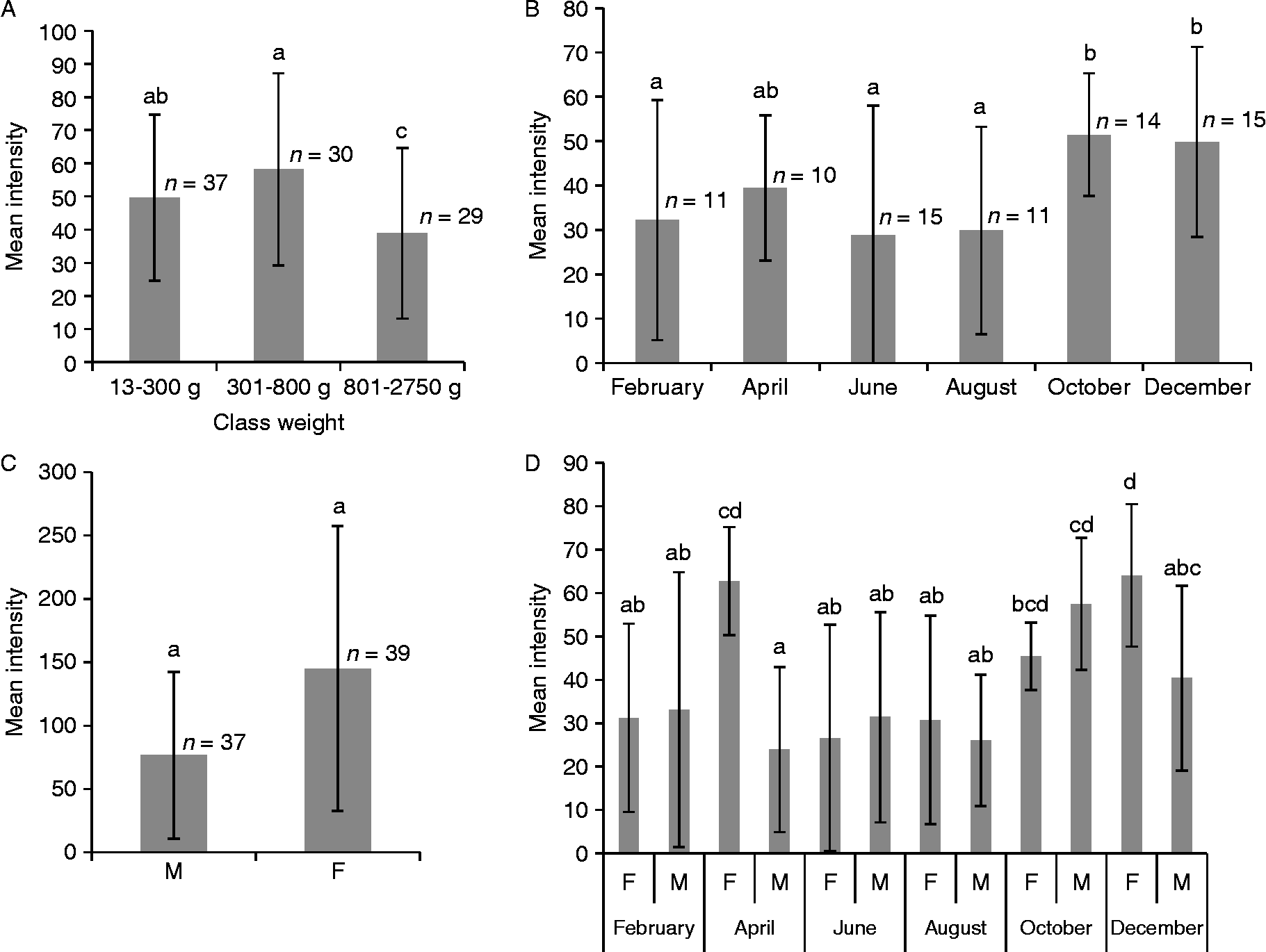
The months with the highest levels of parasitism were October and December, as shown in fig. 1B. Fish examined in April (except for females), June and August showed lower MI of infection than those examined in October and December (fig. 1D). The highest distribution frequencies were: 1–10, 11–30, 31–70 and 101–200 parasites per host.
Infection levels and host gender
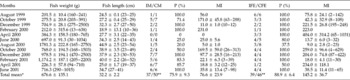
When analysing the infection related to the sex of the hosts, during the whole period, in males, the total prevalence rate was 75.9 ± 9.3% with a MI of infection of 76.6 ± 23.9 and, in females 88.9 ± 6.4% prevalence and 145.2 ± 36.7 MI. We observed high values of MI of infection in females captured in February 2000 (MI = 223), April 2000 (MI = 404 ± 314.2), October 2000 (MI = 259.0 ± 96.6), December 2000 (MI = 204 ± 74.8) and April 2001 (MI = 234 ± 118.1). Consequently, a 100% prevalence commonly occurred in females (table 2). In general, no difference was found between males and females during the whole period independently of the month (fig. 1C). Females captured in April and December showed the highest MI (P < 0.05) when compared with males examined in the same months (fig. 1D).
Parasitological indexes in Cichla piquiti parasitized by proteocephalidean cestodes from the Volta Grande Reservoir, Minas Gerais, Brazil. IM/CM, infected males/collected males; IFE/CFE, infected females/collected females; P, prevalence; MI, mean intensity followed by standard error and amplitude of variation in parentheses. *Values obtained from the averages in the months. **Total number of fish.

Discussion
Infection levels and host body weight
Species of Cichla are native to the Amazonian Rivers (Gomiero & Braga, Reference Gomiero and Braga2003a, Reference Gomiero and Braga2004a, Reference Gomiero and Bragab), but have been introduced in several localities (Hoeinghaus et al., Reference Hoeinghaus, Layman, Arrington and Winemiller2003). In the Volta Grande Reservoir, Minas Gerais, species of Cichla are alien and their strong voracity affects the other small fish including the same fish species (Gomiero & Braga, Reference Gomiero and Braga2004a, Reference Gomiero and Bragab). For this reason, predation might be the main cause of elevated parasitological indexes (Martins et al., Reference Martins, Pereira, de Chambrier and Yamashita2009). Among the factors that contribute to disease dissemination in fish are host susceptibility, fish stocking densities, the duration of the infectious process, the introductions and inadequate handling, as mentioned by Reno (Reference Reno1998). Consequently, the trophic relationship of this alien fish in the reservoir should be better understood to explain the elevated parasitological indexes found by Martins et al. (Reference Martins, Pereira, de Chambrier and Yamashita2009); they are discussed below regarding the sex and weight of the host and parasitism.
The diet variations among Cichla species are related to food availability, their length (onthogeny) and seasonality (Rabelo & Araújo-Lima, Reference Rabelo and Araújo-Lima2002; Gomiero & Braga, Reference Gomiero and Braga2004b). No difference was related to feeding and condition factor between the sexes in Cichla spp. (Gomiero & Braga, Reference Gomiero and Braga2003b). However, there are no studies on the relationship between parasitological indexes in males and females in that region. In the studies of Martins et al. (Reference Martins, Pereira, de Chambrier and Yamashita2009), general parasitological indexes in C. piquiti were discussed.
This new information on the relationship between the sex and weight of the hosts and proteocephalidean infection in tucunaré from this reservoir contributes to the knowledge of the host–parasite–environment relationships. The intensity of infection associated with increased body size shown by Moravec et al. (Reference Moravec, Mendoza-Franco, Vivas-Rodríguez, Vargas-Vázquez and González-Solís2002) differs from our results. In the present case, C. piquiti weighing 301–800 g showed the highest MI of infection, probably related to the fact that fish of lower weight might eat invertebrates (Gomiero & Braga, Reference Gomiero and Braga2004a) that are intermediate hosts of proteocephalideans (Scholz, Reference Scholz1999). In contrast to the present study, Moravec et al. (Reference Moravec, Mendoza-Franco, Vivas-Rodríguez, Vargas-Vázquez and González-Solís2002) did not observe seasonal variation. A 100% prevalence in C. piquiti was also reported in fish parasitized by Proteocephalus chamelensis (Pérez Ponce de León et al., Reference Pérez-Ponce de León, Brooks and Berman1995) and by S. maringaensis (De Chambrier & Vaucher, Reference De Chambrier and Vaucher1999; Arredondo & Gil de Pertierra, Reference Arredondo and Gil de Pertierra2008). According to Scholz (Reference Scholz1987), larger perch were the most parasitized by Proteocephalus percae Müller, 1780. Also studying the parasitic fauna of fish from lakes, Molloy et al. (Reference Molloy, Holland and Poole1995) reported low infection by cestodes in trout, in contrast to our results. Contrary to the present results, Zelmer & Arai (Reference Zelmer and Arai1998) reported a significant increase in the plerocercoid abundance in female perch.
When analysing the length of the hosts parasitized by S. maringaensis, a positive correlation between intensity of infection and standard length was observed (Takemoto & Pavanelli, Reference Takemoto and Pavanelli2000). A correlation between total length and prevalence was also verified in C. monoculus weighing 53–803 g parasitized by proteocephalideans (Machado et al., Reference Machado, Almeida, Pavanelli and Takemoto2000). These results differ from ours in that fish from 301–800 g showed the highest MI of infection.
The cumulative effect of parasitism with regard to host length, suggested by Machado et al. (Reference Machado, Almeida, Pavanelli and Takemoto2000) in fish from the same genus, was not clear in our material. The frequency of distribution of proteocephalideans in C. piquiti was more important between 1 and 200 parasites. A case of elevated intensity of cestode infection (1031 helminths) was reported in April 2000, but this phenomenon was not common, as supported by Martins et al. (Reference Martins, Pereira, de Chambrier and Yamashita2009). On the other hand, Valtonen & Koskivaara (Reference Valtonen and Koskivaara1994) reported that the MI of infection was higher for wild than for farmed salmon and trout.
It could be possible that the highest MIs observed in October and December (fig. 1B) are related to the greater age of the fish. In these months, fish presented total lengths between 23 and 53 cm, which would correspond to the ages of 2–6 years, according to Gomiero & Braga (Reference Gomiero and Braga2007), in Cichla spp. from the Volta Grande reservoir. As discussed by Gomiero & Braga (Reference Gomiero and Braga2007), the study of Sagitta can offer only preliminary information to characterize fish length. In this study, it is not possible to know the exact age of the fish, providing only length data as supported by Gomiero & Braga (Reference Gomiero and Braga2007). Apart from the possible interference of reproductive stage (Gomiero & Braga, Reference Gomiero and Braga2003a), fish weight is a variable parameter when measured in fish in which differences may be present between the sexes.
Infection levels and host gender
Despite the large sample of males and females in the present study, there was no significant association between sex and prevalence of parasitism, as also supported by Takemoto & Pavanelli (Reference Takemoto and Pavanelli2000). These results are supported by Gomiero & Braga (Reference Gomiero and Braga2003b), who did not find significant differences in the condition of males and females of Cichla spp. in the same reservoir. They argued that fish diet is not influenced by the sex of the host.
The greatest MIs of infection in October and December in both sexes of C. piquiti when analysed together (fig. 1B) may be explained by the highest MI in males in October and females in December (fig. 1D). These numbers coincide with the highest rainfalls (669–1617 mm) and possibly water temperature (25.33–27.83°C), as discussed by Martins et al. (Reference Martins, Fenerick, Nomura and Braga2003). It can be clearly observed in table 2 that from December to April 1999 and December to April 2001 (except February 2001) both fish sexes showed a high parasite load. As mentioned by Gomiero & Braga (Reference Gomiero and Braga2004a, Reference Gomiero and Bragab), this could be explained by the immature population of Cichla occurring mainly in this period.
Moreira et al. (Reference Moreira, Ito, Takemoto and Pavanelli2005) observed parasites only in females of Iheringichthys labrosus from the upper Paraná floodplain, in contrast to our results in that no significant difference was found between parasitized males and females. Moreira et al. (Reference Moreira, Ito, Takemoto and Pavanelli2005) suggested that the number of fish captured must be larger. The quantity of fish used in the present study was sufficient for statistical analysis and the number of males and females was very similar. However, we cannot reject the possibility of individual variation.
In contrast to our observations on C. piquiti in the Volta Grande Reservoir, Takemoto & Pavanelli (Reference Takemoto and Pavanelli2000) reported that male Sorubim lima hosts were the most parasitized sex. However, the evaluation of Machado et al. (Reference Machado, Pavanelli and Takemoto1994) indicated no relationship between host sex and parasitism. Our results show that females have higher prevalence rates than males, but without a significant difference between the sexes.
In marine fish, Luque et al. (Reference Luque, Amato and Takemoto1996) observed that seven parasite species had a positive correlation between intensity of infection and total length of the host, but only digeneans showed a relationship between intensity and sex of the host. In the present study, fish with weight of 301–800 g showed the highest MI.
Supporting this view, Martins et al. (Reference Martins, Fenerick, Nomura and Braga2003, Reference Martins, Pereira, de Chambrier and Yamashita2009) emphasized the influence of aquatic characteristics and rainfall on prevalence and MI of infection in fish from the Volta Grande Reservoir. It must be emphasized that the studied environment constitutes a reservoir where fish may be more susceptible to intermediate hosts than fish from the rivers.
Acknowledgements
We thank the authorities of the Hydroelectric Power Station of Minas Gerais (CEMIG), Brazil for field support and the National Council for Scientific and Technological Development (CNPq) for a grant to the first author.