INTRODUCTION
Conventional wisdom in the Maya region used to and sometimes still does claim that most Group E-type architectural complexes, which deviate from a precise orientation with the cardinal directions displayed at Uaxactun, symbolize mere astronomical referents without empirical basis. For example, Fialko (Reference Fialko1988) suggested that the Tikal Mundo Perdido complex was allegorical in nature and Valdés and Suasnávar (Reference Valdés and Suasnávar1992) asserted that such architectural complexes were meant to be status markers mimicking architecture at the larger sites, just as unreadable glyphs on pottery had been interpreted as products of illiterate potters copying literate ones (Coe Reference Coe1973). Aimers and Rice (Reference Aimers and Rice2006:82, 86) echoed this perspective, stressing the ritual function over practical astronomical uses in E-Groups and emphasizing that a modern observatory in our culture, with its explicitly scientific role, may not be a suitable model for these Mesoamerican monumental buildings.
We agree with the idea that these primarily religious buildings had overtly ecclesiastical functions, espousing an interpretation in which full-time ritual specialists or priests used the temple rooms to practice what at some sites, like Calakmul, had become a state religion (Aveni and Dowd Reference Aveni, Dowd, Freidel, Chase, Dowd and Murdock2017; Dowd Reference Dowd, Freidel, Chase, Dowd and Murdock2017). Because a stereotyped dichotomy between the astronomical and allegorical points of view oversimplifies the layers of meaning E-Groups embodied, the purpose of this article is to shift the focus of research to the range of variability exhibited in these complexes. For example, the slight alignment differences in the relationships among the temples in the E-Group complexes may have had to do with the resources and political aspirations of a leader as interpreted with the input of his or her religious advisors, overlaying a schedule for celebrating different regular and moveable festival days in alternating communities within walking distance of one another. An example of the phenomenon of conflating significant sacred calendar and historical events documented for the Aztec at Tenochtitlan is the 8 Acatl (a.d. 1487) use of the Tizoc Stone to commemorate Templo Mayor rededication ceremonies, two Nahui Ollin festivals, and Ahuitzotl's coronation, illustrating “…how the Tenochca dynasty was operating harmoniously within the confines of the sacred calendar” (Barnes Reference Barnes and Aveni2015:202). Coinciding with festival days, tribute redistribution or market exchanges as Monaghan (Reference Monaghan and Aveni2015:286) has suggested could have taken place in the market north of the Calakmul E-Group.
This interpretation may fit the distribution of 13 mapped E-Groups in the Holmul Archaeological Project area, with a concentration of five at Cival alone (Estrada-Belli Reference Estrada-Belli, Freidel, Chase, Dowd and Murdock2017). Much as processions circumnavigating ritual centers were thought to have taken place, visiting outlying communities in a group of allied centers must have been routine (Baron Reference Baron2013:361). Site-specific solutions to agent-directed architectural renovations might account for the unique character of E-Groups in different cities or communities. In light of previous research, we explore how the Maya used the Calakmul E-Group to view horizon-based solar events. The Calakmul E-Group is a good example for careful examination because it has been excavated, accurately measured, and is one of the best-preserved, largest, and more complex examples known in the Maya region.
The folk adage “you only find what you look for” fits this example. When neither excavation nor detailed measurement had taken place at the Calakmul E-Group, the consensus in the literature was that it could not be used for skywatching and its distinctive design features had not been recognized (Aveni and Hartung Reference Aveni, Hartung and Aveni1989). For that reason, Calakmul shows how an E-Group formerly considered nonfunctioning in terms of astronomy while conserving an exclusively ritual use may be interpreted as having a much more nuanced set of astronomical, calendar, religious, and political roles.
Our previous efforts, expressed in articles, site reports, and conference presentations, have had a long genesis, building on Aveni and Hartung's (Reference Aveni and Hartung1986, Reference Aveni, Hartung and Aveni1988, Reference Aveni, Hartung and Aveni1989) body of work. In 2003, it was proposed that alternate alignments in E-Group-type structures could be explained by attempts to reform the solar calendar from one with a solstitial base to one with a zenithal base (Aveni et al. Reference Aveni, Dowd and Vining2003). Note the interpretation that zenith passage must have been of interest to the Maya is reinforced by Tedlock's (Reference Tedlock and Aveni1992:36; see also Coggins Reference Coggins1980 and Tedlock Reference Tedlock and Aveni1992:18 for more on this point) observation that:
In all Mayan languages spoken today, the terms for east and west indicate a line or vector along which the sunrises and sets, depending on the season of the year. The other two directional terms variously indicate the right and left hand of the sun god, the direction of the prevailing or rain bringing winds, highland and lowland, above and below, and/or zenith and nadir. Thus, Classic and Postclassic directional terms ought not be ethnocentrically glossed and interpreted as though they were equivalent to our own cardinal or intercardinal compass points, which are frozen in space. Rather, they ought to be described, as Mayans currently do, in terms of sides, lines, vectors or trajectories that are inseparable from the movement of the sun and thus the passage of time.
The dates used for zenith passage are May 10 and August 3, 1997, using a mean latitude of 17°30′N (Aveni et al. Reference Aveni, Dowd and Vining2003:175). The year is important to note because the days shift somewhat based upon both the time of measurement and latitude.
The haab, or the 365-day solar calendar, formed of 18 20-day and one five-day uinal month(s), was celebrated at many E-Group complexes. Precise field measurements from 12 Group E-type complexes combined with map analysis from 19 others yielded a sample of 99 analyzed alignments. The resulting statistically valid sample demonstrated that the majority of E-Groups functioned astronomically for the group of alignments evaluated. Astronomical function or observation was defined as a person's ability to observe an event, such as sun or star rise and set, with the naked eye. Aveni (Reference Aveni, Vail and Hernández2010:127) has argued as follows:
When it comes to the question of the role of cosmology in city planning, I prefer to think that ceremonial architecture might have provided not so much a laboratory for the acquisition, documentation, and analysis of precise, quantitative astronomical information (what happens in a modern astronomical observatory), as a sacred place where the conduct of cosmically based ritual could be rendered most efficacious in the eyes of the practitioner…In the practical architectural sense, this would have amounted to laying squares in such a manner that Venus, Mars, the sun, or whatever celestial object or phenomenon might have been configured into the divinatory process would be delivered to the proper place, be it the top of a temple, the doorway of a building, or the open plaza where a debt payment would be transacted with the gods, at the correct time. Such a perspective places ancient Maya astronomy and cosmology as much in the realm of theater as science.
It is this dialectic between astronomy and cosmology that we wish to explore further.
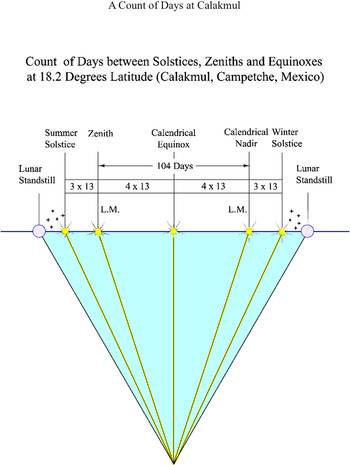
A diagram in Powell's (Reference Powell2009:414) dissertation shows the spread of equinox, solstice and zenith dates at 18°86′31.856″ N latitude (Figure 1). We modified it to show the timing of significant sunrises or sunsets at Calakmul. Following Aveni et al. (Reference Aveni, Dowd and Vining2003, Reference Aveni, Milbrath and Peraza2004) and Šprajc's (Reference Šprajc, Villalobos and Barnhart2014) lead, Reese-Taylor (Reference Reese-Taylor, Freidel, Chase, Dowd and Murdock2017) has evaluated the group of sites surrounding Calakmul and shown that patterning in the orientations of the E-Groups is indeed evident, asserting that the solstice and zenith points were used to organize 20-day month intervals like those used in the haab (18 × 20 + 5 = 365 days), the tzolkin (13 × 20 = 260 days), as well as some other as yet undefined periods were used to orient E-Group structures and their azimuths. Šprajc's (Reference Šprajc, Šprajc and Pehani2013:321) reported data also suggest that “quarter-days” or quarter-year intervals of about 91 days (7 × 13) may have also been important, for example, March 23 and September 21. The Calakmul region data show patterning related to multiple days in a solar and ritual calendar system of observation, with practical farming, religious performance, and astronomy applications. The variation of calendar expressions within E-Group architectural complexes falls inside a range of relatively standardized calendar systems that lasted up until the conquest in the northern Maya lowlands and even longer in the southern Maya highlands.
A Count of Days at Calakmul (Powell Reference Powell2009:414).

It is worthwhile to understand how the Calakmul example was used in ways that were similar to or different from other excavated groups of this type in the Maya region (Aylesworth Reference Aylesworth2004; Stanton and Freidel Reference Stanton and Freidel2003). Specifically we wish to understand the timing of calendar festivals at Calakmul and how these dates were expressed architecturally or as a foreground to solar movements on the horizon. The E-Group complex at Calakmul was not merely an architectural allegory, as has been suggested for the Mundo Perdido Complex at Tikal and other sites, commemorating the idea, but not the practice of, astronomical observation (Aimers and Rice Reference Aimers and Rice2006; Fialko Reference Fialko1987 [1985], Reference Fialko1988; Laporte and Fialko Reference Laporte, Fialko C, Clancy and Harrison1990, Reference Laporte and Fialko C1995; Ruppert Reference Ruppert and Hay1977 [1940]).
We are leaving aside for the moment the suggestion made by Fialko (Reference Fialko1988; Laporte and Fialko Reference Laporte, Fialko C, Clancy and Harrison1990) that the Ciudadela in Teotihuacan, containing the Temple of Quetzalcoatl and three western buildings opposite on a common platform, is an example of a Maya architectural export to central Mexico. Furthermore, the recently found greenstone stela-sized celts buried in front of the Temple of the Moon (INAH 2016) are evocative of the jade celt caching practices in central E-Group contexts from other regions. The temple precinct enclosing the Calakmul E-Group merged space for interpretations of mythic religious narratives with sophisticated structural calendar elements and astronomy principles.
Below we begin by giving an overview of the archaeological context. We discuss the construction sequence of the two main structures in the E-Group, IVa–IVc to the east and VI to the west (Figure 2). Then we evaluate the intrasite astronomical data from Calakmul using interbuilding alignments and doorway orientations. Lastly we provide intersite comparisons of E-Groups from other Maya lowland sites and offer concluding remarks. Presently Preclassic period (2000 b.c.–a.d. 225) data for the Calakmul E-Group are limited, although future excavations might reveal additional earlier construction phases. The earliest four construction phases in Structure IVb date to the Early Classic and extend into three Late Classic period (a.d. 600–900) building episodes (Carrasco Vargas Reference Carrasco Vargas1996, Reference Carrasco Vargas and Gubler1999). A Late Preclassic period (350 b.c.–a.d. 225) construction phase has been identified in Structure VII (Folan et al. Reference Folan, Marcus, Pincemin, Domínguez Carrasco, Fletcher and López1995). While Calakmul has been identified based on finds in Structure II (Doyle Reference Doyle2012, Reference Doyle2013) as a site with the logical potential for Middle Preclassic period (1000–350 b.c.) levels in its E-Group, none have yet been excavated in Structures IV, V, VI, or VII. For these reasons, the information presented here primarily dates to the Classic period (a.d. 225–900).
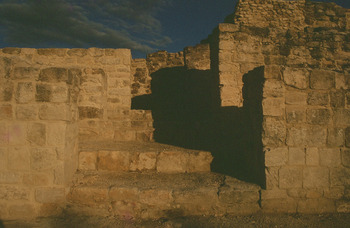
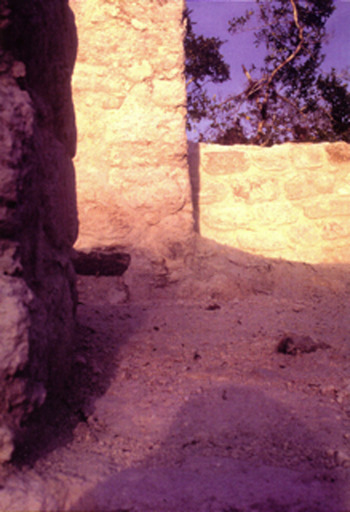
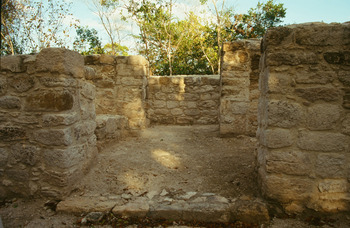
Calakmul, Structure IVb, view east. Photograph by Dowd.

ARCHAEOLOGICAL CONTEXT
Construction Phases
Proyecto Arqueologico de la Biosfera Calakmul excavations have shown that, in Structure IVb, there were four Early Classic building episodes, Substructures 1–4, labeled earliest to latest (Carrasco Vargas Reference Carrasco Vargas, Schmidt, de la Garza and Nalda1998, Reference Carrasco Vargas and Gubler1999; Carrasco Vargas and Boucher Reference Carrasco Vargas and Boucher1994; Carrasco Vargas and Colon González Reference Carrasco Vargas and González2005; Carrasco Vargas et al. Reference Carrasco Vargas, Boucher, Dowd, Paul, González G. and García1994, Reference Carrasco Vargas, Boucher, Dowd, Paul, González G. and García1995). Cache 1, with fifth-century Águila Orange pottery, was associated with Substructure 1. Cache 6 was possibly the earliest of the caches and contained seven Late Preclassic vessels, including Sierra Rojo, Polvero Negro, Flor Crema, and Águila Orange examples. There was no evidence of a substructure in Structure VI (Carrasco Vargas Reference Carrasco Vargas and Gubler1999). Structure VII was begun in the Late Preclassic and construction continued into the Postclassic period (a.d. 900–1519; Braswell et al. Reference Braswell, Gunn, Domínguez Carrasco, Folan, Fletcher, Morales, Glascock, Demarest, Rice and Rice2004; Domínguez Carrasco Reference Domínguez Carrasco1992, Reference Domínguez Carrasco1994; Domínguez Carrasco and Gallegos Gómora Reference Domínguez Carrasco and Gallegos Gómora1989–1990; Domínguez Carrasco et al. Reference Domínguez Carrasco, Reents-Budet, Bishop and Folan1998; Folan et al. Reference Folan, Marcus, Pincemin, Domínguez Carrasco, Fletcher and López1995).
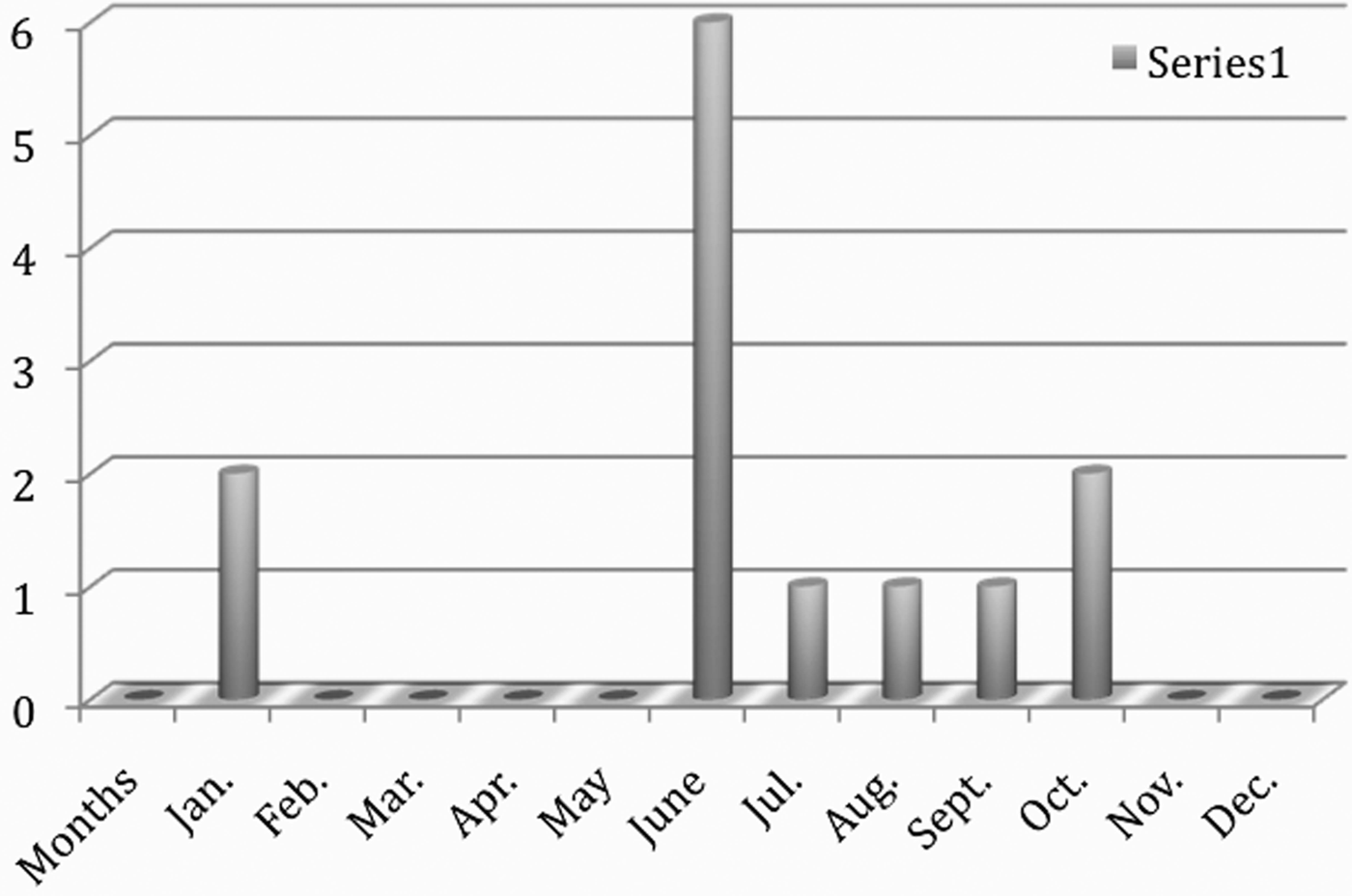
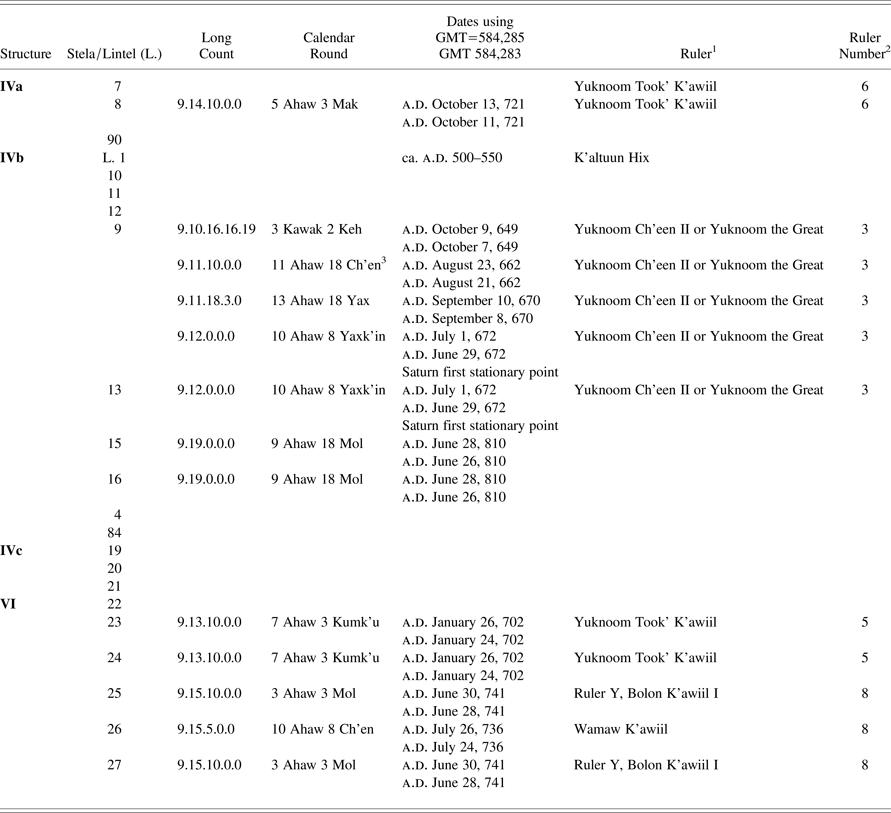
There were at least three Late Classic construction phases. In the first, single rooms were placed on top of Temples IVa, IVb, and IVc. The temple on top of Structure VI was not yet constructed. In the second phase, the second chambers to the front of temples on IVa, IVb, and IVc were added and the two stelae may have been positioned on top of Structure VI at this point (Table 1). Lastly, the third chamber was added to the front of Structure IVb and the superstructure on top of Structure VI was completed (Carrasco Vargas Reference Carrasco Vargas1996, Reference Carrasco Vargas and Gubler1999). Carrasco Vargas's estimates for the three Late Classic construction phases are a.d. 672, 702, and 721, respectively. Martin and Grube (Reference Martin and Grube2000) separate this part of Calakmul's dynastic history into phases corresponding with the reigns of three rulers: a.d. 636–686 when Yuknoom the Great or Yuknoom Ch'een II was in power; ca. a.d. 686–697, during Yuknoom Yich'aak K'ahk's reign; and from a.d. 698 to after a.d. 731 for the reign of king Yuknoom Took’ K'awiil. These date ranges roughly correspond with the preliminary dynastic history Marcus (Reference Marcus1987) proposed at the site, originally spanning Rulers 3–7. Seasonal dates on stelae found in the E-Group complex are shown in Figure 3 and discussed in Appendix A.
Bar graph of dates by month on associated monuments. Graph by Dowd.

Data from Hieroglyphic Texts on Stelae and Lintels in Calakmul's Main Plaza.

1This column includes information from Braswell Reference Braswell2014:104; Grube and Martin Reference Grube, Martin and Grube2001:162–166; Martin and Grube Reference Martin and Grube2000:108, 112–115, Reference Martin, Grube, Young and Magazine2003:28–32, Reference Martin and Grube2008:116–137; Sharer and Traxler Reference Sharer and Traxler2006:357–358. Sources for descriptions of the Calakmul kings include a description of about 400 years or one baktun of history, listing 19 individual name glyphs associated with the emblem glyph but without a one-to-one correspondence with what has been interpreted as a Classic period dynastic sequence from the monumental inscriptions from a series of “dynasty vases” in the Codex Style (Drew Reference Drew1999:224–225; Martin Reference Martin and Kerr1997; Vance Reference Vance2016). These protagonists could have ruled in the Preclassic period or in mytho-historical time.
2Information from Marcus Reference Marcus1987.
3Eberl (Reference Eberl and Aveni2015:95) notes: “[o]n Calakmul Stela 9, a lady introduces herself as the image of [or impersonating] the Calendar Round 11 Ajaw 18 Ch'en, which corresponds to the period ending of 9.11.10.0.0 or 662 CE (Figure 5.14 [after Ruppert and Denison (Reference Ruppert and Denison1943:Plate 48c) glyph blocks D1–E3]).”
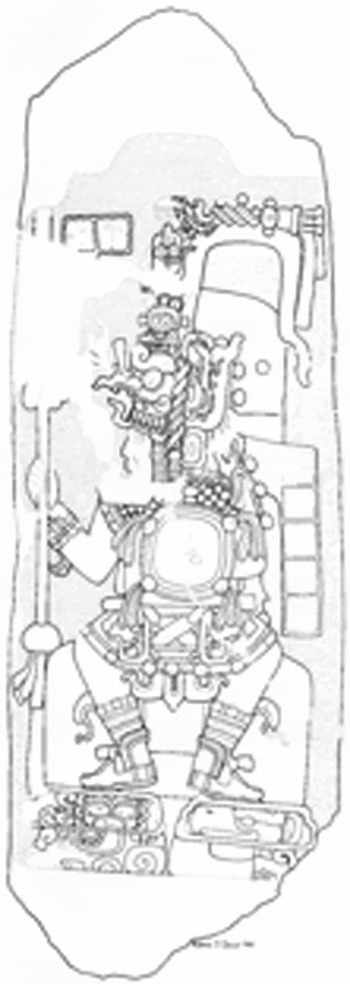
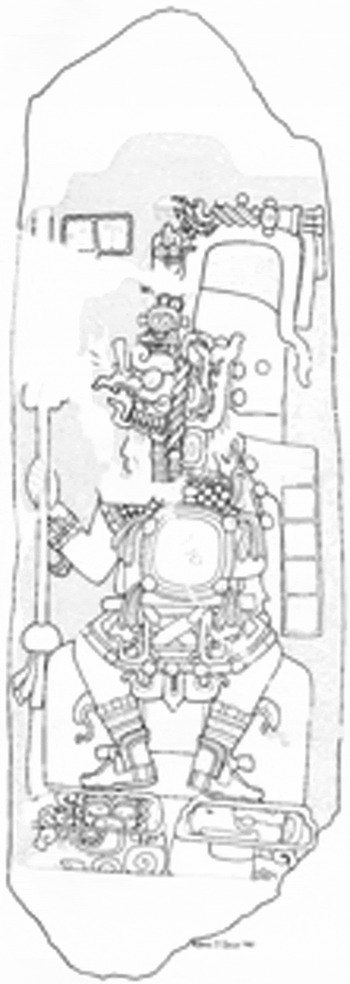
Structure IVb, the largest of the three eastern temples, had changes made in the form of a lower chamber (Carrasco Vargas Reference Carrasco Vargas1996, Reference Carrasco Vargas and Gubler1999). What had been an inner room was filled in to create a smaller chamber late in the construction sequence. Above this level, in front of the superstructure, is a projecting platform that is skewed somewhat from the orientation of the front facade. A broken lintel (ca. a.d. 500–550) and an altar were found within Structure IVb. The lintel (Lintel 1) shows a ruler, possibly K'altuun Hix (Figure 4), and the altar, much eroded except for the center, displays a quatrefoil design (Braswell et al. Reference Braswell, Gunn, Domínguez Carrasco, Folan, Fletcher, Morales, Glascock, Demarest, Rice and Rice2004; Carrasco Vargas Reference Carrasco Vargas1996; Coltman Reference Coltman2015:22–23). The quatrefoil design is deserving of more study because of several general associations: (a) there is an altar in the Uaxactun Group E that exhibits a centrally placed quatrefoil design; (b) this is the shape of radially symmetrical structures often featured in Group E-type structures (e.g., Tikal and Uaxactun); (c) quatrefoil motifs adorn the “flapstaff” shown to have a link with summer solstice at Yaxchilan; (d) in the hieroglyphic inscriptions, this symbol means completion, in the sense of completing a cycle of time; and (e) plaza finds at Ceibal (e.g., Caches 7 and 160) and Cival (e.g., Cache 4) were placed in quadripartite or cruciform holes containing offerings interpreted to have cosmological meaning (Estrada-Belli Reference Estrada-Belli2006; Inomata et al. Reference Inomata, Triadan, Aoyama, Castillo and Yonenobu2013; Smith Reference Smith and Willey1982:243–245).
Calakmul Lintel 1, found buried in Structure IVb. Drawing by Dowd, © 1994, all rights reserved.
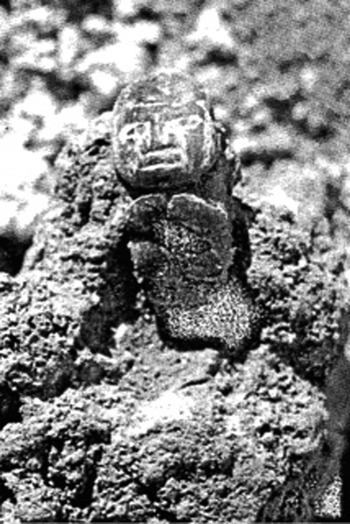
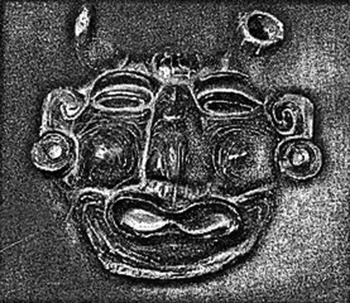
During the 1993 Structure IVb excavations, archaeologists discovered elite Tombs 1 and 2 (Carrasco Vargas Reference Carrasco Vargas and Gubler1999:82). Tomb 1 had been looted but a small Olmec-style jade figurine was found within it (Figure 5). Below Tomb 1, Tomb 2 contained a funerary mask and 18 vessels, most Balanza Negro type, dating to about a.d. 450–600 (Figure 6). It also had been disturbed in antiquity. In Structure IVb at Calakmul, Burial 1 was found in Early Classic Substructure 1 under the floor; Burial 2 was under the front staircase of Substructure 1; and Burial 3 was under the base of the rear wall of the second interior room of the penultimate Structure IVb construction phase (Carrasco Vargas Reference Carrasco Vargas1996, Reference Carrasco Vargas and Gubler1999). Burial 1 in Structure IVc was 1 m under the floor of the front room of the temple. Tomb 1 of Structure VII dated to about a.d. 780 (Braswell et al. Reference Braswell, Gunn, Domínguez Carrasco, Folan, Fletcher, Morales, Glascock, Demarest, Rice and Rice2004:177; Domínguez Reference Domínguez Carrasco1992; Folan et al. Reference Folan, Marcus, Pincemin, Domínguez Carrasco, Fletcher and López1995:319). The tombs and burials discussed here belong to Early and Late Classic period construction phases at Calakmul.
Apple green jade Figure from Tomb 1, Temple IVb (Carrasco Vargas Reference Carrasco Vargas and Gubler1999:76).

Balanza Negro ceramic mask from Tomb 2, Temple IVb (Carrasco Vargas Reference Carrasco Vargas and Gubler1999:76).

Adjacent to Calakmul's Group E-type complex is Structure VIII, not yet excavated, which is visibly out of alignment with the other buildings in the main plaza. Stucture VIII may also have had astronomical importance, possibly analogous to Structure 9 at Nohmul (Chase and Chase Reference Chase and Chase1982), a topic that is beyond the scope of this paper. The view from Structure VIII encompassed the southern horizon dominated by the colossal Structure II. Perhaps other astronomical events were observed. Lounsbury (Reference Lounsbury and Aveni1989:250), for example, has brought attention to the relationship between the sun and Jupiter, saying that: “Chan-Balam's inauguration as ruler, his special rites for the gods and his apotheosis all coincide with Jupiter's first perceptible move in departure from the second stationary point.” Lounsbury (Reference Lounsbury and Aveni1989:254) goes on to summarize: “[t]wo hypotheses, related but distinct, have been advanced. The first is that a departure of Jupiter from its second stationary point marked a preferred time for dynastic rituals for a particular ruler at Palenque… The second is that the coming together of Mars or Saturn with Jupiter provided a favorable or motivating context in some cases, though it was not in general a necessary condition.” Also see Milbrath's (Reference Milbrath2005) publication, which expands on the theme of Jupiter's role in dynastic ritual, and work by Aveni and Hotaling (Reference Aveni and Hotaling1994).
The Mundo Perdido complex had evidence of burials from Structure 5D-86, but not Uaxactun's Group E (Laporte and Fialko Reference Laporte, Fialko C, Clancy and Harrison1990:35). Also at Caracol, Tikal, and Uaxactun, there are considerable burial or cache data providing contextual information for the E-Groups at those sites (Aveni and Hartung Reference Aveni, Hartung and Aveni1989; Chase and Chase Reference Chase and Chase1995; Laporte and Fialko Reference Laporte, Fialko C, Clancy and Harrison1990; Ricketson and Ricketson Reference Ricketson and Ricketson1937). Different patterns have emerged: for example, a shift away from royal interments over time at Tikal, skull burial suggestive of decapitation rituals at Uaxactun, and caches with more generally cosmological referents from Caracol. Aimers (Reference Aimers1993:5–40) reviewed the information on decapitation in the context of Group E complexes from three sites: Uaxactun, San José, and Tayasal. These are good examples of sites with the evidence of possibly sacrificed individuals buried in Group E complexes (Aimers and Rice Reference Aimers and Rice2006:89).
Chase (Reference Chase1983:191), who first defined the Cenote Style, considered it to be different in form, appending three temples to a range structure, and longer and narrower (greater than 70 meters in length) from those built in the Uaxactun's Group E Style. Calakmul's eastern structure measures 150 m end-to-end. Later writers have identified a Cenote-Variant Style, which includes examples that do not quite fit into either category (Aimers Reference Aimers1993; Aimers and Rice Reference Aimers and Rice2006; Runggaldier Reference Runggaldier, Burg and Harrison-Buck2013:70). Yet a fourth group, Pseudo E-Groups, refers to those without known western structures or in the case of a site like Blue Creek without a central western structure (Guderjan Reference Guderjan2006:97–103).
ASTRONOMICAL DATA
Calakmul is located in the state of Campeche at 18°86′31.856″ N, 89°48′17.949″ W, and 240.51 m or 789 ft above sea level (Andrews Reference Andrews1975, Reference Andrews1995; Braswell et al. Reference Braswell, Gunn, Domínguez Carrasco, Folan, Fletcher, Morales, Glascock, Demarest, Rice and Rice2004; Fletcher et al. Reference Fletcher, Hau, Florey Folan, Folan, Moll and Cook1989:74; Folan et al. Reference Folan, Marcus, Pincemin, Domínguez Carrasco, Fletcher and López1995; Folan et al. Reference Folan, Morales Lopez, González, Florey and Domínguez Carrasco2001; Grube and Martin Reference Grube, Martin and Grube2001:162–164; Martin and Grube Reference Martin, Grube, Young and Magazine2003:31–32). Our February 24, 1995 readings using a Trimble GPS on the northwest doorjamb of Structure IVb were 18°86′34.7″ N, 89°48′58.3″ W. Because there are many tall trees obscuring the views between the summits of the temple platforms in the main plaza at Calakmul, field measurements were limited to wall alignments and the orientations of other architectural features like doorways or windows. While the main plaza at Calakmul was stuccoed and all trees were removed, it is possible that trees were visible at the horizon, creating a slightly elevated horizon line. Alignments between structures have been determined from available Proyecto Arqueologico de la Biosfera Calakmul plans completed after excavation and consolidation (with corrections made in 1997). Using the International Geomagnetic Reference Field (IGRF) model, the correction for the 1994–1997 magnetic declination of the compass is about 2°48′ east for 1994, 2°45′ east for 1995, and 2°32′ east for 1997, which is when these measurements were taken.
Approximate alignments of the architectural elements in this complex at Calakmul were recorded in August 1994 using a hand-held compass (Topochaix). In February 1995, a number of these measurements were confirmed using a theodolite (WILD Heerburgg Switzerland TD-73848; Dowd et al. Reference Dowd, Aveni and Vargas1995). On January 10, 1997, the authors returned to the complex and secured more precise measurements by obtaining a sun fix using a theodolite with the magnetic setting corrected on true north (Aveni et al. Reference Aveni, Dowd and Vining2003; Dowd and Aveni Reference Dowd and Aveni1998).
Thus, we confirmed that an observer situated at the top center of the stairway of Structure VI would see the sunrise on June 21 over the central doorway of IVa, on March 15 or September 29 (or within five days of the equinoxes) over IVb, and on January 21 (or approximately 4° south of the winter solstice horizon position) over Structure IVc. The measurements show that, like Tikal (6–8° east of true north), the entire complex at Calakmul is skewed (by comparison to the orientations of true cardinal directions displayed at Uaxactun) by 13° east of true north. (Other Group E complexes, which are also oriented by 13° east of true north, include Caracol, Rio Bec II, and Xunantunich.) The doorway alignments of the structures at Calakmul appear to compensate, so that the positions of Temple IVc with respect to sunset are accurate enough to produce a solar-architectural hierophany (from the Greek word phainein, to reveal, show, or make known). In other words, the shadows cast by the exterior doorjambs exactly met (or touched) the interior doorway entrances, at least for one summer solstice event.
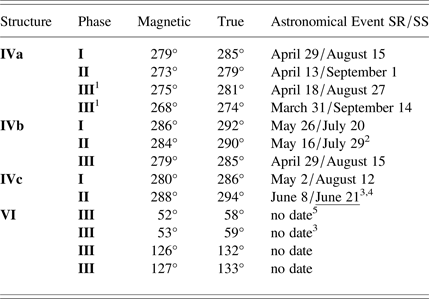
Measured eastward from the north, the azimuths were calculated, and the sunrise and sunset positions were modeled for a.d. 700 (ø = 18°, 3° elevated horizon approximately, from Aveni's [Reference Aveni1972] tables). The results of these measurements are shown in Table 2.
Solstice and equinox azimuths.

All seasonal dates referred to in this paper are corrected to Gregorian and are, therefore, independent of epoch. Changes in solar orientations owing to precession amount to less than one day over the time elapsed since the period referred to in the text. The azimuth is the horizontal angular distance from a fixed reference direction to a position, object, or object referent, from a point due south, usually measured clockwise along the horizon. This 3° horizon is assumed throughout to correspond to the present forested condition of the site. The date a.d. 700 was chosen because it approximates a.d. January 24, 702 or 9.13.10.0.0 7 Ahaw 3 Kumk'u, which appears on Stelae 23 and 24 on top of Structure VI (Marcus Reference Marcus1987:84–85). The Goodman-Martinez-Thompson Julian day number 584,285 and 584,283 correlation constants for Gregorian dates are shown in Table 1. The 584,283 base date of the Maya calendar used for time elapsed since January 1, 4713 b.c. is used for the dates shown in the text (Lounsbury Reference Lounsbury and Aveni1989:256). See a recent discussion by Patrick Encina (Reference Patrick Encina2016) for an alternate correlation interpretation. Other scholars have reviewed the correlation question in depth (Bricker and Bricker Reference Bricker and Bricker2011; Martin and Skidmore Reference Martin and Skidmore2012).
INTERBUILDING ALIGNMENTS
Sunrises
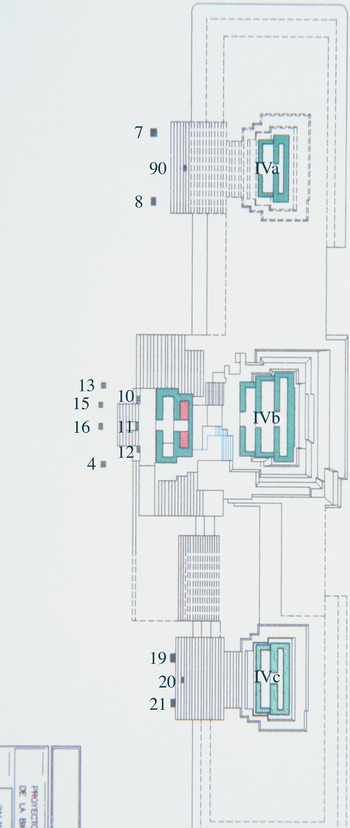
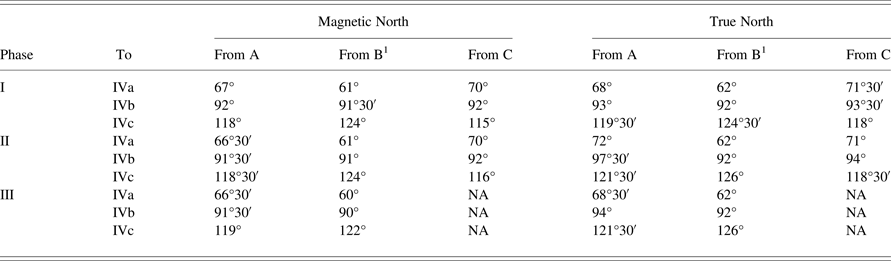
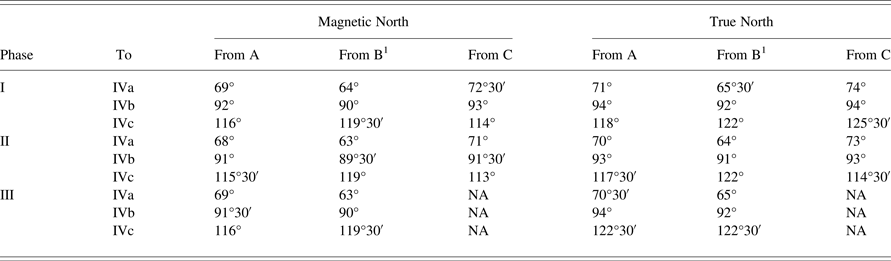
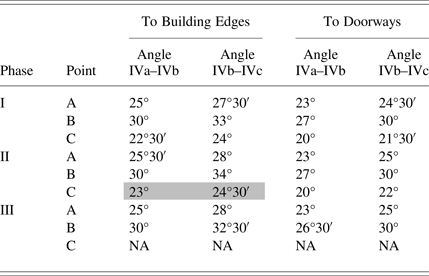
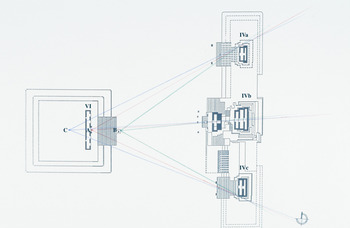
Because there is compelling evidence for the use of Uaxactun's Group E to view solstice sunrises using the outside corners of the structures EI and EIII (Aveni and Hartung Reference Aveni, Hartung and Aveni1989), analogous building alignments at Calakmul were also evaluated (Tables 3a–3b). Interestingly, like Uaxactun, Calakmul exhibits relative building alignments that correspond well to the angular deviation between solstice and equinox sunrises from true east-west (i.e, if the centerline were oriented true east-west, the outer buildings would mark the solstices; Table 4, Figure 7). The azimuth angles between the northernmost, middle, and southernmost structures are 23°30′ and 25°00′ (second construction phase, measured to edge of buildings not to doorways from Point C). These compare favorably to Uaxactun measurements of 23°33′ and 25°00′.
Calakmul, Structure IVa, b, and c plan. Plan by Emyly González.

Building alignments (building edges).
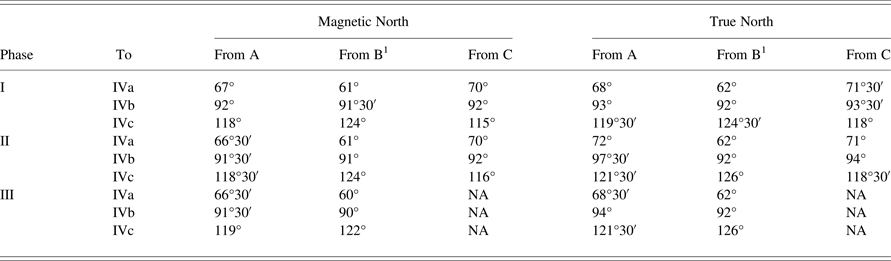
1B = Stela platform on axis with Structure VI.
Building alignments (doorways).

1B = Stela base (slightly off Structure VI axis).
Building alignment angles (from VI).

Points A (between Stelae 23 and 24), B (on axis with the structure at the edge of the stela platform or at the base of Stela 22), and C (the midpoint of the platform) were evaluated for all three construction phases. As can be seen from the data presented in Table 3a, there are few differences among the three construction phases, with one exception. The orientation of the line between the center of Structure VI and the south building edge of Structure IVc shifts somewhat after the first construction phase. From Point A, the second construction phase measurements are 62° to the north building edge of IVa, 87°30′ to the central portal of IVb and 115°30′ to the south building edge of IVc. The alignment of the doorways within Temple IVc and the line from Point A to the edge of the building are within one and one-half degrees of each other. The line between VI and the central doorway of IVb is oriented 87°30′ or 2° south of the equinox sunrise azimuth.
Comparing orientations between VI and the center points of doorways of IVa and IVb, rather than the building edges (from Point A for the second construction phase), the angles measure 64° and 111°30′. The angles between the structures measure 22°30′ and 24°30′, north and south. The most favorable viewing position, given the slightly elevated level of the horizon as viewed from Calakmul's main plaza, appears to have been from Point A to Phase III constructions using the same building edges and center doorway sightlines that operate at Uaxactun (Aveni and Hartung Reference Aveni, Hartung and Aveni1989).
Doorway Orientations
Earlier in the history of E-Group alignment studies, as mentioned above, if one only looked at the overall architectural alignment, one might conclude that Calakmul's Group E Complex would not permit viewing of solar events due to the assumption that an overall plan oriented towards true north was a prerequisite. Recall that, where Calakmul is oriented 13° east of true north, Uaxactun is oriented 0° east of true north. When, after excavation, specific architectural elements were considered, we concluded that Calakmul's E-Group was an architectural setting used to watch the sun's movements along the horizon, although not in exactly the same way as the Group E Complex at Uaxactun. Alignments were organized using the first annual solar zenith and 20-day intervals around the May 13 zenith as a reference point rather than solstices or equinoxes, as at Uaxactun (Aveni et al. Reference Aveni, Dowd and Vining2003). As Aveni (Reference Aveni, Vail and Hernández2010:119) has noted:
One can think of such an arrangement as a spatial transformation of a temporal idea–a clever and highly visible, unwritten way of expressing the manner in which the counting of time and the laying out of space in the city go together. We argued that this calendar was a modified form of a solar zenith-based calendar that emanated (along with many other architectural and iconographic traits) from the Peten (cf. Gendrop Reference Gendrop1983). This turns out to be consistent with the results of our more recent investigation of the E-type groups (Aveni et al. Reference Aveni, Dowd and Vining2003).
A cross-cultural comparison is the use of the number 12 as a reference point for the hand on a clock's dial for telling time over the course of two 12-hour cycles. For the Maya, the reference point for seasonal time keeping appears to have shifted from the June 21 solstice at Uaxactun in a.d. 278 to the May 13 zenith passage at Calakmul by a.d. 672.
The Calakmul data demonstrate the importance of looking at the interplay of light and shadow on the buildings, as Maya architects took into consideration how the moving sun illuminated different parts of the facade during certain times of the day or season. Measured alignments do not always reveal what an observer sees if they are situated in different places from the point at which an alignment might begin. The descending serpent-body balustrade of El Castillo at Chichen Itza is the best-known example of such phenomena (Galindo Trejo Reference Galindo Trejo1994:158; Krupp Reference Krupp1997:267–268), but other hierophanies exist in the Palenque Tower or the Temple of Inscriptions on the December solstice (Mendez et al. Reference Mendez, Barnhart, Powell and Karasik2005), and there are examples at Yaxchilan (Tate Reference Tate and Aveni1989). Furthermore, architectural details, such as reoriented doorways, created custom or modified architectural features for emphasizing solar phenomena. As more Group E complexes are excavated, our corpus of architectural data will increase, but now with many newly excavated or partially excavated examples, we believe that these complexes commemorated a greater variety of solar dates than just solstices, equinoxes, and zenith or nadir passages. For this reason, we describe the Calakmul Group E's design in detail.
Sunsets
Since the unusual doorway alignment phenomena observed in Structure IVc might be part of a larger pattern, various doorway alignments were measured and compared with solstice, equinox, or other information (Table 5). Specifically, we wanted to determine whether doorjamb shadows in Structure IVa also lined up on the winter solstice at sunset and if doorjamb shadows in Structure IVb did on the equinox (Figure 8). An interesting feature of Structure IVa is that the inner doorway was rebuilt to narrow the entrance by about 20 centimeters on either side. We tested the hypothesis that this renovation may have been a correction used to adjust the alignment of the two doorjambs to ensure that the exterior doorway shadows lined up with the inner passage on the winter solstice, with negative results. Structure IVa approximately mirrors the layout of Structure IVc; therefore, although we might have expected that the doorjamb shadows would line up during the winter solstice on December 21 and that equinox sunsets would be observed from Structure IVb on March 21 and September 22, they do not.
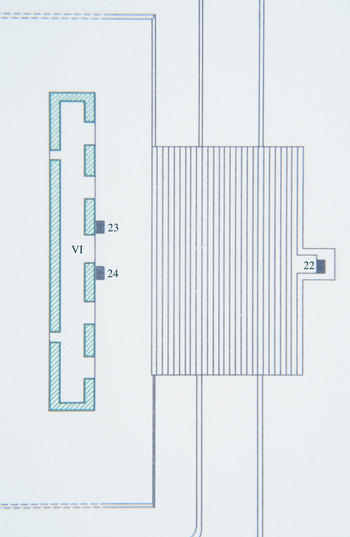
Calakmul, Structure VI plan. Plan by Emyly González.

Doorway orientations.

1Inner doorway rebuilt. Two possible sequences: (1) both jambs, (2) north jamb first.
2Zenith passage dates are May 13 and August 1.
3Observed at present tree-covered horizon line.
4Underline indicates date highlighted in the architecture by means of a hierophany at sunset.
5Too far north by approximately 7°.
Given these data, we postulated the following process for the evolution of the architecture (Carrasco Vargas Reference Carrasco Vargas and Gubler1999). It appears that the original doorway within Structure IVc, oriented 286° east of true north, would have had the summer solstice sun shining directly on it, but the shadows cast by the doorjambs would not have been parallel to the summer solstice sunset azimuth. Perhaps it was this observation that inspired the architects to place the doorway of the antechamber, added on to the original one-room construction, on the building's central axis, so that the shadows cast by it would bracket the offset inner passage. Thus, the second construction phase created a pair of doorways oriented 294°. This orientation lines up perfectly with the last gleam of the sunset on the June 21 summer solstice (294°02′).
The first doorway in Structure IVa was oriented 285°. Then, presumably, the second doorway and antechamber were built, measuring 279°. The second construction phase does not give a good fit with the expected alignment of 244°09′, which would cause the doorjamb shadows to line up on winter solstice sunset. A slight change was made to the inner doorway, however, narrowing it somewhat (assuming additions to both doorjambs were simultaneous). The alignment shifted two degrees 281° (or an alternate possibility might be 274°, if the north but not the south jamb was added).
In the middle temple, Structure IVb, where there were three upper level construction phases (and four buried ones), two antechambers were added separately. The doorway alignments shift slightly each time, but never come close to an alignment that would cause the doorway shadows to line up perfectly with the sun's position at equinox sunset. First, the innermost doorjamb alignments were 292°. Second, the two entrance doorjambs were aligned 290°. Third, all three doorjamb pairs were oriented 285°. None of these is close enough to the 270°30′ (0° horizon) alignment required for the doorjamb shadows to line up with the setting sun on the equinoxes. Note that these measurements are an average of the alignment of the north and south doorjambs of Temple IVb used to calculate the alignment of the midpoint of the doorway.
Sunrises
In addition, the likelihood of observing either equinox or winter solstice sunrise from Structure VI was evaluated. Structure VI, across the plaza, offers two alignments that visually align with summer solstice sunrise in Structure IVa (Figure 9). These are through the first and seventh doorways and through the fourth and sixth doorways (starting in the north and counting clockwise). One is 58° and the other is 59°. The two corresponding alignments yield measurements of 132° and 133°. These do not equal the azimuth of the sun's first gleam at summer or winter solstice sunrise, which are 65°58′ or 115°51′, respectively. Perhaps the sunrise observed in 1994 around the time of the solstice through two sets of doorways was due to the amount of vegetation obscuring and elevating the horizon to a more extreme degree than would have been the case during the Late Classic period. The alignment through the central doorway and the adjacent stelae is 99° east of true north. This also contrasts with the expected orientation of the fall and spring equinox sunrise (first gleam) which is 89°30′ (0° horizon) or 90°46′ (3° horizon). Apparently, none of the doorways in Structure VI were oriented specifically for solstice or equinox observation through the entrances per se. The differences are about 6° or 7° for the solstices and about 9.5° for the equinoxes (0° horizon; doorjamb orientation, not the line between Structures VI and IVb, which is not perpendicular to axis of VI). Alternatively, like Uaxactun, standing at a location on the temple platform provided an observation point for viewing solar events.
Calakmul Group E Complex plan. Lines from point A are red, from point B are green, and from point C are blue (modified from Carrasco et al. Reference Carrasco Vargas, Boucher, Dowd, Paul, González G. and García1995; image from Dowd and Milbrath Reference Dowd and Milbrath2015:Figure 3.6a). Map by Emyly González.

Intersite Comparisons
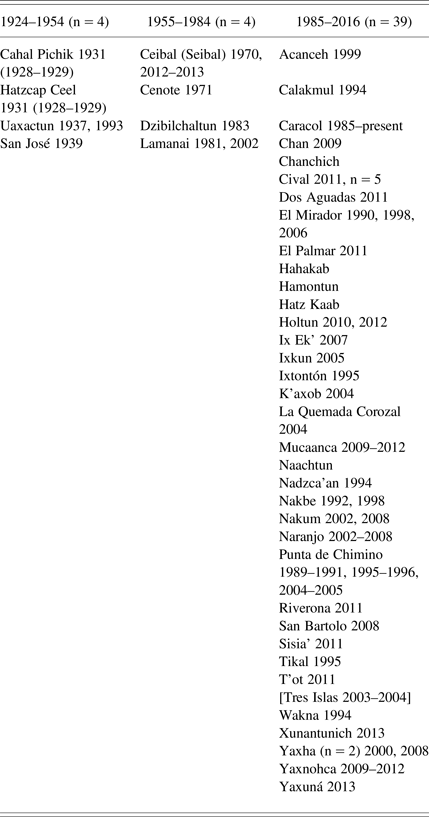
Calakmul is one of 47 examples of Group E-type complexes excavated to date (Table 7). About 18% of the more than 256 known examples have been excavated to some degree. Like most of these examples, Calakmul is slightly skewed to the east. Excavation evidence shows that the building orientations were not regular, and there may be disjunction between the orientations of the platform and façade, or changes to building heights with remodeling episodes. Through time there also were changes in the individual wall lines within structures. Interbuilding alignments may have been asymmetrical. Such details require analysis before deciding whether a complex functioned astronomically, or categorically rejecting such a hypothesis.
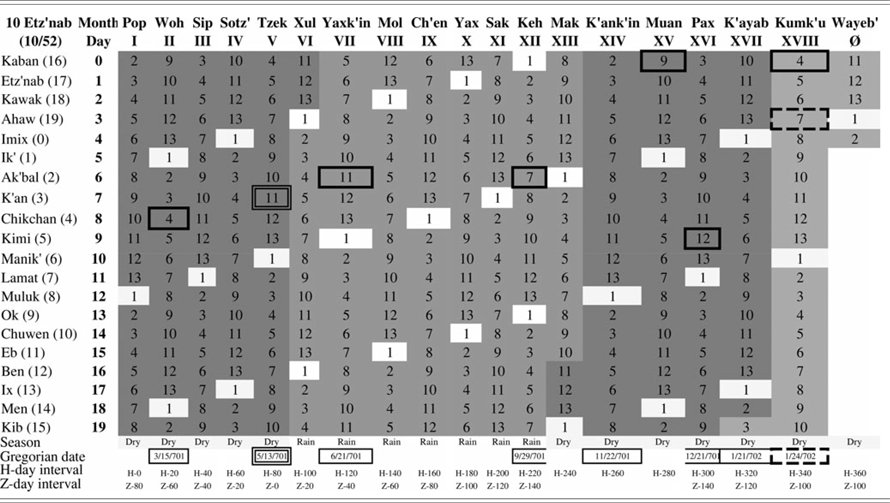
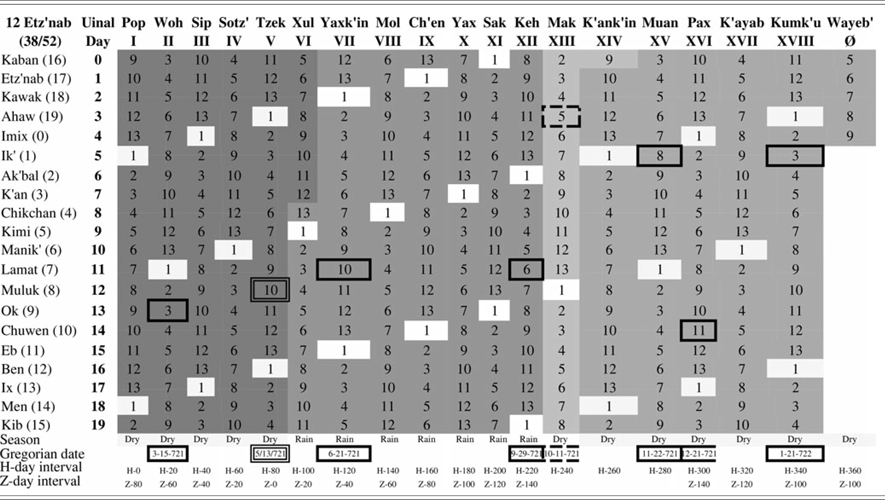
Haab intervals and calendar dates as calculated from Azimuths.

Excavated Group E complexes. About 18% of >256 known examples have been excavated, not including Tres Islas, which has an E Group-like arrangement of three stelae and an altar (Tomasic et al. Reference Tomasic, Quintanilla, Barrios, LaPorte, Arroyo and Mejía2005).

Ruppert and Denison (Reference Ruppert and Denison1943:19) first noticed the resemblance between Uaxactun's Group E complex and Structures VI (west), IVa, IVb, and IVc (east) at Calakmul and other researchers have echoed this comparison (Folan Reference Folan1989a, Reference Folan1992; Morales Lopez Reference Morales Lopez1989). Aveni and Hartung (Reference Aveni, Hartung and Aveni1989:Table 35.3), who listed 30 E-Group site examples, have presented groups of structures comparable to those at Uaxactun. In addition, Santa Rosa Xtampak deserves mention (Folan Reference Folan1989b:44). Many of these sites (e.g, Balakbal, Naachtun, Oxpemul, and Uxul) were Calakmul dependencies overseen by the kaan dynasty.
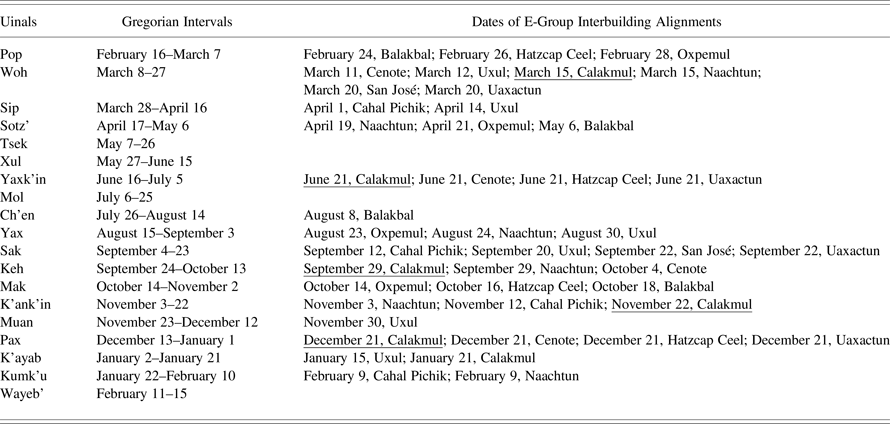
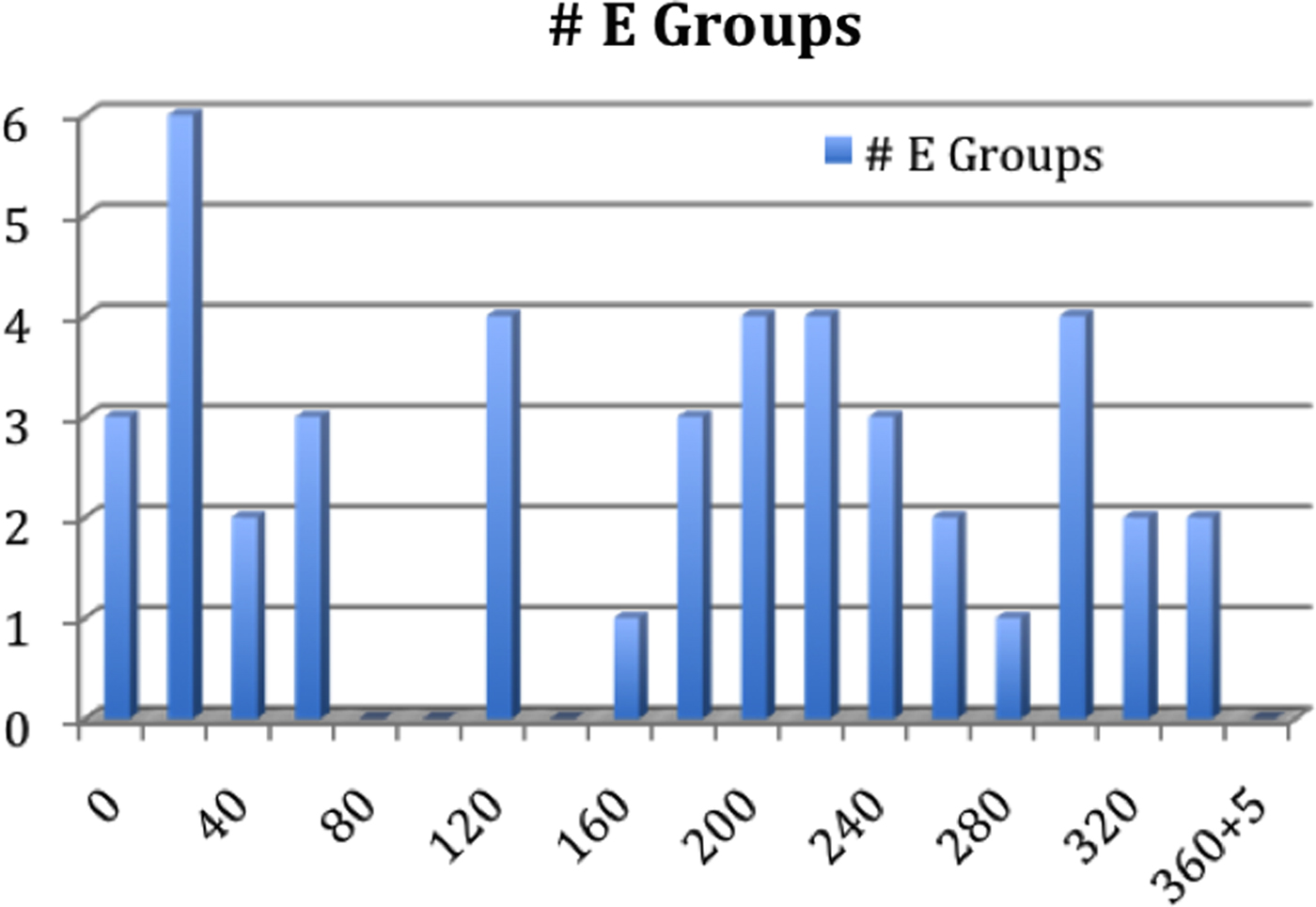
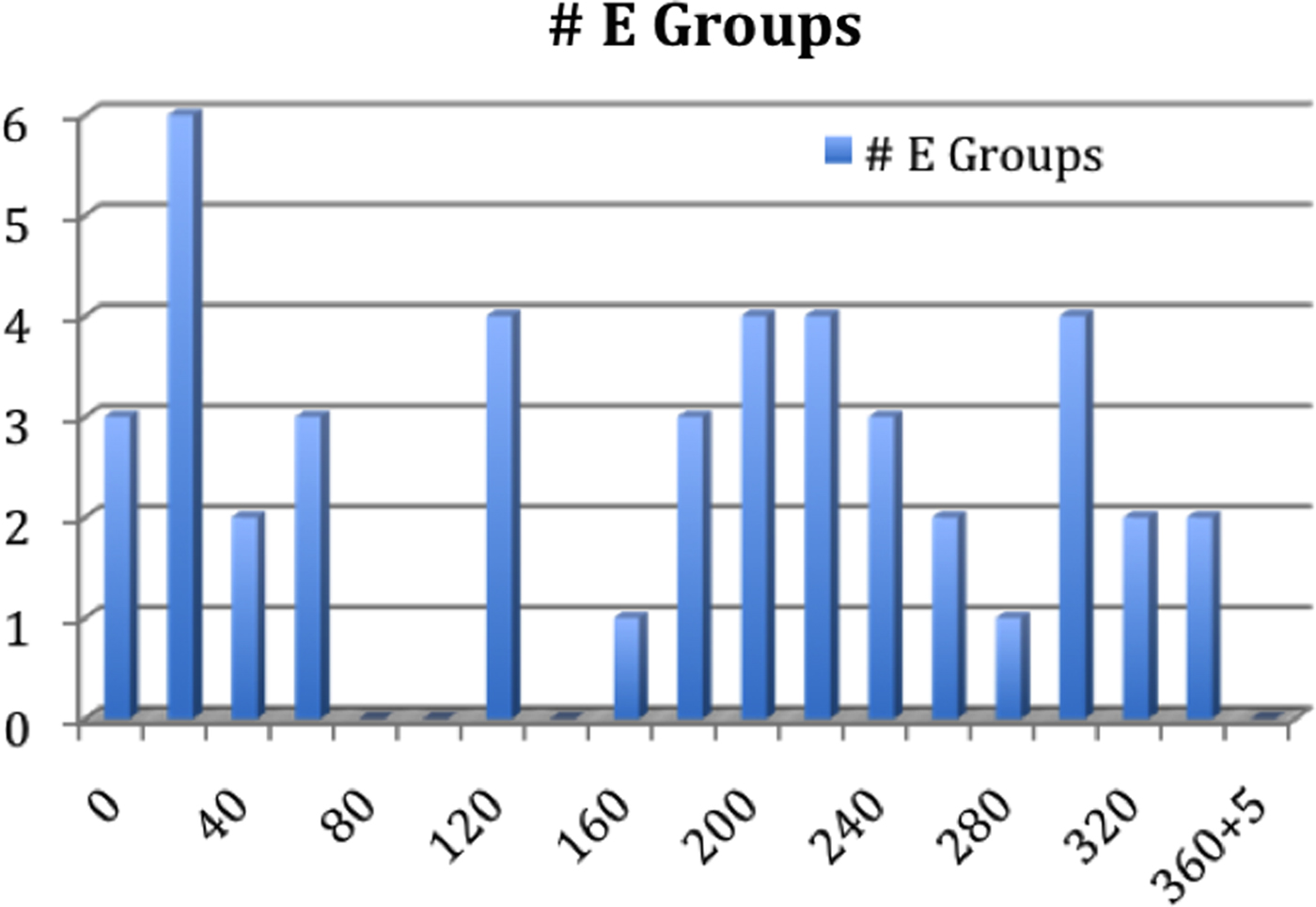
Consider that Balakbal and Oxpemul are aligned in such a way that similar dates of February 24 and 28, for example, in the haab 0-day month, referred to above as H-0 and beginning with (0 Pop), could have been observed. In the codices, the haab 0-day (0 Pop) can be inferred for the Dresden Codex (pages 25–28) and Paris Codex (pages 19–20) year-bearer pages and would have played a significant role in the Yucatan's festival calendar (Bricker and Bricker Reference Bricker and Bricker2011; Chase and Chase Reference Chase and Chase2015; Förstemann Reference Förstemann1880; Landa Reference Braswell and Gibbs1978:76; Rosny Reference de Rosny1888; Stuart Reference Stuart2011; Vail Reference Vail2002:78, Reference Vail2013; Vail and Looper Reference Vail and Looper2013). The month beginning with H-180 day (0 Yax) or the dates August 23, 24, and 30, observed at Oxpemul, Naachtun, and Uxul may pertain to renovating structures according both to Landa's (Reference Braswell and Gibbs1978) Relacion and information in the codices. Also, Uxul, Calakmul, and Naachtun shared relatively close March 12 and 15 observation dates because all three site's E-Groups celebrated the haab at the 20-day month or H-20 beginning with (0 Woh; Tables 8–10). Calakmul and Naachtun shared an emphasis on the H-220 month beginning with 0 Keh. Uxul and Calakmul commemorated the 320-day month H-320 beginning with 0 K'ayab. H-60 or 0 Sotz’ was observed at Naachtun, Oxpemul, and Balakbal on April 19, April 21, and May 6. Oxpemul and Balakbal celebrated the month beginning with H-240 or 0 Mak. Considering the issue of whether or not the dates with which the Calakmul E-Group alignments correspond to real-time events later expressed in Maya codices, there are some possible connections. The haab dates are referenced in, or may be inferred from, the seasonal almanacs with astronomical associations. Haab month intervals possibly significant at Calakmul include those beginning with days H-20 (0 Woh), H-120 (0 Yaxk'in), H-220 (0 Keh), H-260 (0 K'ank'in), H-300 (0 Pax), and H-320 (0 K'ayab). The solar hierophany in the entrance of Temple IVc at Calakmul corresponds with the uinal month Yaxk'in.
Interbuilding alignments converted to Gregorian dates at uinal intervals. These were calculated using the GMT-584,283 correlation for a.d. 701–702.1

1Underline indicates date highlighted in the architecture by means of a hierophany at sunset.
The year “10 Etz'nab” (Febuary 16, 701 to Febuary 15, 702 including January 24, 702 or LC 9.13.10.0.0 7 Ahaw 3 Kumk'u using GMT-584,283 Gregorian). H = haab, Z = zenith.1

1Shaded areas represent the dry season and non-shaded areas represent the rainy season.
The Year “12 Etz'nab” (Febuary 11, 721 to Febuary 10, 722 including October 11, 721 or LC 9.14.10.0.0 5 Ahaw 3 Mak using GMT-584,283 Gregorian). H = haab, Z = zenith.1

1Shaded areas represent the dry season and non-shaded areas represent the rainy season.
To recap, after Calakmul's Temples IVa, IVb, IVc, and VI were excavated, we became interested in the question of whether the main plaza at Calakmul a place for viewing the course of the sun at horizon. At least one temple entrance marked summer solstice in the solar year (Aveni et al. Reference Aveni, Dowd and Vining2003; Carrasco Vargas et al. Reference Carrasco Vargas, Boucher, Dowd, Paul, González G. and García1995; Dowd and Aveni Reference Dowd and Aveni1998; Dowd and Milbrath Reference Dowd and Milbrath2015). Solstices occur two times of year, June 21 and December 21, when the rising/setting sun reaches an extreme northward (longest day in the northern hemisphere) or southward (shortest day) position on the horizon. Equinoxes also occur two times a year, March 20 and September 22, when the sun rises and sets exactly in the east and west (between the two day length extremes). From the top of Structure IVc at sunset, 6:00 p.m., June 21, on the summer solstice, two sets of doorjamb shadows align perfectly, illuminating the area between the two doorways. Because the interior portal is slightly offset to the south and the doorjambs are oriented 294° east of true north to create this effect, such alterations may have been deliberate. The setting sun would have dramatically illuminated a Maya ruler, priest, or idol passing though the interior and exterior doorways on this date (Figure 10).
Calakmul, Structure IVc north doorjambs at summer solstice sunset, view East. Photograph by Dowd from Dowd and Milbrath (Reference Dowd and Milbrath2015: Figure 3.4).

Conversely, sunrise may be observed from Structure VI in the direction of Structure IVa to the east at 5:00 a.m. on June 21, from either of two pair of doorjamb alignments. These alignments measure 58° and 59° east of true north. The first is from the south rear door to the fourth front doorway and the second is from the north rear door to the first front doorway. In each case, the alignment is from one exterior to the other exterior doorjamb. Two doors at the back of the superstructure, five in front and two stelae (Stelae 23 and 24) flanking the central doorway give a variety of vantage points from which to observe sunrise and other events like uinal groupings of 20 days. If one stood on the platform in front of the structure, the azimuth between that point and the northernmost IVa temple corner, assuming a 0° horizon, is 64°30′ closely matching summer solstice sunrise of 64°58′.
Solar metaphors were used iconographically to imply death or rebirth and the end or beginning of cycles such as period endings or ruler's reigns. Temples in the Calakmul E-Group were used for the observation of sunrises and sunsets for wet and dry season rituals at specific intervals in the Maya calendar (Aveni et al. Reference Aveni, Dowd and Vining2003; Townsend Reference Townsend1992). Establishing links between temple architecture and the heavens underscored the cosmological foundation of Maya culture, kingship, and religion (Schele Reference Schele and Aveni1977:50). Recent work on emerging religious institutions in the Maya lowlands has demonstrated that E-Group temple room number and scale, for example floor area, increased dramatically at the Late Preclassic to Early Classic (a.d. 225–593) transition, especially at Calakmul (Dowd Reference Dowd, Freidel, Chase, Dowd and Murdock2017).
Of the examples of comparable complexes known to date, only Uaxactun's Group E, among those measured in situ, is oriented relatively precisely with the cardinal directions and measures the summer solstice with the northeastern temple, the equinoxes with the center eastern temple, and the winter solstice with the southeastern temple (Aveni and Hartung Reference Aveni, Hartung and Aveni1989). Also San José (0°20′ S), Cenote, Comalcalco, Dzibilchaltun, Ixtutz, Naranjo, El Venado, Uxul and Naachtun are within 5° of due east (Aimers Reference Aimers1993:124–125). Many others appear to have a greater north-south skew, including Calakmul.
Calakmul with many other E-Groups appears to be oriented with points on the horizon that correspond either with the first annual zenith passage or 20-, 40-, 60-, 80-, 100-, 120-, or 140-day intervals [leading up to first zenith passage] (Aveni et al. Reference Aveni, Dowd and Vining2003). At Calakmul, the azimuth of the corner of the north structure on the east platform IVa, as viewed from the west platform VI, is 64°30′, which matches the June 21 sunrise date at a 0° horizon and the Z-40 sunrise on horizon. The centerline of the central east temple IVb has an azimuth of 92°30′, matching the March 15/September 29 sunrise dates if one estimates a 0° horizon line, and it falls on Z-60/Z-140 sunrise. Another alignment that is within the range of solar events is the June 21 sunset doorway hierophany in the south temple on the east platform IVc, which falls into the Z-40 sunrise bin.
Similarly, the architects who designed St. Peter's Basilica in Rome oriented the nave so that the sun would shine through it on the vernal equinox, illuminating the altar below (Hartmann Reference Hartmann1985:18). This is an example of a hierophany from the European architectural tradition. Still other cathedrals were oriented toward sunrise on the saint's day they commemorated. In Chaco Canyon, a ray of light shines on the Fajada Butte spiral petroglyph during the summer solstice (Sofaer et al. Reference Sofaer, Zinser and Sinclair1979). The significance of architectural assemblages and outdoor religious worship in Mesoamerica is discussed elsewhere (Dowd and Milbrath Reference Dowd and Milbrath2015).
A south building corner with a 128°30′ alignment is outside of the range of solar events. These alignments served as indicators of sunrise/sunset on significant days in the year, such as intervals related to the date of passage of the sun across the zenith (Aveni Reference Aveni1978:62, 64; Aveni et al. Reference Aveni, Dowd and Vining2003:Table 1; Aveni and Hartung Reference Aveni, Hartung and Aveni1989:445; Blom Reference Blom1924, Reference Blom1926; Ricketson Reference Ricketson1928; Ricketson and Ricketson Reference Ricketson and Ricketson1937). Available data show that the Calakmul example of a single western structure facing three eastern structures, like Group E from Uaxactun, was a built landscape that brought the experience of viewing solar events against distant horizons into sharper focus for audiences within temple precincts in city centers.
Where the haab is emphasized, these dates may divide the solar year into two groups of five, and two groups of four 20-day intervals with a five-day remainder: March 15 to June 21 = 99 days; June 22 to September 29 = 100 days; September 30 to December 21 = 83 days; and, December 22 to March 14 = 83 days. For the intervals surrounding the two zenith passages on May 13 and on August 1 at Calakmul, three 20-day groups are on either side of the 81-day period between them (Powell Reference Powell2009:414). Between March 15 and September 29 is 199 days; September 30 to March 14 is 166 days. Intercalation or commensuration was an important means of creating a calendar system that applied to a variety of astronomical, religious, agricultural, and economic ends.
Šprajc (Reference Šprajc and Šprajc2008:239, Reference Šprajc, Rubiño-Martín, Belmonte, Prada and Alberdi2009:306) and others have suggested that El Mirador's La Pava Group E-type complex may have been the locus of the trend of emphasizing the 14°-group of alignments and postulate that perhaps the Maya could have inspired the people from Central Mexico rather than Teotihuacanos providing the impetus for calendar revisions marked by E-Group complex orientations (Laporte Reference Laporte and Braswell2003; Laporte and Fialko Reference Laporte and Fialko C1995). According to Šprajc (Reference Šprajc, Rubiño-Martín, Belmonte, Prada and Alberdi2009:310):
However, the relationship between Calakmul and El Mirador, two huge Maya centers located in the central lowlands of the Yucatán peninsula, suggests that alignments connecting prominent and intervisible buildings at different settlements may have been, indeed, intentionally incorporated in the ancient Maya cultural landscapes. Structure I of Calakmul, the site's second highest pyramid, is skewed 14°19′ clockwise from cardinal directions, recording sunrises on February 12 and October 30 (Šprajc Reference Šprajc and Šprajc2008:235, Table 9.1). Since this orientation belongs to the group that–as mentioned in the previous section–may have originated at the Late Preclassic El Mirador, and considering that the Kaan dynasty ruling in the Late Classic period from Calakmul, located about 40 km north of El Mirador, may have originally had its seat at the latter site (Martin Reference Martin and Kerr1997; Šprajc & Grube Reference Šprajc, Grube and Šprajc2008:273f), it is hardly fortuitous that the north-south axis of Structure I prolonged southward passes exactly over the colossal Danta pyramid of El Mirador, visible from Calakmul as a small bump on the southern horizon. If this alignment was designed with the purpose of manifesting Calakmul's relationship with El Mirador, then the place for erecting Structure I had to be carefully selected, so that the perpendicular to the intended astronomically functional east-west orientation coincided with the symbolically significant direction to the Danta pyramid of El Mirador.
This is a possibility for future research. The degree, nature, and direction of Maya-Teotihuacan influence is still debated (Kováč Reference Kováč2011; Laporte and Fialko Reference Laporte, Fialko C, Clancy and Harrison1990). At Calakmul in Structure VI, an Early Classic period (a.d. 225–600) cache yielded a large, laurel-leaf shaped, handheld knife, and nearby a fragment of an obsidian biface was recovered from a test pit that has been characterized using Neutron Activation Analysis (NAA) as originating in the Otumba, Mexico source area. Both probable sacrificial knives resemble one another macroscopically and appear to have been imports from the Teotihuacan region (Hruby et al. Reference Hruby, Braswell and Mazariegos2014).
While solstice orientation was the initial concern on the part of early inhabitants of the Maya lowlands, later on a modified orientation calendar appears to have emphasized the position of the sun at the horizon on days when the sun passed the zenith at noon, annual zenith passages, and bracketing 13 20-day months comprising the tzolkin or 260-day sacred almanac. The first zenith occurred at May 13 at Calakmul and on May 10 at the 17°30′ N latitude characteristic of central Peten. This canonical calendar may have been used to time crop planting during the rainy season when the Maya grew corn and intensifying ritual activities during the dry season leading up to the agricultural growth cycle. Sites like Champerico and Chicaanticaanal commemorate the tzolkin 260-day calendar with azimuths that permitted views of zenith sunrises on February 12, when milpa preparation began, or October 30, when harvesting started (Reese-Taylor Reference Reese-Taylor, Freidel, Chase, Dowd and Murdock2017; Šprajc Reference Šprajc2000:409).
Šprajc (Reference Šprajc, Villalobos and Barnhart2014:43–44) has noted a group of sites, including Champerico, Cheyokolnah, Chicaanticaanal, El Gallinero, Las Delicias, and Yaxnohcah, as well as El Mirador, Tikal, Chakanbakan, and Izamal, in the general vicinity of Calakmul in southeastern Campeche, Mexico, with a set of relatively standardized east west orientation azimuths clustering at 104°–284° corresponding to declinations of ± 13°. These orientations are part of what were identified as the 17° family of alignments by Aveni (Reference Aveni2001:234). The reason for the family of alignments being labeled 17° rather than 13° has to do with the conflation of two sets of east west azimuths. They are a physical record of zenith sunrise observation on dates on or near February 12, October 30, and antizenith or nadir sunsets near or on April 25 and August 18 (Aveni Reference Aveni2015:110). A 259-day/106-day range intervenes between February 12 and October 30 and a 114-day/251-day range intervenes between April 25 and August 18. Key variables include latitude and horizon altitude, in addition to whether or not observations were made in an eastern direction only or a more elaborate set of observation directions.
CONCLUDING REMARKS
Data recovered from archaeological excavations at Calakmul provided the opportunity to re-evaluate assumptions about the architecture and show the specific details that made the site unique and special by comparison to examples from other Maya cities. Oriented 13° east of north, Structures IVa, IVb, IVc, and VI flank the main plaza. Summer solstices were observed in and marked by at least one doorway on Structure IVc skewed so that doorjamb shadows were aligned as the sun set behind Structure VI (Figure 11). As the summer solstice sun rose, it did so behind Structure IVa as viewed from Structure VI (Figure 12). Equinoxes are not precisely marked by other doorway orientations. Interbuilding alignments, however, were oriented with deviations from the equinox alignments of only a couple of degrees, which we have interpreted instead as matching uinal months in the Maya solar calendar, and a clearly marked winter solstice sunrise. At first we thought that the Calakmul complex functioned in a more limited fashion than did the earlier one at Uaxactun. Later we realized that different functional patterns operated at various E-Groups used at different times or places (Aveni et al. Reference Aveni, Dowd and Vining2003) and other researchers have confirmed and refined this finding (Estrada-Belli Reference Estrada-Belli, Freidel, Chase, Dowd and Murdock2017; Reese-Taylor Reference Reese-Taylor, Freidel, Chase, Dowd and Murdock2017; Šprajc Reference Šprajc and Šprajc2008, Reference Šprajc, Villalobos and Barnhart2014, Reference Šprajc, Rappenglück, Rappenglück, Campion and Silva2016:188; Šprajc et al. Reference Šprajc, Morales-Aguilar and Hansen2009).
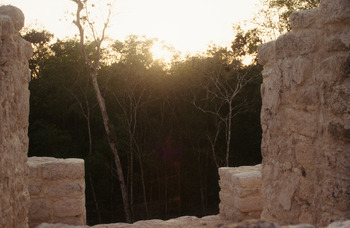
Calakmul, Structure IVc, view west. Photograph by Dowd.

Calakmul, Structure IVa, view northeast. Photograph by Dowd.

We have challenged the idea that the groups that departed from the Uaxactun easterly alignment were necessarily just allegorical by documenting a match between the summer solstice and the alignment between Structure VI and Structure IVc. Other structures, such as IVa and IVb, also appear to have had a role in commemorating astronomical events such as veintena-like 20-day uinal months leading up to and following the first annual zenith passage or other key dates such as the solar haab.
An emphasis on winter, summer, and fall dates was observed in the stelae associated with the Calakmul Group E-type complex, which may offer a connection between written and orientation-based calendars. These dates, with an apparent emphasis on summer dates as is shown in Figure 3, correspond with the winter/spring dry season when skies were clear between November and May, the summer beginning of the rains between June and August, with a one-two week dry spell corresponding to the canícula in August, and the rainy season lasting though the fall from June to October.
Uinal 20-day month intervals provided a potential set of nine paired dates of which three pairs, Yaxk'in/Pax, Woh/Keh, and K'ayab/K'ank'in, were commemorated in the Calakmul Group E. The E-Group highlighted times of day, such as sunrise and sunset, as well as seasons of year, such as dry or rainy. While Yaxk'in and Keh correspond to June and September rainy season dates respectively, the other uinal months were in the dry season.
Assumptions of symmetry in Maya architecture are not necessarily born out by the excavation data. For example, at Calakmul Structure VI is not perpendicular to the midpoint of IVb. For this reason, the 13° east of north orientation does not signal a corresponding deviation in the line measured from Structure VI to Structure IVb. In addition, the offset interior doorways of Structure IVc were not evident until after the superstructure had been excavated. Šprajc (Reference Šprajc, Villalobos and Barnhart2014:52) further points out that the building orientation is not a necessary measure of alignment function because western cultural ideals about building symmetry, orientation, or skew from true north are not demonstrated in Maya architectural traditions. This information supports our assertion that excavation data are required to more fully evaluate the possible astronomical utility of these complexes.
Available evidence supports consideration of the Group E-type complex at Calakmul as having some important architectural features that correspond to solar alignments. The growth and evolution of these architectural groups suggests that over time and through space there was variation in the manner and degree to which the architectural complex functioned, and individual site architectural solutions to design problems or ritual programs changed. Now that there are more excavated examples, chronological and formal patterning among them will be easier to discern.
At Calakmul, where the condition of the many exposed monuments (at least 140) is poor, epigraphic studies and new texts from excavated contexts may provide additional historical data to use for reconstructing the types of rituals timed to coincide with solar events like solstices. The elite Tombs 1 and 2 in Structure IVb and observed emphasis on the summer solstice in this example of an Group E architectural setting, the lintel excavated from Structure IVb featuring a ruler; the cluster of spring/summer dates on Stelae 9 and 13, Stelae 25 and 27, and on Stelae 15 and 16; and possible correlations with festivals documented in the later codices prompt us to continue analyzing Group E structures in search of their astronomical and ritual meaning within Maya dynastic and religious contexts (Figure 13).
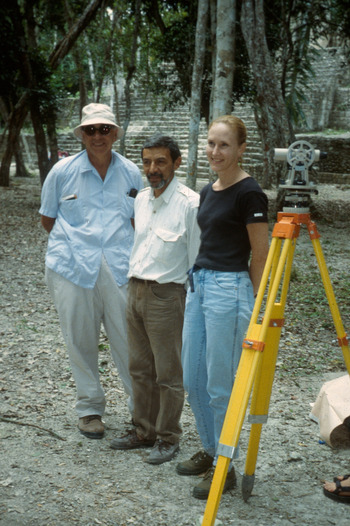
The authors at Calakmul. Structure VI is in the background, view southwest. Photograph by Lorraine R. Aveni, © 1997, all rights reserved.

These groups appear to have been the context for uinal-interval religious calendar festivals that commemorated seasonal holidays in the 365-day haab solar calendar (Figure 14). Seasonal festivals were central to the religious observances of Maya people during the time period when E-Groups were distributed in the lowland region as evidenced by their locations in site cores. Important astronomers likely coordinated religious activities with priests who performed rituals in the temple interior spaces (Aveni and Dowd Reference Aveni, Dowd, Freidel, Chase, Dowd and Murdock2017; Dowd Reference Dowd, Freidel, Chase, Dowd and Murdock2017; Saturno et al. Reference Saturno, Stuart, Aveni and Rossi2012). In the overall context of the central plaza, other religious, period ending, accession, investiture or rulership rites, may have taken place as Ringle (Reference Ringle2004) has described for Chichen Itza’s temple precinct, calling it an investiture court. Market activities, taking place directly north of Calakmul's E-Group may have also played a role, if they were timed to coincide with festivals (Carrasco Vargas and Cordeiro Banqueiro Reference Carrasco Vargas, Baqueiro, Golden, Houston and Skidmore2012; Carrasco Vargas et al. Reference Carrasco Vargas, Vázquez López and Martin2009).
Haab Alignment Orientations in E Groups, based on data from Balakbal, Cahal Pichik, Calakmul, Cenote, Hatzcap Ceel, Naachtun, Oxpemul, San José, Uaxactun and Uxul. Graph by Dowd.
In answer to the question of whether or not the Calakmul Group E-type complex was an observatory or an allegory, it was both, merging empirical uses for calendars and astronomy with mythic dramas in city centers that were cosmograms (Dowd Reference Dowd and Milbrath2015; Šprajc Reference Šprajc2005). The temple roofcomb peaks and level stuccoed floors of central plaza united the landscape beyond the city, and the source of rain and wind, with a place in which priests and penitents practiced religion, including making observations that had foundations in astronomy and timekeeping. Accumulated evidence indicates that Calakmul's E-Group apparently had a different reference base alignment than at Uaxactun, one linked to calendar reform from a solstice/equinox emphasis to intervals leading to zenith passage(s) (Aveni et al. Reference Aveni, Dowd and Vining2003). Nevertheless, it would be interesting to see if Temple EIII at Uaxactun, skewed from the underlying platform alignment to face EVII-sub, operates like the illuminated doorways (with doorjamb shadows lining up) of Temple IVc at Calakmul on summer solstice sunset (Dowd Reference Dowd and Milbrath2015). Other sites, like Caracol and San José, share this architectural feature in their E-Groups.
The summer solstice may have been of special interest to the inhabitants of Calakmul due to its importance in the agricultural year, but the correspondence between 20-day intervals likely related to festivals timed to uinal months is a persistent pattern across a range of sites. We also note that other significant dates in the solar year, such as zenith and antizenith, or nadir passage, were observed at Calakmul as well as at other sites like Tikal (Aveni et al. Reference Aveni, Dowd and Vining2003). More research is needed to determine if trecenas (13-day periods) were also important at some sites along the lines of work Šprajc and Sánchez Nava (Reference Šprajc and Sánchez Nava2012:38) have undertaken. Similarly, quarter day or year intervals have not yet been investigated thoroughly (Patrick Encina Reference Patrick Encina2011, Reference Patrick Encina2013, Reference Patrick Encina2016; Šprajc Reference Šprajc, Šprajc and Pehani2013).
Ritual and astronomical use of the Group E-type complex at Calakmul was undoubtedly intertwined, but it is important to consider patterning indicative of observing the course of the sun at horizon in light of excavation data specific to individual examples. We do not recommend assuming ceremonial functions alone given the variety of architectural solutions represented by the many Group E-type complexes in the Maya region and the difficulty of correctly perceiving these prior to excavation and careful mapping. Recent detailed comparisons of Group E-type complexes have resulted in a better understanding of Maya architects' urban planning principles, showing cosmology and astronomy to be of paramount importance in Maya city centers (Freidel et al. Reference Freidel, Chase, Dowd and Murdock2017). With archaeologists increasingly emphasizing landscape approaches, high-resolution topography using Light and RADAR or Light Detection and Ranging (LiDAR) imaging techniques, and employing Geographic Information Systems (GIS) computer mapping programs to map sites more accurately, future work on the cultural astronomy and religious significance of E-Groups is promising.
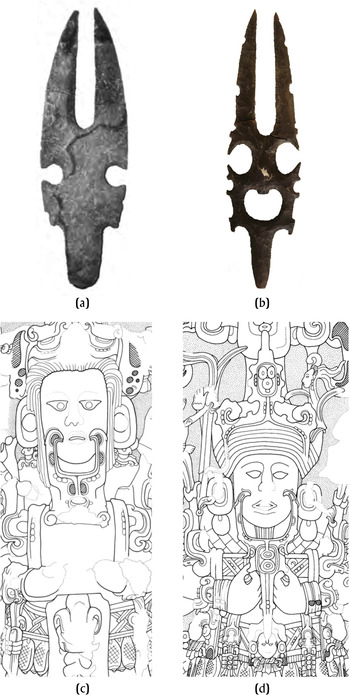
More than allegory was at work in these important central places. Just like the almanacs in codices have been recognized as being records of “real time” observations rather than predicted imaginary future occurrences, here we identify E-Groups in Maya site centers as “real space” temple precincts for skywatching, prognostication, and commemorating historical events, in addition to community gatherings for seasonal celebrations, period endings, investiture rites, mythic reenactments of creation narratives, ritual dances, deity offerings such as burning incense and sacrifice, as well as effigy processions (Figure 15). As rulers, priests and other elite circumnavigated the plaza and surrounding monumental architectural features, it was imperative that celestial agents participated with delicately choreographed and timely precision. Observing the stars, sun, moon, and planets at Calakmul impressively conveyed religious metaphor as a means of accomplishing a fusion of pragmatic agricultural, economic, intellectual, or political goals.
(a) A 23 × 8 cm chert eccentric lance from Pusilha, Belize, Tomb 8/4, Operation 8 Structure (Braswell and Gibbs Reference Braswell and Gibbs2006:281). (b) A 44 × 12 cm personified chert eccentric lance from Nim li Punit, Belize, Tomb 5, Structure 7 (Prager and Braswell Reference Prager and Braswell2016:Figure 5a). (c) Detail of west face of Stela F, Copan, Honduras, showing a lithic lance with two prongs resting on Waxaklajuun Ubaah K'awiil's face. Note the effigy or mask-like nature of the holes in the chert lance on the left, as well as a hole, two upper outside lateral notches on the blade edges, and cross-hatched fill in six ovals indicating dark, shiny stone in the iconographic depiction on the right. Drawing by Dowd based on Baudez (Reference Baudez1994:49, Figure 17). (d) Detail of the east face of Stela B, Copan, Honduras, showing a bi-pronged lithic blade balanced on two hands and resting on Waxaklajuun Ubaah K'awiil's cheeks. An inverted example, possibly a foliated shell diadem replica, is superimposed over the turban headdress. Drawing by Dowd after Baudez Reference Baudez1994:Figures 5a, 24, 26, 95.

RESUMEN
Miembros del Proyecto Arqueológico de la Biosfera Calakmul bajo la dirección de Ramón Carrasco excavaron el sitio Maya Estilo-Cenote Grupo E-tipo complejo en Calakmul, Campeche, México. El Estilo Cenote se refiere al plan del Grupo E con una serie de tres templos construidos sobre una extensión larga y angosta en la parte oriental de la estructura, frente a una estructura oeste en una plaza central amplia. Existen datos arquitectónicos para evaluar la utilidad de este grupo estandardizado y observar los eventos solares. Las evidencias astronómicas de la función de este complejo es presentada y discutida. La orientación general de las Estructuras IVa, IVb, IVc y VI es ligeramente este, 13° del norte verdadero. Mientras que un par de puertas en la Estructura IVc están alineadas con la puesta del sol durante el punto del solsticio de verano, a pesar del corte en la simetría que el plano de planta representa.
ACKNOWLEDGMENTS
Many thanks to María Elena García (Chalia), who was in charge of the excavations; Emyly González, who created the maps using AutoCad; Sylviane Boucher, who interpreted the ceramic data; Jean-Pierre Courau, who helped with the surveying; Richard W. Stoops Jr., who formatted the tables; and, the members of the Camel Trophy Tour route planning expedition, who accompanied the first author to Uaxactun, Guatemala. Dr. Gabrielle Vail assisted with connecting haab celebrations noted in the codices with possible events on dates associated with the Calakmul E-Group alignments, in part using www.mayacodices.org to find correspondences. Eloisa Pollack ably translated the abstract from English into Spanish. This is an updated version of a contributed paper, with a similar title, originally given May 4, 1995 at the 60th Society for American Archaeology Annual Meeting in Minneapolis, Minnesota.
APPENDIX A: MONUMENTAL SCULPTURE
The 1993–1994 excavations at Calakmul targeted a number of architectural groups where monumental sculpture appears, among them, the Group E-type complex with its numerous associated stelae forming the central plaza (Carrasco Vargas Reference Carrasco Vargas, Schmidt, de la Garza and Nalda1998, Reference Carrasco Vargas and Gubler1999; Carrasco Vargas and Boucher Reference Carrasco Vargas and Boucher1994; Carrasco Vargas and Colon González Reference Carrasco Vargas and González2005; Carrasco Vargas et al. Reference Carrasco Vargas, Boucher, Dowd, Paul, González G. and García1994, Reference Carrasco Vargas, Boucher, Dowd, Paul, González G. and García1995). See Marcus (Reference Marcus1987:5) for the suggestion that bilaterally symmetrical lines of stelae in front of temples at Calakmul dedicated the accession of the ruler named on them and the refurbishment of the associated structure. These stelae, altars, lintel, and either their style or associated long count and calendar round dates, provide information on the Late Classic use of the temple precinct roughly between a.d. 431–810 (Marcus Reference Marcus1987; Martin and Grube Reference Martin and Grube2000; Morley Reference Morley1933). As might be expected, many of the stelae display period-ending dates (85% of the dates), so any astronomical correlations on these examples are probably fortuitous; nevertheless, we checked associated sky events.
At Calakmul, archaeologists found 22 monuments positioned in front of, in back of, on top of, or inside of Structures IV and VI, which form the main plaza. Summer dates predominated, with a cluster of fall dates as well. No specific correlation between dates of solar events that may have been observed in the architectural complex using doorway orientations or building alignments was noted on the monuments' inscriptions.
General correlations with the dates listed on the stelae exist for Mars and Jupiter, which might have been seen at sunrise at 5:58 a.m. on October 11, 721 CE, and Venus as evening star that night. Jupiter and Mercury could be seen before sunrise at 4:47 a.m. on a.d. August 21, 662. Saturn and Uranus were visible on a.d. June 26, 672. The moon, Venus, and Mars would have been visible on a.d. June 24, 810. On a.d. January 24, 702, at the 6:39 a.m. sunrise, Mercury and Venus were aligned and Jupiter and the moon were aligned before sunrise. On a.d. July 24, 736, Mercury and Mars would have been visible at sunrise at 5:39 a.m. and Venus rose as evening star at sunset. Venus was morning star on a.d. June 28, 741 at sunrise at 5:30 a.m.
Yet the platform to the rear of Structure VI might have accommodated a group of people celebrating community rituals such as petitions for healthy crops or a maize god impersonator's dance, like Yuknoom Took’ K'awiil's performance referred to on the newly discovered La Corona Element 55 (Stuart 2012–2015), which is the same 9.13.10.0.0 date commemorated on Stelae 23 and 24 in front of the Structure VI temple (Dowd Reference Dowd, Freidel, Chase, Dowd and Murdock2017). As related in the Popul Vuh, the creation myth climaxes when Hunahpu manifested as the sun rises on zenith passage and begins the corn cycle (Bassie-Sweet Reference Bassie-Sweet2008:33).
Two stelae, Stelae 23 and 24, and an altar are just outside the central (east) entrance to the superstructure of Structure VI. These are dated 9.13.10.0.0 7 Ahaw 3 Kumk'u (or a.d. January 24, 702) and are associated with Yuknoom Took’ K'awiil (Marcus Reference Marcus1987:84–85; Martin and Grube Reference Martin and Grube2000). Stela 22 is at the base of the east side of the structure. An altar was found buried in the plaza in front of it in 1994. Stelae 25–27 are positioned with a single altar on the west side of the platform. Dating to between 9.15.5.0.0 10 Ahaw 8 Ch'en (or a.d. July 24, 736; Stela 26) and 9.15.10.0.0 3 Ahaw 3 Mol (or a.d. June 28, 741; Stelae 25 and 27), these may document a change in focus from the central plaza to the West Group. By this time, Bolon K'awiil I was in power but Calakmul's regional hegemony was waning, as allies El Perú Waka’ and Naranjo were defeated by Tikal in a.d. 743 and 744, respectively.
Structure IVa is associated with Stelae 7, 8 and 90. Of these, Stela 8 was erected by Yuknoom Took’ K'awiil in 9.14.10.0.0 5 Ahaw 3 Mak (or a.d. October 11, 721; Marcus Reference Marcus1987:86; Martin and Grube Reference Martin and Grube2000). Associated with Structure IVb are Stelae 10– 12 (on the platform); Stela 9 (now in the Campeche Museum); and Stelae 13, 15, 16, and 4 (in front of the platform). Stela 9 is of interest because it is shows a male ruler, Yuknoom Ch'een II, on the front and his wife on the back (Marcus Reference Marcus1987:136; Martin and Grube Reference Martin and Grube2000). This stela has four dates inscribed on it: (a) 9.10.16.16.19 3 Kawak 2 Keh (a.d. October 7, 649); (b) 9.11.10.0.0 11 Ahaw 18 Ch'en (a.d. August 21, 662); (c) 9.11.18.3.0 13 Ahaw 18 Yax (a.d. September 8, 670); and (d) 9.12.0.0.0 10 Ahaw 8 Yaxk'in (a.d. June 29, 672). Stela 13 also exhibits the 9.12.0.0.0 10 Ahaw 8 Yaxk'in date (a.d. June 29, 672). Stelae 15 and 16 are dated 9.19.0.0.0 9 Ahaw 18 Mol (a.d. June 26, 810; Marcus Reference Marcus1987:82). Structure IVc is associated with Stelae 19–21, but these stelae are not dated. Note that Stela 114, found in 1994 with a long count date of 8.19.15.12.13 8 Ben 6 Mol (a.d. September 14, 431), extended Calakmul's history to suggest that there were rulers preceding “Ruler 1” (cf. Stela 43, dated to 514 CE; Marcus 1987:67; Martin and Grube Reference Martin and Grube2008:103; Pincemin et al. Reference Pincemin, Marcus, Folan, Folan, Domínguez Carrasco and López1998). The name Ch'ok Chan(al), or Young Snake, appears on Stela 114 (Martin Reference de Landa and Gates2006:156, 180, note 5).
The date (a.d. October 31, 721, 9.14.10.0.0) on Stela 8 in front of Structure IVa at Calakmul, corresponds with the timing of the copal incense scattering event, or throwing incense pellets into a fire, recorded on Stela 15 at Nim li Punit showing the protagonist wearing a T503 Ik’- (wind, breath, and, by extension, life) or T-shaped jade jewel pectoral similar to one found in Calakmul's Structure VII, Tomb 1, and likely identical to the recently excavated example from Structure 7, Tomb 5, at Nim li Punit (Folan et al. Reference Folan, Marcus, Pincemin, Domínguez Carrasco, Fletcher and López1995:320; Love Reference Love1987; Prager and Braswell Reference Prager and Braswell2016). Stela F from Copan, Honduras, also commemorates this 9.14.10.0.0 date and shows a bifurcated whistongue or knife-tongue lancet similar to the personified eccentric two-pronged black chert knife discovered in Nim li Punit Tomb 5 and possibly also to an lithic artifact from outside Pusilha Burial 8/4 (Figure 15a–15b; Baudez Reference Baudez1994:51, Figures 17–18; Prager and Braswell Reference Prager and Braswell2016:Figure 5a). Besides Stela F, Stela B at Copan, dated 9.15.0.0.0 4 Ahaw 13 Yax, prominently displays a twin-tipped lithic blade (Figure 15c). While neither Stela F nor Stela B exhibit an Ik’ wind jewel pectoral, other examples of Copan sculpture show one being worn, for example by figure 10 on the Structure 11 bench throne, and by six of the rulers depicted on Altar Q (Baudez Reference Baudez1994:98–99, 178, Figure 87; Dowd Reference Dowd1992). Lounsbury (Reference Lounsbury1978) has interpreted glyph block G1a to read hand scattering event preceding a 9.17.10.0.0 date in blocks A1–B1 on the Structure 11 bench inscription. Dates on Stelae 25 and 27 (June 30, 741, 9.15.10.0.0) west of Structure VI at Calakmul, also correspond temporally with a copal incense scattering event recorded on Stela 1 at Nim li Punit, Belize.
At Calakmul there are inscriptions recording half-katun period or tenth tun ending events, sometimes called lahuntun or lajuntun, commemorated on stelae associated with Structures VI and IVa between a.d. 662–741 (9.11.10.0.0 [Stela 9]; 9.13.10.0.0 [Stelae 23–24]; and 9.15.10.0.0 [Stelae 25 and 27]). Examples of scattering events noted at Calakmul occurred on katun period endings recorded on Stela 52 at 9.15.0.0.0 or a.d. 731 (Stuart Reference Stuart2011:263–265, Reference Stuart2012–2015) and on Stela 61 at 10.4.0.0.0 or a.d. 909 (Martin and Grube Reference Martin and Grube2008:115) and there are other examples that we do not have room to describe here. The inscription on the Nim li Punit jade pectoral back describes an incense scattering event that took place on 9.12.0.0.0. Stela 9 at Calakmul also records this date.
Available information suggests that a comparison of hieroglyphic inscriptions and iconographic depictions recorded on stelae celebrating events (ti chok, for the scattering–incense or other substances, perhaps blood) on the same days (for example: 9.12.0.0.0, a.d. 672 CE; 9.14.10.0.0, a.d. 721; 9.15.0.0.0, a.d. 731; 9.15.10.0.0, a.d. 741) by people (like Yuknoom Took’ K'awiil, Waxaklajuun Ubaah K'awiil, or Janaab Ohl K'inich) wearing or holding individual or sets of distinctive ceremonial artifacts (such as a jade jewel Ik’ wind pectoral and a chert twin pronged lance blade) may show how period ending rituals were carried out at different site centers (Calakmul, Copan, and Nim li Punit, to name a few). Of these sites, Calakmul has an E-Group that may have been the location of the event. We do not yet know its exact transcription (Prager and Braswell Reference Prager and Braswell2016), but the very last hieroglyph on the jade pectoral could be a reference to a three-stone place from north central Belize or eastern Peten. Residue analysis, if used to successfully characterize organic remains on the Nim li Punit or the Pusilha eccentric flint lances, may reveal new data.
The idea that the burials in the E-Group north structures may warrant comparison based on correspondences observed between Tomb 1 in Calakmul's Structure VII and a tomb in Caracol's Structure A-3 has been suggested elsewhere (Dowd Reference Dowd, Freidel, Chase, Dowd and Murdock2017:560). Information from paraphernalia buried with a priest in an E-Group at Comalcalco, Mexico suggests that an individual from a master of fire yajawk'ahk religious order preformed autosacrificial rites at sunrise on the equinoxes (Edmonson Reference Edmonson1986; Zender Reference Zender2004). The timing of this event makes the location of similar rituals in Temple IVb, with center doorway orientations that coincide with March 15/September 29 at Calakmul, a possibility. Girard (Reference Girard1966) cites an ethnographic example of a solstice ceremony among the Chorti, who moved a statue symbolizing the sun from a southerly temple to a northerly one on the winter solstice and back again on the summer solstice. In addition, the “flapstaff” ceremony, so called because the images accompanying the text on stone monuments show a distinctive staff with cut-out quatrefoil designs passed between protagonists, or the Jasaw dance, was performed among the Classic Maya at Yaxchilan on the summer solstice (Dowd and Milbrath Reference Dowd and Milbrath2015; Looper Reference Looper2003; Milbrath Reference Milbrath1999:69); however, it may not have been specifically associated with Group-E-type architecture, since no architectural complex of this type has yet been reported from Yaxchilan. Zenith passage dates were also commemorated at Yaxchilan (Tate Reference Tate and Aveni1989:420–424). At least fourteen or more Group E-type standardized architectural assemblages at different sites feature abundant architectural and freestanding sculpture that offer an important source of calendric, epigraphic, and iconographic information. Data from the sculptural corpus at La Corona, Nim li Punit, and Copan have been mentioned above. At Calakmul, other stone monuments exist associated with architecture within and around the E-Group complex, and, while these are not discussed here, may have dates that provide seasonal or astronomical information.
The raw material used for many of Calakmul's stelae is a soft, friable, and easily eroded limestone, which makes for poorly preserved surface monuments; slate was also used (Graham and Williams Reference Graham and Williams1971:161–166; Martin and Grube Reference Martin and Grube2008:101; Morley Reference Morley1933:30–43; Ruppert and Denison Reference Ruppert and Denison1943:23). Some examples of better preservation when monuments, or fragments thereof, were buried are Stela 114 and Lintel 1, both exposed in excavations. While there may be potential for earlier, as yet undiscovered, construction phases at Calakmul's E-Group containing early inscriptions or varied alignment patterns based on the identification of very early E-Groups at other sites, notably Ceibal (Inomata et al. Reference Inomata, Triadan, Aoyama, Castillo and Yonenobu2013), the stelae erected in the main plaza at Calakmul primarily date to the Late Classic period. The possibility exists of finding stelae or fragments thereof in the ongoing excavations, as has been the pattern at Calakmul and at other sites. The recent discovery of stelae fragments used as offerings at El Perú Waka’ in the vicinity of Structure M13-1 in the central plaza is another example (Freidel Reference Freidel2016).
A correspondence between astronomical alignments and dates may exist at other sites; for example, Ceibal's Stela 7 records an inauguration/nominal compound (at A2 [59:684b:126/x:1030i]), after a period-ending date 9.17.0.0.0 13 Ahaw 18 Kumk'u (or a.d. January 22, 771; Graham Reference Graham and Willey1990:20). Stelae 5 and 7 flanked the west staircase of Structure A-10, the central eastern structure within the Group E-type complex composed of Structure A-20 to the west and Structures A-12, A-10, and A-9 to the east. These Late Classic era monuments relate to contemporaneous E-Group construction phases at the site. The stelae erected in the main plaza attest to the long duration of E-Group use at Ceibal, from about 950 b.c. to a.d. 810 or later (Inomata et al. Reference Inomata, Triadan, Aoyama, Castillo and Yonenobu2013).