INTRODUCTION
In view of the growing energy crisis, resource degradation problems and increasing cost of cultivation, modified tillage and crop establishment techniques are being advocated for improving resource-use efficiency, productivity and profitability in diversified cropping systems. Greengram is grown during rainy season as a rainfed short-duration low-input requiring crop. Although it is mostly grown on flat land surface, bed planting may be useful under conditions of deficit moisture or excess water after heavy rains, as well as for more efficient use of irrigation water. Legumes develop canopy cover quickly and smother weed growth. Further, these crops fix atmospheric N2, shed their leaves at maturity and benefit the subsequent cereal crop. Soil looks apparently more friable and the following wheat can be grown without much of soil manipulation. Accordingly, greengram-wheat cropping system is followed in some parts of north-western and central India (Ghanshyam et al., Reference Ghanshyam and Jat2010; Raundal and Sabale, Reference Raundal and Sabale2000). The farmers normally grow greengram as a subsistence crop without much of external inputs, and take the following wheat with elaborate tillage operations and liberal N fertilization. The productivity levels can be enhanced through suitable manipulation of cultivation practices while reducing the cost on tillage and using the inputs like fertilizer and water more judiciously.
Growing wheat under ZT is reported to produce equal or higher yields than CT (Erenstein and Laxmi, Reference Erenstein and Laxmi2008; Ram et al., Reference Ram, Singh, Saini, Kler and Timsina2013). However, it is advocated to use higher seed rate and more N fertilizer under ZT conditions to compensate for the likely loss in initial crop stand and vigour (Singh et al., Reference Singh, Gupta, Singh, Singh, Sindhu and Singh2009). Nitrogen applied in ZT is used 20% less efficiently by wheat crop than N applied in CT (Hobbs et al., Reference Hobbs, Sayre and Gupta2008). On the other hand, raised-bed planting is believed to result in saving of seed, water and N fertilizer while producing similar or even higher yields as compared with conventional flat sowing (Majeed et al., Reference Majeed, Muhmood, Niaz, Javid, Ahmad, Shah and Shah2015; Ram et al., Reference Ram, Singh, Saini, Kler and Timsina2013). Such a system also prevents lodging of the crop and checks weed infestation on the top of the bed, thus ensuring easy weed control and intercultural operations (Dhillon et al., Reference Dhillon, Prashar and Thaman2004; Tripathy et al., Reference Tripathy, Sayre, Kaul and Narang2002). The concept of permanent beds has been developed in recent years where the following crops are grown on the beds of the previous crop in order to save time, reduce cost and improve soil quality (Freeman et al., Reference Freeman, Girma, Teal, Arnall, Klatt and Raun2007; Govaerts et al., Reference Govaerts, Sayre and Deckers2005). Nitrogen-use efficiency in wheat is influenced significantly due to tillage, crop establishment and residue management (Gajri et al., Reference Gajri, Singh, Arora and Gill1997; Limon-Ortega et al., Reference Limon-Ortega, Sayre and Francis2000). The N response and use-efficiency of wheat grown after greengram has not been adequately studied under ZT and raised-bed planting systems. Therefore, this study was planned to evaluate the N response of wheat under varying tillage and crop establishment practices in greengram-wheat cropping system.
MATERIALS AND METHODS
Experimental site
A field experiment was conducted during 2005–06 and 2006–07 at the research farm of Indian Agricultural Research Institute, New Delhi situated at 28°35′ N latitude and 77°12′ E longitude and at an altitude of 228 m above mean sea level. The soil of the experimental site was sandy-loam in texture, with pH 7.2, organic C 0.40%, KMnO4-oxidizable N 100 mg kg−1, 0.5 M NaHCO3-extractable P 8 mg kg−1 and 1 N NH4OAc-exchangeable K 105 mg kg−1 soil. In 2005, greengram was grown during rainy season (July-September) on a well-prepared field either on flat surface or raised-beds. After harvest, wheat was grown in winter season (November–April) with four different treatment combinations of tillage, viz. CT and ZT; and crop establishment, viz. flat sowing and FIRB. These treatments were further combined with varying rates of N fertilizer, viz. 0, 40, 80, 120 and 160 kg N ha−1. In 2006, greengram was sown without disturbing the layout under varying tillage and crop establishment practices, viz. CT-flat sowing, CT-FIRB, ZT-flat sowing and ZT-FIRB. The residual effect of N rates applied to wheat on greengram was considered negligible and hence it was ignored. Wheat crop in 2006–07 was raised with the same treatments as in 2005–06. Thus, there were two and four treatments for greengram in 2005 and 2006, respectively arranged in a randomized block design; while there were 20 treatment combinations for wheat involving four levels of tillage and crop establishment kept in the main plots (35.0 × 2.8 m) and five rates of N in sub-plots (5.0 × 2.8 m) arranged in a split-plot design. Three replications were maintained for both crops.
Crop management
Field was thoroughly ploughed two times each with a disc harrow and cultivator after the onset of monsoons in June–July in the CT plots. There was, however no ploughing done in ZT plots. A uniform dose of 18 kg N and 20 kg P ha−1 (100 kg diammonium phosphate) was applied basally. Greengram cv. ‘Pusa Vishal’ (70 days) was sown @ 20 kg seed ha−1 by mid-July either on flat surface at 35 cm row spacing or on raised-beds formed at 70 cm. Beds were formed with a bed planter and two rows of greengram were sown on the top of bed at 25 cm row spacing, thus leaving a distance of 45 cm between the adjacent rows of 2 beds. Plant to plant spacing was maintained at 5 ± 2 cm after thinning. Uniform plant population per unit area (50–60 m−2) was maintained under both the methods of sowing. Application of paraquat @ 0.5 kg ha−1 in ZT plots three days before sowing, and pendimethalin @ 0.75 kg ha−1 in all plots on the following day after sowing was made. The first picking of pods was done at 60 days of growth, and the second at full maturity (70 days). The stover except the fallen leaves was removed from the field.
Wheat cv. ‘PBW 343’ (150 days) was sown by mid-November under different tillage and methods of establishment as per treatment. CT in the respective plots involved ploughing once each with a disc harrow, cultivator and rotavator. Paraquat @ 0.5 kg/ha was sprayed 2–3 days before sowing in ZT plots, in which, no ploughing was done under flat as well as raised-bed system. Raised-beds were prepared fresh under CT, while in ZT-FIRB system, sowing was done in a single pass of bed planter which also reshaped the beds. Sowing on flat surface was done with ZT seed drill at 20 cm spacing using 100 kg seed ha−1 under both conventional and ZT conditions. Similarly, sowing on beds was done with a bed planter under both the conditions, with 3 rows of wheat on the bed at a spacing of 13 cm. Thus, there were equal number of rows in each plot and plants per unit area (160–170 m−2) although the plants on the side rows on the bed enjoyed greater spacing (43 cm) than the central row (13 cm). A uniform dose of 26.2 kg P and 33.3 kg K ha−1 along with 50% N as per treatment was applied basally. The remaining N was top-dressed at 35 days of growth after herbicide spray, which involved uniform application of isoproturon @ 1 kg ha−1 for controlling weeds. Only one irrigation was given to greengram, while wheat was irrigated five times during the season besides a pre-sowing irrigation. One spray of endosulfon (0.5%) was given to greengram at 40–45 days of growth, while no pest control measures were required for wheat.
Data collection and analysis
Observations were recorded on growth and yield performance of crops. Nitrogen concentration in grain and straw of wheat was determined, and accordingly N uptake and use-efficiency of applied N fertilizer was calculated. Regression analysis was done to work out the optimum dose of N for wheat under different tillage and crop establishment practices. Economic analysis was done considering the cost of inputs used, field operations and the price of produce. Statistical analysis of data was done following the standard analysis of variance technique.
RESULTS
Performance of greengram
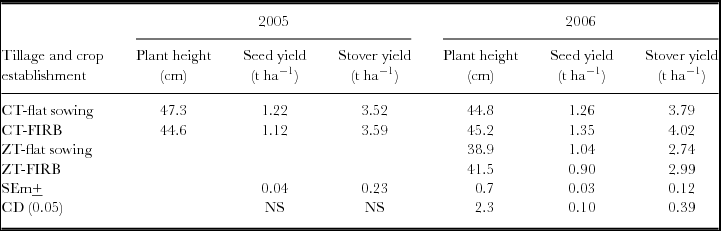
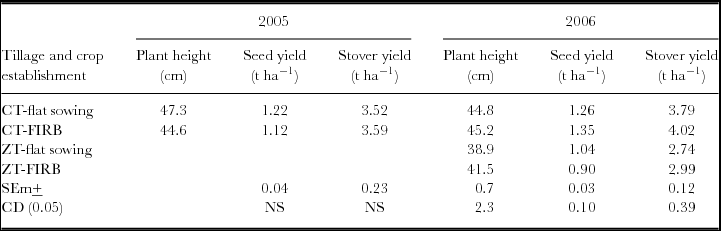
Initial growth of greengram was apparently better under raised-bed than flat sowing, and under CT than ZT conditions. However, at harvest there was no significant difference in the growth and yield performance under flat and raised-bed following CT in 2005 (Table 1). In 2006, growth and yield attributes differed significantly due to varying tillage and crop establishment practices. Plant height was significantly more under CT than ZT, but the differences between flat and raised-bed were at par. Seed and stover yields were significantly lower under ZT than CT, the mean decrease being 25.9–26.5%. There was no significant difference in yield due to methods of establishment. Stover production was comparatively higher under FIRB than flat sowing but the differences were not significant.
Effect of tillage and crop establishment practices on growth and yield of greengram.
Performance of wheat
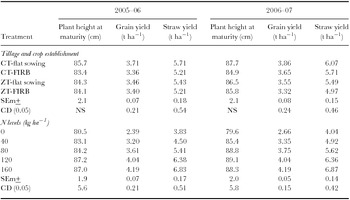
Emergence and initial growth of wheat plants showed apparent differences among the treatments of tillage and methods of establishment. Germination of wheat was better in the flat-sown crop, while the seeds sown on the raised-beds germinated poorly and required an early irrigation within 15 days to ensure proper germination. At harvest, plant height was maximum under CT-flat, which was similar to raised-bed planted crops in both years (Table 2). In general, the flat-sown crop resulted in relatively taller plants under both tillage practices, although the differences were not statistically significant. Yield performance of wheat varied significantly due to tillage and crop establishment practices as well as N levels. In general the yields were higher under CT and flat sowing than ZT and FIRB system, respectively. The mean yield decreased by 0.11–0.32 t ha−1 under ZT over CT, and by 0.21–0.23 t ha−1 under FIRB over flat system. The yield of grain as well straw was the highest under CT-flat. This grain yield was significantly more than all other treatments in 2005–06 but in 2006–07, the yields under CT-flat and CT-FIRB were on par. The variation in straw yield also followed almost a similar trend.
Effect of tillage and crop establishment practices on growth and yield of wheat after greengram.

Response function
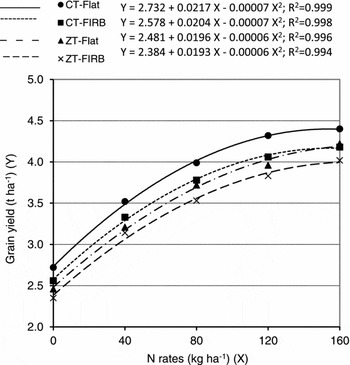
Nitrogen fertilization brought about large increases in yield of wheat. While the mean increase in straw yield was significant up to 160 kg N ha−1 in both years, the grain yield increased up to 120 kg N ha−1. Interaction between tillage and N rates revealed that the grain yield increased up to 120 kg N ha−1 under CT and up to 160 kg N ha−1 under ZT conditions, suggesting that ZT crop required additional N for realizing the full potential of the crop. The increases in yield were more pronounced at the lower levels of N (up to 80 kg N ha−1) but tended to level off at the highest level of N fertilization. Response of wheat to N application was quadratic under all tillage and crop establishment practices (Figure 2). The yield was the highest under CT-flat, followed by CT-FIRB system at all N levels. However, the increase in yield from 120 to 160 kg N ha−1 was marginal. The grain yield under ZT-flat was relatively lower than under CT-FIRB at lower N levels, but was similar when the N application was increased to its maximum. On the other hand, ZT-FIRB recorded the lowest yield throughout, and the loss could not be compensated even at higher levels of N. Interestingly, there was a greater increase in yield under ZT when the N rate was increased from 120 to 160 kg N ha−1; while such increase was negligible under CT conditions. Nitrogen dose for achieving the maximum and optimum yield of wheat was worked out to be 155 and 147 kg N ha−1, respectively under CT-flat, which decreased by about 10 kg ha−1 under CT-FIRB system. On the other hand, the N max and N opt doses were 161–163 and 152–154 kg ha−1 respectively under both ZT treatments. Based on these data, the overall decrease in yield under FIRB compared with flat-bed was 0.3 t ha−1 under CT and 0.1 t ha−1 under ZT conditions.
Response of wheat to N application under varying tillage and methods of establishment (based on mean of two years).

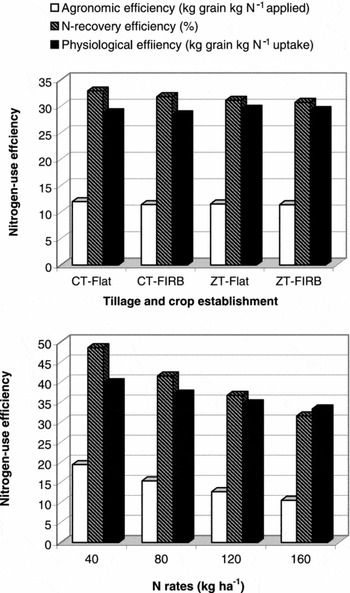
Nitrogen-use efficiency as influenced by tillage and N fertilization in wheat (based on mean of two years).

N uptake and use-efficiency
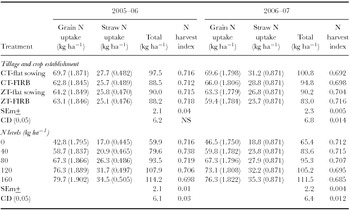
Nitrogen concentration in grain as well as straw of wheat was influenced by tillage but not much by the method of establishment (Table 3). The crop sown under CT had relatively higher N concentration than that under ZT. This increase in N concentration coupled with higher production of grain and straw led to maximum N uptake under CT-flat sowing, which was significantly more than all other treatments. The CT-FIRB and ZT-flat resulted in similar N uptake but significantly more than ZT-FIRB. The N harvest index did not show perceptible differences among the treatments, although it was relatively higher under ZT than CT conditions. On the other hand, N fertilization resulted in conspicuous increase in N concentration of grain and straw of wheat, and this increase was linear with N rates up to 160 kg N ha−1. Nitrogen-use efficiency was only marginally influenced by the tillage and crop establishment practices, but there was conspicuous change with N application rates (Figure 2). Agronomic efficiency varied from 11.4 to 11.9 kg grain kg N−1 applied, while the physiological efficiency ranged from 26.8 to 29.2 kg grain kg−1 N uptake.
Nitrogen concentration and uptake of wheat under different tillage and methods of establishment.

*Values within parentheses indicate N concentration (%).
Economic analysis
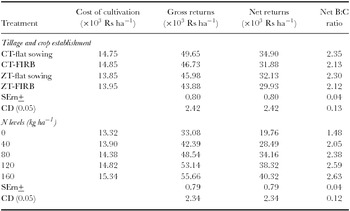
Cost of cultivation was higher under CT due to three additional ploughings done for land preparation than ZT (Table 4). It was also slightly more under FIRB due to requirement of a heavy duty tractor (>50 HP) for sowing than under flat conditions. The gross as well as net returns were the highest under CT-flat, followed by near equal returns under CT-FIRB and ZT-flat. The ZT-FIRB system resulted in the lowest returns due to low productivity under this treatment. Evidently, the cost increased linearly with N application rates, and the returns also improved up to the highest level of N tested. The net B:C ratio was maximum and near equal under CT-flat and ZT-flat; while the FIRB under both CT and ZT resulted in much lower values. On the other hand, the increase in net B:C ratio was more pronounced up to 120 kg N ha−1, after which the increase was marginal.
Economics of wheat under different tillage and methods of establishment (based on mean of 2 years) (Rs 65 = 1 US $).

Cost of inputs/operations: N – Rs 12 kg−1, P2O5 – Rs 20 kg−1, K2O – Rs 8 kg−1, Isoproturon – Rs. 600 kg−1, Paraquat – Rs 600/- per litre, seed – Rs 20 kg−1, Sowing/ploughing once – Rs 500/-, irrigation once – Rs 400, harvesting and threshing – Rs 2000 ha−1, rental value of land – Rs. 4000 ha−1.
Cost of produce: Grain – Rs 10000 t−1, straw – Rs 2000 t−1.
DISCUSSION
Poor performance of greengram under ZT was due to its shorter growth duration, lower dry matter accumulation and restricted root growth in the comparatively compact soil. Further, relatively higher weed infestation under ZT also adversely affected crop growth. Adverse effects on crop growth due to soil compaction and weed infestation can be overcome with residue application under ZT conditions. Bed planting did not prove superior to flat sowing in both years in terms of yield production, despite better initial growth of plants. In summer green gram, ZT and bed planting proved beneficial due to lower weed infestation and high water-use efficiency (Dodwadiya and Sharma, Reference Dodwadiya and Sharma2012; Idnani and Singh, Reference Idnani and Singh2008). In most crops and situations, bed planting resulted in equal or higher yields but the use-efficiency of applied resources especially water was always higher than flat sowing (Sepat et al., Reference Sepat, Behera, Sharma, Das and Bhattacharya2014; Wang et al., Reference Wang, Wang and Sayre2004). Under the present conditions, the crops grown on flat or raised-bed did not experience any moisture stress during the growth period. Rainfall pattern in both years was normal and only one irrigation was needed at an early growth stage of the crop.
Wheat performed equally well in the two years as the weather conditions during the season were optimum and the crop received five irrigations at the critical growth stages. Germination was nearly equal under CT-flat and ZT-flat conditions but the initial growth of plants was apparently poor in the latter. Uniform dose of P and K fertilizer along with N as per treatment was drilled at sowing under both the conditions. The crop under ZT showed stunted growth in the early stages due to less availability of N and restricted root growth. The increase in height under CT than ZT was due to better growing environment, and that under flat than FIRB was due to greater competition among plants. The decrease in yield under ZT was also due to relatively poor growth of plants owing to restricted root growth in the compact soil and less availability of nutrients (Hobbs et al., Reference Hobbs, Sayre and Gupta2008). Retaining crop residues on the soil surface with ZT is critical as ZT without residues drastically reduced yield of wheat grown after maize (Govaerts et al., Reference Govaerts, Sayre and Deckers2005). There was no greater weed problem under ZT conditions as these were effectively checked with herbicide applications. Crop establishment under flat system with ZT seed drill resulted in uniform crop stand, while that with FIRB planter required greater care under ZT conditions. Therefore, for the success of bed planting technology, a perfect seed-drill with more appropriate row spacing between the tynes was necessary. Sharma et al. (Reference Sharma, Tripathi, Kharub, Chhokar, Mongia, Jag, Chauhan and Nagarajan2005) reported that seeding 2 or 3 rows of wheat on the raised-bed made no difference on yield performance. Thus, 2 rows on the bed with inter-row spacing of 26 cm may be ideal to avoid blocking of pores. The performance of ZT crop can be improved particularly when sowing gets delayed due to late harvest of rainy season crops or other operational constraints. ZT technology for wheat has been found to result in equal or higher yields when adopted after long-duration basmati rice as it enabled advance sowing by 7–10 days compared with the normally-tilled crop (Arora et al., Reference Arora, Sidhu, Sandhu and Thind2010; Kumar et al., Reference Kumar, Saharawat, Gathala, Jas, Singh, Chaudhary and Jat2013). However, for the long-term success of ZT, it is essential to combine it with surface cover management through crop residue mulching so as to take care of N deficiency, soil compaction and perennial weeds infestation (Aggarwal et al., Reference Aggarwal, Choudhary, Singh and Chakraborty2006; Govaerts et al., Reference Govaerts, Sayre and Deckers2005; Malhi et al., Reference Malhi, Lemke, Wang and Chhabra2006). Retention of crop residues and application of N greatly influenced the N economy of greengram-wheat cropping system and ensured higher crop productivity in low N soils (Bakht et al., Reference Bakht, Shafi, Jan and Shah2009).
The additional N (more than the optimum of 120 kg N ha−1 under CT) was beneficial under ZT to compensate for some loss in yield. Arora et al. (Reference Arora, Sidhu, Sandhu and Thind2010) recommended that ZT wheat should be grown with additional 30 kg N ha−1. Similarly, Yaduvanshi and Sharma (Reference Yaduvanshi and Sharma2008) suggested using FYM or sulphitation pressmud along with recommended N under ZT conditions with saline-sodic irrigation. Freeman et al. (Reference Freeman, Girma, Teal, Arnall, Klatt and Raun2007) reported that grain yield response of winter wheat to N was greater in the CT than bed-planting system. Further, N requirement for wheat and greengram was higher for strip tillage compared with CT but may decline with passage of time due to organic matter build-up in soil (Ali, Reference Ali2014). In our study, the optimum N doses were 7–15 kg ha−1 higher under ZT, indicating that additional N application was necessary to offset decrease in yield.
The N uptake increased significantly up to the highest level of N. About 70% of the N was accumulated in grain, and was not much affected by the N rates. This suggests that heavy N fertilization not only resulted in increased biomass production but also in N-rich grains. The reported negative relationship between biomass production and nutrient concentration due to dilution effect was not evident in our study. It was revealed that 25.0–26.3 kg N was removed for each tonne of grain produced. The N recovery efficiency was the highest under CT-flat (32.9%) and decreased marginally to the lowest value of 30.7% under ZT-FIRB. Higher use efficiency of N and water was obtained under bed system with residue mulching (Limon-Ortega et al., Reference Limon-Ortega, Sayre and Francis2000; Majeed et al., Reference Majeed, Muhmood, Niaz, Javid, Ahmad, Shah and Shah2015; Ram et al., Reference Ram, Singh, Saini, Kler and Timsina2013). Gajri et al. (Reference Gajri, Singh, Arora and Gill1997) also reported that N-use efficiency was greatly influenced by tillage, and was 30.5% higher under deep tillage than CT in wheat grown in north-western India. All the three indices of N-use efficiency decreased linearly with increasing N rates, indicating that applied N was less efficiently utilized at the successive N levels. The decrease in agronomic efficiency and N recovery efficiency was more pronounced, while the physiological efficiency was more stable under different N rates. The greater decrease in agronomic efficiency and N recovery efficiency at higher N levels was due to higher magnitude of N losses (Malhi et al., Reference Malhi, Lemke, Wang and Chhabra2006).
ZT cultivation avoided all tillage operations and thus resulted in direct saving of Rs. 2000 incurred for 3 ploughings under CT. Arora et al. (Reference Arora, Sidhu, Sandhu and Thind2010) suggested that ZT was more cost effective than CT even after accruing for the cost of additional fertilizer N to overcome the associated yield penalties under no advancement of sowing time. The ZT system has several indirect long-term benefits, such as improvement in physico-chemical and biological properties of soil, besides reduced environmental pollution (Malhi et al., Reference Malhi, Lemke, Wang and Chhabra2006; Yaduvanshi and Sharma, Reference Yaduvanshi and Sharma2008). Further, the benefits in terms of productivity and profitability from ZT can be substantial by advancing sowing time of wheat when the harvesting of previous crop gets delayed. ZT technology for sowing of wheat has been widely adopted in late-maturing basmati rice-wheat cropping system (Gupta and Syre, Reference Gupta and Sayre2007), and can also be followed in different soil types and agro-ecologies across the Indo-Gangetic plains (Kumar et al., Reference Kumar, Saharawat, Gathala, Jas, Singh, Chaudhary and Jat2013).
CONCLUSION
It was concluded that wheat can be successfully grown after greengram under ZT-flat along with additional N fertilization for realizing equally good productivity, profitability and N-use efficiency. However, ZT would be of more potential benefit under conditions of delayed harvesting of the previous crop, and might lead to improved soil and environmental quality in the long-run. The bed planting system has the benefit of higher water-use efficiency but the decrease in yield should be minimized by adopting efficient seeding machinery and greater care in sowing. Second generation conservation agriculture-based seed-cum-fertilizer drills are now available which are energy efficient and improve the wheat productivity and profitability. The adoption of these resource conserving techniques should be promoted along with residue management for sustained wheat productivity in the Indo-Gangetic plains.