Introduction
Older people living in residential aged care (RAC) homes, ‘residents’, face a 50 per cent chance of falling annually (Barker et al. Reference Barker, Nitz, Low Choy and Haines2009; Burland et al. Reference Burland, Martens, Brownell, Doupe and Fuchs2013; Nyman and Victor Reference Nyman and Victor2011). The experience of falling can result in a devastating loss of independence from trauma such as hip fracture (Rapp et al. Reference Rapp, Becker, Lamb, Icks and Klenk2008; Rigler et al. Reference Rigler, Ellerbeck, Whittle, Mahnken, Cook-Wiens and Shireman2011; Vlaeyen et al. Reference Vlaeyen, Coussement, Leysens, Van der Elst, Delbaere, Cambier, Denhaerynck, Goemaere, Wertelaers and Dobbels2015), with associated feelings of frustration, self-blame, vulnerability and depression (Ramsey et al. Reference Ramsey, Hin, Prado and Fernandez2015). Consequently, this physiological and psychological trauma may severely compromise a resident's quality of life (Oliver and Masud Reference Oliver and Masud2004; Oliver et al. Reference Oliver, Connelly, Victor, Shaw, Whitehead, Genc, Vanoli, Martin and Gosney2007; Rubenstein Reference Rubenstein2006). Therefore, reducing falls through a range of multi-factorial falls prevention strategies is a common goal in RAC homes and provider organisations.
There is limited evidence in the RAC population regarding which falls prevention strategies are effective, but supplementation with vitamin D has been shown to reduce falls rates by 37 per cent (95% confidence intervals (CI) = 0.46–0.86) (Cameron et al. Reference Cameron, Murray, Gillespie, Robertson, Hill, Cumming and Kerse2012) and multifactorial interventions decreased falls by 33%, (95% CI = 0.55–0.82) (Vlaeyen et al. Reference Vlaeyen, Coussement, Leysens, Van der Elst, Delbaere, Cambier, Denhaerynck, Goemaere, Wertelaers and Dobbels2015). Despite this, falls rates remain high (Cameron et al. Reference Cameron, Murray, Gillespie, Robertson, Hill, Cumming and Kerse2012; Nitz et al. Reference Nitz, Cyarto, Andrews, Fearn, Fu, Haines, Haralambous, Hill, Hunt, Lea, Moore, Renehan and Robinson2012; Oliver et al. Reference Oliver, Connelly, Victor, Shaw, Whitehead, Genc, Vanoli, Martin and Gosney2007). Guidelines for falls prevention that influence clinical practice in both Australia and the UK suggest a multifactorial approach delivered by multi-disciplinary staff. Recommendations include: an individual comprehensive falls risk assessment informing tailored falls and falls injury prevention interventions, review of medical conditions and medications, environmental modifications, staff training in falls prevention, and education for residents and their families (Australian Commission on Safety and Quality in Healthcare 2009; National Institute for Health and Care Excellence 2013). Multifactorial approaches may target interventions at resident, RAC home and RAC organisation levels (Cameron et al. Reference Cameron, Murray, Gillespie, Robertson, Hill, Cumming and Kerse2012; Francis-Coad et al. Reference Francis-Coad, Etherton-Beer, Nobre, Naseri and Hill2017; Quigley et al. Reference Quigley, Bulat, Kurtzman, Olney, Powell-Cope and Rubenstein2010), therefore resident input and engagement is imperative. A lack of resident consultation and engagement may contribute to the problem of low uptake and enactment of falls prevention strategies where initiation or action by residents themselves (such as using their prescribed walking aid) is required (Hill et al. Reference Hill, McPhail, Francis-Coad, Waldron, Etherton-Beer, Flicker, Ingram and Haines2015, Reference Hill, McPhail, Francis-Coad, Waldron, Etherton-Beer, Flicker, Ingram and Haines2016). This may also extend to intervention adherence in the longer term (Nyman and Victor Reference Nyman and Victor2011).
Findings from studies of community-dwelling older people (living in their own homes) and hospitalised older people have reported perceived barriers and facilitators to the uptake of falls prevention strategies (Bunn et al. Reference Bunn, Dickinson, Barnett-Page, McInnes and Horton2008, Dickinson et al. Reference Dickinson, Machen, Horton, Jain, Maddex and Cove2011, Haines et al. Reference Haines, Lee, O'Connell, McDermott and Hoffmann2015; Hill et al. Reference Hill, McPhail, Francis-Coad, Waldron, Etherton-Beer, Flicker, Ingram and Haines2016). Barriers included fatalism, denial and under-estimation of the risk of falling, poor health and function, low health expectations and self-efficacy, no history of previous exercise and fear of falling. The stigma of association with a programme targeting older people (Bunn et al. Reference Bunn, Dickinson, Barnett-Page, McInnes and Horton2008) and its perceived threat to personal identity were also reported as reasons for not participating (Ballinger and Clemson Reference Ballinger and Clemson2006). Several studies also noted that older people preferred messages for encouraging participation that focused on promoting health and independence, rather than the negative consequences of falling (Dickinson et al. Reference Dickinson, Machen, Horton, Jain, Maddex and Cove2011; Hughes et al. Reference Hughes, van Beurden, Eakin, Barnett, Patterson, Backhouse, Jones, Hauser, Beard and Newman2008; Stevens, Noonan and Rubenstein Reference Stevens, Noonan and Rubenstein2010). Facilitators for participation in falls prevention strategies were providing social support, low-intensity exercise, greater education, involving the older person in decision making, and the older person perceiving the programme was relevant and beneficial in improving quality of life (Bunn et al. Reference Bunn, Dickinson, Barnett-Page, McInnes and Horton2008; Hill et al. Reference Hill, McPhail, Francis-Coad, Waldron, Etherton-Beer, Flicker, Ingram and Haines2016). Providing flexible falls prevention intervention programmes that met the needs of a diverse older population have been suggested (Dorresteijn et al. Reference Dorresteijn, Rixt Zijlstra, Van Eijs, Vlaeyen and Kempen2012; McInnes and Askie Reference McInnes and Askie2004), but the specifics of these programmes are yet to be determined.
Addressing these recommendations to facilitate engagement and participation in falls prevention strategies also requires older people to change their health-related behaviour. Health behaviour change models indicate that for a new behaviour to occur, the person must be physiologically and psychologically capable of performing the behaviour, they must be provided with the social or environmental opportunity to perform the behaviour and they need to be motivated to perform the behaviour (Michie, van Stralen and West Reference Michie, van Stralen and West2011). Previous studies have also suggested that consulting with older people prior to designing falls prevention interventions may assist in providing behavioural change approaches that are more acceptable to older people (Albert Reference Albert2009; Bulsara et al. Reference Bulsara, Khong, Hill and Hill2016; Hill et al. Reference Hill, McPhail, Francis-Coad, Waldron, Etherton-Beer, Flicker, Ingram and Haines2016).
The research on older peoples’ perceptions of falls and their prevention has predominantly been conducted in community-dwelling and hospital populations. Current evidence suggests that responses to falls prevention interventions are not likely to be the same across different populations of older people (Cameron et al. Reference Cameron, Murray, Gillespie, Robertson, Hill, Cumming and Kerse2012; Gillespie et al. Reference Gillespie, Robertson, Gillespie, Sherrington, Gates, Clemson and Lamb2012). This may be due to variations in their capabilities, opportunities and motivations to engage with falls prevention strategies (Albert Reference Albert2009; Dorresteijn et al. Reference Dorresteijn, Rixt Zijlstra, Van Eijs, Vlaeyen and Kempen2012; Hill et al. Reference Hill, McPhail, Francis-Coad, Waldron, Etherton-Beer, Flicker, Ingram and Haines2016). However, there is limited evidence identifying what older people who live in RAC homes think and understand about falls and falls prevention, and what may limit or enable their adoption of falls prevention strategies. Health-care systems in different countries may also influence the opportunities available for residents to have knowledge of and engage in falls prevention strategies. In the context of RAC homes, education for residents is usually provided by professional allied health staff such as nurses and physiotherapists. Differences exist between the professional workforces in RAC homes in Australia and Wales, United Kingdom (UK), e.g. physiotherapists who play a significant role in falls prevention and are not employed in Welsh RAC homes (Australian Institute of Health and Welfare 2012; Rochira Reference Rochira2014). It is unknown whether this limits what information residents receive or the opportunity for residents to engage in falls prevention strategies. Understanding differences across countries, as well as populations, could lead to a more tailored approach to falls prevention in RAC homes.
The aim of this study was to explore resident's levels of knowledge and awareness of falls risks, knowledge about falls prevention, opportunities, motivation and confidence to adopt falls prevention strategies in RAC homes in Australia and Wales.
Methods
Design
A mixed-methods cross-sectional survey design (Creswell and Plano Clark Reference Creswell and Plano Clark2007) with a customised questionnaire was used (Hill et al. Reference Hill, Hoffmann, Beer, McPhail, Hill, Oliver, Brauer and Haines2011; Michie, Atkins and West Reference Michie, Atkins and West2014).
Questionnaire development
The 21-item questionnaire contained both open- and closed-ended questions and is available on request. A five-point Likert scale was used to measure subjective variables such as attitudes, beliefs about falls and falls prevention in RAC homes, and confidence and motivation to adopt falls prevention strategies through extent of agreement to the responses generated (Hartley Reference Hartley2014). The questionnaire was developed using the domains of health behaviour change (Michie, Atkins and West Reference Michie, Atkins and West2014) and was also adapted from a validated questionnaire that measured knowledge and awareness about falls and falls prevention amongst a population of older people in geriatric rehabilitation wards of public hospitals (Hill et al. Reference Hill, Hoffmann, Beer, McPhail, Hill, Oliver, Brauer and Haines2011). The questionnaire was piloted with five residents at a single RAC home in Australia. Feedback from the pilot led to modification of questions 5, 6, 8, 9 and 13; this included additional prompts, simpler wording, and uniform terminology to improve clarity and understanding.
Participants and setting
A convenience sample was drawn from the population of older people meeting the eligibility criteria who lived at the six participating RAC homes in Australia and six in Wales. Eligibility criteria were that residents were over 65 years of age, had been residing at the facility for a minimum of three months, their English-language skills were sufficient to respond to survey questions and they were cognitively able (eligible if Mini Mental State Exam >22/30 (Folstein, Folstein and McHugh Reference Folstein, Folstein and McHugh1975) or Abbreviated Mental Test Score >7/10 (Hodkinson Reference Hodkinson1972)) to give informed consent. Care home staff and researchers conducted an initial resident screening for potential participants based on the eligibility criteria. Residents meeting the eligibility criteria were then invited to participate in the study. All RAC homes were led by a care manager and provided 24-hour care delivered predominantly by personal care assistants in a home-like environment. In Australia, the six RAC homes ranged in size from 20 to 110 beds with a total capacity of 333 beds. These RAC homes provided the opportunity for residents to ‘age in place’ through the provision of a continuum of care delivery addressing low- to high-dependency needs. In Wales, the six RAC homes ranged in size from ten to 76 beds with a total capacity of 227 beds. These RAC homes provided care for residents with lower levels of dependency, however, staff reported they were caring for increasing numbers of residents with higher levels of dependency due to both physical disability and cognitive impairment. RAC homes in Australia differed from those in Wales in that they employed professional nurses for regular day shifts seven days per week, and physiotherapists and occupational therapists most frequently on a part-time basis only (Australian Institute of Health and Welfare 2012); whereas RAC homes in Wales were supported by external district (community) nursing services on a needs-only basis, with allied health consultations requiring complicated referral processes to external agencies (Cook et al. Reference Cook, McNall, Thompson, Hodgson, Shaw and Cowie2017; Rochira Reference Rochira2014).
Procedure
The survey was conducted in Perth, Australia (May 2015) and Swansea, Wales (October 2016). All residents meeting the inclusion criteria were provided with information regarding the study and those who agreed to participate provided written consent. A trained research assistant (research assistants in both countries were trained by the first researcher, J.F.-C.) visited the RAC home on a negotiated day and time. Demographic data including falls history were extracted from the resident's file prior to administration of the questionnaire. The research assistant met face to face with the resident in a private room to administer the questionnaire, each question was read (and repeated if necessary) and responses recorded verbatim on the data collection sheet. All participants were offered a copy of the questions in large 20-point font. A colour-contrasted laminated sheet of Likert responses was also provided to residents for reference. After the survey was completed, the researcher read back the responses to the resident for confirmation. These procedures were designed to compensate for age-related changes in both vision and hearing (Bottomley and Lewis Reference Bottomley and Lewis2003) and to provide member checking, ensuring residents were truly represented (Creswell and Plano Clark Reference Creswell and Plano Clark2007; Thomas and Magilvy Reference Thomas and Magilvy2011). The questionnaire administration took approximately 30 minutes per resident. All questionnaires were de-identified, placed in a sealed envelope by the research assistant and delivered to the university researcher for analysis.
Data analysis
Quantitative responses collected from the survey describing residents’ levels of knowledge and awareness of falls risks, and their confidence, motivation and perceived opportunities to adopt falls prevention strategies, were entered into the statistical package SPSS version 22 (IBM SPSS Inc., Chicago, USA) and summarised using descriptive statistics. Parametric data (demographics) were described as means, frequencies and percentages, and non-parametric data as medians and interquartile ranges. Differences between Australian and Welsh residents’ levels of knowledge and awareness of falls risks, and their confidence, motivation and perceived opportunities to adopt falls prevention strategies, were examined using the non-parametric Mann–Whitney U test (Portney and Watkins Reference Portney and Watkins1993).
Qualitative open responses from the survey items were transcribed and scrutinised iteratively by the primary researcher (J.F.-C.) and second researcher (A.-M.H.). A third researcher (C.E.-B.) was available to arbitrate any disagreement and facilitate consensus. Deductive content analysis was utilised (Elo and Kyngäs Reference Elo and Kyngäs2008) as previous knowledge around the research topic of older people's falls-related health behaviours and recommended falls prevention strategies existed (Bunn et al. Reference Bunn, Dickinson, Barnett-Page, McInnes and Horton2008; Cameron et al. Reference Cameron, Murray, Gillespie, Robertson, Hill, Cumming and Kerse2012; Haines et al. Reference Haines, Lee, O'Connell, McDermott and Hoffmann2015; Hill et al. Reference Hill, McPhail, Francis-Coad, Waldron, Etherton-Beer, Flicker, Ingram and Haines2016), but the theory was being tested in a different (RAC) population. A category matrix was constructed around the behaviour change framework (Michie, van Stralen and West Reference Michie, van Stralen and West2011) of a resident's knowledge and awareness (capability) of falls and falls prevention, opportunity and motivation to engage in falls prevention strategies, together with the recommended falls prevention strategies reported in literature and guidelines from Australia and the UK (Australian Commission on Safety and Quality in Healthcare 2009; Cameron et al. Reference Cameron, Murray, Gillespie, Robertson, Hill, Cumming and Kerse2012; National Institute for Health and Care Excellence 2013). This category matrix was used to code residents’ responses from the open survey items (Elo and Kyngäs Reference Elo and Kyngäs2008). Verbatim quotations were included to represent the voices of the residents, establishing confirmability. Creation of an audit trail, through detailed methodological process, demonstrated dependability (Polit and Beck Reference Polit and Beck2013; Thomas and Magilvy Reference Thomas and Magilvy2011). Responses to questions seeking further categorical information, such as other preferences for engaging in falls prevention strategies, were subjected to quantitative content analysis. Data were extracted on the number and frequency of categories identified within each document (Neuendorf Reference Neuendorf2016). Quantitative survey results are presented in reports using tables and qualitative results in narrative.
Results
Demographics
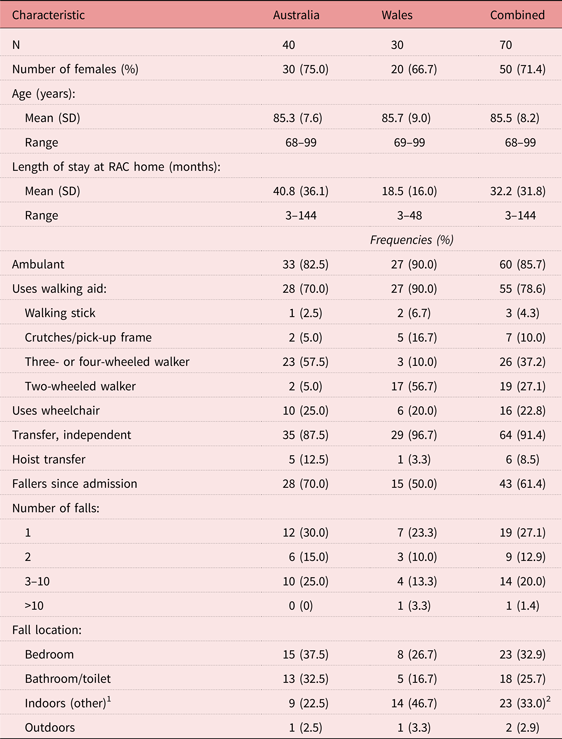
Eighty-four older people residing in six care homes in Australia and six in Wales (approximately 15% of the total population) met the eligibility criteria and 70 volunteered to participate (response rate of 83.3%). Participants were predominantly female (N = 50, 71.4%) and their ages ranged from 68 to 99 years of age (mean = 85.5, standard deviation (SD) = 8.2) (Table 1). The mean length of stay was 32.2 (SD = 31.8) months (2.5 years). Sixty (85.7%) of the participants were ambulant and 55 (78.6%) of these used a walking aid to mobilise within the RAC setting. The predominant type of aid residents used was a walking frame, however, in Australia residents most often used the four-wheeled variety with a seat (N = 23, 57.5%) and in Wales more than half the residents used frames with two wheels (N = 17, 56.7%). Forty-three (61.4%) residents had fallen since admission with most falls occurring in the residents’ bedrooms (N = 23, 32.9%) and bathroom/toilet (N = 18, 25.7%). Among those residents who had fallen, 19 (27.1%) had sustained a single fall and 24 (34.3%) multiple falls.
Demographic characteristics

Notes: 1. Includes kitchen, dining room and corridors, falling between rooms, down stairs. 2. Data missing for two respondents for both Australia and Wales. SD: standard deviation. RAC: residential aged care.
Residents’ capability (knowledge and awareness) regarding falls and falls prevention
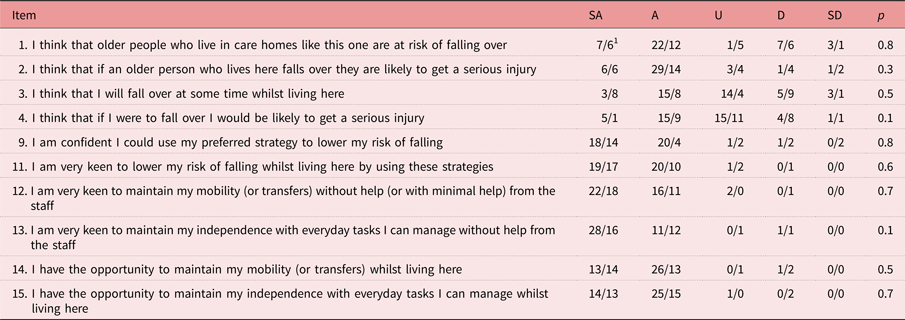
There were no significant differences between Australian and Welsh residents’ levels of knowledge and awareness of falls risks, perceived opportunities, confidence and motivation to adopt falls prevention strategies (ten items; Table 2).
Comparison of residents’ awareness of personal risk, knowledge, confidence and motivation regarding falls
Notes: 1. Australian cohort/Welsh cohort. SA: strongly agree. A: agree. U: undecided. D: disagree. SD: strongly disagree.
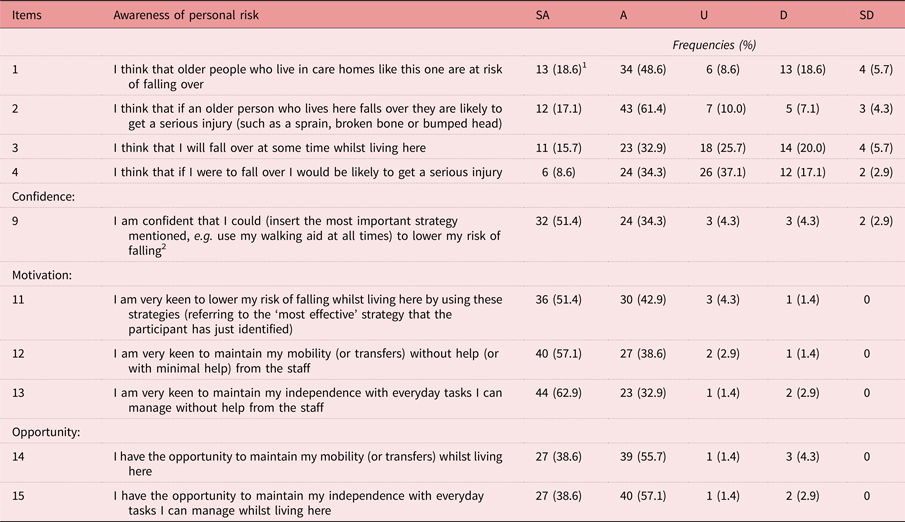
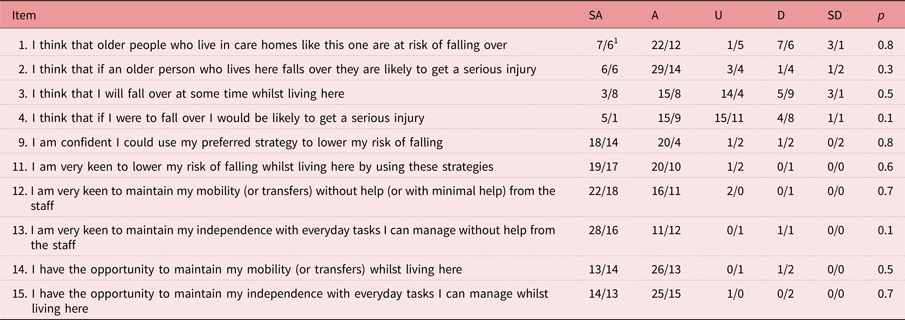
Forty-seven (67.2%) residents agreed or strongly agreed that older people who live in RAC homes were at risk of falling over and 55 (78.5%) thought that the older people who fell were likely to sustain a serious injury such as a sprain or fracture (Table 3). When asked about their perception regarding their personal falls and injury risk while living in the RAC home, less than half (N = 34, 48.6%) the residents strongly agreed or agreed that they would fall over and only a quarter (N = 18, 25.7%) of the residents thought they would be likely to sustain a serious injury if they fell.
Residents’ awareness of personal risk, knowledge, confidence and motivation regarding falls

Notes: 1. Combined Australian and Welsh data. 2. Data missing for six respondents. SA: strongly agree. A: agree. U: undecided. D: disagree. SD: strongly disagree.
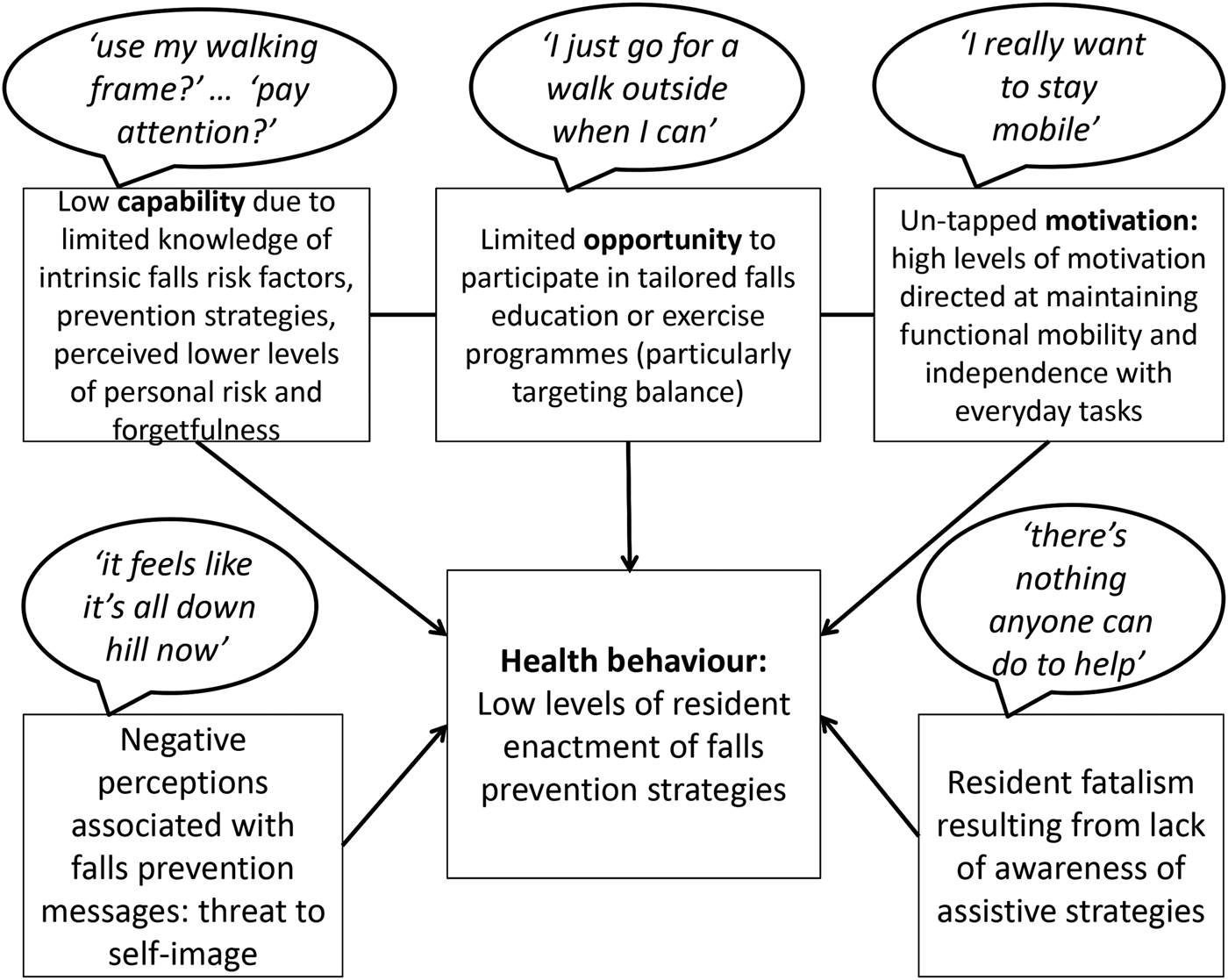
When asked why they thought older people fell over, residents commonly thought it was because of their behaviour (N = 24, 34.3%), often blaming themselves for the outcome (Figure 1). Residents reasoned that not paying full attention to what they were doing caused them to fall, an 89-year-old Australian female resident reflected, ‘sometimes we [residents] are not careful enough perhaps, walking too quickly or turning around too sharply … you go to move but find your feet haven't [moved with you]!’ Overestimating their ability in performing the task at hand was suggested by some residents as a reason for falls; one 91-year-old Welsh male resident reasoned that ‘each person has it in them that they want to do better, so they go beyond their limits’; another 74-year-old female Australian resident reflected, ‘they [residents] attempt to do things without help … we all think we are 21!’ A 93-year-old female resident from Australia linked personality as a contributor to falls: ‘it's my personality I think, sometimes I'm a bit impulsive!’
Potential contributors to low levels of resident enactment of falls prevention strategies.

Many residents in both countries described a series of extrinsic risk factors as causative of falls. Residents most frequently perceived that not using a prescribed walking aid to mobilise was highly likely to cause someone to fall, a 95-year-old Welsh male resident stated, ‘some of them [residents] forget, they try to walk without their frame and sometimes the staff move them [frames] out of the way’. One 68-year-old Australian male resident commented on their environment, ‘it can be slippery floors, after a shower the water needs wiping up’; another 80-year-old Welsh female resident reflected on clutter, ‘if there's obstacles in your way and loose mats, they can be fatal, before I came in here I nailed mine [mats] to the floor!’ Wearing inappropriate footwear such as ‘slippers that aren't suitable can make you trip over anything’, commented an 87-year-old female Australian resident. There was less resident awareness regarding intrinsic falls risk factors (N = 8, 11.4%). One 91-year-old female resident from Wales stated that deteriorating vision was linked to falls: ‘our eyesight is not so good anymore and you need that’; another 83-year-old Australian female resident referenced weakness in the legs and poor balance: ‘your legs get shaky, wobbly; you tend to lose your balance’.
Residents thought that lowering their risk of having a fall and keeping safe was achievable through predominantly addressing extrinsic risk factors. Using a walking aid at all times was the most common response; one 80-year-old Australian male resident emphatically stated, ‘the number one thing is don't walk without your frame, always use it’; another 85-year-old Welsh female resident reflected, ‘I use my walker, it's very good for steadying me’. Equipment in the environment such as hand rails were seen as important, one 91-year-old Welsh male resident described his RAC home as ticking this box: ‘there's plenty of rails around the place, people should use them’. Residents highlighted the importance of wearing ‘good shoes’, with an 87-year-old Australian female recommending ‘ones that don't slip off or scuff the ground’ and another 89-year-old Australian male resident adding that ‘lace-ups are probably best’. Receiving timely assistance from staff as required was also reported as necessary for staying safe. Residents indicated that paying more attention to the environment and being careful were behaviour changes they should aspire to enact. One resident commented, ‘you need to be aware of your surroundings, concentration is everything at our age’ (85-year-old male, Wales); another resident shared her strategy: ‘Use my brain! I stop and think before I move, make sure I know what I'm doing. It's really up to me not to do anything stupid’ (89-year-old female, Australia). In terms of evidence-based multifactorial falls prevention strategies, including supplementation with vitamin D and getting medication reviewed regularly (Cameron et al. Reference Cameron, Murray, Gillespie, Robertson, Hill, Cumming and Kerse2012; Vlaeyen et al. Reference Vlaeyen, Coussement, Leysens, Van der Elst, Delbaere, Cambier, Denhaerynck, Goemaere, Wertelaers and Dobbels2015), there was negligible resident awareness (N = 2, 2.9%).
Barriers to a resident utilising a nominated fall prevention strategy were reported as dependent on staff availability to assist; two female residents from Australia aged 85 and 74 years old, respectively, commented, ‘if I feel unsafe I ask for help, but they are short staffed so they may not be able to help me’ and ‘we should have more staff on duty at certain times … at night-time there are only two staff and at mealtimes lots are feeding people in their own rooms’. An 80-year-old female resident from Wales also shared: ‘I was given balance exercises by the hospital physio but the staff won't do them with me. I don't think they know how and they won't let me do them myself because you do them on the stairs. I think it would be good if the physio came here to do them with me’. Ten (14.3%) residents suggested that staff should devote more attention to them personally. Three (4.3%) residents perceived low levels of staff knowledge and skills regarding falls prevention was a barrier, commenting that staff should receive more training to help them [residents] prevent falls and a 79-year-old Australian female resident went further in saying, ‘care staff need more training and education on their job in general … and some have poor English skills which is frustrating’. One 86-year-old Welsh female resident reflected that ‘all things were not equal’ when referring to staff, stating ‘some [staff] know more than others you know, but some of them [staff] need to learn more’. Further barriers explicated included being distracted from the task at hand and having poorer memory resulting in them simply forgetting to engage in falls prevention behaviours. A 92-year-old Welsh male resident gave examples of being distracted as ‘simply someone talking to you … or even bending over to pat a dog’. Another 80-year-old female resident from Australia noted the impact of being forgetful on her safety, ‘my memory for one thing, sometimes even though you are aware how important it is to use it [walking aid] you forget momentarily’. Sixteen (22.9%) residents stated they could not forsee any barriers.
However, when asked if staff or the RAC management could do anything else to help residents stay safe and prevent falls, 47 (67.1%) residents perceived there was nothing else staff could do. This perspective was exemplified by two residents, who commented, ‘I think they [staff] do a lot, I don't know what else they could do to help’ (87-year-old male, Wales) and ‘we're pretty well looked after here, they do a mighty job, I can't think of anything else they could do [to help prevent falls]’ (86-year-old female, Australia). Residents from both countries who responded that RAC management could assist them in remaining safe suggested improvements to their living environment, such as having non-slip tiles, sensor mats and additional hand-rails in outdoor communal areas.
Residents’ confidence, motivation and opportunity to engage in falls prevention strategies
Fifty-six (85.7%) residents felt confident they could lower their risk of falling by using a self-selected prevention strategy, but this predominantly related to using their walking aid at all times. Almost all residents (N = 67, 95.7%) were highly motivated to maintain both their functional mobility, unassisted or minimally assisted, and their independence with everyday tasks such as washing and dressing. The majority of residents strongly agreed or agreed they were given the opportunities to maintain their functional mobility (N = 66, 94.3%) and independence with everyday tasks (N = 67, 97.5%) whilst residing at their RAC home. Opportunities such as exercise programmes were offered at RAC homes in both countries, with residents describing programme content. A greater variety of exercise programmes targeting physical functioning were offered more frequently in Australian RAC homes. Here residents participated in seated group exercises targeting strength and sitting balance (N = 11, 27.5%), combined group sitting and standing exercises (N = 6, 15.0%), yoga (N = 9, 22.5%) and outdoor walking (N = 3, 7.5%). In Welsh RAC homes residents reported walking indoors as exercise (N = 7, 23.3%), which was mostly self-initiated incidental physical activity, outdoor walking (N = 3, 10.0%), chair exercises targeting joint range of motion (N = 9, 30.0%) and residents at one home attended a weekly Zumba (aerobic dance) class (N = 2, 6.7%).
Preferences for falls prevention messages
Forty-one (58.6%) residents expressed a preference for receiving positive messages regarding falls prevention that focused on achieving wellness and staying independent and safe (from harm). Residents expressed a need for prompts to engage in falls prevention interventions, with the strongest preference identified as using a pictorial format supported with simple text. Australian residents expressed a preference for a poster for their room (N = 11, 27.5%) whilst Welsh residents preferred a brochure (N = 15, 50.0%). Both cohorts reported they would like face-to-face small-group discussions, preferably with a demonstration, on the topic of falls prevention (N = 18, 25%). When asked if residents would like their family members to receive falls prevention information, 39 (55.7%) said no, citing they did not want to trouble them. One 91-year-old Welsh female resident commented, ‘they are too busy with their own family, I doubt they would be interested anyway’. Other residents perceived family members did not need to know, with an 86-year-old female Australian resident responding ‘it wouldn't make a difference … they know all these things [about falls prevention]’.
Discussion
Residents in both Australia and Wales reported similar perceptions and preferences regarding falls and their prevention. Our study found that residents had an alternative preference for the way messages aimed at engaging them in falls prevention strategies were delivered, combined with low levels of knowledge and awareness regarding the intrinsic aetiology of falls and how to prevent them. Concepts of health behaviour change theory explain that knowledge and positive social reinforcement are fundamental determinants to behaviour change (Michie, Atkins and West Reference Michie, Atkins and West2014). Therefore, these findings indicate it is unlikely that residents would engage in evidence-based prevention strategies that require staff to assist, such as vitamin D supplementation and medication review (Cameron et al. Reference Cameron, Murray, Gillespie, Robertson, Hill, Cumming and Kerse2012).
Residents perceived that older people in RAC homes were at higher risk of falling and injuring themselves but this was far less likely to apply to them personally. This perception that ‘falls happen to others not me’ has been reported amongst other populations of older people (Ballinger and Payne Reference Ballinger and Payne2002; Haines et al. Reference Haines, Lee, O'Connell, McDermott and Hoffmann2015; Hill et al. Reference Hill, McPhail, Francis-Coad, Waldron, Etherton-Beer, Flicker, Ingram and Haines2016) and highlights a deficit in capability. Ballinger and Payne (Reference Ballinger and Payne2002) explored older people's perception of ‘risk’ in relation to falls. They suggested older people might perceive risk in a different way, interpreting it as a threat to their personal identity and self-image. This offers a plausible explanation for why older people may be reluctant to view themselves as being at risk of falling and associating themselves with prevention strategies. Findings from a recent study also suggest that older people have low awareness in identifying when they maybe ‘at risk’ of falling and require prompting to undertake early intervention (Lette et al. Reference Lette, Stoop, Lemmens, Buist, Baan and Bruin2017). This has been confirmed in studies of hospitalised older people who often try to be independent when they are still in the early stages of functional recovery and do not realise assistance is required in the absence of patient-centred education (Hill et al. Reference Hill, McPhail, Francis-Coad, Waldron, Etherton-Beer, Flicker, Ingram and Haines2015, Reference Hill, McPhail, Francis-Coad, Waldron, Etherton-Beer, Flicker, Ingram and Haines2016). In our study, resident falls occurred mostly in residents’ bedrooms or bathrooms, as previously described (Nitz et al. Reference Nitz, Cyarto, Andrews, Fearn, Fu, Haines, Haralambous, Hill, Hunt, Lea, Moore, Renehan and Robinson2012; Rapp et al. Reference Rapp, Becker, Cameron, König and Büchele2012), where residents tended to be alone, often attempting to be independent with transfers or ambulation. This verifies the need for educational discussions and other types of learning strategies, such as handouts or family information nights, to be undertaken with residents to assist them in managing their independence safely. Residents also perceived falls to be their fault, attaching personal blame as identified in other populations of older people (Hill et al. Reference Hill, McPhail, Francis-Coad, Waldron, Etherton-Beer, Flicker, Ingram and Haines2016; Ramsey et al. Reference Ramsey, Hin, Prado and Fernandez2015). This demonstrates a lack of resident awareness that falls are a result of staff, resident and environmental factor interaction, as identified in other surveys of community-dwelling and hospitalised older people (Hill et al. Reference Hill, Hoffmann, Beer, McPhail, Hill, Oliver, Brauer and Haines2011, Reference Hill, McPhail, Francis-Coad, Waldron, Etherton-Beer, Flicker, Ingram and Haines2016; Lee et al. Reference Lee, Brown, Stolwyk, O'Connor and Haines2016), thus evidence-based education is required.
Residents demonstrated gaps in knowledge of intrinsic risk factors contributing to falls. Similar to other studies, we found residents’ knowledge on how to prevent falls explicated as taking more care, using a walking aid and minimising environmental hazards (Hill et al. Reference Hill, Hoffmann, Beer, McPhail, Hill, Oliver, Brauer and Haines2011; Yardley et al. Reference Yardley, Donovan-Hall, Francis and Todd2006). It has also been reported that amongst older people in general, many may lack awareness that strategies to prevent falls even exist (Snodgrass, Rivett and Mackenzie Reference Snodgrass, Rivett and Mackenzie2005). Very few residents were aware of falls research evidence findings such as vitamin D deficiency, muscle weakness, joint stiffness, cognitive impairments, side-effects of medications or taking multiple medications (Cameron et al. Reference Cameron, Murray, Gillespie, Robertson, Hill, Cumming and Kerse2012; Francis-Coad et al. Reference Francis-Coad, Etherton-Beer, Nobre, Naseri and Hill2017) contribute to falls. This highlights a gap in the translation of falls research evidence reaching the end-user (Glasziou and Haynes Reference Glasziou and Haynes2005) in RAC settings and demonstrates a need for informed falls prevention education for those residents who are able to engage in some learning interactions. A lack of resident awareness regarding what staff could do to assist them in preventing falls further supports the need for resident education and may combat feelings of fatalism reported by others (Bunn et al. Reference Bunn, Dickinson, Barnett-Page, McInnes and Horton2008; Hill et al. Reference Hill, McPhail, Francis-Coad, Waldron, Etherton-Beer, Flicker, Ingram and Haines2016). Furthermore, threats to a resident's current physical or psychological capability such as illness, injury or bereavement may limit their capacity to engage in falls prevention strategies, placing them at greater risk of falling. This requires repeated education for residents to request assistance, framed in an enabling manner, and for staff to provide assistance in the short term.
Residents reported feeling confident to undertake a selected falls prevention strategy, which in most cases was using their walking aid at all times. However, simply using a walking aid for everyday activities is unlikely to provide the level of challenge required to improve a resident's balance to the level necessary to help lower the risk of falls (Sherrington et al. Reference Sherrington, Tiedemann, Fairhall, Close and Lord2011). Provision of vitamin D supplementation and complex-level interventions are required in this setting (Cameron et al. Reference Cameron, Murray, Gillespie, Robertson, Hill, Cumming and Kerse2012; Quigley et al. Reference Quigley, Bulat, Kurtzman, Olney, Powell-Cope and Rubenstein2010; Vlaeyen et al. Reference Vlaeyen, Coussement, Leysens, Van der Elst, Delbaere, Cambier, Denhaerynck, Goemaere, Wertelaers and Dobbels2015). Therefore, residents (and their families) need to be provided with this information on a regular basis to avoid falls and the consequential self-blaming that occurs. It was apparent that providing the allied health professional expertise required to deliver effective exercise therapy for those residents who could undertake such interventions, that are strongly evidence based in RAC homes, is very limited (Cameron et al. Reference Cameron, Murray, Gillespie, Robertson, Hill, Cumming and Kerse2012). This was particularly evident in Welsh RAC homes where allied health professional staff, in particular physiotherapists, were not employed, meaning there were fewer opportunities for residents to participate in carefully prescribed exercise programmes targeting physical functioning, such as improving standing balance and strength, to lower their risk of falling (Rochira Reference Rochira2014). Additionally, in Australia there were limited nursing staff to discuss vitamin D supplementation and medication review if this was not done by the resident's own doctor. This requires addressing at a health system level. Residents in both countries reported limited social opportunity to engage in falls prevention strategies as staff were not always available to help and residents did not want to bother their family. This lack of social support, such as staff assistance and family approval (Bunn et al. Reference Bunn, Dickinson, Barnett-Page, McInnes and Horton2008; Hill et al. Reference Hill, McPhail, Francis-Coad, Waldron, Etherton-Beer, Flicker, Ingram and Haines2016; Michie, Atkins and West Reference Michie, Atkins and West2014), might limit residents in engaging in falls prevention behaviours.
We found residents were highly motivated to maintain their independence in both mobility and activities of daily living (ADLs), thus successful uptake of falls prevention messages maybe better re-framed around the meaningful goals of independent mobility and ADL function, as reported amongst studies of community-dwelling older people (Ballinger and Clemson Reference Ballinger and Clemson2006; Bulsara et al. Reference Bulsara, Khong, Hill and Hill2016).
Preferences for falls prevention education
More than half the residents perceived falls prevention messages highlighting negative consequences were less appealing, suggesting an alternative is required. Residents expressed a preference to receive messages about falls prevention framed positively, emphasising safety and wellbeing similar to studies conducted with community-dwelling older people (Bulsara et al. Reference Bulsara, Khong, Hill and Hill2016; Dickinson et al. Reference Dickinson, Machen, Horton, Jain, Maddex and Cove2011; Hughes et al. Reference Hughes, van Beurden, Eakin, Barnett, Patterson, Backhouse, Jones, Hauser, Beard and Newman2008; Stevens, Noonan and Rubenstein Reference Stevens, Noonan and Rubenstein2010). The preferences described in this study may assist inter-disciplinary staff when designing and presenting falls prevention education for residents that is more appealing, meaningful and relevant.
Our findings concur with those of older people in hospital and community settings suggesting falls prevention resources be made available in different formats (Khong et al. Reference Khong, Bulsara, Hill and Hill2017; Lee et al. Reference Lee, Brown, Stolwyk, O'Connor and Haines2016). This may assist residents to engage with the content as alternative presentation formats address both learning-style preferences and sensory impairments. It has also been suggested that older people should be given both written and verbal information educating them on falls prevention to improve adherence and maintain interest (McInnes and Askie Reference McInnes and Askie2004).
Strengths and limitations
A high proportion of older people who live in RAC homes have cognitive impairment, with measured levels averaging 68 per cent (Francis-Coad et al. Reference Francis-Coad, Haines, Etherton-Beer, Nobre and Hill2018; Onder et al. Reference Onder, Carpenter, Finne-Soveri, Gindin, Frijters, Henrard, Nikolaus, Topinkova, Tosato, Liperoti, Landi and Bernabei2012). Of the residents in the RAC homes we surveyed, only around 15 per cent met the eligibility criteria for participation, thereby limiting the sample representativeness. However, to our knowledge this is one of the first studies reporting the thoughts of older people in RAC homes on falls and their prevention. Our study focused on residents with normal cognition, but even though these findings are only representative of one section of the RAC population, these views are important for designing tailored approaches to falls prevention in RAC settings. Seeking the views of residents with cognitive impairment and family members of all residents regarding falls and falls prevention would also provide meaningful insights for intervention engagement but this was beyond the scope of the current study. It would also be beneficial to interview care staff to ascertain what falls prevention education and assistance they perceive they are providing to residents. These topics will form the subject of future research.
Recommendations
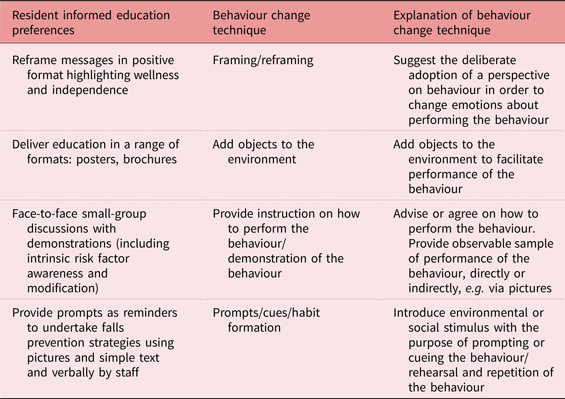
Findings from this study can be shared between the two countries to inform falls prevention education and resource design. Developing interventions for residents should seek their input and partnership throughout the process to facilitate intervention uptake and longer-term adherence. Future research should also seek to include care staff together with residents presenting with cognitive impairment and their families in this partnership. Identifying deficits in residents’ capability, opportunity and motivation has informed how falls prevention behaviour may be changed (Michie, Atkins and West Reference Michie, Atkins and West2014). We propose that resident-informed behaviour change techniques underpin the design of falls prevention education to facilitate residents’ engagement with tailored falls prevention strategies (Table 4).
A proposal for resident falls prevention education design

Conclusion
Findings from this study may assist RAC organisations and staff to more effectively engage with residents about falls prevention and provide targeted resources to address the needs and preferences of this population. Health professionals should provide residents with clear and current information about evidence for falls and strategies most beneficial for falls prevention so that their knowledge levels can be raised, particularly in reference to awareness and subsequent modification of their personal falls risk factors. Health professionals should also consider re-framing falls prevention messages informed by the goals and motivations of residents and offer delivery in alternative formats. Providing residents with relevant meaningful falls prevention education and resources may assist them, with staff support if required, to adopt and enact falls prevention strategies in their daily lives.
Acknowledgements
The authors sincerely thank the Brightwater group executive, Gwalia Care, Foxtroy House, Bloomfield and Heatherslade residents and staff.
Declaration of contribution of authors
J.F.-C., A.-M.H. and C.E.-B. conceptualised and contributed to all aspects of the study. A.-M.H. is the chief investigator of the funding awarded for this research activity. J.F.-C. and T.Wa. conducted the Welsh phase of the study and G.P., H.G., M.A., T.Wi., B.G. and D.N. contributed to data collection. J.F.-C. wrote the first draft, and all authors contributed to manuscript appraisal, revision and editing, and read and approved the final manuscript.
Funding
This study had confirmed funding support from Collaborative Research Network (CRN) funding (Federal Government of Australia) awarded to The University of Notre Dame Australia as part of a project led by Associate Professor Anne-Marie Hill. The study was independently peer reviewed by the funder. Dr Jacqueline Francis-Coad was awarded a 2016 WA Health and Medical Research Travel Fellowship to undertake the study in Wales with Associate Professor Tessa Watts and team. Funders played no role in the design, execution, analysis and interpretation of data or writing of the manuscript
Conflict of interest
The authors declare no conflict of interest in relation to this study.
Ethical approval
Ethical approval from The University of Notre Dame Australia (reference number 015033 F) and College of Human and Health Science/College of Medicine, Swansea University (reference number 030419) human research ethics committees was granted for this study. Consent to participate was also sought from the residential aged care provider organisations. All participation was voluntarily sought following the presentation of verbal and written information to participants. Written consent to participate was obtained from all who volunteered, with participants being free to withdraw from the study at any time.