INTRODUCTION
Recently Paterson et al. (Reference Paterson, Glover, Barrio Froján, Whitaker, Budaeva, Chimonides and Doner2009) collated from the literature records of all polychaete species collected below 2000 m over the past 200 years. The authors list 26 abyssal serpulid species (Fauchald, Reference Fauchald1977), including two records of the enigmatic serpulid Spirodiscus grimaldii from Hartman & Fauchald (Reference Hartman and Fauchald1971). Fauvel's (Reference Fauvel1909) type material of Spirodiscus grimaldii was collected by the Prince of Monaco Expeditions on-board RV ‘Princesse Alice’ off Faial Island (Azores, Atlantic Ocean) and deposited in the Muséum National d'Histoire Naturelle, Paris (MNHN) and in the Museum of Monaco (MOM). The species had been known by the type material only until Hartman & Fauchald (Reference Hartman and Fauchald1971) reported additional specimens from three stations collected from deep-sea localities in the western Atlantic Ocean. Most recently, ten Hove & Kupriyanova (Reference ten Hove and Kupriyanova2009) provided a diagnosis and scanning electron micrographs (SEM) of chaetae based on topotypical material from 2440 m deposited in the collections of the Zoological Museum of the University of Amsterdam (ZMA). In this study we review and re-identify published material and report new records of this poorly known deep-water serpulid, the unique Recent species within the genus Nogrobs.
MATERIALS AND METHODS
The type material of Spirodiscus grimaldii was examined by E.K.K. in 2010 at the MNHN. The material of Hartman & Fauchald (Reference Hartman and Fauchald1971) was re-examined by E.K.K. in 2008 at the Natural History Museum of Los Angeles County, USA (NHMLAC) and the material mentioned in ten Hove & Kupriyanova (Reference ten Hove and Kupriyanova2009) was studied at the ZMA. Finally, the research collection of the P.P. Shirshov Institute of Oceanology (SIO), Moscow, Russia was examined. Specimens were viewed under a Leica MZ8 dissecting microscope. Specimens borrowed from the SIO were photographed with a Nikon 4300 Coolpix camera mounted on a Leica MZ8 stereomicroscope at Yokohama National University. The distribution map was generated with PanMap (http://gcmd.nasa.gov/records/PanMap.html)
Type-species: Nogrobs vermicularis de Montfort, Reference de Montfort1808 (a fossil taxon).
DIAGNOSIS (AFTER TEN HOVE & KUPRIYANOVA, Reference ten Hove and Kupriyanova2009)
Tube free, white, sinistrally coiled, initially cylindrical, then prismatic (quadrangular in cross-section), finally with short cylindrical straight distal part. Collar like rings and granular overlay absent. Operculum inverse cone (ampulla) with chitinous endplate and central depression. Peduncle pinnulated, without distal wings, with outer groove distally, with or without constriction beneath ampulla; inserted as second right radiole, up to three times as wide as other radioles. Pseudoperculum absent. Arrangement of radioles semi-circular, up to eight per lobe. Inter-radiolar membrane, branchial eyes, and stylodes absent. Mouth palps absent. Six thoracic chaetigerous segments. Collar non-lobed with entire edge, no clear separation towards thoracic membranes that end at second chaetiger. No apron, no tonguelets. Collar chaetae limbate. Apomatus chaetae absent. Thoracic uncini saw-to-rasp-shaped with numerous teeth (>12) in profile, 2–3 teeth per row (dental formula P:3:3:3:2:2:1:1:1:1:1:1:1:1); anterior peg gouged (Pomatoceros type). Abdominal chaetae short, with flat triangular denticulate blade. Thoracic triangular depression absent. Abdominal uncini similar to thoracic ones. Achaetous anterior abdominal zone absent. Long posterior capillary chaetae absent. Posterior glandular pad absent.
REMARKS
The diagnosis mostly taken from the review by ten Hove & Kupriyanova (Reference ten Hove and Kupriyanova2009) is based on the specimens collected off the Azores at depths of 1846–2400 m. Additional material from the central Atlantic with four thoracic chaetigers mentioned by Hartman & Fauchald (Reference Hartman and Fauchald1971) belongs to an unidentified serpulid (see below), thus the number of thoracic segments (4–6) from the generic diagnosis of ten Hove & Kupriyanova Reference ten Hove and Kupriyanova2009) is changed to six here.
Spirodiscus was transferred from the subfamily Serpulinae to the Filograninae by Hartman & Fauchald (Reference Hartman and Fauchald1971) because of the pinnules on the opercular peduncle. However, Kupriyanova et al. (Reference Kupriyanova, Macdonald and Rouse2006) stated that both sub-families Serpulinae and Filograninae are not monophyletic and poorly defined, thus, should not be used until revision of the family is complete.
The Recent genus Spirodiscus Fauvel, Reference Fauvel1909 was synonymized with the fossil Nogrobs de Montfort, Reference de Montfort1808 by Jäger (Reference Jäger2004) and was followed in the review of ten Hove & Kupriyanova (Reference ten Hove and Kupriyanova2009).
Spirodiscus grimaldii: Fauvel, Reference Fauvel1909: 56–57, figure 4; Fauvel, Reference Fauvel1914: 335–338, pl. 29.7–21; Hartman & Fauchald, Reference Hartman and Fauchald1971: 183 (in part, Station A 199 only); in Zibrowius Reference Zibrowius, Reish and Fauchald1977: 299 (name only); in Fabri et al., Reference Fabri, Galeron, Larour and Maudire2006 (database name only).
Nogrobs grimaldii: ten Hove & Kupriyanova, Reference ten Hove and Kupriyanova2009: 68–69, figure 31 (SEM of chaetae and uncini), ten Hove, Reference ten Hove and Fauchald2009 (name only).
MATERIAL EXAMINED
MNHN: registration number POLY TYPE 237, off Azores, W. Faial Island, 39°30′N 29°02′W, 1900 m, Prince of Monaco Campaign, RV ‘Princesse Alice’ Station 1334, 13 August 1902, 3 specimens and tubes, syntypes of Spirodiscus grimaldii.
ZMA: registration number V.Pol. 3906, off Azores (topotypical), 39°03.5′N 28°25.5′W, 2440 m, 2 specimens, 3 tubes, RV ‘Jean Charcot’, Cruise Biacores 1971, Station 95, 7 December 1971, det. Zibrowius 1972, don. to ZMA 21 October 1992, SEM of chaetae and uncini published in ten Hove & Kupriyanova, Reference ten Hove and Kupriyanova2009 as Nogrobs grimaldii.
SIO: no registration number, ~1000 km south-west of the Azores, 34°41.1′N 40°38.6′W, 3160 m, RV ‘Vityaz-2′, Station 78, 3 tubes, det. Kupriyanova, previously unpublished (Figure 1).
(A) Photographs of three specimens of Nogrobs grimaldii from the SIO collection; (B, C) two sides of specimen 1. Scale bar: 3 mm.

NHMLAC: no registration number, RV ‘Atlantis-2’, cruise 24, Station A119, 32°15.8′N–32°16.1′N 64°31.6′W–64°32.6′W, 2095–2223 m, 19 August 1966, 2 specimens in tubes, published in Hartman & Fauchald (Reference Hartman and Fauchald1971) as Spirodiscus grimaldii.
ADDITIONAL MATERIAL STUDIED
Bathyditrupa sp.: NHMLAC, RV ‘Chain’, cruise 58, Station 100, 33°56.8′N 65°47′W, 4893–4743 m, 1 May 1966 (1 tube).
Bathyditrupa cf. hovei: NHMLAC, RV ‘Atlantis-2’, cruise 24, Station A118, 32°19.4′N–32°19.0′N 64°34.9′W–64°34.8′W (2), 1135–1153 m, 18 August 1966, 5 specimens.
Serpulidae gen. spp.: NHMLAC, RV ‘Atlantis-2’, cruise 24, Station A118, 32°19.4′N –32°19.0′N 64°34.9′W–64°34.8′W (2), 1135–1153 m, 18 August 1966, 23 specimens.
Serpulidae gen. spp.: NHMLAC, RV ‘Atlantis-2’, cruise 24, Station A119, 32°15.8′N–32°16.1′N 64°31.6′W–64°32.6′W, 2095–2223 m, 19 August 1966, 21 specimens.
Nogrobs sp. nov.(?): ZMA, V.Pol. 3859, south-east off Galapagos, 07°10′S 85°50′W, 4124 m, RV ‘Vema’, cruise 17, Station 1, 26 February 1961, 2 specimens, tube, det. ten Hove 1992 (examined at LACNH Museum, exchange from ZMA), published as Serpulidae A in Maurer & Williams, Reference Maurer and Williams1988, mentioned in ten Hove & Kupriyanova Reference ten Hove and Kupriyanova2009 as potentially Nogrobs sp. nov.
Nogrobs cf. grimaldii: NHMLAC, equatorial Pacific Ocean, 14°40′N 125°26′W, ECHO-1 Survey Station H361, 4500 m, manganese nodules, 1 specimen, unpublished, det. Kupriyanova.
RESULTS AND DISCUSSION
Tubes from examined localities are not attached to any substrate and coiled into flat spirals. This tube geometry is unusual, contrasting with the irregular tube geometries typical for most serpulids (excluding spirorbins), it most closely resembles tubes of the fossil serpulid genus Rotularia (see Savazzi, Reference Savazzi1995; Vinn, Reference Vinn2008). Although adults of Nogrobs grimaldii have free tubes, their juveniles most likely attach to small particles during settlement and metamorphosis as demonstrated for Ditrupa, another serpulid genus with free tubes (see Charles et al., Reference Charles, Jordana, Amouroux, Grémare, Desmalades and Zudaire2003).
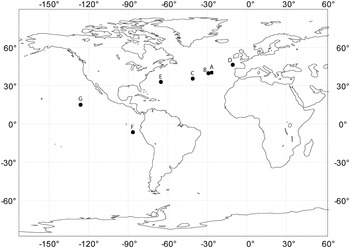
This study summarizes all records available to date, of a poorly known deep-sea serpulid polychaete Nogrobs grimaldii (Figure 2). There are five reliable North Atlantic and two questionable Pacific records.
Map of distribution of the Nogrobs spp. records. Nogrobs grimaldii, Atlantic Ocean: (A) type material (square); (B) ZMA V.Pol 3906 (ten Hove & Kupriyanova, Reference ten Hove and Kupriyanova2009); (C) SIO record; (D) OBIS, Fabri et al., Reference Fabri, Galeron, Larour and Maudire2006; (E) Station A199 (Hartman & Fauchald, Reference Hartman and Fauchald1971). Nogrobs sp. nov. (?), Pacific Ocean: (F) ZMA V. Pol. 3859 (Maurer & Williams, Reference Maurer and Williams1988; ten Hove & Kupriyanova, Reference ten Hove and Kupriyanova2009); (G) NHMLAC, ECHO-1 Station H361.

Originally Nogrobs (as Spirodiscus) grimaldii was described and illustrated by Fauvel based on specimens from Stations 698 and 1334 off Azores (Figure 2A). According to Zibrowius (Reference Zibrowius, Reish and Fauchald1977), part of the type material is at MOM and the rest is at MNHN. The label of the syntypes at the MNHN does not indicate the station, but they are likely to be from Station 1334, as no material from this station has been preserved at the MOM (H.A. ten Hove, personal communication). The material from the ZMA (V.Pol. 3906) previously reported by ten Hove & Kupriyanova, Reference ten Hove and Kupriyanova2009 is topotypical, from off Azores (Figure 2B). A new record from the SIO (Figure 2C) has been collected relatively close to the type locality. An otherwise unpublished record of Spirodiscus grimaldii from the Gulf of Gascogne, Atlantic Ocean (45°50′N 10°5′W, 2100 m) was found in the on-line database of the Ocean Biogeographic Information System (OBIS, Fabri et al., Reference Fabri, Galeron, Larour and Maudire2006). The specimen was not re-examined by us, but was identified by H. Zibrowius who is extremely well familiar with the taxon, and thus, a misidentification is unlikely. Therefore, the OBIS record is also included in the distribution map (Figure 2D).
Re-examination of the Hartman & Fauchald (Reference Hartman and Fauchald1971) material gave the most interesting results—out of three reported records, only the sample from Station A119 contained two specimens of Nogrobs grimaldii (Figure 2E). Zibrowius (Reference Zibrowius, Reish and Fauchald1977), who had re-examined some of the material of Hartman & Fauchald (Reference Hartman and Fauchald1971), stated ‘The specimen from “Chain” Station 100, doubtfully referred to S. grimaldii as “tube-only”, has been checked (AHF): tiny tube quadrangular in cross section containing a poorly preserved operculate worm, probably belonging to that species.' Our examination of the material from Station Ch100 revealed a fragment of a tiny straight quadrangular tube similar to the tubes of Bathyditrupa hovei Kupriyanova, 1993 (see figure 1E of Kupriyanova et al., Reference Kupriyanova, Bailey-Brock and Nishi2011), but definitely not a spiral tube typical for Nogrobs grimaldii.
However, Zibrowius (Reference Zibrowius, Reish and Fauchald1977: 299) did not have an opportunity to examine the material from the RV ‘Atlantis’ Stations A118 and A119. Hartman & Fauchald (Reference Hartman and Fauchald1971) describe the specimens they identify as ‘Spirodiscus grimaldii’: ‘All are small, come from slender calcareous tubes which are basally coiled sinistrally, then straight, erect, or the tube may be angular along a part of its length. The enclosed specimens measure about 1.5 mm long by 0.14 mm wide; they consist of four thoracic and nine or ten abdominal segments. The opercular stalk is unique; it is erect, rising as one of the dorsal-most radioles, with a few barbules on its basal half; then smooth and cylindrical to rise beyond the pinnules, and terminate in a structure resembling a small spool with larger base and smaller distal disc. The thoracic collar is voluminous.’ Even from this cursory description it is clear that the number of thoracic segments, the shape of the peduncle, operculum and collar of specimens are quite different from those of Nogrobs grimaldii. Our re-examination of these two samples showed that the content of samples from these stations consists of several serpulid species.
The sample from Station A118 contained no Nogrobs grimaldii, but instead five Bathyditrupa cf. hovei specimens with quadrangular tusk-shaped free tubes, two irregularly coiled cylindrical smooth shiny tubes attached to mollusc shell fragments, a loose elongated soft operculum on thin smooth peduncle, probably of a Hyalopomatus sp., and ~20 tiny specimens (most likely juveniles) in fragile white cylindrical tubes with collar thickenings, none of these tubes had flat spiral parts typical for ‘Spirodiscus’, while their worm morphology corresponded to the description of ‘Spirodiscus grimaldii’ by Hartman & Fauchald (Reference Hartman and Fauchald1971, see above).
The sample from Station A119, in addition to two obvious specimens of Nogrobs grimaldii in typical ‘Spirodiscus’ tubes, contained two more species. Fifteen unidentified serpulid specimens in quadrangular slightly twisted tubes did not belong to Bathyditrupa hovei as they had conical opercula with slightly convex distal plates and smooth peduncles without pinnules. Another six specimens were unknown, likely juvenile specimens identical to those from Station 118 and identified as ‘Spirodiscus grimaldii’ by Hartman & Fauchald (Reference Hartman and Fauchald1971).
The identity of the two Pacific records of Nogrobs appears to be less certain. According to ten Hove & Kupriyanova (Reference ten Hove and Kupriyanova2009), the specimens from ZMA V.Pol. 3859 (Figure 2F) possibly belong to an undescribed species of Nogrobs. An external examination of the single specimen from the Pacific Station H361 of ECHO-1 survey (Figure 2G) revealed a typical Spirodiscus-type tube (split in halves to remove the animal for examination), with six thoracic chaetigers and a thick pinnulate peduncle bearing typical for this species operculum covered with concave endplate. This Pacific specimen, however, might also belong to the same (new?) species as ZMA V.Pol. 3859, and thus further detailed comparative study is needed. A detailed taxonomic revision of the Nogrobs/Bathyditrupa-complex based on unpublished material collected by earlier Russian and French deep-sea oceanographic expeditions is currently underway.
Updated distribution of Nogrobs grimaldii
Bathyal and abyssal depths, North Atlantic Ocean, 1846–3160 m off Azores; Gulf of Gascogne, 2440 m; 3834 to 4892 m; north-western Atlantic Ocean, 1135–1153 m; questionably East Pacific Ocean, equatorial region, 4124–4500 m.
ACKNOWLEDGEMENTS
This study was supported by the Japan Society for the Promotion of Science Invitation Fellowship (JSPS No. S42300038) and KAKENHI (20008766) grant to E.K.K. We thank Alexander Mironov and Andrey Gebruk who facilitated E.K.K.'s visit to P.P. Shirshov Institute of Oceanology, Moscow, Russia. Special thanks are due to Leslie Harris for hosting E.K.K.'s visit to Los Angeles County Museum of Natural History, CA, USA. Sergio Salazar is thanked for his help during E.K.K.'s visit to the Muséum National d'Histoire Naturelle, Paris. Harry A. ten Hove and Helmut Zibrowius kindly shared their extensive knowledge of serpulid taxonomy and biology. Harry ten Hove also hosted E.K.K.'s visits to the ZMA.