Introduction
To obtain metacercariae of a digenean species, the breeding of the intermediate host in the laboratory is necessary. In the case of Fasciola hepatica, several methods of snail rearing, mainly based on the culture of blue-green algae, a food of Galba truncatula, have been proposed (Taylor & Mozley, Reference Taylor and Mozley1948; Kendall, Reference Kendall1953; Pécheur, Reference Pécheur1974; Osborn et al., Reference Osborn, Gron and Simmons1982; Fereira Filipa et al., Reference Fereira Filipa, Delgado, Seixa Lopes and Sampaio Silva2000). Another method using lettuce-reared snails was also reported by Abrous et al. (Reference Abrous, Roumieux, Dreyfuss, Rondelaud and Mage1998). Since this latter date, this breeding technique has been constantly improved by our team with the use of 14-cm Petri dishes to rear snails and that of grass and lettuce leaves to feed these animals (Rondelaud et al., Reference Rondelaud, Fousi, Vignoles, Moncef and Dreyfuss2007). However, in spite of its numerous advantages, this technique still suffers from a problem related to the recruitment of wild snails used for experimental infections. Indeed, during most months of the year, pre-adult snails (3–4 mm high) were sampled from meadow populations of G. truncatula, known to be devoid of any natural infection at the time of each experiment. In contrast, during the summer months, the habitats of these populations are often dry so that other geographical strains of G. truncatula living in sites with permanently running water must be used. As the permanent habitats of this snail were scarce in lowland meadows on the acid soils of central France (Rondelaud et al., Reference Rondelaud, Hourdin, Vignoles and Dreyfuss2009b), the only populations that could be used for experimental infections in summer were those that lived along river banks.
The use of such geographical strains for experimental infections was problematic for the following three reasons. First, these populations were scarce along river banks in central France and often comprised only a few individuals (Dreyfuss et al., Reference Dreyfuss, Vareille-Morel and Rondelaud1997). Second, the number of annual generations was still imprecise (1 or 2) according to the year (Vareille-Morel et al., Reference Vareille-Morel, Rondelaud and Dreyfuss1998) and seasonal water-level variations (Hourdin et al., Reference Hourdin, Vignoles, Dreyfuss and Rondelaud2006). Third, the prevalence of experimental infections derived from these populations was often less than 20% and the number of cercariae produced was very low (Rondelaud, Reference Rondelaud1993; Rondelaud et al., Reference Rondelaud, Dreyfuss, Vareille-Morel and Moukrim1997). However, if G. truncatula from meadow populations were reared in 14-cm Petri dishes with a high-quality diet, the characteristics of F. hepatica infections in these snails were better (Rondelaud et al., Reference Rondelaud, Denève, Belfaiza, Mekroud, Abrous, Moncef and Dreyfuss2004). In view of these results, it was interesting to study the susceptibility of riverbank G. truncatula to experimental infections with F. hepatica by using the method of Rondelaud et al. (Reference Rondelaud, Fousi, Vignoles, Moncef and Dreyfuss2007) to rear snails in the laboratory. Two experiments were thus carried out with four geographical strains of G. truncatula living along river banks, to study: (1) the number of cercariae shed by these snails, and (2) the quantity of cercariae present in dissected G. truncatula at day 42 post-exposure (p.e.) at 24°C.
Materials and methods
Four geographical populations of G. truncatula have already been used in a previous report (Rondelaud et al., Reference Rondelaud, Dreyfuss, Vareille-Morel and Moukrim1997) to study the dynamics of cercarial shedding over time. They originated from central France. The first (46°37′59″N, 1°25′20″E) was living on a sedimentary soil at Saint Gaultier, Department of Indre, and the maximum height of adults was only 8 mm. The three other populations were living on acid soils in the Department of Haute Vienne, with a strain living at Limoges (45°49′43″N, 1°16′15″E), another at Saint Priest Taurion (45°53′13″N, 1°23′39″E) and the third at Saint Martin Terressus (45°55′24″N, 1°26′32″E). In these populations, the shell height of adults did not exceed 6.5 mm (Limoges and Saint Priest Taurion) or 5.5 mm (Saint Martin Terressus). These differences in the shell height of adults were due to: (1) the location of these populations on a sedimentary or an acid soil (the shell height of snails is always greater on sedimentary than on acid soils) (Rondelaud et al., Reference Rondelaud, Vignoles and Dreyfuss2009a); and (2) the quality of the diet used as food by snails on these river banks (Rondelaud et al., Reference Rondelaud, Vignoles and Dreyfuss2009a). Due to the existence of a single annual generation for riverbank G. truncatula with egg-laying occurring from mid-July to mid-August, according to altitude (Dreyfuss et al., Reference Dreyfuss, Vareille-Morel and Rondelaud1997), 100 snails were collected from each site in September–October 2008. The shell height chosen for collecting these snails was 3 mm because of the maximum length noted for adults (5.5–6.5 mm) on acid soil. The eggs of F. hepatica were collected from the gall bladders of heavily infected cattle at the slaughterhouse of Limoges. They were washed several times with spring water and were incubated at 24°C for 12 days in the dark (Ollerenshaw, Reference Ollerenshaw1971).
Snails collected from each site were divided into two subgroups of 50 snails each, the first subgroup for the study of cercarial shedding of the parasite, and the second to dissect surviving snails at day 42 and count metacercariae. As the riverbank G. truncatula used by Rondelaud et al. (Reference Rondelaud, Dreyfuss, Vareille-Morel and Moukrim1997) were each subjected to a bimiracidial exposure, each snail was also exposed to two newly hatched miracidia of F. hepatica for 4 h at 20°C. After exposure, snails were subsequently reared for 30 days in 14-cm Petri dishes, according to the method described by Rondelaud et al. (Reference Rondelaud, Fousi, Vignoles, Moncef and Dreyfuss2007). Water used for snail breeding originated from a spring located on a calcareous soil, so that the dissolved calcium contents ranged from 60 to 73 mg/l. These dishes were placed in an air-conditioned room (24 ± 1°C) with a diurnal photoperiod of 12 h and a 3000–4000 lux light intensity. At day 30 post-exposure, the surviving snails from the first subgroup were placed individually in 35-mm diameter Petri dishes with the same breeding conditions. If necessary, water and lettuce were changed every day. If metacercariae were present, they were counted and removed from dishes. In the case of the second subgroup, snail dissection was performed at day 42 under a stereomicroscope and counts were made 4 h later on metacercariae and unencysted cercariae.
The first three parameters studied were snail survival at day 30 p.e., the overall prevalence of snail infection, and the shell height of infected snails at day 42 p.e. In the first subgroups, we also considered the frequency of snails of each category: uninfected G. truncatula, non-shedding snails and cercariae-shedding animals; and uninfected and infected snails in the second subgroups. Two other parameters were the length of the prepatent period and that of the patent period (first subgroups). Finally, the number of metacercariae (both subgroups) and that of unencysted cercariae (second subgroups only) were also considered. Individual values recorded for the shell height of infected snails, the lengths of prepatent and patent periods, the number of metacercariae and that of unencysted cercariae were averaged and standard deviations were established. A χ 2 test and a one-way analysis of variance (Stat-Itcf, 1988) were used to establish levels of significance.
Results
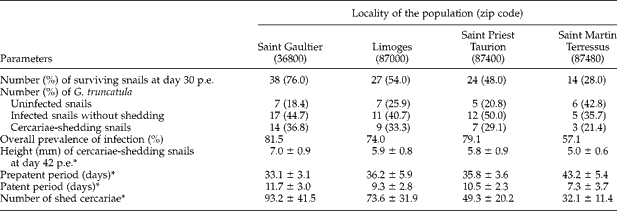
In the first subgroups of snails monitored for cercarial shedding (table 1), the survival rate of snails at day 30 p.e. was 76.0% in the Saint Gaultier subgroup and was significantly lower (χ2 = 23.44, P < 0.001) in the three others originating from acid soils. The lowest value (28.0%) was noted in the snails from Saint Martin Terressus. However, in spite of this difference in survival rates, no significant difference between these subgroups was noted in the overall prevalence of infection or in the frequency of each snail category (infected snails without shedding, or cercariae-shedding snails). At day 42 p.e., a significant difference between the shell height of cercariae-shedding snails (F = 4.04, P < 0.05) was noted. The length of the prepatent period was significant greater (F = 5.42, P < 0.05) in the Saint Martin Terressus subgroup than in the three others. In contrast, the difference between the patent periods was insignificant. Another significant difference (F = 4.12, P < 0.05) between the numbers of shed cercariae was also noted. The greatest values were noted in the Saint Gaultier subgroup while the lowest were those from Saint Martin Terressus snails.
Snail survival, prevalence of F. hepatica infection and number of shed cercariae in the first subgroups of riverbank G. truncatula. Fifty snails were exposed at each site.
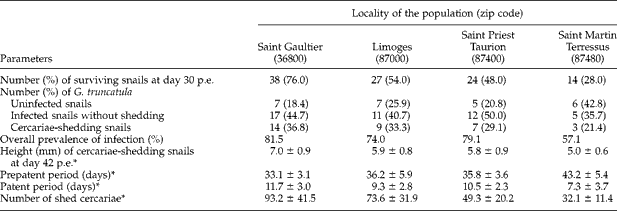
* Mean value ± SD. p.e., post-exposure.
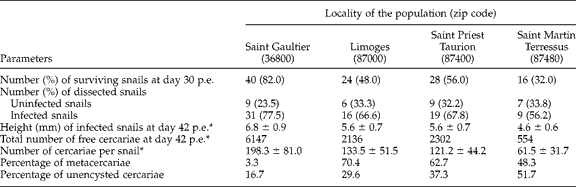
Table 2 gives the values found in the second subgroups of snails after their dissection at day 42 p.e. Compared to figures listed in table 1, there were several slight fluctuations in the numbers and percentages. However, the same significant differences were found for snail survival at day 30 p.e. (χ2 = 24.15, P < 0.001), the shell height of infected snails at day 42 (F = 5.21, P < 0.05) and the total number of free cercariae counted in dissected snails (F = 4.33, P < 0.05). The prevalence of infection, calculated using the number of infected snails, was not significantly different. If the outcome of cercariae after snail dissection was considered, a significant difference (χ2 = 641.96, P < 0.001) between the percentages of unencysted cercariae in snail subgroups was noted. The highest value was noted in the Saint Martin Terressus snails whereas the lowest was that of the Saint Gaultier subgroup.
Snail survival, prevalence of F. hepatica infection and number of shed cercariae in the second subgroups of riverbank G. truncatula. Fifty snails were exposed at each site.
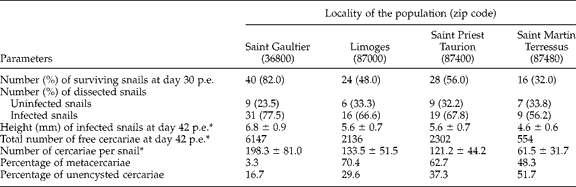
* Mean value ± SD. p.e., post-exposure.
Discussion
The results noted for cercariae-shedding snails in the present study (table 1) can be compared with those of Rondelaud et al. (Reference Rondelaud, Dreyfuss, Vareille-Morel and Moukrim1997), as these authors have used snails from the same geographical population but reared in either aquaria or aquaterraria. Under these conditions, the values noted for snail survival, prevalence of infection, snail growth during the experiment, and cercarial production for snails reared in 14-cm Petri dishes were better in the present study. For example, in the Saint Gaultier subgroups, the survival rates of snails at day 30 p.e. were 76.0 and 82.0% in the present study (instead of 25.5% in the report by Rondelaud et al., Reference Rondelaud, Dreyfuss, Vareille-Morel and Moukrim1997), while their height after their death and the number of shed cercariae were 6.8 mm and 93.2 (instead of 4.8 mm and 51.0, respectively). To explain these differences, the most valid hypothesis is to relate these findings to the method used to breed snails in the laboratory. According to Rondelaud et al. (Reference Rondelaud, Fousi, Vignoles, Moncef and Dreyfuss2007), the use of this technique allowed optimization of the characteristics of snail infection with F. hepatica in the laboratory.
In spite of these better conditions, each population of G. truncatula retained its same characteristics during the infection of snails with F. hepatica (tables 1 and 2). Indeed, the shell heights noted in the present study (from 4.6 to 7.0 mm) were lower than that recorded for infected G. truncatula from meadow populations and raised in 14-cm Petri dishes (a mean of 8.8 mm according to Rondelaud et al., Reference Rondelaud, Fousi, Vignoles, Moncef and Dreyfuss2007). However, in each geographical strain, the shell heights of these riverbank G. truncatula were close to those found for the corresponding adults in the field (see above). This finding is more difficult to interpret because the breeding conditions of snails during the experiment, and particularly the dissolved calcium contents in water, were the same for all subgroups, whatever the geographical origin of the population. In our opinion, the most valid hypothesis is to admit that the riverbank populations of G. truncatula would not feed much on decaying grass leaves in their natural habitats, contrary to the meadow populations of this species. If this assumption is valid, it would be necessary to analyse the contents of the snail intestines to determine the plant species on which these riverbank populations feed throughout the year. However, another hypothesis, based on the influence of snail habitat on the characteristics of life for G. truncatula, cannot be excluded. Indeed, these river banks are considered to be permanent habitats for this species (Taylor, Reference Taylor1965) and are known for the shorter life span and the small size of snails that colonize these sites (Chappuis et al., Reference Chappuis, Trouve, Facon, Degen and Goudet2007).
In the second subgroups (table 2), a greater percentage of unencysted cercariae was noted in the Saint Martin Terressus snails after their dissection. Several hypotheses may explain this difference. This delay in cercarial differentiation observed in the snails from Saint Martin Terressus may be due to the limited snail growth noted during the experiment (a mean height of 4.6 mm only at day 42 p.e., instead of 5.6–6.8 mm in the three other subgroups) and/or to the prepatent period which was longer in this subgroup (43.2 days at 24°C instead of 33.1–36.2 days; see table 1). A third assumption may also be proposed because of the presence of numerous cadavers of degenerated rediae (Rondelaud & Barthe, Reference Rondelaud and Barthe1980) in the intervisceral spaces of the digestive gland in the Saint Martin Terressus subgroup. As more than 50% of rediae were cadavers in the digestive gland of these snails after their dissection, this poses the question of whether these snails show a lower sensibility to larval development of F. hepatica. This is supported by the numerous series of abortive infections and the absence of cercarial shedding in the few infected snails found over past years when this snail population was exposed to F. hepatica miracidia (Rondelaud et al., Reference Rondelaud, Dreyfuss, Vareille-Morel and Moukrim1997, Reference Rondelaud, Vignoles and Dreyfuss2009a).
Even if the characteristics of snail infection with F. hepatica in these riverbank populations are not as good as those noted with the meadow strains of G. truncatula, the experimental infection of the former populations of snails with this digenean allows metacercariae to be obtained via the dissection of infected snails. Moreover, this use of these riverbank strains avoided the breeding of newborns from egg-masses laid, for example, by meadow adult snails, because this technique, performed by our team for the past 20 years, is time consuming and more expensive. As snail habitats with permanently running water are scarce on the lowland soils of central France (Rondelaud et al., Reference Rondelaud, Hourdin, Vignoles and Dreyfuss2009b), the use of riverbank G. truncatula allowed the commercial demand for metacercariae of F. hepatica to be met during the summer months.