





1. Introduction
Public support for climate action in Latin America is exceptionally high, with 80–90% of people wanting governments to do more on greenhouse gas (GHG) emission reductions (EIB, 2023; Gillreath-brown et al., Reference Gillreath-brown, Rivas, Jefferson, Carman, Goddard, Kioko and Marlon2025). Yet emissions continue to rise as governments prioritize fossil fuel development in the name of energy security and economic growth (Climate Action Tracker, 2025; Rousseau, Reference Rousseau2021). This growth rationale is itself questionable: although economic growth is meant to improve living standards, its benefits in the region remain unevenly distributed, indicating that rising wealth does not reliably translate into well-being for everyone (Boyd, Reference Boyd2024; Haas, Reference Haas2025). Continued reliance on fossil fuels also clashes with public sentiment: roughly 70% of Latin Americans say that climate change has already affected their livelihood or income (EIB, 2023). These perceptions reflect tangible impacts, including heat-related illnesses, the spread of disease vectors (Pinto et al., Reference Pinto, Barnes, Philip, Kew, Cerezo-mota, Tannenbaum and Otto2024), and dependence on climate-vulnerable sectors such as agriculture and resource extraction (Gouveia et al., Reference Gouveia, Justino, Gurjao, Zita and Alonso2023; OECD, 2022). Conventionally, economies defer emissions reductions until they have developed (Bettarelli et al., Reference Bettarelli, Furceri, Loungani, Ostry and Pisano2025; Grossman & Krueger, Reference Grossman and Krueger1995), and because many Global South countries remain heavily dependent on fossil fuels (Ritchie & Rosado, Reference Ritchie and Rosado2024), cutting emissions tends to be politically unpopular (Caucheteux et al., Reference Caucheteux, Fankhauser and Srivastav2025; IPCC, 2022). Latin America, however, deviates from this pattern: 80% of its citizens would rather their governments pursue sustainable growth than growth-at-all-costs (EIB, 2023).
To further understand climate policy preferences and the relationship between economic growth and emissions reductions in Latin America, our study surveys citizens of Chile (n = 1,000) and Mexico (n = 1,001) as contrasting cases. Since the 2015 Paris Agreement, both countries have struggled to decouple emissions from economic growth (Climate Action Tracker, 2022, 2024; World Bank, 2025). However, the early 2020s marked a shift for Chile, where renewable energy development, coal phaseouts (Government of Chile, 2024, 2022; Pettigrew, Reference Pettigrew2022), and carbon pricing mechanisms (ICAP, n.d.a, n.d.b) produced emission cuts that align with Paris goals (Climate Action Tracker, 2024). In contrast, Mexico’s relaxed climate policies (IEA, 2024a, 2025a) and emphasis on domestic fossil fuel production (Rousseau, Reference Rousseau2021) align with a 4°C global temperature increase (Climate Action Tracker, 2022).
This study explores support for compulsory and voluntary climate policies and citizens’ beliefs about how governments should balance economic growth and emissions reductions. Across both countries, climate policy support remains understudied: in Chile, the literature focuses on broad climate attitudes without exploring public support for specific climate policies (Geng et al., Reference Geng, Kostroch, Vasilyev and Vasquez-baos2024; Gillreath-brown et al., Reference Gillreath-brown, Rivas, Jefferson, Carman, Goddard, Kioko and Marlon2025; Grossman et al., Reference Grossman, Sacks and Xu2026; Sapiains-arrué et al., Reference Sapiains-Arrué, Cruz, Ugarte-Caviedes and Romero-Hernández2021), and in Mexico, research on policy support and its drivers generally remains limited (Cárdenas, Reference Cárdenas2023; Dabla-Norris et al., Reference Dabla-Norris, Helbling, Khalid, Khan, Magistretti, Sollaci and Srinivasan2023; Dechezlepretre et al., Reference Dechezlepretre, Fabre, Kruse, Planterose, Chico and Stantcheva2025). We contribute to the literature by measuring levels and characteristics of public support for nine compulsory and voluntary climate policies in both countries.
To understand public perceptions of emissions–economy trade-offs, we examine four conceptual approaches: decoupling, agrowth, degrowth, and growth-at-all-costs paradigms (Drews & Bergh, Reference Drews and Bergh2016a; Drews et al., Reference Drews, Savin and Bergh2019; Tomaselli et al., Reference Tomaselli, Sheppard, Kozak and Gifford2019; Bergh, Reference Bergh2018). To our knowledge, citizen support for climate policies has not been studied from the perspective of emissions–economy trade-offs in Latin America. By comparing Chile and Mexico, we show how climate policy support, beliefs about emissions–economy trade-offs, and the associations between them differ across distinct national development trajectories. This positions our study as a novel contribution to the Global South literature while providing practical, country-specific insights to help governments respond to high public demand for climate action.
The objectives of our study are to assess the (1) levels of support for different types of climate policies in Chile and Mexico; (2) beliefs about emissions and economic trade-offs; and (3) associations between beliefs about emissions–economy trade-offs and climate policy support.
2. Literature review
2.1. Climate policy support and its predictors
Growing demand for climate action across the Global South has led to high support for climate policies. Baum et al.’s (Reference Baum, Fritz, Low and Sovacool2024) comparative international survey finds significantly (p < 0.05) higher support for technology regulations, R&D funding, participation in international carbon markets, and oversight mechanisms in the Global South than in the Global North. Similarly, Bretter and Schulz's (Reference Bretter and Schulz2025) survey finds that Brazil, China, and South Africa all exhibit higher support for taxes, regulations, subsidies, and information compared to the US, the UK, and Germany. Notably, Brazilians had the second-highest overall policy support, reflecting a broad desire for climate action in Latin America.
Strong support for climate policies in Latin America partly reflects widespread agreement that climate change is real, human-induced, and personally harmful (EIB, 2023; Gillreath-brown et al., Reference Gillreath-brown, Rivas, Jefferson, Carman, Goddard, Kioko and Marlon2025). About 80% of Chileans and Mexicans want their governments to prioritize investments in renewable energy, suggesting a willingness to depart from conventional fuel sources (EIB, 2023). In Mexico, 69% support subsidies for renewable or low-carbon technologies, 56% favor emission-limiting regulations, and 58% back carbon pricing; however, only 16%, 18%, and 61% of Mexican respondents had heard of carbon taxes, emissions trading, and emission-limiting regulations, respectively, when surveyed (Cárdenas, Reference Cárdenas2023), potentially biasing results. Dechezlepretre et al. (Reference Dechezlepretre, Fabre, Kruse, Planterose, Chico and Stantcheva2025) show that Mexicans express high support for green infrastructure programs (84%) and for banning combustion engines (67%), but support for a carbon tax is more variable, ranging from 44% to 79% depending on how the revenue is used, with the highest backing when funds are directed toward green infrastructure and technology. In Chile, Carson et al.’s (Reference Carson, Lu, Khossravi, Kohlin, Sterner, Sterner and Whittington2025) multinational survey shows the public prefers renewable energy R&D investment, phasing out high-emission vehicles, and channeling carbon tax revenues toward clean technologies and social programs. However, the survey does not quantify support and instead presents it relative to other countries. Other studies on Chile generally focus on broad attitudes about climate change, such as cause, awareness, and concern (Gillreath-brown et al., Reference Gillreath-brown, Rivas, Jefferson, Carman, Goddard, Kioko and Marlon2025; Grossman et al., Reference Grossman, Sacks and Xu2026; Sapiains-arrué et al., Reference Sapiains-Arrué, Cruz, Ugarte-Caviedes and Romero-Hernández2021) or discuss pro-climate policy shifts while omitting public support measurements (Geng et al., Reference Geng, Kostroch, Vasilyev and Vasquez-baos2024).
Even with broad support for climate action in Chile and Mexico, climate policies remain susceptible to familiar tensions centering around emissions–economy trade-offs commonly found in the Global North. Perceived economic costs of climate policies lower public support (Drews & Bergh, Reference Drews and Bergh2016b; Lackner et al., Reference Lackner, Fierro and Mellacher2025). In 2017, Mexicans protested carbon tax increases over concerns about fuel price (Patterson et al., Reference Patterson, Anisimova, Logg-scarvell and Kasier2025), while renewable energy projects faced opposition from low-income, fossil fuel–dependent communities because of high upfront costs (IEA, 2021c), insufficient infrastructure, and limited government support (Necoechea, Reference Necoechea2025). Roughly half of Mexicans believe carbon pricing would raise consumer prices and harm small businesses (Cárdenas, Reference Cárdenas2023), though revenue transfers to low-income groups could increase acceptance (Black et al., Reference Black, Kirabaeva, Parry, Raissi and Zhunussova2021). Similarly, in Chile, public support for carbon tax hikes improves when revenues are earmarked for poorer citizens, low-carbon infrastructure, and R&D (IMF, 2023). Communicating co-benefits, such as improved air quality, and policy effectiveness can also enhance support (Dabla-Norris et al., Reference Dabla-Norris, Helbling, Khalid, Khan, Magistretti, Sollaci and Srinivasan2023).
Additional factors influence climate policy support, including institutional trust (Cologna et al., Reference Cologna, Mede and Berger2025; Fairbrother et al., Reference Fairbrother, Seva and Kulin2019; Kitt et al., Reference Kitt, Axsen, Long and Rhodes2021), perceptions of policies’ economic harm and effectiveness (Dabla-Norris et al., Reference Dabla-Norris, Helbling, Khalid, Khan, Magistretti, Sollaci and Srinivasan2023; Drews & Bergh, Reference Drews and Bergh2016b), beliefs about the cause of climate change (Fritz et al., Reference Fritz, Baum, Brutschin, Low and Sovacool2024; Funk & Kennedy, Reference Funk and Kennedy2016), future health impacts (Gillreath-brown et al., Reference Gillreath-brown, Rivas, Jefferson, Carman, Goddard, Kioko and Marlon2025), political orientation (Bumann, Reference Bumann2021; Moyano-diaz et al., Reference Moyano-diaz, Palomo-velez and Vergara-bravo2018), and populism (Huber et al., Reference Huber, Fesenfeld and Bernauer2020, Reference Huber, Greussing and Eberl2022; Meijers et al., Reference Meijers, Yael and Jacobs2023). As such, we have controlled for these variables.
2.2. Climate policy landscape in Chile and Mexico
Climate policies are generally categorized along a continuum, ranging from compulsory ‘push’ policies that mandate behavioral and/or technological change and penalize noncompliance, to voluntary ‘pull’ policies that encourage the same changes through market-based incentives without imposing penalties (Howlett, Reference Howlett2019; Jaccard, Reference Jaccard2020). While the public tends to prefer voluntary measures, such as subsidies, they are ineffective in generating significant emissions reductions (IPCC, 2022; Valkengoed & Werff, Reference Valkengoed and Werff2022). Conversely, compulsory policies, such as taxes and regulations, receive lower support due to high perceived costs (Dechezlepretre et al., Reference Dechezlepretre, Fabre, Kruse, Planterose, Chico and Stantcheva2025; Fairbrother, Reference Fairbrother2022), even though they are more effective in reducing emissions (Baranzini et al., Reference Baranzini, Bergh, Carattini, Howarth, Padilla and Roca2017).
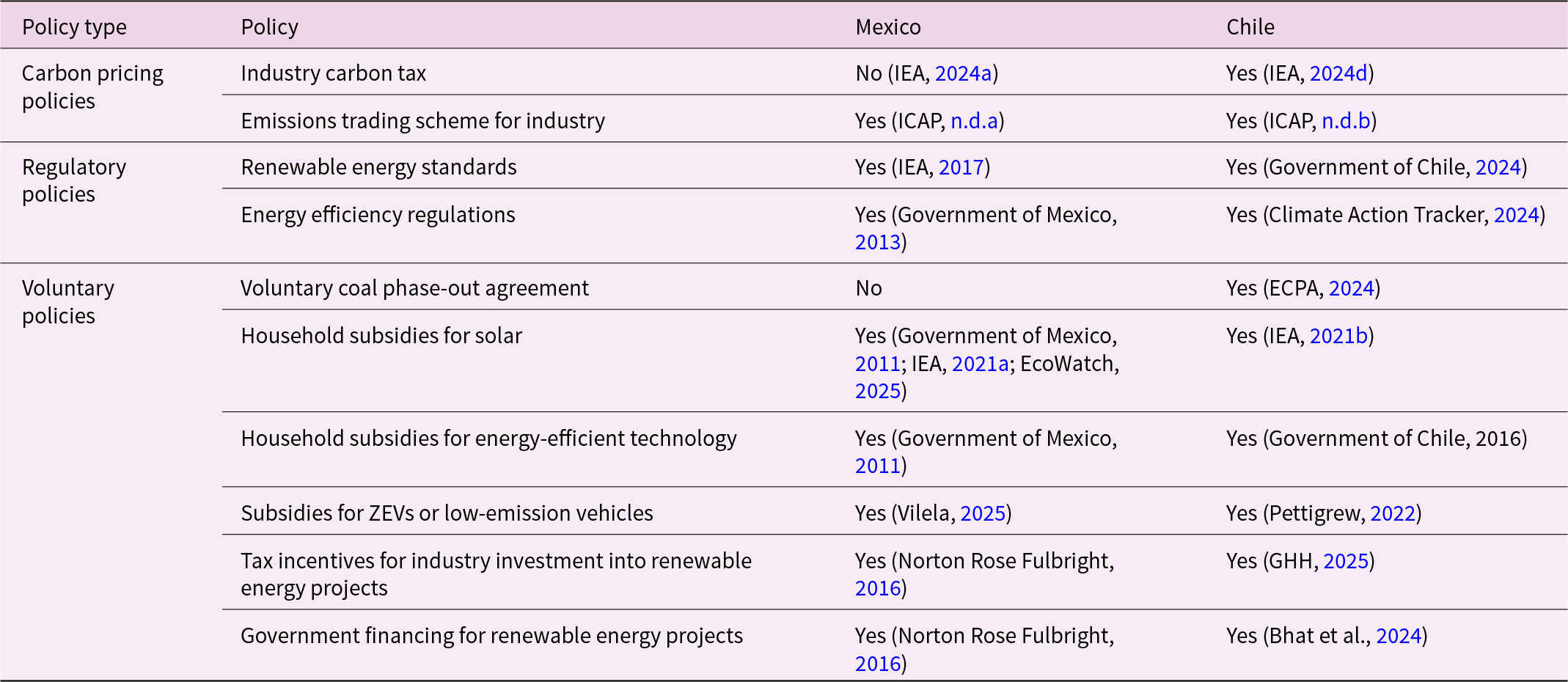
Mexico and Chile have struggled to decouple emissions from economic growth. Between 2015 and 2022, Chile’s economy grew by 16.1% and Mexico’s by 6.4% (World Bank, 2025). In the same period, Chile’s emissions increased by 7.7% (Climate Action Tracker, 2024) and Mexico’s by 3.5% (Climate Action Tracker, 2022; ICAP, 2024). In 2022, transportation accounted for 36% of emissions in Chile and 34% in Mexico, electricity and heat production for 34% and 33%, and industry for 19% and 12%, respectively (IEA, 2025b, 2025c). Table 1 summarizes Mexico’s and Chile’s national climate policies to help clarify why Chile is positioned to reduce more emissions than Mexico (Climate Action Tracker, 2022, 2024).
Climate policies in Mexico and Chile as of 2026

Table 1 Long description
A table with four columns: policy type, policy, Mexico and Chile. Ten policies are grouped into three types, and each country cell records yes or no with a supporting reference. Under carbon pricing policies, an industry carbon tax is absent in Mexico but present in Chile, while an emissions trading scheme for industry is present in both. Under regulatory policies, both countries have renewable energy standards and energy efficiency regulations, though at different stringencies. Under voluntary policies, a voluntary coal phase-out agreement is present only in Chile, while both countries have household subsidies for solar, household subsidies for energy-efficient technology, subsidies for zero-emission or low-emission vehicles, tax incentives for industry investment in renewable energy projects, and government financing for renewable energy projects. Chile therefore has all ten policies, whereas Mexico lacks the industry carbon tax and the coal phase-out agreement.
Mexico’s 2012 General Climate Change Law set a 50% GHG emissions reduction target against 2000 levels. It established an emissions trading scheme (ETS) and created the Climate Change Fund to channel public and private resources toward adaptation and mitigation projects (Government of Mexico, 2023; IEA, 2022). However, the Fund was dissolved in 2020, eliminating a key financing source (Climate Action Tracker, 2022). The pilot ETS was launched in 2020 for fixed energy and industrial installations emitting more than 100,000 tonnes of GHGs annually, with full operational implementation expected in 2026 (ICAP, n.d.a). Mexico also prices carbon at 3.5 USD per tonne of GHG emissions on sold or imported fuels (Climate Action Tracker, 2022), which applies only to the additional GHG emissions released relative to natural gas (International Energy Agency, 2024a).
Mexico’s 2015 Energy Transition Law introduced a mandatory clean electricity target of 35% by 2024 (Rousseau, Reference Rousseau2021) and was complemented by the Electric Industry Act of 2017, which created tradable clean energy certificates (CELs) that reward compliance with increasingly stringent clean energy quotas (International Energy Agency, 2017; SEMARNAT, 2018). However, 2019 amendments allowed state-owned legacy power plants to earn CELs, decreasing their value (ITA, n.d.).
In transportation, Mexico has zero-emission vehicle (ZEV) sales targets of 50% by 2030 and 100% by 2050 (IEA, 2025a), which are supported by tax incentives for the public (Vilela, Reference Vilela2025) and light-duty vehicle GHG emissions standards (IEA, 2024b). For energy efficiency, Mexico applies national standards for buildings and appliances (Government of Mexico, 2013), with subsidies to adopt solar energy and energy-efficient equipment (EcoWatch, 2025; Government of Mexico, 2011; IEA, 2021a). In the industrial sector, tax incentives encourage renewable electricity generation, while the national development bank offers financing for clean energy projects (Norton Rose Fulbright, 2016).
Mexico’s carbon pricing, ZEV strategy, and CELs all lack sufficient stringency to reduce emissions (Black et al., Reference Black, Kirabaeva, Parry, Raissi and Zhunussova2021; IPCC, 2022). Compounded by the 2018–2024 national policy emphasis on domestic fossil fuel development and the cancellation of renewable energy project bids (Rousseau, Reference Rousseau2021), Mexico fell 10% short of its 2024 clean electricity goals (Ember Energy, 2025).
Chile’s 2022 Climate Change Framework Law set a net-zero GHG emissions target by 2050 and established an energy sector ETS, scheduled for 2026 (Government of Chile, 2022; ICAP, n.d.b). For carbon pricing, the 2017 national carbon tax set a rate of 5 USD per tonne of GHG emissions for stationary installations emitting over 25,000 tonnes annually (International Energy Agency, 2024c), with planned increases to 35 USD by 2030 and 80 USD by 2040 (ICAP, n.d.b).
Since 2019, Chile has pursued a structured energy transition, beginning with a policy to phase out coal power plants by 2040 (ECPA, 2024) supported by international Climate Investment Funds (Bhat et al., Reference Bhat, Holzman, Khannan, Lone, Lubis and Matsuo2024). Grants for hydrogen projects and tax credits for low-carbon technology buyers complement the shift (GHH, 2025). The success of these efforts is already apparent, with 46% of electricity coming from hydro and solar in 2023 (IEA, 2024d) – over double the 20% renewable electricity target for 2025 (Government of Chile, 2024).
Chile’s transportation policies target 100% zero-emission light- and medium-duty vehicles, urban buses, and large machinery by 2035, supported by manufacturing and adoption incentives (Pettigrew, Reference Pettigrew2022). The 2021 Energy Efficiency Law strengthened these measures by mandating progressively stricter vehicle fuel economy standards and establishing a national goal to reduce energy intensity by 10% by 2030 (IEA, 2025d; Pettigrew, Reference Pettigrew2022). The law also requires energy management systems for high-consumption firms and labeling for appliances and buildings (Climate Action Tracker, 2024). Additional incentives include tax exemptions for solar systems (Government of Chile, 2016a) and ZEVs (Pettigrew, Reference Pettigrew2022), and subsidies for household efficiency upgrades (Government of Chile, 2016b) and solar usage (IEA, 2021b). Chile’s carbon pricing, coal phaseout, renewable expansion, and efficiency standards across the electricity, transport, and industry sectors position the country on track to meet its climate targets (Climate Action Tracker, 2022, 2024), in contrast to Mexico.
2.3. Emissions reduction and economic growth trade-off paradigms
Citizen support for emissions reduction and economic growth has previously been explored through the examination of public beliefs about the compatibility of environmental protection and economic growth (Tomaselli et al., Reference Tomaselli, Sheppard, Kozak and Gifford2019; Drews et al., Reference Drews, Savin and Bergh2019; Bergh, Reference Bergh2018; Drews & Bergh, Reference Drews and Bergh2016a). Past studies have classified citizens into four broad economic growth paradigms: green growth, degrowth, agrowth, and growth-at-all-costs.
Green growth suggests that economic expansion and environmental preservation are not mutually exclusive, with decoupling emissions from economic growth deemed an appropriate approach to resolve the climate crisis (Drews & Bergh, Reference Drews and Bergh2016a). In contrast, degrowth proposes to reduce emissions by planned, equitable downscaling of harmful production and consumption in high-income countries through democratic decision-making to align the anthropogenic ecological footprint with the Earth’s carrying capacity, while implementing policies to prevent unemployment, expand public goods and services, and redistribute wealth (Hickel, Reference Hickel2021; Parrique, Reference Parrique2019). The third perspective, agrowth, strikes a balance between decoupling and degrowth by arguing that societal goals, such as emissions reduction, should take priority over gross domestic product, which omits many negative externalities (Bergh, Reference Bergh2011, Reference Bergh2017, Reference Bergh2018). Finally, growth-at-all-costs advocates for unconditional economic growth, based on the assertion that growth equates to prosperity and skepticism about the association between economic growth and environmental degradation or climate change (Drews & Bergh, Reference Drews and Bergh2016a).
Levels of citizen support differ for each growth paradigm. Drews and Bergh’s (Reference Drews and Bergh2016a) survey of Spanish citizens on economic growth, the environment, and prosperity found that 59% of citizens support decoupling, 21% support agrowth, 15% support degrowth, and only 4% support growth-at-all-costs. Tomaselli et al.’s (Reference Tomaselli, Sheppard, Kozak and Gifford2019) survey of Canadian citizens on the relationship between economic growth and sustainability found similar results, with 41% preferring decoupling, 36% favoring agrowth due to uncertainty about growth’s benefits and environmental impacts, and 23% ascribing to degrowth by rejecting indefinite growth.
Another study of the Spanish population by Drews et al. (Reference Drews, Savin and Bergh2019) indicated higher skepticism about economic growth, with agrowth supported by most respondents (43%), followed by green growth (29%), degrowth (18%), and indifference (10%). A qualitative follow-up by Savin et al. (Reference Savin, Drews and Bergh2021), using free association, revealed that Spanish citizens are more critical of economic growth and associate it with corruption, inequality, and poverty, likely influenced by timing since the data were collected in 2014 during Spain’s economic crisis. A common finding between the two studies is that citizens’ beliefs are not polarized and could be influenced by communication.
While agrowth is preferred in Spain, Drews et al. (Reference Drews, Antal and Bergh2018) broader European and US data show that most citizens prioritize environmental protection over economic growth but do not view them as mutually exclusive, aligning with decoupling beliefs. Similarly, Bell et al.’s (Reference Bell, Rhodes, Long and Salemi2025) survey of the UK and Australia found decoupling to be the most popular approach (~50%), followed by agrowth, growth-at-all-costs, and degrowth at 10–20%. Conversely, Krpan et al. (Reference Krpan, Basso, Hickel and Kallis2025) reported 73–81% support for degrowth in the US and UK. However, this popularity warrants caution: their degrowth proposal used broadly appealing goals, such as reducing harmful production and consumption, ensuring affordable housing and employment, and supporting Global South development – all of which can be achieved via decoupling – while omitting feasibility and trade-offs for lifestyles, freedoms, and welfare levels in high-income countries (Andres et al., Reference Andres, Bosca, Domenech and Ferri2024).
Bell et al. (Reference Bell, Rhodes, Long and Salemi2025) also measured beliefs about emissions and economic trends (in addition to trade-offs) in the UK and Australia, finding that citizens are pessimistic about emissions reductions and economic growth, despite successes in these areas. They demonstrated that the agrowth belief had the strongest association with climate policy support, and that optimistic beliefs about future emissions reductions and economic performance increased support more than past beliefs. This aligns with Bertolotti et al. (Reference Bertolotti, Catellani and Nelson2021), who note that framing policies around future economic benefits increases support, and Kudrnáč and Fairbrother (Reference Kudrnáč and Fairbrother2025), who show that positive policy outcomes and co-benefits influence public backing more than perceived costs.
While the Global North debates growth paradigms, the Global South faces distinct structural realities, with a higher reliance on low-cost fossil fuels (Ritchie & Rosado, Reference Ritchie and Rosado2024) and pervasive energy poverty concerns (Caucheteux et al., Reference Caucheteux, Fankhauser and Srivastav2025). Because emissions reduction priorities typically arise after economies mature (Bettarelli et al., Reference Bettarelli, Furceri, Loungani, Ostry and Pisano2025; Grossman & Krueger, Reference Grossman and Krueger1995), the Global South drove emissions upward between the 1990s and 2020s, while the Global North’s emissions fell (IPCC, 2022). Strategies to reconcile development with decarbonization are crucial for lower-income countries to avoid carbon lock-in (IPCC, 2022). Latin America presents an interesting case within the Global South: while economic growth remains pivotal for poverty reduction (Dávila, Reference Dávila2023), 80% of Latin Americans prefer that their governments focus on sustainable growth instead of growth-at-all-costs (EIB, 2023).
2.4. Contributions to the literature
Our study addresses several gaps in the literature. First, past studies on emissions–economy trade-offs focus on the relationship between the economy and environment, while we investigate emission–economy relationships specifically and their associations with climate policy support. Second, studies on support for climate policies are limited in Chile and Mexico, while the preferred alternative to growth-at-all-costs remains unknown. Finally, emissions–economy trade-off studies mostly lack jurisdictional comparisons and are absent in Latin America. Comparing Mexico and Chile fills this gap, offering contrasting cases of climate policy success and growth trajectories. By analyzing these nations, we determine how climate policy support, growth paradigm preferences, and their associations differ under varying levels of government climate policy ambition, which may help governments implement climate strategies with less opposition.
3. Theoretical insights
Our study tests the associations between emissions–economy trade-off beliefs and policy support using Drews and Bergh's (Reference Drews and Bergh2016b) three categories of climate policy support drivers to organize our main and control variables: (1) contextual factors, including emissions–economy trade-offs, trend beliefs, and trust; (2) perceptions of climate policy design, including perceived policy-induced economic harm and policy effectiveness; and (3) individual beliefs, including climate change beliefs, political orientation, populism, and sociodemographics. For emissions–economy trade-offs, we draw on ecological economics growth paradigm theories on the relationship between economic growth and environmental impacts, particularly GHG emissions, including decoupling, agrowth, degrowth, and growth-at-all-costs (Drews & Bergh, Reference Drews and Bergh2016a; Drews et al., Reference Drews, Savin and Bergh2019; Tomaselli et al., Reference Tomaselli, Sheppard, Kozak and Gifford2019; Bergh, Reference Bergh2018).
Table 2 summarizes our hypotheses: relative to decoupling, we expect agrowth to be positively associated with support for all policies due to its focus on emissions reduction and growth agnosticism; degrowth to be positively associated with support for compulsory policies that could be seen as limiting fossil fuel growth and to be negatively associated with voluntary policies that could encourage green growth; and growth-at-all-costs to be negatively associated with support for compulsory policies limiting fossil fuel-based growth and positive associations with support for voluntary policies encouraging green economic growth. Following Bell et al. (Reference Bell, Rhodes, Long and Salemi2025), we also hypothesize that optimistic beliefs about past and future emissions reductions and economic growth will have positive associations with support for all climate policy types.
Variables hypothesized to have positive [+] or negative [-] associations with support for compulsory and voluntary climate policies

Table 2 Long description
A table with four columns: variable, hypothesized association with support for compulsory policies, the same for voluntary policies, and references. Variables fall into three groups. Among contextual variables, with decoupling as the reference category, agrowth is a positive predictor of support for both policy types, degrowth positive for compulsory but negative for voluntary, and growth-at-all-costs negative for compulsory but positive for voluntary policies. The four trend beliefs in past and future emissions and economic changes and trust in parliament, in scientists and in the United Nations are expected to predict support for all policy types. Among policy design variables, economic harm is negative for both policy types and policy effectiveness positive. Among individual variables, climate change denial, political orientation left to right, populism and age are negative predictors for all policies, while future health problems, education, income and female gender are positive.
4. Methods
4.1. Data collection
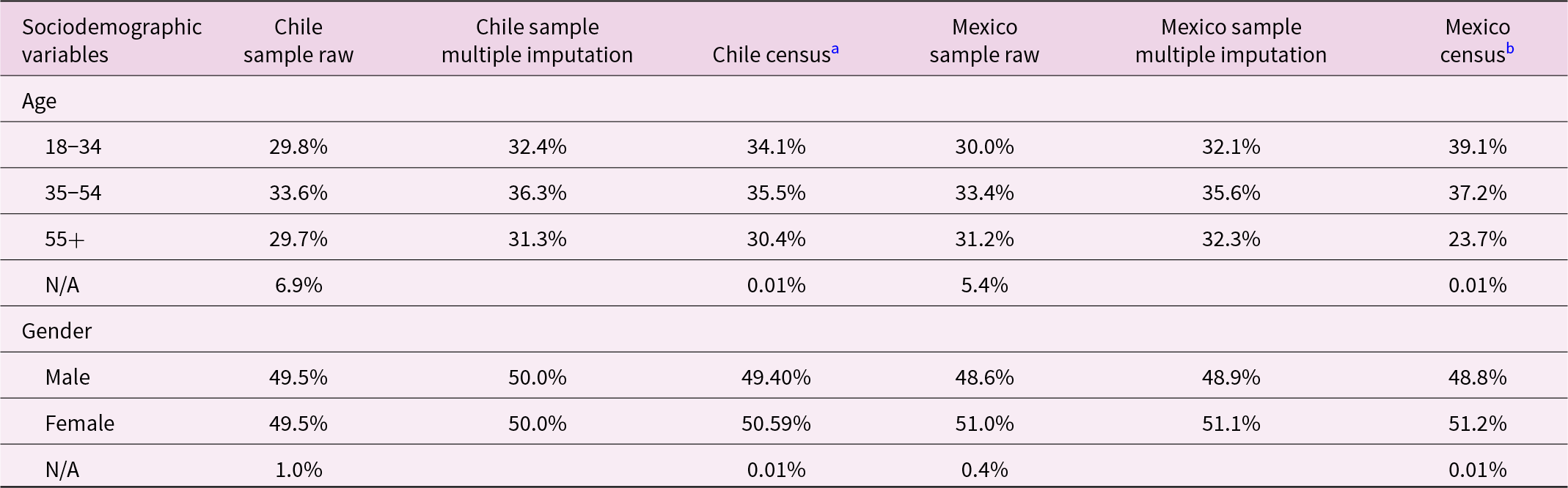
Our data were collected from a 20-minute web-based survey of citizens (18+) in Chile (n = 1,000) and Mexico (n = 1,001), conducted in Spanish. The market research company Qualtrics administered the survey from September to October 2023. The samples are somewhat representative of the populations by age and gender (Table 3). Random Iterative Method (RIM) weighting was applied using the R ‘survey’ package to ensure representativeness for age and gender. Obtaining census data on other sociodemographics, such as education and income, was not feasible in these countries.
Sample (raw and multiple imputation) versus census data for Chile and Mexico

Table 3 Long description
A table with seven columns: socio-demographic variable, then for Chile and for Mexico in turn the raw sample, the sample after multiple imputation, and the Census figure. All values are percentages. For Chile, ages 18 to 34 are 29.8, 32.4 and 34.1; ages 35 to 54 are 33.6, 36.3 and 35.5; ages 55 and over are 29.7, 31.3 and 30.4; 6.9 of the raw sample gave no age. For Mexico the same bands are 30.0, 32.1 and 39.1; 33.4, 35.6 and 37.2; and 31.2, 32.3 and 23.7, with 5.4 not stated. For gender, Chile is 49.5, 50.0 and 49.40 male and 49.5, 50.0 and 50.59 female, with 1.0 not stated. Mexico is 48.6, 48.9 and 48.8 male and 51.0, 51.1 and 51.2 female, with 0.4 not stated. Census sources are Population Pyramid (2022) for Chile and Government of Mexico (2020).
We used predictive mean matching multiple imputation (R ‘Mice’ package; seed = 123, m = 5) to replace nonresponses. On average, nonresponses were below 5% for both countries. The multiple imputation dataset was used to create population weights based on age and gender. The design effects for Chile’s models were 0.96–0.99 and for Mexico’s models 1.01–1.03, indicating a minimal change to the effective sample size and variance estimates. The variance inflation factor (VIF) was used to ensure that multicollinearity was absent, with all VIF values below the accepted value of 5.0 (Marcoulides & Raykov, Reference Marcoulides and Raykov2019).
4.2. Survey design
We used a subset of survey questions according to our research objectives (see full questionnaire in the Supplementary material). We assessed climate policy support on a five-point Likert scale from ‘strongly oppose’ to ‘strongly support’ accompanied by a brief non-technical description of each policy (objective 1). We tested support for the carbon tax, cleaner fuel regulations, energy efficiency regulations, a ZEV sales mandate, fossil fuel bans, household subsidies, business subsidies, information, and government investment. Then we measured climate change beliefs using three response categories: ‘climate change is happening now, caused mainly by human activities’, ‘climate change is happening now, but caused mainly by natural forces’, and ‘climate change is not happening now’. We combined ‘climate change is happening now, but caused mainly by natural forces’ and ‘climate change is not happening now’ to create the ‘climate change denial’ category.
To measure beliefs about emissions and economic trade-offs (objective 2), we used Bell et al. (Reference Bell, Rhodes, Long and Salemi2025), who operationalized these paradigms in Australia and the United Kingdom and demonstrated their associations with climate policy support. Specifically, we used the following emissions–economy paradigm question: ‘Which of the following do you think the [COUNTRY’s] government should do?’ Those who answered ‘try to grow the economy and reduce emissions at the same time’ were categorized as decouplers, ‘reduce greenhouse gas emissions regardless of any impacts on the economy’ as agrowthers, ‘grow the economy regardless of any impacts on greenhouse gas emissions’ as supporters of growth-at-all-costs, and ‘reduce greenhouse gas emissions and shrink the economy at the same time’ as degrowthers. We also measured beliefs about emissions–economy trends by assessing perceptions of past and future emissions and economic changes on a continuous slider from −100% to +100%. The time frames were from 2015 to 2023 (since the Paris Agreement to the date of the survey) for past trends and 2023 to 2030 (until the most immediate climate targets) for future trends.
To determine levels of trust in different institutions and populist beliefs, we used Likert scales with a ‘prefer not to answer’ option. We measured trust in scientists, the UN, and parliament on an 11-point Likert scale from ‘no trust at all’ to ‘complete trust’. We measured populist beliefs using three items from Kulin and Sevä (Reference Kulin and Sevä2024) on a five-point Likert scale from ‘strongly disagree’ to ‘strongly agree’. We then averaged the populist items to create a populism score.
We measured political orientation around economic and sociocultural issues using an 11-point Likert scale from 0 to 10, with 0 as liberal/left and 10 as conservative/right. For household income, we converted respondents’ values into 2023 US dollars. Education had five categories, from ‘high school or less’ to ‘doctorate or PhD degree’. Gender included ‘male’, ‘female’, and a self-identifying category. All variables above included a ‘prefer not to answer’ option.
4.3. Data analysis
First, we conducted one-tailed t-tests to compare country means in climate policy support levels. We measured differences in support for emissions–economy growth paradigms and for past and future emissions and economic trends using a Pearson’s chi-squared test for homogeneity and a Bonferroni-adjusted critical value (α = 0.05) post hoc test.
Then, we ran multivariate linear regression models to assess the associations between beliefs about emissions–economy trade-offs and climate policy support (objective 3). We controlled for additional variables listed in Table 2. To reduce the number of dependent variables, we conducted an exploratory factor analysis on policy support questions using a Promax (oblique) rotation at a cutoff of r < |0.30|. We determined four climate policy support factors: (1) the carbon tax, (2) compulsory consumer-facing policies (an average of support for fossil fuel bans and ZEV sales mandates), (3) compulsory industry-facing policies (an average of support for cleaner fuel regulations and energy efficiency regulations), and (4) voluntary policies (an average of support for household subsidies, business subsidies, information, and government investment).
We used the following model to determine climate policy support:
 \begin{align*}{y_i} &= {\alpha _0} + {\alpha _1}Emissions\,economy\,tradeoff\,belie{f_i}\\ &\quad + {\alpha _2}Past\,emissions\,decrease{d_i}\\ &\quad + {\alpha _3}Future\,emissions\,decrease{s_i}\\ &\quad + {\alpha _4}past\,economy\,increase{d_i}\\ &\quad + {\alpha _5}Future\,economy\,increase{s_i} + {X^\prime }\beta + {u_i}\end{align*}
where yi represents climate policy support for the carbon tax, compulsory consumer-facing policies, compulsory industry-facing policies, and voluntary policies. Support for a given policy was regressed on the independent variables described above, with  ${X^\prime }\beta $ representing variables controlled for (Table 2).
5. Results
5.1. Climate policy support levels
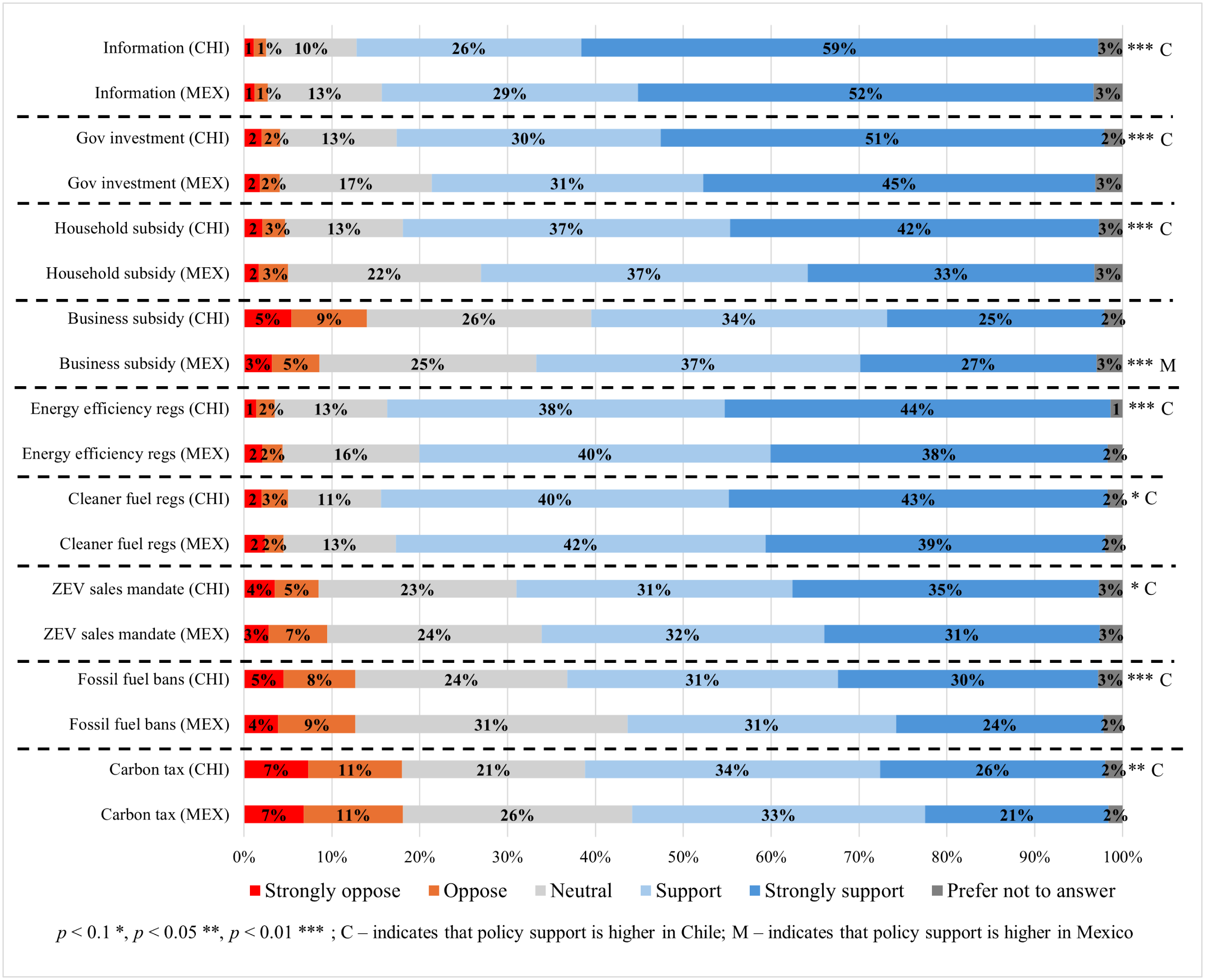
Figure 1 shows that citizens in Chile and Mexico express the highest support (an aggregate of ‘support’ and ‘strongly support’) for information (81–85%), government investment (76–81%), household subsidies (70–79%), energy efficiency regulations (78–82%), and cleaner fuel regulations (81–83%). The carbon tax, fossil fuel bans, and the ZEV sales mandate receive the least support in both countries at 54–66%. Business subsidies face relatively high opposition at 8–14% in both countries. Finally, 10–31% of respondents selected ‘neutral’ when asked about policy support, with neutrality ranging from 21% to 31% for fossil fuel bans, the carbon tax, business subsidies, and ZEV sales mandates.
Climate policy support in Chile and Mexico.

Figure 1 Long description
Stacked bar chart of support for nine climate policies, with one bar for Chile and one for Mexico. Each bar is split into five response categories, from strongly oppose to strongly support, shown as percentages. Combined support is highest for information, 81 to 85 per cent, cleaner fuel regulations, 81 to 83 per cent, energy efficiency regulations, 78 to 82 per cent, government investment, 76 to 81 per cent, and household subsidies, 70 to 79 per cent. It is lowest for the carbon tax, fossil fuel bans and the vehicle sales mandate, all 54 to 66 per cent. Opposition ranges from 2 per cent for information to 18 per cent for the carbon tax, with business subsidies at 8 to 14 per cent. Neutral responses range from 10 to 31 per cent, reaching 21 to 31 per cent for fossil fuel bans, the carbon tax, business subsidies and the vehicle sales mandate. Chile has higher mean support than Mexico for every policy except business subsidies.
The intercountry comparisons highlight that Chileans have significantly higher mean support for all climate policies, except for business subsidies, for which Mexicans show higher mean support (t(1999) = 2.59, p = 0.004885).
Additional descriptive analyses confirm that 95% of respondents in both countries believe that the government should put more effort to tackle climate change (an aggregate of ‘a little more effort’, ‘somewhat more effort’, ‘quite a bit more effort’, and ‘a great deal more effort’). Furthermore, 77–80% of respondents in both countries attribute climate change predominantly to human activities.
5.2. Emissions–economy trade-off beliefs
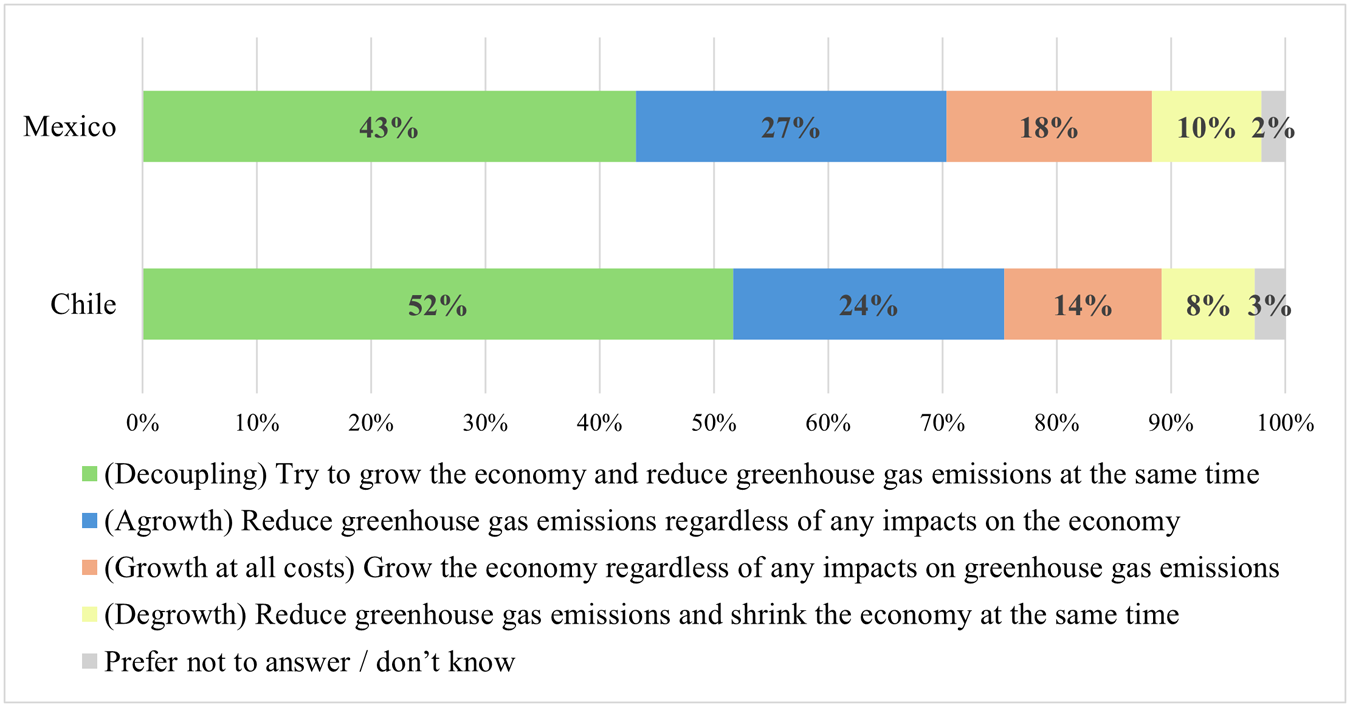
Figure 2 summarizes beliefs about what governments should do on emissions and the economy. The preferred option is decoupling (43–52%), followed by agrowth (24–27%), growth-at-all-costs (14–18%), and degrowth (8–10%). A chi-squared test (X2(4,2001) = 17.588, p < 0.01) reveals a significant difference between response categories in both countries, with decoupling being more preferred in Chile.
Beliefs about the emissions–economy trade-offs in Chile and Mexico.

Figure 2 Long description
A bar chart showing responses in Chile and Mexico to a question about what the government should do on emissions and the economy. Four options are shown, with one bar per country, and bar length gives the percentage of respondents. Decoupling, growing the economy and reducing emissions at the same time, is the most popular option at 43 to 52 per cent and is chosen more often in Chile. Agrowth, reducing greenhouse gas emissions regardless of any impact on the economy, is second at 24 to 27 per cent. Growth-at-all-costs, growing the economy regardless of any impact on emissions, follows at 14 to 18 per cent. Degrowth, reducing emissions and shrinking the economy at the same time, is least popular at 8 to 10 per cent. A chi-squared test shows the two countries differ significantly: chi-squared with 4 degrees of freedom and 2001 respondents equals 17.588, p less than 0.01.
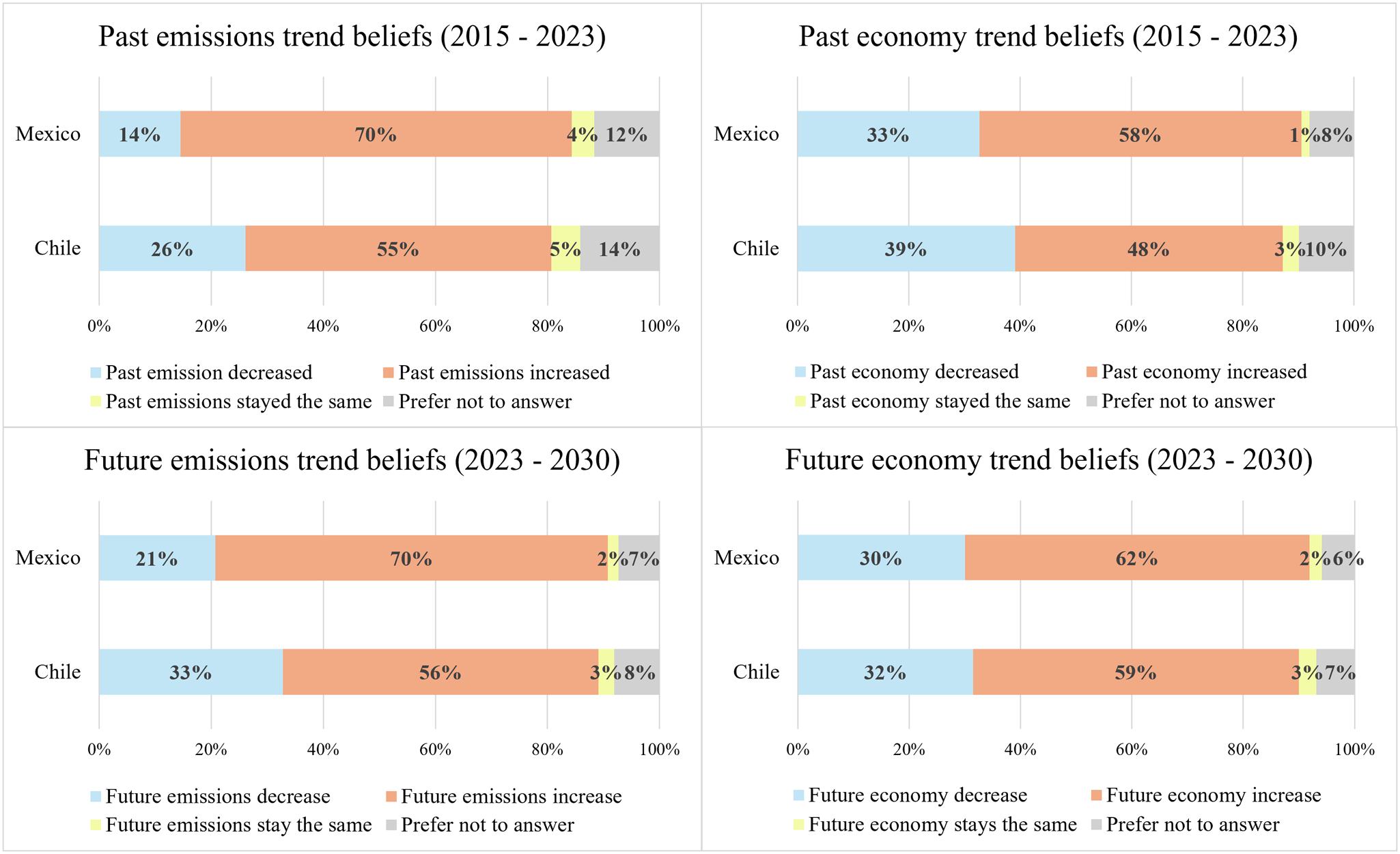
Figure 3 shows perceptions of past and future emissions and economic growth trends. A majority believe emissions have risen historically, aligning with historical trends, with about 70% of Mexicans and 56% of Chileans expecting continued emissions increases. Chi-squared tests confirm differing distributions for past (χ2(3,2001) = 55.458, p < 0.0001) and future emission trends (χ2(3,2001) = 44.572, p < 0.0001), with post hoc analysis attributing significance to Chileans’ greater emissions reduction optimism on both.
Past and future beliefs about emissions and economic trends in Chile and Mexico.

Figure 3 Long description
A stacked bar chart in four parts covering past emissions, future emissions, past economy and future economy, each with one bar for Chile and one for Mexico. Bars are divided into categories recording whether respondents believe the measure decreased or increased, and segment length gives the percentage of respondents. Most respondents in both countries believe emissions rose between 2015 and 2023, in line with actual trends, and about 70 per cent of Mexicans and 56 per cent of Chileans expect emissions to keep rising to 2030. Chi-squared tests show the countries differ on past emissions, 55.458, and future emissions, 44.572, each with 3 degrees of freedom, 2001 respondents and p below 0.0001, with Chileans more optimistic on both. Most respondents also believe their economy grew and will keep growing. Past economic beliefs differ significantly, 22.014, p below 0.0001, with more Mexicans reporting past growth, while future expectations do not differ, 3.6355, p equals 0.3036.
Most respondents in both countries believe their economies grew and will continue growing. Cross-nationally, past economic perceptions differ significantly (X2(3,2001) = 22.014, p < 0.0001), with more Mexicans reporting past growth. Future growth expectations show no significant difference (χ2(3,2001) = 3.6355, p = 0.3036).
5.3. Multivariate regression results
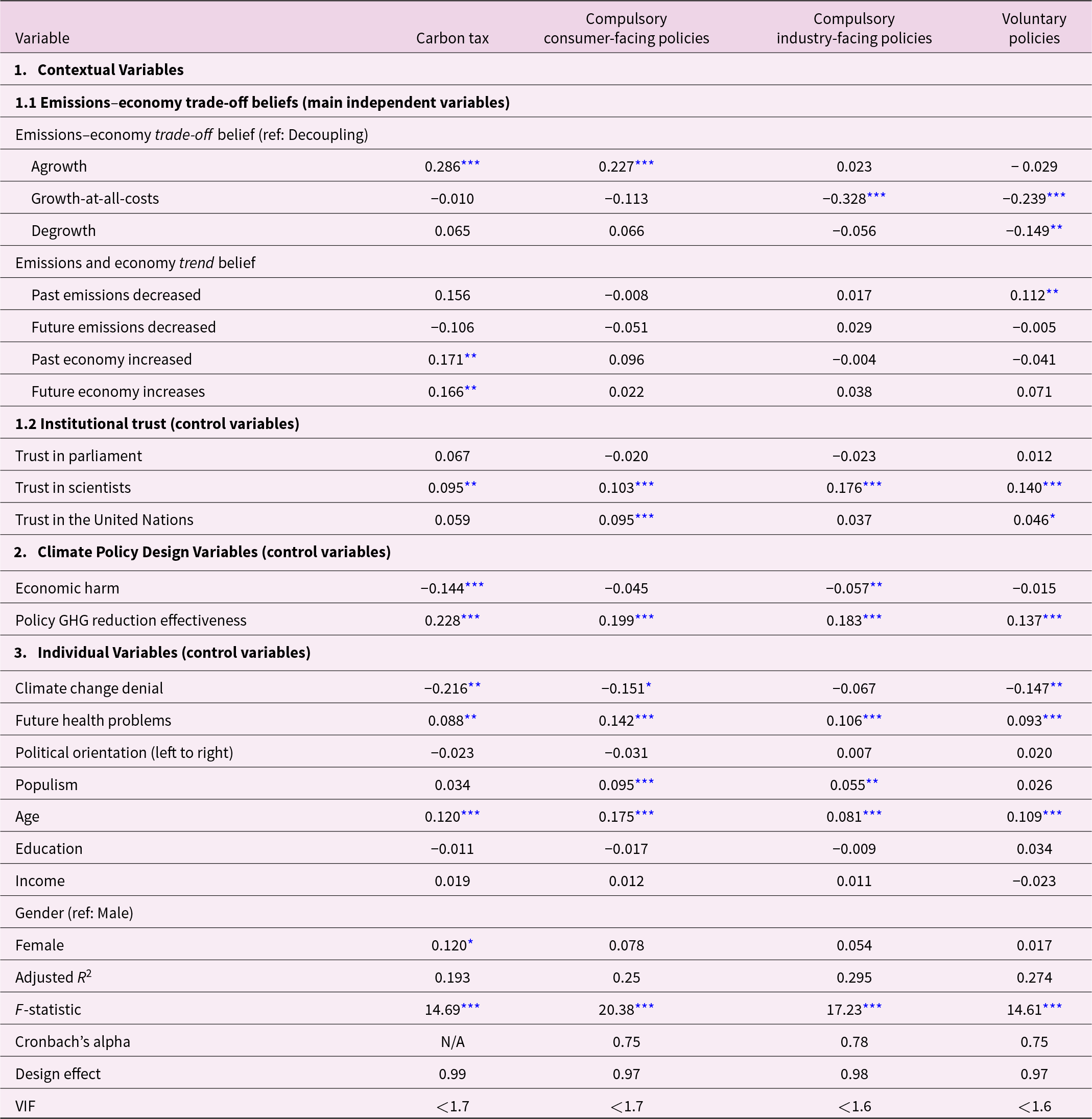
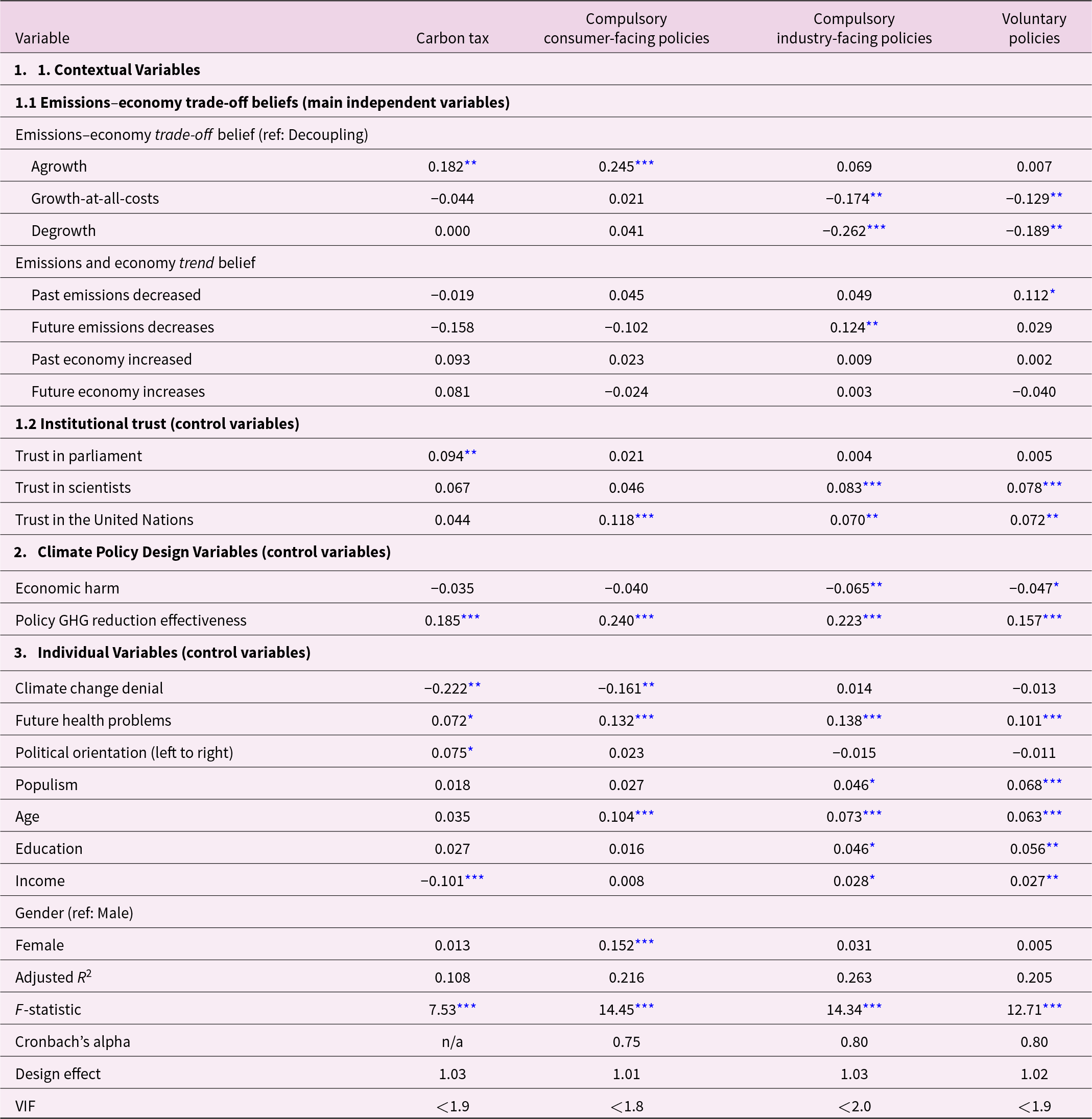
Tables 4 and 5 report multivariate regression results for Chile and Mexico, respectively. For emissions–economy trade-off beliefs (decoupling as the reference), agrowth is positively associated with support for the carbon tax and consumer-facing compulsory policies, while growth-at-all-costs is negatively associated with support for industry-facing policies and voluntary policies in both countries. Degrowth is negatively associated with support for voluntary policies in Chile, and with both voluntary and compulsory industry-facing policies in Mexico.
Multivariate regression results for climate policy support in Chile (Standardized β coefficients)

Table 4 Long description
A table of standardized beta coefficients from four multivariate regression models for Chile, one for each of the columns: carbon tax, compulsory consumer-facing policies, compulsory industry-facing policies, and voluntary policies. Rows give twenty predictor variables in three groups (contextual, climate policy design, and individual) followed by model statistics: adjusted R-squared, F-statistic, Cronbach’s alpha, design effect and variance inflation factor. Asterisks denote significance at p below 0.1, 0.05 and 0.01.
* p < 0.1; **p < 0.05; ***p < 0.01.
Multivariate regression results for climate policy support in Mexico (Standardized β coefficients)

Table 5 Long description
A table of standardized beta coefficients from four multivariate regression models for Mexico, one for each of the columns: carbon tax, compulsory consumer-facing policies, compulsory industry-facing policies, and voluntary policies. Rows give twenty predictor variables in three groups (contextual, climate policy design, and individual) followed by model statistics: adjusted R-squared, F-statistic, Cronbach’s alpha, design effect, and variance inflation factor. Asterisks denote significance at p below 0.1, 0.05, and 0.01.
* p < 0.1; **p < 0.05; ***p < 0.01.
The belief that past emissions decreased is positively associated with support for voluntary policies in both countries, while the belief that future emissions will decrease shows a positive association only with compulsory industry-facing policies in Mexico. Chileans who believe in past and future economic growth express higher support for the carbon tax. In Mexico, neither beliefs about the past nor future growth are associated with policy support.
Trust in parliament is positively associated only with carbon taxes in Mexico, while trust in scientists is positively associated with all policies in Chile, and with compulsory industry-facing and voluntary policies in Mexico. Higher trust in the UN in Mexico is positively associated with all policies except carbon taxes, and with compulsory consumer-facing and voluntary policies in Chile.
The belief that climate policies will harm the economy is negatively associated with the carbon tax and compulsory industry-facing policies in Chile and with compulsory industry-facing and voluntary policies in Mexico. Belief in policy effectiveness emerges as a strong predictor of support for all climate policies in both countries.
Climate change denial is negatively associated with support for carbon taxes and compulsory consumer-facing policies in both countries, as well as with voluntary policies in Chile. Concern that climate change will worsen health outcomes emerges as a characteristic of support for all climate policies in both countries. Political orientation is not a significant predictor of policy support in Chile, but right-leaning attitudes are positively (though slightly) associated with support for carbon taxes in Mexico. Finally, populism is positively associated with support for compulsory industry-facing policies in both countries, compulsory consumer-facing policies in Chile, and voluntary policies in Mexico.
6. Discussion
Support for the carbon tax, fossil fuel bans, and the ZEV sales mandate is higher in both countries compared to Global North jurisdictions (Bell et al., Reference Bell, Rhodes, Long and Salemi2025; Dechezlepretre et al., Reference Dechezlepretre, Fabre, Kruse, Planterose, Chico and Stantcheva2025; Rhodes et al., Reference Rhodes, Axsen and Jaccard2017), with over half of respondents in each country supporting these three often contentious policies. These findings align with Bretter and Schulz (Reference Bretter and Schulz2025), who show that climate policy support is higher in the Global South than the Global North. Conversely, support for business subsidies in both countries is lower than in the Global North (Dechezlepretre et al., Reference Dechezlepretre, Fabre, Kruse, Planterose, Chico and Stantcheva2025; Kitt et al., Reference Kitt, Axsen, Long and Rhodes2021; Long et al., Reference Long, Kitt and Axsen2021), which is surprising given their incentive-based nature. A potential explanation is lower trust in private businesses, which are often viewed as influencing governments for their own benefit in the Global South (OECD, 2024a). The overall higher support for climate policies may be due to a lack of policy-specific politicization, as seen in Global North jurisdictions, and a higher demand for action. Across countries, we find that Chileans have greater support for climate policies, except for business subsidies, reflecting the country’s decoupling trajectory, but this may be influenced by the pro-environment attitudes present during Chile’s constitutional reforms, coinciding with our data collection (Moreno, Reference Moreno2025).
Another important consideration is the relatively large share of ‘neutral’ respondents, especially for the carbon tax, fossil fuel bans, and the ZEV sales mandate, suggesting their opinions could shift toward either policy support or opposition. Empirical evidence from Latin America shows that support for compulsory policies can be strengthened when they are paired with measures such as compensation for low-income households, investments in green infrastructure, and improvements to public health (Dabla-Norris et al., Reference Dabla-Norris, Helbling, Khalid, Khan, Magistretti, Sollaci and Srinivasan2023; Dechezlepretre et al., Reference Dechezlepretre, Fabre, Kruse, Planterose, Chico and Stantcheva2025) – design features that could nudge ‘neutral’ respondents toward support.
Decoupling as the preferred growth paradigm in both countries is consistent with Bell et al. (Reference Bell, Rhodes, Long and Salemi2025), Tomaselli et al. (Reference Tomaselli, Sheppard, Kozak and Gifford2019), and Drews et al. (Reference Drews, Antal and Bergh2018), indicating that, despite the countries’ actual emissions reduction trajectories, most citizens seek an approach that balances emissions reduction with economic growth, unlike the Global North's historical pattern of growth preceding emissions cuts (Bettarelli et al., Reference Bettarelli, Furceri, Loungani, Ostry and Pisano2025; IPCC, 2022). Our findings also align with EIB (2023), suggesting that only 14–18% of citizens prefer growth-at-all-costs. However, our single-dimension definitions for the emissions–economy relationship for each paradigm should be approached with caution when interpreting the results. For example, Krpan et al. (Reference Krpan, Basso, Hickel and Kallis2025) found degrowth to be the most popular approach, though they used a broadly appealing definition that omitted welfare and consumption impacts on high-income nations. A possible cause of the low support in Chile and Mexico is that the degrowth definition omitted equity, democracy, and redistribution of wealth as considered in theory (Krpan et al., Reference Krpan, Basso, Hickel and Kallis2025). Although respondents in both countries prefer decoupling or agrowth, the majority believe both emissions and the economy will grow (i.e., growth-at-all-costs) despite any past emissions reduction successes, suggesting limited hope or trust in government to meet emissions targets. The comparison also reveals that Chileans are more optimistic about emissions reductions but are less aware of their past economic performance.
In our regression models, our findings only partially align with the hypotheses but reveal an overarching paradigm hierarchy. While we anticipated agrowth to be positively associated with support for all policy types, it specifically predicted support for carbon taxes and consumer-facing compulsory policies. Conversely, growth-at-all-costs is only linked to opposition to compulsory industry-facing policies and voluntary policies, which is surprising, considering that voluntary measures, such as subsidies, encourage growth, while carbon taxes and compulsory consumer-facing policies are usually viewed as more restrictive, costly, and thus growth limiting (Dechezlepretre et al., Reference Dechezlepretre, Fabre, Kruse, Planterose, Chico and Stantcheva2025; Fairbrother, Reference Fairbrother2022; Vona, Reference Vona2019). Degrowth beliefs showed unexpected results: while they are negatively associated with support for voluntary (growth-inducing) policies in both countries, they also predict opposition to industry-facing (growth-hindering for fossil fuels) compulsory policies in Mexico. One potential explanation is that industry policies might be viewed as those that promote growth of zero-emission technologies, which can misalign with degrowth principles. Despite these nuances, the overall pattern suggests that agrowth has the strongest association with support for climate policies in both countries, mirroring Bell et al.’s (Reference Bell, Rhodes, Long and Salemi2025) findings from the UK and Australia, suggesting that fostering post-growth attitudes may be a powerful lever for policy acceptance in Latin America.
The results for emissions and economic trend beliefs deviate from our hypotheses. We had expected beliefs about past emissions to be positively associated with support for compulsory policies. The absence of any positive association in Chile for future emissions optimism is similarly perplexing. Conversely, optimism about economic trends predicts support for the carbon tax in Chile, aligning with past research (Bell et al., Reference Bell, Rhodes, Long and Salemi2025; Bertolotti et al., Reference Bertolotti, Catellani and Nelson2021; Kudrnáč & Fairbrother, Reference Kudrnáč and Fairbrother2025), yet shows no association with support in Mexico. Taken together, these findings suggest that communications emphasizing positive economic trends may resonate more with Chileans, particularly given their likely lower awareness of those trends, whereas messaging that builds optimism about emissions reductions may be more effective for Mexicans.
The role of government trust appears to differ meaningfully across the two countries, and this divergence is itself revealing. In Mexico, where trust in the national government is relatively high (54%; OECD, 2024b), greater trust corresponds to stronger support for the carbon tax – an intuitive pattern for a revenue-based policy, where citizens must believe that the government will use the revenues responsibly. In Chile, by contrast, trust does not seem to play a role: Chileans report low confidence in their national government (30%) yet above-average optimism that the country will succeed in reducing emissions (48%; OECD, 2024a), with support for the tax not depending on trust at all. This contrast suggests that low government trust does not necessarily translate into resistance to climate action, at least in these two countries – a departure from the pattern documented across other Global North and Global South jurisdictions (Bretter & Schulz, Reference Bretter and Schulz2025; Kitt et al., Reference Kitt, Axsen, Long and Rhodes2021; Kulin & Sevä, Reference Kulin and Sevä2021).
What does appear to matter, in both countries, is trust in scientists and in the UN. This is consistent with Cologna et al.’s (Reference Cologna, Mede and Berger2025) cross-continental survey of 68 countries, which ranks Mexico 11th and Chile 19th in trust in scientists (both above the global average) and with the UN’s prominent role in the Paris Agreement and IPCC reports that advocate for such policies. Carson et al. (Reference Carson, Lu, Khossravi, Kohlin, Sterner, Sterner and Whittington2025) similarly find that Chileans trust scientists over their national government as a source for climate information, while OECD (2024b) reports that 60% of Mexicans trust international institutions such as the UN. Taken together, this dynamic suggests that governments in Chile and Mexico could improve climate policy support by grounding policy design and communication in independent scientific consensus.
Perceptions of policy design appear to cut in two directions. On the one hand, the belief that climate policies will cost jobs and damage the economy dampens support (Dabla-Norris et al., Reference Dabla-Norris, Helbling, Khalid, Khan, Magistretti, Sollaci and Srinivasan2023; Drews & Bergh, Reference Drews and Bergh2016b; Lackner et al., Reference Lackner, Fierro and Mellacher2025; Vona, Reference Vona2019) – a salient concern in Latin America where continued economic development underpins living standards (Dávila, Reference Dávila2023; IPCC, 2022). Yet this concern also points toward a remedy. Because heat and drought threaten agriculture and natural resource extraction in the region (Gouveia et al., Reference Gouveia, Justino, Gurjao, Zita and Alonso2023; OECD, 2022), policymakers may be able to reframe climate action not as a brake on the economy but as a safeguard for it, anchoring climate policies to localized economic co-benefits such as protecting vulnerable sectors and channeling revenue into emerging green industries (Dabla-Norris et al., Reference Dabla-Norris, Helbling, Khalid, Khan, Magistretti, Sollaci and Srinivasan2023). On the other hand, perceived policy efficacy emerges as a consistent predictor of support, consistent with past research (Bergquist et al., Reference Bergquist, Nilsson, Harring and Jagers2022; Dabla-Norris et al., Reference Dabla-Norris, Helbling, Khalid, Khan, Magistretti, Sollaci and Srinivasan2023; Drews & Bergh, Reference Drews and Bergh2016b) and with Kudrnáč and Fairbrother (Reference Kudrnáč and Fairbrother2025), who find that in Europe, expected benefits and policy effectiveness shape support more strongly than cost perceptions. Together, these patterns suggest that the case for climate policy in Chile and Mexico may rest less on minimizing its costs than on making its economic and environmental payoffs visible and concrete.
At the individual level, the negative association between climate skepticism and policy support reinforces a well-established link between anthropogenic attribution and climate policy support (Fritz et al., Reference Fritz, Baum, Brutschin, Low and Sovacool2024; Funk & Kennedy, Reference Funk and Kennedy2016), highlighting the importance of communicating clear causal links between human activity and climate change. Concerns about climate change-induced health impacts are well-founded (Pinto et al., Reference Pinto, Barnes, Philip, Kew, Cerezo-mota, Tannenbaum and Otto2024). Given their consistent association with policy support, these concerns present an opportunity to highlight health co-benefits, such as improved air quality and reduced disease burden, as a way to build support (Dabla-Norris et al., Reference Dabla-Norris, Helbling, Khalid, Khan, Magistretti, Sollaci and Srinivasan2023). Surprisingly, political leaning plays no role in explaining policy support in Chile but predicts support for the carbon tax in Mexico. Because right-leaning individuals typically oppose climate policies (Bumann, Reference Bumann2021; Moyano-diaz et al., Reference Moyano-diaz, Palomo-velez and Vergara-bravo2018), these results suggest climate policies might be less politically polarized compared to the Global North.
Finally, although populism has been linked to weaker climate policy implementation across OECD countries (Lockwood & Lockwood, Reference Lockwood and Lockwood2022) due to political and scientific mistrust (Huber et al., Reference Huber, Greussing and Eberl2022; Meijers et al., Reference Meijers, Yael and Jacobs2023), populism is ideologically malleable. It can frame climate policies as elite overreach or, conversely, demand emissions reductions by framing inaction as the elites’ failure (Huber et al., Reference Huber, Fesenfeld and Bernauer2020; Marquardt, Reference Marquardt2024). At the time of the survey, Mexico’s government (2018–2024) pursued a populist agenda (Dussauge-Laguna, Reference Dussauge-Laguna2022) and populist movements were gaining ground in Chile (Díaz et al., Reference Díaz, Kaltwasser and Zanotti2023). However, this appears not to have translated into policy opposition. Populism’s positive associations with policy support can be explained by the high demand for action in both countries (EIB, 2023; Gillreath-brown et al., Reference Gillreath-brown, Rivas, Jefferson, Carman, Goddard, Kioko and Marlon2025) and the foundational populist sentiment that politicians need to follow the people’s will.
7. Conclusions and policy recommendations
7.1. Summary of results
Policy support is high in Mexico and Chile, with opposition ranging from 2% for information policies to 18% for the carbon tax, exceeding those in the Global North (Bell et al., Reference Bell, Rhodes, Long and Salemi2025; Kitt et al., Reference Kitt, Axsen, Long and Rhodes2021; Rhodes et al., Reference Rhodes, Axsen and Jaccard2014, Reference Rhodes, Axsen and Jaccard2017). Additionally, 95% of respondents want their government to do more to address climate change, and 80% attribute it to human activity.
Compulsory policies like carbon taxes, fossil fuel bans, and ZEV sales mandates face the most opposition (9–18%). However, cleaner fuel and energy efficiency regulations draw lower opposition (2–5%), matching voluntary policies (2–5%) and undercutting business subsidies (8–14%). Chileans show significantly higher mean support for all tested policies except business subsidies. Some of the tested policies receive up to 31% ‘neutral’ responses, suggesting movable opinions that may warrant targeted engagement to strengthen climate policy implementation.
Both countries prefer a decoupling approach to emissions reduction and economic growth, followed by agrowth, growth-at-all-costs, and degrowth, with more Chileans preferring decoupling than Mexicans. This preference aligns with much of the Global North literature (Bell et al., Reference Bell, Rhodes, Long and Salemi2025; Drews et al., Reference Drews, Antal and Bergh2018; Drews & Bergh, Reference Drews and Bergh2016a; Drews et al., Reference Drews, Savin and Bergh2019; Tomaselli et al., Reference Tomaselli, Sheppard, Kozak and Gifford2019), but contrasts with Krpan et al. (Reference Krpan, Basso, Hickel and Kallis2025), who find that degrowth is the most popular. For emissions–economy trends, the majority is pessimistic about past and future emissions trends, but exhibits optimism about future economic growth. The gap between preferring decoupling and expecting growth-at-all-costs likely stems from low trust in governments’ climate sincerity – understanding the key drivers and resolutions of this pessimism could be the focus of future research.
We also find that agrowth shows the strongest association with support for the carbon tax and consumer-facing compulsory policies. Decouplers have similar associations with support for compulsory industry-facing policies and voluntary policies – key policies for effective climate policy mixes (Scott et al., Reference Scott, Rhodes and Hoicka2023). Economic and emissions-related beliefs about past and future trends may carry less weight in Chile and Mexico than they appear to in Australia and the UK (Bell et al., Reference Bell, Rhodes, Long and Salemi2025), and where they do matter, they do so asymmetrically: emissions optimism is the stronger predictor of support in Mexico, economic optimism in Chile.
The regression results also show that trust in scientists and the UN can be leveraged to increase support. Fear of economic harm works in the opposite direction, eroding support, whereas perceived policy effectiveness, health concerns, and pro-climate populist beliefs all appear to strengthen it.
7.2. Policy recommendations
Our study offers several important policymaking insights. First, policymakers could emphasize climate action's economic benefits (e.g., job creation, long-term economic resilience) while stressing that the cost of climate damage to vulnerable sectors (e.g., forestry, agriculture, fisheries, and tourism) far exceeds the cost of mitigation (Kotz et al., Reference Kotz, Levermann and Wenz2024). This framing could help address the economic concerns of decoupling and growth-at-all-costs proponents. Notably, communications that boost economic optimism may be better suited to Chileans, while highlighting emissions-reduction successes may resonate more with Mexicans. Second, we recommend that governments build trust in policy efficacy by following expert advice, quantifying GHG reductions per policy, ensuring transparent and equitable use of revenues, and partnering with industry through tax incentives and subsidy programs to decarbonize. Third, policymakers could capitalize on the high support for compulsory policies by implementing or increasing the stringency of carbon pricing, industry efficiency and fuel use regulations, and standards targeted to reduce the public’s fossil fuel use, paired with decarbonization subsidies, to mirror some of the Global North’s successes. Further support may be gained in some population groups by using post-growth framing that emphasizes well-being by incorporating eco-social considerations, such as earmarking revenues for low-income households or universal basic services (Dechezlepretre et al., Reference Dechezlepretre, Fabre, Kruse, Planterose, Chico and Stantcheva2025; Schulz et al., Reference Schulz, Bretter, Buchs and Trappmann2026) and emphasizing health benefits (Dabla-Norris et al., Reference Dabla-Norris, Helbling, Khalid, Khan, Magistretti, Sollaci and Srinivasan2023). Engagement with ‘neutral’ respondents to tailor communications about climate action co-benefits may also increase overall support. Finally, the mismatch between public demand and policy ambition in Latin America points to likely interference from fossil fuel interests. In Mexico, the state-owned petroleum company PEMEX shapes policy by resisting a full transition away from fossil fuels (LobbyMap, 2026), while in Chile, wealth concentrated among a small number of corporations grants them substantial influence over government action – a dynamic compounded by a highly polarized multiparty political system that makes reforms difficult (Lecaros et al., Reference Lecaros, Cruzat, Muñoz, Tillan and Walton2023; United Nations Development Programme, 2024). Strategies to bring these influential actors into the green transition could therefore improve policy outcomes.
7.3. Limitations
We acknowledge several limitations of our research. First, because the study covers only two countries with differing policy trajectories, generalization to all Latin America warrants caution. Additionally, Mexico’s heavy political prioritization of fossil fuels and Chile’s ongoing constitutional uncertainty at the time of the survey may have affected trust and climate policy attitudes – dynamics that cannot be fully captured. Second, we use a single item to measure beliefs about government action on emissions–economy trade-offs. This simplification might have affected support, especially for degrowth, as the narrow framing around shrinking the economy can decrease support (Krpan et al., Reference Krpan, Basso, Hickel and Kallis2025). Future research should employ multi-item scales to better capture opinions about benefits and drawbacks of each emissions–economy paradigm using multi-criteria definitions. Third, while the samples were corrected using RIM weighting for age and gender, they were not adjusted for income and education due to missing and incongruent census data. Consequently, these socioeconomic variables may be over- or underrepresented in the sample, potentially biasing the estimated associations with policy support. Fourth, opt-in panels may overrepresent more educated, urban, and politically engaged respondents, potentially biasing the results by inflating support for climate policies. Fifth, grouping individual policies into voluntary and consumer- and industry-facing compulsory policy categories might have limited our ability to distinguish individual policy support predictors, which future research may consider disaggregating. Sixth, the lower R 2 for Mexico’s carbon tax model suggests other variables, such as cost salience, may predict its support, which should be considered in future research. Seventh, as with all self-reported survey data, our findings may be subject to common biases such as social desirability, anchoring, and acquiescence response bias, which can affect stated support for climate policies. Finally, because our analysis is correlational, it identifies associations rather than causal relationships; future experimental research is therefore needed to establish whether the links between policy support and emissions–economy trade-offs are causal.
Supplementary material
The supplementary material for this article can be found at https://doi.org/10.1017/sus.2026.10083.
Acknowledgements
We are thankful to Dr Malcolm Fairbrother, Dr Aya Kachi, Dr Joakim Kulin, and Dr Ingemar Sevä for their contributions to the survey design.
Author contributions
E.R. and C.B. contributed equally to conceptualization, data curation, formal analysis, investigation, methodology, validation, and review and editing. E.R. additionally led funding acquisition, project administration, resources, and supervision, with supporting roles in visualization and original drafting, while C.B. led software development, visualization, and original drafting.
Data availability statement
Data will be made available on request.
Funding statement
This work was supported by the Vetenskapsrådet (Swedish Research Council), grant “In Search of Decoupling” 2020-04725.
Competing interests
The authors declare no conflicts of interest.



 Open access

