In 1744, Madame Montour, a métis frontier diplomat and interpreter, participated in a treaty council that led to a complex settlement known as the Treaty of Lancaster, perhaps the last of many public events she had attended over the course of a long career. For two weeks in the summer of 1744, officials from Pennsylvania, Maryland, and Virginia joined some 250 Native Americans, mostly Iroquoians, in Lancaster, Pennsylvania, to negotiate this critical treaty between English colonists and Native Americans. The official treaty minutes were printed by Benjamin Franklin while Witham Marshe, a member of the Maryland delegation, chronicled his observations in his journal (Marshe Reference Marshe1801). According to Marshe, Native Americans used trees from nearby woods to create temporary houses, or cabins, on the edge of town for the duration of the treaty council. There they sang, smoked, drummed, danced, and strategized. Beyond recording Madame Montour's presence in Lancaster, Witham Marshe's account provides a semi-opaque though intriguing window through which to view the significant role cloth played in colonial Pennsylvania. He remarked that Native Americans had their faces painted in a diverse range of colors and were dressed in old and ragged matchcoats, a garment made of European wool worn as a loosely wrapped cloak (Becker Reference Becker2005). Marshe's journal also listed the European trade goods presented to Native American leaders in Lancaster, including textile items such as strouds, shirts, and duffel blankets in addition to guns and gunpowder. He also took notice of the clothing worn by a relative of Madame Montour. One evening Marshe traveled to the “wigwam” of the “celebrated Mrs. Montour,” where he visited with her and two women whom he characterized as her daughters, likely her niece and great-niece (Hirsch Reference Hirsch2000:105). He observed that the five-year-old son of one of Madame Montour's nieces wore a green banjan, a loose gown that was often made of lightweight fabric that offered comfort in the summer heat (Baumgarten Reference Baumgarten2002:110). Cloth figured prominently in the eighteenth-century world of Madame Montour and in Marshe's recollections, yet archaeological examples of matchcoats, banjans, and shirts are exceedingly rare.
In the decades leading up to the Treaty of Lancaster, Madame Montour resided at Otstonwakin, a multinational and linguistically diverse Native American village at the confluence of two rivers in the upper Susquehanna Valley of Pennsylvania. Otstonwakin was located on the site of what is now Montoursville, a town named for the Montour family. The preservation of cloth at Otstonwakin provides a rare opportunity to shed light on a poorly represented component of most eighteenth-century material assemblages. I first discuss the salience of cloth in the colonial era, Madame Montour's role in frontier diplomacy where cloth was of paramount importance, and the site of Otstonwakin itself; I then examine preserved textile fragments from Otstonwakin's burial ground recovered by Works Progress Administration (WPA) archaeologists in the 1930s but never before analyzed. As both the documentary and archaeological record on colonial cloth is fragmentary, a collections-based analysis of preserved textiles, sewing thread, and decorative brass trim at Otstonwakin expands our understanding of the role cloth played in the material and social negotiation of colonial identity on the Pennsylvania frontier and deepens our appreciation for the agency exerted by Native Americans in the fur trade.
Cloth and Colonialism
By the early eighteenth century, the native peoples of northeastern North America had been enmeshed in webs of colonial interaction for generations. This entanglement was simultaneously defined by colonial-settler populations seeking to exploit the peoples and resources of the continent, and indigenous populations struggling to persist under often brutal and violent conditions. Survival by indigenous peoples required not only overt acts of resistance but also strategies to retain and remake their identities and traditions. This colonial experience was complex and far-reaching, shaping the nature of social and economic interaction between native peoples and colonizing newcomers, while at the same time shifting existing social and economic networks within and between indigenous groups (Silliman Reference Silliman2005). During the fur trade era, Native Americans negotiated the exchange of a variety of objects, selectively intertwining European goods into their daily lives. The process of negotiation was complex as European objects, including such commodities as iron, brass, and textiles, were variously incorporated, adapted, rejected, or selectively modified into indigenous lifeways. Among the most important of these was European cloth, a type of object that was overtly used to simultaneously and publicly express both individual and group identity. Cloth was thus crucial to the colonial experience not only as an object of exchange but as a medium for the negotiation of individual and social power at a time when power and identity were fluid.
Susan Sleeper-Smith (Reference Sleeper-Smith and Sleeper-Smith2009:xlvi) suggests that mounting evidence confirms the observation made by Braund (Reference Braund1993:122) that the fur trade might be more accurately termed the cloth trade. Anderson's (Reference Anderson1992) provocative study of European trade goods that flowed into the western Great Lakes from 1715 to 1760 reveals a striking emphasis on cloth. Native Americans were discriminating consumers and the strong demand for cloth as well as for the scissors, needles, and thread used to create clothing from cloth is evident in the business records of merchants. Anderson (Reference Anderson, Brown, Eccles and Heldman1994:107–109) calculates that clothing accounted for more than 60% of trader expenditures at the eight locations he studied, with cloth accounting for 72% of expenditures at Michilimackinac. Similarly, Silverman (Reference Silverman2005:191) tabulated that cloth, clothing, and sewing items made up an increasingly significant percentage of Wampanoag purchases in the eighteenth century. Between 1759 and 1765, cloth and clothing sales made up 86% of all transactions by the Wampanoag at one store on Martha's Vineyard. Among the wide array of European-made goods available to Native American consumers in Pennsylvania, cloth figures prominently in the material interactions between natives and newcomers there as well. Scrutiny of the account books kept by James Logan, William Penn's provincial secretary, reveals that in the period from 1712 to 1720, cloth and clothing constituted 52% of the goods traded to Native Americans on the Pennsylvania frontier (Johnson Reference Johnson2009:121). Increasing evidence has led Johnson (Reference Johnson2009:119) to argue that prior “emphasis on such perceived materials of acculturation as metals and alcohol shadowed the prominence, and unique role, of textiles as the single largest (and usually most valuable) category of consumer items in the Atlantic economy.” Cloth played a crucial role in shaping the fur trade and constructing colonial identities throughout the Eastern Woodlands (Loren Reference Loren2010).
Although “literally tons of cloth and clothing were imported into New England” (Bragdon Reference Bragdon and Cipolla2017:118) as well as surrounding areas, Native Americans were not passive recipients of European mercantilism (Ulrich Reference Ulrich1991). Native Americans exerted considerable agency as consumers and exchange partners in the fur trade by rejecting certain cloth types and clothing styles and controlling the commodities that entered their communities. Kidd (Reference Kidd1961:48) has argued that rather than “stoically accepting anything and everything in the way of cloth which was offered to them,” they were only willing to undertake transactions for certain varieties that they found acceptable. This resulted in the production of some cloth types made specifically for them. European textile mills in Holland, France, and England produced fabrics specifically for Native American consumers. For example, strouds, a kind of woolen cloth woven and dyed bright scarlet or deep blue on the river Stroud in Gloucestershire, were specifically manufactured for sale to Native Americans (Braund Reference Braund1993:123; Welters et al. Reference Welters, Ordoñez, Tarleton, Smith, De Cunzo and Herman1996:209). Duffels, made from a coarse woolen cloth with a thick nap that was white, red, blue, or striped, were also produced for indigenous markets. Native American consumer preferences concerning quality and color thus affected the manufacturing industry in various metropoles. James Logan, a shrewd merchant, described in considerable detail the exact size, color, and texture that his clients demanded and implored his contacts in England to send the exact specifications he detailed as the fur trade in Pennsylvania depended on it. He admonished his business associates that nothing but the best goods would content his Native clients (Kidd Reference Kidd1961:52–53). Native Americans bargained, refused substandard commodities, and engaged in exchange relationships on their own terms (Shannon Reference Shannon1996:17), interlacing specific kinds and qualities of cloth into their everyday expression of self.
Although cloth might have been the single largest import in the colonial era, there are very few preserved fragments of European textiles from Native American sites in the Eastern Woodlands surviving into the twenty-first century. In fact, textiles “only rarely survive” (Webster and Drooker Reference Webster, Drooker, Drooker and Webster2000:11), as cloth and clothing are usually unable to withstand the unfavorable preservation conditions associated with acidic soils. However, typically perishable fibers will be preserved when found in association with copper-based metal artifacts (Drooker Reference Drooker and Drooker2004:1; Petersen and Blustain Reference Petersen, Blustain and Drooker2004:150). As artifacts such as brass beads, bracelets, and kettles degrade, they produce toxic biocides that limit the deterioration of cloth found in proximity to such copper-rich objects (Beukens et al. Reference Beukens, Pavlish, Hancock, Farquhar, Wilson, Julig and Ross1992:892). Unless textiles are deposited in these extraordinary preservation environments, however, acidic soils will promote their decay. Equally significant is the loss that textile assemblages have suffered from the hands of grave robbers who for centuries have looted Native American burials to illicitly acquire grave goods interred with the dead, including cloth (Weslager Reference Weslager1945). Rubertone (Reference Rubertone2001:173–184) documents that this widespread practice began as early as 1620 when the Pilgrims disembarked the Mayflower and plundered colonial-era graves on Cape Cod. Numerous documents record the pillaging of Narragansett graves in Rhode Island as well. Cloth was not always the focus of such shameful activity, but because it was frequently interred with the deceased among other items, grave robbing has directly affected the preservation of textile assemblages in the archaeological record. Take, for example an incident reported by Willem Beekman to Peter Stuyvesant, director-general of New Amsterdam. In a letter dated January 1661, Beekman writes from Delaware that the grave of Hoppemink, a recently deceased chief, was opened and robbed. He specifically notes that looters removed grave goods including wampum and three or four pieces of duffels; in this documented case, cloth was notably removed from a fresh grave, likely for reuse (Weslager Reference Weslager1945:105). The preservation of European textiles in Northeastern Native American sites is rare due to the twin perils that stem from acidic soils and the desecration of burial grounds. For this reason, Anderson (Reference Anderson1992:156) has argued that although documentary inventories reveal that clothing and textiles were primary goods in the fur trade, the archaeological record does not reflect this.
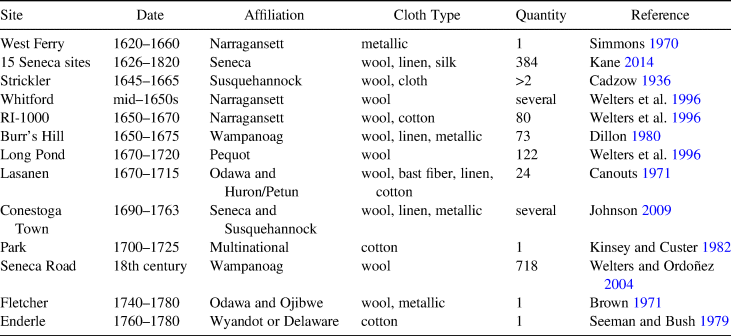
The inventory of preserved cloth from Native American sites in the greater Northeast dating from the fifteenth through nineteenth centuries is limited (Table 1) and typically restricted to mortuary contexts where cloth and brass artifacts comingled. Most extant European cloth fragments from Native American sites in New England are associated with five seventeenth-century sites (Welters et al. Reference Welters, Ordoñez, Tarleton, Smith, De Cunzo and Herman1996:212). The textile assemblage from Long Pond (1670–1720), a Pequot cemetery in Connecticut, yielded 122 textile fragments consisting predominantly of red and green wool fabric fragments and a single “textile cast.” The cast formed when an iron ladle coated a piece of wool with ferrous oxide before the fibers disintegrated (Welters et al. Reference Welters, Ordoñez, Tarleton, Smith, De Cunzo and Herman1996). The textile assemblage from Burr's Hill, a seventeenth-century Wampanoag Burial Ground in Rhode Island, consists of 73 fabric fragments represented mostly by wool (Dillon Reference Dillon and Gibson1980:100). With the exception of one fragment of linen typically used for shirts or sheets and one long silken silver galloon (a type of lustrous decorative braid) used as trim on clothing, the Burr's Hill assemblage consists of 33 fragments of brown or red wool, 23 fragments of a single white woolen striped blanket, 9 fragments of tan wool, and 7 fragments of a finely woven brown tailored garment. A total of 80 textile fragments was recovered from RI-1000 (1650–1670), a Narragansett burial ground in Rhode Island. Red, orange, brown, blue, and black wool fabric predominates, though cotton, possibly of the sort used for shirts, is represented by 3 samples (Welters et al. Reference Welters, Ordoñez, Tarleton, Smith, De Cunzo and Herman1996). The fabric from the West Ferry site (1620–1660), a Narragansett burial ground in Rhode Island, consists of a single “shred of silver-colored European cloth” (Simmons Reference Simmons1970:87). Finally, the textiles from Whitford, a Narragansett site in Rhode Island, have not been published but include “several fragments of coarse wool plus an iron-encrusted fragment of fine wool” (Welters et al. Reference Welters, Ordoñez, Tarleton, Smith, De Cunzo and Herman1996:197). European cloth fragments have also been recovered from eighteenth-century sites in New England, including an all-wool assemblage from Seneca Road, a Wampanoag cemetery in Massachusetts (Welters and Ordoñez Reference Welters, Ordoñez and Drooker2004). A total of 718 fragments from this site, most of which were freshly cut sewing scraps from 83 different fabric types, suggest the use of wool-stuffed mortuary pillows (Welters and Ordoñez Reference Welters, Ordoñez and Drooker2004:187).
Preserved Cloth from Native American Sites in the Greater Northeast.

An equally small number of sites outside of New England contain preserved European cloth assemblages. The Enderle site (1760–1780), a Wyandot or Delaware burial ground in Ohio, yielded a single piece of decorated French cotton fabric that was folded atop a vanity box (Seeman and Bush Reference Seeman and Bush1979:8). The Lasanen site (1670–1715), an Odawa and Huron-Petun burial ground, produced an assemblage of 24 textile fragments, consisting of red, brown, and yellow swatches of wool as well as a few examples of bast fiber, linen, and cotton (Canouts Reference Canouts and Cleland1971). The Fletcher site (1740–1780), an Odawa and Ojibwe cemetery in Michigan, includes a preserved wool coat that was lined and decorated with “gold lace” or thread wrapped with fine brass wire (Brown Reference Brown1971:128). The coat is 40 inches long, lacks pockets but includes decorative pocket flaps, and is adorned with buttons made of brass wound thread. The coat is imagined to have been “resplendent” when new but was constructed as cheaply as possible with poor-quality lace (Brown Reference Brown1971:131). The cemetery also included a number of fabric “scraps,” a black wool belt, a fabric headband adorned with silver brooches, and the remains of a second coat (Mainfort Reference Mainfort1979). Fifteen sites dating from 1615 to 1820, which are associated with the Seneca Nation of the Iroquois Confederacy, have yielded 384 pieces of cloth unearthed from mortuary contexts (Kane Reference Kane2014). The Seneca practice of lining graves with wool blankets resulted in coarse woven woolen fabrics being best represented in the assemblage (Kane Reference Kane2014:3). Wool used to clothe the body is represented by 26 fragments of multicolored wool yarn used in Native-made finger-woven items and 41 fragments of twined fabric. The assemblage includes three coats. The Fall Brook site (1740–1779) preserved a cheaply constructed unlined coat found rolled up inside a brass kettle in the grave of an elder (Kane Reference Kane2014:7). The Dann site (1656–1675) includes a small fragment of an unlined wool coat buried with a child, and the Townley-Reid site (1715–1754) includes a fragment of a coat made of a coarse green fabric (Kane Reference Kane2014:7).
European trade cloth has also been unearthed from sites in Pennsylvania's Lower Susquehanna Valley. For example, the Strickler site (1645–1665), a very large Susquehannock village located adjacent to the Susquehanna River, includes funerary items such as trade blanket fragments as well as other fabric that was used to wrap a wooden bowl found inside a brass kettle (Cadzow Reference Cadzow1936:85–88). The Park site (1700–1725), a multinational village located along a tributary of the Susquehanna, yielded a tiny fragment of white cotton preserved beneath brass bracelets worn on the wrist of the deceased (Kinsey and Custer Reference Kinsey and Custer1982:38). Conestoga Town, (1690–1763), a multinational Seneca and Susquehannock village, includes an assemblage of knitted stockings, linen fragments, and three coats each rolled up and placed in brass kettles (Johnson Reference Johnson2009:128). The two coats that have been analyzed represent two different styles. One coat had a woolen exterior, was lined with a finer fabric, and adorned with galloon, a type of decorative braid or lace made of brass ribbon that was wrapped around a bast fiber core (Johnson Reference Johnson2009:129). Additional features include linen-covered buttons and pocket flaps. The galloon used was inexpensive but would have flashed brilliantly in the sun much like expensive gold or silver galloon. Johnson (Reference Johnson2009:131) concludes that the fabric, cut, and construction of the coat was of mediocre quality and was embellished to look more expensive than it really was. The second coat is interpreted as a plain weave wool English frock coat embellished with inexpensive inkle, a narrow-woven trim.
The archaeological recovery of colonial cloth from Native American sites in the Eastern Woodlands is exceedingly uncommon. Where cloth has been recovered, preserved fragments tend to be tiny scraps or remnants of much larger artifacts and thus have interpretive limitations. Moreover, coarser woolens, of the sort used for blankets, form a significant part of the fabric inventory, whereas textiles associated with garments are more poorly represented. Given the circumstances of poor preservation, archaeological sites dating to the fifteenth through nineteenth centuries typically signal the significance of cloth through indirect evidence recovered from non-mortuary contexts. For example, the Fort St. Joseph site in Michigan has not yielded any preserved cloth yet the assemblage strongly signals the significance of cloth through indirect evidence (Nassaney Reference Nassaney2015:187). In addition to the documentary records like vouchers that make explicit reference to cloth, the excavations at Fort St. Joseph have recovered 66 lead cloth seals, scissors, straight pins, thimbles, and awls. Lead cloth seals, usually taking the form of two stamped lead discs, were attached to bolts of cloth produced in Europe (Loren Reference Loren2010:45). An analysis of the lead seals from Fort St. Joseph revealed that although some light cotton might have been imported, most of the cloth acquired consisted of woolens (écarlatines, mazamet, kersey, broadcloths) and originated from many different cities in France and England (Davis Reference Davis2014:69–70). Given the variety of challenges associated with the representation of cloth, the identification of previously unanalyzed colonial fabric from a museum collection significantly adds to our understanding of the salience of this commodity during the fur trade. The fabric from Otstonwakin, much of it represented by sizeable pieces of textile, thread, and decorative trim, was deposited in a small local history museum following its removal from a mortuary context by WPA archaeologists in 1936.
Madame Montour's Otstonwakin
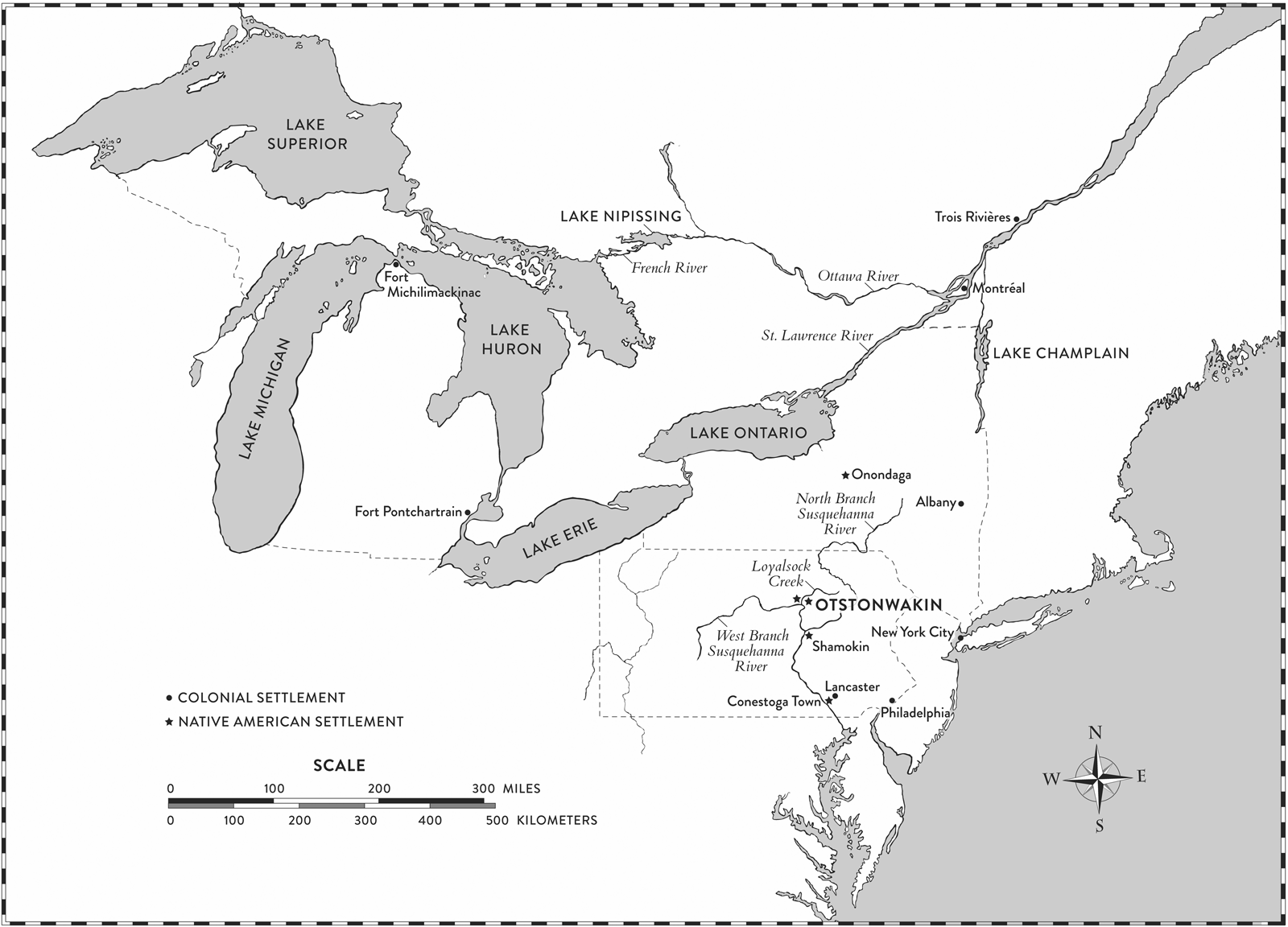
Over the course of several field seasons, I led archaeological excavations at Otstonwakin that were exclusively focused on identifying and recovering artifacts associated with the village habitation area. The multinational village of Otstonwakin was established in the early eighteenth century and was home to Madame Montour. Madame Montour was a prominent figure in colonial diplomacy, and as such was deeply entwined in the fabric of empire. Otstonwakin was strategically situated at the confluence of the West Branch of the Susquehanna River and the Loyalsock Creek in present-day Montoursville, Pennsylvania (Figure 1). Stretching 448 miles from its northernmost point in upstate New York to its southern terminus in the Chesapeake Bay (Stranahan Reference Stranahan1993:2), the Susquehanna is the longest river on the eastern seaboard. As such, it served as an important conduit for the conveyance of people, goods, and ideas and provided Native Americans with riverine resources and an arable floodplain. Otstonwakin was also located at the intersection of two well-traveled Indian trails (Wallace Reference Wallace1965). The Great Shamokin Path connected Otstonwakin to Shamokin, the largest Native American town and trading center in the region. From Otstonwakin the Great Shamokin path coursed westward to Ohio. The Sheshequin Path, which also passed through Otstonwakin and continued northward to Iroquoia, was the main thoroughfare used by travelers en route to Onondaga. Otstonwakin was a junction of place and time, linking its people both to their colonial contemporaries to the north, south, and west and to their ancestors who had continuously occupied the land surrounding the Loyalsock confluence for millennia since at least the Archaic (Bressler Reference Bressler2009). Otstonwakin served as a frequent stop for both natives and newcomers alike and as a key nexus of European and Native American interaction.
Location of Otstonwakin. Map by Susan Malikowski.

The material legacy of mediating that nexus is evident in the domestic artifacts unearthed in the village of Otstonwakin. Among the quotidian objects recovered during the Otstonwakin project were glass trade beads, brass mouth harps, musket balls, white clay pipestems, brass buttons, a lead brooch, and a brass finger ring (Levine Reference Levine2011). Like so many Native Americans at this time, the residents of Otstonwakin actively transformed European mass-produced material culture into a wide variety of items that they desired (Ehrhardt Reference Ehrhardt2005). For example, brass tinkling cones that were sewn onto bags, leggings, pouches, and clothing as decorative fringe items were likely crafted from small trapezoidal pieces of sheet metal cut from old brass kettle scraps (Bradley Reference Bradley1987:130–133). Similarly, a brass thimble fragment was perforated so that it could be worn as an ornament on clothing. A hallmark of fur trade culture was the creative transformation and repurposing of imported utilitarian objects for ornamental purposes (Nassaney Reference Nassaney2015:105). European commodities were reimagined in a newly developing worldview emerging in the Susquehanna Valley.
Like many of the 50 known eighteenth-century villages in Pennsylvania, Otstonwakin was characterized by a dispersed settlement pattern and lacked a protective stockade. Many Pennsylvania river towns were spread out over miles, consisting of scattered hamlets interspersed with cornfields (Kent et al. Reference Kent, Rice and Ota1981). While some villages consisted primarily of one native nation, most, including Otstonwakin, were multinational, polyglot communities. Throughout the eighteenth century, Pennsylvania was a crucible of cultural interaction as it experienced an influx of both native and non-native peoples from outside the region. By 1700, the Susquehannocks, who had called the Susquehanna Valley home in the seventeenth century, had been displaced following a decline in both power and population (Merrell Reference Merrell, Cayton and Teute1998). During that time, Delawares, Mahicans, Shawnees, Conoys, Nanticokes, Tutelos, Tuscaroras, Senecas, Cayugas, and Oneidas as well as English- and German-speaking peoples all moved into the region and founded new towns (Merritt Reference Merritt2004). In many cases, several groups came together to form new culturally diverse and multilingual communities. Rather than retrench in the face of European expansion, the Iroquois in particular began expanding out of their homelands to establish extra-regional satellite villages in places like the Susquehanna Valley (Jordan Reference Jordan2013:37). Otstonwakin was one such village, characterized by a mixture of nations and languages and defined by continually shifting identities.
As arenas for intercultural engagement, exchange, and entanglement, frontier zones like the Susquehanna Valley were contested spaces that gave rise to cultural mediators who helped to maintain peace and build diplomatic bridges in the era known as the Long Peace (Merritt Reference Merritt2004). Established by William Penn, the Long Peace was fragile but was maintained by a complex class of mediators known as “go-betweens” who traveled the woods to carry messages and negotiate compromises as representatives of their respective cultures (Merrell Reference Merrell1999). The period just prior to the carnage and bloodshed of the French and Indian War (1754–1763) was a dynamic era of innovation and invention (White Reference White1991) as Native Americans and Europeans in fur trade-era communities were forced to resolve their problems, create common ground, and accommodate each other's interests to further their own agendas. Madame Montour, one of the most important interpreters and mediators of the day, resided at Otstonwakin.
Madame Montour had lived in a diverse range of intercultural settings and acquired considerable experience in frontier diplomacy long before her arrival in Pennsylvania's Susquehanna Valley (Vincens Reference Vincens1979). She was born in Quebec in 1667 as Isabelle Couc, the métis child of Marie Miteouamegoukoué, a Christian Algonquin, and Pierre Couc, an interpreter in the area around Trois Rivières (Hirsch Reference Hirsch2000:84–85). She spoke her mother's Central Algonquin language, her father's French, and in the course of her life, she learned a variety of Iroquoian languages as well as English (Hirsch Reference Hirsch2000:87). In the 1690s, following the death of her first husband, a French fur trader, she joined family in Michilimackinac, a fur trading post in Michigan (Hirsch Reference Hirsch2000:88). Michilimackinac was key to the St. Lawrence-Great Lakes riverine system that transported animal pelts to world markets and was a culturally and linguistically diverse home to Ottawa and Wyandot villages, a French fort, and a Jesuit mission (Brandão Reference Brandão, Peyser and Brandão2008). Her marriage to another French man involved in the fur trade was brief, as he was killed in 1709 during an Ottawa/Miami conflict at Fort Pontchartrain (Detroit). She likely served as an interpreter in Detroit, laying the groundwork for her role in frontier diplomacy in New York and Pennsylvania.
Madame Montour enters the documentary record of colonial New York in 1709, the year that her brother Louis Couc Montour, a métis fur trader, was assassinated by an agent of Canada's Governor Vaudreuil for his role in facilitating exchange relationships between indigenous peoples in the Great Lakes and traders outside of New France in Albany (Parmenter Reference Parmenter, Steele and Rhoden1999:144). He was murdered while guiding a group of Mississaugas to Albany. Madame Montour continued the journey to return a wampum belt that her brother had not been able to deliver to the Albany Commissioners of Indian Affairs (Hirsch Reference Hirsch2000:91). Hirsch (Reference Hirsch2000:92) argues that Madame Montour was likely the only individual available who knew all the languages at play and that she quickly became an ideal interpreter for the colonial government of New York.
By 1711, “Eysabelle Muntoer” was employed as an “interpretress” for the ill-fated Vetch expedition that had sought to conquer New France (Peter Van Brugh and Hendrick Hansen, 29 August 1711, Account Book for the Vetch Expedition Against Canada, New York Historical Society, New York). As such, she was directly involved in transactions that resulted in the receipt of European cloth and textiles as payment for the services that she rendered. The expedition account book entries for August 20 and August 27 record that she received 1⅝ yards and 2 yards of cloth respectively. The account book entry for August 24 records that she received one shirt, while the August 29, 1711, entry notes that she received 2 yards of duffels, ⅝ of a yard of stroud, and one white shirt. In addition to cloth she also received cash payments in exchange for the production of wampum belts (Hirsch Reference Hirsch2000:93). She served as interpreter for New York Governor Robert Hunter, receiving payments until 1721.
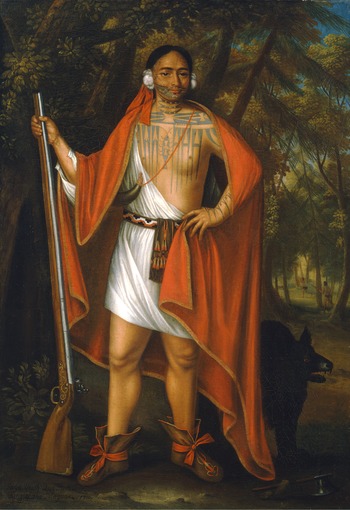
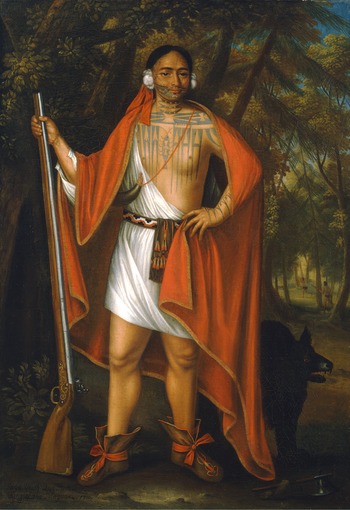
On August 25, 1711, Madame Montour served as an interpreter for Governor Hunter during a meeting convened to enlist the support of the Iroquois for an attack on Canada (O'Callaghan Reference O'Callaghan1885:268). At this meeting a remarkable set of portraits of four Native American emissaries who had traveled to England to meet with Queen Anne in 1710 were presented to the Iroquois by the governor. The governor distributed a set of mezzotint prints to each of the Five Nations and one framed set with protective glass to hang at Onondaga. The queen arranged for the diplomatic delegation to sit for John Verelst, a Dutch painter. Verelst meticulously focused on facial features and placed each individual in an imagined wooded American landscape (Hinderaker Reference Hinderaker1996; Muller Reference Muller2008). European cloth figures prominently in all four portraits. In one portrait, a Mohawk named Sa Ga Yeath Qua Pieth Tow, wears a gold-trimmed scarlet cloak, a white knee-length hunting shirt, and moccasins fastened by cloth (Figure 2). His ears are adorned with large feather earrings and much of his upper body is marked with tattoos. A powder horn is slung over his shoulder and in his right hand he holds the barrel of a musket. At his feet is a bear to indicate his clan affiliation. The diplomatic team, known by the moniker “the Four Indian Kings,” presented the queen with shell necklaces and bracelets, and in return she gave them many different fabrics (cotton, wool, linen, kerseys, and duffels) as well as brass kettles, knives, mirrors, lead bars, scissors, gunpowder, and vermillion (Bond Reference Bond1952:12). Madame Montour translated during the exchange of the portraits, positioning herself at the center of a key political negotiation between the Iroquois and the English in New York. While the portraits are colonial constructions, they do shed light on the central roles fabric and adornment played in the negotiation and display of identity.
Sa Ga Yeath Qua Pieth Tow (Christianized Brant), 1710. Oil painting by John Verelst, Library and Archives Canada, accession number 1977-035 PIC 00002, reproduction copy number C-092418.
In 1712, the governor ended a letter to Kilian van Renslaer imploring him to “countenance Mrs. Montour for I shall never be able to hear the truth but by her means” (R. Hunter to K. van Renslaer, letter, 15 August 1712, Robert Hunter Papers, New York Historical Society, New York). Hunter trusted her immensely and according to Cadwallader Colden, she was very “usefull to Mr. Hunter on many occasions for which reason she had a pension and was sometimes admitted to his table in her Indian dress” (New-York Historical Society 1868:200). This reflection offers a tantalizing clue for determining how Madame Montour expressed her identity through clothing while in New York.
During her time in New York, Madame Montour married Carandowana, who is identified as Oneida in New York colonial documents dating to 1710. The entries describe his movements on intelligence-gathering expeditions for the Albany Commissioners for Indian Affairs, the formal institution for colonial diplomacy in New York during the fur trade. Madame Montour and her husband Carandowana became key figures in the Pennsylvania Colony after 1714. In that year, Carandowana was “Elected King” of the Shawnees, who had recently come to Pennsylvania seeking refuge (Colonial Records of Pennsylvania 1852a:574). While it is unclear precisely when Madame Montour first arrived at Otstonwakin, she is reported in the upper reaches of the Susquehanna Valley at the village in the fall of 1727. By July of that year she had served as interpreter in Philadelphia for a three-day council between Governor Patrick Gordon and a large delegation of Iroquoian chiefs who were requesting that the colony prevent further settlement in the northern Susquehanna River Valley and prohibit settlers in that area from selling or keeping rum. Madame Montour was compensated with one stroud, one shirt, and one matchcoat as well as one stroud for her husband and one stroud for her niece (Colonial Records of Pennsylvania 1852b:274). In 1728 she received another matchcoat for the information she provided James Le Tort when he consulted her at Otstonwakin (Colonial Records of Pennsylvania 1852b:297). In 1729, a battle between the Iroquois and the Catawbas resulted in Carandowana being attacked and killed in Virginia on his way back to Otstonwakin. Upon hearing of his death, the governor sent Madame Montour a whole suit of mourning clothes as well as a coat and handkerchief for her son, Andrew (Bennett Reference Bennett1943:36–37).
Madame Montour remained at Otstonwakin where she engaged in intercultural diplomacy and welcomed a succession of visitors into her home. When a large party of Oneidas arrived in Philadelphia in 1734, it was she who authorities called upon to determine how to proceed. During this time, Otstonwakin became the locus of sustained, daily, face-to-face interaction between Native Americans and Europeans. In 1737, Conrad Weiser, a German immigrant who began serving as an interpreter and go-between, lodged at Otstonwakin on his way to the Onondaga. In 1742, Count Nicholas Ludwig von Zinzendorf, a nobleman and ecumenical leader of the Moravian Church, traveled to Otstonwakin seeking to develop a plan for proselytizing among Native Americans in Susquehanna. Madame Montour's son, Andrew, or Sattelihu, began work as an interpreter and guide with Conrad Weiser during Zinzendorf's visit. Andrew was fluent in many languages and was of Algonquin, Iroquoian, and French descent. In that year Count Zinzendorf gave this description of Andrew Montour:
Andrew's cast of countenance is decidedly European, and had not his face been encircled with a broad band of paint, applied with bear's fat, I would certainly have taken him for one. He wore a brown broadcloth coat, a scarlet damasken lapel-waistcoat, breeches, over which his shirt hung, a black Cordovan neckerchief, decked with silver, bugles, shoes and stockings, and a hat. His ears were hung with pendants of brass and other wires plaited together like the handle of a basket [Reichel Reference Reichel1870:95–96].
This description provides a provocative glimpse into the ways that Andrew's dress combined locally made and imported items to mediate his place in the colonial world. Andrew Montour went on to become one of the most important midcentury frontier diplomats in Pennsylvania. In contrast to his mother, Andrew served as a go-between in times of war (Merrell Reference Merrell1999). Clothing was a powerful tool of diplomacy and visual form of communication. Shannon (Reference Shannon1996:18) has argued that clothing was a valuable form of cultural mediation in culturally diverse and multilingual colonial landscapes. Leaders strategically deployed the selective acquisition of shirts and coats to don a new appearance to create a special and recognizable category of intercultural diplomat. Native leaders such as Andrew Montour created a new appearance that blended and combined European-manufactured and locally produced items, which could be leveraged at treaty conferences as a way of blurring and transcending boundaries (Shannon Reference Shannon1996:26). Clothing became part of the middle ground where differences melted at the edges to enable successful mediation (White Reference White1991).
In June 1745, Joseph Spangenberg and numerous traveling companions stopped at Otstonwakin en route to the Onondaga nation. At around this time, Madame Montour, now in her seventies, was said to be living in nearby Shamokin. She attended the Treaty of Lancaster in 1744. In 1748, the Moravian missionary David Zeisberger returned to Otstonwakin, reporting that it was deserted and that smallpox had ravaged the region. He arrived at the once thriving village of Otstonwakin only to find it abandoned, laid waste by the epidemic. By 1753, Bernard Grube, a Moravian missionary, traveled up the West Branch of the Susquehanna, referring to Madame Montour as deceased and describing Otstonwakin as a pleasant area where no one was currently living (Faull Reference Faull2012).
Madame Montour experienced colonialism on many frontiers (Hirsch Reference Hirsch, Pencak and Richter2004). She navigated a diverse set of linguistic frontiers, not just between Native Americans and Europeans, but also between Algonquin and Iroquoian languages, and between French and English (Hirsch Reference Hirsch2000:111). She lived on various economic frontiers, playing an important role in the fur trade economy that gave rise to mutually transformative intercultural interactions where cloth occupied a prominent role. Frontier landscapes also included complex religious terrains, and she lived as a Catholic traveling the borderlands between Protestant Anglo-America and traditional Native communities. She lived her entire life on frontier junctions—Trois Rivières, Michilimackinac, Detroit, Albany, Shamokin, and Otstonwakin (Hirsch Reference Hirsch, Pencak and Richter2004:63). In the last decades of her life she resided at Otstonwakin, where she remained a culture broker at the gateway between north and south, east and west, French and British, Algonquin and Iroquoian, American and European, ancestors and the living. The multivalent nature of her life in the world of intercultural diplomacy is revealed in the material culture recovered from her home village of Otstonwakin. Just as the site was a junction between places, it was also a junction where people at the frontier fashioned their world through a continual recombination of native and European objects and ideas, both in life and in death.
Otstonwakin's Burial Ground
Although Otstonwakin's burial ground would have been one of the most significant places on the physical and cultural landscape for the indigenous inhabitants of this river town, our understanding of this sacred space is incomplete and limited. Otstonwakin's burial ground was disturbed and desecrated several times in the past with little regard for the sanctity of the dead. Following a brief discussion of those late nineteenth- and early twentieth-century excavations, I provide the results of a collections-based analysis of the textiles curated in a local museum for the better part of a century.
In anticipation of a 1907 road-widening project in Montoursville, the property owner of a residence affected by the planned construction dug “behind a stone wall preparatory to moving the wall back to accommodate the width of the new road” and disturbed a Native American grave (The Patriot, 19 April 1907:8). A newspaper article reported that among the grave goods encountered were a flintlock musket barrel, a tomahawk, flints, and beads. A newspaper account from the following day reported that a second grave, just a few feet away from the first, was uncovered and included “Indian beads, twenty brass rings, a rudely fashioned ornamental clay pipe, the remnants of a flint-lock revolver . . . and some knives” (The Patriot, 20 April 1907:14). The graves contained Native American objects, including what are most likely wampum beads and a locally produced clay pipe together with European brass rings, knives, and firearms. One article closes by noting that about 10 years earlier, in the 1890s, several more burials with mortuary goods had been unearthed while digging a cellar at the nearby Koch residence (The Patriot, 19 April 1907:8).
A generation later, in 1936, a WPA-sponsored project led by Harry Schoff (Reference Schoff1937:8) unearthed two additional burials. The description of the property, owned at that time by J. T. Roberts, combined with deed research establishing that the Roberts and Koch residences were adjacent to one another provide unambiguous confirmation that all the graves were from the same communal burial ground. Schoff (Reference Schoff1937:8) unearthed a burial of a woman thought to be around 25 years old who was buried with a wide array of offerings including a brass kettle, a barlow-type jackknife, two brass bracelets, two brass rings, and a necklace made of glass beads. The second grave Schoff uncovered was that of a 10-year-old girl. The child was laid to rest in a coffin, as several iron nails and preserved coffin fragments were recovered. Several shell wampum beads and a perforated shell disc measuring 2 inches in diameter were found around her head. The child was also enshrouded by remnants of a preserved fabric object. Schoff conjectured that the fabric formed a coat made of fine wool and noted that it was decorated with brass braid.
The burial ground at Otstonwakin is thus represented by four documented graves, with reports that more graves were accidentally disturbed on private land in the late 1800s. Although the full extent of the cemetery is unknown, the burials were found on two contiguous properties that measured a combined 9 acres in size. No other graves are known to have been disturbed and no further disturbance is likely, as in 1974 the Pennsylvania Department of Transportation condemned the properties by eminent domain ahead of the construction of Interstate 180, which now lies atop the cemetery. With the location of the cemetery firmly established, however, it is clear, that the burial ground was situated in proximity to the village site and not isolated from the world of the living. The cemetery is approximately 1,500 feet from where domestic artifacts were recovered and as such was integrated with the village and the larger ancestral homeland. At Otstonwakin, the dead shared a cultural landscape with the living.
Although Otstonwakin's cemetery is known through four graves and an assortment of funerary offerings, the only artifact whose whereabouts can be accounted for is the brass-embellished fabric object recovered from the child's grave. The fabric remnants are curated in the Thomas T. Taber Museum in Williamsport, Pennsylvania. No field notes accompany the fabric, although a typewritten tag identifies the textile as the jacket recovered by Schoff in 1936. Multiple stakeholders may have an interest in this object. Analyses such as these coupled with recommendations for conservation and preservation are one way to assist museums in responsible stewardship of their collections until the time that objects can be repatriated and make their way home.
Although an examination of the non-textile artifacts is not possible, the artifacts collectively shed considerable light on mortuary practices at Otstonwakin. The graves include a striking mixture of Native-made artifacts and imported European commodities. The burials attest to both change and continuity and signal the creation of new constellations of material objects in ritual contexts. Domestically produced shell artifacts were interred alongside imported glass beads, and each interment illustrates the diverse ways that objects were combined. As colonial identities were expressed as well as constituted through material remains, it is significant that the living selected domestically produced shell artifacts along with imported glass beads to be interred with the dead. The wide assortment of grave goods of both European and Native origin express the complex duality of the eighteenth century and reflect how indigenous people at Otstonwakin expressed the negotiation of their colonial identities. Otstonwakin's funerary practices mirror the fluid redefinition of the social and economic realities that were unfolding and resulted in the deposition of diverse amalgamations of grave goods.
An analysis of the preserved fabric from Otstonwakin significantly expands our understanding of eighteenth-century mortuary customs and the ways in which indigenous peoples in multinational villages negotiated and constructed their identity through colonial clothing and couture.
Fabric Analysis
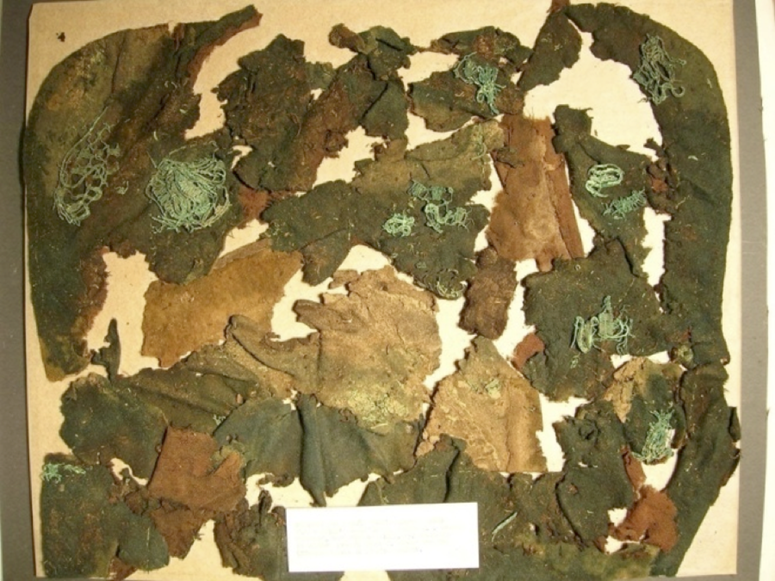
The preserved fabric fragments from Otstonwakin are associated with a single textile mortuary object that was sealed for some 80 years in a wooden picture frame consisting of a glass front and a cardboard back (Figure 3). The fabrics used in the construction of the textile were examined by Kathryn Jakes and Christel Baldia (Reference Jakes and Baldia2009) at Ohio State University and identified by characteristic morphologies observed using different techniques of microscopy. Fibers were mounted on microscope slides with Meltmount (refractive index of 1.539) and examined with a Zeiss Axioplan microscope using brightfield, darkfield, polarized light, and differential interference contrast techniques (Jakes Reference Jakes, Drooker and Webster2000). Photomicrographs were taken with a Zeiss HRC digital microscope camera. Images were taken with a Nikon COOLPIX digital camera with a macro lens and with a Nikon DSM digital microscope camera connected to a Bausch & Lomb stereomicroscope at a magnification of 4X. The use of these analytical methods and associated instrumentation resulted in the identification of five different fabrics used in the creation of this cloth artifact.
Preserved fabric from Otstonwakin curated in a frame measuring 18.75 × 15.5 in. Photograph by Kathryn Jakes. (Color online)

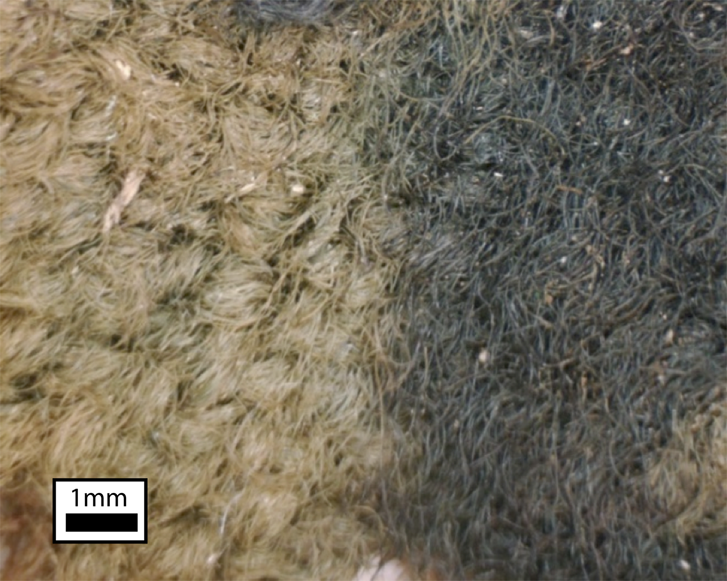
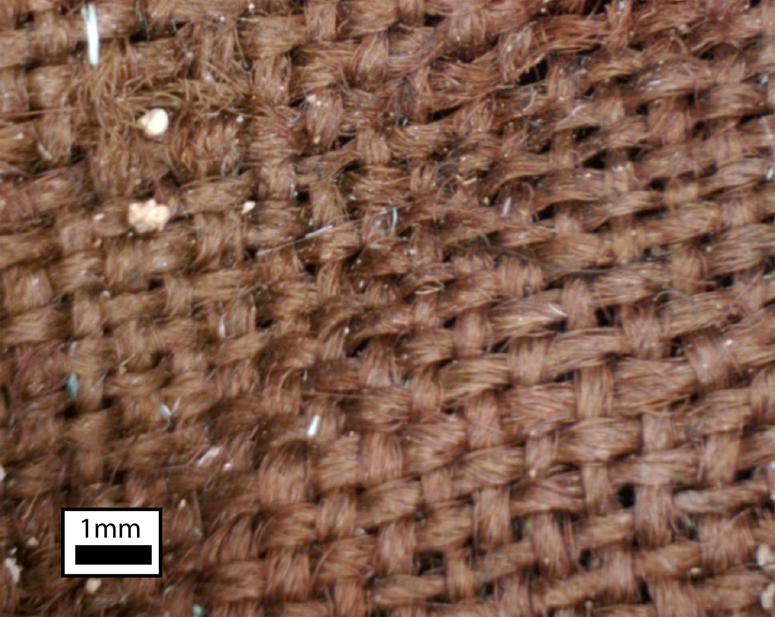
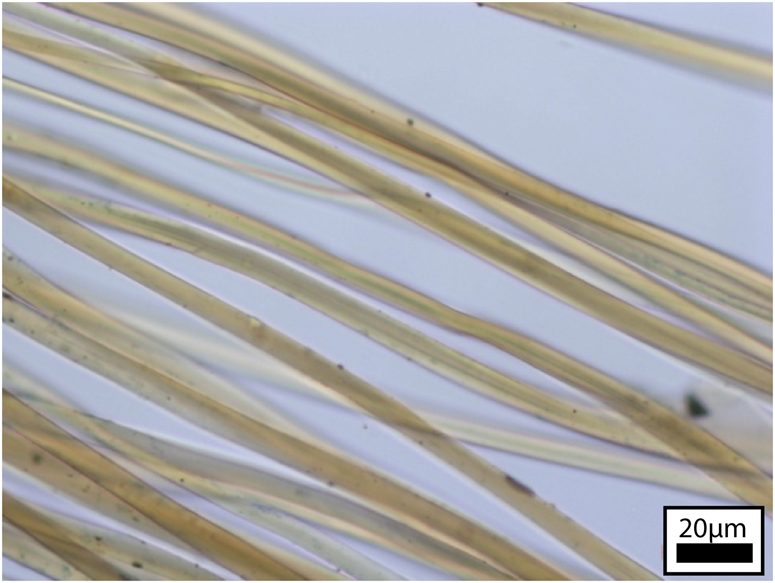
The fabric used for the exterior of the mortuary textile object consists of a plain-woven blue wool with a yarn count of 15 yarns/cm (Jakes and Baldia Reference Jakes and Baldia2009). The surface of the blue wool is napped and consists of single-ply yarns that are loosely twisted in an S direction. Although the surface of wool can become fuzzy as it degrades in mortuary contexts, the napped surface of the blue wool is likely original to the textile. The fabric exhibits decolorization in some areas as the color grades from blue to tan in single continuous sections of the fabric (Figure 4). A second fabric, a brown plain weave fabric made of bast, probably linen, was used for the interior of the garment (Figure 5). The brown fabric consists of yarns that are loosely Z-twisted with a yarn count of 20 yarns/cm. The cloth is very fragile and appears to have been used as supporting or supplementary fabric on the reverse side of the blue wool. The blue wool and brown linen fabrics are joined with a seam of brown silk sewing thread (Figure 6). The yarns in the silk sewing thread are single ply, loosely S-twisted, and probably undyed. A running stitch, a common technique used in hand-sewing where the needle passes down and up through cloth to generate a dashed straight line, was used to join the seams.
Plain-woven blue wool exhibiting a decolorized area (left) that is tan colored. Photograph by Kathryn Jakes. (Color online)

Brown plain weave fabric made of bast, probably linen. Photograph by Kathryn Jakes. (Color online)

Silk fiber from brown sewing thread, brightfield image. Photograph by Kathryn Jakes. (Color online)

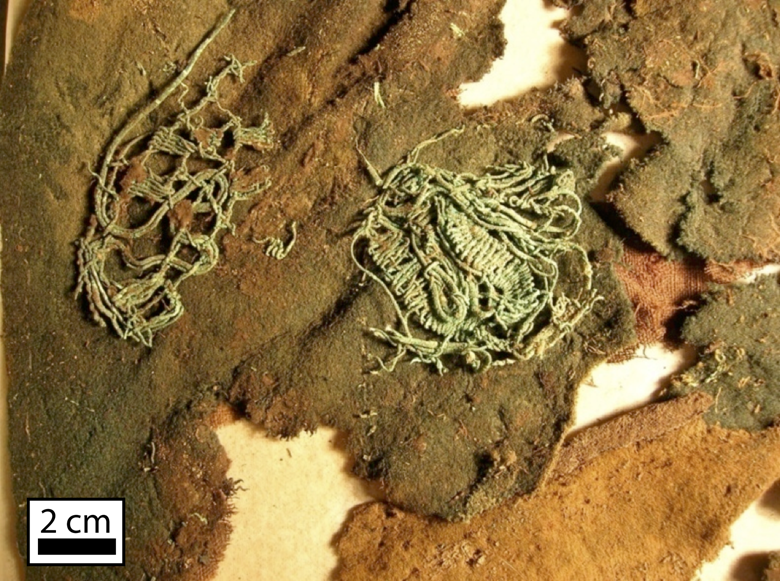
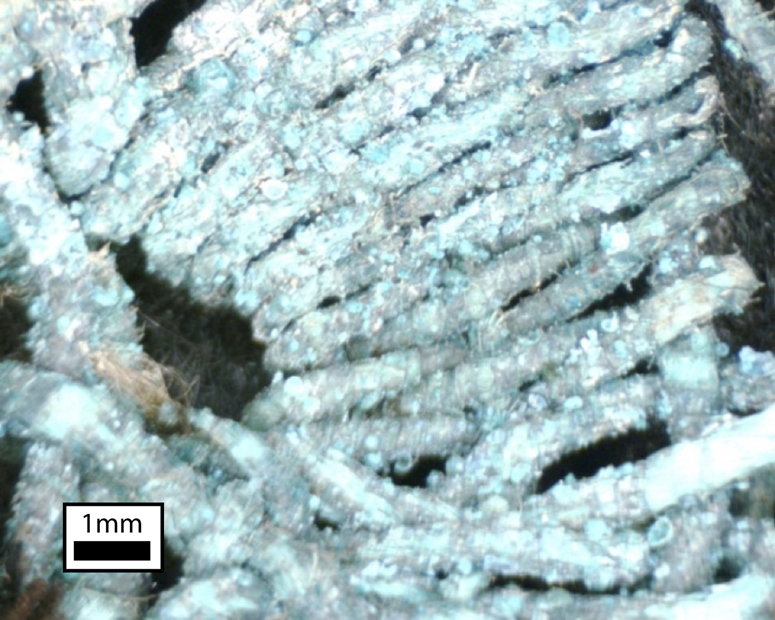
The object is adorned with a heavily corroded decorative trim that displays the green color typically associated with copper-containing oxidation products (Figure 7). Although Schoff (Reference Schoff1937) refers to the adornment as brass braid, it is likely a type of lace similar to needle lace or bobbin lace. The decorative trim has a yarn core identified as bast fiber, probably flax. The yarn is wrapped by metal that is very thin, narrow, and of consistent size (Figure 8). The decorative trim was skillfully made and is attached to the garment with the same brown silk sewing thread used to join the seams of the blue wool and brown linen textiles. Although there are approximately a dozen different areas with preserved decorative trim, an insufficient amount has survived to determine the overall pattern that the copper-rich trim formed. The metallic lace embellishment was stitched to the surface of the blue wool and appears to have been placed on the garment as the item was sewn. The metal-wrapped yarn presents itself within the seam between the blue wool fabric face and the brown bast backing. In addition to the metal-wrapped trim, the garment is embellished with blue wool thread that was used as a decorative topstitch and bears some resemblance to saddle stitching. None of the fibers analyzed displayed fluorescence when illuminated with UV, indicating an absence of fluorescing colorants.
Metallic lace placed and stitched to blue wool. Photograph by Kathryn Jakes. (Color online)

Metal-wrapped yarns winding back and forth to create a decorative trim on the garment. Photograph by Kathryn Jakes. (Color online)

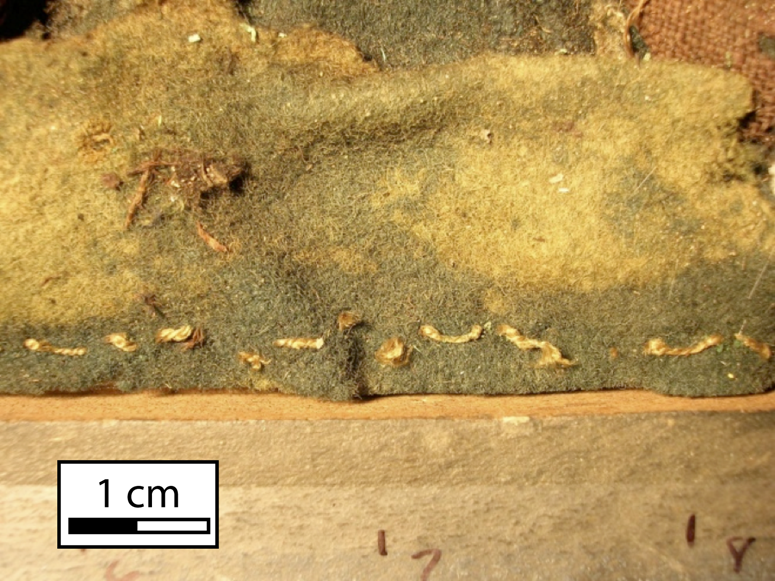
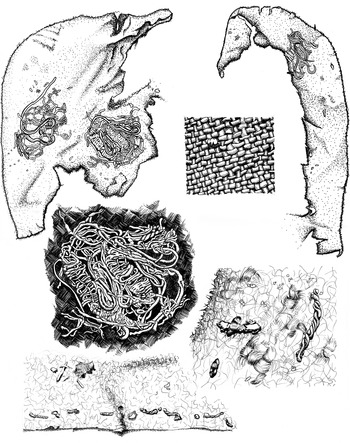
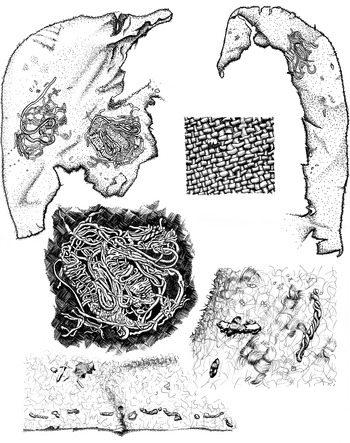
Although the object cannot be unequivocally designated a garment, it most likely was one. There are two seamed and curved shapes that appear to have been crafted to create a similar appearance on two sides of a garment. The lower portion of the garment included a row of broken hand-stitches (Figure 9). The curved shapes are sewn, turned, and finished, and match each other in shape. It is possible that the garment was a cape and that the two sides met near the front (Figure 10). Although Schoff (Reference Schoff1937) suggested that the object was a coat, the absence of armholes, sleeves, and closures suggests that there is insufficient preserved evidence to indicate that it was a jacket or waistcoat. While the curved shapes could be seen as lapels, that designation is problematic. If the curved areas extended through particular fragments, one could imagine creating a curved shape that would conform to a neckline. However, the 13-inch circumference of the circle suggested by such an arrangement is more in keeping with the size of an adult garment. If the curved shapes were lapels, it is unlikely that they were part of a garment crafted for a child due to their large size. The curved shapes more likely represent two sides of a garment such as a cape.
Broken hand-stitching on a single layer of wool fabric resting atop the wooden frame. Photograph by Kathryn Jakes. (Color online)

Examples of preserved fabric from Otstonwakin. Top left: Curved shape. Top right: Curved shape. Middle left: Example of metallic lace embellishment used as decorative trim. Middle right: Brown plain weave linen fabric. Bottom left: Broken hand-stitching on a single layer of blue wool fabric. Bottom right: Blue wool fabric, blue thread stitching, brown silk thread with remnant of metallic-covered yarn caught beneath a stitch. Illustration by Colin Ely.
Discussion
By the time the residents at Madame Montour's Otstonwakin participated in the interment ceremony for the child who wore this garment, Europeans had been exploring and settling on indigenous land in the Eastern Woodlands for over two centuries. Despite these regular encounters designed to subordinate Native Americans and usurp their land, the residents at Otstonwakin persisted with the ritual practice of interring the dead with a wide range of funerary goods, including fabric. In death, as in life, the people of Otstonwakin incorporated imported cloth into their material world, combining familiar and unfamiliar items in their dress. At Otstonwakin, the living chose to bury a child with shell wampum beads, a perforated shell disc, and a heavily embellished textile, likely a cape crafted from blue wool. The cape would have draped loosely over the body and the decorative trim would have glistened when new. In colonial Massachusetts, red coats were distributed to Wampanoag leaders as the color red was associated with authority and prestige; Native children were furnished with blue coats as the color blue denoted an apprentice (Dillon Reference Dillon and Gibson1980:106).
Cloth and clothing played a crucial role in shaping colonial identities at villages such as Otstonwakin. The strouds, duffels, linens, kerseys, flannels, calicos, silks, and decorative laces along with the shirts, coats, stockings, and handkerchiefs that flowed into Native American communities became part of a colonial clothing tradition that Loren (Reference Loren2010:4) characterizes as a “patchwork, a mixture of local and imported, Native and non-Native, handmade and manufactured.” Native Americans did not unilaterally adopt European dress and were selective about what was incorporated into their communities. For example, the Seneca rejected many types of ready-made apparel (Kane Reference Kane2014:4). Native Americans were typically more attracted to uncut cloth and had a strong aversion to tight-fitting clothes (Shannon Reference Shannon1996:21). In addition, they innovatively transformed imported cloth and garments by embellishing textiles to fit into their own cultural paradigms (Kane Reference Kane2014:3). Native Americans used cloth and clothing to consistently reflect their cultural values. Fur trade-era sites far outside the Eastern Woodlands also reveal the selective amalgamation of imported and local items. Native American women on the Western Plains preferred the comfort, color, and texture of some imported fabrics but constructed original styles, not copies of Euro-Canadian clothing (Kehoe Reference Kehoe, Nassaney and Johnson2000). Similarly, fur trade-era Western Anishinaabe combined textiles and associated funerary goods in ways that reveal considerable expression, agency, and indigenous worldviews (Willmott and Brownlee Reference Willmott, Brownlee, Podruchny and Peers2010). Colonial identities were constituted through the manipulation of material culture, including cloth and adornment, and Native Americans combined objects in unique ways throughout the fur trade era.
Although the garment maker of Otstonwakin's blue wool cape is unknown, Johnson's observations from the contemporaneous village of Conestoga Town hint at the possibility that textiles were locally refashioned. The Conestoga Town textile assemblage consists of numerous items, including a plain weave wool English frock coat that was embellished with inkle and a wool coat adorned with galloon. Johnson (Reference Johnson2009:127) argues that the coats might have been ready-made garments but suggests that Conestoga Town seamstresses, not professional garment workers in London or Philadelphia, added the decorative elements. She states:
A Conestoga woman could have easily added lace to Logan's plain coats. Logan's traders supplied Native seamstresses with large quantities of expensive decorative edgings, including galloon, lace, and silk lace. Sewing equipment, including large quantities of thread and pins also appeared in Logan's accounts. At least one Conestoga woman used her small iron snuffbox as a sewing kit. An X-ray of the sealed box showed glass and catlinite beads in combination with at least one needle. Other iron boxes held strung beads and remnants of thread [Johnson Reference Johnson2009:137].
The Conestoga Town analysis shows that Native Americans in eighteenth-century colonial Pennsylvania exercised considerable agency in dealing with European-manufactured textiles. While the decorative metal was applied to ready-made coats at Conestoga Town, the amount of cloth, thread, and lace that was acquired as individual trade goods listed in account books provides a compelling example of how other garments themselves could have been locally made as well as locally decorated.
Conclusion
The multinational village of Otstonwakin was a colonial crossroads where a diverse array of cultures, languages, commodities, and people continuously encountered one another. Frontiers such as Otstonwakin have been conceptualized as contested spaces that create kinetic interactions among people resulting in new cultural matrices that are eclectic and fluid (Cayton and Teute Reference Cayton, Teute, Cayton and Teute1998:2). These matrices were selectively porous, and trade cloth played a central role in the economic and cultural negotiations that characterized native–newcomer interactions in the decades preceding the French and Indian War. Fabric wove the colonial world together, creating vast markets in Europe for indigenous goods (mainly furs), yet created equally vast markets in Native America for cloth, clothing, and sewing accessories. Cloth was a particularly plastic commodity that could be materially and symbolically shaped and reinterpreted by indigenous people who incorporated it into preexisting native lifeways. As we see in the case of Otstonwakin, trade cloth was woven into existing ritual practices for both the living and the dead and emerged as a prominent tool in diplomatic contexts. Colonial identities in eighteenth-century villages, such as Otstonwakin, were constituted through cloth and clothing. Madame Montour emerged as a mediator of native–newcomer interactions in which cloth played a significant role. Her services as interpreter and diplomat were compensated with duffels, strouds, shirts, and matchcoats, and she herself was observed to don “Indian dress.” Her son Andrew strategically combined European cloth and clothing with brass earrings and face paint to deploy a colonial sartorial identity that resulted in his unrivaled ability to mediate the frontier's cultural terrain (Merrell Reference Merrell1999:76). Most importantly, the fabric of empire became a part of mortuary ceremonialism at Otstonwakin, where imported cloth was combined with Native-made artifacts in ritual contexts. The rare preservation of the brass-trimmed blue wool cape deepens our understanding of the role that trade cloth played in the negotiation of identity in the eighteenth century.
Trade cloth continues to be a powerful symbol among Iroquoian nations today. The 1794 Canandaigua Treaty, the result of extensive nation-to-nation intercultural diplomacy, delineated land boundaries and recognized the right of the Six Nations to possession of their land and their sovereignty (Oberg Reference Oberg2016). While the agreement has been violated on several occasions, some aspects of the Treaty continue to be fulfilled (Jemison Reference Jemison, Jemison and Schein2000:154). Article 6 of the Treaty mandates that the United States deliver, on an annual basis, bolts of cloth valued at $4,500 (Oberg Reference Oberg2016:193). While there has been a decline in the quantity and quality of cloth that can be purchased with the set annuity, the yearly distribution of the cloth continues to signal to the Iroquois that the treaty is being honored. The brightly printed calico cloth that had been traditionally distributed was eventually replaced by small quantities of unbleached cotton and inexpensive muslin, but the arrival of cloth has enduring significance. Irving Powless Jr., chief of the Beaver Clan of the Onondaga Nation, who died in 2017 at the age of 88, recounted childhood memories about the cloth: “The Longhouse used to be filled with calico prints, cotton prints, huge piles of cloth. Our people went into the Longhouse and took their share of treaty cloth. That treaty cloth still comes to us every year” (Powless Reference Powless, Jemison and Schein2000:31). Geraldine Green, Seneca Faithkeeper, expressed her resolve at a commemoration event and said, “[I] collected a half a yard of muslin. That isn't even enough to make one panel on my window. . . . But nonetheless, I went down and claimed it, keeping the Canandaigua Treaty alive and what it stands for. If it gets down to an eighth of a yard, I will stand there and collect it” (Schein Reference Schein, Jemison and Schein2000:194). While the cloth circulates through Iroquoian homelands in various ways, it is also used in repatriation ceremonies (Whitefield-Madrano Reference Whitefield-Madrano2011). Repatriated human remains are cradled in treaty cloth and reburied on Iroquoian homelands recognized as theirs by the Canandaigua Treaty. Although its meaning has changed over time, cloth has retained its powerful symbolic meaning tying the people to the land and to their ancestors.
Acknowledgments
I express my sincere gratitude to Ray Halbritter (Oneida Nation Representative and Nation Enterprises CEO) and Jesse Bergevin (Oneida Nation Historical Resources Specialist) for meeting with me and affording me the opportunity to share the objectives of this project. Jesse Bergevin was also kind enough to read a draft of this manuscript. I am also grateful to Ron Patterson (Oneida Heritage Center Manager) and his wife, Tammy Patterson (Oneida Indian Nation Elders Program Activities Leader), for discussing the continued significance of treaty cloth during their visit to Franklin and Marshall College. This research could not have been undertaken without the support of Scott Sagar, curator of collections at the Thomas T. Taber Museum of the Lycoming County Historical Society in Williamsport, Pennsylvania. I am also indebted to the late James P. Bressler, past president of both the Northcentral Chapter No. 8 of the Society for Pennsylvania Archaeology and the Lycoming County Historical Society, for providing early encouragement and for sharing his recollections on the recovery of the textile and its subsequent curation at the Taber Museum. Dr. Kathryn Jakes, faculty emeritus, Department of Human Sciences at the Ohio State University, and her colleague Christel Baldia expertly carried out the analysis of the preserved textile from Otstonwakin and offered critical insight concerning the examination of colonial fabric. They also took the photographs that illustrate this article. Mark D. Hutter, Colonial Williamsburg Foundation, and Diana Loren, museum curator for the Peabody Museum of Archaeology and Ethnology at Harvard University, graciously answered questions concerning colonial couture. Susan Malikowski of DesignLeaf Studio prepared the map that illustrates this article. My gratitude is further extended to James Delle (Millersville University) and Michael Nassaney (Western Michigan University) who commented on drafts of this article. I offer heartfelt thanks to the three anonymous reviewers who offered invaluable suggestions for improvement and to Lynn Gamble (UC Santa Barbara) for her guidance and support. An early version of this paper was presented at the Society for American Archaeology annual meeting in St. Louis and I benefited from the lively discussions generated there. I am grateful to Scott Smith, Franklin and Marshall College, for translating the abstract into Spanish. And finally, I am indebted to a number of Franklin and Marshall College anthropology majors for their contributions to this manuscript. Colin Ely created the ink drawing of diagnostic elements of the preserved fabric. John Picard undertook a literature survey of preserved textiles in the Northeast as part of the Hackman Scholars program. Christine Squillante carried out the deed chain research for the J. T. Roberts Property as a Hackman Scholar as well.
Data Availability Statement
The fabric reported on in this article is curated at the Thomas T. Taber Museum in Williamsport, Pennsylvania.