Introduction
Referring to a shortage of mates of a certain sex, ‘marriage squeeze’ has been a major concept in demography since it was introduced 50 years ago (Glick et al., Reference Glick, Heer and Beresford1963). It implicitly assumes a rigid age preference in mate choice (Ní Bhrolcháin, Reference Ní Bhrolcháin2001) and expects a positive association between marriage formation and the availability of mates with a preferred age difference or simply preferred mates, and a substantial proportion of members of the sex in surplus ending in permanent celibacy under a monogamous marriage system (Akers, Reference Akers1967). The concept has stimulated major interest in the imbalance between numbers of men and women in the prime marriage ages and its consequences for marriage formation in historical and contemporary populations.
Many studies have supported the marriage squeeze hypothesis in identifying factors responsible for a gender imbalance: cohort growth (Akers, Reference Akers1967; Mari Bhat & Halli, Reference Mari Bhat and Halli1999), sex-specific migration (Goodkind, Reference Goodkind1997), differential mortality by sex (Saxena et al., Reference Saxena, Kulczycki and Jurdi2004) and an imbalanced sex ratio at birth (Kim, Reference Kim2004; Guilmoto, Reference Guilmoto2012). However, there are also examples of studies contradicting it. Dixon (Reference Dixon1971) found that across 57 countries in 1960, the sex ratios of men aged 20–44 to women aged 15–39 and of men aged 25–29 to women aged 20–24 correlated weakly with the proportions ever-married in men and women aged 40–44 and 20–24, respectively. By checking 382 US labour-market areas in 1980, Lichter et al. (Reference Lichter, LeClere and McLaughlin1991) found that the sex ratio of men to women aged 20–29 was not significantly correlated with the proportion of ever-married women in this age group. Using a marriage squeeze measure based on all marriageable ages, Schoen and Baj (Reference Schoen and Baj1985) indicated that marriage squeeze was not a major factor influencing age at marriage and proportion ever-married, although it cannot be ignored.
There were several reasons for the mixed results from previous studies of marriage squeeze. Firstly, different marriage measures were used. Proportion ever-married or single (e.g. Dixon, Reference Dixon1971; Lichter et al., Reference Lichter, LeClere and McLaughlin1991) was used more often than marriage rate, i.e. marriages per person-year (e.g. Akers, Reference Akers1967); in other words, prevalence was a more popular measure of marriage formation than incidence (South & Lloyd, Reference South and Lloyd1992; Ní Bhrolcháin & Sigle-Rushton, Reference Ní Bhrolcháin and Sigle-Rushton2005). The problem with the prevalence measure is that lower marriage prevalence at a given age may be caused by lower marriage incidence at ages before the age; thus, analysing the relationship between mate availability and marriage prevalence at that age might lead to a misleading conclusion. Secondly, different studies focused on different ages or age groups. In some studies, the focus was on a single age group (e.g. Akers, Reference Akers1967; Dixon, Reference Dixon1971; Lichter et al., Reference Lichter, LeClere and McLaughlin1991); in others, the focus was on all men and women at marriage ages (e.g. Schoen & Baj, Reference Schoen and Baj1985; Mari Bhat & Halli, Reference Mari Bhat and Halli1999). Few studies analysed marriage squeeze and its consequences for marriage behaviour in each age group along the marriageable life course (Fossett & Kiecolt, Reference Fossett and Kiecolt1991), but the situation has changed somewhat in recent decades (e.g. Lampard, Reference Lampard1993; Raymo, Reference Raymo1998). It is possible that the association between mate choice and mate availability changes with age, as suggested by Lampard (Reference Lampard1993). Consequently, the pattern observed in one age or age group might not be observed in others or the whole marriageable life course. Thirdly, these studies generally focused on populations that were not close to migration, but few of them made adjustment for migration. As Lichter et al. (Reference Lichter, LeClere and McLaughlin1991) pointed out, migration could be a serious confounding factor of the relationship between marriage formation and mate availability (see also Lampard, Reference Lampard1993).
This study suggests a new framework for estimating the effect of mate availability on marriage formation in a cohort, which leads naturally to a test of the marriage squeeze hypothesis. In this theoretical framework, the linkage between the availability of mates with a preferred age difference and first marriage rate/incidence in a cohort at a given age is formulated, with both mortality and migration considered. The framework is thus robust to age effect and situation, e.g. contemporary China (Zhang & Song, Reference Zhang and Song2003) and early 20th century Japan (Nojiri, Reference Nojiri1949), where migration is not negligible. Here, the preferred age difference could be different from the observed or acceptable age difference (Buss, Reference Buss1989; Lampard, Reference Lampard1993); it is the former that is directly relevant to the marriage squeeze hypothesis (Ní Bhrolcháin, Reference Ní Bhrolcháin2001; Matthews & Garenne, Reference Matthews and Garenne2013). Then, the formulation is tested at each stage (e.g. from 15–19 to 20–24 years) along the marriageable life course of female cohorts using Japan’s 1920–1940 census data. As preferred by the test (see Methods), one merit of the Japanese census data in contrast to data from most other countries is a 5-year rather than a longer intercensal period.
If the estimated effect of mate availability is significant at some life-course stage, the marriage squeeze hypothesis will not be rejected at the stage. Relevant estimations can then be used to infer to what an extent change in mate availability contributed to change in intercensal marriage experience in terms of first marriage rate at specific life-course stages, and thus change in Japan’s marriage pattern from 1920 to 1940, when the female singulate mean age at marriage (SMAM) increased from about 21 years to more than 23 years, i.e. a trend towards later marriage (Hajnal, Reference Hajnal1953; Retherford et al., Reference Retherford, Ogawa and Matsukura2001). Although an effect of marriage squeeze on the change in marriage pattern has been noticed (e.g. Hajnal, Reference Hajnal1965; Mari Bhat & Halli, Reference Mari Bhat and Halli1999), the current study raises the issue of an age-specific effect, i.e. an effect along the marriageable life course.
Methods
Theoretical framework
The terminology ‘kinetics’ is borrowed from chemistry, where it refers to the response of the rate of a chemical reaction to the concentration/availability of substrates; here it describes how first marriage rate responds to the availability of preferred mates. If the marriage squeeze hypothesis is true, marriage kinetics can be derived by analysing the flow of singles in the context of mortality and migration.
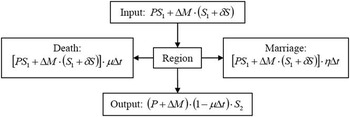
Figure 1 shows the flow of singles (men or women) within a short time interval Δt for a region open to migration. Here, Δt is a short time interval within an intercensal period; P is the population size of a cohort in the region at the beginning of Δt; S 1 is the proportion single in P at the beginning of Δt; ΔM is the net migration (in-migrations minus out-migrations) during Δt (for simplicity, migration is assumed to occur at the beginning of Δt); S 1+δS is the proportion single in the net migration population ΔM; μ is the mean mortality rate during Δt (it is assumed that there is no mortality differential by marital status); η is the mean first marriage rate during Δt; and S 2 is the proportion single in the population (including migrants) at the end of Δt.
The flow of singles (men or women) within a short time interval Δt for a region open to migration. See text for definition of abbreviations.

Based on the balance of singles, it follows that:
 $$\eta ={{PS_{1} {\plus}\Delta M \cdot \left( {S_{1} {\plus}\delta S} \right){\minus}\left[ {PS_{1} {\plus}\Delta M \cdot \left( {S_{1} {\plus}\delta S} \right)} \right] \cdot \mu \Delta t{\minus}\left( {P{\plus}\Delta M} \right) \cdot \left( {1{\minus}\mu \Delta t} \right) \cdot S_{2} } \over {\left[ {PS_{1} {\plus}\Delta M \cdot \left( {S_{1} {\plus}\delta S} \right)} \right] \cdot \Delta t}}$$
The above equation reflects multiple decrements in singles: marriage, mortality and migration. If the marriage squeeze hypothesis is true, a lower availability of preferred mates brings a lower marriage rate. Furthermore, if the relationship is linear, it follows that:
 $$\eta ={{PS_{1} {\plus}\Delta M \cdot \left( {S_{1} {\plus}\delta S} \right){\minus}\left[ {PS_{1} {\plus}\Delta M \cdot \left( {S_{1} {\plus}\delta S} \right)} \right] \cdot \mu \Delta t{\minus}\left( {P{\plus}\Delta M} \right) \cdot \left( {1{\minus}\mu \Delta t} \right) \cdot S_{2} } \over {\left[ {PS_{1} {\plus}\Delta M \cdot \left( {S_{1} {\plus}\delta S} \right)} \right] \cdot \Delta t}}=k\overline{A} $$
where,
 $$\overline{A} $$
is the mean availability of preferred mates during Δt and k is a constant coefficient. Under the assumption that
 $${{\Delta M} \mathord{\left/ {\vphantom {{\Delta M} P}} \right. \kern-\nulldelimiterspace} P}\to0$$
,
 $$S_{2} {\minus}S_{1} =\Delta S\to0$$
and
 $$\overline{A} \to A$$
when
 $$\Delta t\to0$$
, it follows that:
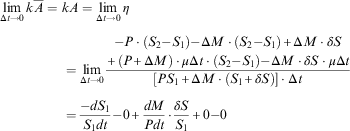 $$\eqalignno{ \mathop{{\lim }}\limits_{{\Delta t\to0}} k\overline{A} = \ & kA=\mathop{{\lim }}\limits_{{\Delta t\to0}} \eta \cr {\rm } & =\mathop{{\lim }}\limits_{{\Delta t\to0}} {\displaystyle{{\minus}P \cdot \left( {S_{2} {\minus}S_{1} } \right){\minus}\Delta M \cdot \left( {S_{2} {\minus}S_{1} } \right){\plus}\Delta M \cdot \delta S\atop{\plus}\left( {P{\plus}\Delta M} \right) \cdot \mu \Delta t \cdot \left( {S_{2} {\minus}S_{1} } \right){\minus}\Delta M \cdot \delta S \cdot \mu \Delta t} \over {\left[ {PS_{1} {\plus}\Delta M \cdot \left( {S_{1} {\plus}\delta S} \right)} \right] \cdot \Delta t}} \cr {\rm } & {\rm }={{{\minus}dS_{1} } \over {S_{1} dt}}{\minus}0{\plus}{{dM} \over {Pdt}} \cdot {{\delta S} \over {S_{1} }}{\plus}0{\minus}0 $$
Thus, the differential form of marriage kinetics in the context of mortality and migration is:
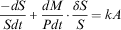 $${{{\minus}dS} \over {Sdt}}{\plus}{{dM} \over {Pdt}} \cdot {{\delta S} \over S}=kA$$
Equation (1) differentiates between nominal and actual first marriage rates. The term −dS/Sdt is the nominal first marriage rate or force of nuptiality (Hajnal, Reference Hajnal1953); over an intercensal period, the mean value of it:
 ${{\mathop{\int}\nolimits_{t_{1} }^{t_{2} } {\left( {{\minus}{{d\ln S} \over {dt}}} \right)dt} } \mathord{\left\big/ {\vphantom {{\mathop{\int}\limits_{t_{1} }^{t_{2} } {\left( {{\minus}{{d\ln S} \over {dt}}} \right)dt} } {\left( {t_{2} {\minus}t_{1} } \right)}}} \right. \kern-\nulldelimiterspace} {\left( {t_{2} {\minus}t_{1} } \right)}}={\minus}{{\ln S_{2} {\minus}\ln S_{1} } \over {t_{2} {\minus}t_{1} }}$
depends only on the proportions single at the two ends (i.e. starting and ending censuses) of the period. The term dM/Pdt is the instantaneous net migration rate, (dM/Pdt) (δS/S) is the migration-based adjustment to the nominal first marriage rate, and
 ${{{\minus}dS} \over {Sdt}}{\plus}{{dM} \over {Pdt}} \cdot {{\delta S} \over S}$
is thus a representation of the adjusted or actual first marriage rate. Evidently, the nominal first marriage rate will be lower than the actual rate if the net migration population is composed of single immigrants; in extreme cases, the nominal rate could be zero or even negative, although the actual rate will always be positive.
The differential form of the kinetics equation considers instantaneous force of nuptiality. For application to census data, it is integrated to get its integral forms. To do so, two assumptions are made. Firstly, migration rate is constant during an intercensal period. As
 $\overline{r} =\overline{b} {\minus}\overline{\mu } {\plus}\overline{\tau } $
and for a cohort
 $$\overline{b} =0$$
(Preston et al., Reference Preston, Heuveline and Guillot2001), it follows that
 $$\overline{\tau } =\overline{r} {\plus}\overline{\mu } $$
, i.e. mean net migration rate is the sum of the mean growth rate and mortality rate over an intercensal period; here,
 $$\overline{r} $$
is the mean growth rate,
 $$\overline{b} $$
is the mean birth rate,
 $$\overline{\mu } $$
is the mean mortality rate, and
 $$\overline{\tau } $$
is mean net migration rate. Secondly, mate availability A is a linear function of t, i.e. At
=A
0+at.
The integration is illustrated for two typical situations of migration. If migrants are composed of singles only, δS/S=(1−S)/S. When a logistic curve is assumed for decrement of singles, ln[(1−S)/S] is a linear function of time/age. Let:
 $$\ln \left[ {{{\left( {1{\minus}S} \right)} \mathord{\left/ {\vphantom {{\left( {1{\minus}S} \right)} S}} \right. \kern-\nulldelimiterspace} S}} \right]=u{\plus}vt,$$
i.e.
 $${{\left( {1{\minus}S} \right)} \mathord{\left/ {\vphantom {{\left( {1{\minus}S} \right)} S}} \right. \kern-\nulldelimiterspace} S}=e^{{u{\plus}vt}} \Rightarrow v={{\left( {\ln {{1{\minus}S_{2} } \over {S_{2} }}{\minus}\ln {{1{\minus}S_{1} } \over {S_{1} }}} \right)} \mathord{\left/ {\vphantom {{\left( {\ln {{1{\minus}S_{2} } \over {S_{2} }}{\minus}\ln {{1{\minus}S_{1} } \over {S_{1} }}} \right)} {\left( {t_{2} {\minus}t_{1} } \right)}}} \right. \kern-\nulldelimiterspace} {\left( {t_{2} {\minus}t_{1} } \right)}}.$$
It follows that:
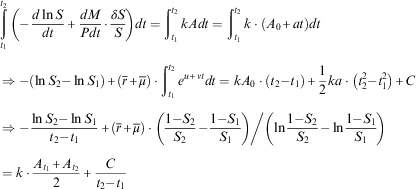 $$\eqalignno{ & {\rm }\mathop{\int}\limits_{t_{1} }^{t_{2} } {\left( {{\minus}{{d\ln S} \over {dt}}{\plus}{{dM} \over {Pdt}} \cdot {{\delta S} \over S}} \right)} dt=\mathop{\int}\nolimits_{t_{1} }^{t_{2} } {kAdt=\mathop{\int}\nolimits_{t_{1} }^{t_{2} } {k \cdot \left( {A_{0} {\plus}at} \right)} } dt \cr & \Rightarrow{\minus}\left( {\ln S_{2} {\minus}\ln S_{1} } \right){\plus}\left( {\overline{r} {\plus}\overline{\mu } } \right) \cdot \mathop{\int}\nolimits_{t_{1} }^{t_{2} } {e^{{u{\plus}vt}} } dt=kA_{0} \cdot \left( {t_{2} {\minus}t_{1} } \right){\plus}{1 \over 2}ka \cdot \left( {t_{2}^{2} {\minus}t_{1}^{2} } \right){\plus}C \cr & \Rightarrow{\minus}{{\ln S_{2} {\minus}\ln S_{1} } \over {t_{2} {\minus}t_{1} }}{\plus}\left( {\overline{r} {\plus}\overline{\mu } } \right) \cdot {{\left( {{{1{\minus}S_{2} } \over {S_{2} }}{\minus}{{1{\minus}S_{1} } \over {S_{1} }}} \right)} \mathord{\left/ {\vphantom {{\left( {{{1{\minus}S_{2} } \over {S_{2} }}{\minus}{{1{\minus}S_{1} } \over {S_{1} }}} \right)} {\left( {\ln {{1{\minus}S_{2} } \over {S_{2} }}{\minus}\ln {{1{\minus}S_{1} } \over {S_{1} }}} \right)}}} \right. \kern-\nulldelimiterspace} {\left( {\ln {{1{\minus}S_{2} } \over {S_{2} }}{\minus}\ln {{1{\minus}S_{1} } \over {S_{1} }}} \right)}}\cr &=k \cdot {{A_{t_{1} } {\plus}A_{t_{2} } } \over 2}{\plus}{C \over {t_{2} {\minus}t_{1} }}{\rm } $$
If migrants are composed of the married only, δS/S=(0−S)/S=−1. It follows that:
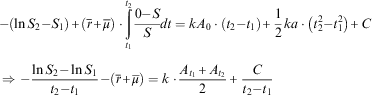 $$\eqalignno{ & {\rm }{\minus}\left( {\ln S_{2} {\minus}S_{1} } \right){\plus}\left( {\overline{r} {\plus}\overline{\mu } } \right) \cdot \mathop{\int}\limits_{t_{1} }^{t_{2} } {{{0{\minus}S} \over S}} dt=kA_{0} \cdot \left( {t_{2} {\minus}t_{1} } \right){\plus}{1 \over 2}ka \cdot \left( {t_{2}^{2} {\minus}t_{1}^{2} } \right){\plus}C \cr & \Rightarrow{\minus}{{\ln S_{2} {\minus}\ln S_{1} } \over {t_{2} {\minus}t_{1} }}{\minus}\left( {\overline{r} {\plus}\overline{\mu } } \right)=k \cdot {{A_{t_{1} } {\plus}A_{t_{2} } } \over 2}{\plus}{C \over {t_{2} {\minus}t_{1} }}{\rm } $$
Thus, the generalized differential form leads to various integral forms according to the marital status composition of migrants and/or empirical representation of availability. Theoretically, actual first marriage rate can also be computed by dividing total marriages by total person-years of a cohort between two censuses. However, for a cohort aged 15–19 in a census year, the count of marriages in each age from 16 to 20 years in the next year may not be available (e.g. in Japan’s 1920–1940 vital statistics); in such cases, Eqns (2) and (3) have the merit of needing only statistics on marriages in each census year, but not statistics between census years. It is worth noting that if t 2−t 1 is shorter, the assumptions in the integration (e.g. constant migration rate) over an intercensal period are easier to satisfy. In this sense, census data with a 5-year intercensal period (e.g. Japan and South Korea) are preferred to those with a 10-year intercensal period (e.g. Malaysia and Taiwan) in testing kinetics equations.
Through Eqns 2 and 3, the theoretical formulation can be linked to the census data via a linear regression analysis to test whether and how lower mean mate availability predicts a lower adjusted or actual mean first marriage rate in a cohort over an intercensal period.
Census data from Japan
The data used for regression analysis come from: (1) the Population Census of Japan, 1920–1940 (Statistics Bureau, 2011); and (2) Vital Statistics, 1920–1940 (Tōkei-Kyoku, 1920–1940). These data are generally in both Japanese and English, but the original Japanese version is more comprehensive and is thus used in this study. The choice of 1920–1940 census data is explained later.
The Japanese government has conducted a population census every five years since 1920, with a break in 1945 due to WWII. The census counts persons that live in local areas over 6 months, by age group (0–14, 15–19, 20–24, etc.), sex and marital status at both national and prefecture (the first administrative division level in Japan; Wikipedia Contributors, 2015) levels. Based on such data, period female SMAM can be calculated at the national level (Retherford et al., Reference Retherford, Ogawa and Matsukura2001). Until 1925, female SMAM was close to 21 years, the upper limit of SMAM typical of a non-European marriage pattern; in 1940, female SMAM was already more than 23 years, the lower limit typical of a European pattern (Hajnal, Reference Hajnal1965). From 1920 to 1940, the proportion of single women at age 40–44 levelled off at 2%, far less than the lower limit level of 10% in a European marriage pattern (Hajnal, Reference Hajnal1965). Thus, there was a trend towards later but not less marriage (for a discussion of the development of marriage that is not only later but also less in East Asia in recent decades, see Retherford et al. (Reference Retherford, Ogawa and Matsukura2001), Chen & Chen (Reference Chen and Chen2014) and Raymo et al. (Reference Raymo, Park, Xie and Yeung2015)); in Hajnal’s terms, it might also be said that the Japanese marriage pattern shifted from a non-European one to a semi-European one from 1920 to 1940.
It makes no sense to do regression analysis at the national level, as only one value of mate availability and one first marriage rate can be arranged from each census. However, it is feasible to conduct analysis with census data from 47 prefectures. Three life-course stages (15–19→20–24, i.e. from age 15–19 to age 20–24; 20–24→25–29; 25–29→30–34) are analysed in the study; these covered more than 90% of marriages in single women during the period 1920–1940 (Statistics Bureau, 2011). Given that there are 47 prefectures, and for each prefecture four intercensal periods and three life-course stages are considered, there are 47×4×3=564 data points for regression analysis; each point corresponds to one value of mean mate availability and one mean first marriage rate in a cohort over an intercensal period.
Assignment for variables in the regression analysis
Firstly, a measure of mate availability is introduced. Lampard (Reference Lampard1993) indicated that although theoretically inferior to other more complicated measures of mate availability like iterated availability ratio (IAR), sex ratio may in practice be a better predictor of marriage rate. Thus, mate availability for single women in an age group and a given census can be represented empirically as follows (subscript e refers to empirical):
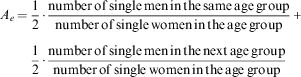 $$\eqalignno{ A_{e} \,{\rm =}\, & {1 \over 2} \cdot {{{\rm number}\,{\rm of}\,{\rm single}\,{\rm men}\,{\rm in}\,{\rm the}\,{\rm same}\,{\rm age}\,{\rm group}} \over {{\rm number}\,{\rm of}\,{\rm single}\,{\rm women}\,{\rm in}\,{\rm the}\,{\rm age}\,{\rm group}}}{\plus} \cr & {1 \over 2} \cdot {{{\rm number}\,{\rm of}\,{\rm single}\,{\rm men}\,{\rm in}\,{\rm the}\,{\rm next}\,{\rm age}\,{\rm group}} \over {{\rm number}\,{\rm of}\,{\rm single}\,{\rm women}\,{\rm in}\,{\rm the}\,{\rm age}\,{\rm group}}} $$
Mate availability, as defined in Eqn (4), is a reasonable representation of the availability of mates with a preferred age difference. The survey on age preference nearest to the period 1920–1940 was the 1982 National Fertility Survey (National Institute of Population and Social Security Research, 1982), which indicated that the preferred age difference among single women roughly varied from zero to five years, with an average at about three years. The cross-country studies on mate selection preferences by Buss (Reference Buss1989) and Kenrick and Keefe (Reference Kenrick and Keefe1992) also indicated an age difference preference by females within this range across the countries surveyed (underdeveloped, developing and developed). Thus, it is reasonable to represent single females’ preferred mate set as single males in two adjacent age groups and preferred age difference as the mid-point between zero (mates in the same age group) and five years (mates in the next age group) (see also Torabi & Baschieri, Reference Torabi and Baschieri2010). Mate availability calculated in this way declined with time in the pre-WWII period but increased with time in the post-war decades after a major loss of marriageable men in the war; thus, it is better to use the pre-war data to test the marriage squeeze hypothesis, which concerns the response of marriage behaviour to a decline in mate availability, i.e. a relative, not absolute, shortage of mates, with time.
Secondly, for a cohort, the adjusted intercensal first marriage rate is obtained by adding a migration-based adjustment to the nominal marriage rate according to Eqns (2) or (3). As discussed in the theoretical formulation, the nominal mean first marriage rate over an intercensal period is −(lnS 2−lnS 1)/(t 2−t 1). Here, the time interval is the intercensal period (five years) and the two proportions correspond to a cohort at the two ends of an intercensal period; for example, women aged 15–19 in 1920 were 20–24 years old in 1925 and two proportions can then be found.
In adjusting nominal rate, the intercensal growth rate is assumed to be constant and calculated as:
 $$\bar{r}\,\,{\rm =(ln}\,P_{{\rm 2}} {\rm {-}ln}\,P_{{\rm 1}} {\rm )/(}t_{{\rm 2}} {\rm {-}}t_{{\rm 1}} {\rm ),}$$
i.e. the mean growth rate over a full intercensal period. Mortality rate is also assumed to be constant over an intercensal period and can be computed using two methods. The first method divides total deaths by total person-years during an intercensal period; this method needs annual statistics of deaths at each age (note: the females aged 15–19 in 1920 were aged 16–20 in 1921). The second method is to compute the mean value of two rates at the beginning and end of an intercensal period: for a cohort, if the mortality rate was μ
1 in 1920 (calculated by counts of deaths in each prefecture; Tōkei-Kyoku, 1920–1940) and μ
2 in 1925, the intercensal mortality rate is then calculated as
 $$\bar{\mu }{\rm =(}\mu _{{_{{\rm 1}} }} {\rm {\plus}}\mu _{{\rm 2}} {\rm )/2}$$
; generally, μ
1 was close to μ
2. The first method is the one used in the current study. However, intercensal mortality rates computed by the two methods are almost the same; for example, the coefficients of correlation between mortality rates at the life-course stage 15–19→20–24 calculated by the two methods are 0.943, 0.986, 0.984 and 0.982 in the four intercensal periods, respectively. When annual age-specific vital statistics are not available, the second method can be used, as it needs only age- or age-group-specific vital statistics of a cohort in each census year, but not vital statistics in the years between the two censuses.
Intercensal migration rate, i.e. mean migration rate over a full intercensal period, is computed by adding intercensal growth and mortality rates together (the results are available from the author). In general, prefecture-specific migration rates were in the interval from −40‰ to 40‰ (note: the unit of migration rate is the same as that of growth rate, year−1). Most areas had a negative migration rate, i.e. out-migration; however, metropolitan areas like Tokyo, the capital of Japan, and Osaka, historically the centre of commerce in Japan, had a positive migration rate, i.e. in-migration (for a review of migration to economic centres, see Yap, Reference Yap1977). This pattern arose because in that period single girls migrated from rural areas to large cities, e.g. Osaka and Tokyo, for temporal/seasonal work before marriage (note: single women after age 25 or married women were generally not favoured by employers) and married women migrated for union with their husbands (Nojiri, Reference Nojiri1949; Taeuber, Reference Taeuber1958). Among men, single non-heir sons migrated to large industry centres for a better subsistence chance and married men migrated for temporary or seasonal work. There was a trend towards universal emigration from 1935 to 1940, as more and more men and women migrated to other countries for military services or land opportunities during war-time (Taeuber, Reference Taeuber1958). In the 1940 census, overseas soldiers were still included in their original hometown populations, although overseas landers were excluded (Tōkei-Kyoku, 1920–1940).
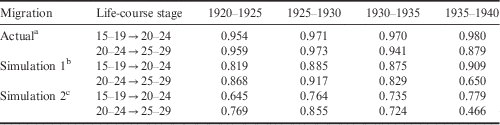
Using intercensal migration rate, nominal first marriage rate is adjusted using Eqn (2) in the case of the life-course stage 15–19→20–24, in that migrants at this stage were almost universally single women. As for the stage 20–24→25–29, the nominal rate is adjusted using Eqn (3), in that regardless of migration within Japan or migration to other countries, most (75% on average) migrants at this stage were married women (see above discussion on sex, age and spatial patterns of migration; for more details, see Taeuber, Reference Taeuber1958). In general, the ratios of the migration adjustment-induced change in first marriage rate to nominal first marriage rate were in the interval from −10% to 10%; however, they were evidently bigger in the metropolitan areas of Tokyo and Osaka (details available from the author). Table 1 lists Pearson’s coefficients of correlation between the nominal and adjusted/actual marriage rates at the stages 15–19→20–24 and 20–24→25–29 in the four intercensal periods. With migration rates in the current study, there was a high correlation between nominal and adjusted first marriage rate. A simulation with two times the migration rate in this study (i.e. a level at 80‰) indicates that, under such a condition, the correlation coefficient declines quickly from 0.954 to 0.819 at the stage 15–19→20–24 during the period 1920–25; a simulation with three times the migration rate (i.e. a level at 120‰) produces a lower correlation (Table 1). No adjustment is made to the nominal first marriage rate in the case of stage 25–29→30–34 because migration at this stage can be disregarded (Taeuber, Reference Taeuber1958; Nakagawa, Reference Nakagawa2010).
Pearson’s coefficients of correlation between nominal and adjusted first marriage rates among female cohorts in four intercensal periods from 1920 to 1940 in Japan
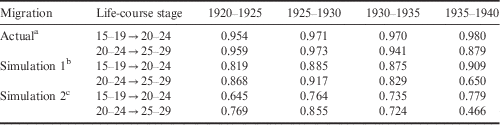
a Actual migration rate.
b Simulated situation at two times the actual migration rates.
c Simulated situation at three times the actual migration rates.
For each test, degree of freedom=45 and p<0.001.
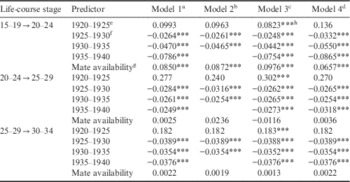
The adjusted rates indicate that in each prefecture there was an evident secular decline in first marriage rate at the life-course stage 15–19→20–24 from 1920 to 1940, and thus a steady marriage postponement during the period (prefecture details are available from the author; for the overall trend, see Table 2). By contrast, in almost every prefecture first marriage rate at the stages 20–24→25–29 and 25–29→30–34 only declined slightly from 1920 to 1925, but remained almost constant from 1925 to 1940 (for the overall trend, see Table 2). Thus, the transition to later marriage during the period 1920–1940 was mainly driven by a decline in first marriage rate at the stage 15–19→20–24.
Regression coefficients from models with intercensal first marriage rate as the response variable
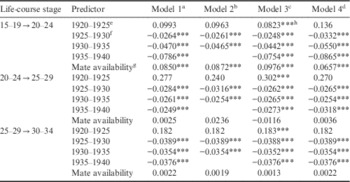
a Fixed effects model: intercensal first marriage rate is corrected using Eqn (4); both prefecture and intercensal period fixed effects are included.
b Fixed effects model: intercensal first marriage rate is corrected using Eqn (4); both prefecture and intercensal period fixed effects are included; 1935–1940 intercensal period is not considered.
c Random effects model: first marriage rate is corrected using Eqn (4); intercensal period dummy variable is included.
d Fixed effects model: intercensal first marriage rate is not corrected; both prefecture and intercensal period fixed effects are included.
e Regression coefficient of first marriage rate on the intercensal period 1920–1925 is treated as ‘intercept’ (not given by model but computed manually), which is the mean of individual intercepts for prefectures.
f Regression coefficients of first marriage rate on the intercensal periods 1925–1930, 1930–1935 and 1935–1940 are given by the model as the difference from that for the period 1920–1925.
g Regression coefficient of first marriage rate on mate availability.
h The intercept is given by model.
R 2 values for the three life-course stages are: Model 1, 0.957, 0.469 and 0.761; Model 2, 0.947, 0.693 and 0.794; Model 3, 0.943, 0.401 and 0.706; and Model 4, 0.960, 0.539 and 0.761.
***p<0.001.
Panel regression model
The primary analysis is a two-way fixed effects model. Prefectures are taken as panels. Given that there were only four intercensal periods from 1920 to 1940, intercensal period is included as the second fixed effect, in the form of a dummy variable (Wooldridge, Reference Wooldridge2012). Heteroskedasticity is taken into account by computing robust covariance matrices of coefficients (Zeileis & Hothorn, Reference Zeileis and Hothorn2002). The modelling platform is the statistical package ‘plm’ (Croissant & Millo, Reference Croissant and Millo2008) in R 3.1.2 (R Core Team, 2014). The model structure is:
 $$y_{{_{{ij}} }} {\rm =}\upsilon _{i} {\plus}\theta _{j} {\plus}\beta x_{{i_{j} }} {\plus}{\varepsilon}_{{ij}} $$
where y
ij
is the adjusted intercensal first marriage rate in prefecture i (=1, 2, …, 47) and intercensal period j (e.g. 1920–1925); x
ij
is the intercensal mate availability in prefecture i and intercensal period j; β is the regression coefficient; υ
i
is the fixed parameter for prefecture i; θ
j
is the fixed parameter for intercensal period j; and ε
ij
is a random variable with a distribution
 $${\varepsilon}_{{ij}} \!\sim \!N(0,\sigma _{i}^{2} )$$
.
Results
The fixed effects model (Model 1) is run, using mate availability as defined in Eqn (4), separately for each life-course stage, i.e. three model runs in total (Table 2). At the stage 15–19→20–24, mate availability significantly affected first marriage rate; the regression coefficient is 0.0850, i.e. every 0.1 unit decrease in mate availability caused a 0.0085 decrease in first marriage rate. Mate availability did not significantly affect the first marriage rate at the other two life-course stages; in other words, change of mate availability was not responsible for the dynamics of first marriage rate at these two stages from 1920 to 1940.
The change in first marriage rate at the life-course stage 15–19→20–24 with time could be via two paths: first, mate availability changed with time and this change affected first marriage rate; second, some other unspecified factors changing with time affected first marriage rate. The contribution of mate availability to change in first marriage rate can then be calculated as the ratio of change in first marriage rate that was due to change in mate availability to total change in first marriage rate. At the stage 15–19→20–24, with mate availability controlled for, intercensal first marriage rate declined by 0.0786 from 1920 to 1940 (Table 2); the model with intercensal availability as the response variable and intercensal period as the predictor shows that mate availability declined by 0.251 from 1920 to 1940. Thus, the contribution to the decline in first marriage rate from the decline in mate availability was 0.251×0.0850/(0.251×0.0850+0.0786)=21.3%.
Some parallel models are conducted as a contrast. Firstly, as mentioned above, the 1940 census included overseas soldiers so that the 1935–1940 intercensal mate availability could be overestimated and, consequently, the effect of mate shortage or marriage squeeze could be underestimated. Model 2 shows that if the 1940 census is excluded, the estimated effect of mate availability on the force of nuptiality at the life-course stage 15–19→20–24 would be slightly higher (Table 2); in such a case, the contribution of a decline in mate availability to the decline in the force of nuptiality from 1920 to 1935 is estimated at 0.225×0.0872/(0.225×0.0872+0.0465)=29.7%. Secondly, Model 3 is a random effects model and gives a result qualitatively consistent with that of fixed effects Model 1. The estimated effect of mate availability at the stage 15–19→20–24 is higher than that from Model 1; presumably, some unobserved prefecture effect (e.g. local cultural norm encouraging early marriage among single women) contributed to both higher mate availability and marriage rate. As a result of the higher estimated effect of mate availability, the contribution would be estimated at 24.3% (Table 2). In both Model 2 and Model 3, the estimated effect of mate availability is not significant at the stages 20–24→25–29 and 25–29→30–34. Finally, to make a contrast with the above models, where force of nuptiality is adjusted by migration rate, Model 4 is run using nominal force of nuptiality. Still, the above conclusion does not change. However, the estimated effect of mate availability regarding the stage 15–19→20–24 is only about 0.0657, which means a contribution of 16.0%. In other words, the contribution of decline in mate availability to the decline in first marriage rate would be underestimated if intercensal marriage rate is not corrected for migration.
Discussion
This study provides a framework to estimate the effect of the availability of preferred mates on marriage formation in terms of marriage rate/incidence rather than prevalence in a cohort in the context of mortality and migration. The marriage kinetics Eqns (1)–(3) indicate that it makes more sense to check the association between mate availability and migration-adjusted rather than nominal first marriage rate. If no adjustment is made for migration, the mate availability effect could be underestimated, although the conclusion in significance terms from analysing nominal first marriage rate will be similar to that from analysing the adjusted one, provided migration rate is low, e.g. within ±40‰, as analysed in this study (cf. Table 2). When migration rate is high, nominal first marriage rate could be a biased measure of marriage formation (cf. Table 1) and the conclusion from analysing it might be misleading.
The fixed effects models that are used to give an empirical test of kinetics equations with the Japanese demographic data indicate that mate availability was positively associated with first marriage rate and a decline in the former was partly responsible for the decline in the latter at the early stage of the marriageable life course, i.e. 15–19→20–24 years, in 1920–1940 Japan. Similar results were found in the 1946–1948 cohort of women in England & Wales (Ní Bhrolcháin, Reference Ní Bhrolcháin2001) and the 1891–1895 cohort of women in France (Henry, Reference Henry1966); both cohorts suffered severe marriage squeeze due to an excess of male deaths in the two World War periods, and as a result their first marriages were delayed or temporarily forsaken. Thus, at young ages, female mate choice was not flexible, the marriage squeeze hypothesis held, and the dynamics of mate availability played an important role in Japan’s transition to later marriage by affecting first marriage rate. On the other hand, consistent with Bergstrom and Lam (Reference Bergstrom and Lam1991), Ní Bhrolcháin (Reference Ní Bhrolcháin2001) and Choo and Siow (Reference Choo and Siow2006), the study also indicates that there was some flexibility in female choice at later stages of the marriageable life course, i.e. 20–24→25–29 and 25–29→30–34: in the period 1920–1940, there was no significant association between mate availability and first marriage rate at these two stages. Presumably, if mates with preferred age difference were in short supply, single women at these ages chose to marry less-preferred men. The Japanese vital statistics for 1920–1940 supported this inference: for females in age groups 25–29 and 30–34, 20% to 30% of all marriages were with men older by more than 10 years; in contrast, less than 15% of females in the age group 20–24 married men older by more than 10 years. Henry (Reference Henry1966) also found that at older ages, French women of the 1891–1895 cohort were more likely to marry too old or too young men rather than men with a ‘normal’ age difference, divorced men or widowed men. A similar phenomenon was observed in Romania’s 1967 female cohort, which was much larger than cohorts both before and after it (Bradatan, Reference Bradatan2009). South (Reference South1991) indicated that divorced or widowed men were more acceptable for older women, although these men were not highly valued, i.e. preferred.
It is worth discussing some points that appear to contradict the present finding. Firstly, the arranged marriage in Japan (so-called miai) does not affect the above interpretation of the results, in that miai was essentially just a manner of meeting, i.e. arranged meeting in contrast to ren’ai or love meeting; the final decision of marriage lay largely with the single females themselves (Hendry, Reference Hendry1981). Secondly, the contrasting pattern of female choosiness at different ages may not be observed, if the effect of mate availability at different life-course stages is not analysed separately, i.e. the interaction between mate availability and age is not analysed. Without considering the interaction effect, Torabi and Baschieri (Reference Torabi and Baschieri2010) found that from the mid-1970s to 2000, the sex ratio calculated in the same way as in the current study was not significant in predicting female first marriage hazard, a measure closely related to first marriage rate, in Iran. Brandt et al. (Reference Brandt, Siow and Vogel2008) found that small size – i.e. an advantageous marriage market – of the female cohort born in China’s 1958–1962 famine, did not bring a higher marriage rate to cohort members aged 27 or more in 1990; however, the study did not tell the case before age 27. Thirdly, as non-marital consensual union or pregnancy are different from marriage, which is generally accompanied by long-term commitment, the association between low sex ratio or mate availability and increased non-marital pregnancy rate in teenage girls found in Guttentag and Secord (Reference Guttentag and Secord1983) and Barber (Reference Barber2001) is not in conflict with the finding here, i.e. low mate availability brought about a decreased first marriage rate in young females.
Relaxation of female choosiness in selecting a marriage partner along the marriageable life course has also been noticed in other human societies. Analysis of Lonely Hearts advertisements in the US and UK found that, compared with young women, older women were less demanding in terms of a number of traits – including age difference – demanded of prospective long-term partners (Waynforth & Dunbar, Reference Waynforth and Dunbar1995; Pawlowski & Dunbar, Reference Pawlowski and Dunbar1999). A similar result was found in a study of marriage or stable partner selection based on 7415 advertisements published in Spanish newspapers (Gil-Burmann et al., Reference Gil-Burmann, Peláez and Sánchez2002). Thus, the change of female choosiness in long-term mate choice with age could be genuine and some evolutionary mechanism seems to underlie the cross-cultural phenomenon. Presumably, in selecting a marriage partner, females face a trade-off between the benefit of waiting for an ideal partner – e.g. a male who displays a preferred age difference, a trait signalling both sound investment ability and survivorship in the future – and the cost of rapid decline in reproductive opportunity with age, i.e. reproductive senescence (Pawlowski & Dunbar, Reference Pawlowski and Dunbar1999; Moore & Moore, Reference Moore and Moore2001). Natural selection thus favours moderate choosiness regarding age difference at young ages but reduced choosiness at older ages in females.
To conclude, this test of the marriage kinetics equations indicates that a shortage of preferred mates partly accounts for why Japanese single women chose to postpone their marriage at young ages during the period 1920–1940, reflected in a consistently declining first marriage rate at the life-course stage 15–19→20–24 (see Methods and Table 2), which left naturally a higher proportion of single women in age group 20–24. From 1920 to 1940, this proportion increased from 31% to 54% (Retherford et al., Reference Retherford, Ogawa and Matsukura2001). In this period, single women presumably did not want to forsake their marriage, as mate availability did not affect their marriage rate at later ages (Table 2), and the proportion of single women in the age group 30–34 just increased from 4% to 5%. Such findings on micro-level marriage behaviours shed light on the trend towards late but not less marriage in Japan from 1920 to 1940.
Given that other East Asian and South-East Asian countries also had a proportion of single women far less than 5% at age 35–39 when SMAM increased to 23 years (Jones & Gubhaju, Reference Jones and Gubhaju2009), it is clear that late marriage developed earlier than less or non-universal marriage, and population growth or wars inducing a shortage of preferred mates among females may partly explain the trend towards later marriage in these countries. For example, a study on historical Indian population supported this conclusion (Mari Bhat & Halli, Reference Mari Bhat and Halli1999). It would be interesting to test the conclusion using data from Asian countries other than Japan and India. Additionally, investigation of the contributions of different factors – such as mate availability, urbanization, cultural change, female employment – to the nuptiality transition in Asia is warranted; some studies have produced illuminating qualitative results on the issue (e.g. Smith, Reference Smith1980; Retherford et al., Reference Retherford, Ogawa and Matsukura2001; Jones & Gubhaju, Reference Jones and Gubhaju2009).
Acknowledgments
The author received financial support from a postdoctoral fellowship provided by the Max Planck Society. The author sincerely thanks Professor Mikko Myrskylä for suggestions on the research and comments on an early version of the work. The author would also like to thank Dr Akihiko Kato for help in reading the Japanese data and references and comments on an early version of the work, Dr Yu-Hua Chen for suggestions on data selection and revising the manuscript for publication, Tianyu Cui for collecting some of the data and the anonymous referees for their constructive comments.