Historical Antecedents
The strength of the trade union movement in Pakistan has ebbed and flowed over the course of the country's history, but today, after roughly twenty-five years of liberalization, deregulation, and privatization, the movement is arguably at its weakest point in recent memory.
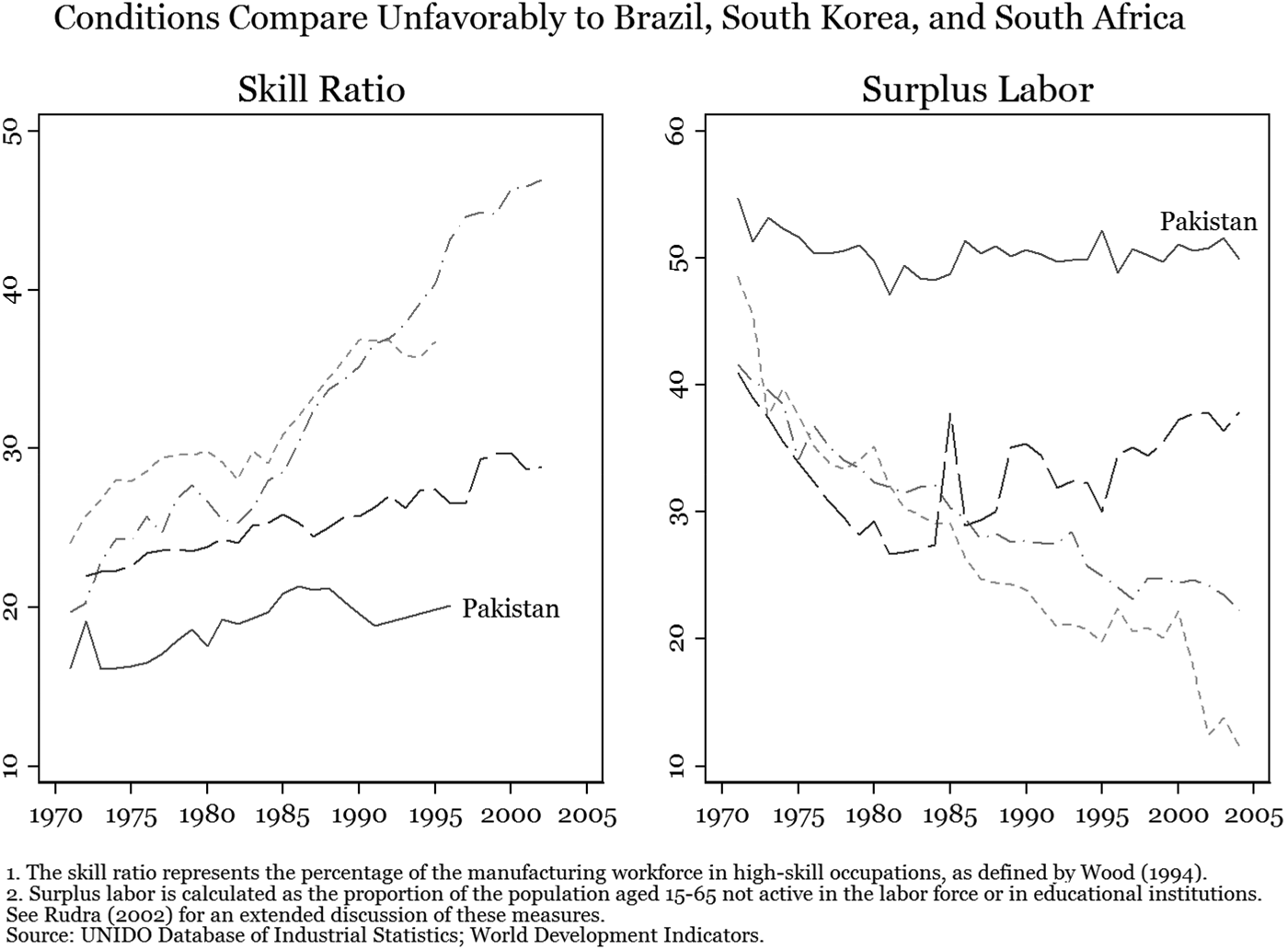
As a rule, Pakistan's trade union movement has never managed to build a strong foundation. Certainly, in other late-developing countries, more extensive economic transformation produced, by the 1980s, conditions that bred labor movements of far greater significance (see Figure 1). In countries like Brazil, South Africa, and South Korea, for instance, unions were national-level actors, able to put up at least some resistance to the neoliberal onslaught that began in the 1980s.Footnote 2 If the movement in Pakistan never matched them, it is because of the relative failures of the country's development trajectory.
Conditions compare unfavorably to Brazil, South Korea, and South Africa.

Having inherited very little of British India's industrial base, the early trade union federations in Pakistan started on a weak footing. Their bastions, such as they were, were located in the country's strategic enterprises in railways and the ports.Footnote 3 In the 1950s and 1960s, after a period of sustained growth in domestic manufacturing, trade unions did manage to acquire some significance, reflected in membership totals and particularly in the scale of industrial unrest. By all accounts, labor was an important participant in the protests that led to Pakistan's inaugural democratic transition in the late 1960s.Footnote 4 But stubborn features of Pakistan's political economy kept the movement weak. An unequal agrarian structure, which resisted meaningful land reform and a criminally feeble educational system, meant that there was a large pool of easily replaced and unskilled workers.
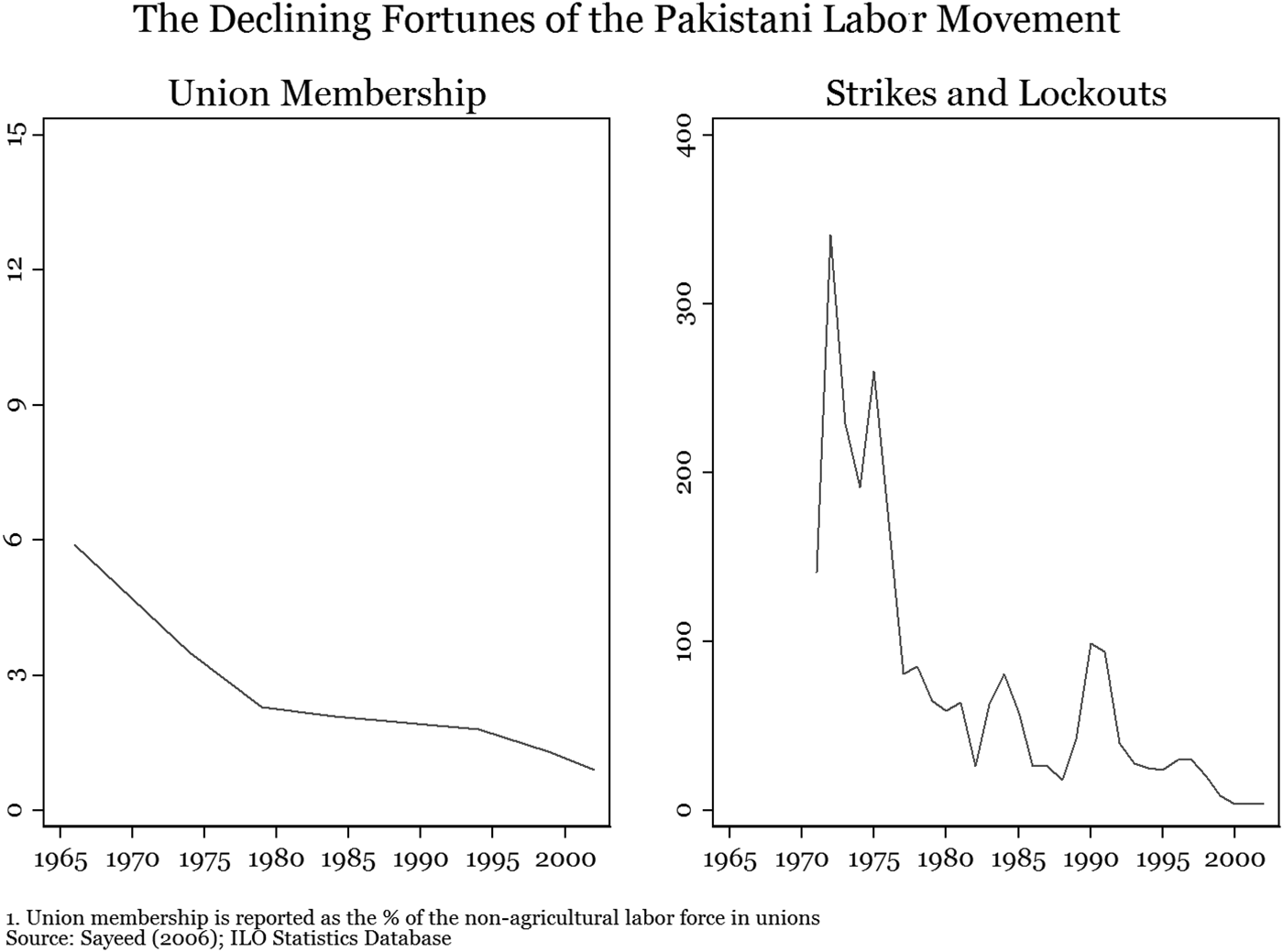
The authoritarian political system exacerbated these structural difficulties. In 1959, the first Industrial Relations Ordinance broke from colonial precedent by forbidding the vast majority of the labor force to collectively bargain and by effectively banning workers' right to strike.Footnote 5 A new ordinance in 1969 and then further reforms under Z.A. Bhutto improved the position of workersFootnote 6 and, with the industrial development of the 1960s, enabled what one commentator has termed the Pakistani labor movement's “Golden Age.”Footnote 7 But Bhutto soon turned on the labor movement. And he was deposed by General Zia ul-Haq, whose dictatorship was arguably labor's darkest period yet. Despite the considerable growth of the manufacturing sector,Footnote 8 trade union membership stagnated, and strike activity plummeted. As summarized by Sayeed, “[s]ummarily banning all trade unions, Zia proceeded to deny labour of its most basic rights by abridgement and non-implementation of labour laws.”Footnote 9 Union leaders were imprisoned and their unions suppressed (see Figure 2).Footnote 10
The declining fortunes of the Pakistani labor movement.

The Neoliberal Onslaught
Perhaps predictably, Pakistani workers were poorly placed to resist the neoliberal assault that arrived in the 1980s in the form of International Monetary Fund (IMF) conditionalities. This process began in earnest in 1988 but accelerated dramatically in the early to mid-1990s. The IMF's conditionalities for Pakistan included the now well-known policy mix of rapid trade liberalization, financial deregulation, and privatization, combined with a tight monetary and fiscal policy. These changes were expected to bring increased economic growth and thus improved living standards. According to the IMF, its management “welcomes the bold and comprehensive reform measures just announced by the Pakistan Government. …The timely implementation of these wide-ranging policies should significantly strengthen the basis for high and sustainable economic growth in Pakistan in the context of financial stability.”Footnote 11
By the mid-2000's, after the post-9/11 boom, many began to claim a “turnaround” in the economy, citing growth rates consistently above 5 percent, which reached a high of 9 percent in 2004–2005, rising exports, falling inflation, and a soaring stock market.Footnote 12 Pakistan even began to receive the praise of the IMF.Footnote 13 It was assumed that neoliberal policies would lead to increased growth, which through an ill-defined mechanism of “trickle down” would translate to pro-poor growth, improving the livelihood of Pakistani workers.
Real Wages
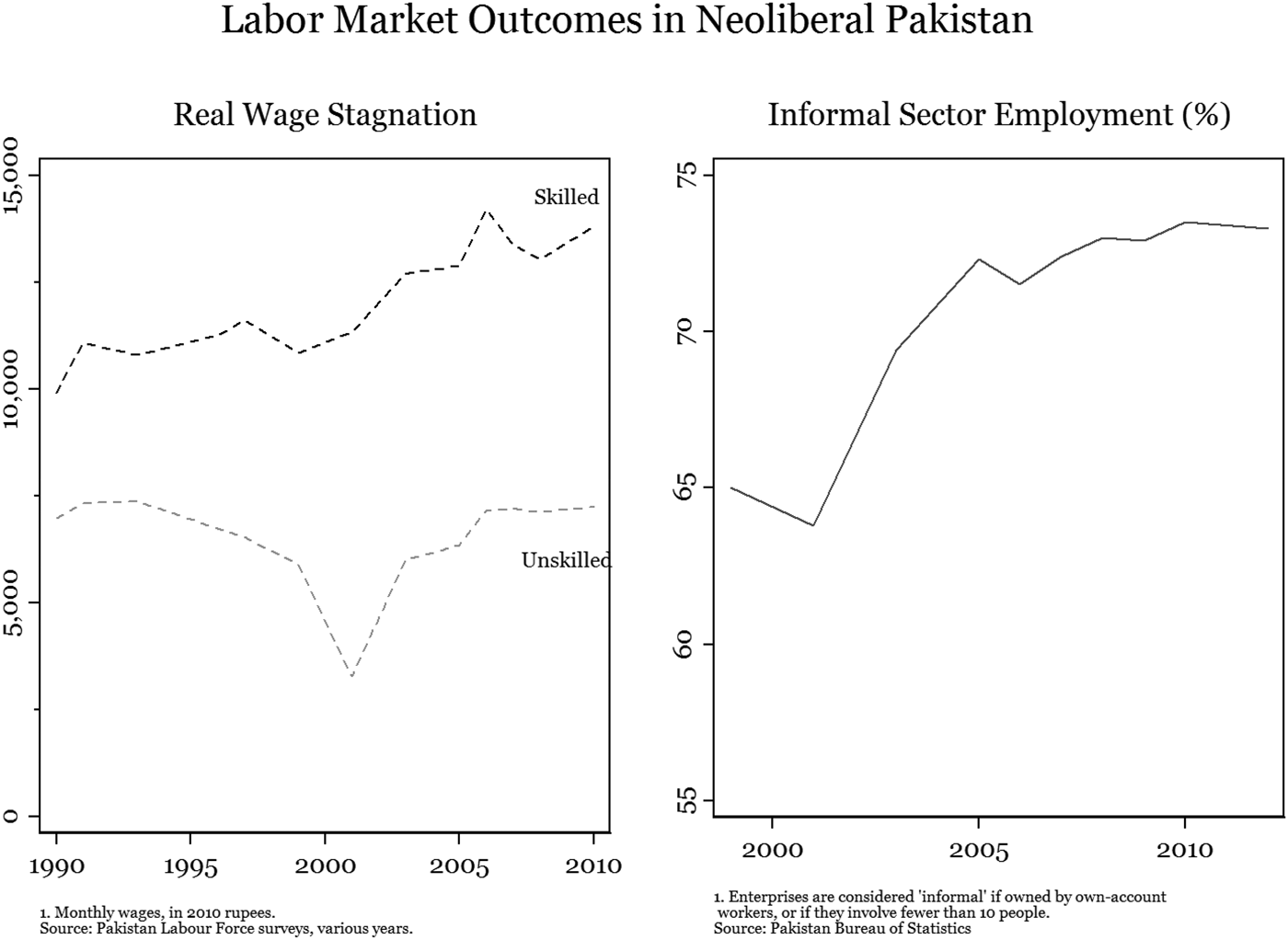
The net effect of these policies and processes has been dismal for the working class. First, there has been a stagnation or decline in real wages for large portions of the labor force (see Figure 3). Prior to the liberalization reforms, real wages were generally increasing, especially in the manufacturing sector, through the 1960s, 1970s, and early 1980s.Footnote 14 This growth in real wages was reversed in the early 1990s.Footnote 15 While wages in a few high skill/high salary sectors increased, for the majority of workers real wages stagnated or fell. This was largely the case even during the highly praised post-9/11 growth period of 2001/2002–2007/2008.
Labor market outcomes in neoliberal Pakistan.

It should be noted that the data on wages, drawn from the Pakistan Labor Force Surveys, are subject to a number of limitations. As a consequence, the extent of real wage stagnation, especially for lower income groups and unskilled labor, is understated. First, the data do not include the benefits that workers with permanent positions receive, which underreport the true gap in earnings between those workers and those employed on a contract basis or in the informal sector. Second, the consumption basket differs by income group, and inflation is higher for lower-wage workers, but this is not captured in the data, leading to overestimates of real earnings for the lowest-paid workers. Finally, most of the jobs that have been generated in the post-reform period are not in the sectors in which real wages have risen, but in the low-productivity, informal sector. As can be seen from Figure 3, the percentage of the workforce employed in the informal sector has steadily climbed.
Unemployment has been on the rise as well. Although official data suggest that unemployment hovers around 6 percent, it is widely acknowledged amongst policy makers and academics that the official figures disguise vast and growing levels of underemployment and casual employment. Low unemployment figures do not reflect healthy labor market outcomes, but rather the absence of an adequate social safety net, which leaves the unemployed with no option but to accept inadequate jobs.
One can glean some information about levels of underemployment from the Labor Force Surveys, which report that “vulnerable employment”Footnote 16 ranged from 50 percent to 62 percent between 2001–2002 and 2012–2013. This shows that the majority of the labor force is not in secure full-time employment. The share of “wage and salaried workers,” which represents those with stable jobs, has been consistently below 40 percent.Footnote 17 According to Karamat Ali, Executive Director of the Pakistan Institute for Labor Education and Research (PILER),Footnote 18 unemployment among educated youth is estimated to be around 45 percent. So much then for claims of economic growth and successful job creation!
Deregulation
The pace of labor market deregulation has increased over time in Pakistan.Footnote 19 The Pakistani labor movement roundly criticized the Industrial Relations Ordinances of 2002 and 2008 for being hostile to the interests of the working class. The 2002 ordinance greatly reduced penalties for labor law violations by employers and revoked the right of wrongfully terminated workers to reinstatement.Footnote 20 The 2008 ordinance, which was the work of the newly elected Pakistan People's Party government, was crafted without any input from labor and failed to address workers' deep-seated concerns and grievances. Under the ordinance, an estimated 80 percent of the workforce did not receive the protections of labor law.Footnote 21
Perhaps the most vocal proponents of such liberalization have been the World Bank and the IMF. A 2006 report from the World Bank, for instance, called the “excessive regulatory burden [of] existing labor laws” a critical factor holding back private-sector job creation.Footnote 22 Similarly, in a 2012 report, the IMF points out, “Improvement in labour market efficiency [defined by, amongst other things, ease of hiring and firing and flexibility of wage determination] is critical if jobs are to be created in the formal private sector.”Footnote 23 In keeping with this advice, in its 2003 Industrial Policy, the government of the state of Punjab officially suspended factory inspections and allowed enterprises to police their own social security contributions.Footnote 24 A revised, country-wide Labor Inspection Policy passed in 2006 weakened oversight over factory working conditions in the nation as a whole, and relaxed restrictions on work hours, which were established as early as 1969 under the West Pakistan Shops and Establishment Ordinance.Footnote 25 Needless to say, the deplorable work conditions present at Ali Enterprises in Karachi, where 259 workers were killed in a September 2012 fire, are not atypical in today's Pakistan.
The recent passage of the Eighteenth Amendment to the Pakistani constitution made labor a provincial subject, which has greatly muddied the jurisdictional waters and done little to improve matters for workers. Provinces were expected to pass their own ordinances to regulate industrial relations, and this enabled Punjab to curtail unionization rights by excluding enterprises with fewer than fifty employees from the purview of collective bargaining laws.Footnote 26 In Sindh the rights of association were extended in 2013 to agricultural workers, but this is unlikely to change things in practice.Footnote 27 Under the new constitutional regime, the task of overseeing and enforcing existing labor legislation now falls to provincial bureaucracies, which lack the requisite capacity and resources. The signs, in short, are not promising for the workers of Pakistan.
Privatization
Arguably, the large-scale privatization of public enterprises has had the greatest impact on the labor movement over the past two decades. Until the 1990s the heart and soul of the labor movement lay in the public sector, where jobs were formalized, secure, and well protected. But over the course of the 1990s and 2000s, many of these enterprises, ranging from banks to telecom companies, were privatized. The pretexts for this change were often inefficiency and overstaffing. Overstaffing was said to put increased resources (labor) into areas of lower marginal productivity. Labor, it was argued, needed to be redeployed to more profitable sectors, which would increase overall efficiency in the economy. Workers were promised retraining so that they could move to higher profit (and supposedly higher paid) sectors, but this retraining never materialized, and neither did labor-intensive, high-productivity sectors. Between 1991 and 1998, employment in public sector corporations was halved.Footnote 28 Workers were also fired and then rehired after privatization, with lower wages and on temporary contracts. While unions in some sectors managed to put up some resistance and extract better terms, such as more generous severance packages, they were too weak to prevent privatization.Footnote 29 The state was often brutal, cracking down ruthlessly on strikers and rallies and imprisoning protesters on all kinds of fabricated charges, including terrorism.Footnote 30
Privatization and the lack of growth in the large-scale manufacturing sector had wider effects on labor standards in general. Public sector jobs were permanent, secure, and better paid, with all the attendant benefits such as paid leave, sick days, etc. After the selling off of government enterprises, even large-scale private firms began to hire workers on a contract rather than permanent basis in order to cut costs and to prevent workers from unionizing.Footnote 31 Anecdotal evidence suggests that in a typical, large factory, up to 85 percent of workers may be hired through as many as twenty different subcontractors.Footnote 32 This has contributed to an “informalization of the formal sector,” as subcontracting firms typically employ fewer than ten workers and are thus not subject to formal labor law.
Rural-Urban Migration
Other trends over the neoliberal period have exacerbated the plight of workers. Rural-urban migration, for instance, has increased the number of workers in cities, thus weakening their bargaining power and putting great downward pressure on urban wages. Pakistan has seen several waves of rural-urban migration. In 1951, 82.26 percent of the total population lived in rural areas; this figure dropped to 66 percent in 2008. There are many reasons for this migration. The introduction of green-revolution technologies in the 1950s and 1960s pushed small producers and landless labor out of the rural areas. Industrialization in the 1960s and 1970s attracted workers from the countryside. Structural adjustment in the early 1990s dramatically reduced subsidies for the social and agriculture sectors, affecting health, education, social housing, employment, and incomes. Finally, urban growth and massive speculation in real estate is depriving communities that subsist on fishing, agriculture, and other rural occupations of their lands and means of livelihood. In a related development, corporate dairy farming is resulting in large-scale evictions of tenants and sharecroppers. More recently, the enormous rise in input prices (for fertilizer, pesticide, etc.) has put severe strain on small landholders. This pressure comes as villages move from subsistence and self-sufficiency to a dependent, cash economy. Cash is an ever-pressing need to pay utility, education, and health bills, and agriculture does not lend itself to sustained cash flows the way urban employment does.
Globalization and Textiles and Garments
The staggering levels of unemployment and consequent downward pressure on wages are not sufficient to keep Pakistani goods competitive in world trade. Pakistan's largest industry, textiles, is mobilizing a reserve army of women to further depress wages in an attempt to maintain its position in the world economy. Textiles, along with garments, have for the past several decades remained Pakistan's most significant industry, attracting the highest share of total capital investment. Textiles also account for nearly 38 percent of the total manufacturing labor force and contribute about 9 percent to the GDP while also comprising between 50 and 70 percent of the country's total exports.Footnote 33
Things changed dramatically for this industry in 2005, with grave implications for garment workers. The global quota regime established by the Multi-Fibre Agreement (MFA) had ensured Pakistan a guaranteed share of global garment exports in particular categories, such as cotton T-shirts. In 2005 this was phased out. The MFA had served Pakistan's garment industry well, giving manufacturers a measure of protection from cut-throat, race-to-the-bottom global competition. With the abolition of quotas, it was feared that business would flow out of Pakistan to countries, such as China, India, and Bangladesh, where suppliers were better attuned to the supply chain and could offer lower unit costs with quicker turnaround. In response to this threat, two major programs were initiated to maintain the competitiveness of Pakistani textile and garment manufacturing. First, piece rates were replaced with a wage payment system centered on line work—a detailed division of labor involving the repetitive application of a narrow range of skills.
Second, expensive male workers were replaced with less costly, more compliant females. Before 2000, nearly 700,000 workers were employed in the garment industry,Footnote 34 but only 10 percent were female.Footnote 35 Between 2005 and 2009 female employment had passed the 20 percent mark and is now thought to be close to 30 percent.Footnote 36 The advantages of using women workers were two-fold. First, while men working on piece rate tended to be more independent, organized (albeit in informal social networks), and knowledgeable about their rights (and hence difficult to control), women were found to be far more docile and ignorant of their rights. Second, women were being employed at wages that could be half those of men. Indeed, the industry became one of the largest employers of women in a country where 78 out of 100 women are engaged full-time in unpaid family duties.Footnote 37
It is important to note, however, that despite the weakened bargaining position of workers in this industry (the number of registered trade unions in textiles went down from 335 in 1990 to 2 in 2008) and resistance from male piece-rate workers, these changes were not rammed through by brute force. Multilateral agencies such as the United Nations Development Program (UNDP) ran elaborate and expensive campaigns to recruit female workers and legitimize factory work for women in terms of women's empowerment and gender balance. It was through UNDP's recruitment and training of cheap female labor that Pakistan's textile and garment sectors were able to at least partly survive the shock of global competition.
The stress that global trade has put on Pakistani textile and garment workers is also reflected in surveys of the workforce. For instance, a 2010 PILER study of Karachi power loom weavers found that more than 90 percent of the respondents were working 12-hour work days; 93 percent did not have paid weekly holidays, and 99.8 percent were not paid overtime wages. None of them had written contracts, and only 0.5 percent of the workers were in possession of a factory identity card. Only 2 out of 1,000 respondents were registered at the state-run Social Security Institution and Employees Old-age Benefit Institution.Footnote 38
Conclusion
The Pakistani labor movement, in short, has seen better days. While it was never as strong as its counterparts in other regions of the world, owing to Pakistan's particularly acute form of underdevelopment, unions and their members were an important political constituency in the 1960s and 1970s. The economic and political winds of the last three decades, however, have not been favorable. Today, the most noticeable political cleavages in Pakistan run along provincial and ethnic lines. While it is impossible to predict what the next decades hold, what is certain is that ordinary people have much to gain from the revival of class politics, the possibility of which does not, fortunately, lie entirely beyond their control.