








1 Introduction
In theoretical psychology, Jens Mammen has proposed a model for what may be called the interface between the inner world of a human mind, and the outer world that this human mind lives in, perceives, and interacts with. From the outset, Mammen has formulated and presented his theory axiomatically, in the style familiar to mathematicians. The purpose of this paper is to study the set-theoretic aspects of Mammen’s theory.
Briefly, a Mammen space can be defined as follows:
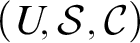
Definition 1.1. A Mammen space is a triple
 $(U,\mathcal S,\mathcal C)$
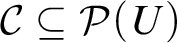
, where U is a non-empty set, called the universe of objects, and
 $\mathcal S,\mathcal C\subseteq \mathcal P(U)$
such that
-
(1)
 $\mathcal S$
is a perfect Hausdorff topology on U; here perfect means that every non-empty open set is infinite, and so in particular the set U is infinite.
-
(2)
$\mathcal C$
satisfies:-
(a) There is a non-empty
$C\in \mathcal C$
; -
(b)
$\mathcal C$
is closed under finite unions and intersections; -
(c) Every non-empty
$C\in \mathcal C$
contains a singleton which is in
$\mathcal C$
.
-
-
(3)
$\mathcal S$
and
$\mathcal C$
together must satisfy:-
(a)
$\mathcal S\cap \mathcal C=\{\emptyset \}$
; -
(b) If
$C\in \mathcal C$
and
$S\in \mathcal S$
then
$C\cap S\in \mathcal C$
.
-


The elements of
 $\mathcal S$
are called sense categories and the elements of
 $\mathcal C$
are called choice categories. The reader should think of a Mammen space
 $(U,\mathcal S,\mathcal C)$
as a model that a person’s mind has (or has built) as a result of sensory input and experience: It has formed broad categories of the objects in the universe U, and these are represented by the subsets of U which are in
 $\mathcal S$
; and it has singled out categories of particular objects or people, and these are represented by subsets of U which are in
 $\mathcal C$
. For instance, the mind of a person overlooking a beach will have a sense category of all the stones on the beach, but if that person singles out a special stone and picks it up, he is availing himself of a choice category, which in the mathematical representation is the singleton of that special stone. Restating this with the emphasis on the role of
 $\mathcal C$
instead, the idea is that categories in
 $\mathcal C$
represent collections of objects, people, animals, etc., of particular attachment for the person (e.g., the person’s father), in contrast to the broad categories in
 $\mathcal S$
(e.g., the category of all people who are fathers).
Fuller details of the psychological background and motivation for the definition of a Mammen space are given in Section 2 below.
The question which gives rise to much of the mathematics of this paper is the question of completeness: Are the categories
 $\mathcal S$
and
 $\mathcal C$
sufficient to be able to account for all possible categories of objects that can be formed in the universe? That is, can every
 $X\subseteq U$
be written as
 $$ \begin{align*} X=S\cup C\text{ where } S\in\mathcal S\text{ and } C\in\mathcal C {\,?} \end{align*} $$
If this is the case, we will call the Mammen space
 $(U,\mathcal S,\mathcal C)$
complete.
From the point of view of psychology, if we think of a Mammen space as a model of someone’s mind, then completeness is important as it corresponds to that the mind has formed, or can form, all possible categories of objects and describe them in terms of just the two systems
 $\mathcal S$
and
 $\mathcal C$
(see Sections 2 and 9 for a longer discussion). From the point of view of mathematics, the possibility of having a complete Mammen space turns out to be non-trivial. It was answered in the positive by Hoffmann-Jørgensen in [Reference Hoffmann-Jørgensen and Mammen9], but the Axiom of Choice (below abbreviated AC, or Choice) was used to do so:
Theorem 1.2 (Hoffmann-Jørgensen. Uses AC)
For any infinite set U, there is a complete Mammen space with universe U.
Hoffmann-Jørgensen proved this by observing that if
 $\mathcal S$
is a maximal perfect topology on U, and we take
 $\mathcal C$
to be the family of closed nowhere dense subsets of U, then
 $(U,\mathcal S,\mathcal C)$
is a complete Mammen space. (We will reprove this below; see Theorem 3.6 and Corollary 3.8.) The Axiom of Choice is used by Hoffmann-Jørgensen only to ensure that maximal perfect topologies exist.
Do we really need the Axiom of Choice to prove Theorem 1.2? Given the psychological origin and relevance of the notion of a complete Mammen space, it is desirable to avoid using AC in its full strength, if possible, and at the same time highly interesting if AC can’t be avoided (see discussion in Section 9). Hoffmann-Jørgensen was of the opinion that AC is unavoidable, and conjectured this:
Conjecture Ia (Hoffmann-Jèrgensen)
If there is a complete Mammen space, then the Axiom of Choice holds. In particular, if there is a maximal perfect Hausdorff topology, then the Axiom of Choice holds.
The purpose of this paper is to refute this conjecture, and at the same time show that Theorem 1.2 requires some non-constructive mathematical methods, at least if the universe U is required to be countably infinite.Footnote 1 Specifically, we will prove:
Theorem A. In the first Cohen model, that is,
 $\operatorname {\mathrm {HOD}}^{V[G]}(A)$
where A is the countable set of Cohen reals added by the generic G, there is a complete Mammen space, and the underlying universe U of this space can even be chosen to be countable. Indeed, in
 $\operatorname {\mathrm {HOD}}^{V[G]}(A)$
, it holds that every perfect topology can be extended to a maximal perfect topology.
Since it is well-known that
 $\operatorname {\mathrm {HOD}}^{V[G]}(A)$
is a model of Zermelo–Fraenkel (ZF) set theory in which Choice fails, the previous theorem refutes Hoffmann-Jørgensen’s conjecture.
As a counterpoint to Theorem A, we will show:
Theorem B. If all sets are Lebesgue measurable, or if all sets are Baire measurable, then there are no complete Mammen spaces with a countable universe U. It follows that it is not possible to prove in ZF alone that there is a complete Mammen space with a countable universe.
It is open if ZF alone can prove the existence of a complete Mammen space with an uncountable universe (see Question 5 in Section 8).
In the final parts of the paper, we will defineFootnote 2 two new cardinal invariants that are naturally associated with the notions of maximal perfect topologies and complete Mammen spaces:
 $$ \begin{align*} \mathfrak u_{T}=\inf\{\operatorname{\mathrm{card}}(\mathcal B): \mathcal B \text{ is the basis of a maximal perfect Hausdorff topology on }{\mathbb N}\}, \end{align*} $$
and
 $$ \begin{align*} \mathfrak u_{M}=\inf\{\operatorname{\mathrm{card}}(\mathcal B): \mathcal B \text{ is the basis of }\mathcal S\text{ of a complete Mammen space }({\mathbb N},\mathcal S,\mathcal C) \}. \end{align*} $$
We will show the following:
Theorem C. Let
 $\operatorname {\mathrm {add}}(\operatorname {\mathrm {BP}})$
denote the additivity of the meagre ideal (see [Reference Jech10, p. 515]). Then:
-
(1)
$\operatorname {\mathrm {add}}(\operatorname {\mathrm {BP}})\leq \mathfrak u_{M}\leq \mathfrak u_{T}\leq 2^{\aleph _{0}}$
. -
(2) In particular,
$\mathfrak u_{M}$
and
$\mathfrak u_{T}$
are always uncountable, and if Martin’s Axiom holds then
$\mathfrak u_{M}=\mathfrak u_{T}=2^{\aleph _{0}}$
. -
(3) In the Baumgartner–Laver model we have
$\aleph _{1}=\mathfrak u_{M}=\mathfrak u_{T}<2^{\aleph _{0}}=\aleph _{2}$
.


Towards the end of the paper, we discuss several intriguing questions that remain open.
2 Psychological background
The present paper is basically about some mathematical problems. However, the motivation for posing the problems has its roots in corresponding questions in psychological science. Therefore, there will be a short introduction to these psychological questions, also to provide a possible interpretative frame for the mathematics, or even a model outside mathematics. At the same time, we attempt to briefly show the relevance to psychology of the kind of mathematical model that is presented here, and give a few hints of even broader relevance.
This introduction is not in itself a psychological paper with the usual demands for documentation and direct references, as this would consume too much space in the present context. More details could be found in the works in the reference list. The reader who primarily is interested in the axiom system for Mammen spaces can skip ahead to Section 2.4.
2.1 Introducing psychology and psychophysics
Today, psychology is not a coherent science with commonly accepted basic theoretical concepts. This means that it will be impossible to give a short covering definition of the scientific field, and perhaps even worse, also of the concrete domain of study, or in other words what it is about and how it can be applied as a tool in this context.
There is, however, a not quite negligible minority claiming that human psychology must in some way be about the “interface”Footnote 3 between humans and the world we are living in.
This does not mean that questions of what is going on inside the body, and especially in the brain, be it subjective experiences and/or physiological processes, are of no interest in psychology, on the contrary. But a prerequisite for this study is that the tasks to be solved by the brain and the body meeting the world are rather well understood. Walking is the key to understanding the legs, which again serve and constrain walking.
The mythical, philosophical, and scientific understanding of this “interface” has a long history since antiquity which of course can’t be covered here. When focusing on scientific psychology something dramatic happened, however, around 1850 when psychology found a way to define itself as a natural science in the conceptual frame of contemporary physics, chemistry, physiology and mathematics. Before that psychology had rather been considered an auxiliary discipline to theology and philosophy.
It is thus common to define the birth of modern scientific psychology to the introduction of so-called psychophysics, often referring to the theory of G. T. Fechner. The idea was to consider the senses, e.g., vision, hearing, smelling, as “transmitters” receiving objective physical-chemical “input,” and as “output” causing subjective impressions with some, mostly hypothetical, physiological correlates or equivalents. Further the idea was to apply measures not only to the objective input but also to the subjective output, so the two events or entities could be bridged by a quantitative mathematical function.
This bridging, however, had a price. When our contact with the world before psychophysics had been understood as meaningful it was now reduced to the raw material of patterns of, in themselves meaningless, quantitative sense impressions. How could meaning, or conceptual knowledge, be reestablished on this meager ground? Psychology was “eaten” by the mechanistic understanding of the outer world. Psychophysics not only appeared as a bridge but perhaps even more as a barrier between man and world.
The problem is classic and reflected in European philosophy since the renaissance. There are inductive or empiricist attempts appealing to high, complex or hierarchical organizations of input-patterns (“sense data”) hoping that “consciousness” would pop up with enough complexity, but in vain. And there are deductive or rationalist attempts appealing to a priori conceptual frames inducing order and meaning in the patterns, e.g., as when I. Kant rightly claims that time and space as frames for objects can’t be inferred from sense impressions but have to be a priori, but just raising new problems.
Many other attempts have been promoted to overcome the reductions of psychophysics. There has been appeal to language, hermeneutics, and semiotics in what in newer philosophy and psychology has been called “the linguistic turn” (see [Reference Mammen19], ch. 2). There are even attempts to reintroduce Aristotelian teleology violating the modern concept of proximal forward causality.
The result is that today we either have a reductionist mechanistic psychology or a psychology with a schism between a pure naturalist approach and a pure humanistic approach, sometimes expressed as “the two cultures” or Naturwissenschaft versus Geisteswissenschaft with two incompatible frames of understanding, causing both theoretical and practical problems.
Common to these attempts or approaches is that they don’t correct or change psychophysics but either accept it as it is, or try to supplement it with principles “taken from elsewhere” but in a conceptual frame being incompatible with psychophysics. A third stance is just to turn your back to psychophysics and natural science and promote a pure humanistic psychology.
2.2 Inspiration from modern natural science and mathematics
There is, however, still another approach with inspiration from physics. When it was discovered that electromagnetic propagation of waves and particles did not follow the same kinematic laws as movements of solid bodies you did not choose a split in theory of movements in space and time but rather, as Einstein did, searched a “conservative generalization” of classical kinematics to include both corporeal movements and electromagnetic movements in one common law.
Einstein analyzed in detail the classic “Galilei-transformation” for movements of bodies in different systems of reference and searched what was the minimal change which conserved the classical laws for slow movements and still included the new knowledge of the speed of light. The apparent paradox is that this conservative approach implied the most revolutionary result, the famous formula for equivalence of mass and energy, as a simple deductive implication.
The principle of conservative generalization is also well known from mathematics: Non-Euclidean geometries are still locally Euclidean, complex numbers include the real numbers, etc. The principle has, however, not played an apparent role in psychology.
Let us have a closer look at psychophysics to see if we can copy Einstein and conserve its unquestionable virtues without falling back to its reductionism. First, we must re-conceptualize psychophysics.
Early psychophysicists believed that they bridged objective stimulation and subjective impressions when measuring both and connecting them in a quantitative functional relationship.
That was, however, the result of a rather speculative interpretation of what was going on in the experiments. What was demanded from the experimental subjects when they were presented for physical stimulation was in fact only to make a yes/no-decision, or with other words to react or not. The questions to answer were either if some stimulation was at all being noticed (being greater than zero), or if a stimulation in some well-defined respect (e.g., size, strength, and pitch) was greater than (or smaller than) another stimulation, serving as a comparative standard.
The experiments can be considered a continuous mapping from the domain of stimulation on the two-valued set (yes, no), and what was found in the experiments was the inverse images in the domain of the response “yes” (for noticed difference).Footnote 4
These kinds of inverse images were introduced in [Reference Mammen18, 1983], and following the terminology established there, they are called sense categories. They are sets organizing the domain of stimulation in a structure similar to the way the real axis is organized by open intervals defined by measurements based on the relations “greater than” and “smaller than,” which is a perfect Hausdorff topology or just a perfect topology.Footnote 5
It is postulated that also outside the experimental situation is this topology a structural description of the senses’ capacity, of course to be filled out with more quantitative definitions. Still this may be an idealization, but perhaps the best one we have as a theoretical foundation for understanding our sensory interface with objects in our world.
This description of our “interface” with domains of stimulation from objects in our environment can be generalized to the domain of the objects themselves. In psychology this is conceptualized as the movement, or step, from sensation to perception.
Now, the sense categories can be seen as organizing the domain of objects in a structure equivalent to a perfect topology.
Furthermore, this step from sensation to perception includes perception in a more general approach in psychology which could be called the extensional approach, i.e., the attempt to understand the human subject by taking departure in which parts of the, in principle infinite, world we are making objects for our relations and activities. In this context “objects” should be understood as including places as well as other subjects.
A little metaphorically expressed are our practical, cognitive and emotional relations and activities considered as selections or “figure-ground” operations on the infinite domain of objects, initiated by the subject. The originally Russian Activity Theory [Reference Leontiev16] is a paradigmatic example of thinking about subjects in terms of such object directed activities. The so-called ecological approach as represented by the American psychologist J.J. Gibson [Reference Gibson6] is another example.
2.3 A conservative generalization of psychophysics
In this perspective it becomes evident what is the insufficiency of reducing humans’ “interface” with the world to a structure of sense categories. Sense categories are general categories of measures or “universals” and are only catching in principle infinite sets of objects defined by their measurable properties. They are not able to “zoom in” on any particular object. The perfect topology has no singletons.
But humans are not only living in a world of “superficial” universal properties, or with an interface to the world of only sensory pattern recognition. We are first of all, being particulars ourselves, relating to “particulars” or “individuals” with an individual history, in many cases irreplaceable and linguistically denoted by proper names. That is the case with our relatives, our possessions, and our belonging. It is these “deep” relations of co-existence (kinship, love, grief, solidarity, moral obligations, veneration, sentimental value, etc.) which give our life meaning, and it is fatal if psychology, of all sciences, is ignoring them.
The historical “threads” of particular objects are also what define the meanings we share and express in language and concepts as, e.g., a present or a gift. The difference between a valid coin and a counterfeit is not their properties but their individual history of origin.
But the ignorance is also fatal in a practical sense. As already Kant pointed out is the condition for an empirical statement (not only in science but also in everyday life) that the chosen particular object of predication is defined independently of the universal predicates in the statement. If you already have used them for identification, the statement is not empirical (synthetic) but analytic.
Our choice of objects, in space and time, for use or investigation, or predication, is not dependent of an infinite process of “zooming in” on the set of universal sense categories. Due to our existence as particulars ourselves and being in a particular place at a particular time we can just take an object or point it out.
When walking on the beach I can just pick up an accidental stone without having to define it in advance by discriminating it from all other stones. I can put it in my pocket, and without having noticed its form and color I can be sure it is the same when returning home.
In contrast to sense categories, particulars or collections of particulars are here called choice categories (following the terminology established in [Reference Mammen18, 1983]). They are not necessarily finite, as they could also be defined by networks departing from particulars as a, in principle infinite, genealogical tree.
These two structures are disjoint in the sense that no non-empty choice category can be a sense category, although they of course may share objects. But at the same time the two structures are framing each other. When picking up a stone I am not searching a piece of driftwood. And when coming home with a finite collection of chosen stones I will be able to not only distinguish them mutually but also to identify each—within this collection—with a finite sensory description.
In fact, this capacity to have simultaneous dual relations to objects in the world, as members of sense categories and of choice categories, may have some antecedents in animals, but seems, in its full realization, to be a human privilege. In philosophical terms it is the capacity to operate jointly with objects’ qualitative as well as numerical identity. Besides being basis for establishing a genuine referential language, it makes the distinction meaningful between, e.g., seeing a new object, and seeing a well-known object with changed position or properties, which is vital for our cognitive, practical and emotional life.
This capacity is developed during our first year of life, before our appropriation of language, and remains a logical basis also in adult life. A renowned experimental study in this context is [Reference Xu and Carey30]. For an overview of some later research see [Reference Krøjgaard14].
The concept of choice categories, or equivalent concepts in other frames of terminology, is, however, nearly non-existing in theoretical psychology, with exception of the above-mentioned niche of infant research where Krøjgaard (e.g., in [Reference Krøjgaard, Tønnesvang, Høgh-Olesen and Bertelsen13]) explicitly refers to sense and choice categories. The concept has, however, practical equivalents in applied psychology, e.g., clinical psychology, and has also been used more explicitly in clinical psychology. An early example is [Reference Mogensen23] in an analysis of schizophrenia as an impairment of choice categories. A more recent example is Neumann [Reference Neumann24] working with Danish soldiers’ affective relations on the battlefield on foreign missions.
Almost all theoretical psychology is still split in two (or even more) fragments, as described in Section 2, with no consistent conceptual frame to unite the field, with severe consequences for academic studies and teaching, applied psychology, and interdisciplinary collaboration [Reference Mammen, Christensen, Wagoner and Demuth21]. Here, the missing concept of choice categories plays a decisive role.
This means that it isn’t easy to support our mathematical and logical points with, and interpret them in terms of, present-day-psychology only, but rather in relation to our tacit everyday logic (see also [Reference Mammen20]) and to examples from philosophy,Footnote 6 as we tried above.
This also means that the potential field of interpretation may be very broad,Footnote 7 but also that the present attempt to introduce the duality of sense and choice categories in psychology and to formalize the duality axiomatically is “new territory”[Reference Mammen, Karpatschof, Engelsted, Hedegaard and Mortensen17–Reference Mammen20, Reference Mammen and Mironenko22], only partially explored.
Also, many of the mathematical and logical details in the following exposition have no immediate psychological interpretation. Some of them may have it, however, when some of the open questions listed later hopefully are being answered. As part of mathematical logic Mammen Spaces are also new territory.
Summing up and concluding, we should remember that psychology is an empirical and applied scientific discipline with a much fragmented and underdeveloped theoretical structure, e.g., compared with physics. But although physics has a solid theoretical core matching empirical data and with applied success, it also has a fringe of theoretical predictions not yet verified and empirical data not yet fitting the theory, and also a fringe of competing theoretical expansions.
Compared with this, psychology is, however, still extremely underdeveloped and with no effective theoretical core.
In the paper we attempt to construct a limited, but solid basis for such a theoretical core. We have to stress, that this core is new and “in the making,” and also that the logical bridge from psychology to the extensional approach of mathematical logic, to the best of our knowledge, has not been constructed before. The paper is generally more explorative than conclusive.
This means that there are few already established explicit examples from scientific psychology to be integrated with the more mathematical development of the core, beyond the ones already mentioned.
A little more elegant and integrated presentation would, however, be possible when some of the open questions to the mathematical development in Section 8 have been answered, e.g., Question 3, which directly calls for a psychological interpretation.
2.4 Axiomatics for sense and choice categories
It should now be time for presenting an axiomatic system describing the joint structure of sense and choice categories. Here U denotes the world of objects.
Ax. 1: There is more than one object in U.
Ax. 2: The intersection of two sense categories is a sense category.
Ax. 3: The union of any set of sense categories is a sense category.
Ax. 4 (Hausdorff): For any two objects in U there are two disjoint sense categories so that one object is in the one and the other object in the other one.
Ax. 5 (perfectness): No sense category contains just one object.
Ax. 6: No non-empty choice category is a sense category.
Ax. 7: There exists a non-empty choice category.
Ax. 8: Any non-empty choice category contains a choice category containing only one object.
Ax. 9: The intersection of two choice categories is a choice category.
Ax. 10: The union of two choice categories is a choice category.
Ax. 11: The intersection of a choice category and a sense category is a choice category.
A lengthy discussion of the motivation and intuition behind each axiom can be found in Chapter 7 of [Reference Mammen19]. It has been proven that the axioms are consistent and independent [Reference Mammen18, Reference Mammen19].
Axioms Ax. 1–5 state that sense categories are the open sets in a perfect topology on the underlying set of objects U, and so correspond to (1) of Definition 1.1 in the introduction.
Axiom Ax. 5 claims that there are no singletons or that no single object is “decidable” in the topology of sense categories.
If U had been finite would axiom Ax. 4 imply that all single objects themselves were sense categories, or singletons, in the topology. This is however negated by Ax. 5, which proves, that U must be infinite.
It is Ax. 5 which “opens for” or “makes room for” the existence of non-empty choice categories as stated in Ax. 7 and thus invites the conservative generalization of the topology of sense categories to a structure also including choice categories.Footnote 8
Axiom Ax. 6 states the mutual exclusion of the two kinds of categories, and corresponds to (3.a) of Definition 1.1 in the introduction.
Axioms Ax. 7–10 describe the structure of choice categories, and correspond to part (2) of Definition 1.1.
Axiom Ax. 8 secures the existence of finite non-empty choice categories. Further it states, in interpretative terms, that every non-empty choice category contains an “accessible,” “reachable” or “decidable” member, or in other words, that every non-empty choice category must contain at least one identified specimen or instance. It further follows from the axioms that after picking out a member of a choice category, what is left is still a choice category. But also that it does not follow that the choice category necessarily could be “emptied” or “exhausted” by repeating this operation. It does also not follow that every member of a choice category is a choice category. That would be too radical generalizations, although the axioms don’t exclude these possibilities.
Finally, axiom Ax. 11 expresses the interaction, or mutual framing, of the two kinds of categories. This corresponds to (3.b) of Definition 1.1.
Of course, we can also combine the categories and define a joint concept of decidable category:
Definition 2.1. A decidable category is a union of a sense category and a choice category.
As it can be proven from the axioms that the empty set
 $\emptyset $
is both a sense category and a choice category, it follows that sense and choice categories themselves are decidable categories.
There are many implications of the axiomatic system.Footnote 9 Here we shall just refer to two consequences in the form of derived theorems, Theorems 9 and 10, from the set of axioms. The numbering refers to the one used in [Reference Mammen19, pp. 80–82].
Theorem 2.2 (Theorem 9, Correspondence)
Any finite choice category defines a subspace in U where all subsets are both choice categories and “local” sense categories.
In other words is the induced or relative topology on the subspace discrete both with respect to sense categories and choice categories. The proof is trivial.Footnote 10 The term “correspondence” refers to the fact that within any finite choice category the logical structure is reduced to the well-known classical “Aristotelian” logic in the same way as, e.g., relativistic or quantum mechanical theories under limiting conditions are reduced to classical physics, which is Niels Bohr’s famous correspondence principle, reciprocal to the abovementioned principle of conservative generalization.
Theorem 2.3 (Theorem 10, Globality)
Any sense category in U containing a non-empty choice category defines a subspace where all axioms Ax. 1–11 are satisfied.
The proof of this theorem is also trivial.Footnote 11
The theorem tells that the structure defined by the 11 axioms is global or pervasive in U and that it repeats itself in any detail as a fractal structure, or in mathematical terms that it is hereditary. It also says that the axiomatic system is rather “immune” to changes in definitions and interpretations of U and its “range.”
2.5 The possible completeness of the axiomatic system
The aim of the analysis until now has been to establish an understanding of the interface between man and the world of objects. This is of course not exhausting psychology in any way but just defining a foundation or basis on which to build an understanding of development of our cognition, actions, feelings, language, and much more.
In the present context we shall, however, dwell a little more on this basis itself, or in other words humans’ immediate interface with the world of objects. One urgent problem is here if this basis, as defined by the 11 axioms, can be considered complete in the sense that there is not some third kind of category determining the structure of the interface. Could you from the 11 axioms deduce that such a third kind of category must necessarily exist? Or, alternatively, that sense and choice categories are sufficient for describing any category of objects (i.e., subset of) U? The significance of completeness will be discussed more in depth in our final Section 9 (“Returning to psychology”) in a context of other important hypothetical properties of the model.
Having Def. 2.1 in mind this question can be expressed in these two conjectures:
Conjecture II (Claim of Completeness, CC)
There exists a space where any subset is a decidable category.
or its negation:
Conjecture III. There always exists a subset of U which is not decidable.
These opposing conjectures were put forward in [Reference Mammen18, 1983, pp. 406–407]. In [Reference Mammen18, 1989, pp. xvi–xvii] it was then proven that Conjecture III was true if the set of sense categories had a countable basis, but no more general proofs were established.
However, in 1994 Hoffmann-Jørgensen in [Reference Hoffmann-Jørgensen and Mammen9] proved that if the sense categories had a basis with higher cardinality than U, then Conjecture II (CC) was true if Zorn’s Lemma was true, Zorn’s Lemma being equivalent with the Axiom of Choice (AC).
Hoffmann- Jørgensen referred to the fact that Zorn’s Lemma implied the existence of maximal perfect topologies [Reference Hewitt8, Reference van Douwen29] and proved that this existence further implied the Claim of Completeness (CC).
Hoffmann-Jørgensen then, as stated in the introduction, put forward the opposite implication as a conjecture:
Conjecture Ib (Hoffmann-Jørgensen [Reference Mammen19, p. 86])
CC implies AC.
It was rather surprising, that the set of 11 axioms combined with the claim of completeness seemed to imply an exotic structure as maximal perfect topologies, higher cardinalities, and perhaps also the axiom of choice. After all, taken separately the axioms were extremely simple as they were directly translatable into first-order-logic, and not more complicated than they could be explained on elementary school level.
However, Hoffmann-Jørgensen, and in fact some colleagues in Moscow, were not able to prove the above conjecture.
3 Mathematical background
This section sets the general stage for the mathematical results of the paper, and collects various observations and lemmas about Mammen spaces (defined in the introduction), and the connection between Mammen spaces and maximal perfect Hausdorff topological spaces.
3.1 General observations
Let U be a non-empty set, let
 $(U,\mathcal S,\mathcal C)$
be a Mammen space with universe U, and let
 $\mathcal {T}$
be a perfect Hausdorff topology on U.
(1) If
 $I(\mathcal C)$
is the ideal generated by
 $\mathcal C$
, then it is easy to verify that
 $(U,\mathcal S,I(\mathcal C))$
is also a Mammen space.
(2) If
 $I\neq \{\emptyset \}$
is an ideal on U such that
 $I\cap \mathcal {T}=\{\emptyset \}$
, then
 $(U,\mathcal {T},I)$
is easily seen to be a Mammen space.
(3) Since
 $\mathcal {T}$
is a perfect topology, (2) gives that
 $(U,\mathcal {T},\operatorname {\mathrm {FIN}}(U))$
is a Mammen space, where
 $\operatorname {\mathrm {FIN}}(U)$
denotes the ideal of finite subsets of U.
(4) Let
 $\operatorname {\mathrm {NDe}}(\mathcal {T})$
denote the ideal of nowhere dense sets in the topology
 $\mathcal {T}$
. Then
 $(U,\mathcal {T},\operatorname {\mathrm {NDe}}(\mathcal {T}))$
is a Mammen space. Note that
 $\operatorname {\mathrm {NDe}}(\mathcal {T})\supseteq \operatorname {\mathrm {FIN}}$
, so this gives us an example with a potentially richer family of choice categories.
Recall from the introduction that a Mammen space
 $(U,\mathcal S,\mathcal C)$
is complete if every
 $X\subseteq U$
can be written as
 $X=S\cup C$
, where
 $S\in \mathcal S$
and
 $C\in \mathcal C$
. Building on (4) above, the next proposition tells us that in complete Mammen spaces, the sets
 $\operatorname {\mathrm {NDe}}(\mathcal {T})$
are necessarily choice categories:
Proposition 3.1. Suppose
 $(U,\mathcal S,\mathcal C)$
is a complete Mammen space. Then
-
(a)
$X\subseteq U$
contains no non-empty open set in
$\mathcal S$
iff
$X\in \mathcal C$
. -
(b)
$\mathcal C$
is an ideal, consisting precisely of the sets with empty interior. -
(c)
$\operatorname {\mathrm {NDe}}(\mathcal S)\subseteq \mathcal C$
.


Proof. (a) “
 $\Longrightarrow $
”: By completeness,
 $X=S\cup C$
for some
 $S\in \mathcal S$
and
 $C\in \mathcal C$
. So if X contains no non-empty set from
 $\mathcal S$
, then
 $X=C$
follows.
“
 $\Longleftarrow $
”: If
 $X\in \mathcal C$
and
 $S\subseteq X$
where
 $S\in \mathcal S$
, then
 $X\cap S=S\in \mathcal C$
by (3.b) of Definition 1.1/Ax. 11, and
 $S=\emptyset $
follows by (3.a) of Definition 1.1/Ax. 6.
(b)
 $\mathcal C$
is closed under finite unions by (2.b)/Ax. 10. That
 $\mathcal C$
is closed under subsets is clear by (a), and (a) also gives that it consists precisely of the sets with empty interior.
(c) Clear by (b).
The following simple combinatorial lemma will be used several times in the sequel; it was already observed by Jens Mammen in his early investigations of his axiom system (see, e.g., [Reference Mammen18, 1989, pp. xvi–xxi]).
Lemma 3.2 (Mammen)
Let
 $(U,\mathcal S,\mathcal C)$
be a Mammen space. Suppose there is
 $X\subseteq U$
such that the following property holds:
 $(*)$
For any
 $S\in \mathcal S\setminus \{\emptyset \}$
the sets
 $S\cap X$
and
 $S\setminus X$
are infinite.
Then
 $(U,\mathcal S,\mathcal C)$
is not complete.
Proof. Suppose, seeking a contradiction, that
 $(U,\mathcal S,\mathcal C)$
were complete. Then
 $$ \begin{align*} X=S\cup C \end{align*} $$
for some
 $S\in \mathcal S$
and
 $C\in \mathcal C$
. By
 $(*)$
, we can’t have that
 $S\neq \emptyset $
, so we must have
 $X=C$
, so
 $X\in \mathcal C$
. By the same reasoning, we must also have
 $U\setminus X\in \mathcal C$
. But then
 $U=X\cup (U\setminus X)\in \mathcal C$
by (2.a) of Definition 1.1/Ax. 10; but this contradicts (3.a)/Ax. 6.
From the previous lemma, it is easy to derive the following:
Theorem 3.3 (Mammen)
If
 $(U,\mathcal S,\mathcal C)$
is a complete Mammen space then
 $\mathcal S$
is not second countable.
Proof. If
 $(U_{n})_{n\in {\mathbb N}}$
enumerates a countable basis for
 $\mathcal S$
, then it is easy to construct from
 $(U_{n})_{n\in {\mathbb N}}$
a set
 $X\subseteq U$
satisfying the property
 $(*)$
.
Remark 3.4. The reasoning of the previous proof can be adapted to prove a stronger result under the assumption of Martin’s Axiom: Assuming
 $MA(\kappa )$
, the basis of an
 $\mathcal S$
in a complete Mammen space must have cardinality
 $>\kappa $
. See also the discussion of cardinal invariants and Theorem 6.1 below.
3.2 Maximal perfect topologies and complete Mammen spaces
We now describe a method, due to Hoffmann-Jørgensen, for obtaining complete Mammen spaces by considering maximal perfect topologies.
Definition 3.5. Let U be an infinite set. A perfect topology
 $\mathcal {T}$
on U is said to be a maximal perfect topology if no topology finer than
 $\mathcal {T}$
is perfect.
The next theorem is due to Hoffmann-Jørgensen [Reference Hoffmann-Jørgensen and Mammen9]. It provides the central connection between complete Mammen spaces and maximal perfect topologies. We note that the proof of this theorem (and the lemma following it) does not use the Axiom of Choice.
Theorem 3.6 (Hoffmann-Jørgensen)
Let
 $\mathcal {T}$
be a perfect Hausdorff topology on an infinite set U. Then
 $\mathcal {T}$
is maximal if and only if every set
 $X\subseteq U$
can be written as
 $X=S\cup C$
where
 $S\in \mathcal {T}$
and C is closed and discrete (and therefore is closed nowhere dense).
The following easy lemma will be used in the proof of Theorem 3.6, and in many other places later.
Lemma 3.7. Let
 $\mathcal {T}$
be a perfect topology on a set
 $U\neq \emptyset $
. Suppose
 $X\subseteq U$
is such that
 $$ \begin{align} (\forall V\in\mathcal{T})\ |X\cap V|\in\{0,\infty\}, \end{align} $$
that is,
 $X\cap V$
is always either empty or infinite for every
 $V\in \mathcal {T}$
. Then
 $\mathcal {T}\cup \{V\cap X:V\in \mathcal {T}\}$
is a basis of a perfect topology
 $\mathcal {T}^{\prime }\supseteq \mathcal {T}$
with
 $X\in \mathcal {T}^{\prime }$
.
It follows that
 $\mathcal {T}$
is maximal if and only if every
 $X\subseteq U$
which satisfies Eq.
 $(3.1)$
must be open.
Moreover, if
 $\mathcal {T}$
is maximal, perfect and Hausdorff, then every discrete set is closed.
Proof of Lemma 3.7
It is clear that
 $\mathcal {T}\cup \{V\cap X:V\in \mathcal {T}\}$
is closed under finite intersections, and so forms a basis for a topology
 $\mathcal {T}^{\prime }$
refining
 $\mathcal {T}$
. That
 $\mathcal {T}^{\prime }$
is perfect follows easily from Eq. (3.1).
For the “moreover,” let
 $C\subseteq U$
be discrete; we will use the first part of the lemma to show that
 $U\setminus C$
is open. For this, suppose, seeking a contradiction, that
 $W\cap (U\setminus C)$
is finite and non-empty for some
 $W\in \mathcal {T}$
. Since
 $\mathcal {T}$
is a perfect topology, every non-empty open set is infinite, and so
 $W\cap C$
must be infinite since
 $W\cap (U\setminus C)$
is finite. In particular,
 $W\cap C\neq \emptyset $
; let
 $x\in W\cap C$
. Since C is discrete, we can find
 $V\in \mathcal {T}$
such that
 $V\cap C=\{x\}$
. Now a contradiction with perfectness of
 $\mathcal {T}$
ensues, since
 $W\cap V=\{x\}$
is a finite non-empty open set.
Proof of Theorem 3.6
“
 $\Longleftarrow $
”: Suppose X satisfies Eq. (3.1). By Lemma 3.7, we just need to prove that
 $X\in \mathcal {T}$
. For this, write
 $X=S\cup C$
with
 $S\in \mathcal S$
and C closed discrete. We may assume that
 $S\cap C=\emptyset $
, since we can otherwise replace S by the open set
 $S\cap (U\setminus C)$
. We claim that
 $C=\emptyset $
, and therefore
 $X=S\in \mathcal {T}$
. Indeed, if
 $C\neq \emptyset $
were the case, let
 $x\in C$
. Then, since C is discrete, there would be
 $V\in \mathcal {T}$
such that
 $V\cap C=\{x\}$
. Then, since
 $S\cap C=\emptyset $
, we have
 $V\cap X=V\cap (S\cup C)=\{x\}$
, which contradicts that X satisfies Eq. (3.1).
“
 $\Longrightarrow $
”: Let
 $X\subseteq U$
, and let
 $$ \begin{align*} C=\{x\in X: (\exists V\in\mathcal{T})\ V\cap X=\{x\}\}. \end{align*} $$
Clearly C is discrete, and therefore closed by Lemma 3.7. To see that
 $X\setminus C\in \mathcal {T}$
, use Lemma 3.7: If
 $(X\setminus C)\cap V$
was finite and non-empty for some
 $V\in \mathcal {T}$
, then the Hausdorff property would give that
 $(X\setminus C)\cap V\subseteq C$
.
Corollary 3.8 (Hoffmann-Jørgensen [Reference Hoffmann-Jørgensen and Mammen9])
Let
 $\mathcal {T}$
be a maximal perfect topology on U, and let
 $\operatorname {\mathrm {CDi}}(\mathcal {T})$
denote the family of closed discrete subsets of U. Then
-
(a)
$(U,\mathcal {T},\operatorname {\mathrm {CDi}}(\mathcal {T}))$
is a complete Mammen space; -
(b)
$\operatorname {\mathrm {NDe}}(\mathcal {T})=\operatorname {\mathrm {CDi}}(\mathcal {T})=\{X\subseteq U: \operatorname {\mathrm {Int}}(X)=\emptyset \}$
.


3.3 Existence of maximal perfect topologies and complete Mammen spaces
A routine application of Zorn’s lemma (and therefore AC) provides the following:
Theorem 3.9 (Hewitt [Reference Hewitt8]; uses Choice)
If
 $\mathcal {T}$
is a perfect topology on a set U, then there is a maximal perfect topology
 $\mathcal {T}^{\prime }$
on U such that
 $\mathcal {T}\subseteq \mathcal {T}^{\prime }$
.
Using this theorem and Corollary 3.8, we get:
Corollary 3.10 (Hoffmann-Jørgensen)
The Axiom of Choice implies that there are complete Mammen spaces. We can even obtain a complete Mammen space with a countable universe.
Proof. The first statement is clear by Theorem 3.9 and Corollary 3.8. For the second part, take
 $U={\mathbb Q}$
(the rationals), and extend the topology induced by open rational intervals to a maximal perfect topology.
Remark 3.11. We are grateful for the following example and remark by one of the referees: It is natural to ask if the topology
 $\mathcal S$
of a complete Mammen space is always a maximal perfect topology. This is not the case as the following example, given by the referee, shows:
Take
 $({\mathbb Q},\mathcal S,\mathcal C)$
to be the complete Mammen space obtained in the proof of the previous corollary. Let
 ${\mathbb Q}^{*}={\mathbb Q}\cup \{x^{*}\}$
, where
 $x^{*}$
is an element not in
 ${\mathbb Q}$
. Let
 $\mathcal S^{*}$
be the topology generated by
 $$ \begin{align*} \mathcal S\cup\{(q,\infty)\cup\{x^{*}\}:q\in{\mathbb Q}\}, \end{align*} $$
where
 $(q,\infty )=\{p\in {\mathbb Q}: p>q\}$
. Let
 $$ \begin{align*} \mathcal C^{*}=\mathcal C\cup\{C\cup \{x^{*}\}: C\in\mathcal C\}. \end{align*} $$
Then
 $({\mathbb Q}^{*},\mathcal S^{*},\mathcal C^{*})$
is easily seen to be a complete Mammen space, but
 ${\mathbb N}\subseteq {\mathbb Q}$
is discrete and not closed in the topology
 $\mathcal S^{*}$
, so
 $\mathcal S^{*}$
is not a maximal perfect topology by the “moreover” part of Lemma 3.7.
Despite this example, the question if the existence of a complete Mammen space implies the existence of a maximal perfect topology (in ZF with only weak choice principles) remains open. See Question 1 in Section 8.
4 Theorem B: Measurability and complete Mammen spaces
In this section we will prove:
Theorem 4.1.
-
(a) If all sets are Lebesgue measurable then there is no complete Mammen space with universe
${\mathbb N}$
. -
(b) If all sets are Baire measurable then there is no complete Mammen space with universe
${\mathbb N}$
.


Of course, Solovay [Reference Solovay27] famously showed that if ZF is consistent then so is ZF+“all sets are Lebesgue and Baire measurable.” (In the Lebesgue case we need an inaccessible cardinal to obtain this, but in the Baire case, Shelah [Reference Shelah26] famously showed we don’t). So the previous theorem tells us that at least some amount of Choice is needed to obtain a complete Mammen space with a countably infinite universe. It is unclear if Lebesgue and Baire measurability has any influence on the existence of complete Mammen spaces with universes of higher cardinality than
 $\aleph _{0}$
; see Question 5 later.
Proof. The proofs of (a) and (b) are virtually identical. We give the details for (a).
Identify
 $\mathcal P({\mathbb N})$
with
 $2^{\mathbb N}=\{0,1\}^{\mathbb N}$
in the natural way, and equip
 $2^{\mathbb N}$
, and therefore
 $\mathcal P({\mathbb N})$
, with the “coin-flipping measure”
 $\mu $
, that is, the product measure on
 $\{0,1\}^{\mathbb N}$
where equal weight
 $1/2$
is given to
 $0$
and
 $1$
. Then the function
 $\rho :\mathcal P({\mathbb N})\to \mathcal P({\mathbb N})$
defined by
 $\rho (A)={\mathbb N}\setminus A$
is measure-preserving.
Let
 $({\mathbb N},\mathcal S,\mathcal C)$
be a Mammen space with universe
 ${\mathbb N}$
, and assuming all subsets of
 $\mathcal P({\mathbb N})$
are
 $\mu $
-measurable. We will show that
 $({\mathbb N},\mathcal S,\mathcal C)$
is not complete.
To see this, define for each
 $n\in {\mathbb N}$
the set
 $$ \begin{align*} \mathcal A_{n}=\{A\subseteq{\mathbb N}: (\forall V\in\mathcal S)\ n\in V\implies |V\cap A|=\infty\}. \end{align*} $$
Note that
 $\mathcal A_{n}$
is “
 $E_{0}$
-invariant,” i.e., is invariant under finite changes: If
 $A\in \mathcal A_{n}$
and
 $B\subseteq {\mathbb N}$
is such that
 $A\triangle B$
is finite, then
 $B\in \mathcal A_{n}$
. Since we’re assuming that all sets are Lebesgue measurable, the
 $E_{0}$
-invariance of
 $\mathcal A_{n}$
implies that
 $\mu (\mathcal A_{n})=1$
or
 $\mu (\mathcal A_{n})=0$
.
Claim.
 $\mathcal P({\mathbb N})=\mathcal A_{n}\cup \rho (\mathcal A_{n})$
.
Proof of Claim
Suppose not, and let
 $A\subseteq {\mathbb N}$
be such that
 $A\notin \mathcal A_{n}\cup \rho (\mathcal A_{n})$
. Then by definition of
 $\mathcal A_{n}$
there must be
 $V,V^{\prime }\in \mathcal S$
such that
 $n\in V$
and
 $n\in V^{\prime }$
and
 $A\cap V$
and
 $A^{c}\cap V^{\prime }$
are finite. It follows that
 $V\cap V^{\prime }\cap A$
and
 $V\cap V^{\prime }\cap A^{c}$
are finite sets, and so
 $V\cap V^{\prime }$
is finite. But since
 $n\in V\cap V^{\prime }$
, we have
 $V\cap V^{\prime }\neq \emptyset $
, contradicting that
 $\mathcal S$
is a perfect topology.
The previous claim gives that
 $\mu (\mathcal A_{n})>0$
or
 $\mu (\rho (\mathcal A_{n}))>0$
, but since
 $\mu (\rho (\mathcal A_{n}))=\mu (\mathcal A_{n})$
, it then follows
 $\mu (\mathcal A_{n})>0$
; and the
 $E_{0}$
-invariance of
 $\mathcal A_{n}$
then gives us that
 $1=\mu (\mathcal A_{n})=\mu (\rho (\mathcal A_{n}))$
. It follows that
 $$ \begin{align*} \mu\Bigg(\bigcap_{n\in{\mathbb N}} \mathcal A_{n}\cap \bigcap_{n\in{\mathbb N}} \rho(\mathcal A_{n})\Bigg)=1, \end{align*} $$
and so there is
 $X\in \bigcap _{n\in {\mathbb N}} \mathcal A_{n}\cap \bigcap _{n\in {\mathbb N}} \rho (\mathcal A_{n})$
. Then X must be infinite, and
 $X\notin \mathcal S$
.
Let
 $V\in \mathcal S\setminus \{\emptyset \}$
, and let
 $n\in V$
. Since
 $X\in \mathcal A_{n}\cap \rho (\mathcal A_{n})$
we have
 $|V\cap X|=|V\cap X^{c}|=\infty $
. So by Lemma 3.2
 $({\mathbb N},\mathcal S,\mathcal C)$
is not a complete Mammen space.
The previous proof can easily be localized to pointclasses in Polish spaces (in the usual sense of descriptive set theory, see [Reference Kechris12]). In particular we have:
Corollary 4.2. There are no complete Mammen spaces
 $(U,\mathcal S,\mathcal C)$
where
 $\mathcal S$
is analytic as a subset of
 $\mathcal P({\mathbb N})$
.
Proof. We just need to observe that if
 $\mathcal S$
is analytic, then
 $\mathcal A_{n}$
is co-analytic, and therefore Lebesgue measurable, and then the rest of the proof goes through unchanged.
Corollary 4.3. If all sets are Lebesgue measurable (or all sets are Baire measurable) then there are no maximal perfect topologies on
 ${\mathbb N}$
(or any other countably infinite set).
5 Theorem A: Maximal perfect topologies in
$\operatorname {\mathrm {HOD}}^{V[G]}(A)$

In this section, we will prove Theorem A. Specifically we will prove:
Theorem 5.1. In the first Cohen model, every perfect topology can be extended to a maximal perfect topology.
Theorem A then follows by combining Theorem 5.1 and Theorem 3.6.
Our proof follows Repický’s [Reference Repický25] presentation of Halpern and Lévy’s theorem [Reference Halpern and Lévy7] that the Boolean prime ideal theorem and the ultrafilter lemma (i.e., “every ideal in a Boolean algebra can be extended to a prime ideal” and “every filter can be extended to an ultrafilter,” respectively) holds in the first Cohen model. In keeping with [Reference Jech10, Reference Repický25], we will use
 $\omega $
for the set of non-negative integers.
5.1 Notation and the first Cohen model
Our ground model will be called V. Let
 ${\mathbb P}\in V$
be the poset of all finite functions
 $p\subseteq (\omega \times \omega )\times \{0,1\}$
. If
 $G\subseteq {\mathbb P}$
is a filter generic over V, then let
 $a:\omega \times \omega \to \{0,1\}$
be
 $a=\bigcup G$
, and let
 $a_{i}(n)=a(i,n)$
. Let
 $A=\{a_{i}:i\in \omega \}$
. The “first Cohen model” is then
 $\operatorname {\mathrm {HOD}}^{V[G]}(A)$
. It is well-known that
 $\operatorname {\mathrm {HOD}}^{V[G]}(A)$
is a model of ZF, but that the Axiom of Choice is false in
 $\operatorname {\mathrm {HOD}}^{V[G]}(A)$
, since the set A is infinite, yet
 $\operatorname {\mathrm {HOD}}^{V[G]}(A)$
believes that A has no countable subsets. (An excellent, and brief, account of all the notions referred to in this paragraph can be found in [Reference Jech10, Chapters 13 and 14]; a much fuller account of the first Cohen model can be found in [Reference Jech11].)
Following Kechris [Reference Kechris12, Theorem 19.1], we will denote by
 $(C)^{m}$
the set of injective sequences in the set C of length m. As always,
 $[C]^{m}$
denotes the set of all m-element subsets of C. We will use
 $C^{m}$
and
 $C^{<\omega }$
for the set of m-element sequences from C and the set of all finite sequences (indexed from 0), respectively. (Repický uses
 $^{m} C$
and
 $^{<\omega }C$
instead.)
Next, we recall the two key lemmas from Repický’s paper:
Lemma 5.2 (“Schema of continuity,” Lemma 2 in [Reference Repický25])
Let
 $\varphi (w_{1},\ldots , w_{n}, u,v)$
be a formula in the language of (ZF) set theory with free variables shown, and let A be as in Section 5.1. Suppose that for some
 $x_{1},\ldots , x_{n}\in V$
,
 $m\in \omega $
and
 $s\in (A)^{m}$
we have
 $V[G]\models \varphi (x_{1},\ldots , x_{n},s,A)$
. Then there is k such that for any
 $\vec {t}\in A^{m}$
with
 $\vec {t}_{i}\supseteq s_{i}\!\upharpoonright \! k$
for all
 $i<m$
we have
 $$ \begin{align*} V[G]\models \varphi(x_{1},\ldots, x_{n},\vec{t},A). \end{align*} $$
Moreover, k may be chosen such that the finite sequences
 $s_{0}\!\upharpoonright \! k,\ldots ,s_{m-1}\!\upharpoonright \! k$
are pairwise incompatible.
Tracking Repický’s [Reference Repický25] again, we make the following definition:
Definition 5.3. Let
 $F\in [A]^{m}$
, and let
 $u_{1},\ldots , u_{m}\in 2^{<\omega }$
be pairwise incompatible. We will say that
 $u_{1},\ldots , u_{m}$
distinguish F if
 $F\cap N_{u_{i}}$
is a singleton for all
 $i\leq m$
, where
 $N_{u_{i}}$
is the basic open neighbourhood in
 $2^{\omega }$
determined by
 $u_{i}$
.
Lemma 5.4 (Corollary 3 in [Reference Repický25])
Let
 $\varphi (w_{1},\ldots , w_{n}, v)$
be a formula in the language of set theory with free variables shown. Let
 $s\in A^{<\omega }$
,
 $x_{1},\ldots , x_{n}\in \operatorname {\mathrm {OD}}^{V[G]}[A,s]$
, and let
 $F^{\prime }\subseteq A\setminus \operatorname {\mathrm {ran}}(s)$
be a finite set, and let
 $m=|F^{\prime }|$
.
Suppose
 $\varphi (x_{1},\ldots , x_{n}, F^{\prime })$
holds in
 ${V[G]}$
. Then there are
 $u_{1},\ldots , u_{m}\in 2^{<\omega }$
which distinguish the elements of
 $F^{\prime }$
, and
 $\varphi (x_{1},\ldots , x_{n},F)$
holds in
 $V[G]$
for any
 $F\in [A]^{m}$
such that F is distinguished by
 $u_{1},\ldots , u_{m}$
.
Proof of Theorem 5.1
We will work in
 $V[G]$
, so that
 $\operatorname {\mathrm {OD}}$
refers to
 $\operatorname {\mathrm {OD}}^{V[G]}$
and
 $\operatorname {\mathrm {HOD}}$
refers to
 $\operatorname {\mathrm {HOD}}^{V[G]}$
, etc. Let
 $(X,\mathcal {T})\in \operatorname {\mathrm {HOD}}(A)$
and suppose
 $$ \begin{align*} \operatorname{\mathrm{HOD}}(A)\models\text{``}\mathcal{T}\text{ is a perfect topology on }X\text{.''} \end{align*} $$
Then for some finite sequence
 $f\in A^{<\omega }$
we have
 $X,\mathcal {T}\in \operatorname {\mathrm {OD}}[A,f]$
. For notational simplicity, we assume that
 $f=\emptyset $
, that is,
 $X,\mathcal {T}\in \operatorname {\mathrm {OD}}[A]$
, as the presence of the f makes no difference for our argument.
There is a well-ordering of
 $\operatorname {\mathrm {OD}}[A]$
which itself is ordinal definable from A (see [Reference Jech10, Lemma 13.25]). Using this well-ordering, we can define a perfect topology
 $\mathcal {T}^{\prime }\in \operatorname {\mathrm {OD}}[A]$
on X with
 $\mathcal {T}^{\prime }\supseteq \mathcal {T}$
which is maximal among perfect topologies ordinal definable from A. We claim that
 $$ \begin{align*} \operatorname{\mathrm{HOD}}(A)\models\text{``}\mathcal{T}^{\prime}\text{ is a maximal perfect topology.''} \end{align*} $$
To see this, we will prove the following:
Claim. If
 $\, \mathcal {T}^{\prime }$
is maximal among perfect topologies on X in
 $\operatorname {\mathrm {OD}}[A,s]\, $
for some
 $s\in A^{<\omega }$
, then it is maximal among perfect topologies on X in
 $\operatorname {\mathrm {OD}}[A,s^{\frown } a]$
for any
 $a\in A$
.
If we can prove this claim, then an easy induction on
 $\operatorname {\mathrm {lh}}(s)$
shows that
 $\mathcal {T}^{\prime }$
is maximal among perfect topologies in
 $\operatorname {\mathrm {OD}}[A,s]$
for any
 $s\in A^{<\omega }$
, and so
 $\mathcal {T}^{\prime }$
is maximal in
 $\operatorname {\mathrm {HOD}}(A)$
(see, e.g., [Reference Jech10, pp. 186–188] for the general background on
 $\operatorname {\mathrm {OD}}$
and
 $\operatorname {\mathrm {HOD}}$
).
We now turn to the proof of the claim. As s will play no role in our argument, we suppress it (that is, we give the argument for
 $s=\emptyset $
, which is virtually identical to the argument for
 $s\neq \emptyset $
).
To prove the claim, we will use Lemma 3.7. Suppose
 $a^{\prime }\in A$
and
 $w\in \operatorname {\mathrm {OD}}[A,a^{\prime }]\cap \mathcal P(X)$
, and for all
 $v\in \mathcal {T}^{\prime }$
either
 $w\cap v=\emptyset $
or
 $w\cap v$
is infinite (in
 $V[G]$
). By Lemma 3.7, we need to show that
 $w\in \mathcal {T}^{\prime }$
. Assume for a contradiction that
 $w\notin \mathcal {T}^{\prime }$
. Let
 $\varphi $
be a formula such that
 $$ \begin{align*} w=\{x\in V[G]: V[G]\models\varphi(x,\alpha_{1},\ldots,\alpha_{n},a^{\prime},A)\}, \end{align*} $$
where
 $\alpha _{1},\ldots ,\alpha _{n}$
are ordinals. Then by Lemma 5.4, there is
 $u\in 2^{<\omega }$
such that for all
 $a\in A\cap N_{u}$
and all
 $v\in \mathcal {T}^{\prime }$
we have either
 $w(a)\cap v=\emptyset $
or
 $w(a)\cap v$
is infinite, and
 $w(a)\notin \mathcal {T}^{\prime }$
, where
 $$ \begin{align*} w(a)=\{x\in V[G]: V[G]\models\varphi(x,\alpha_{1},\ldots,\alpha_{n},a,A)\}. \end{align*} $$
The set
 $$ \begin{align*} \mathcal S=\mathcal{T}^{\prime}\cup\{v\cap \bigcap_{a\in F} w(a) : v\in\mathcal{T}^{\prime}\wedge F\subseteq A \text{ finite}\wedge (\forall a\in F)\ u\subset a\} \end{align*} $$
is definable from
 $\alpha _{1},\ldots ,\alpha _{n}$
and A, so is in
 $\operatorname {\mathrm {OD}}[A]$
, and moreover it is the basis of a topology which is strictly finer than
 $\mathcal {T}^{\prime }$
. Since
 $\mathcal {T}^{\prime }$
is maximal among perfect topologies in
 $\operatorname {\mathrm {OD}}[A]$
, there must be some finite
 $F^{\prime }\subseteq A$
and
 $v\in \mathcal {T}^{\prime }$
such that
 $z(F^{\prime })$
is finite, where in general we let
 $$ \begin{align*} z(F)=v\cap \bigcap_{a\in F} w(a). \end{align*} $$
Note that by the assumptions on u, we must have
 $|F^{\prime }|>1$
. Let
 $m=|F^{\prime }|$
. We may assume that m is minimal, that is, for no
 $E\subseteq A\cap N_{u}$
with
 $|E|<m$
do we have
 $z(E)$
finite.)
Since
 $z(F^{\prime })$
is a finite subset of
 $X\in \operatorname {\mathrm {HOD}}(A)$
we can find
 $s\in A^{<\omega }$
and
 $x_{1},\ldots , x_{n}\in \operatorname {\mathrm {OD}}[A,s]$
and
 $V[G]\models z(F^{\prime })=\{x_{1},\ldots , x_{n}\}$
. By Lemma 5.4 we can find
 $u_{1},\ldots , u_{m} \in 2^{<\omega }$
pairwise incompatible and extending u which distinguish
 $F^{\prime }$
. Then for any
 $F\in [A]^{m}$
distinguished by
 $u_{1},\ldots , u_{m}$
we have
 $$ \begin{align*} z(F)=\{x_{1},\ldots, x_{n}\}, \end{align*} $$
which shows that
 $z(F^{\prime })\in \operatorname {\mathrm {OD}}[A]$
.
Now, for each
 $1\leq i\leq m$
, let
 $$ \begin{align*} y_{i}=\bigcup_{a\in A\cap N_{u_{i}}} w(a). \end{align*} $$
Then
 $y_{i}\in \operatorname {\mathrm {OD}}[A]$
, and
 $v\cap y_{1}\cap \cdots \cap y_{m}=\{x_{1},\ldots , x_{n}\}$
. We must have that the sets
 $v^{\prime }\cap y_{i}$
are infinite or empty for any
 $v^{\prime }\in \mathcal {T}^{\prime }$
since this already holds for any
 $w(a)$
with
 $a\in A\cap N_{u}$
. So
 $y_{i}\in \mathcal {T}^{\prime }$
for all
 $i\leq m$
by the maximality of
 $\mathcal {T}^{\prime }$
among perfect topologies in
 $\operatorname {\mathrm {OD}}[A]$
. But now
 $v\cap y_{1}\cap \cdots \cap y_{m}$
is finite and in
 $\mathcal {T}^{\prime }$
, which is impossible since
 $\mathcal {T}^{\prime }$
is a perfect topology.
6 Some cardinal invariants
In this section and the next, we will study the cardinal invariants
 $$ \begin{align*} \mathfrak u_{T}&=\inf\{\operatorname{\mathrm{card}}(\mathcal B){\,:\,} \mathcal B \text{ is the basis for a maximal perfect Hausdorff topology on }{\mathbb N}\},\\ \mathfrak u_{M}&=\inf\{\operatorname{\mathrm{card}}(\mathcal B){\,:\,} \mathcal B \text{ is the basis for some }\mathcal S\text{ of a complete Mammen space }({\mathbb N},\mathcal S,\mathcal C)\! \}, \end{align*} $$
and we will prove items (1) and (2) of Theorem C.
Since every maximal perfect topology gives rise to a Mammen space in a canonical way, we must have
 $\mathfrak u_{M}\leq \mathfrak u_{T}$
. Of course, we must also have
 $\mathfrak u_{M},\mathfrak u_{T}\leq 2^{\aleph _{0}}$
since any
 $\mathcal {T}$
and
 $\mathcal S$
above are subsets of
 $\mathcal P({\mathbb N})$
. We do not know if
 $\mathfrak u_{M}<\mathfrak u_{T}$
is consistent with ZFC, see the question section at the end.
Recall from [Reference Jech10, p. 515] that
 $\operatorname {\mathrm {add}}(\operatorname {\mathrm {BP}})$
denotes the additivity of the ideal of meagre sets in Cantor space
 $2^{\mathbb N}$
(equivalently, in any Polish space), that is,
 $\operatorname {\mathrm {add}}(\operatorname {\mathrm {BP}})$
is the least cardinal
 $\kappa $
such that the union of some family of
 $\kappa $
meagre sets is non-meagre.
Theorem 6.1. Let
 $({\mathbb N},\mathcal S,\mathcal C)$
be a complete Mammen space with universe
 ${\mathbb N}$
, and suppose
 $\mathcal B$
is a basis for
 $\mathcal S$
. Then
 $|\mathcal B|\geq \operatorname {\mathrm {add}}(\operatorname {\mathrm {BP}})$
.
Proof. Assume, aiming for a contradiction, that
 $|\mathcal B|<\operatorname {\mathrm {add}}(\operatorname {\mathrm {BP}})$
. Let
 $$ \begin{align*} \mathcal B^{\prime}=\{V\in\mathcal B: |V|=|{\mathbb N}\setminus V|=\aleph_{0}\}. \end{align*} $$
This set is non-empty since
 $\mathcal S$
is a perfect Hausdorff topology. By assumption,
 $\mathcal B^{\prime }$
has cardinality less than
 $\operatorname {\mathrm {add}}(\operatorname {\mathrm {BP}})$
. For each
 $V\in \mathcal B^{\prime }$
, let
 $$ \begin{align*} M_{V}=\{x\subseteq{\mathbb N}: |x\cap V|=|V\setminus x|=\aleph_{0}\}. \end{align*} $$
Then
 $M_{V}$
is comeagre in
 $\mathcal P({\mathbb N})$
(which we identify with
 $2^{\mathbb N}$
as we did in Section 4), and since
 $|\mathcal B^{\prime }|<\operatorname {\mathrm {add}}(\operatorname {\mathrm {BP}})$
, the set
 $\bigcap _{V\in \mathcal B^{\prime }} M_{V}$
is comeagre, and so non-empty. Let
 $x\in \bigcap _{V\in \mathcal S^{\prime }} M_{V}$
. Then no sense category is a subset of x, and so since
 $({\mathbb N},\mathcal S,\mathcal C)$
is a complete Mammen space, we must have
 $x\in \mathcal C$
. Similarly, no sense category is a subset of
 ${\mathbb N}\setminus x$
, so
 ${\mathbb N}\setminus x\in \mathcal C$
. It follows that
 ${\mathbb N}=x\cup ({\mathbb N}\setminus x)\in \mathcal C$
, contradicting that
 $\mathcal S\cap \mathcal C=\{\emptyset \}$
.
Corollary 6.2 (Theorem C part (1))
 $\operatorname {\mathrm {add}}(\operatorname {\mathrm {BP}})\leq \mathfrak u_{M}\leq \mathfrak u_{T}$
.
Corollary 6.3 (Theorem C part (2))
Martin’s Axiom (MA) implies that
 $\mathfrak u_{M}=\mathfrak u_{T}=2^{\aleph _{0}}$
. So under MA, the family of sense categories in a complete Mammen space always has cardinality
 $2^{\aleph _{0}}$
.
Proof. It is well-known (see [Reference Kunen15, Theorem 2.22]) that MA implies that
 $\operatorname {\mathrm {add}}(\operatorname {\mathrm {BP}})=2^{\aleph _{0}}$
. So by the previous corollary, MA implies that
 $2^{\aleph _{0}}\leq \mathfrak u_{M}\leq \mathfrak u_{T}$
, and as noted above,
 $\mathfrak u_{M}\leq \mathfrak u_{T}\leq 2^{\aleph _{0}}$
.
Remark 6.4. Since MA+
 $2^{\aleph _{0}}>\aleph _{1}$
is consistent (with ZFC, provided ZFC itself is consistent; see [Reference Kunen15, Theorem 6.3]) the previous corollary shows that it is consistent to have
 $2^{\aleph _{0}}>\aleph _{1}$
and no complete Mammen spaces on
 ${\mathbb N}$
has a basis for the sense categories of cardinality
 $\aleph _{1}$
. In the next section, we show that it is also consistent to have
 $2^{\aleph _{0}}>\aleph _{1}$
while at the same time there is a complete Mammen space with a basis for the sense categories having cardinality
 $\aleph _{1}$
.
Remark 6.5. In the first version of the paper,Footnote
12
the cardinal invariants
 $\mathfrak u_{M}$
and
 $\mathfrak u_{T}$
were mistakenly defined to be
 $$ \begin{align*} \mathfrak u_{T}^{*}=\inf\{\operatorname{\mathrm{card}}(\mathcal{T}):& \ \mathcal{T} \text{ is a maximal perfect topology on }{\mathbb N} \},\\ \mathfrak u_{M}^{*}=\inf\{\operatorname{\mathrm{card}}(\mathcal S):& \ \mathcal S \text{ is the topology of sense categories}\\ &\text{ of a complete Mammen space }({\mathbb N},\mathcal S,\mathcal C) \}. \end{align*} $$
Clearly,
 $\mathfrak u_{M}\leq \mathfrak u_{M}^{*}\leq \mathfrak u_{T}^{*}$
and
 $\mathfrak u_{T}\leq \mathfrak u_{T}^{*}$
, but actually we will always have
 $\mathfrak u_{M}^{*}=\mathfrak u_{T}^{*}=2^{\aleph _{0}}$
. To see this, note first that whenever
 $\mathcal {T}$
is a (not necessarily maximal) perfect Hausdorff topology on
 ${\mathbb N}$
(or any other infinite set), then there is a sequence
 $(U_{i})_{i\in {\mathbb N}}$
of non-empty open pairwise disjoint sets. Indeed, take
 $x_{0},x_{1}\in {\mathbb N}$
with
 $x_{0}\neq x_{1}$
. Since
 $\mathcal {T}$
is Hausdorff, there are disjoint open sets
 $U_{0},U_{0}^{\prime }$
with
 $x_{0}\in U_{0}$
and
 $x_{1}\in U_{0}^{\prime }$
. Since
 $\mathcal {T}$
is a perfect topology and
 $U_{0}^{\prime }$
is non-empty, it is infinite, so choose
 $x_{2}\in U_{0}^{\prime }\setminus \{x_{1}\}$
. Then use the Hausdorffness of
 $\mathcal {T}$
to find disjoint open sets
 $U_{1},U_{1}^{\prime }\subseteq U_{0}^{\prime }$
such that
 $x_{1}\in U_{1}$
and
 $x_{2}\in U_{1}^{\prime }$
. Pick
 $x_{3}\in U_{1}^{\prime }\setminus \{x_{2}\}$
, find disjoint open
 $U_{2},U_{2}^{\prime }\subseteq U_{1}^{\prime }$
with
 $x_{2}\in U_{2}$
and
 $x_{3}\in U_{2}^{\prime }$
. Et cetera. This produces the desired sequence of pairwise disjoint open sets
 $(U_{i})_{i\in {\mathbb N}}$
. It is now clear that
 $\mathcal P({\mathbb N})\to \mathcal {T}:x\mapsto \bigcup _{i\in x} U_{i}$
is an injection, so
 $|\mathcal {T}|=2^{\aleph _{0}}$
.
7
$\mathfrak u_{T}$
and
$\mathfrak u_{M}$
in the Baumgartner–Laver model


By the Baumgartner–Laver model
 $V[G]$
we mean the model of ZFC obtained by iteratively adding
 $\aleph _{2}$
Sacks reals to a model V, where V satisfies the Continuum Hypothesis, CH. The purpose of this section is to provide a counterpoint Theorem C part (2) (Corollary 6.3 in the previous section) by proving:
Theorem 7.1 (Theorem C part (3))
In the Baumgartner–Laver model
 $V[G]$
, there is a maximal perfect topology on
 ${\mathbb N}$
which has a basis of cardinality
 $\aleph _{1}$
. So in the Baumgartner–Laver model we have
 $$ \begin{align*} \aleph_{1}=\mathfrak u_{T}=\mathfrak u_{M}<2^{\aleph_{0}}=\aleph_{2}. \end{align*} $$
7.1 Background: The Baumgartner–Laver model
We very briefly recall the most important facts about the Baumgartner–Laver model that we will need to the proof of Theorem 7.1. First recall the notion of a selective or Ramsey ultrafilter (on
 ${\mathbb N}$
):
Definition 7.2. A non-principal ultrafilter
 $\mathcal U$
on
 ${\mathbb N}$
is called a selective ultrafilter (also called a Ramsey ultrafilter) if for every partition
 $\{A_{n}:n\in {\mathbb N}\}$
of
 ${\mathbb N}$
into
 $\aleph _{0}$
pieces with each
 $A_{n}\notin \mathcal U$
, there is
 $X\in \mathcal U$
such that
 $|A_{n}\cap X|\leq 1$
for all
 $n\in {\mathbb N}$
.
It is well-known, and quite easy, to show that if the Continuum Hypothesis (CH) holds, then there is a selective ultrafilter (which, since CH holds, must be of cardiality
 $\aleph _{1}$
). Baumgartner and Laver, in their classic paper [Reference Baumgartner and Laver1], showed the following:
Theorem 7.3 (Baumgartner–Laver, 1979)
In the Baumgartner–Laver model, it holds that
 $2^{\aleph _{0}}=\aleph _{2}$
, and every selective ultrafilter in the ground model V generates a selective ultrafilter in
 $V[G]$
.
An important consequence of the previous theorem is: In
 $V[G]$
, the so-called ultrafilter number
 $\mathfrak u$
satisfies
 $\mathfrak u=\aleph _{1}<2^{\aleph _{0}}=\aleph _{2}$
. Here,
 $\mathfrak u$
is the smallest cardinality that a basis for an ultrafilter on
 ${\mathbb N}$
can have.
7.2 An ultrafilter condition for topologies
Before embarking on the proof of Theorem 7.1, we prove in this section a lemma (7.4) which provides a link (in one direction) between ultrafilters and maximal perfect topologies. The lemma seems interesting in its own right.
Notation: For a topology
 $\mathcal {T}$
on
 ${\mathbb N}$
and
 $n\in {\mathbb N}$
, define
 $$ \begin{align} \mathcal{T}^{*}(n)=\{W\setminus \{n\}: W\in\mathcal{T}\wedge n\in W\}. \end{align} $$
It is easy to see that when
 $\mathcal {T}$
is a perfect topology,
 $\mathcal {T}^{*}(n)$
is a basis for a non-principal filter on
 ${\mathbb N}\setminus \{n\}$
.
Lemma 7.4. Let
 $\mathcal {T}$
be a perfect topology on
 ${\mathbb N}$
such that for every
 $n\in \omega $
, the set
 $\mathcal {T}^{*}(n)$
is the basis for an ultrafilter on
 ${\mathbb N}\setminus \{n\}$
. Then
 $\mathcal {T}$
is a maximal perfect topology.
Proof of Lemma 7.4
Let
 $X\subseteq {\mathbb N}$
and assume that
 $$ \begin{align*} (\forall W\in\mathcal{T})\ |X\cap W|\in\{0,\infty\}. \end{align*} $$
By Lemma 3.7 it is enough to show that
 $X\in \mathcal {T}$
. For this, it is enough to show that for any
 $n\in X$
there is
 $W\in \mathcal {T}$
such that
 $n\in W\subseteq X$
, since then
 $$ \begin{align*} X=\bigcup\{W\in\mathcal{T}: W\subseteq X\}, \end{align*} $$
which shows that
 $X\in \mathcal {T}$
.
So let
 $n\in X$
. By the assumption on
 $\mathcal {T}^{*}(n)$
, there is
 $W\in \mathcal {T}$
with
 $n\in W$
such that either
 $W\setminus \{n\}\subseteq X\setminus \{n\}$
or
 $(W\setminus \{n\})\cap (X\setminus \{n\})=\emptyset $
. The latter can’t be the case, since then
 $W\cap X=\{n\}$
, which violates the assumption on X. So we must have
 $W\setminus \{n\}\subseteq X\setminus \{n\}$
, from which it follows that
 $W\subseteq X$
.
7.3 Towards the proof of Theorem 7.1
We now start working towards proving Theorem 7.1. Our strategy is to combine Lemma 7.4 and Theorem 7.3, and the next theorem provides a step in that direction.
Theorem 7.5. Assume CH holds. Then there is a maximal perfect Hausdorff topology
 $\mathcal {T}$
on
 ${\mathbb N}$
such that for all
 $n\in \omega $
, the family
 $\mathcal {T}^{*}(n)$
(defined in
 $(7.1)$
above) generates a selective ultrafilter on
 ${\mathbb N}\setminus \{n\}$
.
For the proof of Theorem 7.5, we need:
Lemma 7.6. Let
 $\mathcal {T}$
be a countable perfect Hausdorff topology on
 ${\mathbb N}$
and let
 $n\in {\mathbb N}$
. Let
 $\mathcal A$
be a partition of
 ${\mathbb N}\setminus \{n\}$
into finitely or countably many pieces. Then there is an infinite set
 $B\subseteq {\mathbb N}\setminus \{n\}$
such that the following hold:
-
(1) Either
$B\subseteq A$
for some
$A\in \mathcal A$
, or
$|B\cap A|\leq 1$
for all
$A\in \mathcal A$
. -
(2)
$|B\cap W|\in \{0,\infty \}$
for all
$W\in \mathcal {T}$
.


Proof of Lemma 7.6
The proof is divided into two cases.
Case 1: There is
 $\emptyset \neq W\in \mathcal {T}$
such that
 $W\cap A\neq \emptyset $
for only finitely many
 $A\in \mathcal A$
.
In this case there must be
 $A_{1},\ldots , A_{k}\in \mathcal A$
such that
 $$ \begin{align} W\setminus\{n\}\subseteq A_{1}\cup\cdots\cup A_{k}. \end{align} $$
Since there are only finitely many
 $A_{1},\ldots ,A_{k}$
, it follows that there must be a non-empty
 $\tilde W\in \mathcal {T}$
with
 $\tilde W\subseteq W$
such that for any non-empty
 $W\in \mathcal {T}$
with
 $W\subseteq \tilde W$
, we have
 $$ \begin{align} \{i\in\{1,\ldots, k\}: |A_{i}\cap W|=\aleph_{0}\}=\{i\in\{1,\ldots, k\}: |A_{i}\cap \tilde W|=\aleph_{0}\}. \end{align} $$
Since
 $\tilde W$
is non-empty and
 $\mathcal {T}$
is a perfect topology,
 $\tilde W$
must be infinite, and since
 $\tilde W\subseteq W$
, it follows from (7.2) that there is
 $i_{0}\leq k$
such that
 $|A_{i_{0}}\cap \tilde W|=\aleph _{0}$
. Let
 $B=(A_{i_{0}}\cap \tilde W)\setminus \{n\}$
. Then (1) in the lemma is clearly satisfied, and (2) is satisfied since for any
 $W\in \mathcal {T}$
with
 $W\cap \tilde W\neq \emptyset $
we will have
 $$ \begin{align*} |W\cap B|=|W\cap(A_{i_{0}}\cap \tilde W)\setminus\{n\}|=\aleph_{0}, \end{align*} $$
since the choice of
 $i_{0}$
and the fact that
 $\emptyset \neq W\cap \tilde W\in \mathcal {T}$
and
 $W\cap \tilde W\subseteq \tilde W$
ensures that
 $W\cap W\cap A_{i_{0}}$
is infinite.
Case 2: For every
 $W\in \mathcal {T}\setminus \{\emptyset \}$
there are infinitely many
 $A\in \mathcal A$
such that
 $A\cap W\neq \emptyset $
.
Let
 $E_{\mathcal A}$
denote the equivalence relation on
 ${\mathbb N}\setminus \{n\}$
corresponding to the partition
 $\mathcal A$
, and let
 $[x]_{E_{\mathcal A}}$
denote the equivalence class of x. In the current case, each
 $W\in \mathcal {T}\setminus \{\emptyset \}$
meets infinitely many
 $E_{\mathcal A}$
-classes. Since there are only countably many
 $W\in \mathcal {T}$
, an easy enumeration argument produces a family of sequences
 $(x_{i}^{W})_{i\in {\mathbb N}, W\in \mathcal {T}\setminus \{\emptyset \}}$
such that
-
(1)
$x_{i}^{W}\in W\setminus \{n\}$
for all
$i\in {\mathbb N}$
; -
(2) The function
$(i,W)\mapsto [x_{i}^{W}]_{E_{\mathcal A}}$
is injective from
${\mathbb N}\times (\mathcal {T}\setminus \{\emptyset \})$
into
$({\mathbb N}\cup \{n\})/E_{\mathcal A}$
.


Now let
 $B=\{x_{i}^{W}:(i,W)\in {\mathbb N}\times (\mathcal {T}\setminus \{\emptyset \})\}$
. Then
 $|B\cap W|=\aleph _{0}$
for all
 $W\in \mathcal {T}\setminus \{\emptyset \}$
, and
 $|B\cap A|\leq 1$
for all
 $A\in \mathcal A$
by the injectivity of
 $(i,W)\mapsto [x_{i}^{W}]_{E_{\mathcal A}}$
.
Proof of Theorem 7.5
Use CH to enumerate, for each
 $n\in {\mathbb N}$
, all partitions (finite or infinite) of
 ${\mathbb N}\setminus \{n\}$
as
 $(\mathcal A_{n,\alpha })_{\alpha <\omega _{1}}$
. Let
 $\mathcal {T}_{0}$
be a countable perfect Hausdorff topology on
 ${\mathbb N}$
. For
 $n\in {\mathbb N}$
and
 $\alpha <\omega _{1}$
, let
 $$ \begin{align*} \Lambda_{n,\alpha}=\{(i,\beta)\in{\mathbb N}\times\omega_{1}: (\beta=\alpha\wedge i<n)\vee(\beta<\alpha\wedge i\in{\mathbb N})\}. \end{align*} $$
By recursion on
 $\alpha <\omega _{1}$
, we will define for each
 $n\in {\mathbb N}$
infinite sets
 $B_{n,\alpha }\subseteq {\mathbb N}\setminus \{n\}$
and perfect Hausdorff topologies
 $\mathcal {T}_{n,\alpha }\supseteq \mathcal {T}_{0}$
with the following properties:
-
(1)
$\mathcal {T}_{n,\alpha }$
is the topology generated by
$$ \begin{align*} \{B_{n,\alpha}\cup\{n\}\}\cup\mathcal{T}_{0}\cup\bigcup_{(i,\beta)\in\Lambda_{n,\alpha}} \mathcal{T}_{i,\beta}, \end{align*} $$
-
(2) Either
$B_{n,\alpha }\subseteq A$
for some
$A\in \mathcal A_{n,\alpha }$
, or
$|B_{n,\alpha }\cap A|\leq 1$
for all
$A\in \mathcal A_{n,\alpha }$
.


It is virtually clear by Lemma 7.6 that a recursion on
 $\alpha <\omega _{1}$
can be done: Having defined
 $\mathcal {T}_{i,\beta }$
for all
 $(i,\beta )\in \Lambda _{n,\alpha }$
, Lemma 7.6 can be applied with
 $\mathcal {T}=\bigcup _{(i,\beta )\in \Lambda _{n,\alpha }}\mathcal {T}_{i,\beta }$
to obtain
 $B_{n,\alpha }$
as desired, with (1) of Lemma 7.6 ensuring that
 $\mathcal {T}_{n,\alpha }$
is a perfect topology, which is Hausdorff since
 $\mathcal {T}_{0}\subseteq \mathcal {T}_{n,\alpha }$
.
Let
 $\mathcal {T}=\bigcup \{\mathcal {T}_{n,\alpha }: n\in {\mathbb N}\wedge \alpha <\omega _{1}\}$
. Then
 $\mathcal {T}$
is a perfect Hausdorff topology in
 ${\mathbb N}$
. To see that
 $\mathcal {T}^{*}(n)$
generates a ultrafilter, let
 $A\subset {\mathbb N}\setminus \{n\}$
, and let
 $\alpha $
be such that
 $\mathcal A_{n,\alpha }=\{A,A^{c}\}$
. Then (2) guarantees that we must either have
 $B_{n,\alpha }\subseteq A$
or
 $B_{n,\alpha }\subseteq A^{c}$
, while clearly
 $B_{n,\alpha }\in \mathcal {T}^{*}(n)$
by (1). The selectivity property is also clear by (2). Finally, maximality of
 $\mathcal {T}$
follows from Lemma 7.4.
Finally, we will combine Theorem 7.5 with Theorem 7.3 and Lemma 7.4 to prove Theorem 7.1:
Proof of Theorem 7.1
Assume CH holds in V, and let
 $V[G]$
be the corresponding Baumgartner-Laver model. By Theorem 7.5, in V there is a perfect topology
 $\mathcal {T}$
on
 ${\mathbb N}$
such that
 $\mathcal {T}^{*}(n)$
generates (in V) a selective ultrafilter on
 ${\mathbb N}\setminus \{n\}$
for every
 $n\in {\mathbb N}$
. Observe that by Baumgartner and Laver’s theorem (Theorem 7.3),
 $\mathcal {T}^{*}(n)$
still generates a selective ultrafilter on
 ${\mathbb N}\setminus \{n\}$
in
 $V[G]$
.
In
 $V[G]$
, the set
 $\mathcal {T}$
is closed under finite intersections (since this is true in of
 $\mathcal {T}$
in V), whence
 $\mathcal {T}$
is a basis in
 $V[G]$
for a topology
 $\tilde {\mathcal {T}}$
; and
 $\tilde {\mathcal {T}}$
is a perfect topology, since every non-empty open set of
 $\tilde {\mathcal {T}}$
contains a non-empty open set in
 $\mathcal {T}$
, which must be infinite because
 $\mathcal {T}$
is a perfect topology in V.
Still working in
 $V[G]$
, note that for any
 $n\in {\mathbb N}$
, the filter on
 ${\mathbb N}\setminus \{n\}$
generated by
 $\tilde {\mathcal {T}}^{*}(n)$
contains the filter generated by
 $\mathcal {T}^{*}(n)$
, which, as observed above, is an ultrafilter. Thus, in
 $V[G]$
, the filter generated by
 $\tilde {\mathcal {T}}^{*}(n)$
must be an ultrafilter, identical to the one generated by
 $\mathcal {T}^{*}(n)$
. Applying Lemma 7.4, we see that
 $\tilde {\mathcal {T}}$
is a maximal perfect topology; and
 $\tilde {\mathcal {T}}$
has a basis of size
 $\aleph _{1}$
, namely
 $\mathcal {T}$
.
8 Open questions
The following questions of a mathematical nature remain unsolved:
8.1 Complete Mammen spaces and maximal perfect topologies
Inspired by Hoffmann-Jørgensen, we have used maximal perfect topologies as a device to obtain complete Mammen spaces. It is natural to wonder how closely connected these two concepts are, specifically, we ask:
Question 1. Working in ZF and applying only weak consequences of the Axiom of Choice (e.g., Dependent Choice, Countable Choice, or the Ultrafilter Lemma), can the following implication be proven: “There exists a complete Mammen space implies there exists a maximal perfect topology?”
8.2 First order compactness and Mammen spaces
One can quite easily make a first order formulation of Mammen’s axiom system. The concept of completeness, though, is not so easily captured in such a first order axiomatization, since completeness of a space is a statement about all subsets of the universe. Thus the following questions are natural:
Question 2. Does the first order compactness theorem imply that there is a complete Mammen space?Footnote 13 Does it imply there is a maximal perfect topology?
One may more generally ask:
Question 3. How weak a Choice principle is enough to ensure that a complete Mammen space exists?
Question 2 can be thought of as a specific test case for the previous question.
8.3 Regularity properties and the existence of complete Mammen spaces
The next question takes aim at Question 3 from a different angle:
Question 4. Which regularity properties imply that there are no complete Mammen spaces with countable universe? For example, if all sets are completely Ramsey, are there no complete Mammen spaces? What about Sacks, Miller, or Laver measurability, or other measurability notions that arise from arboreal forcing notions? (See, e.g., [Reference Brendle and Löwe2].)
Of course, one may wonder if regularity properties have any influence on the existence of complete Mammen spaces with uncountable universes; or if the existence of a complete Mammen space with uncountable universe can be achieved without appealing to Choice at all:
Question 5. Is it possible to prove in ZF without Choice (or with only weak Choice principles, such as countable choice or dependent choice) that there is a complete Mammen space with an uncountable universe?
8.4 The cardinal invariants
$\mathfrak u_{M}$
and
$\mathfrak u_{T}$


We have seen in Sections 6 and 7 the general inequalities
 $$ \begin{align*} \aleph_{1}\leq\operatorname{\mathrm{add}}(\operatorname{\mathrm{BP}})\leq\mathfrak u_{M}\leq\mathfrak u_{T}\leq 2^{\aleph_{0}}, \end{align*} $$
and that (1) in models of Martin’s Axiom, the last three
 $\leq $
are actually
 $=$
, but (2) in the Baumgartner–Laver model, the first
 $\leq $
is actually
 $=$
, and the last
 $\leq $
is actually
 $<$
.
The most important unsolved question in this direction seems to be to separate
 $\mathfrak u_{M}$
and
 $\mathfrak u_{T}$
:
Question 6. Is it consistent with ZFC to have
 $\mathfrak u_{M}<\mathfrak u_{T}$
?
One may of course also wonder about the relation between
 $\mathfrak u_{T}$
and
 $\mathfrak u_{M}$
and the many other well-known cardinal invariants that have been extensively studied. Most obviously, one may wonder what the connection between
 $\operatorname {\mathrm {add}}(\operatorname {\mathrm {LM}})$
, the additivity of the Lebesgue null ideal, and
 $\mathfrak u_{M}$
and
 $\mathfrak u_{T}$
is:
Question 7. Can
 $\operatorname {\mathrm {add}}(\operatorname {\mathrm {LM}})\leq \mathfrak u_{M}$
be proven in ZFC?
Let us highlight one more question of this nature: Recall that
 $\mathfrak u$
denotes the smallest cardinality of a basis for a non-principal ultrafilter on
 ${\mathbb N}$
. We ask:
Question 8. What is the relationship between
 $\mathfrak u$
and
 $\mathfrak u_{M}$
and
 $\mathfrak u_{T}$
?
9 Returning to psychology
The question of completeness of the basic interface, as described in the Axioms 1–11, between human subjects and the world of objects is about the ultimate or ideal capacity of the interface. No human subject will be able to “fill it out” with categories realizing the complete case, and different people may differ in their “repertoire” of categories, and differ through their lives. The issue of completeness is therefore rather a question of whether sense and choice categories, or in short decidable categories, provide a sufficient conceptual frame, or system of reference, for describing people’s factual system of categories and their development, e.g., in childhood, or if some third “transcendental” category should be needed by conceptual necessity, whether it is “filled out” or not.
The claim of completeness is therefore an expression of negation of a priori limitations or restrictions on our access to subsets in the world of objects via decidable categories as defined by the axioms. But of course, there are also some factual limitations and restrictions of varying degree, which can be studied empirically within the complete frame. As human beings we are not reaching very far out in space and time, and there are many other practical restrictions on our activities. However, there might still, hypothetically, be some further restrictions by principle on our factual “repertoire” of sense and choice categories.
1. The completeness is dependent on some Choice principle weaker than the Axiom of Choice, but not yet made explicit (cf. Question 3).
It is therefore also an open question if this choice principle can be given an interpretation with some “realism,” and accordingly some independent “authority,” beyond the “ad hoc” securing of completeness, or if it is too “wild” and should be replaced by a more “modest” choice principle, not securing completeness.
On the other hand, if completeness of the space is considered a sound and important principle in itself, we might have a criterion for deciding the corresponding choice principle to be fundamental, especially if it has further useful implications.
2. Many psychological models of human perception and cognition, e.g., building on computer analogies and artificial intelligence, presuppose some degree of metric or regularity as basis for digital approximations or convergence towards our analogue reality. If such models are taken as premises it seems evident that completeness is excluded a priori (cf. Question 4).
The same is the case if these models presuppose countable bases for their sense categories, which also excludes completeness (cf. Theorem 3.3).
The last point raises the question of what is excluded a priori working with computable or algorithmic models. It also raises the question of what the reason is for using algorithmic models of human activity at all. There is, e.g., nothing in the function of the brain which points in that direction, despite popular ideas. It is true that some nerve impulses are of a binary on/off character, but they are occurring in continuous and not discrete time, and therefore not digital, but analogue, as the brain and body throughout.
However, already the fact that artificial intelligence models using pattern recognition are working exclusively on sense categories, although often within a user-defined finite frame of names referring to choice categories (e.g., persons or places), means that they a priori are non-complete. Further, like a book, the AI models don’t know the referents of the names. That is the user’s human privilege.
This does not mean that algorithmic models can’t be used as tools modeling domains with some regularity properties and being digitalized by intelligent humans. But they can’t model humans themselves and their relations to the world, not even approximately (see [Reference Halpern and Lévy7], ch. 8).
Acknowledgments
Jens Mammen wants to thank Anne Bjerg, Ib Madsen, the late Jørgen Hoffmann-Jørgensen, Jens Kvorning, Niels Engelsted, Peter Krøjgaard and Jaan Valsiner for indispensable support through the years. Both authors thank the referees for their careful reading of the first version of the paper, for their insightful comments and suggestions for improving the paper, and for pointing errors and mistakes. Asger Törnquist thanks the Denmark’s Independent Research Fund (DFF) for funding through the grants “Automorphisms and Invariants of Operator Algebras” and “Operator Algebras, Groups, and Quantum Spaces.” Most works by Jens Mammen can be downloaded freely from http://engelsted.net/mammenbibliografi.htm.



