Introduction
The Montreal Cognitive Assessment (MoCA; Nasreddine et al., Reference Nasreddine, Phillips, Bédirian, Charbonneau, Whitehead, Collin and Chertkow2005) is one of the most recent screening tests, specifically developed for the screening of milder forms of cognitive impairment. Surpassing the limitations of the Mini-Mental State Examination (MMSE; Folstein, Folstein, & McHugh, Reference Folstein, Folstein and McHugh1975), the MoCA is now recognized as one of the best cognitive screening tests (Appels & Scherder, Reference Appels and Scherder2010; Ismail, Rajji, & Shulman, Reference Ismail, Rajji and Shulman2009; Jacova, Kertesz, Blair, Fisk, & Feldman, Reference Jacova, Kertesz, Blair, Fisk and Feldman2007; Lonie, Tierney, & Ebmeier, Reference Lonie, Tierney and Ebmeier2009). Although it was initially designed to assess the cognitive state of patients with Mild Cognitive Impairment and with Alzheimer's disease, currently the MoCA is an extensively validated screening tool for many disorders. Several studies have proved the good psychometric properties and excellent sensitivity of data gathered with the MoCA. Its ability for the early identification of cognitive decline throughout the course of the disease, has promoted its rapid international dissemination (see studies in http://www.mocatest.org). Beyond its screening properties, the MoCA can also be used as a quantitative estimate of the overall cognitive ability (Koski, Xie, & Finch, Reference Koski, Xie and Finch2009; Koski, Xie, & Konsztowicz, Reference Koski, Xie and Konsztowicz2011), and as an indicator of the global cognitive decline in patients’ longitudinal monitoring (Freitas, Santana, & Simões, Reference Freitas, Santana and Simões2010).
Despite its current widespread use and clinical validity studies, the internal structure of the MoCA needs to be studied more systematically. Nasreddine et al. (Reference Nasreddine, Phillips, Bédirian, Charbonneau, Whitehead, Collin and Chertkow2005) made a theoretical proposal according to which the MoCA's 30 items could be categorized into the following cognitive domains: executive functions; visuospatial abilities; short-term memory; language; attention, concentration, and working memory; and temporal and spatial orientation.
Duro, Simões, Ponciano, and Santana (Reference Duro, Simões, Ponciano and Santana2010) analyzed the dimensions underlying the MoCA in a heterogeneous clinical sample with cognitive decline, not having confirmed the structure originally suggested by the MoCA authors (Nasreddine et al., Reference Nasreddine, Phillips, Bédirian, Charbonneau, Whitehead, Collin and Chertkow2005). In this study, a two-factor model was found as best solution: the first factor was designated “Memory,” it comprised memory, language and orientation tasks; the second factor was designated “Attention/Executive Functions,” it included attention, executive functions and visuospatial skills. It should be noted that this study used the MoCA's Portuguese experimental version, while the present study uses the MoCA's Portuguese final version, which resulted from the adaptation process for the Portuguese population and which is significantly different from the first. The main changes occurred at the level of the words of the memory task and sentences for repetition (translated version used in MoCA's Portuguese experimental version was not equivalent with the original version in words and sentences length), as well as in administration and scoring instruction manual (which was improved after the studies conducted with the experimental version), as described by Freitas, Simões et al. (Reference Freitas, Simões, Martins, Vilar and Santana2010). To date, and as far as we know, there have been no other studies on the factorial structure of the MoCA in clinical populations and there are not any studies with community samples, which represents an important gap in the construct related validity of this instrument.
Translation, adaptation, and validation studies, as well as normative study of the MoCA on the Portuguese population were performed by our research group (Freitas, Santana, et al., Reference Freitas, Santana and Simões2010; Freitas, Simões, et al., Reference Freitas, Simões, Martins, Vilar and Santana2010; Freitas, Simões, Alves, & Santana, Reference Freitas, Simões, Alves and Santana2011; Simões et al., Reference Simões, Freitas, Santana, Firmino, Martins, Nasreddine and Vilar2008). The present study was undertaken to assess the construct related validity of the MoCA. First, we examined the psychometric properties of the items and scale, and then we analyzed the factorial structure of the MoCA and established the respective factorial, convergent, and discriminant related validities.
Methods
Participants and Procedures
The total sample was composed of 830 participants distributed between two main sub-groups:
Healthy Group
The healthy group was composed by cognitively healthy community dwellers, living in all geographic regions of the Portuguese continental territory. These individuals were recruited through the national health and social security services. This sample served as the basis for the MoCA normative study for the Portuguese population (Freitas et al., Reference Freitas, Simões, Alves and Santana2011). Several demographic and clinical inclusion criteria were considered in the initial selection phase: individuals 25 years and over; Portuguese as the native language and schooling in Portugal; absence of significant motor, visual, or auditory deficits—all of which may influence performance on tests; and to ensure that participants were cognitively healthy adults: autonomy in daily activities; no history of alcoholism or substance abuse; absence of neurological or psychiatric diseases, as well as of chronic unstable systemic disorders with impact in cognition; absence of significant depressive complaints and medication with possible impact in cognition (e.g., psychotropic or psycho-active drugs). The presence of these criteria was confirmed by a psychologist in an interview through a standard questionnaire that included a complete socio-demographic questionnaire, an inventory of current clinical health status, and past habits and medical history. Regarding older participants, this information was also checked with general practitioners, community center directors, and/or an informant, usually an individual that lived with the participant or a close relative. After this initial selection, a set of instruments of global assessment was administered to all subjects: a comprehensive sociodemographic questionnaire; an inventory of the current clinical health status, past habits, and medical history; the MMSE (Folstein et al., Reference Folstein, Folstein and McHugh1975; Guerreiro, Reference Guerreiro1998); the Clinical Dementia Rating scale (CDR; Garret et al., Reference Garret, Santos, Tracana, Barreto, Sobral and Fonseca2008; Hughes, Berg, Danziger, Coben, & Martin, Reference Hughes, Berg, Danziger, Coben and Martin1982), only for participants over 49 years old; the Irregular Word Reading Test (TeLPI: Teste de Leitura de Palavras Irregulares; Alves, Simões, & Martins, Reference Alves, Simões and Martins2009), for pre-morbid intelligence estimation; the Subjective Memory Complaints scale (SMC; Ginó et al., Reference Ginó, Mendes, Ribeiro, Mendonça, Guerreiro and Garcia2008; Schmand, Jonker, Hooijer, & Lindeboom, Reference Schmand, Jonker, Hooijer and Lindeboom1996); and the Geriatric Depression Scale (GDS-30—Barreto, Leuschner, Santos, & Sobral, Reference Barreto, Leuschner, Santos and Sobral2008; Yesavage et al., Reference Yesavage, Brink, Rose, Lum, Huang, Adey and Leirer1983). The inclusion criteria required each individual to have a normal performance in the aforementioned instruments. Each participant was assessed in a single session by one of the two psychologists with expertise in neuropsychological assessment. From the initial community-based sample of the 936 volunteers, 194 (20.73%) were excluded according to data collected in the interview (the most frequent reasons were history of neurological or psychiatric disorder and a history of alcohol abuse), and 92 (9.83%) were further excluded due to the presence of significant depressive symptoms, or because the performance on the assessment battery was indicative of cognitive impairment according to the Portuguese cutoff points. The final group is composed of 650 cognitively healthy adults that met all the inclusion and exclusion criteria previously described. Cross tabulation of the participants according to socio-demographic variables reproduced the stratification accordingly to age group, gender, educational level, geographic region, geographic localization, and residence area of the Portuguese population (Freitas et al., Reference Freitas, Simões, Alves and Santana2011).
Clinical Group
The clinical group included 90 patients with Mild Cognitive Impairment (MCI) and 90 patients with Alzheimer's disease (AD), recruited from the Dementia Clinic, Neurology Department of Coimbra University Hospital. All patients were clinically examined through neurological, biochemical, and image studies—structural (computed tomography and/or magnetic resonance imaging) and functional (single photon emission computed tomography and/or positron emission tomography)—considered to be essential in the exclusion of other causes and forms of cognitive decline. Furthermore, all patients underwent a comprehensive neuropsychological assessment battery which comprised the following instruments: the MMSE (Folstein et al., Reference Folstein, Folstein and McHugh1975; Guerreiro, Reference Guerreiro1998), the CDR (Hughes et al., Reference Hughes, Berg, Danziger, Coben and Martin1982; Garret et al., Reference Garret, Santos, Tracana, Barreto, Sobral and Fonseca2008), the Alzheimer's Disease Assessment Scale (ADAS; Guerreiro, Fonseca, Barreto, & Garcia, Reference Guerreiro, Fonseca, Barreto and Garcia2008; Rosen, Mohs, & Davis, Reference Rosen, Mohs and Davis1984); the TeLPI (Alves et al., Reference Alves, Simões and Martins2009), the SMC (Ginó et al., Reference Ginó, Mendes, Ribeiro, Mendonça, Guerreiro and Garcia2008; Schmand et al., Reference Schmand, Jonker, Hooijer and Lindeboom1996), and the GDS-30 (Barreto et al., Reference Barreto, Leuschner, Santos and Sobral2008; Yesavage et al., Reference Yesavage, Brink, Rose, Lum, Huang, Adey and Leirer1983). Each participant was assessed in a single session by one of two neuropsychologist experts. The diagnoses were previously established through a consensus reached by a multidisciplinary team based on the international criteria for the MCI of the Petersen workgroup (Petersen, Reference Petersen2004) and probable AD (American Psychiatric Association, 2000; McKhann et al., Reference McKhann, Drachman, Folstein, Katzman, Price and Stadlan1984). The MCI group included patients classified as “amnestic MCI” (single or multidomain) (Petersen, Reference Petersen2007) and with a classification of 0.5 on the CDR. The AD group included only patients with mild to moderate severity (classified with CDR ≤2 and MMSE ≥12 points). Only the patients with a completed clinical evaluation, a well established diagnosis according to the above international criteria and a stable clinical condition, without significant comorbidities, were eligible for this study. Thirty patients were initially excluded due to the fact that the differential diagnosis had not yet been established by the multidisciplinary team. Also at the outset the exclusion criteria were: high dementia's severity, recent pharmacotherapy changes, recent psychiatric comorbidity (a clinical diagnosis in the 6 months before the current neuropsychological evaluation), and significant motor, visual or auditory deficits, all of which may influence in neuropsychological assessment. Additionally, each patient who participated in the study had a diagnosis confirmed by a neurologist at the time of the data collection.
For this study purposes, two control sub-groups were selected from the healthy group to match each patient on variables that were found to be predictive of the MoCA's performance (educational level and age) (Freitas et al., Reference Freitas, Simões, Alves and Santana2011). These group's subjects were additionally matched on gender. As a result, a perfect match was obtained between the group with MCI and the control group (afterward named C-MCI group) and between the group with AD and the associated control group (C-AD Group).
An informed consent was obtained from all the participants after the research aims and procedures, as well as the confidentiality requirements, were fully explained by a member of the research team. For the AD patients who were not capable of providing the informed consent, a legal representative fulfilled that requirement on their behalf. The present research complies with the ethical guidelines on human experimentation stated in the Declaration of Helsinki and was approved by the Portuguese Foundation for Science and Technology and by the Faculty of Psychology and Educational Sciences Scientific Committee.
Measure: Montreal Cognitive Assessment
The MoCA is a brief cognitive screening tool, which provides a quick indication of an individual's global cognitive state. It is a tool in paper-and-pencil format, composed by a one-page test, which requires a short administration time, and by a manual explicitly describing the instructions for administering the tasks and objectively portraying the defined scoring system. The MoCA covers a wide range of cognitive functions such as short-term memory, executive functions, visuospatial abilities, language, attention, concentration, working memory, and temporal and spatial orientation. The short-term memory (5 points) is tested by a delayed recall of the five nouns previously learned in two trials. The executive functions (4 points) are evaluated by an alternation task adapted from the Trail Making B task, a phonemic fluency task, and a two verbal abstraction tasks. The visuospatial skills (4 points) are assessed using a three-dimensional cube copy and a clock-drawing task (contour, numbers, and hands). The language (5 points) is tested by naming three low-familiarity animals, repeating exactly two syntactically complex sentences, and by the phonemic fluency task above mentioned. The attention, concentration, and working memory (6 points) are assessed using digits forward and backward, a sustained attention task, and a serial subtraction task. Finally, the time orientation (4 points) is tested by asking the subject the date, month, year, and day; while the space orientation (2 points) is tested by asking the subject in what place and city they are in (Nasreddine et al., Reference Nasreddine, Phillips, Bédirian, Charbonneau, Whitehead, Collin and Chertkow2005). A MoCA score is derived by adding the points of each successfully completed task, in a range from 0 to 30 points, with higher scores indicating better cognitive performance.
Statistical Analyses
Statistical analyses were performed using the Statistical Package for the Social Sciences (SPSS, version 19.0) (IBM SPSS, Chicago, IL) and the package Analysis of Moment Structures (AMOS version 19.0) (IBM SPSS). Descriptive statistics were used for the sample's characterization and analysis of the distribution responses to each item. The χ2 test and the two-sample t-test allowed the establishment of the two groups comparisons. To assess item/domain discriminating power, the Pearson's correlation coefficient was performed between each item and the total score, each item and cognitive domains, and between each cognitive domain and the MoCA total score (Himmelfarb, Reference Himmelfarb1993). Non-significant correlation coefficients indicate lack of factorial validity, while significant correlation coefficients are an indicator of factorial validity. The Cronbach's alpha is considered as an index of internal consistency. This reliability value should be equal to or higher than 0.7 (Hair, William, Barry, Rolph, & Ronald, Reference Hair, William, Barry, Rolph and Ronald2010).
The MoCA's diagnostic accuracy for MCI and AD patients was assessed through the receiver operating characteristics (ROC) curve analysis. In this analysis, the areas under the curve (AUC) can vary between 0.5 and 1, with larger AUC indicating better diagnostic accuracy. The optimal cutoff points were calculated for each group according to the highest Youden index, with higher Youden index indicating maximization of the sensibility and specificity.
Confirmatory Factor Analysis (CFA) was conducted to provide further evidence to MoCA's construct validity. Since MoCA's items are dichotomic, model estimation was done with tetrachoric correlations and the weighted least squares mean and variance adjusted estimation procedure implemented in Mplus6 (Muthén & Muthén, Los Angeles, CA). To evaluate the goodness of fit of the tested factorial structures the indices χ2/df, CFI (Comparative Fit Index), TLI (Tucker-Lewis Index), RMSEA (Root Mean Square Error of Approximation) were used. Values indicative of good fit were those generally assumed in CFA (Byrne, Reference Byrne2010; Marôco, Reference Marôco2010): χ2/df ∼ 2–3, CFI, and TLI >0.9; and RMSEA <.05.
Results
Sample Characterization
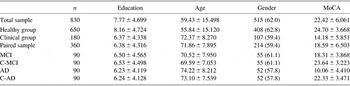
The total sample was comprised of 830 participants. The characterization of the study sample and in more detail of the all sub-groups is presented in Table 1. For this description were considered the following variables: sample size, educational level, age, gender, and MoCA score.
Descriptive statistics for the total sample and subgroups

Note. Healthy group: all cognitively health participants; Clinical group: all patients with MCI and AD; Control Group: cognitively health participants paired with patients; Paired sample: sum of all the patients and their matched controls. Gender is characterized by female's n and respective percentage (%). Data of others variables are presented as mean ± standard deviation.
MoCA = Montreal Cognitive Assessment (maximum score = 30); MCI = Mild cognitive impairment patients; C-MCI = subgroup of controls matched with MCI patients; AD = Alzheimer's disease patients; C-AD = subgroup of controls matched with AD patients.
The control participants included in the paired sub-sample were select from the health group to match in educational level, age and gender to patients of clinical groups. No statistically significant differences were found on the educational level (t(178) = .049; p = .961), age (t(178) = .833; p = .406), and gender (χ2 (1) = .000; p = 1.0) between the MCI and the C-MCI group. Likewise, the AD and the C-AD group did not differ on the educational level (t(178) = .018; p = .986), age (t(178) = .955; p = .341), and gender (χ2 (1) = .000; p = 1.0). The MCI group and the AD group did not differ on educational level (t(178) = .411; p = .681) and gender (χ2 (1) = .092; p = .761), but nevertheless the AD patients were significantly older than MCI patients (t(178) = 3.071; p = .002).
Item Analysis
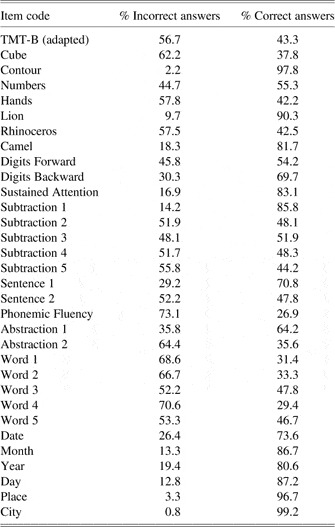
To evaluate the distribution responses to each item, the response frequencies were computed (dichotomous items: 0 or 1 point). For the purpose of this analysis, we used the paired sample (n = 360) to balance the proportion of healthy controls and patients and minimize the possible influence of sociodemographic differences. The results are provided in Table 2.
Analysis of the distribution responses of the MoCA′s items

Note. All values are expressed in percentage (%).
A close examination of these results reveals that the items Contour, Lion, Place and City have a high hit rate (greater than 90%) which suggests a low index of difficulty. On the other hand, Phonemic Fluency is the item with the lower hit rate (26.9%).
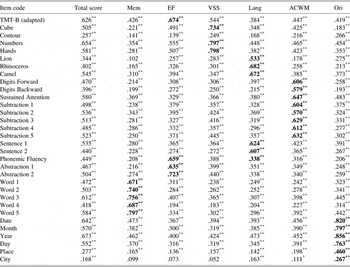
The correlations between each item and the total score, and each item and the cognitive domains, as were conceptualized by the authors (Nasreddine et al., Reference Nasreddine, Phillips, Bédirian, Charbonneau, Whitehead, Collin and Chertkow2005), were also explored. As demonstrated in Table 3, each of the 32 items showed a significant (p < .001) and positive correlation with the total score of the scale, with lower correlations of Contour, Lion, Place, and City items (respectively, .168, .344, .277, .257). These were simultaneously the items with higher hit rate (respectively, 97.8, 90.3, 96.7, 99.2). Therefore, these items reveal a lower contribution for the individual information obtained with the MoCA. Regarding the correlation coefficients of each item with the cognitive domains, all the items showed a significantly higher correlation with the respective domain, according to the structure proposed by the authors, as compared to the correlations with any other domain. With the exception of the Contour, Place, and City items, that showed lower correlations with any domain. Although the Contour did not exhibit a differentiated correlation with any domain, the Place and City showed a significantly higher correlation with Orientation than with any of the others domains. Despite the consideration that the Phonemic Fluency contributes to the two domains in the original MoCA formulation, we found a higher correlation with the Executive Functions domain than with the Language domain.
Correlation coefficients of each item with total score and cognitive domains

Note. Mem = short-term memory; EF = executive functions; VSS = visuospatial skills; Lang = language; ACWM = attention, concentration, and working memory; Ori = orientation to time and space.
*p < .05; **p < .001.
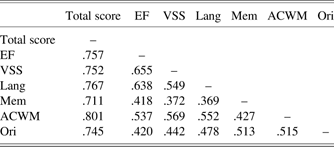
As shown in Table 4, correlations between each cognitive domain and the MoCA total score were high and positive, ranging from .711 to .801. These correlations are suggestive of construct related validity. Furthermore, we can observe that each domain showed significantly higher correlation with the MoCA total score than with another domain, what is suggestive of discriminative power of domains.
Correlation coefficients of the cognitive domains and total score

Note. All correlation coefficient were significant at the .001 level.
EF = executive functions; VSS = visuospatial skills; Lang = language; Mem = short-term memory; ACWM = attention, concentration, and working memory; Ori = orientation to time and space.
Scale Reliability
Internal consistency reliability of the MoCA was estimated using Cronbach's α. In the total paired sample (n = 360), we found a Cronbach's α of .903 that confirms the overall reliability of the scale when used to examine Portuguese subjects. A more detailed analysis reveals that there is no improvement regarding the reliability coefficient value with the exclusion of any item of the scale. This reliability coefficient was also computed for each sub-group. In the clinical group (n = 180) the respective value was .883, while in the control group (n = 180) it was .678. In the total sample (n = 830) we found a Cronbach's α of .905.
Diagnostic Accuracy
The ROC curve analysis was conducted on paired sample (n = 360) to evaluate the diagnostic accuracy of MoCA to discriminate MCI and AD patients from cognitively healthy adult. The discriminant potential of the MoCA for MCI was high, with an AUC of .856 (95% confidence interval [CI] = .796–.904) and for AD was excellent, with an AUC of .980 (95% CI = .947–.995). According to the Youden index, the optimal cutoff point for MCI was below 22 points (sensitivity = 81%; specificity = 77%). For the AD patients, the optimal cutoff point was below 17 points (sensitivity = 88%; specificity = 98%).
Confirmatory Factor Analysis
Model Specification
The CFA was performed to provide further evidence of the MoCA's construct validity. Three models were contemplated in the analyses. The first model (a six-factor model) was based on the original conceptual model proposed by the MoCA's authors (Nasreddine et al., Reference Nasreddine, Phillips, Bédirian, Charbonneau, Whitehead, Collin and Chertkow2005). The second model (two-factor model) matched the two factor model proposed by Duro et al. (Reference Duro, Simões, Ponciano and Santana2010). Finally, we included a third model (one-factor second-order model) which considers that all the first-order factors are contributing to a common underlying second-order factor that we named “Cognition.” With this latter model, we intend to explore the unidimensionality tendency of the MoCA, similarly to what was found in some studies with other cognitive screening tests, as MMSE (e.g., Jones & Gallo, Reference Jones and Gallo2000).
Model Assessment
To determine the best model, the three models were tested using the CFA and the model fit statistics compared. The fit statistics for each model, in total sample (n = 830), are summarized in Table 5.
it indices of the Confirmatory Factor Analysis models

χ 2 = Chi-square test statistic; df = degrees of freedom; χ 2/df = relative Chi-square; CFI = Comparative Fit Index; TLI = Tucker-Lewis Index; RMSEA = root mean square error of approximation.
We can observe that the different fit models indices reflect good fit of the three models. All three models had a relative χ2 close 2, the CFI and the TLI were above .95, and an RMSEA was less than .05. However, the six-factor model theoretically proposed by the authors showed a general better fit to the observed data in all the indices considered. The improved fit of six-factor model was significantly higher than the two-factor model in this study sample (Δχ2 (15) = 269.165; p < .001) and than the one-factor second-order model (Δχ2 (9) = 128.703; p < .001). The standardized factor weights and the item's squared multiple correlations of the six-factor model are compiled in Table 6. General factor weights and fit indices are suggestive of the MoCA six-factor factorial related validity.
Standardized regression weights and squared multiple correlations for six-factor Model

Following the approach of Fornell and Larcker (Reference Fornell and Larcker1981), the composite reliability indices were computed for each latent factor. We found a value of .74 for Executive Function; .84 for Language; .89 for Visuospatial Skills; .87 for Short-term Memory; .91 for Attention, Concentration, and Working Memory; and .95 for Orientation, which is indicative of good convergent related validity for each factor.
Given the fit results for the six-factor model we also examined the convergent and discriminant validity of the six factors using a stringent procedure outlined by Fornell and Larcker (Reference Fornell and Larcker1981). Regarding convergent validity, we computed the averaged variance extracted (AVE) which denotes the proportion of variance in the items explained by the underlying factor. The respective results range from .46 to .75, which is suggestive of appropriated convergent validity, according the criterion AVE >.5 (Fornell & Larcker, Reference Fornell and Larcker1981). The discriminant validity of the factors was measured by comparing the AVE of each factor with the square of correlation between the factors. According to Fornell and Larcker (Reference Fornell and Larcker1981), two factors showed discriminant validity when the AVE is greater than the square of correlation between the factors. Except for Executive Functions and Language, which share the variance of the Phonemic Fluency, we have found discriminant validity between the factors.
Discussion
The overall aim of the present study was to evaluate the factorial structure of the MoCA and analyze its construct related validity in cognitively healthy subjects, as well as in the MCI and the AD patients. To date, there were no other research studies of the factorial structure of the MoCA in community samples, and only one analyzed the dimensions underlying the MoCA in a heterogeneous clinical sample with cognitive decline. Thus, this study contributes to overcome a significant gap in the evaluation of the construct related validity of this instrument.
To provide further evidence to MoCA's construct related validity, several models were tested using CFA: a six-factor model based on the conceptual model proposed by the authors of the MoCA (Nasreddine et al., Reference Nasreddine, Phillips, Bédirian, Charbonneau, Whitehead, Collin and Chertkow2005); a two-factor model proposed by Duro et al. (Reference Duro, Simões, Ponciano and Santana2010); and a one-factor second-order model with all the first-order factors contributing to a common second-order factor “Cognition.” Although all models showed a good fit in our data, the six-factor model showed the better absolute and relative fit indices, proving to have a significantly better fit than the others factorial models evaluated. Thus, this study corroborates the six-dimensional structure of the MoCA proposed by the authors. This six-dimensional approach was confirmed, not only by the improved fit of the model, but also by the validity analysis of the test where we were able to observe stronger intercorrelations between each item and the cognitive domains and between each cognitive domain and the MoCA total score. However, we found a lower contribution of the Phonemic Fluency task for the assessment of the Executive Function domain, so it is advisable to caution its interpretation in this sense.
The item analysis reveals an overall psychometric adequacy of the items of the MoCA. However, some problems were identified regarding the items Contour, Place, and City, which showed a higher hit rate and consequently lower correlations with any cognitive domain and with the total score. However, these items did not compromise the overall six-factor model fit, showing an appropriated factor weights in model. The MoCA has also shown good reliability, either through the Cronbach's α or through the composite reliability indices.
Regarding to the MoCA's diagnostic accuracy to discriminate MCI and AD patients from cognitively healthy adults, with an optimal cutoff point below 22 points for the MCI patients, the MoCA showed a good sensitivity (81%) and specificity (77%). Likewise, with an optimal cutoff point below 17 points for the AD patients, the MoCA showed an excellent sensitivity (88%) and specificity (98%).
Our results allowed to establish the factorial, convergent, and discriminant validity of the six-dimensional structure of the MoCA, and then proving its construct related validity. These findings permitted the calculation of performance profiles based on the results of the six cognitive dimensions. The possibility of a more comprehensive analysis of the performance in a brief cognitive screening test is a valuable advantage, resulting in an important contribution to outline a more systematic and comprehensive neuropsychological evaluation. Although the six-factor model shows the best fit, our findings allow to additionally support a second-order factor model, which considers that all the first-order factors are contributing to a common underlying second-order factor: “Cognition.” This reveals a second-order unidimensional tendency, and serves as a good indicator that the MoCA, as a whole, evaluates individuals’ global cognition (a positive finding considering that the MoCA is a brief cognitive screening instrument). The authors (Nasreddine et al., Reference Nasreddine, Phillips, Bédirian, Charbonneau, Whitehead, Collin and Chertkow2005) a priori hypothesized dimensions are consistent with the best MoCA's factor structure of this study. Indeed, this study provides additional evidence for the MoCA multifactorial nature, supporting the idea that this screening test does not measure only a global cognitive ability (total score) but the sub-scores extracted reflect different constructs or specific aspects of cognitive functioning, offering an empirical rational for examining separate indexes scores in the context of a profile analysis. So, the MoCA interpretation could also examine the relative strengths and weaknesses (or higher and lower scores) for further additional hypothesis testing.
The current study has some limitations regarding the clinical samples size which did not allow a more detailed analysis of the MoCA's structure in these groups. Some future considerations should be taken into account when analyzing the present results, namely the need for more studies conducted in different cultural contexts other than the Portuguese, as well as for different diagnostic groups to further confirm the proposed six-dimensional structure underlying the MoCA and extend the present findings. Furthermore, it will be interesting to analyze the invariance of factorial structure across different groups, like diagnostic groups, age groups, and educational groups.
In summary, the MoCA has proved to be an appropriate measure for brief cognitive screening taking into account different cognitive domains such as: short-term memory; executive functions; visuospatial abilities; language; attention, concentration, working memory; and temporal and spatial orientation. These constructs have demonstrated to be structurally related. The present findings establish the factorial, convergent, and discriminant validity, providing good evidence of the construct related validity of the MoCA, and will enable clinicians and others researchers to use this test, including the total score and also mainly their six latent dimensions to achieve a better understanding of the individuals’ cognitive profile.
Acknowledgments
This work was supported by the Fundação para a Ciência e Tecnologia [Portuguese Foundation for Science and Technology], (S.F., SFRH/BD/38019/2007); and by the Fundação Calouste Gulbenkian [Calouste Gulbenkian Foundation], (Proc.74569, SDH-22 Neurociências). All authors of this study declare that there are no conflicts of interest.