Introduction
Informant interviews are frequently used to complement psychometric testing or as a proxy measure of cognitive ability (Jorm et al., Reference Jorm, Christensen, Henderson, Jacomb, Korten and MacKinnon1996). A measure of a subject's abilities through the eyes of a relative or caregiver provides information on everyday cognitive performance as opposed to the snap-shot obtained during a clinical interview. This may provide a better indication of the subject's cognitive ability, particularly in the period up to their death when they may be cognitively impaired and unable or unwilling to complete testing. Other benefits of this approach include being able to carry out testing via mail or telephone.
There is no standard informant interview that is used uniformly across studies. Instead there are multiple variations under three broad interview categories (brief measures, scales, and diagnostic measures). Of current informant measures, the Information Questionnaire on Cognitive Decline in the Elderly (IQCODE) is one of the most widely used scales (Jorm and Jacomb, Reference Jorm and Jacomb1989). Nonetheless, a recent study found the IQCODE to be a poor predictor of general cognitive ability – as measured by the modified Mini-mental State Examination (3MSE) (Arnold et al., Reference Arnold, Newman, Dermond, Haan and Fitzpatrick2009). The IQCODE uses 26 questions to assess change in the subject's cognitive abilities over the last ten years. A retrospective version of the IQCODE has also been compiled. This questionnaire has been used in studies where there has been a post-mortem brain donation but no assessment of cognition when the person was alive. In his review, Jorm (Reference Jorm2004) comments that it has also been used in prospective studies of dementia to assess cognitive ability in participants who die between assessment waves (Rockwood et al., Reference Rockwood, Howard, Thomas, Mallery, Macknight, Sangalang and Darvesh1998), and to assess cognitive decline preceding complications such as stroke (Henon et al., Reference Henon, Durieu, Guerouaou, Lebert, Pasquier and Leys2001), delirium (Cole et al., Reference Cole2002), or admission to intensive care (Pisani et al., Reference Pisani, Inouye, McNicoll and Redlich2003). Another retrospective informant measure of cognition is the RInI (retrospective informant interview). The RInI is a longer and more detailed informant questionnaire with over 100 questions covering several domains including cognitive ability, depression, and activities of daily living.
Little work has been carried out to relate retrospective informant interview scores with psychometric test scores and the times between the scores and death, and between death and informant assessment. In many studies there is a gap between the last respondent interview and death. The aim of this study was to compare the results from the RInI with cognitive scores from an interview near death in participants of the Medical Research Council Cognitive Function and Ageing Study (MRC CFAS). This was to determine the potential use of the RInI as a proxy measure of end-of-life cognition where the gap between cognitive assessment and death can often be lengthy. We also studied the relationship between time from death to RInI assessment and RInI score to see if this had an effect on the results reported.
Methods
Study population
Data came from the Medical Research Council Cognitive Function and Ageing Study (MRC CFAS, 1998). MRC CFAS is a multi-centre study of over 18,000 persons from across six sites in England and Wales; five of the sites have standardized designs. These five sites of the study had a two-phase sampling design with a screening interview followed by an assessment interview. The other site had an assessment interview on all. Participants were selected from Family Health Service Authority lists, and were stratified by age to include persons aged 65 years and over at the index date for each centre and living within a specified geographical area. The study began in the late 1980s with the first meeting with participants taking place in 1989–1993. There have been up to ten further interviews over a 12-year longitudinal follow-up period.
The retrospective informant interview (RInI) was administered to a subject's relative or carer, but only when a subject had died and donated their brain. The total number of brain donations available for analysis was 456 (data version 9.0) and RInI information along with date of death and a last cognitive assessment had been collected on 248 (54%) of this group. The RInI data were collected between February 1997 and June 2006. Cognitive data from these subjects’ final interviews were also accessed. These took place between June 1990 and March 2003. The analysis population of 248 died between February 1992 and March 2004 at ages between 71 and 102 years.
Cognitive assessment
Cognitive ability in life was assessed using the Mini-mental State Examination (MMSE) (Folstein et al., Reference Folstein, Folstein and McHugh1975), which is a brief, easily administered measure of general cognitive function. This was assessed at multiple waves of MRC CFAS although only the last measure, closest to death, was used in the present analysis.
The informant interview, the RInI, is an amalgam of retrospective questionnaires and is freely available from the MRC CFAS website (www.cfas.ac.uk). It contains 115 questions split into 12 sections: information about the informant; how well they knew the subject; the subject's final illness; their personality; their memory; their general mental functioning; their activities of daily living; if they had been subject to clouding/delirium; depressed mood; paranoid; cerebrovascular problems; and a general summary. The interviewer is also asked to complete a four-part question to rate the informant's understanding of the questions, the accuracy of their answers, whether the informant might have had any cognitive impairment, and their opinion on whether there could have been dementia prior to the subject's death. The RInI interview takes around 30 minutes to complete and it is administered face-to-face with the informant or via telephone. In this analysis the sections on memory and general mental functioning were combined to create an overall score. This comprised 27 questions, two of which were qualitative in nature. The remaining questions rated the subject's ability using either a 0–1, 0–1–2, or 0–1–2–3 scale, where 0 represented normal with 1, 2, or 3 being the most impaired state. A total RInI score was created by summing the ratings to give a possible score between 0 and 39.
Statistical analysis
Given the large number of zero scores on the RInI (indicating no cognitive impairment), a zero-inflated Poisson regression model was used to analyze the age at death- and sex-adjusted associations between the MMSE and RInI scores. Self-reported education in years and the time between MMSE and death and between death and RInI were added to the model as additional covariates. MMSE scores were split into four categories: high performance 29–30, moderate performance 24–28, poor performance 18–23, and impaired performance <18. There were 41 missing MMSE scores, which left an analysis cohort of 207 persons. All analyses were performed using R version 2.9.2 (R Development Core Team, 2009).
Results
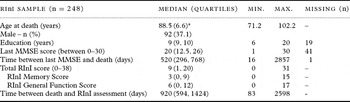
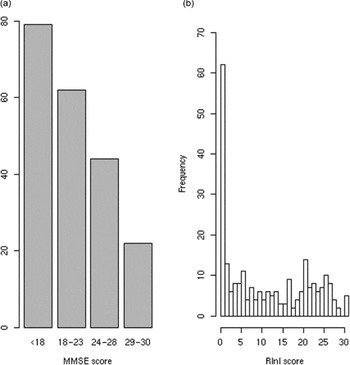
A summary of the study population is presented in Table 1. There was a particularly large spread of scores on the MMSE (Figure 1a) with 38% (n = 79) failing to obtain more than 17 points. This is as expected for the target population for brain donation (Matthews et al., Reference Matthews, Stephan, Bond, McKeith and Brayne2007). The distribution of RInI scores (Figure 1b) showed a floor effect with 62 persons (25%) being rated as ageing normally without sign of any major cognitive impairment.
Baseline characteristics of the sample

MMSE = Mini-mental State Examination, RInI = Retrospective Informant Interview.
*Mean (s.d.).
(a) Distribution of MMSE scores. (b) Distribution of RInI scores. MMSE = Mini-mental State Examination; RInI = Retrospective Informant Interview.

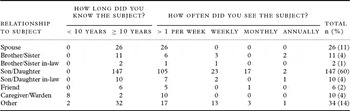
A summary of type of informants is presented in Table 2. The majority (n = 147; 60%) were a son or daughter of the subject. Apart from the caregiver/warden informants and two out of 34 informants who were a mixture of relatives/acquaintances (nieces, nephews, grandchildren, social workers, etc.), all informants had known the subject for more than 10 years. Nearly all of the informants (n = 228, 88%) visited the subject a minimum of once a week.
Relationship between the informant and the subject*

*Data were missing for two informants.
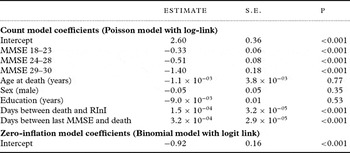
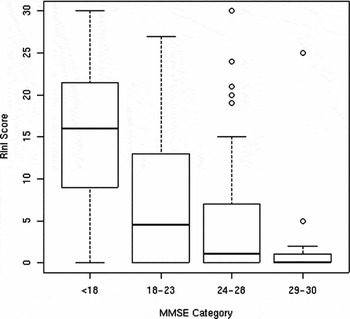
Results of the zero-inflated Poisson regression model showed significant differences between all three MMSE categories and the baseline group who scored <18 points (Table 3). RInI scores decreased, i.e. cognitive performance increased as the MMSE categories went from low to high cognitive performance (estimate for the MMSE score between 29–30 was −1.40 S.E. 0.18, p < 0.001). This translates into a RInI score 0.25 (e−1.40) times lower for those with high MMSE scores compared to those with the low MMSE scores. Boxplots showing the MMSE-RInI associations are presented in Figure 2.
Zero-inflated Poisson regression model of the association between MMSE and RInI scores

MMSE = Mini-mental State Examination; RInI = Retrospective Informant Interview.
Boxplot of RInI scores by MMSE category. MMSE = Mini-mental State Examination; RInI = Retrospective Informant Interview.

There were no significant associations between age at death, sex, or education with RInI scores. However, both the time between the last MMSE and death, and between death and RInI were found to be significant predictors (estimate = 3.2×10−04, S.E. = 2.9×10−05, p < 0.001; estimate = 1.5×10−04, S.E. 3.8×10−05, p < 0.001). In real terms this implies that for every additional year between last MMSE and death the RInI increases 1.12 times, and that for every additional year between death and RInI the RInI score increases 1.06 times.
In a final model we considered the interviewers’ opinions of the informant. This included whether they thought the informant understood all of the questions, whether they thought they had replied accurately, and whether they thought that they were demented. However, excluding data from informants who were not deemed to understand every question (n = 16), answer all questions accurately (n = 38), or were cognitively impaired (n = 11) made little difference to the model findings (results not shown).
Discussion
This study showed a strong association between retrospective informant measures of cognition and subject assessed cognition (MMSE scores). This finding was independent of age at death, gender and number of years of education. Subjects who scored in the highest MMSE category (29–30) had, on average, a RInI estimate that was four times lower than those in the impaired category (MMSE < 18). The time between cognitive assessment and death had a significant effect on the informant measure of cognition; the longer the duration the bigger the decrease in the informant estimate of cognitive ability (around a 12% decrease for each additional year). However, this became a non-significant predictor when the gap was restricted to three years or less.
The time between death and the informant interview was also a significant predictor of the informant scores; the greater the duration the lower the estimate of cognitive ability (around a 6% decrease for each additional year). However, the period between death and RInI was up to seven years in some instances. These longer intervals tended to be at the start of the data collection period. A sensitivity analysis found that the time between death and RInI only becomes a significant predictor after including measures taken over four years after death (results not shown).
The strengths of this study included the detailed RInI questionnaire data. Whilst the IQCODE provides a general cognitive assessment, the RInI enabled us to target a memory domain as well as general cognitive functioning. Another advantage of the RInI as opposed to the IQCODE is its ability to factor in an interviewers assessment of the informant. Whilst it is a longer questionnaire than the IQCODE, the RInI is still easy to administer for the assessor and easy to complete for the informant. Our study also had a relatively large sample size compared to previous investigations of cognitive assessment by an informant.
The most notable limitation of using informant interviews to assess cognitive ability is the potential lack of a suitable informant (Jorm, Reference Jorm2004; Jorm et al., Reference Jorm, Christensen, Henderson, Jacomb, Korten and MacKinnon1996). However, this was not deemed to be an issue in our study where the majority of informants were close family members who saw the subject at least once a week. Another limitation of the informant interview is the inability to tap the specific cognitive abilities that can be obtained via psychometric tests, e.g. processing speed, verbal declarative memory, non-verbal reasoning, etc. To our knowledge, this is the first study to include the RInI as a retrospective measure of cognition. Hence, replication is required in order to confirm the positive findings from this study. A further limitation is the possibility that the MMSE scores were affected by level of education. We controlled for an education effect on the RInI scores, although it is less likely to be prone to such biases as informant-based questionnaires evaluate global and functional performance.
There is an increasing literature to recommend the integration of patient and informant measures of cognition to obtain the most complete assessment of late-life ability and quality of life (Ready and Ott, Reference Ready and Ott2007). However, some studies have found evidence to suggest the converse (Abreu et al., Reference Abreu, Nunes, Diniz and Forlenza2008). In addition, the value in using only an informant interview as a measure of cognition is still under investigation. A recent study by Hancock and Larner (Reference Hancock and Larner2009) in a memory clinic-based population found the IQCODE to be a sensitive test for the prediction of dementia (0.86) but with poor specificity (0.39) and a sub-optimal positive predictive value (0.67).
In conclusion, we have shown that the RInI is a good measure of end-of-life cognitive ability, as measured by the MMSE, in an older population. As the time between last cognitive assessment (MMSE) and death increases, the RInI score also increases. This supports the evidence that informant data, even where death occurred some time after the last respondent interview, can be used as an additional source of cognitive state, including decline which may not have been possible to measure during life. The RInI output does depend on the time elapsed between the subject's death and the informant's interview, but only if this is greater than four years. These findings could have major implications in the collection of longitudinal cognitive data where measures of cognition in later waves are not possible due to illness or death of study subjects.
Conflict of interest
None.
Description of authors' roles
REM analyzed and interpreted data, drafted the first version of the paper and revised and edited the paper. REM is guarantor of the analysis. FEM contributed to design, advised on the analytical strategy, data acquisition, assisted in obtaining funding and revised and edited the paper. CB conceived the research idea, contributed to design, data acquisition, funding and revised and edited the paper.
Acknowledgments
We thank the CFAS population, their families, carers, and interview informants for their participation.