Once considered a backwater, state politics has become a critical arena of American politics. In the face of congressional gridlock, national-level political actors have turned to the states as venues for achieving their policy goals (Grossmann Reference Grossmann2019; Alex Hertel-Fernandez Reference Hertel-Fernandez2019). Policy variation across the states is growing and is increasingly associated with whether Democrats or Republicans control state office (Grumbach Reference Grumbach2018). Perhaps as a result, candidates for state office have amassed huge sums of campaign contributions from outside of their states in recent years (Kaneya and Yerardi Reference Kaneya and Yerardi2018).
Renewed interest in state politics is in part driven by an understanding that state-level decisions have implications for politics and policy across the country. This understanding is reflected in a rich tradition of scholarship in American federalism examining the ways that policies adopted in one federal unit can affect politics and policymaking elsewhere (Berry and Berry Reference Berry and Berry1990; Brandeis Reference Brandeis1932; Gray Reference Gray1973). At the core of this literature is the notion of states as "laboratories of democracy" (Brandeis Reference Brandeis1932)—the idea that state lawmakers learn from policy experiments carried out elsewhere. Building on this concept, existing literature on policy interdependence in American federalism has focused on policy diffusion (e.g., adoption of a policy in one federal unit increases the likelihood that it will subsequently be adopted in other units) via mechanisms of learning and competition (Shipan and Volden Reference Shipan and Volden2006, Reference Shipan and Volden2008; Volden Reference Shipan and Volden2006).
I argue that traditional policy diffusion mechanisms do not account for an important source of policy interdependence: the effects of subnational policies on interest groups’ political capacities in the broader federal system. My theoretical argument builds on the classic finding in the policy feedback literature that public policies shape the landscape of organized interests represented in the political sphere (Pierson Reference Pierson1993; Skocpol Reference Skocpol1992; Walker Reference Walker1991). I identify and explore mechanisms by which these dynamics can manifest across units of government. Broadly speaking, subnational reforms that benefit particular organized interests also tend to strengthen them politically. These interests, in turn, might have an economic incentive to apply newfound strength to seek to propagate the reforms that benefit them. In this way, mechanisms of policy feedback can, like learning and competition, drive policy diffusion.
Empirically, I examine cross-state policy feedback—the effects of state policy on the politics in other states—in rooftop solar policy. Unlike traditional utility-owned and centralized power sources, rooftop solar arrays are connected to distribution systems (versus transmission systems) and are generally owned or leased by customers. State-level policy played a key role in promoting the strong growth of rooftop solar over the last decade. I show that, by empowering new business interests that subsequently engaged politically across the federal system, state solar policies affected the interest group politics in other states. The clear role of state policy in the growth of a new industry makes rooftop solar an instructive case for examining cross-state feedback effects. But this is also a hard case to observe effects due to the power and opposition of incumbent electric utilities.
The empirical analysis proceeds in three general steps. First, I bring together state rooftop solar policy data with solar installation data to investigate the relationship between policy and solar growth. Results from two-way fixed effects regression models indicate faster distributed solar growth in states with pro-rooftop solar policies. Though findings are consistent with advocates’ and industries’ understanding (and the fact of their political engagement), this finding—by providing empirical evidence for the substantive importance of state policy—lays the groundwork for the subsequent analyses.
In the second step, I bring together firm-level system installation data and firm-level lobbying disclosure data to examine the relationship between growth in solar installations and firms’ political engagement across the states. I specifically examine the political engagement of large installer firms that have been central to efforts to expand and defend pro-rooftop solar policies. Results from multilevel modeling indicate that an installer’s lobbying in a particular state depends on its economic presence in that state—but also its economic presence across the states. In addition, by tracking the economic expansion and political activity of the two largest rooftop solar installers, I demonstrate that these firms sought to influence policy in markets where they did not yet have an economic presence in preparation for potential expansion. These findings, put together with the results indicating the importance of state policy to industry growth, suggest that state policy decisions affected political contestation in other states. Installers relied on growth in early adopters of favorable rooftop solar policies to accumulate resources, and then deployed those resources to propagate favorable policies more broadly.
Third, I present analysis suggesting these cross-state feedback effects had policy consequences. Two-way fixed effects models indicate that installer lobbying is associated with more favorable state policies, with larger effects in states with lower levels of rooftop solar penetration. Qualitative analysis of the case of South Carolina affirms the plausibility of installers influencing policy even in states where they did not have an economic presence. By partnering with local groups and hiring well-connected lobbyists, Sunrun (one of the largest installers) was able to drive policy shifts to construct a new market it could then expand into.
I contribute to a growing body of literature at the intersection of federalism, policy feedback, and interest groups scholarship (Darmofal et al. Reference Darmofal, Kelly, Witko and Young2019; Finger and Hartney Reference Finger and Hartney2019; Meckling and Trachtman Reference Meckling and Trachtman2021; Stokes Reference Stokes2020). Recent advances have documented how federated unions rely heavily on resources from affiliates in states with favorable labor laws (Darmofal et al. Reference Darmofal, Kelly, Witko and Young2019; Finger and Hartney Reference Finger and Hartney2019), and how renewable energy interests leveraged states with favorable policies as “beach-heads” for their expansion across the country (Stokes Reference Stokes2020). Empirically, I build on this developing literature by using a rich array of evidence to trace out a causal chain from state policy to shifts in interest group engagement to policy decisions in other states. Conceptually, while existing work in this area—especially that on labor unions—has focused on organizational maintenance, I bring a focus to the role of state policy in driving lobbying and policy decisions, thus bridging this literature with scholarship on policy diffusion.
By integrating policy feedback and policy diffusion literatures, I provide a lens for understanding and examining a myriad of interdependencies in our federal system that are difficult to study with existing theoretical frameworks. Subnational policies do not just motivate learning and competition: they also fundamentally affect the resources of organized interests that, in many cases, engage politically across the federal system. This can serve as a mechanism of policy diffusion, as groups that benefit from particular subnational reforms deploy their newfound resources to propagate the reforms that benefit them. However, the cross-unit political engagement of organized interests empowered by subnational reforms will, in most cases, go beyond simply seeking to propagate those reforms. As a result, the perspective put forward here suggests that, in addition to potentially initiating a process of diffusion, subnational reforms can also more durably shape interest group competition in the broader federal system over long time horizons.
In addition to theoretical contributions, I also offer practical implications for climate advocates. Well-designed climate policies not only drive shifts from fossil fuel energy infrastructure to renewables infrastructure, but also replace fossil fuel political interests with clean energy interests (Meckling et al. Reference Meckling, Kelsey, Biber and Zysman2015). As I show, this positive feedback can manifest across state lines, lending weight to an institutionally and geographically pluralistic advocacy approach to climate politics.
Laboratories of Democracy
Prominent theoretical perspectives for studying policy interdependence in American federalism have focused on three key mechanisms: political learning, competition, and firm preferences for unified standards.
The general concept of political learning goes at least as far back as Supreme Court justice Louis Brandeis’s famous characterization of the states as “laboratories of democracy” (Brandeis Reference Brandeis1932). The basic logic of political learning is straightforward. Re-election motivated government officials generally prefer policies that benefit their constituents. If officials observe that a policy is performing well in another federal unit, this indicates that the policy has a greater likelihood of succeeding in their own locale, so they are more likely to adopt it. As a result, well-performing policies, the theory suggests, will diffuse across units and levels of government (Boehmke and Witmer Reference Boehmke and Witmer2004; Gilardi, Füglister, and Luyet Reference Gilardi, Füglister and Luyet2009; Volden Reference Shipan and Volden2006).
Of course, in practice, it is not so simple. As Gilardi (Reference Gilardi2010) points out, officials are concerned broadly with the political effects of adopting a particular policy, not just whether that policy worked well elsewhere. In Gilardi’s analysis, whether learning leads to policy diffusion depends on officials’ prior beliefs and ideologies, and experimental work supports the notion that ideology moderates political learning (Butler et al. Reference Butler, Volden, Dynes and Shor2017).Footnote 1 Broadly speaking, this finding suggests that political polarization can weaken learning as a diffusion mechanism.
In addition to learning from one another, governments also compete with one another for residents and businesses, and this competition can serve as a mechanism by which policy decisions in one federal unit affect decisions in another. Competition has long been recognized as an important feature of governance in federal systems. In Tiebout’s (Reference Tiebout1956) seminal model, competition between municipalities for residents and tax revenue leads to lower taxes and more efficient government. The reason is that firms and individuals can “vote with their feet,” choosing where to do business or live based on the favorability of the policy and political environment—thereby putting pressure on governments to adopt and sustain effective policies.
While the upshot of Tiebout’s model is generally positive, firms’ and individuals’ mobility across the federal system can also have negative consequences. Government competition for mobile individuals and firms can lead to a regulatory “race to the bottom” to the extent that governments seek to attract business investment, and believe that they can do so by relaxing regulations relative to competing federal units (Potoski Reference Potoski2001; Woods Reference Woods2006). Competition might lead governments to converge on lower regulatory stringency than that preferred by constituents, as officials trade off public interest regulations for greater business investment and growth. While empirical evidence demonstrating a regulatory race to the bottom in American federalism is mixed, there is some evidence of these dynamics affecting decisions in environmental policy (Konisky Reference Konisky2007) and welfare policy (Volden Reference Volden2002) among other areas.
These models of competition imply a general logic of policy diffusion, as policy adoption in one unit exerts pressure on competing units to adopt that same policy. Failure to keep up imposes costs on polities in loss of investment or residents. And similar to political learning, competition is considered to be a core mechanism of policy diffusion (Shipan and Volden Reference Shipan and Volden2008; Volden Reference Volden2005).Footnote 2 But again, there is reason to think that polarization and relatedly, the nationalization of American politics (Hopkins Reference Hopkins2018), might blunt the effects of competition on policy diffusion. The transformation of state elections into referenda on the national parties reduces the incentive for state lawmakers to shift policy in response to competitive pressures.
The third broad mechanism of policy interdependence identified in existing literature is firm preferences for unified standards.Footnote 3 Due to the “marble-cake” structure of American federalism (Grodzins Reference Grodzins1982), whereby different levels of government share regulatory authority (e.g., in healthcare, energy, education), large firms are often regulated at multiple levels of government. These firms can face costs from complying with regulations that differ across subnational units, so generally prefer national standards to a state patchwork. Firms, therefore, might respond to the adoption of subnational regulations by advocating for federal policies that provide a unified regulatory landscape and potentially pre-empt future subnational regulations.
Elliott, Ackerman, and Millian’s (Reference Elliott, Ackerman and Millian1985) seminal legal study highlights the mobilization of regulated industries in response to subnational regulations in driving the passage of both the Motor Vehicle Pollution Act of 1965 and the Air Quality Act of 1967. In political science literature, the upward diffusion of standards driven by advocacy of regulated industries is associated with Vogel’s concept of the “California effect” (Reference Vogel1995). In a key empirical contribution, Vogel argues that industry support for federal standards to replace state patchwork drove the upward diffusion of California’s auto emissions standards.
While the mechanisms of political learning and competition are driven by shifts in lawmakers’ beliefs about which policies will best serve their constituents, this third mechanism is driven by shifts in firm preferences. The theoretical dynamic I propose here similarly examines how subnational policies affect the mobilization of organized interests in other federal units. But, instead of studying how subnational policies shift national-level preferences, I consider how subnational policies affect the capacities of organized interests—and in turn their ability to mobilize resources to influence policymaking in other states.
By examining the role of interest group influence in driving policy interdependence, the perspective I put forward also relates to the literature on the role of interest groups in mediating policy diffusion (Balla Reference Balla2001; Garrett and Jansa Reference Garrett and Jansa2015; Haider-Markel Reference Haider-Markel2001; Mintrom and Vergari Reference Mintrom and Vergari1998). The key difference is that, while this literature treats interest groups as exogenous, I argue that the capacities of interest groups to influence policy is endogenous to prior policy decisions adopted in other federal units.
Policy Feedback and Interdependence
My theoretical argument draws directly from scholarship in the policy feedback literature examining the effects of public policies on organized interests. A rich body of literature has explored how policies shape the political capacities of organized economic interests: particularly, businesses and unions (Anzia and Moe Reference Anzia and Moe2016; Hacker Reference Hacker2002; Mettler Reference Mettler2014). Businesses and unions are classic organized vested interests: groups that receive material benefits directly from particular policies and institutions, and can funnel resources back into the political system to shape policy trajectories (Moe Reference Moe2015). Market rules influence which firms and industries grow (Polanyi Reference Polanyi1957; Vogel Reference Vogel2018), and as a result the resources different firms and industries can deploy in their political engagement. Similarly, policies like collective bargaining rules shape the organizational strength and political power of unions (Hertel-Fernandez Reference Hertel-Fernandez2018).
Though the seminal policy feedback studies examine national policies (e.g., Campbell Reference Campbell2003; Mettler Reference Mettler2005; Skocpol Reference Skocpol1992), some recent scholarship has explored how the institution of federalism interacts with policy feedback dynamics (Feigenbaum, Hertel-Fernandez, and Williamson Reference Feigenbaum, Hertel-Fernandez and Williamson2018; Michener Reference Michener2018; Stokes Reference Stokes2020). Studying Medicaid, Michener argues that social welfare policy variation across the states affects individual-level political behavior. Research focused on organized interests has a similar implication: variation in policy, by shaping the relative strength of different organized interests, leads to variation in important political outcomes. For instance, studying neighboring counties across state borders, Feigenbaum, Hertel-Fernandez, and Williamson find that the enactment of right-to-work laws affected elections by reducing union strength and political capacity.
Unlike these contributions, my goal is not to better understand how policies produce variation in politics across the states, but rather to better understand interdependent policymaking in American federalism. Policy feedback theory, I argue, offers unrealized potential for expanding our understanding of policy interdependence. A key tenet of the policy feedback literature is that the organized interests that benefit from particular policies are likely to have greater resources to defend those policies in future political rounds—producing a self-reinforcing feedback cycle. But in a decentralized political system, groups might have an incentive not only to defend the subnational policies that benefit them, but also to seek to spread them. This is particularly relevant to economic interests (e.g., firms and unions), for whom the diffusion of favorable policies can drive revenue growth.
Recent literature has illuminated how organized economic interests deploy resources strategically across the federal system. Moe (Reference Moe2011) documents how the National Education Association, recognizing the threat to the viability of its Utah affiliate, leveraged resources drawn from its California affiliate to block a 2007 school voucher ballot initiative proposed in Utah. Similarly, in recent work, Finger and Hartney (Reference Finger and Hartney2019) demonstrate that teachers unions systematically transfer finances to states where labor laws are weakened to ensure that their affiliates remain viable. One of the key insights in this literature is that unions recognize that their strength—and ability to influence politics and policy—depends on maintaining favorable policy environments across the federal system (see also Darmofal et al. Reference Darmofal, Kelly, Witko and Young2019). While there is less work on firms, Stokes (Reference Stokes2020) reports, using first-hand interviews, that renewable energy advocates understood the importance of resources and expertise gained in states with favorable policy environments for expanding into other states.
The notion that organized interests deploy resources strategically across the federal system—put together with the insight from the policy feedback literature that policies can shape the resources organized interests have at their disposal to engage politically—suggests that state (and more broadly, subnational) policies can have intergovernmental effects on interest group politics. More specifically, when states adopt policy reforms, the groups that benefit might leverage their newfound strength to seek to propagate those (or similar) reforms across and up the federal system. These intergovernmental policy feedbacks, or “policy feedback spillovers” (Stokes Reference Stokes2020), can manifest horizontally (e.g., policy in one state affects politics in another) and vertically (e.g., state policy affects national politics). Here, I focus on horizontal feedback via interest group mobilization across the states.Footnote 4
These dynamics are clearest for economic interests operating in multiple states and thus directly affected by policies adopted in each of the states where they operate. At a basic level, the groups that benefit from policy reform adopted in one state will have greater capacity to engage politically in others (e.g., lobbying, campaign contributions, etc.)—and might draw on their enhanced capacity to advance similar reforms.
Operating across multiple states is not a pre-condition for these dynamics. Economic interests (especially firms) often seek to expand geographically across the states, and an expansion-minded group might leverage resources gained from favorable policy reform in one state to seek to shift policy and construct new markets. For instance, as I will discuss, rooftop solar installers in several cases lobbied in states where they were not (at the time) operating to promote policy shifts that would allow them to profitably expand. Because lobbying is generally highly effective at the subnational level (Anzia Reference Anzia2018)—where voters are less capable of holding politicians accountable for representing their preferences (Rogers Reference Rogers2017)—firms’ political efforts might bear fruit even in federal units where they do not (yet) have an economic presence.
In addition to shaping the resources that firms have at their disposal to engage politically across the federal system, state policies can also shape the composition of the broader advocacy environment by incubating new economic interests. While scholars have long argued that a benefit of federalism is the potential for learning from subnational experimentation (Brandeis Reference Brandeis1932), another feature of federalism is that variation in policy landscapes can promote greater diversity in the organized interests that emerge. Subnational units offering favorable policy environments can provide emergent business interests with “beachheads” from which they can expand across the federal system (Stokes Reference Stokes2020). To the extent that these firms expand beyond their beachheads, their political influence might expand to other locales as well.
While I focus on economic interests, some of the mechanisms outlined earlier are also relevant to citizens groups. Like firms and unions, some citizens groups depend on particular public policies to grow and accumulate resources (Walker Reference Walker1991), and many operate across multiple federal units (Skocpol, Ganz, and Munson Reference Skocpol, Ganz and Munson2000). Even more broadly, this theoretical perspective relates to literature on how externally adopted policies can influence public opinion, and thereby lead to policy diffusion (Linos Reference Linos2011; Pacheco Reference Pacheco2012), which also confounds the traditional distinction made by Berry and Berry (Reference Berry and Berry1990) between external and internal determinants of policy decisions. Indeed, it shows that external policies can affect internal determinants (e.g., public opinion or interest group engagement).Footnote 5
What are the political and policy implications of these intergovernmental policy feedbacks on interest group politics? In addressing this question, policy diffusion is the logical place to start. Building on seminal work from Crain (Reference Crain1966), diffusion has been the core theoretical and empirical framework by which scholars have analyzed political and policy interdependence across the U.S. federal system (e.g., Berry and Berry Reference Berry and Berry1990; Gray Reference Gray1973; Shipan and Volden Reference Shipan and Volden2008). The empirical framework of policy diffusion scholarship, where scholars examine the effect of policy passage in one federal unit on the likelihood of passage in another, aligns with existing theoretical mechanisms of policy interdependence in the literature. As I discuss earlier, the mechanisms of learning, competition, and firm preferences for unified standards all promote policy diffusion.
The intergovernmental feedbacks studied here can also lead to policy diffusion. An organized interest that benefits and draws resources from a policy adopted in one state might leverage those resources to advocate for the adoption of that same policy elsewhere. But organized interests might also respond to varying political (e.g., liberal versus conservative states), institutional (e.g., state or national government), and economic environments by advocating for different policies in different locales. As a result, these dynamics can also produce a wider range of intergovernmental policymaking outcomes (beyond diffusion) depending on how organized interests deploy their resources across the federal system. Studying these effects therefore requires attention to the engagement of organized interests (e.g., lobbying, campaign contributions, etc.), and attention to the total political implications of organized group engagement. The empirical portion of the paper follows this framework by examining how state policies affect interest group engagement, and ultimately policy and political outcomes, in other states in the case of rooftop solar policy.
To be clear, the theoretical argument suggests policy feedback mechanisms can operate in addition to, not instead of, conventional diffusion mechanisms of learning and competition. Therefore, in the empirical analysis, I do not aim to show that mechanisms of learning and competition have been absent (and I do not believe they have), but rather to show that mechanisms of cross-state policy feedback have played an important role in the politics of rooftop solar.
State Policy and the Rise of Rooftop Solar
Rooftop solar has grown rapidly over the past decade. According to the U.S. Energy Information Administration (EIA), distributed solar capacity, of which rooftop solar represents the major component,Footnote 6 increased from just under 1700 megawatts (MW) in 2010 to nearly 25000 MW in 2019. While this is still just a small fraction of generation capacity overall, in 2016 it accounted for fully 12% of new capacity additions, and analysts expect the industry to continue to grow rapidly over the next several decades (Annual Energy Outlook 2019). Rooftop, and more broadly, distributed solar now is seen by many climate advocates as a key piece of the energy transition.Footnote 7
While the role of technological advance should not be understated—the price of solar panels has fallen exponentially, from $100 per watt in 1975 to $10 per watt in 1990 to under $1 per watt in 2015 (Kavlak, McNerney, and Trancik Reference Kavlak, McNerney and Trancik2018)—policy has played a key role at each step. Government research and development policy drove advances in technology, and deployment policy has driven cost declines through economies of scale and learning-by-doing (ibid.). At the federal level, the most important market-stimulating policy for rooftop solar has been the Solar Investment Tax Credit (ITC). The ITC, enacted in 2006 and extended multiple times (most recently in 2015), provides a tax credit for the installation of both utility-scale and distributed solar systems. Solar advocates view the ITC as a critical component of solar energy’s growth (Solar Investment Tax Credit (ITC) 2019).
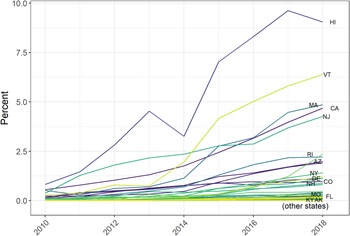
But the growth of rooftop solar depends perhaps even more fundamentally on favorable state-level policies. Historically, states have taken the lead in shaping electricity generation, transmission, and distribution systems through policy and regulation (Rabe Reference Rabe2008). States have promoted rooftop solar through pricing policy, interconnection rules, rebates and tax credits, and mandates that utilities draw a determined amount of power from distributed sources. The importance of state policy to rooftop solar growth has led to enormous variation across the states, as demonstrated by figure 1. Notably, many of the leading states like Vermont and New Jersey are not particularly sunny—but have pro-solar policies.
Distributed solar capacity as percent of total generation capacity by state (EIA)

Perhaps most politically controversial (at least in recent years), leading states have bolstered the economics of solar adoption by specifying how utilities must value the electricity produced “behind the meter” by rooftop solar systems. Solar advocates generally support Net Energy Metering (NEM) pricing, which requires utilities to credit rooftop solar owners for the electricity they provide to the grid and allow rooftop solar owners to draw upon those credits when they demand more electricity than they are producing. Utilities generally support pricing regimes that value electricity produced “behind the meter” at (lower) rates closer to wholesale.
The Effect of State Policy on Rooftop Solar Growth
What is the relationship between state policies and distributed solar growth? To address this question, I match solar capacity data from the EIA to data measuring each state’s policy favorability toward rooftop solar. Solar policy data comes from the website Freeing the Grid, which is managed by two pro-solar advocacy groups: VoteSolar and Interstate Renewable Energy Council. From 2007 to 2017, these groups graded state-level NEM and interconnection policies from F (anti-solar) to A (pro-solar). I average grades across these two dimensions to produce a measure from 1–5 of rooftop solar policy favorability.Footnote 8 Variation in this measure across the states and over time is presented visually in the online appendix (figure A2). To measure solar capacity, I use EIA data available starting in 2010.
Two-way fixed effects and multilevel models are used to investigate the association between policies and distributed solar growth for the fifty states from 2011 to 2017. These panel regression models account for potential confounders within years and states. They also mitigate concerns of reverse causation. Specifically, I model logged increase to distributed solar capacity in state s and year t as a function of policy in state s at the start of year t. Footnote 9
Results are presented in table 1. Estimates from the two-way fixed effects model presented in column 1 suggest that, within states, a one-level change in policy is associated with a 17% increase in solar growth. Column 2 presents results from a multilevel model that allows for incorporation of state-level, time-invariant variables. Specifically, I model a state’s solar resource,Footnote 10 GDP per capita, and electricity prices. The multilevel model yields similar estimates as the fixed-effects model. Altogether, the empirical analysis supports the view—widely shared by those in the field—that state policy is a crucially important factor driving distributed solar growth.
Association between state policy and distributed solar growth

Note: Panel covers fifty states from 2011–2017. Reduced observations in column 2 reflect missing solar potential data for AK. *p<.05, **p<.01.
Rooftop Solar Growth and the Emergence of New Political Interests
The rise of rooftop solar has created new business opportunities and interests along an entire supply chain from manufacturing to installation, but large installers have been particularly politically active. Installers’ key role is driven by two main factors. First, unlike manufacturers, the largest installers are domestic. Second, installation is highly labor intensive (National Solar Jobs Census 2018), which gives installers greater political leverage.
In the early 2000s, with the industry still undeveloped, installations were generally carried out by small, regional firms. Starting around 2007, several venture capital-funded firms entered the market offering “solar as a service” (Wesoff Reference Wesoff2010). In this model, customers could lease third-party owned (TPO) systems instead of purchasing large systems outright and pay TPO installers for electricity instead of utilities. Notably, several major TPO installer firms emerging in this period, like Sunrun and SolarCity, came out of California, where their business was bolstered by the California Solar Initiative, a large incentive program that closed in 2016. The industry’s fast growth in the early 2010s was driven by the expansion of large installers. For instance, Sunrun was active selling systems in just seven states as of 2010, but by 2015 was operating in fifteen states, and by 2019 was selling systems in twenty-two states.
As figure 2 demonstrates, the period of economic expansion for large solar installers has also coincided with greater political engagement. From 2010 to 2016, the number of state-level lobbying registrations from installers that lobbied independently over the period (Sunrun, SolarCity, Vivint Solar, SunEdison, and SunPower) grew from under fifty to over three hundred.Footnote 11
Distributed solar installations and state-level lobbying
Note: The dashed line represents total state-level lobbying registrations from installers that lobbied independently over the period (Sunrun, SolarCity, Vivint Solar, SunEdison, and SunPower). Bars represent the total U.S. MW of distributed solar.

Rooftop solar has grown despite opposition from incumbent electric utilities. Although models vary across the states, electric utilities generally profit by delivering power through transmission and distribution systems to customers. If customers can procure power more cheaply from solar panels on their roofs (whether the customer or a solar installer owns the panels), utilities’ investments in grid infrastructure become less valuable.
Utilities for the most part acquiesced to the spread of NEM programs across the country in the late 1990s and early 2000s since, even with favorable pricing policies, the high cost of solar panels ensured that rooftop solar would not threaten their business (Stoutenborough and Beverlin Reference Stoutenborough and Beverlin2008). However, with solar panel costs dropping rapidly and the emergence of TPO installer firms in the early 2010s, electric utilities began leveraging their long-standing political sway to push back. In efforts to retrench NEM and block the expansion of pro-rooftop solar policies,Footnote 12 utilities have in some cases partnered with fossil fuel, manufacturing, and conservative interests (Stokes Reference Stokes2020; Stokes and Breetz Reference Stokes and Breetz2018). Despite its vast resources and connections, this coalition has met mixed success. Growth slowed, but was not halted, in states like Arizona where utilities successfully rolled back NEM, and utility victories were soon reversed in Nevada and Maine.
The Cross-State Feedback Effects of Solar Policies
One reason for utilities’ mixed success is the feedback effects of prior policies that spurred the rooftop solar industry’s growth. As the industry has grown, large installers have developed political operations capable of challenging utilities (even if they cannot match utilities’ financial resources). Moreover, the evidence suggests that, in addition to “feeding back” into the politics where they are adopted, state policies have also “fed into” the politics in other states due to the horizontal mobilization of installers. Since the causal process is somewhat complicated, I first present a short illustrative case before presenting quantitative data indicating that the dynamics observed in the case are systematic.
Sunrun’s Venture to South Carolina
South Carolina was a rooftop solar laggard up until recent years. In 2014, South Carolina’s NEM policy was given an “F” by the pro-solar website Freeing the Grid, and its interconnection policy was given a “D.” That year, local environmental and clean energy groups worked with major utilities to draft new legislation. Early versions of the bill, which featured a buy-all sell-all provisionFootnote 13 and allowed utilities to use their monopoly status to dominate the solar market, were not seen as particularly favorable to rooftop solar.
Sunrun intervened late in the process, mounting a lobbying and social media campaign advocating for several rooftop solar-friendly revisions to the bill. Notably, Sunrun was not, at the time, selling systems in South Carolina. Rather, Sunrun’s business depended on strong growth in states with favorable policy environments. At the time Sunrun was only active in states rated by Freeing the Grid as “A” or “B” for both NEM and interconnection policy, for an average overall score on a 1–5 scale of 4.6 (the average elsewhere was 3.0). Sunrun’s intervention, while criticized by the utilities, likely had an effect. Favorable provisions like dedication of incentives to rooftop solar were added to the bill, while options for utilities to meet targets through direct procurement were struck. To be sure, at the same time, the bill’s success also depended fundamentally on prior work and negotiations with utilities from environmental groups like Coastal Conservation League and Conservation Voters of South Carolina.Footnote 14
With the new legal environment in place, Sunrun prepared to enter the market. In early 2015, Sunrun hired a lobbyist with a strong background in conservative Southeast politics (serving, for instance, as Lindsey Graham’s political director in the 2014 cycle) to represent them in South Carolina and other states in the Southeast—their first Southeast-based policy hire. Sunrun’s summer of 2015 entry, coupled with the new policy regime, spurred distributed solar growth from just 6 MW at the end of 2015 to 127 MW by the end of 2017. As rooftop solar’s economic presence grew, so did the industry’s lobbying presence. Industry lobbying expenditures (excluding lobbying through broader solar trade associations) grew from naught in 2013 to over $150,000 in 2017. From 2014 to 2017, South Carolina’s Freeing the Grid NEM score went from “D” to “B”; its interconnection score went from “F” to “A”. Moreover, rooftop solar growth precipitated an expansion of the coalition beyond long-standing environmental groups and emergent rooftop solar companies, with groups like VoteSolar and the Solar Energy Industries Association (SEIA) developing a greater political presence.
The coalition of emergent clean energy interests and existing environmental groups has been critical to defending and expanding the new policy regime. Utilities started hitting NEM caps in 2018,Footnote 15 far earlier than lawmakers and advocates had predicted. Solar advocates promoted a bill in the 2018 legislative session that would extend the cap indefinitely, but the utilities mounted an aggressive campaign against the bill. The bipartisan bill received majority support, but ultimately failed a procedural vote that required a two-thirds majority. The coalition of solar and environmental advocates regrouped in the 2019 session. While they were badly outspent by utilities in the 2018 cycle, in 2019, according to one solar advocate, the number of lobbyists representing each side was approaching parity, with Sunrun playing a major role—particularly in highlighting the job-creation benefits of rooftop solar.Footnote 16 The Republican leader of the South Carolina House of Representatives, perhaps not wanting to preside over another tough legislative battle that would divide his caucus, encouraged members to reach a deal. The Energy Freedom Act, which would eliminate the NEM cap in addition to promoting solar energy through other provisions like raising the maximum size of leased systems, passed unanimously in 2019.
Installer Growth and Horizontal Mobilization
In this section, I explore the extent to which the dynamics documented in the case of South Carolina are systematic. More specifically, I ask: to what extent is installer political activity in particular states related to installer economic growth both within those states and outside of those states?
To evaluate these questions, I match lobbying data from the National Institute on Money in State Politics (NIMSP) to solar installation data from the EIA, which I use to measure economic activity. According to NIMSP, only five installer firms lobbied state governments independently between 2015 and 2017: Sunrun, SolarCity, Vivint Solar, SunEdison, and SunPower.Footnote 17 These were also the top five firms by installed TPO capacity as of 2015. The analysis focuses on the relationship between installations and lobbying activity for these firms.Footnote 18 I should note that some smaller firms were politically active via membership in SEIA and local industry groups, but this activity cannot be systematically documented.
NIMSP collects data recording firm-level lobbying expenditures and lobbying registrations by state and year. While expenditures is the preferable measure, it is only available for fifteen states from 2015 through 2017 (depending on state lobbying regulations). Lobbying registration data, which record the number of registered lobbyists advocating on behalf of firms, are available over the full set of states. The measures of lobbying expenditures and registrations are highly correlated (
 $ \rho $
= .48).
To measure installations, I use data available starting in 2015 recording the total third-party owned (TPO) capacity for each of the major installers.Footnote 19 Although it introduces some measurement error, TPO capacity provides a useful measure of a firm’s economic activity. In each year from 2012 to 2016, TPO capacity comprised over 50% of total rooftop solar MW installed, and TPO development was an important piece of each of the firms’ business models over this period.
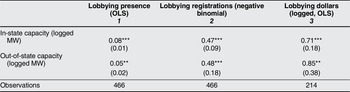
I model lobbying activity for firm i in year y and state s as a function of installed generation capacity for firm i in year y and state s; and installed generation capacity outside of state s for firm i in year y. Footnote 20 I estimate multilevel models with random effects at the firm, state, and year levels to account for the hierarchical structure of the data. The model includes a linear time variable to account for broader temporal trends. In column 1 of table 2, the outcome variable is a binary measure of whether a firm lobbied in a particular state-year (e.g., had at least one lobbying registration).Footnote 21 In column 2, the outcome variable is the total number of lobbying registrations attributed to a particular firm (in a state-year). For this specification, I estimate a negative binomial model since the outcome is an over-dispersed count variable (Greene Reference Greene2008). Finally, in column 3, the outcome is logged lobbying expenditures for the limited sample of states for which these data are available.
Association between rooftop solar capacity and lobbying within and across states

Note: Coefficients from multilevel models with random effects at firm, state, and year levels. Years covered: 2015–2017. **p<.05, ***p<.01.
Across specifications, the results presented in table 2 indicate that firm lobbying in a state is increasing in its installed TPO capacity in that state and its installed capacity in other states. The coefficients in column 1 indicate that a doubling of in-state capacity is associated with an eight-percentage point increase in the likelihood of an installer lobbying, while a doubling of out-of-state capacity is associated with a five-percentage point increase likelihood of an installer lobbying. Results from the negative binomial model also indicate that both in-state and out-of-state capacity matter for lobbying. The coefficient of .47 in column 2 suggests that a 1% increase in in-state capacity installed for a firm is associated with a .47% increase in number of retained lobbyists in that state (and a doubling in within-state capacity is associated with a 39% increase in number of retained lobbyists); the coefficient of .48 indicates that a 1% increase in out-of-state capacity is associated with a .48% increase in number of retained lobbyists in a given state (while a doubling in other-state capacity is associated with a 40% increase in number of retained lobbyists). I recover consistent results in the limited sample of states using logged lobbying expenditures as the outcome in a linear model. The coefficients suggest that a doubling of in-state capacity is associated with a 71% increase in lobbying expenditures, while a doubling of out-of-state capacity is associated with an 85% increase in lobbying expenditures.
These findings showing that installer lobbying in a state depends on installer economic strength in other states, put together with findings presented earlier, suggest that policy in one state also affects lobbying in another. State policy affects installer business growth (refer to table 1), which in turn drives installer lobbying across the states due to the horizontal mobilization of firms.
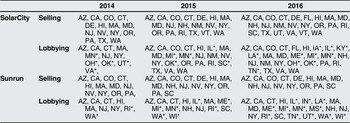
A particularly important case of cross-state feedback is where firms apply growth in states with favorable policy environments to seek to shape policy in potential new markets. To examine this dynamic, I track the economic and political (lobbying) presence across the states over time for the two largest and most politically active rooftop solar firms over the period: Sunrun and SolarCity. As illustrated by table 3, both firms significantly expanded economically and politically from 2014 to 2016. While there is certainly significant overlap in the states where the firms did business and lobbied, both firms engaged politically in a number of states in which they were not selling systems. In 2016, for instance, SolarCity lobbied in ten states in which it was not actively selling systems, and Sunrun lobbied in eleven. In many cases, these firms hired lobbyists in advance of economic expansion to particular states. Sunrun, as of 2020, had expanded to four of the eleven states in which it lobbied without a business presence in 2016.
The economic and political expansion of Sunrun and SolarCity

Note: *Denotes states where firms lobbied without selling systems.
Source: Firm websites and NIMSP
The Policy Effects of Cross-State Feedback
I now turn to the policy consequences of installer political engagement in the states. Estimating the influence of lobbying is a difficult task (Anzia Reference Anzia2018; Baumgartner et al. Reference Baumgartner, Berry, Hojnacki, Kimball, Beth and Leech2009). Though organized interests are widely understood to be influential (Gilens and Page Reference Gilens and Page2014), studies of interest group lobbying often estimate null effects (Baumgartner et al. Reference Baumgartner, Berry, Hojnacki, Kimball, Beth and Leech2009; Baumgartner and Leech Reference Baumgartner and Leech1998). The empirical approach I take has advantages over prior approaches since it leverages variation in policy outcomes both across states (Anzia Reference Anzia2018) and over time.
I rely on data previously discussed from Freeing the Grid measuring the favorability of state rooftop solar policies on a 1–5 scale and data from NIMSP on the lobbying of large rooftop solar installers. I model policy in state s and year t and as a function of the number of firms lobbying in state s and year t-1, and use two-way fixed effects panel regression to adjust for state-specific and year-specific confounders.
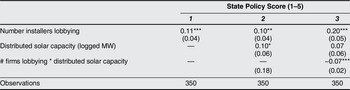
Results are presented in table 4. Across specifications, I find that firm lobbying is statistically significantly associated with policy favorability. The coefficient of .11 in column 1 suggests that the presence of an additional firm lobbying is associated with an increase of .11 in favorability of state policies in the following year (on a 1–5 scale). Column 2 presents results from a specification that also includes a measure of rooftop solar capacity at the state-year level. That the coefficient on firm lobbying remains roughly the same suggests the observed association is not driven by underlying industry growth. Finally, in column 3, I interact the number of firms lobbying with state-level rooftop solar capacity to explore how the effect of firm lobbying varies according to the degree of economic penetration of rooftop solar in a state. The negative, and statistically significant, coefficient on the interaction term suggests that the effect of firm lobbying on policy is greater in states with smaller presence of rooftop solar industry. This indicates that the behavior documented in the prior section of firms lobbying in states where they do not yet operate is particularly important for policy decisions.
Rooftop solar firm lobbying is associated with pro-rooftop solar state policy

Note: Coefficients from panel regression models with state and year fixed effects. Years covered: 2011–2017. *p<.1 **p<.05 ***p<.01.
Discussion
To summarize, I have shown that 1) favorable rooftop solar policy leads to rooftop solar industry growth; 2) rooftop solar industry growth leads to greater lobbying from rooftop solar industry both in the states where growth takes place and also in other states; 3) rooftop solar installers have in a number of cases sought to influence policy in states where they are not yet active; and 4) installer lobbying is associated with more favorable policy, particularly in places where the industry has less of an economic presence. Taken together, the empirical analyses trace out a causal process whereby adoption of favorable rooftop solar policies in leading states affected the interest group politics—and ultimately policy decisions—in other states.
Of course, the empirical analysis is not without its limitations. In particular, establishing causality in policy feedback and interest group influence research is a major challenge (Anzia Reference Anzia2018; Campbell Reference Campbell2012). In this case, neither policy enactment nor interest group lobbying is randomly assigned, nor are there apparent natural experiments to leverage. Yet by bringing together a multitude of both state- and firm-level data, I provide evidence in support of the proposed theoretical framework, and an empirical setup on which scholars working across different policy areas can build.
In addition, the evidence presented does not rule out that traditional diffusion mechanisms of learning and competition have also shaped state-level rooftop solar policy and politics. It clearly demonstrates, however, that these traditional mechanisms are not the whole story. An analysis of interdependent policymaking in this case that failed to consider the effects of state policies on the resources installers had at their disposal to engage politically in other states would be incomplete. Moreover, it is likely that the dynamics of cross-state policy feedback on interest group politics studied here can also serve to facilitate mechanisms of learning and competition. For instance, when installers lobbied in states where they had yet to establish an economic presence, they likely initiated a learning process among state lawmakers.
Future research building on this paper might seek to refine methods for distinguishing the types of intergovernmental policy feedbacks explored here from traditional diffusion mechanisms. The standard policy diffusion designs are limited in their ability to parse mechanisms (Gilardi and Wasserfallen Reference Gilardi and Wasserfallen2019), and the feedback dynamics studied here will not always lead to diffusion (the spread of particular policies) in a strict sense. Broadly speaking, studying intergovernmental policy feedback requires close attention not just to patterns of policy adoption in different units, but also to the political engagement of organized interests across the federal system. Scholars might pay attention to two groups in particular: first, groups with federated structures that can swiftly leverage resources from one jurisdiction to influence policy in another; and second, business interests seeking to expand.
Studying the intergovernmental effects of policies on interest group politics also likely requires examinations over longer periods of time than conventional policy diffusion approaches. Diffusion mechanisms like learning and competition might manifest quickly, since they depend principally on the beliefs of lawmakers, while the intergovernmental feedbacks studied here depend on long-run shifts to interest group systems. Indeed, the case of rooftop solar examined here is likely an outlier in the speed by which state policies gave rise to new interests.
By adopting this empirical approach, scholars can further extend the theoretical framework developed in this paper. A natural extension is vertical policy feedback (e.g., how state policies affect national politics). The organized interests that benefit from and are strengthened by state-level reforms might, in addition to advocating for their propagation across the states, advocate for the national-level adoption of those or aligned reforms. These effects have likely been limited in the case of rooftop solar, where key decisions are made at the state level. Indeed, while SolarCity, Sunrun, Vivint Solar, and SunEdison spent a bit less than nine million dollars lobbying in the fifteen states that collected expenditure data between 2015 and 2017, they collectively spent just two-and-a-quarter million dollars lobbying the federal government over the same period (NIMSP and Center for Responsive Politics). But there is some anecdotal evidence that the growth of the rooftop solar lobby, driven in part by state-level decisions, has been important to the national politics for issues like tariffs on solar panels and the Solar Investment Tax Credit (e.g., House letter to the USITC 2017).
Future research might also consider the conditions under which strategic actors intentionally leverage state policy as a political tool in building a coalition for broader reform—or seeking to dismantle opposing organized interests (Hertel-Fernandez Reference Hertel-Fernandez2018). Importantly, politicians often face a collective action problem in their efforts to use policy for political gain. Even when a broader party or interest group benefits from a particular policy, individual lawmakers might defect (Anzia and Moe Reference Anzia and Moe2016). This collective action problem is particularly pronounced for politicians seeking to use state policy for national-level political gain (Trachtman Reference Trachtman2020). As a result, we might expect federated groups with political operations across sites and levels of government to be most equipped to strategically harness dynamics of intergovernmental policy feedback (Hertel-Fernandez, Skocpol, and Lynch Reference Hertel-Fernandez, Skocpol and Lynch2016; Trachtman Reference Trachtman2020).
While I demonstrate the force of intergovernmental feedbacks on interest group politics, these mechanisms are likely more limited in other cases. The aggressive growth strategy of installers, combined with the crucial role of state policy in driving growth, provided a strong incentive for installers to mobilize politically across the states. At the same time, even as rooftop solar firms have mobilized, incumbent electric utilities have been able to prevent pro-solar reforms across a number of states, and in some cases, roll them back (Stokes Reference Stokes2020). Forward-looking incumbents engaged across sites and levels of government in the federal system can, in this way, leverage policy to prevent competitors from growing. Moreover, in policy areas like immigration or marriage equality, where subnational policy decisions are less likely to engender major shifts in the broader interest-group landscape, we are unlikely to observe strong intergovernmental policy feedbacks operating through organized interests.
But at the same time, there are a broad swath of policy issues for which the mechanisms I explore here are likely quite relevant. Indeed, the emergence of supportive interests with a stake in new policy regimes is a fundamental feature of sustainable policy reform (Patashnik Reference Patashnik2008). These mechanisms are particularly relevant to the politics of the energy transition, where liberal-leaning states have led the way, but where there are significantly more greenhouse gas emissions to be abated in conservative-leaning areas. While rooftop solar is just a small piece of the energy transition, similar ideas apply to other elements like utility-scale renewables and energy efficiency (Meckling and Hughes Reference Meckling and Hughes2018; Trachtman Reference Trachtman2019). In general, policy feedbacks in energy governance tend to be quite powerful, since policies that replace fossil fuel infrastructure with clean energy infrastructure also replace fossil fuel interests with clean energy interests (Bernstein and Hoffmann Reference Bernstein and Hoffmann2018; Meckling et al. Reference Meckling, Kelsey, Biber and Zysman2015).
More broadly, states play large regulatory roles across several important policy areas, and state-level decisions can affect the political resources of organized interests active (or potentially active in the future) in other states. For instance, in the education system, state policy has been instrumental to the steady growth of charter schools in recent years, which in many states and districts now pose a meaningful challenge to the traditional public-school model—as well as to the teachers’ unions that draw strength from that model. As charter schools have grown, so has the charter school lobby, as wealthy foundations have allied with charter networks to push forward policies across the states, and also in local and federal politics (Henig, Jacobsen, and Reckhow Reference Henig, Jacobsen and Reckhow2019).
The general scope conditions for these types of effects are quite broad. Subnational policies must give rise to new organized interests (in this case rooftop solar installers) or significantly influence the capacities of existing interests. And the organized interests affected by subnational policies must leverage newfound strength to mobilize horizontally across the federal system. Though I focus specifically on the effects of state policies on business interests, elements of the proposed perspective also likely apply to other types of organized interests (e.g., unions and citizen groups), and also to subnational jurisdictions apart from the U.S. states (e.g., cities and non-U.S. federal systems).
There are reasons to think, in addition, that these types of dynamics are at play even in some areas where we do not observe shifts to policy or interest-group landscapes: they can be baked into the status quo. The period of rooftop solar policy and politics that I study saw massive policy and interest group changes over a relatively short period of time, which renders the dynamics of policy feedback across the states highly visible. Similar mechanisms, though, can enforce policy stability. Many powerful organized interests draw strength from policies in place in jurisdictions across the federal system and use their resources to block threatening policies at multiple sites and levels of government (Moe Reference Moe2011). These dynamics are difficult to study since they tend to lead to non-action. But studying policy areas in flux such as rooftop solar can provide insight into forces of policy stability.
Supplemental Materials
To view supplementary material for this article, please visit http://doi.org/10.1017/S153759272100092X.
Figure A1. Distributed solar capacity by state (EIA)
Figure A2. Rooftop solar policy favorability by state over time
Table A1. Association between state policy and distributed solar growth, robustness to dropping negative observations
Acknowledgements
Thanks to Sarah Anzia, David Broockman, Becca Goldstein, Alex Hertel-Fernandez, Jonas Meckling, Paul Pierson, Laura Stoker, Leah Stokes, Eric Schickler, Sam Zacher, as well as participants at the American Political Science Association 2019 meeting and University of California, Berkeley Research Workshop in American Politics for helpful comments. Any errors are my own.