




No CrossRef data available.
Article contents
Peer victimization in early adolescence: Association between physical and relational victimization and drug use, aggression, and delinquent behaviors among urban middle school students
Published online by Cambridge University Press: 10 February 2006
Abstract
This study examined associations between two forms of peer victimization, physical and relational, and externalizing behaviors including drug use, aggression, and delinquent behaviors among a sample of 276 predominantly African American eighth graders attending middle school in an urban public school system. Regression analyses indicated that physical victimization was significantly related to cigarette and alcohol use but not to advanced alcohol and marijuana use; relational victimization contributed uniquely to all categories of drug use after controlling for physical victimization. Physical victimization was also significantly related to physical and relational aggression and delinquent behaviors, and relational victimization made a unique contribution in the concurrent prediction of these behaviors. Physical victimization was more strongly related to both categories of alcohol use, aggression, and to delinquent behaviors among boys than among girls. In contrast, relational victimization was more strongly related to physical aggression and marijuana use among girls than among boys, but more strongly related to relational aggression among boys than among girls. These findings provide information about the generalizability of prior research and have important implications for intervention efforts.
This research was supported by Cooperative Agreement U81/CCU309966 from the Centers for Disease Control and Prevention (CDC). The research and interpretations reported herein are the sole responsibility of the authors and are not necessarily endorsed by the CDC or represent the views, opinions, or policies of the CDC or its staff.
Information
- Type
- Research Article
- Information
- Copyright
- © 2006 Cambridge University Press
Being the target of physical, verbal, or relational aggression is unfortunately a relatively common experience for children and adolescents. Prevalence rates indicate that between 40 and 80% of school-aged youth have been exposed to victimization by peers, and approximately 10 to 15% of these youth experience chronic victimization (Juvonen & Graham, 2001). A growing body of research documents the detrimental effects of peer victimization on children's psychosocial development. Peer victimization has been related to internalizing behaviors such as anxiety, depression, and low self-worth (e.g., Hawker & Boulton, 2000), externalizing behaviors such as aggression and delinquency (e.g., Khatri, Kupersmidt, & Patterson, 2000; Schwartz, Proctor, & Chien, 2001), and peer rejection (e.g., Hodges & Perry, 1999). The majority of studies in this area focus on physical (e.g., being hit) or more general verbal (e.g., being teased) forms of victimization. An important extension to this literature is the study of relational victimization (e.g., Crick & Bigbee, 1998; Crick & Grotpeter, 1996). Relational victimization represents a distinct construct in that it encompasses behaviors that are specifically designed to inflict harm by damaging or manipulating the victim's relationship with other peers (Crick et al., 2001; Crick, Casas, & Nelson, 2002). Examples include lying and spreading rumors to make others dislike a peer, excluding a peer from group activities, and threatening to withdraw friendship unless a peer acquiesces to specific demands (Crick et al., 2002).
The study of peer victimization and its association with psychosocial adjustment is particularly relevant during early adolescence as youth transition from adult- to peer-centered relationships (Nansel, Haynie, & Simons-Morton, 2003). As autonomy from parents increases, adolescents spend more time with peers and rely on peer support to a greater extent (Prinstein, Boergers, & Vernberg, 2001). Hierarchies develop within peer groups and concerns about social status and popularity become increasingly salient (Espelage, 2002). The formation of cliques that represent small groups of youth with similar backgrounds, interests, or reputations is common and adolescents may also become more possessive of their friendships, demanding exclusivity (Brown & Lohr, 1987). Within dyadic and peer group contexts, supportive peer relationships fill needs for belonging and acceptance by peers and provide opportunities to develop adaptive coping skills and improved social competence (Yoon, Barton, & Taiariol, 2004). Such relationships may also help youth better adapt to contextual changes in middle school that may create feelings of anonymity including a more bureaucratic administration, larger student body, and moving from class to class (Nansel et al., 2003).
Although physical victimization clearly places youth at risk for injury, physical and relational victimization are also harmful because they limit opportunities to develop supportive peer relationships (e.g., Crick et al., 2001; Coie, Dodge, & Kupersmidt, 1990). Both types of victimization are used to establish and maintain boundaries and status within cliques, and victims are frequently rejected from or marginalized within these peer groups (e.g., Rodkin & Hodges, 2003; Underwood, 2003). In particular, developmental changes in the quality and meaning of friendships underscore the hurtful and harmful nature of relational victimization. The quality of relationships changes from being unilateral or reciprocal in middle childhood to being more mutual and interdependent (Selman, 1981). Relationships are viewed as enduring and committed and involve more intimate disclosure of personal issues (Maccoby, 1988). Themes of conversation include avoidance of rejection, inclusion by peers, and concerns about self-presentation, with gossip and evaluation of others becoming more normative (Parker & Gottman, 1989). Relational victimization may be particularly threatening because this behavior betrays the trust placed in peer relationships and the high level of sharing and openness make youth vulnerable to having personal information used against them in this context (Prinstein et al., 2001). Overall, the combined developmental changes occurring in early adolescence (shifts in understanding of friendships and peer relations, underlying themes of conversations with peers, and the development of cliques) highlight the significance of investigating peer victimization.
The study of relational victimization provides important insight into a unique category of victimization experiences for girls and boys. In contrast with physical victimization that more frequently occurs among boys, several studies documented similar prevalence rates for relational victimization among adolescent boys and girls (e.g., Prinstein et al., 2001; Storch, Brassard, & Masia-Warner, 2003). This may be explained in part by peer networks moving from predominantly same-gender peer groups during middle childhood to mixed-gender peer groups and romantic relationships in adolescence, thus providing new contexts for relational victimization across gender (Crick et al., 2001). Although boys and girls may experience comparable rates of relational victimization, key differences exist in the way these events are perceived (e.g., Galen & Underwood, 1997; Paquette & Underwood, 1999). In a study including elementary, middle, and high school youth, girls rated social victimization (a construct that encompassed relational victimization) as significantly more hurtful than did boys. In addition, girls perceived social and physical victimization to be equally hurtful, while boys rated physical victimization as more hurtful than social victimization (Galen & Underwood, 1997). A subsequent study of early adolescents in seventh and eighth grade found that boys experienced similar levels of negative affect following social and physical victimization, but girls reported significantly more negative affect in response to social victimization compared to boys. Results also indicated that girls tended to ruminate more about experiences of social victimization than did boys (Paquette & Underwood, 1999). Overall, these findings suggest that social forms of victimization such as relational victimization are particularly distressing for girls, potentially reflecting the strong emphasis placed by girls on social bonds with peers (Crick & Zahn-Waxler, 2003).
Although a number of studies have examined the relation between peer victimization and internalizing behaviors (see Hawker & Boulton, 2000, for a recent meta-analysis), fewer have focused on peer victimization as a risk factor for externalizing behaviors such as aggression, delinquency, and drug use (e.g., Khatri et al., 2000; Schwartz et al., 2001; Weiner et al., 2003). The identification of potential risk factors for externalizing behaviors is particularly important given the increase in these behaviors during early adolescence (e.g., Farrell & Sullivan, 2004; Moffitt, 1997). Although these behaviors typically decline by adulthood, they exact significant negative short- and long-term consequences. They not only place adolescents at risk for adverse health consequences (e.g., physical injury) but may also interfere with normative developmental processes. As an example, adolescents who rely on drug use or aggressive behavior to cope with stressors may limit opportunities to learn more adaptive problem-solving strategies. Involvement in delinquent behavior may result in legal sanctions that displace youth from typical school environments and curtail involvement with nondelinquent peers. Finally, onset of drug use in early adolescence is related to continued use and abuse of substances at later stages of development (Everett et al., 1999; Grant & Dawson, 1997).
Several studies have examined peer victimization as a risk factor for increased aggressive and delinquent behavior among elementary school children (e.g., Hodges, Boivin, Vitaro, & Bukowski, 1999; Khatri et al., 2000). For example, Khatri et al. (2000) investigated whether verbal victimization (i.e., being teased or called names a lot) predicted increased delinquency and aggression among a sample of 471 fourth, fifth, and sixth graders. Verbal victimization resulted in subsequent increases in delinquency for girls but not for boys 1 year later, but it was not related to changes in aggression for either gender. In a sample of 393 French Canadian fourth and fifth graders, peer victimization based on a combined measure of verbal and physical victimization predicted increased externalizing behavior (including aggression and delinquency) over a 1-year period (Hodges et al., 1999).
Building on research conducted with elementary school students, Paul and Cillessen (2003) investigated longitudinal associations between a composite peer nomination measure of relational, physical, and verbal victimization and levels of disruptive behavior (including aggression and delinquency) among a sample of predominantly Caucasian sixth grade middle school students. Students nominated as victims reported higher levels of disruptive behavior than did nonvictims 1 year later. Among victims, girls reported higher levels of disruptive behavior than did boys. The authors speculated that the finding for girls may reflect the inclusion of relational victimization items, but the composite measure precluded establishing any unique contributions. Peer victimization (a composite measure of physical, relational, and verbal victimization) was also positively associated with teacher reported externalizing behavior among 785 African American and Latino youth in middle school (Graham, Bellmore, & Juvonen, 2003). In contrast, Prinstein and colleagues (2001) examined associations between relational and physical victimization and externalizing behavior (including both aggression and delinquency) among 566 high school students. Results indicated that externalizing behavior was positively associated with physical victimization for boys and girls, but not with relational victimization. One complication of much of the existing literature is the use of composite measures for externalizing behavior and victimization, making it difficult to isolate the contributions of the various forms of these behaviors. Previous studies have highlighted the importance of differentiating between relational and physical victimization (e.g., Crick & Bigbee, 1998; Crick & Grotpeter, 1996) and between aggression and delinquency (e.g., Farrell, Kung, White, & Valois, 2000).
Few studies have examined potential links between physical and relational victimization by peers and drug use. One exception is a study by Weiner et al. (2003) that explored associations between relational victimization, anger control, and drug use among a sample of 3,922 predominantly Caucasian 8th, 10th, and 12th graders. Results indicated that higher levels of relational victimization were associated with lower levels of anger control, which in turn, was related to higher levels of gateway drug use. However, these researchers did not measure the direct association between relational victimization and gateway drug use. Support for the relation between physical forms of peer victimization and drug use is provided by a related line of research that documents a positive association between violent victimization and drug use among adolescents (e.g., Berenson, Wiemann, & McCombs, 2001; Kilpatrick et al., 2000; Martin, Clark, Lynch, Kupper, & Cilenti, 1999; Simantov, Schoen, & Klein, 2000). For example, adolescent girls who reported experiencing violent acts including robbery, physical attack, rape, or threats against their life were 2–4 times more likely to use cigarettes, alcohol, and marijuana than those who had neither witnessed nor experienced these types of violence (Berenson et al., 2001). Moreover, among a sample of 4,023 adolescents ages 12–17, victimization experiences including physical and sexual assault were significant risk factors for alcohol, marijuana, and hard drug abuse or dependence (Kilpatrick et al., 2000). Additional research is needed to determine whether these relations also generalize to victimization by peers.
Stress and coping theories provide insight into why physical and relational victimization may be related to higher levels of externalizing behaviors. Peer victimization is a salient stressor for youth (e.g., Boulton & Underwood, 1992) that elicits coping responses that may be adaptive or maladaptive (e.g., behavioral, cognitive) in attempts to relieve or manage stress associated with these experiences (Lazarus & Folkman, 1984). The hurtful nature of physical and relational victimization has been documented in several studies (e.g., Crick, Bigbee, & Howes, 1996; Galen & Underwood, 1997; Paquette & Underwood, 1999). Maccoby (1988) highlighted several developmental changes in the nature of stressful events that suggest peer victimization may be particularly distressing for early adolescents. When peer relationships are damaged, adolescents compared to younger children are more upset by the loss of emotional support. In addition, self-concept during this time period is increasingly driven by social comparison with peers. Youth are invested in creating and projecting a certain image and stressors that humiliate or embarrass them in front of peers may be especially painful. Finally, youth are generally more distressed when they experience difficulty in areas that impact their self-concept where they wish to excel and have invested considerable energy (Maccoby, 1988). For early adolescents, substantial effort and importance is placed in developing and maintaining supportive peer relationships. Concomitant with the above changes are shifts in coping behavior. As youth move from childhood into adolescence their coping repertoires increase. Specifically, youth acquire and use more emotion-focused coping strategies (Compas, Worsham, & Ey, 1992), some of which are less adaptive than others (e.g., avoidant strategies such as drug use).
The stress-coping model for drug use developed by Wills and Filer (1996) provides a framework for hypothesizing a link between peer victimization and aggression and delinquent behaviors. At a general level, stressful events are characterized as risk factors for drug use and other problem behaviors (Wills, Vaccaro, & Benson, 1995). This premise is supported by empirical findings linking peer victimization to higher levels of drug use (e.g., Weiner et al., 2003) and to aggression and delinquent behaviors (e.g., Paul & Cillessen, 2003). More specifically, drug use is viewed as an avoidant coping strategy whereby drugs are used to reduce the negative emotional arousal generated by a stressful experience (Wills & Filer, 1996). Several studies have revealed positive associations between peer victimization and increased negative affect such as anxiety or depression (e.g., Hawker & Boulton, 2000), and one reason that adolescents report using drugs is to reduce stress (e.g., Brennan & Moos, 1991; Novacek, Raskin, & Hogan, 1991; Simantov et al., 2000).
Aggression and delinquent behaviors could also be characterized as maladaptive coping strategies to deal with the emotional arousal created by peer victimization experiences. In a recent study, Kochenderfer-Ladd (2004) found that elementary school children responded to peer victimization with negative affect including being afraid, embarrassed, upset, or angry. Being angry was the most common response to a victimization experience, and the most frequent way youth coped with this anger was to get back at the victim by using aggressive behavior. Crick and Bigbee (1998) theorized that some youth who experience physical or relational victimization respond by forming negative opinions of their aggressive peers, leading to difficulty with self-restraint and retaliatory behavior. For example, seventh and eighth graders in middle school perceived that the most frequent goal of an aggressor was to seek revenge (Paquette & Underwood, 1999). Youth who experience peer victimization may thus engage in aggression or delinquent behaviors (e.g., destroying another's property) in retaliation. Although the function of externalizing behaviors may differ with aggression and delinquency being used to retaliate more directly against an aggressor and drug use being used as an avoidant coping strategy to blunt negative affect, each of these responses represents a maladaptive coping response for dealing with peer victimization experiences.
The present study examined the association between physical and relational victimization and externalizing behaviors including drug use, aggression, and delinquent behaviors. This study differed from most prior studies in several important respects. First, unlike many previous studies of relational victimization, this study employed a sample of predominantly African American urban middle school students. This study thus provides information about the generalizability of prior research examining the association between relational victimization and psychosocial adjustment to urban African American adolescents. We examined the association between relational and physical forms of aggression and victimization. Crick and Zahn-Waxler (2003) argued that relational aggression should be included in the categorization of externalizing behaviors to provide a more comprehensive understanding of externalizing behaviors across gender. Unfortunately, most studies examining associations between peer victimization and aggression have not included separate constructs for physical and relational aggression. In addition, although studies have examined the association between relational victimization and externalizing behaviors such as aggression and delinquent behaviors (e.g., Khatri et al., 2000), few have focused specifically on drug use (e.g., Weiner et al., 2003). We also examined the potential moderating effect of gender in the relation between peer victimization and externalizing behaviors. For boys, compared to girls, physical victimization occurs more frequently (e.g., Crick & Bigbee, 1998; Prinstein et al., 2001), is salient in establishing status and hierarchies within peer groups (Rodkin & Hodges, 2003), and is rated as more hurtful than social forms of victimization (Paquette & Underwood, 1999). Thus, we anticipated that physical victimization would be more strongly related to externalizing behaviors for boys than for girls. In contrast, girls rated social forms of victimization as more hurtful and harmful than did boys, and these behaviors undermine the development of social bonds and intimate relationships with peers, which are especially important goals for girls during adolescence (Crick et al., 2001). Therefore, we anticipated that relational victimization would be more strongly related to externalizing behaviors for girls than for boys.
Method
Setting and participants
Eighth graders attending two middle schools in the public school system of a large city in the Southeastern United States completed self-report measures in May of 1999 as part of a larger project evaluating school-based violence prevention programs (Farrell, Meyer, Sullivan, & Kung, 2003). Recent data from the school system indicated that 82% of the middle school students attending these schools were eligible for the federally subsidized school lunch program. Potential participants were eighth grade students enrolled at the participating schools except for those in self-contained classrooms, and all were informed that their participation was completely voluntary. Out of 389 possible participants, data were not obtained from 52 students who were absent or could not be located, 23 students in a classroom that was not assessed on request from the teacher, and from 17 students who elected not to participate. Data were excluded from 16 students because visual inspection of their booklets suggested random responding, and from 5 because analysis of inconsistencies in their data met statistical criteria for random responding (Farrell, Danish, & Howard, 1991). The final sample of 276 students represented 71% of potential participants and included 116 boys, 158 girls, and 2 participants for whom gender was not reported. The average age of participants was 14.5 years (SD = 0.5); 92% of students identified themselves as African American, 2% as Caucasian, 1% as Hispanic, 1% as Native American, and the remainder as Asian American or other.
Procedure
Measures were administered during homeroom or a class period scheduled for testing by graduate research assistants who explained the purpose of the testing and assured students that their responses would be confidential and school staff would not be involved in handling completed data. Students not wishing to participate were given the opportunity to hand in blank booklets. All booklets were collected and immediately sealed in envelopes before being taken from the room. Data were collected across multiple days at each school in an effort to include students absent on the primary testing days.
Measures
The Problem Behavior Frequency Scales include separate scales assessing the frequency of physical and relational aggression, gateway drug use, and delinquent behavior (Farrell et al., 2000; Miller-Johnson, Sullivan, Simon, & Multi-Site Violence Prevention Project, 2004). For all items, students indicated how frequently they had engaged in each behavior in the past 30 days using a 6-point anchored scale (1 = never, 2 = 1–2 times, 3 = 3–5 times, 4 = 6–9 times, 5 = 10–19 times, 6 = 20 or more times). The five items representing physical aggression were based on the Centers for Disease Control's Youth Risk Survey (Kolbe, Kann, & Collins, 1993) (e.g., “hit or slapped another kid,” “shoved or pushed another kid”). The five items representing relational aggression (e.g., “Excluded another student from your group,” “Told another kid you wouldn't like them unless they did what you wanted them to do”) were based on Crick and Grotpeter's (1995) measure of relational aggression. Several items were reworded to be more appropriate for a middle school context, and the response format was changed to reflect the frequency of these behaviors in the past 30 days. One item, “Spread a false rumor about someone” was added to the Relational Aggression Scale. The alphas for the Physical and Relational Aggression Scales were .86 and .76, respectively. The six-item Gateway Drug Use Scale assesses the frequency of use for specific drugs (i.e., beer, wine, cigarettes, hard liquor, and marijuana), and advanced alcohol use (i.e., been drunk), with each item reflecting the number of times adolescents reported using that particular drug in the past 30 days. A composite measure was created for alcohol use that included the items assessing beer, wine, and liquor use. Finally, the seven-item Delinquent Behavior Scale was based on items in Jessor and Jessor's (1977) Attitude Toward Deviance Scale such as stealing something from another person, damaging property that didn't belong to you, or skipping school, but not drug use or violent behaviors. The alpha for this scale was .79.
The Social Experience Questionnaire (Self-Report; Crick & Grotpeter, 1996) included separate scales that assessed the frequency of physical and relational victimization. Several items were slightly reworded to be more appropriate for a middle school context and the response format was changed to reflect the frequency of these behaviors in the past 30 days. One item, “Had someone start a rumor about you” was added to the Relational Victimization Scale. For all items, students indicated how frequently each behavior happened to them in the past 30 days using the same 6-point scale as the Problem Behavior Frequency Scale. The four-item Physical Victimization Scale measures the frequency of physical harm or threatened physical harm by peers (e.g., “been hit by another kid”). The six-item Relational Victimization Scale assessed the frequency of victimization aimed at damaging or manipulating peer relationships (e.g., “had a kid tell lies about you to make other kids not like you anymore”). Alphas for the Physical and Relational Victimization Scales were .85 and .84, respectively.
Results
Prevalence of physical and relational victimization and drug use
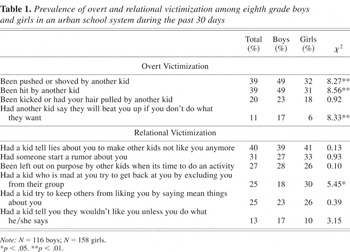
The prevalence of physical and relational victimization for eighth graders is reported by gender in Table 1. For physical victimization, approximately 40% of the students reported being hit, pushed, or shoved in the past 30 days, 20% reported being kicked or having their hair pulled, and 11% indicated being threatened with physical violence. Boys reported higher frequencies than did girls for all items except being kicked or having their hair pulled. Overall, 49% of students reported being the victim of at least one physically aggressive act in the past 30 days, and 33% experienced multiple acts of physical victimization. For relational victimization, the prevalence of individual items varied from 40% for another student told lies about you to make other kids not like you anymore to 13% for another student said they would not like you unless you complied with his or her demands. Boys and girls reported similar frequencies of relational victimization across all items with the exception that girls reported being excluded from a peer group by a student who was mad at them more often than did boys. Sixty-one percent of adolescents reported experiencing at least one act of relational victimization in the past 30 days, and 38% experienced multiple acts of relational victimization.
Prevalence of overt and relational victimization among eighth grade boys and girls in an urban school system during the past 30 days

For drug use, prevalence rates indicated that 31% of eighth graders reported cigarette use, 48% reported alcohol use, 24% reported advanced alcohol use, and 22% reported marijuana use in the past 30 days. Comparison to national surveys assessing drug use among adolescents revealed that these prevalence rates were somewhat higher than those found for eighth graders (e.g., Johnston, O'Malley, & Bachman, 2001) and more typical of rates found among high school students (e.g., Youth Risk Behavior Surveillance, 2004). However, studies indicate that youth living under conditions of poverty in disadvantaged neighborhoods may be at risk for higher levels of drug use irrespective of ethnic background (Oetting & Beauvais, 2002).
Descriptive statistics and associations among physical and relational victimization and aggression, delinquent behaviors, and drug use variables
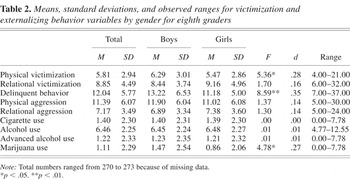
The mean, standard deviation, and observed ranges for physical and relational victimization and drug use, aggression, and delinquent behaviors are reported by gender in Table 2. Analysis of variance (ANOVA) indicated that boys reported significantly higher mean frequencies for physical victimization, F (1, 271) = 5.36, p < .05, and delinquent behaviors, F (1, 271) = 8.59, p < .01, compared to girls. Boys also reported a higher frequency of marijuana use, F (1, 271) = 4.78, p < .05, than did girls.
Means, standard deviations, and observed ranges for victimization and externalizing behavior variables by gender for eighth graders

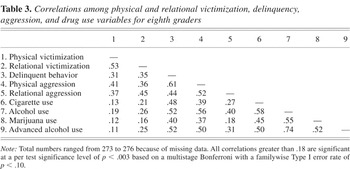
Correlations among peer victimization and externalizing behaviors are presented in Table 3. Physical and relational victimization were moderately correlated supporting the notion that they are related but distinct constructs. Correlations among physical victimization and physical and relational aggression were significant. Similarly, relational victimization was significantly correlated with these forms of aggression. Physical and relational victimization were both significantly correlated with delinquency. With regard to drug use, physical victimization was significantly correlated with alcohol use only. Correlations among relational victimization and drug use variables were significant for cigarette, alcohol, and advanced alcohol use.
Correlations among physical and relational victimization, delinquency, aggression, and drug use variables for eighth graders

Comparisons between independent correlations (Cohen & Cohen, 1988) were used to determine if correlations among peer victimization and externalizing behavior variables were different for boys and girls. Out of 36 correlations, only four significant differences were found at p < .05. For boys compared to girls, physical victimization was more strongly correlated with physical aggression (r = .56 for boys, r = .28 for girls; z = 2.78, p < .01), delinquent behaviors (r = .44 for boys, r = .16 for girls; z = 2.51, p < .05), and alcohol use (r = .40 for boys, r = .02 for girls; z = 3.26, p < .01). Correlations among relational victimization and relational aggression were also stronger for boys than for girls (r = .65 for boys, r = .35 for girls; z = 3.31, p < .01).
Combined effects of physical and relational victimization on delinquency, aggression, and drug use variables
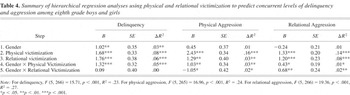
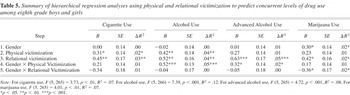
Hierarchical regression analyses were used to examine the effects of physical victimization on externalizing behaviors and the unique contribution of relational victimization in the concurrent prediction of these behaviors after controlling for physical victimization (see Tables 4 and 5). Gender differences in these relations were also examined. Separate analyses were conducted for physical and relational aggression, delinquency, and each category of drug use (cigarettes, alcohol, advanced alcohol, and marijuana). Physical and relational victimization variables were converted to z scores. The scores for physical victimization ranged from 4 to 21, and the scores for relational victimization ranged from 6 to 32. Because many students scored at the bottom of the scale (i.e., 51% for overt victimization, 39% for relational victimization), these scores were represented at the lower end of the plotted scores. The cutoff for the upper end of the plotted scores was set at the 90th percentile. Gender (coded −1 for girls and 1 for boys) was entered at Step 1, physical victimization at Step 2, relational victimization at Step 3, the Gender × Physical Victimization interaction at Step 4, and the Gender × Relational Victimization interaction at the final step. Consistent with the recommendations of Aiken and West (1991), interaction terms were created by multiplying gender by each of the victimization variables. Drug use variables were log transformed to normalize their distribution and multiplied by 10 to facilitate reporting.
Summary of hierarchical regression analyses using physical and relational victimization to predict concurrent levels of delinquency and aggression among eighth grade boys and girls

Summary of hierarchical regression analyses using physical and relational victimization to predict concurrent levels of drug use among eighth grade boys and girls

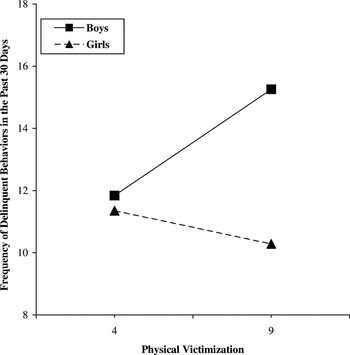
For delinquency, a significant main effect for gender was found with boys reporting higher levels of this behavior than girls. With gender controlled, physical victimization accounted for an additional 8% of the variance. Relational victimization accounted for 6% of the variance beyond that explained by gender and physical victimization. The Gender × Physical Victimization interaction was significant, and Figure 1 represents the frequency of delinquent behaviors as a function of gender and physical victimization. Boys reported slightly higher frequencies of delinquent behaviors than girls at low levels of physical victimization. For boys, higher levels of physical victimization were associated with an increased frequency of delinquent behaviors. In contrast, there was little change in the frequency of delinquent behaviors for girls as a function of physical victimization levels. No gender differences were found in the association between relational victimization and delinquency.

Regression lines for reported frequency of delinquent behaviors as a function of gender and physical victimization.
No gender differences were found in the frequency of physical aggression. Physical victimization accounted for 16% of the variance in physical aggression after controlling for gender. Relational victimization accounted for a significant portion of the variance with the R2 change = 3% when gender and physical victimization were controlled. Physical victimization was more strongly related to physical aggression for boys than for girls, and the pattern of this relation was similar to that found for delinquent behaviors. A significant Gender × Relational Victimization interaction was also found. Boys reported higher levels of physical aggression than girls at low levels of relational victimization. For girls, higher levels of relational victimization were associated with an increased frequency of physical aggression, but boys showed little change in physical aggression as a function of relational victimization levels.
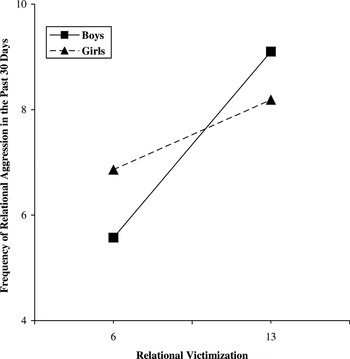
Boys and girls reported similar frequencies of relational aggression. Main effects for physical and relational victimization were both significant. Physical victimization accounted for 14% of the variance in relational aggression after controlling for gender, and relational victimization, entered at Step 3, explained an additional 8% of the variance. The relation between physical victimization and relational aggression was stronger for boys than for girls. Girls reported higher frequencies of relational aggression than did boys at low levels of physical victimization. Higher levels of physical victimization were associated with increased relational aggression for boys, but girls showed little change in relational aggression as a function of physical victimization levels. Finally, a significant Gender × Relational Victimization interaction was found. At low levels of relational victimization, higher frequencies of relational aggression were found for girls compared to boys. Higher levels of relational victimization were associated with increased relational aggression for both boys and girls, but this relation was stronger for boys (see Figure 2).

Regression lines for reported frequency of relational aggression as a function of gender and relational victimization.
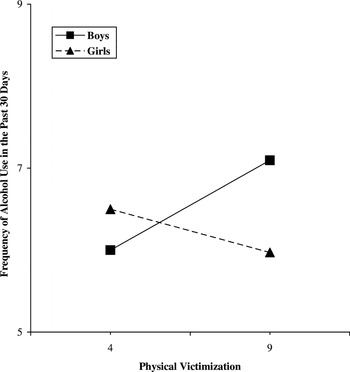
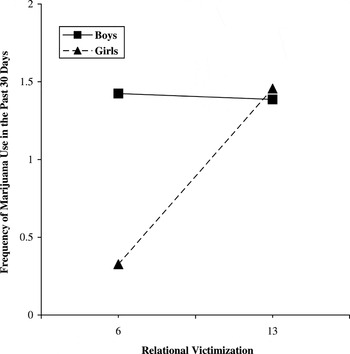
In terms of drug use, results revealed only one significant main effect for gender with boys reporting a higher frequency of marijuana use than girls in the past 30 days. Physical victimization, entered at Step 2, was related to cigarette and alcohol use, accounting for an additional 2% of the variance in cigarette use and 4% in alcohol use, but not to advanced alcohol or marijuana use. Relational victimization, entered at Step 3, accounted for a significant increase (2–5%) in the variance across all drug use categories. The Gender × Physical Victimization interaction was significant for both categories of alcohol use, but not for cigarette or marijuana use. Higher levels of physical victimization were associated with increased alcohol and advanced alcohol use for boys. However, for girls the frequency of use decreased as the level of physical victimization increased from low to high. Figure 3 represents the frequency of alcohol use as a function of gender and physical victimization; the pattern of findings for advanced alcohol use was similar. The Gender × Relational Victimization interaction was significant for marijuana use. For girls, higher levels of relational victimization were associated with an increased frequency of marijuana use. However, there was little change in the frequency of marijuana use for boys as a function of relational victimization levels (see Figure 4).

Regression lines for reported frequency of alcohol use as a function of gender and physical victimization.

Regression lines for reported frequency of marijuana use as a function of gender and relational victimization.
Discussion
The purpose of this study was to examine the extent to which two forms of peer victimization were related to externalizing behaviors including drug use, physical and relational aggression, and delinquency within a sample of urban, predominantly African American adolescents. With few exceptions (e.g., Graham et al., 2003), studies in this area have included small percentages of African American adolescents, and to our knowledge, little research has been conducted on the association between physical and relational forms of peer victimization and drug use. A substantial percentage of youth in our sample experienced acts of physical and relational victimization. We expected that physical victimization would be more strongly related to externalizing behaviors among boys than among girls, and this hypothesis was supported for physical and relational aggression, delinquent behaviors, and both categories of alcohol use. In contrast, we anticipated that relational victimization would be more strongly related to externalizing behaviors for girls compared to boys. After controlling for physical victimization, relational victimization accounted for unique variance across all the measures of externalizing behaviors. However, few gender differences were found in the strength of these relations. In fact, our hypothesis regarding gender differences was confirmed for only physical aggression and marijuana use, and relational victimization was more strongly associated with relational aggression among boys than among girls.
Prevalence rates indicated that half or more of the students experienced at least one incident of physical or relational victimization in the past 30 days, and approximately 40% experienced multiple acts of victimization during this time period. Although few studies of relational victimization have included this type of breakdown, these prevalence rates are comparable to rates reported across studies of peer victimization that ranged from 40 to 80% (Juvonen & Graham, 2001). Consistent with studies including adolescent samples (e.g., Prinstein et al., 2001; Storch et al., 2003), boys reported higher frequencies of physical victimization than girls, whereas comparable frequencies of relational victimization were reported across gender. Overall, these findings highlight the importance of considering relational victimization as a key construct within peer victimization experiences in that it represents a unique category of these experiences that is relevant for girls and boys. It is important to note that this study was based on a sample of primarily urban African American adolescents and a large percentage of these youth were from low-income households and lived in urban neighborhoods characterized by high rates of crime and violence. Youth living in neighborhoods high in disadvantage have reported nearly twice as many stressful events as those in moderately disadvantaged neighborhoods (Attar, Guerra, & Tolan, 1994) and also report high rates of witnessing community violence and violent victimization (e.g., Farrell & Bruce, 1997; Gorman-Smith & Tolan, 1998; Hammond & Yung, 1993). Study results demonstrated that physical and relational peer victimization might also represent salient sources of stress that were prevalent among youth in this sample. It is important to note that youth from economically disadvantaged backgrounds face a number of environmental stressors that may contribute to negative outcomes and are not related to ethnic background (e.g., Evans, 2004). Thus, these results must be viewed through the lens of this environmental context and further research is needed to examine the generalizability of these findings to African American youth living in other socioeconomic contexts.
Consistent with our hypotheses, a stronger relation was found between physical victimization and delinquent behaviors and physical and relational aggression for boys than girls. Overall, these findings are supported by several studies that identified significant concurrent (e.g., Graham et al., 2003; Prinstein et al., 2001) and longitudinal (e.g., Hodges et al., 1999; Paul & Cillessen, 2003) associations between peer victimization and higher frequencies of externalizing behaviors including delinquency and aggression. However, the pattern of gender differences was not consistent with prior studies that indicated stronger relations between peer victimization and delinquency for girls as compared to boys (e.g., Khatri et al., 2000; Paul & Cillessen, 2003). A potential explanation is that one study focused exclusively on verbal victimization (e.g., Khatri et al., 2000) and the other included a composite measure of victimization encompassing verbal, relational, and physical forms of this construct (Paul & Cillessen, 2003). With regard to aggression, few studies investigating peer victimization as a risk factor for aggression have included separate constructs for physical and relational aggression. Findings indicated a stronger relation between physical victimization and relational aggression for boys than for girls. Prinstein et al. (2001) noted that the cost of physical aggression in response to peer victimization experiences may be greater during adolescence due to increased physical strength of peers, risk of legal sanctions, and availability of weapons and this may contribute to an increased use of relational aggression.
There are several possible explanations as to why the relation between physical victimization and aggression and delinquency was stronger for boys than girls. First, passive socialization may partially explain why boys respond to physical victimization with increased aggression and delinquent behavior. Boys may observe same-gender peers and older males responding to frustration with aggression and delinquent activity, and then model this behavior. Indeed, aggressive behavior in males is strongly linked to the presence of both peer and aggressive models (e.g., Clark, Dogan, & Akbar, 2003; Espelage, Holt, & Henkel, 2003). Boys may also be socialized to respond to victimization by fighting back. In a study of parent–child communication regarding coping with violence (Kliewer et al., 2003), 10% of caregivers of inner city youth ages 9–13 suggested aggression as a way of handling victimization experiences. Moreover, physical victimization may be more threatening for boys versus girls because it taps into concerns about loss of status, or relative power in the peer group. Finally, boys may be more likely than girls to form negative evaluations of other peers based on physical victimization experiences, and this may result in increased externalizing behaviors as a way of getting back at peers (Crick & Bigbee, 1998).
Relational victimization was positively associated with both types of aggression and delinquency after controlling for physical victimization. Examination of gender differences indicated that relational victimization was associated with increased frequencies of physical aggression for girls but not boys. As anticipated, relational victimization experiences were linked to high levels of physical and relational aggression and delinquency for girls. These findings highlight the importance of assessing relational victimization as a means to better understand potential risk factors for externalizing behaviors among girls. For example, numerous studies have identified a subgroup of mainly boys who are both highly aggressive and highly victimized (e.g., provocative victims), with percentages ranging from 2 to 29% across studies (Schwartz et al., 2001). Youth who are provocative victims may experience difficulties with self-restraint in response to victimization and often retaliate in ineffectual ways against their aggressors (Schwartz et al., 2001). The inclusion of separate constructs to assess relational victimization and aggression in future research may not only identify a similar subgroup of girls but also highlight important gender differences in these relations. Crick and Zahn-Waxler (2003) noted that efforts to understand patterns of psychosocial adjustment among girls might also provide interesting insights into such behaviors among boys. Higher levels of relational victimization were associated with increased relational aggression for boys and girls, but contrary to expectations, this association was stronger among boys than among girls. As boys enter adolescence, they may experience increased incidents of relational victimization in the context of mixed-gender peer groups and romantic relationships and be more likely to respond in kind with relational aggression in these contexts. More generally, the positive association between relational victimization and relational aggression for boys and girls may also reflect developmental changes in cognitive problem solving in that adolescents are more planful, deliberate, and sophisticated in their responses to stressors (Maccoby, 1988).
The final goal of this study was to examine associations between physical and relational victimization and drug use. Overall, findings supported a positive relation between these types of peer victimization and drug use, and gender differences were revealed that deserve further consideration. We anticipated a stronger association between physical victimization and drug use for boys and between relational victimization and drug use for girls. Higher levels of physical victimization were associated with increased frequency of alcohol and advanced alcohol use for boys but not for girls. In contrast, relational victimization was associated with increased cigarette, alcohol, and advanced alcohol use for boys and girls, and increased marijuana use for girls only. Thus, the inclusion of relational victimization highlighted a pathway linking peer victimization to drug use that was relevant for girls as well as boys. The association between higher levels of relational victimization and increased marijuana use among girls is particularly troubling given the role of marijuana as a gateway drug leading to use of other illicit drugs (Kandel, 1975).
Given the multitude of negative consequences associated with adolescent drug use, this study offers an important extension of prior efforts that demonstrated the relation between violent victimization and increased drug use (e.g., Berenson et al., 2001; Kilpatrick et al., 2000; Martin et al., 1999; Simantov et al., 2000). These findings highlight the importance of addressing both physical and relational victimization in drug use prevention programs, and suggest that violence prevention programs that attend to these types of victimization may address important risk factors for drug use as well. Potential mediating relations that may account for the relation between physical and relational victimization and drug use should also be explored. Stress and coping theories suggest that stressful events such as peer victimization may result in negative emotional arousal thereby leading to drug use. In fact, Weiner et al. (2003) provided evidence of an indirect pathway where relational victimization was associated with low levels of anger control, and this variable was then related to higher levels of gateway drug use.
Additional research is needed to consider the potential role of deviant peer associations in explaining the relation between peer victimization and externalizing behavior. For example, boys and girls who are physically or relationally victimized may be more likely to use drugs either to cope with the negative affect generated by these experiences or perhaps also in an attempt to fit in with deviant peers. Moreover, the role of deviant peers may explain why victimized youth may engage in aggressive and delinquent behaviors that are not retaliatory in nature. Prior studies have demonstrated that youth who are victimized are more likely to be rejected from normative peer groups (e.g., Crick & Bigbee, 1998). These youth may be more likely to affiliate with deviant peer groups and thus experience greater pressure to engage in externalizing behavior.
In general, these findings extended prior research by demonstrating a strong association between physical and relational victimization and psychosocial adjustment among urban African American adolescents. As mentioned previously, further research is needed to develop models to test underlying causal mechanisms that may account for the association between these forms of victimization and psychosocial adjustment. For example, identification of variables that may mediate these relations has important implications both to better understand the pathways by which this type of victimization influences these outcomes and to inform the development of effective prevention and intervention programs to address the impact of peer victimization. Additional longitudinal research is clearly needed to examine causal relations over time and to test models that may explain these relations during various developmental stages including adolescence. Unfortunately, physical and relational victimization may serve as a cause and consequence of such behaviors, creating an unrelenting cycle leading to both increased victimization and psychosocial maladjustment (Crick & Bigbee, 1998).
The results of this study must be interpreted cautiously because of several limitations. First, although we conceptualized peer victimization as a risk factor for externalizing behaviors, the cross-sectional nature of the study precludes our ability to draw conclusions as to the causal nature of relations among these variables. Second, all measures relied solely on self-report, and therefore it is possible that shared method variance may limit the generalizability of these findings, as the association between peer victimization and psychosocial adjustment tends to be higher when the same individual reports on both (e.g., Hawker & Boulton, 2000). However, the scales assessing relational and physical victimization were based on measures that have compared well with peer-nominated forms of these constructs (e.g., Crick & Bigbee, 1998), and several studies have demonstrated the reliability of self-report data for these types of peer victimization experiences (e.g., Crick & Grotpeter, 1996; Crick & Bigbee, 1998; Prinstein et al., 2001). Self-report data may also provide an important perspective about students' own experiences of victimization and involvement with externalizing behaviors, especially for more subtle acts of relational aggression and victimization. Collection of data from peers may also represent a more limited sample of behavior in that it is typically limited to incidents happening during school. Next, the use of a 30-day frequency measure to assess separate constructs of physical and relational victimization limits the extent to which our findings generalize to studies that have utilized other time frames to assess peer victimization or created a composite measure by summing scores for physical and relational victimization. One advantage of using a 30-day frequency scale is that it provides a precise assessment of the number of times adolescents experience either type of peer victimization in a circumscribed period. In addition, the differential pattern of findings for physical and relational victimization, especially across gender, highlights the importance of maintaining separate constructs. With regard to drug use, although reported rates of use were somewhat higher than those for national samples, the low frequency of use for several drug categories, particularly advanced alcohol and marijuana use, may have attenuated the correlations with peer victimization measures. Finally, the use of a school-based sample is less likely to include students with poor school attendance and somewhat limits the representativeness of the sample. However, this study is one of the first to examine associations between physical and relational victimization and psychosocial adjustment including drug use among a large sample of urban, primarily African American adolescents. Further research is needed to examine the robustness of these findings for other ethnically diverse samples and youth living in a variety of socioecological contexts.
References
REFERENCES
Aiken, L. S., &
West, S. G.
(1991).
Multiple regression: Testing and interpreting interactions.
Newbury Park, CA:
Sage.
Attar, B. K.,
Guerra, N. G., &
Tolan, P. H.
(1994).
Neighborhood disadvantage, stressful life events, and adjustment in
urban elementary-school children.
Journal of Clinical Child Psychology,
23,
391–400.CrossRefGoogle Scholar
Berenson, A. B.,
Wiemann, C. M., &
McCombs, S.
(2001).
Exposure to violence and associated health-risk behaviors among
adolescent girls.
Archives of Pediatrics and Adolescent Medicine,
155,
1238–1242.Google Scholar
Boulton, M. J., &
Underwood, K.
(1992).
Bully/victim problems among middle school children.
British Journal of Developmental Psychology,
12,
315–329.CrossRefGoogle Scholar
Brennan, P. L., &
Moos, R. F.
(1991).
Functioning, life context, and help-seeking among late-onset problem
drinkers: Comparisons with non-problem and early-onset problem
drinkers.
British Journal of Addiction,
86,
1139–1150.CrossRefGoogle Scholar
Brown, B. B., &
Lohr, M. J.
(1987).
Peer-group affiliation and adolescent self-esteem: An integration of
ego-identity and symbolic-interaction theories.
Journal of Personality and Social Psychology,
52,
47–55.CrossRefGoogle Scholar
Clark, R.,
Dogan, R. R., &
Akbar, N. J.
(2003).
Youth and parental correlates of externalizing symptoms, adaptive
functioning, and academic performance: An exploratory study in
preadolescent Blacks.
Journal of Black Psychology,
29,
210–219.CrossRefGoogle Scholar
Cohen, J., &
Cohen, P.
(1988).
Applied multiple regression/correlation analyses for the
Behavioral sciences.
Hillsdale, NJ:
Erlbaum.
Coie, J. D.,
Dodge, K. A., &
Kupersmidt, J. B.
(1990).
Peer group behavior and social status. In
S. R. Asher &
J. D. Coie (Eds.),
Peer rejection in childhood.
New York:
Cambridge University Press.
Compas, B. E.,
Worsham, N. L., &
Ey, S.
(1992).
Conceptual and developmental issues in children's coping with
stress. In
A. M. La Greca,
L. J. Siegel,
J. L. Wallander, &
C. E. Walker (Eds.),
Stress and coping in child health (pp.
7–24).
New York:
Guilford Press.
Crick, N. R., &
Bigbee, M.
(1998).
Relational and overt forms of peer victimization: A multiinformant
approach.
Journal of Consulting and Clinical Psychology,
66,
337–347.CrossRefGoogle Scholar
Crick, N. R.,
Bigbee, M., &
Howes, C.
(1996).
Gender differences in children's normative beliefs about
aggression: How do I hurt thee? Let me count the ways.
Child Development,
67,
1003–1014.CrossRefGoogle Scholar
Crick, N. R.,
Casas, J. F., &
Nelson, D. A.
(2002).
Toward a more comprehensive understanding of peer maltreatment:
Studies of relational victimization.
Current Directions in Psychological Science,
11,
98–101.CrossRefGoogle Scholar
Crick, N. R., &
Grotpeter, J. K.
(1995).
Relational aggression, gender, and social-psychological
adjustment.
Child Development,
66,
710–722.CrossRefGoogle Scholar
Crick, N. R., &
Grotpeter, J. K.
(1996).
Children's treatment by peers: Victims of relational and overt
aggression.
Development and Psychopathology,
8,
367–380.CrossRefGoogle Scholar
Crick, N. R.,
Nelson, D. A.,
Morales, J. R.,
Cullerton-Sen, C.,
Casas, J. F., &
Hickman, S.
(2001).
Relational victimization in childhood and adolescence: I hurt you
through the grapevine. In
J. Juvonen &
S. Graham (Eds.),
School-based peer harassment: The plight of the vulnerable and
victimized (pp.
196–214).
New York:
Guilford Press.
Crick, N. R., &
Zahn-Waxler, C.
(2003).
The development of psychopathology in females and males: Current
progress and future challenges.
Development and Psychopathology,
15,
719–742.CrossRefGoogle Scholar
Espelage, D. L.
(2002).
Bullying in early adolescence: The role of the peer group.
Champaign, IL:
ERIC Clearinghouse on Elementary and Early Childhood
Education
(ERIC Document Reproduction Service No. ED471912).
Espelage, D.,
Holt, M. K., &
Henkel, R. R.
(2003).
Examination of peer-group contextual effects on aggression during
early adolescence,
Child Development,
74,
205–220.Google Scholar
Everett, S. A.,
Warren, C. W.,
Sharp, D.,
Kann, L.,
Husten, C. G., &
Crossett, L. S.
(1999).
Initiation of cigarette smoking and subsequent smoking behavior
among U.S. high school students.
Preventive Medicine,
29,
327–333.Google Scholar
Evans, G. W.
(2004).
The environment of child poverty.
American Psychologist,
59,
77–92.CrossRefGoogle Scholar
Farrell, A. D., &
Bruce, S. E.
(1997).
Impact of exposure to community violence on violent behavior and
emotional distress among urban adolescents.
Journal of Clinical Child Psychology,
26,
2–14.CrossRefGoogle Scholar
Farrell, A. D.,
Danish, S. J., &
Howard, C. W.
(1991).
Evaluation of data screening methods in surveys of adolescents'
drug use.
Psychological Assessment,
3,
295–298.CrossRefGoogle Scholar
Farrell, A. D.,
Kung, E. M.,
White, K. S., &
Valois, R.
(2000).
The structure of self-reported aggression, drug use, and delinquent
behaviors during early adolescence.
Journal of Clinical Child Psychology,
29,
282–292.CrossRefGoogle Scholar
Farrell, A. D.,
Meyer, A. L.,
Sullivan, T. N., &
Kung, E. M.
(2003).
Evaluation of Responding in Peaceful and Positive Ways (RIPP)
seventh grade violence prevention curriculum.
Journal of Child and Family Studies,
12,
101–120.CrossRefGoogle Scholar
Farrell, A. D., &
Sullivan, T. N.
(2004).
Impact of witnessing violence on growth curves for problem behaviors
among early adolescents in urban and rural settings.
Journal of Community Psychology,
32,
505–525.CrossRefGoogle Scholar
Galen, B. R., &
Underwood, M. K.
(1997).
A developmental investigation of social aggression among
children.
Developmental Psychology,
33,
589–600.CrossRefGoogle Scholar
Gorman-Smith, D., &
Tolan, P.
(1998).
The role of exposure to community violence and developmental
problems among inner-city youth.
Development and Psychopathology,
10,
101–116.CrossRefGoogle Scholar
Graham, S.,
Bellmore, A., &
Juvonen, J.
(2003).
Peer victimization and middle school: When self and peer views
diverge.
Journal of Applied School Psychology,
19,
117–137.CrossRefGoogle Scholar
Grant, B. F., &
Dawson, D. A.
(1997).
Age at onset of alcohol use and its association with DSM-IV
alcohol abuse and dependence.
Journal of Substance Abuse,
9,
103–110.CrossRefGoogle Scholar
Hammond, W. R., &
Yung, B. R.
(1993).
Psychology's role in the public health response to assaultive
violence among young African-American men.
American Psychologist,
48,
148–154.Google Scholar
Hawker, D. S. J., &
Boulton, M. J.
(2000).
Twenty years' research on peer victimization and psychosocial
maladjustment: A meta-analytic review of cross-sectional studies.
Journal of Child Psychology and Psychiatry,
41,
441–455.CrossRefGoogle Scholar
Hodges, E. V. E.,
Boivin, M.,
Vitaro, F., &
Bukowski, W. M.
(1999).
The power of friendship: Protection against an escalating cycle of
peer victimization.
Developmental Psychology,
35,
94–101.CrossRefGoogle Scholar
Hodges, E. V. E., &
Perry, D. G.
(1999).
Personal and interpersonal antecedents and consequences of
victimization by peers.
Journal of Personality and Social Psychology,
76,
677–685.CrossRefGoogle Scholar
Jessor, R., &
Jessor, S. L.
(1977).
Problem behavior and psychosocial development: A longitudinal study
of youth.
New York:
Academic Press.
Johnston, L. D.,
O'Malley, P. M., &
Bachman, J. G.
(2001).
Monitoring the future national results on adolescent drug use:
Overview of key findings, 2000
(NIH Publication No. 01-4923).
Bethesda, MD:
National Institute on Drug Abuse.
Juvonen, J., &
Graham, S.
(2001).
Peer harassment in school: The plight of the vulnerable and
victimized.
New York:
Guilford Press.
Kandel, D. B.
(1975).
Stages in adolescent involvement in drug use.
Science,
190,
912–914.CrossRefGoogle Scholar
Khatri, P.,
Kupersmidt, J. B., &
Patterson, C.
(2000).
Aggression and peer victimization as predictors of self-reported
behavioral and emotional adjustment.
Aggressive Behavior,
26,
345–358.3.0.CO;2-L>CrossRefGoogle Scholar
Kilpatrick, D. G.,
Acierno, R.,
Saunders, B.,
Resnick, H. S.,
Best, C. L., &
Schnurr, P. P.
(2000).
Risk factors for adolescent substance abuse and dependence: Data
from a national sample.
Journal of Consulting and Clinical Psychology,
68,
19–30.CrossRefGoogle Scholar
Kliewer, W.,
Taylor, K. W.,
Adams, P. C.,
Jackson, K.,
Haley, A.,
Walker, J. M.,
et al.
(2003, June).
Mother–child discussions about coping with violence:
Prospective associations with adjustment.
Poster presented at the Conference on Middle
Childhood—Building Pathways to Success:
Research, Policy, and Practice on Development in Middle Childhood,
Washington, DC.
Kochenderfer-Ladd, B.
(2004).
Peer victimization: The role of emotion in adaptive and maladaptive
coping.
Social Development,
13,
329–349.CrossRefGoogle Scholar
Kolbe, L .D.,
Kann, L., &
Collins, J. L.
(1993).
Overview of the Youth Risk Behavior Surveillance System.
Public Health Reports,
108(Suppl. 1),
2–10.Google Scholar
Lazarus, R. S., &
Folkman, S.
(1984).
Stress, appraisal, and coping.
New York:
Springer.
Maccoby, E. E.
(1988).
Social–emotional development and response to
stressors. In
N. Garmezy &
M. Rutter (Eds.),
Stress, coping, and development in children (pp.
217–234).
Baltimore, MD:
Johns Hopkins University Press.
Martin, S. L.,
Clark, K. A.,
Lynch, S. R.,
Kupper, L. L., &
Cilenti, D.
(1999).
Violence in the lives of pregnant teenage women: Associations with
multiple substance use.
American Journal of Drug and Alcohol Abuse,
25,
425–440.CrossRefGoogle Scholar
Miller-Johnson, S.,
Sullivan, T. N.,
Simon, T., &
Multi-Site Violence Prevention Project.
(2004).
Evaluating the impact of interventions in the multi-site violence
prevention study: Samples, procedures, and measures.
American Journal of Preventive Medicine,
24,
48–61.CrossRefGoogle Scholar
Moffitt, T.
(1997).
Adolescence-limited and life-course-persistent offending: A
complementary pair of developmental theories. In
T. Thornberry (Ed.),
Developmental theories of crime and delinquency: Advances in
criminological theory
(Vol. 7, pp.
11–54).
New Brunswick, NJ:
Transaction Publishers.
Nansel, T. R.,
Haynie, D. L., &
Simons-Morton, B. G.
(2003).
The association between bullying and victimization with middle
school adjustment.
Journal of Applied School Psychology,
19,
45–61.CrossRefGoogle Scholar
Novacek, J.,
Raskin, R., &
Hogan, R.
(1991).
Why do adolescents use drugs? Age, sex, and user differences.
Journal of Youth and Adolescence,
30,
475–492.CrossRefGoogle Scholar
Oetting, E. R., &
Beauvais, F.
(2002).
Variances in the etiology of drug use among ethnic groups of
adolescents.
Public Health Reports,
117,
S8–S14.Google Scholar
Paquette, J. A., &
Underwood, M. A.
(1999).
Gender differences in young adolescents' experiences of peer
victimization: Social and physical aggression.
Merrill–Palmer Quarterly,
45,
242–266.Google Scholar
Parker, J. G., &
Gottman, J. M.
(1989).
Social and emotional development in a relational context:
Friendship interaction from early childhood to adolescence. In
T. J. Berndt &
Gary W. Ladd (Eds.),
Peer relationships in child development (pp.
95–131).
Oxford:
Wiley.
Paul, J. J., &
Cillessen, A. H. N.
(2003).
Dynamics of peer victimization in early adolescence: Results from a
four-year longitudinal study.
Journal of Applied School Psychology,
19,
25–43.CrossRefGoogle Scholar
Prinstein, M. J.,
Boergers, J.,
Vernberg, E. M.
(2001).
Overt and relational aggression in adolescence: Social-psychological
adjustment in aggressors and victims.
Journal of Clinical Child Psychology,
30,
479–491.CrossRefGoogle Scholar
Rodkin, P. C., &
Hodges, E. V. E.
(2003).
Bullies and victims in the peer ecology: Four questions for
psychologists and school professionals.
School Psychology Review,
32,
384–400.Google Scholar
Schwartz, D.,
Proctor, L. J., &
Chien, D. H.
(2001).
The aggressive victim of bullying: Emotional and behavioral
dysregulation as a pathway to victimization by peers. In
J. Juvonen &
S. Graham (Eds.),
Peer harassment in schools: The plight of the vulnerable and the
victimized (pp.
147–174).
New York:
Guilford Press.
Selman, R. L.
(1981).
The development of interpersonal competence: The role of
understanding in conduct.
Developmental Review,
1,
401–422.CrossRefGoogle Scholar
Simantov, E.,
Schoen, C., &
Klein, J. D.
(2000).
Health-compromising behaviors: Why do adolescents smoke or
drink?
Archives of Pediatrics and Adolescent Medicine,
154,
1025–1033.Google Scholar
Storch, E. A.,
Brassard, M. R., &
Masia-Warner, C. I.
(2003).
The relationship of peer victimization to social anxiety and
loneliness in adolescence.
Child Study Journal,
33,
1–18.Google Scholar
Underwood, M. A.
(2003).
Social aggression among girls.
New York:
Guilford Press.
Weiner, M. D.,
Pentz, M. A.,
Skara, S. N.,
Li, C. Chou,
C., &Dwyer,
J. H.
(2003).
Relationship of substance use and associated predictors of violence
in early, middle, and late adolescence.
Journal of Child and Adolescent Substance Use,
13,
61–81.CrossRefGoogle Scholar
Wills, T. A., &
Filer, M.
(1996).
Stress-coping model of adolescent substance use. In
T. H. Ollendick &
R. J. Prinz (Eds.),
Advances in clinical child psychology
(Vol. 18, pp.
91–131).
New York:
Plenum Press.
Wills, T. A.,
Vaccaro, D., &
Benson, G.
(1995).
Coping and competence in adolescent alcohol and drug use.
In
J. L. Wallander &
L. J. Seigel (Eds.),
Adolescent health problems: Behavioral perspectives (pp.
160–178).
New York:
Guilford Press.
Yoon, J. S.,
Barton, E., &
Taiariol, J.
(2004).
Relational aggression in middle school: Educational implications of
developmental research.
Journal of Early Adolescence,
24,
303–318.CrossRefGoogle Scholar
Youth Risk Behavior Surveillance.
(2004).
Morbidity and Mortality Weekly Report,
53,
1–29.
Prevalence of overt and relational victimization among eighth grade boys and girls in an urban school system during the past 30 days
Means, standard deviations, and observed ranges for victimization and externalizing behavior variables by gender for eighth graders
Correlations among physical and relational victimization, delinquency, aggression, and drug use variables for eighth graders
Summary of hierarchical regression analyses using physical and relational victimization to predict concurrent levels of delinquency and aggression among eighth grade boys and girls
Summary of hierarchical regression analyses using physical and relational victimization to predict concurrent levels of drug use among eighth grade boys and girls
Regression lines for reported frequency of delinquent behaviors as a function of gender and physical victimization.
Regression lines for reported frequency of relational aggression as a function of gender and relational victimization.
Regression lines for reported frequency of alcohol use as a function of gender and physical victimization.
Regression lines for reported frequency of marijuana use as a function of gender and relational victimization.
 You have
Access
- 332
- Cited by