Introduction
Edamame [Glycine max (L.) Merr.] consumption has increased in the United States, but most edamame consumed in this country is imported from China or Taiwan (Dong et al. Reference Dong, Fu, Yuan, Chen, Zhu, Li, Yang, Yu and Zhu2014). American vegetable growers and processors are interested in producing edamame; however, weed interference remains a major barrier to commercial production (Williams Reference Williams2015). Weeds reduce edamame yields, disrupt machine harvest, and contaminate harvested product. Efforts to facilitate herbicide registration in recent years have led to labels for nine herbicide active ingredients in edamame. Current weed management depends largely on herbicides and tillage (Kaiser and Ernst Reference Kaiser and Ernst2013; Williams Reference Williams2015). While the vegetable industry now has nascent weed management options in edamame, potential issues related to herbicide resistance and weed escapes necessitate development of more integrated weed management systems.
Integrated weed management (IWM) uses multiple tactics aimed at giving the crop an advantage over the weed, with the goal of reducing weed growth and fecundity (Harker and O’Donovan Reference Harker and O’Donovan2013; Jordan Reference Jordan1993). IWM systems are used to suppress weed population density, reduce the environmental impact of herbicides, increase sustainability, and reduce selection pressure on weeds (Harker and O’Donovan Reference Harker and O’Donovan2013). IWM may include biological, chemical, mechanical, and cultural weed management tactics. Specific cultural weed management approaches include crop interference, crop rotation, and soil fertility manipulation (Jordan Reference Jordan1993). An important part of cultural weed management is taking advantage of competitive interactions between crops and weeds, such as using competitive cultivars or vigorous seed lots (Bussan et al. Reference Bussan, Burnside, Orf and Puettmann1997; Harker and O’Donovan Reference Harker and O’Donovan2013; Jordan Reference Jordan1993). Crop competitive ability refers to how well the crop competes with neighboring plants, including weeds and other crop plants, for limited resources (Jordan Reference Jordan1993; Lindquist et al. Reference Lindquist, Mortensen and Johnson1998). Crop competitive ability is useful in IWM of grain-type soybean (Bussan et al. Reference Bussan, Burnside, Orf and Puettmann1997; Harker and O’Donovan Reference Harker and O’Donovan2013; Jordan Reference Jordan1993; Place et al. Reference Place, Reberg-Horton, Carter and Smith2011a). Some have reported crop seed size could be used to increase soybean’s competitive ability with weeds (Burris et al. Reference Burris, Edje and Wahab1973; Place et al. Reference Place, Reberg-Horton, Carter and Smith2011a, Reference Place, Reberg-Horton, Dickey and Carter2011b).
One characteristic difference between grain-type soybean and edamame is that edamame seeds are larger. Average grain-type soybean seed mass is ~15 to 20 g 100 seed−1, whereas edamame seed mass often averages 25 to 30 g 100 seed−1 or more (Bernard Reference Bernard2005; Dong et al. Reference Dong, Fu, Yuan, Chen, Zhu, Li, Yang, Yu and Zhu2014). Soybean seed mass can vary by 1 to 14 g 100 seed−1 within and among cultivars (Adebisi et al. Reference Adebisi, Kehinde, Salau, Okesola, Porbeni, Esuruoso and Oyekale2013; Burris et al. Reference Burris, Edje and Wahab1973; Fontes and Ohlrogge Reference Fontes and Ohlrogge1972; Longer et al. Reference Longer, Lorenz and Cothren1986; Madanzi et al. Reference Madanzi, Chiduza and Richardson-Kageler2010; Mourtzinis et al. Reference Mourtzinis, Gaska, Pedersen and Conley2015; Place et al. Reference Place, Reberg-Horton, Carter and Smith2011a; Rezapour et al. Reference Rezapour, Kazemi-arbat, Yarnia and Zafarani-Moattar2013). Similarly, edamame seed mass can vary as much as 18 g 100 seed−1 (Sung Reference Sung1992). Although seed size varies within and among edamame cultivars, the extent to which seed size affects edamame growth and competitive ability is unknown.
Soybean seed size is controlled by genetics and environmental conditions during seed fill. Soybean seed size is a multigenic trait that ranges in heritability from 26% to 94% (Cober et al. Reference Cober, Voldeng and Frégau-Reid1997; Mourtzinis et al. Reference Mourtzinis, Gaska, Pedersen and Conley2015). Optimal environmental conditions for maternal growth during seed fill also favor soybean seed growth (Nafziger Reference Nafziger2009). Water stress during seed fill reduces seed mass, because the maternal plant’s photosynthetic capacity is compromised (Roach and Wulff Reference Roach and Wulff1987).
Previous research found crop seed size may be useful in IWM in grain-type soybean. Because large crop seeds often produce more above- and belowground biomass at seedling stages than small seed, large crop seeds are believed to have an early competitive advantage over weeds (Burris et al. Reference Burris, Edje and Wahab1973; Fontes and Ohlrogge Reference Fontes and Ohlrogge1972; Longer et al. Reference Longer, Lorenz and Cothren1986; Place et al. Reference Place, Reberg-Horton, Carter and Smith2011a). Increasing soybean seed mass by 2 g 100 seed−1 increased per-plant shoot biomass by 0.25 g and root biomass by 0.1 g at 10 d after germination (Longer et al. Reference Longer, Lorenz and Cothren1986). At 1 wk after emergence (WAE), soybean seeds that were 14 g 100 seed−1 larger resulted in 38.5-mm-taller shoots and a 3-cm2-larger unifoliate area (Burris et al. Reference Burris, Edje and Wahab1973). Within grain-type soybean cultivars, Place et al. (Reference Place, Reberg-Horton, Carter and Smith2011a, Reference Place, Reberg-Horton, Dickey and Carter2011b) reported plants from large seeds reduced midseason weed biomass 27% to 37% compared with plants from small seeds.
Competitive ability is measured in terms of crop tolerance and weed suppressive ability. Crop tolerance (CT) refers to the crop’s ability to maintain normal emergence, growth, and yield despite interference from the weed (Bussan et al. Reference Bussan, Burnside, Orf and Puettmann1997; Jordan Reference Jordan1993; So et al. Reference So, Williams, Pataky and Davis2009). Weed suppressive ability (WSA) refers to the crop’s ability to reduce the emergence, growth, and fecundity of weed species (Bussan et al. Reference Bussan, Burnside, Orf and Puettmann1997; Jordan Reference Jordan1993; So et al. Reference So, Williams, Pataky and Davis2009). CT and WSA are practical measures of crop competitive ability with regard to short-term (e.g., yield stability) and long-term (e.g., weed seedbank reduction) objectives (Jordan Reference Jordan1993).
The overall goal of the study was to determine the role of edamame seed size on crop–weed interactions. The objective was to quantify the effect of edamame seed size on early-season CT and WSA. Two hypotheses were tested. The first hypothesis was that, within a cultivar, crop plants grown from large seeds would have higher CT and WSA than crop plants grown from small seeds. The second hypothesis was that crop cultivar also would affect CT and WSA. Although many weed species are problematic in edamame, velvetleaf (Abutilon theophrasti Medik.) was chosen as a model weed for this study because of crop loss potential (Hagood et al. Reference Hagood, Bauman, Williams and Schreiber1980), seedbank longevity (Lueschen et al. Reference Lueschen, Andersen, Hoverstad and Kanne1993), and incidence of herbicide resistance (Gray et al. Reference Gray, Stoltenberg and Balke1995).
Materials and Methods
Germplasm Selection and Seed Sizing
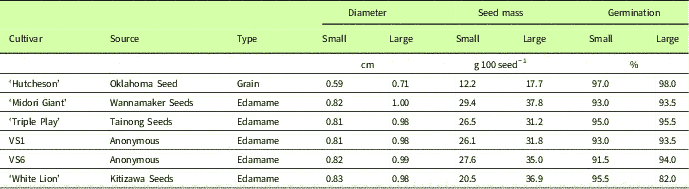
Five edamame cultivars and one grain-type soybean cultivar were used (Table 1). Limited seed availability dictated the edamame cultivars selected for this study and size of experimental units. The grain-type soybean cultivar ‘Hutcheson’ was chosen, because this cultivar was previously found to show seed-size-mediated effects on WSA (Place et al. Reference Place, Reberg-Horton, Carter and Smith2011a). Before planting each year, seeds of each cultivar were sorted on round-hole screens in a seed cleaner (Clipper Cleaner, A. T. Ferrell, Bluffton, IN) in 0.4-mm-diameter increments beginning with the smallest size. The median size class of each cultivar was omitted to create two distinct size classes. Seeds in size classes smaller than the median class were grouped together for the small size class, and seeds larger than the median class were grouped together for the large size class (Table 1). In order to minimize the effect of soil pathogens, crop seeds were treated with mefenoxam (3.37 g 100 kg−1 of seed) and fludioxonil (2.27 g 100 kg−1 seed; Apron Maxx®, Syngenta Crop Protection, Greensboro, NC) before planting.
Germplasm information and mean seed characteristics of two seed size classes for one grain-type soybean and five edamame cultivars used in field experiments near Urbana, IL.

Site Characterization
Field experiments were conducted in 2015 and 2016 at the University of Illinois Vegetable Crop Farm near Urbana, IL (40.08°N, 88.26°W). Experiments were located in different fields each year. The experiment followed the soybean phase of a sweet corn (Zea mays L. ssp.)–soybean rotation. The soil was a Flanagan silt loam (fine, smectitic, mesic Aquic Argiudolls). The seedbed was prepared using a disk harrow and field cultivator to ensure weed-free planting conditions and a fine seedbed. Experiments were planted on June 4, 2015, and May 20, 2016, using a cone planter (ALMACO, Nevada, IA).
Experimental Design
The experimental design was a split–split plot randomized complete block with four replications. Eight-row main plots, measuring 18.6 m2, were assigned one of six crop cultivars. Seed size class was assigned to four-row subplots measuring 9.3 m2. Presence or absence of A. theophrasti was assigned to two-row sub-subplots spaced 76 cm apart. There also were four A. theophrasti monoculture treatments in each replicate. Seed of a local population of A. theophrasti was collected the previous fall for use the following summer. Seeds, stored over winter at room temperature, were scarified with sandpaper before planting to improve germination. Both the crop and weed seeds were planted at 30 seeds m−1 of row to a depth of 2.5 cm. S-metolachlor (Dual Magnum®, Syngenta Crop Protection) was applied PRE at a rate of 1,870 g ai ha−1 to the entire experiment within 2 d of planting. The experiment was kept free of weeds other than in-row A. theophrasti for the remainder of the season with one pass of an interrow cultivator and by hand weeding as needed.
Data Collection
Before planting each year, 100-seed mass and germination were determined for both size classes by cultivar. Germination was characterized using a rolled towel test at 16 C. After planting, seedlings were counted daily across each 2.4-m-long row for both the crop and weed. To measure emergence, seedlings were counted until all plants reached the V1 stage. Plant height, measured weekly until 7 WAE, was measured on two edamame and two A. theophrasti plants per row. Crop height was measured from the soil surface to the apical meristem, and A. theophrasti height was measured from the soil surface to the apex of the youngest fully extended leaf. Leaf area index (LAI) was measured in full sun within 2 h of solar noon with a linear ceptometer (AccuPAR Linear Ceptometer; Decagon Devices, Pullman, WA) in crop and weed monoculture plots at 2 and 6 WAE. Avoiding alleys, the ceptometer was placed parallel to the base of a row in each monoculture plot.
Four plants each of the crop and weed were harvested from every sub-subplot at 4 and 8 WAE by cutting at the soil surface. Leaf area and stem area were measured separately on an area meter (LI-3100C, LI-COR, Lincoln, NE) and were pooled for analysis. To measure biomass, leaves and stems were pooled and oven-dried to a constant mass and weighed.
If seed size were to affect CT and WSA, we hypothesized the effect would be detected within 8 WAE, as evidenced by Place et al. (Reference Place, Reberg-Horton, Carter and Smith2011a, Reference Place, Reberg-Horton, Dickey and Carter2011b). Beyond 8 WAE, growth responses in the present study were at risk of being confounded by edge effects in the two-row experimental units, which were necessitated by the limited seed supply. Therefore, the experiment was terminated at 8 WAE.
Statistical Analysis
CT and WSA were calculated for plant height, area, and biomass (Jacob et al. Reference Jacob, Johnson, Dyck and Willenborg2016; So et al. Reference So, Williams, Pataky and Davis2009). CT values (CTheight, CTarea, CTbiomass) were calculated as the weedy crop response divided by the crop monoculture response within each replicate at each sampling time. WSA values (WSAheight, WSAarea, WSAbiomass) were calculated as:
 $${\rm WSA}{\equals}1{\minus}\left( {Y_{{{\rm mixed}}} \,/\,Y_{{{\rm monoculture}}} } \right)$$
where Y mixed is A. theophrasti response when grown with the crop and Y monoculture is A. theophrasti response in monoculture within each replicate at each sampling time. In theory, CT and WSA are on a scale of 0 to 1, with values approaching 1.0 representing excellent CT (i.e., crop is unaffected by the weed) or complete WSA (i.e., crop completely suppresses the weed).
Data were analyzed with ANOVA in SAS (v. 9.4, SAS Institute, Cary, NC) using a mixed-effects model. Based on residual analysis, data met ANOVA assumptions of independence, normality, and equality of variances (Hox Reference Hox2002). ANOVA was conducted on observed crop and weed emergence, monoculture LAI, and CT and WSA values. Seed size and cultivar were considered fixed effects in the ANOVA model, while year and replicate nested within year were considered random effects. The ANOVA model for emergence also included weed treatment as a fixed effect. To reduce the risk of making a type II error when examining the effects of competition between two species, the significance level was set at α=0.1 (Murtaugh Reference Murtaugh2014). Tukey’s mean separation test was used on all variables that were significantly different.
Results and Discussion
Environmental Conditions
Water supply and soil temperature were not limiting factors for plant emergence or seedling growth. In 2015, the month of June received 12.2 cm more precipitation than the 30-yr average (Illinois Climate Network, 2017). July received an additional 10.7 cm precipitation. In 2016, the months of May and July received near-normal precipitation, while June precipitation was 7 cm higher than the 30-yr average. Across both years, mean daily air temperatures were often at or above the 30-yr normal, ranging from 10.6 to 33.9 C.
Emergence
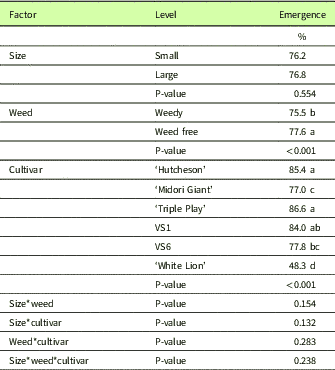
Crop emergence was not affected by crop seed size or interactions among treatment factors (P≥0.132; Table 2) but was affected by the presence of A. theophrasti (P<0.001) and crop cultivar (P<0.001). Crop emergence was 2.1% higher in the weed-free treatment than the weedy treatment. Among cultivars, emergence of ‘Triple Play’ was highest (86.6%) and emergence of ‘White Lion’ was lowest (48.3%). Abutilon theophrasti emergence averaged 40.7% and was unaffected by crop seed size, crop cultivar, or their interaction (P≥0.384, unpublished data).
Total crop emergence (%) as influenced by seed size, Abutilon theophrasti presence, and crop cultivar in field experiments near Urbana, IL.Footnote a

a Significance (P) of main effects and their interactions are included. Values followed by different letters are significantly different at P≤0.1, according to Tukey’s mean separation test. Cultivar is represented in main plots, seed size is represented in subplots, and weed is represented in sub-subplots of a split–split plot design.
Crop Tolerance
Variability in crop emergence resulted in different crop plant densities among cultivars. To determine whether plant density contributed to CT and WSA, a post hoc analysis of covariance (ANCOVA) was conducted. Using total emergence as a covariate, an ANCOVA model on CT and WSA variables yielded the same results as the ANOVA model, indicating the effects of treatments were independent of crop plant density. Therefore, only the ANOVA results are presented.
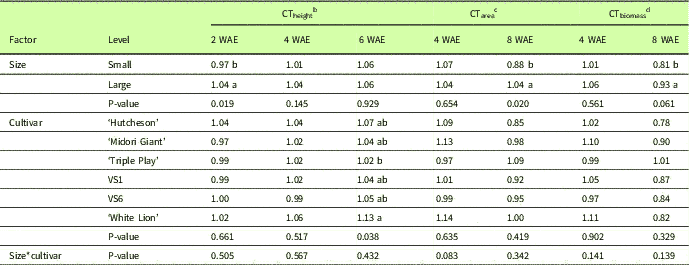
The hypothesis that, within a cultivar, plants from large seeds would have higher CT than plants from small seeds was supported at certain time points. Crop seed size affected CTheight at 2 WAE (P=0.019) and CTarea (P=0.020) and CTbiomass at 8 WAE (P=0.061; Table 3). There was a significant cultivar by seed size interaction for only CTarea at 4 WAE (P=0.083).
Mean crop tolerance (CT) to Abutilon theophrasti for crop height (CTheight), crop area (CTarea), and crop biomass (CTbiomass) at 2, 4, 6, and/or 8 wk after emergence (WAE) in field experiments near Urbana, IL.Footnote a

a CT was calculated as the weedy crop response divided by crop monoculture response. Values within each column and factor followed by different letters are significantly different at P≤0.1, according to Tukey’s mean separation test. Cultivar is represented in main plots, and seed size is represented in subplots.
b Mean crop monoculture height at 2, 4, and 6 WAE was 11.5, 26.9, and 48.4 cm, respectively.
c Mean crop monoculture area at 4 and 8 WAE was 369.1 and 1,393 cm2 plant−1, respectively.
d Mean crop monoculture biomass at 4 and 8 WAE was 2.3 and 12.1 g plant−1, respectively.
Plants from large seeds showed greater tolerance in crop height to A. theophrasti interference (CTheight) at 2 WAE than plants from small seeds (Table 3). Burris et al. (Reference Burris, Edje and Wahab1973) found a positive relationship between soybean seed size and soybean seedling height. A crop seed mass increase of 14 g 100 seed−1 resulted in 38.5-mm-taller soybean seedlings at 1 WAE (Burris et al. Reference Burris, Edje and Wahab1973). Place et al. (Reference Place, Reberg-Horton, Carter and Smith2011a) reported a positive correlation between crop seed size and soybean height at 7 WAE. The present study found no effect of crop seed size on CTheight beyond 2 WAE.
Plants from large seeds were able to maintain shoot growth in the presence of A. theophrasti better than plants from small seeds. By 8 WAE, plants from large seeds had 15% and 13% higher CTarea and CTbiomass, respectively, than plants from small seeds (Table 3). The higher CT values were because plants from large seeds produced approximately 7.5% more biomass at both 4 and 8 WAE than plants from small seeds (unpublished data). Longer et al. (Reference Longer, Lorenz and Cothren1986) and Place et al. (Reference Place, Reberg-Horton, Carter and Smith2011a, Reference Place, Reberg-Horton, Dickey and Carter2011b) reported the effect of seed size on crop biomass could be observed as early as 10 d after germination and continued through to 7 WAE. Longer et al. (Reference Longer, Lorenz and Cothren1986) reported that increasing seed mass by 2 g 100 seed−1 increased seedling root and shoot biomass by 0.10 and 0.25 g, respectively. Place et al. (Reference Place, Reberg-Horton, Dickey and Carter2011b) found that plants from large seeds produced 21.1 g m−1 more soybean biomass at 7 WAE than plants from small seeds. Place et al. (Reference Place, Reberg-Horton, Carter and Smith2011a) reported that at 7 WAE, an increase in seed mass of 9 g 100 seed−1 resulted in 6% to 24% greater soybean biomass.
The second hypothesis, that crop cultivar would affect CT, was poorly supported by results. Cultivar only affected CTheight at 6 WAE (P=0.038; Table 3) and did not affect CTarea or CTbiomass at the measured time points. For most variables, edamame cultivars had a similar response to A. theophrasti, which was comparable to the grain-type soybean response to the weed.
Weed Suppressive Ability
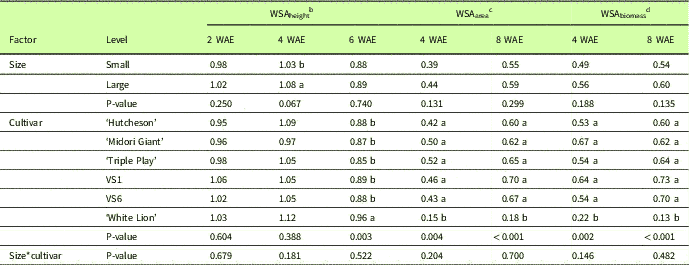
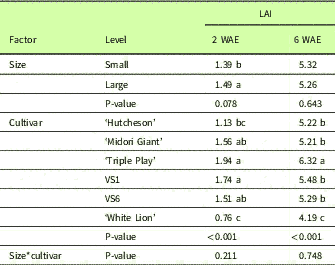
Results showed minimal support of the hypothesis that, within a cultivar, plants from large crop seeds would have higher WSA than plants from small seeds. Crop plants from large seeds were able to suppress A. theophrasti better than plants from small seeds, but only for A. theophrasti height measured at 4 WAE (Table 4). Place et al. (Reference Place, Reberg-Horton, Carter and Smith2011a) reported that, for the grain-type soybean cultivar Hutcheson, plants from large seeds resulted in higher WSA. Results in the present study may be due to greater crop LAI in the large seed treatment, compared with small seed, at 2 WAE (P=0.078). Plants from large seeds produced 7% greater LAI than small seeds at 2 WAE (Table 5). Greater crop LAI may have reduced light interception by A. theophrasti, thereby suppressing A. theophrasti growth. Place et al. (Reference Place, Reberg-Horton, Carter and Smith2011a) also reported a positive relationship between seed size and light interception at 3 WAE but not at 5 WAE. Such results align with the present study: seed size affected crop LAI at 2 WAE but had dissipated by 6 WAE (Table 5).
Mean Abutilon theophrasti suppressive ability estimates for weed height (WSAheight), weed area (WSAarea), and weed biomass (WSAbiomass) at 2, 4, 6, and/or 8 wk after emergence (WAE) in field experiments near Urbana, IL.Footnote a

a Weed suppressive ability (WSA) was calculated as WSA=1 − (Y mixed/Y monoculture), where Y mixed is A. theophrasti response when grown with the crop, and Y monoculture is A. theophrasti response in monoculture. Values within each column and factor followed by different letters are significantly different at P≤0.1, according to Tukey’s mean separation test. Cultivar is represented in main plots, and seed size is represented in subplots.
b Mean A. theophrasti monoculture height at 2, 4, and 6 WAE was 3.7, 23.5, and 73.0 cm, respectively.
c Mean A. theophrasti monoculture area at 4 and 8 WAE was 335.1 and 2,548 cm2 plant−1, respectively.
d Mean crop monoculture biomass at 4 and 8 WAE was 2.1 and 28.9 g plant−1, respectively.
Mean LAI for the crop monoculture treatment in field experiments near Urbana, IL.Footnote a

a Significance (P) of main effects and their interaction are included. Within a factor and column, values followed by different letters are significantly different at P≤0.1, according to Tukey’s mean separation test. Cultivar is represented in main plots, and seed size is represented in subplots.
The second hypothesis, that crop cultivar would affect WSA, was supported by the results. Crop cultivar affected WSAheight at 6 WAE (P=0.003) and WSAarea and WSAbiomass at all sampling times (P≤0.004). Among cultivars, White Lion was the least suppressive of A. theophrasti. For instance, at 8 WAE, WSAbiomass of White Lion was 0.13; considerably lower than WSAbiomass of all other cultivars, which ranged from 0.60 to 0.73 (Table 4). White Lion was the shortest cultivar used (unpublished data), which likely resulted in lower WSA. White Lion also had the poorest canopy among cultivars (Table 5). In a season-long study, the most weed suppressive edamame cultivar had the most favorable canopy characteristics for light competition, namely, greatest height, LAI, and light interception (Williams Reference Williams2015). A combination of poor emergence, height, and slow canopy development, represented by the low LAI values, likely accounted for poor WSA of White Lion.
Despite differences in seed size between edamame and grain-type soybean, four of five edamame cultivars in the present work had similar crop–weed interactions to the grain-type cultivar Hutcheson. The one exception was an edamame cultivar that had poorer A. theophrasti suppressive ability than all other cultivars. Therefore, results from this work show early-season competitive interactions between edamame and A. theophrasti are comparable to, or poorer than, competitive interactions between grain-type soybean and A. theophrasti. As such, early-season weed management in edamame will need to be just as effective as weed management in grain-type soybean, if not more so.
Manipulating crop seed size appears to have potential for improving early-season edamame tolerance to weed interference. Conceivably, crop seeds could be sized and sorted before planting. Perhaps “high-risk” fields (e.g., high weed seedbank) could be planted with the largest seeds. However, additional research is needed to determine potential implications of using large seeds, including optimizing agronomic practices such as seeding depth and seeding rate. Furthermore, seed size–mediated effects on crop yield and weed seed production need to be quantified. In the meantime, cultivar itself appears to have a greater influence on WSA than crop seed size. Certain edamame cultivars deviate from the “average” WSA. The current magnitude of edamame seed size and cultivar competitiveness to WSA underscores the importance of considering these not as stand-alone tactics but rather as useful additions to a more comprehensive IWM system.
Acknowledgments
The authors wish to thank Jim Moody, Nick Hausman, and the undergraduate students who assisted in this experiment. Mention of a trademark, proprietary product, or vendor does not constitute a guarantee or warranty of the product by the U.S. Department of Agriculture and does not imply its approval to the exclusion of other products or vendors that also may be suitable. This research was made possible by the USDA-Agricultural Research Service, project number 5012-12220-009-00-D. No conflicts of interest have been declared.