Introduction
The Buddhist point of view takes the function of work to be at least threefold: to give a man a chance to utilise and develop his faculties; to enable him to overcome his ego-centredness by joining with other people in a common task; and to bring forth the goods and services needed for a becoming existence ….
Work and leisure are complementary parts of the same living process and cannot be separated without destroying the joy of work and the bliss of leisure. (Schumacher & Porritt, Reference Schumacher and Porritt1993)
Prior to the coronavirus disease 2019 (COVID-19) pandemic, burnout in medical staff was receiving increasing attention in the national media in Ireland (Cullen, Reference Cullen2019; Hennessey, Reference Hennessey2019). It has been suggested that Graham Greene was the first to introduce the term ‘burnout’ in his 1961 novel, A Burnt-Out Case, about an architect ‘who is the victim of an attack of indifference’ (Rossler, Reference Rossler2012). One of the first scientific papers on the topic was by American psychiatrist Freudenberger in Reference Freudenberger1975, which described a psychological syndrome emerging in response to chronic interpersonal stressors at work. Burnout is defined by the World Health Organization in the International Classification of Disease, Version 11 (ICD-11) as an occupational phenomenon ‘resulting from chronic workplace stress that has not been successfully managed’ (2019). It is characterized by three dimensions:
-
1. Feelings of energy depletion or exhaustion.
-
2. Increased mental distance from one’s job, or feelings of negativism or cynicism related to one’s job.
-
3. Reduced professional efficacy.
Burnout has strongly been found to correlate with intention to change jobs and can have a contagious effect, leading to conflict and disruption of job tasks (Scanlan & Still, Reference Scanlan and Still2013). Burnout has been recognised as being detrimental to one’s physical and mental health. Maslach & Leiter (Reference Maslach and Leiter2016) emphasised that emotional exhaustion predicts adverse physical and mental health outcomes. It has also been found to predict hospital admissions for cardiovascular diseases (Toppinen-Tanner et al. Reference Toppinen-Tanner, Ahola, Koskinen and Väänänen2009) and mental health problems (Ahola & Hakanen, Reference Ahola, Hakanen, Leiter, Baker and Maslach2014). Of particular concern is the association of burnout with increases in medical errors, with negative consequences for patient outcomes (Motluk, Reference Motluk2018).
Maslach & Leiter (Reference Maslach and Leiter2016) identify six key domains of risk of developing burnout: work overload, lack of control, insufficient recognition and reward, lack of supportive relationships (community), perception of workplace decisions being unfair and disharmony of values between the individual and the organisation. Both individual factors, such as neuroticism as a trait (McManus et al. Reference McManus, Keeling and Paice2004), and external, such as negative life events in the past year (Rossi et al. Reference Rossi, Cetrano, Pertile, Rabbi, Donisi, Grigoletti, Curtolo, Tansella, Thornicroft and Amaddeo2012), have been associated with a higher risk of burnout. Work environments characterised by interpersonal aggression contribute to higher level of burnout (Savicki et al. Reference Savicki, Cooler and Fjesvold2003; Gascon et al. Reference Gascon, Leiter, Andres, Santed, Pereira, Cunha, Albesa, Montero-Marín, García-Campayo and Martínez-Jarreta2013). Factors that protect against burnout have also been identified including empathy, extraversion, increased age and greater levels of responsibility (Scanlan & Still, Reference Scanlan and Still2013; Maslach & Leiter, Reference Maslach and Leiter2016). Engagement is the positive antithesis to burnout and has been divided into three components of vigour, dedication and absorption (Maslach & Leiter, Reference Maslach and Leiter2016).
Chambers and colleagues surveyed a large cohort (n= 1487) of hospital doctors and dentists in New Zealand using the Copenhagen Burnout Inventory (CBI) and found high rates of burnout, particularly among doctors in emergency medicine and psychiatry who had high mean work-related burnout (Chambers et al. Reference Chambers, Frampton, Barclay and McKee2016). Of the 197 psychiatry respondents, mean personal (49.5) and work-related (48.1) burnout were high. Heavy work demands, under-staffing, onerous on-call duties and lack of support from management were identified as the contributing factors (Chambers et al. Reference Chambers, Frampton, Barclay and McKee2016). A recent survey of over 2000 North American psychiatrists (using different study instruments) found that 78% of the respondents’ scores suggested high levels of burnout (Summers et al. Reference Summers, Gorrindo, Hwang, Aggarwal and Guille2020). They found that the presence of depressive symptoms, female gender, inability to control work schedule and work setting were significantly associated with higher burnout scores.
Interest in burnout among healthcare professionals in Ireland has burgeoned as the health service has come under pressure due to increased demand, relative resource reductions and recruitment difficulties (Hennessey & Ryan, Reference Hennessey and Ryan2020). Prior to the outbreak of COVID-19, Ireland was experiencing persistent difficulties in filling consultant psychiatrist and mental health nursing positions (Houses of the Oireachtas Joint Committee on the Future of Mental Health Care, 2018, p 32).
Some studies conducted in Ireland have also suggested high burnout rates. An Irish study of emergency department staff, both clinical and non-clinical, found that 75% met the criteria for burnout (Chernoff et al. Reference Chernoff, Adedokun, O’Sullivan, McManus and Payne2019). A study of Irish interns found that 73% was burnt out (O’Connor et al. Reference O’Connor, Lydon, O’Dea, Hehir, Offiah, Vellinga and Byrne2017). A study of 477 Irish Hospital Consultants’ Association (IHCA)-affiliated consultants in 2018 found that 42% of respondents reported high levels of burnout (Margiotta et al. Reference Margiotta, Crudden, Byrne and Doherty2019). However, in a national study of Royal College of Physicians of Ireland–affiliated hospital doctors, Hayes et al. (Reference Hayes, Prihodova, Walsh, Doyle and Doherty2019) reported lower overall burnout rates. Just under one third (29.7%) met two or more of the Maslach burnout criteria (emotional exhaustion, depersonalisation and low personal accomplishment), with higher rates among trainees (41.8%) (Hayes et al. Reference Hayes, Prihodova, Walsh, Doyle and Doherty2019). A recent Irish study of child psychiatrists found high levels of burnout and ambivalence about career choice (McNicholas et al. Reference McNicholas, Sharma, O’Connor and Barrett2020).
Difficulties recruiting to psychiatry have been recognised internationally, with references to psychiatry becoming an ‘endangered species’ (Katschnig, Reference Katschnig2010). Despite the workforce planning increases in post numbers, not all have been filled, bringing a focus on the barriers that deter many from pursuing this speciality. In the context of ongoing recruitment and retention difficulties in the Irish Mental health services, this study seeks to examine the levels of burnout and related factors among people working in a Dublin community mental health service. The service is a publicly funded, predominantly urban, adult community mental health service, with a catchment area population of 172 000. The service includes an outpatient department, a day hospital, an inpatient service in a nearby psychiatric hospital, 24-hour staffed rehabilitation accommodation and serviced apartments. The service also provides a liaison psychiatry team to two general hospitals within the catchment and oversees an early intervention service for psychosis detection and management. Staffing levels in the service are only half of those recommended in the national mental health policy Vision for Change (Houses of the Oireachtas Joint Committee on the Future of Mental Health Care, 2018, p 23). Unlike other studies, this study included administrative, household and other staff, all of whom make important contributions to the functioning of a mental health service.
Methods
An anonymous study-specific questionnaire was designed and circulated by email to all staff in November 2019 with an explanatory document. Printed versions were also left in strategic places for staff to anonymously complete. Staff were requested to return the questionnaires to boxes left in key locations throughout the service or via internal post. The study period was closed after 4 weeks, at the end of November 2019.
Our burnout questionnaire comprised the Copenhagen Burnout Inventory (CBI) (Kristensenn et al. Reference Kristensenn, Borritz, Villadsen and Christensen2005), questions from Maslach Burnout Inventory for Human Service Workers (MBI-HSS) subscales (Maslach et al. Reference Maslach, Schaufeli and Leiter2001), and certain effort–reward imbalance index questions; each of these questionnaires is widely used and validated. The CBI is a 19-item tool measuring personal (6 items), work-related (7 items – item 4 reverse scored) and client-related (6 items) burnout on a 5-point Likert scale. Mean subscales scores and subscale percentages are reported, using a CBI cut-off score of 50 and above (to indicate moderate and/higher burnout). As the CBI creators consider depersonalisation to be a coping strategy and reduced personal accomplishment to be a consequence of stress rather than a feature of burnout syndrome, it does not measure these domains. Information on these areas was added to our questionnaire using questions and a modified Likert scale from the MBI-HSS on depersonalisation (5 items) and personal accomplishment (8 items). The Likert scale from the MBI-HSS questionnaire was modified to mirror that used in the CBI, and the CBI cut-off scores were used. Similarly, further questions on effort–reward imbalance and overcommitment from the effort–reward imbalance index (Siegrist et al. Reference Siegrist, Wege, Pühlhofer and Wahrendorf2009) were included in our questionnaire.
Specific study questions included information on job satisfaction, turnover intention and feeling valued (see Appendix 1). We also asked study participants to rank five suggestions for service improvement. The collected characteristics of study participants were as follows: role (medical/other clinical/non-clinical) and years of experience in adult mental health service (AMHS). We also asked about the perception of government and public attitudes to AMHSs. Ethical approval was obtained from the St John of God ethics committee. The collection of questions on specific disciplines (e.g. nurses, psychologists, occupational therapists) or other more detailed demographic information was not allowed by the ethics committee in order to minimise the chances of any respondent being identifiable.
Analysis
Data were entered into SPSS for analysis (IBM, 2017). Descriptive data were calculated and Likert scale responses were compared across staff types using chi-square tests. Kolmogorov–Smirnov tests confirmed normality for total and subscale CBI scores and hence parametric analysis was carried out. Cronbach’s α was calculated for CBI subscales and indicated the reliability of each subscale. Relationships between the subscales were evaluated, using Pearson correlation coefficients. Analysis of variance was carried out between staff groups for total and subscale CBI scores. Correlations between total burnout and risk/associated factors, and among associated factors, were calculated using two-tailed Spearman correlation coefficient for non-parametric data. Similarly, correlations between total burnout and study-specific questions were calculated using Spearman’s coefficient.
Results
Demographics
Sixty-three (63) responses were received from the staff of 133 employees, which involves a response rate of 47.4%. One fifth of the respondents identified themselves as doctors (n = 13, 20.6%), almost half as other clinical staff (n = 30, 47.6%), one fifth as non-clinical (n = 12, 19%) and 8 (12.7%) staff did not identify their area of work. About a fifth of respondents had less than 5 years’ experience (n = 12, 19%), and almost a quarter had 5–10 years’ experience (n = 15, 23%); while the majority had greater than 10 years’ experience (n = 34, 54%), and two staff members (3.2%) did not specify their length of experience.
Burnout
Cronbach’s α measured for total CBI scores was 0.89, indicating good internal consistency. As measured by the CBI, almost one third (30.8%) of doctors reported moderate or higher levels of burnout, with the remainder scoring low on the overall burnout. Similarly 30% of other clinical staff report moderate burnout with the remainder scoring low. One quarter (25%) of non-clinical staff reported moderate burnout; and 37.5% who did not specify their occupation scored moderate on total burnout. The majority of staff (44 or 69.8%) scored ‘low’ for total burnout with just under one third (30.2%) scoring in the ‘moderate’ range and no staff scoring ‘high’ or ‘severe’ for total burnout. Although not statistically significant, non-clinical workers had higher mean total work-related and personal burnout scores than either the medical and non-medical clinicians (Table 1). Examining the CBI subdomains suggests higher burnout rates being experienced in both personal (46%) and work-related areas (45%), while the proportion experiencing moderate levels of patient-related burnout was lower (14%)
It appears that the time for lowest burnout in our service is 5–10 years into working in psychiatry, with only 20% of those with 5–10 years’ experience scoring moderate on total burnout. Higher proportions of those with <5 years’ experience (25%) and with >10 years’ experience (38.2%) scored in the moderate range of total burnout. The ratios of variances for CBI total and subscale scores were less than the critical ratio for our group sizes (p < 0.05). Therefore, CBI total and subscale scores did not significantly differ across professional groups in our service (Table 1).
Copenhagen Burnout Inventory scores (total and subscale) reported as mean and S.D., with scores for each staff type and corresponding p values (ANOVAs). The prevalence of burnout categories (no/low, moderate, high or severe) according to the CBI cut-off values are reported as percentages of the total sample

Burnout level: no/low(<50), moderate (50–74), high (74–99); severe (100).
Personal accomplishment
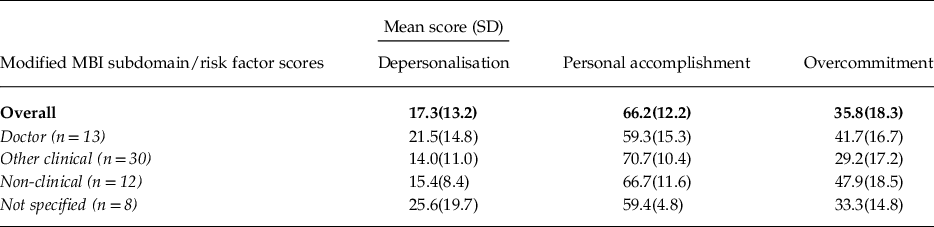
Most staff members (95.2%) report moderate or high levels of personal accomplishment. This seems to peak after a few years of working in psychiatry, with those with 5–10 years’ experience having the largest proportion (40%), with a ‘high’ sense of personal accomplishment. It does not seem to vary substantially across disciplines within the service (Table 2).
Associated factor scores by profession

Burnout level: no/low(<50); moderate (50–74); high (74–99); severe (100).
Total burnout negatively and significantly correlated with personal accomplishment (−0.407, p < 0.001) (Table 3).
Correlation between total burnout and associated factors and among associated factors

Spearman correlation coefficient (non-parametric data): 0=no correlation; 1 or −1=perfect correlation.
* Significant results.
Personal accomplishment did not correlate significantly with presenteeism or overcommitment (Table 3).
Depersonalisation
Low levels of depersonalisation (and of client-related burnout) among staff members were reported, with 93.7% of respondents recording no/low depersonalisation. All staff reported positive attitudes towards clients/patients although slightly higher levels of depersonalisation were found in medical staff with fewer years of experience; half of those with moderate depersonalisation had fewer than 5 years’ experience.
Total burnout positively and significantly correlated with depersonalisation (0.404, p = 0.001). Depersonalisation did not significantly correlate with personal accomplishment, presenteeism or overcommitment (Table 3).
Risk factors/associations
Presenteeism (attending work when ill)
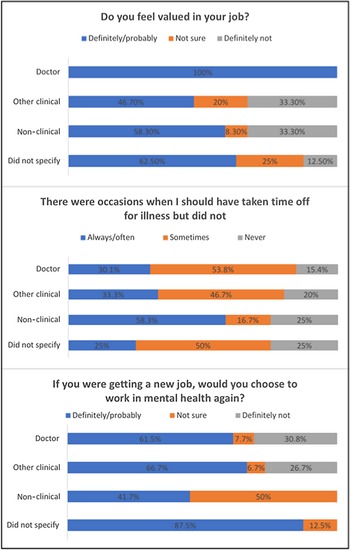
Relatively high levels of presenteeism were observed in our service, with 79.4% of our staff at least sometimes attending work when they think they should have taken time off for illness (Figure 1), and this did not significantly differ across staff types (χ 2(12) = 11.1, p = 0.5).
Likert scale responses, reported as percentages for each staff type, for selected questions on feeling valued, turnover intention and presenteeism.

Presenteeism positively and significantly correlated with total burnout (0.293, p = 0.02) and overcommitment (0.314, p = 0.012). Presenteeism did not correlate with either depersonalisation or personal accomplishment (Table 3).
Overcommitment
Staff reported low–moderate levels of overcommitment, indicating a balanced attitude towards work. No significant differences were observed between groups of different experiences, for example moderate overcommitment was observed among 33.3% of those with 5–10 years’ experience and 35.3% of those with >10 years’ experience. Overcommitment is higher among doctors and non-clinical staff than among other clinical staff, with 46.2% doctors and 50.0% of non-clinical staff reporting at least moderate overcommitment while only 20.0% of other clinical staff reported this.
Total burnout positively and significantly correlated with overcommitment (0.362, p = 0.004). Depersonalisation also correlated significantly with overcommitment (0.287, p = 0.022). Personal accomplishment did not significantly correlate with overcommitment (Table 3).
Feeling valued
A statistically significant difference was observed in how valued different types of staff felt in their jobs. Specifically, all doctors felt valued but only about half of other clinical and non-clinical staff reported that they ‘definitely’ or ‘probably’ feel valued (100% v. 46.7% v. 58.3%, respectively), χ 2(12)=24.4, p = 0.02) (see Figure 1).
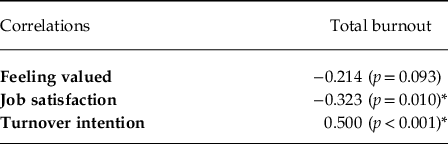
No correlation/relationship was observed between total burnout (depersonalisation or personal accomplishment) and feeling valued in the job (Table 4).
Correlation between study-specific questions and total burnout

Spearman correlation coefficient: 0=no correlation; 1 or -1=perfect correlation.
* Significant results.
Staff’s perception of job satisfaction correlated negatively with total burnout (−0.323, p = 0.010) (Table 4).
Turnover intention
Over half of all staff (35/63; 55%) surveyed indicated that they were considering changing jobs (turnover intention) although a majority (63.5%) of staff members would definitely or probably choose to work in the area of psychiatry again. Doctors (5/13; 38%) were less likely than other clinicians (20/30; 67%) and non-clinicians (8/12; 67%) to be considering changing job. Doctors and other clinical staff members (61.5% and 66.7%, respectively) were significantly more likely than non-clinical staff (41.7%) to choose to work in psychiatry again, χ 2(12)=30.1, p = 0.003 (see Figure 1). Turnover intention positively and significantly correlated with personal burnout (0.38, p = 0.002), work burnout (0.502, p = 0.000) and client burnout (0.363, p = 0.003) as well as with total burnout (0.500, p < 0.001).
Turnover intention did not correlate with either depersonalisation or personal accomplishment.
Improvement options
Increased staffing and reduced workload received most endorsement from options to improve the quality of mental health services. Increased access to allied health professionals and increased home support received most endorsement from options to improve public perceptions of AMHSs.
Discussion
This study found relatively low levels of burnout in all staff types in one Irish community of AMHS. Approximately one third of staff reported moderate burnout. This is about half of the burnout levels found in a recent study of consultant child psychiatrists in Ireland, where 59.6% of the sample reported moderate or higher degrees of burnout (McNicholas et al. Reference McNicholas, Sharma, O’Connor and Barrett2020).
The levels of burnout we found are also lower than those reported by other groups internationally (Chambers et al. Reference Chambers, Frampton, Barclay and McKee2016; Creedy et al. Reference Creedy, Sidebotham, Gamble, Pallant and Fenwick2017).
While the staff we surveyed had a consistently positive attitude towards patients and a high level of personal accomplishment, we also found a high rate of presenteeism, indicating that staff are at an elevated risk of burnout. In our study, burnout levels seemed lowest in those with 5–10 years of experience although these differences were not statistically significant. Only 20% of those with 5–10 years’ experience had moderate levels of total burnout, while higher proportions of those with <5 years’ experience (25%) and with >10 years’ experience (38.2%) scored in the moderate range. It is difficult to disentangle this, as longer duration in the job may bring about both more responsibilities and, in some cases, less face-to-face patient contact; it may also bring experience, competence and autonomy, all known to be linked to reduced stress. Our findings suggest that at either end, both newer entrants with less experience and those in more senior roles have higher rates of burnout.
We used two different burnout measures to achieve a greater breadth of information from respondents. Total burnout in the CBI correlated with both depersonalisation and personal accomplishment scores. However, depersonalisation and personal accomplishment correlation with risk factors and other associations was inconsistent. For example, total burnout correlated with presenteeism, but neither depersonalisation nor personal accomplishment did. Total burnout correlated with overcommitment, as did personal accomplishment, but depersonalisation did not correlate. This seems to call into question the usefulness of the concepts of depersonalisation and personal accomplishment as measures of burnout and would seem to support the position of the CBI creators that perhaps depersonalisation and personal accomplishment should be viewed separately from burnout.
Many factors have been proposed as risk and protective against burnout, even in the face of high demand. Job satisfaction, being valued and supported by management, and working in a service affiliated with an academic centre or the medical community, have been found to be protective (Morse et al. Reference Morse, Salyers, Rollins, Monroe-DeVita and Pfahler2012). In our study, all doctors felt valued, but one third of the non-medical clinicians and the non-clinical staff did not feel valued. Validation has been seen as a key protective factor from burnout, and thus this is an area of concern (Gorbenko et al. Reference Gorbenko, Mendelev and Keefer2020).
Almost half of respondents surveyed had considered changing jobs, with almost one third of doctors intending not to re-enter the area of mental health. This has significant ramifications on staffing levels and occurs in the context where recruitment to psychiatry has been recognised to be in a state of ‘crisis’, both in Ireland and in other countries (Mukherjee et al. Reference Mukherjee, Maier and Wessely2013; Choudry & Farooq, Reference Choudry and Farooq2017). Given this was also a finding in the survey of consultants working in child and adolescent mental health services in Ireland, where 65% had reservations about training in child psychiatry and 70% had seriously considered changing jobs in the previous 6–12 months; organisations must take heed and ensure optimum working conditions (McNicholas et al. Reference McNicholas, Sharma, O’Connor and Barrett2020).
Doctors reporting burnout have been found to be over twice as likely to make medical errors (Tawfik et al. Reference Tawfik, Profit, Morgenthaler, Satele, Sinsky, Dyrbye, Tutty, West and Shanafelt2018). Burnout levels similar to those in our cohort were associated with significant levels of depression and anxiety in the National Study of Well-being of Hospital Doctors in Ireland (Hayes et al. Reference Hayes, Walsh and Prihodova2017). Therefore, regardless of our finding of relatively low levels, attention constantly needs to be paid to minimising burnout and improving staff well-being. It has been suggested with merit that staff health should be used as a quality indicator in service audits (Wallace et al. Reference Wallace, Lemaire and Ghali2009). This could encourage health services to address staff well-being, allow measurement of the effectiveness of interventions and enable tracking of changes over time.
Finally, as per suggestions of our staff in this study, increased staffing (reducing workload) and increased access to MDT members are advised to help improve the working experience of staff and the patient experience of the public.
Limitations
To the authors’ knowledge, this is the first study to examine the rates of burnout in an AMHS in Ireland. Furthermore, it included non-clinical staff, such as administrative and housekeeping staff, a group less often studied. The use of well-developed validated instruments, CBI, the MBI subdomain questions and the effort–reward imbalance questionnaire, to measure burnout is a strength of the study and allows for comparability with other studies. However, some of the questions were devised for this study (included in Appendix 1), and MBI responses offered a modified Likert scale and, therefore, have not been validated. Further, respondents were recruited from one AMHS and as such may not be generalizable to other services in Ireland. Despite the relatively small sample size (n = 66) and low response rate (47.4%), it is comparable to the response rates in other studies.
Conflict of interest
NB has no conflicts of interest to disclose. RV has no conflicts of interests to disclose. FMcN has no conflicts of interests to disclose. LF has no conflicts of interests to disclose.
Ethical standards
The authors assert that all procedures contributing to this work comply with the ethical standards of the relevant national and institutional committee on human experimentation with the Helsinki Declaration of 1975, as revised in 2008. The authors assert that ethical approval for publication of this study has been provided by their local ethics committee.
Financial support
This research received no specific grant from any funding agency, commercial or not-for-profit sectors.