Hospital-acquired infections (HAIs) are important causes of morbidity.Reference Haque, Sartelli, McKimm and Abu Baka 1 Consequences, especially from multidrug-resistant (MDR) organisms, range from increased morbidity, higher cost, and longer duration of therapy to restriction of hospital admissions or temporary ward closure.Reference Haque, Sartelli, McKimm and Abu Baka 1 Consequently there are substantial direct and indirect costs to healthcare systems.Reference Marchetti and Rossiter 2
Stethoscopes routinely contact patients and are potential vectors for HAIs. Across 28 medical studies, contamination ranged from 47% to 100%, with a mean frequency of 85%.Reference O’Flaherty and Fenelon 3 Veterinary studies report similarly high contamination rates (67%) and frequent isolation of MDR bacteria.Reference Fujita, Hansen and Hanel 4 Of 61 MDR E. faecium isolated during one study, 20 of 61 resistant isolates (32.7%) came from stethoscopes.Reference Kukanich, Ghosh, Skarbek, Lothamer and Zurek 5 Isolation rates of 2% for methicillin-resistant Staphylococcus aureus (MRSA) and 5% for methicillin-resistant Staphylococcus pseudintermedius (MRSP) have also been reported.Reference McCord, Stanton, Botle, Hyatt and Lunn 6
Despite these contamination rates, no guidelines to optimize stethoscope cleaning have been established. Various protocols have been described, and alcohol-based disinfection (ethyl or isopropyl alcohol) has been shown to yield a 99% reduction in colony-forming units (CFU) per stethoscope.Reference Raghubanshi, Sapkota, Adhikari, Dutta, Bhattarai and Bhandari 7
Concern regarding bacterial resistance to topical antiseptics has led to the development of innovative decontamination methods.Reference Wand and C 8 , Reference Messina, Spataro and Rosadini 9 Ultraviolet germicidal irradiation (UVGI) at wavelengths between 200 and 280 nm kills or inactivates microorganisms by destroying nucleic acids or by disrupting DNA, effectively reducing bacterial counts.Reference Messina, Spataro and Rosadini 9 However, comparative studies are lacking.
Regular decontamination also reduces transmission risk. However, extremely low rates of stethoscope cleaning are documented.Reference Jordan, Barrett, Murney, Whipp and Elliott 10 , Reference Saunders, Hryhorskyj and Skinner 11 Of 10 veterinarians surveyed, 5 reported never or almost never cleaning their stethoscopes.Reference Kukanich, Ghosh, Skarbek, Lothamer and Zurek 5
The primary objectives of this study were to perform environmental surveillance of stethoscope bacterial contamination within a veterinary referral hospital and to compare 3 disinfection protocols. Our secondary objectives were to evaluate recontamination without clinical reuse following disinfection and to evaluate participants’ attitudes toward and habits of stethoscope cleaning.
We formulated the following hypotheses: (1) Stethoscopes are variably contaminated with pathogenic and nonpathogenic bacteria, including MDR bacteria. (2) All proposed protocols reduce bacterial contamination, but based upon existing data, isopropyl alcohol is superior. (3) Decontamination is not sustained over time.
Material and methods
Study design and participants
In this prospective and interventional study, we utilized a crossover design. We assigned random numbers (1–30) to 30 stethoscopes regularly used within a referral veterinary hospital. Owners completed a questionnaire detailing the stethoscope model, their specialty field, any current cleaning protocol, and the frequency of cleaning.
Treatment protocols
Stethoscopes were sampled at baseline (time point 1), were subjected to 1 of 3 treatment protocols, and were then resampled. To allow adequate recontamination, 2 weeks of clinical recirculation occurred before each stethoscope was subjected to alternate cleaning protocols (time points 2 and 3). All cleaning and sampling procedures were performed by the same investigator (P.S.M.).
Protocol 1. We used 70% isopropyl alcohol swabs (Universal Alcotip preinjection swabs, Shermond, London, UK) to rub the stethoscope diaphragm for 10 seconds. The stethoscope diaphragm was rubbed with a swab for 10 seconds, then left for 10 seconds at room temperature to facilitate evaporation prior to resampling.
Protocol 2. Anistel (Tristel Solutions, Fordham, UK), a common veterinary disinfectant containing alkyldimethyl-benzylammonium chloride + didecyldimethylammonium chloride + polymeric biguanide hydrochloride, was used according to the manufacturer’s recommendations. The stethoscope diaphragm was rubbed with sterile cotton gauze impregnated in a 1:200 dilution of Anistel, with a dwell time of 5 minutes. Thereafter, the membrane was dried with dry sterile gauze.
Protocol 3. For proof of concept of UVGI, a biosafety cabinet (LabGard Energy Saver, NU-437 Class II, Type A2, Nuaire, Plymouth, MN) was used to expose each stethoscope membrane to 1 minute of ultraviolet (UV) light (Philips UV 30W tube, UV at 253.7 nm), as recommended by the manufacturer.
Sample collection
At each time point, baseline samples were obtained prior to cleaning and a second sample was taken immediately after cleaning. A third sample was collected 24 hours later to evaluate early recontamination. During this interval, stethoscopes were stored in a clean, nonclinical environment.
For each bacteriology sample, the entire membrane surface was sampled with a sterile cotton-tipped swab moistened in phosphate-buffered saline (PBS). Swabs were submerged in 2 mL PBS in a sterile sampling container for transport and were processed the same day. Prior to plating, sample containers were agitated vigorously. Consecutive, 10-fold dilutions of this media were spread onto tryptic soy blood agar (TSBA) plates in triplicate, then incubated at 37°C for 48 hours prior to reading. Average colony counts were reported as CFU/mL. Due to funding availability, only samples obtained during the first sampling period underwent colony identification (ie, precleaning, postcleaning, and 24-hour samples). Isolates were differentiated via colony morphology, Gram staining, and biochemical profiling (API identification kits, bioMèrieux, Marcy-l'Étoile, France). Species with potential for MDR underwent susceptibility testing by disc diffusion to determine MDR status.
Recontamination between cleaning protocol time points
During the 2-week period of crossover to alternative cleaning protocols, clinicians were required to auscultate a minimum of 6 patients per day. Cleaning was only permitted for gross contamination or likely contagious disease.
Statistical analysis
Based upon available studies, where reductions in colony counts of 86%–99% have been achieved using individual methodologies, and assuming a standard deviation (SD) of ~10, sample size calculations for analysis of variance were performed based upon a 95% confidence interval and a predicted power of 80%. Based upon these values, a sample size of 30 stethoscopes was predicted as adequate to determine group differences.
For group comparisons, Δ values (%) in colony counts were determined for each stethoscope. Colony counts higher than a baseline of zero (or any other positive integer) following cleaning were classified as having a maximum of a 100% increase. Where contamination was absent prior to and following cleaning, the data point was censored. Differences between groups were analyzed using a nonparametric analysis of variance (Kruskal-Wallis test). Detected differences were analyzed post hoc using the Dunn multiple comparisons method to identify where these differences occurred. Analysis of bacterial diversity pre- and postcleaning was performed using the Mann-Whitney U test.
Results
Baseline questionnaire results
The participants’ stethoscopes were used within a variety of clinical disciplines: anesthesia (n = 10); general hospital use (n = 6); internal medicine (n = 5); neurology (n = 5); and oncology (n = 4). A range of stethoscope brands were used: Littman Classic II (n = 12); Littman Cardio (n = 6); Thinklabs One (n = 6); Littman Classic II Paediatric (n = 4); and Littman Master Cardio (n = 2). Based upon questionnaires, a mean of 4 auscultations were performed per day (range, 2–8) prior to study commencement.
Only 1 clinician reported cleaning their stethoscope after every patient. Otherwise cleaning frequency was variable: daily (n = 3); weekly (n = 3); monthly (n = 5); only following an identified infection risk (n = 10); more than once a year (n = 5); and never (n = 3). Most commonly, cleaning was performed with isopropyl alcohol (n = 21). Cleaning otherwise involved disinfectant wipes (n = 4), F10 (Heath & Hygiene, Roodepoort, South Africa) (n = 1), or no specific repeated protocol (n = 1).
Cleaning protocol outcomes
At baseline, the stethoscopes were contaminated with an average colony count of 34.6 CFU/mL (range, 0.3–167.7). Baseline contamination was significantly higher compared to subsequent time points (p = .009), likely reflective of existing poor cleaning practices prior to study commencement. Despite higher baseline contamination, contamination rates between each treatment group across the overall study were not significantly different (P = .14).
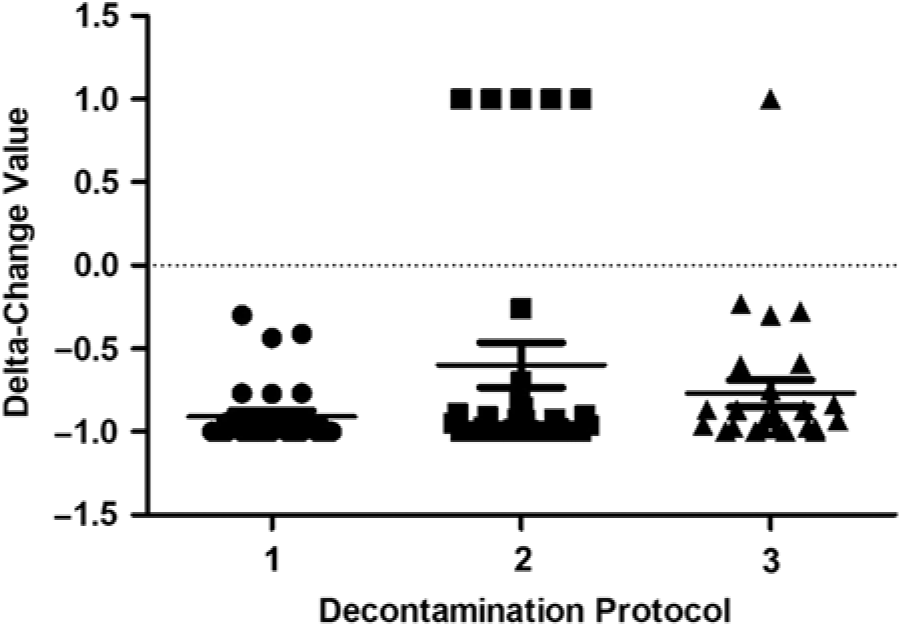
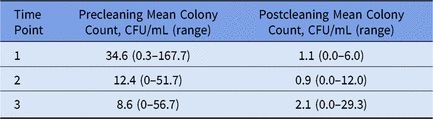
Significant differences in Δ values (%) for protocols occurred across all time points (P = .03). However, a post hoc analysis could not detect where this difference lay with pairwise comparisons. Reductions in contamination of 91.98% (95% CI, 83.4–100), 92.79% (95% CI, 85.54–100), and 67.9 % (95% CI, 36.48–99.33) were achieved for protocols 1, 2, and 3, respectively (Fig. 1). Three stethoscopes were censored due to absence of contamination pre- and postcleaning, all treated with protocol 3 at time points 2 or 3. Average colony counts in CFU/mL pre- and postcleaning for each time point are summarized in Table 1.
Overall comparison of Δ-change values (%) of bacterial concentration across the three treatments.

Precleaning and Postcleaning Colony Counts (CFU/mL) at Time Points 1, 2, and 3

Note. CFU, colony-forming units.
Due to higher baseline contamination, time point 1 was further analyzed and a significant difference in outcome for UVGI versus other protocols was detected (P = .0004). Reductions in contamination of 99.37% (95% CI, 98.5–100), 95.32 (95% CI, 92.5–98.1), and 47.82 (95% CI, 54.6–90.18) were achieved for protocols 1, 2, and 3, respectively, in this evaluation.
In 6 instances, the postcleaning colony count was higher than that of the precleaning count: 1 for protocol 3 at time point 1 and 5 for protocol 2 at time point 3.
Environmental surveillance
The 5 organisms most frequently identified included a range of pathogens and opportunistic pathogens: Bacillus spp, Coagulase negative Staphylococcus spp, Escherichia coli, Enterococcusspp, and S. aureus. Other isolates included Aeromonas spp, S. pseudointermedius, Acinetobacter spp, Pseudomonas oryzihabitans, Agrobacterium radiobacter, P. fluorescens, and Klebsiella oxytoca. No MDR organisms were identified.
A mean of 2.5 different bacteria per stethoscope were present precleaning (n = 30 stethoscopes; range, 1–4). Cleaning reduced organism diversity with a mean of 0.9 different bacteria per stethoscope postcleaning (n = 30 stethoscopes; P ≤ .0001). When only stethoscopes positive for bacterial growth postcleaning were analyzed (n = 20), a mean of 1.35 different bacteria were present per stethoscope (range, 1–3), which remained significant (P ≤ .0001).
Recontamination within 24 hours of cleaning
At time point 1, following a period of 24 hours and prior to recirculation, 2 of 30 stethoscopes remained culture negative, both of which were cleaned using protocol 2. Based upon bacterial identification, recontamination within 24 hours of cleaning was with a similar spectrum of bacterial types as were present precleaning.
Within 24 hours of cleaning, all stethoscopes returned positive cultures at time point 2, and at time point 3, only 4 stethoscopes returned a negative culture. Of those 4, 1 was cleaned using protocol 1, 2 were cleaned using protocol 2, and 1 was cleaned using protocol 3.
Discussion
Stethoscopes are regularly in patient contact and are demonstrable fomites for pathogen transmission, including MDR bacteria.Reference O’Flaherty and Fenelon 3 – Reference Kukanich, Ghosh, Skarbek, Lothamer and Zurek 5 , Reference Jeyakumari, Nagajothi, Praveen-Kumar, Ilayaperumal and Vigneshwaran 12 Similar to previous studies, we found that surveyed veterinarians had poor to nonexistent stethoscope hygiene and generally performed cleaning only following identified contagious risks, or due to visible contamination.
Unsurprisingly, all surveyed stethoscopes were highly contaminated with a range of pathogens or opportunistic pathogens, including bacterial types previously associated with a range of HAIs. 13 Nevertheless, suspected HAIs were infrequently observed in this center (data not included), and there were no direct causal links between stethoscopes and HAIs in any case.
We evaluated 2 topically applied protocols and a novel UVGI approach and found no overall differences. However, compared to topical treatments, UVGI did not perform as well at time point 1 when higher contamination rates were documented. Because UVGI requires a direct line of sight for effectiveness, differences are likely explained by an inability of UVGI to access crevices that might harbor bacteria.Reference Jelden, Gibbs and Smith 14 Topical disinfection, and/or the physical action of rubbing with these techniques might also cut through and remove debris or sebum otherwise serving as a protective barrier.
Interestingly, 5 of 10 stethoscopes cleaned with protocol 2 during time point 3 had higher counts following decontamination. Explanations for this include labelling errors; failure to adequately sample baseline; and direct cross contamination postcleaning. Because separate sterile swabs were used for sampling and to dry each stethoscope after recommended dwell times, the latter is unlikely. Incorrect dilution, subsequent ineffectiveness, and solution contamination are also unlikely given that 5 stethoscopes demonstrated reductions in colony counts ranging from 85% to 100% with this same solution. However, contamination could have occurred midway through the experiment. A further explanation could be the presence of resistance mechanisms to quaternary ammonia and/or biguanide disinfectants. Acquisition of QAC resistance genes has been described, and the mechanisms for documented resistance toward biguanide disinfectants, such as chlorhexidine as in the product used, are less well understood.Reference Wand and C 8 Cross contamination with resistant bacteria remains possible; however, neither colony identification nor other testing was performed to evaluate this further.
Although UVGI performed less well at a single time point, it remained effective overall, as demonstrated elsewhere, and it should not be discounted as a method.Reference Jelden, Gibbs and Smith 14 , Reference Rock, Small and Thom 15 Another group has reported a prototype of a wearable UVGI pocket device demonstrating effective reductions in stethoscope contamination (94.8%).Reference Messina, Spataro and Rosadini 9 Other novel approaches include incorporation of copper alloys into surface components.Reference Schmidt, Tuuri and Arif Dharsee 16 Combinations of these novel approaches with topical agents might overcome shortcomings of any individual techniques.
In our study, bacteria rapidly returned following cleaning, without clinical reuse. Given similar spectrums of bacteria, protocols might have inhibited but not killed organisms. Alternatively, survival could have occurred in protected niches such as crevices or defects associated with the diaphragm surface or rim, or with organic debris.
Our findings reflect those of other studies and reinforce a need to improve stethoscope hygiene practices. Proactive initiatives are likely to be most successful in reducing HAI rates and, consequently, morbidity and mortality.Reference Kingston, O’Connell and Dunne 17 Educational and clinical monitoring policies improve compliance with hand hygiene.Reference Kingston, O’Connell and Dunne 17 The literature supports links between hand and stethoscope contamination rates, and similar approaches that encourage simultaneously decontamination might be more successful, as demonstrated elsewhere.Reference Longtin, Schneider and Tschopp 18 , Reference Schroeder, Schroeder and D’Amico 19 Within the organization assessed, the authors have advocated for these approaches, including cleaning prior to use, rather than following use. This proposal reflects available data and recommended hand hygiene practices.
Importantly, our study relied upon culture-based methods, which may underestimate colony counts for difficult to culture bacteria. Presumably, these bacteria find survival on hospital surfaces equally difficult, and thereby pose less transmission risk. Furthermore, we surveyed only for bacterial contamination, and we did not evaluate the samples for viral or other infectious organisms.
In conclusion, this study reflects others finding poor stethoscope hygiene practices in a veterinary referral center and contamination with a range of pathogenic and opportunistic pathogenic bacteria. All cleaning protocols reduced bacterial loads although UVGI was less effective at significantly higher contamination levels at 1 time point. The effectiveness of the cleaning intervention was short in duration, highlighting the importance of regular cleaning.
Acknowledgments
We wish to thank the veterinarians and veterinary nurses at the Animal Health Trust who participated in and aided this study. We also extend thanks to Dr Asher Allison who assisted our statistical analysis.
Financial support
This research did not receive any specific grant from funding agencies in the public, commercial, or not-for-profit sectors.
Conflicts of interest
The authors have no conflicts of interest to declare.